SUBSCRIBE TO OUR FREE NEWSLETTER
Daily news & progressive opinion—funded by the people, not the corporations—delivered straight to your inbox.
5
#000000
#FFFFFF
To donate by check, phone, or other method, see our More Ways to Give page.
Daily news & progressive opinion—funded by the people, not the corporations—delivered straight to your inbox.
"These companies want Americans to believe price spikes are simply the unavoidable result of global events, but their own executives are openly telling investors that volatility, conflict, and supply disruptions are good for business."
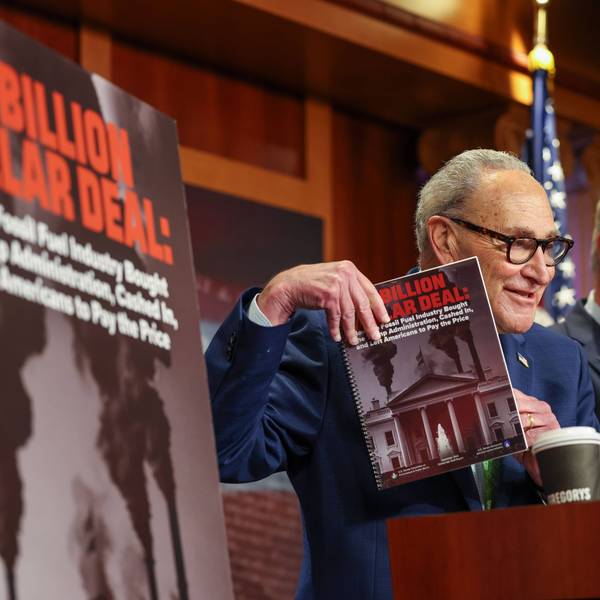
A Tuesday report from Groundwork Collaborative reveals how fossil fuel companies are not merely scoring windfall profits from President Donald Trump's illegal war with Iran, but also using that money to reward shareholders rather than providing relief to consumers.
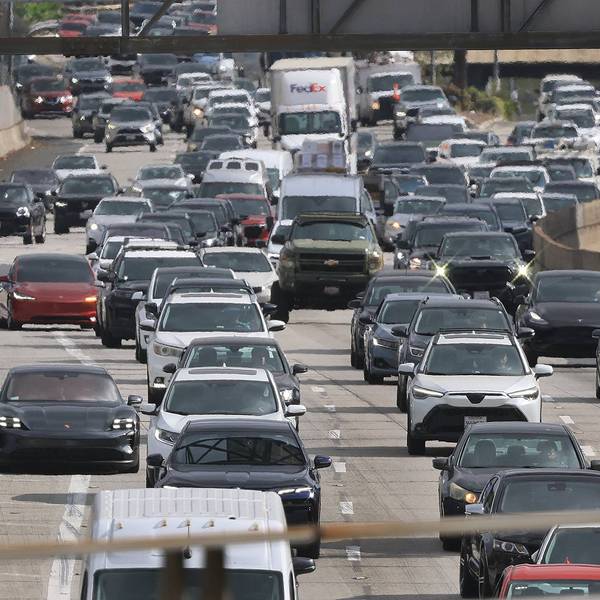
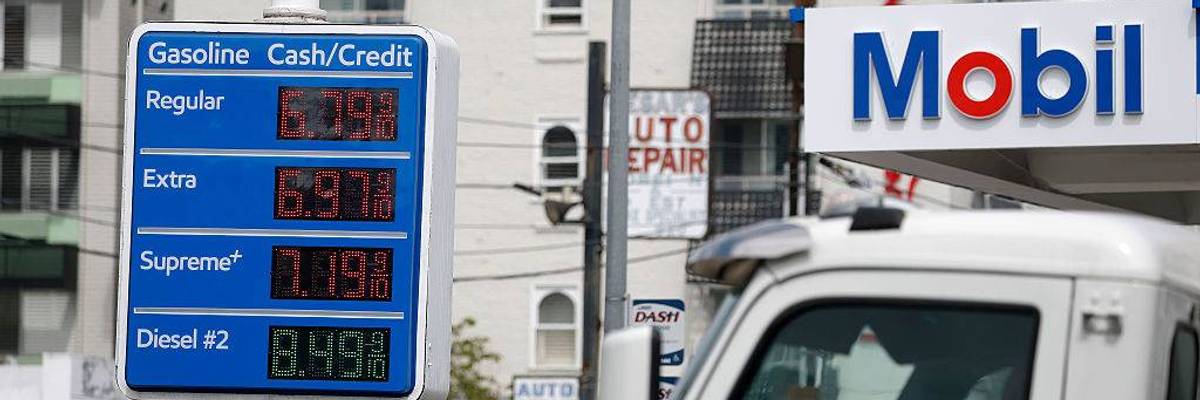
The price of gas has soared since Trump attacked Iran without any congressional authorization in late February, going from an average of under $3 per gallon at the start of the war to $4.49 per gallon as of Tuesday.
As US drivers have paid more at the pump, however, fossil fuel firms have been concerned with paying out dividends and conducting stock buybacks expanding production to lower prices, Groundwork Collaborative's report finds.
Among other things, the report notes that ExxonMobil is on pace to deliver $20 billion worth of stock buybacks in 2026, even as CEO Darren Woods has insisted that the company's decisions on production will be "grounded in value, not volume."
Additionally, the report documents how Shell recently announced "another 5% dividend increase and more than $3 billion in buybacks," with CEO Wael Sawan describing the company's commitment to paying shareholders as "sacrosanct."
Chevron has pledged roughly $3 billion in quarterly stock buybacks, while also saying increasing dividends for shareholders is its "first and foremost" priority.
Chevron CFO Eimear Bonner, the report adds, recently revealed that the company has no plans to boost output in response to high energy prices, stating that "capital spending and production outlooks are consistent with previous guidance."
Lindsay Owens, executive director of Groundwork Collaborative, accused Big Oil of using Trump's illegal war as cover to keep prices high without taking any steps to reduce pain at the pump.
"These companies want Americans to believe price spikes are simply the unavoidable result of global events," said Owens, "but their own executives are openly telling investors that volatility, conflict, and supply disruptions are good for business. They are choosing buybacks over production, shareholder payouts over affordability, and corporate profiteering over the economic security of working families.”
The high fuel prices aren't being felt just in the US, but across the world.
Karthik Sankaran, senior research fellow at the Quincy Institute for Responsible Statecraft, explained in a Tuesday analysis how oil prices are hitting nations in the Global South particularly hard.
"A recent story in The New York Times described how the price for transporting corn into refugee camps in Somalia had doubled or even tripled, as had the price of water at diesel-powered public tubewells," Sankaran wrote. "Meanwhile, protests this week in Kenya against fuel price hikes have led to four deaths, and political and financial stresses are mounting across the continent."
Sankaran also pointed to problems in India, where "sharp jumps in the price of liquid petroleum gas have hit urban households hard, particularly those whose breadwinners work in small-scale industrial establishments."
Despite the actue global economic pain, energy experts who spoke with CNN on Tuesday expressed skepticism that the crisis would abate anytime soon, despite Trump's regular hyping of a deal to end the conflict.
Rory Johnston, an oil market researcher and founder of Commodity Context, told CNN that he wasn't buying optimism from commodities futures markets after Trump claimed to have made significant progress on an agreement with Iran.
"Nothing has fundamentally changed," Johnston said. "The strait remains closed."
Sultan Al Jaber, the CEO of Abu Dhabi National Oil Company, said that a deal to end the war wouldn't instantly bring energy prices back to where they were before the war began, estimating it could take months just to get 80% of the pre-war oil supply flowing through the Strait of Hormuz.
Dear Common Dreams reader, It’s been nearly 30 years since I co-founded Common Dreams with my late wife, Lina Newhouser. We had the radical notion that journalism should serve the public good, not corporate profits. It was clear to us from the outset what it would take to build such a project. No paid advertisements. No corporate sponsors. No millionaire publisher telling us what to think or do. Many people said we wouldn't last a year, but we proved those doubters wrong. Together with a tremendous team of journalists and dedicated staff, we built an independent media outlet free from the constraints of profits and corporate control. Our mission has always been simple: To inform. To inspire. To ignite change for the common good. Building Common Dreams was not easy. Our survival was never guaranteed. When you take on the most powerful forces—Wall Street greed, fossil fuel industry destruction, Big Tech lobbyists, and uber-rich oligarchs who have spent billions upon billions rigging the economy and democracy in their favor—the only bulwark you have is supporters who believe in your work. But here’s the urgent message from me today. It's never been this bad out there. And it's never been this hard to keep us going. At the very moment Common Dreams is most needed, the threats we face are intensifying. We need your support now more than ever. We don't accept corporate advertising and never will. We don't have a paywall because we don't think people should be blocked from critical news based on their ability to pay. Everything we do is funded by the donations of readers like you. When everyone does the little they can afford, we are strong. But if that support retreats or dries up, so do we. Will you donate now to make sure Common Dreams not only survives but thrives? —Craig Brown, Co-founder |
A Tuesday report from Groundwork Collaborative reveals how fossil fuel companies are not merely scoring windfall profits from President Donald Trump's illegal war with Iran, but also using that money to reward shareholders rather than providing relief to consumers.
The price of gas has soared since Trump attacked Iran without any congressional authorization in late February, going from an average of under $3 per gallon at the start of the war to $4.49 per gallon as of Tuesday.
As US drivers have paid more at the pump, however, fossil fuel firms have been concerned with paying out dividends and conducting stock buybacks expanding production to lower prices, Groundwork Collaborative's report finds.
Among other things, the report notes that ExxonMobil is on pace to deliver $20 billion worth of stock buybacks in 2026, even as CEO Darren Woods has insisted that the company's decisions on production will be "grounded in value, not volume."
Additionally, the report documents how Shell recently announced "another 5% dividend increase and more than $3 billion in buybacks," with CEO Wael Sawan describing the company's commitment to paying shareholders as "sacrosanct."
Chevron has pledged roughly $3 billion in quarterly stock buybacks, while also saying increasing dividends for shareholders is its "first and foremost" priority.
Chevron CFO Eimear Bonner, the report adds, recently revealed that the company has no plans to boost output in response to high energy prices, stating that "capital spending and production outlooks are consistent with previous guidance."
Lindsay Owens, executive director of Groundwork Collaborative, accused Big Oil of using Trump's illegal war as cover to keep prices high without taking any steps to reduce pain at the pump.
"These companies want Americans to believe price spikes are simply the unavoidable result of global events," said Owens, "but their own executives are openly telling investors that volatility, conflict, and supply disruptions are good for business. They are choosing buybacks over production, shareholder payouts over affordability, and corporate profiteering over the economic security of working families.”
The high fuel prices aren't being felt just in the US, but across the world.
Karthik Sankaran, senior research fellow at the Quincy Institute for Responsible Statecraft, explained in a Tuesday analysis how oil prices are hitting nations in the Global South particularly hard.
"A recent story in The New York Times described how the price for transporting corn into refugee camps in Somalia had doubled or even tripled, as had the price of water at diesel-powered public tubewells," Sankaran wrote. "Meanwhile, protests this week in Kenya against fuel price hikes have led to four deaths, and political and financial stresses are mounting across the continent."
Sankaran also pointed to problems in India, where "sharp jumps in the price of liquid petroleum gas have hit urban households hard, particularly those whose breadwinners work in small-scale industrial establishments."
Despite the actue global economic pain, energy experts who spoke with CNN on Tuesday expressed skepticism that the crisis would abate anytime soon, despite Trump's regular hyping of a deal to end the conflict.
Rory Johnston, an oil market researcher and founder of Commodity Context, told CNN that he wasn't buying optimism from commodities futures markets after Trump claimed to have made significant progress on an agreement with Iran.
"Nothing has fundamentally changed," Johnston said. "The strait remains closed."
Sultan Al Jaber, the CEO of Abu Dhabi National Oil Company, said that a deal to end the war wouldn't instantly bring energy prices back to where they were before the war began, estimating it could take months just to get 80% of the pre-war oil supply flowing through the Strait of Hormuz.
A Tuesday report from Groundwork Collaborative reveals how fossil fuel companies are not merely scoring windfall profits from President Donald Trump's illegal war with Iran, but also using that money to reward shareholders rather than providing relief to consumers.
The price of gas has soared since Trump attacked Iran without any congressional authorization in late February, going from an average of under $3 per gallon at the start of the war to $4.49 per gallon as of Tuesday.
As US drivers have paid more at the pump, however, fossil fuel firms have been concerned with paying out dividends and conducting stock buybacks expanding production to lower prices, Groundwork Collaborative's report finds.
Among other things, the report notes that ExxonMobil is on pace to deliver $20 billion worth of stock buybacks in 2026, even as CEO Darren Woods has insisted that the company's decisions on production will be "grounded in value, not volume."
Additionally, the report documents how Shell recently announced "another 5% dividend increase and more than $3 billion in buybacks," with CEO Wael Sawan describing the company's commitment to paying shareholders as "sacrosanct."
Chevron has pledged roughly $3 billion in quarterly stock buybacks, while also saying increasing dividends for shareholders is its "first and foremost" priority.
Chevron CFO Eimear Bonner, the report adds, recently revealed that the company has no plans to boost output in response to high energy prices, stating that "capital spending and production outlooks are consistent with previous guidance."
Lindsay Owens, executive director of Groundwork Collaborative, accused Big Oil of using Trump's illegal war as cover to keep prices high without taking any steps to reduce pain at the pump.
"These companies want Americans to believe price spikes are simply the unavoidable result of global events," said Owens, "but their own executives are openly telling investors that volatility, conflict, and supply disruptions are good for business. They are choosing buybacks over production, shareholder payouts over affordability, and corporate profiteering over the economic security of working families.”
The high fuel prices aren't being felt just in the US, but across the world.
Karthik Sankaran, senior research fellow at the Quincy Institute for Responsible Statecraft, explained in a Tuesday analysis how oil prices are hitting nations in the Global South particularly hard.
"A recent story in The New York Times described how the price for transporting corn into refugee camps in Somalia had doubled or even tripled, as had the price of water at diesel-powered public tubewells," Sankaran wrote. "Meanwhile, protests this week in Kenya against fuel price hikes have led to four deaths, and political and financial stresses are mounting across the continent."
Sankaran also pointed to problems in India, where "sharp jumps in the price of liquid petroleum gas have hit urban households hard, particularly those whose breadwinners work in small-scale industrial establishments."
Despite the actue global economic pain, energy experts who spoke with CNN on Tuesday expressed skepticism that the crisis would abate anytime soon, despite Trump's regular hyping of a deal to end the conflict.
Rory Johnston, an oil market researcher and founder of Commodity Context, told CNN that he wasn't buying optimism from commodities futures markets after Trump claimed to have made significant progress on an agreement with Iran.
"Nothing has fundamentally changed," Johnston said. "The strait remains closed."
Sultan Al Jaber, the CEO of Abu Dhabi National Oil Company, said that a deal to end the war wouldn't instantly bring energy prices back to where they were before the war began, estimating it could take months just to get 80% of the pre-war oil supply flowing through the Strait of Hormuz.