SUBSCRIBE TO OUR FREE NEWSLETTER
Daily news & progressive opinion—funded by the people, not the corporations—delivered straight to your inbox.
5
#000000
#FFFFFF
To donate by check, phone, or other method, see our More Ways to Give page.
Daily news & progressive opinion—funded by the people, not the corporations—delivered straight to your inbox.
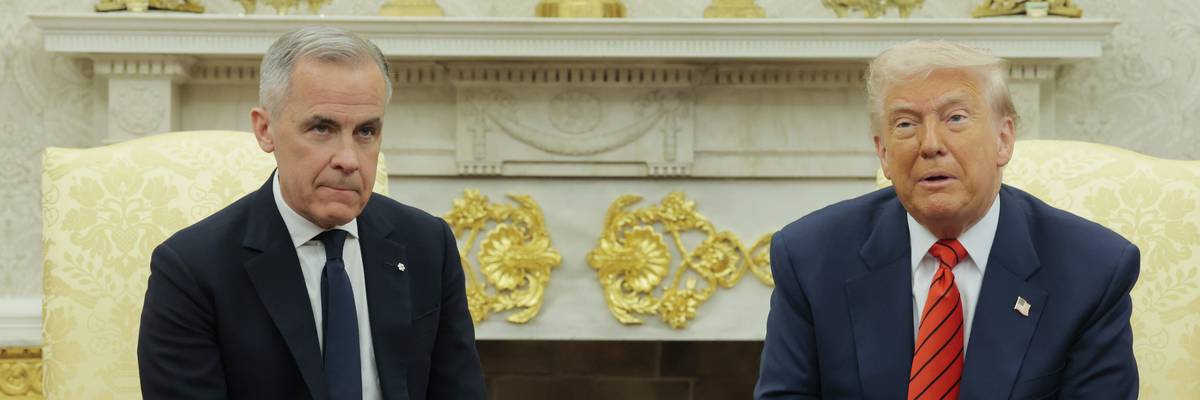
U.S. President Donald Trump speaks to reporters alongside Canadian Prime Minister Mark Carney in the Oval Office at the White House on May 6, 2025 in Washington, D.C.
"Canada is not for sale and is never going to be for sale," said Prime Minister Mark Carney.
In an Oval Office meeting on Tuesday, Canadian Prime Minister Mark Carney was diplomatic toward U.S. President Donald Trump, who has threatened to take over the United States' northern neighbor and whom Carney excoriated in his victory speech after being elected in March.
But at one point, Carney resorted to speaking to the cameras in the room to push back against the president's repeated claim that Canada could become "the 51st state."
After Carney reiterated that Canada "is not for sale," Trump told the press assembled in the room, "Never say never."
Carney responded by saying under his breath, "Never. Never. Never," to several of the reporters.
Carney later told reporters at the Canadian Embassy in Washington, D.C. that he views Trump's persistent talk about taking control of one of the United States' top allies and trade partners as "a wish," and said he has "been careful always to distinguish between wish and reality."
"We're very clear, I've been very clear publicly consistently," said Carney. "I've been clear in private. I was very clear again in the Oval Office, have been clear throughout."
"Canada is not for sale and is never going to be for sale," he added.
In his remarks in the Oval Office, the Canadian prime minister, who represents the center-left Labour Party, seemed to appeal to Trump's self-image as a successful businessman at one point, reminding him that "as you know, from real estate, there are some places that are never for sale."
He also complimented Trump, saying he has "revitalized" international security.
But in his remarks after the meeting, Carney said he had pushed Trump to stop referring to Canada as the "51st state," and regarding a trade deal, he said the president "understands that we're having a negotiation between sovereign nations and that we will only pursue and accept a deal that is in the best interest of Canada."
The Trump administration has imposed 25% tariffs on goods from Canada, with some imports exempt under a trade deal signed in 2020.
Carney reported that Trump was willing to discuss lowering the tariffs and said he planned to have further discussions with the president "in the coming weeks" about a new trade agreement.
Trump appeared to soften his stance on eliminating the border between the U.S. and Canada and taking over the country in the meeting, allowing that "it takes two to tango."
Trump spoke about what he believes would be "a massive tax cut for the Canadian citizens" as well as healthcare benefits, but suggested he won't continue pushing Canada to make a deal.
"We're not going to be discussing that unless somebody wants to discuss it," he said.
Dear Common Dreams reader, It’s been nearly 30 years since I co-founded Common Dreams with my late wife, Lina Newhouser. We had the radical notion that journalism should serve the public good, not corporate profits. It was clear to us from the outset what it would take to build such a project. No paid advertisements. No corporate sponsors. No millionaire publisher telling us what to think or do. Many people said we wouldn't last a year, but we proved those doubters wrong. Together with a tremendous team of journalists and dedicated staff, we built an independent media outlet free from the constraints of profits and corporate control. Our mission has always been simple: To inform. To inspire. To ignite change for the common good. Building Common Dreams was not easy. Our survival was never guaranteed. When you take on the most powerful forces—Wall Street greed, fossil fuel industry destruction, Big Tech lobbyists, and uber-rich oligarchs who have spent billions upon billions rigging the economy and democracy in their favor—the only bulwark you have is supporters who believe in your work. But here’s the urgent message from me today. It's never been this bad out there. And it's never been this hard to keep us going. At the very moment Common Dreams is most needed, the threats we face are intensifying. We need your support now more than ever. We don't accept corporate advertising and never will. We don't have a paywall because we don't think people should be blocked from critical news based on their ability to pay. Everything we do is funded by the donations of readers like you. When everyone does the little they can afford, we are strong. But if that support retreats or dries up, so do we. Will you donate now to make sure Common Dreams not only survives but thrives? —Craig Brown, Co-founder |
In an Oval Office meeting on Tuesday, Canadian Prime Minister Mark Carney was diplomatic toward U.S. President Donald Trump, who has threatened to take over the United States' northern neighbor and whom Carney excoriated in his victory speech after being elected in March.
But at one point, Carney resorted to speaking to the cameras in the room to push back against the president's repeated claim that Canada could become "the 51st state."
After Carney reiterated that Canada "is not for sale," Trump told the press assembled in the room, "Never say never."
Carney responded by saying under his breath, "Never. Never. Never," to several of the reporters.
Carney later told reporters at the Canadian Embassy in Washington, D.C. that he views Trump's persistent talk about taking control of one of the United States' top allies and trade partners as "a wish," and said he has "been careful always to distinguish between wish and reality."
"We're very clear, I've been very clear publicly consistently," said Carney. "I've been clear in private. I was very clear again in the Oval Office, have been clear throughout."
"Canada is not for sale and is never going to be for sale," he added.
In his remarks in the Oval Office, the Canadian prime minister, who represents the center-left Labour Party, seemed to appeal to Trump's self-image as a successful businessman at one point, reminding him that "as you know, from real estate, there are some places that are never for sale."
He also complimented Trump, saying he has "revitalized" international security.
But in his remarks after the meeting, Carney said he had pushed Trump to stop referring to Canada as the "51st state," and regarding a trade deal, he said the president "understands that we're having a negotiation between sovereign nations and that we will only pursue and accept a deal that is in the best interest of Canada."
The Trump administration has imposed 25% tariffs on goods from Canada, with some imports exempt under a trade deal signed in 2020.
Carney reported that Trump was willing to discuss lowering the tariffs and said he planned to have further discussions with the president "in the coming weeks" about a new trade agreement.
Trump appeared to soften his stance on eliminating the border between the U.S. and Canada and taking over the country in the meeting, allowing that "it takes two to tango."
Trump spoke about what he believes would be "a massive tax cut for the Canadian citizens" as well as healthcare benefits, but suggested he won't continue pushing Canada to make a deal.
"We're not going to be discussing that unless somebody wants to discuss it," he said.
In an Oval Office meeting on Tuesday, Canadian Prime Minister Mark Carney was diplomatic toward U.S. President Donald Trump, who has threatened to take over the United States' northern neighbor and whom Carney excoriated in his victory speech after being elected in March.
But at one point, Carney resorted to speaking to the cameras in the room to push back against the president's repeated claim that Canada could become "the 51st state."
After Carney reiterated that Canada "is not for sale," Trump told the press assembled in the room, "Never say never."
Carney responded by saying under his breath, "Never. Never. Never," to several of the reporters.
Carney later told reporters at the Canadian Embassy in Washington, D.C. that he views Trump's persistent talk about taking control of one of the United States' top allies and trade partners as "a wish," and said he has "been careful always to distinguish between wish and reality."
"We're very clear, I've been very clear publicly consistently," said Carney. "I've been clear in private. I was very clear again in the Oval Office, have been clear throughout."
"Canada is not for sale and is never going to be for sale," he added.
In his remarks in the Oval Office, the Canadian prime minister, who represents the center-left Labour Party, seemed to appeal to Trump's self-image as a successful businessman at one point, reminding him that "as you know, from real estate, there are some places that are never for sale."
He also complimented Trump, saying he has "revitalized" international security.
But in his remarks after the meeting, Carney said he had pushed Trump to stop referring to Canada as the "51st state," and regarding a trade deal, he said the president "understands that we're having a negotiation between sovereign nations and that we will only pursue and accept a deal that is in the best interest of Canada."
The Trump administration has imposed 25% tariffs on goods from Canada, with some imports exempt under a trade deal signed in 2020.
Carney reported that Trump was willing to discuss lowering the tariffs and said he planned to have further discussions with the president "in the coming weeks" about a new trade agreement.
Trump appeared to soften his stance on eliminating the border between the U.S. and Canada and taking over the country in the meeting, allowing that "it takes two to tango."
Trump spoke about what he believes would be "a massive tax cut for the Canadian citizens" as well as healthcare benefits, but suggested he won't continue pushing Canada to make a deal.
"We're not going to be discussing that unless somebody wants to discuss it," he said.