

SUBSCRIBE TO OUR FREE NEWSLETTER
Daily news & progressive opinion—funded by the people, not the corporations—delivered straight to your inbox.
5
#000000
#FFFFFF
To donate by check, phone, or other method, see our More Ways to Give page.
Daily news & progressive opinion—funded by the people, not the corporations—delivered straight to your inbox.
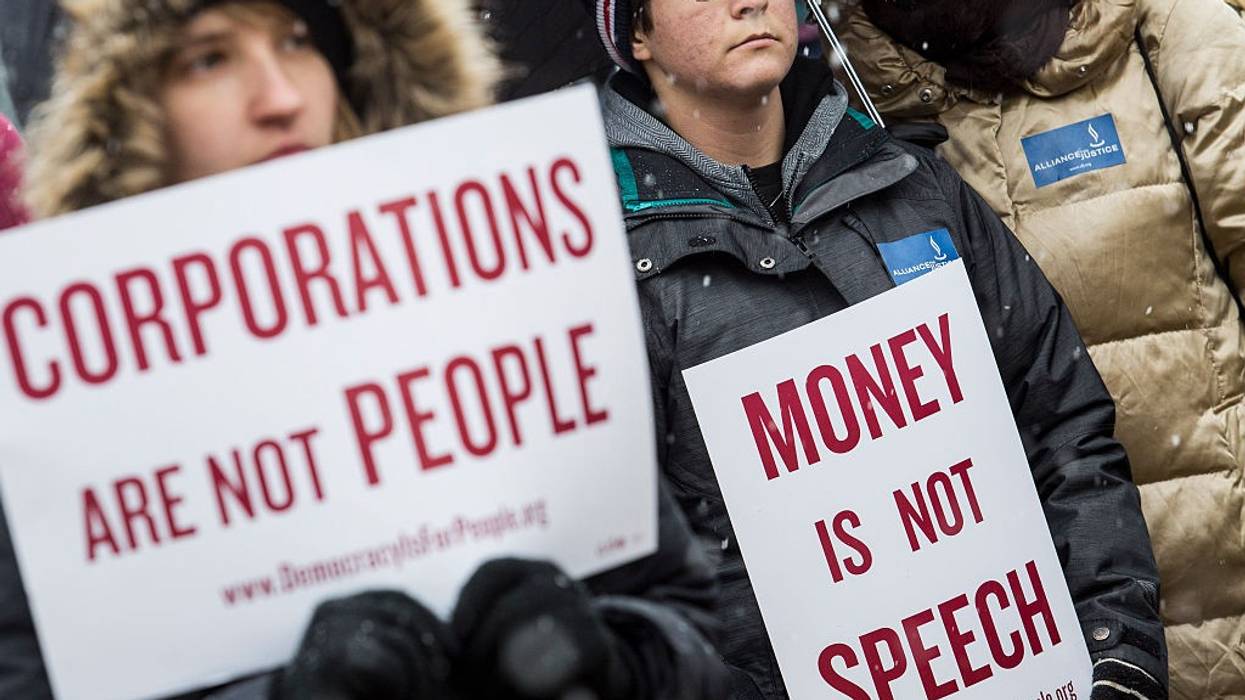
Initiative 194 "is not going to stop Elon Musk from writing a big fat check," explained one backer, but it would prevent "laundering the money through a dark money group."
Montanans are voting Tuesday on a potentially groundbreaking ballot initiative that could become a model for how to overturn Citizens United v. Federal Election Commission—the 2010 US Supreme Court decision that ushered in the era of unlimited money in politics—without the near-impossible necessity of a constitutional amendment.
Citizens United established that the government cannot restrict independent political expenditures by corporations, labor unions, and other outside groups on the basis of their corporate or union identity. Simply put, the decision affirmed corporate personhood and, essentially, that money is speech that cannot be restricted.
Since then, super political action committees have proliferated, and corporate spending has exploded from just $12.8 million during the 2010 election cycle to $737 million during the current one.
Initiative 194, also known as the Montana Plan, would prohibit corporations, nonprofits, trade associations, and other artificial entities from spending money to influence elections and ballot measures in the state. Rather than attempting to restrict corporations' constitutional rights as affirmed by Citizens United, states could simply not give corporations the legal power to spend on politics.
"A yes vote on I-194 means that only real people—not corporations, unions, trade associations, nonprofits, or groups with anonymous donors—are allowed to spend money in Montana elections," the Yes on Initiative 194 campaign said on its website.
"It's time to kick the oligarchs out of Big Sky country," the campaign added.
The proposal's backers argue that legal entities should not have the same rights as natural persons.
"Each state creates and defines its corporations. It need not permit its creations to consume it," Tom Moore, a senior fellow at the Center for American Progress (CAP), explained in September, arguing that corporations are legal creations, not natural persons, and that states retain broad authority to determine what powers they exercise.
"When the state creates a corporation, it is starting from nothing and deciding what to give the corporation, and no case has ever held that they have to give local spending power to a corporation," Moore told Fortune on Tuesday. "It's not regulation; it's redefinition."
Moore stressed that Initiative 194 "is not going to stop Elon Musk from writing a big fat check to some election in Montana."
"What it will stop them from doing is laundering the money through a dark money group," he added.
Montana's former commissioner of Political Practices, Jeff Mangan—who spearheaded Initiative 194—was equally blunt.
"The Montana Plan simply removes the ability for corporations to spend in our politics," he told Montana PBS. "By removing the corporation's ability to spend in our politics, we end dark money. Simple as that."
Initiative 194 has attracted support from Montanans concerned about the growing influence of wealthy donors and anonymous political spending.
"Most people I talk to when they hear about the prospect of getting dark money out of elections are in favor of it," state resident Nathan Kommers told Montana PBS. "I think that it makes sense to almost everybody."
Shannon Stober, who lives in the Bozeman area, said: "I think what I've observed over the past 15 years is the ways in which money and politics has completely created a decline in civic engagement and participation. A lot of people have just decided that their participation doesn't matter and they don't feel like there's a way out."
Opponents, including the Montana Chamber of Commerce, argue that Initiative 194 violates the First Amendment by restricting organizations' political speech. If passed, the measure will surely face legal challenges.
However, former Republican Montana Gov. Marc Racicot, who supports Initiative 194, said the effort is worthwhile regardless of the ultimate outcome.
"You can't just sit back and curse the darkness," he told Montana PBS. "You have to try and do something about it."

"I'm more in danger of going through a racist event, a dangerous event, than I was like five years back, especially in school and public places," said one young Michigander.
Lawmakers and political operatives from both sides of the aisle, with varying degrees of subtlety, have spent the 2026 midterms campaign insisting that Michigan US Senate candidate Abdul El-Sayed, a progressive Democrat, has endangered or threatened Jewish Americans with his campaign.
But young Arab Americans in Michigan this week said the pervasive anti-Arab and anti-Muslim comments of President Donald Trump along with innuendo by some Democrats have made them feel unsafe in their own communities.
"Seeing us so misunderstood, it's really disheartening," a student named Mina Abdel-Khalek told Sam Robinson of The Michigan Chronicle on Monday. "Because I honestly don't know anyone who's as evil as we're painted out to be."
Aasiya Yaasiin added that "it's like going back in time."
"I'm more in danger of going through a racist event, a dangerous event, than I was like five years back, especially in school and public places," said Yaasiin.
El-Sayed supporters Aasiya Yaasiin, Mina Abdel-Khalek and Faduma Hassan say Islamophobic rhetoric in TV ads is making them feel less safe at school and in public. “It’s like going back in time. I’m more in danger of a racist event now than five years ago,” Yaasiin says. https://t.co/aQzqoU5bNH
— Sam Robinson (@samueljrob) November 2, 2026
The corporate Democrat-aligned think tank Third Way kicked off months of attacks on El-Sayed long before the August primary that focused on his decision to campaign with streamer Hasan Piker, who has said the October 2023 Hamas-led attack on Israel was a “direct consequence” of US and Israeli actions. His association with Piker, the group suggested, was an act of antisemitism. Rep. Haley Stevens (D-Mich.) and a number of Democratic operatives have amplified the claim.
Sen. Ted Cruz (R-Texas) said point-blank recently that El-Sayed would put Americans' lives at risk should be win the Senate seat and serve on the Senate Intelligence Committee, while the candidate has been asked repeatedly about his views on Israel's "right to exist" by journalists who have said nothing about his comments on fighting antisemitism.
Meanwhile, a number of political observers have noticed that the corporate media has said far less about rampant Islamophobia and how the safety of Arab Americans and Muslims in the US has been impacted by the persistent attacks on El-Sayed.
Stevens has accused El-Sayed of being "disrespectful to women," and focused intently this week, as she struggled to explain why she had decided to endorse Republican former Rep. Mike Rogers in the race, on El-Sayed allegedly becoming "angrier and angrier"—suggesting the Muslim former public health official is an "angry antisemite," as Matt Sledge wrote at The Intercept.
The former chair of the Michigan Democratic Party also asserted that El-Sayed, an outspoken critic of US funding for the Israeli military, is an "extremist" and urged Democrats to vote for neither the Democrat nor the Republican.
Meanwhile, President Donald Trump and Cruz have openly called El-Sayed a "jihadist," the president has mocked his Arabic name, and Rogers has claimed he has ties to the Muslim Brotherhood—a movement based in Egypt which Rogers himself has previously said he would be open to working with—and Health and Human Services Secretary Robert F. Kennedy baselessly mused at an event for the Republican candidate that hundreds of millions of Arabs across the world had contributed nothing to science and literature.
A speaker at a Rogers rally also claimed that the Michigan-born candidate, whose family immigrated from Egypt, is "not an American."
While interview questions, rally speeches, and articles have fixated on whether El-Sayed has endangered or could endanger Jewish communities, whom he has engaged with through a "deep canvassing" campaign in the final weeks of the race, observers have noted that Rogers and Trump have not been asked whether their comments on the candidate may endanger Arab Americans and Muslims.
"Mike Rogers has run a bigoted, openly Islamophobic campaign that endangers millions of our fellow Americans," said Dylan Williams of the Center for International Policy. "That some pro-Israel groups have assisted him by spreading lies about Abdul El-Saued should be a source of shame and cause for reflection among many who should know better."

"It’s unconscionable to force workers to choose between the care they need and keeping their job," said one reproductive health advocate, "which is why the Trump administration is waiting until after the election to roll this out."
In addition to renewing its war on abortion rights, the Trump administration is planning to roll back workplace protections for women dealing with a range of reproductive health conditions after Tuesday's midterm elections.
The New York Times reported on Monday, citing several people familiar with the plans, that the US Equal Employment Opportunity Commission (EEOC) was prepared to rewrite regulations issued under the 2022 Pregnant Workers Fairness Act (PWFA).
Signed by then-President Joe Biden, the bipartisan law was meant to fill in gaps in civil rights legislation that left pregnant women and others with reproductive health concerns at risk of being denied basic accommodations like bathroom and water breaks, exemptions from heavy lifting on the job, and time off for prenatal appointments.
The law requires employers to make reasonable accommodations for workers with limitations due to “pregnancy, childbirth, or related medical conditions,” language that has existed in antidiscrimination law for nearly half a century.
In 2024, the Biden administration enacted a rule interpreting the law to cover a wide range of conditions and procedures related to women’s reproductive health—including fertility treatments, abortion, and menstruation.
President Donald Trump’s EEOC, led by Andrea Lucas, a conservative employment lawyer, is reportedly leading the effort to narrow the scope of the rule.
In her dissent from the final rule, Lucas argued that it “errs in conflating pregnancy and childbirth accommodation with accommodation of the female sex, that is, female biology and reproduction.”
Republicans have objected to the rule’s requirement to accommodate workers seeking abortions. A federal judge in Louisiana struck down the rule’s requirement to accommodate elective abortions last year, though protections for other reproductive health conditions remained in place.
But Lucas’ argument went far beyond abortion. She said the law should exclude infertility and in vitro fertilization (IVF), menstruation and menopause, hormonal conditions, lactation-related conditions, contraception and its side effects, and other reproductive health issues she considered unrelated to pregnancy or immediate postpartum recovery.
According to the Times, Lucas is expected to shorten the list of “related medical conditions” covered by the rule and expand religious exemptions, which could allow employers to refuse accommodations they deem incompatible with their beliefs.
In May, 15 Democratic senators, including Elizabeth Warren (D-Mass.), Tammy Duckworth (D-Ill.), and Chuck Schumer (D-NY), sent a letter urging Lucas to abandon plans to scrap accommodations for workers undergoing IVF. They noted that Trump had dubbed himself “the fertilization president” and pledged to increase access to fertility treatments.
The senators, including Duckworth, who conceived her two daughters through IVF, described it as an intensive process with “serious impacts on women’s lives.” Treatment can involve daily injections, regular blood draws and ultrasounds, and egg retrieval and embryo transfer procedures that cannot easily be rescheduled. Side effects can include nausea, vomiting, and fatigue.
"The current regulation explicitly protects the right of workers undergoing IVF to request reasonable accommodations like short breaks to take medication, a schedule that accommodates daily monitoring appointments and medical procedures, or even access to a chair," the lawmakers said. "Removing them from this rule does not change the fact that these workers are owed these protections, but it does make it more likely that employers will illegally deny women undergoing IVF their rights under PWFA."
The EEOC is reportedly holding off on the changes until after the election. The US Department of Justice is also waiting until then to step up efforts to restrict access to abortion pills, potentially even in states where abortion is legal, according to reporting last month.
On Tuesday, Mini Timmaraju, president and CEO of Reproductive Freedom for All, said, “It’s unconscionable to force workers to choose between the care they need and keeping their job, which is why the Trump administration is waiting until after the election to roll this out.”
"Today’s elections," she added, "are a crucial opportunity to establish checks on a corrupt administration that continues to leave pregnant workers and working families behind.”

"This highlights the danger of allowing an unregulated monopolist to control an essential service," said former Federal Trade Commission Chair Lina Khan.
Tech giant Alphabet, the parent company of Google, is telling US schools that there's a price to be paid for restricting student access to its artificial intelligence tools.
The New York Times reported on Tuesday that, starting early next year, schools that fully disable the company's AI will also lose access to its search engine, which is by far the most used internet search tool in the world.
Chris Phillips, vice president for education at Google, justified the policy by claiming that "Search and AI are deeply integrated," adding that students attending schools where AI is banned "will not have access to Search, and they’ll see a message from their school that indicates it’s not available."
As the Times noted, Google has deeply integrated itself into US classrooms, many of which rely on its Classroom assignment platform and equip students with low-cost Chromebook laptops.
"The company’s new strategy underscores Google’s powerful role in American education," the Times explained. "If school leaders want continued student access to Search within the company’s ecosystem, they will be forced to embrace Google's AI."
Schools around the US have been banning the use of AI for young students over concerns that reliance on the technology will hinder the development of critical thinking skills and also enable mass cheating on assignments.
Morgan Polikoff, an education professor at the University of Southern California, told the Times that he expects Google's new policy linking AI and Search will only add more fuel to the backlash against the tech industry.
"This is a particularly clear example of the tech industry going out of its way to force AI on us all," said Polikoff, "even if we have said we don’t want it."
Lina Khan, former chair of the Federal Trade Commission under President Joe Biden, accused Google of "using its search monopoly to coerce schools into adopting AI," and said it was yet another reason why antitrust action should be taken against the company.
"This highlights the danger of allowing an unregulated monopolist to control an essential service," Khan wrote in a social media post. "Multiple courts have found Google liable for violating antitrust laws, and this latest move shows it remains unchastened. As the public increasingly pushes back against the use of AI in schools, Google is making clear it will punish those who don’t fall in line."
New York City Mayor Zohran Mamdani, whose city earlier this year banned AI in elementary and middle schools, similarly took Google to task for trying to force its products onto students.
"No corporation should have the power to dictate how we teach our children," Mamdani wrote. "Our public schools exist to serve students, not to grow the profit margins of Big Tech."
Sen. Bernie Sanders (I-Vt.) used news of Google's new AI school policy to take a shot at President Donald Trump, who has constantly downplayed the need for any regulation of the industry.
"President Trump claimed that AI oligarchs could regulate themselves because they 'love our country,'" Sanders wrote. "Now, Google is threatening schools: If you stop your students from using AI, we will cut off your access to Google Search. That’s not love. That’s extortion."
Cognitive scientist Gary Marcus, a longtime skeptic of the AI industry, responded to Google's move by writing, "This is evil."
Author Kashana Cauley remarked that Google's motto used to be "don't be evil," whereas today its motto appears to be, "We are now holding your kids and their schools hostage."
Cauley added that schools wouldn't be in this position if they hadn't taken up Google's offer to supply low-cost Chromebooks for students.
"The schools shouldn’t be beholden to district-wide Chromebook deals if Google is holding us hostage," she wrote. "We need to get Chromebooks and Google out of the schools."

"The federal government should not be outsourcing its vision on ‘the future of warfare’ to a panel dominated by individuals that stand to profit from it."
A coalition of government watchdog organizations sued the US Department of Defense on Monday over a recently announced initiative known as Project Meridian, a Pentagon advisory committee headed by SpaceX CEO Elon Musk and Anduril Industries cofounder Palmer Luckey—billionaires whose companies benefit extensively from federal contracts.
The lawsuit, filed in the US District Court for the District of Columbia, alleges that Project Meridian violates the Federal Advisory Committee Act (FACA), which "requires that any federal advisory committee that includes non-governmental members be created by a charter, have a defined structure and purpose, make its records and meetings open to the public, and be fairly balanced in its membership."
In his memorandum ordering the creation of Project Meridian, Pentagon Secretary Pete Hegseth set a deadline of January 28, 2027 for the panel to deliver recommendations to the US Defense Department on how to "map the trajectory of future warfare" and help the country "maintain global dominance."
Project Meridian has held at least two meetings at the Pentagon, which has not disclosed the specific contents of the gatherings or released a list of attendees. Former Republican House Speaker Newt Gingrich is helping Musk and Luckey spearhead the advisory panel, coordinated by the MITRE Corporation—whose board previously included the GOP's nominee for US Senate in Michigan, Mike Rogers.
"Despite its ongoing operations and imminent final report," the new lawsuit reads, "defendants have failed to comply with FACA’s procedural and substantive requirements for new federal advisory committees, including FACA transparency requirements that disallow Project Meridian’s closed-door operations."
"Compounding the problem, Project Meridian’s private-sector membership raises precisely the type of conflict-of-interest concerns that FACA was designed to address," the lawsuit continues. "Announced members include Elon Musk and Palmer Luckey, both leaders and stakeholders of major defense contractors with substantial financial interests in the outcome of Project Meridian’s recommendations. Other members likewise have direct financial stakes in Project Meridian’s findings or are dedicated to aggressive military action."
The lawsuit was filed by Citizens for Responsibility and Ethics in Washington (CREW), Public Citizen, and the Project on Government Oversight. The groups urged the federal court to "hold unlawful, vacate, and set aside Secretary Hegseth’s September 30 memorandum establishing Project Meridian," "enjoin defendants from allowing Project Meridian to continue its work until defendants bring it into compliance with FACA," and bar the Pentagon from "accepting or acting upon any recommendations by Project Meridian while it is acting outside the law."
Donald Sherman, CREW's president, said in a statement on Monday that the Pentagon is "legally barred from getting advice in secret, by defense contractors with enormous potential conflicts of interest."
"But that’s exactly what Project Meridian is doing—soliciting private counsel from contractors about military capacity including the president’s largest political benefactor,” said Sherman. "The Federal Advisory Committee Act sets clear requirements about transparency and avoiding conflicts of interest, and Project Meridian must either comply or stop operating.”
Musk's SpaceX has secured more than $8 billion in Pentagon contracts in 2026 alone.
Anduril Industries, Luckey's firm, is known for building autonomous drones. The company won a $2 billion US Navy contract last month, days after Hegseth announced Project Meridian.
“Project Meridian would outsource design of grand military strategy to two extremist Pentagon contractors, Elon Musk and Palmer Luckey,” Robert Weissman, co-president of Public Citizen, said Monday. “Very predictably, they will recommend more spending, much more spending, on more AI-enabled weaponry. That would simultaneously make the world more dangerous and starve funding for domestic and human needs."
"The law demands balance on advisory committees, precisely to prevent connected insiders like Musk and Luckey from writing policy at the expense of the public," Weissman added.

"This is where Section 219 of the NDAA comes in," said one observer. "They’re going to transfer all of the aid behind closed doors and cut it from the appropriations process."
President Donald Trump on Tuesday claimed the United States would end its annual military assistance to Israel by the end of the year, a dubious announcement made on Election Day as Republicans face mounting backlash over their support for the Israeli government's genocidal assault on Gaza.
In a phone interview with Fox News' Brian Kilmeade, Trump said he had reached a deal with Israeli Prime Minister Benjamin Netanyahu months ago to end the roughly $4 billion in annual assistance Washington provides Israel under a 2016 agreement with the Obama administration.
"They’re fine with it because they’ve become a very successful country," Trump said of Israel. "They don’t need it. And we won’t be paying anymore."
The president also admitted to political motivations, complaining about criticism from Democrats like Michigan US Senate candidate Abdul El-Sayed.
"Why should we suffer the slings from lunatics like an El-Sayed when they don't need it?" Trump asked, calling American aid a "bad talking point."
But it's not just Democrats. An increasingly vocal faction of Trump's own MAGA movement has been arguing that spending billions of taxpayer dollars on arming Israel is fundamentally incompatible with the president's stated "America First" agenda.
A March Pew Research Center survey found that 57% of Republicans under 50 viewed Israel unfavorably as prominent right-wing figures like commentator Tucker Carlson, reporter Megyn Kelly, and former Congresswoman Marjorie Taylor Greene (R-Ga.) amplify anti-Israel views amid an ongoing genocide in which more than 250,000 Palestinians have been killed and wounded.
The timing of Trump's announcement raised eyebrows, coming on the morning of the midterm elections. Commentators opined that the announcement appeared aimed at undercutting criticism from progressive Democrats and the president's own disaffected supporters.
Skepticism is also rooted in the fact that US military assistance to Israel technically cannot end by the end of the year.
First, the current US-Israel military assistance memorandum of understanding, signed under then-President Barack Obama in 2016, provides $38 billion over 10 years, including $33 billion in foreign military financing and $5 billion for missile defense. The MOU runs through September 2028, not December 2026.
Netanyahu faces an uncertain political future after indecisive parliamentary elections last month, and as The Times of Israel noted Tuesday, he has discussed phasing out American assistance, but over a decade—not abruptly ending it this year.
Second, Section 219 of the House-passed fiscal year 2027 National Defense Authorization Act would establish a United States-Israel Defense Technology Cooperation Initiative, coordinating joint research, development, testing, and industrial cooperation in areas including missile defense, drones, artificial intelligence, and cybersecurity. The highly contentious provision would significantly integrate the two countries' defense industries and institutionalize cooperation.
"The announcement that Trump is cutting off US aid to Israel is false hype to make US voters think Trump cut off the spigot," said AIPAC Tracker, which tallies how much money politicians have taken from the American Israel Public Affairs Committee. "The reality is Trump and Congress are trying to replace aid with [a] military tech merger."
Similarly, Section 622 of the separate fiscal year 2027 Intelligence Authorization Act would compel the president to "expand and enhance intelligence sharing" with Israel, explicitly stating that such sharing shall generally "not be suspended, reduced, or otherwise materially limited," with certain exceptions.
Perhaps most importantly, Trump's own comments suggest that the announcement would not end the flow of American weapons to Israel. When Kilmeade pressed him on whether he meant military hardware or financial assistance, Trump replied: "I'm giving in any way you want to define it. You can consider it barter. You can consider it military aid or cash."
Furthermore, nothing suggests that the US is abandoning its fundamental support for Israel, despite it being the only country that United Nations experts and others say is simultaneously committing genocide in Gaza as well as occupation, colonization, ethnic cleansing, and apartheid in the West Bank.
If you believe that Trump is really cutting off aid to Israel on Bibi's recommendation, I have a $5,000 Trump dividend to sell you as well as shares of Melania's memecoin
— Aaron Rupar (@atrupar.com) November 3, 2026 at 6:03 AM
Skepticism over Trump's claim abounded Tuesday, with the Washington, DC-based Council on American-Islamic Relations (CAIR) noting that US arms sales to Israel will not end.
"Let's be clear. Selling American weapons to a foreign government engaged in war crimes is just as immoral and illegal as giving those weapons away for free," CAIR asserted. "Because federal law prohibits providing weapons to foreign militaries engaged in human rights abuses, ending free military aid is not enough. Our nation must completely stop arming and otherwise enabling the Israeli government's unjust wars and crimes against humanity."
Defense analyst William Hartung said in a statement that Trump's announcement "may be less than meets the eye."
"While the timing is a slap in the face [to] Netanyahu, coming as he struggles to form a coalition that would keep him in power, it may not ultimately change the amount of US tax dollars flowing to Israel, because Congress is considering a measure that would open the way to joint US-Israeli arms development across a wide range of areas," said Hartung.
The IMEU Policy Project said in response to the announcement that “President Trump is a serial liar who has announced over $20 billion in weapons giveaways to Israel since taking office."
"He and other politicians realize our taxpayer funding for Israel is a liability," the IMEU Policy Project continued. "That's why he and his allies in Congress are at this very moment trying to advance legislation to conceal support for Israel by integrating Israeli weapons companies into the Pentagon."
"This is a bait and switch that would result in Americans funding Israeli weapons makers in record amounts," the group added.

"It offers every country a menu of policies to build its own plan to move away from coal, oil, and gas, whether it's a major producer, a big consumer, or an economy that depends on imports."
With the next United Nations Climate Change Conference less than a week away, greenhouse gas levels soaring, and a temporary overshoot of the Paris Agreement's 1.5°C goal now inevitable, Brazil, the host of last year's COP30, on Tuesday published a pair of roadmaps for transitioning away from planet-heating fossil fuels and tackling deforestation.
"We don't need more negotiations. What we need is for governments to start taking action," André Aranha Corrêa do Lago, the Brazilian diplomat who served as the president of COP30, told Reuters. "We need to completely change the way governments deal with climate change. To implement this, we need finance, infrastructure, and transportation ministers at the table."
In his foreword for the transition report, Corrêa do Lago explained that at the closing plenary in Belém last November, "and in the context of the COP being held in the Amazon, I committed to developing... roadmaps for implementing two outcomes of the First Global Stocktake, agreed by consensus at COP28 just two years earlier: (i) transitioning away from fossil fuels in energy systems in a just, orderly, and equitable manner; and (ii) enhancing efforts toward halting and reversing deforestation and forest degradation by 2030. With their publication, that commitment is fulfilled."
"Both transitions depend on finance," he stressed. "The two roadmaps are therefore presented alongside a third document, 'Implementing the Baku to Belém Roadmap to 1.3T,' which sets out how financing to developing countries for climate action can be scaled up from all public and private sources to at least US$1.3 trillion per year by 2035. Read together, the three documents describe what has to change and propose ways forward so that change can be financed and sustained."
After ending with what critics called "an empty deal," COP30 was condemned as a "catastrophic failure to take concrete action to implement a funded and fair fossil fuel phaseout," and there was some criticism of the new roadmaps for also not going far enough.
Greenpeace Brazil executive director Carolina Pasquali said in a statement that "this is a major effort by the COP30 presidency and a crucial step towards ensuring the COP28 decision to transition away from fossil fuels is fully implemented. As our climate races towards a 1.5°C overshoot, the roadmap encourages important measures but stops short of setting clear fossil fuel phaseout targets or calling for an immediate halt to the expansion of fossil fuels."
However, Pasquali praised the forests roadmap—launched in the aftermath of Brazilian President Luiz Inácio Lula da Silva's reelection victory over far-right candidate Flávio Bolsonaro—which she said "represents a major effort from the COP30 presidency and was launched with the credibility of a Brazilian government that has achieved the lowest deforestation rate in its history. The presidency has helped bring together, through multiple contributions and dialogues, a wide range of existing initiatives and views."
It remains slightly mad that governments have agreed to phase out fossil fuels from energy systems, but can't agree to even the principle that having a plan for doing so would be a good idea. www.businessgreen.com/news-analysi...
[image or embed]
— James Murray (@james-bg.bsky.social) November 3, 2026 at 11:34 AM
Despite some shortcomings, other climate campaigners welcomed the roadmaps—released as activists and world leaders alike prepare for COP31, which is scheduled to kick off Monday in Antalya, Türkiye.
"Brazil has offered a valuable blueprint for the global transition away from fossil fuels," said Oil Change International global policy lead Romain Ioualalen in a statement. "It recognizes there is no one-size-fits-all pathway, that all countries need to plan their transition now, and that equity and finance are critical to achieving fossil-free prosperity in many countries."
Like Corrêa do Lago, he emphasized that "now that we have a global roadmap, we need to see action. If all this process leads to is another series of dialogues, it will be a massive missed opportunity in an already closing window. Countries need to develop their own domestic roadmaps that plan their economic diversification away from fossil fuels using the guidance and tools provided by Brazil’s report."
"We also need to see the global Mutirão for the transition away from fossil fuels deliver key decisions that allow countries with strong economic and energy constraints to unlock their transition. The Second Global Stocktake in 2028 will be a critical opportunity to make that happen," Ioualalen continued.
"Delivering on this global roadmap for countries with deep financial constraints hinges on finance. But it does outline some finance tools that have a track record of failing, like debt swaps and derisking methods," he noted. "Enough public finance can be delivered to fund a fair fossil fuel phaseout as rich countries can unlock trillions every year through taxing polluters and extreme wealth, ending fossil fuel subsidies, and reforming unfair financial rules."
Ioualalen added that "one area of real concern is the suggestion that global action on reducing fossil fuel supply could wait until the 2030s. That would be a grave mistake, and a guarantee to further lock in fossil fuels and for a chaotic transition. Existing fossil fuel extraction projects already commit the world to emissions nearly seven times the remaining 1.5°C carbon budget. There is no time to pass the baton between supply and demand. Both need to be addressed now, through a fair, funded, and fast transition."
“The roadmaps are valuable but fall short of clearly indicating the pace of change needed by including no timeline or key benchmarks” ~Joeri Rogelj, professor of climate science and policy at Imperial College London.
[image or embed]
— Suzanne York (@suzanneyork.bsky.social) November 3, 2026 at 12:06 PM
Fanny Petitbon, a policy analyst at the international movement 350.org, similarly said that "this roadmap is a critical handbook for ending the fossil fuel era, which leaves governments with no excuse not to act. It offers every country a menu of policies to build its own plan to move away from coal, oil, and gas, whether it's a major producer, a big consumer, or an economy that depends on imports."
"Electrification is absolutely central to this transition, but it will only deliver if it is powered by renewable energy, matched by investment in modern grids, and brings clean, affordable energy to everyone," she highlighted. "We cannot swap one energy system for another while leaving the same communities behind."
Petitbon argued that "the roadmap must not end up as just another report gathering dust on a shelf. France, the Netherlands, and Germany have already published national roadmaps, but they fall short of the ambition the climate crisis demands and of their responsibility in it. Pacific Island states plan to deliver a regional strategy to break free from fossil fuels. So the question for all major emitters is simple: When will you submit your roadmap?"
"Rich nations must also mobilize public finance to support developing countries with their transition and ensure that the fossil fuel industry cannot continue to profit from a crisis that is costing people their livelihoods, health, and homes," she asserted. "COP31 must be the moment when governments take this work forward, with clear commitments, timelines, and the resources to deliver a fair and orderly exit from coal, oil, and gas."
"The COP30 presidency has set out clear next steps, and future COPs must keep this issue at the top of the agenda every year so the momentum is never lost," she added. "2028 will be the moment of truth. As the world will take stock of how far it has come in delivering the Paris Agreement, it will become clear who has honored the promise made in Dubai to transition away from fossil fuels, and who has walked away from it."

"I’ve sat down with Michiganders from all walks of life, all of whom are hurting... and are hungry for change."
Michigan Democratic US Senate hopeful Abdul El-Sayed made a final pitch to voters in an op-ed published by Fox News on Monday.
In his op-ed, El-Sayed discussed his campaign stops throughout rural parts of the state that typically support Republican candidates, while declaring that "no Michigander deserves to be left behind."
El-Sayed emphasized that he has been happy to engage many former supporters of President Donald Trump who have become disenchanted with the state of the economy during his second term.
"I’ve sat down with Michiganders from all walks of life, all of whom are hurting... and are hungry for change," he wrote. "We’re seeing historic momentum in unlikely places. Rural districts, from Escanaba to Port Huron to Cadillac, are showing up and showing out for our campaign. Hundreds of former Trump voters line up for hours to attend our town halls."
The Michigan Democrat then emphasized that he's been hearing the same message from voters across the state about the economy: "It shouldn't be this hard" to get ahead.
"Whether it’s that mom in Escanaba or a farmer in Ithaca or a teacher in Detroit," El-Sayed stressed, "working Americans are struggling to afford gas, groceries, and healthcare while billionaires and corporations grow richer and richer."
El-Sayed put the blame for Americans' struggles directly on Trump and politicians like Mike Rogers, his Republican opponent in the Senate race.
"Experts estimate that the average Michigan household is paying a whopping $5,600 due to Trump’s tariffs, in addition to spending about $20 more every time they fill up a tank as a result of Trump’s dangerous Iran war," he wrote. "The numbers speak for themselves. Working Michiganders are going through hell—and our president isn’t doing a thing to help. He’s just making it worse."
As for Rogers, El-Sayed described him as "just another cog in the political machine that delivers for special interests over the public" who is "running for office to enrich himself at the expense of Michiganders, just as he’s done before."
El-Sayed on Tuesday morning posted a video on social media highlighting his travels throughout Michigan during the campaign, with music from iconic Detroit rapper Eminem playing in the background.
Michigan. It's time. It's up to us to show the country what's possible.The world is watching.Polls are open 7AM-8PM.
[image or embed]
— Abdul El-Sayed (@abdulelsayed.bsky.social) November 3, 2026 at 7:05 AM
"It's time," El-Sayed wrote in a message accompanying the video. "It's up to us to show the country what's possible. The world is watching."

Solid majorities of voters across parties oppose data centers in their communities. In dozens of municipalities across the US, they have an opportunity to do something about it.
Artificial intelligence data centers have become one of the defining issues in the 2026 election cycle, with some candidates putting opposition to their unchecked growth at the heart of their campaigns.
Polls show that majorities across parties oppose building data centers in their communities, citing concerns about excessive energy and water use, pollution, and noise.
On all six local data center measures decided before Election Day—including in Maine, Michigan, and New Hampshire—voters favored limiting development, often by overwhelming margins.
Tuesday offers a bigger test of just how toxic data centers have become. Across 10 states, 44 local measures are on the ballot, according to a tracker by Redbud Consulting.
Many of the measures ask voters whether to ban or temporarily pause data center development, cap facilities’ power use, or require voter approval for new projects. Others give voters a chance to support development.
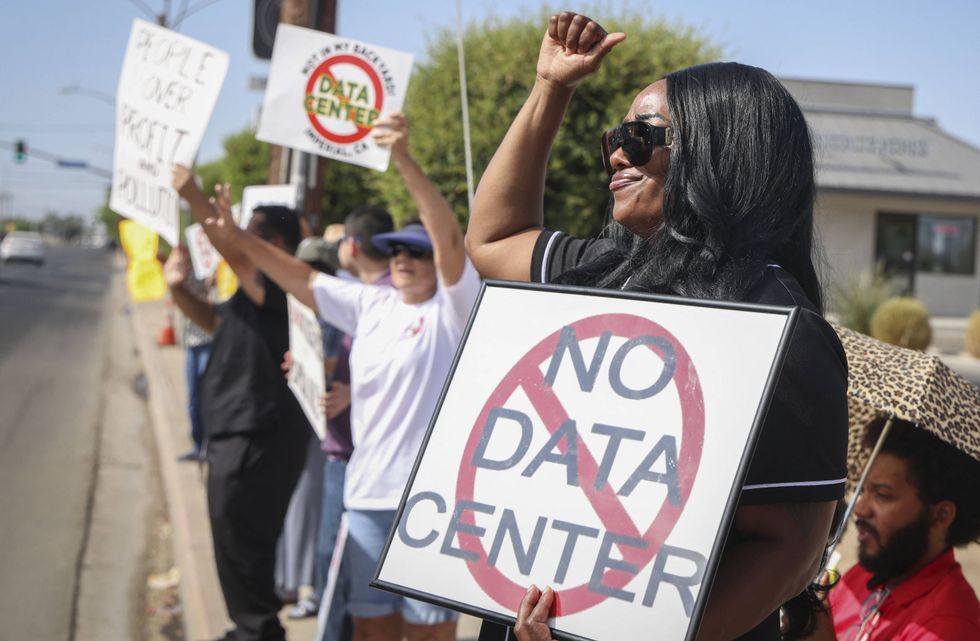 Demonstrators wave signs during a nationwide protest against AI data center expansion in Imperial, California, on July 18, 2026. (Photo by Sandy Huffaker/AFP via Getty Images)
Ohio
Nearly half the local measures on the ballot are in Ohio, ground zero for the data center boom, where Democratic former US Sen. Sherrod Brown has seized on voters’ outrage to paint his opponent, Republican Sen. John Husted, as “the face of data centers” over his role in attracting projects and securing tax breaks.
Zoning measures are on the ballot in Wilmington and in the townships of Sprigg and Monroe. Grove City’s measure would require voter approval for large developments. In Monroeville, a nonbinding question asks voters whether the village should allow data center development.
Eight municipalities—Conneaut, Defiance, Granville, Oregon, Pataskala, Sunbury, Trenton, and Upper Sandusky—will vote on proposals to restrict new data centers. The proposals generally target facilities that draw more than 25 megawatts. A stricter measure in Urbana would prohibit new data centers, with an exception for certain facilities below 7.5 megawatts. In Hubbard, a measure would ban new data centers citywide, regardless of size or power demand.
Maine
Democratic labor leader Troy Jackson, who is running to unseat Republican Sen. Susan Collins, has said data centers benefit tech oligarchs while foisting costs onto ordinary residents. He said data center developers should be required to pay for their own power, protect water quality, and keep electricity rates from rising. Collins has called for restrictions on a case-by-case basis and has been criticized for speaking favorably about certain projects around the state.
Eight towns in Maine have data center measures on the ballot Tuesday. Eliot, Freedom, Peru, and Wiscasset are considering temporary pauses on data center development regardless of size. Proposed moratoriums in Brownfield, Sabattus, and Wells would apply based on facility size or power demand. A measure in North Berwick would permanently ban facilities of 25,000 square feet or more.
In April, the Maine Legislature passed a bill that would have halted permitting for data centers with electric loads of 20 megawatts or more until November 2027. Democratic Gov. Janet Mills vetoed the bill. At least 21 municipalities have already enacted similar restrictions, according to The Maine Monitor.
Illinois
In Illinois, which has one of the nation’s highest concentrations of data centers, voters in five townships will be asked whether they support allowing new facilities—Chouteau, Granite City, Nameoki, Venice, and Joliet. All of the measures are nonbinding.
A separate advisory question asks Bloomington voters whether the city should impose a moratorium on new large-scale data centers. In Morgan County, residents can vote to call for countywide restrictions on data center construction and operation, though the measure leaves the details to county officials.
Kansas
Data centers have been a major source of strife in Kansas, where lawmakers from both parties voted last year for a 20-year sales tax exemption for data center construction and equipment to lure more hyperscale facilities to the state.
Though both candidates for governor voted for the bill, state Sen. Cindy Holscher (D-8) now supports a statewide pause on data center development, while state Sen. Ty Masterson (R-16) still defends the tax breaks. In the state’s unexpectedly competitive Senate race, Democrat Adam Hamilton has hammered Republican Sen. Roger Marshall for voting for last year’s Republican budget bill, which Hamilton says gave federal tax breaks to data centers.
Voters in Emporia and El Dorado will decide Tuesday whether to ban data centers with peak electrical loads above 10 megawatts or daily water use above 100,000 gallons. Ottawa is voting on a 10-year ban on large data centers with a 25-megawatt threshold.
Elsewhere
Six other communities have data center measures on the ballot.

"Susan Collins says she's 'Our Senator,'" said the former Maine state Senate president. "But there’s no one in my life who feels that way."
"Let's win this thing," said US Senate candidate Troy Jackson just before voters in Maine and across the country went to the polls on Tuesday, with Democrats vying to take control of Congress to rein in President Donald Trump.
The progressive former Maine state Senate president, who launched his campaign in July after former nominee Graham Platner dropped out of the race to unseat Republican Sen. Susan Collins, posted a video showing the packed campaign events where he has met voters from across the state and spoken out against Collins' support for Trump's mass deportation agenda, illegal war on Iran, and an economy that is "about taking pieces of our lives away from us."
"I am seeing something now that I've been waiting so damn long for," said Jackson at one event featured in the ad. "I've seen people who haven't been involved in politics before showing up now. We are the ones that built this country. We are the ones that's always put our blood, sweat, and tears on the line, and all those billionaires, we made them that money. Susan Collins needs to come out and hear that."
"Maine deserves a senator who works for Maine, not just those at the top," added Jackson in the video. "Because we're not from the left, we're not from the right, we're from the bottom, and we're rising!"
Tomorrow, Maine decides.I don't owe Washington, Donald Trump, or the billionaires a single thing. I owe the people of Maine everything.We’re not from the left. We’re not from the right. We’re from the bottom, and tomorrow, we’re rising.Polls are open tomorrow. Let's win this thing.
— Troy Jackson (@TroyJackson207) November 3, 2026
Countering Collins' perennial claims that she is a "moderate," independent-minded senator, Jackson has sought to tie New England's only remaining Republican member of the US Senate to Trump, whose approval rating is now in the low 30s as his war on Iran and tariff policies send gas and grocery prices soaring and as his mass deportation agenda continues to tear families and communities apart.
Last month he said Collins "paid for the bullets at Donald Trump’s command" when Colombian immigrant and Biddeford, Maine resident Johan Sebastián Durán Guerrero was shot to death by a US Immigration and Customs Enforcement (ICE) agent in July. He also took her to task during a debate over her vote for the One Big Beautiful Bill Act last year, which helped secure the largest Medicaid cuts in history, and over her attempt to mask the damage she did to Maine's healthcare system by touting a $50 billion rural hospital fund.
“Sen. Collins is like an arsonist who helped set the fire, and then she wants credit for bringing a cup of water to put it out,” said Jackson at the debate.
The fifth-generation logger, who has been endorsed by Sens. Bernie Sanders (I-Vt.) and Elizabeth Warren (D-Mass.) and Rep. Alexandria Ocasio-Cortez (D-NY), supports Medicare for All, a billionaire's tax, dismantling and abolishing ICE, overturning Citizens United to rein in unlimited election spending by corporations and special interest groups, passing a federal right to abortion, and ending US funding for Israel's military.
In recent weeks he has condemned Collins for voting to confirm two anti-abortion federal judges—something she has done dozens of times while claiming to support abortion rights—saying, "Enough is enough."
Jackson also accused her of "corruption of the highest order" after ProPublica reported on a "pay-to-play scheme" in which Collins sent millions of taxpayer dollars to a defense contractor whose CEO donated to her campaign.
"Susan Collins says she's 'Our Senator,'" said Jackson on Tuesday in reference to her campaign signs. "But there’s no one in my life who feels that way."
There's always money for bombs. There's always money for income tax cuts for the wealthiest Americans. But there's never any money for everyday people.Susan Collins says she's "Our Senator" — but there’s no one in my life who feels that way. It’s our time, Maine. Get to the polls to vote her out today.
— Troy Jackson (@TroyJackson207) November 3, 2026
The Maine race could be decisive in determining whether Republicans continue to control the Senate or Democrats have an opportunity to launch investigations into widespread allegations of Trump's corruption and connections to late convicted sex offender Jeffrey Epstein, block his nominees, and force the White House to negotiate over legislation.
A poll released by The New York Times/Siena College this week found Jackson six points ahead of Collins.
In his final get-out-the-vote push, Jackson reminded Mainers that polls are open until 8:00 pm and that they can register at their election sites on Election Day.
"There's always money for bombs. There's always money for income tax cuts for the wealthiest Americans. But there's never any money for everyday people," said Jackson, who also posted a photo of himself greeting Mainers at the polls. "It’s our time, Maine. Get to the polls to vote her out today."

"California, send these oligarchs a message: Democracy is not for sale," said US Sen. Bernie Sanders.
Foes of a California ballot initiative to establish a one-time 5% wealth tax on the state's billionaires have spent vastly more on advertising than proponents—and polls show that money may be having an impact.
A Monday report in The Washington Post estimated that opponents of California’s Proposition 40, led by Google co-founder Sergey Brin, have spent 250 times more than those in favor of the tax.
In total, the Post found, tax opponents have raised more than $379 million to fight the wealth tax, while proponents of the initiative have raised just $35 million.
The spending disparity in advertising is even greater, as tax opponents have spent $148 million on ads, while proponents have spent a mere $572,000.
Google co-founder Sergey Brin has been leading the charge against the measure, having donated more than $100 million to ensure its defeat.
Former Google CEO Eric Schmidt and Kleiner Perkins chairman John Doerr, meanwhile, have both chipped in $40 million each to help defeat the proposal.
The spending blitz comes as polling has shown a steady erosion of support for Proposition 40.
As noted by Gizmodo on Monday, two recent surveys—one from the Public Policy Institute of California and another from the University of California Berkeley Institute of Governmental Studies—show that opposition to the measure now outpaces support. For several months prior, polls showed a majority of California voters in favor of the wealth tax.
David McCuan, a political scientist at Sonoma State University, told the Post that opponents of the tax appear to have held their fire until late in the campaign, when most voters have traditionally started to really pay attention to ballot initiatives.
"The strategy has been to blanket the airwaves in weeks three and four," McCuan said, "and carpet-bomb the airwaves in the last two weeks."
McCuan also estimated that the battle over Proposition 40 "will be the most expensive ballot measure in the history of the world."
Sen. Bernie Sanders (I-Vt.) decried the billionaire campaign to defeat the tax in a Monday social media post.
"Oligarchs in California spent $379 million against Prop 40, a 5% billionaire wealth tax, outraising supporters 250-1," Sanders wrote. "They’d rather poor kids die than pay a little more in taxes. Obscene. California, send these oligarchs a message: Democracy is not for sale. Vote for Prop 40."
Economist Gabriel Zucman, a professor at the University of California, Berkeley, said in an interview with NPR published Monday that the wealth tax in California was part of a broader fight to take away power from the ultrarich, who have seen their wealth grow by leaps and bounds over the last several decades.
"If California says, 'We can tax billionaires. We can tax the wealthiest, most powerful people in the world,'" Zucman explained, "it will be the beginning of not only a broader US-wide movement, ultimately paving the way for a federal wealth tax—but I think it will be the beginning of an international movement."