Data Centers Are Spreading, But So Is Popular Resistance
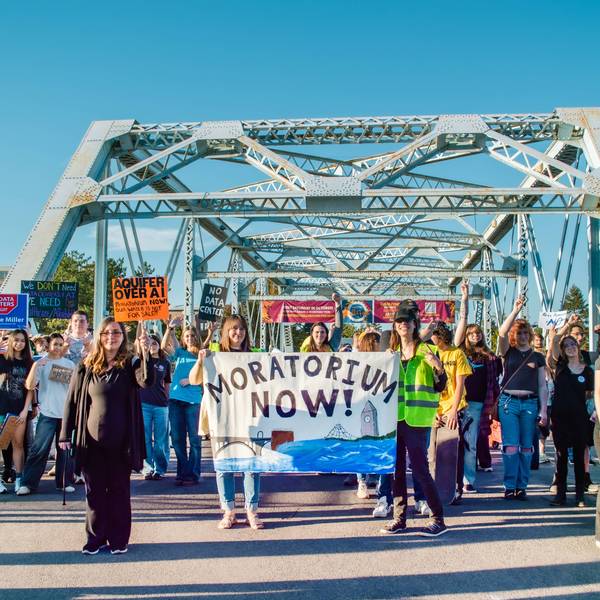
The real race appears to be for tech companies to build data centers in as many communities as possible before residents can stop them.
These days, it seems as though there are new data centers being proposed and built everywhere.
Tech companies have long relied on these gigantic server warehouses to process massive amounts of digital data. But a race to develop AI, championed by President Donald Trump, has fed a sharp surge in construction.
The problem is, no one really wants to live near one. Three-quarters of Americans surveyed in August say they oppose data centers. That’s up from 42% a year earlier.
Data centers use up lots of land—largely in rural America. They use inordinate amounts of water for cooling, eat up power and pollute our air, and generate heat in an already-warming climate. So anyone concerned with their most basic needs—land, water, air, electricity, and the climate—is justifiably concerned about data centers.
The good news, Meyer says, is “there has been tremendous grassroots pushback and opposition to data centers in all parts of the country.”
Data centers are also physical symbols of the way in which AI companies are gambling away our economic stability.
“They are pushing to move as quickly as possible, to throw as much money at this as possible, basically offering open bribes to governments at all levels—local, state, and federal—to get these things approved and built,” Thomas Meyer, deputy political director at Food & Water Watch, told me.
Even mainstream economists are warning about a massive “AI bubble,” which could take the entire system down with it when it bursts. (South Korea, where that bubble may already be bursting, offers a real warning to the United States.)
The good news, Meyer says, is “there has been tremendous grassroots pushback and opposition to data centers in all parts of the country.” Meyer’s organization is one of hundreds that have joined the newly formed Stop Data Centers Coalition, which unites local fights against data centers in urban and rural areas across the country. Many of these struggles have enjoyed varying degrees of success.
What’s really needed is a national moratorium on data centers, as outlined in a letter to Congress signed by the coalition’s partners.
Partisan gridlock in Congress, and President Trump’s full-throated support of AI companies, stands in the way of a national ban for now. But this spring, environmental organizations defeated a bill called the “Protect American AI Act” that would have carved out environmental loopholes for data centers.
Meanwhile, activists are pushing ahead at the state and local levels.
Residents in Maine pushed legislators to pass what would have been the first state-wide moratorium on data centers earlier this year (although Governor Janet Mills vetoed the bill).
The fight against data centers fared better in New York, where state lawmakers passed a similar moratorium. Gov. Kathy Hochul, who has championed AI technology, has yet to sign the bill. But in the meantime, she signed an executive order issuing a one-year pause to allow time to develop regulations. “We are still pushing her to sign that bill because it’s a bit stronger than the executive order,” said Meyer.
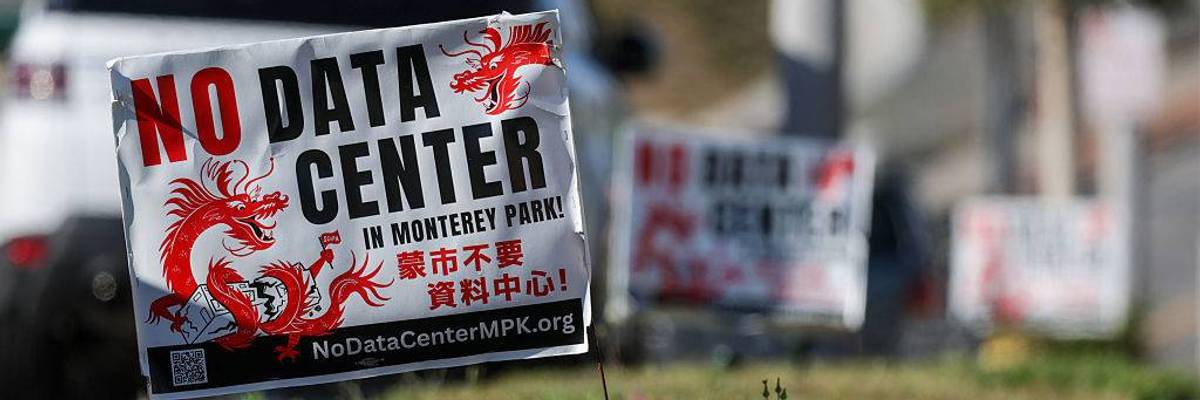
Meyer pointed out that more than a dozen states are considering similar moratoria, and bans have already taken effect in many local communities. “Several hundred places have enacted moratoriums of different kinds of shapes and sizes,” said Meyer—including Sarasota County in Florida, and the cities of Minneapolis and Spokane. Monterey Park, California, stands out for being the first in the nation to enact a permanent ban passed by voters.
Trump unashamedly centers industry talking points in his executive order, casting data center construction and AI technology as a “race” to be won. But the real race appears to be for tech companies to build data centers in as many communities as possible before residents can stop them.
And that’s exactly why we need a moratorium.
We are at a crossroads
This country and this world are at a monumental crossroads. In a few short weeks, US voters will have an opportunity to beat back the forces of fascism and confront the billionaires who are rigging the economy, our media system, and our democracy, making it increasingly impossible for ordinary people to get by. We’re not just talking about the election. We’re talking about what must be done once these fascist elements are vanquished from power. We need a bolder set of solutions than what either major party has so far been willing to offer and a working-class movement ready to fight like hell for it. Trump didn't emerge from nowhere. The conditions that fueled MAGA authoritarianism were created by decades of radical neoliberal economic policies and a corrupt political system dominated by corporate interests. They slashed taxes on the super-rich, promising that the benefits would trickle down. They said giveaways to the corporate titans would make life more affordable for the rest of us. It was all bullshit. And when a bitter, betrayed populace searches for someone to blame, right-wing demagogues have little trouble finding scapegoats. People know when they're being lied to, but you won't hear any of this from the corporate media. Only independent journalism—powered and funded by people who believe in building a better world—can deliver truly trustworthy daily news. Our Fall Campaign is underway, and we need your help. To power our newsroom through the rest of the year, we need to raise $125,000 by midnight on October 31. So if you share our vision, please contribute whatever you can to sustain our work. |
These days, it seems as though there are new data centers being proposed and built everywhere.
Tech companies have long relied on these gigantic server warehouses to process massive amounts of digital data. But a race to develop AI, championed by President Donald Trump, has fed a sharp surge in construction.
The problem is, no one really wants to live near one. Three-quarters of Americans surveyed in August say they oppose data centers. That’s up from 42% a year earlier.
Data centers use up lots of land—largely in rural America. They use inordinate amounts of water for cooling, eat up power and pollute our air, and generate heat in an already-warming climate. So anyone concerned with their most basic needs—land, water, air, electricity, and the climate—is justifiably concerned about data centers.
The good news, Meyer says, is “there has been tremendous grassroots pushback and opposition to data centers in all parts of the country.”
Data centers are also physical symbols of the way in which AI companies are gambling away our economic stability.
“They are pushing to move as quickly as possible, to throw as much money at this as possible, basically offering open bribes to governments at all levels—local, state, and federal—to get these things approved and built,” Thomas Meyer, deputy political director at Food & Water Watch, told me.
Even mainstream economists are warning about a massive “AI bubble,” which could take the entire system down with it when it bursts. (South Korea, where that bubble may already be bursting, offers a real warning to the United States.)
The good news, Meyer says, is “there has been tremendous grassroots pushback and opposition to data centers in all parts of the country.” Meyer’s organization is one of hundreds that have joined the newly formed Stop Data Centers Coalition, which unites local fights against data centers in urban and rural areas across the country. Many of these struggles have enjoyed varying degrees of success.
What’s really needed is a national moratorium on data centers, as outlined in a letter to Congress signed by the coalition’s partners.
Partisan gridlock in Congress, and President Trump’s full-throated support of AI companies, stands in the way of a national ban for now. But this spring, environmental organizations defeated a bill called the “Protect American AI Act” that would have carved out environmental loopholes for data centers.
Meanwhile, activists are pushing ahead at the state and local levels.
Residents in Maine pushed legislators to pass what would have been the first state-wide moratorium on data centers earlier this year (although Governor Janet Mills vetoed the bill).
The fight against data centers fared better in New York, where state lawmakers passed a similar moratorium. Gov. Kathy Hochul, who has championed AI technology, has yet to sign the bill. But in the meantime, she signed an executive order issuing a one-year pause to allow time to develop regulations. “We are still pushing her to sign that bill because it’s a bit stronger than the executive order,” said Meyer.
Meyer pointed out that more than a dozen states are considering similar moratoria, and bans have already taken effect in many local communities. “Several hundred places have enacted moratoriums of different kinds of shapes and sizes,” said Meyer—including Sarasota County in Florida, and the cities of Minneapolis and Spokane. Monterey Park, California, stands out for being the first in the nation to enact a permanent ban passed by voters.
Trump unashamedly centers industry talking points in his executive order, casting data center construction and AI technology as a “race” to be won. But the real race appears to be for tech companies to build data centers in as many communities as possible before residents can stop them.
And that’s exactly why we need a moratorium.
- 'I've Never Seen This': Massive Collapse in Support for AI Data Centers Captured in New Poll ›
- Nationwide Backlash Brewing Against Big Tech's Energy-Devouring AI Data Centers ›
- Big Tech Ramps Up Propaganda Blitz As AI Data Centers Become Toxic With Voters ›
- 'Have Your Friend Elon Build One at Mar-a-Lago,' Says Sanders After Trump Comments on Data Centers ›
- Virginia's Data Center Alley Reveals Big Tech's Vision for America ›
- Why the Anti-Data Center Movement Is Succeeding Where Others Have Struggled ›
These days, it seems as though there are new data centers being proposed and built everywhere.
Tech companies have long relied on these gigantic server warehouses to process massive amounts of digital data. But a race to develop AI, championed by President Donald Trump, has fed a sharp surge in construction.
The problem is, no one really wants to live near one. Three-quarters of Americans surveyed in August say they oppose data centers. That’s up from 42% a year earlier.
Data centers use up lots of land—largely in rural America. They use inordinate amounts of water for cooling, eat up power and pollute our air, and generate heat in an already-warming climate. So anyone concerned with their most basic needs—land, water, air, electricity, and the climate—is justifiably concerned about data centers.
The good news, Meyer says, is “there has been tremendous grassroots pushback and opposition to data centers in all parts of the country.”
Data centers are also physical symbols of the way in which AI companies are gambling away our economic stability.
“They are pushing to move as quickly as possible, to throw as much money at this as possible, basically offering open bribes to governments at all levels—local, state, and federal—to get these things approved and built,” Thomas Meyer, deputy political director at Food & Water Watch, told me.
Even mainstream economists are warning about a massive “AI bubble,” which could take the entire system down with it when it bursts. (South Korea, where that bubble may already be bursting, offers a real warning to the United States.)
The good news, Meyer says, is “there has been tremendous grassroots pushback and opposition to data centers in all parts of the country.” Meyer’s organization is one of hundreds that have joined the newly formed Stop Data Centers Coalition, which unites local fights against data centers in urban and rural areas across the country. Many of these struggles have enjoyed varying degrees of success.
What’s really needed is a national moratorium on data centers, as outlined in a letter to Congress signed by the coalition’s partners.
Partisan gridlock in Congress, and President Trump’s full-throated support of AI companies, stands in the way of a national ban for now. But this spring, environmental organizations defeated a bill called the “Protect American AI Act” that would have carved out environmental loopholes for data centers.
Meanwhile, activists are pushing ahead at the state and local levels.
Residents in Maine pushed legislators to pass what would have been the first state-wide moratorium on data centers earlier this year (although Governor Janet Mills vetoed the bill).
The fight against data centers fared better in New York, where state lawmakers passed a similar moratorium. Gov. Kathy Hochul, who has championed AI technology, has yet to sign the bill. But in the meantime, she signed an executive order issuing a one-year pause to allow time to develop regulations. “We are still pushing her to sign that bill because it’s a bit stronger than the executive order,” said Meyer.
Meyer pointed out that more than a dozen states are considering similar moratoria, and bans have already taken effect in many local communities. “Several hundred places have enacted moratoriums of different kinds of shapes and sizes,” said Meyer—including Sarasota County in Florida, and the cities of Minneapolis and Spokane. Monterey Park, California, stands out for being the first in the nation to enact a permanent ban passed by voters.
Trump unashamedly centers industry talking points in his executive order, casting data center construction and AI technology as a “race” to be won. But the real race appears to be for tech companies to build data centers in as many communities as possible before residents can stop them.
And that’s exactly why we need a moratorium.
- 'I've Never Seen This': Massive Collapse in Support for AI Data Centers Captured in New Poll ›
- Nationwide Backlash Brewing Against Big Tech's Energy-Devouring AI Data Centers ›
- Big Tech Ramps Up Propaganda Blitz As AI Data Centers Become Toxic With Voters ›
- 'Have Your Friend Elon Build One at Mar-a-Lago,' Says Sanders After Trump Comments on Data Centers ›
- Virginia's Data Center Alley Reveals Big Tech's Vision for America ›
- Why the Anti-Data Center Movement Is Succeeding Where Others Have Struggled ›