SUBSCRIBE TO OUR FREE NEWSLETTER
Daily news & progressive opinion—funded by the people, not the corporations—delivered straight to your inbox.
5
#000000
#FFFFFF
To donate by check, phone, or other method, see our More Ways to Give page.
Daily news & progressive opinion—funded by the people, not the corporations—delivered straight to your inbox.
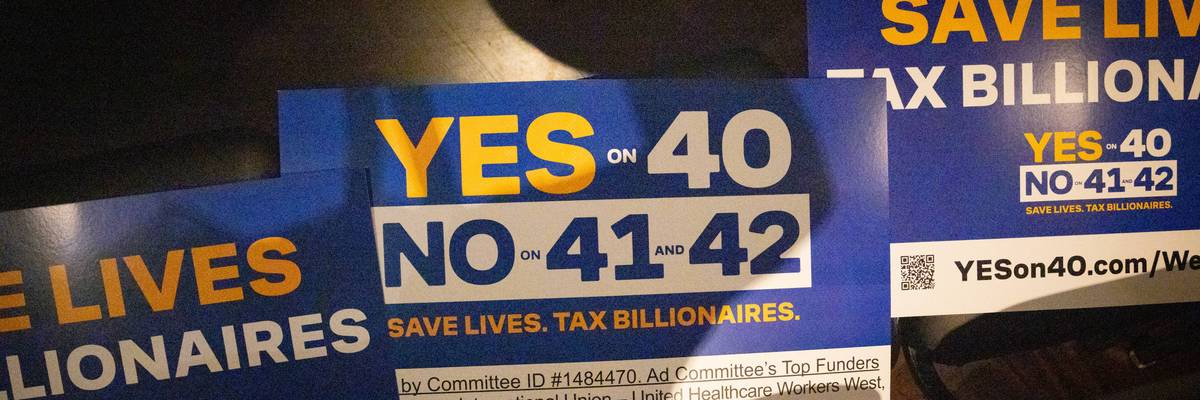
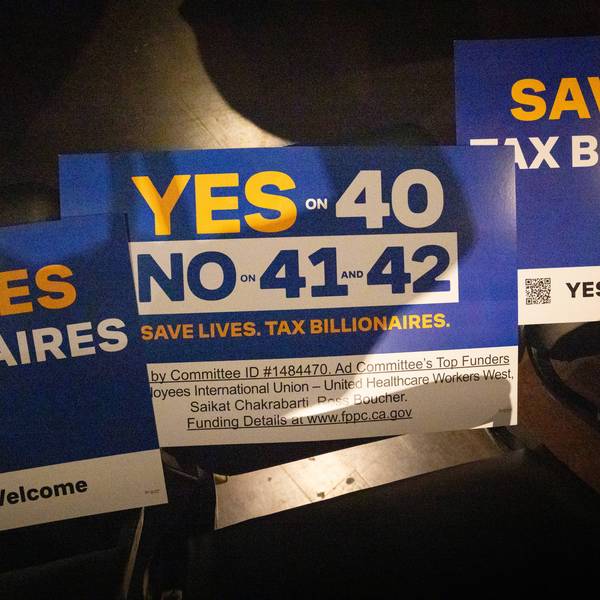
Signs sit on seats at the "Ballots Over Billionaires" rally on October 5, 2026 in Los Angeles, California.
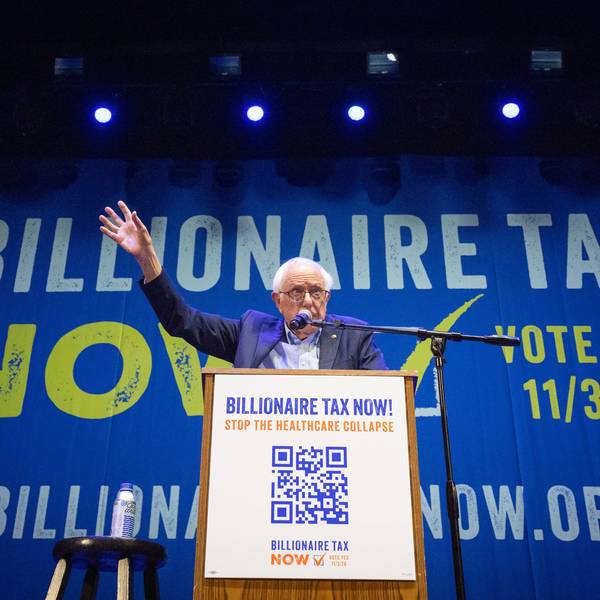
"California, send these oligarchs a message: Democracy is not for sale," said US Sen. Bernie Sanders.
Foes of a California ballot initiative to establish a one-time 5% wealth tax on the state's billionaires have spent vastly more on advertising than proponents—and polls show that money may be having an impact.
A Monday report in The Washington Post estimated that opponents of California’s Proposition 40, led by Google co-founder Sergey Brin, have spent 250 times more than those in favor of the tax.
In total, the Post found, tax opponents have raised more than $379 million to fight the wealth tax, while proponents of the initiative have raised just $35 million.
The spending disparity in advertising is even greater, as tax opponents have spent $148 million on ads, while proponents have spent a mere $572,000.
Google co-founder Sergey Brin has been leading the charge against the measure, having donated more than $100 million to ensure its defeat.
Former Google CEO Eric Schmidt and Kleiner Perkins chairman John Doerr, meanwhile, have both chipped in $40 million each to help defeat the proposal.
The spending blitz comes as polling has shown a steady erosion of support for Proposition 40.
As noted by Gizmodo on Monday, two recent surveys—one from the Public Policy Institute of California and another from the University of California Berkeley Institute of Governmental Studies—show that opposition to the measure now outpaces support. For several months prior, polls showed a majority of California voters in favor of the wealth tax.
David McCuan, a political scientist at Sonoma State University, told the Post that opponents of the tax appear to have held their fire until late in the campaign, when most voters have traditionally started to really pay attention to ballot initiatives.
"The strategy has been to blanket the airwaves in weeks three and four," McCuan said, "and carpet-bomb the airwaves in the last two weeks."
McCuan also estimated that the battle over Proposition 40 "will be the most expensive ballot measure in the history of the world."
Sen. Bernie Sanders (I-Vt.) decried the billionaire campaign to defeat the tax in a Monday social media post.
"Oligarchs in California spent $379 million against Prop 40, a 5% billionaire wealth tax, outraising supporters 250-1," Sanders wrote. "They’d rather poor kids die than pay a little more in taxes. Obscene. California, send these oligarchs a message: Democracy is not for sale. Vote for Prop 40."
Economist Gabriel Zucman, a professor at the University of California, Berkeley, said in an interview with NPR published Monday that the wealth tax in California was part of a broader fight to take away power from the ultrarich, who have seen their wealth grow by leaps and bounds over the last several decades.
"If California says, 'We can tax billionaires. We can tax the wealthiest, most powerful people in the world,'" Zucman explained, "it will be the beginning of not only a broader US-wide movement, ultimately paving the way for a federal wealth tax—but I think it will be the beginning of an international movement."
This country and this world are at a monumental crossroads. US voters have an opportunity to beat back the forces of fascism and confront the billionaires who are rigging the economy, our media system, and our democracy, making it increasingly impossible for ordinary people to get by. We’re not just talking about the election. We’re talking about what must be done once these fascist elements are vanquished from power. We need a bolder set of solutions than what either major party has so far been willing to offer and a working-class movement ready to fight like hell for it. Trump didn't emerge from nowhere. The conditions that fueled MAGA authoritarianism were created by decades of radical neoliberal economic policies and a corrupt political system dominated by corporate interests. They slashed taxes on the super-rich, promising that the benefits would trickle down. They said giveaways to the corporate titans would make life more affordable for the rest of us. It was all bullshit. And when a bitter, betrayed populace searches for someone to blame, right-wing demagogues have little trouble finding scapegoats. People know when they're being lied to, but you won't hear any of this from the corporate media. Only independent journalism—powered and funded by people who believe in building a better world—can deliver truly trustworthy daily news. If you share our vision, please contribute whatever you can to sustain our work. |
Foes of a California ballot initiative to establish a one-time 5% wealth tax on the state's billionaires have spent vastly more on advertising than proponents—and polls show that money may be having an impact.
A Monday report in The Washington Post estimated that opponents of California’s Proposition 40, led by Google co-founder Sergey Brin, have spent 250 times more than those in favor of the tax.
In total, the Post found, tax opponents have raised more than $379 million to fight the wealth tax, while proponents of the initiative have raised just $35 million.
The spending disparity in advertising is even greater, as tax opponents have spent $148 million on ads, while proponents have spent a mere $572,000.
Google co-founder Sergey Brin has been leading the charge against the measure, having donated more than $100 million to ensure its defeat.
Former Google CEO Eric Schmidt and Kleiner Perkins chairman John Doerr, meanwhile, have both chipped in $40 million each to help defeat the proposal.
The spending blitz comes as polling has shown a steady erosion of support for Proposition 40.
As noted by Gizmodo on Monday, two recent surveys—one from the Public Policy Institute of California and another from the University of California Berkeley Institute of Governmental Studies—show that opposition to the measure now outpaces support. For several months prior, polls showed a majority of California voters in favor of the wealth tax.
David McCuan, a political scientist at Sonoma State University, told the Post that opponents of the tax appear to have held their fire until late in the campaign, when most voters have traditionally started to really pay attention to ballot initiatives.
"The strategy has been to blanket the airwaves in weeks three and four," McCuan said, "and carpet-bomb the airwaves in the last two weeks."
McCuan also estimated that the battle over Proposition 40 "will be the most expensive ballot measure in the history of the world."
Sen. Bernie Sanders (I-Vt.) decried the billionaire campaign to defeat the tax in a Monday social media post.
"Oligarchs in California spent $379 million against Prop 40, a 5% billionaire wealth tax, outraising supporters 250-1," Sanders wrote. "They’d rather poor kids die than pay a little more in taxes. Obscene. California, send these oligarchs a message: Democracy is not for sale. Vote for Prop 40."
Economist Gabriel Zucman, a professor at the University of California, Berkeley, said in an interview with NPR published Monday that the wealth tax in California was part of a broader fight to take away power from the ultrarich, who have seen their wealth grow by leaps and bounds over the last several decades.
"If California says, 'We can tax billionaires. We can tax the wealthiest, most powerful people in the world,'" Zucman explained, "it will be the beginning of not only a broader US-wide movement, ultimately paving the way for a federal wealth tax—but I think it will be the beginning of an international movement."