SUBSCRIBE TO OUR FREE NEWSLETTER
Daily news & progressive opinion—funded by the people, not the corporations—delivered straight to your inbox.
5
#000000
#FFFFFF
To donate by check, phone, or other method, see our More Ways to Give page.


Daily news & progressive opinion—funded by the people, not the corporations—delivered straight to your inbox.
The time has come for us to rise up against this deceptive and powerful industry, to finally kick them out of spaces with influence. It is high time for us to stop being manipulated by fossil fuel companies that are only out to make a profit and harm us.
Temperatures have soared globally this summer. And far from simply being uncomfortable, it’s killing people.
This past July 4 was one of the hottest in US history. While Americans gathered to celebrate the country’s 250th birthday, dozens died from extreme heat—and the toll may still rise. In Europe, which has seen its own devastating heatwave, some 3,700 people have died. And the heat has become so extreme in Pakistan that people’s teeth are literally dissolving in their mouths.
This is only the beginning of extreme heat this summer—and if we don’t stop the climate crisis, for the rest of time. Scientists are warning that this marks “uncharted territory” in rising temperatures.
The good news? We know the solution. To build a better world, with cheaper and cleaner energy, we have to phase out fossil fuels and transition to green energy. This process is easier and cheaper than ever. Some 90% of renewable energy is now cheaper than fossil fuels, and renewables don’t heat our planet the way that fossil fuels do.
As temperatures rise, we are now in a battle of people vs. fossil fuels.
The bad news? Fossil fuel companies, and the politicians who support them, are trying to block this transition. Companies like Exxon have known for over 50 years that fossil fuels cause climate change —and that rising temperatures would cost lives. But they’ve tried to bury this information, stall the transition, and deceive the public that fossil fuels aren’t responsible.
I’ve seen this play out firsthand.
When I was 17, I spent a sunny week in Dubai at the 28th United Nations annual climate conference (COP28). I was so excited to attend the conference. I met other activists passionate about renewable energy and taking down the fossil fuel industry. I even attended lobbying meetings with the lead US negotiators, Trigg Talley and Sue Biniaz.
Everything in Dubai felt larger than life—from the Burj Khalifa to the massive dome in the middle of the conference center. But over the week, the conference began to feel more and more dystopian. The fossil fuel industry had sent 2,456 lobbyists to that COP—and despite the loud cries of activists and scientists, their voices drowned ours out.
At the end of the conference, we had a small win—fossil fuels were mentioned in a COP text for the first time ever. But the language was so weak that the statement felt almost meaningless. The text did nothing to change the trajectory of the climate crisis.
The fossil fuel industry has propagated lies about climate change for years. They’ve tried to convince us that climate change is our fault instead of theirs, with campaigns around “carbon footprints”—a concept created by BP—and recycling, which was popularized by the plastics industry but has never managed to efficiently recycle plastics themselves.
They have also spent hundreds of millions of dollars on influencing climate decision-making spaces—from United Nations conferences to Washington, DC. Big Oil spent $445 million during the 2024 elections—and in return has gotten $40 billion in fossil fuel subsidies from the Trump administration.
The time has come for us to rise up against this deceptive and powerful industry, to finally kick them out of spaces with influence. It is high time for us to stop being manipulated by fossil fuel companies that are only out to make a profit and harm us.
As temperatures rise, we are now in a battle of people vs. fossil fuels. We must win—it’s a matter of life and death.
"We can't legitimize COP meetings in their current form," Thunberg said. "The last three years, they've taken place in authoritarian regimes, and holding them in such places leads nowhere."
When national delegates and civil society representatives gather in Baku, Azerbaijan next week for the United Nations Climate Change Conference, one prominent climate voice will not be among them—Greta Thunberg.
The 21-year-old Swedish activist said she would not attend COP29 due to Azerbaijan's authoritarian record and reliance on fossil fuels, and criticized the U.N. Framework Convention on Climate Change (UNFCCC) for naming it as a host.
"It is extreme hypocrisy of the UNFCCC to let yet another authoritarian petrol state host the COP," Thunberg said in a video posted on social media.
Thunberg expressed concerns about Azerbaijan's record of stifling internal dissent as well as its ethnic cleansing of Armenians. The U.N. summit comes a little over a year after Azerbaijani forces entered the disputed, ethnic Armenian-controlled territory of Nagorno-Karabakh, prompting most ethnic Armenians in the area to flee across the border to Armenia. Armenia told the International Court of Justice in April that Azerbaijan had "completed" ethnic cleansing in the territory and was "erasing all traces of ethnic Armenians' presence" there.
At the same time, Thunberg added her voice to the many environmental advocates who have called out Azerbaijan for planning to expand its fossil fuel production. Azerbaijan's selection was especially controversial because it came on the heels of the United Arab Emirates' hosting of COP28, which also prompted backlash due to the country's human rights record and reliance on oil and gas. Both COPs also came under fire for selecting presidents with close ties to state-run oil companies.
"It is a slap in the face to all the people who are suffering from the climate emergency and from the repression and oppression of the Azerbaijani regime," Thunberg said.
"Climate activism and human rights are united."
There is another reason that Thunberg cannot attend COP29: It has a closed land border, which means that people can only enter the country by plane, something Thunberg has vowed not to do for climate reasons.
"The population in Azerbaijan is trapped. They can't travel in or out of the country except through the airport. Even if I could go there, I wouldn't. I don't want to legitimize the regime," Thunberg told Blankspot.
Instead, she is traveling through Europe ahead of COP29, coming as close as possible to Azerbaijan. Currently, she is in Georgia where people are in the streets protesting a parliamentary election they say was rigged by the ruling party with help from Russia. After COP29 starts, she plans to continue on to Armenia.
During COP29, she will meet with Azerbaijani activists who are not in the country, as well as activists from Georgia and Armenia.
She told Blackspot that one purpose of her trip is to "highlight that we can't legitimize COP meetings in their current form. The last three years, they've taken place in authoritarian regimes, and holding them in such places leads nowhere."
More broadly, she also aims to foreground the relationship between the climate crisis and human rights.
"In countries like Sweden, many people are surprised when you talk about how climate activism, the LGBTQ movement, and human rights are interconnected," she said. "But in countries where people face repression and rights violations every day, activists see a clearer connection."
"Of course, we can't talk about the climate until our fundamental human rights are met," Thunberg continued. "'We can't talk about the climate if we can't go out on the street and hold a sign,' they say. Unfortunately, the climate crisis is extremely urgent, so it has to happen simultaneously. Climate activism and human rights are united."
Thunberg's remarks come as there has been an increasing crackdown on climate and other forms of nonviolent protest, including in so-called democratic countries. In its most recent report on the killing of environmental defenders, Global Witness observed that countries like the U.S., U.K., and E.U. member states had continued to criminalize climate protesters in 2023, with new laws targeting dissent and dolling out harsh penalties for common protest tactics.
"Nonviolent, nondestructive climate protest is increasingly being subjected to criminal prosecution, while punishments are being ratcheted up to levels befitting violent and far more serious crimes," author Stan Cox observed in October.
As for the outcome of COP29 itself, Thunberg does not hold high expectations.
"The only thing that will come out of it is loopholes, more negotiations, and symbolic decisions that look good on paper but are really just greenwashing," Thunberg said.
However, she maintained faith in the importance of speaking out on climate and other issues.
"Every time those in power get a chance to act, they choose not to and instead listen to industries that destroy the planet and violate human rights, rather than doing what's right," Thunberg said. " I want to spread awareness, focus on grassroots activism, and support those who are trying to make a difference."
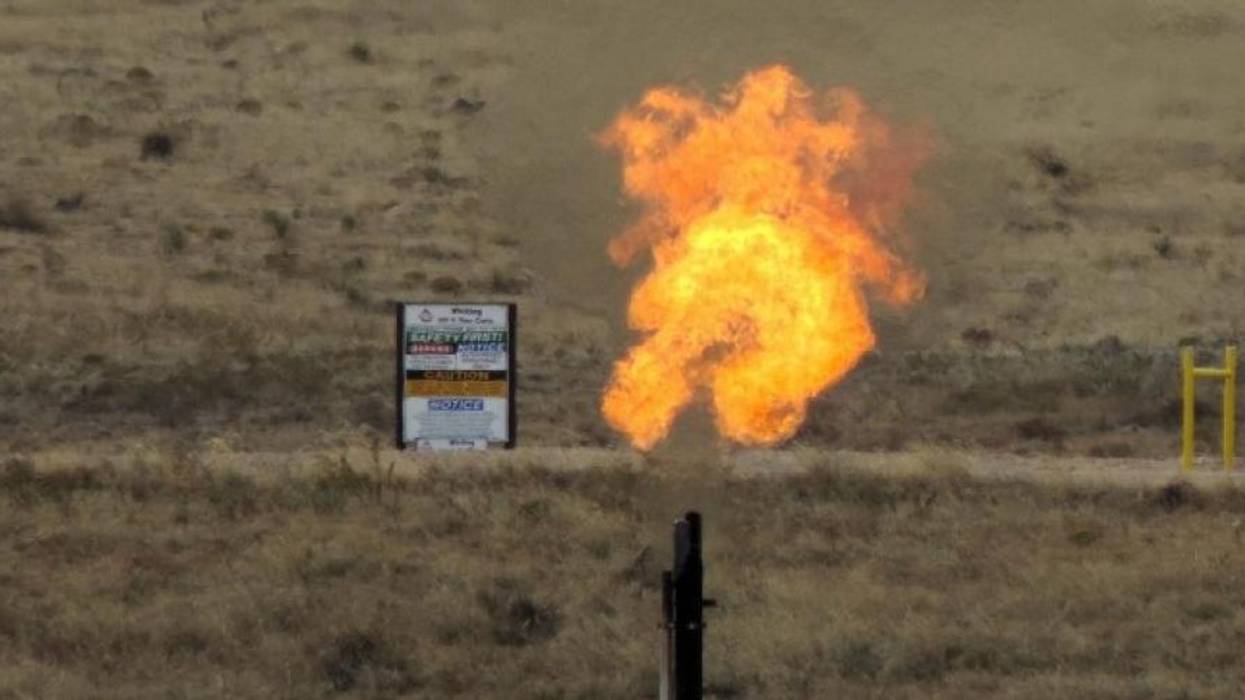
The CEO of methane-tracking company GHGSat said that company satellites had detected around 20,000 oil and gas operations, coal mines, and landfills that spewed massive amounts methane since the end of 2023.
The number of methane "super-emitters" detected by a satellite company has surged by approximately one-third over the past year, despite pledges from fossil fuel companies to reduce their emissions of the highly potent greenhouse gas.
Stephane Germain, the CEO of methane-tracking company GHGSat, toldThe Associated Press on Thursday that company satellites had detected around 20,000 oil and gas operations, coal mines, and landfills that spewed 220 pounds of methane per hour since the end of 2023—up from around 15,000 the year before.
"The past year, we've detected more emissions than ever before," Germain said, adding that existing data on methane emissions is only "scratching the surface" of the reality.
"The only safe and effective way to 'clean up' fossil fuel pollution is to phase out fossil fuels."
GHGSat's data covers the period since 50 fossil fuel companies pledged to end flaring and reduce methane emissions from their operations to "near zero" by 2030 at the United Nations Climate Change Conference, or COP28, in Dubai.
At the time, more than 320 civil society organizations criticized the pledge and other voluntary commitments as a "dangerous distraction."
"The only safe and effective way to 'clean up' fossil fuel pollution is to phase out fossil fuels," the groups wrote in an open letter. "Methane emissions and gas flaring are symptoms of a more than century-long legacy of wasteful, destructive practices that are routine in the oil and gas industry as it pursues massive profits without regard for the consequences."
"That the industry, at this crucial moment in the climate emergency, is offering to clean up its mess around the edges in lieu of the rapid oil and gas phaseout that is needed is an insult to the billions impacted both by climate change and the industry's appalling legacy of pollution and community health impacts," they continued.
Yet now it seems as if the industry isn't even attempting to clean up its mess around the edges.
Germain, who is sharing his company's data ahead of the next round of climate talks at COP29 in Baku, Azerbaijan, said that nearly half of the methane super-emitters GHGSat detected were oil-and-gas related. Another third were landfills or waste facilities, and 16% from mining. Geographically, most of the super-emitting sites are in North America and Eurasia.
The data comes amid growing concerns about the extent of methane emissions and how they threaten efforts to rapidly reduce greenhouse gas pollution this decade and limit global temperature rise to 1.5°C. Methane is a more powerful greenhouse gas than carbon dioxide—with about 80 times its heat-trapping potential over its first 20 years in the atmosphere—but it also dissipates much more quickly. This means that curbing methane emissions could be an effective near-term part of halting temperature rise.
However, a series of studies published this year show these emissions moving in the wrong direction. A Nature analysis concluded in March that U.S. oil and gas operations were emitting around three times the methane that the U.S. government thought. A Frontiers of Science paper in July found that the growth rate of atmospheric methane concentrations had seen an "abrupt and rapid increase" in the early 2020s, due largely to the fossil fuel industry as well as releases from tropical wetlands.
The danger of methane emissions is one reason that the climate movement has mobilized to stop the buildout of liquefied natural gas (LNG) infrastructure, as methane routinely leaks in the process of drilling for and transporting the fuel. A September study found that, despite industry claims it could act as a bridge fuel, LNG actually has a 33%. greater greenhouse gas footprint than coal when its entire lifecycle is taken into account.
The fate of the LNG buildout, at least in the U.S., could be decided by the outcome of the 2024 presidential election. The Biden-Harris administration paused the approval of new LNG exports while the Department of Energy considers the latest climate science. While a Trump-appointed judge then halted the pause, this does not actually stop the DOE from continuing its analysis. A second Trump administration, however, would be almost guaranteed not look further into the risk of methane emissions before it approves more LNG exports. Former President Donald Trump has promised to "drill, baby, drill" and offered a policy wishlist to fossil fuel executives who back his campaign.
A document leaked in October showed that a major oil and gas trade association had drafted plans for a second Trump administration, including ending Biden administration regulations to curb methane emissions, such as an emissions fee.
As Mattea Mrkusic, a senior energy transition policy lead at Evergreen Action, warned, "Under Trump, we could double down on even more dirty fossil fuel infrastructure that'll lock us into harmful pollution for decades to come."
Nearly 80 world leaders and Nobel laureates say the 'Pact for the Future' will be deeply flawed if it ignores the key driver of the planetary crisis.
A group of 77 former world leaders, Nobel laureates, and scientists on Tuesday called on United Nations member countries to reintroduce into an upcoming treaty, the Pact for the Future, a strong commitment to transitioning away from fossil fuels.
The Pact for the Future has been under negotiation by U.N. member nations this year and is expected to be signed at a special meeting in September called the Summit of the Future.
The initial draft of the agreement, from January, included language fairly similar to that which nearly 200 U.N. nations agreed to at last year's COP28 climate summit in Dubai, calling on countries to "accelerat[e] the transition away from fossil fuels." The first draft also included a commitment to setting a deadline to end fossil fuel subsidies.
However, subsequent versions have not included any reference to fossil fuels, the burning of which is the main cause of the climate emergency, due to the greenhouse gases emitted. In response, the 77 leading figures have published a letter supported by the Fossil Fuel Non-Proliferation Treaty Initiative.
"The omission of fossil fuels from the draft Pact for the Future is another stark failure to confront one of the greatest threats to our planet and humanity."
The signatories include Muhammad Yunus, Nobel Peace Prize winner and chief adviser in Bangladesh's new interim government; Mary Robinson, the former president of Ireland; the Dalai Lama; and Stefan Löfven, the former prime minister of Sweden.
The authors of the letter wrote that they are "gravely concerned" about the watering down of the agreement.
"We call on the United Nations to ensure that the Pact for the Future includes robust commitments to manage and finance a fast and fair global transition away from coal, oil, and gas extraction in line with the 1.5ºC limit agreed to by nations in the Paris Agreement," they wrote.
"If the Summit of the Future does not address the threat of fossil fuels, it will not be worthy of its name, risking undermining a once-in-a-century opportunity to restore trust in the power of international cooperation," they added.
Jody Williams, a human rights activist and Nobel Peace Prize winner who signed the letter, said in a statement that "unless fossil fuels are tackled, there is no future to safeguard."
Löfven, who led Sweden from 2014 until 2021 and is now head of the Party of European Socialists, a coalition of center-left parties from around Europe, also spoke forcefully about the need for a stronger international agreement.
"The omission of fossil fuels from the draft Pact for the Future is another stark failure to confront one of the greatest threats to our planet and humanity, " he said. "World leaders should be unequivocal when it comes to acting decisively and collectively to prevent further climate impacts, and instead, they are deciding to bury their heads in the sand."
"Only through unwavering international cooperation to phase out fossil fuels can we safeguard our common future," he added.
The pact is not exclusive to climate issues but covers five areas: sustainable development; peace and security; science and technology; youth and future generations; and transforming global governance, including international financial architecture reform.
The first draft of the pact released in January, despite its mention of fossil fuels, was "somewhat unambitious," according to Tim Hirschel-Burns, a policy liaison at the Boston University Global Development Policy Center. The draft didn't contain many concrete, binding proposals, he wrote on the center's website in April.
Hirschel-Burns called for the treaty to include language that would give more voting power to Global South countries at the International Monetary Fund and the World Bank, and an end to the gentleman's agreement that places a European in control of the former institution and an American the latter. Some language regarding Global South representation at those financial institutions was included in the newest draft of the pact.
In May, Human Rights Watch called for a strong pact that prioritized economic justice and the environment. HRW asserted that civil society organizations hadn't been consulted enough and that China, Russia, Cuba, and Iran had sought to weaken the human rights provisions in the agreement. However, the group was also critical of Western countries, saying that "their selective application of human rights undermines the credibility of such an agenda, particularly for countries in the Global South."
"While the United States and other Western countries justifiably condemn Russia’s atrocities in Ukraine, for example, many of them have not shown the same resolve concerning Israel's atrocities in Gaza," the HRW statement said. "While the European Union says it champions human rights protection globally, it opposes efforts at the U.N. to make the international tax system fairer for developing countries."
The Fossil Fuel Non-Proliferation Treaty Initiative, which published Tuesday's letter, leads an effort to establish an international agreement in which full transparency is developed over fossil fuel reserves so that countries can successfully negotiate a phaseout of their use. A huge number of government entities and global organizations have endorsed the idea, but only 13 countries have signed on so far.
"Make no mistake, COP28 was hijacked by the interests of the fossil fuel industry," said one campaigner.
A new analysis released by human rights and anti-corruption group Global Witness on Wednesday left no room for doubt, said one campaigner, that the host country of last year's United Nations climate summit, the United Arab Emirates, prioritized fossil fuel interests over the planet.
"Make no mistake, COP28 was hijacked by the interests of the fossil fuel industry," said Patrick Galey, senior investigator for Global Witness, referring to the 28th Conference of the Parties of the United Nations Framework Convention on Climate Change (UNFCCC).
The analysis showed that the UAE's Abu Dhabi National Oil Company (ADNOC) used the COP28 presidency of its CEO, Sultan Ahmed Al Jaber, to seek deals worth nearly $100 billion with oil, gas, and petrochemical companies in at least 12 countries.
Fossil fuel firms, said Galey, "weren't content simply to block or stall genuine climate policy but used the opportunity to pursue more climate-wrecking oil and gas deals."
Al Jaber previously denied that ADNOC used COP28 to further its business interests after a leak of briefing documents that instructed the company to discuss fossil fuel deals with at least 16 states that were present at the talks.
According to Global Witness, the company sought deals with at least 11 of those countries and at least one other that had not been included in the leaked documents.
The group's investigation found that the UAE redoubled its investment in oil and gas in Egypt in 2023, the year Al Jaber presided over COP28. ADNOC finalized a deal with TotalEnergies Marketing Egypt, purchasing a 50% stake in the company for a reported $200 million—resulting in the UAE now jointly operating 240 service stations across the country and contributing to its record profits posted in 2023.
Other deals sought by ADNOC with COP28 participants include a joint venture with BP to buy a 50% stake in NewMed Energy in Israel and multiple bids for a stake in Braskem, the largest petrochemical producer in Latin America. The company is part-owned by Brazil's state-run oil and gas producer Petrobas.
ADNOC also finalized deals worth an estimated $17 billion with Lukoil in Russia and Wintershall in Germany to develop the Hail and Ghasha gas field in the UAE.
Global Witness' findings bolstered a report by the Center for Climate Reporting and the BBC in November, which showed Al Jaber used his position at COP28 to push for fossil fuel deals with foreign governments.
The report confirms the worst fears of climate campaigners, who were incensed in early 2023 when Al Jaber was named the president of the U.N.'s largest annual climate conference and warned of conflicts of interest due to his position at the helm of ADNOC.
As it turns out, said Galey, "the UAE knew exactly what it was doing and was not let down—COP28 seems to have been molded towards the benefit of its state oil company."
"As depressing as it is dystopian, climate talks must never be allowed to create more climate chaos," he added.
The analysis was released weeks after U.S. Sen. Jeff Merkley (D-Ore.) and Rep. Jan Schakowsky (D-Ill.) led 24 Democratic lawmakers in writing to Secretary of State Antony Blinken and White House Senior Advisor John Podesta, urging them to support conflict of interest guidelines ahead of COP29, which is scheduled to take place in November in Baku, Azerbaijan.
With Mukhtar Babayev, the country's ecology and natural resources minister who worked for a state-owned oil and gas company for more than 20 years, set to preside over the conference, Galey said that "COP28 seems to have provided other petrostates with a sinister playbook to copy and paste from."
"As the UAE passes the baton onto Azerbaijan, we are now looking at the possibility of consecutive COPs being hijacked for the interests of big polluters and their profits," said Galey, noting that scientists have warned the planet is "dangerously close" to heating that exceeds 1.5°C.
Global Witness pointed to recently announced plans to partially privatize the State Oil Company of Azerbaijan (SOCAR) ahead of COP29, "with its downstream and petrochemical subsidiaries made available to help attract foreign investments."
Rep. Rashida Tlaib (D-Mich.), who signed the letter spearheaded by Merkley and Schakowsky, said Global Witness' report "is a disturbing warning about the potential for further fossil fuel corruption at COP29, which incredibly will also be hosted by another fossil fuel executive."
"I will continue urging the U.S. and UNFCCC to adopt new policies to prevent these absurd conflicts of interest that frustrate the international community's work to address the urgent threats of climate change," she said.
Global Witness reached out to ADNOC, SOCAR, and COP29 for comment regarding its investigation, and was told that ADNOC is working to "secure, reliable, and responsible supply of energy to support a just, orderly, and equitable global energy transition and that allegations regarding Al Jaber's deal-making at COP28 are "false, not true, incorrect, and not accurate."
A COP29 spokesperson said Azerbaijan is "100% committed to bringing countries together with the ambition of keeping the 1.5° target within reach."
Rep. Barbara Lee (D-Calif.), said in a statement Wednesday that Babayev should be removed "from any leadership role at COP29."
"It is an absolute scandal that the UNFCCC has two years running put an oil and gas executive in charge of this event," she said, "thus putting foxes in charge of the henhouse."
"We have to put the social justice element upfront," an architect of the 2015 Paris agreement said as the world's climate delegates gathered in Germany.
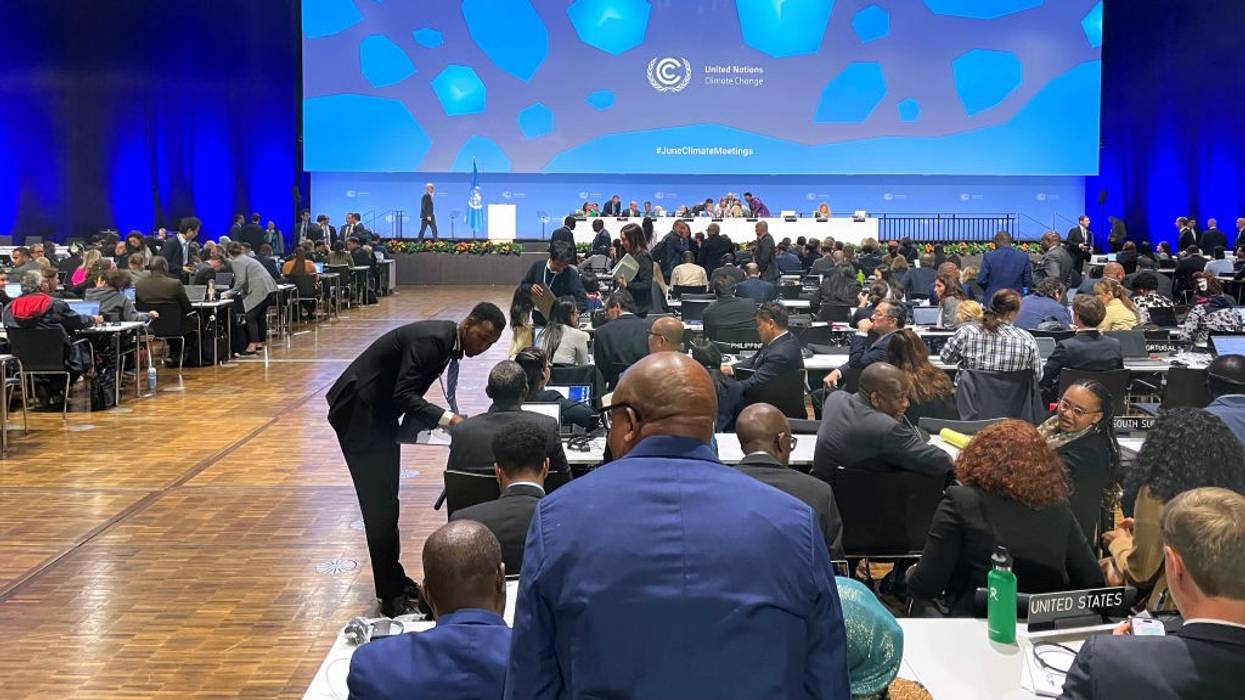
Advocates on Tuesday issued strong calls to action on climate finance for developing countries and an international agency released a report on the need to ramp up renewable energy production as the Bonn Climate Change Conference continued in Germany and G7 nations prepared to meet in Italy next week.
At the conference in Bonn, Friends of the Earth International pushed for more rich-country financing to pay for the rising costs of climate impacts in the Global South, while Laurence Tubiana, head of the European Climate Foundation and an architect of the 2015 Paris agreement, called for the global rich to pay their share through taxes and consumption levies.
Meanwhile, two organizations warned that countries aren't on track to meet targets they set just last year. Oil Change International (OCI) published a briefing showing that G7 nations are expanding oil and gas commitments that undermine goals set at the United Nations Climate Change Conference (COP28) meeting in Dubai, and the International Energy Agency (IEA) issued a report showing that the world's nations are not on track to meet their Dubai pledge to triple renewable energy production by 2030.
"The world is on fire because of decades of inaction by rich countries on reducing emissions, and their failure to pay the climate finance they owe to developing countries to transition to renewable energy systems for all, and to pay for rising costs for loss and damage and adaptation," Sara Shaw, Friends of the Earth International program coordinator, said in a statement. "What is on the table to date is scales of magnitude away from what it needed. This year must be a year of breakthrough on climate finance."
Climate representatives are meeting in Bonn this week and next to prepare for COP29 in November in Azerbaijan, where a key agenda item is expected to be financing for a green transition in the Global South. COP negotiations are conducted under the aegis of the United Nations Framework Convention on Climate Change (UNFCCC). At COP21 in 2015, nations signed the Paris agreement, a treaty that sought to limit global warming to less than 2°C above preindustrial levels.
Tubiana, an architect of that deal, said Tuesday that tackling climate change requires centering global justice in order to avoid conflict and gain public acceptance of climate measures.
"We have to put the social justice element upfront," Tubiana, a French economist and diplomat, told The Guardian.
Tubiana said that raising the funds required for low-income nations will require holding both rich nations and people to account, via taxes and consumption levies, given that inequities exist not just between nations but also within them.
"This inequality is true not only between developed countries and developing ones, but within each country—the 1% of rich Chinese, or the 1% of very rich Indians, or the U.S. citizen—they have a lifestyle which is very, very similar, in terms of overconsumption," she said.
The world's richest and most powerful nations are not taking responsibility for climate action as they should, the new OCI briefing argues.
"Some G7 countries are massively expanding fossil fuel production at home, while others are investing in more fossil fuel infrastructure abroad," the briefing states. "Both are catastrophic failures of leadership."
OCI cites the United States, Italy, and Japan as particularly bad climate actors. The U.S. is the largest oil and gas producer in the world and has plans for massive expansions of the industry, despite President Joe Biden's climate promises, the briefing notes. Italy has announced plans to double natural gas production. And both the U.S. and Japan have financed billions of dollars worth of oil and gas production in other countries just since the end of 2022, the document states, citing earlier OCI findings.
.@G7 countries 🇨🇦 🇺🇸 🇬🇧 could be responsible for nearly half of the CO2 pollution from new oil & gas projects planned between 2023 and 2050 - equivalent to the lifetime emissions of nearly 600 coal plants.
📑 https://t.co/ujhMLMVNtr pic.twitter.com/8IB1sxLuHj
— Oil Change International (@PriceofOil) June 4, 2024
The IEA also spelled out unfulfilled commitments, while detailing progress that has been made on the energy transition. The agency looked at the domestic policies and targets of 150 countries to see how far along they were toward reaching the international target of tripling renewable power generation by 2030. It found that once added together, the nations' domestic plans would get them about 70% of the way toward the 11,000 gigawatts of additional capacity required to meet the goal.
"There is a gap, but the gap is bridgeable," Heymi Bahar, a senior energy analyst at the IEA and co-author of the report, told The Guardian.
Governments have not in most cases written these domestic plans into their Nationally Determined Contributions (NDCs) under the Paris agreement. The IEA report says that countries need to "bring their NDCs in line with their current domestic ambitions" and scale those ambitions up further still, to get from 70% to 100%. Moreover, they must follow through with their promises and achieve the targets they've set.
"This report makes clear that the tripling target is ambitious but achievable—though only if governments quickly turn promises into plans of action," Fatih Birol, the IEA's executive director, said in a statement.
The world added about 560 gigawatts of renewable capacity in 2023, a record increase, more than half of which came from China, according to the IEA. About half of planned capacity increases are in solar, with a quarter from wind power, the IEA report states.
"They are continuing to do similar things today to try to fool people and pull the wool over people's eyes just in the name of greed," the former vice president said.
In reflecting on nearly 50 years of climate advocacy, former Vice President Al Gore said that he had "underestimated" the greed of the fossil fuel industry.
The remarks came in an interview published in USA Today on Sunday. When asked if he had any regrets, Gore responded that he had "put every ounce of energy" he had into climate advocacy, but added:
"I was pretty slow to recognize how important the massive funding of anti-climate messaging was going on. I underestimated the power of greed in the fossil fuel industry, the shamelessness in putting out the lies."
"They are continuing to do similar things today to try to fool people and pull the wool over people's eyes just in the name of greed," Gore continued.
"What's at stake is so incredible."
Gore, who tried to raise awareness about the climate crisis in the U.S. House of Representatives as early as 1981 and brought the issue to national attention in 2006's documentary An Inconvenient Truth, has taken a harsher tone against oil, gas, and coal companies in recent months. In August 2023, he said that the "climate crisis is a fossil fuel crisis," and in September, he implored the industry to "get out of the way." In December, he lamented that the industry had "captured the COP process," referring to the appointment of the United Arab Emirates national oil company CEO Sultan Ahmed Al Jaber to preside over the United Nations' COP28 climate conference in that country.
In the USA Today interview, Gore also named the fossil fuel industry when asked about his greatest frustration.
"Well, that we haven't made more progress," Gore answered, "and that some of the fossil fuel companies have been shameless in providing, continuing to provide lavish funding for disinformation and misinformation."
"What's at stake is so incredible," he added.
However, Gore told USA Today that he tried not to focus on his anger, but instead on continuing to raise awareness about the crisis and what can be done about it. And he remained hopeful that his grandchildren would live in a world in which people had come together and acted in time.
"We've got all the solutions we need right now to cut emissions in half before the end of this decade," he said. "We've got a clear line of sight to how we can cut the other 50% of emissions by mid century."
He also encouraged more people to get involved with the climate movement.
"I would say the greatest need is for more grassroots advocates because the most persuasive advocates are those in your own community," he said.
The COPs are easily dismissed as “blah blah blah.” But they are, in a word, necessary.
During the recent climate summit in Dubai, COP28 president Sultan Al-Jaber, with some exasperation, came out with the following rather amazing statement:
“Please help me, show me the roadmap for a phase out of fossil fuel that will allow for sustainable socioeconomic development, unless you want to take the world back into caves.”
Al-Jabar was posturing when he made this quip about caves, but he can almost be forgiven. We badly need a roadmap for a “phase out of fossil fuel that will allow for sustainable socioeconomic development.” By noting the lack of one, he underscored its absence. This is true even if he spoke as a flack of the fossil fuel cartel.
Speaking of COP28, it helped settle the question of the COPs, which still troubles the climate left. The COPs are easily dismissed as “blah blah blah.” But they are, in a word, necessary. We would be in far greater trouble without them, and this is true even though the COPs are condemned to make decisions by consensus, even though they engender endless greenwashing, even though, with next year’s COP29 slated for Azerbaijan, two in a row will be hosted by straight-up petrostates.
The climate reckoning is arriving, and it finds us everywhere divided between rich and poor.
The climate negotiations are finally circling core issues. COP26 saw a decision to “phase down” coal, and COP28 opened with the Loss and Damage fund finally lurching into existence. Then came COP28’s key decision text, which called for “Transitioning away from fossil fuels in energy systems, in a just, orderly and equitable manner, accelerating action in this critical decade, so as to achieve net zero by 2050 in keeping with the science.” Only a month later—with President Biden’s decision to “pause” the approval of new liquified natural gas terminals, a decision the White House explicitly linked to COP28— the meeting demonstrated real world benefits. It could have many more in the future, including outside the United States.
Meanwhile, COP29 is set to see climate finance take center stage, and the next big battle begin. It could (if all goes well) culminate in 2025, where COP30 will be hosted by Lula da Sila’s Brazil, and deliver a meaningful decision on that crucial front. This is not the time to performatively insist that COP stands for “conference of polluters.”
Having said all this, I must immediately add that the climate negotiations have thus far failed, as decisively witnessed by the steadily rising atmospheric carbon-dioxide concentration. COP skeptics are quite right about this. But in their failure the international negotiations are hardly alone. Domestic climate action has had many victories, but it has hardly put us on a path to deep and rapid decarbonization. Nor has the green technology revolution brought planetary emissions into a peak-and-decline pathway. Nor—and this is not easy to say—have the world’s direct action and climate justice movements filled the gaps. Politically, they may be everything, but they too have failed to stop the warming.
One key point: the COP28 text does not simply call for transitioning away from fossil fuels but rather stipulates that this transition must be “just, orderly, and equitable,” a much more challenging prospect. This led Sivan Kartha, a climate equity specialist at the Stockholm Environment Institute, to add that the “deepest fissure” in Dubai was between those who simply want a rapid fossil phase out and those who insist that, to have any hope of success, such a phase out must be fair.
Many of us agree—but what does such fairness imply?
It has become fashionable, yet again, to argue that terms like “climate emergency” are dangerously demoralizing. Perhaps they are. Unfortunately, they are also accurate. We really do have to aim for net-zero emission by 2050, and that means facing political-economic challenges that are difficult to exaggerate. As are those posed by the closely related 1.5°C temperature goal.
There are lots of voices telling us that 1.5°C is no longer achievable, but this is not quite true. Rather, 1.5°C remains achievable, but only via “overshoot and decline” pathways in which, sometime after the warming grinds past 1.5°C, we manage to claw it back down. Will we achieve such a mobilization, or at least avoid catastrophe? This is the real question.
We are going to go into 1.5°C overshoot soon. As we do, even if we assume we’ll be able to draw the temperature back down, we can’t know how extreme the overshoot will be, or how long it will last. Some people, Marxist climate hawk Andreas Malm among them, do not think we’ll be able to pull off the necessary drawdown (“I’m not an optimist about the human project”), though he agrees that it is technically possible.
If we seriously intend to keep 1.5°C alive (as a long-term goal—think 2100), we must in the short term do everything to keep the temperature peak “well below 2°C” (the weak end of the Paris target), which is widely judged, by top scientists, to still be achievable. But there’s a hitch. Even this weaker goal demands, per the IPCC, “rapid, far-reaching and unprecedented changes in all aspects of society.” It’s not going to happen in today’s world.
If, in 2050, we are approaching true net-zero planetary emissions, we’ll have a good chance of avoiding a world in which the cascading consequences of the warming become unmanageable. Very rapidly building low- and ultra-low emissions energy systems around the world is a necessary step towards that goal—and because such systems are emerging, and rapidly dropping in cost, it’s possible to be honestly optimistic. But such systems are not going to be enough.
Net-zero 2050 means going beyond the deployment of new, ultra-low emissions infrastructure to also eliminate existing fossil fuel infrastructure. This means that virtually all countries, be they rich or poor, developed or developing, should immediately stop investing in fossil fuel infrastructure, not least because that infrastructure will have to be decommissioned—shut down, mothballed, stranded—long before it’s worn out. All countries must also very rapidly decommission the fossil fuel infrastructure (e.g. existing oil wells, old coal plants) they already have in place—even if it’s profitable and even if people depend on it for their livelihoods. Such a decommissioning process is going to be both expensive and disruptive, in both political and economic terms, and in ways that are particularly hard on poor and insecure populations.
In a world geared for rapid transition, these would be tractable challenges, but that would be a world in which we were speaking honestly about the depth and profundity of the necessary transformation, a world in which we were, as per Australian author and analyst David Spratt, in “emergency mode.” This, obviously, is not our world, which still tends towards greenwashing, soft-pedaling, and small-bore gradualism, if not actual denialism and climate “brightsiding.”
The encouraging possibilities are real, don’t get me wrong.
The green technology revolution really does make it possible for us to save ourselves, and to build new futures. But we’re still facing almost impossible strategic challenges, and justice is at the heart of many of them. Brave choices are going to be necessary, and a political movement that tries to avoid them will not do well when push comes to shove. As it will, within the lifetimes of our children.
It will be very difficult to engineer a sufficiently rapid phase out of fossil fuel consumption. But the difficulties are even greater when it comes to fossil fuel extraction and production. Think mining, and drilling, and fracking.
There are rich countries like the United States and Norway, which are heavily invested in oil and gas extraction. High-poverty developing countries, like South Africa and India, are heavily invested in coal, while the Democratic Republic of Congo is highly dependent on oil revenue to provide public services. Gulf oil exporters like the United Arab Emirates, the COP28 host, was a developing country before it struck oil. Today, though the UAE may not be “developed” in the same way as, say, the United States or Germany, it is nonetheless a wealthy, high-capacity country with the money and resources to buffer the turbulence that will come with any rapid abandonment of oil.
Which countries deserve more time before they have to stop extracting and selling fossil fuels? The question haunts the climate negotiations, but it is not, in an important sense, the right question at all. The greater truth is that we must stop the fossil energy pipeline, globally and as soon as possible. The right question is which countries need support—financial, political, and technological support—before they can hope to rapidly break their dependency on fossil fuel extraction.
All extracting countries will plead their cases. The most legitimate pleas come from poor developing countries that are highly dependent on fossil-related revenues and livelihoods. But although lots of countries call themselves developing, some of them are a lot richer than others. The good news is that this confusion is dissipating, for reasons that were easy to appreciate in Dubai, the global city of the United Arab Emirate. The UAE, like Saudi Arabia, is an extremely wealthy Gulf oil exporter that, while still officially a member of the “Group of 77” developing countries, is not a developing country at all.
Why must we say this? Because we must transition away from fossil fuels in a “just, orderly, and equitable” manner, and because such a transition is going to be extremely difficult. It is also going to be expensive, which immediately raises the “who pays?” question. Those who wish to evade this question—there are many, and they tend to be rich—seek delay by any available means, and in the next 10 years aggressively rosy predictions about carbon-dioxide removal—which would, if real, make a perfect case for delay—seem certain to play a leading role in their strategies.
In such a situation, with uncertainty layered upon complexity upon emergency, optimism is as much a danger as pessimism. For one thing, it is not at all obvious that we will manage to rapidly draw temperatures back down after they overshoot 1.5°C—Malm’s pessimism may, in the end, be well placed. For another, all efforts to honestly face the severity of our situation will be endlessly harried by soft-pedaling, false solutions, dangerous distractions, and lies. Politicians everywhere will want all the wiggle room they can get, and meanwhile the fossil cartel will move at every opportunity to deflect all efforts to mandate, or even discuss, the strategic demands of an actual planetary fossil-fuel phase out.
Al-Jaber was right: we need that roadmap.
The climate negotiations are marked by endless skirmishing between global North and global South, which will not abate anytime soon. After all, the planet is still strongly structured by the “uneven and combined development” of the colonial past, and the countries of the global North still host the majority of the world’s wealth.
Despite this skirmishing, which has for decades kept fossil fuels off the negotiating agenda, COP28 saw the fossil phaseout challenge finally take center stage. Activists and diplomats alike saw this challenge as a litmus test that would show if the climate negotiations were fit for purpose. Will the negotiations take up the challenge, or can they be forever derailed and distracted, while the fossil cartel just continues its relentless, exterminist expansion? Perhaps we’ll know in a few years, but just now, after Dubai, a bit of guarded optimism may be in order.
To be sure, not everyone in Dubai connected the brutal logic of the climate reckoning to the larger geopolitical crisis, but this crisis hung palpably in the air. COP28 took place in the Arab world, and Gaza did not seem so very far away. The atrocity of the Israeli bombing continued day by excruciating day, and it could not be entirely separated from the discussions in the conference halls. The pain was acute within civil society circles. Demonstrations took place and were noticed, though they were marginalized by the COP’s security regime. Importantly, the ethos of the protest was an expansive one. The bombing, in particular, was not an isolated consequence of local hatreds. There were larger forces at work. The United States—which refused all talk of climate liability—was more than implicated. The term “settler colonialism” was heard again and again. The war, and war in general, was not a distant abstraction.
COPs are not mere climate meetings. The talk is not confined to carbon budgets and energy-system transformation. International debt relief, for example, is now front and center, as is the need for a radically new planetary finance architecture. The military budget—now over $2 trillion a year—is a common point of comparison, and a reminder that we routinely subsidize violence on a vast scale. The problem of climate is the problem of history, and history is suddenly a very big problem. As the Financial Times noted,
The anecdotal evidence that war is surging round the world is confirmed by the numbers. A recent report by the International Institute for Strategic Studies documented 183 ongoing conflicts around the world, the highest number in more than three decades. And that figure was arrived at before the outbreak of the war in Gaza.
The fraying of the world order is, obviously, a threat to climate cooperation. Beyond this, and beyond the fading illusion that the climate challenge will yield to simple interventions, we’re still only beginning to come to terms with its implacable sprawl. There is little chance of climate stabilization without a political-economic shift that makes robust cooperation possible, but such a shift isn’t going to come cheaply and easily, and simple stories will not help trigger it. How could they when the riddle of climate stabilization is as well the riddle of development, and the riddle of peace?
The Gaza bombing is now on the agenda of the International Court of Justice, where it has joined a crowded docket that includes climate change lawsuits and all manner of other infamies. Nor can these all be laid entirely at the feet of the global North. The two million people of Gaza are currently, and justly, in the spotlight, but spare a thought for another two million people, the Rohingya of Myanmar, who have been murdered and expelled by a huge and terrifying wave of anti-Muslim violence. Southern elites are not innocent.
And don’t forget Russia’s war in Ukraine, which, in addition to its immediate murderous consequences, is a milestone in the global right’s campaign against collective action, including climate action. It has certainly been an enormous setback to the Russian activist campaign for carbon neutrality.
During COP28’s second week, the negotiations were roiled by the leak of a letter that Haitham al-Ghais, the OPEC secretary general, had sent to the 13 members of OPEC. The letter warned that “pressure against fossil fuels may reach a tipping point with irreversible consequences”, and argued that OPEC members must “proactively reject any text or formula that targets energy i.e. fossil fuels rather than emissions.”
This was not an isolated move. There was also, by accounts, a great deal of arm twisting, and even a Saudi walkout. Jennifer Morgan, a long-time civil society climate strategist who is now Special Envoy at the German Foreign Ministry, went so far as to speculate that OPEC might be in “a bit of panic.” If so, the panic quickly passed. Once COP28 was over, the Saudis argued that the Dubai agreement to transition away from fossil fuels was entirely optional, just one of several “choices” on an “a la carte menu.”
First of all, the OPEC cartel, and the fossil cartel more generally, wants to prevent the transition away or phase down/out frames (the two are essentially equivalent) from taking hold, and argues instead that “emissions” (which can, it is said, be “captured”) are the real problem. This is the greenwashing strategy, and its partisans will use all available arguments in its service, including repeated references to energy justice. Al-Ghais, for example, explains that “Our goal must be to reduce emissions, which is the core objective of the Paris Agreement, while ensuring energy security and universal access to affordable energy.”
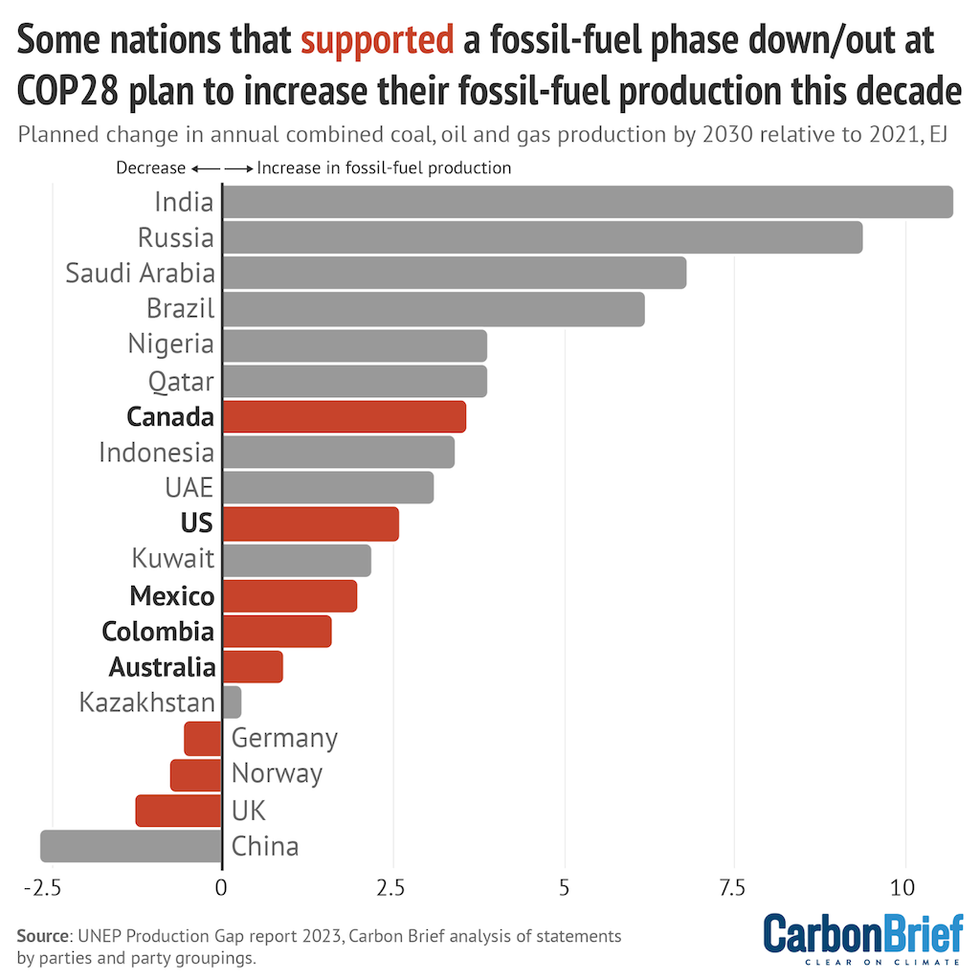
OPEC, moreover, has no intention of scaling back fossil fuel extraction. This could change (one must hope) but there is absolutely no chance that it will do so unless the great powers of the global North have already taken the lead and begun their own fossil fuel extraction phase out. Which is why the Biden administration’s decision to scrutinize and hopefully reject a wave of new LNG export terminals, if it survives the counterattacks, could mark a true turning point. Talk, after all, is cheap, and just because a country’s delegation supported phase down/out at COP28 (as did the U.S. delegation) this doesn’t mean its decision makers are ready, and able, to follow through. At the COP, many of them clearly weren’t, as is crisply shown in this December 2023 graphic from Carbon Brief:
Some countries, or rather the fossil powers within those countries, are planning even greater production increases than the United States is. Some of these (India and Nigeria) are clearly developing countries, while some (Canada, Russia, and Saudi Arabia) are not. Most all fossil-rich countries, whether their history lay with the global North or the global South, are still planning on exploiting their coal, oil, and gas resources for as long as they possibly can, though do note that China is at the encouraging bottom of the chart. All told, despite its complexities, the picture is grim.
At the same time, the climate reckoning is arriving, and it finds us everywhere divided between rich and poor. In consequence, the countries of the global South can continue to make compelling appeals to basic levels of developmental justice, and these appeals cannot be easily dismissed, even when they bleed into PR cover for continued fossil investment. The energy poverty of the global South is deadly real, as is its pressing need—and its right—to a viable development path, as are the obstacles that today’s world system strews in its path.
(Note that this chart is somewhat out of date – Azerbaijan, which holds the COP29 presidency, has since COP28 announced that it is planning on raising its gas production by a third.)
To succeed, the fossil fuel phaseout roadmap must be reasonably detailed and properly funded. At the same time, it must sharply increase the development and build-out of low-carbon energy systems. In practice, this roadmap has to include nationally differentiated coal, oil, and gas extraction phaseout timeframes detailed enough to be useful to both government planners and political organizers, and financing strategies that can support them.
Given the emergency, these phaseout timeframes will be extremely challenging, as befits the goal of net-zero emissions by or around 2050. We have to be realistic about this, but it’s not a traditional realism that we’re after. Traditional realism tells us that the necessary timeframes are unachievable, in large part because countries always hew to their “national interests,” which can be only slowly changed. Climate realism, on the other hand, tells us that it’s the pace of the necessary decarbonization, not the politics of the day, that is immutable, that the problem of climate stabilization must be seen as a solution to a collective action problem, in which national interests rapidly change.
Collective action problems—commons problems—have a special relationship to justice. So, while I have no idea what the “orderly” part of “just, orderly, and equitable” is going to wind up meaning, I’m confident that justice and equity are going to be key to any successful climate transition.
But what kind of justice? And what shape must it take? These questions bring us back to Al-Jaber’s roadmap, the one for a “phase out of fossil fuel that will allow for sustainable socioeconomic development.” It’s a bear of a problem, but lots of people are working on it. For starters, look at the work of the Fossil Fuel Non-Proliferation Treaty initiative. Or Phaseout Pathways for Fossil Fuel Production within Paris-Compliant Carbon Budgets, the Tyndell Centre report that Dan Calverley and Kevin Anderson published in 2022. Or Economic Diversification from Oil Dependency, a report Vincent Yu, a key G77 negotiator, wrote for the Third World Network. Or the many reports of the Civil Society Equity Review, an international collaborative that, full disclosure, I work closely with. The conversation is still in its early days, but there are lots of good ideas floating around.
Meanwhile, if we’re going to use terms like “economic diversification” and “developing countries,” let’s use them carefully. The challenges here involve “differentiation” between different kinds of countries and different kinds of circumstances, and they are anything but easy. The obvious example is the Gulf oil exporters like Saudi Arabia and the UAE. They may in some sense be developing countries, but they have the money to diversify their economies as they phase out fossil fuel extraction, in ways that other developing countries like Kenya or even India absolutely do not. Harder cases come when you consider countries like China, hybrids that are both developed and developing, or when you take inequality within countries into proper account. For example, Saudi Arabia is traditionally considered to be a developing country, while the United States is the richest country in the world, but both are brutally divided between rich and poor. Somehow, this has to matter.
At the end of the day, the biggest differentiation problem remains the one between the global North and the global South. The challenges here are now widely if not routinely recognized. In Dubai, soon after the COP28 decision was gaveled through, Avinash Persaud, now Barbados’ special climate envoy, noted that “Some activists were disappointed we didn’t commit to an immediate fossil fuel phase out. Still, without the trade, investment, and finance to achieve it, it would either have hit developing countries hardest or been meaningless.”
These points will have to be addressed as the finance challenge—the need for a global financial architecture that can support rapid climate transition—takes center stage. Which brings me to a new report – An Equitable Phase Out of Fossil Fuel Extraction: Towards a reference framework for a fast and fair rapid global phase out of coal, oil and gas—the preliminary version of which was released at COP28 by the Extraction Equity Working Group of the Civil Society Equity Review.
I can’t summarize this report here—though it does sport a fine executive summary—but I do want to explain why its subtitle includes the words “towards a reference framework.” The explanation, basically, is that a detailed climate transition roadmap is not yet possible. An Equitable Phase Out of Fossil Fuel Extraction thus proposes a framework by which to judge the steps that can be taken in the next few years, to at least indicate if they are fair and ambitious enough to have a real chance. To this end, it concentrates on calculating coal, oil, and gas phaseout dates for all major fossil fuel producing countries—here’s a scatterplot with the oil dates; scroll right or left for coal and gas—and on estimating the minimum level of annual international public finance that will be needed to support these phase outs.
This minimum is denominated in “hundreds of billions of dollars” a year.
An Equitable Phase Out of Fossil Fuel Extraction argues that, if we would limit warming to 1.5°C, all countries must immediately cease to build new fossil fuel extraction infrastructure. Further, wealthy fossil fuel producers whose overall economies are less dependent on fossil extraction—such as the United States, UK, Australia, Norway, Germany, and Canada—must phase out all fossil fuel extraction by 2031, while also providing significant financial support to poorer countries that are economically dependent on fossil fuel revenues and employment. Such poorer countries are given until 2050, though they too must be wrapping things up much earlier.
One key point, in all this, should never be forgotten. The “unrealistic” nature of these dates is not the result of any equity-side logic—in which we try to model a fair phase out—but rather derives from the implacable constraints imposed by the Earth’s nearly-depleted 1.5°C emissions budget. To push these deadlines out, say to 2060 or 2070, we must either weaken our temperature goal or we must assume—as the geoengineers will incessantly encourage us to do—that gigatons upon gigatons of carbon-dioxide can very soon, and affordably, and safely, be extracted from the climate system and “sequestered” away.
After Dubai, much of the left’s commentary focused on criticizing the late-game negotiations in which “phase out” was replaced by “transitioning away,” as if such diplomatic wordsmithing was only a watering down, as if it revealed the compromised truth at the core of a meaningless negotiation. For the activists embedded in the negotiations, the sense was different. They generally agreed that Dubai had “sent the necessary signal”—despite everything, the world’s governments have decided the fossil economy has to go.
Bill McKibben had the last word on this disagreement when he argued that the “transitioning away” phrase “will hang over every discussion from now on—especially the discussions about any further expansion of fossil fuel energy.” In a nutshell, he argued that the diplomats forged a tool and it’s up to us all to wield it.
The Dubai decision is of course limited. But its real weakness has more to do with loopholes and omissions than with any fine point of diplomatic wording. And the greatest of its omissions is financial: there is no agreement on how the phaseout will be funded. Harjeet Singh, now the Global Engagement Director for the Fossil Fuel Non-Proliferation Treaty Initiative, put the overall picture succinctly and well,
A long-overdue direction to move away from coal, oil, and gas has been set. Yet, the resolution is marred by loopholes that offer the fossil fuel industry numerous escape routes, relying on unproven, unsafe technologies. The hypocrisy of wealthy nations, particularly the USA, as they continue to expand fossil fuel operations massively while merely paying lip service to the green transition, stands exposed. Developing countries, still dependent on fossil fuels for energy, income, and jobs, are left without robust guarantees for adequate financial support in their urgent and equitable transition to renewables. COP28 recognised the immense financial shortfall in tackling climate impacts, but the final outcomes fall disappointingly short of compelling wealthy nations to fulfil their financial responsibilities—obligations amounting to hundreds of billions, which remain unfulfilled.
Harjeet is being diplomatic when he refers to “hundreds of billions,” a figure that echoes the one used in the Equitable Phase Out of Fossil Fuel Extraction report. It seems to be the formulation of choice these days, at least when civil society researchers and activists want to assert financial markers large enough to move the window, but small enough to be taken as realistic.
It’s important to understand that figures of this scale refer to public monies—grants and grant equivalents—and that they’ve lately been sharing the stage with references to trillions, which are typically private monies framed as “investments.” As in Dubai’s high-level Leader’s Declaration, which spoke of the opportunities that lay in “investing $5-7tn annually in greening the global economy by 2030.”
The elites are far more likely to deliver on private finance pledges than on public ones. Investment is something they know how to do. But a future defined by “investment” and “insurance” and “loans” and “aid” is unlikely be a future that takes proper account of even deep decarbonization, let alone the challenges of development in a climate-constrained world, let alone people-centered adaptation and an ethically defensible loss and damage response and recovery system. Which is to say that, unless we win a comprehensive climate finance breakthrough, all hope for a “fair, orderly, and equitable” transition will be abandoned in favor of a short-term neoliberal expediency that is unlikely to deliver the global just transition we actually need.
The challenge here encompasses everything from the historical responsibility of the global North to the debt crisis now wracking the global South to the inequality crisis raging in both North and South. Not to mention the crisis of democracy and the endless techno-economic complexities of the great rebuilding that’s now on the horizon. Bracket all this for now, but know that the next international battle will be fought over finance.
It’s about time.
To be complacent about climate is not just to be shockingly oblivious but to endorse future human suffering on an almost inconceivable scale.
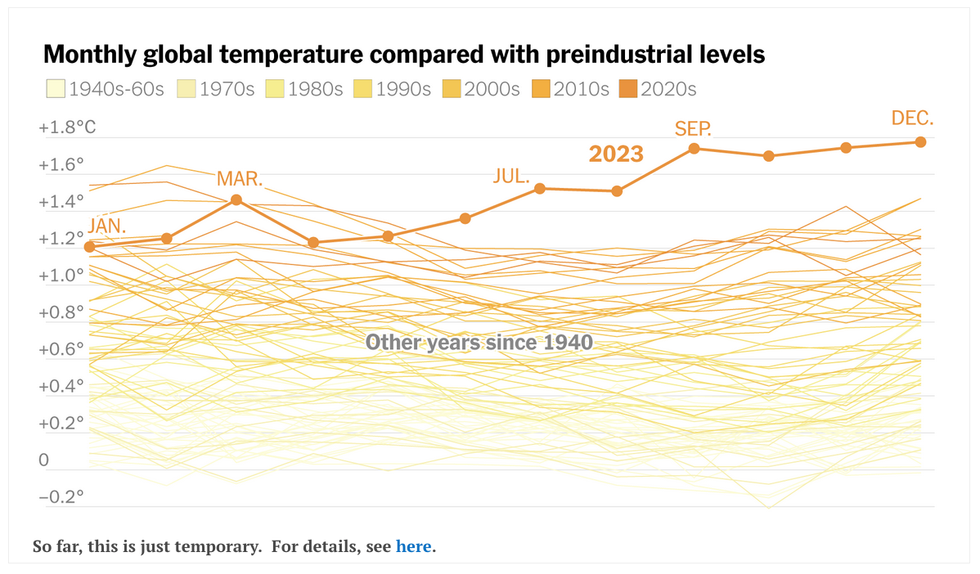
In December, the New York Times reported that “Earth is finishing up its warmest year in the past 174 years and very likely the past 125,000.” (Though it’s not the Times’s style, that latter figure should have had a couple of exclamation points after it!) Furthermore, according to the National Oceanic and Atmospheric Administration’s chief scientist, “Not only was 2023 the warmest year in NOAA’s 174-year climate record — it was the warmest by far.” In fact, each of the six decades since 1960 saw a higher global average temperature than the 10 years that preceded it. In addition, every decade-to-decade increase has been larger than the previous one. In other words, the Earth’s not just steadily warming; it’s heating up at an ever-faster pace.
And you don’t have to wait for the distant future to see the impact of such accelerated heating. Just look at current global data. Comparing 2023 to 2022, the United Nations Office for the Coordination of Humanitarian Affairs (OCHA) reported a worldwide rise of 60% in the number of deaths from landslides, 278% from wildfires, and 340% from storms. Worse yet, those of our fellow humans suffering the most from the impact of human-induced climate change aren’t the ones causing it. More than half of the deaths reported by OCHA occurred in low- to lower-middle-income countries, and 45% of those killed lived in countries that produce less than one-tenth of one percent of the world’s greenhouse-gas emissions. Imagine that for (in)justice!
The climate crisis simply can’t be lost in the shuffle.
Putting an end to global warming should be an overwhelming moral imperative for every nation on this planet. But climate-change stories, extreme as they may be, almost never lead the news, nor does dealing with the phenomenon seem to be at the top of any leader’s list of national priorities. How about last month’s COP28 global climate summit in Dubai? It produced an agreement that committed the world’s nations to doing… well, essentially nothing.
With the news cycle stuck in a bumper-to-bumper traffic jam of sudden, compelling crises and unending wars, world powers seem almost willfully blind to the possibility that the global environment (and with it, civilization itself) is spinning out of control — and not in some distant future but right now.
Long Emergencies
With the recent COP28 agreement, the rich nations have at least finally acknowledged that fossil fuels are indeed a problem. Still, they continue to reject a planned, systematic phase-out of oil, natural gas, and coal on an ambitiously expedited timetable (as laid out in proposals for a global Fossil Fuel Nonproliferation Treaty).
Governments, it seems, always have on hand some other dire emergency that supposedly justifies setting climate change aside. Perhaps the closest the rich countries have ever come to seriously tackling the subject of greenhouse gas emissions, which might be thought of as a long emergency, was in the various U.S., European, and global Green New Deals of 2018-2019. But those inadequate proposals were soon eclipsed by the Covid-19 pandemic and a still-surging rise of far-right extremists who consider global warming a completely off-the-charts subject. Then, in 2022–2023, just as interest in climate was rising again thanks to scary new reports from the world’s climate-science community, the Russian invasion of Ukraine elbowed global warming out of our field of vision, while a stunning war-related spike in fossil-fuel prices killed off any immediate interest in reducing carbon emissions.
Then, last fall, the genocide in Gaza began. In November, TomDispatch’s Tom Engelhardt wrote that “while the nightmare in the Middle East is being covered daily in a dramatic fashion across the mainstream media, the burning of the planet is, at best, a distinctly secondary, or tertiary, or… well, you can fill in the possible numbers from there… reality.” He certainly wasn’t suggesting, nor am I, that the Palestinians are getting too much attention. On the contrary, they need even more of it, but the climate crisis simply can’t be lost in the shuffle.
A Side-Trip to India: No Eye-Catching Crisis in Sight? Just Conjure One Up
Such failures of attention are, of course, hardly confined to the United States. Similar shortsightedness can be seen right now in India, where my family and I are spending January with relatives in Mumbai. Here, too, politicians are making a ruckus about immediate, in-your-face issues — some real, others concocted — while ignoring the more slowly developing but far more consequential threat of climatic breakdown.
In recent years, India has endured a string of cataclysmic droughts, floods, heat waves, and other disasters, along with a chronic but climate-related plague of urban air pollution. In this Mumbai dry season, we’re living in the midst of a dense off-white “fog,” inhaling a toxic brew of dust, motor-vehicle exhaust, factory emissions, and clouds of fine particulate matter created by the construction and demolition of buildings. Overhead, the cloudless daytime sky is a dull, depthless white. Blue patches rarely appear and not a star is visible at night.
Such in-your-face bad air quality is impossible to ignore, but the Indian public is also alarmed by the odorless, invisible carbon-dioxide emissions that underlie the increasing pace of climate chaos on the subcontinent. There is, in fact, a massive constituency-in-waiting here for climate action. A 2022 poll indicated that 81% of voters were worried about human-induced climate change. Fully 50% were “very worried,” and a similar share said that they had been personally harmed by greenhouse warming.
As in the U.S., 2024 is an election year here. So given the above polling numbers, you’d think that boosting climate mitigation and adaptation would be a great way to garner votes. But climate efforts by Prime Minister Narendra Modi and his ruling Hindu-nationalist BJP party continue to be, at best, sporadic and desultory. Instead, they’re pursuing what they see as a far more reliable way of revving up their voter base ahead of the election: announce the inauguration of a new Hindu temple.
How in the world would that work, you ask? Well, we’re not talking about just any temple. This one, currently under construction, sits on a site once occupied by a famed mosque, the former Babri Masjid in the northern city of Ayodhya. That hallowed, five-century-old Muslim place of worship was demolished in 1992 by BJP-backed fanatics. Religious fervor over the demolition sparked violence across the country, leaving more than 2,000 people dead.
For three decades, the destruction of the mosque and its planned replacement with a temple dedicated to the god Ram have been a toxic current running just beneath the surface of Indian politics, occasionally erupting in conflict. So, to gin up their Hindu-supremacist base and ensure victory in this spring’s elections, BJP leaders rushed to organize a ceremony consecrating the temple on January 22nd — months before construction will even be completed.
The outpouring of right-wing religious nationalism triggered by that event has had the side effect of ensuring that global warming will remain out of the political headlines for months, if not longer.
It’s Not All in Your Mind
An institutional preoccupation with acute “red-meat” issues (to the detriment of addressing long-term emergencies like climate change) reflects all too human predilections that fit well with studies psychologists have done on how our brains react to crises.
Harvard Professor Daniel Gilbert, for instance, is known for his hypothesis regarding the kinds of threats we humans respond most strongly to, those he’s termed the “four I’s” — “intentional, immoral, imminent, and instantaneous.” Those adjectives, he’s found, catch the kinds of emergencies that stimulate our quickest and most intense responses. In a 2019 interview with NPR, Gilbert elaborated on how, particularly when it comes to climate, such a response system can translate into a failure of political action. To most people, the potential devastation of climate catastrophe still seems all too far in the future. And although climatic hazards like ever more devastating hurricanes and floods come close to being instantaneous, the heating of the atmosphere that underlies their increasing virulence has, until recently, progressed very slowly. Humans have a great ability to adapt psychologically to gradual change, but with global warming, that power doesn’t serve us well. After all, if this year feels more or less like last year, is there really anything to respond to?
Two other characteristics of climate change, related to two of Gilbert’s I’s, separate it from many other emergencies, both short and long. For one thing, governments tend to respond most decisively to human enemies acting all too intentionally, but climate change, as he told NPR, “doesn’t seem like it’s a person at all, so we just kind of ho and hum.” Nor does it seem immoral. “As a social creature,” he observes, “we are deeply concerned with morality, the rules by which people treat each other.” Even though the overheating of this planet is indeed being caused by human activity, he points out, climate change “is meteorological. It doesn’t present itself as an affront to our sense of decency” — at least until people around you are being killed by a heat wave.
The time has passed for societies to grapple only with the individual crises in the 24-hour news cycle. It’s time to shift into polycrisis mode.
In addition, in a capitalist economy, the short term is more or less the whole ball game. Corporations are as committed to maximizing stock values for their stockholders, quarter by quarter, as politicians are committed to maximizing themselves for voters. Any politician who dares declare that cutting greenhouse gas emissions is a more urgent matter than cutting the price of gasoline will hear a giant sucking sound as voters and campaign donors vanish into thin air.
Clinical psychologist Margaret Klein Salamon is executive director of the Climate Emergency Fund and author of Facing the Climate Emergency. In that book, she argues that curbing climate chaos will require Americans to shift collectively into “emergency mode.” That state, she observes, is “markedly different from ‘normal’ functioning [and] characterized by an extreme focus of attention and resources on working productively to solve the emergency.” In “normal mode,” as Salamon points out, with no urgent threat in sight, response time isn’t critical. In emergency mode, where there’s a dire threat to life, health, property, or the environment, a quick, effective response is essential — and dealing with the threat must take priority over all other matters.
When it comes to fast, far-reaching action, emergency mode, she adds, shouldn’t just be for short-term problems. In fact, according to Salamon, what climate action truly requires is shifting into what she calls “long emergency mode,” in which tight focus on a single problem is no longer tolerable. Climate change is now caught in traffic with too many other immediate emergencies, none of which can be set aside for years or decades, but none of which threaten the very existence of life as we’ve known it on this planet.
Given that, Salamon urges that climate-emergency mode radiate through our society as quickly as possible, which won’t happen if politicians, corporations, and even some climate-movement figures continue soft-pedaling the message. It won’t happen if the public continues to get the impression that future technological breakthroughs and the magic of markets will ensure the inevitability of the reduction and then elimination of carbon emissions with little disruption of everyday life.
No Time for Happy Talk
Spurring a grassroots takedown of the corporate and political resistance to genuine climate action requires articulating a vision of a better world that awaits us beyond the fossil-fuel era, but more than that is needed. It must become far clearer that our growing global emergency is deeply linked to an ongoing business-as-usual attitude and that a staggering amount of work and sacrifice is actually required. In contrast, happy talk like the current mischaracterization of the COP28 agreement as an “unprecedented” climate “breakthrough” will prompt people to strike ecological catastrophe off their list of urgent concerns.
To be complacent about climate is not just to be shockingly oblivious but to endorse future human suffering on an almost inconceivable scale. At COP28, the president of Colombia, Gustavo Petro, spoke in stark terms about the moral imperatives of stopping the horror in Gaza now and preventing almost unimaginable future horrors triggered by ecological breakdown. In doing so, he offered a vision of a climate-change-devastated future that should stun us all:
“Are these events disconnected, is my question, or are we seeing here a mirror of what is going to happen in the future? The genocides and the barbaric acts unleashed against the Palestinian people is what awaits those who are fleeing the south because of the climate crisis… Most victims of climate change, [who] will be counted in their billions, will be in those countries that do not emit CO2 or emit very little. Without the transfer of wealth from the north to the south, the climate victims will increasingly have less drinking water in their homes and they will have to migrate north… The exodus will be of billions… There will be pushback against the exodus, with violence, with barbaric acts committed. This is what is happening in Gaza. This is a rehearsal for the future.”
President Petro was describing just a few of the likely catastrophic interactions and feedbacks that, amid other crises, climate change will bring to this planet in what’s coming to be known as the “global polycrisis.” If governments continue to focus on “solving” only the most immediate, seemingly most tractable emergencies (often making matters worse in the process), we’re in trouble deep. The time has passed for societies to grapple only with the individual crises in the 24-hour news cycle. It’s time to shift into polycrisis mode. All of us will then have to deal with the sprawling web of connections among this planet’s emergencies, immediate and long-term, especially the future devastating overheating of our world, as one big problem that must be solved — or else.
One researcher called the findings proof that a decarbonization pact signed by the companies "is little more than a forgery."
In another high-profile case of "greenwashing," the oil and gas companies that signed a decarbonization pact at last year's 28th United Nations Climate Change Conference have plans that would burn through around 62% of the carbon dioxide that can still be emitted without pushing global temperatures past 1.5°C above preindustrial levels.
The figures come from a Global Witness analysis published Friday, which found that the more than 50 companies that signed the pact would release over 150 billion metric tons of climate pollution into the atmosphere by 2050.
"This analysis, while jaw-dropping, only reinforces what we've long known—that fossil fuel companies will stop at nothing to extract every last drop of profit from the world's remaining fossil reserves, no matter the cost," Friends of the Earth climate coordinator Jamie Peters said in a statement.
The Oil and Gas Decarbonization Charter was launched at COP28 on December 2 by Saudi Arabia and conference president Sultan Ahmed Al Jaber, who also heads the United Arab Emirates' state oil company. In the announcement, Al Jaber called it a "great first step" and said that companies representing more than 40% of global oil production had agreed to reach net-zero by or before 2050, end methane emissions, and stop routine flaring by 2030.
However, the pact has a major loophole, as Global Witness points out: It only covers emissions released by the companies directly, not by the use of their products once they are sold. These "scope 3" emissions represent as much as 90% of the oil and gas industry's total carbon footprint.
"After looking at the detail of this pact, signed to great backslapping by bosses of some of the world's largest polluters, I have only two questions: Who do these people think they are, and how stupid do they think we are?" asked Global Witness senior fossil fuels investigator Patrick Galey in a statement.
"If a child promises to do less than 10% of their homework, they don't get a gold star. So why are oil and gas bosses congratulating themselves for signing up to rules they wrote themselves and which only address 10% of their companies' contribution to the climate crisis?" Galey asked.
"The only way to slash emissions from usage of oil and gas is to cut demand."
Global Witness used data from Rystad Energy to look at the production plans of the pact's signatories—which include major state and private companies such as Saudi Aramco, Al Jaber's Abu Dhabi National Oil Company (ADNOC), ExxonMobil, and Shell—and then calculated the total emissions of those plans through 2050.
It found that the companies would produce 265 billion barrels of oil and 26.7 billion cubic meters of gas by 2050, and that this would result in 156 billion metric tons of carbon dioxide equivalent emissions, or approximately 62% of the remaining carbon budget.
"This pact is little more than a forgery, publicly committing each company to address its outsize contribution to global heating, while privately allowing them to produce and sell billions of barrels of oil and gas for decades more," Galey said.
Of the companies who signed the pact, those with the largest carbon footprints through 2050 were:
"You'd think the hottest year in the last 125,000 would be enough to end greenwashing once and for all—but since it wasn't, let's state it plainly. No means no—there's not a way to square 'decarbonization' with fossil fuel expansion," 350.org and Third Act co-founder Bill McKibben said in a statement. "They mean the exact opposite."
The fact that the pact was announced at COP28, along with the high future footprint of ADNOC, calls into question the effectiveness of U.N. climate talks, especially when hosted by major fossil fuel-producing nations like the UAE. This year's COP29 is scheduled to take place in oil and gas-rich Azerbaijan, and will be presided over by a former oil executive.
"COP28 has shown that the profits of fossil fuel companies receive more care than the most affected regions of the world," Luisa Neubauer, climate activist and co-organizer of the Fridays for Future climate strike movement, said in a statement. "Parts of the COP agreement sound like a Christmas present for the fossil fuel lobby. Compared to what is needed in the hottest year in human history, the COP agreement is not even close to enough. The future will lie primarily in the hands of those who resist new coal, oil, and gas projects locally and globally."
Campaigners said that governments must act to phase out fossil fuels.
"This powerful analysis by Global Witness highlights that the operations of the fossil fuel industry make up a tiny proportion of the total carbon emissions from the sector," Cara Jenkinson, the cities manager at climate charity Ashden, said in a statement. "The only way to slash emissions from usage of oil and gas is to cut demand—governments across the world must speed up their electrification plans, with poorer nations being supported to bypass fossil fuel vehicles and ramp up clean renewable energy production."
Galey concluded: "We need a rapid and equitable phaseout of fossil fuels, and fossil fuel bosses must be locked out of climate talks. Everything else is marketing and spin, pure and simple."