5
#000000
#FFFFFF
To donate by check, phone, or other method, see our More Ways to Give page.
Daily news & progressive opinion—funded by the people, not the corporations—delivered straight to your inbox.
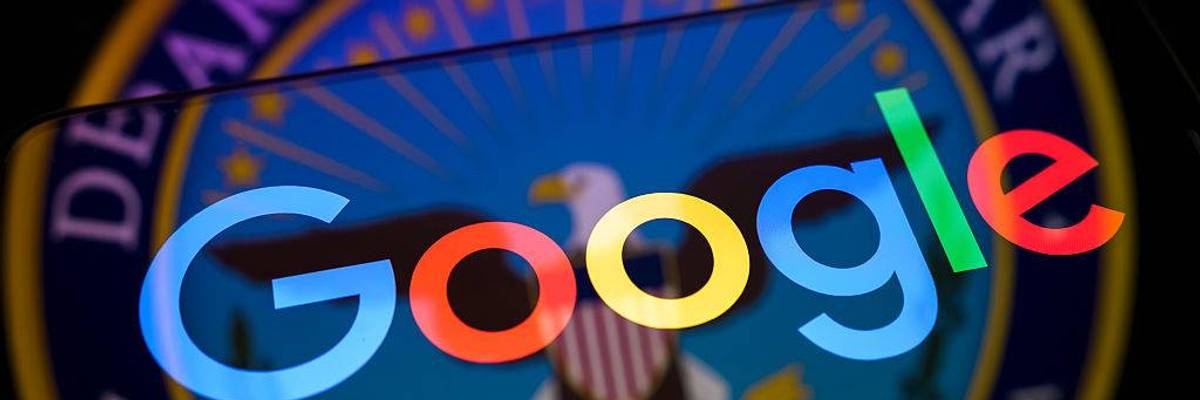
The Google logo is displayed on a smartphone screen placed on a reflective surface onto which the Department of Defense emblem is projected, in Creteil, France, on May 4, 2026.
"This highlights the danger of allowing an unregulated monopolist to control an essential service," said former Federal Trade Commission Chair Lina Khan.
Tech giant Alphabet, the parent company of Google, is telling US schools that there's a price to be paid for restricting student access to its artificial intelligence tools.
The New York Times reported on Tuesday that, starting early next year, schools that fully disable the company's AI will also lose access to its search engine, which is by far the most used internet search tool in the world.
Chris Phillips, vice president for education at Google, justified the policy by claiming that "Search and AI are deeply integrated," adding that students attending schools where AI is banned "will not have access to Search, and they’ll see a message from their school that indicates it’s not available."
As the Times noted, Google has deeply integrated itself into US classrooms, many of which rely on its Classroom assignment platform and equip students with low-cost Chromebook laptops.
"The company’s new strategy underscores Google’s powerful role in American education," the Times explained. "If school leaders want continued student access to Search within the company’s ecosystem, they will be forced to embrace Google's AI."
Schools around the US have been banning the use of AI for young students over concerns that reliance on the technology will hinder the development of critical thinking skills and also enable mass cheating on assignments.
Morgan Polikoff, an education professor at the University of Southern California, told the Times that he expects Google's new policy linking AI and Search will only add more fuel to the backlash against the tech industry.
"This is a particularly clear example of the tech industry going out of its way to force AI on us all," said Polikoff, "even if we have said we don’t want it."
Lina Khan, former chair of the Federal Trade Commission under President Joe Biden, accused Google of "using its search monopoly to coerce schools into adopting AI," and said it was yet another reason why antitrust action should be taken against the company.
"This highlights the danger of allowing an unregulated monopolist to control an essential service," Khan wrote in a social media post. "Multiple courts have found Google liable for violating antitrust laws, and this latest move shows it remains unchastened. As the public increasingly pushes back against the use of AI in schools, Google is making clear it will punish those who don’t fall in line."
New York City Mayor Zohran Mamdani, whose city earlier this year banned AI in elementary and middle schools, similarly took Google to task for trying to force its products onto students.
"No corporation should have the power to dictate how we teach our children," Mamdani wrote. "Our public schools exist to serve students, not to grow the profit margins of Big Tech."
Sen. Bernie Sanders (I-Vt.) used news of Google's new AI school policy to take a shot at President Donald Trump, who has constantly downplayed the need for any regulation of the industry.
"President Trump claimed that AI oligarchs could regulate themselves because they 'love our country,'" Sanders wrote. "Now, Google is threatening schools: If you stop your students from using AI, we will cut off your access to Google Search. That’s not love. That’s extortion."
Cognitive scientist Gary Marcus, a longtime skeptic of the AI industry, responded to Google's move by writing, "This is evil."
Author Kashana Cauley remarked that Google's motto used to be "don't be evil," whereas today its motto appears to be, "We are now holding your kids and their schools hostage."
Cauley added that schools wouldn't be in this position if they hadn't taken up Google's offer to supply low-cost Chromebooks for students.
"The schools shouldn’t be beholden to district-wide Chromebook deals if Google is holding us hostage," she wrote. "We need to get Chromebooks and Google out of the schools."
This country and this world are at a monumental crossroads. US voters have an opportunity to beat back the forces of fascism and confront the billionaires who are rigging the economy, our media system, and our democracy, making it increasingly impossible for ordinary people to get by. We’re not just talking about the election. We’re talking about what must be done once these fascist elements are vanquished from power. We need a bolder set of solutions than what either major party has so far been willing to offer and a working-class movement ready to fight like hell for it. Trump didn't emerge from nowhere. The conditions that fueled MAGA authoritarianism were created by decades of radical neoliberal economic policies and a corrupt political system dominated by corporate interests. They slashed taxes on the super-rich, promising that the benefits would trickle down. They said giveaways to the corporate titans would make life more affordable for the rest of us. It was all bullshit. And when a bitter, betrayed populace searches for someone to blame, right-wing demagogues have little trouble finding scapegoats. People know when they're being lied to, but you won't hear any of this from the corporate media. Only independent journalism—powered and funded by people who believe in building a better world—can deliver truly trustworthy daily news. If you share our vision, please contribute whatever you can to sustain our work. |
Tech giant Alphabet, the parent company of Google, is telling US schools that there's a price to be paid for restricting student access to its artificial intelligence tools.
The New York Times reported on Tuesday that, starting early next year, schools that fully disable the company's AI will also lose access to its search engine, which is by far the most used internet search tool in the world.
Chris Phillips, vice president for education at Google, justified the policy by claiming that "Search and AI are deeply integrated," adding that students attending schools where AI is banned "will not have access to Search, and they’ll see a message from their school that indicates it’s not available."
As the Times noted, Google has deeply integrated itself into US classrooms, many of which rely on its Classroom assignment platform and equip students with low-cost Chromebook laptops.
"The company’s new strategy underscores Google’s powerful role in American education," the Times explained. "If school leaders want continued student access to Search within the company’s ecosystem, they will be forced to embrace Google's AI."
Schools around the US have been banning the use of AI for young students over concerns that reliance on the technology will hinder the development of critical thinking skills and also enable mass cheating on assignments.
Morgan Polikoff, an education professor at the University of Southern California, told the Times that he expects Google's new policy linking AI and Search will only add more fuel to the backlash against the tech industry.
"This is a particularly clear example of the tech industry going out of its way to force AI on us all," said Polikoff, "even if we have said we don’t want it."
Lina Khan, former chair of the Federal Trade Commission under President Joe Biden, accused Google of "using its search monopoly to coerce schools into adopting AI," and said it was yet another reason why antitrust action should be taken against the company.
"This highlights the danger of allowing an unregulated monopolist to control an essential service," Khan wrote in a social media post. "Multiple courts have found Google liable for violating antitrust laws, and this latest move shows it remains unchastened. As the public increasingly pushes back against the use of AI in schools, Google is making clear it will punish those who don’t fall in line."
New York City Mayor Zohran Mamdani, whose city earlier this year banned AI in elementary and middle schools, similarly took Google to task for trying to force its products onto students.
"No corporation should have the power to dictate how we teach our children," Mamdani wrote. "Our public schools exist to serve students, not to grow the profit margins of Big Tech."
Sen. Bernie Sanders (I-Vt.) used news of Google's new AI school policy to take a shot at President Donald Trump, who has constantly downplayed the need for any regulation of the industry.
"President Trump claimed that AI oligarchs could regulate themselves because they 'love our country,'" Sanders wrote. "Now, Google is threatening schools: If you stop your students from using AI, we will cut off your access to Google Search. That’s not love. That’s extortion."
Cognitive scientist Gary Marcus, a longtime skeptic of the AI industry, responded to Google's move by writing, "This is evil."
Author Kashana Cauley remarked that Google's motto used to be "don't be evil," whereas today its motto appears to be, "We are now holding your kids and their schools hostage."
Cauley added that schools wouldn't be in this position if they hadn't taken up Google's offer to supply low-cost Chromebooks for students.
"The schools shouldn’t be beholden to district-wide Chromebook deals if Google is holding us hostage," she wrote. "We need to get Chromebooks and Google out of the schools."