SUBSCRIBE TO OUR FREE NEWSLETTER
Daily news & progressive opinion—funded by the people, not the corporations—delivered straight to your inbox.
5
#000000
#FFFFFF
To donate by check, phone, or other method, see our More Ways to Give page.



Then, in the last week of July, when a host of international experts, monitors, and humanitarian aid groups declared that Gaza was plunging into a state of famine, I wondered if big media would expand or improve their coverage accordingly. Now that Palestinian photographers have provided us with countless images of mothers holding skeletal children in their arms, one might expect that Israel's campaign to expel the Palestinian people from their homeland, if not wipe them out entirely, would be the story at every news outlet every day. You'd think the issue would be blowing up on social media across the political spectrum. You'd think that, as a result, Congress and the White House would be inundated with demands that they crack down on Israel and finally get enough food into Gaza.
So I looked around, and some establishment media have indeed increased their quantity of coverage. But few are expressing the heightened sense of horror and urgency that's needed at this juncture. Their tone often reads or sounds as if they're reporting on the aftermath of a wildfire or earthquake or plane crash. And context is still missing. In every report or commentary, they should be reminding readers, viewers, or listeners that Israel could not have inflicted such unspeakable cruelty and human suffering on this vast scale for almost two years without Washington's full support. They're neglecting (or deciding?) not to provide that crucial background, much less recognize the Palestinian people's right to live free in their own homeland.
 (Photo: Priti Gulati Cox)
When it comes to cheerleading for Zionism—and blithely supporting a full-blown genocide to boot—The New York Times is the consensus champion. In the past two years, Palestine supporters have blasted the old paper harder than ever for spreading pro-Israel propaganda with its reporting, for the smug callousness of its opinion writers, and for passive-voice headlines giving the impression that the source of Palestinians' endless suffering is a mystery. Here, though, I'll leave monitoring of the Times to the pros and focus instead on many liberals' favorite "objective" news source, the beleaguered National Public Radio.
It had been clear since this spring that if the Israeli occupation continued blocking food supplies from entering Gaza, famine would eventually sweep through the territory. Then on July 29, the International Integrated Food Security Phase Classification, the technical body that declares when and where famines occur, issued an alert stating in part"
The worst-case scenario of Famine is currently playing out in the Gaza Strip. Conflict and displacement have intensified, and access to food and other essential items and services has plummeted to unprecedented levels. Mounting evidence shows that widespread starvation, malnutrition, and disease are driving a rise in hunger-related deaths. Latest data indicates that Famine thresholds have been reached for food consumption in most of the Gaza Strip and for acute malnutrition in Gaza City. Immediate action must be taken to end the hostilities and allow for unimpeded, large-scale, life-saving humanitarian response. This is the only path to stopping further deaths and catastrophic human suffering.
This came as no surprise. In the course of the previous week, increasing numbers of children were reported to be starving to death, and more than a hundred aid organizations issued a statement warning of "mass starvation," as the "Israeli government's siege starves the people of Gaza." As early as July 19, the Palestinian Information Center put out a report titled, "Famine Claims Hundreds of Lives, Including 69 Children." So around July 22, I started checking to see if corporate and public media were ramping up their coverage of Israel's genocide and if so, what they were reporting.
The major U.S. TV networks have expanded their coverage, for the most part. The Times and Washington Post appear to have done so as well, but I, like many, canceled my subscriptions to them last year, so all I know of the substance of their reporting comes from their detractors. The Guardian has had lots of stories on some days and not much on others. Magazines vary. The New Yorker has done OK; don't miss the interviews in which Isaac Chotiner has grilled and fact-checked Israeli apologists. The Atlantic has paid little attention, and what they have published comes mostly from the keyboard of Yair Rosenberg, their earnest purveyor of Zionist propaganda. Slate and The New Republic seem to have run very little if anything.
I examined NPR's coverage more systematically, by looking through the archives of "Morning Edition" and "All Things Considered," their top daily news programs. I sampled random dates (without looking at show contents beforehand), including eight shows, four from each program, in the July 2–17 timespan, that is, before there was much talk of imminent famine in Gaza. I then sampled 14 shows that aired in the July 18–31 period, when a quickening drumbeat of increasingly dire famine warnings was sounding.
In the sample of shows between June 2 and 17, I found exactly one report related to Israel's war on Gaza. It was a gripping, harrowing story featuring NPR Gaza producer Anas Baba's attempt to obtain food for his family by venturing to one of the phony, deadly food distribution centers being run by American mercenaries. It was very good, but it was alone; there were no reports on Gaza among the other 148 segments aired during the eight shows I checked.
Like most outlets, NPR started paying more attention as famine closed in on Gaza between July 18 and 31. Of the 226 segments included in the 14 shows I sampled from that period, 18, or 8%, covered Israel's war on Gaza. Anas Baba reported again on the "food aid" death traps and also on Israel's threat to kill any Palestinian who ventured into the Mediterranean Sea, thereby blocking people from catching fish to feed their families. There were stories about cease-fire talks and starvation among Gaza's journalists. Then there was an interview of a British surgeon who had been operating on gunshot victims at Nasser Hospital. Among other shocking revelations, he noted that "one day we will see mainly abdominal gunshot wounds. Another day we'll see head gunshot wounds. Another day we'll see neck gunshot wounds. So there is a very clear pattern that all, not just me but all of us, have seen in this hospital, whereby particular body parts are targeted [by Israeli troops] on particular days." Though few and far between, reports like those, especially ones with Anas Baba's byline, gave a good sense of what's happening in Gaza.
But other segments told a very different story.
On July 23, with children dying of starvation in ever-greater numbers, "All Things Considered" host Ari Shapiro interviewed the vice president of global policy for the aid organization Mercy Corps about the group's just-issued statement on mass starvation in Gaza. Having prefaced an earlier question by saying, "I know that food has been scarce since the beginning of this war," Shapiro asked, concerning the food centers run by U.S. mercenaries, "Can you explain why this scheme is so much more dangerous than the previous U.N. model that you would like to see come back?"
The interviewee responded, in part, "In order to get there, [food-seekers are] often going through places that are quite dangerous, either because they're littered with unexploded ordnance or because they have to sort of cross near Israeli forces, and as a result, we've seen these massacres that have occurred. And there's also, just because of the situation I described, how little [food?] there is, often panic and chaos and lack of communication around this. And we see crushing incidents, like happened last week at one of these sites. So as a result, you know, [it's] very dangerous to go to these places."
That exchange may have confused listeners who'd missed on-the-scene reporting by Baba or other Palestinian journalists. Neither the interviewer nor the interviewee was putting nouns and verbs together in ways that make clear who's causing starvation and deaths, or how. Food "has been scarce." Why? The new food scheme is "much more dangerous than the previous U.N. model that you would like to see come back"? You mean those 400 not-at-all-dangerous United Nations food centers that were replaced by four U.S. death traps? Is it only Mercy Corps that wants the U.N. centers back? "Massacres have occurred." How? Does it have something to do with people having to "sort of cross near Israeli forces"?
The Mercy Corps representative mentioned unexploded ordnance, poor communication, and "crushing incidents" but not gunfire by Israeli troops. It is, of course, the latter who have killed more than 1,000 Palestinian civilians at or on the way to food sites. (At the top of the interview, Shapiro does mention that food-seekers are "risking being shot," but that's just more passive-voice equivocation.)
That same day, Shapiro interviewed an Israel representative to the U.N. about his country's blockade that continues to keep food out of Gaza. He allowed the official to repeat Israeli myths that Hamas—Gaza's government—is starving its own people. And as Israeli officials always do, he also blamed Hamas for the failure of cease-fire talks: "There is a cease-fire offer on the table. We said yes, for that cease-fire… We accepted the cease-fire offer. Hamas rejected it... So the blame is on Hamas."
It's Israel that keeps scuttling deals, of course; the official was turning reality inside out. And instead of challenging him on his lies about food aid and the cease-fire talks, Shapiro came back with a clumsy taunt that implicitly accepted the official's bogus claims: "You are saying that Hamas is able to prevent food from reaching the civilian population. Israel has spent almost two years heavily bombarding the Gaza Strip. If that was not enough to loosen the grip of Hamas, does that mean Israel's strategy in this war has been a failure?" Having falsely but successfully pinned blame on Hamas, the official simply dismissed the accusation of failure, saying, "We accomplished a lot," but "We have to finish the job."
Shapiro let those final six chilling words slip by without pointing out what Israelis mean when they say, "finish the job" in Gaza.
Finally, Shapiro bore down hard on the official—not about Israel having created a hell on Earth for 2 million Palestinians, half of them children, and not about Israel slaughtering more than 200 Palestinian journalists or keeping food out of Gaza, but about Israel refusing to allow Western journalists into Gaza. The official offered another vapid answer, and, with the usual, "I'm afraid that's all the time we have," Shapiro put an end to the debacle.
On July 29, virtually every U.S. news outlet, including NPR, reported that two Israeli human rights groups had just taken the fateful step of labeling the war on Gaza a genocide. But "Morning Edition," sustaining its reputation for hearing from both sides—however abhorrent one side's position may be—followed its report on the groups' announcements with a segment headlined, "War scholar discusses why he does not think there is a genocide in Gaza."
Rather than interview, say, an expert in international law, NPR chose John Spencer, an urban warfare scholar from the U.S. Military Academy who has embedded four times with the Israeli occupation forces in Gaza. In response to host Steve Inskeep's softball questions, Spencer disgorged propaganda that may have been even less connected to reality than the hasbara we keep hearing from Israeli officials. Several times, Inskeep responded not by fact-checking Spenser but by asking fresh questions that seemed intended to express incredulity but instead provided the military scholar with more chances to elaborate on his lies. At other times, Inskeep just changed the subject. Here are a few examples from the interview:
Inskeep: We could argue over how many [Palestinians] are combatants or noncombatants, but many are dead. Why is that not genocide?
Spencer: Because that's—I mean, the Genocide Convention's only a few pages. You can read it… And all the mountain of evidence of what Israel is doing to preserve infrastructure, civilian life, to provide services—both medical. I mean, the number of field hospitals, the number of water pipes, the amount of aid…
Inskeep: Do you think there's a single well-functioning hospital in all of Gaza?
Spencer: Yeah… After Israel surrounds them and evacuates them, picks the Hamas out of the crowd, and then lets [the staff] go back in, they go back into operating in some way.
Inskeep [allowing that fairy tale to stand]: Why do you think food has been so desperately short in recent months in Gaza…?
Spencer: Yeah, and there's more than one reason, and this is the problem. Israel attempted the Gaza Humanitarian Foundation effort to try to wrest the grasp of Hamas, depending on who's...
Inskeep [interrupting]: They blamed Hamas for being connected too closely to United Nations efforts and said they'd set up their own. OK.
Spencer: [more false accusations against Hamas, which Inskeep left uncontested]
Inskeep: Why do you think the Israeli effort to replace that food distribution system has worked so poorly?
Spencer: I don't think it's worked poorly… [followed by a string of lies praising the death-trap "food aid" centers run by U.S. mercenaries]
Inskeep: Do you not think that there are people in Israel's government who would like the land for Israel and for the Palestinians to leave?
Spencer: What usually happens in war is, you do move in, and you occupy that ground until you find somebody else to govern it.
Inskeep: Israel has not seemed that interested in finding someone else to govern it.
He was right on that. Israel wants to govern Gaza itself, after driving out its entire population. Lastly, Inskeep suggested a compromise by asking Spencer, in effect, OK, if you reject the term genocide, would you agree that Israel is at least committing war crimes? Spencer refused to do even that, contending that it's only individual soldiers who have "done the wrong thing." And with that, he got the last word. Inskeep wrapped up this bizarre who's-on-first conversation with, "John Spencer, scholar at West Point. Thanks very much."
These NPR interviews nicely illustrate a principle articulated by the scholar Benay Blend in her conclusion to a recent article for The Palestine Chronicle: "Given their reluctance to report anything other than the Official Story, it's not enough to ask that mainstream news cover these stories from Palestine. Given their unqualified reliance on Zionist narratives, it is perhaps best that they don't."
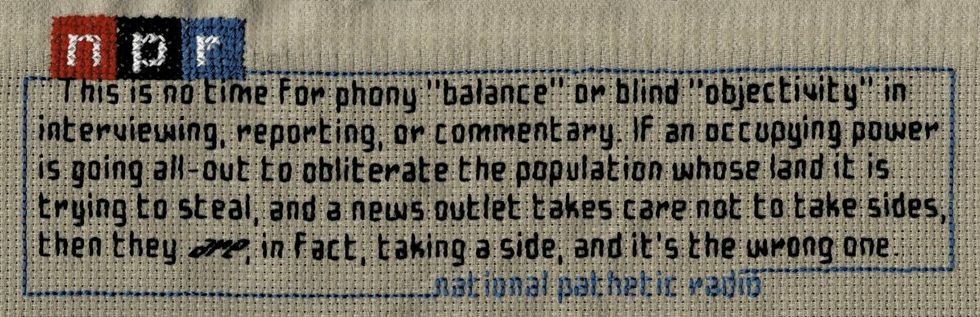
This is no time for phony "balance" or blind "objectivity" in interviewing, reporting, or commentary. If an occupying power is going all-out to obliterate the population whose land it is trying to steal, and a news outlet takes care not to take sides, then they are, in fact, taking a side, and it's the wrong one.