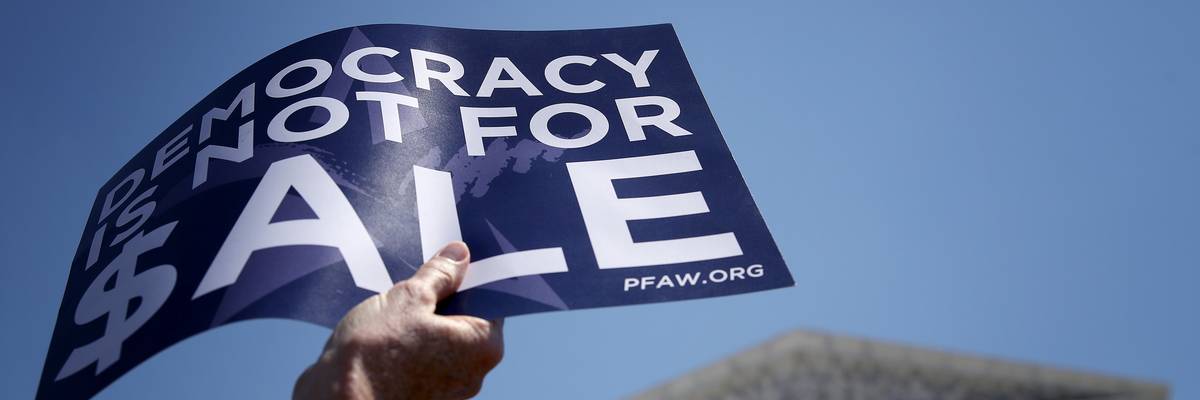
A protester holds a sign reading "Democracy Is Not for $ale" outside the US Supreme Court in Washington, DC in 2019.
Before Citizens United, Corporations Spent $12.8 Million on 2010 Elections. In 2026? $737 Million
"This election cycle shows beyond any doubt that we desperately need a constitutional amendment to overturn Citizens United," said the co-president of a prominent consumer advocacy group.
Data published Thursday by a leading consumer watchdog group revealed that corporate spending on US elections has soared by more than 5,000% since an infamous 2010 Supreme Court ruling that opened the floodgates of outside political contributions—a staggering increase that critics said underscored the need for major campaign finance reform.
Public Citizen released an analysis of newly filed federal campaign finance data showing that corporate political spending has grown exponentially since the 2010 midterm election cycle, the first of the Citizens United era.
Citizens United v. Federal Election Commission affirmed corporate personhood and that unlimited political spending by corporations, nonprofit organizations, labor unions, and other groups is a form of free speech protected by the First Amendment that government cannot restrict. The decision ushered in the era of super political action committees (PACs)—which can raise unlimited amounts of money to spend on campaigns—and secret spending on elections with so-called “dark money.”
According to the data studied by Public Citizen, corporate spending totaled $12.8 million for the 2010 election cycle. By the 2012 cycle, it had surged to $84.9 million. During the 2016 cycle, it spiked to $117.9 million.
NEW from @publiccitizen.bsky.social:Corporate money in the 2026 midterms has reached an unprecedented $737 million, October filings show.Full report: www.citizen.org/article/corp...
[image or embed]
— Rick Claypool (@rickclaypool.bsky.social) October 29, 2026 at 10:55 AM
For 2026, "spending this cycle"—over $737 million— accounts for "40% of the $1.8 billion corporations have spent on federal elections" since 2010," Public Citizen said.
"Cryptocurrency, online betting, and Big Tech interests—including companies involved in [artificial intelligence] and data centers—have collectively contributed $391 million toward the 2026 elections," the group noted. "This accounts for more than half of corporate political spending reported this cycle."
The analysis shows that the 50 largest donors and organizations had collectively contributed $2.77 billion, with Republican-aligned contributors accounting for roughly 60% of that amount.
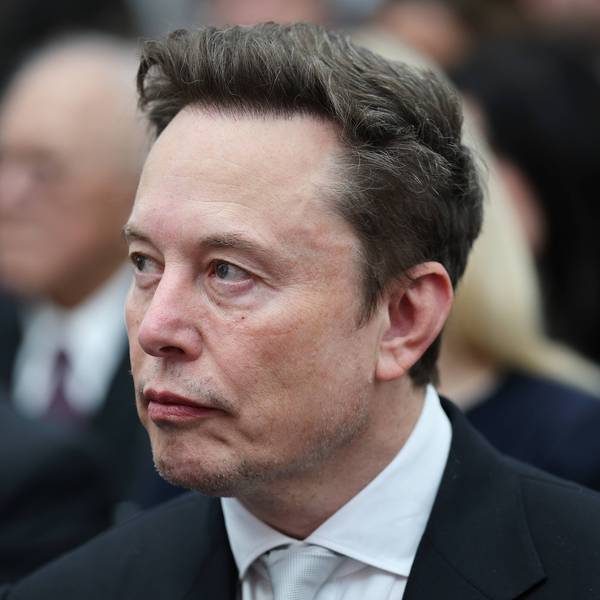
Elon Musk—the world's richest person and first trillionaire in history—led the pack, giving over $445 million to conservative candidates and causes. This, after the tech titan and former de facto head of the short-lived Department of Government Efficiency poured more than a quarter billion dollars into the campaign coffers of then-former President Donald Trump's successful reelection bid and Republican congressional candidates during the 2024 cycle.
“Corporations are exploiting Citizens United to drive their political spending to unprecedented levels,” Robert Weissman, Public Citizen's co-president, said Thursday.
“These corporations aren’t investing this money because they are civic-minded or want to advance a particular viewpoint," he continued. "They are spending to buy influence, determine outcomes, and shape policy. This election cycle shows beyond any doubt that we desperately need a constitutional amendment to overturn Citizens United and put the people, not corporations or the super rich, back in charge of elections."
Democrats are trying to do just that. Last year, Congresswoman Pramila Jayapal (D-Wash.) led more than two dozen lawmakers in introducing the We the People Amendment, a constitutional amendment that would reverse Citizens United.
The following month, Sen. Jeanne Shaheen (D-NH) led 39 upper chamber Democrats plus Sens. Bernie Sanders (I-Vt.) and Angus King (I-Maine) in reintroducing the Democracy for All Amendment. The proposal would allow Congress and state legislatures to impose some limits on money raised and spent to influence elections, distinguish between people and corporations, and prohibit corporate election spending.
But it might not take a constitutional amendment—something that is exceedingly difficult to pass, by design—to undo Citizens United.
Mother Jones reported Thursday that Montana could become a testing ground for a new legal strategy to reverse the effects of the ruling without having to overturn the decision. Instead, Montana is challenging corporations’ legal powers under state law rather than targeting their constitutionally protected political "speech" in the form of spending.
The strategy, known as the Montana Plan, will be put to voters on Election Day in the form of Initiative 194, which would prohibit corporations, nonprofits, labor unions, trade associations, and other special interests from spending money to support or oppose candidates, political parties, or state and local ballot measures. Violators could forfeit their state-granted privileges, including limited liability.
If approved, it could provide a model for other states seeking to curb corporate political spending and anonymous campaign financing.
Other efforts include a Sanders-led push for the Democratic Party to ban super PAC and dark money spending in its primaries.
"We cannot allow billionaires and powerful corporate interests to continue undermining democracy by injecting unlimited amounts of money into the political process," Sanders and seven Senate backers of his proposal asserted last year.
We are at a crossroads
This country and this world are at a monumental crossroads. US voters have an opportunity to beat back the forces of fascism and confront the billionaires who are rigging the economy, our media system, and our democracy, making it increasingly impossible for ordinary people to get by. We’re not just talking about the election. We’re talking about what must be done once these fascist elements are vanquished from power. We need a bolder set of solutions than what either major party has so far been willing to offer and a working-class movement ready to fight like hell for it. Trump didn't emerge from nowhere. The conditions that fueled MAGA authoritarianism were created by decades of radical neoliberal economic policies and a corrupt political system dominated by corporate interests. They slashed taxes on the super-rich, promising that the benefits would trickle down. They said giveaways to the corporate titans would make life more affordable for the rest of us. It was all bullshit. And when a bitter, betrayed populace searches for someone to blame, right-wing demagogues have little trouble finding scapegoats. People know when they're being lied to, but you won't hear any of this from the corporate media. Only independent journalism—powered and funded by people who believe in building a better world—can deliver truly trustworthy daily news. Our Fall Campaign is underway, and we need your help. To power our newsroom through the rest of the year, we need to raise $125,000 by midnight on October 31. So if you share our vision, please contribute whatever you can to sustain our work. |
Data published Thursday by a leading consumer watchdog group revealed that corporate spending on US elections has soared by more than 5,000% since an infamous 2010 Supreme Court ruling that opened the floodgates of outside political contributions—a staggering increase that critics said underscored the need for major campaign finance reform.
Public Citizen released an analysis of newly filed federal campaign finance data showing that corporate political spending has grown exponentially since the 2010 midterm election cycle, the first of the Citizens United era.
Citizens United v. Federal Election Commission affirmed corporate personhood and that unlimited political spending by corporations, nonprofit organizations, labor unions, and other groups is a form of free speech protected by the First Amendment that government cannot restrict. The decision ushered in the era of super political action committees (PACs)—which can raise unlimited amounts of money to spend on campaigns—and secret spending on elections with so-called “dark money.”
According to the data studied by Public Citizen, corporate spending totaled $12.8 million for the 2010 election cycle. By the 2012 cycle, it had surged to $84.9 million. During the 2016 cycle, it spiked to $117.9 million.
NEW from @publiccitizen.bsky.social:Corporate money in the 2026 midterms has reached an unprecedented $737 million, October filings show.Full report: www.citizen.org/article/corp...
[image or embed]
— Rick Claypool (@rickclaypool.bsky.social) October 29, 2026 at 10:55 AM
For 2026, "spending this cycle"—over $737 million— accounts for "40% of the $1.8 billion corporations have spent on federal elections" since 2010," Public Citizen said.
"Cryptocurrency, online betting, and Big Tech interests—including companies involved in [artificial intelligence] and data centers—have collectively contributed $391 million toward the 2026 elections," the group noted. "This accounts for more than half of corporate political spending reported this cycle."
The analysis shows that the 50 largest donors and organizations had collectively contributed $2.77 billion, with Republican-aligned contributors accounting for roughly 60% of that amount.
Elon Musk—the world's richest person and first trillionaire in history—led the pack, giving over $445 million to conservative candidates and causes. This, after the tech titan and former de facto head of the short-lived Department of Government Efficiency poured more than a quarter billion dollars into the campaign coffers of then-former President Donald Trump's successful reelection bid and Republican congressional candidates during the 2024 cycle.
“Corporations are exploiting Citizens United to drive their political spending to unprecedented levels,” Robert Weissman, Public Citizen's co-president, said Thursday.
“These corporations aren’t investing this money because they are civic-minded or want to advance a particular viewpoint," he continued. "They are spending to buy influence, determine outcomes, and shape policy. This election cycle shows beyond any doubt that we desperately need a constitutional amendment to overturn Citizens United and put the people, not corporations or the super rich, back in charge of elections."
Democrats are trying to do just that. Last year, Congresswoman Pramila Jayapal (D-Wash.) led more than two dozen lawmakers in introducing the We the People Amendment, a constitutional amendment that would reverse Citizens United.
The following month, Sen. Jeanne Shaheen (D-NH) led 39 upper chamber Democrats plus Sens. Bernie Sanders (I-Vt.) and Angus King (I-Maine) in reintroducing the Democracy for All Amendment. The proposal would allow Congress and state legislatures to impose some limits on money raised and spent to influence elections, distinguish between people and corporations, and prohibit corporate election spending.
But it might not take a constitutional amendment—something that is exceedingly difficult to pass, by design—to undo Citizens United.
Mother Jones reported Thursday that Montana could become a testing ground for a new legal strategy to reverse the effects of the ruling without having to overturn the decision. Instead, Montana is challenging corporations’ legal powers under state law rather than targeting their constitutionally protected political "speech" in the form of spending.
The strategy, known as the Montana Plan, will be put to voters on Election Day in the form of Initiative 194, which would prohibit corporations, nonprofits, labor unions, trade associations, and other special interests from spending money to support or oppose candidates, political parties, or state and local ballot measures. Violators could forfeit their state-granted privileges, including limited liability.
If approved, it could provide a model for other states seeking to curb corporate political spending and anonymous campaign financing.
Other efforts include a Sanders-led push for the Democratic Party to ban super PAC and dark money spending in its primaries.
"We cannot allow billionaires and powerful corporate interests to continue undermining democracy by injecting unlimited amounts of money into the political process," Sanders and seven Senate backers of his proposal asserted last year.