SUBSCRIBE TO OUR FREE NEWSLETTER
Daily news & progressive opinion—funded by the people, not the corporations—delivered straight to your inbox.
5
#000000
#FFFFFF
To donate by check, phone, or other method, see our More Ways to Give page.
Daily news & progressive opinion—funded by the people, not the corporations—delivered straight to your inbox.
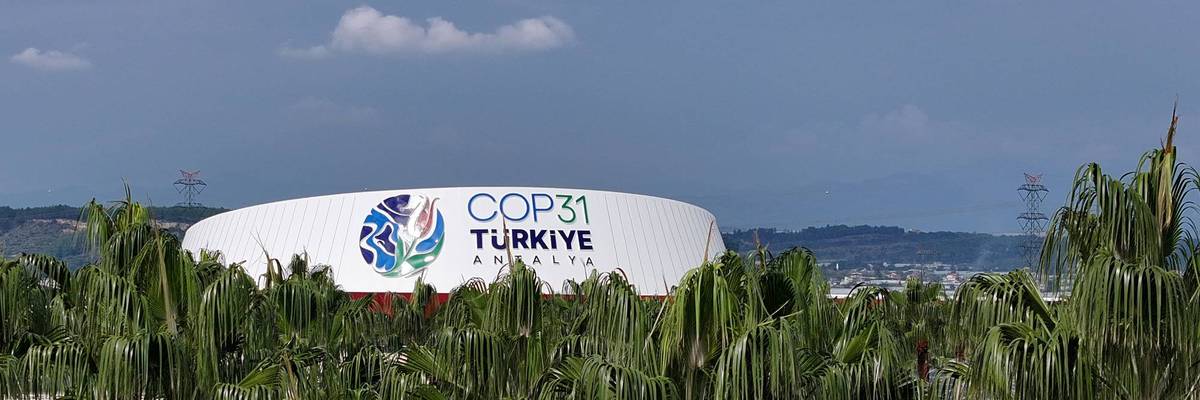
The venue prepared for the 31st Conference of the Parties to the United Nations Framework Convention on Climate Change is shown from the air in Antalya, Türkiye, on November 2, 2026.
"It offers every country a menu of policies to build its own plan to move away from coal, oil, and gas, whether it's a major producer, a big consumer, or an economy that depends on imports."
With the next United Nations Climate Change Conference less than a week away, greenhouse gas levels soaring, and a temporary overshoot of the Paris Agreement's 1.5°C goal now inevitable, Brazil, the host of last year's COP30, on Tuesday published a pair of roadmaps for transitioning away from planet-heating fossil fuels and tackling deforestation.
"We don't need more negotiations. What we need is for governments to start taking action," André Aranha Corrêa do Lago, the Brazilian diplomat who served as the president of COP30, told Reuters. "We need to completely change the way governments deal with climate change. To implement this, we need finance, infrastructure, and transportation ministers at the table."
In his foreword for the transition report, Corrêa do Lago explained that at the closing plenary in Belém last November, "and in the context of the COP being held in the Amazon, I committed to developing... roadmaps for implementing two outcomes of the First Global Stocktake, agreed by consensus at COP28 just two years earlier: (i) transitioning away from fossil fuels in energy systems in a just, orderly, and equitable manner; and (ii) enhancing efforts toward halting and reversing deforestation and forest degradation by 2030. With their publication, that commitment is fulfilled."
"Both transitions depend on finance," he stressed. "The two roadmaps are therefore presented alongside a third document, 'Implementing the Baku to Belém Roadmap to 1.3T,' which sets out how financing to developing countries for climate action can be scaled up from all public and private sources to at least US$1.3 trillion per year by 2035. Read together, the three documents describe what has to change and propose ways forward so that change can be financed and sustained."
After ending with what critics called "an empty deal," COP30 was condemned as a "catastrophic failure to take concrete action to implement a funded and fair fossil fuel phaseout," and there was some criticism of the new roadmaps for also not going far enough.
Greenpeace Brazil executive director Carolina Pasquali said in a statement that "this is a major effort by the COP30 presidency and a crucial step towards ensuring the COP28 decision to transition away from fossil fuels is fully implemented. As our climate races towards a 1.5°C overshoot, the roadmap encourages important measures but stops short of setting clear fossil fuel phaseout targets or calling for an immediate halt to the expansion of fossil fuels."
However, Pasquali praised the forests roadmap—launched in the aftermath of Brazilian President Luiz Inácio Lula da Silva's reelection victory over far-right candidate Flávio Bolsonaro—which she said "represents a major effort from the COP30 presidency and was launched with the credibility of a Brazilian government that has achieved the lowest deforestation rate in its history. The presidency has helped bring together, through multiple contributions and dialogues, a wide range of existing initiatives and views."
It remains slightly mad that governments have agreed to phase out fossil fuels from energy systems, but can't agree to even the principle that having a plan for doing so would be a good idea. www.businessgreen.com/news-analysi...
[image or embed]
— James Murray (@james-bg.bsky.social) November 3, 2026 at 11:34 AM
Despite some shortcomings, other climate campaigners welcomed the roadmaps—released as activists and world leaders alike prepare for COP31, which is scheduled to kick off Monday in Antalya, Türkiye.
"Brazil has offered a valuable blueprint for the global transition away from fossil fuels," said Oil Change International global policy lead Romain Ioualalen in a statement. "It recognizes there is no one-size-fits-all pathway, that all countries need to plan their transition now, and that equity and finance are critical to achieving fossil-free prosperity in many countries."
Like Corrêa do Lago, he emphasized that "now that we have a global roadmap, we need to see action. If all this process leads to is another series of dialogues, it will be a massive missed opportunity in an already closing window. Countries need to develop their own domestic roadmaps that plan their economic diversification away from fossil fuels using the guidance and tools provided by Brazil’s report."
"We also need to see the global Mutirão for the transition away from fossil fuels deliver key decisions that allow countries with strong economic and energy constraints to unlock their transition. The Second Global Stocktake in 2028 will be a critical opportunity to make that happen," Ioualalen continued.
"Delivering on this global roadmap for countries with deep financial constraints hinges on finance. But it does outline some finance tools that have a track record of failing, like debt swaps and derisking methods," he noted. "Enough public finance can be delivered to fund a fair fossil fuel phaseout as rich countries can unlock trillions every year through taxing polluters and extreme wealth, ending fossil fuel subsidies, and reforming unfair financial rules."
Ioualalen added that "one area of real concern is the suggestion that global action on reducing fossil fuel supply could wait until the 2030s. That would be a grave mistake, and a guarantee to further lock in fossil fuels and for a chaotic transition. Existing fossil fuel extraction projects already commit the world to emissions nearly seven times the remaining 1.5°C carbon budget. There is no time to pass the baton between supply and demand. Both need to be addressed now, through a fair, funded, and fast transition."
“The roadmaps are valuable but fall short of clearly indicating the pace of change needed by including no timeline or key benchmarks” ~Joeri Rogelj, professor of climate science and policy at Imperial College London.
[image or embed]
— Suzanne York (@suzanneyork.bsky.social) November 3, 2026 at 12:06 PM
Fanny Petitbon, a policy analyst at the international movement 350.org, similarly said that "this roadmap is a critical handbook for ending the fossil fuel era, which leaves governments with no excuse not to act. It offers every country a menu of policies to build its own plan to move away from coal, oil, and gas, whether it's a major producer, a big consumer, or an economy that depends on imports."
"Electrification is absolutely central to this transition, but it will only deliver if it is powered by renewable energy, matched by investment in modern grids, and brings clean, affordable energy to everyone," she highlighted. "We cannot swap one energy system for another while leaving the same communities behind."
Petitbon argued that "the roadmap must not end up as just another report gathering dust on a shelf. France, the Netherlands, and Germany have already published national roadmaps, but they fall short of the ambition the climate crisis demands and of their responsibility in it. Pacific Island states plan to deliver a regional strategy to break free from fossil fuels. So the question for all major emitters is simple: When will you submit your roadmap?"
"Rich nations must also mobilize public finance to support developing countries with their transition and ensure that the fossil fuel industry cannot continue to profit from a crisis that is costing people their livelihoods, health, and homes," she asserted. "COP31 must be the moment when governments take this work forward, with clear commitments, timelines, and the resources to deliver a fair and orderly exit from coal, oil, and gas."
"The COP30 presidency has set out clear next steps, and future COPs must keep this issue at the top of the agenda every year so the momentum is never lost," she added. "2028 will be the moment of truth. As the world will take stock of how far it has come in delivering the Paris Agreement, it will become clear who has honored the promise made in Dubai to transition away from fossil fuels, and who has walked away from it."
This country and this world are at a monumental crossroads. US voters have an opportunity to beat back the forces of fascism and confront the billionaires who are rigging the economy, our media system, and our democracy, making it increasingly impossible for ordinary people to get by. We’re not just talking about the election. We’re talking about what must be done once these fascist elements are vanquished from power. We need a bolder set of solutions than what either major party has so far been willing to offer and a working-class movement ready to fight like hell for it. Trump didn't emerge from nowhere. The conditions that fueled MAGA authoritarianism were created by decades of radical neoliberal economic policies and a corrupt political system dominated by corporate interests. They slashed taxes on the super-rich, promising that the benefits would trickle down. They said giveaways to the corporate titans would make life more affordable for the rest of us. It was all bullshit. And when a bitter, betrayed populace searches for someone to blame, right-wing demagogues have little trouble finding scapegoats. People know when they're being lied to, but you won't hear any of this from the corporate media. Only independent journalism—powered and funded by people who believe in building a better world—can deliver truly trustworthy daily news. If you share our vision, please contribute whatever you can to sustain our work. |
With the next United Nations Climate Change Conference less than a week away, greenhouse gas levels soaring, and a temporary overshoot of the Paris Agreement's 1.5°C goal now inevitable, Brazil, the host of last year's COP30, on Tuesday published a pair of roadmaps for transitioning away from planet-heating fossil fuels and tackling deforestation.
"We don't need more negotiations. What we need is for governments to start taking action," André Aranha Corrêa do Lago, the Brazilian diplomat who served as the president of COP30, told Reuters. "We need to completely change the way governments deal with climate change. To implement this, we need finance, infrastructure, and transportation ministers at the table."
In his foreword for the transition report, Corrêa do Lago explained that at the closing plenary in Belém last November, "and in the context of the COP being held in the Amazon, I committed to developing... roadmaps for implementing two outcomes of the First Global Stocktake, agreed by consensus at COP28 just two years earlier: (i) transitioning away from fossil fuels in energy systems in a just, orderly, and equitable manner; and (ii) enhancing efforts toward halting and reversing deforestation and forest degradation by 2030. With their publication, that commitment is fulfilled."
"Both transitions depend on finance," he stressed. "The two roadmaps are therefore presented alongside a third document, 'Implementing the Baku to Belém Roadmap to 1.3T,' which sets out how financing to developing countries for climate action can be scaled up from all public and private sources to at least US$1.3 trillion per year by 2035. Read together, the three documents describe what has to change and propose ways forward so that change can be financed and sustained."
After ending with what critics called "an empty deal," COP30 was condemned as a "catastrophic failure to take concrete action to implement a funded and fair fossil fuel phaseout," and there was some criticism of the new roadmaps for also not going far enough.
Greenpeace Brazil executive director Carolina Pasquali said in a statement that "this is a major effort by the COP30 presidency and a crucial step towards ensuring the COP28 decision to transition away from fossil fuels is fully implemented. As our climate races towards a 1.5°C overshoot, the roadmap encourages important measures but stops short of setting clear fossil fuel phaseout targets or calling for an immediate halt to the expansion of fossil fuels."
However, Pasquali praised the forests roadmap—launched in the aftermath of Brazilian President Luiz Inácio Lula da Silva's reelection victory over far-right candidate Flávio Bolsonaro—which she said "represents a major effort from the COP30 presidency and was launched with the credibility of a Brazilian government that has achieved the lowest deforestation rate in its history. The presidency has helped bring together, through multiple contributions and dialogues, a wide range of existing initiatives and views."
It remains slightly mad that governments have agreed to phase out fossil fuels from energy systems, but can't agree to even the principle that having a plan for doing so would be a good idea. www.businessgreen.com/news-analysi...
[image or embed]
— James Murray (@james-bg.bsky.social) November 3, 2026 at 11:34 AM
Despite some shortcomings, other climate campaigners welcomed the roadmaps—released as activists and world leaders alike prepare for COP31, which is scheduled to kick off Monday in Antalya, Türkiye.
"Brazil has offered a valuable blueprint for the global transition away from fossil fuels," said Oil Change International global policy lead Romain Ioualalen in a statement. "It recognizes there is no one-size-fits-all pathway, that all countries need to plan their transition now, and that equity and finance are critical to achieving fossil-free prosperity in many countries."
Like Corrêa do Lago, he emphasized that "now that we have a global roadmap, we need to see action. If all this process leads to is another series of dialogues, it will be a massive missed opportunity in an already closing window. Countries need to develop their own domestic roadmaps that plan their economic diversification away from fossil fuels using the guidance and tools provided by Brazil’s report."
"We also need to see the global Mutirão for the transition away from fossil fuels deliver key decisions that allow countries with strong economic and energy constraints to unlock their transition. The Second Global Stocktake in 2028 will be a critical opportunity to make that happen," Ioualalen continued.
"Delivering on this global roadmap for countries with deep financial constraints hinges on finance. But it does outline some finance tools that have a track record of failing, like debt swaps and derisking methods," he noted. "Enough public finance can be delivered to fund a fair fossil fuel phaseout as rich countries can unlock trillions every year through taxing polluters and extreme wealth, ending fossil fuel subsidies, and reforming unfair financial rules."
Ioualalen added that "one area of real concern is the suggestion that global action on reducing fossil fuel supply could wait until the 2030s. That would be a grave mistake, and a guarantee to further lock in fossil fuels and for a chaotic transition. Existing fossil fuel extraction projects already commit the world to emissions nearly seven times the remaining 1.5°C carbon budget. There is no time to pass the baton between supply and demand. Both need to be addressed now, through a fair, funded, and fast transition."
“The roadmaps are valuable but fall short of clearly indicating the pace of change needed by including no timeline or key benchmarks” ~Joeri Rogelj, professor of climate science and policy at Imperial College London.
[image or embed]
— Suzanne York (@suzanneyork.bsky.social) November 3, 2026 at 12:06 PM
Fanny Petitbon, a policy analyst at the international movement 350.org, similarly said that "this roadmap is a critical handbook for ending the fossil fuel era, which leaves governments with no excuse not to act. It offers every country a menu of policies to build its own plan to move away from coal, oil, and gas, whether it's a major producer, a big consumer, or an economy that depends on imports."
"Electrification is absolutely central to this transition, but it will only deliver if it is powered by renewable energy, matched by investment in modern grids, and brings clean, affordable energy to everyone," she highlighted. "We cannot swap one energy system for another while leaving the same communities behind."
Petitbon argued that "the roadmap must not end up as just another report gathering dust on a shelf. France, the Netherlands, and Germany have already published national roadmaps, but they fall short of the ambition the climate crisis demands and of their responsibility in it. Pacific Island states plan to deliver a regional strategy to break free from fossil fuels. So the question for all major emitters is simple: When will you submit your roadmap?"
"Rich nations must also mobilize public finance to support developing countries with their transition and ensure that the fossil fuel industry cannot continue to profit from a crisis that is costing people their livelihoods, health, and homes," she asserted. "COP31 must be the moment when governments take this work forward, with clear commitments, timelines, and the resources to deliver a fair and orderly exit from coal, oil, and gas."
"The COP30 presidency has set out clear next steps, and future COPs must keep this issue at the top of the agenda every year so the momentum is never lost," she added. "2028 will be the moment of truth. As the world will take stock of how far it has come in delivering the Paris Agreement, it will become clear who has honored the promise made in Dubai to transition away from fossil fuels, and who has walked away from it."