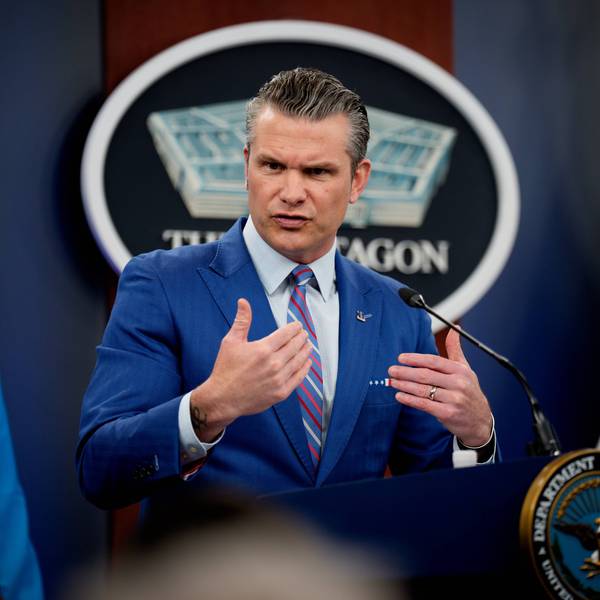
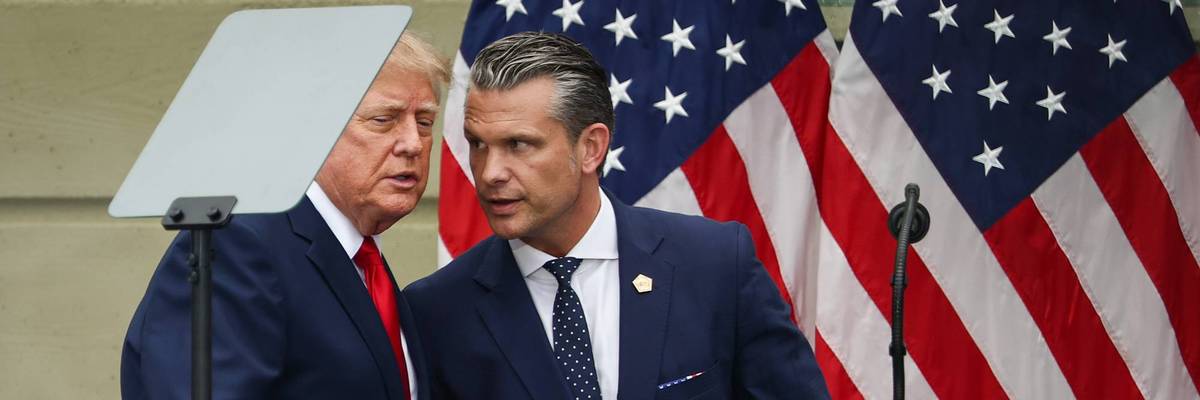
US President Donald Trump shakes hands with Pentagon Secretary Pete Hegseth on September 11, 2026 in Arlington, Virginia.
‘Their Plan Is Insane’: Senator Issues Grave Warning About Post-Election Assault on Iran
If carried out, says Sen. Chris Murphy, the attack Trump and Hegseth are plotting "will lead to devastating escalation and the likely destruction of our commitment to the rule of law."
US Sen. Chris Murphy disclosed Wednesday that he was among the members of Congress recently briefed behind closed doors on the Trump administration's discussions of a possible post-midterm assault on Iran, and he came away with a startling assessment: "Their plan is insane."
Murphy (D-Conn.), who recently traveled to Gulf countries to survey the extensive damage Iran has inflicted on American military installations in retaliation for US President Donald Trump's illegal war, said during an event hosted by the Middle East Institute that he and some of his colleagues got the chance during a classified briefing "to have a fairly detailed conversation about what the war plan would be if we restarted military operations."
Without disclosing specific details from the briefing, the senator said administration officials told lawmakers that a renewed assault would be a "short-duration plan"—a common narrative from an administration that pledged shortly after launching the war that it would be over in a matter of weeks.
"It will lead to devastating escalation and the likely destruction of our commitment to the rule of law," Murphy warned of the administration's post-election plan.
Asked to elaborate, he said that "there's been open reporting as to what we may be planning and the civilian infrastructure that we may be targeting."
"They've been asked by the president to develop a plan," Murphy continued. "The plan that they have developed will lead, in my view, to a prolongment and an escalation of this war that would be devastating for our security interests."
Watch:
Ryan Costello, policy director at the National Iranian American Council (NIAC), called Murphy's remarks "a chilling warning that underscores the need to end the Iran war immediately."
In recent days, major media outlets including The Associated Press, CNN, and The Wall Street Journal have reported that the Trump administration has notified Middle East allies of a potential new military assault on Iran following next week's elections in the US.
According to the Journal, the US "has told several Gulf Arab countries to be prepared for a short, intense military campaign" in Iran following the midterms.
Citing unnamed officials, CNN reported that "Trump has not made up his mind on what he will do after the midterms but that he appears to be leaning toward ordering major action." The outlet noted that "leaders in US Central Command and the Pentagon have been developing a wide-ranging target list, which includes Iranian energy infrastructure, military sites, and nuclear facilities."
Sina Toossi, a senior non-resident fellow at the Center for International Policy, said Thursday that he increasingly believes "some level of infrastructure warfare between the US/Israel and Iran, on a scale we haven't yet seen, is inevitable."
"With that said, I wouldn't expect such an infrastructure war to last long, or reach catastrophic levels, largely because I expect Iran would retaliate on a scale that would compel the US to stop quickly," Toossi continued. "Yet if that doesn't happen, the consequences could be disastrous for all sides. The destruction of critical regional energy infrastructure would greatly exacerbate the existing energy crisis, likely push many economies, including the US, into recession, and deal a devastating blow to the rest of Trump's presidency and his legacy."
"Whether that prospect has already deterred him, however, remains quite unclear," he added.
Trump himself has floated a possible attack on Iran while campaigning for Republicans in recent weeks. At a rally in Lubbock, Texas earlier this week, the president told a crowd of supporters: "You'll see Iran in a couple of weeks, if you don't mind."
"There is a way forward, but it can only materialize once the US administration genuinely accepts that it has no military options."
Meanwhile, US Vice President JD Vance—widely viewed as the leading choice to succeed Trump at the top of the Republican ticket in 2028—has reportedly reached out to a leading Iranian official in a bid to revive diplomatic talks.
The Journal reported on Wednesday that Vance, with Trump's approval, "sent a letter to Mohsen Rezaei, the secretary of Iran’s top security body, the Supreme National Security Council, and previously Iran’s longest-serving commander of the Islamic Revolutionary Guard Corps."
"Vance is testing whether Tehran and Washington could find enough common ground to persuade Trump not to give a final order for a short, intense attack on Iran in the coming weeks," the Journal reported. (Trump, who has repeatedly threatened to "annihilate" Iran, publicly denied that he directed Vance to try to revive peace talks with Iran.)
Costello of NIAC said in a statement Thursday that "while the desire to pursue an off-ramp is positive, Trump needs to walk the walk."
"Thus far, there is little to indicate a new approach and a serious desire to end the war," said Costello. "There is no military solution to the conflict with Iran, yet Trump still seems to think there is and that he’ll get to decide when the next round of fighting pauses. These are wrong-headed and dangerous conclusions to hold."
On the Iranian side, Foreign Minister Abbas Araghchi wrote in a Financial Times op-ed last week that while Tehran is "firmly committed to seeking a dignified peaceful resolution to the conflict, we are also fully prepared to defend ourselves."
"President Donald Trump entered this war on the basis of fundamentally erroneous assumptions about Iran’s fortitude. It appears that he continues to be wrongly told that our armed forces are unprepared to defend the homeland, despite all evidence to the contrary," Araghchi wrote. "To state the obvious, we have no trust whatsoever in the sincerity of the US administration’s professed desire for peace with Iran."
"Given that the White House has shown no willingness to reach an understanding on the way forward, while also threatening more violence, there is little reason to expect progress now," he added. "In spite of all this, as a career diplomat, I am obliged to do my utmost to give diplomacy a chance, even when hope of success is scant... There is a way forward, but it can only materialize once the US administration genuinely accepts that it has no military options."
We are at a crossroads
This country and this world are at a monumental crossroads. US voters have an opportunity to beat back the forces of fascism and confront the billionaires who are rigging the economy, our media system, and our democracy, making it increasingly impossible for ordinary people to get by. We’re not just talking about the election. We’re talking about what must be done once these fascist elements are vanquished from power. We need a bolder set of solutions than what either major party has so far been willing to offer and a working-class movement ready to fight like hell for it. Trump didn't emerge from nowhere. The conditions that fueled MAGA authoritarianism were created by decades of radical neoliberal economic policies and a corrupt political system dominated by corporate interests. They slashed taxes on the super-rich, promising that the benefits would trickle down. They said giveaways to the corporate titans would make life more affordable for the rest of us. It was all bullshit. And when a bitter, betrayed populace searches for someone to blame, right-wing demagogues have little trouble finding scapegoats. People know when they're being lied to, but you won't hear any of this from the corporate media. Only independent journalism—powered and funded by people who believe in building a better world—can deliver truly trustworthy daily news. Our Fall Campaign is underway, and we need your help. To power our newsroom through the rest of the year, we need to raise $125,000 by midnight on October 31. So if you share our vision, please contribute whatever you can to sustain our work. |
US Sen. Chris Murphy disclosed Wednesday that he was among the members of Congress recently briefed behind closed doors on the Trump administration's discussions of a possible post-midterm assault on Iran, and he came away with a startling assessment: "Their plan is insane."
Murphy (D-Conn.), who recently traveled to Gulf countries to survey the extensive damage Iran has inflicted on American military installations in retaliation for US President Donald Trump's illegal war, said during an event hosted by the Middle East Institute that he and some of his colleagues got the chance during a classified briefing "to have a fairly detailed conversation about what the war plan would be if we restarted military operations."
Without disclosing specific details from the briefing, the senator said administration officials told lawmakers that a renewed assault would be a "short-duration plan"—a common narrative from an administration that pledged shortly after launching the war that it would be over in a matter of weeks.
"It will lead to devastating escalation and the likely destruction of our commitment to the rule of law," Murphy warned of the administration's post-election plan.
Asked to elaborate, he said that "there's been open reporting as to what we may be planning and the civilian infrastructure that we may be targeting."
"They've been asked by the president to develop a plan," Murphy continued. "The plan that they have developed will lead, in my view, to a prolongment and an escalation of this war that would be devastating for our security interests."
Watch:
Ryan Costello, policy director at the National Iranian American Council (NIAC), called Murphy's remarks "a chilling warning that underscores the need to end the Iran war immediately."
In recent days, major media outlets including The Associated Press, CNN, and The Wall Street Journal have reported that the Trump administration has notified Middle East allies of a potential new military assault on Iran following next week's elections in the US.
According to the Journal, the US "has told several Gulf Arab countries to be prepared for a short, intense military campaign" in Iran following the midterms.
Citing unnamed officials, CNN reported that "Trump has not made up his mind on what he will do after the midterms but that he appears to be leaning toward ordering major action." The outlet noted that "leaders in US Central Command and the Pentagon have been developing a wide-ranging target list, which includes Iranian energy infrastructure, military sites, and nuclear facilities."
Sina Toossi, a senior non-resident fellow at the Center for International Policy, said Thursday that he increasingly believes "some level of infrastructure warfare between the US/Israel and Iran, on a scale we haven't yet seen, is inevitable."
"With that said, I wouldn't expect such an infrastructure war to last long, or reach catastrophic levels, largely because I expect Iran would retaliate on a scale that would compel the US to stop quickly," Toossi continued. "Yet if that doesn't happen, the consequences could be disastrous for all sides. The destruction of critical regional energy infrastructure would greatly exacerbate the existing energy crisis, likely push many economies, including the US, into recession, and deal a devastating blow to the rest of Trump's presidency and his legacy."
"Whether that prospect has already deterred him, however, remains quite unclear," he added.
Trump himself has floated a possible attack on Iran while campaigning for Republicans in recent weeks. At a rally in Lubbock, Texas earlier this week, the president told a crowd of supporters: "You'll see Iran in a couple of weeks, if you don't mind."
"There is a way forward, but it can only materialize once the US administration genuinely accepts that it has no military options."
Meanwhile, US Vice President JD Vance—widely viewed as the leading choice to succeed Trump at the top of the Republican ticket in 2028—has reportedly reached out to a leading Iranian official in a bid to revive diplomatic talks.
The Journal reported on Wednesday that Vance, with Trump's approval, "sent a letter to Mohsen Rezaei, the secretary of Iran’s top security body, the Supreme National Security Council, and previously Iran’s longest-serving commander of the Islamic Revolutionary Guard Corps."
"Vance is testing whether Tehran and Washington could find enough common ground to persuade Trump not to give a final order for a short, intense attack on Iran in the coming weeks," the Journal reported. (Trump, who has repeatedly threatened to "annihilate" Iran, publicly denied that he directed Vance to try to revive peace talks with Iran.)
Costello of NIAC said in a statement Thursday that "while the desire to pursue an off-ramp is positive, Trump needs to walk the walk."
"Thus far, there is little to indicate a new approach and a serious desire to end the war," said Costello. "There is no military solution to the conflict with Iran, yet Trump still seems to think there is and that he’ll get to decide when the next round of fighting pauses. These are wrong-headed and dangerous conclusions to hold."
On the Iranian side, Foreign Minister Abbas Araghchi wrote in a Financial Times op-ed last week that while Tehran is "firmly committed to seeking a dignified peaceful resolution to the conflict, we are also fully prepared to defend ourselves."
"President Donald Trump entered this war on the basis of fundamentally erroneous assumptions about Iran’s fortitude. It appears that he continues to be wrongly told that our armed forces are unprepared to defend the homeland, despite all evidence to the contrary," Araghchi wrote. "To state the obvious, we have no trust whatsoever in the sincerity of the US administration’s professed desire for peace with Iran."
"Given that the White House has shown no willingness to reach an understanding on the way forward, while also threatening more violence, there is little reason to expect progress now," he added. "In spite of all this, as a career diplomat, I am obliged to do my utmost to give diplomacy a chance, even when hope of success is scant... There is a way forward, but it can only materialize once the US administration genuinely accepts that it has no military options."