SUBSCRIBE TO OUR FREE NEWSLETTER
Daily news & progressive opinion—funded by the people, not the corporations—delivered straight to your inbox.
5
#000000
#FFFFFF
To donate by check, phone, or other method, see our More Ways to Give page.
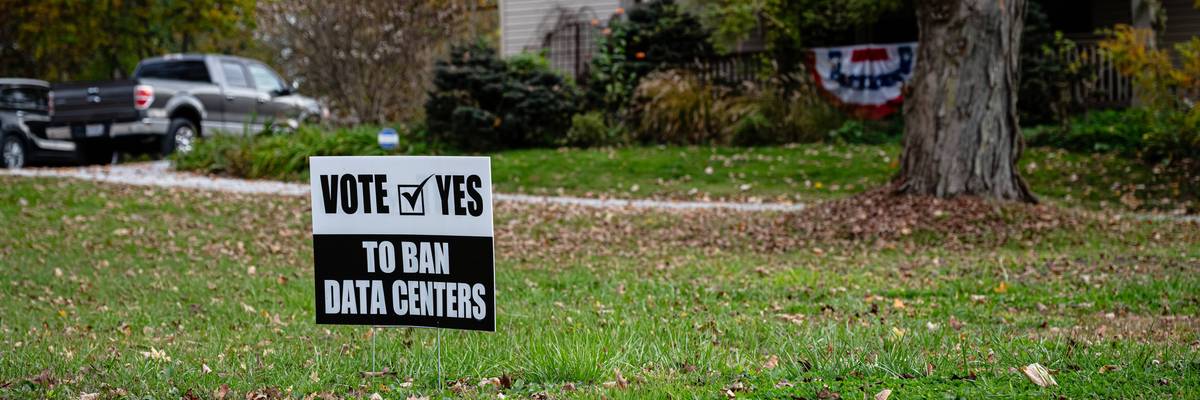
Artificial intelligence data centers have become one of the defining issues in the 2026 election cycle, with some candidates putting opposition to their unchecked growth at the heart of their campaigns.
Polls show that majorities across parties oppose building data centers in their communities, citing concerns about excessive energy and water use, pollution, and noise.
On all six local data center measures decided before Election Day—including in Maine, Michigan, and New Hampshire—voters favored limiting development, often by overwhelming margins.
Tuesday offers a bigger test of just how toxic data centers have become. Across 10 states, 44 local measures are on the ballot, according to a tracker by Redbud Consulting.
Many of the measures ask voters whether to ban or temporarily pause data center development, cap facilities’ power use, or require voter approval for new projects. Others give voters a chance to support development.
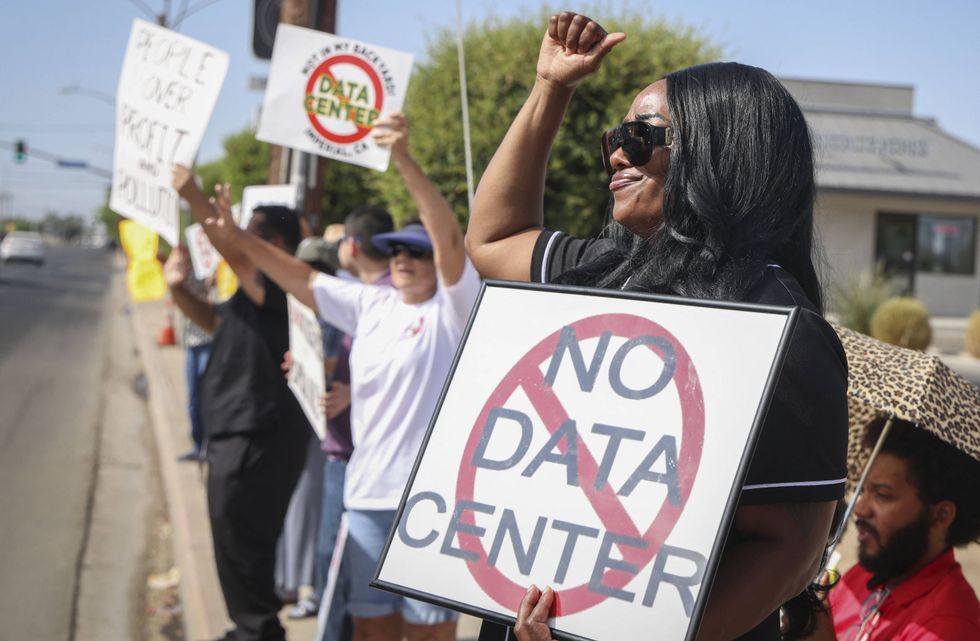 Demonstrators wave signs during a nationwide protest against AI data center expansion in Imperial, California, on July 18, 2026. (Photo by Sandy Huffaker/AFP via Getty Images)
Ohio
Nearly half the local measures on the ballot are in Ohio, ground zero for the data center boom, where Democratic former US Sen. Sherrod Brown has seized on voters’ outrage to paint his opponent, Republican Sen. John Husted, as “the face of data centers” over his role in attracting projects and securing tax breaks.
Zoning measures are on the ballot in Wilmington and in the townships of Sprigg and Monroe. Grove City’s measure would require voter approval for large developments. In Monroeville, a nonbinding question asks voters whether the village should allow data center development.
Eight municipalities—Conneaut, Defiance, Granville, Oregon, Pataskala, Sunbury, Trenton, and Upper Sandusky—will vote on proposals to restrict new data centers. The proposals generally target facilities that draw more than 25 megawatts. A stricter measure in Urbana would prohibit new data centers, with an exception for certain facilities below 7.5 megawatts. In Hubbard, a measure would ban new data centers citywide, regardless of size or power demand.
Maine
Democratic labor leader Troy Jackson, who is running to unseat Republican Sen. Susan Collins, has said data centers benefit tech oligarchs while foisting costs onto ordinary residents. He said data center developers should be required to pay for their own power, protect water quality, and keep electricity rates from rising. Collins has called for restrictions on a case-by-case basis and has been criticized for speaking favorably about certain projects around the state.
Eight towns in Maine have data center measures on the ballot Tuesday. Eliot, Freedom, Peru, and Wiscasset are considering temporary pauses on data center development regardless of size. Proposed moratoriums in Brownfield, Sabattus, and Wells would apply based on facility size or power demand. A measure in North Berwick would permanently ban facilities of 25,000 square feet or more.
In April, the Maine Legislature passed a bill that would have halted permitting for data centers with electric loads of 20 megawatts or more until November 2027. Democratic Gov. Janet Mills vetoed the bill. At least 21 municipalities have already enacted similar restrictions, according to The Maine Monitor.
Illinois
In Illinois, which has one of the nation’s highest concentrations of data centers, voters in five townships will be asked whether they support allowing new facilities—Chouteau, Granite City, Nameoki, Venice, and Joliet. All of the measures are nonbinding.
A separate advisory question asks Bloomington voters whether the city should impose a moratorium on new large-scale data centers. In Morgan County, residents can vote to call for countywide restrictions on data center construction and operation, though the measure leaves the details to county officials.
Kansas
Data centers have been a major source of strife in Kansas, where lawmakers from both parties voted last year for a 20-year sales tax exemption for data center construction and equipment to lure more hyperscale facilities to the state.
Though both candidates for governor voted for the bill, state Sen. Cindy Holscher (D-8) now supports a statewide pause on data center development, while state Sen. Ty Masterson (R-16) still defends the tax breaks. In the state’s unexpectedly competitive Senate race, Democrat Adam Hamilton has hammered Republican Sen. Roger Marshall for voting for last year’s Republican budget bill, which Hamilton says gave federal tax breaks to data centers.
Voters in Emporia and El Dorado will decide Tuesday whether to ban data centers with peak electrical loads above 10 megawatts or daily water use above 100,000 gallons. Ottawa is voting on a 10-year ban on large data centers with a 25-megawatt threshold.
Elsewhere
Six other communities have data center measures on the ballot.
Artificial intelligence data centers have become one of the defining issues in the 2026 election cycle, with some candidates putting opposition to their unchecked growth at the heart of their campaigns.
Polls show that majorities across parties oppose building data centers in their communities, citing concerns about excessive energy and water use, pollution, and noise.
On all six local data center measures decided before Election Day—including in Maine, Michigan, and New Hampshire—voters favored limiting development, often by overwhelming margins.
Tuesday offers a bigger test of just how toxic data centers have become. Across 10 states, 44 local measures are on the ballot, according to a tracker by Redbud Consulting.
Many of the measures ask voters whether to ban or temporarily pause data center development, cap facilities’ power use, or require voter approval for new projects. Others give voters a chance to support development.
Demonstrators wave signs during a nationwide protest against AI data center expansion in Imperial, California, on July 18, 2026. (Photo by Sandy Huffaker/AFP via Getty Images)
Ohio
Nearly half the local measures on the ballot are in Ohio, ground zero for the data center boom, where Democratic former US Sen. Sherrod Brown has seized on voters’ outrage to paint his opponent, Republican Sen. John Husted, as “the face of data centers” over his role in attracting projects and securing tax breaks.
Zoning measures are on the ballot in Wilmington and in the townships of Sprigg and Monroe. Grove City’s measure would require voter approval for large developments. In Monroeville, a nonbinding question asks voters whether the village should allow data center development.
Eight municipalities—Conneaut, Defiance, Granville, Oregon, Pataskala, Sunbury, Trenton, and Upper Sandusky—will vote on proposals to restrict new data centers. The proposals generally target facilities that draw more than 25 megawatts. A stricter measure in Urbana would prohibit new data centers, with an exception for certain facilities below 7.5 megawatts. In Hubbard, a measure would ban new data centers citywide, regardless of size or power demand.
Maine
Democratic labor leader Troy Jackson, who is running to unseat Republican Sen. Susan Collins, has said data centers benefit tech oligarchs while foisting costs onto ordinary residents. He said data center developers should be required to pay for their own power, protect water quality, and keep electricity rates from rising. Collins has called for restrictions on a case-by-case basis and has been criticized for speaking favorably about certain projects around the state.
Eight towns in Maine have data center measures on the ballot Tuesday. Eliot, Freedom, Peru, and Wiscasset are considering temporary pauses on data center development regardless of size. Proposed moratoriums in Brownfield, Sabattus, and Wells would apply based on facility size or power demand. A measure in North Berwick would permanently ban facilities of 25,000 square feet or more.
In April, the Maine Legislature passed a bill that would have halted permitting for data centers with electric loads of 20 megawatts or more until November 2027. Democratic Gov. Janet Mills vetoed the bill. At least 21 municipalities have already enacted similar restrictions, according to The Maine Monitor.
Illinois
In Illinois, which has one of the nation’s highest concentrations of data centers, voters in five townships will be asked whether they support allowing new facilities—Chouteau, Granite City, Nameoki, Venice, and Joliet. All of the measures are nonbinding.
A separate advisory question asks Bloomington voters whether the city should impose a moratorium on new large-scale data centers. In Morgan County, residents can vote to call for countywide restrictions on data center construction and operation, though the measure leaves the details to county officials.
Kansas
Data centers have been a major source of strife in Kansas, where lawmakers from both parties voted last year for a 20-year sales tax exemption for data center construction and equipment to lure more hyperscale facilities to the state.
Though both candidates for governor voted for the bill, state Sen. Cindy Holscher (D-8) now supports a statewide pause on data center development, while state Sen. Ty Masterson (R-16) still defends the tax breaks. In the state’s unexpectedly competitive Senate race, Democrat Adam Hamilton has hammered Republican Sen. Roger Marshall for voting for last year’s Republican budget bill, which Hamilton says gave federal tax breaks to data centers.
Voters in Emporia and El Dorado will decide Tuesday whether to ban data centers with peak electrical loads above 10 megawatts or daily water use above 100,000 gallons. Ottawa is voting on a 10-year ban on large data centers with a 25-megawatt threshold.
Elsewhere
Six other communities have data center measures on the ballot.