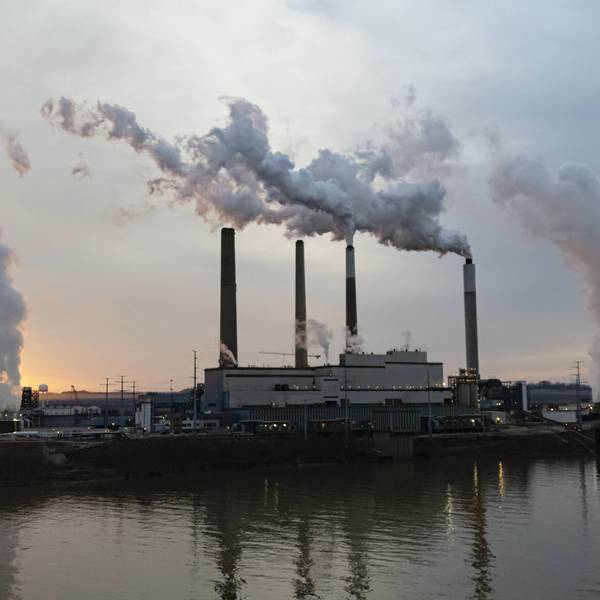
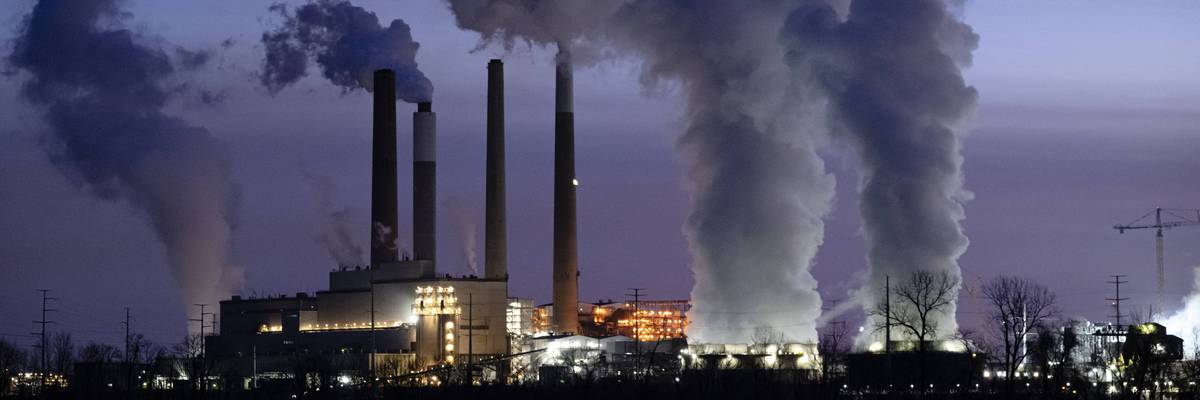
The Mill Creek Generating Station, a coal-fired power plant in Louisville, Kentucky, is seen on February 14, 2026 in Elizabeth, Indiana.
'Another Year, Another New Record': UN Highlights Rising Greenhouse Gas Levels Ahead of COP31
"We are supercharging the ocean and the atmosphere," said one WMO leader. "That means that heatwaves, tropical cyclones, and rainstorms are intensifying faster than our historical baselines prepared us for."
With the next United Nations Climate Change Conference less than two weeks away, a UN agency confirmed Tuesday that levels of three key greenhouse gases in the atmosphere "reached unprecedented highs in 2025, locking in more long-term temperature increase for the planet."
“Another year, another new record," World Meteorological Organization (WMO) Deputy Secretary-General Ko Barrett said in a statement. "The past 11 years have been the warmest on record, and this trend is set to continue."
"The big three are carbon dioxide, methane, and nitrous oxide. Since the 1960s, growth rates of CO2 have tripled," Barrett told journalists during a press briefing about the "Greenhouse Gas Bulletin of 2025," which is published annually.
Global greenhouse gas concentrations reach record highs in 2025. The unprecedented atmospheric levels of carbon dioxide and methane lock in severe climate impacts and temperature increases for centuries ahead of the upcoming United Nations climate summit in Turkey.www.france24.com/en/live-news...
[image or embed]
— Flingjore (@flingjore.com) October 27, 2026 at 11:12 AM
"When the bulletin was first published in 2004, the annual level of carbon dioxide was 377.5 parts per million. In 2025, it was 426.8 parts per million," Barrett noted. Methane, or CH4, hit 1,948 parts per billion, while nitrous oxide, or N2O, was 339.1 ppb.
"Every additional part per million matters because it traps additional heat," she stressed. "In effect, we are supercharging the ocean and the atmosphere. That means that heatwaves, tropical cyclones, and rainstorms are intensifying faster than our historical baselines prepared us for."
While carbon dioxide is "the most abundant long-lived gas," Barrett also addressed "gases which are present in much lower concentrations but are of potential concern," such as sulfur hexafluoride, or SF6—which "is closely related to electricity production and distribution, and has been rising over the past three decades because of the switch to global electrification."
"Sulfur hexafluoride concentration in 2025 have increased by 249% relative to 1995 levels. They are measured in parts per trillion—not million. So why should we be concerned?" she said. "Because SF6 has an atmospheric lifetime of up to 3,200 years. Its global warming potential is more than 24,000 times that of CO2."
"The energy transition is essential and welcome," Barrett added. "But as with every transition, it has to be done in a smart way and informed by environmental observations."
The WMO bulletin follows a series of recent UN reports showing the Paris Agreement's goal of limiting global temperature rise this century to 1.5°C above preindustrial levels is no longer possible without an overshoot, but getting back to that level is, with ambitious action to phase out fossil fuels.
Additionally, before the ongoing biodiversity summit in Yerevan, Armenia, the UN warned that the world is not on track to meet any of the targets from the Kunming-Montreal Global Biodiversity Framework, or the "Paris Agreement for Nature."
While that event on the global biodiversity crisis—which is linked to the worsening climate emergency—is set to conclude in a few days, world leaders are scheduled to convene again on November 9 in Antalya, Türkiye for the next climate conference, or COP31.
Although the United States is the world's biggest historical climate polluter, and one of the recently released UN reports repeatedly calls out US emissions, Big Oil-backed President Donald Trump has ditched the Paris Agreement, again, and is not expected to send a delegation to Antalya.
"The rest of the world is exhausted when it comes to counting the damage that the US is willingly doing to allies, multilateral structures, economic cooperation, disaster relief," Australian climate scientist Malte Meinshausen told The Associated Press earlier this month. "The rest of the world should probably continue to focus even less on the US."
There is hope in the elections taking place around the world and how they may usher in new leadership in many countries. Even with those changes, we all are in for a warm ride filled with climate shocks until we stabilize the concentrations of greenhouse gases in the atmosphere.
— Dana R. Fisher (aka the Apocalyptic Optimist) (@fisherdanar.bsky.social) October 27, 2026 at 6:37 AM
In the United States, University of Pennsylvania professor Michael Mann said Tuesday that "there is a lot of support among the public for a clean energy transition. The problem is that the fossil fuel industry currently owns our government. But there are reasons for optimism that we might begin to turn the corner, with the midterm elections" on November 3.
"If they return one or both houses of Congress to the Democrats, there will be the possibility of Congress acting as a check on the destructive policies of the Trump administration and in a couple of years, with new leadership at the presidential level, the US could once again reassert leadership on climate," the climatologist told writer Brian McHugh.
"We have to transition rapidly away from fossil fuel burning," Mann emphasized. "There's simply no other way. Without regulating them and imposing an incentive structure that leads them to move toward clean energy, nothing else is really going to matter."
We are at a crossroads
This country and this world are at a monumental crossroads. In a few short weeks, US voters will have an opportunity to beat back the forces of fascism and confront the billionaires who are rigging the economy, our media system, and our democracy, making it increasingly impossible for ordinary people to get by. We’re not just talking about the election. We’re talking about what must be done once these fascist elements are vanquished from power. We need a bolder set of solutions than what either major party has so far been willing to offer and a working-class movement ready to fight like hell for it. Trump didn't emerge from nowhere. The conditions that fueled MAGA authoritarianism were created by decades of radical neoliberal economic policies and a corrupt political system dominated by corporate interests. They slashed taxes on the super-rich, promising that the benefits would trickle down. They said giveaways to the corporate titans would make life more affordable for the rest of us. It was all bullshit. And when a bitter, betrayed populace searches for someone to blame, right-wing demagogues have little trouble finding scapegoats. People know when they're being lied to, but you won't hear any of this from the corporate media. Only independent journalism—powered and funded by people who believe in building a better world—can deliver truly trustworthy daily news. Our Fall Campaign is underway, and we need your help. To power our newsroom through the rest of the year, we need to raise $125,000 by midnight on October 31. So if you share our vision, please contribute whatever you can to sustain our work. |
With the next United Nations Climate Change Conference less than two weeks away, a UN agency confirmed Tuesday that levels of three key greenhouse gases in the atmosphere "reached unprecedented highs in 2025, locking in more long-term temperature increase for the planet."
“Another year, another new record," World Meteorological Organization (WMO) Deputy Secretary-General Ko Barrett said in a statement. "The past 11 years have been the warmest on record, and this trend is set to continue."
"The big three are carbon dioxide, methane, and nitrous oxide. Since the 1960s, growth rates of CO2 have tripled," Barrett told journalists during a press briefing about the "Greenhouse Gas Bulletin of 2025," which is published annually.
Global greenhouse gas concentrations reach record highs in 2025. The unprecedented atmospheric levels of carbon dioxide and methane lock in severe climate impacts and temperature increases for centuries ahead of the upcoming United Nations climate summit in Turkey.www.france24.com/en/live-news...
[image or embed]
— Flingjore (@flingjore.com) October 27, 2026 at 11:12 AM
"When the bulletin was first published in 2004, the annual level of carbon dioxide was 377.5 parts per million. In 2025, it was 426.8 parts per million," Barrett noted. Methane, or CH4, hit 1,948 parts per billion, while nitrous oxide, or N2O, was 339.1 ppb.
"Every additional part per million matters because it traps additional heat," she stressed. "In effect, we are supercharging the ocean and the atmosphere. That means that heatwaves, tropical cyclones, and rainstorms are intensifying faster than our historical baselines prepared us for."
While carbon dioxide is "the most abundant long-lived gas," Barrett also addressed "gases which are present in much lower concentrations but are of potential concern," such as sulfur hexafluoride, or SF6—which "is closely related to electricity production and distribution, and has been rising over the past three decades because of the switch to global electrification."
"Sulfur hexafluoride concentration in 2025 have increased by 249% relative to 1995 levels. They are measured in parts per trillion—not million. So why should we be concerned?" she said. "Because SF6 has an atmospheric lifetime of up to 3,200 years. Its global warming potential is more than 24,000 times that of CO2."
"The energy transition is essential and welcome," Barrett added. "But as with every transition, it has to be done in a smart way and informed by environmental observations."
The WMO bulletin follows a series of recent UN reports showing the Paris Agreement's goal of limiting global temperature rise this century to 1.5°C above preindustrial levels is no longer possible without an overshoot, but getting back to that level is, with ambitious action to phase out fossil fuels.
Additionally, before the ongoing biodiversity summit in Yerevan, Armenia, the UN warned that the world is not on track to meet any of the targets from the Kunming-Montreal Global Biodiversity Framework, or the "Paris Agreement for Nature."
While that event on the global biodiversity crisis—which is linked to the worsening climate emergency—is set to conclude in a few days, world leaders are scheduled to convene again on November 9 in Antalya, Türkiye for the next climate conference, or COP31.
Although the United States is the world's biggest historical climate polluter, and one of the recently released UN reports repeatedly calls out US emissions, Big Oil-backed President Donald Trump has ditched the Paris Agreement, again, and is not expected to send a delegation to Antalya.
"The rest of the world is exhausted when it comes to counting the damage that the US is willingly doing to allies, multilateral structures, economic cooperation, disaster relief," Australian climate scientist Malte Meinshausen told The Associated Press earlier this month. "The rest of the world should probably continue to focus even less on the US."
There is hope in the elections taking place around the world and how they may usher in new leadership in many countries. Even with those changes, we all are in for a warm ride filled with climate shocks until we stabilize the concentrations of greenhouse gases in the atmosphere.
— Dana R. Fisher (aka the Apocalyptic Optimist) (@fisherdanar.bsky.social) October 27, 2026 at 6:37 AM
In the United States, University of Pennsylvania professor Michael Mann said Tuesday that "there is a lot of support among the public for a clean energy transition. The problem is that the fossil fuel industry currently owns our government. But there are reasons for optimism that we might begin to turn the corner, with the midterm elections" on November 3.
"If they return one or both houses of Congress to the Democrats, there will be the possibility of Congress acting as a check on the destructive policies of the Trump administration and in a couple of years, with new leadership at the presidential level, the US could once again reassert leadership on climate," the climatologist told writer Brian McHugh.
"We have to transition rapidly away from fossil fuel burning," Mann emphasized. "There's simply no other way. Without regulating them and imposing an incentive structure that leads them to move toward clean energy, nothing else is really going to matter."
- 'Alarm Bells Ringing': Global CO2 Levels at Highest in 3 Million Years ›
- 'Never Happened Before': WMO Finds Past 10 Years Have Been 10 Hottest on Record ›
- NOAA Finds Carbon Concentrations Highest in 800,000 Years as Sea Level Rise Hits Record | Common Dreams ›
- 'Worst Possible News': Scientists Urge Immediate Action as Greenhouse Gas Levels Hit All-Time High ›
- Atmospheric Greenhouse Gas Concentrations Hit New Record Levels ›