

SUBSCRIBE TO OUR FREE NEWSLETTER
Daily news & progressive opinion—funded by the people, not the corporations—delivered straight to your inbox.
5
#000000
#FFFFFF
To donate by check, phone, or other method, see our More Ways to Give page.
Daily news & progressive opinion—funded by the people, not the corporations—delivered straight to your inbox.
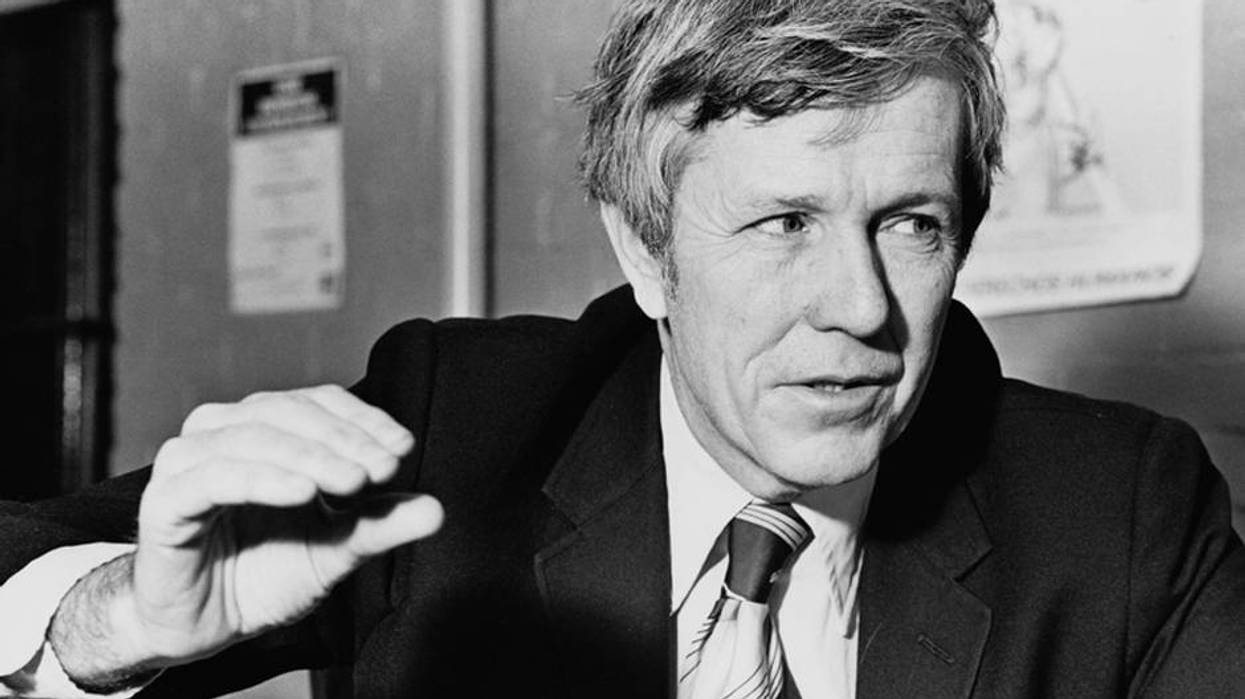
The "big tent" of the Democratic Socialists of America has its drawbacks too.
Kirkpatrick Sale has it half right in his lament over today’s Democratic Socialists of America, “Michael Harrington is Spinning in His Grave.” The imagined spinning stems from post-mortem distress at what its founding leader would make of the organization today. Sale—best remembered for SDS, his history of Students for a Democratic Society, the seminal 1960s “New Left” organization—calls himself Harrington’s “close friend and traveling companion,” and feels that today’s DSA “has stood on its head the principles that Mike and his colleagues stood for.”
While I cannot claim to have been Harrington’s friend, I did know him and arguably qualify as one of his colleagues, in that I was a member of the Democratic Socialist Organizing Committee, his prior organization whose 1982 merger with the New American Movement created DSA. I remain a member of the organization to this day, and when serving in the Massachusetts House of Representatives was once one of DSOC/DSA’s handful of public elected officials. From my vantage point, while I understand Sale’s real–and Harrington’s imagined–distress at some of what he sees in today’s DSA, not only does he ignore developments that would have made Harrington proud, but I also think his take on Harrington’s politics is not quite right.
As a flat statement, Sale’s contention that DSA “is no longer anything that could be called democratic or socialist” is wrong, but he is not wrong in identifying parts of 2026 DSA that would seem unlikely to have appealed to Harrington. Sale clearly recognizes that the roots of the organization’s dramatic changes—its 20-fold inflation from the 6,000 member group of the 90's—lie in Bernie Sanders’ 2016 presidential campaign. He errs, though, in calling Sanders “a leading DSA figure and its only representative in Congress.” Sanders actually was not then, is not now, and so far as I know has never been an actual member of DSA—counterintuitive as that may seem.
After Sanders introduced “democratic socialism” to millions of American living rooms in his debates with Hillary Clinton and politically “lived to talk about it,” a whole lot of people who’d also been thinking about the idea googled the term and found DSA; some joined. They were then followed by some who indeed did not identify with the democratic socialist tradition but recognized that this was now where the action was—the hazard of success.
The result is generally understood as a “big tent” organization—a tent thus far large enough to contain both US Rep. Alexandria Ocasio-Cortez (D-NY) and Democratic New York City Mayor Zoran Mamdani—figures for whom I cannot imagine Harrington having anything but admiration—along with caucuses by no means committed to that approach, groups that Harrington would consider bizarre and out of place (as does this writer.) It contains serious divergences between local chapters and a tenuous national organization. How long this tent holds up is anyone’s guess. As for Sale, if he would actually consider the entirety of organization (the best description of which I’ve seen was recently published in a German Left Party newspaper—"Von Degrowth bis ML" Jungle World, July 30, 2026) he might well see similarities with the late years of SDS (an organization Harrington subsequently regretted having failed to productively engage with.)
Among those similarities is a certain not-ready-for-prime-time quality common in organizations trying to cope with the increased glare of the public attention spotlight. Foibles and foolish statements surface from the past. My personal nomination for the dumbest left slogan of recent years is “Defund the police”—its rational kernel of re-evaluating government’s approach to certain types of public safety situations smothered in a seemingly naive call for an end to law enforcement. And yet, even someone like Mamdani who is generally considered to possess masterful political skills—correctly, I think—has had to walk that one back.
On some points of his critique of current DSA, Sale seems perhaps frozen in time, such as his noting that “Mike was an outspoken champion of the new Israel.” That “new Israel” has changed quite a bit in the thirty-seven years since Harrington has been gone. Would he remain a champion of a nation now planning a prison for Palestinians that includes a moat stocked with crocodiles – a proposal temporarily stalled by consideration of the animals’ subsequently repealed protected status? Sure hope not.
But where I really think Sale is just wrong is in essentially arguing that Harrington was not actually a socialist. Yes, Harrington did talk of being “the left wing of the possible,” and that “generally meant working within the Democratic Party”—as do most current DSAers running campaigns to do something for the American working class in the here-and-now. And while Sale is accurate in saying that the DSA of Harrington’s day “put forth a vision of a democratically elected government that would be like those of the Scandinavian countries, providing state services in health, education, housing and the like,” his contention that back then there was “Nowhere stuff about ending capitalism” makes it sound like Sale missed a lot of meetings—and maybe didn’t keep up on his reading so well either. Even the small DSA had differing strands of thinking. One major one was all about imagining how to reach a genuinely democratically controlled economy beyond the “welfare state” and capitalism, something you will find reflected in Harrington’s writing.
So would the imagined Harrington be troubled by some of what he’d see in today’s DSA? Yes, I’m sure he would. And would he be positively thrilled by some of what he found in today’s DSA? Yes, I’m sure he would.

It is easy to forget that in his day, in his own country, Rev. Martin Luther King Jr. was considered a dangerous radical. He was harassed by the FBI and vilified in the media. The establishment's campaign to denigrate King worked. In August 1966 - two years after he was awarded the Nobel Peace Prize at age 35--the Gallup Poll found that 63 percent of Americans had an unfavorable opinion of King, compared with 33 percent who viewed him favorably.
Today Rev. Martin Luther King Jr. is viewed as something of an American saint. The most recent Gallup Poll discovered that 94 percent of Americans viewed him in a positive light. His birthday is a national holiday. His name adorns schools and street signs. Americans from across the political spectrum invoke King's name to justify their beliefs and actions.
He opposed US militarism and imperialism, especially the country's misadventure in Vietnam.
In fact, King was a radical. He believed that America needed a "radical redistribution of economic and political power." He challenged America's class system and its racial caste system. He was a strong ally of the nation's labor union movement. He was assassinated in April 1968 in Memphis, where he had gone to support a sanitation workers' strike. He opposed US militarism and imperialism, especially the country's misadventure in Vietnam.
If he were alive today, he would certainly be standing with Walmart employees and other workers fighting for a living wage and the right to unionize. He would be on the picket lines with striking school teachers, demanding smaller class sizes and more resources for schools so that every student can have a first-rate education. He would be in the forefront of the battle for strong gun controls and to thwart the influence of the National Rifle Association. He would protest the abuses of Wall Street banks, standing side-by-side with homeowners facing foreclosure and crusading for tougher regulations against lending rip-offs.
As he did in his own day, King would be calling for dramatic cuts in the military budget to reinvest public dollars in jobs, education and health care. He would surely be marching with immigrants and their allies in support of comprehensive immigration reform. He would no doubt travel to the US-Mexico border to protest the mistreatment of children and their parents seeking asylum and refuge. He would be joining hands with activists seeking to reduce racial profiling by police and ending the mass incarceration of young people. Like most Americans in his day, King was homophobic, even though one of his closest advisors, Bayard Rustin, was gay. But today, King would undoubtedly stand with advocates of LGBT rights and same-sex marriage, just as he challenged state laws banning interracial marriage. We don't know what King's views were on abortion, but in 1966, he was pleased to receive Planned Parenthood's Margaret Sanger Award in Human Rights. Accepting the award, he wrote: "There is a striking kinship between our movement and Margaret Sanger's early efforts. ... Margaret Sanger had to commit what was then called a crime in order to enrich humanity, and today we honor her courage and vision."
King began his activism in Montgomery as a crusader against racial segregation, but the struggle for civil rights radicalized him into a fighter for broader economic and social justice and peace.
Indeed, King's views evolved over time. He entered the public stage with some hesitation, reluctantly becoming the spokesperson for the Montgomery bus boycott in 1955, at the age of 26. King began his activism in Montgomery as a crusader against racial segregation, but the struggle for civil rights radicalized him into a fighter for broader economic and social justice and peace. Still, in reviewing King's life, we can see that the seeds of his later radicalism were planted early.
King was born in Atlanta, Georgia, in 1929, the son of a prominent black minister. Despite growing up in a solidly middle-class family, King saw the widespread human suffering caused by the Depression, particularly in the black community. In 1950, while in graduate school, he wrote an essay describing the "anticapitalistic feelings" he experienced as a youngster as a result of seeing unemployed people standing in breadlines.
During King's first year at Morehouse College, civil rights and labor activist A. Philip Randolph spoke on campus. Randolph predicted that the near future would witness a global struggle that would end white supremacy and capitalism. He urged the students to link up with "the people in the shacks and the hovels," who, although "poor in property," were "rich in spirit."
After graduating from Morehouse in 1948, King studied theology at Crozer Theological Seminary in Pennsylvania (where he read both Mohandas Gandhi and Karl Marx), planning to follow in his father's footsteps and join the ministry. In 1955, he earned his doctorate from Boston University, where he studied the works of Reinhold Niebuhr, the influential liberal theologian. While in Boston, he told his girlfriend (and future wife), Coretta Scott, that "a society based on making all the money you can and ignoring people's needs is wrong."
When King moved to Montgomery to take his first pulpit at the Dexter Avenue Baptist Church, he was full of ideas but had no practical experience in politics or activism. But history sneaked up on him. On Thursday, December 1, 1955, Rosa Parks, a seamstress and veteran activist with the National Association for the Advancement of Colored People (NAACP), decided to resist the city's segregation law by refusing to move to the back of the bus on her way home from work. She was arrested. Two other long-term activists in the black community - E. D. Nixon (leader of the NAACP and of the Brotherhood of Sleeping Car Porters) and Jo Ann Robinson (a professor at the all-black Alabama State College and a leader of Montgomery's Women's Political Council) - determined that Parks' arrest was a ripe opportunity for a one-day boycott of the much-despised segregated bus system. Nixon and Robinson asked black ministers to use their Sunday sermons to spread the word. Some refused, but many others, including King, agreed.
The boycott was very effective. Most black residents stayed off the buses. Within days, the boycott leaders formed a new group, the Montgomery Improvement Association (MIA). At Nixon's urging, they elected a hesitant King as president, in large part because he was new in town and not embroiled in the competition for congregants and visibility among black ministers. He was also well educated and already a brilliant orator, and thus would be a good public face for the protest movement. The ministers differed over whether to call off the boycott after one day but agreed to put the question up to a vote at a mass meeting.
That night, 7,000 blacks crowded into (and stood outside) the Holt Street Baptist Church. Inspired by King's words - "There comes a time when people get tired of being trampled over by the iron feet of oppression" - they voted unanimously to continue the boycott. It lasted for 381 days and resulted in the desegregation of the city's buses.
During that time, King honed his leadership skills, aided by advice from two veteran pacifist organizers, Bayard Rustin and Rev. Glenn Smiley, who had been sent to Montgomery by the pacifist group, Fellowship of Reconciliation. During the boycott, King was arrested, his home was bombed, and he was subjected to personal abuse. But--with the assistance of the new medium of television--he emerged as a national figure.
Between 1957 and 1968, King traveled over six million miles, spoke more than 2,500 times, and was arrested at least 20 times, always preaching the gospel of nonviolence.
In 1957, King launched the Southern Christian Leadership Conference (SCLC) to help spread the civil rights crusade to other cities. He helped lead local campaigns in different cities, including Selma and Birmingham, Alabama, where thousands marched to demand an end to segregation in defiance of court injunctions forbidding any protests. While participating in these protests, King also sought to keep the fractious civil rights movement together, despite the rivalries among the NAACP, the Urban League, the Student Nonviolent Coordinating Committee (SNCC), the Congress of Racial Equality (CORE) and SCLC. Between 1957 and 1968, King traveled over six million miles, spoke more than 2,500 times, and was arrested at least 20 times, always preaching the gospel of nonviolence. King attended workshops at the Highlander Folk School in Tennessee, which connected him to a network of radicals, pacifists and union activists from around the country whose ideas helped widen his political horizons.
It is often forgotten that the August 1963 protest rally at the Lincoln Memorial, where King delivered his famous "I Have a Dream" speech, was called the March on Washington for Jobs and Freedom. King was proud of the civil rights movement's success in winning the passage of the Civil Rights Act in 1964 and the Voting Rights Act the following year. But he realized that neither law did much to provide better jobs or housing for the masses of black poor in either the urban cities or the rural South. "What good is having the right to sit at a lunch counter," he asked, "if you can't afford to buy a hamburger?"
"We know through painful experience that freedom is never voluntarily given by the oppressor; it must be demanded by the oppressed."
King had hoped that the bus boycott, sit-ins and other forms of civil disobedience would stir white southern moderates, led by his fellow clergy, to see the immorality of segregation and racism. His famous "Letter from a Birmingham Jail," written in 1963, outlines King's strategy of using nonviolent civil disobedience to force a response from the southern white establishment and to generate sympathy and support among white liberals and moderates. "The purpose of our direct-action program is to create a situation so crisis-packed that it will inevitably open the door to negotiation," he wrote, and added, "We know through painful experience that freedom is never voluntarily given by the oppressor; it must be demanded by the oppressed."
King eventually realized that many white Americans had at least a psychological stake in perpetuating racism. He began to recognize that racial segregation was devised not only to oppress African Americans but also to keep working-class whites from challenging their own oppression by letting them feel superior to blacks. "The Southern aristocracy took the world and gave the poor white man Jim Crow," King said from the Capitol steps in Montgomery, following the 1965 march from Selma. "And when his wrinkled stomach cried out for the food that his empty pockets could not provide, he ate Jim Crow, a psychological bird that told him that no matter how bad off he was, at least he was a white man, better than a black man."
When King launched a civil rights campaign in Chicago in 1965, he was shocked by the hatred and violence expressed by working-class whites as he and his followers marched through the streets of segregated neighborhoods in Chicago and its suburbs. He saw that the problem in Chicago's ghetto was not legal segregation but "economic exploitation" - slum housing, overpriced food and low-wage jobs - "because someone profits from its existence."
These experiences led King to develop a more radical outlook.
He became increasingly committed to building bridges between the civil rights and labor movements. Invited to address the AFL-CIO's annual convention in 1961, King observed:
"The labor movement did not diminish the strength of the nation but enlarged it. By raising the living standards of millions, labor miraculously created a market for industry and lifted the whole nation to undreamed of levels of production. Those who today attack labor forget these simple truths, but history remembers them."
"Call it democracy, or call it democratic socialism, but there must be a better distribution of wealth within this country for all God's children."
In a 1961 speech to the Negro American Labor Council, King proclaimed: "Call it democracy, or call it democratic socialism, but there must be a better distribution of wealth within this country for all God's children."
King supported President Lyndon B. Johnson's declaration of the War on Poverty in 1964, but, like his friend and ally Walter Reuther, the president of the United Auto Workers, King thought that it did not go nearly far enough. As early as October 1964, he called for a "gigantic Marshall Plan" for the poor--black and white. He began talking openly about the need to confront "class issues," which he described as "the gulf between the haves and the have-nots."
In 1966 King confided to his staff:
"You can't talk about solving the economic problem of the Negro without talking about billions of dollars. You can't talk about ending the slums without first saying profit must be taken out of slums. You're really tampering and getting on dangerous ground because you are messing with folk then. You are messing with captains of industry. Now this means that we are treading in difficult water, because it really means that we are saying that something is wrong with capitalism. There must be a better distribution of wealth, and maybe America must move toward a democratic socialism."
Speaking to a meeting of Teamsters union shop stewards in 1967, King said, "Negroes are not the only poor in the nation. There are nearly twice as many white poor as Negro, and therefore the struggle against poverty is not involved solely with color or racial discrimination but with elementary economic justice."
King's growing critique of capitalism coincided with his views about American imperialism. By 1965 he had turned against the Vietnam War, viewing it as an economic as well as a moral tragedy. But he was initially reluctant to speak out against the war. He understood that his fragile working alliance with LBJ would be undone if he challenged the president's leadership on the war.
King called America the "greatest purveyor of violence in the world today" and linked the struggle for social justice with the struggle against militarism.Although some of his close advisers tried to discourage him, he nevertheless made the break in April 1967, in a bold and prophetic speech at the Riverside Church in New York City, entitled "Beyond Vietnam - A Time to Break Silence." King called America the "greatest purveyor of violence in the world today" and linked the struggle for social justice with the struggle against militarism. King argued that Vietnam was stealing precious resources from domestic programs and that the Vietnam War was "an enemy of the poor." In his last book, Where Do We Go from Here: Chaos or Community? (1967), King wrote, "The bombs in Vietnam explode at home; they destroy the hopes and possibilities for a decent America."
In early 1968, King told journalist David Halberstam, "For years I labored with the idea of reforming the existing institutions of society, a little change here, a little change there. Now I feel quite differently. I think you've got to have a reconstruction of the entire society, a revolution of values."
King kept trying to build a broad movement for economic justice that went beyond civil rights. In January, 1968, he announced plans for a Poor People's Campaign, a series of protests to be led by an interracial coalition of poor people and their allies among the middle-class liberals, unions, religious organizations and other progressive groups, to pressure the White House and Congress to expand the War on Poverty. At King's request, socialist activist Michael Harrington (author of The Other America, which helped inspire Presidents Kennedy and Johnson to declare a war on poverty) drafted a Poor People's Manifesto that outlined the campaign's goals. In April, King was in Memphis, Tennessee, to help lend support to striking African American garbage workers and to gain recognition for their union. There, he was assassinated, at age 39, on April 4, a few months before the first protest action of the Poor People's Campaign in Washington, DC.
President Johnson utilized this national tragedy to urge Congress to quickly enact the Fair Housing Act, legislation to ban racial discrimination in housing, which King had strongly supported for two years. He signed the bill a week after King's assassination.
The campaign for a federal holiday in King's honor, spearheaded by Detroit Congressman John Conyers, began soon after his murder, but it did not come up for a vote in Congress until 1979, when it fell five votes short of the number needed for passage. In 1981, with the help of singer Stevie Wonder and other celebrities, supporters collected six million signatures on a petition to Congress on behalf of a King holiday. Congress finally passed legislation enacting the holiday in 1983, 15 years after King's death. But even then, 90 members of the House (including Richard Shelby of Alabama, now in the Senate) voted against it. Senator Jesse Helms, a North Carolina Republican, led an unsuccessful effort - supported by 21 other senators, including current Senator Charles Grassley (R-Iowa) - to block its passage in the Senate.
The holiday was first observed on January 20, 1986. In 1987, Arizona governor Evan Mecham rescinded King Day as his first act in office, setting off a national boycott of the state. Some states (including New Hampshire, which called it "Civil Rights Day" from 1991 to 1999) insisted on calling the holiday by other names. In 2000, South Carolina became the last state to make King Day a paid holiday for all state employees.
In his final speech in Memphis the night before he was killed, King told the crowd about a bomb threat on his plane from Atlanta that morning, saying he knew that his life was constantly in danger because of his political activism.
"I would like to live a long life," he said. "Longevity has its place. But I'm not concerned about that now. I just want to do God's will. And he's allowed me to go up to the mountain, and I've looked over, and I've seen the promised land. I may not get there with you. But I want you to know tonight that we as a people will get to the promised land."
We haven't gotten there yet. But Dr. King is still with us in spirit. The best way to honor his memory is to continue the struggle for human dignity, workers' rights, racial equality, peace and social justice.
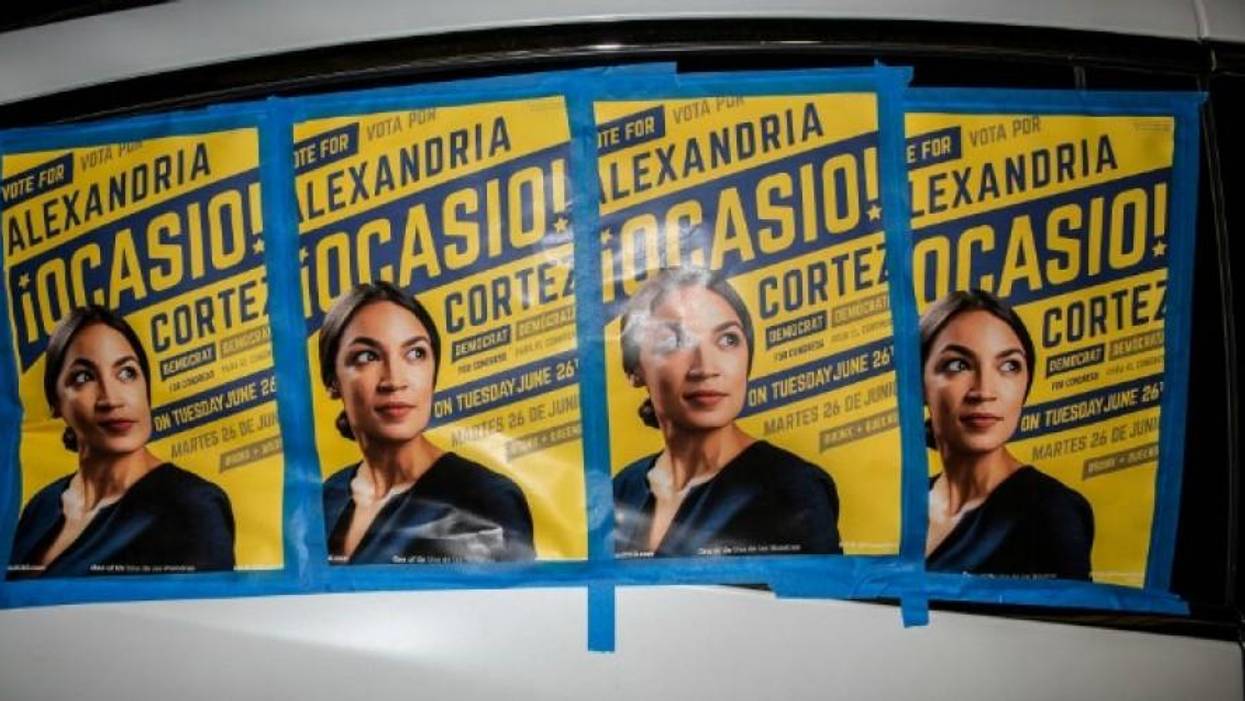
Recently, when 28-year-old Alexandria Ocasio-Cortez, an obscure, upfront democratic socialist from the Bronx, easily defeated one of the most powerful U.S. Congressmen in the Democratic primary, the story became an overnight sensation. How, the pundits wondered, could this upset have occurred?
Actually, it shouldn't have been a total surprise for, in recent years, democratic socialism has been making a remarkable comeback in American life. Bernie Sanders, the democratic socialist U.S. Senator from Vermont, won 23 Democratic primaries and caucuses during his tumultuous 2016 election campaign. Indeed, he nearly defeated Hillary Clinton, all but coronated by the Democratic Party establishment, for the Democratic presidential nomination. In addition, numerous candidates backed by a Sanders campaign's successor, Our Revolution, won Democratic Party primaries and election to office in 2017 and 2018.
Other indications of socialism's recent popularity are numerous. They include Gallup polls done in early 2016--one showing that 35 percent of Americans had a favorable view of "socialism" and another revealing that 6 out of 10 Democratic primary voters felt that "socialism" had a positive impact on society. Polls found that socialism was especially popular among young people, a key factor behind the jump in membership of Democratic Socialists of America from 5,000 in November 2016 to 40,000 today.
Of course, democratic socialism--centered on the idea of democratic ownership and control of the economy--has had periods of growth, as well as decline, over the course of American history. During the first decades of the 20th century, it flourished. By 1912, the Socialist Party of America, led by charismatic labor leader and presidential candidate Eugene V. Debs, had succeeded in electing socialists to 1,200 public offices in 340 American cities, including 79 mayors in 24 states. But, within a few years, the party was largely destroyed by government repression (thanks to its opposition to U.S. entry into World War I) and by its bitter feud with the rising Communist movement over the Communists' contempt for political democracy and civil liberties.
With the onset of the Great Depression, the Socialist Party experienced a modest revival, but soon began to fade as the Democratic Party, then in its New Deal phase, began to implement many of the key programs long championed by democratic socialists: collective bargaining rights for workers; minimum wage and maximum hour laws; public sector jobs for the unemployed; a social security system; and heavy taxes on the rich to pay for an array of social services. Increasingly, the Democratic Party attracted the support of the democratic socialist constituency, including some of its prominent figures--labor leaders like Walter Reuther, David Dubinsky, Sidney Hillman, and A. Philip Randolph, educators like John Dewey, women's rights activists like Margaret Sanger, and popular writers like Upton Sinclair.
For some decades, the Democratic Socialist Organizing Committee, founded in 1973 by the writer Michael Harrington and other committed socialists--and its successor, Democratic Socialists of America (DSA)--tried to revive democratic socialism by cutting loose from fruitless third party election campaigns and focusing, instead, on fostering public support for greater economic and social democracy. On occasion, DSA backed worthy candidates in Democratic primaries. But it had only minimal success. For the most part, the best that DSA could do was to keep the democratic socialist current alive by pulling together socialist-minded activists scattered about in the labor, women's rights, racial justice, and peace movements, and putting them in touch with a small group of sympathetic public officials.
Nevertheless, the rise in American life of a rapacious corporate capitalism, a widening level of economic inequality, and the sharply rightwing policies of many states and the federal government are clearly inspiring a revolt on the Left. As the Sanders campaign and the recent election victories of Ocasio-Cortez and other leftwing candidates indicate, in electoral politics this revolt is finding expression largely inside the Democratic Party.
Although it's too early to know how this revolt will play out, there are signs that it is beginning to alter Democratic Party politics. With a heartily-despised Donald Trump in the White House and with rightwing Republicans now dominating Congress and the Supreme Court, many newly-energized leftwing voters will probably close ranks with mainstream Democrats in an all-out Democratic Party effort to drive the Right from power. At the same time, there is a comparable recognition among establishment Democrats that, unless they welcome the growing number of democratic socialists into their ranks, they have little chance of winning elections. This might well explain why so many leading Democratic politicians have now turned to backing the staples of the Sanders campaign, such as Medicare for all, free public college education, and curbs on corporate power. It might also explain why the Democratic National Committee is busy cutting back the establishment-controlled superdelegate system for choosing a presidential candidate.
As a result, just as the Democratic Party largely absorbed America's democratic socialist constituency during the 1930s and 1940 and, in turn, was itself transformed by that process, the same phenomenon might be underway today. For many years, sectarian leftists have railed against the activity of democratic socialists within the Democratic Party, claiming that it has held back a workers' revolution or some other ostensibly glorious occurrence. But this contention seems dubious. Instead, democratic socialist activity within the Democratic Party helped produce the kind of progressive politics and public policy that delivered significant economic and social gains to most Americans in the past. And it might well do so again today.

The current controversy over whether to dismantle statues of some prominent Confederate figures is a battle over whom we admire and consider as heroes. It is also a battle over who has power to shape how we view our history.
"Many of those people were there to protest the taking down of the statue of Robert E. Lee," President Donald Trump said last month after the struggle in the streets of Charlottesville, Virginia. "So this week, it is Robert E. Lee. I noticed that Stonewall Jackson is coming down. I wonder, is it George Washington next week? And is it Thomas Jefferson the week after?"
In May, the New Orleans City Council declared monuments of Lee, Confederate President Jefferson Davis and Confederate Gen. P.G.T. Beauregard public nuisances and had them removed. In August, Baltimore Mayor Catherine Pugh ordered Confederate monuments removed from the city's public spaces. Maryland Gov. Larry Hogan, a Republican, directed the dismantling of a statue in front of the State House of Roger Taney--a Supreme Court justice who was chief author of the 1857 Dred Scott decision that ruled that African-Americans could not be American citizens. Earlier this month, in response to student protests, Yale University renamed Calhoun College--a residential complex named for John C. Calhoun, a senator from South Carolina, vice president and influential advocate for slavery--Hopper College, after Rear Adm. Grace Murray Hopper, a computer pioneer and naval officer. To buttress the symbolism, Yale removed a portrait of Calhoun from a dining hall.
Shouldn't we also honor the organizers, activists, artists, writers, athletes, judges and occasional elected officials who fought to make the United States a more humane and inclusive country? The New York Times recently published a list of the Confederate monuments that are now subject of controversy in cities across the country.
Not surprisingly, most monuments celebrate political, business and military figures. You can criss-cross the country and find statues, schools, government and university buildings, museums, parks, and streets celebrating presidents, senators, governors, jurists, inventor-entrepeneurs, founders of major corporations, generals and fallen soldiers. But our veneration of them often comes at the expense of recognizing other citizens who had a major role in shaping our nation's history.
Shouldn't we also honor the organizers, activists, artists, writers, athletes, judges, and occasional elected officials who fought to make the United States a more humane and inclusive country? What about the pioneers who built movements and gave voice to the struggles for women's suffrage, protecting the environment and consumers, putting an end to lynching, giving workers the right to form unions, and pushing for a progressive income tax, a federal minimum wage, old-age insurance, the 8-hour workday and government-subsidized health care and housing?
When they first advanced their ideas, they were considered impractical idealists, utopian dreamers or dangerous radicals. Now we take these ideas for granted. We all stand on their shoulders.
To create a partial catalogue of monuments celebrating progressive figures, I've drawn on the people profiled in my book, The 100 Greatest Americans of the 20th Century: A Social Justice Hall of Fame. I've identified statues located in public places (but not busts of heads or paintings, parks or public buildings), celebrating these progressive figures.
The list focuses on people whose influence was primarily during the 20th century--so Tom Paine, Daniel Shays, Harriet Tubman, Frederick Douglass, William Monroe Trotter, William Lloyd Garrison, Mother Jones, Elizabeth Cady Stanton, Henry Demarest Lloyd, John Muir, Ida Wells, Terrence Powderly, Thorsten Veblen and Jacob Riis, among other radicals and reformers, are not included.
A Short Tour of Monuments to Progressives
A statue of Tom L. Johnson, the progressive mayor of Cleveland from 1901 to 1909, is located in Cleveland's Public Square.
A statue of Robert M. La Follette Sr., the progressive Wisconsin governor and senator, sits in National Statuary Hall in the US Capitol. A number of public schools throughout Wisconsin are named for La Follette.
Crusading lawyer and Supreme Court Justice Louis Brandeis adorns the campus of Brandeis University in Waltham, Massachusetts. Besides the university, many public schools--including high schools in New York City and San Antonio--are named for Brandeis.
Attorney Clarence Darrow spent most of his career defending radicals and labor activists, but he's most famous for defending evolution in the famous Scopes Monkey Trial. A statue of Darrow sits on the lawn in front of the Rhea County Court House in Dayton, Tennessee. It was dedicated on July 14, 2017 and sits opposite the statue of William Jennings Bryan, who beat Darrow in that controversial case.
This statue of Theodore Roosevelt on Roosevelt Island in the Potomac River across from Washington, D.C. is one of many statues and schools named for the trust-busting president. You call also visit three national parks in honor of the environmental president.
The name of progressive philosopher and school reformer John Dewey adorns public schools in Denver; New York City; Warrensville Heights, Ohio; Flint, Michigan and elsewhere, but there are no statues with Dewey's likeness.
A sculpture of urban reformer Jane Addams, the first American woman to be awarded the Nobel Peace Prize (1931), can be found on the campus of Cal State University in Fresno. Schools in Seattle; New York City; Bolingbrook and Moline, Illinois; Long Beach, California and other cities are named for the founder of modern social work.
Students in Sacramento can attend Hiram Johnson High School, and the public can visit the state office building in San Francisco named for the progressive governor, but there are no statues celebrating his life.
A statue of scholar and activist W.E.B. DuBois is located at his alma mater, Fisk University. The main library at the University of Massachusetts in Amherst, a physics building at Fisk University, and dormitories at the University of Pennsylvania and Hampton University are named for DuBois. Public schools is Chicago, Baltimore, Wake Forest, N.C., and elsewhere are named for him, too.
This statue of Alice Hamilton, a crusading physician who founded the modern field of occupational health, sits in Headwaters Park in Fort Wayne, Indiana.
A middle school in New York City is named for Robert F. Wagner, the progressive New Deal senator who led fights for workers' rights and public housing, but there are no statues erected to honor him.
These statues of Eleanor and Franklin Roosevelt at the Roosevelt National Historic Site in Hyde Park, New York are among the many statues and schools named in their honor. A stunning recent addition to the collection of memorials is The Franklin Delano Roosevelt Memorial along the Potomac in Washington, D.C.
A 12-foot-high, 4-ton statue of Albert Einstein is set at the entrance to the headquarters of the National Academy of Sciences in Washington, D.C. Einstein is holding a paper engraved with the equations for his major scientific contributions. There are dozens of other Einstein statues in the U.S. and around the world and many schools named after the famous scientist and socialist.
This statue of the pioneering and fearless birth control advocate Margaret Sanger, with a gag over her mouth, stands in Old South Meeting House in Boston. There are no schools named for the controversial socialist and feminist.
A monument to John L. Lewis--leader of the mine workers union and later the Congress of Industrial Orgnizations (CIO)--sits in Monongahela Township, Greene County, Pennsylvania, on a site where 37 coal miners lost their lives in a mine explosion in 1962. There's another statue of the brilliant orator and labor leader at the John L. Lewis Mining & Labor Museum in Lucas, Iowa.
Several statues of Helen Keller portray the socialist, feminist and pacifist as a young girl learning how to speak, like this one located in Tewksbury, Massachusetts, of Keller and her teacher, Anne Sullivan. The Keller statue in National Statutory Hall in the US Capitol in Washington, DC shows her at a pump, where she spoke her first word, "water." There are many schools around the country named for the founder of what is now called the disability rights movement.
There's no sculpture of consumer and labor activist Frances Perkins, but the US Department of Labor building and the Frances Perkins Academy in New York City are named for the first female Cabinet secretary and a crusading New Deal reformer. However, the governor of Maine recently tried to have the Frances Perkins Conference Room in the state capitol renamed in view of her pro-labor stance.
Famed New York City Mayor and congressman Fiorello La Guardia sits in the Greenwich Village section of New York City. New York's La Guardia High School is one of the premier arts high schools in the country.
Norman Thomas High School in Manhattan and the Norman Thomas '05 Library at Princeton University are named after the leader of the American Socialist Party and frequent presidential candidate, from the 1930s through the 1950s. A plaque at the Princeton library reads: "Norman M. Thomas, class of 1905. 'I am not the champion of lost causes, but the champion of causes not yet won.'"
Swarthmore College named a dormitory after suffragist leader Alice Paul, a graduate of the college. Montclair State University in New Jersey has also named a building in her honor. And you can pay homage to Alice Paul and other women's rights luminaries at the National Park Service's Belmont-Paul National Historic Site.
An apartment building in Philadelphia bears the name of Sidney Hillman, the founder and president of the Amalgamated Clothing Workers of America and a key backer of FDR's New Deal program.
A. Philip Randolph, civil rights and labor leader and leader of the Brotherhood of Sleeping Car Porters, sits in Boston's Back Bay Train Station. Another statue of Randolph was erected in the concourse of Union Station in Washington, D.C. Schools in Jacksonville, Florida; New York City; Philadelphia and Atlanta are named in his honor. Jacksonville renamed one of its streets A. Phillip Randolph Boulevard and an A. Philip Randolph Pullman Porter Museum is located in Chicago's Pullman Historic District.
Statues of the radical Minnesota Depression-era Farmer-Labor Party Gov. Floyd Olson, including one in front of the Minnesota State Capitol in St. Paul, have been constructed throughout state.
Dorothy Day, founder of the Catholic Worker movement, sits outside St. Mary's Catholic Church in Colts Neck, New Jersey. Another Day statue can be found in front of the Solanus Casey Center in Detroit. Dormitories at Lewis University in Romeoville, Illinois, the University of Scranton in Scranton, Pennsylvania, and Loyola University in Maryland are named in her honor. Broadway Housing Communities, a supportive housing project in New York City, opened the Dorothy Day Apartment Building at 583 Riverside Drive in 2003.
The name of actor, activist, singer and linguist Paul Robeson adorns public schools in Chicago, Philadelphia, New York City, and New Brunswick and Trenton, New Jersey. In 1976, the apartment building on Edgecombe Avenue in the Washington Heights section of Manhattan where Robeson lived during the early 1940s was officially renamed the Paul Robeson Residence, and the street was renamed Paul Robeson Boulevard. The main library at Rutgers University, Robeson's alma mater, is named for him. There are no statues, but many busts of Robeson, including this one at Central State University in Wilberforce, Ohio.
The people of Yakima, Washington honored their native son, Supreme Court Justice William O. Douglas, with a statue in front of Davis High School, his alma mater.
The Los Angeles Unified School District named a school in Wilmington after Harry Bridges, the longtime left-wing leader of the International Longshore and Warehouse Union. There's a bust of Bridges in San Pedro, Los Angeles' waterfront district, and the union is currently seeking a home for a newlycompleted statue.
A statue of Langston Hughes--poet, novelist, playwright, short story writer and columnist--sits in the Watkins Community Museum of History in Lawrence, Kansas. Schools in Lawrence; East Orange, New Jersey; Baltimore; Chicago; New Orleans and Fairburn, Georgia are named for Hughes.
New York City named a school after left-wing congressman Vito Marcantonio, who represented Harlem in Congress from 1934-50.
The Ella Baker School in Manhattan, serving pre-K to eighth-grade students, is named for the civil rights organizer.
There's a statue of Theodor Geisel--whose children's books, under the pen name Dr. Seuss, took aim at bullies, hypocrites and demagogues--on the campus of the University of California-San Diego, not far from the Geisel Library.
In 2010, fans of William J. Brennan, Jr., unveiled a statue of the Supreme Court justice in front of the Essex County Hall of Records in his hometown of Newark, New Jersey. William J. Brennan High School, named for the author of many far-reaching decisions including Roe v. Wade and the Miranda rulings, is located in San Antonio, Texas. The historic Hudson County Courthouse in Jersey City, New Jersey, which had opened in 1910, was named the William J. Brennan Court House in 1989.
Schools named for Rabbi Abraham Joshua Heschel, the theologian who was active in the civil rights and anti-war movements, are located in New York, Los Angeles and Toronto.
A statue of environmental crusader Rachel Carson was dedicated in Woods Hole on Cape Cod, Massachusetts in 2013. Schools named for Carson are located in New York City; Chicago; San Jose, California; Herndon, Virginia; Gaithersburg, Maryland; Sammamish, Washington and Beaverton, Oregon.
Riverfront Park in Wheeling, West Virginia is home to a statue of Walter Reuther, longtime president of the United Auto Workers and a founder of the modern labor movement. Walter Reuther High School is part of the public school system in Kenosha, Wisconsin and Walter Reuther Middle School is located in Rochester Hills, Michigan.
A statue of Thurgood Marshall--the courageous leader of the NAACP Legal Defense Fund, lead lawyer in the Brown v. Board of Education case and the first African-American justice on the U.S. Supreme Court, stands in front of the State House in Annapolis, Maryland. Another Marshall statue stands in front of the federal courthouse in Baltimore. High schools in San Francisco; Dayton, Ohio; and Missouri City, Texas are named for Marshall.
There's probably no progressive American with more monuments in his honor than Martin Luther King Jr. His name adorns many schools, streets, buildings and statues, including this one on the University of Texas campus in Austin. You can also visit the National Park Service memorial to Dr. King along the banks of the Potomac.
The West Chester (Pennsylvania) Area School District named its newest high school after native Bayard Rustin, a key organizer in the civil rights movement who coordinated the 1963 March on Washington.
Okemah, Oklahoma honored its most famous native, folk singer Woody Guthrie (who wrote "This Land Is Your Land") with a statue in its downtown area. Another Guthrie statue is located in Washington state near the Grand Coulee Dam, the subject of several Guthrie songs.
A statue of civil rights activist Fannie Lou Hamer was unveiled in her hometown of Ruleville, Mississippi in 2012. Fannie Lou Hamer Middle School and Fannie Lou Hamer Freedom High School are located in the Bronx section of New York City.
The Los Angeles Dodgers unveiled a statue of baseball legend and civil rights activist Jackie Robinson outside Dodger Stadium in April 2017. There are also statues in Brooklyn; Pasadena, California; Jersey City, New Jersey; Daytona Beach, Florida; and Los Angeles on the UCLA campus honoring the Hall of Fame player who broke baseball's color line in 1947. Schools in Milwaukee, New York City and elsewhere also are named after Robinson.
A statue of Malcolm X can be found in the former Audubon Ballroom in Harlem, the site of his 1965 assassination.
Chavez Plaza at California State University San Marcos includes a statue dedicated to Cesar Chavez as does the University of Texas at Austin. There are public schools named for the leader of the farmworkers movement in Portland, Oregon; Coachella, California; Phoenix and many other cities.
New York City is home to Harvey Milk High School, named after San Francisco supervisor and the first openly gay man to be elected to public office in the United States. A bust of Milkis located in San Francisco City Hall.
Missing Monuments
You won't find statues of some of the nation's most influential radicals and reformers. We may stand on their shoulders, but we can't stand on their statues, because they don't exist.
Here are just a few of those who aren't commemorated in any substantial way: Eugene V. Debs, Florence Kelley, Victor Berger, Charlotte Perkins Gilman, Lincoln Steffens, Bill Haywood, Emma Goldman, Lewis Hine, Upton Sinclair, Rose Schneiderman, Roger Baldwin, Myles Horton, Harry Hay, Saul Alinsky, Virginia Durr, Carey McWilliams, C. Wright Mills, I.F. Stone, Bella Abzug, Betty Friedan, Arthur Miller, Jane Jacobs, Jerry Wurf, Barry Commoner, Pete Seeger, Howard Zinn, Michael Harrington, William Sloane Coffin, Allard Lowenstein, John Kenneth Galbraith, Ted Kennedy, Muhammad Ali, Tom Hayden, and Paul Wellstone.
Today is the 50th anniversary of one of Rev. Martin Luther King's most important speeches -- an address at the prestigious Riverside Church in New York City on April 4, 1967 in which he publicly denounced America's war in Vietnam.
Today is the 50th anniversary of one of Rev. Martin Luther King's most important speeches -- an address at the prestigious Riverside Church in New York City on April 4, 1967 in which he publicly denounced America's war in Vietnam.
In the 1960's, the debate over war versus want was often called a battle between "guns" and "butter." At a time when President Donald Trump has proposed a huge increase in the nation's military budget by slashing programs for the poor, King's speech, and the debate over the nation's spending and moral priorities, is particularly relevant.
King called his speech "Beyond Vietnam - Time to Break Silence." The title is misleading and may explain why some journalists and historians have claimed that this speech was King's first public stance against that war. In fact he had spoken out against America's involvement in that Southeast Asian country two years earlier and had gradually become more vocal in his opposition. The Riverside Church speech, however, garnered considerable national publicity because the anti-war movement was gaining momentum, President Johnson's popularity was beginning to falter, and a growing number of establishment figures were questioning both the moral and economic costs of having U.S. combat troops and expensive weaponry in Vietnam.
By the time King delivered that speech, he had become increasingly frustrated by the slow pace of progress by both the civil rights and anti-poverty movements. His crusade for civil rights had begun more than a decade earlier with the successful Montgomery bus boycott in 1955, which forced the city to integrate its bus system. In the subsequent decade, he helped lead local campaigns in different cities, including Selma, Alabama, and Birmingham, Alabama, where thousands marched to demand an end to segregation in buses, schools, jobs, restaurants, parks, and voting rights. In defiance of court injunctions forbidding any protests, he was arrested at least 20 times, always preaching the gospel of nonviolence.
King recognized that the use of violence -- by local police and sheriffs as well as by the Ku Klux Klan and other para-military hate groups -- was the South's way to oppose the struggle for civil rights. They bombed and burned churches and beat and killed civil rights activists. His own home was bombed and he received many death threats.
King began his activism in Montgomery as a crusader against the nation's racial caste system, but the struggle for civil rights radicalized him into a fighter for broader economic and social justice. As early as 1961, in a speech to the Negro American Labor Council, King said, "Call it democracy, or call it democratic socialism, but there must be a better distribution of wealth within this country for all God's children."
He was proud of the civil rights movement's success in winning the passage of the Civil Rights Act in 1964 and the Voting Rights Act the following year. But he realized that neither law did much to provide better jobs or housing for the masses of black poor in either the urban cities or the rural South. "What good is having the right to sit at a lunch counter," he asked, "if you can't afford to buy a hamburger?"
When King launched a civil rights campaign in Chicago in 1965, he was shocked by the hatred and violence expressed by working-class whites as he and his followers marched through the streets of segregated neighborhoods in Chicago and its suburbs. He saw that the problem in Chicago's ghetto was not legal segregation but "economic exploitation"--slum housing, overpriced food, and low-wage jobs--"because someone profits from its existence."
These experiences led King to develop a more radical outlook. King supported President Lyndon B. Johnson's declaration of the War on Poverty in 1964, but, like the United Auto Workers' Walter Reuther and others, he thought it did not go nearly far enough. As early as October 1964, he called for a "gigantic Marshall Plan" for the poor--black and white. He began talking openly about the need to confront "class issues," which he described as "the gulf between the haves and the have nots."
In 1966 King confided to his staff:
You can't talk about solving the economic problem of the Negro without talking about billions of dollars. You can't talk about ending the slums without first saying profit must be taken out of slums. You're really tampering and getting on dangerous ground because you are messing with folk then. You are messing with captains of industry.Now this means that we are treading in difficult water, because it really means that we are saying that something is wrong with capitalism. There must be a better distribution of wealth and maybe America must move toward a democratic socialism.
Speaking to a meeting of Teamsters union shop stewards in 1967, King said, "Negroes are not the only poor in the nation. There are nearly twice as many white poor as Negro, and therefore the struggle against poverty is not involved solely with color or racial discrimination but with elementary economic justice."
King's growing critique of capitalism coincided with his views about American militarism and imperialism.
After the French withdrew from their former colony in Vietnam, the U.S. gradually took charge of trying to prop up authoritarian governments in South Vietnam in order to keep the nationalist anti-colonial regime based in North Vietnam from uniting the country. America's initial involvement was covert. Between the time of President John F. Kennedy's death in November 1963 and the end of 1964, the number of American military personnel in Vietnam increased from 16,000 to 23,000.
In August 1964, a U.S. destroyer was allegedly attacked by North Vietnamese torpedo boats while on patrol in the Gulf of Tonkin. Johnson used that incident to persuade Congress to authorize him to take whatever action he deemed necessary to deal with future threats to U.S. forces or U.S. allies in Southeast Asia -- a statement called the Gulf of Tonkin resolution.
At the time, few Americans were paying attention. Opposition to U.S. presence in Vietnam was isolated to a handful of small peace groups. Not surprisingly, in his speech accepting the Nobel Peace Prize in Oslo, Norway on December 10, 1964, King didn't mention Vietnam.
The first major anti-war protests, centered on college campuses but also mobilizing people to demonstrate in Washington, D.C., took place in early 1965. King was clearly paying attention. On March 2 that year, after a speech at Howard University, he responded to a question by declaring that America's entanglement in Vietnam was ''accomplishing nothing'' and called for a negotiated settlement. A week later, as part of the march from Selma to Montgomery, Alabama to pressure Congress to pass a voting rights bill, King expressed his concern that ''millions of dollars can be spent every day to hold troops in South Vietnam and our country cannot protect the rights of Negroes in Selma." A few weeks later, while appearing on the TV show Face the Nation, he said that as ''one greatly concerned about the need for peace in our world and the survival of mankind, I must continue to take a stand on this issue."
While King and many others were marching in Selma to gain the right to vote, and being attacked by vigilante thugs as well as the Alabama state troopers, Johnson was escalating the war. That week, he sent 3,500 combat troops to Vietnam.
In early July 1965, speaking at Virginia State College, King made a significant leap in his public statements about Vietnam.
"The time has come for the civil rights movement to become involved in the problems of war. ... There is no reason why there cannot be peace rallies like we have freedom rallies. ... We are not going to defeat Communism with bombs and guns and gases. We will do it by making democracy work. The war in Vietnam must be stopped. There must be a negotiated settlement with the Viet Cong. ... The long night of war must be stopped."
The following month, in his remarks to the annual meeting of the Southern Christian Leadership Conference (which he had founded and still headed), King called for a halt to U.S. bombing in North Vietnam and suggested that the United Nations mediate the conflict to reach a peace agreement.
Despite these statements, King was not yet seen as a major voice in the anti-war movement or a significant opponent of American militarism. But he was inching closer to expressing those sentiments. He views were influenced by some of his close clergy friends, especially Rabbi Abraham Joshua Heschel. In October 1965 Heschel spoke at an anti-war rally at the UN Church Center and proposed a national religious movement to end the war. He quickly went to work putting that idea into practice. He, Jesuit priest Daniel Berrigan, and Lutheran pastor Richard John Neuhaus founded the National Emergency Committee of Clergy Concerned About Vietnam in January 1966. Rev. William Sloane Coffin, the Yale chaplain, agreed to be acting executive secretary.
Their first act was to send a telegram to President Johnson, signed by twenty-one clergy -- including King and Reinhold Niebuhr -- urging the president to extend the bombing halt that had begun the previous Christmas and to pursue negotiations with the National Liberation Front and the North Vietnamese. Over the next few months, the group recruited additional clergy and organized rallies, fasts, vigils, and other forms of protest, including a two-day fast to push Johnson to end U.S. bombing of North Vietnam.
Although King signed that telegram to LBJ, he was still reluctant to speak out as part of the anti-war movement. He understood that his fragile working alliance with the president -- who had been an ally in getting the Civil Rights Act and Voting Rights Act through Congress in 1964 and 1965 -- would be undone if he challenged the president's leadership on the war. He was also concerned that if he expressed his opposition to the war, some would label him unpatriotic or even a Communist, undermining his still fragile reputation among America's political leaders and the general public. (King was still being vilified by parts of the establishment, including the media and the FBI. In August 1966 -- as King was bringing his civil rights campaign to Northern cities to address poverty, slums, housing segregation and bank lending discrimination -- the Gallup Poll found that 63 percent of Americans had an unfavorable opinion of King, compared with 33 percent who viewed him favorably).
So King moved cautiously but steadily in making his views known. In January 1966 he gave a sermon at Ebenezer Baptist Church in Atlanta in which he declared his opposition to the Vietnam War and described America's involvement in that civil war as as a violation of the 1954 Geneva Accord that promised self-determination.
In December 1966, King testified before Congress about the nation's spending priorities. He called for a ''rebalancing'' of the federal budget away from America's ''obsession'' with Vietnam and toward greater support for anti-poverty programs at home.
On January 31, 1967, Rabbi Heschel's organization--renamed Clergy and Laymen Concerned About Vietnam (CALCAV) to be more inclusive--organized its first Washington, DC, rally. More than 2,000 people, clergy and laity, from 45 states participated, including the leaders of the nation's major Jewish and Protestant denominations, but King did not participate. CALCAV's leaders met with their congressional representatives and picketed in front of the White House. Heschel electrified the audience with his speech, "The Moral Outrage in Vietnam." He said:
"Who would have believed that we life-loving Americans are capable of bringing death and destruction to so many innocent people? We are startled to discover how unmerciful, how beastly we ourselves can be. In the sight of so many thousands of civilians and soldiers slain, injured, crippled, of bodies emaciated, of forests destroyed by fire, God confronts us with this question: Where art thou?"
The next day, Heschel joined a small CALCAV delegation in a forty-minute meeting with Secretary of Defense Robert McNamara. They attempted, without success, to persuade him to suspend the bombing of North Vietnam and begin peace negotiations.
By early 1967, Heschel and CALCAV's other leaders knew that King was preparing to make public his growing opposition to the war.
In January of that year King spoke at an anti-war conference in Los Angeles. His speech, which he entitled ''The Casualties of the War in Vietnam,'' argued that U.S. power should be ''harnessed to the service of peace and human beings, not an inhumane power [unleashed] against defenseless people."
On March 25, 1967, King led a march of 5,000 people down State Street in Chicago to protest the war -- the first anti-war march he had joined. At that march, he made what many view as one of his most pithy and memorable remarks of his life: ''The bombs in Vietnam explode at home. They destroy the dream and possibility for a decent America.'' He was clearly rehearsing for his speech at Riverside Church the following month.
Although some of his close advisers continued to discourage him from giving that speech, King decided it was time to put his influence as a moral voice in the service of the peace movement. On April 4, 1967, accompanied by Heschel, Amherst College professor Henry Commager, and Union Theological Seminary President John Bennett, King spoke to an overflow crowd of 3,000 at the prestigious Riverside Church. The event was sponsored by Heschel's group, Clergy and Laymen Concerned About Vietnam.
"I come to this magnificent house of worship tonight because my conscience leaves me no other choice," King said.
He described the war's disastrous consequences on America's poor and on Vietnamese peasants. He declared that the U.S. had a moral imperative to end the war through nonviolent means.
"I come to this platform tonight to make a passionate plea to my beloved nation. This speech is not addressed to Hanoi or to the National Liberation Front. It is not addressed to China or to Russia. Nor is it an attempt to overlook the ambiguity of the total situation and the need for a collective solution to the tragedy of Vietnam. Neither is it an attempt to make North Vietnam or the National Liberation Front paragons of virtue, nor to overlook the role they must play in the successful resolution of the problem. While they both may have justifiable reasons to be suspicious of the good faith of the United States, life and history give eloquent testimony to the fact that conflicts are never resolved without trustful give and take on both sides. Tonight, however, I wish not to speak with Hanoi and the National Liberation Front, but rather to my fellow Americans."
King continued: "There is at the outset a very obvious and almost facile connection between the war in Vietnam and the struggle I and others have been waging in America. A few years ago there was a shining moment in that struggle. It seemed as if there was a real promise of hope for the poor, both black and white, through the poverty program. There were experiments, hopes, new beginnings," referring to President Johnson's anti-poverty initiatives, called the Great Society program.
"Then came the buildup in Vietnam, and I watched this program broken and eviscerated as if it were some idle political plaything on a society gone mad on war. And I knew that America would never invest the necessary funds or energies in rehabilitation of its poor so long as adventures like Vietnam continued to draw men and skills and money like some demonic, destructive suction tube. So I was increasingly compelled to see the war as an enemy of the poor and to attack it as such."
King then observed:
"Perhaps a more tragic recognition of reality took place when it became clear to me that the war was doing far more than devastating the hopes of the poor at home. It was sending their sons and their brothers and their husbands to fight and to die in extraordinarily high proportions relative to the rest of the population. We were taking the black young men who had been crippled by our society and sending them eight thousand miles away to guarantee liberties in Southeast Asia which they had not found in southwest Georgia and East Harlem. So we have been repeatedly faced with the cruel irony of watching Negro and white boys on TV screens as they kill and die together for a nation that has been unable to seat them together in the same schools. So we watch them in brutal solidarity burning the huts of a poor village, but we realize that they would hardly live on the same block in Chicago. I could not be silent in the face of such cruel manipulation of the poor."
King's next words linked the struggle for social justice with the struggle against militarism, in some ways echoing former President Dwight Eisenhower's farewell speech in January 1961 in which he warned the country about the growing influence of what he termed the "military industrial complex."
In 1965, Los Angeles' Watts neighborhood erupted in violence, the first of what would become several years of riots, typically sparked by an incident of police abuse but rooted in the miserable housing, employment, education, and other conditions facing the nation's African American poor. King noted:
"As I have walked among the desperate, rejected, and angry young men, I have told them that Molotov cocktails and rifles would not solve their problems. I have tried to offer them my deepest compassion while maintaining my conviction that social change comes most meaningfully through nonviolent action. But they asked, and rightly so, 'What about Vietnam?' They asked if our own nation wasn't using massive doses of violence to solve its problems, to bring about the changes it wanted. Their questions hit home, and I knew that I could never again raise my voice against the violence of the oppressed in the ghettos without having first spoken clearly to the greatest purveyor of violence in the world today: my own government. For the sake of those boys, for the sake of this government, for the sake of the hundreds of thousands trembling under our violence, I cannot be silent."
Moving beyond the Vietnam war, King called for the U.S. to "undergo a radical revolution of values," suggesting that "we must rapidly begin the shift from a 'thing-oriented' society to a 'person-oriented' society." He observed:
When machines and computers, profit motives and property rights are considered more important than people, the giant triplets of racism, materialism, and militarism are incapable of being conquered.
The crux of his argument came a few paragraphs later: "A nation that continues year after year to spend more money on military defense than on programs of social uplift is approaching spiritual death."
(You can listen to the recording of the speech here and read the entire text here).
King knew that his speech would stir controversy, not only among his enemies but also among some civil rights groups. The NAACP, the nation's largest civil rights organization whose leaders sometimes viewed as a rival as well as an ally, issued a statement criticizing King for linking the civil rights and peace movements, saying, in effect, that he should stick to his expertise in civil rights and not venture into the debate over foreign policy.
Three days after King's speech, the New York Times -- then considered the voice of the nation's moderate establishment -- published an editorial entitled "Dr. King's Error," that blasted him for his comments. It began:
"In recent speeches and statements the Rev. Dr. Martin Luther King Jr. has linked his personal opposition to the war in Vietnam with the cause of Negro equality in the United States. The war, he argues, should be stopped not only because it is a futile war waged for the wrong ends but also because it is a barrier to social progress in this country and therefore prevents Negroes from achieving their just place in American life. This is a fusing of two public problems that are distinct and separate. By drawing them together, Dr. King has done a disservice to both. The moral issues in Vietnam are less clear-cut than he suggests; the political strategy of uniting the peace movement and the civil rights movement could very well be disastrous for both causes."
The Washington Post declared that King had "diminished his usefulness to his cause, his country, his people." TIME magazine called the speech "demagogic slander that sounded like a script for Radio Hanoi."
Despite the criticism, King was undeterred. On April 15, 1967 -- 11 days after his Riverside Church address -- he joined forces with popular singer Harry Belafonte and famous pediatrician Dr. Benjamin Spock at a march in New York City of 100,000 protesters from Central Park to the United States -- the largest anti-war demonstration up until then. King's wife Coretta participated in another anti-war march that day in San Francisco.
In early 1968 King told journalist David Halberstam, "For years I labored with the idea of reforming the existing institutions of society, a little change here, a little change there. Now I feel quite differently. I think you've got to have a reconstruction of the entire society."
King kept trying to build a broad movement for economic justice that went beyond civil rights. In January 1968 he announced plans for a Poor People's Campaign, a series of protests to be led by an interracial coalition of poor people and their allies among the middle-class liberals, unions, religious organizations, and other progressive groups, to pressure the White House and Congress to expand the War on Poverty. At King's request, socialist Michael Harrington (author of The Other America in 1962, which helped inspire the war on poverty) drafted a Poor People's Manifesto that outlined the campaign's goals.
King continued to commit himself to ending the war. He worked with Spock and others to create ''Vietnam Summer,'' a volunteer project to increase grassroots peace activism to encourage candidates for president and Congress in 1968 to oppose the war. His speeches continued emphasize the need to end militarism in order to address America's domestic problems. He talked about the three major crises facing America: poverty, racism, and the war in Vietnam. At a sermon at the National Cathedral in Washington, D.C., on March 31, 1968, King said that he was ''convinced that [Vietnam] is one of the most unjust wars that has ever been fought in the history of the world."
Later that day, President Johnson stunned the country when he announced that he would not seek a second term as president. His escalation of the war without any signs of success had sapped his public support. King's growing involvement in the anti-war movement surely contributed to the political environment that led LBJ to bow out.
In April, King traveled several times to Memphis, Tennessee -- at the invitation of his friend Rev. James Lawson -- to help lend support to African American garbage workers who were on strike to improve pay and safety conditions and to win recognition for their union.
On April 4, 1968 -- exactly a year after his speech at Riverside Church -- the 39-year old King was assassinated while standing on the balcony of his Memphis motel.
King's public opposition to the war had helped shift public opinion against U.S. involvement, giving candidates for office room to run on anti-war platforms. One of them was Senator Robert F. Kennedy from New York. After LBJ announced he would not seek-election, Kennedy entered the presidential race. He, too, had steadily become more outspoken against the Vietnam war. His campaign's two major themes echoed what King had been saying -- that the nation must end its involvement in Vietnam so it could wage a major war against poverty at home.
Kennedy was the favorite to win the Democratic nomination for president at the party's August convention in Chicago. It is likely that King would have embraced Kennedy's campaign, which had a good chance of defeating Richard Nixon, whom the Republicans nominated as their president. Had Kennedy won the presidency, and taken office in January 1969, U.S. involvement in Vietnam would have probably ended within a year.
Of course, history took a different turn. Kennedy was killed in Los Angeles in June on the night he won the California primary. Rather than Kennedy, the Democrats nominated Vice President Hubert Humphrey, who had reluctantly but loyally supported LBJ's Vietnam policy. Nixon beat Humphrey in November, claiming he had a "secret plan" to end the war. Instead, he further escalated the war, although he so by using air power while eventually withdrawing U.S. combat troops.
The last American combat troops didn't leave Vietnam until August 1972, but U.S. advisers and weapons remained in the country for several more years. Nixon was re-elected in 1972 but was soon caught in the Watergate scandal, forcing him to resign in August 1974, replaced by Vice President Gerald Ford. America's incompetent puppet government in South Vietnam continued to lose ground to the North Vietnamese troops. On April 30, 1975, the last Americans, 10 Marines from the embassy, left Saigon, ending the U.S. presence in Vietnam. By later that day, the Viet Cong flag flied from the presidential palace and America's one-time allies surrendered. The war was over.
Fifty years after King's Riverside Church speech, the U.S. remains embroiled in several ground wars as well as a war on terrorism, a war against Muslims and a war against immigrants. President Trump has not only proposed a $54 billion increase the military budget but also recommended massive tax cuts, both of which would be accomplished through draconian cuts to programs that serve the poor and the elderly.
As the resistance to Trump's presidency and his priorities gains momentum, it is worth recalling King's words a half century ago. The United States, he declared, is "on the side of the wealthy, and the secure, while we create a hell for the poor." We cannot solve our domestic problems and help promote global peace until we "give up the privileges and the pleasures that come from the immense profits of overseas investments."
Today, we still need what King called a "radical revolution of values'' that emphasizes social justice rather than militarism and economic nationalism.
It should be no surprise that a growing percentage of millennials dislike capitalism.
It should be no surprise that a growing percentage of millennials dislike capitalism.
Having come of age during the Great Recession or in the midst of the dismally slow (and profoundly unequal) recovery, many young Americans know only an economic environment beset by instability and falling opportunity -- the burdens imposed by soaring student loan debt, stagnant wages, and ever-climbing rent only compound the already bleak circumstances.
Far from being mere youthful pessimism, the perception among millennials that they are confronting a difficult moment is obviously accurate: They are more likely to live in poverty than the previous generation, they are more likely to be unemployed or underemployed even though they are "the most educated cohort of young people in history," and they "earn $2,000 less than their parents did at a comparable age."
Despite these startling facts, millennials have been a frequent target of disparagement in the press; Time magazine's 2013 cover story, which took aim at "The Me Me Me Generation," is but one example of many. As Laura Marsh has observed, millennials are repeatedly accused of "creative destruction": They are blamed for the decline of various industries, from golf to napkins to diamonds, and the economic context in which they are now struggling is glossed over in favor of more flavorful narratives -- like those that frame "frugality" as a rebellious lifestyle choice.
Of course, it's easy to be frugal when you're broke.
But polling data and other measures show that young people have largely remained hopeful in the face of stark material realities and condescension from their elders and peers, alike. And nowhere was this hope for a better future more profoundly on display than during the presidential campaign of Bernie Sanders.
A self-described democratic socialist, Sanders brought to the national stage an ambitious agenda, one that called for free public college tuition, universal healthcare, tougher regulation on Wall Street, and significantly higher taxes on the wealthy. He also took the lead in highlighting the nation's gross inequities, particularly in terms of wealth and income.
As Sanders's popularity soared, commentators struggled to pinpoint the precise nature of his appeal. Alexandra Schwartz, a millennial herself, wondered in the pages of the New Yorker why young people so enthusiastically backed a "fist-shaker and haranguer who makes the 'Yakety Yak' dad look chill, the nutty great-uncle at the Seder table who insists on debating the morality of the Ten Plagues while everyone else is dying to just eat already."
"Really?" she scoffed. "That's the guy with the youth vote?"
Schwartz, like many pundits weighing in on the Sanders phenomenon, failed to get beyond the superficial. Instead of ridiculing Sanders's "shambolic presentation" and musing about the "historical fetishism" of America's youth, Schwartz would have done well to consider, just for a moment, the Vermont senator's ideas as the source of his appeal.
Perhaps, though, something else is at play.
"But does she have no friends or relatives who are struggling with student debt, low-paying or nonexistent jobs?" Corey Robin asked in response to Schwartz's narrative. "Is the cognitive divide between the haves and the have-nots that stark, that extreme?"
In her attempts to dig deep into the motivations of the Sanders backer, Schwartz unwittingly highlighted a fact that Sanders has done much to bring to the national stage: Those at the top -- political leaders, commentators, and the business class -- are insulated from the realities of, well, everyone else.
As income inequality grows, the rich and the poor are increasingly sectioned off: They live in different neighborhoods, attend different schools, end up in different professions, and accumulate different experiences.
If these divides appear uniquely striking to the millennial generation, it's because they are getting worse; inequality has likely reached unprecedented heights, and few seem eager to acknowledge the problem, let alone to address it with the necessary vigor. So business as usual continues: According to a recent report by the Congressional Budget Office, the wealthiest 10 percent of families owned "76 percent of all family wealth" in 2013. Those in the bottom 50 percent, by contrast, owned just 1 percent.
Drawing attention to these disparities throughout his campaign, Sanders earned the support of an overwhelming number of young voters, more than Donald Trump and Hillary Clinton combined.
While Sanders's presidential run ultimately came to what many considered to be a disappointing end, young people are still looking to get involved in progressive politics. Among other objectives, they are eager to cultivate a movement that finally does away with the old Democratic guard, which insists on maintaining its deep ties to corporate America while selling itself, once more, as "the party of the people."
And as poll results indicate, young progressives are not simply tired of capitalism and the feckless political establishment; they are also more open to socialism than previous generations. Such openness has been quite a boon for the Democratic Socialists of America (DSA), the largest socialist organization in the United States.
"DSA membership has been exploding," Kayla Pace, the co-chair of the Young Democratic Socialists of America (YDS), DSA's student section, told me in an interview. "DSA is getting 200 new members a month on average, this is up from the year prior with only 50 to 75 recruits a month."
DSA emerged out of the Democratic Socialist Organizing Committee (DSOC), founded by Michael Harrington and other veteran leftists in 1973 after a rather bitter split with the Socialist Party of America.
By the time DSOC was formed, Harrington -- who took to calling himself "America's oldest young socialist" -- had long been a household name on the American left. From his early adult years as a Catholic Worker to his surprise bestseller that prompted the New York Herald Tribune to christen him "the man who discovered poverty," his influence within the socialist movement, both as an organizer and a chronicler of the class struggle, was profound.
But as his popularity soared, he also came to straddle two worlds in conflict.
While leading the fight against the capitalist order in the streets, Harrington also took on a role in the Johnson administration's war on poverty, a war Harrington's work did much to spark. Throughout his time as a member of Johnson's so-called anti-poverty task force, Harrington came to appreciate the difficulties of attempting to work within the system while also pushing for change from the outside.
Perhaps as an outlet for his frustrations, Harrington, along with his colleague Paul Jacobs, took to poking fun at administration officials by concluding each of his sober policy memos with a call for revolution.
"Of course," the two would write, "there is no real solution to the problem of poverty until we abolish the capitalist system."
While this goal -- the abolition of capitalism -- was shared by the left more broadly, there was much arguing and feuding over the ideal path; Harrington was often at the center of these conflicts, which came to a head during the Vietnam War era, when Harrington found himself embroiled in caustic disputes with the burgeoning Students for a Democratic Society (SDS).
Harrington would later come to regret this period of infighting, and as a kind of official reconciliation, he, in 1982, "presided over the merger between DSOC and a rival left-wing organization called the New American Movement (NAM) to form Democratic Socialists of America (DSA)."
During the remainder of Harrington's life -- he would die of cancer in 1989 -- DSA struggled to escape the margins of American society. While Harrington was optimistic, and while membership indeed grew after the DSOC-NAM merger, the likelihood that a small socialist organization would blossom into a mass movement, one that could measurably affect American electoral politics and achieve crucial legislative aims, remained low.
DSA, principally an activist organization dedicated to "establishing an openly democratic socialist presence in American communities and politics," has also suffered somewhat of a public relations problem: Writing in 2012, Harrington biographer Maurice Isserman noted that since the icon's death, "no obvious successor to the post of socialist tribune in the Debs-Thomas-Harrington tradition has emerged."
But circumstances have changed drastically since 2012. The surprisingly successful presidential campaign of Bernie Sanders -- himself a great admirer of Eugene Debs and his vision -- brought socialism to the national stage in a way that even Harrington at his peak could not. And his candidacy has provided a rare opportunity for socialists to shed the tired image with which they have been tarred by both reactionaries and ostensibly liberal Democrats.
"You cannot be concerned about issues like poverty, war or the exploitation of minorities without beginning to put them together, seeing them not as separate problems, but a system," Sanders said in 1986. In 2016, Sanders brought this notion to presidential politics, changing rapidly the substance of political discourse, particularly among his younger supporters.
For millennials, YDS co-chair Spencer Brown told me, "socialism is a term that designates a rejection of a status quo that is undemocratic, militarist, and racist. They, like myself, clearly see that some sort of a left alternative to liberalism is needed, and needed fast. The success of the Sanders campaign has shown that young people are beginning to turn that general feeling into actual political action, hopefully transforming that vague notion of socialism into a real mass movement."
The appetite for such a movement is ravenous and widespread -- and, contrary to the mythical narratives invoked by socialism's liberal detractors, the coalition to which Sanders appealed (and to which progressive politics continues to appeal) was diverse, enthusiastic, and quite a bit to the left of the Democratic establishment.
"Apparently," notes the Washington Post's Max Ehrenfreund in a moment of clarity that so often eludes the liberal commentariat, "Sanders's popularity with young voters isn't just some shallow fad or a cult of personality with little connection to substantive questions of politics. Young people, it seems, are taking Sanders's ideas to heart."
Of course, many young people, particularly young people of color, didn't need the Sanders campaign to push them to the left -- they were already there. They merely needed the infrastructure to help transport this worldview into the political realm.
It is no surprise, then, that "black millennials favored Bernie Sanders to Hillary Clinton 53 to 39 percent," according to a poll conducted by the Black Youth Project at the University Chicago in partnership with the AP-NORC Center for Public Affairs Research.
"Minorities are more liberal on economic issues," observes the Post's Jeff Guo. "They are more likely than whites to support increases in the minimum wage and free tuition at colleges. They are more likely to agree with the idea that wealth in America should be more evenly distributed."
Considering these facts, DSA's leaders and organizers are not dismayed by Sanders's defeat; they see tremendous opportunity in his campaign's ability to raise expectations and to reach a mass audience with a radically egalitarian agenda.
"The Sanders campaign showed that the neoliberal wing of the Democratic Party has effectively lost the support of the entire youth vote," says Spencer Brown, "and YDS plans on continuing to transform this fissure into a mass movement against income inequality, against the TPP, against drone killings, against mass incarceration."
Such efforts are sure to face powerful opposition -- and as Adolph Reed has made clear, the left is beginning from a position of weakness, if not powerlessness.
"Right now, we have a weak, but growing left," writes DSA national director Maria Svart in the organization's lively publication, the Democratic Left. "Some 13 million people voted for Bernie Sanders in the presidential primaries. There is a hunger for an alternative to capitalism, and he moved us several steps forward in the war of position."
The next steps are the usual ones: Organize, organize, organize. Working in conjunction with labor, peace activists, and racial and environmental justice movements, America's socialists are looking to take this unique moment in history -- a moment in which an explicit class critique has matured from its resurgence within Occupy and other crucial struggles, like the Fight for $15 -- in stride and to expand the left's influence, both within the limited confines of the Democratic Party (by backing progressive candidates like Pramila Jayapal) and on the outside.
It is a difficult balance to strike, given the Democratic Party's continuing transformation into "the preferred party of the very wealthy."
But for America's democratic socialists, Hillary Clinton's emergence as the Democratic Party's standard-bearer represents, in Spencer Brown's words, "a massive opportunity to take the socialist critique mainstream." It is a chance to clearly delineate who's who in the fight for economic, racial, and environmental justice.
The left's job now, as Corey Robin has put it, "is to make politics into a struggle between a multicultural neoliberal center and a multicultural, multiracial socialist left."
Struggle is certainly the right word; the power, the institutional clout, and the money are overwhelmingly on the side of economic and political elites, making change, particularly revolutionary change, a daunting task.
But while they may not be seizing the means of production any time soon, the nation's young progressives are doing all they can to seize this moment -- to, for lack of a better word, capitalize on shifting attitudes, political disaffection, and a desire among young Americans to fundamentally alter the structures of authority and to reorganize the economy in such a way that benefits everyone, not just, in Sanders's signature phrase, "a handful of billionaires."
The numbers are not yet there, but the momentum is: DSA chapters are sprouting up in areas hardly known for their socialistic flair. "We get a new one every few weeks," Maria Svart told Dissent's Jesse Myerson. "A lot of our growth is in the South, which is very exciting." Democratic socialism has also reached several high schools, as Myerson notes -- an unexpected development, but one that speaks to the hard work of long-time organizers and to the passion of those new to the movement.
Given the obstacles, blind optimism is hardly warranted. But, again given the obstacles, victories and progress, even of the smallest kind, are worth appreciating.
"That is how revolutions go forward sometimes," Michael Harrington wrote in his memoir, "in such ridiculous settings, sometimes among just a few people."
When Democrats began their rightward lurch in the late 1960's, they were not content to merely broaden their coalition in order to quell the rise of the ultra-reactionary right; they have been concerned, also, with
When Democrats began their rightward lurch in the late 1960's, they were not content to merely broaden their coalition in order to quell the rise of the ultra-reactionary right; they have been concerned, also, with preventing left-wing insurgencies that could spook their patrons and push the party left.
After Ronald Reagan's decisive victories -- first in 1980 against an incumbent president whose administration had, in many ways, fueled the neoliberal turn, and again in 1984 -- the efforts of Democrats eager to transform the party, both superficially and ideologically, intensified.
"This year, with the insurgent campaign of Bernie Sanders doing much to expose long-standing rifts within the Democratic establishment, the flaws inherent in a party reliant on both high-income and lower-income voters have been thrown into sharp relief."
"The only alternative for Democrats now was to modernize," notes Shawn Gude, summarizing the prevailing attitude of the Democratic leadership. "Anything but a wholesale rethink of the party's more social-democratic commitments would invite future electoral disaster."
Though it was often framed as a tactical move necessary to undercut movement conservatives, Democrats' shift to the right was accompanied by lucrative material advantages, advantages that organized labor, even at its peak, could not provide.
But the Democratic Leadership Council's takeover of the party didn't just have the effect of bringing over business interests previously wary of Democrats' ostensible commitment to labor's causes -- key DLC advisers, noted Robert Dreyfuss in an analysis of the Third Way's rise, included such corporate giants as Enron, Aetna, British Petroleum, Chevron, and Philip Morris.
It also had a significant, and often devastating, impact on the poorest Americans.
Though Democrats were happy to take their votes on election day, lower-income Americans were increasingly faced with a party that had taken on a managerial posture, one characterized by both a growing commitment to market principles and an abandonment of the notion -- fostered by the New Deal period -- that government could play a significant role in improving the material conditions of the population.
This message of business friendly "moderation" resonated with rich Americans.

"The 1992 election marked an inflection point of sorts," notes Lee Drutman. The year in which "Democrats changed their policies, with Bill Clinton as the standard bearer for a new pro-business, neoliberal centrism that sought to win over the growing professional classes," the very rich began to find comfort within the party's ever-broadening tent.
Though there have been diversions, these trends have largely continued up to the present. "The wealthiest 4 percent of voting-age Americans, by a narrow plurality," backed President Obama in 2012, Drutman observes.
Today, confronting the flailing and odious candidacy of Donald Trump, Democrats have seized upon yet another opportunity to expand their coalition. And, once more, they have looked not to the left -- the diverse bloc of Sanders backers pushing for social democracy -- but to wealthier constituencies, including those that tend to lean Republican.
Presenting the 2016 election as a vote for or against "American values," the Clinton campaign has frequently deployed the right-wing language of exceptionalism and patriotism, and Clinton herself has eagerly embraced the endorsements of billionaire businessmen and women eager to legitimize their own wealth by highlighting Trump's history of fraud and abuse.
Of course, these moves are in no way ahistorical.
"There is," writes Carl Beijer, "a distinct history of Clintonian coalition-building with right-wing Republicans." And as even the most cursory examination of this history reveals, Democrats' opportunistic and strategic solidarity with the right has real-world consequences; in Beijer's words, such an approach is "undertaken at the risk of normalizing their politics."
From the gross demonization of poor minorities that permeated Bill Clinton's tenure to the Democratic Party's tacit -- and in some cases eager -- acceptance of a political process dominated by business interests, this is largely what has happened.
Sky-high wealth inequality has become the new normal, and far from embracing and aggressively pushing a radical redistributionist agenda, Democrats have embraced a meritocratic message, one that emphasizes the centrality of hard work, dedication, and personal responsibility.
Such platitudes, while reassuring to the winners of globalization, ring hollow in the ears of those who rightly feel abandoned by the political system in general -- and by the Democratic Party in particular.
This year, with the insurgent campaign of Bernie Sanders doing much to expose long-standing rifts within the Democratic establishment, the flaws inherent in a party reliant on both high-income and lower-income voters have been thrown into sharp relief.
In a recent piece for the New York Times, Thomas Edsall nicely captures this tension, using housing as the focal point.
Contrasting Baltimore County -- a majority white community where the median household income is over $68,000 -- and Baltimore City -- a majority black community where the median household income is just over $42,500 -- Edsall details "how hard it is for the Democratic Party to reconcile the interests of its upscale wing with those of its lower-income wing."
Baltimore City, Edsall notes, has always been a Democratic stronghold, but Baltimore County, "in the wake of an influx of educated, higher income professionals, immigrants and minorities," has, of late, been leaning Democratic, as well; Barack Obama beat Mitt Romney there decisively in 2012.
But progressive attempts to lift poor families in the city -- to provide better opportunities for housing, education, and other means of upward mobility -- have been met with strong resistance from wealthier communities that, though they increasingly vote Democratic, are wary of attempts to integrate poor and rich neighborhoods.
The result, Edsall quotes former Maryland attorney general Stephen Sachs as saying, is "economic apartheid."
To demonstrate the rifts between the county and the city, Edsall cites the recent efforts by Baltimore's Housing Authority to buy homes "in prosperous suburbs to use as public housing." Attempts to provide affordable housing have long been a key component of anti-poverty programs, but opposition to such programs by wealthy county residents has proven intractable.
Despite attempts by public officials to work "under the radar" to provide opportunities for poor families, anger was quick to mount.
"The reaction from many was outright racist," Doug Donovan, a journalist who has followed this issue closely, told Edsall.
"The problems for Democrats on matters of race and housing subsidies are not confined to Baltimore," Edsall points out. "In Westchester County, just north of New York City, an ongoing battle over the court-ordered construction of affordable housing has played a key role in the election and re-election of a Republican county executive -- in a suburban jurisdiction that, in presidential elections, has become increasingly Democratic."
Given her attempts to take both sides on matters of class, and given her embrace of big-tent liberalism, it makes sense that Hillary Clinton has been rather mute on this topic -- despite the fact that, as Edsall observes, Clinton owns a home that "happens to be located in the midst of an affordable housing conflict."
This willingness to quietly accept a status quo that privileges wealthy communities at the expense of the poor pervades the thinking not just of Clinton Democrats, but of the two-party system as a whole.
"This willingness to quietly accept a status quo that privileges wealthy communities at the expense of the poor pervades the thinking not just of Clinton Democrats, but of the two-party system as a whole."
Across the board, the interests of organized wealth and economic elites are prioritized over those of much of the population. The case of housing is just one example; health care, including Obamacare, which was subordinated to the interests of the private insurance and pharmaceutical industries at great cost to the most vulnerable, is another.
In 1996, Adolph Reed denounced Clintonian neoliberalism as "a politics motivated by the desire for proximity to the ruling class and a belief in the basic legitimacy of its power and prerogative. It is a politics which, despite all its idealist puffery and feigned nobility, will sell out any allies or egalitarian objectives in pursuit of gaining the Prince's ear."
Over the last several decades, the consequences of such a dynamic -- one in which both major parties are eager, above all, to serve the needs of their wealthiest constituents -- have been stark. While those at the very top are doing extremely well in the aftermath of decades of deregulation and privatization, almost everyone else is in a state of stagnation or decline.
As Neil Irwin observes, "81 percent of the United States population is in an income bracket with flat or declining income over the last decade."
And while Hillary Clinton and Donald Trump both vie for the support of economically insecure middle class Americans, the poorest are virtually ignored.
"We don't have a full-voiced condemnation of the level or extent of poverty in America today," Matthew Desmond, the author of an essential book on evictions and deep poverty, told the New York Times. "We aren't having in our presidential debate right now a serious conversation about the fact that we are the richest democracy in the world, with the most poverty. It should be at the very top of the agenda."
But it isn't. Not satisfied with a crime of omission, however, Democrats, particularly in 2016, have moved in the opposite direction, earnestly courting and proclaiming the benevolence of "the good billionaires," in contrast with the pernicious Donald Trump.
Such distinctions say, in effect, that staggering systemic inequities are okay, just as long as those benefiting from these inequities are admirable people -- they're not, of course: Warren Buffett has made a lot of money exploiting the poor, and Michael Bloomberg has been quite Trump-like with his extensive history of sexist remarks.
Because they eschew any honest critique of capitalism, these are the absurdities to which Democrats are confined: They must justify the economic order and insist that there are good and bad economic elites, those who, out of the kindness of their hearts, share the spoils with their workers and those who, like Trump, don't.
Missing is any meaningful discussion of the ways in which the poor are pushed to the margins and ruthlessly disenfranchised by norms established and perpetuated by Democrats and Republicans -- norms, from business-friendly trade policy to welfare reform to Wall Street deregulation, that are to be expected in the context of a "a political order subservient to the needs of the economy."
And often, Democrats have not merely capitulated to the anti-poor agenda of the right; they have adopted swaths of it, pushing it on their own under the guise of political compromise. It is no wonder, then, that the poorest tend to not turnout on election day -- they feel disowned by a political system that has, in actual fact, disowned them.
The campaign of Bernie Sanders helped to bring to the surface Democrats' history of rightward sprints, and it offered a brief glimpse of the class and ideological warfare brewing within the confines of the Democratic Party, a party divided by its ostensible commitment to "the people" and its actual commitment to the business interests and the economic elites that have so skillfully captured the legislative process.
This shaky coalition, Corey Robin notes, "rests upon the age-old powder keg of race, class, and real estate that's just waiting to explode. Everything about the neoliberal Democratic Party depends upon suppressing this conflict."
We saw this throughout the primary process, during which the Sanders coalition, whose core priority was an aggressive approach to income inequality, was smeared repeatedly as racist, sexist, and class-reductionist.
The elite anger the Sanders insurgency provoked was telling: It made clear the opposition within the political establishment to "even mild social democracy." It teased out the distinctions between those who believe corporate money is inherently corrupting and those who don't, those who support single-payer health care and those who don't, those who support a radical approach to both redistributing income and wealth and addressing the crisis of poverty and those who don't.
These are meaningful distinctions, and they will animate future political contests and, hopefully, successful progressive movements and campaigns.
With Hillary Clinton at the helm, though, it is unlikely that the Democrats' drift toward becoming "the cosmopolitan elite party" will slow, particularly if Trumpism becomes the dominant current within the GOP. Also, given Clinton's "embrace of amoral billionaires," notes Nathan Robinson, it is "highly unlikely that the party will follow through on any meaningful attempt to reduce American economic inequality."
But the crises we face -- deep poverty is just one of many -- reach far beyond the realm of electoral politics, and even the election of the Right Leaders will not move us any closer to ameliorating the suffering in America's most vulnerable communities.
The problem is, ultimately, systemic: It is about who writes the rules, and how these rules act in the real world to create extraordinary gains for some while leaving others to compete, endlessly and ruthlessly, for the rest.
As long as those who write the rules are primarily concerned with securing gains for their wealthy constituents, and as long as Democratic initiatives are shaped by the "truly advantaged wing" of the party, there is little reason to believe the steps necessary to eradicate poverty will be taken.
"The problem is that we have a political system almost wholly captured by those hostile to the radical redistributive agenda necessary to ameliorate the suffering poverty inflicts in communities throughout the world's wealthiest nation."
"If we are going to spend the bulk of our public dollars on the affluent -- at least when it comes to housing -- we should own up to that decision and stop repeating the canard about this rich country being unable to afford more," Matthew Desmond writes. "If poverty persists in America, it is not for lack of resources. We lack something else."
In the present, we lack the mass organization necessary to launch a meaningful counter-offensive to combat "the scourge of neoliberalism," a political and economic framework that atomizes individuals who would otherwise share common objectives, undercutting avenues for democratic reform and entrenching the power of private capital.
And, according to the latest census figures, the costs of our inability to challenge these institutional powers are startling: Over 46 million Americans live in poverty; the poverty rate for children under the age of 18 is 21.1 percent. Millions, furthermore, live in deep poverty; over 17 million families suffer from food insecurity.
The problem is no longer, as it was prior to the publication of Michael Harrington's famous study The Other America, that the poor are invisible, unseen by the political class and by those enjoying the gains of an "affluent society."
The problem is that we have a political system almost wholly captured by those hostile to the radical redistributive agenda necessary to ameliorate the suffering poverty inflicts in communities throughout the world's wealthiest nation. We have, in other words, a political class that sees the poor, but does nothing in response.
"No other advanced nation," writes Eduardo Porter, "tolerates this depth of deprivation."
In such a context, even the election of Bernie Sanders would not have been sufficient to alter the nature of the political and economic order. Only labor-based mass movements sustained beyond the extravaganzas of electoral politics and working independently of the anti-democratic forces that so dominate Washington can produce sufficient force to create lasting change.
Such efforts will be dismissed as Utopian, unfeasible, too idealistic; they will fail more often than they succeed; and they will always provoke a response from those uninterested in ceding the gains they have gone to great lengths to consolidate -- they are necessary, nonetheless, given the stakes.
"Never before has humanity depended so fully for the survival of us all on a social movement being willing to bet on impracticality," write Mark and Paul Engler, in a similar vein as John Dewey's observation, penned in the midst of the Great Depression, that it is, ultimately, "the pressure of necessity which creates and directs all political changes."
There has always existed a fundamental tension between those who seek to amplify the voices of the oppressed and the vulnerable and those who paint a rosier picture, one that acknowledges superficial flaws but seeks, ultimately, to justify the prevailing order, economic or otherwise.
There has always existed a fundamental tension between those who seek to amplify the voices of the oppressed and the vulnerable and those who paint a rosier picture, one that acknowledges superficial flaws but seeks, ultimately, to justify the prevailing order, economic or otherwise.
In January of 1963, Dwight Macdonald, in his famous essay reviewing Michael Harrington's groundbreaking book The Other America, cast a light on this perpetual conflict.
"For a long time now," Macdonald wrote, "almost everybody has assumed that, because of the New Deal's social legislation and -- more important -- the prosperity we have enjoyed since 1940, mass poverty no longer exists in this country."
Referring to John Kenneth Galbraith's declaration in his 1958 work The Affluent Society that poverty "can no longer be presented as a universal or massive affliction," Macdonald expressed dismay at the fact that such a "humane critic" as Galbraith could downplay (and, in some cases, overlook entirely) the tremendous suffering felt in marginalized communities -- particularly in communities of color.
But MacDonald was forgiving, noting that Galbraith's perception equaled that of many Americans at the time, including experts.
Harrington's work, in Macdonald's assessment, did much to call the public's -- and the political establishment's -- attention to the fact that "mass poverty still exists in the United States, and that it is disappearing more slowly than is commonly thought."
"In the last year," Macdonald notes, "we seem to have suddenly awakened, rubbing our eyes like Rip van Winkle, to the fact that mass poverty persists, and that it is one of our two gravest social problems. (The other is related: While only eleven per cent of our population is non-white, twenty-five per cent of our poor are.)"
Among the awakened, the story goes, was President John F. Kennedy, who was reportedly spurred into action by close readings of both Macdonald's review of The Other America and of the book itself.
A democratic socialist had caught the ear of the president -- and though he would often note that the government failed utterly to act on many of his recommendations, his work changed the national conversation.
And it corresponded with other seismic shifts in American political and economic consciousness, specifically with regard to one of our "two gravest social problems," as Macdonald had put it: The fact that black and Latino communities were disproportionately impacted by an unequal and predatory economic order.
The year after The Other America was first published, the March on Washington for Jobs and Freedom grabbed the attention of the nation. Organized by a "network of democratic socialists" and civil rights leaders -- including Bayard Rustin and A. Philip Randolph -- in conjunction with labor organizers, the march set forth an ambitious agenda calling for robust anti-discrimination measures, civil rights legislation, and a higher nationwide minimum wage.
Though discussions of the march often cleanse it of its radical economic message, it was there, and it was embraced by the man who would, on the same day, deliver his "I Have a Dream" speech in front of the Lincoln Memorial -- the same man who once said jokingly to Harrington that "we didn't know we were poor until we read your book."
The notion that change would eventually come from the top down -- that idealism and radicalism are tools of the foolish -- never infiltrated the minds of those who labored for decades to overcome the horrific injustices perpetuated by the American political establishment.
"These rights," A. Philip Randolph observed of the equality for which he strove, "will not be given. They must be taken."
Needless to say, this year is not 1963, but there are lessons to be learned from a period of such remarkable turmoil -- and of such remarkable progress.
A democratic socialist in the tradition of Michael Harrington -- a democratic socialist who joined Martin Luther King Jr. and 250,000 others in the march demanding racial and economic justice -- emerged as a major contender in the Democratic presidential race, defying the political class and astonishing those who scoffed at the notion of a socialist pursuing the White House.
By speaking clearly -- and in moral terms -- about the corruption of America's political system and about the conditions of the most vulnerable, Bernie Sanders brought to the fore divisions within the Democratic Party that so often lay dormant.
These were divisions understood by figures like Harrington and Rustin, who often decried both the "reactionary policies" of conservatives along with the "irresponsibility and elitism of New Politics liberals."
The party establishment Sanders confronted as he began to garner mass support is one that has has shown itself to be openly hostile to the radical change necessary to address the nation's deep economic, political, and environmental crises.
It is a party that embraces the lobbyist class and conservative billionaires willing to open their wallets in exchange for access.
"The Democrats' embrace of amoral billionaires makes it highly unlikely that the party will follow through on any meaningful attempt to reduce American economic inequality," notes Nathan Robinson. "In today's Democratic Party, predatory lenders and workplace harassers are welcome, so long as they share the goal of making Hillary Clinton the President of the United States of America."
It is a party now dedicated to the trope that "America is already great," a rhetorical flourish that provides both a shameful defense of the status quo and little comfort -- much less material relief -- to those victimized by American capitalism.
But most of the population, particularly those on the margins -- from the immigrants working in horrific conditions to the communities torn apart by austerity and neglect -- understand that, to use Eddie Glaude's phrase, "business as usual is unacceptable."
A political and economic order that delivers massive gains to those at the top while leaving everyone else to compete for a dwindling cut cannot, with any honesty, be considered "great." A system that prioritizes party unity and "pragmatic" compromise over principle, a system that places the needs of the donor class above those of working families, cannot, with any honesty, be labeled democratic.
Millions have revolted against this entrenched order. Many of them were motivated by the successes of Bernie Sanders; many were already doing the work that allowed Sanders to emerge as a viable candidate.
The Democratic Socialists of America "organized a socialist caucus" corresponding with the Democratic National Convention, during which leftists contended with the issues facing the United States and discussed how best to address them in a political context dominated by two parties, both of which are out of touch with the needs of the most vulnerable. Since Sanders entered the race, DSA has seen a significant attention boost, one that the organization's leaders hope will translate into long-term membership growth.
Also organizing at the convention was the Working Families Party, founded in 1998, whose goal is to "put leftward pressure on the Democratic Party" and to stop the "conservative shift among Democrats."
The Working Families Party has joined the Fight for $15 movement in its call for a $15 minimum wage nationwide and it has fought in solidarity with labor unions for mandated paid sick leave, equal pay for women, and universal health care.
The Green Party, facing a population that is greatly dissatisfied with both major parties, has made notable progress during this year's election cycle, and it has called attention to the moral and ideological bankruptcy of the Democratic Party while also focusing intensely on environmental degradation.
"We face unprecedented crises that call for transformational solutions, a new way forward based on democracy, justice and human rights," said Green Party presidential nominee Jill Stein at the party's convention. "And that won't come from corporate political parties funded by predatory banks, war profiteers and fossil fuel giants."
Black Lives Matter, having begun as an effort to organize against police brutality and violence and to call attention to systemic racism, has gone international, and the movement has recently released a remarkable policy platform -- endorsed and celebrated by the Democratic Socialists of America -- that includes a call for economic justice that echoes the inspiring messages of Diane Nash, Bayard Rustin, and Dr. King.
"This document is so important," notes Steven Pitts, who worked with the group on the economic portion of the platform, "because it can help to broaden the scope of the conversation and place the context of Black death and police murder within the context of institutional racism and neoliberalism."
Calls for racial justice throughout the Civil Rights Movement were always conjoined with a radical economic vision, one that decried "socialism for the rich" and called attention to the fact that poor communities lack clean water, good schools, and adequate health care.
Today, some neighborhoods in Baltimore, for instance, have a life expectancy comparable to that of North Korea, and black families were, in many areas, disproportionately affected by the 2008 financial crisis, having been targeted by predatory institutions.
By releasing such a comprehensive document, Black Lives Matter has, writes Douglas Williams, created "a banner behind which the Black working class can march and fight. It does this by seeking to address the challenges working class Black people face in their day-to-day lives under racialized capitalism."
The document also focuses specifically on union organizing, which The Week's Ryan Cooper rightly calls "the traditional foundation of left-wing politics."
Unions, Cooper notes, "were largely abandoned by the Democratic Party during the turn to neoliberalism in the 1990s. This platform goes well beyond Clinton-style liberalism; at times, it basically mainlines Bernie Sanders."
Black Lives Matter, like all effective progressive movements, understands that we cannot expect much more than tepid political change in the absence of mass democratic action from below.
In putting forward radical economic proposals that strike at the heart of the established order, the organization is challenging a political class that, for all its differences, remains almost unanimously committed to the fundamentals of a system that has produced soaring inequality and deep poverty while delivering most of its gains to the very top.
As the campaign of Hillary Clinton ponders how best to deploy its billionaire backers, leftists are organizing for a better future in a nation in which 15 percent of the population lives in poverty, according to official Census Bureau statistics. And the reality, notes Paul Buchheit, is "actually much worse."
"According to a new analysis by the McKinsey Global Institute," notes Neil Irwin, "81 percent of the United States population is in an income bracket with flat or declining income over the last decade."
Having abandoned the class politics necessary to address issues that stem from the very core of the American economic system, Democratic leaders have consistently shown that they cannot be much more than what John Dewey called "useful brakes" -- and often, they are much worse than that.
"Nothing Clinton says or intends to do if elected will fundamentally transform the circumstances of the most vulnerable in this country -- even with her concessions to the Sanders campaign," argues Eddie Glaude. "Like the majority of Democratic politicians these days, she is a corporate Democrat intent on maintaining the status quo. And I have had enough of all of them."
With their rejection of the Democratic Party's limited platform and of its commitment to a business class dedicated to maintaining the structures that produce tremendous suffering and exploitation, a diverse coalition of progressive activists is offering an inspiring way forward. We should all be listening closely.
"There is a war going on, a war that doesn't get discussed in the corporate media," Bernie Sanders said in 2007, at the Democratic Socialists of America's convention in Atlanta. "That is, a war against the middle class and working families. It's time we raise this to the level it deserves."
Hillary Clinton's capture of the Democratic presidential nomination--an historic milestone for women--should not obscure the significant long-term opportunities created by democratic socialist Bernie Sanders's sustained and scorching attack on a "rigged" economy and an increasingly undemocratic political system.
Hillary Clinton's capture of the Democratic presidential nomination--an historic milestone for women--should not obscure the significant long-term opportunities created by democratic socialist Bernie Sanders's sustained and scorching attack on a "rigged" economy and an increasingly undemocratic political system.
A January 2016 poll of likely Democratic caucus-goers in Iowa found that 43 percent described themselves as "socialist." Fully 56 percent of registered Democrats, including 52 percent of Clinton supporters, view socialism favorably according to a recent NY Times/CBS News poll.
These poll results signal the emergence of democratic socialism as a mainstream idea--at least in the Democratic Party.
Until now, democratic socialism as an electoral force had been condemned to the margins by America's confining rules. America's political system has, since its inception, systematically favored just two parties, both largely beholden to elites. With this structural bias, advocates of democratic socialism or Ralph Nader-style reform have been torn between a potentially risky vote for committed progressive advocates (think of Bush's narrow 2000 win) or voting for conventional, complacent Democratic candidates.
But four long decades of economic decline for the majority, a mounting environmental crisis, and imperial misadventures have opened the door for Sanders' openly democratic socialist candidacy. The appeal of living-wage jobs, tuition-free college, universal health care, and forceful environmental measures are only likely to grow more popular as economic conditions decline.
"All things considered, economic and social pain is likely to deepen and persist," economist Gar Alperovitz argues in What Then Must We Do? A grim economic picture is intensifying the hunger for a radically different direction for America--manifested in support for both the Sanders and the Trump presidential campaigns.
The demands from within the Democratic Party for improved living standards for working people and fundamental curbs on inequality and corporate power were utterly unthinkable during the pro-corporate administration of Bill Clinton or even that of Barack Obama.
For example, despite some important improvements in health care under Obama's Affordable Care Act, a May Gallup poll shows that nearly 75 percent of Democrats want a Canadian-style single-payer healthcare system. (A solid majority--just under 60 percent--of the broader public wants a single-payer health system, including 41 percent of Republicans and Republican-leaning voters.)
But exactly what is the future for a democratic, progressive socialism? Where does it go from here?
To some, democratic socialism means simply a commitment to New Deal-style policies long abandoned by many Democratic leaders. For others, socialism means adopting the social-welfare policies of Scandinavia. Gar Alperovitz and his Next System project--which has attracted supporters like Noam Chomsky, Frances Fox Piven, and Barbara Ehrenreich--is advocating for a vision centered around the re-direction of the economy away from profit-maximization.
Bringing this discussion into the Democratic Party could help to bridge the gap between visionary ideas and practical proposals for workable socialist policies. But making real progress will have to mean cutting the Democratic Party's dependence on big donors. This brings us to the second challenge.
The Democrats' donor class remains overwhelmingly committed to the financialization of the economy and the "free-trade" deals that have led to the offshoring of jobs to nations like China and Mexico. Democratic officeholders remain cowed by the fear of alienating donors who wield enormous power. Bernie Sanders managed to surmount this system with an impressive base of small donors. But it is improbable that less visible Democratic candidates will be able to launch viable campaigns on $27 contributions.
We need a radically new campaign-finance system.
Under the present system, we witness sordid spectacles like Democratic National Committee Chair Debbie Wasserman-Schultz, a Florida member of Congress, actively working to shield the predatory "payday loan" industry from tighter regulation. That industry has donated $35,000 to her campaigns. Without major reforms of campaign financing, even a full-scale effort to build upon pro-socialist views among rank-and file Democrats could prove fruitless.
Almost all Democratic mayors and governors (and countless legislators) are thoroughly wedded to economic-development "incentives." According to a 2014 report, local and state governments handed out $110 billion in incentives to corporations, with the majority of the dollars going to the largest and most profitable. Although this form of public expenditure often fails to deliver the promised jobs and wages, these incentives continue to drain public coffers.
Finally, whether or not Clinton wins in November, the emerging progressive, socialist wing will need to win the active and enthusiastic involvement of Hillary supporters. This includes African Americans who were key to her decisive victories in Southern primaries, older women, and people who align with labor, feminist, and LGBT causes. A large share of Clinton supporters would welcome the injection of youthful energy and a strongly progressive program popularized by Sanders.
In the late 1970s socialist leader Michael Harrington tried mightily to build a strong socialist current within the Democratic Party. Ultimately, his efforts were blocked by the Democratic leadership's dogged embrace of business as usual. But the dire conditions facing ordinary working people, who are or potentially could be Democratic voters, make this moment ripe for a powerful democratic socialist bloc. The Progressive Democrats have been trying to stoke the flames in recent times.
As Harrington would put it, is the Democratic Party willing to seriously explore "the left edge of the possible"?
Democratic socialism used to be a vibrant force in American life. During the first two decades of the twentieth century, the Socialist Party of America, headed by the charismatic union leader, Eugene V. Debs, grew rapidly, much like its sister parties in Europe and elsewhere: the British Labour Party, the French Socialist Party, the Swedish Social Democratic Party, the Australian Labor Party, and dozens of similar parties that voters chose to govern their countries. Publicizing its ideas through articles, lectures, rallies, and hundreds of party newspapers, America's Socialist Party elected an estimated 1,200 public officials, including 79 mayors, in 340 cities, as well as numerous members of state legislatures and two members of Congress. Once in office, the party implemented a broad range of social reforms designed to curb corporate abuses, democratize the economy, and improve the lives of working class Americans. Even on the national level, the Socialist Party became a major player in American politics. In 1912, when Woodrow Wilson's six million votes gave him the presidency, Debs--his Socialist Party opponent--drew vast, adoring crowds and garnered nearly a million.
This promising beginning, however, abruptly came to an end. Socialist Party criticism of World War I led to a ferocious government crackdown on the party, including raids on its offices, censorship of its newspapers, and imprisonment of its leaders, including Debs. In addition, when Bolshevik revolutionaries seized power in Russia and established the Soviet Union, they denounced democratic socialist parties and established rival Communist parties under Soviet control to spark revolutions. In the United States, the Socialists fiercely rejected this Communist model. But the advent of Communism sharply divided the American Left and, worse yet, confused many Americans about the differences between Socialists and Communists. Although the Socialist Party lingered on during the 1920s and 1930s, many individual Socialists simply moved into the Democratic Party, particularly after its New Deal programs began to steal the Socialist thunder.
The Socialist Party's situation grew even more desperate during the Cold War. With the Communists serving as cheerleaders for the Soviet Union, Americans often viewed them as, at best, apologists for a dictatorship or, at worst, subversives and traitors. And the Socialists were often mistakenly viewed the same way. By the 1970s, the once-thriving Socialist Party was almost non-existent. Some of its remaining activists, led by Michael Harrington, broke away and organized the Democratic Socialist Organizing Committee, which later morphed into Democratic Socialists of America--a group that dropped third party campaigns, called attention to the value of democratic socialist programs, and worked with progressive forces in the Democratic party to secure them. But, for several decades, it made little headway.
And, then, remarkably, democratic socialism began to revive. Of course, it had never entirely disappeared, and occasional polls found small-scale support for it. But, in December 2011, a startling 31 percent of Americans surveyed by the Pew Research Center said that they had a positive reaction to the word "socialism," with young people, Blacks, and Hispanics showing the greatest enthusiasm. In November 2012, a Gallup survey found that 39 percent of Americans had a positive reaction to "socialism," including 53 percent of Democrats.
Why the rising tide of support for socialism in recent years? One key factor was certainly a popular backlash against the growing economic instability and inequality in America fostered by brazen corporate greed, exploitation, and control of public policy. In addition, college-educated young people--saddled with enormous tuition debt, often under-employed, and with little recollection of the Soviet nightmare--began to discover the great untold political story of the postwar years, the remarkable success of European social democracy.
Of course, Bernie Sanders played an important role in this public reappraisal of democratic socialism. Once a member of the Young People's Socialist League, the youth group of the old Socialist Party, Sanders forged a successful political career as an independent, serving as a popular mayor of Burlington, Vermont, a U.S. Congressman, and, eventually, a U.S. Senator. During these years he consistently attacked the greed of the wealthy and their corporations, assailed economic and social inequality, and stood up for workers and other ordinary Americans. For many on the American Left, he provided a shining example of the continued relevance of democratic socialism in America.
Sanders's plunge into the Democratic presidential primaries, though, drew the attention of a much larger audience--and, as it turned out, a surprisingly sympathetic one. Although the communications media were quick to point out that he was a socialist, a fact that many assumed would marginalize him, he didn't run away from the label. Perhaps most important, he presented a democratic socialist program in tune with the views of many Americans: universal healthcare (Medicare for All); tuition-free public college; a $15/hour minimum wage; increased Social Security benefits; higher taxes on the wealthy; big money out of politics; and a less militaristic foreign policy.
This sounded good to large numbers of voters. In June 2015, shortly after Sanders launched his campaign, a Gallup poll found that 59 percent of Democrats, 49 percent of independents, and 26 percent of Republicans were willing to support a socialist if he were the candidate of their party. This included 69 percent of Americans 18 to 29 years of age and 50 percent of those between 30 and 49 years of age. To the shock (and frequent dismay) of the political pundits, Sanders's poll numbers rose steadily until they rivaled those of Hillary Clinton, the presumed Democratic nominee, and he won 20 of the Democratic state primaries and caucuses conducted so far. Indeed, polls showed that, if he became the Democratic nominee, he would win a landslide victory in the race for president.
But whether or not Sanders reaches the White House, it's clear that democratic socialism has made a comeback in American life.