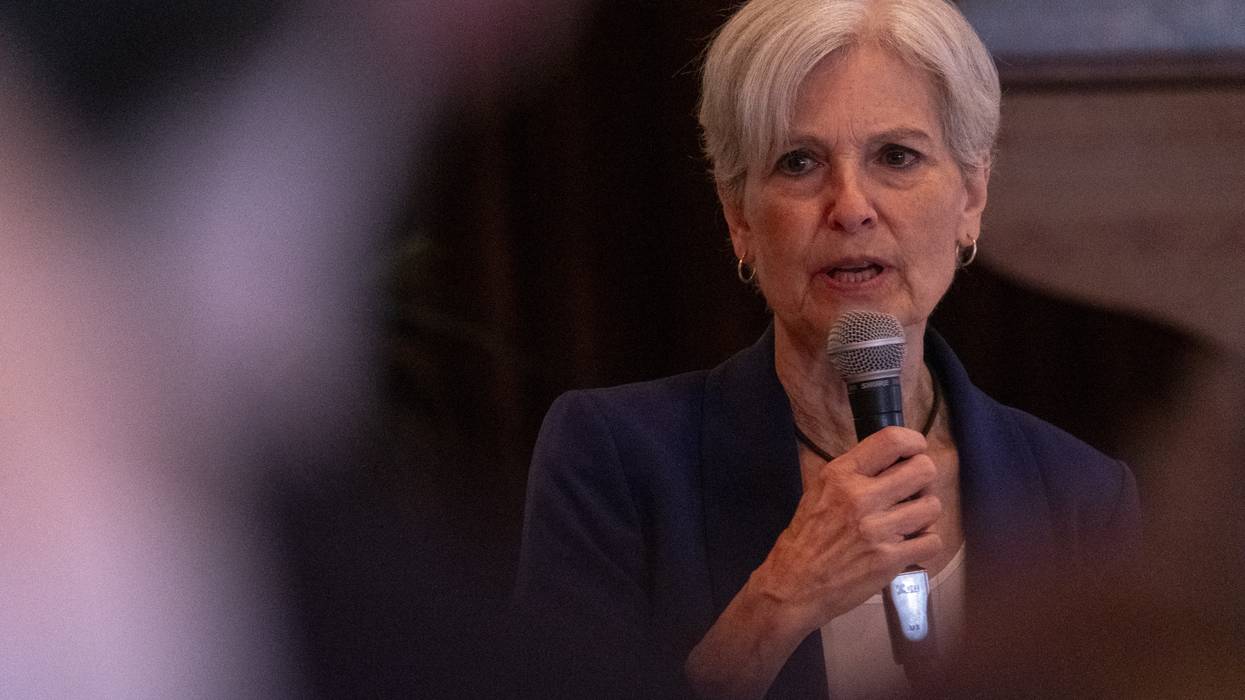
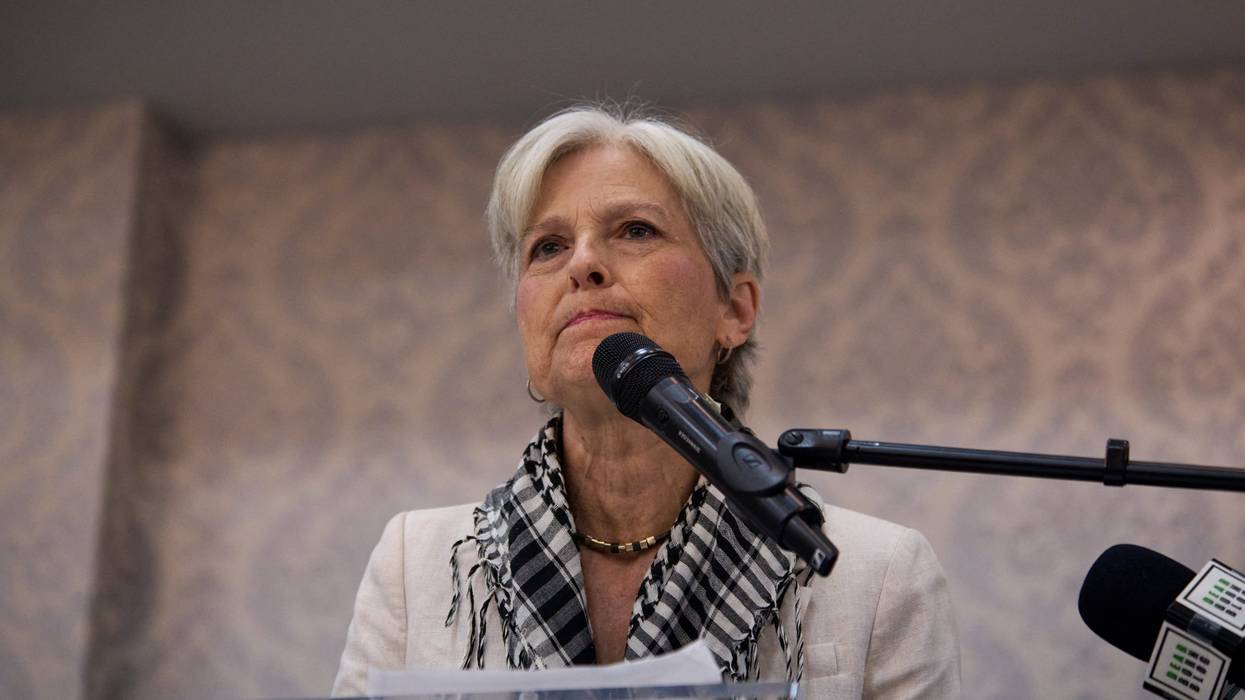
There are many other “third-party” candidates for president, and many of them have good policy proposals for ending the genocidal U.S.-Israeli massacre in Gaza. As the website for Claudia de la Cruz, the presidential candidate for the Party of Socialism and Liberation, explains, “Our tax dollars should be used to meet people's needs -- not pay for the bullets, bombs and missiles used in the massacre in Gaza.”
Whoever wins this election, we must find a way to put peace back on this country’s national agenda, and to make our collective voices heard
Many of the principles and policy proposals of “third-party” and independent candidates are more in line with the views of most Americans than those of Harris or Trump. This is hardly surprising given the widely recognized corruption of the U.S. political system. While Trump cynically flip-flops to appeal to both sides on many questions, and Harris generally avoids committing to policy specifics at all, especially regarding foreign policy, most Americans understand that they are both more beholden to the billionaires and corporate interests who fund their campaigns than to the well-being of working Americans or the future of the planet.
Michael Moore has published a flier titled “This Is America,” which shows that large majorities of Americans support “liberal” positions on 18 different issues, from a ceasefire in Gaza to Medicare For All to getting money out of politics.
Moore implies that this should be reassuring to Democrats and Harris supporters, and it would be if she was running on those positions. But, for the most part, she isn’t. On the other hand, many third party and independent candidates for president are running on those positions, but the anti-democratic U.S. political system ensures that they can’t win, even when most Americans agree with them.
War and militarism are the most deadly and destructive forces in human society, with real world, everyday, physical impacts that kill or maim people and destroy their homes, communities and entire countries. So it is deeply disturbing that the political system in the United States has been corrupted into bipartisan subservience to a military-industrial complex (or MICIMATT, to use a contemporary term) that wields precisely the “unwarranted influence” that President Eisenhower warned us against 64 years ago, and uses its influence to drag us into wars that wreak death and destruction in country after country.
Apart from brief wars to recover small neocolonial outposts in Grenada, Panama and Kuwait, all now many decades ago, the U.S. military has not won a war since 1945. It systematically fails on its own terms, while its nakedly lethal and destructive power only fills graveyards and leaves countries in ruins. Far from being an effective vehicle to project American power, unleashing the brutality of the U.S. war machine has become the fastest, surest way to further undermine America’s international standing in the eyes of our neighbors.
After so many wars under so many administrations of both parties, neither Republicans nor Democrats can claim to be a “lesser evil” on questions of war and peace, let alone a “peace party.”
As with so many of America’s problems, from the expansion of corporate and oligarchic power to the generational decline in living standards, the combined impact of decades of Democratic and Republican government is more dangerous, more lasting and more intractable than the policies of any single administration. On no question is this more obvious than on questions of war and peace.
For decades, there was a small but growing progressive wing in the Democratic Party that voted against record military spending and opposed U.S. wars, occupations and coups. But when Bernie Sanders ran for president and millions of grassroots Democrats rallied around his progressive agenda, the Party leaders and their corporate, plutocratic backers fought back more aggressively to defeat Bernie and the progressives than they ever fought to win elections against the Republicans, or to oppose the war on Iraq or tax cuts for the wealthy.
This year, flush with blood money from the Israel lobby, pro-Israel Democrats defeated two of the most progressive, public-spirited Democratic members of Congress, Cori Bush and Jamaal Bowman.
On the Republican side, in response to the U.S. wars on Iraq and Afghanistan, the libertarian Republican member of Congress Ron Paul led a small group of Republicans to join progressive Democrats in an informal bipartisan peace caucus in Congress. In recent years though, the number of members of either party willing to take any kind of stand for peace has shrunk dramatically. So while there are now over 100 Congressional caucuses, from the Candy Caucus to the Pickleball Caucus, there is still not one for peace.
After the neocons who provided the ideological fuel for Bush’s catastrophic wars reconvened around Hillary Clinton in 2016, President Trump tried to “make America’s military great again” by appointing retired generals to his cabinet and characteristically staking out positions all over the map, from a call to kill the families of “terrorists” to a National Defense Strategy naming Russia and China as the “central challenge to U.S. prosperity and security,” to casting himself as a peacemaker by trying to negotiate a peace treaty with North Korea.
Trump is now running against Biden’s war in Ukraine and trying to have it both ways on Gaza, with undying support for Israel and a promise to end the war immediately. Some Palestinian-Americans are supporting Trump for not being the VP for Genocide Joe, just as other people support Harris for not being Trump.
But most Americans know little about Trump’s actual war policy as president. The unique value of a leader like Trump to the military-industrial complex is that he draws attention to himself and diverts attention away from U.S. atrocities overseas.
In 2017, Trump’s first year in office, he oversaw the climax of Obama’s war against ISIS in Iraq and Syria, which probably killed as many civilians as Israel has massacred in Gaza. In that year alone, the U.S. and its allies dropped over 60,000 bombs and missiles on Iraq, Syria, Afghanistan,Yemen, Libya, Pakistan and Somalia. That was the heaviest bombing since the first Gulf War in 1991, and double the destruction of the “Shock & Awe” bombing of Iraq in 2003.
Most chillingly, the Iraqi forces who defeated the last remnants of ISIS in Mosul’s Old City were ordered to kill all the survivors, fulfilling Trump’s threat to “take out their families.” "We killed them all," an Iraqi soldier told Middle East Eye. "Daesh, men, women and children. We killed everyone." If anyone is counting on Trump to save the people of Gaza from Netanyahu and Biden’s genocide, that should be a reality check.
In other areas, Trump’s back-pedaling on Obama’s diplomatic achievements with Iran and Cuba have led to new crises for both those countries on the eve of this election. By moving the US Embassy to Jerusalem, bribing Arab despots with ‘Abraham’ deals, and encouraging Netanyahu’s Greater Israel ambitions, Trump primed the powder-keg for the genocide in Gaza and the new crisis in the Middle East under Biden.
On the other side, Harris shares responsibility for genocide, arguably the most serious international crime in the book. To make matters worse, she has connived in a grotesque scheme to provide cover for the genocide by pretending to be working for a ceasefire that, as Jill Stein and many others have said, the U.S. could enforce “in the blink of an eye, with a single phone call” if it really wanted to. As for the future, Harris has only committed to making the U.S. military even more “lethal.”
The movement for a Free Palestine and an end to the genocide in Gaza has failed to win the support of the Republican or Democratic presidential campaigns. But this is not a failure on the part of the Palestinian-Americans we have listened to and worked with, who have engaged in brilliant organizing, gradually raised public awareness and won over more Americans to their cause. They are leading the most successful anti-war organizing campaign in America since the Iraq War.
The refusal of Trump or Harris to listen to the calls of Americans whose families are being massacred in Gaza, and now in Lebanon too, is a failure on the part of the corrupt, anti-democratic political system of which Trump and Harris are figureheads, not a failure of activism or organizing.
Whomever each of us votes for in the presidential election, the campaign to end the genocide in Gaza will continue, and we must grow stronger and smarter and more inclusive until politicians cannot ignore us, no matter how much money the Israel lobby and other corrupt interests throw at them, or at their political opponents.
Whomever we vote for, the elephant in the room will still be U.S. militarism and the violence and chaos it inflicts on the world. Whether Trump or Harris is president, the result will be more of the same, unless we do something to change it. As legendary Chinese philosopher Lao Tzu famously said, “If you do not change direction, you may end up where you are heading.”
No American should be condemned for voting for a candidate of their choice, however successfully the Democrats and Republicans have marginalized the very concept of multi-party democracy that the U.S. claims to support in other countries. Whoever wins this election, we must find a way to put peace back on this country’s national agenda, and to make our collective voices heard in ways that cannot be drowned out by oligarchs with big bags of cash.