SUBSCRIBE TO OUR FREE NEWSLETTER
Daily news & progressive opinion—funded by the people, not the corporations—delivered straight to your inbox.
5
#000000
#FFFFFF
To donate by check, phone, or other method, see our More Ways to Give page.
Daily news & progressive opinion—funded by the people, not the corporations—delivered straight to your inbox.
"This is what happens when you go against corporate America and their allies," said the United Auto Workers president.
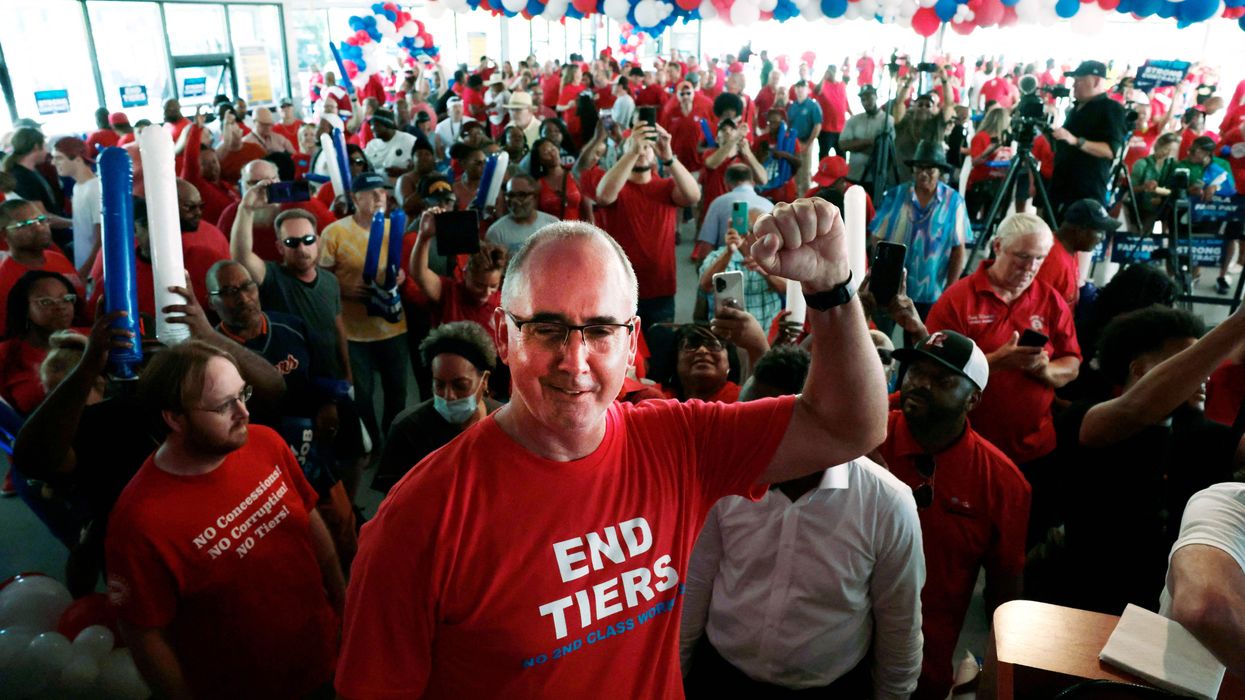
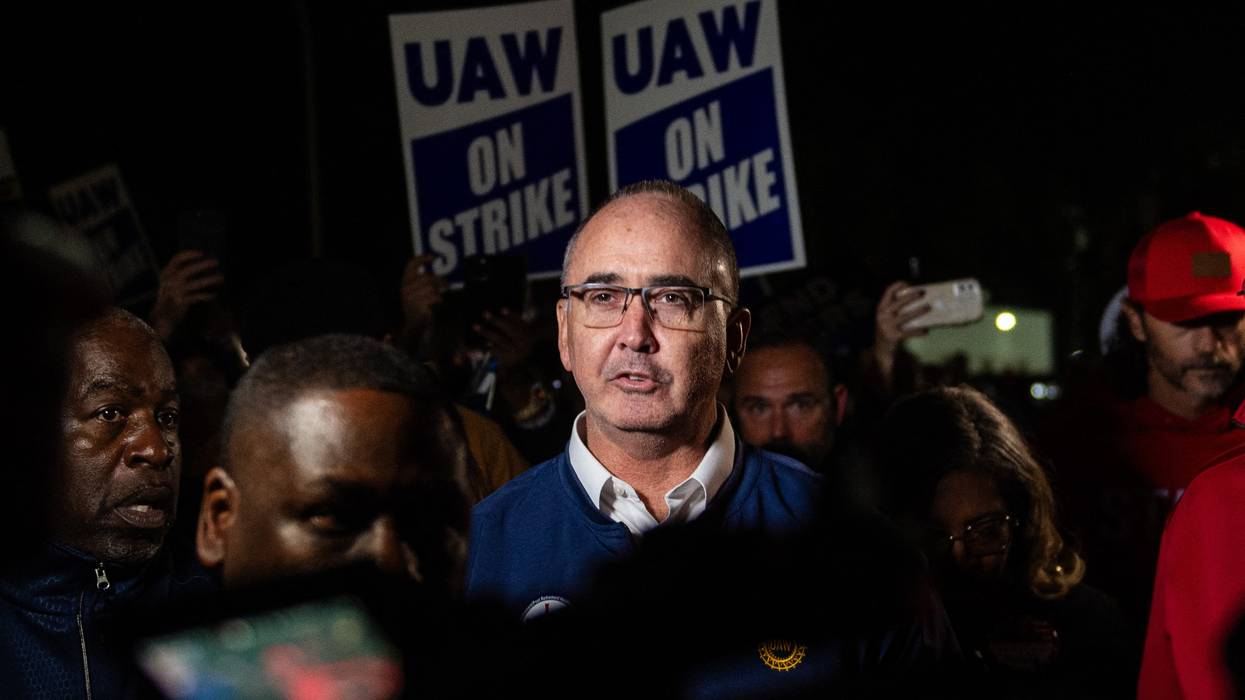
United Auto Workers president Shawn Fain issued a fiery statement on Sunday vowing to "fight back hard" as President Donald Trump's Justice Department launched a probe into allegations that the union leader abused his authority to seek benefits for his fiancée and her sister.
Fain rejected the claims as "false" and accused UAW vice president Rich Boyer, who is vying for the union presidency, of "trying to weaponize these bogus allegations to steal the upcoming UAW election." Fain also hit out at court-appointed federal monitor Neil Barofsky, whom the union president accused of harboring "a political grudge against me because the UAW took an anti-war stance about what was happening in Gaza."
"Rich Boyer has fed the monitor false allegations about me," said Fain. "We're going to fight back hard."
In 2023, Fain emerged as one of the most prominent union leaders in the nation during the UAW's weeks-long "Stand Up Strike" against the Big Three automakers, which yielded historic contracts for UAW members. On Sunday, Fain suggested that the union's successes under his leadership are fueling his opponents' attacks.
"This is what happens when you go against corporate America and their allies," said Fain, "and I'm not going to be intimidated or harassed out of serving our membership."
Bloomberg reported Sunday that the US Justice Department has launched a grand jury probe into allegations that Fain "sought a financial bonus for his fiancée and pushed for a worker’s compensation claim for her sister."
"He allegedly retaliated against Boyer for refusing to approve the benefits by stripping the official of his duties as chief negotiator with Stellantis NV, the maker of Jeep and Ram vehicles," Bloomberg noted. "The allegations became public last month in a report by the court-appointed monitor."
Fain on Sunday denied retaliating against Boyer. "The truth when it comes to Boyer," Fain said, "is that I didn't want him running the Stellantis Department because he wasn't doing a good job for our members."
The UAW president went on to accuse Boyer of trying to "hire family members into UAW positions" and failing to enforce the union's contract with Stellantis.
"Boyer is bad for our union and I'm not going to let him use the monitor's bogus investigation so he can try to fail upwards into a bigger title," said Fain. "Our election is in six weeks. Neil Barofsky will not run our union, no matter how hard he tries. And no company sellout like Boyer is going to dictate our elections."
Barofsky was appointed as UAW monitor in 2021—around two years before Fain was sworn in as union president—as part of a consent decree with the Justice Department in the wake of a corruption investigation.
Relations between Fain and Barofsky have reportedly been strained since late 2023, when the UAW became the largest union in the US to call for a ceasefire in Gaza as the Palestinian enclave faced a massive Israeli assault.
Shortly after the UAW's demand, according to The Detroit News, Barofsky "called Fain for a personal conversation related to the ceasefire statement and other issues around the war—a call Fain would later indicate made him uncomfortable, and that a union lawyer told Barofsky was out of line."
In February 2024, weeks after the UAW's ceasefire call, Fain and Barofsky had an "expletive-laden discussion" that Fain says "led to the monitor launching an investigation into him," The Detroit News reported last week. Fain reportedly said at one point during the February phone meeting that Barofsky accused the union leader of being antisemitic, which Fain furiously denied.
"For anybody to ever f------ say I'm antisemitic, brother, I'll fight your ass in front of this building in a heartbeat," Fain said, according to The Detroit News. "I do not f------ like that, and I don't appreciate it."
In what could be his most important endorsement in the tight Senate primary, Michigan's largest and most influential union said El-Sayed was "someone we can trust to have our backs."
Momentum behind Dr. Abdul El-Sayed, the progressive hopeful for Michigan's US Senate seat, continued to build on Friday when the candidate won a major endorsement from the state's largest and most influential labor union, the United Auto Workers.
"The UAW is proud to endorse Abdul El-Sayed for US Senate," the union said in a post to social media. "UAW members in Michigan want a fighter in Washington, DC who isn’t afraid to push forward a strong working-class agenda with moral clarity."
"Having never taken a dime from corporate PACs, Dr. Abdul El-Sayed is someone we can trust to have our backs," the union continued. "From Medicare for All to banning stock buybacks, Dr. Abdul El-Sayed is ready, eager, and well-equipped to move our core issues in the US Senate."
Despite stronger establishment backing for his opponents, Rep. Haley Stevens (D-Mich.) and state Sen. Mallory McMorrow (D-8), recent polls show El-Sayed, Detroit's former health director, as a narrow frontrunner for the Democratic primary scheduled for early August, where the winner is expected to face the Republican former US Rep. Mike Rogers for the vacant Senate seat.
El-Sayed has won the endorsements of other unions, such as National Nurses United; progressive groups, including the Working Families Party; Sen. Bernie Sanders (I-Vt.); and several like-minded Democrats, such as Michigan’s US Rep. Rashida Tlaib; Reps. Ro Khanna (D-Calif.) and Pramila Jayapal (D-Wash.); and Minnesota Attorney General Keith Ellison.
But the endorsement of the storied UAW, which boasts over 350,000 active and retired members in Michigan, might be his biggest yet as he seeks to transition fully from insurgent to frontrunner.
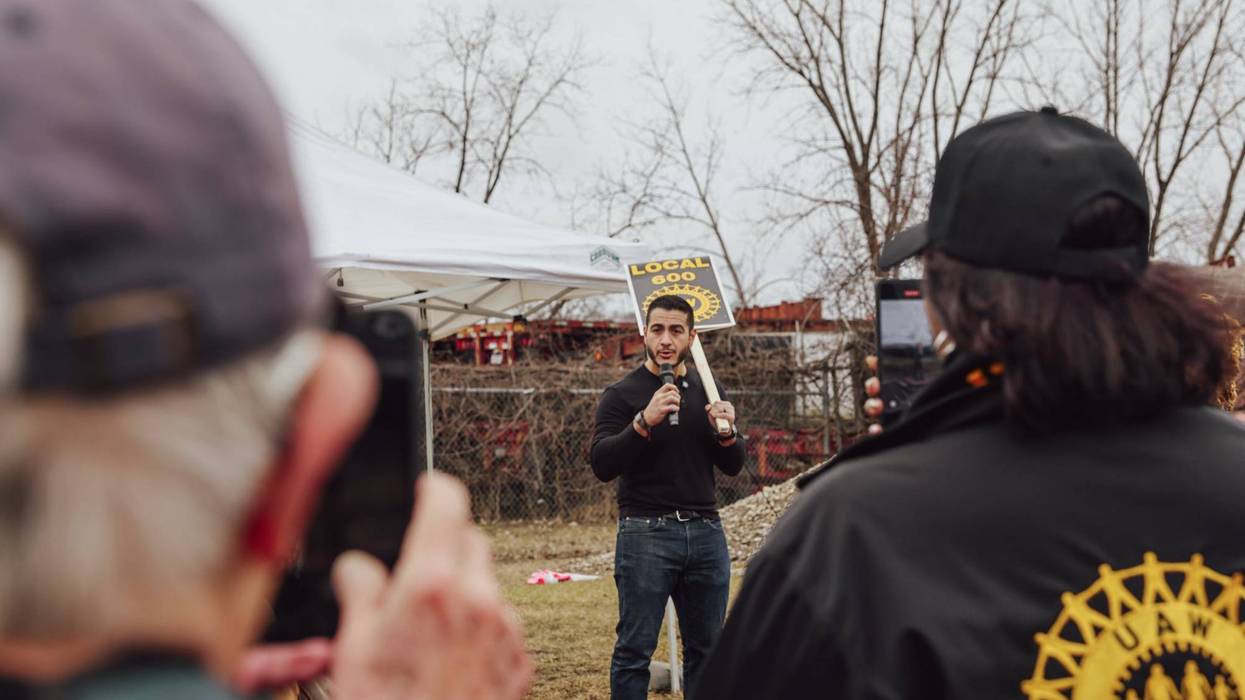
"I am so honored and humbled," El-Sayed said on social media as he prepared to join striking UAW Local 2093 American Axle workers on the picket line in Three Rivers on Friday. "Michigan union autoworkers built the American middle class and proved that when people stand together, there’s nothing we can’t accomplish. Solidarity forever."
Dan Merica, a reporter at The Washington Post, noted that losing the UAW endorsement to El-Sayed was a particularly big blow to Stevens, "who is running as a technocrat, often referring to herself as a 'manufacturing geek' because of her work as one of President Barack Obama’s top officials on the 2009 auto rescue."
It could have major implications in a race that is not only critical for deciding the balance of power in the Senate this November, but is widely perceived as a battle for the future of the Democratic Party.
Michigan's importance is surely not lost on Senate Minority Leader Chuck Schumer (D-NY). The New York Times reported on Friday that despite a public stance of neutrality, he is working behind the scenes to push party donors to support Stevens, the most conservative Democrat in the three-way race. The representative for suburban Detroit recently came under scrutiny over her backing from the American Israel Public Affairs Committee (AIPAC) and the for-profit health insurance industry.
In response to what The Washington Post described as the establishment’s “concerted bid to hew to the political center,” the progressive advocacy group MoveOn said, “Once again the Democratic establishment seems to think it knows what’s best for voters [more] than voters themselves,” and congratulated El-Sayed on his endorsement.
"There’s a reason his campaign is inspiring people all over the state," said MoveOn's chief communications officer Joel Payne. "His economic populism resonates with Michiganders who are sick of lip service, dark money, and politicians who don’t seem to get their day-to-day struggles."
"Those in congressional cloakrooms and in the establishment class in DC may not like it," he continued, "but real Michiganders continue to make their support for El-Sayed’s economic populism and people-centered agenda clear.”
"Southern autoworkers are standing up, and I expect many more to follow Volkswagen’s lead," said the director of United Auto Workers Region8.
Organized labor scored a massive win in the US South on Thursday as Volkswagen workers in Chattanooga, Tennessee voted with 96% support to ratify their first union contract, a four-year deal that includes significant wage increases, reduced healthcare costs, and stronger job-security protections.
The contract ratification vote came nearly two years after the Chattanooga Volkswagen workers voted overwhelmingly to join the United Auto Workers (UAW), which called the vote a "historic victory." The UAW is leading a concerted effort to unionize workplaces in the South, where so-called "right-to-work" laws and Republican-controlled governments' hostility to labor have made organizing extremely difficult.
"Southern autoworkers are standing up, and I expect many more to follow Volkswagen’s lead,” said Tim Smith, director of UAW Region 8, following the contract vote. “Workers are done being left behind, and VW is just the first step towards justice for autoworkers everywhere. Who are we? U-A-W!”
Shawn Fain, the UAW's president, said that Volkswagen workers have "moved yet another mountain."
“From having the courage to stand up and form their union, to having the backbone to authorize a strike and hold out for a contract that honors their worth, VW workers are leading the way for the entire labor movement and non-union autoworkers everywhere," said Fain. "Welcome to the UAW family."
The union victory at the German automaker's lone active manufacturing plant in the US was seen as a critical breakthrough for Southern organizing efforts. The AFL-CIO, the largest labor federation in the US, called the Volkswagen contract vote "an inspiring and historic milestone for working people in the South."
The UAW's bargaining committee at the Chattanooga plant celebrated the win but stressed that ratification is just the first step.
"The next step is enforcing it," the committee said. "The strongest way to make sure every raise is paid, management follows every safety rule, and every right is respected is simple: Become a member. Membership means collective strength. Membership means protection. Membership means that when the contract is tested—and it will be—workers stand united and ready to defend what they fought to win."
"That's a union brother who spoke up," said UAW president Shawn Fain. "He put his constitutional rights to work. He put his union rights to work."
TJ Sabula, the auto worker who called President Donald Trump a “pedophile protector" last month, is reportedly keeping his job.
According to a report from the Detroit News, United Auto Workers (UAW) vice president Laura Dickerson said on Monday that Sabula is not getting fired from his job at a Ford truck plant in Dearborn, Michigan, and he will not face any discipline for his heckling of the president.
Dickerson, who discussed Sabula's case at the UAW's annual Community Action Program conference in Washington, DC, also took a shot at Trump for giving Sabula the middle finger while appearing to mouth or yell “fuck you” back at the auto worker.
"In that moment, we saw what the president really thinks about working people," Dickerson said. "As UAW members, we speak truth to power. We don't just protect rights, we exercise them."
UAW president Shawn Fain also took time during the conference to offer appreciation for Sabula, the Detroit News reported.
"That's a union brother who spoke up," said Fain. "He put his constitutional rights to work. He put his union rights to work."
Sabula, who said he decided to called Trump a "pedophile protecter" for his attempts to block the release of files related to late billionaire sex offender Jeffrey Epstein, had been suspended from his job after the incident took place.
Critics of the president quickly rushed to Sabula's aid, however, as two separate GoFundMe campaigns aimed at raising money for the auto worker raked in a total of over $800,000.
In an interview published last month by the Washington Post, Sabula said he had “no regrets whatsoever” about yelling at the president, even though it led to his suspension.
“I don’t feel as though fate looks upon you often, and when it does, you better be ready to seize the opportunity,” Sabula told the Post. “And today I think I did that.”
"We greatly appreciate the outpouring of support!" autoworker TJ Sabula said to donors.
Fundraisers for TJ Sabula, the auto worker who called President Donald Trump a “pedophile protector,” are being flooded with cash from supporters following news that he was suspended from his job at a Ford truck plant in Dearborn, Michigan.
Two separate GoFundMe campaigns aimed at raising money for Sabula have raked in a total of over $800,000 just three days after the auto worker heckled Trump for his attempts to block the release of files related to late billionaire sex offender Jeffrey Epstein.
Trump responded to Sabula's taunts by giving him the middle finger, while appearing to mouth or yell “fuck you” back at the auto worker.
Sabula on Wednesday expressed gratitude to all the people who had chipped in for the crowdfunding campaign so far.
"We greatly appreciate the outpouring of support!" he wrote at the "TJ Sabula is a Patriot" GoFundMe page. "At this time we are closing donations to this campaign and encourage you to look for other causes and organizations to support. We appreciate every single donation, comment, share, and sign of support!"
In addition to the outpouring of support from strangers, Sabula got the backing of the United Auto Workers (UAW), which described the suspended worker as "a proud member of a strong and fighting union,” further noting that “he believes in freedom of speech, a principle we wholeheartedly embrace, and we stand with our membership in protecting their voice on the job."
UAW vowed that Sabula will receive “the full protection of all negotiated contract language safeguarding his job and his rights as a union member.”
In a Tuesday interview published by the Washington Post, Sabula said he had “no regrets whatsoever” about yelling at the president, despite the uncertain future he now faces at his job.
“I don’t feel as though fate looks upon you often, and when it does, you better be ready to seize the opportunity,” Sabula told the Post. “And today I think I did that.”
"We stand with our membership in protecting their voice on the job."
TJ Sabula, the Michigan auto worker who was suspended from his job at Ford after calling President Donald Trump a "pedophile protector," has the backing of the largest US auto union.
United Auto Workers (UAW) on Wednesday pledged to support Sabula, whom it described as "a proud member of a strong and fighting union," further noting that "he believes in freedom of speech, a principle we wholeheartedly embrace, and we stand with our membership in protecting their voice on the job."
UAW vowed that Sabula will receive "the full protection of all negotiated contract language safeguarding his job and his rights as a union member."
Sabula on Tuesday accused Trump of being a "pedophile protector"—in reference to the president's reluctance to release files related to the criminal investigation of late sex offender Jeffrey Epstein—while the president was visiting a Ford truck plant in Dearborn, Michigan.
Trump responded by giving Sabula the middle finger, while appearing to mouth or yell "fuck you" back at the auto worker.
WATCH: Trump shows his middle finger and appears to say "fuck you" after Ford worker yells "pedophile protector" - TMZ pic.twitter.com/aFsDmrvkr7
— BNO News (@BNONews) January 13, 2026
Sabula has received an outpouring of support since heckling Trump. A GoFundMe campaign aimed at raising money in support of the suspended auto worker has so far raised more than $350,000.
In a Tuesday interview published by the Washington Post, Sabula said he had "no regrets whatsoever" about yelling at the president, despite the uncertain future he now faces at his job.
"I don’t feel as though fate looks upon you often, and when it does, you better be ready to seize the opportunity,” Sabula told the Post. “And today I think I did that.”
"I'm voting yes to get Volkswagen to come back to the table," said one employee at the plant. "The majority of the people I know don't want VW's 'final offer.'"
Volkswagen workers in Chattanooga, Tennessee, who unionized with the United Auto Workers last year, announced Thursday that they will vote next week to authorize a strike after over 13 months of fruitless contract negotiations with the auto giant.
The strike authorization vote planned for October 28-29 "comes after months of unfair labor practices committed by the company, including bad faith negotiations, unlawful intimidation, and the unilateral cutting of jobs at Volkswagen’s only US assembly plant," UAW said in a statement. The union also highlighted Volkswagen's $20.6 billion in profits last year.
Company spokesperson Michael Lowder said Monday that "Volkswagen made it clear to the union that our last, best, and final offer is indeed final. We cannot in good faith prolong negotiations by continuing to bargain when we have already put our best offer on the table. It is time for the UAW to give VW employees a voice and let them decide for themselves by voting on our final offer."
However, multiple employees said Thursday that they are not happy with the company's latest offer and plan to vote for a strike.
"I'm voting yes because this is the time to show Volkswagen we are serious about receiving industry-standard treatment. Job security's essential. They could pay us $100 an hour, but it means nothing if they close the plant two weeks into the agreement," said James Robinson. "I'm hoping this process shows the company we are serious about getting a fair contract. We will show them their offer wasn't enough, show them we're willing to stand up to get what we deserve."
"I'm hoping this process shows the company we are serious about getting a fair contract."
Employee Taylor Fugate said that "I'm voting yes to get Volkswagen to come back to the table. The majority of the people I know don't want VW's 'final offer.' They want to keep negotiating, and we are willing to do what it takes to make that happen."
"We need affordable healthcare and a strong job security statement that leaves no gray area," Fugate added. "We also deserve equal standards—Southern autoworkers shouldn't be treated differently!"
One elected Republican held a press conference on Wednesday in a bid to bully the union into holding a vote on the company's latest offer. Local 3 News reported that Hamilton County Commissioner Jeff Eversole said: "Volkswagen put forward a final union contract offer over a month ago that offers significant gains for Chattanooga workers, including a 20% wage increase, a cost-of-living allowance, a $4,000 ratification bonus, lower healthcare costs, and much more. Many employees have been reaching out to the UAW to vote, and the UAW has refused."
Payday Report's Mike Elk pointed out Thursday that "the tactics used by the GOP in Chattanooga are similar to the tactics that they have used for more than a decade to sometimes successfully dissuade union votes by implying that the plant may close if the union gets 'too greedy' (their words, not my mine, as the son of a Volkswagen auto assembly line worker)."
Local 3 News noted that "during the press conference, dozens of members from both the UAW and the Chattanooga Area Central Labor Council, or CLC, began picketing outside of the VW plant."
The outlet also spoke with some employees. One of them, Dakotah Bailey, explained that "originally, it was going to be a 25% increase in wages. They didn't want to take that, and now they dropped it down to 20%. I wanted to try and get my money now. Especially right before the holidays. It would be great to have an extra $5,500 sitting in my bank account."
According to a "Volkswagen Stories" video series published by the UAW on YouTube, wages are a primary concern for workers. Other top priorities include health and safety conditions at the plant, healthcare, paid time off, and retirement benefits.
"I don't want to strike, but if it comes to it, I will," Volkswagen worker Mitchell Harris said Thursday. "Because I feel that all my brothers and sisters of UAW Local 42 deserve respect, to provide a better life for their families, and have job security for us and generations to come."
Ushering in a vigorous celebration of the real history of the US working class in the lead up to May 1 couldn’t be more necessary to buttress workers’ class consciousness and solidarity under Trump.
Just two months ago, my union—the United Automobile Workers—did a remarkable thing. It made public its pledge to fight for the rights of autoworkers—not its own dues-paying members, but workers overseas—based on the slogan, “An injury to one is an injury to all.”
That slogan has its origins in the radical US labor formation from the last century, the Industrial Workers of the World (IWW), also known as the “Wobblies.” The Wobblies were famous for advocating “One Big Union,” uniting workers without distinction, and directly targeting the capitalist system. Its founders 120 years ago included anarchists, socialists, and Marxists.
The UAW pledged to support injured workers in Colombia who assembled cars and trucks under antiquated, onerous working conditions for one of the largest transnational corporations in the world, General Motors. They were all men, mostly in their 20s, 30s, and 40s when they were fired by GM due to their job-related injuries. When they hired in, they had to sign a pledge they wouldn’t join a union.
This was GM’s routine practice, and they got away with it for a long time, making their factory on the outskirts of the capital city, Bogotá, the most profitable GM plant in Latin America. That is, until dozens of the injured and fired workers formed their own association, ASOTRECOL, and collectively fought back. GM didn’t see that coming, and they’ve tried to be blind to it ever since.
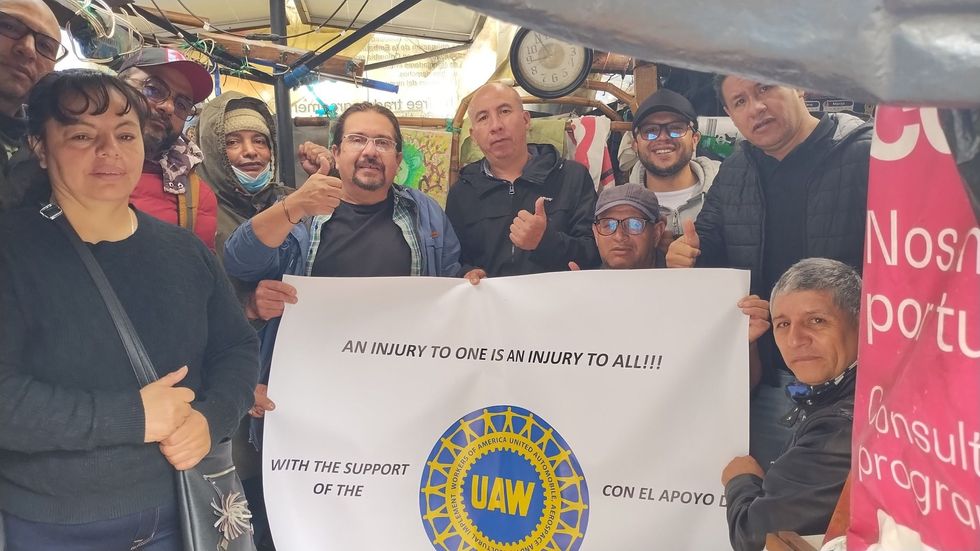
A lot of autoworkers in the US and around the world, and the solidarity network that grew to support ASOTRECOL, became familiar with these courageous workers when a group of them waged three successive hunger strikes, with their lips sewn shut. The tent they occupied at the foot of the massive fortress housing the US Embassy, now going on for over 14 years, has become iconic. All this took place in the country with the worst reputation in the world for the assassination of trade unionists—3,000 organizers during 1990-2010—by paramilitaries and Colombian military forces. There’s no record of GM complaining about these murders.
It was only after one full year of the encampment, and a weeks-long hunger strike, that the UAW and AFL-CIO took notice and lent support to the workers’ struggle. When the workers didn’t bend the knee to GM and declined a settlement “final offer,” everything changed—US Labor’s support disappeared, including the UAW’s. My union was gripped in a corruption scandal which ultimately led to changes in the UAW Constitution enabling the membership, for the first time, to directly elect the top leadership.
The reform caucus, Unite All Workers for Democracy (UAWD), which I helped birth, can take credit for this turn of events. A new slate of leaders (UAW Members United) was elected to the International Executive Board in 2022-23, including President Shawn Fain and the UAW’s GM Department Director, Mike Booth.
The current effort on behalf of ASOTRECOL presents a different face of global solidarity, one not predicated on reciprocity or “what’s in it for us?”
Beginning in 2024, Fain and Booth put GM on notice—calling on GM to “deliver justice for the remaining 12 Colombian workers illegally fired after suffering debilitating injuries at GM’s Bogotá plant.” In August, on the 14th anniversary of the tent occupation the UAW posted on Facebook about the struggle, including a YouTube video, with a call to share and post on GM social media.
The UAW is currently building international support, directly engaging with GM, and garnering support from unions around the globe which represent GM workers.
With this campaign, Fain and Booth are redefining the meaning and practice of the UAW’s “international solidarity.” Former (and convicted) UAW President Dennis Williams and Secretary-Treasurer Gary Casteel elaborated on their view in We Don’t Quit: Stories of UAW Global Solidarity published in 2015. They wrote that “global solidarity is a two-way street—one that shows that those we support regularly use their power on behalf of the UAW when we need their help.” One example: the German IG Metal union’s support for the UAW’s organizing campaign at VW in Chattanooga, Tennessee.
The current effort on behalf of ASOTRECOL presents a different face of global solidarity, one not predicated on reciprocity or “what’s in it for us?” ASOTRECOL is not a union. It does not have the organized power to directly support the UAW. Yet the UAW is investing time, energy, staff, and political capital to see this through, with victory not guaranteed. Standing with 12 South American disabled GM autoworkers who were kicked under the bus literally embraces the IWW tenet that, “An Injury to One is an Injury to All.” That’s a cultural norm that UAW members embrace on the shop floor, more often than not. Fain and Booth have made it international.
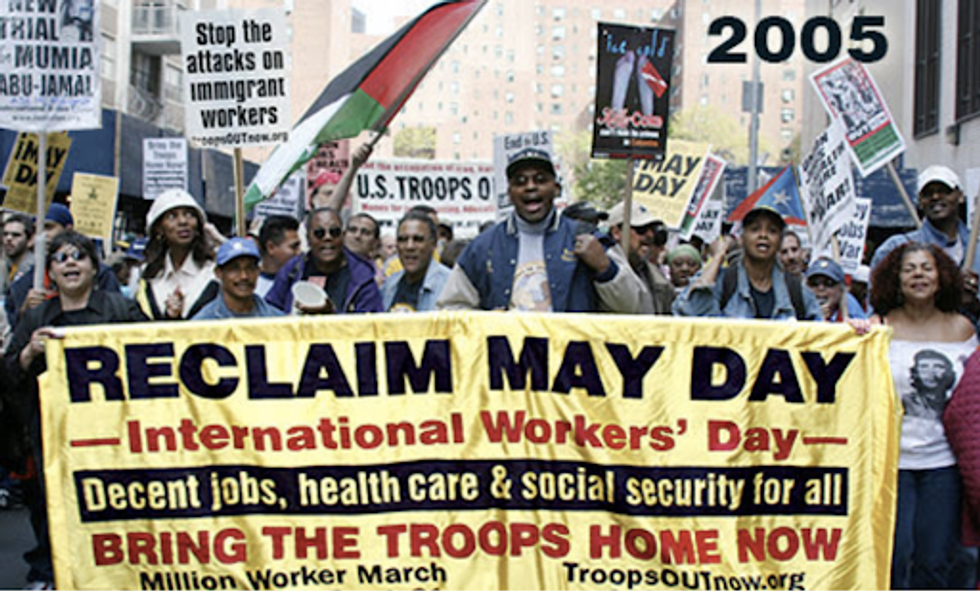
One of the most interesting outcomes of the “Stand Up Strikes” at the “Big 3” in 2023 was the agreement on the contract expiration dates. The strategy behind choosing April 30, 2028 is an envisioned “general strike” on May Day, International Workers Solidarity Day. The UAW’s aim is to win US unions to align their contracts to expire at the same time under the mantra, “We have more power if we strike together.”
The headline of an editorial by President Fain published in In These Times (May, 2024) read, “May Day 2028 Could Transform the Labor Movement—and the World.” In it he doubles down, explaining the date was chosen “…in hopes the labor movement can collectively aspire to building the power needed to change the world.” Much of the UAW’s focus is on the goals of the proposed coordinated strikes: healthcare as a human right, pensions, improved standard of living, work-life balance. Fain argues: If working people are going to accomplish these objectives, “unions have to start thinking bigger.”
The vision for how May Day 2028 would work out, and what exactly it would look like, deserves a lot of study, discussion, and debate. In the meantime, there have been a lot of rumblings among unionists and progressives asking, “Can we wait that long?” Fain’s pronouncements were made before President Donald Trump and Vice President JD Vance were elected, and before the vile, anti-working class Project 2025 became the US government’s agenda. With the growing military occupation of our Democratic Party-leaning cities, there’s no assurance of fair elections in 2026. Will we be experiencing a full-fledged dictatorship by 2028? We need to reevaluate our thinking.
There’s no better way to begin to demonstrate this truth than with a global one-day shut down on May Day 2026.
May Day 2025 commemorations in the US were historic. An estimated quarter million workers and allies turned out at over 1,100 rallies and marches, nationwide—the most ever! Local organizing committees and coalitions, supported by a national network, May Day Strong, organized for May Day like never before, tearing off the stigma that the billionaire class has used historically to ‘kettle” workers to the more “acceptable” Labor Day parades and barbecues. No more!
However, the UAW—except for a scattering of rank-and-file members and retirees—was absent in the Detroit May Day Rally and March, missing the opportunity to educate and mobilize its members. UAW Region 1 Rep Paul Torrente, who spoke at the rally on the importance of May Day, was the exception. UAW Solidarity House cannot afford to be absent next year, the 140th anniversary of the most hallowed celebration of the global working class.
In Fain’s words, “...To reshape the economy into one that works for the benefit of everyone—not just the wealthy—we need to reclaim our country’s history of militant trade unions that united workers across race, gender, and nationality.”
That history must be reclaimed now and marshalled to build a united working class—not in 2-plus years, but now! We must begin now to recalibrate the culture of our working class movement, by explaining—as Fain does in the In These Times article, “The cause of those Haymarket Martyrs became the cause of the working class around the world, and May 1 became an international holiday commemorating the fight of workers everywhere to reclaim their time and the value of their labor.”
How many UAW members or retirees know about the “Haymarket Martyrs?” Aligning contracts is one thing, but it can’t be done in isolation of building the class consciousness that the struggle of “workers over billionaires” requires. That education cannot begin a moment too soon.
The reality is that the US working class and especially UAW members are torn between nationalism and internationalism—hence the fractures within its ranks over the UAW’s position supporting Trump’s tariff agenda. It’s no surprise because the dominant elites within the organized sector of labor—the AFL-CIO—have been steeped and saturated for over a century in American exceptionalism and make “American Great.”
Next year, with Trump at the helm of US celebrations of its 250th anniversary, the working class will be inundated with appeals to patriotism, jingoism, militarism, patriarchy, white supremacy, flag waving, etc. Ushering in a vigorous celebration of the real history of the US working class in the lead up to May 1 couldn’t be more necessary, to buttress workers’ class consciousness and solidarity. Fain is clear:
May Day is celebrated as an official holiday in countries from Argentina to South Africa to Sweden to Hong Kong, just about everywhere—except its country of origin. When unions organize together across industries and countries, our power is exponentially amplified. The fact is: Without workers, the world stops running.
There’s no better way to begin to demonstrate this truth than with a global one-day shut down on May Day 2026. It falls on a Friday. The UAW and the broader labor movement can call for a day of “no work,” for a three-day weekend, and begin to test its capacity to organize a broad “general strike” in the true meaning of the term. Back to Fain:
A united working class is the only effective wall against the billionaire class’ race to the bottom. For the US labor movement, that means grappling with some hard truths. Like the undeniable fact that it is impossible to protect American jobs while ignoring the plight of everyone else.
Stepping up, as the Fain leadership has done, in defense of the Colombian GM ex-workers is a real-life implementation of what otherwise can easily pass as rhetoric. “As working people, we must come together,” concludes President Fain, “We can no longer allow corporations, politicians, and borders to divide us. It’s time we reclaim May Day for the working class.”
One union official described the Democratic candidate as "a voice for the people of Maine fed up with the corrupting influence of the oligarchy and money in our politics."
On the heels of Maine Gov. Janet Mills entering the Democratic primary race to face Republican Sen. Susan Collins next year, the United Auto Workers on Wednesday endorsed Graham Platner, the oyster farmer and working-class champion who's been railing against the oligarchy since he launched his campaign in August.
" Inequality is out of control in our country. Today, the top 1% have more wealth than the bottom 95% of humanity combined," said UAW president Shawn Fain in a statement. "Graham understands this, and at a time when too many politicians take their cues from billionaires and corporate lobbyists, he has chosen to stand with the working class."
In Platner's first campaign ad, the military veteran pointed to his four infantry tours and declared: "I'm not afraid to name an enemy, and the enemy is the oligarchy. It's the billionaires who pay for it and the politicians who sell us out—and yeah, that means politicians like Susan Collins."
Fain said Wednesday that Platner is "focused on the real problems facing workers across this country—not the distractions the billionaire class uses to divide us. His campaign is rooted in the same core issues our union fights for every day: a living wage, affordable healthcare, retirement security, and time outside of work to actually live our lives. The UAW is proud to endorse candidates like Platner taking on the broken status quo."
Trent Vellela, president of the UAW's Maine Community Action Program Council from Bath Marine Draftsmen's Association, said that "I think he's the real deal," a sentiment shared by Platner's supporters across the country.
"Graham directly addresses the hard issues in a straightforward and relatable way," Vellela noted. "He is clear about his principles and his plan to achieve positive outcomes for the working people of Maine."
The UAW represents nearly 2,000 workers across the state, from marine draftsmen at Bath Iron Works to employees at the Portland Museum of Art and the University of Maine System. Maine is part of the union's Region 9A, directed by Brandon Mancilla.
"Graham Platner has emerged as a voice for the people of Maine fed up with the corrupting influence of the oligarchy and money in our politics," Mancilla said. "More importantly, he is building a mass movement that will not only power his campaign but will be ready to take on the challenges facing working families in Maine and across the country once in office."
"Our members are ready to hit the ground running with Graham's campaign and take back the power for Maine's working class," he said.
While the UAW and working-class Mainers rally behind Platner, Mills is already getting a boost from the Democratic Party establishment. On Tuesday, just hours after her announcement to enter the race, news broke that the Mills campaign and the Democratic Senatorial Campaign Committee (DSCC) formed a joint fundraising committee.
Platner's first TV ad—set to "air statewide on MSNBC starting Wednesday," according to Axios—takes aim at his primary opponent. It begins with a woman saying: "Janet Mills again? She was a good governor, but I think it's time for change."
"Republicans gave away trillions in tax cuts for the wealthy," said US Sen. Ed Markey. "Now they are asking Americans to work longer. We won’t stand for it."
Trump-appointed Social Security Administration Commissioner Frank Bisignano on Friday drew immediate fire from many progressives after he said raising the retirement age for American workers was on the table.
During an interview on Fox Business, host Maria Bartiromo asked Bisignano if he would "consider raising the retirement age" to shore up Social Security's finances.
"I think everything's being considered," he replied.
He said that he would need Congress' help to officially raise the retirement age and acknowledged, "That will take a while," before adding, "But we have plenty of time."
Bartiromo: Would you consider raising the retirement age?
Social Security Administration Commissioner Bisignano: I think everything will be considered pic.twitter.com/kqfMm5Prif
— Acyn (@Acyn) September 19, 2025
Advocacy organization Social Security Works immediately pounced on Bisignano's statement, which it noted contradicted statements made by President Donald Trump during the 2024 election campaign.
"That's a betrayal of Trump's campaign promise to protect Social Security," the organization said in a social media post. "Raising the retirement age by a year translates to a 7% Social Security benefit cut. Forcing us to work longer, for smaller checks, and a shorter retirement is unconscionable!"
In fact, as flagged by former Biden White House Senior Deputy Press Secretary Andrew Bates, Trump said in 2024 that "I will not cut one penny from Social Security or Medicaid and I will not raise the retirement age by one day."
Former US Labor Secretary Robert Reich also rebuked Bisignano for floating a retirement age increase, and he proposed an alternative way to improve Social Security's fiscal health.
"A worker making $50,000 a year contributes to Social Security on 100% of their income," he wrote. "A CEO making $20 million a year contributes to Social Security on less than 1% of their income. Instead of raising the retirement age, we should scrap the Social Security tax cap."
Sen. Ed Markey (D-Mass.) noted that Bisignano's call to potentially raise the retirement age came just months after Republicans passed massive tax cuts through the One Big Beautiful Bill Act that disproportionately benefited the wealthiest Americans.
"Republicans gave away trillions in tax cuts for the wealthy," he said. "Now they are asking Americans to work longer. We won’t stand for it."
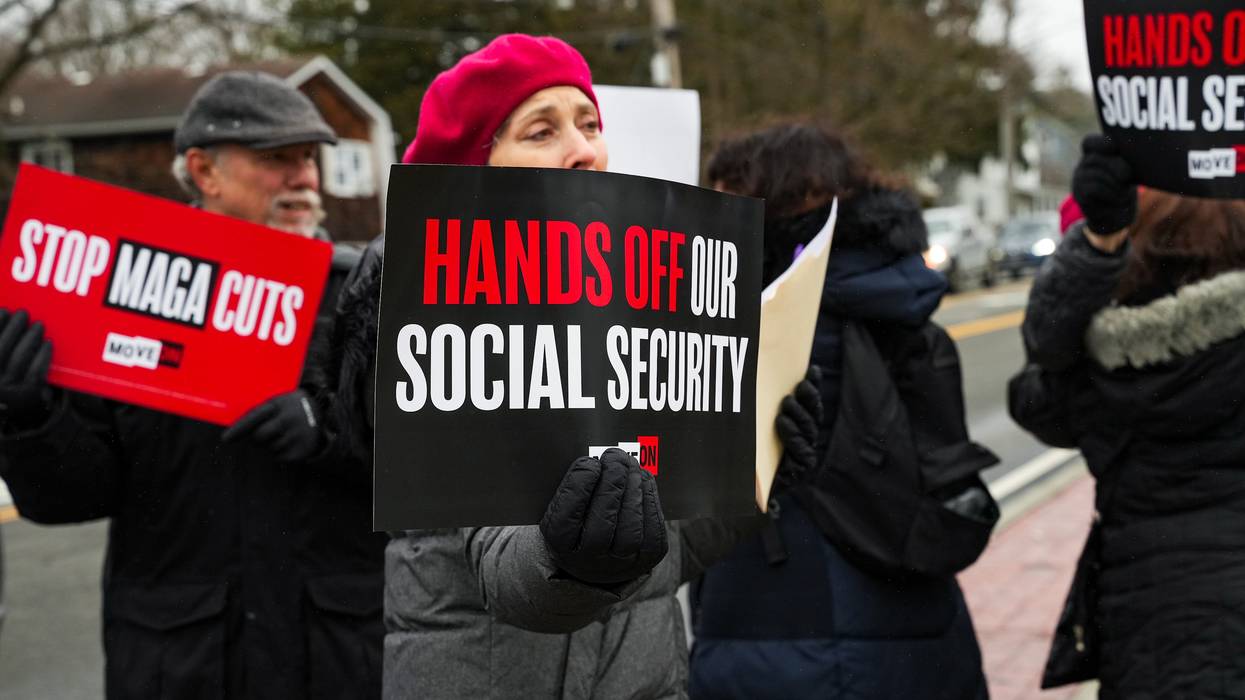
The social media account for United Auto Workers delivered a pithy two-word response to Bisignano: "Hell no!"