SUBSCRIBE TO OUR FREE NEWSLETTER
Daily news & progressive opinion—funded by the people, not the corporations—delivered straight to your inbox.
5
#000000
#FFFFFF
To donate by check, phone, or other method, see our More Ways to Give page.
Daily news & progressive opinion—funded by the people, not the corporations—delivered straight to your inbox.
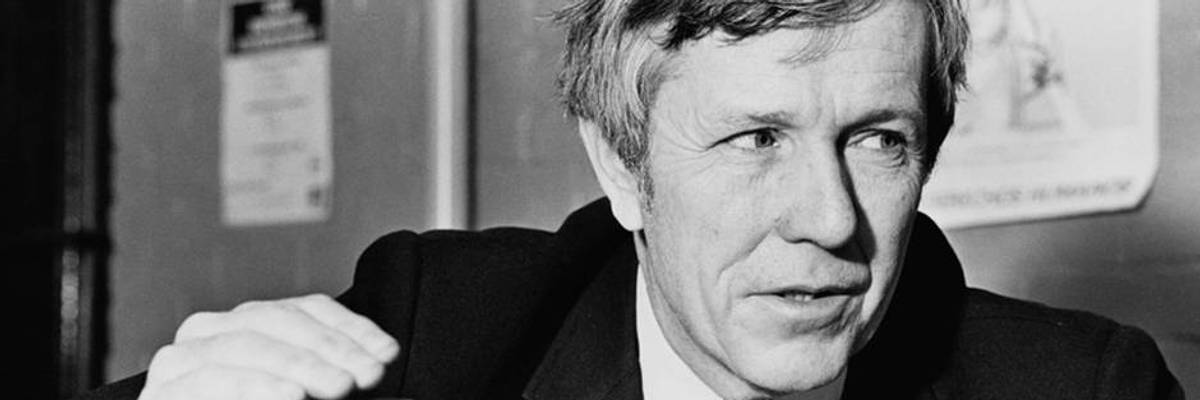
Founding national co-chair of the Democratic Socialists of America, Michael Harrington, author of The Other America, a book about poverty in the United States.
The "big tent" of the Democratic Socialists of America has its drawbacks too.
Kirkpatrick Sale has it half right in his lament over today’s Democratic Socialists of America, “Michael Harrington is Spinning in His Grave.” The imagined spinning stems from post-mortem distress at what its founding leader would make of the organization today. Sale—best remembered for SDS, his history of Students for a Democratic Society, the seminal 1960s “New Left” organization—calls himself Harrington’s “close friend and traveling companion,” and feels that today’s DSA “has stood on its head the principles that Mike and his colleagues stood for.”
While I cannot claim to have been Harrington’s friend, I did know him and arguably qualify as one of his colleagues, in that I was a member of the Democratic Socialist Organizing Committee, his prior organization whose 1982 merger with the New American Movement created DSA. I remain a member of the organization to this day, and when serving in the Massachusetts House of Representatives was once one of DSOC/DSA’s handful of public elected officials. From my vantage point, while I understand Sale’s real–and Harrington’s imagined–distress at some of what he sees in today’s DSA, not only does he ignore developments that would have made Harrington proud, but I also think his take on Harrington’s politics is not quite right.
As a flat statement, Sale’s contention that DSA “is no longer anything that could be called democratic or socialist” is wrong, but he is not wrong in identifying parts of 2026 DSA that would seem unlikely to have appealed to Harrington. Sale clearly recognizes that the roots of the organization’s dramatic changes—its 20-fold inflation from the 6,000 member group of the 90's—lie in Bernie Sanders’ 2016 presidential campaign. He errs, though, in calling Sanders “a leading DSA figure and its only representative in Congress.” Sanders actually was not then, is not now, and so far as I know has never been an actual member of DSA—counterintuitive as that may seem.
After Sanders introduced “democratic socialism” to millions of American living rooms in his debates with Hillary Clinton and politically “lived to talk about it,” a whole lot of people who’d also been thinking about the idea googled the term and found DSA; some joined. They were then followed by some who indeed did not identify with the democratic socialist tradition but recognized that this was now where the action was—the hazard of success.
The result is generally understood as a “big tent” organization—a tent thus far large enough to contain both US Rep. Alexandria Ocasio-Cortez (D-NY) and Democratic New York City Mayor Zoran Mamdani—figures for whom I cannot imagine Harrington having anything but admiration—along with caucuses by no means committed to that approach, groups that Harrington would consider bizarre and out of place (as does this writer.) It contains serious divergences between local chapters and a tenuous national organization. How long this tent holds up is anyone’s guess. As for Sale, if he would actually consider the entirety of organization (the best description of which I’ve seen was recently published in a German Left Party newspaper—"Von Degrowth bis ML" Jungle World, July 30, 2026) he might well see similarities with the late years of SDS (an organization Harrington subsequently regretted having failed to productively engage with.)
Among those similarities is a certain not-ready-for-prime-time quality common in organizations trying to cope with the increased glare of the public attention spotlight. Foibles and foolish statements surface from the past. My personal nomination for the dumbest left slogan of recent years is “Defund the police”—its rational kernel of re-evaluating government’s approach to certain types of public safety situations smothered in a seemingly naive call for an end to law enforcement. And yet, even someone like Mamdani who is generally considered to possess masterful political skills—correctly, I think—has had to walk that one back.
On some points of his critique of current DSA, Sale seems perhaps frozen in time, such as his noting that “Mike was an outspoken champion of the new Israel.” That “new Israel” has changed quite a bit in the thirty-seven years since Harrington has been gone. Would he remain a champion of a nation now planning a prison for Palestinians that includes a moat stocked with crocodiles – a proposal temporarily stalled by consideration of the animals’ subsequently repealed protected status? Sure hope not.
But where I really think Sale is just wrong is in essentially arguing that Harrington was not actually a socialist. Yes, Harrington did talk of being “the left wing of the possible,” and that “generally meant working within the Democratic Party”—as do most current DSAers running campaigns to do something for the American working class in the here-and-now. And while Sale is accurate in saying that the DSA of Harrington’s day “put forth a vision of a democratically elected government that would be like those of the Scandinavian countries, providing state services in health, education, housing and the like,” his contention that back then there was “Nowhere stuff about ending capitalism” makes it sound like Sale missed a lot of meetings—and maybe didn’t keep up on his reading so well either. Even the small DSA had differing strands of thinking. One major one was all about imagining how to reach a genuinely democratically controlled economy beyond the “welfare state” and capitalism, something you will find reflected in Harrington’s writing.
So would the imagined Harrington be troubled by some of what he’d see in today’s DSA? Yes, I’m sure he would. And would he be positively thrilled by some of what he found in today’s DSA? Yes, I’m sure he would.
Dear Common Dreams reader, It’s been nearly 30 years since I co-founded Common Dreams with my late wife, Lina Newhouser. We had the radical notion that journalism should serve the public good, not corporate profits. It was clear to us from the outset what it would take to build such a project. No paid advertisements. No corporate sponsors. No millionaire publisher telling us what to think or do. Many people said we wouldn't last a year, but we proved those doubters wrong. Together with a tremendous team of journalists and dedicated staff, we built an independent media outlet free from the constraints of profits and corporate control. Our mission has always been simple: To inform. To inspire. To ignite change for the common good. Building Common Dreams was not easy. Our survival was never guaranteed. When you take on the most powerful forces—Wall Street greed, fossil fuel industry destruction, Big Tech lobbyists, and uber-rich oligarchs who have spent billions upon billions rigging the economy and democracy in their favor—the only bulwark you have is supporters who believe in your work. But here’s the urgent message from me today. It's never been this bad out there. And it's never been this hard to keep us going. At the very moment Common Dreams is most needed, the threats we face are intensifying. We need your support now more than ever. We don't accept corporate advertising and never will. We don't have a paywall because we don't think people should be blocked from critical news based on their ability to pay. Everything we do is funded by the donations of readers like you. When everyone does the little they can afford, we are strong. But if that support retreats or dries up, so do we. Will you donate now to make sure Common Dreams not only survives but thrives? —Craig Brown, Co-founder |
Kirkpatrick Sale has it half right in his lament over today’s Democratic Socialists of America, “Michael Harrington is Spinning in His Grave.” The imagined spinning stems from post-mortem distress at what its founding leader would make of the organization today. Sale—best remembered for SDS, his history of Students for a Democratic Society, the seminal 1960s “New Left” organization—calls himself Harrington’s “close friend and traveling companion,” and feels that today’s DSA “has stood on its head the principles that Mike and his colleagues stood for.”
While I cannot claim to have been Harrington’s friend, I did know him and arguably qualify as one of his colleagues, in that I was a member of the Democratic Socialist Organizing Committee, his prior organization whose 1982 merger with the New American Movement created DSA. I remain a member of the organization to this day, and when serving in the Massachusetts House of Representatives was once one of DSOC/DSA’s handful of public elected officials. From my vantage point, while I understand Sale’s real–and Harrington’s imagined–distress at some of what he sees in today’s DSA, not only does he ignore developments that would have made Harrington proud, but I also think his take on Harrington’s politics is not quite right.
As a flat statement, Sale’s contention that DSA “is no longer anything that could be called democratic or socialist” is wrong, but he is not wrong in identifying parts of 2026 DSA that would seem unlikely to have appealed to Harrington. Sale clearly recognizes that the roots of the organization’s dramatic changes—its 20-fold inflation from the 6,000 member group of the 90's—lie in Bernie Sanders’ 2016 presidential campaign. He errs, though, in calling Sanders “a leading DSA figure and its only representative in Congress.” Sanders actually was not then, is not now, and so far as I know has never been an actual member of DSA—counterintuitive as that may seem.
After Sanders introduced “democratic socialism” to millions of American living rooms in his debates with Hillary Clinton and politically “lived to talk about it,” a whole lot of people who’d also been thinking about the idea googled the term and found DSA; some joined. They were then followed by some who indeed did not identify with the democratic socialist tradition but recognized that this was now where the action was—the hazard of success.
The result is generally understood as a “big tent” organization—a tent thus far large enough to contain both US Rep. Alexandria Ocasio-Cortez (D-NY) and Democratic New York City Mayor Zoran Mamdani—figures for whom I cannot imagine Harrington having anything but admiration—along with caucuses by no means committed to that approach, groups that Harrington would consider bizarre and out of place (as does this writer.) It contains serious divergences between local chapters and a tenuous national organization. How long this tent holds up is anyone’s guess. As for Sale, if he would actually consider the entirety of organization (the best description of which I’ve seen was recently published in a German Left Party newspaper—"Von Degrowth bis ML" Jungle World, July 30, 2026) he might well see similarities with the late years of SDS (an organization Harrington subsequently regretted having failed to productively engage with.)
Among those similarities is a certain not-ready-for-prime-time quality common in organizations trying to cope with the increased glare of the public attention spotlight. Foibles and foolish statements surface from the past. My personal nomination for the dumbest left slogan of recent years is “Defund the police”—its rational kernel of re-evaluating government’s approach to certain types of public safety situations smothered in a seemingly naive call for an end to law enforcement. And yet, even someone like Mamdani who is generally considered to possess masterful political skills—correctly, I think—has had to walk that one back.
On some points of his critique of current DSA, Sale seems perhaps frozen in time, such as his noting that “Mike was an outspoken champion of the new Israel.” That “new Israel” has changed quite a bit in the thirty-seven years since Harrington has been gone. Would he remain a champion of a nation now planning a prison for Palestinians that includes a moat stocked with crocodiles – a proposal temporarily stalled by consideration of the animals’ subsequently repealed protected status? Sure hope not.
But where I really think Sale is just wrong is in essentially arguing that Harrington was not actually a socialist. Yes, Harrington did talk of being “the left wing of the possible,” and that “generally meant working within the Democratic Party”—as do most current DSAers running campaigns to do something for the American working class in the here-and-now. And while Sale is accurate in saying that the DSA of Harrington’s day “put forth a vision of a democratically elected government that would be like those of the Scandinavian countries, providing state services in health, education, housing and the like,” his contention that back then there was “Nowhere stuff about ending capitalism” makes it sound like Sale missed a lot of meetings—and maybe didn’t keep up on his reading so well either. Even the small DSA had differing strands of thinking. One major one was all about imagining how to reach a genuinely democratically controlled economy beyond the “welfare state” and capitalism, something you will find reflected in Harrington’s writing.
So would the imagined Harrington be troubled by some of what he’d see in today’s DSA? Yes, I’m sure he would. And would he be positively thrilled by some of what he found in today’s DSA? Yes, I’m sure he would.
Kirkpatrick Sale has it half right in his lament over today’s Democratic Socialists of America, “Michael Harrington is Spinning in His Grave.” The imagined spinning stems from post-mortem distress at what its founding leader would make of the organization today. Sale—best remembered for SDS, his history of Students for a Democratic Society, the seminal 1960s “New Left” organization—calls himself Harrington’s “close friend and traveling companion,” and feels that today’s DSA “has stood on its head the principles that Mike and his colleagues stood for.”
While I cannot claim to have been Harrington’s friend, I did know him and arguably qualify as one of his colleagues, in that I was a member of the Democratic Socialist Organizing Committee, his prior organization whose 1982 merger with the New American Movement created DSA. I remain a member of the organization to this day, and when serving in the Massachusetts House of Representatives was once one of DSOC/DSA’s handful of public elected officials. From my vantage point, while I understand Sale’s real–and Harrington’s imagined–distress at some of what he sees in today’s DSA, not only does he ignore developments that would have made Harrington proud, but I also think his take on Harrington’s politics is not quite right.
As a flat statement, Sale’s contention that DSA “is no longer anything that could be called democratic or socialist” is wrong, but he is not wrong in identifying parts of 2026 DSA that would seem unlikely to have appealed to Harrington. Sale clearly recognizes that the roots of the organization’s dramatic changes—its 20-fold inflation from the 6,000 member group of the 90's—lie in Bernie Sanders’ 2016 presidential campaign. He errs, though, in calling Sanders “a leading DSA figure and its only representative in Congress.” Sanders actually was not then, is not now, and so far as I know has never been an actual member of DSA—counterintuitive as that may seem.
After Sanders introduced “democratic socialism” to millions of American living rooms in his debates with Hillary Clinton and politically “lived to talk about it,” a whole lot of people who’d also been thinking about the idea googled the term and found DSA; some joined. They were then followed by some who indeed did not identify with the democratic socialist tradition but recognized that this was now where the action was—the hazard of success.
The result is generally understood as a “big tent” organization—a tent thus far large enough to contain both US Rep. Alexandria Ocasio-Cortez (D-NY) and Democratic New York City Mayor Zoran Mamdani—figures for whom I cannot imagine Harrington having anything but admiration—along with caucuses by no means committed to that approach, groups that Harrington would consider bizarre and out of place (as does this writer.) It contains serious divergences between local chapters and a tenuous national organization. How long this tent holds up is anyone’s guess. As for Sale, if he would actually consider the entirety of organization (the best description of which I’ve seen was recently published in a German Left Party newspaper—"Von Degrowth bis ML" Jungle World, July 30, 2026) he might well see similarities with the late years of SDS (an organization Harrington subsequently regretted having failed to productively engage with.)
Among those similarities is a certain not-ready-for-prime-time quality common in organizations trying to cope with the increased glare of the public attention spotlight. Foibles and foolish statements surface from the past. My personal nomination for the dumbest left slogan of recent years is “Defund the police”—its rational kernel of re-evaluating government’s approach to certain types of public safety situations smothered in a seemingly naive call for an end to law enforcement. And yet, even someone like Mamdani who is generally considered to possess masterful political skills—correctly, I think—has had to walk that one back.
On some points of his critique of current DSA, Sale seems perhaps frozen in time, such as his noting that “Mike was an outspoken champion of the new Israel.” That “new Israel” has changed quite a bit in the thirty-seven years since Harrington has been gone. Would he remain a champion of a nation now planning a prison for Palestinians that includes a moat stocked with crocodiles – a proposal temporarily stalled by consideration of the animals’ subsequently repealed protected status? Sure hope not.
But where I really think Sale is just wrong is in essentially arguing that Harrington was not actually a socialist. Yes, Harrington did talk of being “the left wing of the possible,” and that “generally meant working within the Democratic Party”—as do most current DSAers running campaigns to do something for the American working class in the here-and-now. And while Sale is accurate in saying that the DSA of Harrington’s day “put forth a vision of a democratically elected government that would be like those of the Scandinavian countries, providing state services in health, education, housing and the like,” his contention that back then there was “Nowhere stuff about ending capitalism” makes it sound like Sale missed a lot of meetings—and maybe didn’t keep up on his reading so well either. Even the small DSA had differing strands of thinking. One major one was all about imagining how to reach a genuinely democratically controlled economy beyond the “welfare state” and capitalism, something you will find reflected in Harrington’s writing.
So would the imagined Harrington be troubled by some of what he’d see in today’s DSA? Yes, I’m sure he would. And would he be positively thrilled by some of what he found in today’s DSA? Yes, I’m sure he would.