SUBSCRIBE TO OUR FREE NEWSLETTER
Daily news & progressive opinion—funded by the people, not the corporations—delivered straight to your inbox.
5
#000000
#FFFFFF
To donate by check, phone, or other method, see our More Ways to Give page.
Daily news & progressive opinion—funded by the people, not the corporations—delivered straight to your inbox.

It seems absurd to believe that America could make the same mistake again, to elect an ignorant and vulgar narcissist to the most powerful position in the world. But we can't underestimate the ability of the self-serving super-rich to convince millions of Americans that a surging stock market and a powerful military are essential to their livelihoods. All at the expense of jobs and health care and education.
There are at least three good reasons--strangely and sadly enough--why Trump could win again.
Delusion: A Booming Economy for All of Us
The stock market has more than tripled in value since the recession. America's richest 10% own 84 percent of the stocks.
Real wages have decreased since just before the recession.
Despite these stunning facts about income disparities, people at the rich end share the Wall Street Journal's delusion about the economy: "Americans traditionally left behind...are reaping the benefits.." But that's far, far from the truth. According to the Bureau of Labor Statistics, "Real average hourly earnings increased 1.3 percent, seasonally adjusted, from March 2018 to March 2019." But the cost of living went up 2.8 percent! Even Forbes admits that "real wage growth is actually falling."
Trump brags about the low unemployment rate. But the Bureau of Labor Statistics bases the official unemployment rate on employees "who did any work for pay or profit" during the week being surveyed. That includes part-time workers who are employed for just one hour a week. Tens of millions of Americans are limping along with part-time or 'gig' jobs that don't pay a living wage and usually lack retirement and health benefits. According to a New York Times report, almost a third of America's work force earn less than $12 an hour, nearly all of them without health insurance. An NPR/Marist poll found that 20 percent of American jobs are contract positions, and that within ten years contractors and freelancers could make up half of the U.S. workforce.
The bottom 60 percent of earners are leading in one category: they're dying at increasing rates from drugs and suicides.
Fear: The Socialists Are Coming
Of course, this concern of the super-rich is minimized if Joe Biden wins the nomination, but then we're left with an advocate for whiteness, war, and Wall Street.
No matter who leads the Democrats against Trump, there's growing support for Medicare-for-All and the Green New Deal and taxes on the rich. Conservatives use scare tactics to vilify social-minded programs because they fear the prospect of sharing the wealth. Forty years of a winner-take-all mentality has nurtured the greedy belief that 'social' is a dirty word.
But 'social' serves everyone, 'individual' serves only one. And true socialism is far removed from any government control. As activist Gar Alperovitz describes socialism: "It's about decentralizing power, changing the flow of power to localities rather than to the center." It means firefighters and police and roads and public transportation and parks and libraries. And it means respect for the "social composition" of schools, especially in the early years of our children's lives, when successful patterns for adulthood are found in their kindergarten social skills.
Why is the word 'social' feared in America? One well-studied explanation is that rampant inequality has reduced the level of TRUST in our society. Coinciding with the expanding wealth gap has been a remarkable downturn in public opinion about the belief that "most people can be trusted." As a result, the two unequal extremes lose contact with each other. People at the wealthy end tend to become antisocial, less willing to support the needs of society, opposed to sharing their wealth, and determined to convince the rest of us that socialism in any form will threaten the cherished American qualities of individual initiative and entrepreneurship.
It's revealing, then, that the socialist nations Denmark and Finland and Norway and Sweden have been ranked higher than the U.S. in business freedom by the conservative Heritage Foundation.
Nationalism: Keeping the "Wretched Refuse" Off Our Shores
Extreme nationalism is usually associated with white supremacy, and with the goal of minimizing the inflow of darker-skinned individuals. But it goes beyond that, to a long-held sense of American exceptionalism. A 20-something African-American man summed up the pro-Trump sentiment when asked his opinion of the president's behavior: "I love that. He's for America 100%. It's America or no way. I love that."
How to account for American exceptionalism? A theory called "voluntary settlement hypothesis" posits that "self-selection tends to produce groups of immigrants who are more autonomous, independent, and goal-oriented than their neighbors who stayed behind." The hypothesis describes the pattern of migration from Scandinavia to the U.S. in the late 19th century. Perhaps that helps to explain the resulting social-mindedness in Scandinavia and independent-mindedness in America.
Nationalism and exceptionalism have been accentuated by inequality. The U.S. has the lowest median wealth (as a percentage of average wealth) in the developed world. Studies show that people at the extreme high end of inequality tend to feel entitled, and superior to others. Ironically, poorer whites also feel superior, in the sense that they're reluctant to give up their long-time self-assigned position at the top of the racial hierarchy.
So maybe there's nothing we can do about American attitudes. But we can continue to state the facts, to try to keep Americans from voting against themselves.

As of 01/20/19, the richest six American tech leaders (Bezos, Gates, Zuckerberg, Ellison, Page, Brin) averaged over $80 billion in net worth. Meanwhile, the 25 million Americans just above the median, many of them teachers, have an average net worth of $78 thousand. That's a difference of a million times.
For anyone questioning this disturbing truth, the following information should be helpful: There are over 4 million preschool, primary, secondary, and special education teachers; the median teacher age is 41; the median elementary school salary is $57,000; the median wealth of a 41-year-old is only $60,000. So it's probably even worse than a million to one. Consider also that about 77 percent of teachers are female, and that females suffer the discrimination of lower wealth, especially Black and Hispanic women, for whom net worth is in the low HUNDREDS.
The Los Angeles teachers are striking for better pay, smaller class sizes, the addition of nurses and counselors, and the ending of the rash of charter school openings that suck the lifeblood out of the public school system. They could also be striking for a fairer wealth distribution. A technology boss is not a million times more important than an L.A. teacher.
Do They Deserve It? Fact 1: The Richest Tech CEOs Had Shady Beginnings
Bill Gates may be a knowledgable man, but for starters he was lucky and opportunistic. In 1975, at the age of 20, he founded Microsoft with high school buddy Paul Allen. This was the era of the first desktop computers, and numerous small companies were trying to program them, most notably Digital Research, headed by software designer Gary Kildall, whose CP/M operating system (OS) was the industry standard. Even Gates' company used it. But Kildall was an innovator, not a businessman, and when IBM came calling for an OS for the new IBM PC, his delays drove the big mainframe company to Gates, who provided an OS based on Kildall's CP/M system. Kildall wanted to sue, but intellectual property law for software had not yet been established. David Lefer, a collaborator for the book They Made America, summarized: "Gates didn't invent the PC operating system, and any history that says he did is wrong."
To a large extent Mark Zuckerberg also took his ideas from others. Zuckerberg developed his version of social networking while he was at Harvard. Before he made his contribution, Columbia University students Adam Goldberg and Wayne Ting built a system called Campus Network, which was much more sophisticated than the early versions of Facebook. But Zuckerberg eventually prevailed because of the Harvard name, better financial support, and the simplicity of Facebook. A possible fourth reason: it was alleged that Zuckerberg hacked into competitors' computers to compromise user data.
Jeff Bezos built his business with the extraordinary advantage of minimally-taxed sales on Amazon to offer discounts while undercutting competitors, pushing many of them out of business. While this might seem like a failure of government rather than an appropriation by business, it's a little of both, since Bezos, according to Slate, "spent millions of dollars per year on lobbyists, deployed an army of lawyers, and cultivated political allies with large campaign contributions." The Amazon CEO also takes from his employees, who have long been considered underpaid and overworked.
Larry Ellison was #1 on Sam Pizzigati's Greediest of 2013 list. Greedy for money and for eternal life. According to the Washington Post, "Larry Ellison has proclaimed his wish to live forever." He and fellow Silicon Valley CEOs Peter Thiel and Larry Page were "using their billions to rewrite the nation's science agenda," as some scientists marvel at the "superiority complex" of the big-money men.
As for Google's Larry Page and Sergey Brin, their company has gained recognition as one of the world's biggest tax avoiders, a master at the "Dutch Sandwich" and "Double Irish" global tax games.
Do They Deserve It? Fact 2: The American Public is Responsible for Almost All Modern Technology
The late Steve Jobs spoke for the industry: "We have always been shameless about stealing great ideas."
As Gar Alperovitz noted, "Between the mid-1980s and the mid-1990s the National Science Foundation spent $200 million to build and operate a network of regional supercomputing hubs called the NSFNET. Connected to the ARPANET, this network established Internet access for nearly all U.S. universities, making it a civilian network in all but name."
Government funding for technology goes back much further, as explained by Mariana Mazzucato: "From the Internet that allows you to surf the Web, to GPS that lets you use Google Maps, to touchscreen display and even the SIRI voice activated system -- all of these things were funded by Uncle Sam through the Defense Advanced Research Projects Agency (DARPA), NASA, the Navy, and even the CIA." Mazzucato goes on to describe 12 major technologies that have their roots in government research, including memory and hard disks, displays, cellular technology, and all the Internet protocols. Much of it came from the Department of Defense, the Department of Energy, NASA, the Air Force, and other tax-funded U.S. agencies. The biggest expense in the iPhone is the touchscreen, which was developed at the CERN laboratories in Europe. The National Science Foundation funded the Digital Library Initiative research at Stanford University that was adopted as the Google model.
The business-minded The Economist, with reference to Mariana Mazzucato's book The Entrepreneurial State, admits that "Ms Mazzucato is right to argue that the state has played a central role in producing game-changing breakthroughs, and that its contribution to the success of technology-based businesses should not be underestimated."
Why Do Billionaires Want Even More Money?
Harvard studies indicate that very rich people are likely to base their life satisfaction on the question "Am I doing better than other people?" A survey of 2,000 millionaires and multi-millionaires, who were asked how much money would provide perfect happiness, found that "basically everyone says [they'd need] two or three times as much."
Another insight comes from the "ultimatum game," in which one player divides a pot of money between himself and another, and the second player can choose whether or not to accept the offer. If the offer is rejected, neither player gets anything. Offers below 30 percent are usually rejected. Even at the cost of losing money himself, a player apparently can't bear to see another person outgain him.
Capitalism is a perfect system for people like this, who care only about making more money than everyone else, and fail to grasp the importance of a healthy, working society. It's a game of winner-take-all. As Charles Koch said, "I want my fair share and that's all of it."

[Editor's note: This interview has been excerpted from Global Discontents: Conversations on the Rising Threats toDemocracy, the new book by Noam Chomsky and David Barsamian to be published this December.]
David Barsamian: You have spoken about the difference between Trump's buffoonery, which gets endlessly covered by the media, and the actual policies he is striving to enact, which receive less attention. Do you think he has any coherent economic, political, or international policy goals? What has Trump actually managed to accomplish in his first months in office?
Noam Chomsky: There is a diversionary process under way, perhaps just a natural result of the propensities of the figure at center stage and those doing the work behind the curtains.
At one level, Trump's antics ensure that attention is focused on him, and it makes little difference how. Who even remembers the charge that millions of illegal immigrants voted for Clinton, depriving the pathetic little man of his Grand Victory? Or the accusation that Obama had wiretapped Trump Tower? The claims themselves don't really matter. It's enough that attention is diverted from what is happening in the background. There, out of the spotlight, the most savage fringe of the Republican Party is carefully advancing policies designed to enrich their true constituency: the Constituency of private power and wealth, "the masters of mankind," to borrow Adam Smith's phrase.
These policies will harm the irrelevant general population and devastate future generations, but that's of little concern to the Republicans. They've been trying to push through similarly destructive legislation for years. Paul Ryan, for example, has long been advertising his ideal of virtually eliminating the federal government, apart from service to the Constituency -- though in the past he's wrapped his proposals in spreadsheets so they would look wonkish to commentators. Now, while attention is focused on Trump's latest mad doings, the Ryan gang and the executive branch are ramming through legislation and orders that undermine workers' rights, cripple consumer protections, and severely harm rural communities. They seek to devastate health programs, revoking the taxes that pay for them in order to further enrich their Constituency, and to eviscerate the Dodd-Frank Act, which imposed some much-needed constraints on the predatory financial system that grew during the neoliberal period.
That's just a sample of how the wrecking ball is being wielded by the newly empowered Republican Party. Indeed, it is no longer a political party in the traditional sense. Conservative political analysts Thomas Mann and Norman Ornstein have described it more accurately as a "radical insurgency," one that has abandoned normal parliamentary politics.
Much of this is being carried out stealthily, in closed sessions, with as little public notice as possible. Other Republican policies are more open, such as pulling out of the Paris climate agreement, thereby isolating the U.S. as a pariah state that refuses to participate in international efforts to confront looming environmental disaster. Even worse, they are intent on maximizing the use of fossil fuels, including the most dangerous; dismantling regulations; and sharply cutting back on research and development of alternative energy sources, which will soon be necessary for decent survival.
The reasons behind the policies are a mix. Some are simply service to the Constituency. Others are of little concern to the "masters of mankind" but are designed to hold on to segments of the voting bloc that the Republicans have cobbled together, since Republican policies have shifted so far to the right that their actual proposals would not attract voters. For example, terminating support for family planning is not service to the Constituency. Indeed, that group may mostly support family planning. But terminating that support appeals to the evangelical Christian base -- voters who close their eyes to the fact that they are effectively advocating more unwanted pregnancies and, therefore, increasing the frequency of resort to abortion, under harmful and even lethal conditions.
Not all of the damage can be blamed on the con man who is nominally in charge, on his outlandish appointments, or on the congressional forces he has unleashed. Some of the most dangerous developments under Trump trace back to Obama initiatives -- initiatives passed, to be sure, under pressure from the Republican Congress.
The most dangerous of these has barely been reported. A very important study in the Bulletin of the Atomic Scientists, published in March 2017, reveals that the Obama nuclear weapons modernization program has increased "the overall killing power of existing US ballistic missile forces by a factor of roughly three -- and it creates exactly what one would expect to see, if a nuclear-armed state were planning to have the capacity to fight and win a nuclear war by disarming enemies with a surprise first strike." As the analysts point out, this new capacity undermines the strategic stability on which human survival depends. And the chilling record of near disaster and reckless behavior of leaders in past years only shows how fragile our survival is. Now this program is being carried forward under Trump. These developments, along with the threat of environmental disaster, cast a dark shadow over everything else -- and are barely discussed, while attention is claimed by the performances of the showman at center stage.
Whether Trump has any idea what he and his henchmen are up to is not clear. Perhaps he is completely authentic: an ignorant, thin-skinned megalomaniac whose only ideology is himself. But what is happening under the rule of the extremist wing of the Republican organization is all too plain.
Barsamian: Do you see any encouraging activity on the Democrats' side? Or is it time to begin thinking about a third party?
Chomsky: There is a lot to think about. The most remarkable feature of the 2016 election was the Bernie Sanders campaign, which broke the pattern set by over a century of U.S. political history. A substantial body of political science research convincingly establishes that elections are pretty much bought; campaign funding alone is a remarkably good predictor of electability, for Congress as well as for the presidency. It also predicts the decisions of elected officials. Correspondingly, a considerable majority of the electorate -- those lower on the income scale -- are effectively disenfranchised, in that their representatives disregard their preferences. In this light, there is little surprise in the victory of a billionaire TV star with substantial media backing: direct backing from the leading cable channel, Rupert Murdoch's Fox, and from highly influential right-wing talk radio; indirect but lavish backing from the rest of the major media, which was entranced by Trump's antics and the advertising revenue that poured in.
The Sanders campaign, on the other hand, broke sharply from the prevailing model. Sanders was barely known. He had virtually no support from the main funding sources, was ignored or derided by the media, and labeled himself with the scare word "socialist." Yet he is now the most popular political figure in the country by a large margin.
At the very least, the success of the Sanders campaign shows that many options can be pursued even within the stultifying two-party framework, with all of the institutional barriers to breaking free of it. During the Obama years, the Democratic Party disintegrated at the local and state levels. The party had largely abandoned the working class years earlier, even more so with Clinton trade and fiscal policies that undermined U.S. manufacturing and the fairly stable employment it provided.
There is no dearth of progressive policy proposals. The program developed by Robert Pollin in his book Greening the Global Economyis one very promising approach. Gar Alperovitz's work on building an authentic democracy based on worker self-management is another. Practical implementations of these approaches and related ideas are taking shape in many different ways. Popular organizations, some of them outgrowths of the Sanders campaign, are actively engaged in taking advantage of the many opportunities that are available.
At the same time, the established two-party framework, though venerable, is by no means graven in stone. It's no secret that in recent years, traditional political institutions have been declining in the industrial democracies, under the impact of what is called "populism." That term is used rather loosely to refer to the wave of discontent, anger, and contempt for institutions that has accompanied the neoliberal assault of the past generation, which led to stagnation for the majority alongside a spectacular concentration of wealth in the hands of a few.
Functioning democracy erodes as a natural effect of the concentration of economic power, which translates at once to political power by familiar means, but also for deeper and more principled reasons. The doctrinal pretense is that the transfer of decision-making from the public sector to the "market" contributes to individual freedom, but the reality is different. The transfer is from public institutions, in which voters have some say, insofar as democracy is functioning, to private tyrannies -- the corporations that dominate the economy -- in which voters have no say at all. In Europe, there is an even more direct method of undermining the threat of democracy: placing crucial decisions in the hands of the unelected troika -- the International Monetary Fund, the European Central Bank, and the European Commission -- which heeds the northern banks and the creditor community, not the voting population.
These policies are dedicated to making sure that society no longer exists, Margaret Thatcher's famous description of the world she perceived -- or, more accurately, hoped to create: one where there is no society, only individuals. This was Thatcher's unwitting paraphrase of Marx's bitter condemnation of repression in France, which left society as a "sack of potatoes," an amorphous mass that cannot function. In the contemporary case, the tyrant is not an autocratic ruler -- in the West, at least -- but concentrations of private power.
The collapse of centrist governing institutions has been evident in elections: in France in mid-2017 and in the United States a few months earlier, where the two candidates who mobilized popular forces were Sanders and Trump -- though Trump wasted no time in demonstrating the fraudulence of his "populism" by quickly ensuring that the harshest elements of the old establishment would be firmly ensconced in power in the luxuriating "swamp."
These processes might lead to a breakdown of the rigid American system of one-party business rule with two competing factions, with varying voting blocs over time. They might provide an opportunity for a genuine "people's party" to emerge, a party where the voting bloc is the actual constituency, and the guiding values merit respect.
Barsamian: Trump's first foreign trip was to Saudi Arabia. What significance do you see in that, and what does it mean for broader Middle East policies? And what do you make of Trump's animus toward Iran?
Chomsky: Saudi Arabia is the kind of place where Trump feels right at home: a brutal dictatorship, miserably repressive (notoriously so for women's rights, but in many other areas as well), the leading producer of oil (now being overtaken by the United States), and with plenty of money. The trip produced promises of massive weapons sales -- greatly cheering the Constituency -- and vague intimations of other Saudi gifts. One of the consequences was that Trump's Saudi friends were given a green light to escalate their disgraceful atrocities in Yemen and to discipline Qatar, which has been a shade too independent of the Saudi masters. Iran is a factor there. Qatar shares a natural gas field with Iran and has commercial and cultural relations with it, frowned upon by the Saudis and their deeply reactionary associates.
Iran has long been regarded by U.S. leaders, and by U.S. media commentary, as extraordinarily dangerous, perhaps the most dangerous country on the planet. This goes back to well before Trump. In the doctrinal system, Iran is a dual menace: it is the leading supporter of terrorism, and its nuclear programs pose an existential threat to Israel, if not the whole world. It is so dangerous that Obama had to install an advanced air defense system near the Russian border to protect Europe from Iranian nuclear weapons -- which don't exist, and which, in any case, Iranian leaders would use only if possessed by a desire to be instantly incinerated in return.
That's the doctrinal system. In the real world, Iranian support for terrorism translates to support for Hezbollah, whose major crime is that it is the sole deterrent to yet another destructive Israeli invasion of Lebanon, and for Hamas, which won a free election in the Gaza Strip -- a crime that instantly elicited harsh sanctions and led the U.S. government to prepare a military coup. Both organizations, it is true, can be charged with terrorist acts, though not anywhere near the amount of terrorism that stems from Saudi Arabia's involvement in the formation and actions of jihadi networks.
As for Iran's nuclear weapons programs, U.S. intelligence has confirmed what anyone can easily figure out for themselves: if they exist, they are part of Iran's deterrent strategy. There is also the unmentionable fact that any concern about Iranian weapons of mass destruction (WMDs) could be alleviated by the simple means of heeding Iran's call to establish a WMD-free zone in the Middle East. Such a zone is strongly supported by the Arab states and most of the rest of the world and is blocked primarily by the United States, which wishes to protect Israel's WMD capabilities.
Since the doctrinal system falls apart on inspection, we are left with the task of finding the true reasons for U.S. animus toward Iran. Possibilities readily come to mind. The United States and Israel cannot tolerate an independent force in a region that they take to be theirs by right. An Iran with a nuclear deterrent is unacceptable to rogue states that want to rampage however they wish throughout the Middle East. But there is more to it than that. Iran cannot be forgiven for overthrowing the dictator installed by Washington in a military coup in 1953, a coup that destroyed Iran's parliamentary regime and its unconscionable belief that Iran might have some claim on its own natural resources. The world is too complex for any simple description, but this seems to me the core of the tale.
It also wouldn't hurt to recall that in the past six decades, scarcely a day has passed when Washington was not tormenting Iranians. After the 1953 military coup came U.S. support for a dictator described by Amnesty International as a leading violator of fundamental human rights. Immediately after his overthrow came the U.S.-backed invasion of Iran by Saddam Hussein, no small matter. Hundreds of thousands of Iranians were killed, many by chemical weapons. Reagan's support for his friend Saddam was so extreme that when Iraq attacked a U.S. ship, the USS Stark, killing 37 American sailors, it received only a light tap on the wrist in response. Reagan also sought to blame Iran for Saddam's horrendous chemical warfare attacks on Iraqi Kurds.
Eventually, the United States intervened directly in the Iran-Iraq War, leading to Iran's bitter capitulation. Afterward, George H. W. Bush invited Iraqi nuclear engineers to the United States for advanced training in nuclear weapons production -- an extraordinary threat to Iran, quite apart from its other implications. And, of course, Washington has been the driving force behind harsh sanctions against Iran that continue to the present day.
Trump, for his part, has joined the harshest and most repressive dictators in shouting imprecations at Iran. As it happens, Iran held an election during his Middle East travel extravaganza -- an election which, however flawed, would be unthinkable in the land of his Saudi hosts, who also happen to be the source of the radical Islamism that is poisoning the region. But U.S. animus against Iran goes far beyond Trump himself. It includes those regarded as the "adults" in the Trump administration, like James "Mad Dog" Mattis, the secretary of defense. And it stretches a long way into the past.
Barsamian: What are the strategic issues where Korea is concerned? Can anything be done to defuse the growing conflict?
Chomsky: Korea has been a festering problem since the end of World War II, when the hopes of Koreans for unification of the peninsula were blocked by the intervention of the great powers, the United States bearing primary responsibility.
The North Korean dictatorship may well win the prize for brutality and repression, but it is seeking and to some extent carrying out economic development, despite the overwhelming burden of a huge military system. That system includes, of course, a growing arsenal of nuclear weapons and missiles, which pose a threat to the region and, in the longer term, to countries beyond -- but its function is to be a deterrent, one that the North Korean regime is unlikely to abandon as long as it remains under threat of destruction.
Today, we are instructed that the great challenge faced by the world is how to compel North Korea to freeze these nuclear and missile programs. Perhaps we should resort to more sanctions, cyberwar, intimidation; to the deployment of the Terminal High Altitude Area Defense (THAAD) anti-missile system, which China regards as a serious threat to its own interests; perhaps even to direct attack on North Korea -- which, it is understood, would elicit retaliation by massed artillery, devastating Seoul and much of South Korea even without the use of nuclear weapons.
But there is another option, one that seems to be ignored: we could simply accept North Korea's offer to do what we are demanding. China and North Korea have already proposed that North Korea freeze its nuclear and missile programs. The proposal, though, was rejected at once by Washington, just as it had been two years earlier, because it includes a quid pro quo: it calls on the United States to halt its threatening military exercises on North Korea's borders, including simulated nuclear-bombing attacks by B-52s.
The Chinese-North Korean proposal is hardly unreasonable. North Koreans remember well that their country was literally flattened by U.S. bombing, and many may recall how U.S. forces bombed major dams when there were no other targets left. There were gleeful reports in American military publications about the exciting spectacle of a huge flood of water wiping out the rice crops on which "the Asian" depends for survival. They are very much worth reading, a useful part of historical memory.
The offer to freeze North Korea's nuclear and missile programs in return for an end to highly provocative actions on North Korea's border could be the basis for more far-reaching negotiations, which could radically reduce the nuclear threat and perhaps even bring the North Korea crisis to an end. Contrary to much inflamed commentary, there are good reasons to think such negotiations might succeed. Yet even though the North Korean programs are constantly described as perhaps the greatest threat we face, the Chinese-North Korean proposal is unacceptable to Washington, and is rejected by U.S. commentators with impressive unanimity. This is another entry in the shameful and depressing record of near-reflexive preference for force when peaceful options may well be available.
The 2017 South Korean elections may offer a ray of hope. Newly elected President Moon Jae-in seems intent on reversing the harsh confrontationist policies of his predecessor. He has called for exploring diplomatic options and taking steps toward reconciliation, which is surely an improvement over the angry fist-waving that might lead to real disaster.
Barsamian: You have in the past expressed concern about the European Union. What do you think will happen as Europe becomes less tied to the U.S. and the U.K.?
Chomsky: The E.U. has fundamental problems, notably the single currency with no political union. It also has many positive features. There are some sensible ideas aimed at saving what is good and improving what is harmful. Yanis Varoufakis's DiEM25 initiative for a democratic Europe is a promising approach.
The U.K. has often been a U.S. surrogate in European politics. Brexit might encourage Europe to take a more independent role in world affairs, a course that might be accelerated by Trump policies that increasingly isolate us from the world. While he is shouting loudly and waving an enormous stick, China could take the lead on global energy policies while extending its influence to the west and, ultimately, to Europe, based on the Shanghai Cooperation Organization and the New Silk Road.
That Europe might become an independent "third force" has been a matter of concern to U.S. planners since World War II. There have long been discussions of something like a Gaullist conception of Europe from the Atlantic to the Urals or, in more recent years, Gorbachev's vision of a common Europe from Brussels to Vladivostok.
Whatever happens, Germany is sure to retain a dominant role in European affairs. It is rather startling to hear a conservative German chancellor, Angela Merkel, lecturing her U.S. counterpart on human rights, and taking the lead, at least for a time, in confronting the refugee issue, Europe's deep moral crisis. On the other hand, Germany's insistence on austerity and paranoia about inflation and its policy of promoting exports by limiting domestic consumption have no slight responsibility for Europe's economic distress, particularly the dire situation of the peripheral economies. In the best case, however, which is not beyond imagination, Germany could influence Europe to become a generally positive force in world affairs.
Barsamian: What do you make of the conflict between the Trump administration and the U.S. intelligence communities? Do you believe in the "deep state"?
Chomsky: There is a national security bureaucracy that has persisted since World War II. And national security analysts, in and out of government, have been appalled by many of Trump's wild forays. Their concerns are shared by the highly credible experts who set the Doomsday Clock, advanced to two and a half minutes to midnight as soon as Trump took office -- the closest it has been to terminal disaster since 1953, when the U.S. and USSR exploded thermonuclear weapons. But I see little sign that it goes beyond that, that there is any secret "deep state" conspiracy.
Barsamian: To conclude, as we look forward to your 89th birthday, I wonder: Do you have a theory of longevity?
Chomsky: Yes, it's simple, really. If you're riding a bicycle and you don't want to fall off, you have to keep going -- fast.
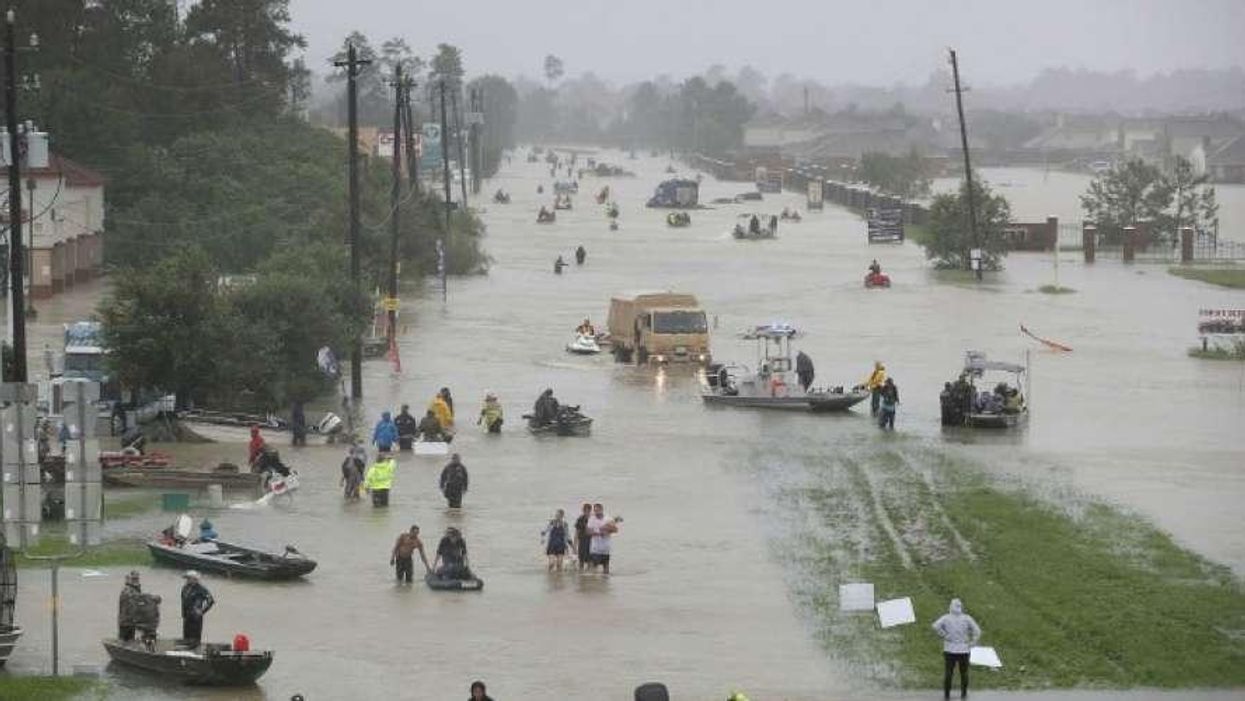
A political system haunted by racial violence and terror. An economy delivering great wealth for the few amid stagnation and indebtedness for the many. A rising millennial generation with deteriorating prospects increasingly willing to put their bodies on the line for something better. A climate catastrophe already beginning to unfold on the flooded streets of our largest cities. With the profoundly troubling events in Charlottesville--and before that in Ferguson, Berkeley, Baltimore, and elsewhere--the ghosts of America's past have come crowding in. And the ghosts of our future made landfall with Hurricanes Harvey and Irma. Like all such ghosts, these demand a response. We must now produce one that is both deeply moral and capable of getting at the heart of our difficulties. We must overcome the nightmares of fear, hatred, and isolation that have seized our politics with a strategy that can deliver solutions commensurate with the scale of the problems we face.
Three challenges stand out against a backdrop of crisis and malaise. The first is the need to confront squarely, and on an ongoing basis, America's deep history of racism that has led to armed white supremacists marching openly in the streets and a Neo-Nazi sympathizer sitting in the White House. The second is the imperative to get off the defensive and, coming together, put forward a much more powerful, transformative alternative to Trumpism--real, practicable solutions to the deep economic and ecological problems we are facing as a nation, building from the bottom up, as all serious movements must. The third calls for a political strategy capable of uniting a broad coalition around a shared agenda for building power, mobilizing the potential mass movement for fundamental transformation that is in the making if we develop the tools and alliances to bring about lasting change.
Our first commitment, as Cornel West has urged, has to be moral and political. We must mount an all-out attack on racism, racist leadership, and the so-called "alt-right"--including those who currently lead the country. America is not the only nation in the world in which the populist right has captured state power. Hungary and Poland each have right-wing authoritarian governments. Narendra Modi, India's Hindu nationalist prime minister, once incited a massacre, while Turkey's Recep Tayyip Erdogan and Israel's Benjamin Netanyahu have each presided over one. But the presidency of the United States is unique in the extraordinary political, economic, and military resources it commands. It's time to face up to the fact that racism has been central not incidental to this power, with deep roots extending all the way back to the origins of the nation.
"The United States was founded on white supremacy."
The United States was founded on white supremacy. Our early economic development rested on the theft of Native land, expropriation of African labor, and expansion into Mexican territory. By 1860, Yale historian David W. Blight reminds us, slaves were still worth more than the entire productive capacity of the country taken together. This history--encompassing Jim Crow, systematic discrimination in local, state, and federal programs, and a continuing racialized regime of mass incarceration--is deeply interwoven in our social fabric. The University of Virginia Rotunda, at which white nationalists, their faces twisted with hate, held their infamous torch-lit rally, was erected and maintained by slaves. The City Council's decision to remove the statue of Confederate General Robert E. Lee--proximate cause of the far right's invasion of Charlottesville--was accompanied by a $4 million reparations plan for the city's historically marginalized black neighborhoods. Even as we mobilize to defend minority communities under assault from Trumpism, we must now massively expand our efforts to repair the terrible legacy of harm we as a nation have inflicted upon them.
"The present crisis long pre-dates Donald Trump."
Our second challenge is to distinguish between symptoms and causes in order to confront the underlying problems. He may stand at the head of some of the most sinister forces in American political life, but the present crisis long pre-dates Donald Trump. Exploding economic inequality, wage stagnation, poverty, deindustrialization, economic and political disenfranchisement, disinvestment--for decades, under Clinton and Obama no less than Reagan and the Bushes, most of the gains from the richest economy in the history of the world have gone only to the very top. Real wages for the vast majority of American workers have been stagnant for at least three decades, while the income share taken by the top one percent has jumped from ten percent in 1980 to more than 22 percent today. In terms of wealth, the top ten percent now command around three quarters of the total, with the richest four hundred individuals amassing more wealth than approximately the bottom 190 million Americans combined. There are also growing disparities between black and Hispanic Americans, on the one hand, and white Americans on the other. Over the past thirty years, for instance, the average wealth of white Americans has grown a fifth faster than that of Hispanic Americans and by more than three times that of black Americans. And all of this inequity has been driven by an economic system addicted to growth, all too happy to "externalize" the consequences for our ecological future.
We are now living the consequences of these dangerous patterns. Many communities are falling into decay, their social bonds dissolving. Violence remains endemic (including shocking levels of violence against women). Civil liberties are eroding. The lives of millions are compromised by economic and social pain. Health inequality is on the rise, with the life expectancy gap between rich and poor people born in 1950 up significantly over those born in 1920. The labor force participation rate has declined for two decades--and is projected to decrease still further. Young people are saddled with ever-growing debt, including (but by no means limited to) a staggering $1.3 trillion in student loans. The incarceration rate has more than quintupled since the 1970s, and remains among the very highest in the world with people of color incarcerated at dramatically higher rates than their white counterparts. Polling on everything from Congress to the media shows a significant fall in public trust. At some point something had to give. This is the context that permitted the monstrous rise of Trump.
At the same time, traditional liberal strategies to achieve equitable and sustainable outcomes simply no longer work to alter most of the big trends. The government lacks both will and capacity to use taxation and "after the fact" redistribution to achieve equity goals or to regulate corporations effectively. Puttering around on the edge of the climate crisis, we fail to understand that we face a system-wide crisis, not simply an economic and political crisis. It is time to get serious about taking on the underlying economic institutions and relationships--capital markets, private credit creation by big banks, footloose multinational corporations--that corrupt the political system and drive current economic and ecological outcomes. It's time to face up to the profound institutional and systemic nature of our difficulties.
"Traditional liberal strategies to achieve equitable and sustainable outcomes simply no longer work to alter most of the big trends."
The good news is that the failure of traditional politics and policies to address fundamental challenges has fueled an extraordinary amount of experimentation in communities across the United States and around the world. Practical precedents, models, and strategies already exist that build from the bottom and begin to suggest radical new possibilities. Cooperatives, worker-owned companies, social enterprises, public banks, community land trusts, neighborhood corporations, municipal enterprises, anchor institution approaches, participatory budgeting, local food systems--in a thousand different places, ordinary people have been at work creating solutions, building knowledge and power and solidarity from the bottom up. A massive escalation of this activity must now be a major priority--in civil society, in philanthropy, in communities, in workplaces, locally, regionally, and nationally.
It is time both to resist and to go on the offensive. A comprehensive plan for the economic reconstruction of our communities--connected to the urgent imperative of a large scale transition in our energy and transit systems--can define the first key element in a compelling political program around which to organize to defeat Trumpism. Such a plan would increase city and state revenues, build the tax base, add new democratized businesses to the economy that are anchored and will not leave, and increase jobs and local multipliers. It requires integrating into a coherent whole many things that we know can be done and are already being done in diverse but isolated ways in many communities across the country.
"It is time both to resist and to go on the offensive."
There is also an urgent need to adapt such strategies to rural areas and Rustbelt states, where they could work to re-build economies through the creation of value chains and sustainable local production. Trump shows that we write off these communities at our peril. From upstate New York through Pennsylvania, Ohio, Illinois, Indiana, Michigan, and Wisconsin, community after community has been destabilized by waves of deindustrialization. Once-great cities have been thrown away, whole regions left behind, and around five million manufacturing jobs lost since the mid-1990s. From Appalachia to the Gulf Coast, communities denied any alternative path cling tenuously to the false promises of the extractive economy, fueling our planetary carbon nightmare. The terrible political consequences of all this are now coming home to roost.
Trump himself ran hard against neoliberal finance and trade, striking a chord in the abandoned towns of the Rustbelt and rural Appalachia, which proved willing to give him a chance. These are not all the racists of Charlottesville who--clad in golf shirts and khakis or military-surplus gear--resemble more the traditional fascist mix of bourgeois and "lumpen" elements. Rather they include ordinary working families whose anger is understandably boiling over at a system they know is stacked against them. An election-day poll found 72 percent of Americans--a supermajority--in agreement that "the American economy is rigged to advantage the rich and powerful." Trump flipped a third of counties that had previously voted twice for Obama. We urgently need to rise to the challenge of this profoundly dangerous era of pain and difficulty.
To do so means adopting a multi-pronged strategy for building community wealth and transforming our economies, thereby defusing some of the pressures currently being exploited by right-wing forces. Examples of the power of such strategies can already be found in places where they might least be expected. Kentuckians for the Commonwealth, for example, organized for participatory planning around a post-coal future in Appalachia, fighting for the Clean Power Plan when it was blocked at state level--a prefiguration of the kind of intransigence and indifference we now face at the national level. Greensburg, Kansas became--in a deep red state, under a Republican mayor--one of the greenest towns in the country when the government acted as partner and catalyst to rebuild the town after it was leveled by a tornado. Chattanooga, Tennessee has one of the fastest internet connections in America--thanks to a municipal fiber broadband network whereby public ownership of digital infrastructure is driving local economic revitalization. Such approaches point in the direction, ultimately, of rebuilding a power base--in both red states and blue cities--for a transformative new politics capable of standing on its own feet, operating within ecological limits, and managing our economy for the benefit of the many and not the few.
"We urgently need to rise to the challenge of this profoundly dangerous era of pain and difficulty."
New strategies of democratic ownership within a community framework could function as the linchpin of an approach capable of uniting economic justice organizers, progressives, labor, and environmental and conservation activists while at the same time presenting an attractive economic development option to municipal officials. Moreover, such an approach can also help build economic power in communities struggling against concentrated poverty. On the basis of such a strategy, "rebel cities" at the forefront of resistance to Trump can begin to address the fiscal crisis locally no matter what the political conditions at the federal and state level. By leveraging their purchasing power, and that of large nonprofit anchor institutions, cities can act to keep dollars circulating locally and get them into the hands of disadvantaged communities--and at the same time reducing the carbon footprint associated with far-flung globalized supply chains.
Building from the bottom is inevitably the beginning step, but it is not the last. It is only through the building of a new power base resting on a renewal of local agency and new democratic ownership forms that the larger trajectory of systemic power can be addressed. A build-up of cooperative, worker- and community-owned firms points in the direction of larger regional and national structural possibilities. When large corporations go down, as General Motors and Chrysler did in the last major crisis, what new directions in public and community/worker ownership, and new forms of transportation, may be possible? Next time the giant Wall Street banks come to the government asking for a bailout, what form of local, regional, or national publicly owned banks might be demanded? As we edge closer and closer to losing our first city to climate change's deadly onset, what new demands could find a ready base of support? New models are needed, building up from real-world experience, projecting national models forward on the basis of local learning and the lessons of other nations. It is in a new coming together of progressive politics and institutional development around innovative community-based models and a powerful and bold larger national democratizing vision that we will find our answers to Trumpism.
Prior to the 1930s, key elements of what became the New Deal were developed slowly, step by step, in America's state and local "laboratories of democracy." This hard work laid the groundwork both for new national institutions and programs and a new national politics--a progressive liberal vision that, at the time, offered something to hope for, work for, which could counter the traditional corporate power that dominated the preceding decades. We're in a related but much more challenging historical moment today, and must get to work building our own new models that both deliver real benefits on the ground and can also lead to much larger transformative forms of democratic institution-changing impact nationally as new political power develops. In dark times such as the present, the possibility of hope--at the level of community and the nation as a whole--depends on being able to envision and deliver an economy and a future that people can believe in.
The answer to Charlottesville, to ever-intensifying racism, to the accelerating climate crisis, and to Donald Trump himself is first, to resist, and then to get serious about changing the system that has created them, from the bottom up and in a radically decentralized way.
Many years ago, while researching the history of the U.S. decision to use atomic weapons on the people of Japan, I came to understand something: There was something deep at work in the American political and economic system driving it toward relentless expansion and a dangerous, informal imperialism. I began thinking about how to fundamentally change America out of concern with what America was doing--and is still doing--to the rest of the world.
Many experiences since--especially working in the U.S. House, Senate, and at upper levels of the State Department trying to resist the war in Vietnam; and thereafter with activists in the antiwar and civil rights movements--taught me something important: It wasn't enough to stand in opposition to the injustices America inflicted on the world and its own people. It was equally important for these movements to operate with an idea of what they want instead.
Could we imagine a system that undercuts the logic responsible for so much suffering at home and abroad?
It was reflections like these that brought me to first sketch the idea of a "pluralist commonwealth"--an economic and political system different from both corporate capitalism and state socialism grounded in democratic ownership, decentralization, and community that could fulfill two key functions. On one hand, it offered a general map of where we might want to go--a design for a next system in which a plurality of overlapping institutions reinforce each other to democratize our common wealth. On the other hand (and unlike other more utopian blueprints), I've always believed that the Pluralist Commonwealth, grounded in everyday American reality--like the deep cooperative tradition of the Wisconsin where I grew up--was also an effective guide to how we might actually get there.
While progress is never strictly linear, I believe that we are beginning to see an accelerating development of the foundations for a system that looks a lot like the Pluralist Commonwealth, and a growing recognition of how they begin to fit together.
So how do we maintain and deepen the momentum? Here are six areas where it's particularly strategic to be organizing and building institutional power in the current moment.
Public banking, which invests capital for the common good rather than Wall Street's bottom line, has existed at the state level for nearly 100 years in North Dakota.
Now, activists are taking this model to cities and uncovering exciting possibilities. In Santa Fe, for instance, organizers have worked with Mayor Javier Gonzales to begin serious consideration of a municipal-level public bank. As an official city study released earlier this year showed, instead of the city's $200 million in cash deposits sitting in large, nonlocal financial institutions, a municipal public bank could leverage those deposits to reduce borrowing costs for the city--saving millions of dollars of taxpayer money every year that would otherwise go toward costly bond offerings.
Similar efforts in Philadelphia and other cities are also picking up steam as more and more people discover just how much money is wasted on Wall Street to finance the growth and development of city infrastructure. Why make a bond trader rich when you could build better schools and lower taxes instead?
A municipal public bank could save millions of dollars of taxpayer money every year.
The publicly owned Bank of North Dakota has long strengthened the state economy, expanded access to affordable credit, and contributed its revenues to supporting vital services like education. But the institution is also the product of a unique history, in which progressive populism was able to use the state Legislature to create this innovation. Today, in the face of relatively unresponsive state legislatures, progressives are proving that cities are promising spaces to channel energies for creative action.
By demonstrating the power of finance as a public utility, the public banking movement is building momentum for and giving shape to a democratic system of investment that is much larger. Public banks, credit unions, and community development financial institutions can all grow over time to displace the financialized, profit-seeking banking sector, helping turn the tables to put the public's money to work for the benefit of everyone.
There's been an explosion of interest in worker cooperatives as a simple solution to begin democratizing ownership of the economy. An ecosystem is emerging that allows people all across the country to accelerate these cooperatives' development by engaging local governments for support, converting existing businesses, or even investing personal savings into their expansion.
Worker cooperatives, by directly shifting ownership and control of the workplace to workers themselves, are some of the most intuitive and immediately appealing institutions of the Pluralist Commonwealth. Studies show that worker-owned companies don't just democratize wealth, they can also operate more efficiently and are more likely to stay in business than "normal" firms.
Yet while there are more than 10 million Americans working in companies in which they also own a share, the number of worker cooperatives--where these shares are equal for all workers, and come with an equal vote in the future of the business--is far smaller.
But this isn't because of some intrinsic problem with worker co-ops. Traditional businesses, in which workers labor for someone else's profit, have an entire ecosystem of support--from the business schools that train their managers to the banks and public subsidies that finance their creation and expansion.
Worker-cooperative advocates are building a parallel ecosystem of this kind all across the country. Cooperative development projects like the Wellspring Collaborative in Springfield, Massachusetts, and the CERO cooperative in Boston are creating exciting new crowdfunding mechanisms to help communities launch democratic enterprises. Organizations like The Working World and the Shared Capital Cooperative are building national networks to channel financial resources into the cooperative economy, creating diversified opportunities in which both institutions and individuals can invest.
In cities like New York, Madison, Wisconsin, and Rochester, New York, municipal funding is now being used to support the work of cooperative developers focusing on creating worker-owned businesses in low-income communities. There is no reason why every city and town's existing infrastructure for helping small businesses cannot be turned toward democratic alternatives, and the more this happens, the easier it becomes to make the case to community stakeholders and policymakers.
A key opportunity here is conversions of existing businesses. As the boomer generation retires, the future for hundreds of thousands of small- and medium-sized businesses is unclear. Without a succession plan, many of these businesses may get absorbed by financialized private equity or simply cease to exist. If we organize to take advantage of this historical moment, we can convert many of these to worker-owned businesses instead.
Solid local organizing is shifting the purchasing behavior of place-based nonprofit institutions--or "anchor" institutions--toward sustainability and economic inclusion. This means big steps toward the Pluralist Commonwealth can be achieved with relatively small amounts of activist resources.
Consider the Real Food Challenge: In less than a decade, this network of student activists has secured pledges to shift more than $60 million of food purchases at 73 colleges and universities across the country into more sustainable and just options.
Opportunities exist in every aspect of anchor institution operations. A student-led study at the University of Michigan found that just a 5 percent shift in procurement to local suppliers would increase local economic activity by more than $13 million and create more than 450 jobs.
Nonprofit hospitals may be particularly open to such demands with new rules under the Affordable Care Act mandating "community health need assessments"--reports that can illuminate the role that poverty plays in poor public-health outcomes and make clear the responsibility of health care institutions to use their resources to address economic inequality.
And campaigns to alter purchasing can strategically link up with campaigns to shift investment dollars in the same institutions. For instance, the Reinvest in Our Power campaign is mobilizing students to demand not just divestment from carbon in their schools' endowment portfolios, but active reinvestment in community-controlled financial institutions.
"Buying local" may make us feel better about the consequences of our consumer choices, but when we change the way our public and large nonprofit institutions like universities and hospitals spend their money, we're shifting hundreds of billions, if not upwards of a trillion, dollars into local economies--and creating a kind of decentralized planning system in the process.
This is the concept behind the Evergreen Cooperatives, which channel the purchasing power of Cleveland's biggest anchors into a network of green worker cooperatives, creating opportunities for ownership in some of the city's hardest-hit communities and communities of color.
As we work to shift the dollars spent by public and nonprofit institutions into patterns that support and stabilize thriving local economies, it's important to remember that we must defend our right to do so politically. Right-wing state legislatures and large-scale international trade agreements like TTIP and the TPP aim to remove barriers to the global movement of capital and undermine local procurement initiatives.
At the heart of the Pluralist Commonwealth is the idea of renewed democracy. We all know that American democracy is severely broken--but just "getting the money out" of our political system is insufficient.
A compelling alternative is suggested by participatory budgeting, which allows residents of a community to vote directly on how a portion of public money is spent. The mechanism, developed initially in Latin America, has been making substantial progress in the U.S. in recent years and can be built upon, shifting our political culture away from spectacles of personality and toward real engagement with the project of self-government.
Boston has placed $1 million of public money under binding, directly democratic control of Boston residents between the ages of 12 and 25.
Following the lead of city officials in places like Chicago and New York who embraced participatory budgeting to manage discretionary funds, smaller cities like Vallejo, California, and Greensboro, North Carolina, have embarked on citywide participatory budgeting processes. Santa Fe, New Mexico, is pioneering a participatory budgeting process tied to a fund for renewable energy investments.
While the amounts of money in each project to date remain small, participatory budgeting at once normalizes the demand for direct community control over the allocation of resources and provides a site in which the muscles of community self-government can be strengthened and scaled up. In short, it is an organizing process as much as it is budgeting process. And it's only through such organizing and development that we can build toward higher-order processes of truly participatory planning.
Boston's trailblazing participatory budgeting process, for instance, recognizes the key role it can play in developing long-term community leadership by prioritizing the city's youth. Boston has placed $1 million of public money under binding, directly democratic control of Boston residents between the ages of 12 and 25.
And even in cities where municipal officials aren't ready to embrace direct participation in budgeting, there are plenty of opportunities for creative grassroots organizing to expand participatory budgeting. The Department of Housing and Urban Development has officially endorsed it as a way to implement required community oversight of money allocated locally through Community Development Block Grants. In Toronto, for the past 13 years public housing residents have had direct, binding control over millions of dollars of annual capital improvement funding.
As we seek to reinvent, reinvigorate, and revitalize American democracy, we can begin by empowering the communities far too commonly denied the right to meaningfully participate.
Building democratic ownership at the community level opens up the possibility for planning. In Boulder, Colorado, citizens felt that their city's power supplier--corporate giant Xcel Energy--was not taking the threat of climate change seriously. Rather than trying to force the company to comply with regulations, the residents of Boulder decided to take their utility back. When this municipalization (currently in progress despite multiple political and legal roadblocks thrown up by the corporate incumbent) is complete, the city will be able to democratically manage its own energy sources.
Boulder proves that planning is by no means necessarily undemocratic or centralized--in fact, one of the reasons I believe changing the underlying ownership patterns of the economy is so important is that it begins to unlock possibilities not just for a more equal distribution of wealth, but for the kinds of decentralized planning we need.
Ultimately, we need to be scaling up beyond the city level to the regional level if we really want to plan effectively for a new energy system. Those most affected by the old energy system already realize this--and in many cases are at the forefront of efforts to imagine what a just transition looks like at a regional level.
A particularly exciting effort is the one being led in parts of Appalachia by groups like Kentuckians for the Commonwealth and Mountain Association for Community Economic Development. Faced with a recalcitrant state government opposed to implementation of the federal Clean Power Plan, local activists have been engaging stakeholders on the ground to develop a clean power plan of their own, from below, with a particular focus on rebuilding economic opportunity for the workers and communities that have traditionally depended on the coal industry as one of the few sources of jobs in the region.
Even without the ability to directly translate this popular planning process into public policy, such activism, oriented around large-scale alternative visions, can be a powerful organizing tool as we work toward a post-carbon future.
I have worked nearly my entire life in the United States, inside what has been the most powerful capitalist state in the world. And while bottom-up, grassroots experiments at increasingly larger levels of scale are key, it is important to remember why they matter.
Simply put, without dismantling the engine of growth at the heart of the American economy, we don't stand a chance of making the world a sustainable and equitable place for the human species to thrive. This ultimately means transforming some very large corporations into public utilities, preferably at the regional level. Such entities would not be subject to the Wall Street maxim of grow or die, nor would they drag the U.S. into support of right-wing dictators willing to allow American corporations to control a good deal of their development.
Building the Pluralist Commonwealth in America is, to my mind, an act of anti-imperialism. But recognizing this deep connection between building a more local and sustainable economy at home and the well-being of the rest of the world does not absolve us of responsibility to oppose the government's efforts to reassert America's grasp on global hegemony. The same good conscience that leads us to reconstruct the American economic system over decades should also lead us to oppose the rattling of sabers, the support for the overthrow of inconvenient foreign democracies, and the destruction wrought by American military action overseas.
Bernie Sanders started losing the election over 200 years ago, when Alexander Hamilton proclaimed "The people are turbulent and changing; they seldom judge or determine right." And when James Madison argued for a republic that would make it "more difficult for all who feel it to discover their own strength, and to act in unison with each other."
Little has changed over two centuries later, as the Democratic National Committee demonstrated when they "criticized and mocked" Senator Bernie Sanders during the primary campaign. People with money and power are still appalled by the notion of a popular democracy. But something is different now. The American majority, driven by frustrated workers and well-connected young people, are better able to communicate, and to unify in pursuit of a progressive nation.
The coining of the phrase "2020 Vision" can be attributed to the Democracy Alliance, which focuses on three "key issue areas that form the core of our 2020 Vision - an inclusive economy, a fair democracy, and strong action on climate change."
The vision expounded here, in the four steps to follow, is focused on the cooperative efforts of the great majority of Americans, many of them young and few of them rich, who are beginning to understand the strength of the growing progressive movement.
1. Occupy the Next Four Years
The Youth & Participatory Politics (YPP) survey project reminds us of the power of people working together: In 2011 tens of thousands of disgruntled customers forced Bank of America to withdraw plans for a $5 debit card fee; and two months later activists worked together to defeat the Stop Online Piracy Act, which would promote Internet censorship. YPP defines participatory politics as "interactive, peer-based acts through which individuals and groups seek to exert both voice and influence on issues of public concern."
Young Americans have the power of mass communication at their fingertips. The Occupy movement is positioned to grow stronger between now and 2020. Lev Hirschhorn, a Sanders campaign director in Philadelphia, said: "Bernie Sanders has demonstrated that we actually can take over the Democratic Party. That we have the ability. We are very close." Robert Reich projects into the future: "How did the People's Party win the U.S. presidency and a majority of both houses of Congress in 2020? It started four years before, with the election of 2016."
But young Americans (and the rest of us!) have to vote. Only about a third of eligible adults voted in this year's primaries. Our progressive candidates are waiting to serve, if we support them in 2018 and 2020.
2. Build the Sharing Economy (with Actual Sharing)
Our jobs are disappearing. Not just the positions of factory workers and customer service employees, but those of professionals like surgeons, accountants, architects, lawyers, and even the clergy. Robot "teachers" are interacting with students in Japan and the UK. Those of us who like to write are being replaced by robot "journalists."
Noam Chomsky correctly rejects the idea of a computer accomplishing the creative tasks of a 4-year-old, but he misses the point of the robot revolution. Computers excel at adult tasks that can be reduced to algorithms. And that means, according to a comprehensive study by Citi and Oxford University, that nearly half of American jobs are susceptible to automation.
What remains is the service economy, especially in the low-paying field of health care, in which the number of jobs increased by 23% in just one year. And the "sharing economy," which so far has robbed many of its contract workers of employee benefits and retirement funds. Yet sharing will work after all, if a 'co-op' element is built into it. "Crowd-based capitalism" may actually help empower workers rather than disenfranchise them, even in the ride-sharing business, where, for example, an Uber challenger called Swift is owned and managed by the drivers themselves, and a worker-owned and unionized co-op called Green Taxi is being formed by over 600 drivers.
Cooperatives represent a form of social democracy that is 100 percent American. Gar Alperovitz describes the process of "decentralizing power, changing the flow of power to localities rather than to the center." The Evergreen Cooperative in Cleveland, the public Bank of North Dakota, the Tennessee Valley Authority, and the Chattanooga Internet service are all examples of the distributed popular control of essential services. The approach works.
3. Foment a Revolution...of Jobs
The other future employment area heralded by the Citi/Oxford study is alternative energy, with red states like Texas and Arizona and Wyoming leading the way. Wind power is now the cheapest source of energy in the U.S., with solar right behind, and together they account for over two-thirds of new U.S. generating capacity.
Our future is paved, literally, with solar roads. The U.S. is covered with over 30,000 square miles of sun-beaten asphalt that could be powering electric cars as they use the roads, while at the same time providing temperature-controlled "smart" technology to assist drivers, including built-in guidance systems for driverless cars. Missouri's Department of Transportation has announced plans to use Solar Roadways panels to build the first public solar powered sidewalk along Route 66.
Many of these alternative energy jobs would be labor-intensive, requiring at most a high school education.
4. Look Up Jurgis Rudkus and Tom Joad
Our 2020 Vision requires an educated, well-informed young adult population. No better way than for high school and colleges students to visit Upton Sinclair's The Jungle, to experience the misery of early-twentieth century immigrants in the meatpacking area of Chicago, as the forces of capitalism cheat Jurgis and his family out of job and home and savings, not unlike today.
Then they should read John Steinbeck's story of the Depression, Grapes of Wrath, to understand how Americans from the heart of our nation were disparaged as unwanted "Okies," much like blacks and immigrants today. The Depression families journeyed to the promised land of California only to find dozens of workers for every available job, and a fleet of police and company guards ordering them to move on, from one desperate and life-draining failed opportunity to the next.
The progressive vision for 2020 is focused on the needs of average working people, on the strength of society rather than on winner-take-all individualism, on the cooperative efforts of underpaid people who have been forced out of the middle class.
Ma Joad said: "I'm learnin' one thing good. Learnin' it all a time, ever' day. If you're in trouble or hurt or need - go to poor people. They're the only ones that'll help - the only ones."
Hillary Clinton's capture of the Democratic presidential nomination--an historic milestone for women--should not obscure the significant long-term opportunities created by democratic socialist Bernie Sanders's sustained and scorching attack on a "rigged" economy and an increasingly undemocratic political system.
Hillary Clinton's capture of the Democratic presidential nomination--an historic milestone for women--should not obscure the significant long-term opportunities created by democratic socialist Bernie Sanders's sustained and scorching attack on a "rigged" economy and an increasingly undemocratic political system.
A January 2016 poll of likely Democratic caucus-goers in Iowa found that 43 percent described themselves as "socialist." Fully 56 percent of registered Democrats, including 52 percent of Clinton supporters, view socialism favorably according to a recent NY Times/CBS News poll.
These poll results signal the emergence of democratic socialism as a mainstream idea--at least in the Democratic Party.
Until now, democratic socialism as an electoral force had been condemned to the margins by America's confining rules. America's political system has, since its inception, systematically favored just two parties, both largely beholden to elites. With this structural bias, advocates of democratic socialism or Ralph Nader-style reform have been torn between a potentially risky vote for committed progressive advocates (think of Bush's narrow 2000 win) or voting for conventional, complacent Democratic candidates.
But four long decades of economic decline for the majority, a mounting environmental crisis, and imperial misadventures have opened the door for Sanders' openly democratic socialist candidacy. The appeal of living-wage jobs, tuition-free college, universal health care, and forceful environmental measures are only likely to grow more popular as economic conditions decline.
"All things considered, economic and social pain is likely to deepen and persist," economist Gar Alperovitz argues in What Then Must We Do? A grim economic picture is intensifying the hunger for a radically different direction for America--manifested in support for both the Sanders and the Trump presidential campaigns.
The demands from within the Democratic Party for improved living standards for working people and fundamental curbs on inequality and corporate power were utterly unthinkable during the pro-corporate administration of Bill Clinton or even that of Barack Obama.
For example, despite some important improvements in health care under Obama's Affordable Care Act, a May Gallup poll shows that nearly 75 percent of Democrats want a Canadian-style single-payer healthcare system. (A solid majority--just under 60 percent--of the broader public wants a single-payer health system, including 41 percent of Republicans and Republican-leaning voters.)
But exactly what is the future for a democratic, progressive socialism? Where does it go from here?
To some, democratic socialism means simply a commitment to New Deal-style policies long abandoned by many Democratic leaders. For others, socialism means adopting the social-welfare policies of Scandinavia. Gar Alperovitz and his Next System project--which has attracted supporters like Noam Chomsky, Frances Fox Piven, and Barbara Ehrenreich--is advocating for a vision centered around the re-direction of the economy away from profit-maximization.
Bringing this discussion into the Democratic Party could help to bridge the gap between visionary ideas and practical proposals for workable socialist policies. But making real progress will have to mean cutting the Democratic Party's dependence on big donors. This brings us to the second challenge.
The Democrats' donor class remains overwhelmingly committed to the financialization of the economy and the "free-trade" deals that have led to the offshoring of jobs to nations like China and Mexico. Democratic officeholders remain cowed by the fear of alienating donors who wield enormous power. Bernie Sanders managed to surmount this system with an impressive base of small donors. But it is improbable that less visible Democratic candidates will be able to launch viable campaigns on $27 contributions.
We need a radically new campaign-finance system.
Under the present system, we witness sordid spectacles like Democratic National Committee Chair Debbie Wasserman-Schultz, a Florida member of Congress, actively working to shield the predatory "payday loan" industry from tighter regulation. That industry has donated $35,000 to her campaigns. Without major reforms of campaign financing, even a full-scale effort to build upon pro-socialist views among rank-and file Democrats could prove fruitless.
Almost all Democratic mayors and governors (and countless legislators) are thoroughly wedded to economic-development "incentives." According to a 2014 report, local and state governments handed out $110 billion in incentives to corporations, with the majority of the dollars going to the largest and most profitable. Although this form of public expenditure often fails to deliver the promised jobs and wages, these incentives continue to drain public coffers.
Finally, whether or not Clinton wins in November, the emerging progressive, socialist wing will need to win the active and enthusiastic involvement of Hillary supporters. This includes African Americans who were key to her decisive victories in Southern primaries, older women, and people who align with labor, feminist, and LGBT causes. A large share of Clinton supporters would welcome the injection of youthful energy and a strongly progressive program popularized by Sanders.
In the late 1970s socialist leader Michael Harrington tried mightily to build a strong socialist current within the Democratic Party. Ultimately, his efforts were blocked by the Democratic leadership's dogged embrace of business as usual. But the dire conditions facing ordinary working people, who are or potentially could be Democratic voters, make this moment ripe for a powerful democratic socialist bloc. The Progressive Democrats have been trying to stoke the flames in recent times.
As Harrington would put it, is the Democratic Party willing to seriously explore "the left edge of the possible"?
I stumbled into the crowded bookstore on a cold winter day a few years ago, rushing to catch a glimpse of the author speaking in the back. As is my custom, I was late and his speech was well underway.
The question and answer began and someone in the crowd asked something I hear often at events like this one: "Don't you get tired of banging your head against the wall? Is there any room for hope?" The speaker laughed a bit before responding quite seriously that he was indeed quite hopeful. Things may look hopeless in the very near term, but the change he's talking about takes decades.
The author was Gar Alperovitz, speaking about his most recent book, What Then Must We Do? The line is one he's repeated often--and one that's stuck with me ever since: If you're in the business of social change, you have to think in terms of decades.
It's with this lesson in mind that we should consider taking on one of the most pressing problems of our time: wealth inequality. The problem with wealth inequality, after all, isn't simply that it's been growing steadily over the past 30 years. The problem is that it's showing no signs of stopping in the near or distant future.
And things are going to get worse.
Short of an all-out, torches-and-pitchforks revolt, reducing structural inequality means going through the legislative process--most particularly, reforming the tax code. But with an intransigent Republican Congress, a campaign-finance system dominated by wealthy donors, and a dispirited and deeply divided public, it's clear that legislative change isn't going to come soon.
That places us in what Alperovitz calls "pre-history." We have to lay the foundation for change without knowing when it will come.
His heroes, Alperovitz says, are the civil rights workers of the 1930s and '40s. They took on insurmountable odds--as well as serious personal risk--to lay the groundwork for what would become the very successful civil rights movement of the 1960s. They knew they might never see the fruits of their labor--Jim Crow and its supporters in Washington seemed impossibly entrenched--but their efforts made it possible for success in the unknowable future.
With the benefit of this long view, we can look past election cycles to see what solutions would actually solve our serious problems. On wealth inequality, that means a direct tax on concentrated wealth.
We shouldn't just tax billionaires' paychecks, in other words. We need to tax the wealth they've already amassed. That idea isn't going to clear Congress anytime soon. But it's just as serious, reasonable, and likely to become law as any other genuine solution.
To understand why we need to tax wealth, we first need to get sense of what makes modern wealth inequality different from the inequality of previous eras. Just how unequal are we?
For starters, the United States leads the planet in billionaires. In fact, we have more billionaires than the next five countries combined. According to numbers my colleague Chuck Collins and I crunched, the 400 wealthiest Americans now own more wealth than the entire GDP of India, a nation of nearly 1.3 billion people. And the 20 wealthiest Americans alone--a group small enough to fit on a private jet--are richer than the bottom half of Americans combined.
Wealth concentration is commonly encapsulated by the duality of the 99 percent vs. the 1 percent, the now famous framing advanced by Occupy Wall Street. But a more accurate distinction is between the 99.9 percent and 0.1 percent. This tiny group--the top one-tenth of 1 percent--now owns about as much wealth as the bottom 90 percent of the country combined. That's a bigger share than at any time since the Gilded Age of the 1920s.
On the other end of the economic spectrum, a survey late last year found that most Americans have less than $1,000 in their checking and savings accounts combined. If they slip on the sidewalk or their car engine light comes on, they can literally be left penniless.
When you factor in race, things look even worse. Across nearly every household economic indicator--from home ownership to retirement savings to income, wealth, and debt--black and Latino families lag behind white families. White families control 10 times more wealth than Latino families and 13 times more wealth than black families.
Wealth is the safety net that enables families to live without fear of a bump in the road--a missed paycheck, a reduced schedule at work, a busted water heater--sending them into destitution. Wealth is security. And without it, millions of families lead perilous and precarious lives.
A small number of Americans are unfathomably secure, while more and more of us are slipping into permanent precariousness. But it's worse than just that.
Research across several disciplines has shown that extreme inequality undermines democracy, social cohesion, and economic stability. A recent New York Times study revealed that just 158 families contributed half of the early contributions to the candidates in this presidential election cycle. Do we really live in a democracy when such a small group is able to wield so much influence?
Inequality is also destroying our health. According to public health researcher Richard Wilkinson, you're better off living in a community with greater equality, even when the overall standard of living is lower than in a more unequal community. That's because inequality has been linked to a host of negative health outcomes--including heart disease, asthma, mental illness, and cancer--for everyone in unequal societies, not just those at the bottom. Infant mortality, for instance, in the United States is double the rate seen in Japan or Sweden, significantly less unequal countries, for everyone--not just those at the bottom.
Make no mistake, the negative impact of inequality still impacts the poor more than the rich. A recent study showed low-income men live 15 years less than wealthy men. The disparity for women is 10 years. As Wilkinson points out, "greater equality makes most the difference at the bottom, but has some benefits even at the top."
Beneath this theft of our health and democratic ideals is a more fundamental pathology: Inequality demolishes our basic idea of fairness. Many of us like to associate wealth with hard work--that's the American Dream, right? But it's a lie.
Today, the strongest indicator that you'll amass lot of wealth in your lifetime is being born into a family with a lot of wealth. In fact, soaring inequality has made the United States among the least socially mobile developed countries in the world. Children born to a typical middle-income family today are less likely to earn more money than their parents did.
If you're not wealthy but aspire to the American Dream--saving money, building a home, paying for college, retiring before you die--you're better off living in Canada.
This is a grim new reality for white Americans who grew up during the vast expansion of the middle class after World War II. It's not so new for millions of people of color, who continue to be systematically blocked from rising into the ranks of the middle class.
OK, so inequality is a problem. How do we solve it?
Not by poking around the margins. Slight adjustments to tax rates or child-care tax credits might ease the pain, but they won't cure the disease.
Throughout history, as Thomas Piketty discovered from digging through centuries of tax data in Capital in the Twenty-First Century, serious wealth stockpiles have only ever been shaken loose in times of intense catastrophe--like wars and reconstruction. While it's true that inequality has been reduced in the past, it's never been done without a massive war and subsequent economic disruption.
I, for one, am not eager to see the return of the guillotine. Fortunately, there's a more peaceful option. Piketty points to a tax on wealth--not just the money people make, but the money they already have--as the least disruptive way to bring down spiraling inequality.
In fact, Piketty's idea isn't new. Veteran wealth tracker and economist Edward Wolff penned an article in 1996 calling for a direct tax on concentrated wealth. Other proposals are older still. Yet the idea was met with bemused scorn by the Very Serious People who guard mainstream political thought in policymaking circles.
This reaction appears incredibly shortsighted--and it wouldn't be the first time conventional ideology turned out to be wrong in the long run of history.
Consider a flat, 1 percent wealth tax levied exclusively on the wealthiest 1 percent of households.
The top 1 percent controls 42 percent of the nation's household wealth, about $26 trillion in total. In its simplest form, a 1 percent tax would raise $260 billion annually--more than the federal government now spends on education and environmental protection combined.
Because most money managers are able to deliver investment returns greater than 1 percent, the impact on those taxed would be negligible. Of course, implementing a progressive wealth tax with even higher rates on the 0.1 percent could yield more revenue still.
Taxing wealth directly strikes at the heart of the problem Piketty describes using his mountain of historical tax data: Capital, left unchecked, will inevitably concentrate at the very top. That's why other solutions won't solve the problem, and why the push for a significant tax on wealth is worth digging into for the long haul.
The seeds of this movement are already beginning to sprout, not least in the surprising success of Bernie Sanders's presidential campaign.
Even if the Vermont senator ultimately comes up short against Hillary Clinton, he's mobilized millions of supporters who view taxing the wealthy as a means to fund programs that could greatly improve their lives--like debt-free college and early child care. Those ideas are popular even among Clinton supporters, and Sanders's overwhelming support from younger voters--GOP consultant Frank Luntz calls millennials "frighteningly liberal"--means they're not going away anytime soon.
There's a tectonic shift underway on the politics of inequality. Even if the wealthy interests that control Congress haven't fallen yet, they're surely starting to feel the rumblings--and, if we start putting more cracks in the political fortress they've built for themselves, we may yet shake history loose in our lifetimes.
Many conservatives shy away from the facts, but a willingness to consider them would be a good way to start 2016.
1. Accept that Poverty Causes Marital Problems, Not the Other Way Around
In his condescending way, libertarian Charles Murray wrote: "There remains a core of civic virtue and involvement in working-class America...Married, educated people who work hard and conscientiously raise their kids shouldn't hesitate to voice their disapproval of those who defy these norms." Senator Marco Rubio agrees, calling marriage the "greatest tool" for lifting families out of poverty.
Marriage, to such people, spreads magic anti-poverty dust over newly-wedded couples.
Here are the facts: Upper-class and lower-class divorce rates rose and fell in similar fashion until the late 1980s, around the time inequality began to rip apart the fabric of American society, and to break down low-income family life. Evidence keeps piling up. Studies show that children whose families receive housing vouchers end up with higher marriage rates. On the other hand, two-thirds of single mothers who heed conservative advice and get married end up divorced. And despite what Murray's followers might think, race isn't a factor. A Pennsylvania study concluded that "over time, it has become evident that poor economic circumstances would produce comparable effects on whites just as they did for blacks." Pew Research Center found little difference between white and black fathers, and the Center for Disease Control found that black fathers are in many ways more involved with their kids than fathers in other racial groups.
2. Learn that Democratic Socialism Does Not Mean Government Control
Social democracy is 100 percent American. Our nation instituted a public education system, a long-successful retirement program, and a national park system. Gar Alperovitz describes the modern form of socialism, which is "about decentralizing power, changing the flow of power to localities rather than to the center." The Evergreen Cooperative in Cleveland, the public Bank of North Dakota, the Tennessee Valley Authority, and the Chattanooga Internet service are all examples of the distributed popular control of essential services. The approach works.
The most socialist program in the U.S. is probably the Alaska Permanent Fund, which has received bipartisan support for 40 years, even from staunch Republicans such as Sarah Palin.
3. Understand that Capitalism Has No Incentive to Work for Poor People
One only need look at health care, for which it has been estimated that less than 10 percent of the budget for health research is spent on diseases that cause 90 percent of the world's illnesses. According to a study in The Lancet, of the 336 new drugs developed in the first decade of this century, only four of them were for diseases impacting third-world peoples. Vital antibiotic research is underfunded because of low profit margins. World Health Organization director Margaret
Chan lamented the long decades of disregard for the African-centered effects of the Ebola virus.
4. Admit that You're Scaring the Hell out of the Public to Support Your War-Happy Ways
A Fox News analyst called ISIS "the single biggest threat in [America's] 200-year history." The national news media has driven Americans to a frenzy of fear, leaving more and more of them to express their concerns about terrorism, even though we're all more likely to get shot by a toddler than a terrorist.
The Air Force is dropping so many bombs on Muslim countries that companies like Boeing are gearing up for increased weaponry sales, as stock prices for weapons manufacturers keep surging. Our nation continues to build up the stock of arms around the world. In 2014 alone arms sales increased 35 percent, to $36.2 billion.
5. Stop Saying Corporations Have an "Insane Tax Burden"
The Wall Street Journal used that phrase in a story about Pfizer, which claims tax-deferred profits overseas and losses in the U.S., and which paid an effective tax rate of just 7.5 percent in 2014, and which is now merging with another company in order to move its corporate offices overseas to avoid even more taxes.
The Wall Street Journal itself admitted that "Pfizer's accounting methods raise its reported tax rate, without increasing the actual taxes the company pays." That's the point. The "tax burden" is an accounting fiction, not reality.
The form of 'socialism' embraced here is more accurately a social democracy, "a compromise between the market and the state." Our American exceptionalism derives in part from neoliberal and neoconservative demands that we be unconstrained by domestic or foreign governments.
Environment: Drones Dropping Seeds Rather Than Bombs
China has planted 66 billion trees since 1978 in an effort to stem desertification. Their 'shelterbelt' program, which has shown mixed results, has its origins in a project implemented right here in the U.S., in the Dust Bowl years of the 1930s, when the FDR Administration planted a thousand-mile line of trees to fight erosion on the Great Plains. The plan worked. In recent years, millions of federal dollars have been committed to restore and manage longleaf pine forests.
The planting of trees is a simple, effective, earth-saving, job-creating idea, especially if military resources were to be diverted to the endeavor. A company called BioCarbon Engineering hopes to plant billions of trees by using drones to disburse seedlings.
Capitalism equates to profit-making, and profit-making abounds in the fossil fuel industry. But cooperative energy solutions await us in solar and wind, which are expected to provide 100 percent of our energy needs within a few decades, if the will of the people prevails over market forces.
Schools: Yes, We Can Actually Learn from Other Countries
Finland's schools were considered mediocre 30 years ago, but they've achieved a remarkable turnaround by essentially challenging their teachers before they're entrusted with the welfare of the children. Most Finnish teachers are unionized, and they undergo rigorous masters-level training to ensure proficiency in the teaching profession, which is held in the same high esteem as law and medicine. In keeping with this respect for learning, government funding is applied equally to all schools, classes in the arts are available to all students, and tuition is free.
As a result, Finnish students finish at or near the top of international comparisons for literacy and math.
Banks: How Many Credit Default Swaps Does One Family Need?
Capitalism begets a financial industry with a quadrillion dollars in high-risk derivatives. The public bank of North Dakota, on the other hand, focuses on small business loans, often those unlikely to be issued by larger banks, except at prohibitive rates of interest.
According to the Federal Reserve Bank of Dallas, community banks, which hold less than one-fifth of industry assets, provide over half of all small business loans.
The Workplace: Closing the "Winner Take All" Wage Gap
The Evergreen Cooperative in Cleveland demonstrates the ability of a desperately poor community to succeed where a typical capitalist solution would appear to be unprofitable. Evergreen runs a solar-powered and LEED-certified laundry service for nearby hospitals and universities, and it is developing a hydroponic greenhouse for the cultivation of lettuce and other produce.
Other "socialist-style" enterprises include the Tennessee Valley Authority, serving the electrical energy needs of nine million customers, and so popular that local Republican politicians opposed privatization; and the publicly-owned Internet service provider in Chattanooga, which provides much faster connectivity than the private companies. Gar Alperovitz lists numerous other successful ventures around the country.
With American jobs rapidly disappearing, we need a new paradigm for the workplace. In the U.S., the most well-known example of a Guaranteed Income is the Alaska Permanent Fund, which has thrived for 35 years, even with anti-socialist conservatives in power. Texas, Wyoming, Nebraska, and Oregon are other states that employ trust funds from natural resources to benefit the public. Programs in Canada, Uganda, and Kenya have reduced poverty while improving health, and a recent study of 18 European countries found "increasing employment commitment as social spending gets more generous" -- in other words, dividend payments encourage people to work harder, rather than the other way around.
Funding for a Guaranteed Income would likely come from a Financial Speculation Tax, which would give the financial industry the opportunity to partly reimburse the nation for the technology, infrastructure, and security that has contributed to one of the highest profit margins in the corporate world.
A Modern Form of Socialism
A sense of exceptionalism drives our foreign policy, and distances the 'takers' in the 1% from the more social-minded and once-thriving middle class. The political revolution envisioned by Bernie Sanders will likely restore that social-mindedness.
As explained by Alperovitz: "What most people think of as socialism is that, with socialism, ownership of wealth and power is traditionally concentrated within the state and its national government. The vision that's emerging in these experiments around the country is anathema to that. It begins in neighborhoods and communities, in cities and states. It's about decentralizing power, changing the flow of power to localities rather than to the center."
Less centralized government. Even conservative Republicans should like that.