
SUBSCRIBE TO OUR FREE NEWSLETTER
Daily news & progressive opinion—funded by the people, not the corporations—delivered straight to your inbox.
5
#000000
#FFFFFF
To donate by check, phone, or other method, see our More Ways to Give page.


Daily news & progressive opinion—funded by the people, not the corporations—delivered straight to your inbox.
A government agency "cannot arbitrarily decide what is true, based on its own whims or the whims of the new leadership, regardless of the evidence before it," said the Republican-appointed judge.
"Happy Presidents Day!" a journalist declared Monday in response to a federal judge's opinion that compares President Donald Trump's administration removing displays about slavery from a historical site in Philadelphia to the actions of the propaganda agency in George Orwell's dystopian novel 1984.
Judge Cynthia Rufe—appointed to the Eastern District of Pennsylvania by former Republican President George W. Bush—began by quoting the iconic 1949 critique of totalitarianism: "All history was a palimpsest, scraped clean, and reinscribed exactly as often as was necessary. In no case would it have been possible, once the deed was done, to prove that any falsification had taken place."
The judge then wrote that "as if the Ministry of Truth in George Orwell's 1984 now existed, with its motto 'Ignorance is Strength,' this court is now asked to determine whether the federal government has the power it claims—to dissemble and disassemble historical truths when it has some domain over historical facts. It does not."
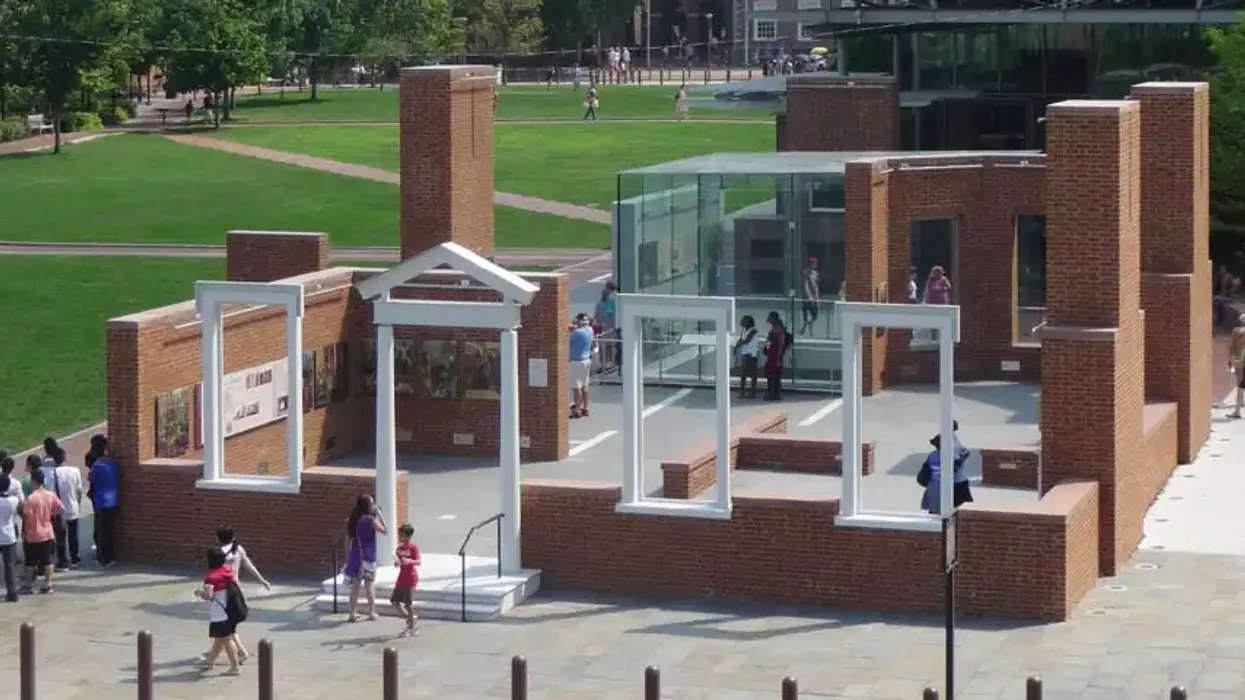
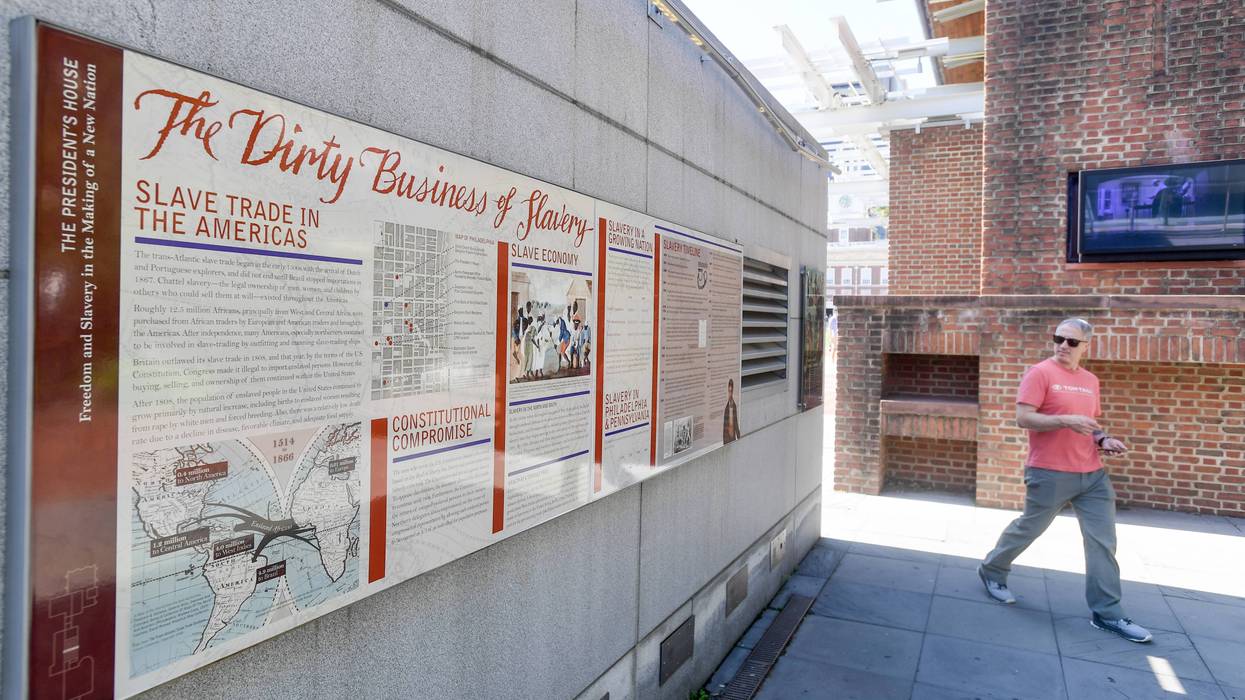
"The President's House is a component of Independence National Historical Park that commemorates the site of the first official presidential residence and the people who lived there, including people enslaved by President George Washington," she explained on the federal holiday established to honor the first US president. "On January 22, 2026, the National Park Service (NPS) removed panels, displays, and video exhibits that referenced slavery and information about the individuals enslaved at the President's House."
The removal followed Trump's March executive order aimed at ensuring "federal sites dedicated to history, including parks and museums," are not subjected to what he called "ideological indoctrination or divisive narratives that distort our shared history," which is just one piece of the president's "war on history" and embrace of authoritarianism.
Relying on the Administrative Procedures Act, Philadelphia sued the NPS and acting Director Jessica Bowron, as well as the parent agency, the US Department of the Interior, and its secretary, Doug Burgum, over the removal of the slavery exhibits.
"In its argument, the government claims it alone has the power to erase, alter, remove, and hide historical accounts on taxpayer and local government-funded monuments within its control. Its claims in this regard echo Big Brother's domain in Orwell's 1984," Rufe wrote in her 40-page opinion. She cited the novel's description of the largest section in the fictional government's Records Department, which "consisted simply of persons whose duty it was to track down and collect all copies of books, newspapers, and other documents which had been superseded and were due for destruction."
According to Rufe, "The government here likewise asserts truth is no longer self-evident, but rather the property of the elected chief magistrate and his appointees and delegees, at his whim to be scraped clean, hidden, or overwritten. And why? Solely because, as defendants state, it has the power."
"An agency, whether the Department of the Interior, NPS, or any other agency, cannot arbitrarily decide what is true, based on its own whims or the whims of the new leadership, regardless of the evidence before it," Rufe stressed. She found that the federal defendants "completely ignored their legislatively imposed duties," took actions that "impede the separation of powers instituted by the Constitution," and "acted in excess of their authority as agencies authorized by Congress within the executive branch."
The judge determined that Philadelphia "is likely to prevail on its claims that the removal was arbitrary and capricious," and "met its burden to establish irreparable harm." She concluded that "the balance of harms and the public interest tip in the city's favor." Her preliminary injunction requires the reinstallation of "all panels, displays, and video exhibits that were previously in place," and bars defendants from "any additions, removals, destruction, or further changes of any kind to the President's House site."
Politico senior legal affairs reporter Kyle Cheney flagged the opinion on social media, highlighting the Orwell references. His posts gathered thousands of reposts and responses, including from observers who were alarmed by the administration's actions and welcomed the judge's decision.
"Federal judges continue to speak up and speak out. It is amazing to see one quote George Orwell, but it also feels appropriate at a time when we see so many attacks on the rule of law," said Lawyers Defending American Democracy.
Democratic Montgomery County Commissioner Neil Makhija wrote on Bluesky: "Proud of this result. The court cited Orwell's 1984 recognizing that we can't just erase hard truths from our history. Montgomery County was proud to join Bucks, Chester, and Delaware Counties in filing an amicus brief to support preserving the President's House slavery exhibits. Happy Presidents Day."
"The message is clear. American history no longer includes all Americans."
The city of Philadelphia has sued the US Department of the Interior and the National Park Service after officials were filmed dismantling exhibits on slavery at the President's House historical site at Independence Park on Thursday.
The lawsuit, filed in federal court by the office of Mayor Cherelle Parker, says “the National Park Service has removed artwork and informational displays" from the site, where George Washington lived as president from 1790 until 1797, in order to follow an executive order signed by President Donald Trump in March, which requires national parks, museums, and monuments to portray an "uplifting" message about American history.
The President's House monument, unveiled in 2010, contained information about nine enslaved people whom Washington brought with him to the nation's "first White House," and Washington's history as a slaveowner. By the time of his death in 1799, there were more than 300 enslaved people at his estate in Mount Vernon, Virginia.
Information about the President's House site and its ties to slavery still remains online. It states:
Washington brought some of his enslaved Africans to this site and they lived and toiled with other members of his household during the years that our first president was guiding the experimental development of the young nation toward modern, republican government...
The president's house in the 1790s was a mirror of the young republic, reflecting both the ideals and contradictions of the new nation. The house stood in the shadow of Independence Hall, where the words "All men are created equal" and "We the People" were adopted, but they did not apply to all who lived in the new United States of America.
A monument acknowledging this history, however, appears to have run afoul of the portion of Trump's order requiring the Interior Secretary to see that sites "do not contain descriptions, depictions, or other content that inappropriately disparage Americans past or living."
As BillyPenn.com reported:
Starting after 3 pm, placards were ripped from the wall around the site with crowbars as people walked by, some heading to the Liberty Bell Center. Signs were unbolted from the poles overlooking the dig site where America’s first “White House” had stood until 1832. They were stacked together alongside a wall, and then taken away around 4:30 pm in a park service truck. No indication was provided where the signs and exhibition parts will go
One of the employees, who did not give his name, told the Philadelphia Inquirer that his supervisor had instructed him to take down the monuments earlier that day.
“I’m just following my orders,” the employee repeatedly said.
In a statement to the Washington Post, Interior Department spokesperson Elizabeth Peace later confirmed that the placards were indeed removed in accordance with the order.
"The president has directed federal agencies to review interpretive materials to ensure accuracy, honesty, and alignment with shared national values,” she said. “Following completion of the required review, the National Park Service is now taking action to remove or revise interpretive materials in accordance with the order."
The city of Philadelphia says it was not given notice about the placards being removed. The lawsuit says their removal was "arbitrary and capricious" and says the “defendants have provided no explanation at all for their removal of the historical, educational displays at the President’s House site, let alone a reasoned one."
In a Facebook post, criminal defense attorney Michael Coard, who pushed for the monument's creation for nearly a decade, called its destruction "historically outrageous and blatantly racist."
It is the latest example of Trump's order being used to justify the removal of monuments related to slavery and Black history in the United States.
The infamous 1863 "Scourged Back" image—a picture of an enslaved man's back with severe whip scars that was used to promote the end of slavery during the Civil War—was removed from the Fort Pulaski National Monument in Georgia in September, along with other information about slavery.
The administration has also removed more than 20 displays at the Smithsonian Museum of American History, some of which dealt with slavery, civil rights, and race relations, a move that came after Trump lamented that the museum put so much focus on "how bad Slavery was."
The National Park Service also deleted information about abolitionist activist Harriet Tubman and many references to slavery from its webpage about the Underground Railroad for months last year, before restoring it following public backlash.
Pages on the Arlington Cemetery website that recognize the contributions of Black and Hispanic soldiers have also been removed.
The order has also led to the removal or alteration of numerous monuments, museum exhibits, and web pages recognizing the achievements or struggles of other racial minority groups, women, LGBTQ+ people, and Native Americans.
In a statement to NBC News, Philadelphia City Council President Kenyatta Johnson said, "Removing the exhibits is an effort to whitewash American history."
"History cannot be erased simply because it is uncomfortable," he added. "Removing items from the President’s House merely changes the landscape, not the historical record."
Daniel Pearson, a columnist for the Philadelphia Inquirer, said: "The message is clear. American history no longer includes all Americans."
"We got people that work and repair the water mains and can't afford their water bill," said union leader Greg Boulware last week. "I don't want to be rich. We just want comfort inside the city that we serve daily."
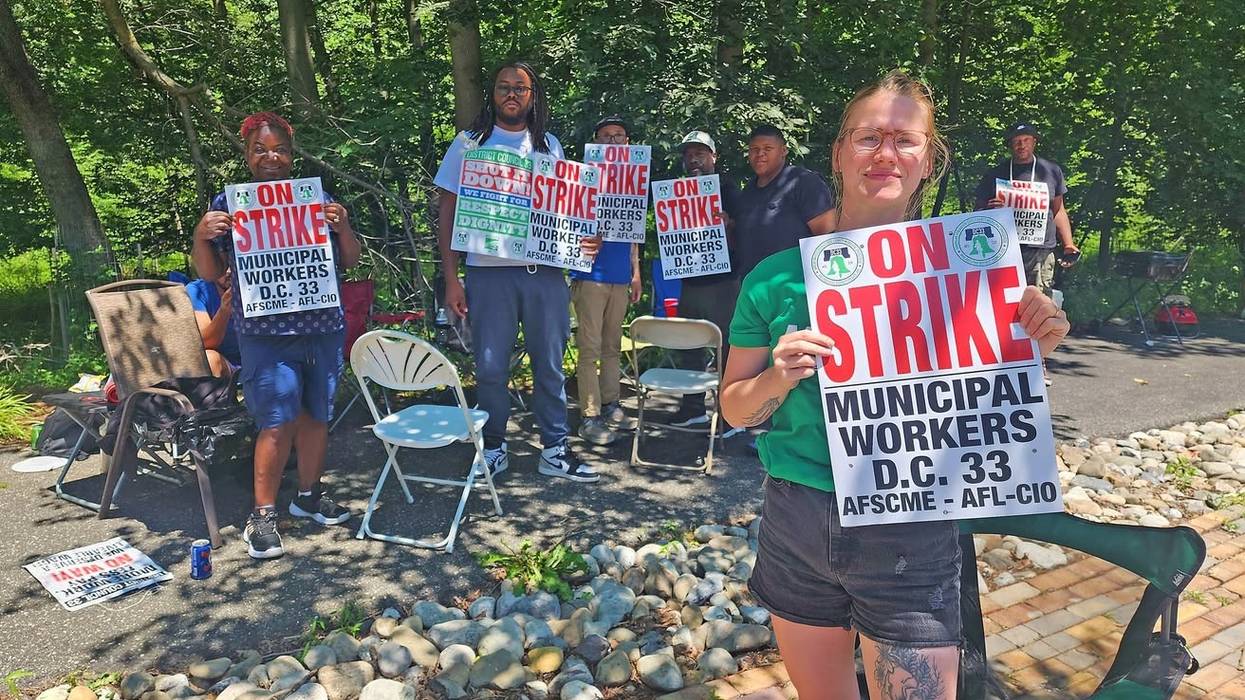
Philadelphia's largest municipal workers' strike in over 40 years is entering its second week after negotiations with the city broke down this weekend.
Over 9,000 sanitation workers, 911 dispatchers, water services workers, crossing guards, and other city employees walked off the job last week, demanding that the city increase their salary enough to meet the rising cost of living.
But even with trash piling up on the streets and other city services understaffed, Mayor Cherelle Parker (D) would not agree to the demands made by AFSCME District Council 33, Philadelphia's largest blue-collar union.
Parker has offered a pay increase of 8.75% over the next three years, which she described as historic.
But DC 33 president Greg Boulware said that's far too little for municipal workers, many of whom are among the city's "working poor," to survive.
"It's not like as if our members are making $80,000, $90,000 a year," Boulware said. "A 2% increase on those would be significantly higher than it would be on somebody making $40,000-$45,000 a year. So, her math truly is not mathing, and you're clearly not paying attention to the working people that are going on in this city."
The average municipal worker in Philadelphia makes around $46,000, which is $15,000 less than the median income in the city and less than half of what a single adult needs to live comfortably, according to a study by SmartAsset.
"We got people that work and repair the water mains and can't afford their water bill," Boulware said at a rally last week. "We got people that repair the runways at the airport and can't afford a plane ticket. I don't want to be rich. We just want a comfort inside the city that we serve daily."
The union initially asked for an 8% raise for the next four years, which the city dismissed. This weekend, they pared their proposal down to 5%, but the city still did not budge.
Parker has insisted that her smaller proposed increases are merely what is "fiscally responsible," and that the city cannot afford to offer more.
The union has disputed this, pointing out that Parker herself is budgeted to receive a 9% increase to her salary of more than $240,000. That increase alone is nearly half the current salary that the average DC 33 member makes in a year.
As of Monday, negotiations have stalled, with no clear end in sight. With a throng of picketers behind him, Boulware told NBC 10, a local affiliate, that the union was working on a third proposal, and that negotiations may resume Tuesday. But he seemed to expect more obstinacy from the city.
"We've been there to be able to sit and meet and negotiate," he said. "It doesn't seem like the city quite honestly wants to entertain any of the questions that we have about things and actually have a true dialogue... That's how you negotiate and that's not truly what's been going on."
Despite the city's refusal to budge, momentum around the strike has continued to grow. On Friday, rapper LL Cool J dropped out of a 4th of July festival in the city, saying, "There is absolutely no way I can perform across a picket line."
Other AFSCME councils around Pennsylvania have joined pickets in solidarity. This includes Philadelphia's Council 47, which represents thousands of "white collar" city workers.
With mounds of trash accumulating on streets, sometimes becoming as "tall as people," the environmental activists with the Sunrise Movement have also joined in the effort to pressure the city. On Monday, activists hauled bags of trash into the lobby of City Hall, labeled with the words "Meet DC 33 Demands" written in yellow tape.
AFSCME, meanwhile, has stated its resolve to fight on as the strike has gained national attention.
"City workers are holding the line until they get a FAIR contract with the wages and benefits they deserve," the national union's account wrote on X Monday. "One day longer, one day stronger, no matter what it takes."