SUBSCRIBE TO OUR FREE NEWSLETTER
Daily news & progressive opinion—funded by the people, not the corporations—delivered straight to your inbox.
5
#000000
#FFFFFF
To donate by check, phone, or other method, see our More Ways to Give page.


Daily news & progressive opinion—funded by the people, not the corporations—delivered straight to your inbox.
If our next leaders can’t deliver as promised, the politics of scapegoating will come roaring back. It won’t be easy, but the voters are watching.
For years, Americans have been viciously divided according to race, religion, immigration status, and gender identity by politicians dead set on making us fight each other rather than them. In a year where real people’s struggles were impossible to ignore, that effort fell short.
It’s hard to overstate the scale of Democratic victories in this year’s midterm elections.
Voters broke for Democratic candidates by margins scarcely anticipated by even the party’s rosiest polls—often in deep red states and congressional districts that few seriously thought were competitive. Democrats will now control a commanding House majority and hold a significant edge in the Senate as well.
In the two years Trump has left, Democrats will need to be held accountable to claw back the enormous funds Trump and the GOP have set aside for ICE and Pentagon and put them back into programs to make sure struggling Americans have food and healthcare.
This was a decisive rejection of Trumpism—and it happened on a significantly tilted playing field.
Before the election, Trump-aligned justices on the Supreme Court gutted what remained of the Voting Rights Act, only the latest in a series of rulings limiting fair access to voting and representation. At President Donald Trump’s urging, Republican-led statehouses unleashed an unprecedented flurry of mid-decade gerrymanders designed to maximize their partisan advantage and disenfranchise their critics. Billionaires poured vast sums into races—and trillionaire Elon Musk spent over $400 million alone, more than George Soros has spent on elections his entire life.
And that’s not even getting into the concerns, often stoked by leading Republicans themselves, that the administration would try to cancel results, deploy National Guard or Immigration and Customs Enforcement (ICE) agents to cities, or otherwise meddle in the election.
None of it was enough for voters who’ve spent years now watching events in their lives spin out of control.
Trump’s tariffs made life miserable for farmers, manufacturers, and consumers while his allies slashed safety net programs to fund tax breaks for billionaires. The war in Iran, which Trump launched shortly after promising no new wars, sent the price of fuel skyrocketing.
Lawless ICE agents terrorized immigrants and citizens alike and shocked the conscience of people across the political spectrum. And a data center boom spiked power bills and disrupted communities across the country, all to power a technology CEOs vowed to use for replacing people’s jobs and surveilling their day to day life.
In the races that mattered most, populist candidates spoke to these concerns directly.
Candidates who backed data center restrictions and moratoria flipped red governorships and Senate seats in Ohio, Texas, Georgia, South Carolina, and beyond—while voters directly passed their own local moratoria in dozens of communities.
In Michigan, Abdul El-Sayed defeated a shockingly Islamophobic opposition by focusing relentlessly on taking US foreign and domestic policy alike back from billionaires. In Maine, Troy Jackson toppled longtime US Senator Susan Collins by embracing his working class identity and supporting Medicare for All. And in a state that became emblematic of ICE’s abuse, Peggy Flanagan ran away with a victory in Minnesota calling to “rip ICE apart.”
But to sustain these gains, these winners—and the leaders of their party—will need to follow through on the promises voters entrusted them with.
In the two years Trump has left, Democrats will need to be held accountable to claw back the enormous funds Trump and the GOP have set aside for ICE and Pentagon and put them back into programs to make sure struggling Americans have food and healthcare—areas which are only set to see further cuts as more provisions of the “Big Beautiful Bill” take effect.
They should embrace their powers of investigation not only to crack down on the administration’s unprecedented corruption, but also to make tech CEOs answer for foisting AI and data centers on Americans and to hold corporate price gougers accountable for raising the cost of groceries, healthcare, and rent. And they’ll need to rapidly repair our civic infrastructure to get money out of politics and put ordinary people back in it.
If our next leaders can’t deliver as promised, the politics of scapegoating will come roaring back. It won’t be easy, but the voters are watching. And this November they spoke loud and clear.
When candidates take our concerns seriously and when they're backed by an organization like the UAW willing to do the work of reaching young voters where they live and work, young people turn out.
Every cycle like clockwork, young voters are written off as too disillusioned or too distracted to show up in a midterm. On Tuesday, that outdated notion was laid to rest. Nationally and across California, young people showed up. And they showed up in numbers that made the difference in power-shifting races for LA Mayor-elect Nithya Raman, California Democratic Rep.-elects Randy Villegas and Marni von Wilpert, and others.
I know because I watched it happen.
I'm the president of UAW 4811, the union of more than 60,000 graduate workers, postdocs, researchers, and staff at the University of California, part of the more than 100,000 UAW members in California. Most of us are young. Too many of us spend the majority of our paychecks on rent and work second jobs just to stay in the cities where we teach and do research. We are exactly the voters campaigns have written off for decades as too hard to reach and too unreliable to count on.
Our members didn't knock on 57,244 doors to celebrate for one night. We did it because we intend to build a future in California, one where you can finish your degree, do work that matters, and still afford to live in the city you call home.
So this year, we stopped waiting for someone else to reach us. We reached out to each other.
Over the course of this campaign, UAW members in California contacted hundreds of thousands of voters. We knocked on 57,224 doors and made 170,748 phone calls. In the final stretch, we worked 4,389 get-out-the-vote shifts and had 41,360 personal conversations with voters.
Those numbers didn't come from mass texts or robocalls—they came from teaching assistants knocking doors on weekends, researchers phonebanking after their experiments wrapped up, and university staff standing on campus asking students whether they had a plan to vote. Peer-to-peer contact is the most effective way to turn out a young voter, and nobody is better positioned to talk to young people on a college campus than the young workers who keep those campuses running.
It worked. The day before the election, students and workers packed Bruin Plaza at UCLA to rally with Nithya Raman and promise to bring their roommates and labmates to the polls. The next day, lines at polling places stretched across California campuses from Davis to San Diego. And across the state, races were won by candidates who believed young voters were worth fighting for.
In Los Angeles last May, UAW was the first major union to endorse Nithya Raman for mayor. We did it because she has delivered for the people being priced out of this city. She led passage of some of the strongest renter protections in the country, capped rent increases, cut the red tape that keeps housing from getting built, and wrote the ordinance that protects our immigrant neighbors from Immigration and Customs Enforcement. A city that can't hold on to its young people doesn't have a future. Raman understood that, and young Angelenos rewarded her for it.
In the Central Valley, Randy Villegas ran on what working families there live with every day: the cost of healthcare, the need for good jobs, and communities that have been taken for granted for too long. UAW members canvassed in Bakersfield alongside him, reaching young voters in a region where youth turnout has historically lagged far behind the rest of the state.
In San Diego County, Marni von Wilpert ran a campaign rooted in standing up for working people, including the researchers and scientists whose work drives the region's economy at a moment when federal attacks on research have put thousands of livelihoods at risk. UAW members at UC San Diego and across the county made sure their neighbors knew what was at stake.
There's a lesson here for every party, every campaign, and every pundit: Young people aren't apathetic. We're exhausted by politicians who ignore us until they need us and never seem to deliver once they win. When candidates take our concerns seriously (rent, wages, research funding, immigrant rights, climate), and when they're backed by an organization willing to do the work of reaching young voters where they live and work, young people turn out.
What comes next matters just as much. We will hold these leaders to the commitments they made, and we will keep organizing. Our members didn't knock on 57,244 doors to celebrate for one night. We did it because we intend to build a future in California, one where you can finish your degree, do work that matters, and still afford to live in the city you call home.
Tuesday proved that young workers can move elections. Now we're going to move policy.
The historic repudiation of Trump and his anti-environmental policies gives incoming lawmakers a chance to protect our oceans and waterways as the climate warms.
The historic impact of the November 3 "Blue Wave" election that swept Democrats into power in both chambers of Congress, statehouses, and elsewhere is widely understood to be a vast rejection of the Trump regime and will be felt across the land and also on our public seas.
The Senate Commerce, Science, and Transportation Committee that oversees the Coast Guard, National Oceanic and Atmospheric Administration (NOAA), weather, and climate will, come January, likely be chaired by Maria Cantwell (D-Wash.) who’s chaired it in the past, after Ted Cruz (R-Texas) hands over the gavel. Cantwell has been a strong opponent of offshore drilling along the West Coast proposed by President Donald Trump and played a major role in blocking the administration’s attempt to shut down a $386 million Ocean Observation System and other federal science projects. She is likely to also work to restore full—pre-Trump—funding for NOAA (the Coast Guard has already gotten a major boost in funding under Trump).
On the House side the change will be even more dramatic with Jared Huffman (D-Calif.) expected to take the gavel of the House Committee on Natural Resources for the first time. A longtime climate advocate within Congress and one-time environmental attorney for the Natural Resources Defense Council, he’s seen some of the worst marine impacts of climate change including the collapse of some 300 miles of kelp forest habitat in his large district that includes all of coastal California north of the Golden Gate. He’s introduced marine protection legislation in the past, including a Help Our Kelp act in 2025, and is likely to highlight the ocean-climate connection from his position as Chair.
For marine conservation groups there will be new opportunities starting now to work with both Congress and with newly elected state officials.
The challenge for the new Congress will be to reverse some of the impacts already felt during the first two years of Trump’s second non-consecutive term. At NOAA they’ll not be able to reverse the loss of both senior managers and new employees who were fired under Elon Musk's Department of Government Efficiency if they’d worked for the agency less than two years.
Nonetheless the new Congress will likely seek ways to restore autonomy and scientific integrity to NOAA, the National Science Foundation, US Fish and Wildlife, and other agencies that were set up to be non-political, but have become corporate and military tools under Trump’s appointees, promoting—along with the elimination of polluter penalties onshore—offshore oil drilling, deep-sea mining, commercial fishing in protected marine monuments, and extrajudicial killings of small boat operators (suspected drug runners), while also attacking and undermining the offshore wind industry to the tune of $4 billion in taxpayer money to date.
Despite efforts by Democratic leaders such as Sen. Chuck Schumer (D-NY) and Rep. Hakeem Jeffries (D-NY) to downplay climate change during the hot smokey summer campaign (and stay focused on "affordability") elected activists working within the new congressional majorities such as Sen. Sheldon Whitehouse (D RI) and Huffman will likely start connecting extreme weather events costing citizens their lives and livelihoods to fossil fuel-fired climate change. They will certainly focus on (and maybe investigate) the oil companies making obscene profits off of the extreme weather events they contribute to as well as from the war in Iran.
At the same time Whitehouse and Huffman differ on a lame duck congressional bill that would allow fast-track permitting for infrastructure plans including offshore wind farms but also onshore gas lines, mines, and data centers.
Ongoing climate disasters have been “non-issues" under Trump’s compliant Congress, including global marine heatwaves that have devastated commercial fisheries, marine mammals, and key habitats such as coral and kelp while spreading diseases linked to harmful algal blooms. Those impacts will be magnified by this year’s historic El Niño.
For marine conservation groups there will be new opportunities starting now to work with both Congress and with newly elected state officials in places such as Kansas and Iowa to address issues including polluted runoff from agriculture that impacts both local drinking water quality and—following gravity down rivers—generates coastal dead zones along with harmful algal blooms.
There will also be opportunities to develop effective coalitions and legislation around plastic marine pollution (holding the manufacturers responsible), illegal fishing operations and seafood traceability, establishing sustainability standards for seafood aquaculture and for coastal development, along with many other creative approaches to living well with our coasts and ocean.
And while much of this legislation may be vetoed by a lame-duck president, it, along with model legislation for more popular ideas such as increasing the minimum wage and universal healthcare, will at the least set the stage and create the platform for the next elections in 2028.
The job of marine conservation groups will be to highlight the opportunities, educate the public around less familiar issues such as kelp and climate or coastal adaptation, engage with policymakers, and hold them accountable while training and collaborating with the next generation of youth activists. As Sen. Jeff Merkeley (D-Ore.) told a group promoting an Ocean Climate Action Plan: “Let’s bring all the best ideas forward and craft legislation. We need an outside force and an inside force to make anything happen in Congress, so let’s forge that together and help save our ocean and our world.”
Against the backdrop of increasingly frequent and extreme weather events, water stress, and food insecurity, this COP must prioritize critical mandates on equitable fossil fuel transitions, post-2020 climate finance, and global urban resilience.
The 31st Conference of the Parties to the United Nations Framework Convention on Climate Change, or COP31, marks a critical juncture in the global effort to translate diplomatic pledges into tangible climate action.
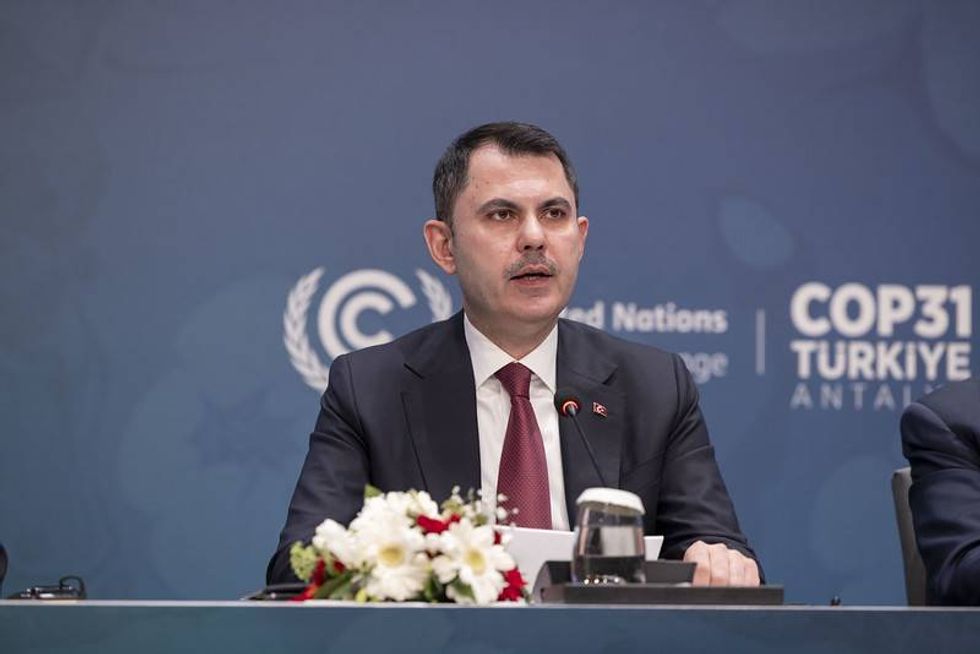
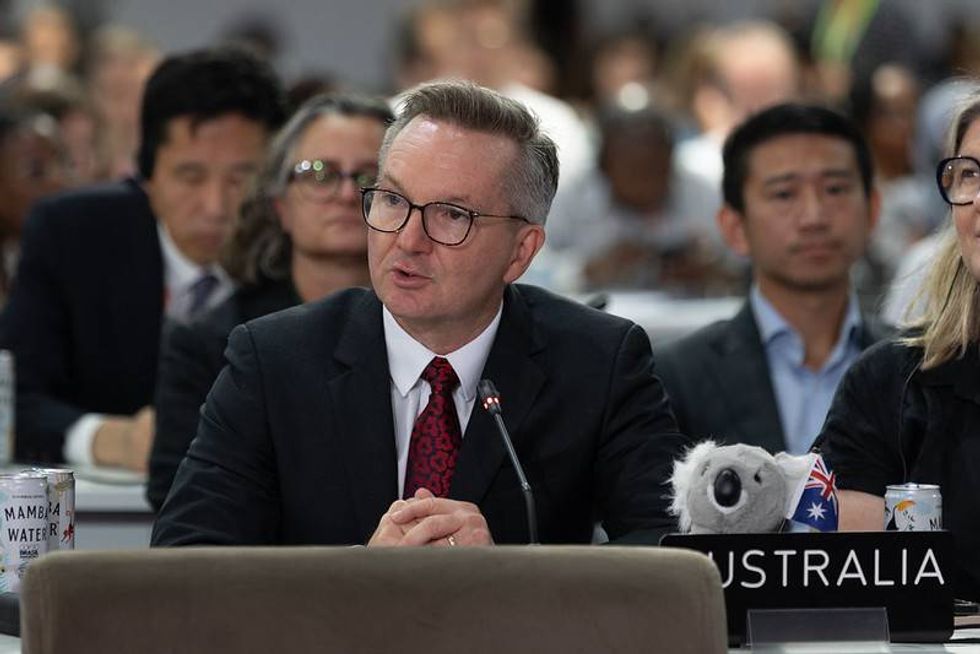
This year's negotiations will operate under an unprecedented shared-leadership framework. Türkiye will host the event, and Murat Kurum, the Turkish minister of environment, urbanization, and climate change, will serve as the president-designate. Meanwhile, Chris Bowen, the Australian minister for climate change and energy, has been designated president of the negotiations.
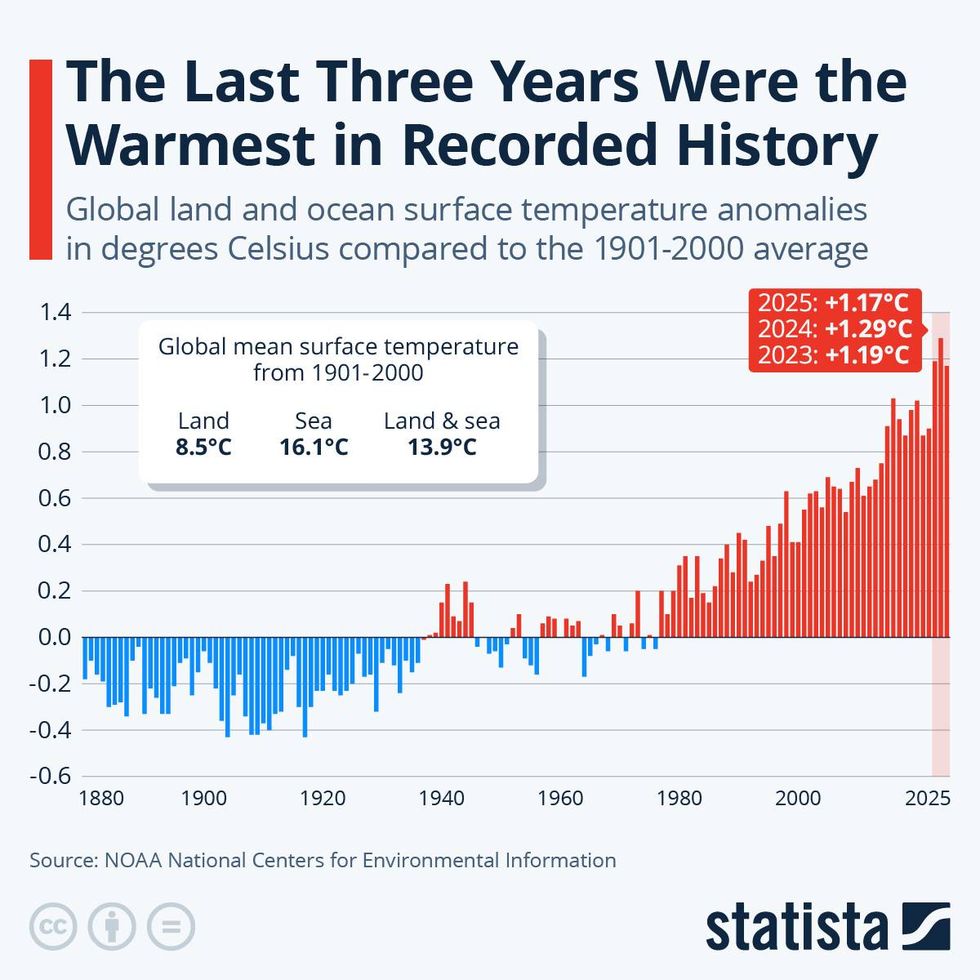
In the run-up to the event, two major findings have been released:
These shocking insights prompted 146 scientists to urge the United Nations to declare climate change an official "global health emergency" and finally force nations to act.
Against the backdrop of increasingly frequent and extreme weather events, water stress, and food insecurity, this COP must prioritize critical mandates on equitable fossil fuel transitions, post-2020 climate finance, and global urban resilience.
This COP must ensure that the newly submitted nationally determined contributions are put into practice while also demanding the urgent submission of outstanding NDCs from parties that delayed their updates.
It will also enact the Climate Implementation Bridge, an initiative to help developing countries translate their high-level NDC commitments into concrete, investable portfolios that can secure international financing.
Murat Kurum has positioned this COP as a vital transition phase in global climate policy. He describes the 1.5°C goal as "a matter of survival. The survival of cultures, history, memories, your homeland, your homes."
The following areas have been flagged as urgent priorities:
Both Türkiye (proposing Antalya) and Australia (proposing Adelaide, in partnership with Pacific Island nations) submitted bids to host COP31 back in 2022. Without consensus on who would host, the process stalled as both nations refused to withdraw their bids.
At COP30, the two countries agreed to split responsibilities and divide leadership. Theoretically, this reduces the risk of negotiation gridlock, brings two very different perspectives into the mix, and allows both sides to hyperfocus on their responsibilities.
It also comes with its fair share of concerns, if the two presidents misalign on major priorities such as the urgency of fossil fuel phaseouts or the mechanisms of debt-free climate finance, it could lead to bureaucratic fragmentation, diluting accountability, and stalling consensus.
President Recep Tayyip Erdoğan sought the COP31 hosting rights to elevate Türkiye's global profile and position the country as a major bridge and mediator between developed and developing nations.
The focus was on making COP31 a "COP of implementation," not on bringing in more pledges.
Türkiye's bid complements its own national initiatives like its 2053 net-zero target, new national climate laws, plans for an emissions trading system, and commitments to increase renewable energy investments.
When Türkiye voluntarily stepped aside in 2021 to let the United Kingdom host COP26 in Glasgow, it felt it had a strong claim and was unwilling to back down.
Türkiye will steer the summit's overall direction and manage event logistics, infrastructure, and the massive green trade fair in Antalya (Growtech), with the Leaders' Summit planned across Antalya and Istanbul.
It is also responsible for the non-negotiated Action Agenda, pushing for strong, measurable implementation and important side deals.
Australia’s bid for COP31 was a chance to reposition itself as a clean energy superpower, build regional goodwill, and counter rising geopolitical competition from China.
It proposed an unprecedented co-hosting arrangement with Pacific Island nations to amplify the voices of the world's most climate-vulnerable communities, acting as a heavyweight champion for its neighbors.
Their priorities are to address the existential concerns of Small Island Developing States (SIDS), including loss-and-damage funding and rapid divestment from fossil fuels.
"It is like taking a glass of water to a burning house if we do not urgently act to address the root cause of the existential threat facing Tuvalu, Fiji, and all Pacific countries: fossil fuel expansion," said Bowen.
Australia is a shining example of the energy transition in action. By the end of 2025, renewable energy has provided well over half of Australia's electricity needs. Today, 1 in 3 Australian homes generate their own power from rooftop solar panels.
As President of Negotiations, Australia will work with countries to build consensus, draft texts, and lead formal policy negotiations. Australia is also working with the past presidencies to deliver on key initiatives like the Belém Mission to 1.5°C and the Global Implementation Accelerator.
Australia's approach will integrate First Nations knowledge and leadership, and it has selected Sally Higgins as the COP31 presidency youth climate champion.
Nearly 50 parties have still not filed their updated NDCs. Major nations such as India, Argentina, Egypt, Iran, and Vietnam missed the standard deadlines, signalling an alarming lack of political will to pursue ambitious action under the Paris Agreement.
COP29 in Baku was billed as the "Finance COP," yet developed nations fell far short of what was needed to meet mitigation targets. COP30 in Belém finished without securing binding, high-level pathways to funnel capital to the Global South.
The UN framework has repeatedly and frustratingly failed to mandate an outright phaseout of fossil fuels. Recent host nations with strong economic ties to oil and gas have successfully diluted negotiation language.
In light of this, the climate crisis continues to accelerate:
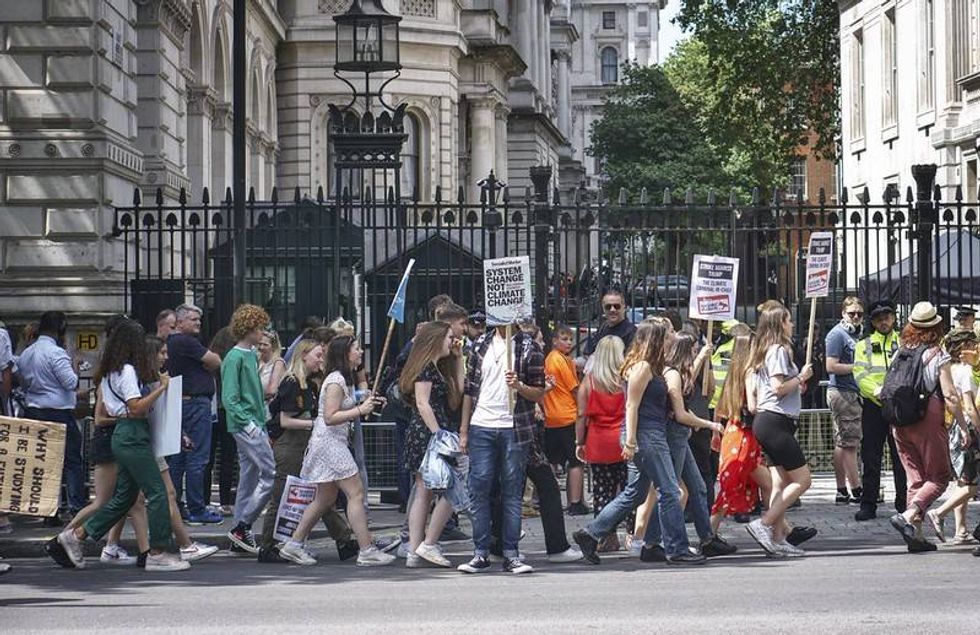
Children and young people are disproportionately affected by climate change; therefore, their voices are particularly important at major climate and biodiversity conferences.
Today's decisions have long-term consequences for their health, education, well-being, and future opportunities. Intergenerational justice looks at how present generations affect past and future people.
On July 23, 2025, the International Court of Justice issued the advisory opinion, which was unanimously adopted by all 15 judges: "Nations have a legal duty to combat the planetary crisis."
This COP31 recognizes children and young people as important stakeholders and constituencies. Official mechanisms have been established to support youth participation:
Major youth organisations and umbrella networks driving the youth climate agenda at COP31 include the European Youth Forum, Generation Climate Europe, Youth Environment Europe (YEE), Regional Conference of Youth (RCOY) Networks, World Food Forum Youth Network, and UNICEF Climate Youth Tracks.
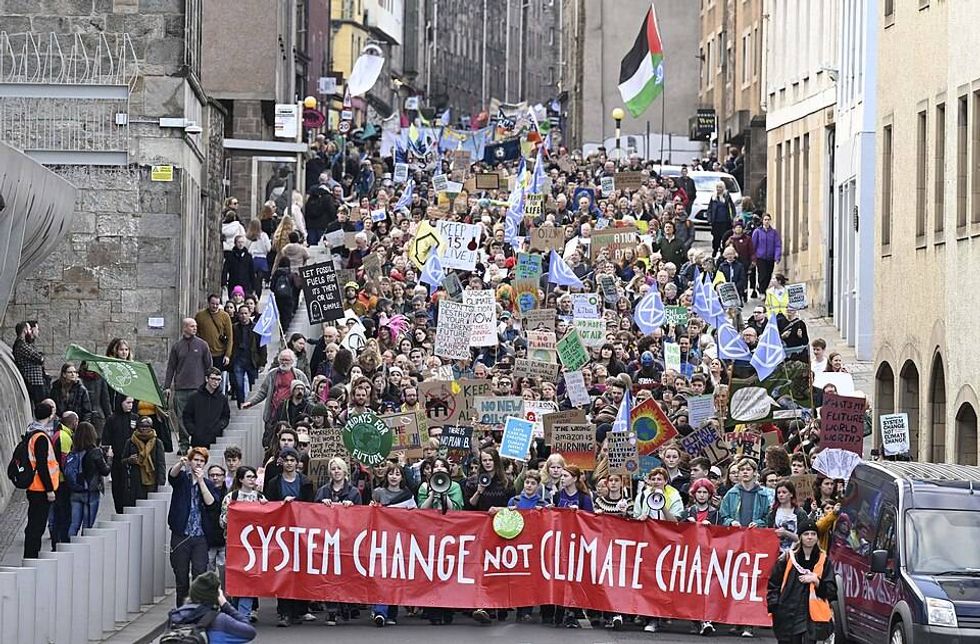
For years, global frustration has grown with these climate conferences; observers, climate scientists, and world leaders point to a persistent pattern of failure in climate finance, the fossil fuel transition, and consensus deadlocks.
COP28 and COP29 saw record-breaking attendance from thousands of fossil fuel lobbyists, diluting the voices of civil society and marginalized youth delegates. It is no wonder they were labelled a farce.
Whether the COP31 unprecedented co-hosting arrangement will help or hinder progress remains to be seen.
Both countries are already drawing criticism for expanding their coal and gas supply chains and omitting any mention of a global fossil fuel phaseout from their official pre-summit communications.
Since 2022, Australia has approved a major Hunter Valley coal mine expansion and 37 new fossil fuel projects.
Türkiye has plans to actively expand its domestic coal and gas capacity by 30% by 2035.
Pacific nations have also expressed their concerns about the joint presidency and the weakening of Australian regional solidarity. They worry the spotlight will shift away from sea-level rise and the vulnerability of small island nations.
On a positive note, the new voluntary "Electrification" pledge, which should help counter the stalemate on phasing out fossil fuels, gives us cause for hope. Another encouraging sign is that record funding for the global energy transition and renewable investment in 2025 reached $2.3 trillion.
It is also hoped that new transparency and funding disclosure rules introduced for delegates will limit the number of fossil fuel lobbyists delaying progress.
Drawing attention to the alarming global rise of militarism, COP31 President-Designate Murat Kurum publicly argued that wealthy countries need to spend much more on climate action than the 5% of GDP NATO members target for defense, warning that climate change is the ultimate security threat.
Without definitive progress at COP31, climate pledges, and indeed the COP conferences themselves, risk collapsing into broken promises and losing public trust. Influential figures such as Greta Thunberg, Chris Packham, Ban Ki-moon, and Mary Robinson have already declared the summits unfit for purpose.
Quite simply, time has run out for more empty words.
The US media system has given more coverage to the most prominent allegations of corruption under Biden than to those under Trump.
Particularly since the Citizens United ruling, US politics has been awash in corporate and billionaire money, with both parties taking gobs of cash from corporations that have direct interests in government policies. But President Donald Trump has taken corruption to new and breathtakingly bold levels.
“I have never seen such open corruption in any modern government anywhere,” said Harvard professor of government Steven Levitsky (Guardian, 6/17/25).
So, it’s probably not surprising to hear CNN (10/21/26) report that voters are increasingly “concerned about corruption,” ranking it only after the economy and the cost of living as a top concern. In a Gallup poll (9/2/26), a record-high 89% of respondents said they believe corruption is “widespread throughout the government in this country.”
But what might be surprising is that, according to a recent NBC poll (10/18/26), a majority (56%) say corruption “is equally a problem among elected officials in both parties.” (Among those who find it worse in one party or the other, 25% point to Republicans and 17% point to Democrats.)
Why would a majority of the public believe that Republicans and Democrats are equally corrupt? A FAIR study suggests that media play no small role: The US media system has given more coverage to the most prominent allegations of corruption under Biden than to those under Trump.
During his first term, Trump refused to divest from his business interests, raking in millions through them from foreign governments and people with interests before his administration. His solicitation of Ukrainian intervention in the 2020 presidential campaign led to his first impeachment trial.
After the GOP-controlled Senate (with Mitt Romney as the sole Republican exception) voted to acquit him—and after the Supreme Court ruling granting the president impunity for virtually anything done in office—Trump unsurprisingly entered his second term with far greater boldness. He essentially operated a pay-to-play administration that engages in regular shakedowns of major corporations and offers pardons to those with political or financial ties to him.
There have been repeated accusations of insider trading under his administration. Trump made $1.4 billion from the cryptocurrency industry in 2025 alone, including $635 million from his $TRUMP memecoin, which was gobbled up by not only true believers but also those seeking political favors. (While Trump profited from fees on trade activity, investors have lost a total of $3.8 billion because of the memecoin’s unsurprising collapse.) In perhaps the most brazen incident of corruption, Trump accepted a Boeing luxury jet worth an estimated $400 million from the Qatari government to use—after spending hundreds of millions of taxpayer dollars on security upgrades—as his presidential plane.
Craig Holman of Public Citizen told FAIR:
The second Trump administration is far more corrupt than Trump’s first administration, and stands out as the most corrupt administration in history. Trump has made no qualms about the fact that he is going to exploit his position as president for self-enrichment. In fact, he has said that he was a fool in his first term for overlooking the opportunities for self-enrichment, given the president’s exemption from the conflict of interest law (18 USC 208).
The corruption is led by Trump, but it’s been enabled by his party since their first impeachment acquittal. In Trump’s second term, the Republican-controlled Congress has refused to investigate any of the corruption scandals, implement stronger ethical standards, or include safeguards in cryptocurrency regulation to prevent Trump (and other political officials) from profiting off it.
During Joe Biden’s election campaigns and presidency, the GOP attempted to paint the former vice president as the pinnacle of corruption. When they took control in 2023, House Republicans launched an oversight committee investigation into the Biden family’s foreign business dealings during his vice presidency. They found that relatives and associates took in a total of $10 million from foreign companies during his tenure, but despite months of investigation, involving interviews and thousands of documents, the committee provided no evidence of Biden’s knowledge or influence. (It did lead to an unsuccessful impeachment inquiry.)
As perhaps the most memorable story in the right’s campaign to make the Biden family known as the “Biden Crime Family,” readers will be familiar with Hunter Biden’s famous laptop, which purportedly contained evidence of corruption on the part of his father. First published by the New York Post (10/14/20) just weeks before the 2020 election, the laptop story was pushed by the right for years and even continues to this day, despite its failure to show any actual evidence of corruption.
So on the one hand we have unsubstantiated stories of Biden family corruption, totaling $10 million in alleged graft, and on the other, we have stories of Trump corruption that total in the billions, some of which will be hard to legally prove Trump’s direct involvement (insider trading) and others in which Trump isn’t even trying to hide his self-enrichment (most of the rest, including the Qatari jet).
If the US had a media ecosystem in which those stories received attention relative to their importance, it wouldn’t even be close: Trump corruption coverage would overwhelm that of Biden.
In the distorted media ecosystem we are subjected to, reality is reversed. FAIR searched Media Cloud’s US–National dataset, which indexes 246 online outlets including all major corporate outlets, as well as right-wing sources like Daily Caller and left-wing sources like the Intercept, to compare attention to the two prominent Biden stories and two of the most prominent Trump stories.
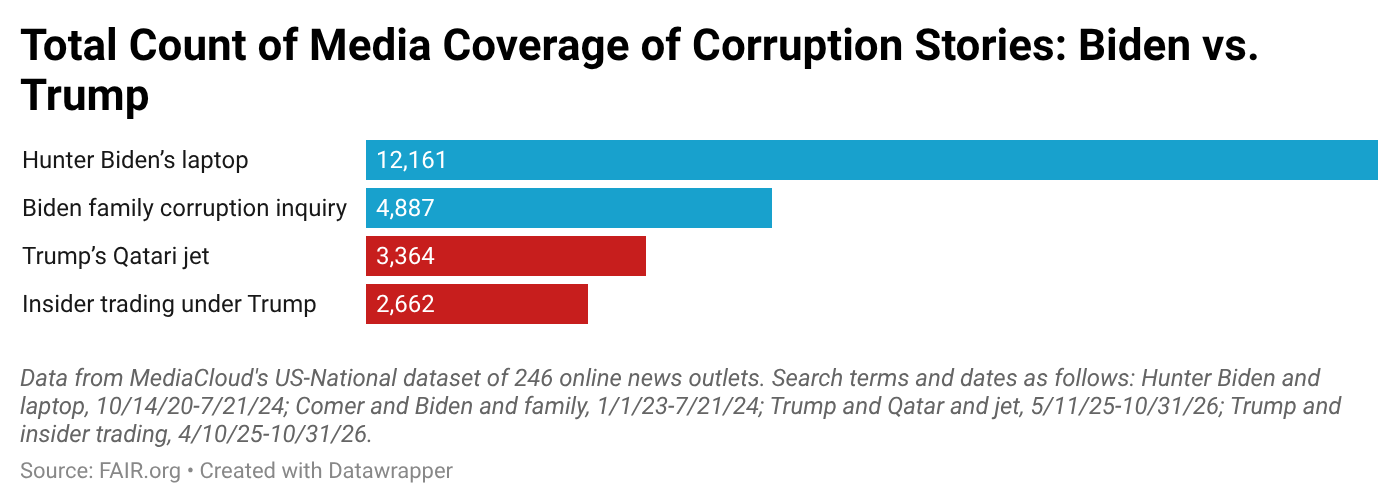
When the New York Post (10/14/20) “broke” the Hunter Biden laptop story, it prompted a huge spike of attention that has never fully gone away. Coverage increased in spring of 2022, when outlets like the New York Times (3/16/22) and Washington Post (3/30/22) published pieces that helped revive it; coverage became particularly intense the next year, which saw the GOP inquiry and the Justice Department criminal investigation.
FAIR’s search found a total of 12,161 stories that mentioned “Hunter Biden” and “laptop” from the Post story’s publication through Biden’s withdrawal from the 2024 race (10/14/20-7/21/24). Right-wing outlets led the way, but MediaCloud showed even centrist outlets like the New York Times, Washington Post, USA Today and Newsweek in the top 20 outlets in terms of volume of coverage.
Coverage of the GOP investigation into Biden’s alleged “crime family,” which began in January 2023 and was led by House Oversight Committee chair James Comer (R–Ky.), drew similarly high averages and peaks of coverage, and also largely petered out after Biden’s withdrawal from the presidential race (1/1/23–7/21/24). In that year and a half, MediaCloud recorded 4,887 stories mentioning “Comer” and “Biden” and “family.”
Not all of these stories necessarily accused Biden of corruption; some centrist reports did work to debunk the false right-wing claims. But those big centrist outlets published enough prominent stories with murky headlines like “Biden Faces Conflict of Interest Questions That Are Being Promoted by Trump and Allies” (New York Times, 5/1/19), or explaining that the Hunter Biden case throws a “new wrench” in “the 2024 election” because “Democrats will have a harder time highlighting Trump’s indictments,” to muddy the narrative and legitimize the GOP accusations (see, e.g., CJR, 10/29/19; Press Watch, 8/14/23).
Compare the quantity of these Biden corruption stories to coverage of the Qatari jet, a story that broke on May 11, 2025, and continued as Trump poured taxpayer dollars into its security upgrades. In the nearly year and a half from the story launch through the end of October 2026, the media produced 3,364 stories on the jet. That means that in approximately the same amount of time, media covered the investigation into Biden family corruption almost 1.5 times more than the Qatari jet. (Note that like the Biden stories, FAIR did not filter out jet stories that did not accuse Trump of corruption.)
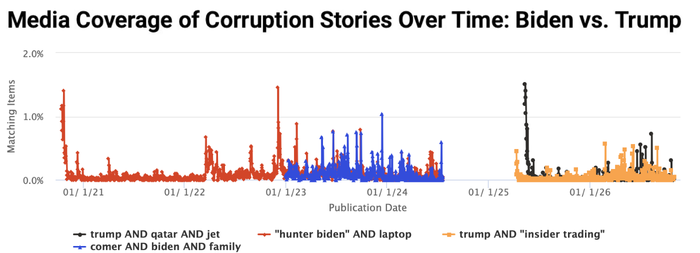
Accusations of insider trading in Trump’s second term began in April 2025, when large call options were placed on the market shortly before Trump announced a 90-day pause on tariffs, sending the market soaring. They continued as more such suspicious and lucrative trades happened just before major Trump announcements on Venezuela and Iran, including within Trump’s personal holdings.
Coverage of Trump and insider trading from the first accusations (4/10/25) until the end of October 2026—a month longer than the Qatari jet coverage—has totaled 2,614 stories. The Biden family inquiry, at 4,887, got 1.9 times that amount.
Hunter Biden’s laptop, which dominated news headlines for longer, overwhelmed the Trump stories by far more. It got 4.7 times the coverage of insider trading under Trump and 3.6 times the coverage of Trump’s Qatari jet.
Even measuring them in terms of percentage of all news stories during their respective time periods, the Biden stories got far more coverage, with the family corruption story and the laptop story each averaging .10% of all content, while the Qatar jet averaged .06% and insider trading averaged .04%.
This isn’t to say there’s no coverage of Trump’s corruption that attempts to put it into proper perspective. The New York Times editorial board (1/20/26) ran a lengthy editorial in January that tried to put a dollar amount to Trump’s self-enrichment just in the first year of his second term: $1,408,500,000.
The New Yorker (8/11/25), looking a bit more broadly and including his first term, came up with a conservative total of $4 billion.
Times columnist Jamelle Bouie (4/22/26) wrote:
To say that President Trump is corrupt is to somehow understate the size, scope and magnitude of his corruption.
It is as if you were to describe a modern thermonuclear device as a “bomb.” That is true enough, but it is not quite the truth. It does not capture the nature of the thing in full.
So it goes for Trump’s corruption, which is so vast as to be a new phenomenon in American politics.
Yet, just as media factchecking falters under the sheer number of Trump’s lies, these isolated efforts at contextualization fall increasingly short as Trump’s corruption balloons to nearly unimaginable proportions. That’s especially true as most right-wing media outlets’ interest in corruption would appear to apply only to Democrats.
One of the most important jobs of any media outlet in a democracy is to hold those in power accountable. Democracy doesn’t work if the public doesn’t know or understand what’s happening in their government. As polling shows, people clearly care a great deal about government corruption, but if they have little sense of its mechanics, scale or worst perpetrators, they can’t easily address it. With the midterm elections suggesting a mandate for rooting it out, there’s no more critical time for journalists to step up and shine the line—brightly and consistently—on what our elected and unelected officials are doing to us.
We need an outright rejection of nuclear weapons by all parties, including the US and Iranian regimes and a meeting of Trump, Putin, and Xi to build an off-ramp from the path of war and nuclear war.
The 1984 British movie Threads opens with ordinary scenes in Sheffield, England, where a young couple learns they are expecting a baby. Their personal story intertwines with news of a growing conflict between the United States and the Soviet Union, centered on Iran. We next learn that a nuclear weapon is used in an attack, followed by another. Before long, Sheffield itself is the site of hydrogen bomb detonations, with our protagonists either perishing in the explosions or subsisting under devastating conditions of starvation, civil unrest, radiation-induced and infectious diseases, and freezing temperatures over the coming days, weeks, months, and years. The film ends with the 13-year-old daughter of the young couple from the start of the film giving birth to a deformed clump of flesh months after being raped in a lawless and collapsed society.
Forty-two years after this brilliant movie first gave people in the UK and beyond a glimpse of the unfathomable consequences of nuclear war, the opening scenes feel even grimmer than they did in the intervening decades, given how eerily similar they seem to our current moment. With the US and Israel continuing to wage war on Iran, and their respective leaders having been repudiated in public polls and elections, the prospect of nuclear weapon use and a wider nuclear war is seemingly more real than ever before. But unlike in the 1980s, when the general public was well aware of what was at stake, having been frightened by Ronald Reagan’s saber-rattling and educated about the dangers of nuclear weapons throughout the Cold War, including through cultural interventions like popular films, today, when President Donald Trump repeatedly threatens to annihilate Iran, the media and the general public seem to shrug and move on to other news of the day, checking perhaps on what Kim Kardashian had for breakfast.
The seriousness of Trump’s threats cannot be overstated. The two of us have been warning in Al Jazeera and other outlets that, sick and desperate as they may be, it behooves the world to take them seriously and make sure a nuclear attack on Iran, or anywhere else for that matter, never happens. Recently, popular media figure Tucker Carlson and other commentators have joined us. The internet is abuzz with such warnings.
Ask yourself what Russia and China will think if the US and Israel use a nuclear weapon in Iran. Will they think that they are next?
The logic is simple. Trump and Israeli Prime Minister Benjamin Netanyahu are both desperate to salvage what little credibility they may have with their publics by demonstrating that this war with Iran was not a total failure. If the purpose of the war had been to prevent Iran from acquiring a nuclear weapon or weapons, then having Iran acquire a nuclear weapon or weapons would be the ultimate repudiation of their efforts and proof of their folly.
Both US and Israeli intelligence agencies report that Iran has shifted the locus of its nuclear enrichment from Fordow and Natanz to the Kuh-e Kolang underground complex widely known as Pickaxe Mountain. The complex is buried under 300 feet of granite, which makes it impenetrable for US or Israeli conventional weapons, including the Mother of All Bombs (MOAB), which Trump has threatened to use. Tucker Carlson shared that he had an “informed source” who told him, “Bibi calls Trump about it [a nuclear strike] every day.” Fortunately, Trump has not yet given the go-ahead.
The background to all this is that Iran has made clear that it will neither export its enriched uranium nor cease its enrichment activities, both of which it had done before Trump stupidly blew up former President Barack Obama’s Iran nuclear deal or JCPOA. With the deal in place, Iran had also mothballed most of its centrifuges and, according to the United Nations’ International Atomic Energy Agency inspectors, was only enriching to 3.67%—well below weapons grade. Ayatollah Khamenei had issued a fatwa against building an Iranian nuclear weapon, which remained in effect until he and other Iranian leaders were killed in a joint US-Israeli strike back in February. Now numerous Iranian leaders have publicly insisted that Iran needs a nuclear weapon as a deterrent against another US or Israeli attack. Evidence suggests some Islamic Revolutionary Guard Corps leaders have also adopted this view, even as official Iranian government policy continues to reject such actions.
And then, there is Israel. Despite an official policy of “nuclear ambiguity” and refusal to acknowledge possessing a nuclear arsenal of between 90 and 250 nuclear weapons, Israel has long made known that there will be no constraints upon its actions if it faces what it considers an existential threat. Netanyahu and other Israeli leaders have stated unambiguously that Iran’s possession of a nuclear weapon would constitute such a threat. In an April exchange on Israeli television, Israeli journalist Shimon Rivkin declared, “Why aren’t we using what’s called a neutron bomb?” The host then turned to National Security Minister Itamar Ben-Gvir who smiled and said, “Let him speak.” While Netanyahu has denied contemplating such an action, in late October he posted an AI-generated image of a nuclear weapon exploding over Tel Aviv, which he called a “second Holocaust.” He quoted right-wing commentator Yuval Blumberg, who wrote: “The state of Israel is in real and tangible existential danger. If the Iranians acquire nuclear weapons, nothing will ever be the same again.” Other Israelis have also bandied this idea about.
Trump has made clear that he is contemplating striking Iran after today’s midterms. Before having a stroke, Democratic Senator Chris Murphy from Connecticut said he had been briefed on Pentagon attack plans, and they are “insane.” Carlson also said Vice President JD Vance was urging restraint because a negotiated deal is still possible, but Vance himself earlier claimed the US has “tools in our toolkit that we so far haven’t decided to use.” We’ve also heard from others with strong White House connections that they're contemplating such steps. In recent months, Elbridge Colby, Pentagon policy chief, has been calling for the US to amend its nuclear policies to facilitate the use of tactical nuclear weapons should fighting break out in the Pacific.
No one can be certain how the use of a nuclear weapon or weapons against Iran would play out. A single strike on Pickaxe Mountain could in itself bring a huge humanitarian catastrophe to the city of Natanz and the broader region. Even if Tehran, some 220 kilometers away, did not fall in the path of the fallout, a large portion of Iran and the broader region could end up covered in radioactive particles that would remain in the environment for days, weeks, months, years, and even thousands of years. The details would depend on how powerful the weapon is and on wind and weather patterns immediately after the explosion.
But beyond the specifics of what one nuclear weapon could do to Iran and the region, it is important to remember that this is not 1945; the explosion of a single nuclear weapon is widely expected to lead to a wider nuclear war. It may not be a matter of if, but when. Regardless of whether there is initial restraint, as world leaders are sobered up by the breaking of the nuclear taboo, or not, we can expect bombs to start flying everywhere soon enough. There are 12,200 of them, after all, in possession of nine nuclear-armed states. Ask yourself what Russia and China will think if the US and Israel use a nuclear weapon in Iran. Will they think that they are next?
And just like in Threads, human civilization will collapse, not just in the Sheffields of the world, but everywhere. As the American scientist Carl Sagan once said: “Our planet is a lonely speck in the great enveloping cosmic dark. In our obscurity, in all this vastness, there is no hint that help will come from elsewhere to save us from ourselves.”
We need an outright rejection of nuclear weapons by all parties, including the US and Iranian regimes; a meeting of Trump, Russian President Vladimir Putin, and Chinese President Xi Jinping to build an off-ramp from the path of war and nuclear war; and engagement of figures like Pope Leo XIV in matters of peace and existential risks to humanity, as we called for in our recent appeal to the good pope. We can save ourselves from ourselves.
This piece was first published in Arabic in Al Jazeera.
By criticizing the Iran War and touting affordability, Vance is not reconsidering the politics that produced the administration's failures; rather, he is signaling how the interests that control him intend to recover the political ground they have lost.
Following the supposed “blue wave,” marked by significant GOP midterm losses, JD Vance published an donald extended statement on X that some have interpreted as a meaningful admission of Republican failure, or even a rebuke of President Donald Trump. Vance seemed to offer an unusually candid explanation of why voters had abandoned the administration, citing a pollster's account of what might persuade disillusioned Trump 2024 voters to return to the Republican camp. The four leading responses, he explained, were:
While Vance's statement has ruffled feathers within the GOP, its implications, and the speed with which it was issued, deserve considerably closer scrutiny.
On the one hand, there is nothing revelatory about acknowledging that an increasingly unpopular, unprovoked war on Iran, mounting economic insecurity and crippling inflation, and the administration's unwavering support for the war-dependent, genocidal, apartheid state of Israel have alienated voters. Yet it is notable how readily Vance, a defender and principal contributor to these very ruinous policies and destructive conditions, has identified them, and how quickly that recognition is being read as evidence of political introspection, or even a “break” from Trump.
Vance’s X-essay is thus not a departure from the political project that brought Trump to power, but a swift, billionaire-backed exercise in working out how to repackage its promises and mobilize them again.
At first glance, Vance's statement reads almost like an exercise in democratic humility. He is “shocked,” apparently eager for an “honest conversation” about where the Republican Party goes from here, and graciously inviting voters to explain where his party went wrong. He writes as though GOP voters might actually be invited to participate in the democratic direction of their party:
I remain hopeful about our country. To the people who are pissed off and want to say, "I told you so," you're right, you did tell us so. Take that energy into electing Republicans who share your worldview.
The performance would be more convincing if Vance were not the vice president of the administration he is now diagnosing and a well-established political puppet of the PayPal Mafia.
It is no secret that Vance's political ascent has been financed and cultivated by Silicon Valley's billionaire class, whose personal and commercial interests and bizarre dystopian visions increasingly depend upon the expansion of the American war machine, the growing privatization of state power, and the accumulation of private wealth at the expense of public services. Most infamously, Peter Thiel was Vance's employer, mentor, political patron, and one of the principal architects of his political ascent.
It is almost too obvious to point out the absurdity of a man explaining to voters what went wrong when he is himself an instrument of the very oligarchs using the executive branch to secure lucrative markets for their data and AI infrastructure, and the development and deployment of autonomous weapons systems. Their fortunes are precisely tied to the expansion of state violence and surveillance at home and abroad. They are the vanguard of a class exploiting public resources, evading taxation, and extracting billions in government contracts.
But exposing Vance's hypocrisy, or reading his statement as a thinly veiled repudiation of Trump, misses the more consequential calculation. Vance is not reconsidering the politics that produced the administration's failures. Rather, he is signaling how the interests that control him intend to recover the political ground they have lost.
It is hardly surprising that Republicans may once again co-opt anti-war and economic populist rhetoric without attempting to deliver on the demands behind it. Trump has demonstrated, in both terms, how readily campaign promises for “peace” and measures to alleviate the cost-of-living squeeze can be altogether abandoned once political power is secured. More consequential is the speed with which the Republican establishment seems to be taking stock of its electoral failures, calculating how to win back the constituencies it has alienated, and laying the groundwork for another political cycle.
Vance's 2028 ambitions offer an important window into the recalibration. His ideological moderation signals no shift in political direction, but rather is a more sophisticated effort to reposition the Republican Party without relinquishing its underlying commitments. Vance and his backers understand that reclaiming their political and electoral appeal requires more than simply appropriating the language of popular demands. The longer-term objective is to accommodate popular discontent rhetorically while severing it from the structural changes necessary to address its underlying causes.
The Republican establishment does not need to defeat anti-war politics if it can detach opposition to a particular war from opposition to American imperialism. It does not need to defeat economic populism if it can detach economic discontent from a critique of corporate ownership and concentrated wealth—narrowing the narrative to prices at the pump or the cost of groceries. Nor does it need to abandon its relationship with Israel if it can present a revised relationship—including through changes to the National Defense Authorization Act—as evidence that it has listened to voters, without challenging the military and financial arrangements that sustain Israeli occupation of Palestine and its broader expansionist project.
The grievances can be acknowledged, the language adopted, and the constituencies courted, without conceding anything to the structural changes those demands might ultimately entail.
The comparison with the Democratic establishment is equally telling. While Republicans are already calculating how to win back voters alienated by their own policies, Democrats seem perfectly ready to mistake another rejection of Trump for an endorsement of their own. The establishment is potentially preparing to restore Zionist PAC-funded, Big Pharma-defending mouthpieces Sen. Chuck Schumer (NY) and Rep. Hakeem Jeffries (NY) to positions of leadership. The same politicians who have spent years rebuking their progressive wing, dismissing its demands, working only in the interests of their corporate backers, and insisting that voters have nowhere else to go. The establishment seems perfectly content to congratulate themselves on their return.
The same tendency to mistake political repositioning for political change extends beyond the establishment, as some sections of the liberal and supposed left have greeted Vance's statement with enthusiasm or credulity. Liberals eager to find signs of moderation within the Republican Party are helping launder a calculated political maneuver into something resembling introspection. Others, celebrating the “blue wave” and desperate for evidence that electoral politics can still produce a meaningful rupture, seem ready to declare a discursive victory for the movements fighting for economic justice and against militarism. For some, Vance's tweet becomes a kind of political talisman: proof that the administration has been wounded, that voters have rejected its agenda, that the contradictions are finally catching up with it.
In other words, those on the left may see their own demands reflected in Vance's rhetoric and mistake such appropriation for a political victory.
This is the mythology of hope at its most politically debilitating, the naive compulsion to find redemption in a political establishment whose interests remain fundamentally unchanged. The election does not resolve the political and moral incoherence that Vance embodies, just as it does nothing to dislodge the ruling class.
Vance’s X-essay is thus not a departure from the political project that brought Trump to power, but a swift, billionaire-backed exercise in working out how to repackage its promises and mobilize them again.
Trump's bombastic circus, his criminality, his revolving cast of cronies, and his particular brand of reactionary politics are not, in themselves, the full expression of the GOP elite's political project. To mistake the current face of the administration for the true cohort of interests it serves is to misunderstand the political coalition that brought Trump to power and continues to benefit from controlling the presidency, most obviously to inflate their members’ stock portfolios.
The current GOP elite’s chauvinist politics—which combine white nationalism, anti-immigrant, and anti-Black reaction; the expansion of Immigration and Customs Enforcement and the machinery of mass detention and deportation; and an increasingly normalized use and threat of state violence at home and abroad—are still not bound by a unified ideological movement with a consistent conservative program. It is their shared appetite for power, accumulation, deregulation, and coercion that binds them.
Trumpism has provided a vehicle through which an increasingly volatile coalition of competing capital interests, billionaire networks, military and intelligence contractors, private surveillance interests, religious reactionaries, and political operators can consolidate power. Their political alliances are contingent, perhaps even sustained by blackmail. Their rhetoric is just as expendable. Trump's second administration has made this especially visible, as competing egos often collide despite shared pursuits of industry-wide deregulation and unfettered access to the institutions through which wealth and power are accumulated.
So Vance's apparent signal of a “2028 GOP showdown” are entirely consistent with this world of self-interested networks and political theater. There is no reason to assume that Trump himself must remain the vehicle through which the ultrarich, the Epstein class, and their affiliates pursue their ambitions and interests, including Trump's own.
In other words, Vance et al. are moving fast to preserve their hold on power while shedding the liabilities that have made the current administration increasingly difficult to sustain. Technology and security interests that profit from the expansion of state coercion can back a politician speaking of economic relief and an end to war. There is no contradiction here from the standpoint of capital. The political presentation can change without any corresponding change in the interests being served.
Vance's statement is then worth taking seriously, as it demonstrates that even the techno-utopian, reality-detached oligarchs are capable of explicitly recognizing the political grievances they manufacture and considering how to bring those voters back into the fold. This is a form of political intelligence that the Democratic establishment has repeatedly proven itself incapable of, or deliberately unwilling to, exercise, even when it is deployed, as it is here, in the service of preserving the very arrangements responsible for producing those grievances.
Neither party's electoral fortunes should be mistaken for a transfer of political power to the people whose grievances they claim to represent.
By uniting around a political program capable of defeating Netanyahu's far-right agenda, and setting aside their factional interests, Arab politicians could achieve something their previous parliamentary efforts failed to accomplish.
The results of Israel's October 27 elections were welcomed by Palestinian Arab communities in Israel and millions of Palestinians worldwide.
Neither Israeli Prime Minister Benjamin Netanyahu's right-wing bloc nor that of his rival, former military chief Gadi Eisenkot, secured the 61 seats required to form a government. This made the 19 seats won by Arab parties all the more consequential.
In a political system structured to marginalize its Arab minority, the electoral achievement of the Joint List and Ra'am cannot be overstated. Through their relative unity and an extraordinary convergence of political circumstances, Palestinian voters have seemingly managed to beat the system at its own game.
The choice now is not between purity and betrayal, but between paralysis, allowing Netanyahu's wars to continue unchecked, and strategic disruption.
The achievement came despite fearmongering and outright racist rhetoric by mainstream Jewish political parties, including Eisenkot himself.
Netanyahu built much of his campaign around the specter of an Arab political takeover. On election day, he warned, “If we don't wake up now, we'll find ourselves with a government of Mansour Abbas and Ahmed Tibi.”
Far-right National Security Minister Itamar Ben-Gvir employed similar rhetoric. Alarmed by Arab turnout, he declared, “If you want this country to be Jewish and Zionist, you must go out and vote,” before warning his supporters, “Don't let them win.”
Even Eisenkot, often portrayed in Western media as a more amiable and less hawkish alternative to Netanyahu, rejected the prospect of governing with Arab parties, declaring, “I do not see an Arab party that accepts my principles.”
Whether the electoral deadlock forces him to reconsider that position is another matter. The point is that Eisenkot and his potential allies, including Naftali Bennett and Yisrael Beiteinu leader Avigdor Lieberman, have rejected Arab participation in governing coalitions.
Imagine this happening in a true democracy, where an entire political community is excluded from government because its members are Black, Irish, or Christian.
This is the crux of Israel's democracy problem. While presenting itself as democratic, Israel has waged political, legal, and constitutional wars against its Palestinian citizens, treating their very identity as a threat to the Jewish character of the state.
Historically, this has been the central point of contention among Palestinian communities in Israel: Why should Arabs participate in elections that validate a system constructed, from its very foundation, to entrench Jewish supremacy and persecute its Palestinian minority?
Consider the Knesset itself. Section 7A of its Basic Law allows electoral lists and candidates to be disqualified for rejecting Israel's existence as a Jewish and democratic state.
Imagine Black American politicians being required to recognize the United States as a white state before being permitted to contest elections.
In 2018, Israel went further, passing the Nation-State Basic Law, which declares that the right to national self-determination in Israel is “unique to the Jewish people.”
It is therefore hardly surprising that some Palestinian political movements have refused to participate in what they regard as a political charade, choosing instead to defend their communities' rights outside a fundamentally rigged parliamentary system.
One example is Abnaa al-Balad, which has long advocated boycotting Knesset elections rather than granting legitimacy to the Israeli political order.
This debate resembles the historical disagreement between revolutionary abstentionism, which rejects participation in institutions deemed illegitimate, and socialist parliamentary participation, which argues that refusing parliamentary engagement should not become an absolute principle.
Vladimir Lenin addressed this argument in his 1920 work "Left-Wing Communism: An Infantile Disorder," rejecting the notion that revolutionary movements should abandon parliamentary participation under all circumstances.
Israel's latest elections have given this debate renewed urgency.
To be clear, although some Arab parties have roots in leftist traditions, none can simply be described as revolutionary.
Ra'am, led by Mansour Abbas, participated in the Zionist coalition government headed by Naftali Bennett and Yair Lapid in June 2021. Abbas effectively sidelined broader Palestinian national aspirations in favor of municipal budgets, socioeconomic equality, and combating crime within Arab communities in Israel.
Ra'am has now won eight seats, and Abbas has made clear his willingness to pursue the same coalition strategy.
The Joint List, on the other hand, secured 11 seats. Its priorities include removing Netanyahu, defending Palestinian national rights, and advancing social justice for Palestinian citizens of Israel.
Now, more than ever, Palestinians need unity. All are facing extraordinary threats: the ongoing genocide in Gaza, accelerating annexation and ethnic cleansing in the West Bank, and further suppression of Palestinian communities inside Israel.
By uniting around a political program capable of defeating Netanyahu's far-right agenda, and setting aside their factional interests, Arab politicians could achieve something their previous parliamentary efforts failed to accomplish: Force Israel to change direction, slow down its machinery of death, and remove the wanted war criminal Netanyahu from power.
While one may insist, on principle, that participating in a corrupt political system validates that very system, history occasionally produces moments so dangerous that even such morally defensible positions must be reconsidered, however temporarily.
The choice now is not between purity and betrayal, but between paralysis, allowing Netanyahu's wars to continue unchecked, and strategic disruption.
Certain distinctions, however, must remain absolutely clear. Replacing Netanyahu is not liberation. Eisenkot is no peacemaker, but a committed Zionist whose military record and political positions offer Palestinians little reason to expect justice. A new Israeli government will not erase the crimes of the state or fundamentally dismantle its apartheid system.
What such a change might offer is a disruption of the alliance through which Netanyahu, Ben-Gvir, and Finance Minister Bezalel Smotrich have pursued their agenda of genocide, ethnic cleansing, and annexation, potentially slowing Israel's capacity to inflict violence on the current scale.
Real change, on the other hand, can only be achieved through genuine Palestinian unity and resistance on all fronts, sustained global solidarity, legal accountability, and meaningful political action.
So long as lawmakers remain more loyal to their Wall Street donors than to working-class, don't expect even this Blue Tsunami to alter their political leanings very much.
As the November 3 euphoria fades, the grim reality remains: Trump and his lawless regime, along with Corporatist Democratic leaders Hakeem Jeffries and Chuck Schumer, still hold the reins of power. Granted, the Democrats now have a comfortable majority in the House and Senate and will hold many investigative hearings into the Trump rein of corruption, cruelty, violence, mass lawbreaking and Elon Musk’s DOGE crimes. However, the grim prospect is that they will mostly produce few results.
Why? First, they have to clear the corporatist Democratic Committee Chairs (more about that later) and then clear Speaker Hakeem Jeffries and Majority Leader Chuck Schumer. Jeffries and Schumer take large amounts of Wall Street campaign money. They take money from the big weapons manufacturers, and they are first in line for AIPAC-related campaign bucks.
Second, they show few signs of heeding the anger of their Democratic voters—90% of whom want Trump impeached. Voters also want Congress to give big corporations a heavy dose of “law and order,” restore taxes on them, and take these corporate giants and the super-rich owners off welfare.
In short, the New York-based Democratic leadership in Congress remains very supportive of the Wall Streeters, the bloated military budget, corporate welfare, and the Netanyahu-AIPAC lobby, backing Netanyahu’s genocide in Palestine.
There are exceptions in Congress—Sen. Elizabeth Warren (D-Mass.) will become the chair of the Senate Banking Committee, and Sen. Bernie Sanders (I-Vt.) is expected to chair the Senate Health, Education, Labor, and Pensions (HELP) Committee. But then what? Their legislation is up against both the Democratic and Republican leadership. Schumer will let these two progressive Democrats provide red meat to the masses, but progressives will likely be marginalized, as has happened so often under party leaders who are cowards and corporatists.
Recall the Obama-led Democratic landslide in 2008. Obama who had an even larger Democratic majority in the House and Senate, mostly punted, enacting a watered-down Obamacare, without a public option. (Obama pushed legislation including the American Recovery and Reinvestment Act, the Lilly Ledbetter Fair Pay Act, and the Credit CARD Act, that established a “bill of rights” for credit cardholders, placing new restrictions on arbitrary interest rate hikes, hidden fees, and marketing to young consumers—but he should have done much more.) A historic loss of major opportunities for a just society.
Two years later, the Democrats had their heads handed to them by voters rejecting their do-nothing-ism. It can happen again.
In August of 2026, Jeffries placed hard-line pro-Netanyahu Democrats in critical positions on the Foreign Relations Committee. He will likely install corporatist Democrats as chairs of powerful committees or loyalists who, if not beholden to corporate lobbies, will do his bidding.
Exhibit One is the longtime, corporate cash register Congressman Richard Neal from a “safe seat” in Massachusetts. Trump must love him. When he became chair of the House Ways and Means Committee in January 2019, he said he would NOT revisit the horrendous tax escapes Trump enacted in 2017 for his super-rich buddies and giant corporations. What?!
Just last September 15, Neal joined a minority of House Democrats headed by Hakeem Jeffries and, with 46 other Democrats, voted “Present,” effectively—along with the Republicans obviously—refusing to vote for Rep. Al Green’s Impeachment Resolution, which received 146 votes, a majority of House Democrats. During his campaign for re-election, Neal declined to say he would vote for Impeachment of Donald J. Trump, the violent, cruel, self-enriching, corrupt, warmongering, bigoted Outlaw. Dictator Donald must be delighted that Richard Neal supports so many Trump positions.
Neal has long opposed full Medicare for All or single-payer, everybody in, nobody out, preferring to go with a very limited, high-priced Obamacare. He takes abundant campaign money from the corporate health insurance and healthcare PACs.
Delivering for his paymasters, Neal goes along with the bloated military budget, vast corporate welfare giveaways, and blocked “surprise medical billing” legislation in 2019 that made private equity firms and other corporate beneficiaries happy to contribute to his campaign war chest.
The big drug companies are also happy with Neal—and are filling his campaign coffers—because he has worked to limit drug-pricing legislation, restrict Medicare’s authority to negotiate prices, and keep lower prices from being extended to uninsured individuals.
Neal had the support of his dittoheads on the Committee and the backing of the “bought and sold” Republican Committee members to deliver these favors for the few at the expense of the many defenseless consumers and people opposed to Trump. He went all the way, running Committee markups dictatorially, and obstructing votes on amendments by progressive Committee members such as Representatives Lloyd Doggett and Gwen Moore designed to hold corporations accountable.
In 2022, despite the support of 200 House Democrats for Subcommittee Chair John Larson’s bill to increase Social Security benefits, frozen since 1971, and pay for it by taxing wages above $400,000, Neal supported Speaker Nancy Pelosi’s keeping the bill from a vote on the House floor.
Blocking it helped the Republicans take the House from Speaker Pelosi. And, Democrats forfeited an opportunity to campaign on expanding Social Security (See The American Prospect: House Leadership Delays Social Security Expansion While Crafting Tax Breaks for Rich Retirees.)
This bill would have helped 60 million retirees.
Neal is a clever politician who talks a good game on slam-dunk reversals of Trump’s restrictions of Medicaid and food stamps. But, when it comes to delivering the big honeypots and immunities big business wants, he is pretty much a corporate toady. Right after taking the Chair of the Ways and Means Committee in 2019, he convened high-dollar fundraisers, spending some of these donations on what Politico reporter Danny Nguyen called, “upscale restaurants, hotels and entertainment to court elite donors and lobbyists with businesses before his committees.”
There is still time to make Richard Neal persona non grata with the tens of millions of voters who want a Peoples’ Congress and fighters for them in Washington. Neal is unpopular with most members of the Progressive Caucus led by the refreshing young Congressman Greg Casar from Texas. Other groups like RootsAction led by Norman Solomon and Progressive Democrats of America led by Alan Minsky, as well as major anti-poverty, tax reform and many anti-Trump organizations, could combine to challenge his selection by Jeffries as the Ways and Means committee chair. There are any number of qualified and willing House candidates for this powerful position.
Earlier this year, Neal, with his 38 years of absentee incumbency in the House, had a paltry 25% approval rating from his District. Loaded with corporate dollars and not being challenged by the Republicans or seriously challenged in the Democratic primaries until this year, he cruises to re-election from his nice mansion on Cape Cod, rejecting in-person town meetings and a presence in his District beyond ribbon-cutting ceremonies.
This year, he fought off an Independent candidate challenge from Nadia Milleron (my niece) by pumping over four million dollars in corporate donations into a Trump-like “Big Lie” smear campaign. This will not be lost on his expanding detractors. (See The Berkshire Eagle article “Ralph Nader blasts Rep. Richard Neal in letter backing niece’s challenge”).
None of these candidates went into Election Day with a “solid Democrat” or even a “likely Democrat” rating from the Cook Political Report; their hard-fought victories are a signal that American voters are ready for inequality-fighting, transformative change.
The “affordability crisis” ranked as the top issue for every Democrat in this election. But candidates’ solutions to this crisis varied widely. Some seemed to think a bit of tinkering to lower prices, plus a dab of deregulation, would do the trick.
We highlight here six candidates who won tough races by offering a much bolder vision of an economy that works for all. These candidates promised to build working families’ power to tackle the extreme wealth concentrations that are driving up housing and healthcare costs, suppressing wages, squeezing consumers and small businesses, and distorting our democracy.
None of these candidates went into Election Day with a “solid Democrat” or even a “likely Democrat” rating from the Cook Political Report. Their hard-fought victories are a signal that American voters are ready for inequality-fighting, transformative change.
Poindexter crushed Republican incumbent Max Miller by nearly 10 points, becoming the first non-Republican to represent Ohio’s 7th District since 1939. The union organizer and ironworker won over Rust Belt voters with a strong pro-worker agenda.
“When tax cuts are debated in Washington, they seem to flow easily to the wealthiest and most powerful,” Poindexter wrote in his economic platform. “When subsidies are discussed, large corporations are first in line. But when the conversation turns to deficits, debt, or ‘tough choices,’ it’s working families who are asked to give more, wait longer, or accept less.”
Drawing on his 20-plus years in the labor movement, Poindexter is vowing to strengthen collective bargaining rights so workers can fight for better wages and benefits. He also aims to increase the minimum wage and expand access to affordable healthcare.
Lawrence’s race was closely watched because it was seen as a test of whether campaigning against Big Tech and unregulated AI could be a vote-getter in a red district. Turns out it was.
Lawrence ran ads denouncing the tech billionaires driving the AI data center boom, vowed to put a pause on advanced AI development, and blasted privacy-invading surveillance technologies like Flock cameras.
A co-founder of a youth-led climate group called the Sunrise Movement, Lawrence also mobilized huge support from Michigan State University students. His campus rallies drew large crowds to discuss his proposals to get money out of politics, increase taxes on the wealthy, end corporate landlord price gouging, and guarantee universal healthcare.
Last night the millennial activist garnered 51% of the vote to oust Republican incumbent Tom Barrett.
Cooke grew up on a Wisconsin dairy farm that has suffered the same fate as thousands of others in the state. Because of unfair competition with large corporate producers, her family has had to sell their cows.
“I want to take on the corporate monopolies that have robbed us of our farming traditions and our heritage,” Cooke said in a campaign trail interview with More Perfect Union. On top of breaking up Big Ag, she wants to pass the PRO Act to strengthen union rights, raise the minimum wage, and protect communities from “unchecked hyperscale data centers.”
In between waitressing at two Eau Claire restaurants, Cooke ran a grassroots-powered campaign that beat incumbent Republican Derrick Van Orden by a four-point margin.
Flanagan wasn’t expected to have a tough race after winning the primary to replace Democrat Tina Smith. But she wound up with a “vulnerable” rating in the face of rampant disinformation about welfare fraud during her time as the state’s lieutenant governor and an opponent who happened to be a smooth-talking former TV sportscaster.
As someone who grew up in poverty, Flanagan prevailed by drawing on that experience to deliver a compelling vision of an economy in which everyone can thrive—not just the ultra wealthy. She vowed to work for inequality-fighting policies such as Medicare for All, scrapping the income cap on Social Security contributions, and banning large corporate landlords from purchasing single-family homes.
Flanagan refused corporate PAC money and called for banning all corporate and “dark” money in future elections. In the end, she won by double digits. And when she enters the US Senate in January, she’ll be making history. That body has never had a Native American woman member, and Flanagan belongs to the White Earth Band of Ojibwe.
After the flameout of the first Democratic nominee, Jackson entered the race with only three months to campaign against teflon Republican Susan Collins.
Growing up, Jackson had formative experiences watching his dad and other loggers stand up to wealthy landowners to demand basic fairness. He carried that working class fight into his own logging career and then into Maine’s state legislature.
On the campaign trail, Jackson signed a “Pledge to Working Mainers” demanding a billionaire tax, a congressional stock trading ban, and a ban on AI surveillance to prevent “robots deciding your paycheck, hiring and firing you, or monitoring your work.”
Heading into Election Night, the Cook Political Report had the Jackson-Collins race as a total “toss-up.” In the end, Jackson ousted the 30-year incumbent by an eight-point margin.
Ending with a big one here. El-Sayed had to put up with grotesque racism and Islamophobia throughout his campaign. He prevailed with one of the strongest inequality-fighting economic platforms of any candidate in 2026.
The native Michigander boiled his agenda down to three alliterative pledges: money in your pocket, money out of politics, and Medicare for All.
With his medical degree and public health experience, El-Sayed projected a particularly strong vision of guaranteed healthcare for every American, regardless of what they do for work. He also called for abolishing medical debt, banning the use of AI to allow health insurers to second-guess doctors’ decisions, and preventing Medicare privatization.
El Sayed did not shy away from overtly arguing for wealth distribution.
“I’d rather have an economy that makes 1,000 millionaires than one billionaire,” El-Sayed said in a social media clip. “If you’re serious about building the most productive possible economy, take that excess money that would have been parked into the S&P 500 and invest it in good schools, good infrastructure, healthcare, childcare, which by the way, all make jobs, a ton of jobs, most of which are very difficult to automate,” El-Sayed argued.
Last night, El-Sayed demolished Republican opponent Mike Rogers by an eight-point margin. As he heads to Washington, he is vowing to “fight against corporate tax breaks and the capture of our economy by billionaires and wanna-be oligarchs.”
Look out.
Lula's comeback offers a powerful lesson: Ambitious economic policies can capture voters' imaginations when they promise tangible improvements in everyday life and win their hearts when you can deliver on that vision.
In just three weeks last month, Brazilian President Luiz Inácio Lula da Silva turned a 2.2-million-vote deficit in the first round into a 4.4-million-vote victory in the runoff. He won 52% to 48%. The six-point reversal made him the first candidate in Brazil's modern presidential history to win a runoff after being down in the first round. He increased turnout and appears to have converted voters who didn’t initially vote for him.
Much has been written about the organizing mechanics of this remarkable turnaround and the revitalization of "Lula's Army." While these explanations tell us how Lula’s campaign mobilized voters, they don’t tell us why voters mobilized. The contrasts between Lula and Flávio Bolsonaro were of course already stark, but if they were so stark, the changing of the tides wouldn’t have been so dramatic over three weeks. That emphasis on organizing mechanics overlooks strategic policy decisions Lula made those final weeks to deliver concrete victories for Brazilian workers.
And the most powerful of those decisions? In October, Lula successfully fought for the passage of a constitutional amendment to shorten the workweek from six days to five days, which had been one of his main campaign pledges. This was one of the most meaningful Brazilian labor reforms in decades. By the end of 2027, workers will have 10% of their time back and an additional day of rest. So many voters are used to politicians making promises but not delivering on them. Lula made sure workers knew he had their back by delivering real policy change in a critical period of the election. And this policy was not a niche policy change impacting small segments of the population. It’s estimated it would concretely touch the lives of over 30 million Brazilian workers by giving them their time back.
For millions of Brazilian workers, they’ve had a “6x1” schedule their entire lives: working six days every week with just a single day to recover. Burnout, unsurprisingly, had become epidemic. Shortening the Brazilian workweek had been advanced by unionists in Brazil for decades, but had taken on newfound pressure from a grassroots campaign called Vida Além do Trabalho (Life Beyond Work). This campaign, founded in 2023 by worker-turned-politician Rick Azevedo, helped turn growing frustration into a real political movement. From 2023 to 2026, workers and politicians worked together to steadily build support in Congress, organizing demonstrations, running for office on a shorter workweek agenda, collecting millions of signatures, and incorporating the demand into campaign rallies. This culminated in Lula focusing on shortening the workweek in his May Day 2025 rally and sending a bill to Congress in April 2026, bringing this issue into the forefront of the presidential election.
The grassroots campaign also helped seed widespread support for shorter workweeks across the political spectrum, helped in part by the fact that shorter workweeks intuitively connected to workers’ material self-interest. In March 2026, a Datafolha poll showed that 71% of Brazilians supported ending the six-day workweek, including 77% of women.
Lula recognized the opportunity. Just days after his first-round defeat in October, he publicly challenged Bolsonaro to support the reform. Simultaneously in October, University of Brasilia’s student union held a 50,000-person rally with the slogan “Bolsonaro never again, and end the 6x1 now.” This bottom-up and top-down approach worked. Bolsonaro and his opposition party initially opposed the proposal. But amid widespread backlash, they quickly backed down. They agreed to a special Senate session to ensure the passage of a constitutional amendment which would result in a 10% reduction of workers’ workweeks (from 44 hours to 40 hours) and two guaranteed days of rest by the end of 2027, with no loss in pay. The public hunger for this change was so deep that the amendment passed 75-1 in the Senate and Congress passed it two days later.
Lula's comeback offers a powerful lesson. Ambitious economic policies can (1) capture voters' imaginations when they promise tangible improvements in everyday life, and (2) win their hearts when you can deliver on that vision. And few promises are more meaningful than giving workers back the one thing they can never earn more of: their time.
The cost-of-living crisis is a global issue: When you hear the struggles of Brazilian workers, they’re not too different from those of American workers. Just as in Brazil, there’s an epidemic of burnout and widespread frustration that the American dream has just resulted in being overworked and tired. Brazilian politicians and movement leaders savvily recognized that cost-of-living and affordability is about prices and wages, but also about time.
American politicians should start paying attention. The United States established the 40-hour workweek nearly 90 years ago. Despite massive changes in who works, how we work, where we work, and when we work, that workweek has stayed at approximately 40 hours at the individual level, and we work more household hours than we did 60 years ago. With AI on the horizon, even more could change rapidly with work.
American politicians should keep in mind that the shorter workweek offers an opportunity to translate this burgeoning coalition for shorter workweeks into meaningful policy change.
In this moment of burgeoning economic populism, shorter workweeks could be a policy that helps politicians deliver real widespread change that is also immensely popular. The Brazil example is instructive. Any shorter workweek bill deserves to be passed merely for the sake of giving time back to workers, but it also holds real electoral fruits. As in Brazil, approximately 7 in 10 Americans support shorter workweeks. After all, a better economy shouldn't just mean having more money in your pocket. It should mean having more life outside of work.
Similar to Brazil in 2023, we’re seeing small scale progress in the last few years. At the federal level, 32-hour workweek bills have been introduced in both houses of Congress from Sen. Bernie Sanders (I-Vt.) and Rep. Mark Takano (D-Calif.). At the state and local level, policymakers as wide-ranging as a Republican in Maine, Rick Bennett, and a DSA NY Member in NYC, Phara Souffrant Forrest, have advanced shorter workweek legislation. Both unions have advocated for this and hundreds of companies have adopted it.
The dust will soon settle on the 2026 midterms, and campaigns will start prepping for the 2027 and 2028 elections. American politicians should keep in mind that the shorter workweek offers an opportunity to translate this burgeoning coalition for shorter workweeks into meaningful policy change. Lula's comeback shows what can happen when politicians give workers something worth fighting for, and then deliver on that idea.