5
#000000
#FFFFFF
To donate by check, phone, or other method, see our More Ways to Give page.
Daily news & progressive opinion—funded by the people, not the corporations—delivered straight to your inbox.

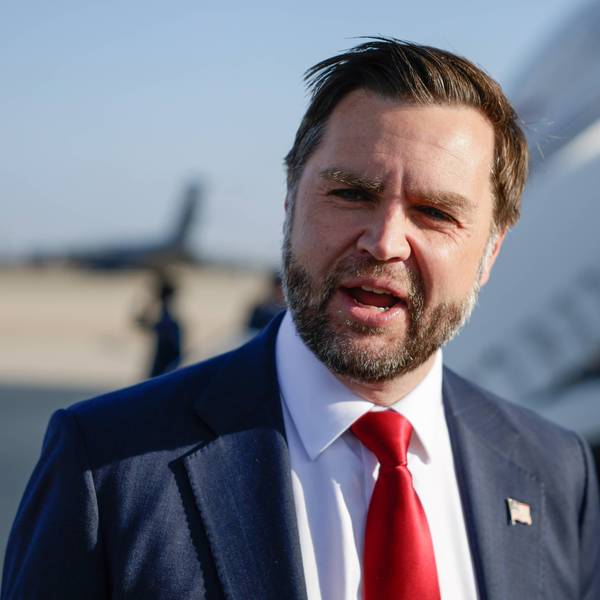
Vice President JD Vance chats with James Byron, president and CEO of the Richard Nixon Foundation, about his new book, "Communion: Finding My Way Back to Faith" during a visit to the Richard Nixon Presidential Library & Museum on Thursday, June 25, 2026, in Yorba Linda.
By criticizing the Iran War and touting affordability, Vance is not reconsidering the politics that produced the administration's failures; rather, he is signaling how the interests that control him intend to recover the political ground they have lost.
Following the supposed “blue wave,” marked by significant GOP midterm losses, JD Vance published an donald extended statement on X that some have interpreted as a meaningful admission of Republican failure, or even a rebuke of President Donald Trump. Vance seemed to offer an unusually candid explanation of why voters had abandoned the administration, citing a pollster's account of what might persuade disillusioned Trump 2024 voters to return to the Republican camp. The four leading responses, he explained, were:
While Vance's statement has ruffled feathers within the GOP, its implications, and the speed with which it was issued, deserve considerably closer scrutiny.
On the one hand, there is nothing revelatory about acknowledging that an increasingly unpopular, unprovoked war on Iran, mounting economic insecurity and crippling inflation, and the administration's unwavering support for the war-dependent, genocidal, apartheid state of Israel have alienated voters. Yet it is notable how readily Vance, a defender and principal contributor to these very ruinous policies and destructive conditions, has identified them, and how quickly that recognition is being read as evidence of political introspection, or even a “break” from Trump.
Vance’s X-essay is thus not a departure from the political project that brought Trump to power, but a swift, billionaire-backed exercise in working out how to repackage its promises and mobilize them again.
At first glance, Vance's statement reads almost like an exercise in democratic humility. He is “shocked,” apparently eager for an “honest conversation” about where the Republican Party goes from here, and graciously inviting voters to explain where his party went wrong. He writes as though GOP voters might actually be invited to participate in the democratic direction of their party:
I remain hopeful about our country. To the people who are pissed off and want to say, "I told you so," you're right, you did tell us so. Take that energy into electing Republicans who share your worldview.
The performance would be more convincing if Vance were not the vice president of the administration he is now diagnosing and a well-established political puppet of the PayPal Mafia.
It is no secret that Vance's political ascent has been financed and cultivated by Silicon Valley's billionaire class, whose personal and commercial interests and bizarre dystopian visions increasingly depend upon the expansion of the American war machine, the growing privatization of state power, and the accumulation of private wealth at the expense of public services. Most infamously, Peter Thiel was Vance's employer, mentor, political patron, and one of the principal architects of his political ascent.
It is almost too obvious to point out the absurdity of a man explaining to voters what went wrong when he is himself an instrument of the very oligarchs using the executive branch to secure lucrative markets for their data and AI infrastructure, and the development and deployment of autonomous weapons systems. Their fortunes are precisely tied to the expansion of state violence and surveillance at home and abroad. They are the vanguard of a class exploiting public resources, evading taxation, and extracting billions in government contracts.
But exposing Vance's hypocrisy, or reading his statement as a thinly veiled repudiation of Trump, misses the more consequential calculation. Vance is not reconsidering the politics that produced the administration's failures. Rather, he is signaling how the interests that control him intend to recover the political ground they have lost.
It is hardly surprising that Republicans may once again co-opt anti-war and economic populist rhetoric without attempting to deliver on the demands behind it. Trump has demonstrated, in both terms, how readily campaign promises for “peace” and measures to alleviate the cost-of-living squeeze can be altogether abandoned once political power is secured. More consequential is the speed with which the Republican establishment seems to be taking stock of its electoral failures, calculating how to win back the constituencies it has alienated, and laying the groundwork for another political cycle.
Vance's 2028 ambitions offer an important window into the recalibration. His ideological moderation signals no shift in political direction, but rather is a more sophisticated effort to reposition the Republican Party without relinquishing its underlying commitments. Vance and his backers understand that reclaiming their political and electoral appeal requires more than simply appropriating the language of popular demands. The longer-term objective is to accommodate popular discontent rhetorically while severing it from the structural changes necessary to address its underlying causes.
The Republican establishment does not need to defeat anti-war politics if it can detach opposition to a particular war from opposition to American imperialism. It does not need to defeat economic populism if it can detach economic discontent from a critique of corporate ownership and concentrated wealth—narrowing the narrative to prices at the pump or the cost of groceries. Nor does it need to abandon its relationship with Israel if it can present a revised relationship—including through changes to the National Defense Authorization Act—as evidence that it has listened to voters, without challenging the military and financial arrangements that sustain Israeli occupation of Palestine and its broader expansionist project.
The grievances can be acknowledged, the language adopted, and the constituencies courted, without conceding anything to the structural changes those demands might ultimately entail.
The comparison with the Democratic establishment is equally telling. While Republicans are already calculating how to win back voters alienated by their own policies, Democrats seem perfectly ready to mistake another rejection of Trump for an endorsement of their own. The establishment is potentially preparing to restore Zionist PAC-funded, Big Pharma-defending mouthpieces Sen. Chuck Schumer (NY) and Rep. Hakeem Jeffries (NY) to positions of leadership. The same politicians who have spent years rebuking their progressive wing, dismissing its demands, working only in the interests of their corporate backers, and insisting that voters have nowhere else to go. The establishment seems perfectly content to congratulate themselves on their return.
The same tendency to mistake political repositioning for political change extends beyond the establishment, as some sections of the liberal and supposed left have greeted Vance's statement with enthusiasm or credulity. Liberals eager to find signs of moderation within the Republican Party are helping launder a calculated political maneuver into something resembling introspection. Others, celebrating the “blue wave” and desperate for evidence that electoral politics can still produce a meaningful rupture, seem ready to declare a discursive victory for the movements fighting for economic justice and against militarism. For some, Vance's tweet becomes a kind of political talisman: proof that the administration has been wounded, that voters have rejected its agenda, that the contradictions are finally catching up with it.
In other words, those on the left may see their own demands reflected in Vance's rhetoric and mistake such appropriation for a political victory.
This is the mythology of hope at its most politically debilitating, the naive compulsion to find redemption in a political establishment whose interests remain fundamentally unchanged. The election does not resolve the political and moral incoherence that Vance embodies, just as it does nothing to dislodge the ruling class.
Vance’s X-essay is thus not a departure from the political project that brought Trump to power, but a swift, billionaire-backed exercise in working out how to repackage its promises and mobilize them again.
Trump's bombastic circus, his criminality, his revolving cast of cronies, and his particular brand of reactionary politics are not, in themselves, the full expression of the GOP elite's political project. To mistake the current face of the administration for the true cohort of interests it serves is to misunderstand the political coalition that brought Trump to power and continues to benefit from controlling the presidency, most obviously to inflate their members’ stock portfolios.
The current GOP elite’s chauvinist politics—which combine white nationalism, anti-immigrant, and anti-Black reaction; the expansion of Immigration and Customs Enforcement and the machinery of mass detention and deportation; and an increasingly normalized use and threat of state violence at home and abroad—are still not bound by a unified ideological movement with a consistent conservative program. It is their shared appetite for power, accumulation, deregulation, and coercion that binds them.
Trumpism has provided a vehicle through which an increasingly volatile coalition of competing capital interests, billionaire networks, military and intelligence contractors, private surveillance interests, religious reactionaries, and political operators can consolidate power. Their political alliances are contingent, perhaps even sustained by blackmail. Their rhetoric is just as expendable. Trump's second administration has made this especially visible, as competing egos often collide despite shared pursuits of industry-wide deregulation and unfettered access to the institutions through which wealth and power are accumulated.
So Vance's apparent signal of a “2028 GOP showdown” are entirely consistent with this world of self-interested networks and political theater. There is no reason to assume that Trump himself must remain the vehicle through which the ultrarich, the Epstein class, and their affiliates pursue their ambitions and interests, including Trump's own.
In other words, Vance et al. are moving fast to preserve their hold on power while shedding the liabilities that have made the current administration increasingly difficult to sustain. Technology and security interests that profit from the expansion of state coercion can back a politician speaking of economic relief and an end to war. There is no contradiction here from the standpoint of capital. The political presentation can change without any corresponding change in the interests being served.
Vance's statement is then worth taking seriously, as it demonstrates that even the techno-utopian, reality-detached oligarchs are capable of explicitly recognizing the political grievances they manufacture and considering how to bring those voters back into the fold. This is a form of political intelligence that the Democratic establishment has repeatedly proven itself incapable of, or deliberately unwilling to, exercise, even when it is deployed, as it is here, in the service of preserving the very arrangements responsible for producing those grievances.
Neither party's electoral fortunes should be mistaken for a transfer of political power to the people whose grievances they claim to represent.
This country and this world are at a monumental crossroads. US voters have an opportunity to beat back the forces of fascism and confront the billionaires who are rigging the economy, our media system, and our democracy, making it increasingly impossible for ordinary people to get by. We’re not just talking about the election. We’re talking about what must be done once these fascist elements are vanquished from power. We need a bolder set of solutions than what either major party has so far been willing to offer and a working-class movement ready to fight like hell for it. Trump didn't emerge from nowhere. The conditions that fueled MAGA authoritarianism were created by decades of radical neoliberal economic policies and a corrupt political system dominated by corporate interests. They slashed taxes on the super-rich, promising that the benefits would trickle down. They said giveaways to the corporate titans would make life more affordable for the rest of us. It was all bullshit. And when a bitter, betrayed populace searches for someone to blame, right-wing demagogues have little trouble finding scapegoats. People know when they're being lied to, but you won't hear any of this from the corporate media. Only independent journalism—powered and funded by people who believe in building a better world—can deliver truly trustworthy daily news. If you share our vision, please contribute whatever you can to sustain our work. |
Following the supposed “blue wave,” marked by significant GOP midterm losses, JD Vance published an donald extended statement on X that some have interpreted as a meaningful admission of Republican failure, or even a rebuke of President Donald Trump. Vance seemed to offer an unusually candid explanation of why voters had abandoned the administration, citing a pollster's account of what might persuade disillusioned Trump 2024 voters to return to the Republican camp. The four leading responses, he explained, were:
While Vance's statement has ruffled feathers within the GOP, its implications, and the speed with which it was issued, deserve considerably closer scrutiny.
On the one hand, there is nothing revelatory about acknowledging that an increasingly unpopular, unprovoked war on Iran, mounting economic insecurity and crippling inflation, and the administration's unwavering support for the war-dependent, genocidal, apartheid state of Israel have alienated voters. Yet it is notable how readily Vance, a defender and principal contributor to these very ruinous policies and destructive conditions, has identified them, and how quickly that recognition is being read as evidence of political introspection, or even a “break” from Trump.
Vance’s X-essay is thus not a departure from the political project that brought Trump to power, but a swift, billionaire-backed exercise in working out how to repackage its promises and mobilize them again.
At first glance, Vance's statement reads almost like an exercise in democratic humility. He is “shocked,” apparently eager for an “honest conversation” about where the Republican Party goes from here, and graciously inviting voters to explain where his party went wrong. He writes as though GOP voters might actually be invited to participate in the democratic direction of their party:
I remain hopeful about our country. To the people who are pissed off and want to say, "I told you so," you're right, you did tell us so. Take that energy into electing Republicans who share your worldview.
The performance would be more convincing if Vance were not the vice president of the administration he is now diagnosing and a well-established political puppet of the PayPal Mafia.
It is no secret that Vance's political ascent has been financed and cultivated by Silicon Valley's billionaire class, whose personal and commercial interests and bizarre dystopian visions increasingly depend upon the expansion of the American war machine, the growing privatization of state power, and the accumulation of private wealth at the expense of public services. Most infamously, Peter Thiel was Vance's employer, mentor, political patron, and one of the principal architects of his political ascent.
It is almost too obvious to point out the absurdity of a man explaining to voters what went wrong when he is himself an instrument of the very oligarchs using the executive branch to secure lucrative markets for their data and AI infrastructure, and the development and deployment of autonomous weapons systems. Their fortunes are precisely tied to the expansion of state violence and surveillance at home and abroad. They are the vanguard of a class exploiting public resources, evading taxation, and extracting billions in government contracts.
But exposing Vance's hypocrisy, or reading his statement as a thinly veiled repudiation of Trump, misses the more consequential calculation. Vance is not reconsidering the politics that produced the administration's failures. Rather, he is signaling how the interests that control him intend to recover the political ground they have lost.
It is hardly surprising that Republicans may once again co-opt anti-war and economic populist rhetoric without attempting to deliver on the demands behind it. Trump has demonstrated, in both terms, how readily campaign promises for “peace” and measures to alleviate the cost-of-living squeeze can be altogether abandoned once political power is secured. More consequential is the speed with which the Republican establishment seems to be taking stock of its electoral failures, calculating how to win back the constituencies it has alienated, and laying the groundwork for another political cycle.
Vance's 2028 ambitions offer an important window into the recalibration. His ideological moderation signals no shift in political direction, but rather is a more sophisticated effort to reposition the Republican Party without relinquishing its underlying commitments. Vance and his backers understand that reclaiming their political and electoral appeal requires more than simply appropriating the language of popular demands. The longer-term objective is to accommodate popular discontent rhetorically while severing it from the structural changes necessary to address its underlying causes.
The Republican establishment does not need to defeat anti-war politics if it can detach opposition to a particular war from opposition to American imperialism. It does not need to defeat economic populism if it can detach economic discontent from a critique of corporate ownership and concentrated wealth—narrowing the narrative to prices at the pump or the cost of groceries. Nor does it need to abandon its relationship with Israel if it can present a revised relationship—including through changes to the National Defense Authorization Act—as evidence that it has listened to voters, without challenging the military and financial arrangements that sustain Israeli occupation of Palestine and its broader expansionist project.
The grievances can be acknowledged, the language adopted, and the constituencies courted, without conceding anything to the structural changes those demands might ultimately entail.
The comparison with the Democratic establishment is equally telling. While Republicans are already calculating how to win back voters alienated by their own policies, Democrats seem perfectly ready to mistake another rejection of Trump for an endorsement of their own. The establishment is potentially preparing to restore Zionist PAC-funded, Big Pharma-defending mouthpieces Sen. Chuck Schumer (NY) and Rep. Hakeem Jeffries (NY) to positions of leadership. The same politicians who have spent years rebuking their progressive wing, dismissing its demands, working only in the interests of their corporate backers, and insisting that voters have nowhere else to go. The establishment seems perfectly content to congratulate themselves on their return.
The same tendency to mistake political repositioning for political change extends beyond the establishment, as some sections of the liberal and supposed left have greeted Vance's statement with enthusiasm or credulity. Liberals eager to find signs of moderation within the Republican Party are helping launder a calculated political maneuver into something resembling introspection. Others, celebrating the “blue wave” and desperate for evidence that electoral politics can still produce a meaningful rupture, seem ready to declare a discursive victory for the movements fighting for economic justice and against militarism. For some, Vance's tweet becomes a kind of political talisman: proof that the administration has been wounded, that voters have rejected its agenda, that the contradictions are finally catching up with it.
In other words, those on the left may see their own demands reflected in Vance's rhetoric and mistake such appropriation for a political victory.
This is the mythology of hope at its most politically debilitating, the naive compulsion to find redemption in a political establishment whose interests remain fundamentally unchanged. The election does not resolve the political and moral incoherence that Vance embodies, just as it does nothing to dislodge the ruling class.
Vance’s X-essay is thus not a departure from the political project that brought Trump to power, but a swift, billionaire-backed exercise in working out how to repackage its promises and mobilize them again.
Trump's bombastic circus, his criminality, his revolving cast of cronies, and his particular brand of reactionary politics are not, in themselves, the full expression of the GOP elite's political project. To mistake the current face of the administration for the true cohort of interests it serves is to misunderstand the political coalition that brought Trump to power and continues to benefit from controlling the presidency, most obviously to inflate their members’ stock portfolios.
The current GOP elite’s chauvinist politics—which combine white nationalism, anti-immigrant, and anti-Black reaction; the expansion of Immigration and Customs Enforcement and the machinery of mass detention and deportation; and an increasingly normalized use and threat of state violence at home and abroad—are still not bound by a unified ideological movement with a consistent conservative program. It is their shared appetite for power, accumulation, deregulation, and coercion that binds them.
Trumpism has provided a vehicle through which an increasingly volatile coalition of competing capital interests, billionaire networks, military and intelligence contractors, private surveillance interests, religious reactionaries, and political operators can consolidate power. Their political alliances are contingent, perhaps even sustained by blackmail. Their rhetoric is just as expendable. Trump's second administration has made this especially visible, as competing egos often collide despite shared pursuits of industry-wide deregulation and unfettered access to the institutions through which wealth and power are accumulated.
So Vance's apparent signal of a “2028 GOP showdown” are entirely consistent with this world of self-interested networks and political theater. There is no reason to assume that Trump himself must remain the vehicle through which the ultrarich, the Epstein class, and their affiliates pursue their ambitions and interests, including Trump's own.
In other words, Vance et al. are moving fast to preserve their hold on power while shedding the liabilities that have made the current administration increasingly difficult to sustain. Technology and security interests that profit from the expansion of state coercion can back a politician speaking of economic relief and an end to war. There is no contradiction here from the standpoint of capital. The political presentation can change without any corresponding change in the interests being served.
Vance's statement is then worth taking seriously, as it demonstrates that even the techno-utopian, reality-detached oligarchs are capable of explicitly recognizing the political grievances they manufacture and considering how to bring those voters back into the fold. This is a form of political intelligence that the Democratic establishment has repeatedly proven itself incapable of, or deliberately unwilling to, exercise, even when it is deployed, as it is here, in the service of preserving the very arrangements responsible for producing those grievances.
Neither party's electoral fortunes should be mistaken for a transfer of political power to the people whose grievances they claim to represent.