5
#000000
#FFFFFF
To donate by check, phone, or other method, see our More Ways to Give page.
Daily news & progressive opinion—funded by the people, not the corporations—delivered straight to your inbox.

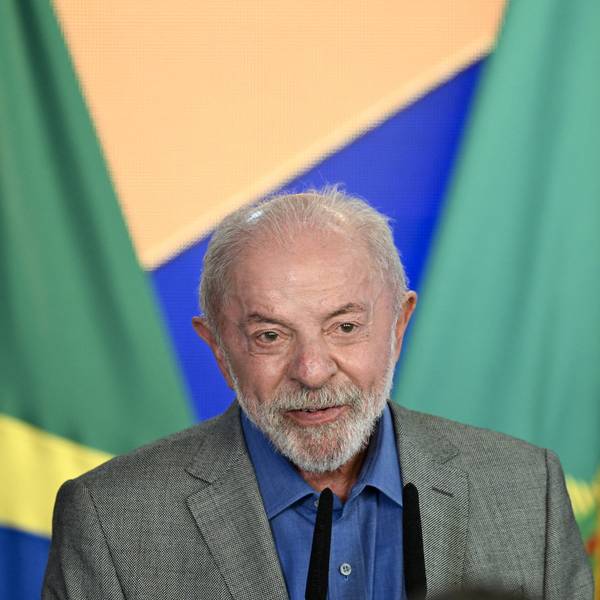
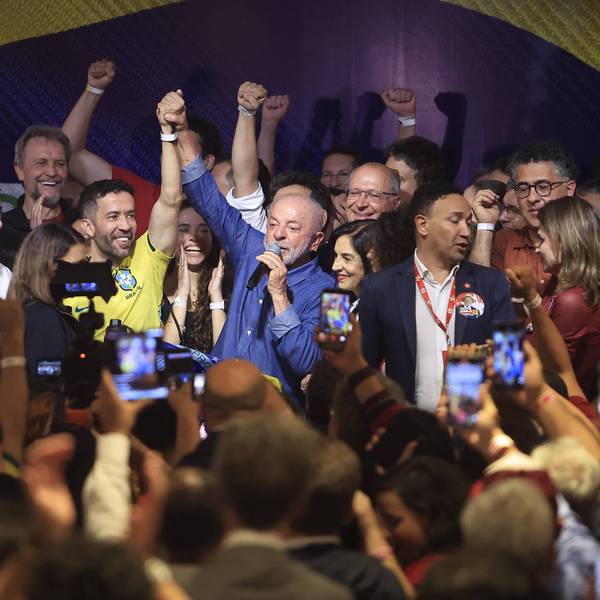
Brazil's President and re-election candidate for the Workers' Party (PT) Luiz Inacio Lula da Silva (C) speaks next to Vice President Geraldo Alckmin (5nd R) after knowing the first results of the presidential runoff election, in Sao Paulo, Brazil, on October 25, 2026.
Lula's comeback offers a powerful lesson: Ambitious economic policies can capture voters' imaginations when they promise tangible improvements in everyday life and win their hearts when you can deliver on that vision.
In just three weeks last month, Brazilian President Luiz Inácio Lula da Silva turned a 2.2-million-vote deficit in the first round into a 4.4-million-vote victory in the runoff. He won 52% to 48%. The six-point reversal made him the first candidate in Brazil's modern presidential history to win a runoff after being down in the first round. He increased turnout and appears to have converted voters who didn’t initially vote for him.
Much has been written about the organizing mechanics of this remarkable turnaround and the revitalization of "Lula's Army." While these explanations tell us how Lula’s campaign mobilized voters, they don’t tell us why voters mobilized. The contrasts between Lula and Flávio Bolsonaro were of course already stark, but if they were so stark, the changing of the tides wouldn’t have been so dramatic over three weeks. That emphasis on organizing mechanics overlooks strategic policy decisions Lula made those final weeks to deliver concrete victories for Brazilian workers.
And the most powerful of those decisions? In October, Lula successfully fought for the passage of a constitutional amendment to shorten the workweek from six days to five days, which had been one of his main campaign pledges. This was one of the most meaningful Brazilian labor reforms in decades. By the end of 2027, workers will have 10% of their time back and an additional day of rest. So many voters are used to politicians making promises but not delivering on them. Lula made sure workers knew he had their back by delivering real policy change in a critical period of the election. And this policy was not a niche policy change impacting small segments of the population. It’s estimated it would concretely touch the lives of over 30 million Brazilian workers by giving them their time back.
For millions of Brazilian workers, they’ve had a “6x1” schedule their entire lives: working six days every week with just a single day to recover. Burnout, unsurprisingly, had become epidemic. Shortening the Brazilian workweek had been advanced by unionists in Brazil for decades, but had taken on newfound pressure from a grassroots campaign called Vida Além do Trabalho (Life Beyond Work). This campaign, founded in 2023 by worker-turned-politician Rick Azevedo, helped turn growing frustration into a real political movement. From 2023 to 2026, workers and politicians worked together to steadily build support in Congress, organizing demonstrations, running for office on a shorter workweek agenda, collecting millions of signatures, and incorporating the demand into campaign rallies. This culminated in Lula focusing on shortening the workweek in his May Day 2025 rally and sending a bill to Congress in April 2026, bringing this issue into the forefront of the presidential election.
The grassroots campaign also helped seed widespread support for shorter workweeks across the political spectrum, helped in part by the fact that shorter workweeks intuitively connected to workers’ material self-interest. In March 2026, a Datafolha poll showed that 71% of Brazilians supported ending the six-day workweek, including 77% of women.
Lula recognized the opportunity. Just days after his first-round defeat in October, he publicly challenged Bolsonaro to support the reform. Simultaneously in October, University of Brasilia’s student union held a 50,000-person rally with the slogan “Bolsonaro never again, and end the 6x1 now.” This bottom-up and top-down approach worked. Bolsonaro and his opposition party initially opposed the proposal. But amid widespread backlash, they quickly backed down. They agreed to a special Senate session to ensure the passage of a constitutional amendment which would result in a 10% reduction of workers’ workweeks (from 44 hours to 40 hours) and two guaranteed days of rest by the end of 2027, with no loss in pay. The public hunger for this change was so deep that the amendment passed 75-1 in the Senate and Congress passed it two days later.
Lula's comeback offers a powerful lesson. Ambitious economic policies can (1) capture voters' imaginations when they promise tangible improvements in everyday life, and (2) win their hearts when you can deliver on that vision. And few promises are more meaningful than giving workers back the one thing they can never earn more of: their time.
The cost-of-living crisis is a global issue: When you hear the struggles of Brazilian workers, they’re not too different from those of American workers. Just as in Brazil, there’s an epidemic of burnout and widespread frustration that the American dream has just resulted in being overworked and tired. Brazilian politicians and movement leaders savvily recognized that cost-of-living and affordability is about prices and wages, but also about time.
American politicians should start paying attention. The United States established the 40-hour workweek nearly 90 years ago. Despite massive changes in who works, how we work, where we work, and when we work, that workweek has stayed at approximately 40 hours at the individual level, and we work more household hours than we did 60 years ago. With AI on the horizon, even more could change rapidly with work.
American politicians should keep in mind that the shorter workweek offers an opportunity to translate this burgeoning coalition for shorter workweeks into meaningful policy change.
In this moment of burgeoning economic populism, shorter workweeks could be a policy that helps politicians deliver real widespread change that is also immensely popular. The Brazil example is instructive. Any shorter workweek bill deserves to be passed merely for the sake of giving time back to workers, but it also holds real electoral fruits. As in Brazil, approximately 7 in 10 Americans support shorter workweeks. After all, a better economy shouldn't just mean having more money in your pocket. It should mean having more life outside of work.
Similar to Brazil in 2023, we’re seeing small scale progress in the last few years. At the federal level, 32-hour workweek bills have been introduced in both houses of Congress from Sen. Bernie Sanders (I-Vt.) and Rep. Mark Takano (D-Calif.). At the state and local level, policymakers as wide-ranging as a Republican in Maine, Rick Bennett, and a DSA NY Member in NYC, Phara Souffrant Forrest, have advanced shorter workweek legislation. Both unions have advocated for this and hundreds of companies have adopted it.
The dust will soon settle on the 2026 midterms, and campaigns will start prepping for the 2027 and 2028 elections. American politicians should keep in mind that the shorter workweek offers an opportunity to translate this burgeoning coalition for shorter workweeks into meaningful policy change. Lula's comeback shows what can happen when politicians give workers something worth fighting for, and then deliver on that idea.
This country and this world are at a monumental crossroads. US voters have an opportunity to beat back the forces of fascism and confront the billionaires who are rigging the economy, our media system, and our democracy, making it increasingly impossible for ordinary people to get by. We’re not just talking about the election. We’re talking about what must be done once these fascist elements are vanquished from power. We need a bolder set of solutions than what either major party has so far been willing to offer and a working-class movement ready to fight like hell for it. Trump didn't emerge from nowhere. The conditions that fueled MAGA authoritarianism were created by decades of radical neoliberal economic policies and a corrupt political system dominated by corporate interests. They slashed taxes on the super-rich, promising that the benefits would trickle down. They said giveaways to the corporate titans would make life more affordable for the rest of us. It was all bullshit. And when a bitter, betrayed populace searches for someone to blame, right-wing demagogues have little trouble finding scapegoats. People know when they're being lied to, but you won't hear any of this from the corporate media. Only independent journalism—powered and funded by people who believe in building a better world—can deliver truly trustworthy daily news. If you share our vision, please contribute whatever you can to sustain our work. |
In just three weeks last month, Brazilian President Luiz Inácio Lula da Silva turned a 2.2-million-vote deficit in the first round into a 4.4-million-vote victory in the runoff. He won 52% to 48%. The six-point reversal made him the first candidate in Brazil's modern presidential history to win a runoff after being down in the first round. He increased turnout and appears to have converted voters who didn’t initially vote for him.
Much has been written about the organizing mechanics of this remarkable turnaround and the revitalization of "Lula's Army." While these explanations tell us how Lula’s campaign mobilized voters, they don’t tell us why voters mobilized. The contrasts between Lula and Flávio Bolsonaro were of course already stark, but if they were so stark, the changing of the tides wouldn’t have been so dramatic over three weeks. That emphasis on organizing mechanics overlooks strategic policy decisions Lula made those final weeks to deliver concrete victories for Brazilian workers.
And the most powerful of those decisions? In October, Lula successfully fought for the passage of a constitutional amendment to shorten the workweek from six days to five days, which had been one of his main campaign pledges. This was one of the most meaningful Brazilian labor reforms in decades. By the end of 2027, workers will have 10% of their time back and an additional day of rest. So many voters are used to politicians making promises but not delivering on them. Lula made sure workers knew he had their back by delivering real policy change in a critical period of the election. And this policy was not a niche policy change impacting small segments of the population. It’s estimated it would concretely touch the lives of over 30 million Brazilian workers by giving them their time back.
For millions of Brazilian workers, they’ve had a “6x1” schedule their entire lives: working six days every week with just a single day to recover. Burnout, unsurprisingly, had become epidemic. Shortening the Brazilian workweek had been advanced by unionists in Brazil for decades, but had taken on newfound pressure from a grassroots campaign called Vida Além do Trabalho (Life Beyond Work). This campaign, founded in 2023 by worker-turned-politician Rick Azevedo, helped turn growing frustration into a real political movement. From 2023 to 2026, workers and politicians worked together to steadily build support in Congress, organizing demonstrations, running for office on a shorter workweek agenda, collecting millions of signatures, and incorporating the demand into campaign rallies. This culminated in Lula focusing on shortening the workweek in his May Day 2025 rally and sending a bill to Congress in April 2026, bringing this issue into the forefront of the presidential election.
The grassroots campaign also helped seed widespread support for shorter workweeks across the political spectrum, helped in part by the fact that shorter workweeks intuitively connected to workers’ material self-interest. In March 2026, a Datafolha poll showed that 71% of Brazilians supported ending the six-day workweek, including 77% of women.
Lula recognized the opportunity. Just days after his first-round defeat in October, he publicly challenged Bolsonaro to support the reform. Simultaneously in October, University of Brasilia’s student union held a 50,000-person rally with the slogan “Bolsonaro never again, and end the 6x1 now.” This bottom-up and top-down approach worked. Bolsonaro and his opposition party initially opposed the proposal. But amid widespread backlash, they quickly backed down. They agreed to a special Senate session to ensure the passage of a constitutional amendment which would result in a 10% reduction of workers’ workweeks (from 44 hours to 40 hours) and two guaranteed days of rest by the end of 2027, with no loss in pay. The public hunger for this change was so deep that the amendment passed 75-1 in the Senate and Congress passed it two days later.
Lula's comeback offers a powerful lesson. Ambitious economic policies can (1) capture voters' imaginations when they promise tangible improvements in everyday life, and (2) win their hearts when you can deliver on that vision. And few promises are more meaningful than giving workers back the one thing they can never earn more of: their time.
The cost-of-living crisis is a global issue: When you hear the struggles of Brazilian workers, they’re not too different from those of American workers. Just as in Brazil, there’s an epidemic of burnout and widespread frustration that the American dream has just resulted in being overworked and tired. Brazilian politicians and movement leaders savvily recognized that cost-of-living and affordability is about prices and wages, but also about time.
American politicians should start paying attention. The United States established the 40-hour workweek nearly 90 years ago. Despite massive changes in who works, how we work, where we work, and when we work, that workweek has stayed at approximately 40 hours at the individual level, and we work more household hours than we did 60 years ago. With AI on the horizon, even more could change rapidly with work.
American politicians should keep in mind that the shorter workweek offers an opportunity to translate this burgeoning coalition for shorter workweeks into meaningful policy change.
In this moment of burgeoning economic populism, shorter workweeks could be a policy that helps politicians deliver real widespread change that is also immensely popular. The Brazil example is instructive. Any shorter workweek bill deserves to be passed merely for the sake of giving time back to workers, but it also holds real electoral fruits. As in Brazil, approximately 7 in 10 Americans support shorter workweeks. After all, a better economy shouldn't just mean having more money in your pocket. It should mean having more life outside of work.
Similar to Brazil in 2023, we’re seeing small scale progress in the last few years. At the federal level, 32-hour workweek bills have been introduced in both houses of Congress from Sen. Bernie Sanders (I-Vt.) and Rep. Mark Takano (D-Calif.). At the state and local level, policymakers as wide-ranging as a Republican in Maine, Rick Bennett, and a DSA NY Member in NYC, Phara Souffrant Forrest, have advanced shorter workweek legislation. Both unions have advocated for this and hundreds of companies have adopted it.
The dust will soon settle on the 2026 midterms, and campaigns will start prepping for the 2027 and 2028 elections. American politicians should keep in mind that the shorter workweek offers an opportunity to translate this burgeoning coalition for shorter workweeks into meaningful policy change. Lula's comeback shows what can happen when politicians give workers something worth fighting for, and then deliver on that idea.