SUBSCRIBE TO OUR FREE NEWSLETTER
Daily news & progressive opinion—funded by the people, not the corporations—delivered straight to your inbox.
5
#000000
#FFFFFF
To donate by check, phone, or other method, see our More Ways to Give page.
Daily news & progressive opinion—funded by the people, not the corporations—delivered straight to your inbox.
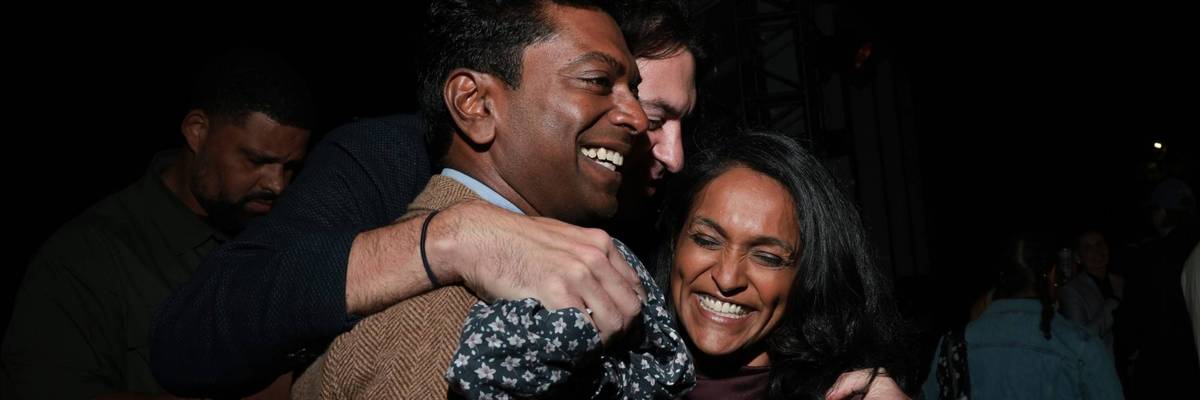
LA mayoral candidate Nithya Raman embraces her husband, Vali Chandrasekaran and an unidentified friend at her election night party at the Greek Theater, Los Angeles, California on Wednesday, November 4, 2026.
When candidates take our concerns seriously and when they're backed by an organization like the UAW willing to do the work of reaching young voters where they live and work, young people turn out.
Every cycle like clockwork, young voters are written off as too disillusioned or too distracted to show up in a midterm. On Tuesday, that outdated notion was laid to rest. Nationally and across California, young people showed up. And they showed up in numbers that made the difference in power-shifting races for LA Mayor-elect Nithya Raman, California Democratic Rep.-elects Randy Villegas and Marni von Wilpert, and others.
I know because I watched it happen.
I'm the president of UAW 4811, the union of more than 60,000 graduate workers, postdocs, researchers, and staff at the University of California, part of the more than 100,000 UAW members in California. Most of us are young. Too many of us spend the majority of our paychecks on rent and work second jobs just to stay in the cities where we teach and do research. We are exactly the voters campaigns have written off for decades as too hard to reach and too unreliable to count on.
Our members didn't knock on 57,244 doors to celebrate for one night. We did it because we intend to build a future in California, one where you can finish your degree, do work that matters, and still afford to live in the city you call home.
So this year, we stopped waiting for someone else to reach us. We reached out to each other.
Over the course of this campaign, UAW members in California contacted hundreds of thousands of voters. We knocked on 57,224 doors and made 170,748 phone calls. In the final stretch, we worked 4,389 get-out-the-vote shifts and had 41,360 personal conversations with voters.
Those numbers didn't come from mass texts or robocalls—they came from teaching assistants knocking doors on weekends, researchers phonebanking after their experiments wrapped up, and university staff standing on campus asking students whether they had a plan to vote. Peer-to-peer contact is the most effective way to turn out a young voter, and nobody is better positioned to talk to young people on a college campus than the young workers who keep those campuses running.
It worked. The day before the election, students and workers packed Bruin Plaza at UCLA to rally with Nithya Raman and promise to bring their roommates and labmates to the polls. The next day, lines at polling places stretched across California campuses from Davis to San Diego. And across the state, races were won by candidates who believed young voters were worth fighting for.
In Los Angeles last May, UAW was the first major union to endorse Nithya Raman for mayor. We did it because she has delivered for the people being priced out of this city. She led passage of some of the strongest renter protections in the country, capped rent increases, cut the red tape that keeps housing from getting built, and wrote the ordinance that protects our immigrant neighbors from Immigration and Customs Enforcement. A city that can't hold on to its young people doesn't have a future. Raman understood that, and young Angelenos rewarded her for it.
In the Central Valley, Randy Villegas ran on what working families there live with every day: the cost of healthcare, the need for good jobs, and communities that have been taken for granted for too long. UAW members canvassed in Bakersfield alongside him, reaching young voters in a region where youth turnout has historically lagged far behind the rest of the state.
In San Diego County, Marni von Wilpert ran a campaign rooted in standing up for working people, including the researchers and scientists whose work drives the region's economy at a moment when federal attacks on research have put thousands of livelihoods at risk. UAW members at UC San Diego and across the county made sure their neighbors knew what was at stake.
There's a lesson here for every party, every campaign, and every pundit: Young people aren't apathetic. We're exhausted by politicians who ignore us until they need us and never seem to deliver once they win. When candidates take our concerns seriously (rent, wages, research funding, immigrant rights, climate), and when they're backed by an organization willing to do the work of reaching young voters where they live and work, young people turn out.
What comes next matters just as much. We will hold these leaders to the commitments they made, and we will keep organizing. Our members didn't knock on 57,244 doors to celebrate for one night. We did it because we intend to build a future in California, one where you can finish your degree, do work that matters, and still afford to live in the city you call home.
Tuesday proved that young workers can move elections. Now we're going to move policy.
This country and this world are at a monumental crossroads. US voters have an opportunity to beat back the forces of fascism and confront the billionaires who are rigging the economy, our media system, and our democracy, making it increasingly impossible for ordinary people to get by. We’re not just talking about the election. We’re talking about what must be done once these fascist elements are vanquished from power. We need a bolder set of solutions than what either major party has so far been willing to offer and a working-class movement ready to fight like hell for it. Trump didn't emerge from nowhere. The conditions that fueled MAGA authoritarianism were created by decades of radical neoliberal economic policies and a corrupt political system dominated by corporate interests. They slashed taxes on the super-rich, promising that the benefits would trickle down. They said giveaways to the corporate titans would make life more affordable for the rest of us. It was all bullshit. And when a bitter, betrayed populace searches for someone to blame, right-wing demagogues have little trouble finding scapegoats. People know when they're being lied to, but you won't hear any of this from the corporate media. Only independent journalism—powered and funded by people who believe in building a better world—can deliver truly trustworthy daily news. If you share our vision, please contribute whatever you can to sustain our work. |
Every cycle like clockwork, young voters are written off as too disillusioned or too distracted to show up in a midterm. On Tuesday, that outdated notion was laid to rest. Nationally and across California, young people showed up. And they showed up in numbers that made the difference in power-shifting races for LA Mayor-elect Nithya Raman, California Democratic Rep.-elects Randy Villegas and Marni von Wilpert, and others.
I know because I watched it happen.
I'm the president of UAW 4811, the union of more than 60,000 graduate workers, postdocs, researchers, and staff at the University of California, part of the more than 100,000 UAW members in California. Most of us are young. Too many of us spend the majority of our paychecks on rent and work second jobs just to stay in the cities where we teach and do research. We are exactly the voters campaigns have written off for decades as too hard to reach and too unreliable to count on.
Our members didn't knock on 57,244 doors to celebrate for one night. We did it because we intend to build a future in California, one where you can finish your degree, do work that matters, and still afford to live in the city you call home.
So this year, we stopped waiting for someone else to reach us. We reached out to each other.
Over the course of this campaign, UAW members in California contacted hundreds of thousands of voters. We knocked on 57,224 doors and made 170,748 phone calls. In the final stretch, we worked 4,389 get-out-the-vote shifts and had 41,360 personal conversations with voters.
Those numbers didn't come from mass texts or robocalls—they came from teaching assistants knocking doors on weekends, researchers phonebanking after their experiments wrapped up, and university staff standing on campus asking students whether they had a plan to vote. Peer-to-peer contact is the most effective way to turn out a young voter, and nobody is better positioned to talk to young people on a college campus than the young workers who keep those campuses running.
It worked. The day before the election, students and workers packed Bruin Plaza at UCLA to rally with Nithya Raman and promise to bring their roommates and labmates to the polls. The next day, lines at polling places stretched across California campuses from Davis to San Diego. And across the state, races were won by candidates who believed young voters were worth fighting for.
In Los Angeles last May, UAW was the first major union to endorse Nithya Raman for mayor. We did it because she has delivered for the people being priced out of this city. She led passage of some of the strongest renter protections in the country, capped rent increases, cut the red tape that keeps housing from getting built, and wrote the ordinance that protects our immigrant neighbors from Immigration and Customs Enforcement. A city that can't hold on to its young people doesn't have a future. Raman understood that, and young Angelenos rewarded her for it.
In the Central Valley, Randy Villegas ran on what working families there live with every day: the cost of healthcare, the need for good jobs, and communities that have been taken for granted for too long. UAW members canvassed in Bakersfield alongside him, reaching young voters in a region where youth turnout has historically lagged far behind the rest of the state.
In San Diego County, Marni von Wilpert ran a campaign rooted in standing up for working people, including the researchers and scientists whose work drives the region's economy at a moment when federal attacks on research have put thousands of livelihoods at risk. UAW members at UC San Diego and across the county made sure their neighbors knew what was at stake.
There's a lesson here for every party, every campaign, and every pundit: Young people aren't apathetic. We're exhausted by politicians who ignore us until they need us and never seem to deliver once they win. When candidates take our concerns seriously (rent, wages, research funding, immigrant rights, climate), and when they're backed by an organization willing to do the work of reaching young voters where they live and work, young people turn out.
What comes next matters just as much. We will hold these leaders to the commitments they made, and we will keep organizing. Our members didn't knock on 57,244 doors to celebrate for one night. We did it because we intend to build a future in California, one where you can finish your degree, do work that matters, and still afford to live in the city you call home.
Tuesday proved that young workers can move elections. Now we're going to move policy.