SUBSCRIBE TO OUR FREE NEWSLETTER
Daily news & progressive opinion—funded by the people, not the corporations—delivered straight to your inbox.
5
#000000
#FFFFFF
To donate by check, phone, or other method, see our More Ways to Give page.
Daily news & progressive opinion—funded by the people, not the corporations—delivered straight to your inbox.
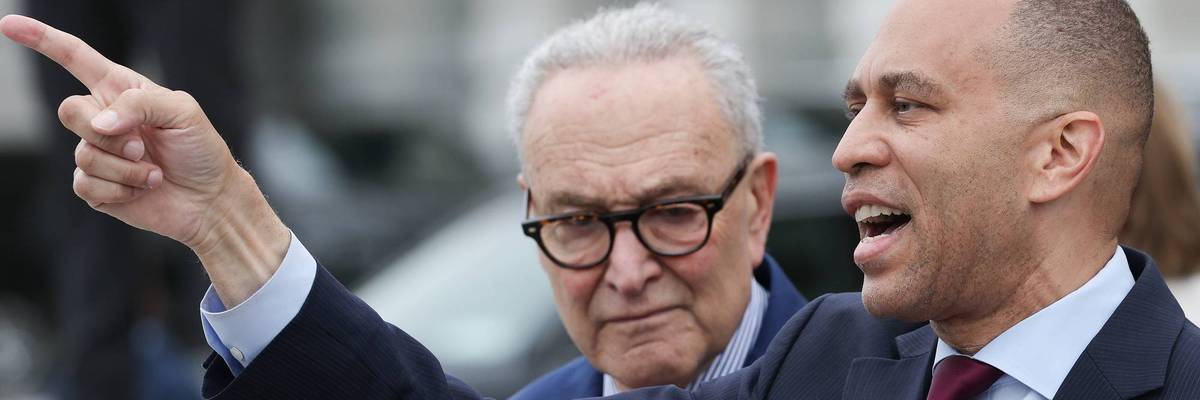
US House Minority Leader Hakeem Jeffries (D-NY) speaks alongside Senate Minority Leader Chuck Schumer (D-NY) on May 21, 2026 in Washington, DC.
After a Democratic "tsunami" in this week's midterm elections that has been widely seen as "a mandate to deliver big change," progressives within and beyond Congress have cast doubt on whether the New York Democrats likely to lead both chambers are actually up for facing Republican President Donald Trump's veto threats and fighting for the "bold agenda" sought by US voters.
As critics of artificial intelligence data centers prepared for a Friday protest outside the Brooklyn home of Senate Minority Leader Chuck Schumer over a "dirty" bill that House Minority Leader Hakeem Jeffries is suddenly speaking out about, political organizer Corbin Trent argued that "Schumer is bad at his job" and "Jeffries is not ready for this moment."
Although some races haven't yet been called, "Democratic voters, independent voters, and even some Republican voters spoke loudly and clearly: They want this country to go in a different direction," wrote Trent, a former communications director for Rep. Alexandria Ocasio-Cortez (D-NY) and two-time presidential campaign staffer for Sen. Bernie Sanders (I-Vt.).
Trent, who also co-founded Justice Democrats and now runs the super political action committee A Fight Worth Having, stressed that "this is an amazing, unprecedented moment in my lifetime. I'm 46 years old, and this is the most hopeful political moment I've ever experienced."
"Democrats have spoken loudly and clearly that they want new leadership. Unfortunately, too many of the people in Washington aren't listening," he added. While Trent and his group are far from alone in calling for new Democratic leadership when the party takes over Congress in January, Schumer and Jeffries are expected to become majority leader and speaker, respectively.
"Do you expect to face any kind of challenge in the election for Senate majority leader?" Michael Barbaro, who hosts The New York Times' podcast The Daily asked Chuck Schumer on Friday. He simply responded, "No."
Schumer ultimately added that "our caucus is focused on moving forward. Everyone's very happy with what we all did. But this is just the beginning. As I said before, and I'll say it again and again to my caucus, to the country, to everybody: If we don't deliver, all this will go away. This is just the first step. But I think we're united together to do that."
He delivered a similar message of unity during a Thursday night appearance on MS NOW, telling host Lawrence O'Donnell that the victorious Democrats—so far the party has 54 seats in the Senate and 253 in the House of Representatives, but those numbers could rise—were "all running on the same basic themes: costs, chaos, corruption."
As both majority and minority leader in recent years, Schumer has faced criticism from the party's left flank—and, as Al Jazeera noted Thursday, at least seven Democratic senators-elect have signaled or outright said they will not support him: Abdul El-Sayed (Mich.), Peggy Flanagan (Minn.), Adam Hamilton (Kan.), Chris Pappas (NH), Juliana Stratton (Ill.), and James Talarico (Texas).
However, as Fox News chief congressional correspondent Chad Pergram explained Friday, basic math and a lack of clear challengers suggest Schumer will win: "The selection of Senate majority leader is not a vote which plays out on the floor. The concept of 'Senate majority leader' has only been around since the early 20th Century and is not mentioned in the Constitution."
"Let's say Democrats do win Mississippi and Alaska, giving them 56 senators who caucus with the Democrats. All Schumer needs is 29 Democrats to support him in caucus, and he's the next majority leader," Pergram wrote on social media.
He noted that other possible contenders are Democratic Sens. Brian Schatz (Hawaii) and Chris Van Hollen (Md.), but the former is running to succeed retiring Senate Minority Whip Dick Durbin (D-Ill.) and the latter reportedly isn't seeking the post—though Van Hollen has said publicly that Democrats should demand an ambitious progressive agenda before backing Schumer or anyone else.
"Progressives are flipping Republican seats and winning critical battlegrounds where pundits told us our politics could never compete. Abdul El-Sayed in Michigan. Troy Jackson in Maine. James Talarico in Texas. Sam Forstag in Montana. Randy Villegas in California. Bob Brooks in Pennsylvania," said Joseph Geevarghese, executive director of Our Revolution, which grew out of Sanders' 2016 presidential run. "We gave people something to vote FOR, and they showed up."
"The progressive movement drove this victory. We spent a decade building the infrastructure, developing leaders, and making the argument that brought us here... This is a vindication of our politics and our theory of change: Organized people can beat organized money when we advance an anti-corporate, working-class agenda," he stressed, recalling when "the talking heads, academics, and party establishment scoffed at Bernie Sanders and our movement for talking about oligarchy."
The organizer said that "this was the corruption election. Affordability was central, but people were also asking why life keeps getting more expensive and who keeps cashing in. From AI and data centers to healthcare, Big Pharma, crypto, oil, and the war industry, people want a say over decisions being made at their expense. Corporate control of government is making their lives harder."
The American Israel Public Affairs Committee (AIPAC)—which notably congratulated Jeffries and Schumer, who wasn't even on the ballot this cycle, by name on Wednesday—along with GOP megadonor Elon Musk "and other billionaires and corporate interests have poured money into shaping our politics," Geevarghese continued. "Our victories show that their money does not make their agenda inevitable. People can organize, fight back, and win."
In the wake of these victories "powered by a progressive wave," Geevarghese called on Democrats to "use every committee, hearing, and budget negotiation. Follow the contracts and conflicts of interest. Put executives and administration officials under oath. Fight for concrete gains and make Trump answer for what he blocks."
"People need to see Democrats using every bit of power they have to fight for them," he said. "That requires leadership ready to meet the moment. Chuck Schumer should step aside. Bernie Sanders has provided the clarity and urgency a real opposition party needs. Leadership must match that ambition, including by investing in candidates and communities too often written off."
Aru Shiney-Ajay, executive director of the youth-led climate group Sunrise Movement, similarly said in a statement after the midterms that "young people voted for change. We deserve a Senate majority leader who will end the filibuster so we can stop the Iran Oil War, end corporate control of our government, and create good green jobs, not more data centers."
"Young people won't get that with the same old Democratic leadership. Schumer, it's time to put the American people first–commit to ending the filibuster or step aside," Shiney-Ajay added, referring to controversial chamber rules that effectively block legislation unless at least 60 of the 100 senators support advancing it to a final vote.
As for Jeffries, he got "the majority of his dreams," as Axios put it earlier this week. The outlet reported:
The left's strategy is "going to look different from what it would have been with a smaller margin," one incoming House progressive told Axios, noting that "leaders have more flexibility when they have big majorities.
Progressives "can't really extract much now [with this] colossal majority," a progressive strategist acknowledged, adding that "we don't have to do this high-stakes Jeffries fight."
Although Jeffries is on track to secure the role, there are calls for him to not be the next speaker. Nearly 900,000 people have signed a related Change.org petition, Nicole Whitted, an author and social media creator who receives compensation in connection with the effort.
"After historic wins on Tuesday, I believe the Democratic Party and our country as a whole is at a crossroads," Whitted told Newsweek. "My opposition to Hakeem Jeffries is about more than any single policy disagreement. It's about real leadership that aligns with today's Democratic voter, real accountability, and whether the party is genuinely listening to the voters demanding change."
In anticipation of Jeffries serving as speaker, the outlet Sludge examined his "financial backing from executives at Anduril and Palantir, cryptocurrency industry interests, and major Wall Street investors—business interests with a stake in how aggressively the new majority pursues corporate beneficiaries of Trump's presidency."
In response to that reporting, Melanie D'Arrigo, executive director of the pro-single-payer Campaign for New York Health, said that "you can't lead the opposition party while being bankrolled by the opposition. This should not be a controversial take."
This country and this world are at a monumental crossroads. US voters have an opportunity to beat back the forces of fascism and confront the billionaires who are rigging the economy, our media system, and our democracy, making it increasingly impossible for ordinary people to get by. We’re not just talking about the election. We’re talking about what must be done once these fascist elements are vanquished from power. We need a bolder set of solutions than what either major party has so far been willing to offer and a working-class movement ready to fight like hell for it. Trump didn't emerge from nowhere. The conditions that fueled MAGA authoritarianism were created by decades of radical neoliberal economic policies and a corrupt political system dominated by corporate interests. They slashed taxes on the super-rich, promising that the benefits would trickle down. They said giveaways to the corporate titans would make life more affordable for the rest of us. It was all bullshit. And when a bitter, betrayed populace searches for someone to blame, right-wing demagogues have little trouble finding scapegoats. People know when they're being lied to, but you won't hear any of this from the corporate media. Only independent journalism—powered and funded by people who believe in building a better world—can deliver truly trustworthy daily news. If you share our vision, please contribute whatever you can to sustain our work. |
After a Democratic "tsunami" in this week's midterm elections that has been widely seen as "a mandate to deliver big change," progressives within and beyond Congress have cast doubt on whether the New York Democrats likely to lead both chambers are actually up for facing Republican President Donald Trump's veto threats and fighting for the "bold agenda" sought by US voters.
As critics of artificial intelligence data centers prepared for a Friday protest outside the Brooklyn home of Senate Minority Leader Chuck Schumer over a "dirty" bill that House Minority Leader Hakeem Jeffries is suddenly speaking out about, political organizer Corbin Trent argued that "Schumer is bad at his job" and "Jeffries is not ready for this moment."
Although some races haven't yet been called, "Democratic voters, independent voters, and even some Republican voters spoke loudly and clearly: They want this country to go in a different direction," wrote Trent, a former communications director for Rep. Alexandria Ocasio-Cortez (D-NY) and two-time presidential campaign staffer for Sen. Bernie Sanders (I-Vt.).
Trent, who also co-founded Justice Democrats and now runs the super political action committee A Fight Worth Having, stressed that "this is an amazing, unprecedented moment in my lifetime. I'm 46 years old, and this is the most hopeful political moment I've ever experienced."
"Democrats have spoken loudly and clearly that they want new leadership. Unfortunately, too many of the people in Washington aren't listening," he added. While Trent and his group are far from alone in calling for new Democratic leadership when the party takes over Congress in January, Schumer and Jeffries are expected to become majority leader and speaker, respectively.
"Do you expect to face any kind of challenge in the election for Senate majority leader?" Michael Barbaro, who hosts The New York Times' podcast The Daily asked Chuck Schumer on Friday. He simply responded, "No."
Schumer ultimately added that "our caucus is focused on moving forward. Everyone's very happy with what we all did. But this is just the beginning. As I said before, and I'll say it again and again to my caucus, to the country, to everybody: If we don't deliver, all this will go away. This is just the first step. But I think we're united together to do that."
He delivered a similar message of unity during a Thursday night appearance on MS NOW, telling host Lawrence O'Donnell that the victorious Democrats—so far the party has 54 seats in the Senate and 253 in the House of Representatives, but those numbers could rise—were "all running on the same basic themes: costs, chaos, corruption."
As both majority and minority leader in recent years, Schumer has faced criticism from the party's left flank—and, as Al Jazeera noted Thursday, at least seven Democratic senators-elect have signaled or outright said they will not support him: Abdul El-Sayed (Mich.), Peggy Flanagan (Minn.), Adam Hamilton (Kan.), Chris Pappas (NH), Juliana Stratton (Ill.), and James Talarico (Texas).
However, as Fox News chief congressional correspondent Chad Pergram explained Friday, basic math and a lack of clear challengers suggest Schumer will win: "The selection of Senate majority leader is not a vote which plays out on the floor. The concept of 'Senate majority leader' has only been around since the early 20th Century and is not mentioned in the Constitution."
"Let's say Democrats do win Mississippi and Alaska, giving them 56 senators who caucus with the Democrats. All Schumer needs is 29 Democrats to support him in caucus, and he's the next majority leader," Pergram wrote on social media.
He noted that other possible contenders are Democratic Sens. Brian Schatz (Hawaii) and Chris Van Hollen (Md.), but the former is running to succeed retiring Senate Minority Whip Dick Durbin (D-Ill.) and the latter reportedly isn't seeking the post—though Van Hollen has said publicly that Democrats should demand an ambitious progressive agenda before backing Schumer or anyone else.
"Progressives are flipping Republican seats and winning critical battlegrounds where pundits told us our politics could never compete. Abdul El-Sayed in Michigan. Troy Jackson in Maine. James Talarico in Texas. Sam Forstag in Montana. Randy Villegas in California. Bob Brooks in Pennsylvania," said Joseph Geevarghese, executive director of Our Revolution, which grew out of Sanders' 2016 presidential run. "We gave people something to vote FOR, and they showed up."
"The progressive movement drove this victory. We spent a decade building the infrastructure, developing leaders, and making the argument that brought us here... This is a vindication of our politics and our theory of change: Organized people can beat organized money when we advance an anti-corporate, working-class agenda," he stressed, recalling when "the talking heads, academics, and party establishment scoffed at Bernie Sanders and our movement for talking about oligarchy."
The organizer said that "this was the corruption election. Affordability was central, but people were also asking why life keeps getting more expensive and who keeps cashing in. From AI and data centers to healthcare, Big Pharma, crypto, oil, and the war industry, people want a say over decisions being made at their expense. Corporate control of government is making their lives harder."
The American Israel Public Affairs Committee (AIPAC)—which notably congratulated Jeffries and Schumer, who wasn't even on the ballot this cycle, by name on Wednesday—along with GOP megadonor Elon Musk "and other billionaires and corporate interests have poured money into shaping our politics," Geevarghese continued. "Our victories show that their money does not make their agenda inevitable. People can organize, fight back, and win."
In the wake of these victories "powered by a progressive wave," Geevarghese called on Democrats to "use every committee, hearing, and budget negotiation. Follow the contracts and conflicts of interest. Put executives and administration officials under oath. Fight for concrete gains and make Trump answer for what he blocks."
"People need to see Democrats using every bit of power they have to fight for them," he said. "That requires leadership ready to meet the moment. Chuck Schumer should step aside. Bernie Sanders has provided the clarity and urgency a real opposition party needs. Leadership must match that ambition, including by investing in candidates and communities too often written off."
Aru Shiney-Ajay, executive director of the youth-led climate group Sunrise Movement, similarly said in a statement after the midterms that "young people voted for change. We deserve a Senate majority leader who will end the filibuster so we can stop the Iran Oil War, end corporate control of our government, and create good green jobs, not more data centers."
"Young people won't get that with the same old Democratic leadership. Schumer, it's time to put the American people first–commit to ending the filibuster or step aside," Shiney-Ajay added, referring to controversial chamber rules that effectively block legislation unless at least 60 of the 100 senators support advancing it to a final vote.
As for Jeffries, he got "the majority of his dreams," as Axios put it earlier this week. The outlet reported:
The left's strategy is "going to look different from what it would have been with a smaller margin," one incoming House progressive told Axios, noting that "leaders have more flexibility when they have big majorities.
Progressives "can't really extract much now [with this] colossal majority," a progressive strategist acknowledged, adding that "we don't have to do this high-stakes Jeffries fight."
Although Jeffries is on track to secure the role, there are calls for him to not be the next speaker. Nearly 900,000 people have signed a related Change.org petition, Nicole Whitted, an author and social media creator who receives compensation in connection with the effort.
"After historic wins on Tuesday, I believe the Democratic Party and our country as a whole is at a crossroads," Whitted told Newsweek. "My opposition to Hakeem Jeffries is about more than any single policy disagreement. It's about real leadership that aligns with today's Democratic voter, real accountability, and whether the party is genuinely listening to the voters demanding change."
In anticipation of Jeffries serving as speaker, the outlet Sludge examined his "financial backing from executives at Anduril and Palantir, cryptocurrency industry interests, and major Wall Street investors—business interests with a stake in how aggressively the new majority pursues corporate beneficiaries of Trump's presidency."
In response to that reporting, Melanie D'Arrigo, executive director of the pro-single-payer Campaign for New York Health, said that "you can't lead the opposition party while being bankrolled by the opposition. This should not be a controversial take."