SUBSCRIBE TO OUR FREE NEWSLETTER
Daily news & progressive opinion—funded by the people, not the corporations—delivered straight to your inbox.
5
#000000
#FFFFFF
To donate by check, phone, or other method, see our More Ways to Give page.
Daily news & progressive opinion—funded by the people, not the corporations—delivered straight to your inbox.
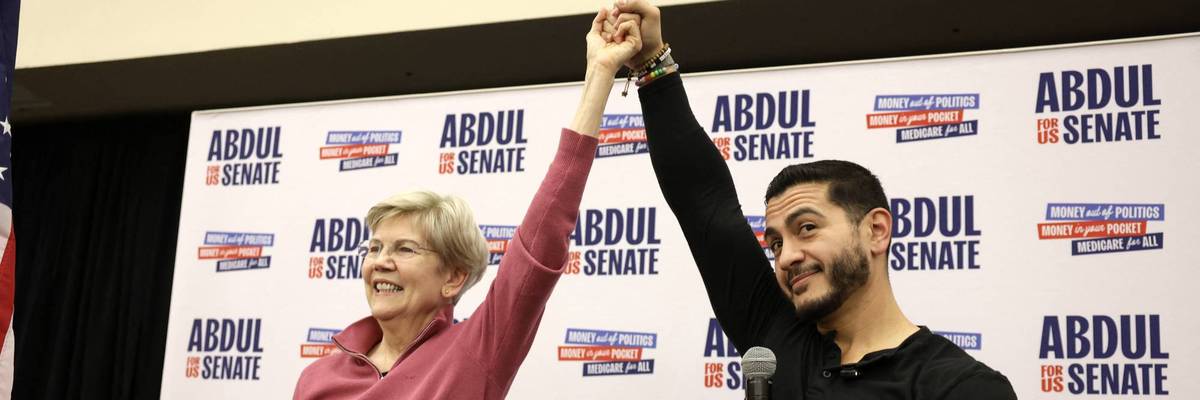
US Senator Elizabeth Warren (L), Democrat from Massachusetts, joins Democratic US Senate candidate for Michigan Abdul El-Sayed at a midterm campaign rally in Eastern Michigan University in Ypsilanti, Ann Arbor, Michigan on November 2, 2026.
If our next leaders can’t deliver as promised, the politics of scapegoating will come roaring back. It won’t be easy, but the voters are watching.
For years, Americans have been viciously divided according to race, religion, immigration status, and gender identity by politicians dead set on making us fight each other rather than them. In a year where real people’s struggles were impossible to ignore, that effort fell short.
It’s hard to overstate the scale of Democratic victories in this year’s midterm elections.
Voters broke for Democratic candidates by margins scarcely anticipated by even the party’s rosiest polls—often in deep red states and congressional districts that few seriously thought were competitive. Democrats will now control a commanding House majority and hold a significant edge in the Senate as well.
In the two years Trump has left, Democrats will need to be held accountable to claw back the enormous funds Trump and the GOP have set aside for ICE and Pentagon and put them back into programs to make sure struggling Americans have food and healthcare.
This was a decisive rejection of Trumpism—and it happened on a significantly tilted playing field.
Before the election, Trump-aligned justices on the Supreme Court gutted what remained of the Voting Rights Act, only the latest in a series of rulings limiting fair access to voting and representation. At President Donald Trump’s urging, Republican-led statehouses unleashed an unprecedented flurry of mid-decade gerrymanders designed to maximize their partisan advantage and disenfranchise their critics. Billionaires poured vast sums into races—and trillionaire Elon Musk spent over $400 million alone, more than George Soros has spent on elections his entire life.
And that’s not even getting into the concerns, often stoked by leading Republicans themselves, that the administration would try to cancel results, deploy National Guard or Immigration and Customs Enforcement (ICE) agents to cities, or otherwise meddle in the election.
None of it was enough for voters who’ve spent years now watching events in their lives spin out of control.
Trump’s tariffs made life miserable for farmers, manufacturers, and consumers while his allies slashed safety net programs to fund tax breaks for billionaires. The war in Iran, which Trump launched shortly after promising no new wars, sent the price of fuel skyrocketing.
Lawless ICE agents terrorized immigrants and citizens alike and shocked the conscience of people across the political spectrum. And a data center boom spiked power bills and disrupted communities across the country, all to power a technology CEOs vowed to use for replacing people’s jobs and surveilling their day to day life.
In the races that mattered most, populist candidates spoke to these concerns directly.
Candidates who backed data center restrictions and moratoria flipped red governorships and Senate seats in Ohio, Texas, Georgia, South Carolina, and beyond—while voters directly passed their own local moratoria in dozens of communities.
In Michigan, Abdul El-Sayed defeated a shockingly Islamophobic opposition by focusing relentlessly on taking US foreign and domestic policy alike back from billionaires. In Maine, Troy Jackson toppled longtime US Senator Susan Collins by embracing his working class identity and supporting Medicare for All. And in a state that became emblematic of ICE’s abuse, Peggy Flanagan ran away with a victory in Minnesota calling to “rip ICE apart.”
But to sustain these gains, these winners—and the leaders of their party—will need to follow through on the promises voters entrusted them with.
In the two years Trump has left, Democrats will need to be held accountable to claw back the enormous funds Trump and the GOP have set aside for ICE and Pentagon and put them back into programs to make sure struggling Americans have food and healthcare—areas which are only set to see further cuts as more provisions of the “Big Beautiful Bill” take effect.
They should embrace their powers of investigation not only to crack down on the administration’s unprecedented corruption, but also to make tech CEOs answer for foisting AI and data centers on Americans and to hold corporate price gougers accountable for raising the cost of groceries, healthcare, and rent. And they’ll need to rapidly repair our civic infrastructure to get money out of politics and put ordinary people back in it.
If our next leaders can’t deliver as promised, the politics of scapegoating will come roaring back. It won’t be easy, but the voters are watching. And this November they spoke loud and clear.
This country and this world are at a monumental crossroads. US voters have an opportunity to beat back the forces of fascism and confront the billionaires who are rigging the economy, our media system, and our democracy, making it increasingly impossible for ordinary people to get by. We’re not just talking about the election. We’re talking about what must be done once these fascist elements are vanquished from power. We need a bolder set of solutions than what either major party has so far been willing to offer and a working-class movement ready to fight like hell for it. Trump didn't emerge from nowhere. The conditions that fueled MAGA authoritarianism were created by decades of radical neoliberal economic policies and a corrupt political system dominated by corporate interests. They slashed taxes on the super-rich, promising that the benefits would trickle down. They said giveaways to the corporate titans would make life more affordable for the rest of us. It was all bullshit. And when a bitter, betrayed populace searches for someone to blame, right-wing demagogues have little trouble finding scapegoats. People know when they're being lied to, but you won't hear any of this from the corporate media. Only independent journalism—powered and funded by people who believe in building a better world—can deliver truly trustworthy daily news. If you share our vision, please contribute whatever you can to sustain our work. |
For years, Americans have been viciously divided according to race, religion, immigration status, and gender identity by politicians dead set on making us fight each other rather than them. In a year where real people’s struggles were impossible to ignore, that effort fell short.
It’s hard to overstate the scale of Democratic victories in this year’s midterm elections.
Voters broke for Democratic candidates by margins scarcely anticipated by even the party’s rosiest polls—often in deep red states and congressional districts that few seriously thought were competitive. Democrats will now control a commanding House majority and hold a significant edge in the Senate as well.
In the two years Trump has left, Democrats will need to be held accountable to claw back the enormous funds Trump and the GOP have set aside for ICE and Pentagon and put them back into programs to make sure struggling Americans have food and healthcare.
This was a decisive rejection of Trumpism—and it happened on a significantly tilted playing field.
Before the election, Trump-aligned justices on the Supreme Court gutted what remained of the Voting Rights Act, only the latest in a series of rulings limiting fair access to voting and representation. At President Donald Trump’s urging, Republican-led statehouses unleashed an unprecedented flurry of mid-decade gerrymanders designed to maximize their partisan advantage and disenfranchise their critics. Billionaires poured vast sums into races—and trillionaire Elon Musk spent over $400 million alone, more than George Soros has spent on elections his entire life.
And that’s not even getting into the concerns, often stoked by leading Republicans themselves, that the administration would try to cancel results, deploy National Guard or Immigration and Customs Enforcement (ICE) agents to cities, or otherwise meddle in the election.
None of it was enough for voters who’ve spent years now watching events in their lives spin out of control.
Trump’s tariffs made life miserable for farmers, manufacturers, and consumers while his allies slashed safety net programs to fund tax breaks for billionaires. The war in Iran, which Trump launched shortly after promising no new wars, sent the price of fuel skyrocketing.
Lawless ICE agents terrorized immigrants and citizens alike and shocked the conscience of people across the political spectrum. And a data center boom spiked power bills and disrupted communities across the country, all to power a technology CEOs vowed to use for replacing people’s jobs and surveilling their day to day life.
In the races that mattered most, populist candidates spoke to these concerns directly.
Candidates who backed data center restrictions and moratoria flipped red governorships and Senate seats in Ohio, Texas, Georgia, South Carolina, and beyond—while voters directly passed their own local moratoria in dozens of communities.
In Michigan, Abdul El-Sayed defeated a shockingly Islamophobic opposition by focusing relentlessly on taking US foreign and domestic policy alike back from billionaires. In Maine, Troy Jackson toppled longtime US Senator Susan Collins by embracing his working class identity and supporting Medicare for All. And in a state that became emblematic of ICE’s abuse, Peggy Flanagan ran away with a victory in Minnesota calling to “rip ICE apart.”
But to sustain these gains, these winners—and the leaders of their party—will need to follow through on the promises voters entrusted them with.
In the two years Trump has left, Democrats will need to be held accountable to claw back the enormous funds Trump and the GOP have set aside for ICE and Pentagon and put them back into programs to make sure struggling Americans have food and healthcare—areas which are only set to see further cuts as more provisions of the “Big Beautiful Bill” take effect.
They should embrace their powers of investigation not only to crack down on the administration’s unprecedented corruption, but also to make tech CEOs answer for foisting AI and data centers on Americans and to hold corporate price gougers accountable for raising the cost of groceries, healthcare, and rent. And they’ll need to rapidly repair our civic infrastructure to get money out of politics and put ordinary people back in it.
If our next leaders can’t deliver as promised, the politics of scapegoating will come roaring back. It won’t be easy, but the voters are watching. And this November they spoke loud and clear.