

SUBSCRIBE TO OUR FREE NEWSLETTER
Daily news & progressive opinion—funded by the people, not the corporations—delivered straight to your inbox.
5
#000000
#FFFFFF
To donate by check, phone, or other method, see our More Ways to Give page.
Daily news & progressive opinion—funded by the people, not the corporations—delivered straight to your inbox.
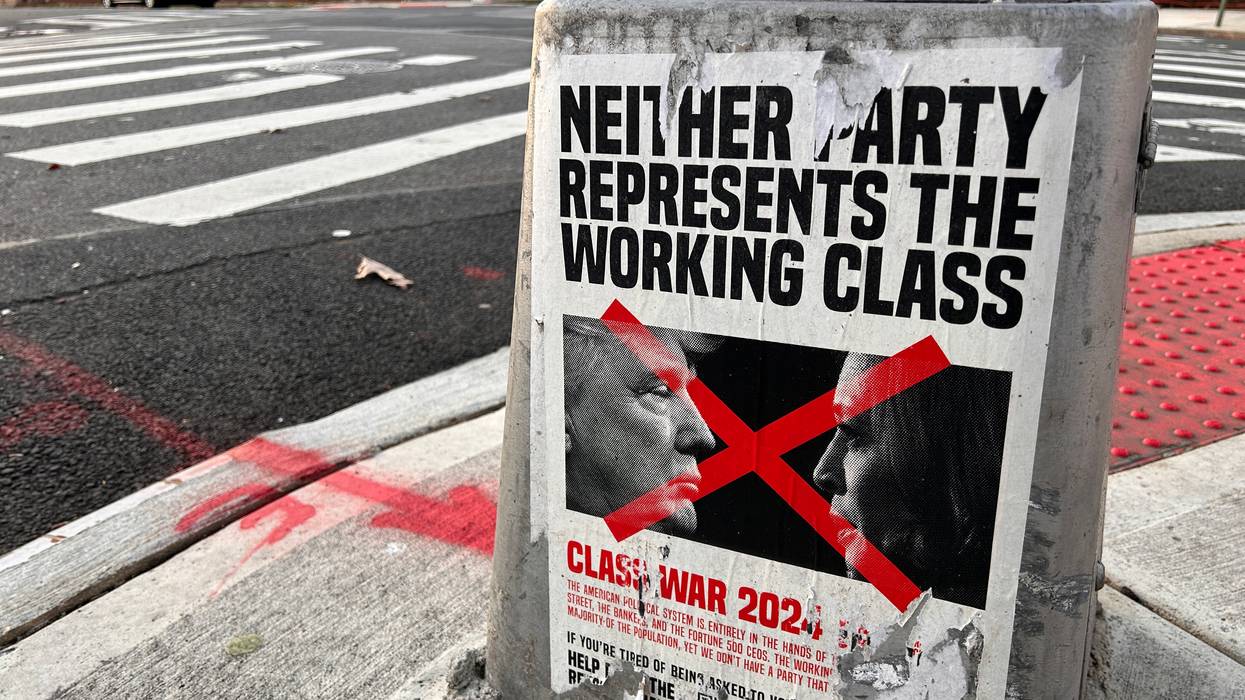
The midterms showed voters want concentrated wealth and power challenged; a durable progressive realignment will require changing who gets recruited, financed, and treated as politically viable—not just changing the message.
Democrats’ sweeping midterm victory has rightly been described as an economic-populist wave. Across the country, candidates won by challenging billionaire influence, rising costs, corporate power, and an economy that too often leaves working people behind.
But there is another question progressives should ask now: If working-class power is the answer, who actually gets the chance to exercise political power?
I spent nearly two decades working behind the scenes on labor, consumer protection, technology, and artificial intelligence policy before entering electoral politics for the first time this year. I ran for Congress as an independent in New York’s 12th District. Together with another fellow independent, Karen Ortiz, we went through this experience from having to get on the ballot by collecting over 3,500 signatures to the general election.
People do not need someone else to become their voice. They need institutions that give them the tools, relationships, resources, and room to exercise their own power.
In the end, I came out of that campaign with more respect for voters and less confidence in the structures we use to understand and represent them.
Running outside the party machinery gave me an unusually direct look at what happens before voters ever cast a ballot.
Political institutions help determine who is encouraged to run, who knows donors, who can afford to stop working, who receives institutional support, who gets invited into important rooms, and who gets treated as a viable candidate.
By the time we tell voters that democracy has given them a choice, institutions have often made hundreds of choices about who will reach them.
New research from political scientists Nicholas Carnes and Noam Lupu makes the consequences stark. Working-class jobs make up roughly 70% of occupations in the average democracy they studied, yet only about 2% of national legislators previously held working-class jobs. Their research also finds that the disparity is not explained by workers being less interested in running, less qualified, or less attractive to voters.
Much of the filtering happens earlier.
Running for office requires time, income, professional flexibility, privacy, and a willingness to assume enormous personal risk. Those burdens are much easier to absorb if you have wealth, flexible employment, or professional networks.
Party gatekeepers, meanwhile, operate under intense pressure to win. They understandably gravitate toward people they know and candidates who already appear financially and professionally equipped to survive a campaign.
The result can become a self-reinforcing political class.
My campaign gave me a smaller window into the same machinery.
We ran independently and rejected corporate PAC, super PAC, and dark-money support. We spent enormous amounts of time talking with Democrats, Republicans, independents, and unaffiliated voters rather than concentrating only on people a political model told us we could win.
That is inefficient by the standards of modern campaigning.
Modern campaigns are built to sort base voter, swing voter, donor, low-propensity voter, progressive, moderate, independent.
Those categories have practical uses. But people routinely violated them.
A worker could want stronger labor protections and still distrust the government. A small-business owner could want tougher corporate regulation. A Republican could worry about workplace surveillance and artificial intelligence. A Democrat could be furious about billionaire influence in their own party.
The political categories were often cleaner than the people.
The electorate itself is also becoming less attached to those categories. Gallup found that a record 45% of American adults identified as independents in 2025, compared with 27% each identifying as Democrats and Republicans. In New York City, unaffiliated voters now make up more than one-fifth of registered voters, and nearly half are under 40.
That does not mean these voters are centrists. It certainly does not mean they are automatically progressive.
It suggests something more fundamental: Millions of Americans do not see the existing parties as complete expressions of who they are politically.
Progressives should see both an opportunity and a warning.
If the lesson of 2026 becomes simply that Democrats need better working-class messaging, we will have missed the deeper challenge.
Professional politicians becoming better at talking about working-class life is not the same as working people possessing political power themselves.
History shows that representation changes when institutions change.
When unions possessed greater political strength in countries like Britain and Germany, they did more than endorse politicians. They recruited workers, financed candidates, supplied organizers, and created pathways into government for people who otherwise faced enormous obstacles to running.
There are examples here at home.
I saw the same principle from another direction during my years at Coworker.org. Coworker was built on a simple idea: Workers who may not have a union or traditional organizing infrastructure still need ways to build power themselves. Over its first decade, more than 500,000 workers connected, organized, and advocated through the network, generating more than 3 million actions and 2 million petition signatures. Some campaigns began with a single worker asking for a workplace change and grew into durable networks, including early Starbucks worker organizing that helped lay groundwork for a much larger movement.
What I learned there was that people do not need someone else to become their voice. They need institutions that give them the tools, relationships, resources, and room to exercise their own power.
Imagine taking that idea seriously at scale.
Public financing could reduce candidates’ dependence on wealthy networks. Income replacement or political scholarships could allow workers to run without risking financial ruin. Right-to-return protections could make candidacy less dangerous for people who cannot simply leave their careers. Unions and community organizations could create candidate pipelines rooted in workplaces and neighborhoods rather than professional political circles.
And none of this substitutes for building power outside government.
Workers will have more influence inside legislatures when they have more leverage in workplaces, unions, neighborhoods, and durable civic organizations. Elections cannot be the only moment when ordinary people exercise power.
Democrats won an extraordinary election.
But victory creates its own blind spot.
The party that loses must ask what went wrong. The party that wins can convince itself that nothing is wrong.
Economic populism helped produce this moment. The next step cannot simply be adopting its language.
If progressives believe politics should serve working people, then working people need a much greater role in making politics.
The challenge after 2026 is not only to win more working-class votes.
It is to change who gets to lead.

Members of Congress can create change by following a simple template provided by the People-First Foreign Policy Pledge: End the Iran War and all endless wars, cut the Pentagon budget and abolish ICE, and end support for governments like Israel's that violate humans rights.
“The idea that US voters don’t care about foreign policy is over.” This is what we wrote in Common Dreams in early October, almost a month before the midterms buried the notion that voters don’t care about foreign policy.
Now, the new Democratic majority has the public mandate and the tools to begin acting on voters’ demands by ending the Iran War, shrinking the Pentagon budget, and stopping the arming of governments abusing human rights.
Democrats flipped over 40 House seats and nine in the Senate, providing sizable majorities in both chambers. Analysts across the political spectrum widely agree on what drove the wave: President Donald Trump’s unauthorized war on Iran and its role in pushing up the price of gas, groceries, and other basics.
Even Vice President JD Vance conceded the point. “The real reason we lost is obvious to almost everyone,” Vance wrote in a November 4 social media post that made headlines worldwide. “The reason we lost is the war.”
Other aspects of foreign policy also mattered: Voters backed candidates who opposed US support for Israel, Trump’s tariffs, and Trump’s Immigration and Customs Enforcement (ICE) violent mass deportation campaign.
The new Democratic majorities, which include 109 incoming lawmakers—the largest class of newcomers since 1933—must seize this moment. With help from Republicans who have read the results, they should use Congress’ power to deliver the change voters want in how the country engages with the world.
Members of Congress can create this change by following a simple template provided by the People-First Foreign Policy Pledge, a tool we helped launch before the election with the endorsement of dozens of foreign policy experts and national organizations.
The Pledge urges support for three commonsense foreign policy positions that the elections showed are broadly popular across the country and across significant parts of the political spectrum. The three positions are
To deliver the change that voters are demanding and we desperately need, Congress should follow the Pledge to embrace a foreign policy that prioritizes the safety, security, and well-being of the people of our country and the world over those profiting off war.
Conventional wisdom once said that voters don’t care about foreign policy because it’s too far removed from their lives. This was likely never true, and it certainly isn’t now.
NBC News exit polls show that 74% of voters surveyed said the Iran War was a “crucial” or “major” factor in their vote. Anti-war messages were central to winning Senate campaigns in swing states as diverse as Texas, Georgia, and Ohio, as well as in dozens of house races. This is unsurprising for a war that quickly has become the most unpopular in US history, according to Stephen Semler of the Center for International Policy.
The public clearly understands how waging an illegal, offensive war of choice has made their lives less affordable by driving up gas, grocery, and other prices. They likewise know the war is wasting tens of billions of taxpayer dollars that could meet people’s urgent needs at home, while killing and injuring tens of thousands, starting on its first day, when a strike on a school in Minab, Iran killed 168 children and other civilians.
The revolt against the president and the party came in part because Trump reneged on his 2024 election campaign promises to “stop wars” and “not… start wars.”
Delivering a people-first foreign policy begins with ending the Iran War, which has harmed so many while benefiting only weapons makers such as Lockheed Martin, Israeli Prime Minister Benjamin Netanyahu and other Israeli leaders, and Washington, DC foreign policy elites who long pushed for the war.
Since the election, Democrats appear encouragingly united in prioritizing an end to the war by immediately cutting off its funding and reasserting Congress’ war powers. The Congressional Progressive Caucus, expected to grow to about 126 members, will be positioned to lead that push. Republicans who, like the vice president, understand the harm the conflict has caused their party would be smart to join Democrats in pressuring Trump to end the war.
The revolt against the president and the party came in part because Trump reneged on his 2024 election campaign promises to “stop wars” and “not… start wars.”
Beyond Iran, Democrats should follow the People-First Foreign Policy Pledge’s first commitment to end all endless wars, including those in Yemen and Somalia, as well as the extrajudicial assassinations of alleged drug traffickers off the coasts of South America.
The key to ending endless US wars—and preventing any future ones—lies in the Pledge’s second commitment. Just as defunding the Iran War is the best way to end it, cutting the budget for what Trump calls the Department of War is the best way to make this war the last one the country wages.
Earlier this year, Trump requested the largest military budget in US and world history for the 2027 fiscal year: $1.57 trillion, counting money to continue his war in Iran, which would be around a 50% increase over this year’s already out-of-control war budget.
Democrats must listen to the overwhelming opposition to Trump’s request: 65% of the country—and 87% of Democrats—are opposed, according to a Washington Post-ABC-Ipsos poll.
Giving Trump even a fraction of his proposed increase (even with prohibitions on using the money to fight Iran) would reward his attacks on Iran, Venezuela, and military threats against 10 other countries. Unless Democrats want to enable a new war with Cuba, for example, they should cut the current Pentagon budget to $750 billion, which would still exceed the combined military spending of China, Russia, and North Korea, while ensuring the cuts don’t harm military personnel or their families.
The cuts should come instead from the many boondoggle weapons programs, such as the “Trump-class” battleship, that go to the main beneficiaries of the bloated Pentagon budget: weapons makers, AI and other tech companies, and other military contractors, which already receive around 54% of annual military spending.
As many voters intrinsically understand, cutting the Pentagon budget will be key to advancing the domestic affordability agenda that so many have demanded and that also proved decisive in Democrats’ midterm victories. Funding Medicare for All, affordable housing, childcare, and other popular priorities will require clawing back money from the War Department that has come to devour more than half of annual discretionary spending controlled by Congress.
This would clearly be a popular move: A new Economist/YouGov poll shows, for example, that 70% of voters support increasing government spending on healthcare compared with only 36% who support increasing military spending.
A $750 billion budget would also be an important way to take on corruption in Washington, DC, another of voters’ top concerns. Military spending has long been an overlooked fountain of corruption and waste beginning with the campaign donations that contractors dole out to congressmembers to secure new contracts. Trump’s Pentagon appears to have been particularly successful in directing billions in contracts to cronies such as Elon Musk’s SpaceX and contractors backed by Trump family investments.
ICE may look like a domestic agency, but Trump’s deportation campaign has become a defining feature of US relations with its neighbors, and it has generated widespread outrage at home. In January, during an ICE raid in Minneapolis, federal agents shot and killed two US citizens, Renee Good, a 37-year-old mother of three, and Alex Pretti, a 37-year-old ICU nurse. ICE has locked up, brutalized, and deported tens of thousands of people whose only offense was a civil immigration violation.
Trump has acknowledged that his immigration policies were likely “too tough” and played a role in Democrats’ victories. Around 60% of voters surveyed in exit polls disapproved of how ICE “is handling its job” and felt that the Trump administration’s immigration enforcement actions have “gone too far.”
While “abolition” may sound too radical to some, nearly three-quarters of Democrats, almost half of independents, and even one-quarter of Republicans support abolishing ICE, according to a July Economist/YouGov poll. The Democratic National Committee passed a resolution in August calling for the agency’s abolition, and Democrats should follow through on this promise to voters.
Congress must also embrace the People-First Foreign Policy Pledge’s third commitment to cut off US support for Israel and other human rights violators.
More than half of voters in exit polls said they think US support for Israel is “too strong,” with only 12% saying it’s “not strong enough,” amid a dramatic decline in support for Israel among Democrats and others across the political spectrum.
It’s no wonder that candidates such as Michigan Senator-elect Abdul El-Sayed, who overcame $42 million in pro-Israel AIPAC spending against him, and House members-elect Adam Hamawy (NJ) and Darializa Avila Chevalier (NY) won after making calls to end support for Israel a key message in their campaigns.
Ending endless US wars, cutting the Pentagon budget, abolishing ICE, and stopping US support for Israel and other human rights violators are just the beginning of the transformation in US foreign policy we need.
This has become such a mainstream position that President Trump announced on election day that the US government would stop sending $3.8 billion in annual support to Israel to buy US and other weapons. In his November 4 social media post, Vice President Vance likewise identified changing the US relationship to Israel as one of four priorities for Republicans seeking to win back voters.
Fulfilling the People-First Foreign Policy Pledge’s third commitment begins with Congress simply enforcing the existing Leahy Laws, which bar US assistance to foreign military forces committing human rights violations, a standard that should apply to countries such as the United Arab Emirates and Saudi Arabia.
In Israel’s case, Congress must ensure Trump follows through on his promise to end $3.8 billion in annual funding and prevent the annual National Defense Authorization Act from including a dangerous provision to deepen military collaboration with and backdoor funding for the country.
We call on people regardless of political affiliation to join us in using the People-First Foreign Policy Pledge as a tool to demand Congress listen to voters and fulfill the Pledge’s three commitments. Each will improve the safety and security of our country and the world by building a foreign policy that puts people first rather than those who profit from war.
Ending endless US wars, cutting the Pentagon budget, abolishing ICE, and stopping US support for Israel and other human rights violators are just the beginning of the transformation in US foreign policy we need. And with 12 state legislative chambers and five governorships flipping to Democrats, including six new Democratic trifectas in Arizona, Michigan, Minnesota, Pennsylvania, Nevada, and Wisconsin, states can push, too, from divesting from weapons makers and countries violating human rights to resisting ICE cooperation.
We are excited to work with others to create a newly democratized foreign policy based on rejecting war and instead embracing diplomacy and the international cooperation we need to overcome the urgent challenges of affordability and inequality, data centers and AI, nuclear weapons, and catastrophic climate change.
Together, we can implement policies—domestic and foreign—that put people first just as tens of millions demanded on election day.

As we honor Native Heritage Month and wrap up COP31, I am called upon by my ancestors to remember the inseparable tie between body and earth, and the destruction caused by governments and extractive industries upon both.
As I write, the kwi’neì kulám [oak tree relatives] shimmer their brilliant vibrancies across the white spotted sky. With firm certainty, their strong bases plunge past where my eyes can see. We are not, altogether, different,
kwi’neì kulám and I.
Our bodies carry the story of our relationship with the land, to the waters, and with one another. Our bodies carry the story of our ancestors. This relationship tells us that our bodies and our land are not two separate things.
I join my relatives in the pursuit of healthy land, safety for Native women and girls, and self-determination for all Indigenous peoples.
Mohawk grandmother and traditional midwife Katsi Cook’s teachings describe “the undeniable connection between the health of our bodies and the health of our planet.” She has said, “Violence that happens on the land is intimately connected to the violence that happens to our bodies.”
As we honor Native Heritage Month and wrap up this year’s United Nations Climate Change Conference (COP31), I am called upon by my ancestors to remember the inseparable tie between body and earth, and the destruction caused by governments and extractive industries upon both.
The United States' failed genocidal colonial project has always been about conquering our land by erasing our bodies. Environmental destructive industries are disproportionately located close to Native reservations. The United Nations has condemned areas where low-income and marginalized groups bear the disproportionate burden of exposure to pollution and toxic substances as “sacrifice zones.” In the US, this practice is commonplace—the health and safety of marginalized people is viewed as expendable.
Many Native scholars take this argument a step further, demonstrating the strategic and systematic ways that the US government oppresses Indigenous people through Land Violence, which is defined as “a tactic that seeks to eliminate Indigenous peoples in order to gain access to land and waters.” Deliberate exposure to pesticides, uranium mining, toxic pollution, chemicals produced by extractive industries—such as coal, mineral, oil, and tar sands—are settler tactics that have been continuously used against Native people.
Amnesty International’s recent report "We’re Here to Protect Mother Earth: Indigenous Rights and Nevada’s Lithium Boom," found that an estimated 79% of all known US lithium reserves lie within 35 miles of Tribal reservations. The report found that lithium mining significantly restricted Tribal Nation’s access to traditional foods, medicines, gathering places, and sacred sites. In tandem, they created significant health concerns for Native people due to chemical hazards. The effects of land violence perpetrated by extraction industries, such as lithium or uranium mines, are often invisible until years later. These health concerns include harms to the reproductive system, as illustrated in the report "Violence on the Land, Violence on our Bodies," which connects proximity to extraction sites to high levels of toxins in breast milk, infertility, miscarriages, premature births, premature menopause, reproductive system cancers, and an inability to produce healthy children—a cruel and intentional attack on our next generation.
When our land suffers, we suffer. My hand grazes kwi’neì kulám [oak tree relatives], feeling their textured surface. With firm warmth, we stand heart to heart until we weep.
The violence against Native people is not an epidemic, it is a deliberate and political attempt to control our land, bounded by colonial oppression. Violence against Native women, in particular, is an urgent matter and a human rights crisis: More than 4 in 5 Native American women experience violence in their lifetime, and 56.1% of Native American women have experienced sexual violence in their lifetime. Homicide is the third leading cause of death among Indigenous women ages 10-24. In some reservations, Indigenous people are murdered at more than 10 times the national average.
Areas with extractive industries are intertwined with heightened levels of violence against Native women and girls, including serious concerns around sexual violence. Companies build temporary housing for large numbers of non-Indigenous and predominantly male workers near extractive industry sites. These “man camps” have been linked to a rise in violent crimes, including sexual violence, against Native women and girls living near extractive project sites. Despite ample evidence of increased sexual violence, there is little done by governments or industries to prevent such violence.
We cannot live healthy and safe lives when our bodies and lands undergo violence. We have a responsibility to protect our kwi’neì [relatives] and demand accountability from the US government in its colonial efforts to erase our bodies, while attempting to conquer our land.
The United Nations Declaration on the Rights of Indigenous Peoples (UNDRIP) affirms the right for Indigenous peoples to self-determination, including to give or withhold consent to projects affecting their land and resources. It is time for the United States to codify these principles into domestic law so that we as Native people can protect ourselves in the way we know best; through love and accountability to all of our relatives—the waters, plants, animals, and each other.
The United States cannot fulfill its human rights obligations to Indigenous people without confronting its own history of settler violence. Violence against Native women is not traditional—it is the direct result of colonization. The US perpetuates systemic violence against Native women and girls through settler colonial tactics. It is time the US government provide Tribal authorities with the resources and funding needed for Tribes to protect and seek justice for their citizens—including rape kits and training for administrators, flexible funding for Tribal shelters, increased cooperation with Tribal law enforcement, and enhanced jurisdiction for Tribal Courts.
This Native Heritage Month, and as global climate leaders return from COP31, I join my relatives in the pursuit of healthy land, safety for Native women and girls, and self-determination for all Indigenous peoples. Great Michi Saagiig Nishnaabeg scholar Leane Simpson asks of us:
Rebel against the permanence of settler colonial reality and not just "dream alternative realities" but to create them, on the ground in the physical world, in spite of being occupied. If we accept colonial permanence, then our rebellion can only take place within settler colonial thought and reality.
I make a promise to you, kwi’neì kulám [oak tree relatives,] that as I dream and rebel, your voice will join me.

We need to be wary of the manufactured China threat that the national security establishment is using it to promote political and economic agendas that are not in the interests of the people—American, Chinese, or other.
In recent days, the world has been forced to become a bystander in another all-too-common story about another rich CEO cheating on his wife. This time, it’s Jensen Huang, co-founder of Nvidia, whose net worth exceeds $147 billion.
It should come as no surprise that another billionaire—who are, as a whole, already entitled by default—has transgressed the contractual arrangements of a marriage (and not just once or even twice).
But Jensen Huang’s sex life is not the story here. Nor should it be.
When we hear of yet another “Chinese spy” plot, we need to take a beat and understand that these stories are part of an ongoing project to manufacture fear of China, while building mistrust in Chinese technology.
The reason why this story has suffocated the current news cycle is because Alice Huang, the first known affair partner, has been reportedly accused by US officials of being a “Chinese spy”—which is actually not the story, either.
The story is much more complex, and it has to do with the ongoing race to AI dominance and control, the struggle of the US to maintain global hegemony over China, the absurd and often contradictory over-securitization of the tech industry, and some probable malign intentions as far as the US security establishment and corporate interests are concerned.
Before we get into it, we need to get one thing clear: US officials have a history of claiming any and every Chinese person—and thing—is a spy. Remember that interview of TikTok CEO Chew Shou Zi (who, by the way, is Singaporean, not Chinese), when Tom Cotton, a hardcore anti-China war hawk, kept asking if he’s a member of the Communist Party of China? “No, I’m Singaporean,” Shou Zi repeated repeatedly. At the time, they were considering banning TikTok, claiming that China was using it to spy on American children (they were, in truth, worried about the pro-Palestine content and growing anger toward the Israeli genocide). In other words, it was a censorship scheme to control the nation’s youth, which have become much more critical of Israel in recent years—China was just the bait.
But anyway, everything from China seems to be a spy plot: social media apps, weather balloons, cranes, students… coffee makers. That’s right, they’ve even gone so far as to accuse Chinese-made coffee makers of spying on the American people. You know, so China can use coffee-drinking data to hatch a grand plot to take over the US hot beverage industry and wipe out Big Coffee.
I’ll never forget the Select Committee on the CCP hearing when Congressman Tim Burchett (R-Tenn.) exclaimed with concerning amounts of sincerity, “[China] knows how many paperclips you all are using in the Longworth building!” Oh no, not the paperclips. Scary.
It’s as ridiculous as it sounds. Which is why, when we hear of yet another “Chinese spy” plot, we need to take a beat and understand that these stories are part of an ongoing project to manufacture fear of China, while building mistrust in Chinese technology—you know, so China’s industry won’t surpass the US, at least when it comes to critical technology.
So instead of buying into yet another spy narrative with no real evidence, let’s pause and examine the story. The real story.
In October 2025, The New York Times released its first report on Nvidia’s business relationship with Singapore-based company Megaspeed International. It was focused solely on chip purchases—nothing yet about affairs or spies.
The article detailed an investigation into suspected circumvention of recent US export restrictions on advanced Nvidia AI chips. In April 2025, the US banned exports without a special license (which would cost Nvidia up to $5.5 billion). Jensen Huang and associates lobbied hard against these new restrictions. In July, Nvidia struck a deal—they could continue to sell H20 products as long as the US government received 15% of revenues from China. However, concerns remained that other advanced chips (H100, H200, etc.) were being physically diverted into China via Megaspeed’s Southeast Asian data centers. Nvidia and Megaspeed both denied wrongdoing, and US officials acknowledged they had no conclusive evidence that chips had been illegally diverted.
It wasn’t until May 2026 that a firm called “Culper Research” released a 40-page report, titled "Nvidia: The China Problem," alleging a closer relationship between Nvidia and Chinese commercial companies. The report also detailed the relationship between Jensen Huang and Alice Huang, calling it “uncomfortably close.” Interestingly, the report came out on May 13, the same day President Donald Trump added Jensen Huang to his list of billionaires joining the delegation to Beijing, which occurred over the next few days. Coincidence?
The biggest contradiction is completely missing from the mainstream news cycle, and it’s this: China doesn’t want to rely on US tech.
Side note: “Culper Research” is a short-betting firm that releases ~negative~ reports on companies while betting against them. Their main profit structure is making money when the stocks fall. It’s run by a guy named Christian Lamarco, and was named after the “Culper Spy Ring,” which reported the movement of British forces to General George Washington during the American Revolution. Ha.
This isn’t Culper Research’s first foray into tackling complicated and “suspicious” links between US and Chinese companies. They seem, in fact, like they’ve become a sort of anti-China watchdog, calling out American companies who make the mistake of working too closely with Chinese ones. In short, they make a profit off of playing into the national security establishment’s racialized China crackdown.
The “spy story” didn’t make it to the news cycles until early November 2026, when the affair allegations started to be reported in public US media—also leading up to another planned Trump-Xi summit in later November. As soon as it became hot news, it was quickly spun from a story about tech exports to a great affair scandal, and then, almost out of nowhere, a spy plot.
Where do the spy allegations even come from? According to reports, this storyline was derived from anonymous “US intelligence officials.” No evidence has been released. The US Department of Justice has even stated that it has not yet determined if Alice Huang is a spy. According to The Washington Post, an anonymous intelligence official explained that Marco Rubio took a CIA report on the matter and “wrote his own” in “more assertive terms.” When the memo leaked, the media took the story and ran with it.
So no evidence—just another manufactured spy plot written and leaked by a China hawk and escalated by mainstream media with a clear agenda: “Jensen Huang must go,” writes The Economist.
Let’s talk about why certain interests want Jensen Huang gone. But first, the contradictory evidence.
The biggest contradiction is completely missing from the mainstream news cycle, and it’s this: China doesn’t want to rely on US tech. It’s actually one of their top policy priorities. Chinese officials have been actively trying to prevent reliance on US tech in order to develop their own tech sovereignty and help their own domestic chip industry grow. Over the past year, China has repeatedly canceled Nvidia chip purchases and ordered top companies, including ByteDance and Alibaba, to stop buying them. They’ve even sent party officials to major ports to enhance customs inspection and ensure nothing was coming through the border without authorization. In November 2026, over 600,000 Nvidia chips were blocked and left sitting in Hong Kong.
So really, the notion that China is using honeypot spies to find ways to get more chips into the country makes no sense at all—it’s a complete contradiction to state policy, and would be in direct opposition to its security and industry goals.
If Megaspeed was, in fact, renting out computing power to Chinese companies, it was more of a private sector workaround to official state policy, not a secret operation coordinated by the Chinese government. Therefore, if Alice Huang was loyal to anyone, it was her company’s profit margins.
On November 12, Jensen Huang was forced to resign from his position as CEO. Interesting that a mere affair could be used to take out a billionaire executive, when others have gotten away with far worse crimes—rape, human trafficking, pedophilia, regular trips to Epstein Island, to name a few. Why were they protected, while Huang was proactively ousted?
The real story is becoming clear. US government officials—including Marco Rubio—in coordination with the mainstream media, have essentially taken out top CEO Jensen Huang. Why would they want that? Why would they intentionally hurt one of the highest-profiting US companies, the first company to ever surpass a $5 trillion valuation, the backbone of the American economy, the most critical company to the ongoing tech race, which has vast political and economic implications?
Who even benefits from that? Let’s list them!
1. China War Hawks
First, you have to understand one crucial point: The current endgame of US policy, that all anti-China hawks are barreling toward at breakneck speed, is a complete decoupling from China’s economy. Why? So the US can wage a prolonged war on China. That’s not possible if the US relies on China for any material, especially the critical minerals and technology that are imperative for weapons making and war waging.
Jensen Huang was a problem because he lobbied against decoupling. He favored a more economically harmonious relationship with China (because it profited him and Nvidia). His efforts largely worked, and he seemed to have had the direct ear of President Trump, who even supported him during the scandal. Under former President Joe Biden, chip restrictions grew significantly. But Trump, ever the businessman, has often sided with profit over the security establishment’s official position. Jensen Huang also seems to have had, according to mainstream media, a long history of being listened to within his own company—The New York Times writes, “Nvidia board has a history of letting Jensen Huang get his way.” Solution? Dump him. Put someone new in there who will do as they’re told.
We also can’t forget the obvious racialized undertones: Jensen Huang is Asian. The US security establishment doesn’t want an Asian person running the top US semiconductor industry, especially not during the current climate of new McCarthyism.
So overall, removing Jensen Huang will provide more flexibility to push for decoupling. And the whole manufactured spy plot works to the advantage of China hawks and national security officials pushing for greater chip restrictions. Already, lawmakers are using the scandal to garner support for three chip-export restriction measures to be added to the 2027 National Defense Authorization Act—the AI Overwatch Act, the Chip Security Act, and the MATCH Act—all of which give Congress greater ability to restrict chip exports.
This happened, all perfectly coordinated with Trump’s next meeting with Xi in the coming week. We can be sure that the outcomes of those talks, along with the successive policy, will continue to shine a light on what US policymakers really hoped to achieve from the Jensen Huang coup.
2. AI Monopolies and Other Big Tech Companies
Profit is played like a zero-sum game. Where Nvidia loses out, others pick up the losses, like scavengers stealing the scraps of a predator’s kill.
So who wins from Nvidia’s loss? Let’s start with one of the biggest advocates for greater chip restrictions—AI monopolist, Anthropic.
Anthropic has donated $40 million to Public First Action (PFA), an AI policy organization that supports stricter AI regulations and tighter chip control. In July 2026, PFA announced the launch of a $15 million Conservative AI Consensus Project to support members of Congress who back stronger AI regulations and chip controls—including John Moolenaar and Brian Mast, who called for an investigation into Jensen Huang. Their lobby, AnthroPAC, has also given thousands of dollars to some of the biggest China hawks in Congress, who have called for an investigation into and the resignation of Jensen Huang. Anthropic CEO Dario Amodei doesn’t have the relationship with Trump that Huang enjoyed—hence the need to ply Congress in their favor. Additionally, think tanks like the Center for a New American Security (whose CEO, Richard Fontaine, is on Anthropic’s board) have petitioned for Jensen Huang’s removal.
The battle of AI is a battle over who gets to control knowledge, technology, and the future of humanity—will it be monopolistic corporations or the people of the world?
But it’s not just about chip controls. Anthropic, OpenAI, and other Big Tech companies have lobbied to ban open-source AI models, which Jensen Huang has repeatedly defended. “I stuck my head out and defended open models, and, if you will, saved the world,” Huang said, speaking on his opinion that open models are both safer and the foundation to entire industries being created. He also mentioned his preference not to “stick his head out” (guess he had a feeling it could be his undoing).
There is an ongoing battle between open-source and closed-source AI models, or as Chen Deli, senior researcher at DeepSeek, writes, “Open source versus closed source, light versus darkness. A decisive battle between two futures, two destinies for humanity.” In other words, the battle of AI is a battle over who gets to control knowledge, technology, and the future of humanity—will it be monopolistic corporations or the people of the world? AI will either, in the hands of the elite, be a tool of domination, or, in the hands of the people, be used as a shared resource for human progress and development.
The Great AI Battle is playing out as we speak. And Jensen Huang was the rare US executive supporting open-source models.
China has been the biggest advocate for the creation and use of open-source AI models. Meanwhile, US organizations like Anthropic and other Big Tech companies have been lobbying to ban them (China’s open-source models are cutting into their profits). Which is why Jensen Huang’s removal, and influence over the open- vs. closed-source battle, works to their benefit.
And all of this is going down after midterm elections, prior to the next Trump-Xi meeting, and leading up to Anthropic’s IPO date (when a private company’s shares officially begin trading on the public stock exchange), which is slated for—you’ll never guess—this week! November 18. Coincidence? No! There are no coincidences!
4. Israel?
What do you mean the three new Nvidia CEO contenders are ALL Israeli?
What will Israel gain from having Nvidia in its back pocket—other than direct access to the world’s leading supplier of advanced AI chips and computing technology, which provides the computing power necessary for all advanced technology, modern data centers, intelligence systems, autonomous weapons, mass surveillance, and more—during its ongoing war on Iran?
What does Israel stand to gain, indeed.
To close, we need to be wary of the manufactured China threat. The national security establishment is using it to promote political and economic agendas that are not in the interests of the people—American, Chinese, or other.
This is happening in parallel with an expansive US military buildup in the Pacific, a burgeoning $1.5 trillion war budget, and an administration of anti-China war hawks who are dead set on preparing the US for war on China. Decoupling economies is just one part of that. The Great AI Battle is just one part of that. We can also point to unprecedented military preparation and extensive threat manufacturing, which has poisoned many layers of American society already.
Some advice before you go: When you hear about another China spy plot, take a step back. Think about who benefits. The truth is always in the details.

The Democrats’ forthcoming majorities mean nothing unless they can do what voters sent them to DC to do: Remove Donald Trump from power.
A weapon of mass destruction has been detonated against the United States of America, and its name is Donald Trump. If I wanted to wreck America from the inside out, I would do exactly what Trump is doing.
I teach 12th-grade English at an urban school in upstate New York. I’ve been doing this job for 20 years. The poverty rate here has always been high, but nothing like it is now. My students, and their families, are hanging by a thread. Truth be told, the whole country’s hanging by a thread. That’s America under Trump. Every day is worse than the day before. And nobody knows what happens next.
Trump’s first term ended with a global pandemic and the deadly January 6 insurrection. Despite Trump being the first US president to thwart the peaceful transfer of power, then the first ex-president to be convicted of a felony, 77 million Americans thought it was a good idea to reelect him in 2024. We survived Trump’s first term by the skin of our teeth. I don’t think we’re going to get that lucky again.
If we don’t find a way to remove Donald Trump from power before something irrevocably horrible happens, I fear history will judge us harshly.
The Democrats’ forthcoming majorities mean nothing unless they can do what voters sent them to DC to do: Remove Donald Trump from power. Oversight won’t work. And Trump, aka Mr. Veto, will not reach across the aisle. The people know this. And the people want their representatives to pull the plug on MAGA.
How do I know the citizenry has seen enough of Trump? Numbers don’t lie. There’s a Democratic senator-elect in Kansas and Mississippi. Democrats flipped 47 House seats (and counting) and nine senate seats. Texas is blue. So is Alaska. Democrats now serve 75% of the population. It’s the largest midterm landslide since Watergate, the last time an American president was forced out of office.
I recognize the unprecedented nature of removing a president through impeachment. But the Founding Fathers put this mechanism in place to deal with a problem. Trump’s not just a problem. He’s the problem. In the throes of the biggest national security debacle in a generation (Nvidia), Trump has taken off to China to break bread with two brutal dictators. I once thought Trump was having his Neville Chamberlain moment with AI. Now it looks more like a Benedict Arnold moment.
Trump is 100% the reason Republicans were trounced in the midterms. In six years as president, Trump has fixed nothing. Solved nothing. If there’s even a glimmer of hope that Democrats and Republicans could find an accord in the coming months, Trump will blow it up by any means necessary.
Following the midterms, Trump’s first substantial move was to promote Stephen Miller, the man who labeled Democrats a domestic extremist organization, “devoted exclusively to the defense of hardened criminals, gang bangers, and illegal alien killers and terrorists” to White House chief of staff. That’s Trump’s idea of an olive branch.
Let’s say, for the sake of argument, Trump has committed no impeachable offenses (by all accounts, he’s committed dozens of them), can we at least agree the basic components of our government are crumbling. Measles is back. We’re stuck in another Middle East war. Last Friday we had to put 12,000 passenger jets on the ground for four-plus hours. There’s nothing to gain by keeping Trump in power. Life will only get harder, darker, and more divisive until he’s exorcised.
I’m a tenured teacher, which means my school has entrusted me to do this job on a long-term basis. But if I was unable to execute a lesson plan or sold grades for profit, there’s a process in place to remove me.
Impeachment, in my view, is likely the only way the Trump era ends sans bloodshed. Trump’s not going to leave quietly. And he clearly has no plans to foster a successor. In the past several days, Vice President JD Vance went from the GOP’s presumptive nominee for president in 28 to probably not going to run. If he tried to run, Trump would sabotage him, because Trump is a weapon of mass destruction.
Democrats must make their Republican friends see that removing Trump is the best move for everyone. And the time is now.
Trump is not just dangerous, incompetent, and corrupt; he’s an embarrassment. How long do we have to listen to him degrade journalists, babble about ballrooms, tell one obvious lie after the other, use the Department of Justice to persecute his enemies, or appoint unqualified people to positions of influence? As a teacher, I can’t believe Linda McMahon is secretary of education. It’s not only embarrassing. It’s a slap in the face.
The United States is the greatest nation on Earth. But right now we have a weapon of mass destruction in the Peoples’ House. Donald Trump is doing to America what he’s done to every business or entity he’s ever touched. If something drastic isn’t done to stop this, there may not be an America—or a world—left to save.
On Monday morning, when asked if he bore responsibility for Friday’s Federal Aviation Administration outage, Trump said, “I don’t take any responsibility,” then proceeded to blame Joe Biden.
If we don’t find a way to remove Donald Trump from power before something irrevocably horrible happens, I fear history will judge us harshly.
On November 8, 2016, I remember watching aerial coverage of Hillary Clinton leave Westchester County then merge onto the parkway for Manhattan. The anchor said, “If all goes to plan, this motorcade will return tomorrow afternoon, carrying America’s first female president-elect.” In the back shot, the sun was beginning to set. But now, 11 years later, I know that wasn’t the setting sun. It was a weapon of mass destruction being detonated against the United States of America. It was Donald Trump.

To deliver for voters, Democratic lawmakers will need to change their leadership, challenge neoliberal orthodoxy to fight inflation, and hold Trump accountable for his crimes.
People who are not American citizens like me don’t have a vote in the US elections, yet what happens at the center of the empire has an impact, positive or negative, on us. So for us, analyzing what happened on November 3 and what its implications and consequences are is an urgent, necessary exercise.
This analysis is divided into three parts: what the far-right did wrong, what progressives did right, and what are the challenges confronting US progressives in the run-up to the 2028 presidential elections.
Where did the far-right go wrong? Here I found two books that I’ve just read particularly illuminating: David Ost’s Red Pill Politics and Naomi Klein and Astra Taylor’s End Times Fascism. One of the key points both books put forward is that the far-right can’t rule via terror alone. It needs to have a positive program that brings economic and other benefits to their base and the groups they want to attract.
Snowy Minneapolis was the turning point of the struggle against 21st century American fascism, much like freezing Stalingrad was the graveyard of the German Sixth Army during the Second World War.
Even as they terrorized socialists, Jews, and Roma people, fascists in the early 20th century in Germany and Italy offered social security measures, employment benefits, housing programs, massive construction projects, and leisure opportunities to their mass base of workers and middle-class people.
President Donald Trump over the last two years, in contrast, has ruled purely negatively, terrorizing migrants and people of color, raising tariffs to punitive levels, engaging in a senseless war. He didn’t offer any economic benefits to his white base, perhaps thinking that they would be content with the psychological satisfaction of seeing Immigration and Citizenship Enforcement (ICE) agents cruelly arrest and deport migrants and shooting anyone who resisted, even if they were white people.
But lack of a positive program for the white base was not the only thing that stymied the far-right. There was just the total chaos of Trump’s reign—allowing Israeli leader Benjamin Netanyahu to enmesh him in an endless war with Iran after he had promised to be the “peace president,” denying that the United States had lost the war when it had clearly done so, denying the ravages of inflation on people’s pocketbooks. The far-right base does not mind the breaking of immigrants’ bones, but they cannot stand perpetual chaos and instability. That’s why many either crossed the political line and voted for the Democrats on November 3 or simply decided not to show up at the polls. The problem the American far-right faces is that their chosen leader is a narcissist first and only a fascist second.
What did the progressives do right? Here I would highlight two things: the heroic resistance of ordinary people to ICE in Minnesota and the candidacy of Zohran Mamdani in New York City.
The impact of what happened in Minnesota in the early months of this year cannot be underestimated. The sight of masses of people coming together to protect their neighbors from being kidnapped by ICE agents invading their community provided inspiration not just to progressives but to ordinary decent people throughout the United States. If Americans did not want the authoritarian rule and cruelty the far-right wanted to impose on the country, they had to go out to the streets to defend their rights.
Naomi Klein and Astra Taylor say it best:
In the snow and tear gas of Minnesota’s winter, the far-right lost control over its central story about who is replacing whom and who is invading and who invaded… When thousands of masked and armed agents from out of town descended on an American city, that narrative could not hold. As residents witnessed strangers in tear gas and kidnap their parents, a profound moral revulsion set in. Huge numbers of people many of whom had never protested before, knew something deep in their bones: they were literally being invaded by an outside force. And they were bound and determined not to let their diverse and loving community be replaced by a police state.
Snowy Minneapolis was the turning point of the struggle against 21st century American fascism, much like freezing Stalingrad was the graveyard of the German Sixth Army during the Second World War.
The second key development that propelled the Democratic wave was Zohran Mamdani’s campaign for mayor of New York in 2025. Mamdani came up with what became the playbook for the 2026 elections during his campaign for mayor of New York City. There were three key elements:
What began as a one-man campaign against the odds became at its end a massive collective effort. Again, Klein and Taylor say it best:
The campaign with its tens of thousands of volunteers making phone calls and knocking on doors [helped] New Yorkers to connect with another in ways many had not previously. And while they found joy and community, they also came face-to-face with neighbors who were struggling. The people who made and delivered their food were being ripped off. The people who nursed them when they were sick and drove them in cabs and buses were barely scraping by, many families were at imminent risk of eviction. he deepening realization—in a city overflowing with private wealth—made the threats of an ultrarich exodus less frightening than enraging.
The Mamdani playbook was successfully reproduced by Democratic candidates in state after state. In fact, it was adopted even beyond the borders of the US—for instance, in Berlin, where the progressive Die Linke party got the highest percentage of votes during the German regional elections last September.
Let’s now turn to the challenges that confront progressives in the run-up to the presidential elections of 2028.
For the left, the first challenge will be how to make sure that replacing their leadership will not result in intra-party bloodletting that will distract them from pushing their affordability programs. It’s fairly clear that Sen. Chuck Schumer (D-NY) and Rep. Hakim Jeffries (D-NY) are not the people who can lead the Democrats at a time that people are expecting an aggressive approach to their multitude of problems, from dealing with racism and ending the attack on migrants to stopping inflation and bringing Trump to justice. Schumer and Jeffries are classic compromisers, and Trump will try to corner them into compromises that will blunt the fulfillment of the Democrats’ promises in the lead-up to 2028 and allow the Republicans to regain lost ground.
So, the big challenge to the Democrats is how to avoid a debilitating internecine struggle and come up with the equivalent of a golden handshake that will allow Schumer and Jeffries to retire gracefully from the competition for leadership.
In short, solving the affordability question necessarily moves the left closer to socialist solutions, so the Democratic Socialists of America and other progressives should expect full-blown resistance from the capitalist establishment and should be prepared for a full-scale ideological battle to win over the allegiance of the people.
The second challenge is how to meet the very real promises of affordability that progressives ran on. Most pressing is how to bring inflation under control. There’s no way to do this except through controls on prices, and here they’ll come into conflict with the fundamental tenet of neoliberal ideology that you can’t interfere with the market. To solve the crisis of housing you can’t trust private developers, so government must manage either directly or indirectly the rapid construction of tens of millions of housing units. Government must move to decisively ban the construction of data centers and radically regulate AI, and this will bring progressives into sharp conflict with Silicon Valley and the billionaire class, as will taxes on the latter’s wealth.
In short, solving the affordability question necessarily moves the left closer to socialist solutions, so the Democratic Socialists of America and other progressives should expect full-blown resistance from the capitalist establishment and should be prepared for a full-scale ideological battle to win over the allegiance of the people. Even if the moderates do not want to frame it as a capitalism-versus-socialism battle, the conservatives and the far-right will do so.
The third challenge is making Trump accountable for his multiple transgressions of the law. Clearly, the Democratic base wants this reckoning and will not allow him to go scot-free. But it will not be easy to bring Trump to heel, since he fights best when cornered. Also, being a narcissist, he has a Samson complex: If he’s going down anyway, he’ll want to bring everything down with him. So, Trump and the far-right must not be underestimated since they’re most dangerous when they’ve suffered a massive defeat. You’ll need not just determination and courage but a smart strategy. And that’s one reason the struggle for the Democratic Party leadership is such a high-stakes battle.

The repetitive, mechanical work of convincing our politicians that Palestinians are human beings, deserving of the same basic rights as anyone else, makes me want to scream: “This violence is being carried out in my name.”
I spent two days on Capitol Hill with two Palestinian parish priests, meeting with public officials about what is happening on the ground in Palestine. The stories these priests brought to congressional offices were beyond horrific—overwhelming accounts of suffering that should shake the conscience of anyone willing to listen, yet I felt no one was listening.
Mechanically moving from office to office, recounting acts of violence and terror, was heart-wrenching. Yet even in describing this suffering, we had to carefully choose our words. To accommodate American political sensitivities, we softened our language, fearful that speaking the awful truth would close the ears of listeners unprepared to confront the reality of life in Palestine.
With the exception of one or two offices, our meetings were with congressional staff from both parties. Although these staffers were familiar with the situation, only one we met had visited the area. Yet they are tasked with helping elected officials shape policies toward a region that occupies an enormous place in our political debate and federal spending.
In a political system so deeply influenced by wealthy donors, the halls of Congress can feel closed to the people whose lives are being debated inside them. Outside those halls, however, people from every walk of life continue to organize, march, and demand justice.
In some offices, even the language needed to describe Palestinian suffering remained a barrier. Rather than speak directly about genocide, apartheid, and ethnic cleansing—terms some offices continued to reject—we focused on the diminishing Christian presence in Palestine. This offered an opening for discussion, but it also narrowed a much larger story: the suffering of an entire people, Muslim and Christian alike.
Although staffers had been briefed on the systematic violence Palestinians face under Israeli occupation, some spoke of settler violence as isolated incidents committed by a handful of individuals. The priests’ accounts told a different story: violence and systematic and intentional killing woven into daily life, leaving families unsafe and afraid in their own homes.
The distance between those accounts and the language used in Washington was striking. What the priests described as a relentless reality of systematic violence was too often discussed as a series of isolated incidents. That gap has consequences for the people whose lives are shaped by the policies made in those offices.
The repetitive, mechanical work of convincing our politicians that Palestinians are human beings, deserving of the same basic rights as anyone else, makes me want to scream: “This violence is being carried out in my name.”
I feel complicit in genocide because I am a law-abiding citizen whose taxes help buy the weapons dropped on children and their families. Families struggle to survive in flooded tents while our president and members of Congress on both sides of the aisle support those responsible for their torment.
When one of our young advocates spoke about Israeli soldiers killing his best friend, the room grew uneasy under the weight of his grief. Then we moved on—from one subject to another, from one office to another—hoping against hope that even one listener would feel the urgency of our pain and act to change the reality on the ground.
We asked for the bare minimum: to check the facts on the ground. Yet even that seemed to be too much. The nods and murmurs of understanding felt shallow.
Still, the priests held on to hope. These men, themselves living under the conditions they described, drew on their faith to sustain their communities and resist despair. They carried their people’s suffering into deaf-tone offices while continuing to believe that someone might help.
Meanwhile, instead of moving on even a symbolic request for minimum change in policy like writing a letter to urge action, we find ourselves occupied by the false accusation of antisemitism that is too often used to divert attention from the suffering we came to address. But using that charge to discredit advocacy for Palestinian rights does nothing to protect Jewish people and leaves Palestinian suffering unanswered. Instead of treating the killing as an emergency, politicians devote their energy to measures that threaten the freedom of those who dare to speak against it.
When did we lose our humanity? When did we surrender our decency? When did a Palestinian mother become blameworthy simply for bringing a child into the world under occupation? When did we accept that one community’s security could require the destruction of another?
We elect public officials to protect our rights and help build a world in which everyone can live freely and safely. Yet the protection we promise is distributed according to political convenience. Some lives are defended; others are dismissed as collateral damage.
We are told this is the price of our collective security. But we are neither secure nor whole when our safety depends on accepting another people’s devastation.
We are a fractured society when we measure human worth by color, creed, religious affiliation, or economic status. Our collective biases shape whose grief we recognize, whose children we mourn, and whose suffering we tolerate.
The priests left these meetings with hope that their appeals might secure even a temporary reprieve for their communities. I left with a persistent dread: that the weeks before January’s change in congressional membership could bring further rewards for those responsible for Palestinian suffering, rather than accountability. I pray that I am wrong.
Yet I also left with reasons to keep going. In a political system so deeply influenced by wealthy donors, the halls of Congress can feel closed to the people whose lives are being debated inside them. Outside those halls, however, people from every walk of life continue to organize, march, and demand justice. They refuse to let Palestinian voices be silenced.
Today, I have hope for Palestine because of those people. I have heard the speeches and know the arguments. What moves me is seeing people of different faiths, backgrounds, and experiences come together, recognizing that Palestinian freedom concerns our shared humanity.
Alongside that hope, I feel numb. There is only so much grief a person can carry, only so many times we can recount a child’s death and wait for a response that matches the horror.
The priests showed me how to keep going: Care for the people in front of you, insist on their dignity, and continue working for justice even when relief seems far away. I will follow their example. I will keep speaking, keep organizing, and keep sounding the alarm: The genocide is ongoing, and it must be stopped.
Palestinians should not have to persuade Congress that they are human. Their humanity should be the starting point of every policy made in their name—and ours.

When the new Congress convenes in January, Democrats must make childcare more affordable and accessible, invest in the workers who make care possible, expand access to paid family and medical leave, and help families manage the crushing costs of caring for aging relatives.
In Iowa, three women are heading to Congress with something important in common: They understand that the high cost of caregiving—childcare, eldercare, and taking time off work to care for loved ones—is one of the biggest economic challenges facing American families.
Lindsay James knows what it's like to stretch every dollar, recalling the days when she clipped coupons and served rice and beans to make ends meet while raising a family and helping put her husband through school. Sarah Trone Garriott has spoken openly about the challenges of affording childcare for her sons and fought to expand assistance for families as a state senator. And Christina Bohannan, the daughter of a day care provider, grew up seeing firsthand the challenges facing the people who care for our children.
These women didn't just campaign on making life more affordable. They brought their own experiences as mothers, daughters, and advocates to the conversation. While I was knocking on voters’ doors, I heard again and again that life is too expensive and people need leaders who will work to bring costs down. And on Election Day, Iowans sent all three to Washington.
The new women heading to Washington from Iowa and districts across the country understand what's at stake because they've lived it. Millions of families across America have too.
At the Campaign for a Family Friendly Economy PAC, we made sure the cost of care was front and center in the races that would determine control of Congress. Across the country, we endorsed 29 candidates who committed to making caregiving more affordable. I met one-on-one with every endorsed candidate to underscore the importance of addressing care costs for voters. We brought candidates together with families and caregivers, elevated their stories to voters, and supported their campaigns through paid communications and voter outreach. We invested more than $40 million in competitive races, knocked on more than 16 million doors, and held over 757,000 conversations with voters about which candidates would actually lower costs, especially the cost of caregiving.
These efforts helped make the cost of care a central part of the broader Democratic affordability message—and helped elect a new generation of champions ready to deliver.
Their victories are part of a much bigger story. Across the country, voters rejected Republican leadership and elected Democrats who promised to tackle the affordability crisis squeezing working families. Now, with new majorities in Congress, Democrats have a mandate to deliver—and lowering the cost of caregiving must be central to that agenda.
Because the cost of care is the cost of living.
For too long, politicians have treated childcare, eldercare, and paid family leave as separate from the economy. But for millions of Americans, they determine whether families can pay their bills, whether parents can remain in the workforce, and whether adult children can afford to care for aging loved ones.
This election made clear that these pressures are top of mind for voters and they want new leaders who will take action to alleviate them.
According to early exit polling, nearly 9 in 10 voters said the cost of living was a crucial or major factor in their vote. And a September 2026 poll from the National Women’s Law Center found that 81% of adults support guaranteeing access to affordable, high-quality childcare, while 89% support affordable long-term care for older adults and people with disabilities.
The message is unmistakable: Families are struggling, and they expect their elected leaders to do something about it.
From Iowa to Maine, Ohio to Pennsylvania, our conversations with voters reinforced what families have been telling us for years: The price of groceries matters. The cost of housing matters. And so does the enormous expense of caring for the people we love.
Candidates who recognized that connection won important victories. In Maine, Senator-elect Troy Jackson made expanding access to affordable childcare, eldercare, and paid family and medical leave central to his message to working families. In Texas, Senator-elect James Talarico put childcare affordability at the heart of his agenda. Across the country, candidates demonstrated that addressing the cost of care isn't just good policy. It's good politics. And it’s what delivered the Blue Tsunami we saw on our TVs on Tuesday night.
But winning elections is only the beginning.
When the new Congress convenes in January, Democrats must turn their promises into action. That means voting to make childcare more affordable and accessible, invest in the workers who make care possible, expand access to paid family and medical leave, and help families manage the crushing costs of caring for aging relatives.
These policies aren't simply about helping families balance work and family. They're about strengthening our economy. Affordable, reliable care allows more people to work, earn higher wages, build financial security, and contribute to their communities. Supporting caregivers means supporting economic growth.
Voters didn't elect new leaders to hear more lofty speeches. Rebekah, whom I met in Des Moines, doesn't need to be told that life is expensive—she needs relief. With affordable childcare so hard to find, she's had to pass up better-paying jobs and career opportunities because she can only take positions that allow her to bring her children when school is out. She knows firsthand how hard it is to make ends meet. Voters elected leaders to do something about it.
The new women heading to Washington from Iowa and districts across the country understand what's at stake because they've lived it. Millions of families across America have too.
Democrats now have an opportunity—and an obligation—to prove that they heard them.
The cost of care helped define this election. Lowering it must help define the next Congress.

Presidents Xi, Putin, and Trump should pursue a diplomatic breakthrough in China, with an eye on a nuclear weapons-free world.
Excitement abounds around the possible, perhaps likely, upcoming tripartite meeting in Shenzen, China among Presidents Xi Jinping, Vladimir Putin, and Donald Trump at the November 18-19 meeting of the Asia-Pacific Economic Cooperation summit. Some are calling it Yalta 2.0. We’d rather think of it as Reykjavik 2.0., while also welcoming some of the broader diplomatic breakthroughs and global reordering achieved at Yalta almost 82 years ago.
Dmitry Trenin, former longtime director of the Carnegie Moscow Center and current president of the Russian International Affairs Council, wrote encouragingly, “The US president has mentioned that an unprecedented trilateral meeting… would make sense if it were focused on denuclearization.” Trenin wrote this in Al Jazeera in the context of explaining why Russia could play a helpful role in negotiating a new nuclear agreement between its Iranian ally and the United States. While anything that might help end the dangerous, destructive, and potentially apocalyptic conflagration in Southwest Asia would be more than welcome, we think the leaders can and should reach even higher. Why not rekindle the spirit of the 1986 meeting between Presidents Ronald Reagan and Mikhail Gorbachev, at which they came within a hairsbreadth, arguably one word, of eliminating not only all ballistic missiles as Reagan originally proposed but all nuclear weapons as Gorbachev countered. Reagan replied, “Yes, all” and Secretary of State George Shultz agreed. “Let’s do it,” he said. The chance to achieve the most extraordinary diplomatic breakthrough in history slipped through Reagan’s grasp when he insisted on unlimited testing of his Strategic Defense Initiative fantasy rather than limiting SDI to the laboratory for 10 years. The world’s hopes were dashed, and we have not come even close ever since.
Sure, we’re up against obstacles and the odds against this are long. Donald Trump has responded to the midterm shellacking by appointing Stephen Miller as chief of staff—in effect giving the middle finger to those who didn’t support the Republicans, which is not a hopeful sign. Putin knows that much of Russian power comes not from its economic prowess or its conventional military but from possessing the largest nuclear arsenal in the world. And Xi Jinping has made it clear that China won’t engage in arms control talks until it achieves rough nuclear parity with the US and Russia; it has been rapidly increasing the size of its arsenal as a result.
The nuclear age should end well before it turns 100.
That said, there are good reasons why all three could support this proposal. After November 3’s humiliating trouncing, Trump, probably the most recalcitrant of the three, may be desperate for an achievement that could cement at least a piece of a positive legacy—and in this case a very big piece, a resounding piece. And he has been all over the map on the nuclear issue. In February 2025, he said: “There’s no reason for us to be building brand-new nuclear weapons. We already have so many. You could destroy the world 50 times over, 100 times over. And here we are building new nuclear weapons, and they’re building nuclear weapons.” He also said, “We’re all spending a lot of money that we could be spending on other things that are actually, hopefully, much more productive." This is apparently something he’s been contemplating for many years. In 2016, he told The New York Times’ Maggie Haberman and David Sanger: “I personally think it’s the biggest problem the world has, nuclear capability. I think it’s the single biggest problem… Power of weaponry today is beyond anything ever thought of, or even, you know, it’s unthinkable, the power… And to me, it’s the single biggest, it’s the single biggest problem.” He credits his “very brilliant” MIT physicist uncle John Trump with making him aware of this danger.
In 1986, he sought the advice of Nobel laureate and International Physicians for the Prevention of Nuclear War founder Dr. Bernard Lown on negotiating nuclear disarmament with Gorbachev. He told Lown that he would get Reagan to send him to Moscow and he would secure disarmament and end the Cold War in one hour. Lown commented: “I sat there dumbfounded. ‘Who is this self-inflated individual? Is he sane or what?’”
On January 23, 2025, he told the World Economic Forum in Davos: “And I will tell you that President Putin really liked the idea of—of cutting way back on nuclear. And I think the rest of the world, we would have gotten them to follow. And China would have come along too. China also liked it. Tremendous amounts of money are being spent on nuclear, and the destructive capability is something that we don’t even want to talk about today, because you don’t want to hear it. It’s too depressing. So, we want to see if we can denuclearize, and I think that’s very possible. And I can tell you that President Putin wanted to do it. He and I wanted to do it. We had a good conversation with China. They would have been involved, and that would have been an unbelievable thing for the planet.”
Whether or not Trump is sane is even more heatedly debated today than it was 40 years ago, but that Trump may be iconoclastic enough to take a dramatic step that reverses the course of history should not be. The question is whether he’s capable of taking such a step in favor of humanity rather than against it.
Similarly with Putin. Putin told a meeting of the Valdai International Discussion Club in Sochi in 2017: “Should you ask me if nuclear disarmament is possible, I will tell you ‘yes, it is possible. Does Russia wish to achieve universal nuclear disarmament or not? The answer is in the affirmative, too. Yes, it does, and it will be working for it.”
Shortly before the invasion of Ukraine, the leaders of the US, Russia, China, France, and the United jointly declared:
We affirm that a nuclear war cannot be won and must never be fought... we remain committed to our Nuclear Non-Proliferation Treaty (NPT) obligations, including our Article VI obligation to pursue negotiations in good faith on effective measures relating to cessation of the nuclear arms race at an early date and to nuclear disarmament.
Skeptics will rightly point out that this was before the invasion of Ukraine and a series of slightly veiled nuclear threats that Putin issued. But it at least offers a glimmer of hope, especially in the context of a security agreement that promises peaceful coexistence for all participants.
In 2017, in a speech at the United Nations Office in Geneva, Xi Jinping said clearly, “Nuclear weapons, the Sword of Damocles that hangs over humankind, should be completely prohibited and ultimately destroyed over time to make the world free of nuclear weapons.” While not disavowing this sentiment, Xi has more recently indicated that China would not participate in arms control discussions until it had achieved rough parity with largest nuclear powers—the United States and Russia. Fine. To most people, that means China increasing the size of its arsenal to the 5,000 plus weapons that both Russia and the United States possess. We have a different proposal. How about if the US and Russia reduce their arsenals down to the 600 or so that China now possesses?
We see this being done in three four-year stages, much as Reagan and Gorbachev envisioned 40 years ago. In the first stage, the US and Russia pare down their arsenals while China forgoes its expansion. During this trust-building stage, the wars in Iran and Ukraine would need to end quickly, alongside a recommitment to the United Nations Charter and peaceful development by not just China, Russia, and the US, but all nuclear-armed states. The second four-year stage would be more complex, as it would involve bilateral, trilateral, and multilateral negotiations among all nine nuclear armed states to address the specific reasons why each of the states possesses nuclear weapons, and to find ways that those incentives could be reduced or eliminated. Intense diplomacy would be required during this period, resulting in all nine nuclear powers joining the Treaty on the Prohibition of Nuclear Weapons (TPNW). The TPNW would give all nine states a 10-year timeline to eliminate their arsenals. However, they could accomplish this in four years, given that the starting point would be arsenals of no more than 600 nuclear warheads. This last four-year stage would involve reductions, verification, and eventual elimination of arsenals. It could be done in plenty of time for the centennial celebration of the United Nations, and the centennial commemoration of the atomic bombings of Hiroshima and Nagasaki. The nuclear age should end well before it turns 100.
If Reagan and Gorbachev could come so close 40 years ago, we should not rule out the possibility that Putin, Xi, and Trump could do so today. As John Kennedy said in his great American University Commencement Address in 1963: "Our problems are man-made—therefore, they can be solved by man. And man can be as big as he wants. No problem of human destiny is beyond human beings. Man's reason and spirit have often solved the seemingly unsolvable—and we believe they can do it again."
This piece was first published in Al Jazeera in Arabic.

Think about what we should be spending money on instead: programs of social uplift—programs like Medicare for All, universal childcare, and tuition-free college.
In the coming weeks, Congress will be voting on President Donald Trump’s proposed $1.5 trillion war budget, double the number it was under Joe Biden, which, of course, was already far too high. If passed, the US military budget will be larger than the military budgets of the next 34 countries combined. Thirty-four countries combined. What’s more, while the Pentagon has been audited eight times, not once has it passed.
In 1967, Martin Luther King Jr. declared, “A nation that continues year after year to spend more money on military defense than on programs of social uplift is approaching spiritual death.” Think about what we should be spending money on: programs of social uplift—programs like Medicare for All, universal childcare, and tuition-free college. We desperately need to address the climate crisis, improve public transportation, and raise the minimum wage.
According to the National Priorities Project, last year, our $1.07 trillion war budget could have funded:
The list goes on.
The justification for this massive budget, and for wars and imperialism in general, is a pile of lies. One outrageous lie after another—so many of them that the warmongers in Washington have seemingly lost track of them.
A couple of days ago, journalist Rania Khalek, who was in the halls of Congress with Medea Benjamin and dozens of Codepink organizers from around the country, asked Rep. Joe Wilson (R-SC) if he’d continue to support funding the Iran War despite its unpopularity. The representative’s answer? “I oppose terrorists who murder babies, putting them in microwaves.” This simply never happened. America’s best and brightest, folks.
Several years ago, then-Secretary of State and ex-CIA Director Mike Pompeo admitted: “I was the CIA director. We lied, we cheated, we stole. It was like we had entire training courses. It reminds you of the glory of the American experiment.” Yes, he actually said that—and he wasn’t wrong.
That’s what the US empire does: the White House, Congress, the corporate media, the CIA, and the Pentagon. Lies, lies, and more lies.
They lie about Iran and boom: The US bombs an Iranian elementary school and kills roughly 160 schoolchildren and staff.
They lie about Venezuela and boom: The US kidnaps Venezuela’s president and first lady and steals its oil.
They lie about drug trafficking and boom: The US wages a deadly bombing campaign against fishermen in the Caribbean and the Pacific.
They lie about Cuba and boom: The US blocks fuel from reaching the island, strangling the Cuban people.
They lie about Gaza and boom: genocide.
Contrary to popular American mythology, we don’t promote human rights and spread democracy abroad. We kill people, overthrow governments, starve entire populations, arm genocidal apartheid regimes and absolute monarchies, threaten international institutions, and destroy ecosystems.
Dr. King was right: The US empire is a project of spiritual, physical, and economic death.
Our movement, however, fights for truth, meaning we fight for life. We know a better world is possible. We see the children of Gaza, Iran, and Cuba as our own. We understand that diplomacy, not war, is the way to build peace. We seek to be good neighbors, not only in the Western Hemisphere, but all across the globe. We want clean air and water, safety, and dignity for all.
That’s why we must mobilize to stop this $1.5 trillion war budget. Because we love and value life—here in Los Angeles, in Rafah, in Tehran, in Havana, and beyond. Commit to the struggle. Dare to imagine something beyond the horizon. Join an organization (like Codepink!), start a book club, apply pressure on your representatives, engage in direct action, and never lose hope.
Only together will we win. As Arundhati Roy said in 2002: “Another world is not only possible, she’s on her way. Maybe many of us won’t be here to greet her, but on a quiet day, if I listen very carefully, I can hear her breathing.”

Lawmakers in both parties have a historic opportunity to free millions of workers. Together, they can seize it.
Right now, more than 28 million people are trapped in forced labor, many of them making the clothes we wear, the food we eat, and the products we use every day. For decades, the issue struggled for attention. Today, for the first time in modern history, it sits near the top of the global agenda. That is a rare opportunity, and it will not last forever.
The shift has come fast. In July, after investigating 60 of America's largest trading partners, the Trump administration imposed tariffs of 10-12.5% on most of their imports for failing to keep goods made with forced labor out of their markets. More than a quarter of the world's countries now ban forced labor imports, many more are considering it, and US trade agreements increasingly prohibit it.
Those tariffs are being challenged in court, and with a new Democratic majority taking office in Congress in January, they will face fresh scrutiny on Capitol Hill. Critics accuse the Trump administration of using forced labor as a pretext to replace the tariffs the Supreme Court struck down earlier this year.
The fight to end that suffering must not rise or fall with shifts in trade policy.
That debate is legitimate. But it must not become a reason to look away from one of the most horrific human rights abuses of our time. Forced labor is work that people cannot refuse and cannot escape, enforced through debt, deception, threats, and violence. It is a migrant worker who paid a recruiter for a job abroad and now owes more than she can earn in years. It is a fisherman whose passport was taken, trapped at sea for months, beaten if he complains. It is a child in a cotton field instead of a classroom. Nearly 40% of people in forced labor are women and girls, and 12% are children. The products of their labor end up in our closets, our kitchens, and our pockets.
The fight to end that suffering must not rise or fall with shifts in trade policy. The danger is that we squander this moment, and that those of us working on the issue pull in different directions just when it matters most to move together.
I've spent 30 years in the leadership of human rights organizations, and I have rarely seen economic, national security, and moral interests line up the way they do on forced labor today. Republicans and Democrats agree that forced labor is morally reprehensible, and that no company should profit from, or be undercut by, a business model built on exploiting trapped workers. Ending it is also a matter of upholding the rule of law, which underpins the democratic principles both parties share. The Uyghur Forced Labor Prevention Act, which bans goods made with state-sanctioned forced labor in China's Xinjiang region from entering the US, passed Congress with near-unanimous support from both parties.
In our investigations, we find forced labor in almost every country, often deep in supply chains, in cotton fields, mines, and fishing vessels, where visibility is weakest and workers are most vulnerable. Voluntary corporate commitments have not driven nearly enough change.
At Transparentem, we've seen import bans work when they're paired with policies that ensure forced labor is remedied rather than simply shifted. In Mauritius, we found Bangladeshi migrant workers making clothing for the US market who were trapped by huge fees they had paid to get their jobs. Most of the factories we exposed repaid the workers. The one that refused was hit with a US import ban. In Taiwan, following several Transparentem investigations in the manufacturing industry and a parallel investigation by an independent researcher of the bicycle industry, US Customs blocked Giant Bicycles imports. That single action has had tremendous ripple effects in Taiwan and across other countries and industries.
We must continue to build on those successes. The United States has banned imports made with forced labor since 1930, and Congress must give Customs the resources to enforce that ban fully. Trade agreements should keep strong forced labor provisions, and the US should do more to help trading partners adopt and enforce bans of their own. We must also strengthen protections for workers here in the United States who face forced labor.
Crucially, regulation must be developed together with workers and their representatives to ensure that it represents workers' interests and that it clearly incorporates viable pathways to remedy. We also know that regulation is not sufficient on its own to change workers' lives. To effectively end forced labor, rather than just shift it or push it deeper into hiding, we must ensure workers can speak up, organize, and bargain collectively without fear. The progress of the next few years will depend on strong worker organizations that represent both domestic and migrant workers, local groups equipped to investigate abuses and press governments to act, governments with the capacity to enforce, and a field coordinated enough to speak with one voice.
Companies and their investors must also keep their commitments to prevent forced labor in their supply chains. Two-thirds of forced labor occurs in private supply chains. Companies can be the driving force behind ending it, and letting it persist carries too great a risk of disruption to ignore.
Moments like this rarely come, and they do not wait. If we act together, we can turn this attention into ending forced labor in our lifetimes. We must not let it slip away.
Update: This piece has been revised by the author.