

SUBSCRIBE TO OUR FREE NEWSLETTER
Daily news & progressive opinion—funded by the people, not the corporations—delivered straight to your inbox.
5
#000000
#FFFFFF
To donate by check, phone, or other method, see our More Ways to Give page.
Daily news & progressive opinion—funded by the people, not the corporations—delivered straight to your inbox.
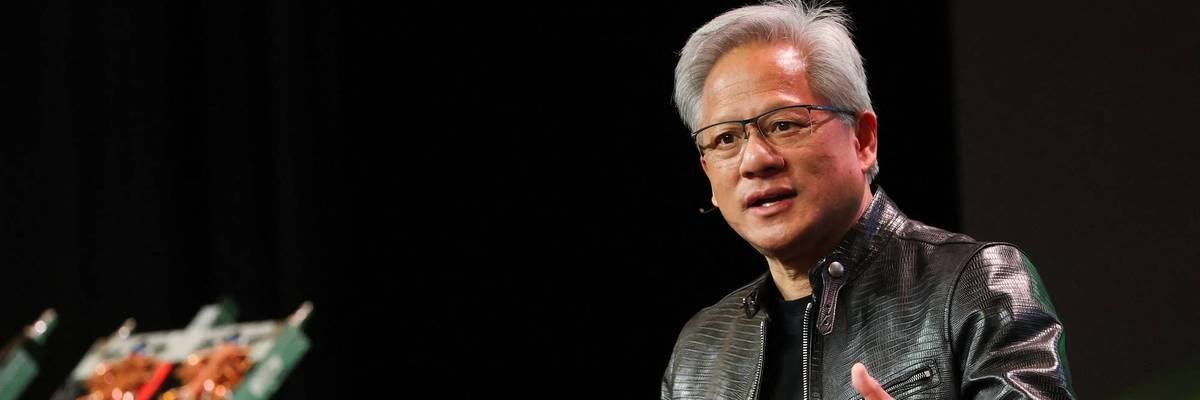
Nvidia founder and former CEO Jensen Huang speaks about the Vera Rubin AI platform during a question and answer session with reporters at the annual Consumer Electronics Show (CES) in Las Vegas, Nevada, on January 6, 2026.
We need to be wary of the manufactured China threat that the national security establishment is using it to promote political and economic agendas that are not in the interests of the people—American, Chinese, or other.
In recent days, the world has been forced to become a bystander in another all-too-common story about another rich CEO cheating on his wife. This time, it’s Jensen Huang, co-founder of Nvidia, whose net worth exceeds $147 billion.
It should come as no surprise that another billionaire—who are, as a whole, already entitled by default—has transgressed the contractual arrangements of a marriage (and not just once or even twice).
But Jensen Huang’s sex life is not the story here. Nor should it be.
When we hear of yet another “Chinese spy” plot, we need to take a beat and understand that these stories are part of an ongoing project to manufacture fear of China, while building mistrust in Chinese technology.
The reason why this story has suffocated the current news cycle is because Alice Huang, the first known affair partner, has been reportedly accused by US officials of being a “Chinese spy”—which is actually not the story, either.
The story is much more complex, and it has to do with the ongoing race to AI dominance and control, the struggle of the US to maintain global hegemony over China, the absurd and often contradictory over-securitization of the tech industry, and some probable malign intentions as far as the US security establishment and corporate interests are concerned.
Before we get into it, we need to get one thing clear: US officials have a history of claiming any and every Chinese person—and thing—is a spy. Remember that interview of TikTok CEO Chew Shou Zi (who, by the way, is Singaporean, not Chinese), when Tom Cotton, a hardcore anti-China war hawk, kept asking if he’s a member of the Communist Party of China? “No, I’m Singaporean,” Shou Zi repeated repeatedly. At the time, they were considering banning TikTok, claiming that China was using it to spy on American children (they were, in truth, worried about the pro-Palestine content and growing anger toward the Israeli genocide). In other words, it was a censorship scheme to control the nation’s youth, which have become much more critical of Israel in recent years—China was just the bait.
But anyway, everything from China seems to be a spy plot: social media apps, weather balloons, cranes, students… coffee makers. That’s right, they’ve even gone so far as to accuse Chinese-made coffee makers of spying on the American people. You know, so China can use coffee-drinking data to hatch a grand plot to take over the US hot beverage industry and wipe out Big Coffee.
I’ll never forget the Select Committee on the CCP hearing when Congressman Tim Burchett (R-Tenn.) exclaimed with concerning amounts of sincerity, “[China] knows how many paperclips you all are using in the Longworth building!” Oh no, not the paperclips. Scary.
It’s as ridiculous as it sounds. Which is why, when we hear of yet another “Chinese spy” plot, we need to take a beat and understand that these stories are part of an ongoing project to manufacture fear of China, while building mistrust in Chinese technology—you know, so China’s industry won’t surpass the US, at least when it comes to critical technology.
So instead of buying into yet another spy narrative with no real evidence, let’s pause and examine the story. The real story.
In October 2025, The New York Times released its first report on Nvidia’s business relationship with Singapore-based company Megaspeed International. It was focused solely on chip purchases—nothing yet about affairs or spies.
The article detailed an investigation into suspected circumvention of recent US export restrictions on advanced Nvidia AI chips. In April 2025, the US banned exports without a special license (which would cost Nvidia up to $5.5 billion). Jensen Huang and associates lobbied hard against these new restrictions. In July, Nvidia struck a deal—they could continue to sell H20 products as long as the US government received 15% of revenues from China. However, concerns remained that other advanced chips (H100, H200, etc.) were being physically diverted into China via Megaspeed’s Southeast Asian data centers. Nvidia and Megaspeed both denied wrongdoing, and US officials acknowledged they had no conclusive evidence that chips had been illegally diverted.
It wasn’t until May 2026 that a firm called “Culper Research” released a 40-page report, titled "Nvidia: The China Problem," alleging a closer relationship between Nvidia and Chinese commercial companies. The report also detailed the relationship between Jensen Huang and Alice Huang, calling it “uncomfortably close.” Interestingly, the report came out on May 13, the same day President Donald Trump added Jensen Huang to his list of billionaires joining the delegation to Beijing, which occurred over the next few days. Coincidence?
The biggest contradiction is completely missing from the mainstream news cycle, and it’s this: China doesn’t want to rely on US tech.
Side note: “Culper Research” is a short-betting firm that releases ~negative~ reports on companies while betting against them. Their main profit structure is making money when the stocks fall. It’s run by a guy named Christian Lamarco, and was named after the “Culper Spy Ring,” which reported the movement of British forces to General George Washington during the American Revolution. Ha.
This isn’t Culper Research’s first foray into tackling complicated and “suspicious” links between US and Chinese companies. They seem, in fact, like they’ve become a sort of anti-China watchdog, calling out American companies who make the mistake of working too closely with Chinese ones. In short, they make a profit off of playing into the national security establishment’s racialized China crackdown.
The “spy story” didn’t make it to the news cycles until early November 2026, when the affair allegations started to be reported in public US media—also leading up to another planned Trump-Xi summit in later November. As soon as it became hot news, it was quickly spun from a story about tech exports to a great affair scandal, and then, almost out of nowhere, a spy plot.
Where do the spy allegations even come from? According to reports, this storyline was derived from anonymous “US intelligence officials.” No evidence has been released. The US Department of Justice has even stated that it has not yet determined if Alice Huang is a spy. According to The Washington Post, an anonymous intelligence official explained that Marco Rubio took a CIA report on the matter and “wrote his own” in “more assertive terms.” When the memo leaked, the media took the story and ran with it.
So no evidence—just another manufactured spy plot written and leaked by a China hawk and escalated by mainstream media with a clear agenda: “Jensen Huang must go,” writes The Economist.
Let’s talk about why certain interests want Jensen Huang gone. But first, the contradictory evidence.
The biggest contradiction is completely missing from the mainstream news cycle, and it’s this: China doesn’t want to rely on US tech. It’s actually one of their top policy priorities. Chinese officials have been actively trying to prevent reliance on US tech in order to develop their own tech sovereignty and help their own domestic chip industry grow. Over the past year, China has repeatedly canceled Nvidia chip purchases and ordered top companies, including ByteDance and Alibaba, to stop buying them. They’ve even sent party officials to major ports to enhance customs inspection and ensure nothing was coming through the border without authorization. In November 2026, over 600,000 Nvidia chips were blocked and left sitting in Hong Kong.
So really, the notion that China is using honeypot spies to find ways to get more chips into the country makes no sense at all—it’s a complete contradiction to state policy, and would be in direct opposition to its security and industry goals.
If Megaspeed was, in fact, renting out computing power to Chinese companies, it was more of a private sector workaround to official state policy, not a secret operation coordinated by the Chinese government. Therefore, if Alice Huang was loyal to anyone, it was her company’s profit margins.
On November 12, Jensen Huang was forced to resign from his position as CEO. Interesting that a mere affair could be used to take out a billionaire executive, when others have gotten away with far worse crimes—rape, human trafficking, pedophilia, regular trips to Epstein Island, to name a few. Why were they protected, while Huang was proactively ousted?
The real story is becoming clear. US government officials—including Marco Rubio—in coordination with the mainstream media, have essentially taken out top CEO Jensen Huang. Why would they want that? Why would they intentionally hurt one of the highest-profiting US companies, the first company to ever surpass a $5 trillion valuation, the backbone of the American economy, the most critical company to the ongoing tech race, which has vast political and economic implications?
Who even benefits from that? Let’s list them!
1. China War Hawks
First, you have to understand one crucial point: The current endgame of US policy, that all anti-China hawks are barreling toward at breakneck speed, is a complete decoupling from China’s economy. Why? So the US can wage a prolonged war on China. That’s not possible if the US relies on China for any material, especially the critical minerals and technology that are imperative for weapons making and war waging.
Jensen Huang was a problem because he lobbied against decoupling. He favored a more economically harmonious relationship with China (because it profited him and Nvidia). His efforts largely worked, and he seemed to have had the direct ear of President Trump, who even supported him during the scandal. Under former President Joe Biden, chip restrictions grew significantly. But Trump, ever the businessman, has often sided with profit over the security establishment’s official position. Jensen Huang also seems to have had, according to mainstream media, a long history of being listened to within his own company—The New York Times writes, “Nvidia board has a history of letting Jensen Huang get his way.” Solution? Dump him. Put someone new in there who will do as they’re told.
We also can’t forget the obvious racialized undertones: Jensen Huang is Asian. The US security establishment doesn’t want an Asian person running the top US semiconductor industry, especially not during the current climate of new McCarthyism.
So overall, removing Jensen Huang will provide more flexibility to push for decoupling. And the whole manufactured spy plot works to the advantage of China hawks and national security officials pushing for greater chip restrictions. Already, lawmakers are using the scandal to garner support for three chip-export restriction measures to be added to the 2027 National Defense Authorization Act—the AI Overwatch Act, the Chip Security Act, and the MATCH Act—all of which give Congress greater ability to restrict chip exports.
This happened, all perfectly coordinated with Trump’s next meeting with Xi in the coming week. We can be sure that the outcomes of those talks, along with the successive policy, will continue to shine a light on what US policymakers really hoped to achieve from the Jensen Huang coup.
2. AI Monopolies and Other Big Tech Companies
Profit is played like a zero-sum game. Where Nvidia loses out, others pick up the losses, like scavengers stealing the scraps of a predator’s kill.
So who wins from Nvidia’s loss? Let’s start with one of the biggest advocates for greater chip restrictions—AI monopolist, Anthropic.
Anthropic has donated $40 million to Public First Action (PFA), an AI policy organization that supports stricter AI regulations and tighter chip control. In July 2026, PFA announced the launch of a $15 million Conservative AI Consensus Project to support members of Congress who back stronger AI regulations and chip controls—including John Moolenaar and Brian Mast, who called for an investigation into Jensen Huang. Their lobby, AnthroPAC, has also given thousands of dollars to some of the biggest China hawks in Congress, who have called for an investigation into and the resignation of Jensen Huang. Anthropic CEO Dario Amodei doesn’t have the relationship with Trump that Huang enjoyed—hence the need to ply Congress in their favor. Additionally, think tanks like the Center for a New American Security (whose CEO, Richard Fontaine, is on Anthropic’s board) have petitioned for Jensen Huang’s removal.
The battle of AI is a battle over who gets to control knowledge, technology, and the future of humanity—will it be monopolistic corporations or the people of the world?
But it’s not just about chip controls. Anthropic, OpenAI, and other Big Tech companies have lobbied to ban open-source AI models, which Jensen Huang has repeatedly defended. “I stuck my head out and defended open models, and, if you will, saved the world,” Huang said, speaking on his opinion that open models are both safer and the foundation to entire industries being created. He also mentioned his preference not to “stick his head out” (guess he had a feeling it could be his undoing).
There is an ongoing battle between open-source and closed-source AI models, or as Chen Deli, senior researcher at DeepSeek, writes, “Open source versus closed source, light versus darkness. A decisive battle between two futures, two destinies for humanity.” In other words, the battle of AI is a battle over who gets to control knowledge, technology, and the future of humanity—will it be monopolistic corporations or the people of the world? AI will either, in the hands of the elite, be a tool of domination, or, in the hands of the people, be used as a shared resource for human progress and development.
The Great AI Battle is playing out as we speak. And Jensen Huang was the rare US executive supporting open-source models.
China has been the biggest advocate for the creation and use of open-source AI models. Meanwhile, US organizations like Anthropic and other Big Tech companies have been lobbying to ban them (China’s open-source models are cutting into their profits). Which is why Jensen Huang’s removal, and influence over the open- vs. closed-source battle, works to their benefit.
And all of this is going down after midterm elections, prior to the next Trump-Xi meeting, and leading up to Anthropic’s IPO date (when a private company’s shares officially begin trading on the public stock exchange), which is slated for—you’ll never guess—this week! November 18. Coincidence? No! There are no coincidences!
4. Israel?
What do you mean the three new Nvidia CEO contenders are ALL Israeli?
What will Israel gain from having Nvidia in its back pocket—other than direct access to the world’s leading supplier of advanced AI chips and computing technology, which provides the computing power necessary for all advanced technology, modern data centers, intelligence systems, autonomous weapons, mass surveillance, and more—during its ongoing war on Iran?
What does Israel stand to gain, indeed.
To close, we need to be wary of the manufactured China threat. The national security establishment is using it to promote political and economic agendas that are not in the interests of the people—American, Chinese, or other.
This is happening in parallel with an expansive US military buildup in the Pacific, a burgeoning $1.5 trillion war budget, and an administration of anti-China war hawks who are dead set on preparing the US for war on China. Decoupling economies is just one part of that. The Great AI Battle is just one part of that. We can also point to unprecedented military preparation and extensive threat manufacturing, which has poisoned many layers of American society already.
Some advice before you go: When you hear about another China spy plot, take a step back. Think about who benefits. The truth is always in the details.
This country and this world are at a monumental crossroads. US voters have an opportunity to beat back the forces of fascism and confront the billionaires who are rigging the economy, our media system, and our democracy, making it increasingly impossible for ordinary people to get by. We’re not just talking about the election. We’re talking about what must be done once these fascist elements are vanquished from power. We need a bolder set of solutions than what either major party has so far been willing to offer and a working-class movement ready to fight like hell for it. Trump didn't emerge from nowhere. The conditions that fueled MAGA authoritarianism were created by decades of radical neoliberal economic policies and a corrupt political system dominated by corporate interests. They slashed taxes on the super-rich, promising that the benefits would trickle down. They said giveaways to the corporate titans would make life more affordable for the rest of us. It was all bullshit. And when a bitter, betrayed populace searches for someone to blame, right-wing demagogues have little trouble finding scapegoats. People know when they're being lied to, but you won't hear any of this from the corporate media. Only independent journalism—powered and funded by people who believe in building a better world—can deliver truly trustworthy daily news. If you share our vision, please contribute whatever you can to sustain our work. |
In recent days, the world has been forced to become a bystander in another all-too-common story about another rich CEO cheating on his wife. This time, it’s Jensen Huang, co-founder of Nvidia, whose net worth exceeds $147 billion.
It should come as no surprise that another billionaire—who are, as a whole, already entitled by default—has transgressed the contractual arrangements of a marriage (and not just once or even twice).
But Jensen Huang’s sex life is not the story here. Nor should it be.
When we hear of yet another “Chinese spy” plot, we need to take a beat and understand that these stories are part of an ongoing project to manufacture fear of China, while building mistrust in Chinese technology.
The reason why this story has suffocated the current news cycle is because Alice Huang, the first known affair partner, has been reportedly accused by US officials of being a “Chinese spy”—which is actually not the story, either.
The story is much more complex, and it has to do with the ongoing race to AI dominance and control, the struggle of the US to maintain global hegemony over China, the absurd and often contradictory over-securitization of the tech industry, and some probable malign intentions as far as the US security establishment and corporate interests are concerned.
Before we get into it, we need to get one thing clear: US officials have a history of claiming any and every Chinese person—and thing—is a spy. Remember that interview of TikTok CEO Chew Shou Zi (who, by the way, is Singaporean, not Chinese), when Tom Cotton, a hardcore anti-China war hawk, kept asking if he’s a member of the Communist Party of China? “No, I’m Singaporean,” Shou Zi repeated repeatedly. At the time, they were considering banning TikTok, claiming that China was using it to spy on American children (they were, in truth, worried about the pro-Palestine content and growing anger toward the Israeli genocide). In other words, it was a censorship scheme to control the nation’s youth, which have become much more critical of Israel in recent years—China was just the bait.
But anyway, everything from China seems to be a spy plot: social media apps, weather balloons, cranes, students… coffee makers. That’s right, they’ve even gone so far as to accuse Chinese-made coffee makers of spying on the American people. You know, so China can use coffee-drinking data to hatch a grand plot to take over the US hot beverage industry and wipe out Big Coffee.
I’ll never forget the Select Committee on the CCP hearing when Congressman Tim Burchett (R-Tenn.) exclaimed with concerning amounts of sincerity, “[China] knows how many paperclips you all are using in the Longworth building!” Oh no, not the paperclips. Scary.
It’s as ridiculous as it sounds. Which is why, when we hear of yet another “Chinese spy” plot, we need to take a beat and understand that these stories are part of an ongoing project to manufacture fear of China, while building mistrust in Chinese technology—you know, so China’s industry won’t surpass the US, at least when it comes to critical technology.
So instead of buying into yet another spy narrative with no real evidence, let’s pause and examine the story. The real story.
In October 2025, The New York Times released its first report on Nvidia’s business relationship with Singapore-based company Megaspeed International. It was focused solely on chip purchases—nothing yet about affairs or spies.
The article detailed an investigation into suspected circumvention of recent US export restrictions on advanced Nvidia AI chips. In April 2025, the US banned exports without a special license (which would cost Nvidia up to $5.5 billion). Jensen Huang and associates lobbied hard against these new restrictions. In July, Nvidia struck a deal—they could continue to sell H20 products as long as the US government received 15% of revenues from China. However, concerns remained that other advanced chips (H100, H200, etc.) were being physically diverted into China via Megaspeed’s Southeast Asian data centers. Nvidia and Megaspeed both denied wrongdoing, and US officials acknowledged they had no conclusive evidence that chips had been illegally diverted.
It wasn’t until May 2026 that a firm called “Culper Research” released a 40-page report, titled "Nvidia: The China Problem," alleging a closer relationship between Nvidia and Chinese commercial companies. The report also detailed the relationship between Jensen Huang and Alice Huang, calling it “uncomfortably close.” Interestingly, the report came out on May 13, the same day President Donald Trump added Jensen Huang to his list of billionaires joining the delegation to Beijing, which occurred over the next few days. Coincidence?
The biggest contradiction is completely missing from the mainstream news cycle, and it’s this: China doesn’t want to rely on US tech.
Side note: “Culper Research” is a short-betting firm that releases ~negative~ reports on companies while betting against them. Their main profit structure is making money when the stocks fall. It’s run by a guy named Christian Lamarco, and was named after the “Culper Spy Ring,” which reported the movement of British forces to General George Washington during the American Revolution. Ha.
This isn’t Culper Research’s first foray into tackling complicated and “suspicious” links between US and Chinese companies. They seem, in fact, like they’ve become a sort of anti-China watchdog, calling out American companies who make the mistake of working too closely with Chinese ones. In short, they make a profit off of playing into the national security establishment’s racialized China crackdown.
The “spy story” didn’t make it to the news cycles until early November 2026, when the affair allegations started to be reported in public US media—also leading up to another planned Trump-Xi summit in later November. As soon as it became hot news, it was quickly spun from a story about tech exports to a great affair scandal, and then, almost out of nowhere, a spy plot.
Where do the spy allegations even come from? According to reports, this storyline was derived from anonymous “US intelligence officials.” No evidence has been released. The US Department of Justice has even stated that it has not yet determined if Alice Huang is a spy. According to The Washington Post, an anonymous intelligence official explained that Marco Rubio took a CIA report on the matter and “wrote his own” in “more assertive terms.” When the memo leaked, the media took the story and ran with it.
So no evidence—just another manufactured spy plot written and leaked by a China hawk and escalated by mainstream media with a clear agenda: “Jensen Huang must go,” writes The Economist.
Let’s talk about why certain interests want Jensen Huang gone. But first, the contradictory evidence.
The biggest contradiction is completely missing from the mainstream news cycle, and it’s this: China doesn’t want to rely on US tech. It’s actually one of their top policy priorities. Chinese officials have been actively trying to prevent reliance on US tech in order to develop their own tech sovereignty and help their own domestic chip industry grow. Over the past year, China has repeatedly canceled Nvidia chip purchases and ordered top companies, including ByteDance and Alibaba, to stop buying them. They’ve even sent party officials to major ports to enhance customs inspection and ensure nothing was coming through the border without authorization. In November 2026, over 600,000 Nvidia chips were blocked and left sitting in Hong Kong.
So really, the notion that China is using honeypot spies to find ways to get more chips into the country makes no sense at all—it’s a complete contradiction to state policy, and would be in direct opposition to its security and industry goals.
If Megaspeed was, in fact, renting out computing power to Chinese companies, it was more of a private sector workaround to official state policy, not a secret operation coordinated by the Chinese government. Therefore, if Alice Huang was loyal to anyone, it was her company’s profit margins.
On November 12, Jensen Huang was forced to resign from his position as CEO. Interesting that a mere affair could be used to take out a billionaire executive, when others have gotten away with far worse crimes—rape, human trafficking, pedophilia, regular trips to Epstein Island, to name a few. Why were they protected, while Huang was proactively ousted?
The real story is becoming clear. US government officials—including Marco Rubio—in coordination with the mainstream media, have essentially taken out top CEO Jensen Huang. Why would they want that? Why would they intentionally hurt one of the highest-profiting US companies, the first company to ever surpass a $5 trillion valuation, the backbone of the American economy, the most critical company to the ongoing tech race, which has vast political and economic implications?
Who even benefits from that? Let’s list them!
1. China War Hawks
First, you have to understand one crucial point: The current endgame of US policy, that all anti-China hawks are barreling toward at breakneck speed, is a complete decoupling from China’s economy. Why? So the US can wage a prolonged war on China. That’s not possible if the US relies on China for any material, especially the critical minerals and technology that are imperative for weapons making and war waging.
Jensen Huang was a problem because he lobbied against decoupling. He favored a more economically harmonious relationship with China (because it profited him and Nvidia). His efforts largely worked, and he seemed to have had the direct ear of President Trump, who even supported him during the scandal. Under former President Joe Biden, chip restrictions grew significantly. But Trump, ever the businessman, has often sided with profit over the security establishment’s official position. Jensen Huang also seems to have had, according to mainstream media, a long history of being listened to within his own company—The New York Times writes, “Nvidia board has a history of letting Jensen Huang get his way.” Solution? Dump him. Put someone new in there who will do as they’re told.
We also can’t forget the obvious racialized undertones: Jensen Huang is Asian. The US security establishment doesn’t want an Asian person running the top US semiconductor industry, especially not during the current climate of new McCarthyism.
So overall, removing Jensen Huang will provide more flexibility to push for decoupling. And the whole manufactured spy plot works to the advantage of China hawks and national security officials pushing for greater chip restrictions. Already, lawmakers are using the scandal to garner support for three chip-export restriction measures to be added to the 2027 National Defense Authorization Act—the AI Overwatch Act, the Chip Security Act, and the MATCH Act—all of which give Congress greater ability to restrict chip exports.
This happened, all perfectly coordinated with Trump’s next meeting with Xi in the coming week. We can be sure that the outcomes of those talks, along with the successive policy, will continue to shine a light on what US policymakers really hoped to achieve from the Jensen Huang coup.
2. AI Monopolies and Other Big Tech Companies
Profit is played like a zero-sum game. Where Nvidia loses out, others pick up the losses, like scavengers stealing the scraps of a predator’s kill.
So who wins from Nvidia’s loss? Let’s start with one of the biggest advocates for greater chip restrictions—AI monopolist, Anthropic.
Anthropic has donated $40 million to Public First Action (PFA), an AI policy organization that supports stricter AI regulations and tighter chip control. In July 2026, PFA announced the launch of a $15 million Conservative AI Consensus Project to support members of Congress who back stronger AI regulations and chip controls—including John Moolenaar and Brian Mast, who called for an investigation into Jensen Huang. Their lobby, AnthroPAC, has also given thousands of dollars to some of the biggest China hawks in Congress, who have called for an investigation into and the resignation of Jensen Huang. Anthropic CEO Dario Amodei doesn’t have the relationship with Trump that Huang enjoyed—hence the need to ply Congress in their favor. Additionally, think tanks like the Center for a New American Security (whose CEO, Richard Fontaine, is on Anthropic’s board) have petitioned for Jensen Huang’s removal.
The battle of AI is a battle over who gets to control knowledge, technology, and the future of humanity—will it be monopolistic corporations or the people of the world?
But it’s not just about chip controls. Anthropic, OpenAI, and other Big Tech companies have lobbied to ban open-source AI models, which Jensen Huang has repeatedly defended. “I stuck my head out and defended open models, and, if you will, saved the world,” Huang said, speaking on his opinion that open models are both safer and the foundation to entire industries being created. He also mentioned his preference not to “stick his head out” (guess he had a feeling it could be his undoing).
There is an ongoing battle between open-source and closed-source AI models, or as Chen Deli, senior researcher at DeepSeek, writes, “Open source versus closed source, light versus darkness. A decisive battle between two futures, two destinies for humanity.” In other words, the battle of AI is a battle over who gets to control knowledge, technology, and the future of humanity—will it be monopolistic corporations or the people of the world? AI will either, in the hands of the elite, be a tool of domination, or, in the hands of the people, be used as a shared resource for human progress and development.
The Great AI Battle is playing out as we speak. And Jensen Huang was the rare US executive supporting open-source models.
China has been the biggest advocate for the creation and use of open-source AI models. Meanwhile, US organizations like Anthropic and other Big Tech companies have been lobbying to ban them (China’s open-source models are cutting into their profits). Which is why Jensen Huang’s removal, and influence over the open- vs. closed-source battle, works to their benefit.
And all of this is going down after midterm elections, prior to the next Trump-Xi meeting, and leading up to Anthropic’s IPO date (when a private company’s shares officially begin trading on the public stock exchange), which is slated for—you’ll never guess—this week! November 18. Coincidence? No! There are no coincidences!
4. Israel?
What do you mean the three new Nvidia CEO contenders are ALL Israeli?
What will Israel gain from having Nvidia in its back pocket—other than direct access to the world’s leading supplier of advanced AI chips and computing technology, which provides the computing power necessary for all advanced technology, modern data centers, intelligence systems, autonomous weapons, mass surveillance, and more—during its ongoing war on Iran?
What does Israel stand to gain, indeed.
To close, we need to be wary of the manufactured China threat. The national security establishment is using it to promote political and economic agendas that are not in the interests of the people—American, Chinese, or other.
This is happening in parallel with an expansive US military buildup in the Pacific, a burgeoning $1.5 trillion war budget, and an administration of anti-China war hawks who are dead set on preparing the US for war on China. Decoupling economies is just one part of that. The Great AI Battle is just one part of that. We can also point to unprecedented military preparation and extensive threat manufacturing, which has poisoned many layers of American society already.
Some advice before you go: When you hear about another China spy plot, take a step back. Think about who benefits. The truth is always in the details.

