SUBSCRIBE TO OUR FREE NEWSLETTER
Daily news & progressive opinion—funded by the people, not the corporations—delivered straight to your inbox.
5
#000000
#FFFFFF
To donate by check, phone, or other method, see our More Ways to Give page.
Daily news & progressive opinion—funded by the people, not the corporations—delivered straight to your inbox.

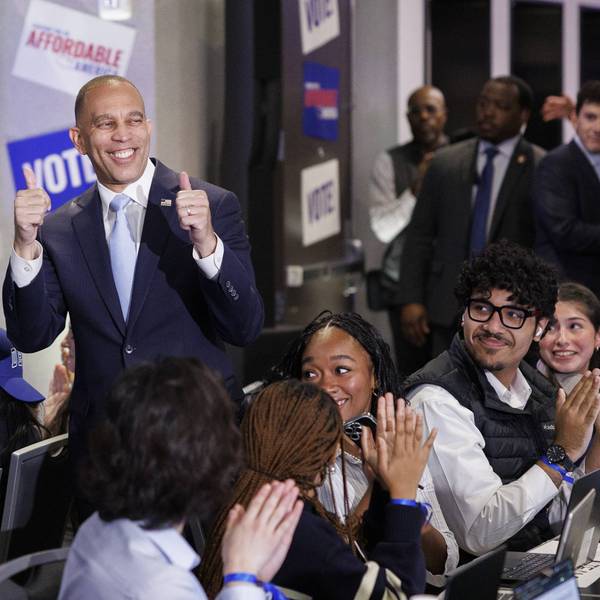
From left, Rep. Pete Aguilar, D-Calif., chair of the House Democratic Caucus. House Minority Leader Hakeem Jeffries, (D-NY) and Rep. Suzan DelBene (D-Wash.)chair of the DCCC, conduct a news conference at the DCCC after the Democrats took control of Congress in the midterm election, on Wednesday, November 4, 2026.
Voters did not reject Republican extremism just to see Democratic leaders continue pouring billions into wars and corporate interests while families struggle to afford housing, healthcare, and basic necessities.
Now that Democrats have swept the House, a key question is: Who should lead it?
Hakeem Jeffries is in line to become the first Black Speaker of the House, which would be a historic milestone. But members of Congress must examine Jeffries' record, his priorities, and the kind of leadership he would bring to this moment.
Here are ten reasons why Jeffries should not be Speaker.
At a time when millions of Americans struggle with unaffordable health insurance, medical debt, and the threat of financial ruin from illness, Jeffries has distanced himself from one of the most important progressive reforms: Medicare for All.
Jeffries co-sponsored Medicare for All legislation from 2013 through 2021. But in an August 2026 interview on NBC's Meet the Press, he said it is no longer legislation he supports or cosponsors. Ironically, he made that statement on the same day a CBS poll found that 90 percent of Democratic voters back the idea.
This reversal puts him at odds with party voters, but also with a majority of Democratic representatives in the House. As of late October, Rep. Pramila Jayapal's Medicare for All Act had 118 Democratic cosponsors. A “leader” who won’t back what his own caucus and voters want is not a leader.
Perhaps nowhere is Jeffries more out of step with the progressive base than on Israel.
For decades, Jeffries has been a staunch defender of the U.S.-Israel alliance. At a pro-Israel rally in 2014, during Israel's military assault on Gaza, Jeffries proclaimed, “Israel today, Israel tomorrow, Israel forever!.” In 2020 he told an AIPAC conference that New Yorkers consider Jerusalem their “sixth borough,” totally disregarding the plight of Palestinians living under Israeli occupation.
Even as Israel's genocide in Gaza sparked worldwide outrage, Jeffries continued to resist calls to end U.S. military support.
In July 2026, 103 House Democrats voted to cut $3.3 billion in military aid to Israel, including the party's second-ranking House leader, Katherine Clark. But Jeffries joined 97 other Democrats and nearly every Republican in voting to preserve the funding.
In a May 2024 60 Minutes interview, when asked whether Israel's bombing of Gaza had been indiscriminate, Jeffries said no. By then, nearly 35,000 Palestinians had been killed. When the interviewer pressed him, saying, "You seem reluctant to criticize Israel at all," Jeffries responded, "I'm dealing with the facts on the ground."
Jeffries has also refused to cosponsor the Block the Bombs Act, which would restrict transfers of some of the deadliest offensive weapons to Israel, including 2,000-pound bombs, bunker busters, precision-guidance kits, and tank and artillery rounds. As of November 2026, the bill has 82 Democratic cosponsors and the endorsement of the Congressional Progressive Caucus. Caucus Chair Greg Casar has pledged to push for a floor vote if Democrats regain the majority. Yet Jeffries has not signed on, and as Speaker, he would have enormous power to determine whether the bill ever receives a vote.
While Jeffries has acknowledged that U.S. policy toward Israel needs to change, he continues to support Israel's military superiority and joint missile-defense programs. He has also refused to condemn Section 219 of the NDAA, which would further integrate U.S. and Israeli military research, technology, and production.
Ironically, both Donald Trump and Benjamin Netanyahu have recently suggested that the U.S. should stop giving Israel nearly $4 billion a year because “Israel doesn't need it.” Whether or not we believe them, it is striking that we have yet to hear a similar call from Hakeem Jeffries.
At a time when Americans are struggling to afford basic necessities, Trump is demanding a staggering $1.5 trillion military budget—an increase of nearly $600 billion, or 66 percent, over the previous year's base funding. Yet Jeffries has not made substantially reducing Pentagon spending a central priority of Democratic leadership.
Yes, he has opposed funding for Trump's war in Iran but he is a staunch advocate of continued U.S. military aid to Ukraine and has sharply criticized Trump for failing to provide sufficient support. He said “America is stronger when Russia is weaker.” In September 2026, he pledged that Democrats would continue backing Ukraine “until victory is won,” signaling his commitment to greater U.S. involvement and military assistance instead of a commitment to a diplomatic solution that would end that terrible war.
Jeffries is also an enthusiastic defender of the aggressive alliance NATO, which should have dissolved when the Soviet Union fell apart in 1991. He has called NATO “the most successful military and diplomatic alliance in the history of the world.” NATO, at Trump’s insistence, has called for all members to dramatically increase their military budgets to 5 percent of their GDP (the US is presently at 3.1 percent).
Jeffries’ ties to the military-industrial complex are particularly troubling. During the 2026 election cycle alone, Jeffries' campaign reportedly received approximately $212,000 from military PACs.
Democrats cannot simply promise better healthcare, affordable housing, quality education and climate action while supporting a massive military budget. Real change requires shifting resources from weapons and war to the needs of ordinary people. The next Democratic Speaker must be prepared to challenge the military-industrial complex.
Jeffries's position on Israel cannot be separated from his longstanding political relationship with the AIPAC lobby.
At a time when AIPAC funding has become toxic and so many Democratic candidates rejected AIPAC money, Jeffries has maintained his ties to the organization.
According to Track AIPAC, Hakeem Jeffries has received more than $1.5 million in campaign contributions from AIPAC and other pro-Israel lobby groups over his congressional career. During the 2026 election cycle alone, his campaign received nearly $300,000 in contributions from pro-Israel PACs.He has also taken five AIPAC-sponsored trips to Israel since arriving in Congress.
Following the November elections, AIPAC publicly celebrated Jeffries as one of the candidates it supported.
How can congressional Democrats be led by someone so closely tied to AIPAC, a lobby increasingly toxic to their own voters?
At a time when Americans are demanding investigations into the Trump family's financial dealings, Hakeem Jeffries chose to sit down privately with Jared Kushner, Trump's son-in-law and influential adviser.
In August 2026, reports revealed that Jeffries had met with Kushner to discuss possible cooperation on housing, immigration and affordability. Yet Kushner, who holds no official government position, continues to wield influence over U.S. foreign policy while maintaining lucrative financial relationships with Gulf governments through his investment firm.
House Judiciary Committee Democrat Jamie Raskin has already launched an investigation into Kushner's foreign financial entanglements, demanding documents and communications about his dealings with foreign governments. So why was Jeffries meeting with him behind closed doors?
With Democrats taking control of the House in January, they need a speaker committed to untangling the dirty web of corruption committed by Trump and his inner circle.
You can tell a political leader's priorities by whom they put in power. And Jeffries's choices speak volumes.
In August 2026, Democratic leaders elevated Rep. Jared Moskowitz, one of the House's most outspoken pro-Israel hawks, to the top Democratic position on the powerful House Foreign Affairs Subcommittee on the Middle East and North Africa. Moskowitz has been an unwavering defender of Israel’s genocide in Gaza, continued U.S. weapons shipments, and Israel’s brutal military operations in Lebanon. He has also openly supported both Israeli attacks on Iran and Trump's 2025 bombing of Iranian nuclear facilities, and initially opposed congressional efforts to prevent the 2026 war before later backing War Powers restrictions.
With Democrats in control of the House, Moskowitz will be positioned to chair the Middle East and North Africa Subcommittee, wielding significant influence over congressional oversight and policy toward Israel, Palestine, Iran, and the entire region.
Debbie Wasserman Schultz and Wesley Bell, two other staunch defenders of Israel, were added to the Foreign Affairs Committee. Bell had defeated progressive Rep. Cori Bush in 2024 after massive spending by AIPAC's super PAC. Progressives are still steaming over the role of Wasserman Schultz in undermining Bernie Sanders during the 2016 Democratic presidential primary.
The backlash to these appointments was immediate. Rep. Ro Khanna warned, "Don't put Israel hawks out of touch with our voters in charge of our Middle East policy." The Council on American-Islamic Relations condemned the appointments as an insult to voters and an attempt to shield Israel from accountability for its actions in Gaza.
The Democratic Party claims to fight for working people, but Jeffries remains deeply connected to the wealthy corporate interests that dominate Washington.
His campaign has benefited from millions of dollars in contributions associated with Wall Street, pharmaceutical and insurance companies, real estate interests, Big Tech and military contractors.
These financial relationships raise a fundamental question: How aggressively will Democrats challenge corporate greed, Wall Street speculation, soaring healthcare costs and the military-industrial complex when their leader maintains such close ties to these powerful interests?
Progressive Democrats have demonstrated that grassroots organizing and small-dollar fundraising offer an alternative to corporate PAC money.
The Democratic Party cannot credibly promise to take on corporate power without confronting the influence of big money within its own leadership.
Jeffries has a long history of protecting entrenched Democratic incumbents against progressive challengers.
In 2020, he backed longtime pro-Israel congressman Eliot Engel against Jamaal Bowman, who defeated Engel in a stunning primary upset. In 2022, Jeffries traveled to Chicago to campaign for veteran Congressman Danny Davis against young progressive organizer Kina Collins, who came within seven percentage points of victory.
And in 2026, Jeffries backed Dan Goldman, Adriano Espaillat and Shri Thanedar against progressive challengers Brad Lander, Darializa Avila Chevalier and Donavan McKinney. All three incumbents lost their primaries, and all three challengers went on to win in November.
This pattern is no coincidence. In 2021, Jeffries joined forces with centrist Democrats Josh Gottheimer and Terri Sewell to establish Team Blue PAC, designed to protect Democratic incumbents against primary challengers.
While voters are demanding a new direction, Jeffries has repeatedly sided with the establishment candidates they rejected.
As ICE agents terrorize immigrant communities, separate families and carry out violent raids, the question of how to dismantle Trump's cruel mass-deportation machinery has become increasingly urgent.
Jeffries has condemned ICE's brutality and demanded greater accountability. But he has stopped short of calling for the abolition of ICE or the dismantling of the Department of Homeland Security, insisting instead that these agencies can be reformed.
Contrast that with Rep. Delia Ramirez's groundbreaking Reimagining Safety Act, which would abolish ICE, dismantle DHS and establish a new Department of Community Safety, redirecting resources toward housing, healthcare and community well-being. Her legislation challenges the very definition of national security, arguing that real safety comes from meeting people's needs, not militarizing their communities.
This is the kind of bold, visionary leadership that offers a fundamental alternative to simply “reforming” an out-of-control immigration enforcement system that is terrorizing immigrant communities.
As devastating wildfires consume entire communities, record-breaking heat waves threaten lives, and floods and droughts wreak havoc across the country, the climate crisis demands bold, urgent leadership—not business as usual.
Yet Jeffries has refused to endorse the Green New Deal or champion demands to halt the expansion of fossil fuel infrastructure and eliminate taxpayer subsidies to the oil and gas industry. In 2022, when more than 70 House Democrats publicly opposed legislation to fast-track fossil fuel projects, Jeffries declined to join them.
More recently, he has distanced himself from calls for a moratorium on new AI data centers, even as a powerful grassroots movement is sweeping the country, with communities organizing against these energy-guzzling facilities that drain water supplies, drive up electricity bills, strain power grids and threaten the environment.
Jeffries supported the Inflation Reduction Act's clean-energy investments, but he has not embraced the more ambitious climate agenda advocated by progressive lawmakers and community groups.
At a time when climate disasters are destroying homes, livelihoods and entire communities, the Democratic Party needs leadership with the urgency and ambition to confront the climate crisis.
More than any single vote, contribution, or appointment, the problem with Hakeem Jeffries is the establishment politics he represents—politics that protect the powerful, accommodate corporate interests, and offer timid reforms when the country is crying out for transformative change.
Voters did not reject Republican extremism just to see Democratic leaders continue pouring billions into wars and corporate interests while families struggle to afford housing, healthcare, and basic necessities.
And the grassroots are making their voices heard. In just a few days, more than one million people have signed a petition demanding new leadership. Congressional offices are being inundated with calls, and several incoming Democrats—including Melat Kiros, Claire Valdez, Chris Rabb, and Adam Hamawy—are withholding support for Jeffries.
The Speaker of the House holds enormous power. That power can be used to confront the military-industrial complex, challenge corporate money and AIPAC, stand up for immigrants, and put human needs ahead of endless wars. Or it can be used to protect the very system that has brought us to this crisis.
That’s why we need a new generation of leadership willing to fight for real change.
Sign the petition demanding new leadership. Call your member of Congress at 202-224-3121.
This country and this world are at a monumental crossroads. US voters have an opportunity to beat back the forces of fascism and confront the billionaires who are rigging the economy, our media system, and our democracy, making it increasingly impossible for ordinary people to get by. We’re not just talking about the election. We’re talking about what must be done once these fascist elements are vanquished from power. We need a bolder set of solutions than what either major party has so far been willing to offer and a working-class movement ready to fight like hell for it. Trump didn't emerge from nowhere. The conditions that fueled MAGA authoritarianism were created by decades of radical neoliberal economic policies and a corrupt political system dominated by corporate interests. They slashed taxes on the super-rich, promising that the benefits would trickle down. They said giveaways to the corporate titans would make life more affordable for the rest of us. It was all bullshit. And when a bitter, betrayed populace searches for someone to blame, right-wing demagogues have little trouble finding scapegoats. People know when they're being lied to, but you won't hear any of this from the corporate media. Only independent journalism—powered and funded by people who believe in building a better world—can deliver truly trustworthy daily news. If you share our vision, please contribute whatever you can to sustain our work. |
Now that Democrats have swept the House, a key question is: Who should lead it?
Hakeem Jeffries is in line to become the first Black Speaker of the House, which would be a historic milestone. But members of Congress must examine Jeffries' record, his priorities, and the kind of leadership he would bring to this moment.
Here are ten reasons why Jeffries should not be Speaker.
At a time when millions of Americans struggle with unaffordable health insurance, medical debt, and the threat of financial ruin from illness, Jeffries has distanced himself from one of the most important progressive reforms: Medicare for All.
Jeffries co-sponsored Medicare for All legislation from 2013 through 2021. But in an August 2026 interview on NBC's Meet the Press, he said it is no longer legislation he supports or cosponsors. Ironically, he made that statement on the same day a CBS poll found that 90 percent of Democratic voters back the idea.
This reversal puts him at odds with party voters, but also with a majority of Democratic representatives in the House. As of late October, Rep. Pramila Jayapal's Medicare for All Act had 118 Democratic cosponsors. A “leader” who won’t back what his own caucus and voters want is not a leader.
Perhaps nowhere is Jeffries more out of step with the progressive base than on Israel.
For decades, Jeffries has been a staunch defender of the U.S.-Israel alliance. At a pro-Israel rally in 2014, during Israel's military assault on Gaza, Jeffries proclaimed, “Israel today, Israel tomorrow, Israel forever!.” In 2020 he told an AIPAC conference that New Yorkers consider Jerusalem their “sixth borough,” totally disregarding the plight of Palestinians living under Israeli occupation.
Even as Israel's genocide in Gaza sparked worldwide outrage, Jeffries continued to resist calls to end U.S. military support.
In July 2026, 103 House Democrats voted to cut $3.3 billion in military aid to Israel, including the party's second-ranking House leader, Katherine Clark. But Jeffries joined 97 other Democrats and nearly every Republican in voting to preserve the funding.
In a May 2024 60 Minutes interview, when asked whether Israel's bombing of Gaza had been indiscriminate, Jeffries said no. By then, nearly 35,000 Palestinians had been killed. When the interviewer pressed him, saying, "You seem reluctant to criticize Israel at all," Jeffries responded, "I'm dealing with the facts on the ground."
Jeffries has also refused to cosponsor the Block the Bombs Act, which would restrict transfers of some of the deadliest offensive weapons to Israel, including 2,000-pound bombs, bunker busters, precision-guidance kits, and tank and artillery rounds. As of November 2026, the bill has 82 Democratic cosponsors and the endorsement of the Congressional Progressive Caucus. Caucus Chair Greg Casar has pledged to push for a floor vote if Democrats regain the majority. Yet Jeffries has not signed on, and as Speaker, he would have enormous power to determine whether the bill ever receives a vote.
While Jeffries has acknowledged that U.S. policy toward Israel needs to change, he continues to support Israel's military superiority and joint missile-defense programs. He has also refused to condemn Section 219 of the NDAA, which would further integrate U.S. and Israeli military research, technology, and production.
Ironically, both Donald Trump and Benjamin Netanyahu have recently suggested that the U.S. should stop giving Israel nearly $4 billion a year because “Israel doesn't need it.” Whether or not we believe them, it is striking that we have yet to hear a similar call from Hakeem Jeffries.
At a time when Americans are struggling to afford basic necessities, Trump is demanding a staggering $1.5 trillion military budget—an increase of nearly $600 billion, or 66 percent, over the previous year's base funding. Yet Jeffries has not made substantially reducing Pentagon spending a central priority of Democratic leadership.
Yes, he has opposed funding for Trump's war in Iran but he is a staunch advocate of continued U.S. military aid to Ukraine and has sharply criticized Trump for failing to provide sufficient support. He said “America is stronger when Russia is weaker.” In September 2026, he pledged that Democrats would continue backing Ukraine “until victory is won,” signaling his commitment to greater U.S. involvement and military assistance instead of a commitment to a diplomatic solution that would end that terrible war.
Jeffries is also an enthusiastic defender of the aggressive alliance NATO, which should have dissolved when the Soviet Union fell apart in 1991. He has called NATO “the most successful military and diplomatic alliance in the history of the world.” NATO, at Trump’s insistence, has called for all members to dramatically increase their military budgets to 5 percent of their GDP (the US is presently at 3.1 percent).
Jeffries’ ties to the military-industrial complex are particularly troubling. During the 2026 election cycle alone, Jeffries' campaign reportedly received approximately $212,000 from military PACs.
Democrats cannot simply promise better healthcare, affordable housing, quality education and climate action while supporting a massive military budget. Real change requires shifting resources from weapons and war to the needs of ordinary people. The next Democratic Speaker must be prepared to challenge the military-industrial complex.
Jeffries's position on Israel cannot be separated from his longstanding political relationship with the AIPAC lobby.
At a time when AIPAC funding has become toxic and so many Democratic candidates rejected AIPAC money, Jeffries has maintained his ties to the organization.
According to Track AIPAC, Hakeem Jeffries has received more than $1.5 million in campaign contributions from AIPAC and other pro-Israel lobby groups over his congressional career. During the 2026 election cycle alone, his campaign received nearly $300,000 in contributions from pro-Israel PACs.He has also taken five AIPAC-sponsored trips to Israel since arriving in Congress.
Following the November elections, AIPAC publicly celebrated Jeffries as one of the candidates it supported.
How can congressional Democrats be led by someone so closely tied to AIPAC, a lobby increasingly toxic to their own voters?
At a time when Americans are demanding investigations into the Trump family's financial dealings, Hakeem Jeffries chose to sit down privately with Jared Kushner, Trump's son-in-law and influential adviser.
In August 2026, reports revealed that Jeffries had met with Kushner to discuss possible cooperation on housing, immigration and affordability. Yet Kushner, who holds no official government position, continues to wield influence over U.S. foreign policy while maintaining lucrative financial relationships with Gulf governments through his investment firm.
House Judiciary Committee Democrat Jamie Raskin has already launched an investigation into Kushner's foreign financial entanglements, demanding documents and communications about his dealings with foreign governments. So why was Jeffries meeting with him behind closed doors?
With Democrats taking control of the House in January, they need a speaker committed to untangling the dirty web of corruption committed by Trump and his inner circle.
You can tell a political leader's priorities by whom they put in power. And Jeffries's choices speak volumes.
In August 2026, Democratic leaders elevated Rep. Jared Moskowitz, one of the House's most outspoken pro-Israel hawks, to the top Democratic position on the powerful House Foreign Affairs Subcommittee on the Middle East and North Africa. Moskowitz has been an unwavering defender of Israel’s genocide in Gaza, continued U.S. weapons shipments, and Israel’s brutal military operations in Lebanon. He has also openly supported both Israeli attacks on Iran and Trump's 2025 bombing of Iranian nuclear facilities, and initially opposed congressional efforts to prevent the 2026 war before later backing War Powers restrictions.
With Democrats in control of the House, Moskowitz will be positioned to chair the Middle East and North Africa Subcommittee, wielding significant influence over congressional oversight and policy toward Israel, Palestine, Iran, and the entire region.
Debbie Wasserman Schultz and Wesley Bell, two other staunch defenders of Israel, were added to the Foreign Affairs Committee. Bell had defeated progressive Rep. Cori Bush in 2024 after massive spending by AIPAC's super PAC. Progressives are still steaming over the role of Wasserman Schultz in undermining Bernie Sanders during the 2016 Democratic presidential primary.
The backlash to these appointments was immediate. Rep. Ro Khanna warned, "Don't put Israel hawks out of touch with our voters in charge of our Middle East policy." The Council on American-Islamic Relations condemned the appointments as an insult to voters and an attempt to shield Israel from accountability for its actions in Gaza.
The Democratic Party claims to fight for working people, but Jeffries remains deeply connected to the wealthy corporate interests that dominate Washington.
His campaign has benefited from millions of dollars in contributions associated with Wall Street, pharmaceutical and insurance companies, real estate interests, Big Tech and military contractors.
These financial relationships raise a fundamental question: How aggressively will Democrats challenge corporate greed, Wall Street speculation, soaring healthcare costs and the military-industrial complex when their leader maintains such close ties to these powerful interests?
Progressive Democrats have demonstrated that grassroots organizing and small-dollar fundraising offer an alternative to corporate PAC money.
The Democratic Party cannot credibly promise to take on corporate power without confronting the influence of big money within its own leadership.
Jeffries has a long history of protecting entrenched Democratic incumbents against progressive challengers.
In 2020, he backed longtime pro-Israel congressman Eliot Engel against Jamaal Bowman, who defeated Engel in a stunning primary upset. In 2022, Jeffries traveled to Chicago to campaign for veteran Congressman Danny Davis against young progressive organizer Kina Collins, who came within seven percentage points of victory.
And in 2026, Jeffries backed Dan Goldman, Adriano Espaillat and Shri Thanedar against progressive challengers Brad Lander, Darializa Avila Chevalier and Donavan McKinney. All three incumbents lost their primaries, and all three challengers went on to win in November.
This pattern is no coincidence. In 2021, Jeffries joined forces with centrist Democrats Josh Gottheimer and Terri Sewell to establish Team Blue PAC, designed to protect Democratic incumbents against primary challengers.
While voters are demanding a new direction, Jeffries has repeatedly sided with the establishment candidates they rejected.
As ICE agents terrorize immigrant communities, separate families and carry out violent raids, the question of how to dismantle Trump's cruel mass-deportation machinery has become increasingly urgent.
Jeffries has condemned ICE's brutality and demanded greater accountability. But he has stopped short of calling for the abolition of ICE or the dismantling of the Department of Homeland Security, insisting instead that these agencies can be reformed.
Contrast that with Rep. Delia Ramirez's groundbreaking Reimagining Safety Act, which would abolish ICE, dismantle DHS and establish a new Department of Community Safety, redirecting resources toward housing, healthcare and community well-being. Her legislation challenges the very definition of national security, arguing that real safety comes from meeting people's needs, not militarizing their communities.
This is the kind of bold, visionary leadership that offers a fundamental alternative to simply “reforming” an out-of-control immigration enforcement system that is terrorizing immigrant communities.
As devastating wildfires consume entire communities, record-breaking heat waves threaten lives, and floods and droughts wreak havoc across the country, the climate crisis demands bold, urgent leadership—not business as usual.
Yet Jeffries has refused to endorse the Green New Deal or champion demands to halt the expansion of fossil fuel infrastructure and eliminate taxpayer subsidies to the oil and gas industry. In 2022, when more than 70 House Democrats publicly opposed legislation to fast-track fossil fuel projects, Jeffries declined to join them.
More recently, he has distanced himself from calls for a moratorium on new AI data centers, even as a powerful grassroots movement is sweeping the country, with communities organizing against these energy-guzzling facilities that drain water supplies, drive up electricity bills, strain power grids and threaten the environment.
Jeffries supported the Inflation Reduction Act's clean-energy investments, but he has not embraced the more ambitious climate agenda advocated by progressive lawmakers and community groups.
At a time when climate disasters are destroying homes, livelihoods and entire communities, the Democratic Party needs leadership with the urgency and ambition to confront the climate crisis.
More than any single vote, contribution, or appointment, the problem with Hakeem Jeffries is the establishment politics he represents—politics that protect the powerful, accommodate corporate interests, and offer timid reforms when the country is crying out for transformative change.
Voters did not reject Republican extremism just to see Democratic leaders continue pouring billions into wars and corporate interests while families struggle to afford housing, healthcare, and basic necessities.
And the grassroots are making their voices heard. In just a few days, more than one million people have signed a petition demanding new leadership. Congressional offices are being inundated with calls, and several incoming Democrats—including Melat Kiros, Claire Valdez, Chris Rabb, and Adam Hamawy—are withholding support for Jeffries.
The Speaker of the House holds enormous power. That power can be used to confront the military-industrial complex, challenge corporate money and AIPAC, stand up for immigrants, and put human needs ahead of endless wars. Or it can be used to protect the very system that has brought us to this crisis.
That’s why we need a new generation of leadership willing to fight for real change.
Sign the petition demanding new leadership. Call your member of Congress at 202-224-3121.