SUBSCRIBE TO OUR FREE NEWSLETTER
Daily news & progressive opinion—funded by the people, not the corporations—delivered straight to your inbox.
5
#000000
#FFFFFF
To donate by check, phone, or other method, see our More Ways to Give page.
Daily news & progressive opinion—funded by the people, not the corporations—delivered straight to your inbox.
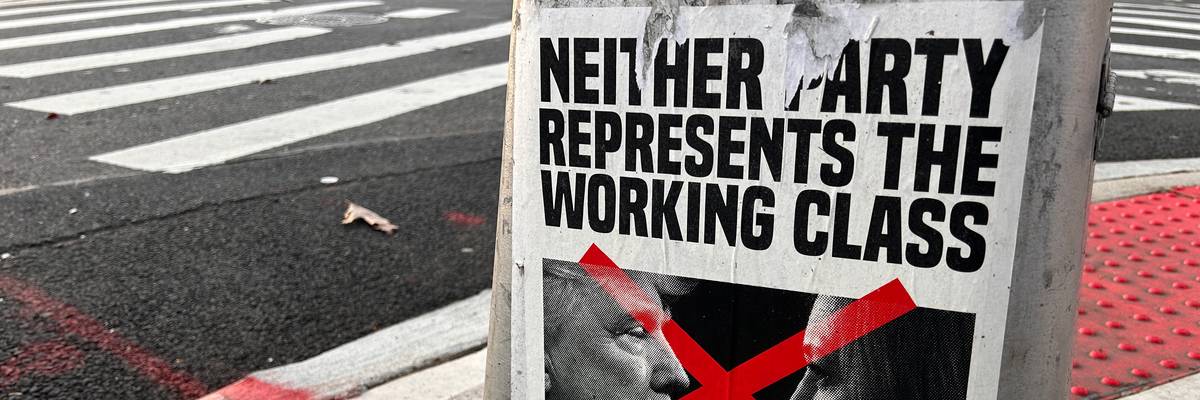
A "Neither party represents the working class" political poster is seen on the street in Queens, New York.
The midterms showed voters want concentrated wealth and power challenged; a durable progressive realignment will require changing who gets recruited, financed, and treated as politically viable—not just changing the message.
Democrats’ sweeping midterm victory has rightly been described as an economic-populist wave. Across the country, candidates won by challenging billionaire influence, rising costs, corporate power, and an economy that too often leaves working people behind.
But there is another question progressives should ask now: If working-class power is the answer, who actually gets the chance to exercise political power?
I spent nearly two decades working behind the scenes on labor, consumer protection, technology, and artificial intelligence policy before entering electoral politics for the first time this year. I ran for Congress as an independent in New York’s 12th District. Together with another fellow independent, Karen Ortiz, we went through this experience from having to get on the ballot by collecting over 3,500 signatures to the general election.
People do not need someone else to become their voice. They need institutions that give them the tools, relationships, resources, and room to exercise their own power.
In the end, I came out of that campaign with more respect for voters and less confidence in the structures we use to understand and represent them.
Running outside the party machinery gave me an unusually direct look at what happens before voters ever cast a ballot.
Political institutions help determine who is encouraged to run, who knows donors, who can afford to stop working, who receives institutional support, who gets invited into important rooms, and who gets treated as a viable candidate.
By the time we tell voters that democracy has given them a choice, institutions have often made hundreds of choices about who will reach them.
New research from political scientists Nicholas Carnes and Noam Lupu makes the consequences stark. Working-class jobs make up roughly 70% of occupations in the average democracy they studied, yet only about 2% of national legislators previously held working-class jobs. Their research also finds that the disparity is not explained by workers being less interested in running, less qualified, or less attractive to voters.
Much of the filtering happens earlier.
Running for office requires time, income, professional flexibility, privacy, and a willingness to assume enormous personal risk. Those burdens are much easier to absorb if you have wealth, flexible employment, or professional networks.
Party gatekeepers, meanwhile, operate under intense pressure to win. They understandably gravitate toward people they know and candidates who already appear financially and professionally equipped to survive a campaign.
The result can become a self-reinforcing political class.
My campaign gave me a smaller window into the same machinery.
We ran independently and rejected corporate PAC, super PAC, and dark-money support. We spent enormous amounts of time talking with Democrats, Republicans, independents, and unaffiliated voters rather than concentrating only on people a political model told us we could win.
That is inefficient by the standards of modern campaigning.
Modern campaigns are built to sort base voter, swing voter, donor, low-propensity voter, progressive, moderate, independent.
Those categories have practical uses. But people routinely violated them.
A worker could want stronger labor protections and still distrust the government. A small-business owner could want tougher corporate regulation. A Republican could worry about workplace surveillance and artificial intelligence. A Democrat could be furious about billionaire influence in their own party.
The political categories were often cleaner than the people.
The electorate itself is also becoming less attached to those categories. Gallup found that a record 45% of American adults identified as independents in 2025, compared with 27% each identifying as Democrats and Republicans. In New York City, unaffiliated voters now make up more than one-fifth of registered voters, and nearly half are under 40.
That does not mean these voters are centrists. It certainly does not mean they are automatically progressive.
It suggests something more fundamental: Millions of Americans do not see the existing parties as complete expressions of who they are politically.
Progressives should see both an opportunity and a warning.
If the lesson of 2026 becomes simply that Democrats need better working-class messaging, we will have missed the deeper challenge.
Professional politicians becoming better at talking about working-class life is not the same as working people possessing political power themselves.
History shows that representation changes when institutions change.
When unions possessed greater political strength in countries like Britain and Germany, they did more than endorse politicians. They recruited workers, financed candidates, supplied organizers, and created pathways into government for people who otherwise faced enormous obstacles to running.
There are examples here at home.
I saw the same principle from another direction during my years at Coworker.org. Coworker was built on a simple idea: Workers who may not have a union or traditional organizing infrastructure still need ways to build power themselves. Over its first decade, more than 500,000 workers connected, organized, and advocated through the network, generating more than 3 million actions and 2 million petition signatures. Some campaigns began with a single worker asking for a workplace change and grew into durable networks, including early Starbucks worker organizing that helped lay groundwork for a much larger movement.
What I learned there was that people do not need someone else to become their voice. They need institutions that give them the tools, relationships, resources, and room to exercise their own power.
Imagine taking that idea seriously at scale.
Public financing could reduce candidates’ dependence on wealthy networks. Income replacement or political scholarships could allow workers to run without risking financial ruin. Right-to-return protections could make candidacy less dangerous for people who cannot simply leave their careers. Unions and community organizations could create candidate pipelines rooted in workplaces and neighborhoods rather than professional political circles.
And none of this substitutes for building power outside government.
Workers will have more influence inside legislatures when they have more leverage in workplaces, unions, neighborhoods, and durable civic organizations. Elections cannot be the only moment when ordinary people exercise power.
Democrats won an extraordinary election.
But victory creates its own blind spot.
The party that loses must ask what went wrong. The party that wins can convince itself that nothing is wrong.
Economic populism helped produce this moment. The next step cannot simply be adopting its language.
If progressives believe politics should serve working people, then working people need a much greater role in making politics.
The challenge after 2026 is not only to win more working-class votes.
It is to change who gets to lead.
This country and this world are at a monumental crossroads. US voters have an opportunity to beat back the forces of fascism and confront the billionaires who are rigging the economy, our media system, and our democracy, making it increasingly impossible for ordinary people to get by. We’re not just talking about the election. We’re talking about what must be done once these fascist elements are vanquished from power. We need a bolder set of solutions than what either major party has so far been willing to offer and a working-class movement ready to fight like hell for it. Trump didn't emerge from nowhere. The conditions that fueled MAGA authoritarianism were created by decades of radical neoliberal economic policies and a corrupt political system dominated by corporate interests. They slashed taxes on the super-rich, promising that the benefits would trickle down. They said giveaways to the corporate titans would make life more affordable for the rest of us. It was all bullshit. And when a bitter, betrayed populace searches for someone to blame, right-wing demagogues have little trouble finding scapegoats. People know when they're being lied to, but you won't hear any of this from the corporate media. Only independent journalism—powered and funded by people who believe in building a better world—can deliver truly trustworthy daily news. If you share our vision, please contribute whatever you can to sustain our work. |
Democrats’ sweeping midterm victory has rightly been described as an economic-populist wave. Across the country, candidates won by challenging billionaire influence, rising costs, corporate power, and an economy that too often leaves working people behind.
But there is another question progressives should ask now: If working-class power is the answer, who actually gets the chance to exercise political power?
I spent nearly two decades working behind the scenes on labor, consumer protection, technology, and artificial intelligence policy before entering electoral politics for the first time this year. I ran for Congress as an independent in New York’s 12th District. Together with another fellow independent, Karen Ortiz, we went through this experience from having to get on the ballot by collecting over 3,500 signatures to the general election.
People do not need someone else to become their voice. They need institutions that give them the tools, relationships, resources, and room to exercise their own power.
In the end, I came out of that campaign with more respect for voters and less confidence in the structures we use to understand and represent them.
Running outside the party machinery gave me an unusually direct look at what happens before voters ever cast a ballot.
Political institutions help determine who is encouraged to run, who knows donors, who can afford to stop working, who receives institutional support, who gets invited into important rooms, and who gets treated as a viable candidate.
By the time we tell voters that democracy has given them a choice, institutions have often made hundreds of choices about who will reach them.
New research from political scientists Nicholas Carnes and Noam Lupu makes the consequences stark. Working-class jobs make up roughly 70% of occupations in the average democracy they studied, yet only about 2% of national legislators previously held working-class jobs. Their research also finds that the disparity is not explained by workers being less interested in running, less qualified, or less attractive to voters.
Much of the filtering happens earlier.
Running for office requires time, income, professional flexibility, privacy, and a willingness to assume enormous personal risk. Those burdens are much easier to absorb if you have wealth, flexible employment, or professional networks.
Party gatekeepers, meanwhile, operate under intense pressure to win. They understandably gravitate toward people they know and candidates who already appear financially and professionally equipped to survive a campaign.
The result can become a self-reinforcing political class.
My campaign gave me a smaller window into the same machinery.
We ran independently and rejected corporate PAC, super PAC, and dark-money support. We spent enormous amounts of time talking with Democrats, Republicans, independents, and unaffiliated voters rather than concentrating only on people a political model told us we could win.
That is inefficient by the standards of modern campaigning.
Modern campaigns are built to sort base voter, swing voter, donor, low-propensity voter, progressive, moderate, independent.
Those categories have practical uses. But people routinely violated them.
A worker could want stronger labor protections and still distrust the government. A small-business owner could want tougher corporate regulation. A Republican could worry about workplace surveillance and artificial intelligence. A Democrat could be furious about billionaire influence in their own party.
The political categories were often cleaner than the people.
The electorate itself is also becoming less attached to those categories. Gallup found that a record 45% of American adults identified as independents in 2025, compared with 27% each identifying as Democrats and Republicans. In New York City, unaffiliated voters now make up more than one-fifth of registered voters, and nearly half are under 40.
That does not mean these voters are centrists. It certainly does not mean they are automatically progressive.
It suggests something more fundamental: Millions of Americans do not see the existing parties as complete expressions of who they are politically.
Progressives should see both an opportunity and a warning.
If the lesson of 2026 becomes simply that Democrats need better working-class messaging, we will have missed the deeper challenge.
Professional politicians becoming better at talking about working-class life is not the same as working people possessing political power themselves.
History shows that representation changes when institutions change.
When unions possessed greater political strength in countries like Britain and Germany, they did more than endorse politicians. They recruited workers, financed candidates, supplied organizers, and created pathways into government for people who otherwise faced enormous obstacles to running.
There are examples here at home.
I saw the same principle from another direction during my years at Coworker.org. Coworker was built on a simple idea: Workers who may not have a union or traditional organizing infrastructure still need ways to build power themselves. Over its first decade, more than 500,000 workers connected, organized, and advocated through the network, generating more than 3 million actions and 2 million petition signatures. Some campaigns began with a single worker asking for a workplace change and grew into durable networks, including early Starbucks worker organizing that helped lay groundwork for a much larger movement.
What I learned there was that people do not need someone else to become their voice. They need institutions that give them the tools, relationships, resources, and room to exercise their own power.
Imagine taking that idea seriously at scale.
Public financing could reduce candidates’ dependence on wealthy networks. Income replacement or political scholarships could allow workers to run without risking financial ruin. Right-to-return protections could make candidacy less dangerous for people who cannot simply leave their careers. Unions and community organizations could create candidate pipelines rooted in workplaces and neighborhoods rather than professional political circles.
And none of this substitutes for building power outside government.
Workers will have more influence inside legislatures when they have more leverage in workplaces, unions, neighborhoods, and durable civic organizations. Elections cannot be the only moment when ordinary people exercise power.
Democrats won an extraordinary election.
But victory creates its own blind spot.
The party that loses must ask what went wrong. The party that wins can convince itself that nothing is wrong.
Economic populism helped produce this moment. The next step cannot simply be adopting its language.
If progressives believe politics should serve working people, then working people need a much greater role in making politics.
The challenge after 2026 is not only to win more working-class votes.
It is to change who gets to lead.