

SUBSCRIBE TO OUR FREE NEWSLETTER
Daily news & progressive opinion—funded by the people, not the corporations—delivered straight to your inbox.
5
#000000
#FFFFFF
To donate by check, phone, or other method, see our More Ways to Give page.
Daily news & progressive opinion—funded by the people, not the corporations—delivered straight to your inbox.
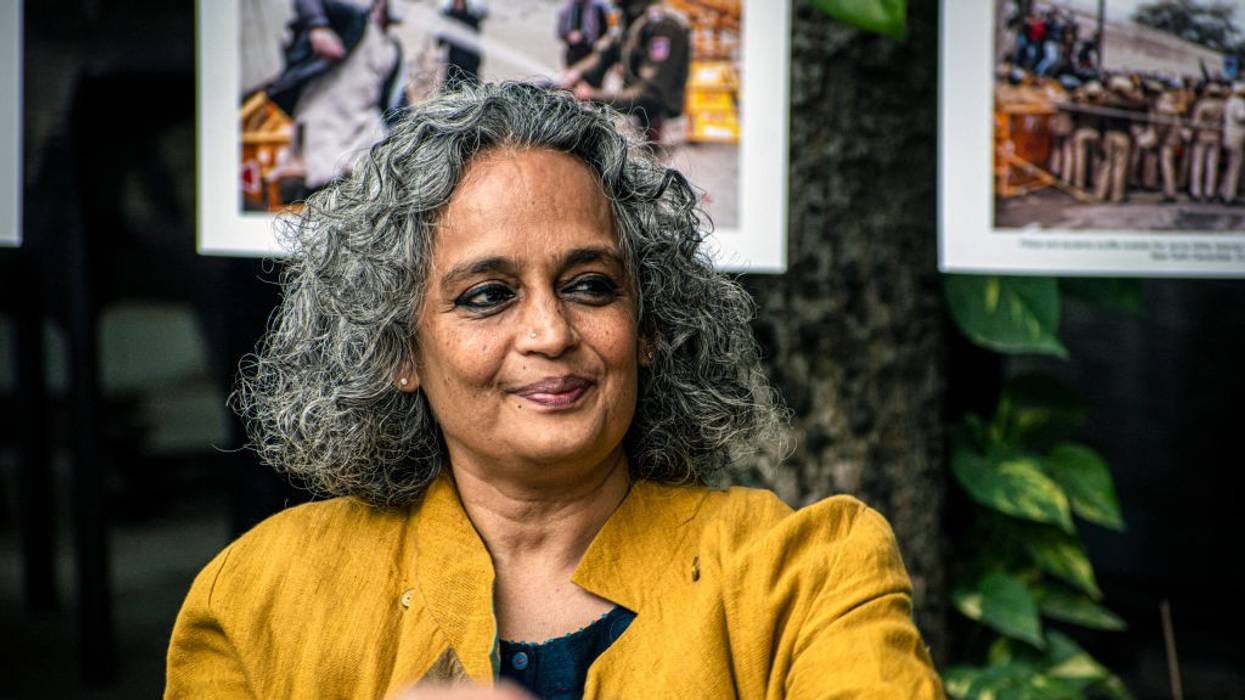
"It is our responsibility to show that as people of India, we refuse to be complicit in that, even if our government wishes to continue with what it does."
Acclaimed Indian author and activist Arundhati Roy this week joined prominent jurists, diplomats, artists, and others in urging their government to stop selling weapons to Israel, which they called "abominable" and "a serious violation of India's obligations under international law and our Constitution."
Speaking Thursday at an event organized by the Press Club of India, Roy—winner of the 1997 Booker Prize for her debut novel The God of Small Things—said that Indians must "at least show that we do not support that murder in Gaza, we do not support our government's support of that."
"What is happening in Gaza, it is not just the murder… of tens of thousands of women and children," she continued. "It is the bombing of hospitals, the destruction of universities… the attempt to erase the very memory people have of that place. It is a genocide like no other because it's taking place on live TV."
"The Indian government is complicit in the genocide that Israel is conducting in Gaza."
"India used to be a country that supported the people of Palestine in their struggle for freedom," Roy noted. "Everywhere, even in the United States… people are standing up against their government's support for [Israel]. But we are not standing up… and that is such a shame."
"We must stand up. We must refuse," she asserted. "We will not support the export of weapons of any kind."
"The Indian government is complicit in the genocide that Israel is conducting in Gaza," Roy added. "It is our responsibility to show that as people of India, we refuse to be complicit in that, even if our government wishes to continue with what it does. We want these weapons exports to stop immediately."
Roy is one of more than two dozen former Indian Supreme Court justices and other judges, foreign service officers, academics, artists, activists, and others who on Wednesday sent a letter to Indian Defense Minister Rajnath Singh urging him to halt the licensing of arms sales to Israel, whose military forces have killed or wounded more than 140,000 Palestinians while obliterating and starving Gaza.
"The International Court of Justice (ICJ) has clearly ruled that Israel is in violation of obligations under the Genocide Convention and further that Israel is in illegal occupation of the occupied Palestinian territory," the letter states. "In light of these rulings, any supply of military material to Israel would amount to a violation of India's obligations under international humanitarian law and the mandate of Article 21 read with Article 51(c) of the Constitution of India."
Among the weapons India has sent to Israel are Hermes 900 unmanned aerial drones, which are co-manufactured with Israeli arms company Elbit Systems. The letter notes that the drones "have been extensively used in the Israeli Defense Forces' military campaign in Gaza."
"Several [United Nations] experts have warned that the transfer of weapons and ammunition to Israel may constitute serious violations of human rights and international humanitarian laws, and risk state complicity in international crimes, possibly including genocide, reiterating their demand to stop transfers immediately," the letter's signer wrote.
"In short, the grant of licenses and approvals for export of military material to Israel, coupled with reports of such exports by Indian companies, constitutes a serious violation of India's obligations under international law and our own Constitution," the letter stresses.
"International law aside, we consider such exports to be morally objectionable, indeed abominable," the signatories added. "We demand, therefore, that India should immediately suspend its collaboration in the delivery of military material to Israel. Further, India must immediately make every effort to ensure that weapons already delivered to Israel are not used to contribute to acts of genocide or violations of international humanitarian law."
The letter came ahead of planned nationwide protests by Indian leftists on Saturday calling for an end to arms sales and "all forms of complicity with Israel's illegal occupation and genocide."
India—which in 1971 invaded Bangladesh (then East Pakistan) in large part to end a U.S.-backed Pakistani genocide mostly targeting Bengalis—voted in favor of the December U.N. Security Council resolution calling for an immediate Gaza cease-fire.
However, the administration of Indian Prime Minister Narendra Modi and many lawmakers from his right-wing Bharatiya Janata Party have expressed steadfast support for Israel and its Gaza onslaught. Critics have noted that both Israel and India are occupying Muslims, the former in Palestine and the latter in Jammu and Kashmir.
In an interview with Middle East Eye published Friday, Roy—who faces prosecution in India over comments she allegedly made nearly 15 years ago regarding Kashmir—said that India could "forever be linked to genocide" if it does not change course.
"India needs to stop the export of weapons to Israel and ensure the return of Indian workers who have been sent to Israel to replace Palestinian workers," she said.
"If it does not do so at once, it is in violation of the orders of the ICJ," she added. "It will forever be complicit in aiding and abetting a genocide that is being telecast live for the world to watch."
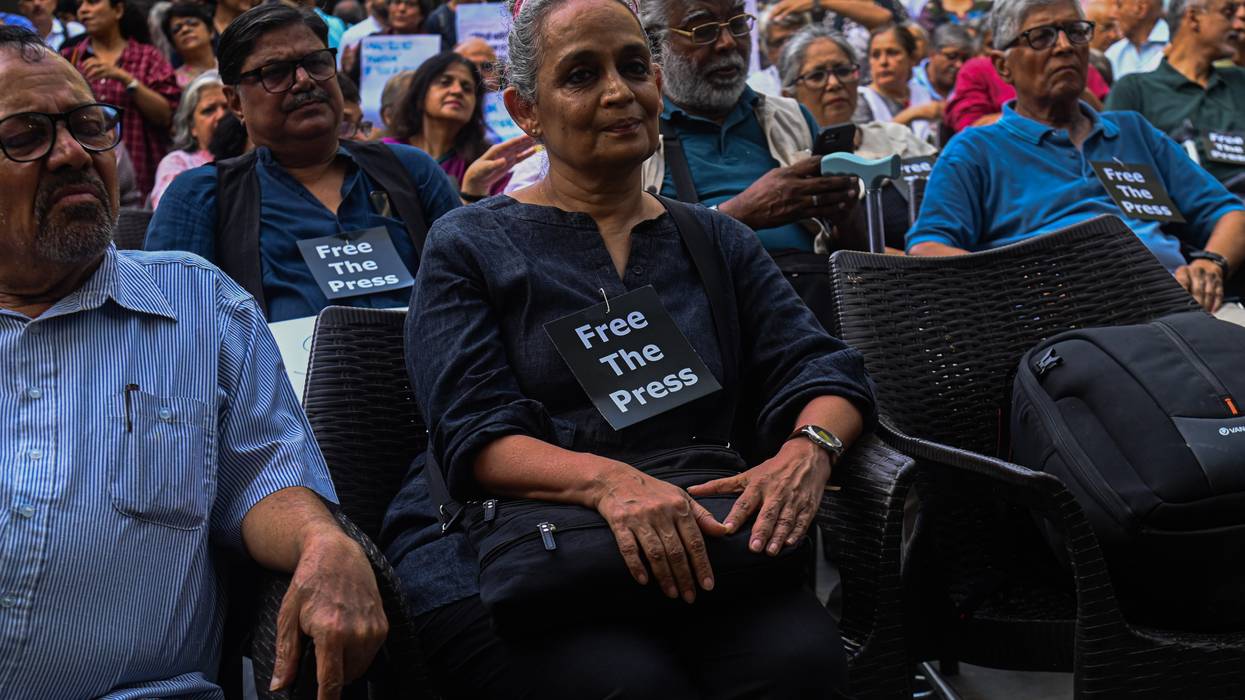
The novelist and activist forewarned that "economic totalitarianism" would run riot over the lives of the poor and that political promises for "development" would act as cover for extraction, exploitation, and colonization. Those predictions have now come to pass.
On 14 June, Indian authorities gave the go-ahead for the prosecution of acclaimed Indian novelist Arundhati Roy over her comments about Kashmir made back in 2010.
Roy, a Booker Prize-winning author and activist, was accused of sedition and disrupting social harmony under Section 45 (1) of the Unlawful Activities (Prevention) Act (UAPA), India's counterterrorism law.
Delhi's Lieutenant Governor VK Saxena also named 70-year-old Kashmiri former professor Sheikh Showkat Hussain for his comments on Kashmir made at the same event in New Delhi.
There would have been others who may have been named, but they are either already in jail or dead.
Even if the absurd case against Roy is meant to rile up the Hindu nationalist base and manufacture a media spectacle and the state does not proceed with arrest or prosecution, how do Indian liberals and the international community expect to explain the hundreds of people already in jail, mostly held without charge, under the UAPA or Public Safety Act (PSA) in Kashmir?
The farcical developments in New Delhi come just days after Prime Minister Narendra Modi returned to power, albeit with a lesser margin, what some liberals in India had hoped would taper the country's descent into fascism and authoritarianism.
Instead, the Hindu nationalist state is already back to the business of stirring up its right-wing base by reminding them of the "anti-national" demons that continue to lurk in its midst.
Yesterday, it was "infiltrator" Muslims. Today, it is one of the world's most celebrated literary icons.
And as the state is well aware, little can be done to stop it.
The assault on 62-year-old Roy has already prompted a media spectacle in the Indian and international press.
But other than repeating ad nauseum statements about the "death of democracy" and the absurdity of India's Hindu nationalist government's policing of free speech, what this attack on this extraordinary writer and thinker tells us about the Indian state and the effort it has made to hide its own history, is likely to go over everyone's heads.
Let me explain.
It was, by all measures, an historic event.
Those who attended the event, "Azadi: The Only Way," in October 2010 at the Litte Theatre Group auditorium recall it as being packed beyond capacity.
They stood on their toes at the back, sat cross-legged in the aisles, and craned their heads to listen in. The venue, designed for 327 people, easily held more than 500.
Whereas the rise of Hindu nationalism has also reached Western shores and drawn naive surprise, it is unlikely that liberal discourse over the attack on Roy will focus on what she said about India rather than her right to speak.
Organised by an India-based group called the Committee For the Release of Political Prisoners (CRPP), the event came as an urgent intervention following months of unrest in Kashmir against Indian rule during the summer of 2010.
The killing of 17-year-old Tufail Mattoo brought people to the streets in an uprising that was met by a vicious crackdown by the Indian state.
The boy was walking home from school when a tear gas canister fired by an Indian police officer tore a hole through his skull.
More than 120 young civilians, mostly boys, were killed on the streets by Indian troops.
In their communique about the event, the CRPP said they had organised the public discussion to inform Indians about how their government had misled them about Kashmir. In his introduction, SAR Geelani, a Kashmiri and the then-working president of the CRPP, said the committee had sought to clarify the terms of the dispute, to explain what azadi (freedom) meant, and to make clear it was up to the people of Kashmir to determine their future.
Several speakers were present, including Hussain, Roy, and Syed Ali Shah Geelani, leader of the Hurriyat Conference, whose mandate was a call for freedom from India.
There were other speakers, too, who reminded the audience that Kashmir was not the only anathema to the "Indian nation."
There were, after all, other areas like Manipur, Nagaland, and Assam that faced immense state repression.
When Roy eventually spoke, she laid out the facts.
In her charismatic, rhapsodic style, she narrated how she had been asked repeatedly if Kashmir was integral to India, to which she answered unequivocally: "Kashmir has never been an integral part of India," adding that Delhi had admitted as much itself by taking the issue to the United Nations.
She then proceeded to underscore how India had emerged from the ashes of colonial rule to become a colonising entity of its own.
"The British drew the map of India in 1899—so that country [India] became a colonising power the moment it became independent, and the Indian state has militarily intervened in Manipur, in Nagaland, in Mizoram, in Kashmir, in Telangana, during the Naxalbari uprising, in Punjab, in Hyderabad, in Goa, in Junagarh," Roy said.
She continued, poking at India's self-image as a "secular state."
"We know today that this word 'secularism' that the Indian state flings at us is a hollow word because you can't kill 68,000 Kashmiri Muslims and then call yourself a secular state," Roy said, referring to the death toll in Kashmir since 1990.
The event, of course, was recorded and reported widely in the Indian press.Weeks after the event, Roy, along with Hussain, SAR Geelani, and Syed Ali Shah Geelani, were reported to the police for sedition.
In response, Roy penned a remarkable riposte in the Indian daily, The Hindu.
In her article, "They can file a charge posthumously against Jawaharlal Nehru too," she listed all the times Nehru, India's first prime minister, had conceded that Kashmir was not an integral part of India during the early stages of the dispute in 1947.
At the time of partition of the subcontinent in August 1947, Kashmir was a princely state that hadn't yet decided to join either the states of India or Pakistan.
But two months later, the Maharajah temporarily acceded to India in exchange for help against Pathan fighters who had come to the region to challenge his assault on the majority Muslim population in what became a series of massacres and ethnic cleansing that cost more than 200,000 Muslim lives and displaced hundreds of thousands more.
Historians refer to this horror as the Jammu Massacre.
At first, India agreed to the principle of a plebiscite, but over time that changed. The Indian nationalist slogan "Kashmir is integral to India" became no different from "Algeria is France," as uttered by French President Francois Mitterand.
In her response to claims of sedition, Roy alluded to communication between then-Prime Minister Nehru and the Pakistani government.
"In his telegram... Nehru said, 'I should like to make it clear that the question of aiding Kashmir in this emergency is not designed in any way to influence the state to accede to India. Our view which we have repeatedly made public is that the question of accession in any disputed territory or state must be decided in accordance with wishes of people and we adhere to this view,'" Roy wrote.
"In another telegram to the PM of Pakistan, Pandit Nehru said, 'We accepted Kashmir's accession to India at the request of the Maharaja's government and the most numerously representative popular organisation in the state which is predominantly Muslim.' Even then it was accepted on condition that as soon as law and order had been restored, the people of Kashmir would decide the question of accession. It is open to them to accede to either Dominion then," she added.
She went on to list several other communiques from Nehru that confirmed the facts of India's forced dominion over Kashmir.
It didn't matter. As someone who has consistently opposed big dam projects, objected to Delhi's nuclear tests, and refused literary awards from the government, she was nonetheless condemned by the mainstream, including both the Congress and Bharatiya Janata Party (BJP) party.
But then, the media storm eventually passed. The case was neither pursued nor withdrawn; it was a card left for another day.
When Modi became prime minister in 2014, his newly installed Hindu nationalist government immediately embarked on carving away at the remaining vestiges of democracy that had, at the very least, given India the illusion of being a democracy.
The judiciary was attacked, the media was captured, and civil society was hounded into submission. Under Modi, India moved from a Hindu majority state (despite its touted secularism) to a Hindu Rashtra, or a Hindu state, in the mould of an ethnocracy, much like Israel.
And like Israel, India continued to evade democratic processes and institutions, like elections, civil society, the press, and the judiciary. These were hollowed-out institutions operating to the dictums of Hindu majoritarianism.
As much as this is a case about targeting Roy (and Hussain) for their dissent, this story is incomplete without locking horns with the original myths of Indian democracy or reckoning with the ways in which India routinely demonises Kashmiris or those who dare sympathise with their cause as a way to foment social cohesion.
In Israel's case, it is a nation for Jews. In India, it is a nation for Hindus. All those outside these categories are second-class citizens and disposable. Modi managed to push through the Citizenship Amendment Act (CAA) and make citizenship for refugees contingent on religion.
The government used the UAPA as a means to quash dissent under the pretext of "national security."
The levelling of civil society under Modi was so dire that even Amnesty International's India office was forced to shut down. The only other Amnesty country office to shut down was in Russia.
Several human rights organisations, too, have either downgraded India's democracy or issued warnings of rising authoritarianism, even raising the prospect of genocide of Muslims in India.
Even the U.S. State Department's most recent Religious Freedom Report slammed India for its treatment of religious minorities. A year prior, the U.S. Holocaust Memorial Museum cautioned that the risk of mass atrocities in India against religious minorities was rising.
In other words, India's "democratic descent," though still poorly reported in the mainstream Western press, is no longer a well-kept secret.
As the mainstream media would attest, it is especially difficult to ignore visuals of vigilantes parading through the streets lynching Muslims for marrying a Hindu woman or on suspicion of carrying or eating beef, or more recently, when the prime minister himself publicly calls Muslims "infiltrators."
But whereas the rise of Hindu nationalism has also reached Western shores and drawn naive surprise, it is unlikely that liberal discourse over the attack on Roy will focus on what she said about India rather than her right to speak.
The knee-jerk reaction to reduce India's so-called recent travails to one specifically linked to the rise of Hindu nationalism does little justice to the India that Roy has committed so much of her life to exposing.
This is more than a mere matter of a right to free speech.
It will soon be nine months since Israel's genocidal war against the Palestinians in Gaza began.
One of the key revelations from this war in the West has been the consolidation of what is known as the "Palestine Exception" to free speech.
University professors have been placed on leave, students suspended, protesters arrested, cafe staff discharged, and award-winning nurses fired, all in the name of opposing the genocide.
In India, even prior to Modi, the exception has always been Kashmir.
Roy is part of a legion of deviants whose recollection pokes at the sentiment of the nation built on a myth of anticolonialism and Gandhi and Nehruvian egalitarianism.
Of course, under Modi, these faultlines have deepened—use of the UAPA has expanded—as the fascist state has become even more insecure, desperate to clasp on to a uniformity of thought, behaviour, and loyalty to the dear leader.
Ending Kashmir's semi-autonomous status and annexing Kashmir—as he did when he ended Articles 370 and Article 35A—represented a central plank of Modi's electoral campaign in 2019.
Kashmir, as Hindu nationalists have made clear, remains foundational to the Hindu nationalist vision of an Akhand Bharat or Undivided India. Modi's actions in 2019, therefore, paved the way for Indians to become legal residents in Kashmir.
It would facilitate the Indian nationalist dream of demographic change in Kashmir. In late 2019, an Indian envoy in New York boasted as much, promising to emulate the Israeli settler model in Kashmir. Some days ago, in the midst of the genocide against the Palestinians, a right-wing Indian commentator called for an "Israel-like" solution in Kashmir.
Yet, as much as this is a case about targeting Roy (and Hussain) for their dissent, this story is incomplete without locking horns with the original myths of Indian democracy or reckoning with the ways in which India routinely demonises Kashmiris or those who dare sympathise with their cause as a way to foment social cohesion.
The question has to be asked: Even if the absurd case against Roy is meant to rile up the Hindu nationalist base and manufacture a media spectacle and the state does not proceed with arrest or prosecution, how do Indian liberals and the international community expect to explain the hundreds of people already in jail, mostly held without charge, under the UAPA or Public Safety Act (PSA) in Kashmir?
For decades, there have been special laws in Kashmir, like the Armed Powers Special Powers Act (AFPSA), which allow the Indian army to shoot to kill or arrest persons on the grounds of "mere" suspicion. And that they have. Tens of thousands have been killed. Thousands of others have been disappeared. Since the 2010s, Indian troops have used pellets to maim and blind.
What will be the fate of those famous and not-so-famous civil society activists like Khurram Parvez, journalists like Irfan Mehraj, and several others? What of the Kashmiri female political prisoners in Tihar, like Asiya Andrabi, Sofi Fehmeeda, and Nahida Nasreen? How about the stripping away of Kashmiri journalists and activists' passports for daring to report on the situation or the criminalisation of several civil society organisations on the ground?
In 2022, more than 36% of all cases involving the UAPA took place in Jammu and Kashmir alone.
Men and women are merely picked up and held for months without reason.
And if we move away from Kashmir for a moment and consider that adjacent to these are several Indian prisoners of conscience, like Umar Khalid and Sharjeel Imam, both accused of sedition under the UAPA; human rights activists Rona Wilson, Arun Ferreira, Hany Babu, and Surendra Gadling, all charged with planning an insurgency against the government, during the Bhima Koregaon violence, back in 2018.
Their cases are so obviously absurd, too, that The Washington Post even found that two of the accused—Wilson and Gadling—had material planted by a hacker on their electronic devices and still nothing changed.
The drift towards fascism that Roy had forewarned, one in which "economic totalitarianism" would run riot over the lives of the poor, and prompts like "development" would cover for extraction, exploitation, and colonisation, has come to pass.
It was Roy, among a spirited handful in India, after all, who alluded to the collusion between big capital and the expansion of Hindu nationalism, highlighted Delhi's closeness with Israel and the U.S. on matters of military and geopolitical ambitions, and warned about the march toward a military state.
In this way, Roy is part of a legion of deviants whose recollection pokes at the sentiment of the nation built on a myth of anticolonialism and Gandhi and Nehruvian egalitarianism.
But in the end, India is just a big bully, built on both fragments of selective memory and collective amnesia.
If charged, Roy faces time in jail. And this could become an arduous, tiresome, even gruesome fight.
But as she would tell you herself, this seditious heart is not alone. Hers is one part of a fight for truth in a land of a thousand fictions.
"This is horrifying—a clear case of political persecution by an authoritarian government," one of Roy's publishers wrote.
Delhi Lieutenant Gov. V. K. Saxena has sanctioned the prosecution of world-renowned Indian author and activist Arundhati Roy over comments she allegedly made 14 years ago regarding Kashmir, officials from his office said on Friday.
Saxena is a member of Indian Prime Minister Narendra Modi's ruling Bhartiya Janata Party (BJP), and Roy has been a vocal critic of Modi and what she has described as India's "descent... into full-blown fascism" under BJP leadership.
"This is horrifying—a clear case of political persecution by an authoritarian government" Seven Stories Press, which publishes Roy's work, wrote on social media in response to the news.
"This kind of fascism is exactly what Indians have voted against."
Along with Roy, Saxena also sanctioned the prosecution of former Central University of Kashmir international law professor Sheikh Showkat Hussain. The charges originate from a conference the two attended in New Delhi titled "Azadi: The Only Way" on October 21, 2010, according to Indian media.
During the conference, Roy allegedly said that Kashmir—a disputed territory that is administered partly by Pakistan and partly by India, and where the Indian occupation has committed human rights abuses—"has never been an integral part of India."
On October 28, 2010, a first information report (FIR) naming Roy, Hussain, and other co-defendants who have since died was registered in the New Delhi's Court of Metropolitan Magistrate. A FIR is a document that law-enforcement officials file after receiving actionable information about a potential offense.
"The issues discussed and spoken about at the conference propagated the 'separation of Kashmir from India,'" the governor's office said.
Friday's sanction allows the prosecution of Roy and Hussain under a part of India's controversial Unlawful Activities (Prevention) Act (UAPA) related to sedition. It follows Saxena's decision in October of last year to allow the case to move forward under different sections of the Indian Penal Code.
As the Independent explained:
The UAPA allows the authorities to detain suspects for up to 180 days without any charges. It was tweaked by the Modi administration in 2019 so that individuals could be classified as terrorists without necessarily being linked to a designated terror group. A total of 1,948 people were arrested in 2019 after the change came into force, marking an uptick of almost 37% from the previous year.
The new development comes a little more than a week after Modi's BJP failed to win a majority in India's elections for the first time since 2014. While Modi retained control of the government through his coalition partners, the better-than-expected performance of the opposition was widely seen as a setback for the right-wing leader, and some critics thought the election results and the prosecution of Roy might be related.
"If by prosecuting Arundhati Roy under UAPA the BJP are trying to prove they're back, well they're not. And they'll never be back the same way they were," member of parliament Mahua Moitra from the opposition Trinamool Congress Party said, adding, "This kind of fascism is exactly what Indians have voted against."
Other Indian opposition politicians spoke out against the targeting of Roy.
The Communist Party of India (Marxist) said the move was "condemnable" and that prosecuting Roy for a speech made 14 years ago "defies logic except the fascist kind," as The Guardian reported.
"Timing is suspect since courts are on vacation, as are lawyers," the party added.
Communist Party of India leader D. Raja also said that the "timing is highly questionable" and added that "it appears to be a political vendetta."
Several well-known authors and activists expressed solidarity with the 62-year-old Roy, who won the Booker Prize in 1997 for her novel The God of Small Things.
"Solidarity with Arundhati Roy," author Hari Kunzru posted on social media. "Modi has been out to get her since the days when she spoke out about his complicity in the 2002 Gujarat riots. She once told me a terrifying story about having to escape via the roof of an Ahmedabad guesthouse when police came to question her."
Author Amitav Ghosh said: "The hounding of Arundhati Roy is absolutely unconscionable. She is a great writer and has a right to her opinion. There needs to be an international outcry about the case that has been brought against her for something she said a decade ago."
Poet Zeeshan Joonam wrote: "The attempt to silence the legendary writer Arundhati Roy from India must be condemned by all free speech advocates. She has done nothing wrong. She is an intellectual and moral giant."
Former Greek Finance Minister and leader of the pan-European leftist political party DiEM25 Yanis Varoufakis, meanwhile, issued a challenge to the international community.
"Only yesterday I was expressing concern over the rumors that Arundhati Roy might be Modi's next political prisoner. A day later the rumor is becoming a reality," Varoufakis posted on social media. "Will there be an uproar in the 'civilized' West? Or will complicity be the order of the day a la Assange?"
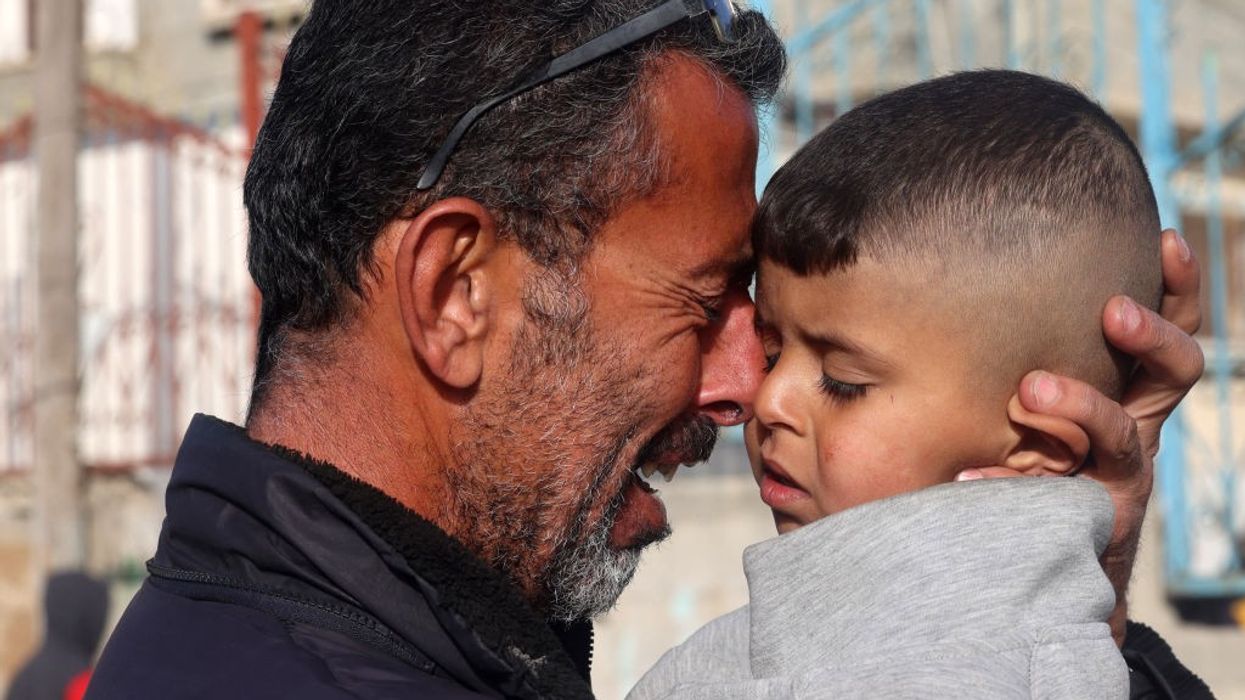
The Palestinians, facing down the most powerful countries in the world, left virtually alone even by their allies, have suffered immeasurably. But they have won this war.
The following is a statement written by Arundhati Roy and delivered on her behalf at the meeting of Working People Against Apartheid and Genocide in Gaza, at the Press Club, New Delhi, on Thursday March 7, 2024. The remarks were first published by Scroll, an independent media outlet in India.
The richest, most powerful countries in the Western world, those who believe themselves to be the keepers of the flame of the modern world’s commitment to democracy and human rights, are openly financing and applauding Israel’s genocide in Gaza. The Gaza strip has been turned into a concentration camp. Those who have not already been killed are being starved to death. Almost the entire population of Gaza has been displaced. Their homes, hospitals, universities, museums, and infrastructure of every kind has been reduced to rubble. Their children have been murdered. Their past has been vaporized. Their future is hard to see.
Even though the highest court in the world believes that almost every indicator seems to meet the legal definition of genocide, IDF soldiers continue to put out their mocking “victory videos” celebrating what almost looks like fiendish rituals. They believe that there is no power in the world that will hold them to account. But they are wrong. They and their children’s children will be haunted by what they have done. They will have to live with the loathing and the abhorrence the world feels for them. And hopefully one day everybody – on all sides of this conflict – who has committed war crimes will be tried and punished for them, keeping in mind that there is no equivalence between crimes committed while resisting Apartheid and Occupation, and crimes committed while enforcing them.
They and their children’s children will be haunted by what they have done. They will have to live with the loathing and the abhorrence the world feels for them.
Racism is of course the keystone of any act of genocide. The rhetoric of the highest officials of the Israeli state has, ever since Israel came into existence, dehumanized Palestinians and likened them to vermin and insects, just like the Nazis once dehumanized Jews. It is as though that evil serum never went away and is now only being recirculated. The “Never” has been excised from that powerful slogan “Never Again”. And we are left only with “Again”.
Never Again.
President Joe Biden, head of state of the richest, most powerful country in the world, is helpless before Israel, even though Israel would not exist without US funding. It’s as though the dependent has taken over the benefactor. The optics say so. Like a geriatric child, Joe Biden appears on camera licking an ice-cream cone and vaguely mumbling about a ceasefire, while Israeli government and military officials openly defy him and vow to finish what they have started. To try and stop the hemorrhaging of the votes of millions of young Americans who will not stand for this slaughter in their name, Kamala Harris, US vice-president, has been tasked with the job of calling for a ceasefire, while billions of US dollars continue to flow to enable the genocide.
And what of our country?
It is well known that our prime minister is an intimate friend of Benjamin Netanyahu and there is no doubt where his sympathies lie. India is no longer a friend of Palestine. When the bombing began, thousands of Modi’s supporters put up the Israeli flag as their DP on social media. They helped spread the vilest disinformation on behalf of Israel and the IDF. Even though the Indian government has now stepped back into a more neutral position – our foreign policy triumph is that we manage to be on all sides at once, we can be pro- as well as anti-genocide – the government has clearly indicated that it will act decisively against any pro-Palestine protestors.
President Joe Biden, head of state of the richest, most powerful country in the world, is helpless before Israel, even though Israel would not exist without US funding. It’s as though the dependent has taken over the benefactor.
And now, while the US exports what it has in abundant surplus – weapons and money to aid Israel’s genocide – India too is exporting what our country has in abundant surplus: the unemployed poor to replace the Palestinian workers who will no longer be given work permits to enter Israel. (I’m guessing there will be no Muslims among the new recruits.) People who are desperate enough to risk their lives in a war zone. People desperate enough to tolerate overt Israeli racism against Indians. You can see it expressed on social media, if you care to look. US money and Indian poverty combine to oil Israel’s genocidal war machine. What a terrible, unthinkable, shame.
The Palestinians, facing down the most powerful countries in the world, left virtually alone even by their allies, have suffered immeasurably. But they have won this war. They, their journalists, their doctors, their rescue teams their poets, academics, spokespeople, and even their children have conducted themselves with a courage and dignity that has inspired the rest of the world. The young generation in the Western world, particularly the new generation of young Jewish people in the US, have seen through the brainwashing and propaganda and have recognized apartheid and genocide for what it is. The governments of the most powerful countries in the Western world have lost their dignity, and any respect they might have had. Yet again. But the millions of protestors on the streets of Europe and the US are the hope for the future of the world.
Palestine will be free.

"You have no idea what you will unleash if you pursue this political prosecution aimed at silencing your most eloquent critic," Canadian author Naomi Klein warned Indian Prime Minister Narendra Modi.
Progressive writers and advocates around the world on Tuesday rallied behind acclaimed Indian author and activist Arundhati Roy after a top New Delhi official reportedly approved her prosecution for allegedly advocating for the secession of the disputed and brutally occupied Kashmir region during a "provocative" 2010 speech.
Indian media reported that Delhi Lt. Gov. V.K. Saxena breathed new life into a 2010 criminal complaint accusing Roy—winner of the 1997 Booker Prize for her debut novel The God of Small Things—of sedition for asserting that Kashmir "has never been an integral part of India."
Sources told The Hindu that a first information report (FIR)—a document prepared by law enforcement officials when they receive actionable information regarding alleged serious offenses—was registered in New Delhi's Court of Metropolitan Magistrate under various sections of the Indian Penal Code. Two co-defendants in the case have since died.
Roy, who is 61 years old, has been an outspoken critic of what she calls India's "descent... into full-blown fascism" under the ruling right-wing Bhartiya Janata Party (BJP) of Prime Minister Narendra Modi and its "Hindu supremacism."
Earlier this month, Roy spoke at a Delhi protest following coordinated police raids on the homes of prominent reporters, condemning what she and other human rights activists called government abuse of anti-terrorism laws to oppress critical writers, journalists, and activists.
"The timing of this is not coincidence. The Modi regime is finally set to prosecute Arundhati Roy," wrote Arjun Sethi, an activist, lawyer, and adjunct professor at Georgetown University Law Center in Washington, D.C.
The Modi government has closely aligned itself with Israel and its illegal occupation of Palestine. Sethi warned that far-right Israeli Prime Minister Benjamin Netanyahu's "brutal war" on the Palestinian territory Gaza, "with the approval of global powers, will embolden authoritarians across the world."
Meenakshi Ganguly, deputy Asia director at Human Rights Watch, wrote on social media that it is "interesting what Indian authorities consider 'provocative speech.'"
"They protect government supporters that incite violence and hate, and appear keen to prosecute peaceful critics," she added.
Former Greek Finance Minister and leader of the pan-European leftist political party DiEM25 Yanis Varoufakis posted a message to Modi: "Hands off Arundhati Roy, India's, and perhaps the world's, finest author."
The international advocacy group Reporters Without Borders ranks India 161st out of 180 nations in press freedom, noting in its 2023 country report that "violence against journalists, the politically partisan media, and the concentration of media ownership all demonstrate that press freedom is in crisis in 'the world's largest democracy.'"

"The metamorphosis of BJP's vindictive politics into autocracy is happening at an alarming pace," one Indian state's chief minister said in response to the parliamentary expulsion and criminal sentencing of Rahul Gandhi.
Democracy defenders sounded the alarm Friday after senior Indian opposition leader Rahul Gandhi was ousted from his parliamentary seat a day after being sentenced to two years in prison in a dubious defamation case involving an insult against the surname of Prime Minister Narendra Modi.
India's lower house of Parliament announced Friday that Gandhi—a former president of the Indian National Congress party (called Congress for short) who until Thursday represented the constituency of Wayanad in the southern state of Kerala—was disqualified to serve in office due to his conviction for defaming the Modi name.
The case involved Gandhi allegedly asking during a 2019 campaign rally in Kolar, Karnataka, "How come all the thieves have Modi as the common surname?"
The Times of India reports Surat Chief Judicial Magistrate H. H. Varma convicted Gandhi for defamation under the Indian Penal Code. Varma granted Gandhi bail on a bond of ₹15,000 (approx. $180) and suspended the sentence for 30 days so he may appeal.
While convicting Gandhi, Varma said that the defendant could have limited his insult to the prime minister, but by disparaging all people with the name, the defendant "intentionally" defamed them.
The Modi surname comes from the Modh Ghanchi or Teli Ghanchi community primarily inhabiting western states like Gujarat, Maharashtra, and Rajashtan, and traditionally employed in the oil pressing and trading business. Although officially designated an Other Backward Caste, Gujaratis do not view the widely successful group as such.
Gandhi
tweeted Friday that he is "fighting for the voice of India" and is "ready to pay any cost."
Congress called Gandhi's conviction an "infirm, erroneous, and unsustainable" judgment.
Party spokesperson Abhishek Manu Singhvi said the government's "efforts to create a chilling effect, a throttling effect, strangulating effect on open, fearless speech relating to public interest, will not stop either Rahul Gandhi or the Congress party."
"There are some disturbing aspects of this judgment which of course will be subject to challenge immediately, but firstly, the heart of the law of criminal defamation is that persons who are complainants should be those who must be able to demonstrate how they personally have been defamed, or prejudiced," Singhvi continued.
"Now," he added, "the admitted position is that no one who is the subject matter of the statement which is found to be offending has filed a criminal complaint."
M.K. Stalin, the leftist chief minister of Tamil Nadu state, tweeted that "the metamorphosis of BJP's vindictive politics into autocracy is happening at an alarming pace," a reference to Modi's right-wing Bharatiya Janata Party (BJP). The prime minister is also a member of the Hindu supremacist Rashtriya Swayamsevak Sangh (RSS) paramilitary group.
"The disqualification of Rahul Gandhi is an onslaught on all the progressive-democratic forces of our country," Stalin said in a statement Friday. "All the political parties in India shall realize this and we should oppose unitedly."
In the United States, Democratic California Congressman Ro Khanna—whose parents immigrated from Punjab state— called Gandhi's ouster a "deep betrayal of Gandhian philosophy and India's deepest values."
"This is not what my grandfather sacrificed years in jail for," Khanna added, referring to former Congress parliamentarian and independence movement figure Amarnath Vidyalankar. "Narendra Modi, you have the power to reverse this decision for the sake of Indian democracy."
Arundhati Roy, the renowned Indian writer, said during a Wednesday lecture at the Swedish Academy in Stockholm that "India's democracy is being systematically disassembled. Only the rituals remain."
Mentioning the persecution of religious minorities—especially Muslims—the brutal military occupation of Kashmir, and the imprisonment of journalists, Roy added that "India for all practical purposes has become a corporate, theocratic Hindu state, a highly policed state, a fearsome state [seething] with Hindu supremacist fervor."

With Covid-19 cases soaring in India, acclaimed author and activist Arundhati Roy wrote Wednesday that her country is witnessing "an outright crime against humanity" as outside observers fear the crisis could hamper global efforts to rein in the pandemic.
As of Thursday, India now has the second highest number of total cases in the world--over 18 million--since the pandemic began, but a surge in recent weeks has made it into a global hot spot for daily infections and deaths.
So far, there have been over 204,000 official Covid-19 related deaths, but the true toll is likely far higher.
"I do not know of a single family that has not seen at least one of its members infected. We are seeing hundreds of thousands of new cases every day and many more deaths," Pankaj Anand, humanitarian and program director with Oxfam India, said in a statement Thursday.
"The health infrastructure in India is bursting at the seams," said Anand, "and there are widespread reports of shortages of oxygen and other medical supplies in large cities."
According to the Associated Press: "India has set a daily global record for seven of the past eight days, with a seven-day moving average of nearly 350,000 infections. Daily deaths have nearly tripled in the past three weeks, reflecting the intensity of the latest surge."
Headlines over the past few days--like "Round-the-clock mass cremations" and "Covid cases cross 18 million, gravediggers work round the clock"--put the crisis in bleak terms.
The crisis is clear to Jyot Jeet, chairperson of the Delhi-based organization Shaheed Bhagat Singh Sewa Dal, which provides free medical care and has been providing cremation services amid the coronavirus pandemic.
"Day in and day out, we are surrounded by the smell of burning flesh, and the sounds of crying families," he told NBC News.
The far-right government of Prime Minister Narendra Modi has come under fire for its response to the pandemic.
In an op-ed published Wednesday at the Guardian, Roy wryly described Modi as being "busy, busy, busy" with other matters like "Destroying the last vestiges of democracy," construction of "massive prison complexes," and watching as "hundreds of thousands of farmers [were] beaten and teargassed."
"The crisis-generating machine that we call our government is incapable of leading us out of this disaster," she wrote. From the op-ed:
The number of Covid-protocol funerals from graveyards and crematoriums in small towns and cities suggest a death toll up to 30 times higher than the official count. Doctors who are working outside the metropolitan areas can tell you how it is. [...]
The precise numbers that make up India's Covid graph are like the wall that was built in Ahmedabad to hide the slums [former U.S. President] Donald Trump would drive past on his way to the "Namaste Trump" event that Modi hosted for him in February 2020. Grim as those numbers are, they give you a picture of the India-that-matters, but certainly not the India that is. In the India that is, people are expected to vote as Hindus, but die as disposables.[...]
The system hasn't collapsed. The government has failed. Perhaps "failed" is an inaccurate word, because what we are witnessing is not criminal negligence, but an outright crime against humanity. Virologists predict that the number of cases in India will grow exponentially to more than 500,000 a day. They predict the death of many hundreds of thousands in the coming months, perhaps more. My friends and I have agreed to call each other every day just to mark ourselves present, like roll call in our school classrooms. We speak to those we love in tears, and with trepidation, not knowing if we will ever see each other again. We write, we work, not knowing if we will live to finish what we started. Not knowing what horror and humiliation awaits us. The indignity of it all. That is what breaks us.
Writing in TIME on Thursday, Naina Bajekal gave a similar picture of devastation.
"India's crisis has blown well past the scale of anything seen elsewhere during the pandemic," wrote Bajekal. "Hospitals across the country are running out of oxygen supplies, ventilators, and beds. Indians are rushing to buy drugs like remdesivir, causing prices to surge, while labs struggle to process growing backlogs of Covid-19 tests."
Blame was also put at the feet of the Modi government, with Bajekal noting that "experts say the current crisis could have been avoided if the government had acted earlier."
Rather than intensifying public-health messaging and ramping up interventions like banning mass gatherings and encouraging mask wearing, Modi and his officials did the opposite. They held mass rallies ahead of elections and promoted the Kumbh Mela, a Hindu pilgrimage that drew millions of worshippers to a single town--an event Jha predicts will end up "one of the biggest superspreader events in the history of humanity." On April 17, after India had overtaken Brazil to become the second worst-hit country in the world, Modi told a rally in West Bengal that he was "elated" to see such a large crowd.
The surging number of cases in India spells doom far beyond its owns borders.
As CNN reports:
The more the virus spreads, the more chances it has to mutate and create variants that could eventually resist current vaccines, threatening to undermine other countries' progress in containing the pandemic, experts warn.
"If we don't help in India, I worry about an explosion of cases" around the world, said Dr. Ashish Jha, dean of the Brown University School of Public Health. That's why India's Covid outbreak is a global problem that needs a coordinated response. [...]
If the Indian outbreak can't be contained and spreads to neighboring countries with low vaccine supplies and weak health systems, experts warn the world risks replicating scenes witnessed in India--especially if newer, potentially more contagious variants are allowed to take hold.
That possible scenario drew concern from John Nkengasong, director of the Africa Centers for Disease Control and Prevention.
"What is happening in India cannot be ignored by our continent," Nkengasong told reporters Thursday. "We do not have enough healthcare workers, we do not have enough oxygen."
Despite the fact that India is the world's top vaccine producer overall, just 2% of its population has been provided access to the Covid-19 vaccines thus far.
The Biden administration pledged this week to send India key medical aide--including oxygen, testing kits, and stockpiles of AstraZeneca vaccine supplies, but progressive U.S. lawmakers and outside groups say the White House must go further.
Public health advocates say the U.S. must stop vaccine hoarding, donate more supplies to WHO-led initiatives, and end its opposition to an India- and South Africa-led--and widely backed--push for a temporary waiver of intellectual property rules at the World Trade Organization to allow for a massive boost in the production of coronavirus vaccines.
As WHO spokesperson Dr. Margaret Harris said Thursday, "What's happening in India can happen anywhere else," and the virus "can rip through a population if you let it."
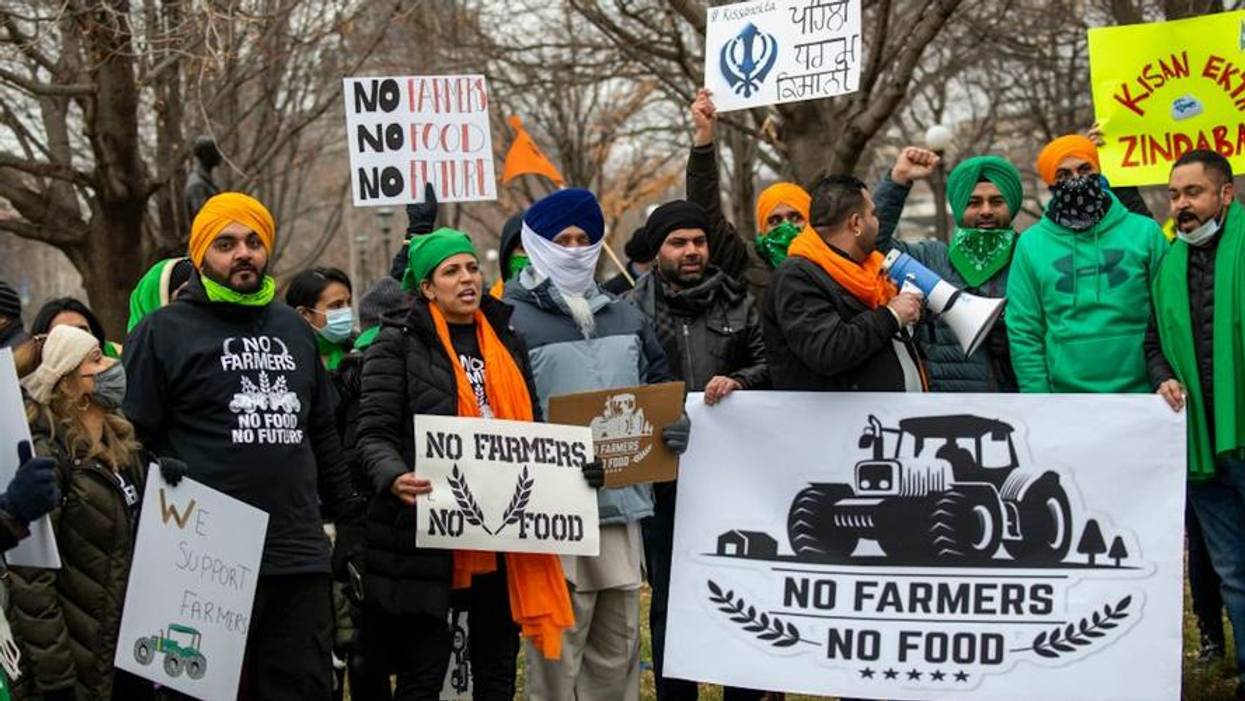
U.S. farmers and food justice advocates on Thursday published a statement of solidarity with Indian farmers protesting deeply unpopular new laws and "the forces of neoliberalism" imposed at the prompting of Prime Minister Narendra Modi's far-right, Hindu nationalist Bharatiya Janata Party.
"India's farmers have mobilized to create one of the world's most vibrant protests in history."
--87 groups
"We stand with India's farmers! Now let's connect the dots between the forces of neoliberalism that stifle farmers, from India to the U.S.," the statement--which was signed by 87 groups--begins.
"India's farmers have mobilized to create one of the world's most vibrant protests in history, camping on the outskirts of New Delhi for more than two and a half months," it says. "Their rallying cry is to repeal the three unjust laws that were passed without their knowledge or consultation."
"We extend our solidarity to countless farmers who are peacefully and boldly standing up for their rights and dignity," the statement continues. Hundreds of millions of Indians have taken to the streets across the country since last November in what has been called the largest protest in human history.
Over 40% of India's workforce of 500 million people is employed in agriculture. More than half of all farming households in the country are in debt, according to a 2018 survey from the National Bank for Agriculture and Rural Development. The ongoing coronavirus pandemic--which has exacerbated India's worst economic slowdown in decades--has driven millions of farmers to desperation.
According to the National Crime Records Bureau, over 300,000 Indian farmers have killed themselves since 1995, often by drinking pesticides, and often due to an inability to repay loans from private lenders charging exorbitant interest.
Many observers claim it is no coincidence that the farmer suicide crisis parallels the period in which neoliberal economic policies have been forced on India's people. The Indian author Arundhati Roy has noted that neoliberalism in rural India often means unconstitutional land seizure, displacement, and human rights crimes perpetrated by state and paramilitary forces.
In her 2007 book The Shock Doctrine: The Rise of Disaster Capitalism, Canadian author Naomi Klein famously examined how governments force neoliberal policies upon their wary citizens during or right after major crises. Three new laws enacted during India's Covid-19 and economic crises are among the main reasons why millions of Indians--who include not not only farmers but students, leftists, labor groups, and others--have protested in recent months.
The three new laws deregulate the sale, pricing, and storage of agricultural goods. Modi, BJP leaders, and others say the "reforms" will make India's agricultural sector less state-controlled and more market-based. However, critics, including former Prime Minister H.D. Deve Gowda, have raised serious concerns about the speed with which the laws were passed and their lack of regulatory safeguards.
The U.S. solidarity statement notes that "one of the key demands of the [protest] movement is for farmers to receive a Minimum Support Price (MSP)--currently assured for just a few crops--for all produce, including vegetables, which are essential for healthy diets."
"This would ensure that farmers in India, already burdened by huge debts, receive a fair price for their produce," it explains.
The statement also acknowledges "the role of the U.S. government in creating the conditions that have led to these repressive laws." It continues:
The U.S. has been a key opponent of India's limited use of MSP at the World Trade Organization. The U.S.--with Australia, Canada, and European allies--has claimed that India's MSP distorts trade. But, that is not surprising: the U.S. government has been eroding the concept of parity (similar to MSP in India) at home for decades.
While the U.S. agricultural sector receives inordinately large support compared to many countries, access to that support remains inequitable. In particular, Black, Indigenous, Latino, Asian-Pacific, and other people of color producers, who lack secure land tenure and are concentrated in vegetable and small-scale cattle sectors, have been excluded historically. Support flows to larger agribusiness farming operations instead of the independent family farmers whose voices we amplify.
"Let us be clear: what the Indian farmers are enduring now happened in the U.S. almost four decades ago," the statement asserts. "The Reagan era furthered the farm crisis through deliberate federal policy changes, with systematic erosion of parity prices and other deregulatory efforts. 'Get big or get out' has been our government's mantra."
"The U.S. government must stop prioritizing the interests of agribusiness over small farmers, abetting further corporatization of the food system here and in other countries."
--87 groups
"Farmers with the means to consolidate have been rewarded for growing monoculture commodities," it continues. "Tribal nations and traditional producers as well as small farmers who have always practiced or shifted to diversified agroecological farming have effectively been subsidizing the U.S. agriculture sector. It is rare for these food producers to make a living without supplemental income. Unsurprisingly, farm suicides in rural America are 45% higher than the rest of the population."
"The U.S. government must stop prioritizing the interests of agribusiness over small farmers, abetting further corporatization of the food system here and in other countries," the statement concludes. "The U.S. must also endorse multilateral governance norms that will support India's transition to climate-resilient, biodiverse, and water-conserving food systems that reach all producers. This would also mean harmonizing trade rules to include parity pricing and public crop procurement."

From March to May, as many of us were adjusting and settling into quarantine life, we began thinking and talking about a "new normal."
In an article by People magazine, Nick Tilsen, of NDN Collective said, "Everyone says, 'I can't wait until things get back to normal.' There's a part of me that's like, 'Normal never did us justice.' The normal meant injustices for Indigenous people. The normal meant underinvestment of our people. The normal meant fossil fuel industry exploiting our lands and our communities. This is a point in time for me where (I) don't want to go back to supporting the same old economic systems and the same old energy systems. There's opportunity here to architect and build a new world."
We must get used to and comfortable with people being in dedicated, committed, and prolonged uprising. Arundhati Roy in the Financial Times said, "Our minds are still racing back and forth, longing for a return to "normality," trying to stitch our future to our past and refusing to acknowledge the rupture. But the rupture exists. And in the midst of this terrible despair, it offers us a chance to rethink the doomsday machine we have built for ourselves. Nothing could be worse than a return to normality. Historically, pandemics have forced humans to break with the past and imagine their world anew. This one is no different. It is a portal, a gateway between one world and the next."
Well, I don't think anyone expected the new normal to be here so quickly, but here it is.
Across the country and the world, people are engaged in civil disobedience, uprising, and rebellion. And we are not just showing up for one issue such as just ending police brutality, or just for George Floyd, although his killing was a catalyst. People are coming out and showing up to dismantle and tear out white supremacy from its root and demand justice for the many who have been slaughtered at the hands of police violence.
In my humble opinion, if these are our goals, we must get used to and comfortable with people being in dedicated, committed, and prolonged uprising. In fact, I believe that's what this "new normal" is, and I hope that these protests go well into November and beyond until we see accountability and real, tangible actions taken by cities, states, and the country to abolish racism and white supremacy.
Prolonged uprising is not the only thing that is a part of this new normal. Here's what I am also seeing:
Communities continue to practice deep care for one another. We are making and distributing masks and safety equipment for each other. I see organizers and doctors talking to each other in ways that I've never seen before, to keep people healthy and safe from COVID-19.
I see folks building healing justice mutual aids so people on the front lines can sustain themselves emotionally and spiritually. I see mutual aids getting stronger and more connected for both COVID-19 response work and for those protesting and organizing to #DefendBlackLives.
I see editors from high profile media outlets offer coaching sessions on pitching articles so that more Black voices can be heard in the news cycle. I see the media industry build lists of Black photographers so they can tell their own stories about this moment, challenging extractive storytelling.
I see White folks show up in ways that I haven't seen them show up before, ready to confront their internalized anti-blackness and eager to learn about and question white supremacy.
I see American voters support the Black Lives Matter movement more in the past two weeks than in previous years combined. I see policies, accountability, and institutional change with swiftness: Schools in Minneapolis have ended contracts with the police. The Minneapolis city council intends to disband the police and replace the department with a transformative model for public safety. In San Francisco, a resolution has passed to prevent the hiring of police officers with a history of misconduct. In Tulsa, Oklahoma, the Mayor has decided not to renew a live police department contract.
On a national level, I see bipartisan support to cut off access to military weapons for local law enforcement. I see momentum building to re-open cases for those who, like George Floyd, have been slain by police brutality and racism.
I see communities begin to imagine what our world looks like without police and individuals asking themselves, "What can I do instead of calling the police? How can I build trust and safety with the people around me, my neighbors, community, and so on?"
This is the new normal.
I see Twitter finally did something about 45's violent and dangerous tweets, (although more needs to be done, such as deleting his account.)
I see Indigenous people and people of color being thoughtful and sensitive in messaging and narrative building so as to not erase the messages and strategies of the Black community. I see POC being cognizant of not centering their own struggles right now and respecting and honoring the leadership and vision of Black Lives Matter and the Movement for Black Lives, which is crucial for building lasting and trustworthy multiracial solidarity.
I see civilians getting smarter and safer about digital technology and surveillance, using this technology in ways that keep our people safe, such as by blurring the faces of protesters and using secure apps for organizing.
Even during uprisings and a pandemic, I see people getting out to vote, the outcome being 22 Native candidates making it into the running for both Congress and state legislatures.
I see the distribution of wealth even during an economic recession.
I see Confederate statues being pulled down by civilians to wash their communities clean of glorifying racist historical figures that celebrate a system that has failed and oppressed so many.
Last but certainly not least, I see my people, my peers, and my comrades have hope, a feeling that's been hard to feel and maintain while so many of our community members have died of COVID-19, which, let's not forget, is also a racial justice issue. Seeing and feeling that rebirth of hope, faith, and energy has been one of the greatest highlights of this moment.
This is the new normal. Let's keep it up. Let's keep protesting, let's keep unlearning and relearning, let's keep honoring and respecting BIPOC (Black, Indigenous, people of color) leadership, let's keep voting, let's keep dismantling white supremacy within ourselves, our families, our workplaces, our institutions, and our government. Let's keep moving resources from the police into Black and Brown communities. Let's keep building the movement, making it stronger and bigger until we abolish the police and ICE and eradicate racism and white supremacy.
Perhaps it was being in our homes for months, having time to really reflect about how our systems work and don't work. Perhaps it was watching our government fail us and seeing how our neighbors are the ones who, at the end of the day, are the ones who really have our backs. No matter what, I believe that COVID-19 set the stage for what we are seeing now. Like Arundhati Roy said, the pandemic was a "portal" for the new normal.

Authors Arundhati Roy and Naomi Klein took part in a virtual conversation on Tuesday to help launch a Global Green New Deal project to foster internationalism and visualize possibilities for a new and better world for people and the planet.
The online event, entitled "Into the Portal, No One Left Behind," was co-sponsored by The Leap, War on Want, and Haymarket Books. Asad Rehman, executive director of War on Want, moderated the discussion.
"We knew our system was broken. But the Covid-19 pandemic has reinforced the cruelty of the global economy, and deepened the visceral injustices of our societies," organizers said in the conversation's event description. "The time to build the future we deserve is now, and international solidarity is the tool we need to begin its construction."
Klein said that driving the cruelty is "the violence of a capitalist system" rooted in "an extractivist logic that treats... the Earth itself, individual places, and entire groups of people as disposable," a "logic of endless extraction and disposal that really cherishes nothing and no one."
The coronavirus crisis means that we are now hearing the "roar of workers who are on the frontlines who are talking about being simultaneously essential and disposable or simultaneously essential and sacrificial," said Klein, adding that this duality has parallels with slavery and land theft.
A more justice vision for life on the other side of the "portal" post-pandemic should be "bounded in treating no one as if they are sacrificeable--and nowhere," she said.
Watch the full conversation:
Roy said the pandemic meant "the machine of capitalism has come to a halt," and suggested a global movement toward justice could heed lessons from the "ferocious, beautiful, and militant movements" in India.
What those movements have done, said Roy, is to ask "the world to redefine the meaning of progress, to redefine he meaning of civilization, to redefine the meaning of happiness. Do you really need to treat the Earth like a resource in order to call yourself civilized?"
"If people think coronavirus is a problem, it's a stuffed toy compared to the climate crisis that's coming," she added.
"The main thing is to change our imagination," said Roy. "Once you understand that you just can't extract everything, that things are finite," a new, more just vision can emerge.
Roy said that it was important to acknowledge that "change doesn't mean that you're going to necessarily suffer."
"Life," she continued, "could be so much more beautiful." People could be in a situation in which they respect the Earth and "have a more equal relationship with people."
Getting from this moment of global crisis to justice will take a far-reaching effort.
"The answer to the question 'How do we change the world?' isn't in any of us individually," said Reyman. "It's in all of us collectively."
The Global Green New Deal website says that a call to action is will be released in the coming weeks. "Together," says the new site, "we will create a people's plan to build a resilient global economy, based on the principles of a just transition and recovery, which guarantees the right to a dignified life for all."