SUBSCRIBE TO OUR FREE NEWSLETTER
Daily news & progressive opinion—funded by the people, not the corporations—delivered straight to your inbox.
5
#000000
#FFFFFF
To donate by check, phone, or other method, see our More Ways to Give page.
Daily news & progressive opinion—funded by the people, not the corporations—delivered straight to your inbox.
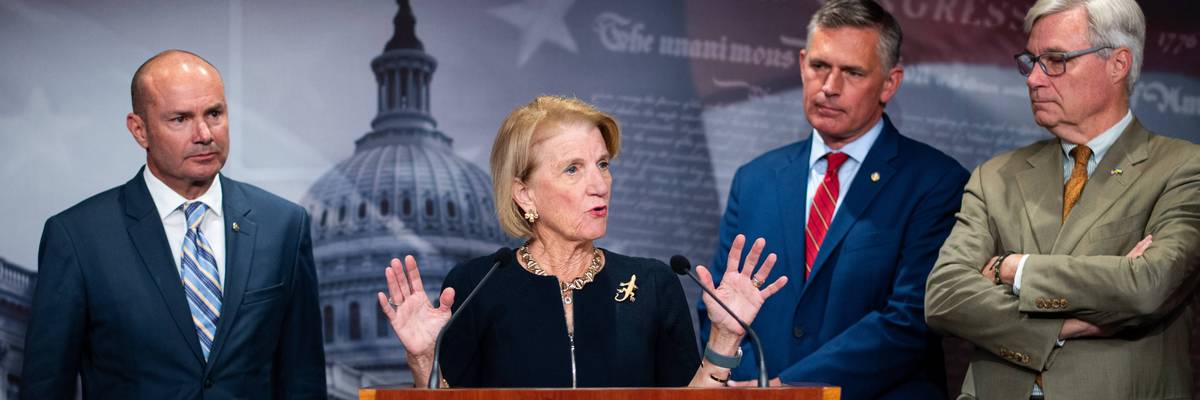
A group of Republican and Democratic senators holds a news conference on the Bipartisan American Affordability and Jobs Act on September 30, 2026.
"It’s exactly what the fossil fuel industry wants," one critic said of the Bipartisan American Affordability and Jobs Act.
The US Senate on Monday voted in bipartisan fashion to advance a fossil fuel industry-backed permitting reform bill that would weaken the Clean Water Act and other key environmental protections to make it easier for the federal government to streamline energy projects—including climate-wrecking gas pipelines.
The 73-25 vote to advance the Bipartisan American Affordability and Jobs Act (BAAJA) sets the stage for what's expected to be a contentious amendment process. The bill's Democratic supporters—including Sens. Sheldon Whitehouse of Rhode Island, Martin Heinrich of New Mexico, and Chuck Schumer of New York—argue it is a necessary compromise to accelerate construction of clean energy projects. Environmentalists, tribal organizations, and progressive lawmakers say the legislation is a gift to fossil fuel companies, tech giants, and other corporate interests at the expense of local communities and the planet.
"The Senate’s supporters of BAAJA just cleared an initial hurdle towards offering Big Oil and Big Tech a massive giveaway at the expense of our clean air, clean water, and communities' right to protect themselves from polluting projects," said Elizabeth Bast, executive director of Oil Change International. "Just days after voters demanded accountability and relief from soaring costs, 73 senators chose Trump’s energy policies over the American people."
“BAAJA is not a compromise—it’s exactly what the fossil fuel industry wants," Bast added.
The bipartisan permitting reform legislation is backed by the Trump White House—which has waged war on clean energy projects while working to boost fossil fuel production—and the American Petroleum Institute, the leading oil and gas industry trade association in the US. Trump said Monday that he would not approve the construction of any wind turbines, confirming critics' fears that the White House sees the bill as an opportunity to advance dirty energy projects.
The bill would exempt pipeline expansions and other energy projects from review under the National Environmental Policy Act and make it harder for opponents of the projects to challenge them in court. The legislation would also restrict courts' ability to pause projects due to inadequate environmental reviews.
Sen. Jeff Merkley (D-Ore.), one of the 25 senators who voted against advancing BAAJA on Monday, said in a statement that while the legislation "has a number of other features that merit careful analysis," it "has never had a public hearing" despite its potentially massive impact.
Merkley warned that, as currently written, the bill "accelerates the extraction and burning of fossil fuels," effectively offsetting the benefits of the measure's promotion of clean energy projects.
“The bill restricts states’ ability to raise and address clean water concerns on gas pipelines as well as transmission lines," said Merkley. "It shortens timelines that make it hard-to-impossible for grassroots and community groups to raise concerns about projects. It eliminates tools that states and localities use to fight the development of new data centers and detention centers. And it impacts the sovereignty and rights of tribes."
"Permitting reform for electrical transmission lines is essential," the senator added. "But the current bill raises too many serious issues that require more deliberation."
Environmental groups and tribal organizations urged lawmakers to pause consideration of the permitting bill until the next Congress, when Democrats will take control of the House and the Senate.
“We shouldn’t and don’t need to endanger our wildlife just to save a few dollars on gas," said Lisa Frank, executive director of Environment America. "We shouldn’t and don’t need to weaken the rules that protect our water from pollution in order to build more clean energy. We shouldn’t facilitate more global-warming air pollution. And we definitely shouldn’t be taking away the public’s right to weigh in on projects that can ruin their environment, make them sick, and lessen their quality of life.”
This country and this world are at a monumental crossroads. US voters have an opportunity to beat back the forces of fascism and confront the billionaires who are rigging the economy, our media system, and our democracy, making it increasingly impossible for ordinary people to get by. We’re not just talking about the election. We’re talking about what must be done once these fascist elements are vanquished from power. We need a bolder set of solutions than what either major party has so far been willing to offer and a working-class movement ready to fight like hell for it. Trump didn't emerge from nowhere. The conditions that fueled MAGA authoritarianism were created by decades of radical neoliberal economic policies and a corrupt political system dominated by corporate interests. They slashed taxes on the super-rich, promising that the benefits would trickle down. They said giveaways to the corporate titans would make life more affordable for the rest of us. It was all bullshit. And when a bitter, betrayed populace searches for someone to blame, right-wing demagogues have little trouble finding scapegoats. People know when they're being lied to, but you won't hear any of this from the corporate media. Only independent journalism—powered and funded by people who believe in building a better world—can deliver truly trustworthy daily news. If you share our vision, please contribute whatever you can to sustain our work. |
The US Senate on Monday voted in bipartisan fashion to advance a fossil fuel industry-backed permitting reform bill that would weaken the Clean Water Act and other key environmental protections to make it easier for the federal government to streamline energy projects—including climate-wrecking gas pipelines.
The 73-25 vote to advance the Bipartisan American Affordability and Jobs Act (BAAJA) sets the stage for what's expected to be a contentious amendment process. The bill's Democratic supporters—including Sens. Sheldon Whitehouse of Rhode Island, Martin Heinrich of New Mexico, and Chuck Schumer of New York—argue it is a necessary compromise to accelerate construction of clean energy projects. Environmentalists, tribal organizations, and progressive lawmakers say the legislation is a gift to fossil fuel companies, tech giants, and other corporate interests at the expense of local communities and the planet.
"The Senate’s supporters of BAAJA just cleared an initial hurdle towards offering Big Oil and Big Tech a massive giveaway at the expense of our clean air, clean water, and communities' right to protect themselves from polluting projects," said Elizabeth Bast, executive director of Oil Change International. "Just days after voters demanded accountability and relief from soaring costs, 73 senators chose Trump’s energy policies over the American people."
“BAAJA is not a compromise—it’s exactly what the fossil fuel industry wants," Bast added.
The bipartisan permitting reform legislation is backed by the Trump White House—which has waged war on clean energy projects while working to boost fossil fuel production—and the American Petroleum Institute, the leading oil and gas industry trade association in the US. Trump said Monday that he would not approve the construction of any wind turbines, confirming critics' fears that the White House sees the bill as an opportunity to advance dirty energy projects.
The bill would exempt pipeline expansions and other energy projects from review under the National Environmental Policy Act and make it harder for opponents of the projects to challenge them in court. The legislation would also restrict courts' ability to pause projects due to inadequate environmental reviews.
Sen. Jeff Merkley (D-Ore.), one of the 25 senators who voted against advancing BAAJA on Monday, said in a statement that while the legislation "has a number of other features that merit careful analysis," it "has never had a public hearing" despite its potentially massive impact.
Merkley warned that, as currently written, the bill "accelerates the extraction and burning of fossil fuels," effectively offsetting the benefits of the measure's promotion of clean energy projects.
“The bill restricts states’ ability to raise and address clean water concerns on gas pipelines as well as transmission lines," said Merkley. "It shortens timelines that make it hard-to-impossible for grassroots and community groups to raise concerns about projects. It eliminates tools that states and localities use to fight the development of new data centers and detention centers. And it impacts the sovereignty and rights of tribes."
"Permitting reform for electrical transmission lines is essential," the senator added. "But the current bill raises too many serious issues that require more deliberation."
Environmental groups and tribal organizations urged lawmakers to pause consideration of the permitting bill until the next Congress, when Democrats will take control of the House and the Senate.
“We shouldn’t and don’t need to endanger our wildlife just to save a few dollars on gas," said Lisa Frank, executive director of Environment America. "We shouldn’t and don’t need to weaken the rules that protect our water from pollution in order to build more clean energy. We shouldn’t facilitate more global-warming air pollution. And we definitely shouldn’t be taking away the public’s right to weigh in on projects that can ruin their environment, make them sick, and lessen their quality of life.”