SUBSCRIBE TO OUR FREE NEWSLETTER
Daily news & progressive opinion—funded by the people, not the corporations—delivered straight to your inbox.
5
#000000
#FFFFFF
To donate by check, phone, or other method, see our More Ways to Give page.
Daily news & progressive opinion—funded by the people, not the corporations—delivered straight to your inbox.
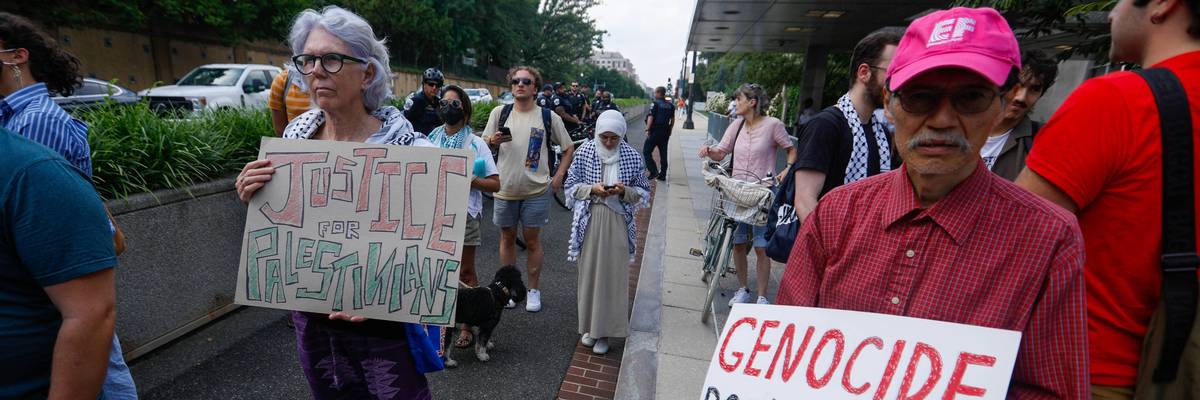
Protesters gather in front of the US State Department demanding an immediate ceasefire in Gaza, an end to the US-backed Israeli military operations, and unrestricted humanitarian aid access on July 22, 2025 in Washington, DC.
The repetitive, mechanical work of convincing our politicians that Palestinians are human beings, deserving of the same basic rights as anyone else, makes me want to scream: “This violence is being carried out in my name.”
I spent two days on Capitol Hill with two Palestinian parish priests, meeting with public officials about what is happening on the ground in Palestine. The stories these priests brought to congressional offices were beyond horrific—overwhelming accounts of suffering that should shake the conscience of anyone willing to listen, yet I felt no one was listening.
Mechanically moving from office to office, recounting acts of violence and terror, was heart-wrenching. Yet even in describing this suffering, we had to carefully choose our words. To accommodate American political sensitivities, we softened our language, fearful that speaking the awful truth would close the ears of listeners unprepared to confront the reality of life in Palestine.
With the exception of one or two offices, our meetings were with congressional staff from both parties. Although these staffers were familiar with the situation, only one we met had visited the area. Yet they are tasked with helping elected officials shape policies toward a region that occupies an enormous place in our political debate and federal spending.
In a political system so deeply influenced by wealthy donors, the halls of Congress can feel closed to the people whose lives are being debated inside them. Outside those halls, however, people from every walk of life continue to organize, march, and demand justice.
In some offices, even the language needed to describe Palestinian suffering remained a barrier. Rather than speak directly about genocide, apartheid, and ethnic cleansing—terms some offices continued to reject—we focused on the diminishing Christian presence in Palestine. This offered an opening for discussion, but it also narrowed a much larger story: the suffering of an entire people, Muslim and Christian alike.
Although staffers had been briefed on the systematic violence Palestinians face under Israeli occupation, some spoke of settler violence as isolated incidents committed by a handful of individuals. The priests’ accounts told a different story: violence and systematic and intentional killing woven into daily life, leaving families unsafe and afraid in their own homes.
The distance between those accounts and the language used in Washington was striking. What the priests described as a relentless reality of systematic violence was too often discussed as a series of isolated incidents. That gap has consequences for the people whose lives are shaped by the policies made in those offices.
The repetitive, mechanical work of convincing our politicians that Palestinians are human beings, deserving of the same basic rights as anyone else, makes me want to scream: “This violence is being carried out in my name.”
I feel complicit in genocide because I am a law-abiding citizen whose taxes help buy the weapons dropped on children and their families. Families struggle to survive in flooded tents while our president and members of Congress on both sides of the aisle support those responsible for their torment.
When one of our young advocates spoke about Israeli soldiers killing his best friend, the room grew uneasy under the weight of his grief. Then we moved on—from one subject to another, from one office to another—hoping against hope that even one listener would feel the urgency of our pain and act to change the reality on the ground.
We asked for the bare minimum: to check the facts on the ground. Yet even that seemed to be too much. The nods and murmurs of understanding felt shallow.
Still, the priests held on to hope. These men, themselves living under the conditions they described, drew on their faith to sustain their communities and resist despair. They carried their people’s suffering into deaf-tone offices while continuing to believe that someone might help.
Meanwhile, instead of moving on even a symbolic request for minimum change in policy like writing a letter to urge action, we find ourselves occupied by the false accusation of antisemitism that is too often used to divert attention from the suffering we came to address. But using that charge to discredit advocacy for Palestinian rights does nothing to protect Jewish people and leaves Palestinian suffering unanswered. Instead of treating the killing as an emergency, politicians devote their energy to measures that threaten the freedom of those who dare to speak against it.
When did we lose our humanity? When did we surrender our decency? When did a Palestinian mother become blameworthy simply for bringing a child into the world under occupation? When did we accept that one community’s security could require the destruction of another?
We elect public officials to protect our rights and help build a world in which everyone can live freely and safely. Yet the protection we promise is distributed according to political convenience. Some lives are defended; others are dismissed as collateral damage.
We are told this is the price of our collective security. But we are neither secure nor whole when our safety depends on accepting another people’s devastation.
We are a fractured society when we measure human worth by color, creed, religious affiliation, or economic status. Our collective biases shape whose grief we recognize, whose children we mourn, and whose suffering we tolerate.
The priests left these meetings with hope that their appeals might secure even a temporary reprieve for their communities. I left with a persistent dread: that the weeks before January’s change in congressional membership could bring further rewards for those responsible for Palestinian suffering, rather than accountability. I pray that I am wrong.
Yet I also left with reasons to keep going. In a political system so deeply influenced by wealthy donors, the halls of Congress can feel closed to the people whose lives are being debated inside them. Outside those halls, however, people from every walk of life continue to organize, march, and demand justice. They refuse to let Palestinian voices be silenced.
Today, I have hope for Palestine because of those people. I have heard the speeches and know the arguments. What moves me is seeing people of different faiths, backgrounds, and experiences come together, recognizing that Palestinian freedom concerns our shared humanity.
Alongside that hope, I feel numb. There is only so much grief a person can carry, only so many times we can recount a child’s death and wait for a response that matches the horror.
The priests showed me how to keep going: Care for the people in front of you, insist on their dignity, and continue working for justice even when relief seems far away. I will follow their example. I will keep speaking, keep organizing, and keep sounding the alarm: The genocide is ongoing, and it must be stopped.
Palestinians should not have to persuade Congress that they are human. Their humanity should be the starting point of every policy made in their name—and ours.
This country and this world are at a monumental crossroads. US voters have an opportunity to beat back the forces of fascism and confront the billionaires who are rigging the economy, our media system, and our democracy, making it increasingly impossible for ordinary people to get by. We’re not just talking about the election. We’re talking about what must be done once these fascist elements are vanquished from power. We need a bolder set of solutions than what either major party has so far been willing to offer and a working-class movement ready to fight like hell for it. Trump didn't emerge from nowhere. The conditions that fueled MAGA authoritarianism were created by decades of radical neoliberal economic policies and a corrupt political system dominated by corporate interests. They slashed taxes on the super-rich, promising that the benefits would trickle down. They said giveaways to the corporate titans would make life more affordable for the rest of us. It was all bullshit. And when a bitter, betrayed populace searches for someone to blame, right-wing demagogues have little trouble finding scapegoats. People know when they're being lied to, but you won't hear any of this from the corporate media. Only independent journalism—powered and funded by people who believe in building a better world—can deliver truly trustworthy daily news. If you share our vision, please contribute whatever you can to sustain our work. |
I spent two days on Capitol Hill with two Palestinian parish priests, meeting with public officials about what is happening on the ground in Palestine. The stories these priests brought to congressional offices were beyond horrific—overwhelming accounts of suffering that should shake the conscience of anyone willing to listen, yet I felt no one was listening.
Mechanically moving from office to office, recounting acts of violence and terror, was heart-wrenching. Yet even in describing this suffering, we had to carefully choose our words. To accommodate American political sensitivities, we softened our language, fearful that speaking the awful truth would close the ears of listeners unprepared to confront the reality of life in Palestine.
With the exception of one or two offices, our meetings were with congressional staff from both parties. Although these staffers were familiar with the situation, only one we met had visited the area. Yet they are tasked with helping elected officials shape policies toward a region that occupies an enormous place in our political debate and federal spending.
In a political system so deeply influenced by wealthy donors, the halls of Congress can feel closed to the people whose lives are being debated inside them. Outside those halls, however, people from every walk of life continue to organize, march, and demand justice.
In some offices, even the language needed to describe Palestinian suffering remained a barrier. Rather than speak directly about genocide, apartheid, and ethnic cleansing—terms some offices continued to reject—we focused on the diminishing Christian presence in Palestine. This offered an opening for discussion, but it also narrowed a much larger story: the suffering of an entire people, Muslim and Christian alike.
Although staffers had been briefed on the systematic violence Palestinians face under Israeli occupation, some spoke of settler violence as isolated incidents committed by a handful of individuals. The priests’ accounts told a different story: violence and systematic and intentional killing woven into daily life, leaving families unsafe and afraid in their own homes.
The distance between those accounts and the language used in Washington was striking. What the priests described as a relentless reality of systematic violence was too often discussed as a series of isolated incidents. That gap has consequences for the people whose lives are shaped by the policies made in those offices.
The repetitive, mechanical work of convincing our politicians that Palestinians are human beings, deserving of the same basic rights as anyone else, makes me want to scream: “This violence is being carried out in my name.”
I feel complicit in genocide because I am a law-abiding citizen whose taxes help buy the weapons dropped on children and their families. Families struggle to survive in flooded tents while our president and members of Congress on both sides of the aisle support those responsible for their torment.
When one of our young advocates spoke about Israeli soldiers killing his best friend, the room grew uneasy under the weight of his grief. Then we moved on—from one subject to another, from one office to another—hoping against hope that even one listener would feel the urgency of our pain and act to change the reality on the ground.
We asked for the bare minimum: to check the facts on the ground. Yet even that seemed to be too much. The nods and murmurs of understanding felt shallow.
Still, the priests held on to hope. These men, themselves living under the conditions they described, drew on their faith to sustain their communities and resist despair. They carried their people’s suffering into deaf-tone offices while continuing to believe that someone might help.
Meanwhile, instead of moving on even a symbolic request for minimum change in policy like writing a letter to urge action, we find ourselves occupied by the false accusation of antisemitism that is too often used to divert attention from the suffering we came to address. But using that charge to discredit advocacy for Palestinian rights does nothing to protect Jewish people and leaves Palestinian suffering unanswered. Instead of treating the killing as an emergency, politicians devote their energy to measures that threaten the freedom of those who dare to speak against it.
When did we lose our humanity? When did we surrender our decency? When did a Palestinian mother become blameworthy simply for bringing a child into the world under occupation? When did we accept that one community’s security could require the destruction of another?
We elect public officials to protect our rights and help build a world in which everyone can live freely and safely. Yet the protection we promise is distributed according to political convenience. Some lives are defended; others are dismissed as collateral damage.
We are told this is the price of our collective security. But we are neither secure nor whole when our safety depends on accepting another people’s devastation.
We are a fractured society when we measure human worth by color, creed, religious affiliation, or economic status. Our collective biases shape whose grief we recognize, whose children we mourn, and whose suffering we tolerate.
The priests left these meetings with hope that their appeals might secure even a temporary reprieve for their communities. I left with a persistent dread: that the weeks before January’s change in congressional membership could bring further rewards for those responsible for Palestinian suffering, rather than accountability. I pray that I am wrong.
Yet I also left with reasons to keep going. In a political system so deeply influenced by wealthy donors, the halls of Congress can feel closed to the people whose lives are being debated inside them. Outside those halls, however, people from every walk of life continue to organize, march, and demand justice. They refuse to let Palestinian voices be silenced.
Today, I have hope for Palestine because of those people. I have heard the speeches and know the arguments. What moves me is seeing people of different faiths, backgrounds, and experiences come together, recognizing that Palestinian freedom concerns our shared humanity.
Alongside that hope, I feel numb. There is only so much grief a person can carry, only so many times we can recount a child’s death and wait for a response that matches the horror.
The priests showed me how to keep going: Care for the people in front of you, insist on their dignity, and continue working for justice even when relief seems far away. I will follow their example. I will keep speaking, keep organizing, and keep sounding the alarm: The genocide is ongoing, and it must be stopped.
Palestinians should not have to persuade Congress that they are human. Their humanity should be the starting point of every policy made in their name—and ours.