SUBSCRIBE TO OUR FREE NEWSLETTER
Daily news & progressive opinion—funded by the people, not the corporations—delivered straight to your inbox.
5
#000000
#FFFFFF
To donate by check, phone, or other method, see our More Ways to Give page.
Daily news & progressive opinion—funded by the people, not the corporations—delivered straight to your inbox.
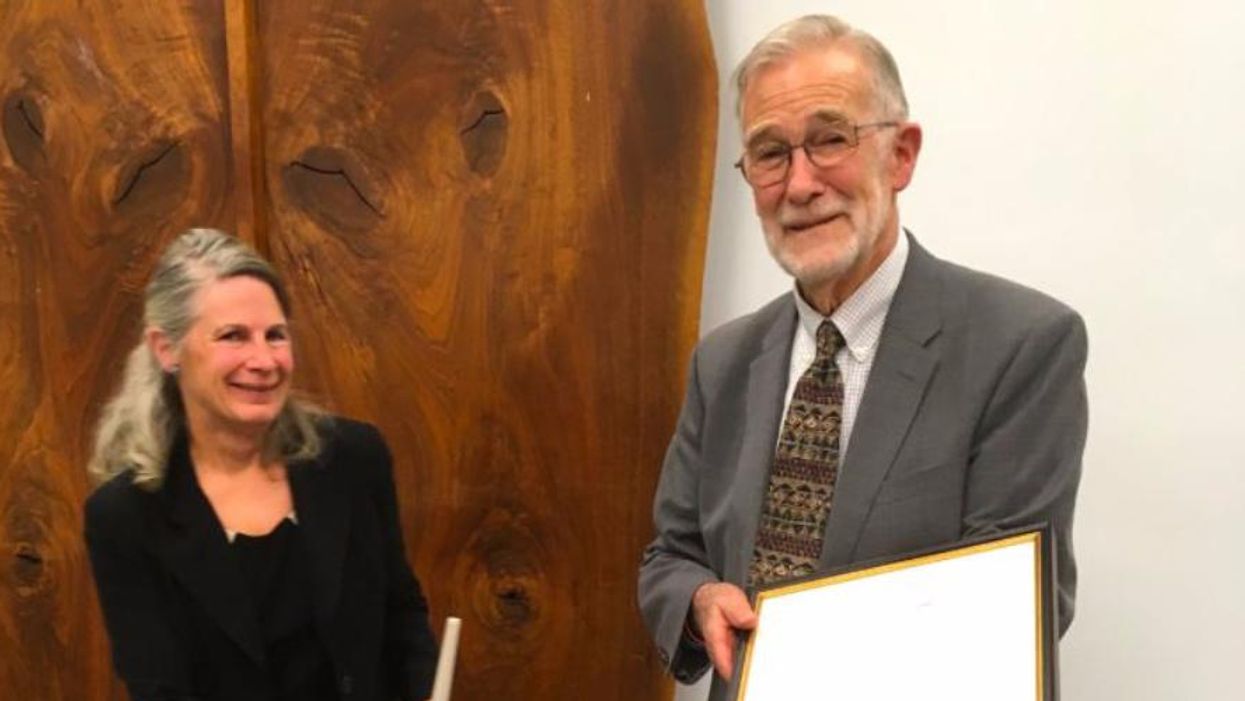
Here is Karen Kwiatowski's acceptance speech for the 2018 Sam Adams Award at a ceremony in Washington on Saturday night, preceded by the citation, that was read by former CIA analyst Ray McGovern.
Know all ye by these presents that Karen Kwiatkowski is hereby honored with the traditional Sam Adams Corner-Brightener Candlestick Holder, in symbolic recognition of her courage in shining light into dark places.
"If you see something, say something," we so often hear. Karen Kwiatkowski took that saying to heart.
She saw her Pentagon superiors acting as eager accomplices to the Cheney/Bush administration's deceit in launching a war of aggression on Iraq. And she said something--and helped Knight Ridder reporters Warren Strobel and Jonathan Landay see beneath the official lies and get the sordid story right before the war.
Karen's courage brings to mind the clarion call of Rabbi Abraham Heschel against the perpetrators of an earlier war--Vietnam. "Few are guilty," he said, "but all are responsible. Indifference to evil is more insidious than evil itself." Karen would not be indifferent to evil.
Ed Snowden, Sam Adams awardee in 2013, noted that we tend to ignore some degree of evil in our daily life, but, as Ed put it, "We also have a breaking point and when people find that, they act." As did Karen. As did 16 of Karen's predecessors honored with this award.
With all the gloom and doom enveloping us, we tend to wonder whether people with the conscience and courage of Ed or Karen still exist in and outside our national security establishment. Our country is in dire need of new patriots of this kind.
Meanwhile, we call to mind the courageous example not only of Karen and Ed, but also of Coleen Rowley and Elizabeth Gun, our first two awardees, who took great risks in trying to head off the attack on Iraq. And we again honor Chelsea Manning and Julian Assange who is now isolated in what the U.N. has called "arbitrary detention," for exposing the war crimes resulting from that war.
Karen Kwiatkowski has made her own unique contribution to this company of conscience and courage, and Sam Adams Associates are pleased to honor her.
Presented this 8th day of December 2018 in Washington by admirers of the example set by the late CIA analyst, Sam Adams.
'Thoughts on the Sam Adams Award': Remarks by Lt. Col. Karen Kwiatowski
I am honored beyond belief to be the 2018 recipient of the Sam Adams Award, and I thank Ray McGovern and the Sam Adams Associates for Integrity in Intelligence, Veteran Intelligence Professionals for Sanity, Warren Strobel, and Jonathan Landay of Knight Ridder during the run up to the second invasion of Iraq, and Rob Reiner for putting together a great movie that was so consistently truthful, that for me, it looked almost like a documentary. I want to also thank the late David Hackworth, a man I never met who published my first anonymous essays from the Pentagon, and of course, Lew Rockwell, who has published so many of my essays examining and trying to understand our government and our offensive policies over the past 15 years.
It is in our country's interest--as security professionals, as intelligence professionals, as soldiers and citizens, as writers and newsmakers--to be sensitive to the lawlessness, the immorality, and the wrongdoing of the bureaucracies and the leaders of the organizations we are a part of.
There have been many American patriots and truth-tellers who have received the honor you have given me tonight--and I am going to name them here because I stand in awe of all of them:
Coleen Rowley of the FBI; Katharine Gun of British Intelligence; Sibel Edmonds of the FBI; Craig Murray, former U.K. ambassador to Uzbekistan; Sam Provance, former U.S. Army Sgt; Maj. Frank Grevil of Danish Army Intelligence; Larry Wilkerson, Col., U.S. Army (ret.), former chief of staff to Colin Powell at State; Julian Assange, of WikiLeaks: Thomas Drake, of NSA; Jesselyn Radack, formerly of Dept. of Justice and now National Security Director of Government Accountability Project; Thomas Fingar, former Deputy Director of National Intelligence and Director, National Intelligence Council, and Edward Snowden, former contractor for the National Security Agency; Chelsea Manning, U.S. Army Private who exposed (via WikiLeaks) key information on Afghanistan and Iraq, as well as State Department activities; and to retired National Security Agency official William Binney, who challenged decisions to ignore the Fourth Amendment in the government's massive--and wasteful--collection of electronic data.
Again, I am very humbled and almost speechless tonight.
But not entirely speechless. My backstory is pretty well-known to most people here, and to anyone who was interested in understanding U.S. war policy in the early 2000s. I had a small role to play, in concert with a number of other truth-tellers in media and in the national security bureaucracy. For every one of us, there were probably 20 to 50 people working beside us and around us, who understood a lot about what was happening, and who probably got a funny feeling about being in an organization where we all swore to uphold the Constitution, but in fact were engaged in promulgating lies of both omission and commission, mistruths and misdirection, aimed not at our enemies abroad but against the American people. We were lying, with the help of a compliant and war-supportive media, to patriots young and old. Millions of Americans were eager to enlist, to fight, to sacrifice their life and health--for a made-up government fairy tale.
A sense of unease, I believe, was shared by many, many people who never blew a whistle, and never said a word. To their credit, some of these people passively resisted within their organizations, and tried to set things straight where they could. Some of these people simply called their assignments guy and got orders out of the Pentagon, others were removed if they resisted too much. There is always a cost when you seriously question the directions or actions of the bureaucracy that employs you.
It is in our country's interest--as security professionals, as intelligence professionals, as soldiers and citizens, as writers and newsmakers--to be sensitive to the lawlessness, the immorality, and the wrongdoing of the bureaucracies and the leaders of the organizations we are a part of. That is the first thing we must cultivate and encourage--a sensitivity to and an awareness of something as simple as right and wrong. This is fundamental. From knowing right and wrong, we move to the factor that motivates so many whistleblowers, something that we all share as human beings, and that is an idea of justice.
The truth-tellers who have been honored with Sam Adams Award, and thousands of others we may not be aware of around the world, share a concept of justice. For those who try to correct our U.S. government, particularly in its initiation and exercise of war, state-sanctioned murder, and physical devastation of whole societies, we as American have tools that many others around the world don't have. We have a Constitution that many of us swore to uphold. Americans tend to have a good grounding in the fundamentals of right and wrong, derived from religion or tradition, or both. We live in something that calls itself a republic, and it is a fine form of government, with a solid set of rules.
But how do we get from a certain moral discomfort, from seeing something going on around us that is wrong, to trying to do something about it? How do we decide if we want to leave the room, turn our backs, put our head down, or instead take some sort of action that will put us on a collision course with very powerful people? What if we, as truth-tellers, are like blind men describing an elephant--we see only one part of a larger story? How do we decide that our faith in our leadership is misplaced, and that more is at stake then just our jobs?
When you look at the experiences of people who made the dangerous and difficult decision to act, like Daniel Ellsberg, and Sam Adams, and Sibel Edwards, Jesselyn Raddick, Colleen Rowley, Thomas Drake, Ed Snowden, Julian Assange, and many others, you realize that speaking up and doing the right thing had a primary impact. That impact wasn't improved transparency, a more informed democracy, a more aware and alert citizenry, and better government decisions by our elected leaders. Those were all secondary impacts, and in many cases tenuous, as the improved level of national understanding seems to last for less than a single generation. No, the primary impact was the unimaginable wrath of the state aimed at the life, livelihood, reputation, family, character, and credibility of the truth-teller. In several cases, this included physical and psychological abuse, prison time, gag orders, and even more devious programs. The rage of the state against these truth-tellers is not impulsive and short-lived--it is a forever project funded by tax dollars, and fueled by very profitable agendas.
Knowing all of this, can we really expect to see a healthy and growing flow of truth tellers, whistleblowers, and simply bold honest people speaking out about government lies?
I think we can, and I am optimistic about the possibilities of better government through honest, bold, and forthright people working in and around this government.
To start with, as I mentioned, we as government employees and uniformed service-members need to have a solid sense of right and wrong. We need to cultivate a sense of justice. In a wonderful way, our younger generations are well prepared for this, at least in terms of cultivating a sense of justice. The young people we see portrayed, often disparagingly, as young socialists may not completely understand the nature of government or the state, but they do cherish ideas of justice.
The more of us--specifically those working with and inside the U.S. government today--who tell the truth, the less likely that government embarrassment will result in harm to a whistleblower, and the less likely in the long run that we will see whistleblowers as we tend to see them today.
We also need people in government service who are sensitive to what is going on in their organizations, and how people are feeling and behaving around them. It is not coincidence that many of the people who have been honored by this award are women, who may be paying closer attention to the mood and morality of their organizations. There's a country song that has a line in it about "Old men talking about the weather, and old women talking about old men." We need both in our organizations, to be in tune with what is happening, and who is leading us.
We need people in government service who are willing to walk away from a job, and to say or even broadcast why they are leaving, without worrying about the next job, without worrying about being blacklisted, without worrying that they can't make their next house payment or college tuition payment, or the alimony or child support payment. We need people in government who travel light, so to speak, and do their job because they love what they are doing and what it stands for. This grounding and lack of rigid self-identification with their employing bureaucracy is extremely important. Thanks to technology and societal evolution, the younger generations of Americans are very likely to walk away from a job that they believe to be immoral, to act to correct what they see as wrong or unjust, and incidentally, are less likely to own a home, and more likely to define themselves by what they believe and stand for, not where they work, and how many promotions they had planned for themselves in that organization.
But even with our younger generations coming into government service--with a good sense of justice, a strong sense of self, and a willingness to speak openly about what they believe and know--there is risk when someone questions the collective government story.
There is risk in the act of challenging authority and one's peer group, risk of being wrong and suffering loss of credibility. There is the rational and real risk of incurring the rage of the state, and being jailed, harmed, ruined and even killed on the whispers of an incensed or threatened agency.
There is another risk that we really don't talk about much. I think most concerning for many people is the risk that you are actually right, that you have discovered something damning and dark in your country, in your government, in your organization. Once this happens, if it happens, your life is irreversibly changed, and nothing is ever going to be the same. Understanding how your government actually works, in particular how it works to create and provoke war and murder, how it works to extract the wealth of the nation and use this blessing to commit Constitutional crimes and untold evil, in your name--for many this understanding is not a gift, but a curse. I estimate at least 10 percent of our country, 20-30 million Americans, many of them veterans the U.S. Empire's global adventures in the past 50 years, feel this curse, and many of them deal with it by turning away from the dark side of Washington D.C., and not talking, writing, or speaking about what they know.
If anyone has followed the case of former Marine Sergeant Brandon Raub a few years ago, you realize that the government keeps a close and paranoid eye on what veterans are doing and saying. Given how things work today, they may be wise to turn away silently from the truth they know.
I think this is why it is often hard for us to demand more truth-tellers come forward, especially in the defense and security and intelligence arena, when we should be shouting it from the rooftops.
Some years ago, I did an online radio program where I would interview interesting people, like Ray McGovern and Sam Provance and Sibel Edmonds, among many others. One person, in our conversation, expressed surprise that I was a short (formerly) brown haired woman, when he thought I would be a tall blonde. I was reminded of this when watching Shock and Awe, because Rob Reiner and the writers did not know who I was, and they portrayed me as a tall light-haired woman, a modern day Viking of sorts. Notwithstanding that this is a popular and attractive stereotype, I think there is something to be learned here. We want to believe that anyone who stands up to authority, who knows his or her own mind, who is willing to enter into a battle of wills with the state, and to take a risk is somehow taller, stronger, bolder, and braver than the rest of us.
But it isn't true. There is something remarkably childlike and simple in being honest, in observing without fear what is happening around you, and reporting this to the person who pays the bills. In the case of the national security arena, the bill payer is the American people. To tell the truth is simple, honorable, and good for the health of the republic. The fact that it drives the security apparatus and the government crazy is just icing on the cake. Granted, we all need jobs, and our mental health, and we don't want to be imprisoned, tortured, or killed. But the more of us--specifically those working with and inside the U.S. government today--who tell the truth, the less likely that government embarrassment will result in harm to a whistleblower, and the less likely in the long run that we will see whistleblowers as we tend to see them today. In a world of that values honesty, they would be receiving the public commendation of a proud Congress, a grateful media and President, and a contented population.
We--average Americans--are increasingly controlled, spied on, monitored, tracked, threatened, boxed in, and shut down by tools that were first used and tested on some contrived wartime enemy.
I'm not a Pollyanna, and I'm worried about the role the U.S. government is playing at home and abroad. The kind of devastation that the U.S. tolerates, supports and initiates around the world--Afghanistan, Iraq, Libya, Syria, of course Yemen comes to mind, the horrendous situation that Julian Assange is still facing as we speak--is not limited to "overseas." The industrial warfare state is as dangerous to Americans as it is to Iraqis, Syrians, and Yemenis. The arts of the warfare state are already being practiced here, against Americans. We--average Americans--are increasingly controlled, spied on, monitored, tracked, threatened, boxed in, and shut down by tools that were first used and tested on some contrived wartime enemy.
You don't need me to tell you this, it's in every newspaper every day, on every page. It is our modern reality. Truth and transparency are its only antidote, and truth and transparency needs all of us. To live in a society, to be a citizen, to love your country -- you cannot sleepwalk through it.
People who value wisdom, people who value common sense, people who value justice and people who believe that being woke is a good thing--congratulations! You are the majority! You are alive, you are in charge of this country, and you can choose. America is worth preserving, healing, and saving - and if she is to be saved we will do it by first learning the difference between the truth and a lie, and then speaking the truth loudly, boldly, to anyone who will listen, over and over and over again.
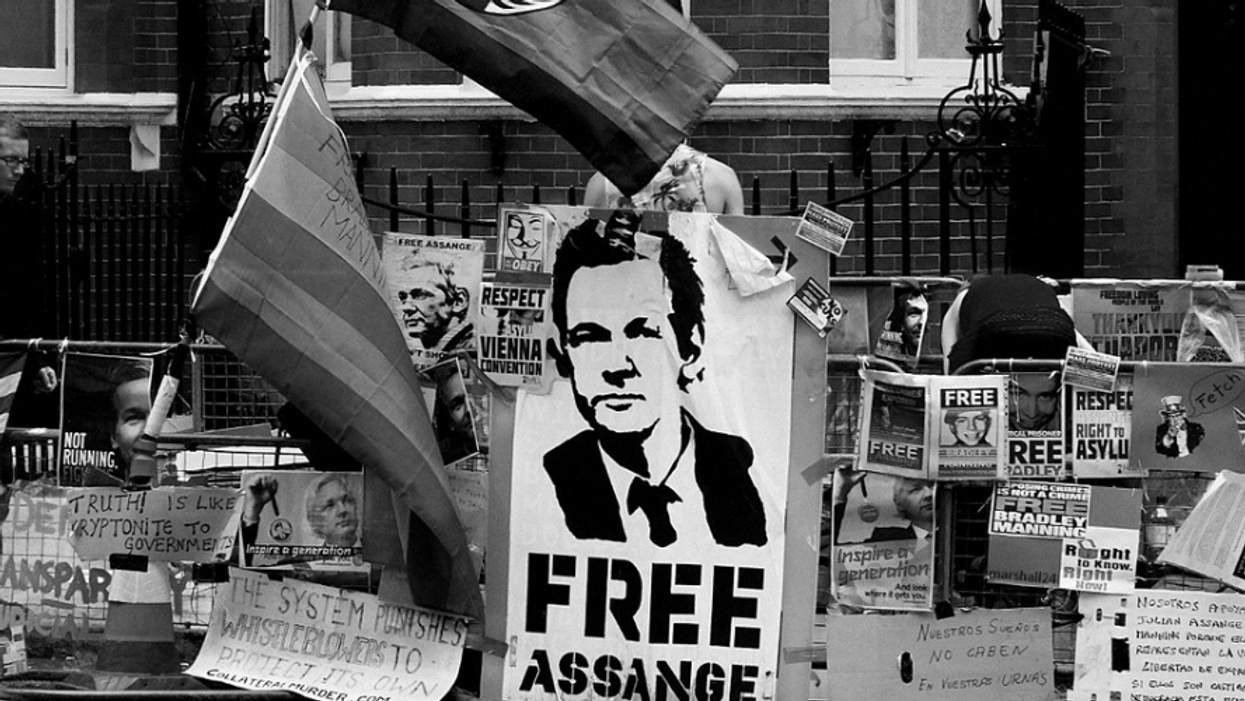
WikiLeaks founder Julian Assange remains arbitrarily detained in the Ecuadorian embassy in London. As he is in a critical situation under a special protocol imposing prison-like surveillance, news emerged that shed light on the grave danger he has been facing. Last week, the Washington Post reported that the US Justice Department, in what appeared to be an error of cut and paste in their court filing, inadvertently disclosed criminal charges against Assange exist under seal.
Assange's lawyer Jennifer Robinson responded to the revelation of a secret US government's prosecution against the publisher, by noting that it confirms what Assange and his legal team have been suspecting. She pointed out how a criminal investigation into WikiLeaks started in 2010 in relation to disclosures made by WikiLeaks in partnership with other major newspapers revealing the evidence of US war crimes. She made it clear that this risk of his extradition to the US has been the reason why Assange sought and was granted asylum by Ecuador in 2012.
This public confirmation of a US indictment sent a huge alarm to civil liberty groups in the US. The ACLU issued a statement, noting how this sealed indictment violates the Constitution and prosecuting journalists for publishing classified documents would set a dangerous precedent for press freedom. Now that this sealed indictment is out in the open, validating Assange's fear of leaving the embassy, the public is given an opportunity to see the true nature of his plight for freedom. What is now being revealed is the war on the First Amendment waged by the US government, targeting the Western journalist who has published materials in the public interest at a scale that has never been seen before.
The war on the First Amendment
The spark for this war was quietly lit in 2008 with US intelligence's plan to destroy WikiLeaks, viewing the website as an information security threat to the US army. It got inflamed in 2010 shortly after the whistleblowing site published the trove of US classified military records of the Afghan war, revealing around 20,000 deaths by assassination, massacre and night raids, and the Iraq War Logs, that informed people in Iraq and the international community about 15,000 civilian casualties previously unreported.
As the White House downplayed the significance of these disclosures, US Joint Chiefs of Staff Mike Mullen called WikiLeaks publications "reckless" and "irresponsible". While there is not a single shred of evidence that any of these disclosures caused anyone harm, the Pentagon deflected its own crimes and aggressively tried to attack the messenger with a bombastic line of "they have blood on their hands".
Assange as a spokesperson of this new multi-national media organization came under attack with an intense campaign of character assassination. The preliminary investigation of his alleged sexual misconduct involving two women in Sweden who explicitly denied the accusation of rape was turned into a full blown legal battle trapping him in London where the local press criminalized him as a rapist.
Right after WikiLeaks' publication of the US diplomatic cables, the vilification of Assange intensified by high profile US political figures. The former Vice President Joe Biden branded Assange as a high-tech terrorist, while a former Republican Speaker of the House, Newt Gingrich calling him an "enemy combatant", who deserves to be executed.
WikiLeaks also has faced massive coordinated political retaliation. On November 29, 2010, the US Attorney General publicly confirmed the existence of a secret grand jury investigation into disclosures of classified information made by WikiLeaks. In December 2010, Amazon removed WikiLeaks from their server after being pressured by US officials. Then, signaled by the US State Department, private paying processing companies such as VISA, MasterCard, PayPal, Bank of America and Western Union engaged in extrajudicial financial blockade against WikiLeaks, reportedly destroying over 95 % of their revenue. Meanwhile, WikiLeaks associates were repeatedly harassed at borders.
Whistleblowers as casualty of war
This attack on WikiLeaks is an escalation of Obama's war on whistleblowers. Before Snowden's revelations, former National Security Agency analysts, Thomas Drake, William Binney, J. Kirk Wiebe and Edward Loomis were alarmed by widespread government surveillance and decided to speak out.
Thomas Drake, former NSA senior executive who blew the whistle on secret mass surveillance programs, spoke about how he came to witness his own government actively violating the privacy and freedom of its citizens in the name of national security and decided not to remain silent. He said, "I took an oath to defend the constitution. Here I am finding myself defending the constitution against my own government, a government that I did not recognise, an alien form of government. I had to stand up to it."
Drake, who faced 35 years in prison before the government charges against him were unexpectedly dropped, also alerted the public about the government's war on whistleblowers:
"We are seeing an unprecedented campaign against whistleblowers and truthtellers: it's now criminal to expose the crimes of the state. Under this relentless assault by the Obama administration, I am the only person who has held them off and preserved his freedom. All the other whistleblowers I know have served time in jail, are facing jail or are already incarcerated or in prison."
John Kiriakou became the first CIA officer to confirm the use of torture and to face jail time for challenging the legality of the US torture program. Before going to jail, he spoke of his decision:
"I took my oath seriously. My oath was to the Constitution. On my first day in the CIA, I put my right hand up, and I swore to uphold the Constitution. And to me, torture is unconstitutional, and it's something that we should not be in the business of doing ... If you see waste, fraud, abuse or illegality, shout it from the rooftops, whether it's internally or to Congress."
While Obama was relentlessly prosecuted whistleblowers more than all other previous administrations combined, corporate media effectively kept the battlefield out of public sight. These whistleblowers who fought to hold the ground for truth became an invisible casualty of this war on the First Amendment, who were made to quietly endure suffering.
Frontline of the battle
As the unchecked power of the national security state grew, expanding its territory in cyberspace with increasing surveillance and censorship, a new stream of dissidents emerged on the Internet. WikiLeaks courageously entered into a frontline of the battle in defense of the First Amendment. With unprecedented technical infrastructure that enables anonymous submission of documents, it provided an avenue for a new generation of whistleblowers to exercise free speech that has been stifled in traditional channels.
The former US Army intelligence analyst Chelsea Manning, the source behind WikiLeaks major publications including the raw footage of a US airstrike killing innocent civilians in Iraq, first reached out to the established media outlets such as the New York Times and the Washington Post, but was not taken seriously by editors. When the mainstream press turned away, she chose to put her trust in the non-profit media organization that was little known at that time.
Manning's act of courage became contagious, creating a wave of whistleblowers. By following the step of his forerunner, political activist Jeremy Hammond exposed the inner workings of the pervasive surveillance state. At the sentencing hearing, he explained how he perfectly understood the consequences of his action and that it was against the law, yet he felt a duty to confront injustice. Then came Edward Snowden who revealed the NSA mass surveillance. In one of the addresses he made, Snowden also described his act as a public service and connected it with non-violent civil disobedience that Dr. King, a leader of civil rights movement employed to challenge the racist laws
As disclosures of government corruption began to challenge the legitimacy of authorities, the war on whistleblowers has escalated to a new level. Recent public confirmation of the US government's secret charges on Assange has shown the empire's expansion of a combat zone, to include journalists and publishers as its target. Although there is no clarity as to what charges are filed against Assange, the data that Google handed over to the US government in order to assist the prosecution of WikiLeaks' staff indicated that alleged offenses include espionage.
The Espionage Act of 1917 is a US federal law, created after World War I for wartime prosecutions. This outdated law does not allow a public interest defense and prevents whistleblowers from having their motivations considered in court, making it impossible for them to defend their acts and receive a fair trial. Manning was convicted and Snowden charged under the Espionage Act by President Obama.
Now this law that was used to imprison whistleblowers is weaponized to punish those who report on government crimes. Commenting on imminent withdrawal of asylum for Assange by the Moreno government and his risk of prosecution in the US, Glenn Greenwald, journalist at The Intercept noted how Obama's Justice Department was eager to prosecute Assange and WikiLeaks for the crime of publishing classified documents, but chose not to do so, due to concerns that it would set a precedent which could strip away the First Amendment protection for the press. Yet he contended that the Trump administration made it clear that they have no such reservation.
Tradition of civil disobedience
The possibility of the US government charging Assange who is not American, and didn't publish in the US under its laws, probably for 'espionage' is extremely alarming. What is this crime of 'aiding the enemy' that the US government is eager to convict this transnational journalistic organization for? WikiLeaks, the organization that claimed to derive its source of inspiration from American founding ideas, with cryptography as a non-violent democratic weapon, helped American people to engage in the tradition of civil disobedience. By doing so, Assange, an Australian citizen, enabled the vital function of American democracy.
The idea of civil disobedience was presented by American philosopher Henry David Thoreau, as a critical component of checks and balances of governmental power. Thoreau, who believed that "government is best which governs least" (1957, p. 235), put forward the idea of civil disobedience, reminding the moral responsibility of ordinary people to defy the illegitimate authority of the state and restrict its power.
Thoreau engaged in the act of civil disobedience, to oppose slavery and went to a prison for refusing to pay a poll tax that supported the US war against Mexico. For him, the method of civil disobedience offered a way for people to create laws that reflect the true values of society and improve democracy that was inherited from the forebears.
He posed the questions:
"Is a democracy, such is we know it, the last improvement possible in government? Is it not possible to take a step further towards recognizing and organizing the rights of man? There will never be a really free and enlightened State until the State comes to recognize the individual as a higher and independent power, from which all its own power and authority are derived, and treats him accordingly." (1957, p. 256)
This father of civil disobedience asked, "... Must the citizen ever for a moment, or in the least degree, resign his conscience to the legislator? Why has every man a conscience, then?" (p. 236). He aimed to institute a new form of government that places conscience as the highest law, allowing each individual to freely explore what is right in their hearts with obligation to act out of their own knowing. He noted, "Unjust laws exist: Shall we be content to obey them, or shall we endeavor to amend them, and obey them until we have succeeded, or shall we transgress them at once?" (p. 242). Through his own act of civil disobedience, he has shown how only by each person's adamant refusal to obey the dictates of unjust laws can we bring real accountability of the government and enshrine ideals into laws.
Conscience of America
Contrary to the ideals of equality and liberty at its foundation, from the onset of the US constitutional republic, unaccounted power has always existed, manifested in the founders' internal contradiction over slavery, genocide of natives and oppression of minority rights. The Declaration of Independence was said to be the promise and the Constitution was its fulfillment. What bridges between the ideals in the original document and laws were ordinary people who are capable of developing their own moral conscience and bearing true faith and allegiance to it.
As WikiLeaks pushed the boundaries of free speech, the world has seen the rise of the power of ordinary people. The late attorney and President Emeritus of the Center for Constitutional Rights, Michael Ratner, who witnessed Manning read her prepared statement at the military court facility in Fort Meade, Maryland, recognized her as the conscience of America.
Through its scientific journalism, publishing primary source material in its full archives, WikiLeaks gave this conscience of America the maximum political impact for it to inform the public, in order to redeem the nation that has lost its own course. In this war of a tyrannical state on the First Amendment, Assange became a lightning rod to take all the heat, so ordinary people can uphold these ideals that are inscribed in their hearts, defending them against all enemies, foreign and domestic.
As the invisible beast inside the US government devours the hearts of these brave young patriots, WikiLeaks acted as a shield. This was demonstrated in their extraordinary source protection. After Snowden identified himself as the source behind the NSA files, aggressive prosecution quickly rolled out from Washington. As Snowden was stranded in Hong Kong, it was then the investigations editor at WikiLeaks and journalist Sarah Harrison who risked her life to secure his asylum.
Call for duty
Just as the Founding Fathers of the United States, by revolting against the autocratic rule of King George were regarded as traitors, by aiding ordinary people expose and defy unjust secret law, WikiLeaks too has been branded as an enemy of the state. Trump's Secretary of State and the former CIA director, Mike Pompeo calls WikiLeaks a non-state hostile intelligence agency, claiming that the organization threatens American values and needs to be shut down. Members of the US Congress urged the Ecuadorian President to persecute Assange, calling him a "dangerous criminal" and a "threat to global security". While all these vicious verbal attacks are thrown at him, Assange remains in confinement, over the past months, being completely shut out from the outside, being continually deprived of fresh air, access to medical care and sunlight by the UK government in violation of UN rulings.
All wars start and are fueled by lies and propaganda. Once it was the Vietnam War, where under the command of the US President Lyndon B. Johnson, the Gulf of Tonkin lies unleashed military forces into Southeast Asia. Then came the invasion of Iraq with the former Secretary of State Colin Powell's speech at the UN, falsely claiming Iraq had 'Weapons of Mass Destruction'. This battle against free speech is another secret war of this empire. It now has become a fog of war, where with the hype of Russia Gate that was created out of thin air, the public was prevented from seeing who the real enemies are.
As Trump's administration now carries on Obama's legacy, vowing to destroy WikiLeaks for engaging in publishing activities that are protected under the First Amendment, American people are slowly coming to see their own government's dirty war that has been waged in their name.
By trying to prosecute Julian Assange, America is betraying its own ideals. As this government that proclaims to be the greatest nation on the earth now heads toward its own destruction, each of us are called to respond to the duty of civil disobedience. Can we the people break silence to end this war and defend those who fought for the ideals that founded this nation? Solidarity across political lines can create the greatest anti-war movement that this country has ever seen. Outcome of this battle matters not only for the freedom of Assange, but for the liberation of America and realization of its own ideals that this country once stood for the world.
August 1, 2018
MEMORANDUM FOR: The President
FROM: Veteran Intelligence Professionals for Sanity (VIPS)
SUBJECT: Intelligence on Iran Fails the Smell Test
Mr. President:
As the George W. Bush administration revved up to attack Iraq 15 years ago, we could see no compelling reason for war. We decided, though, to give President Bush the benefit of the doubt on the chance he had been sandbagged by Vice President Dick Cheney and others. We chose to allow for the possibility that he actually believed the "intelligence" that Colin Powell presented to the UN as providing "irrefutable and undeniable" proof of WMD in Iraq and a "sinister nexus" between Saddam Hussein and al Qaeda.
To us in VIPS it was clear, however, that the "intelligence" Powell adduced was bogus. Thus, that same afternoon (Feb. 5, 2003) we prepared and sent to President Bush a Memorandum like this one, urging him to seek counsel beyond the "circle of those advisers clearly bent on a war for which we see no compelling reason and from which we believe the unintended consequences are likely to be catastrophic."
We take no satisfaction at having been correct -- though disregarded -- in predicting the political and humanitarian disaster in Iraq.
We take no satisfaction at having been correct -- though disregarded -- in predicting the political and humanitarian disaster in Iraq. Most Americans have been told the intelligence was "mistaken." It was not; it was out-and-out fraud, in which, sadly, some of our former colleagues took part.
Five years after Powell's speech, the Chair of the Senate Intelligence Committee minced few words in announcing the main bipartisan finding of a five-year investigation. He said: "In making the case for war, the Administration repeatedly presented intelligence as fact when in reality it was unsubstantiated, contradicted, or even non-existent. As a result, the American people were led to believe that the threat from Iraq was much greater than actually existed."
Iran Now in Gunsight
As drums beat again for a military attack -- this time on Iran, we Veteran Intelligence Professionals for Sanity and other experienced, objective analysts are, by all appearances, being disregarded again. And, this time, we fear the consequences will be all-caps CATASTROPHIC -- in comparison with the catastrophe of Iraq.
In memoranda to you over the past year and a half we have pointed out that (1) Iran's current support for international terrorism is far short of what it was decades ago; and (2) that you are being played by Prime Minister Benjamin Netanyahu's claims about Iran' they are based on intelligence exposed as fraudulent several years ago. Tellingly, Netanyahu waited for your new national security adviser to be in place for three weeks before performing his April 30 slide show alleging that Iran has a covert nuclear weapons program. On the chance that our analysis of Netanyahu's show-and-tell failed to reach you, please know that the Israeli prime minister was recycling information from proven forgeries, which we reported in a Memorandum to you early last spring.
If our Memorandum of May 7 fell through some cracks in the West Wing, here are its main findings:
The evidence displayed by Israeli Prime Minister Benjamin Netanyahu on April 30 in what he called his "Iranian atomic archive" showed blatant signs of fabrication.
The evidence displayed by Israeli Prime Minister Benjamin Netanyahu on April 30 in what he called his "Iranian atomic archive" showed blatant signs of fabrication. That evidence is linked to documents presented by the Bush Administration more than a decade earlier as "proof" of a covert Iran nuclear weapons program. Those documents were clearly fabricated, as well.
In our May 7, 2018 Memorandum we also asserted: "We can prove that the actual documents originally came not from Iran but from Israel. Moreover, the documents were never authenticated by the CIA or the International Atomic Energy Agency (IAEA)."
Iran: Almost Targeted in 2008
There was a close brush with war with Iran a decade ago. Bush and Cheney, in close consultation with Israel, were planning to attack Iran in 2008, their last year in office. Fortunately, an honest National Intelligence Estimate of November 2007 concluded that Iran had stopped working on a nuclear weapon in 2003, and that key judgment was made public. Abruptly, that NIE stuck an iron rod into the wheels of the juggernaut then speeding downhill to war.
The key judgment that Iran had stopped work on a nuclear weapon was the result of the painstakingly deliberative process that was customarily used, back in the day, to produce an NIE. After that process -- which took a full year -- the Nov. 2007 NIE was was approved unanimously by all U.S. intelligence agencies.
(In other words, it was decidedly NOT a rump "assessment" like the one cobbled together in a couple of weeks by "handpicked" analysts from three selected, agenda-laden agencies regarding Russian meddling. We refer, of course, to the evidence-impoverished and deceptively labeled "Intelligence Community Assessment" that the directors of theFBI, CIA, and NSA gave you on January 6, 2017. The Defense Intelligence Agency and the State Department intelligence bureau were among the other 13 agencies excluded from that "Intelligence Community Assessment.")
As for the Bush/Cheney plans for attacking Iran in 2008, President George W. Bush, in his autobiography, Decision Points, recorded his chagrin at what he called the NIE's "eye-popping" intelligence finding debunking the conventional wisdom that Iran was on the verge of getting a nuclear weapon. Bush added plaintively, "How could I possibly explain using the military to destroy the nuclear facilities of a country the intelligence community said had no active nuclear weapons program?"
Mr. President, we do not know whether a fresh National Intelligence Estimate has been produced on Iran and nuclear weapons -- or, if one has been produced, whether it is as honest as the NIE of Nov. 2007, which helped prevent the launch of another unnecessary war the following year. We stand on our record. In sum, if you believe that there is credible evidence that Iran has an active secret nuclear weapons program, we believe you have been misled. And if you base decisions on misleading "intelligence" on Iran, the inevitable result will be a great deal worse than the Bush/Cheney debacle in Iraq.
For the Steering Group
Veteran Intelligence Professionals for Sanity
William Binney, former NSA Technical Director for World Geopolitical & Military Analysis; Co-founder of NSA's Signals Intelligence Automation Research Center (ret.)
Sen. Richard H. Black, 13th District of Virginia; Colonel US Army (ret.); former Chief, Criminal Law Division, Office of the Judge Advocate General, Pentagon (associate VIPS)
Kathleen Christison, Senior Analyst on Middle East, CIA (ret.)
Bogdan Dzakovic, former Team Leader of Federal Air Marshals and Red Team, FAA Security (ret.) (associate VIPS)
Philip Giraldi, CIA, Operations Officer (ret.)
Larry C. Johnson, former CIA and State Department Counter-terrorism officer
Michael S. Kearns, Captain, Wing Commander, RAAF (ret.); Intelligence Officer & ex-Master SERE Instructor
Linda Lewis, WMD preparedness policy analyst, USDA (ret.) (associate VIPS)
Edward Loomis, NSA Cryptologic Computer Scientist (ret.)
David MacMichael, Capt., USMC (ret.); former Senior Estimates Officer, National Intelligence Council
Ray McGovern, former US Army Infantry/Intelligence Officer & CIA analyst; CIA Presidential briefer (ret.)
Elizabeth Murray, former Deputy National Intelligence Officer for the Near East, National Intelligence Council & CIA political analyst (ret.)
Todd E. Pierce, MAJ, US Army Judge Advocate (ret.)
Gareth Porter, author/journalist (associate VIPS)
Coleen Rowley, FBI Special Agent and former Minneapolis Division Legal Counsel (ret.)
Robert Wing, former Foreign Service Officer (associate VIPS)
Ann Wright, Colonel, US Army (ret.); Foreign Service Officer (resigned in opposition to the war on Iraq)
The failure on the part of establishment media to defend Julian Assange, who has been trapped in the Ecuadorean Embassy in London since 2012, has been denied communication with the outside world since March and appears to be facing imminent expulsion and arrest, is astonishing. The extradition of the publisher--the maniacal goal of the U.S. government--would set a legal precedent that would criminalize any journalistic oversight or investigation of the corporate state. It would turn leaks and whistleblowing into treason. It would shroud in total secrecy the actions of the ruling global elites. If Assange is extradited to the United States and sentenced, The New York Times, The Washington Post and every other media organization, no matter how tepid their coverage of the corporate state, would be subject to the same draconian censorship. Under the precedent set, Donald Trump's Supreme Court would enthusiastically uphold the arrest and imprisonment of any publisher, editor or reporter in the name of national security.
Trump is not Vladimir Putin's puppet. He is part of the wave of right-wing populists, who have harnessed the rage and frustration born of an economic and political system dominated by global capitalism and under which the rights and aspirations of working men and women do not matter.
There are growing signs that the Ecuadorean government of Lenin Moreno is preparing to evict Assange and turn him over to British police. Moreno and his foreign minister, Jose Valencia, have confirmed they are in negotiations with the British government to "resolve" the fate of Assange. Moreno, who will visit Britain in a few weeks, calls Assange an "inherited problem" and "a stone in the shoe" and has referred to him as a "hacker." It appears that under a Moreno government Assange is no longer welcome in Ecuador. His only hope now is safe passage to his native Australia or another country willing to give him asylum.
"Ecuador has been looking for a solution to this problem," Valencia commented on television. "The refuge is not forever, you cannot expect it to last for years without us reviewing this situation, including because this violates the rights of the refugee."
Moreno's predecessor as president, Rafael Correa, who granted Assange asylum in the embassy and made him an Ecuadorean citizen last year, warned that Assange's "days were numbered." He charged that Moreno--who cut off Assange's communications the day after Moreno welcomed a delegation from the U.S. Southern Command--would "throw him out of the embassy at the first pressure from the United States."
Assange, who reportedly is in ill health, took asylum in the embassy to avoid extradition to Sweden to answer questions about sexual offense charges. He feared that once in Swedish custody for these charges, which he said were false, he would be extradited to the United States. The Swedish prosecutors' office ended its "investigation" and extradition request to Britain in May 2017 and did not file sexual offense charges against Assange. But the British government said Assange would nevertheless be arrested and jailed for breaching his bail conditions.
The persecution of Assange is part of a broad assault against anti-capitalist and anti-imperialist news organizations. The ruling elites, who refuse to accept responsibility for profound social inequality or the crimes of empire, have no ideological veneer left to justify their greed, ineptitude and pillage. Global capitalism and its ideological justification, neoliberalism, are discredited as forces for democracy and the equitable distribution of wealth. The corporate-controlled economic and political system is as hated by right-wing populists as it is by the rest of the population. This makes the critics of corporatism and imperialism--journalists, writers, dissidents and intellectuals already pushed to the margins of the media landscape--dangerous and it makes them prime targets. Assange is at the top of the list.
I took part with dozens of others, including Daniel Ellsberg, William Binney, Craig Murray, Peter Van Buren, Slavoj Zizek, George Galloway and Cian Westmoreland, a week ago in a 36-hour international online vigil demanding freedom for the WikiLeaks publisher. The vigil was organized by the New Zealand Internet Party leader Suzie Dawson. It was the third Unity4J vigil since all of Assange's communication with the outside world was severed by the Ecuadorean authorities and visits with him were suspended in March, part of the increased pressure the United States has brought on the Ecuadorean government. Assange has since March been allowed to meet only with his attorneys and consular officials from the Australian Embassy.
The Inter-American Court of Human Rights ruled Friday that those seeking political asylum have the right to take refuge in embassies and diplomatic compounds. The court stated that governments are obliged to provide safe passage out of the country to those granted asylum. The ruling did not name Assange, but it was a powerful rebuke to the British government, which has refused to allow the WikiLeaks co-founder safe passage to the airport.
The ruling elites no longer have a counterargument to their critics. They have resorted to cruder forms of control.
The ruling elites no longer have a counterargument to their critics. They have resorted to cruder forms of control. These include censorship, slander and character assassination (which in the case of Assange has sadly been successful), blacklisting, financial strangulation, intimidation, imprisonment under the Espionage Act and branding critics and dissidents as agents of a foreign power and purveyors of fake news. The corporate media amplifies these charges, which have no credibility but which become part of the common vernacular through constant repetition. The blacklisting, imprisonment and deportation of tens of thousands of people of conscience during the Red Scares of the 1920s and 1950s are back with a vengeance. It is a New McCarthyism.
Did Russia attempt to influence the election? Undoubtedly. This is what governments do. The United States interfered in 81 elections from 1945 to 2000, according to professor Dov Levin of Carnegie Mellon University. His statistics do not include the numerous coups we orchestrated in countries such as Greece, Iran, Guatemala and Chile or the disastrous Bay of Pigs invasion in Cuba. We indirectly bankrolled the re-election campaign of Russia's buffoonish Boris Yeltsin to the tune of $2.5 billion.
But did Russia, as the Democratic Party establishment claims, swing the election to Trump? No. Trump is not Vladimir Putin's puppet. He is part of the wave of right-wing populists, from Nigel Farage and Boris Johnson in Britain to Viktor Orban in Hungary, who have harnessed the rage and frustration born of an economic and political system dominated by global capitalism and under which the rights and aspirations of working men and women do not matter.
The party elite, including Chuck Schumer and Nancy Pelosi, is a creation of the corporate state. Campaign finance and electoral reform are the last things the party hierarchy intends to champion.
The Democratic Party establishment, like the liberal elites in most of the rest of the industrialized world, would be swept from power in an open political process devoid of corporate money. The party elite, including Chuck Schumer and Nancy Pelosi, is a creation of the corporate state. Campaign finance and electoral reform are the last things the party hierarchy intends to champion. It will not call for social and political programs that will alienate its corporate masters. This myopia and naked self-interest may ensure a second term for Donald Trump; it may further empower the lunatic fringe that is loyal to Trump; it may continue to erode the credibility of the political system. But the choice before the Democratic Party elites is clear: political oblivion or enduring the rule of a demagogue. They have chosen the latter. They are not interested in reform. They are determined to silence anyone, like Assange, who exposes the rot within the ruling class.
The Democratic Party establishment benefits from our system of legalized bribery. It benefits from deregulating Wall Street and the fossil fuel industry. It benefits from the endless wars. It benefits from the curtailment of civil liberties, including the right to privacy and due process. It benefits from militarized police. It benefits from austerity programs. It benefits from mass incarceration. It is an enabler of tyranny, not an impediment.
They divert the public's anger toward demonized groups such as Muslims, undocumented workers, people of color, liberals, intellectuals, artists, feminists, the LGBT community and the press.
Demagogues like Trump, Farage and Johnson, of course, have no intention of altering the system of corporate pillage. Rather, they accelerate the pillage, which is what happened with the passage of the massive U.S. tax cut for corporations. They divert the public's anger toward demonized groups such as Muslims, undocumented workers, people of color, liberals, intellectuals, artists, feminists, the LGBT community and the press. The demonized are blamed for the social and economic dysfunction, much as Jews were falsely blamed for Germany's defeat in World War I and the economic collapse that followed. Corporations such as Goldman Sachs, in the midst of the decay, continue to make a financial killing.
The corporate titans, who often come out of elite universities and are groomed in institutions like Harvard Business School, find these demagogues crude and vulgar. They are embarrassed by their imbecility, megalomania and incompetence. But they endure their presence rather than permit socialists or leftist politicians to impede their profits and divert government spending to social programs and away from weapons manufacturers, the military, private prisons, big banks and hedge funds, the fossil fuel industry, charter schools, private paramilitary forces, private intelligence companies and other pet programs designed to allow corporations to cannibalize the state.
The irony is that there was serious meddling in the presidential election, but it did not come from Russia. The Democratic Party, outdoing any of the dirty tricks employed by Richard Nixon, purged hundreds of thousands of primary voters from the rolls, denied those registered as independents the right to vote in primaries, used superdelegates to swing the vote to Hillary Clinton, hijacked the Democratic National Committee to serve the Clinton campaign, controlled the message of media outlets such as MSNBC and The New York Times, stole the Nevada caucus, spent hundreds of millions of dollars of "dark" corporate money on the Clinton campaign and fixed the primary debates. This meddling, which stole the nomination from Bernie Sanders, who probably could have defeated Trump, is unmentioned. The party hierarchy will do nothing to reform its corrupt nominating process.
WikiLeaks exposed much of this corruption when it published tens of thousands of messages hacked from Clinton campaign chairman John Podesta's email account. The messages brought to light the efforts by the Democratic Party leadership to thwart the nomination of Sanders, and they disclosed Clinton's close ties with Wall Street, including her lucrative Wall Street speeches. They also raised serious questions about conflicts of interest with the Clinton Foundation and whether Clinton received advance information on primary-debate questions.
The Democratic National Committee, for this reason, is leading the Russia hysteria and the persecution of Assange. It filed a lawsuit that names WikiLeaks and Assange as co-conspirators with Russia and the Trump campaign in an alleged effort to steal the presidential election.
But it is not only Assange and WikiLeaks that are being attacked as Russian pawns. For example, The Washington Post, which has sided with the Democratic Party in the war against Trump, without critical analysis published a report on a blacklist posted by the anonymous website PropOrNot. The blacklist was composed of 199 sites that PropOrNot alleged, with no evidence, "reliably echo Russian propaganda." More than half of those sites were far-right, conspiracy-driven ones. But about 20 of the sites were major progressive outlets including AlterNet, Black Agenda Report, Democracy Now!, Naked Capitalism, Truthdig, Truthout, CounterPunch and the World Socialist Web Site. PropOrNot, short for Propaganda or Not, accused these sites of disseminating "fake news" on behalf of Russia. The Post's headline was unequivocal: "Russian propaganda effort helped spread 'fake news' during the election, experts say."
In addition to offering no evidence, PropOrNot never even disclosed who ran the website. Even so, its charge was used to justify the imposition of algorithms by Google, Facebook, Twitter and Amazon to direct traffic away from the targeted sites. These algorithms, or filters, overseen by thousands of "evaluators," many hired from the military and security and surveillance apparatus, hunt for keywords such as "U.S. military," "inequality" and "socialism," along with personal names such as Julian Assange and Laura Poitras. These keywords are known as "impressions." Before the imposition of the algorithms, a reader could type in the name Julian Assange and be directed to an article on one of these targeted sites. After the algorithms were put in place, these impressions directed readers only to mainstream sites such as The Washington Post. Referral traffic from these impressions at most of the targeted sites has plummeted, often by more than half. Challenged by these algorithms and the abolition of net neutrality, these sites will be pushed further and further to the outer reaches of the media.
If the United States had a public broadcasting system free from corporate money or a commercial press that was not under corporate control, these dissident voices would be included in the mainstream discourse. But we don't.
Any news or media outlet that addresses the reality of our failed democracy and exposes the crimes of empire will be targeted. The January 2017 Director of National Intelligence Report spent seven pages on RT America, where I have a show, "On Contact." The report does not accuse RT America of disseminating Russian propaganda, but it does allege the network exploits divisions within American society by giving airtime to dissidents and critics including whistleblowers, anti-imperialists, anti-capitalists, Black Lives Matter activists, anti-fracking campaigners and the third-party candidates the establishment is seeking to mute.
If the United States had a public broadcasting system free from corporate money or a commercial press that was not under corporate control, these dissident voices would be included in the mainstream discourse. But we don't. Howard Zinn, Noam Chomsky, Malcolm X, Sheldon Wolin, Ralph Nader, James Baldwin, Susan Sontag, Angela Davis and Edward Said once appeared regularly on public broadcasting. Now critics like these are banned, replaced with vapid courtiers such as columnist David Brooks. RT America was forced to register under the Foreign Agent Registration Act (FARA). This act requires Americans who work for a foreign party to register as foreign agents. The FARA registration is part of the broader assault on all independent media, including the effort to silence Assange.
WikiLeak's publication in 2017 of 8,761 CIA files, known as Vault 7, appeared to be the final indignity. Vault 7 included a description of the cyber tools used by the CIA to hack into computer systems and devices such as smartphones. Former CIA software engineer Joshua Adam Schulte was indicted on charges of violating the Espionage Act by allegedly leaking the documents.
The publication of Vault 7 saw the United States significantly increase its pressure on the Ecuadorean government to isolate and eject Assange from the embassy. Mike Pompeo, then the CIA director, said in response to the leaks that the U.S. government "can no longer allow Assange and his colleagues the latitude to use free speech values against us." Attorney General Jeff Sessions said Assange's arrest was a "priority."
It is up to us to mobilize to protect Assange. His life is in jeopardy. The Ecuadorean government, violating his fundamental rights, has transformed his asylum into a form of incarceration. By cutting off his access to the internet, it has deprived him of the ability to communicate and follow world events. The aim of this isolation is to pressure Assange out of the embassy so he can be seized by London police, thrown into a British jail and then delivered into the hands of Pompeo, John Bolton and the CIA's torturer in chief, Gina Haspel.
Assange is a courageous and fearless publisher who is being persecuted for exposing the crimes of the corporate state and imperialism. His defense is the cutting edge of the fight against government suppression of our most important and fundamental democratic rights. The government of Prime Minister Malcolm Turnbull of Australia, where Assange was born, must be pressured to provide him with the protection to which he is entitled as a citizen. It must intercede to stop the illegal persecution of the journalist by the British, American and Ecuadorean governments. It must secure his safe return to Australia. If we fail to protect Assange, we fail to protect ourselves.
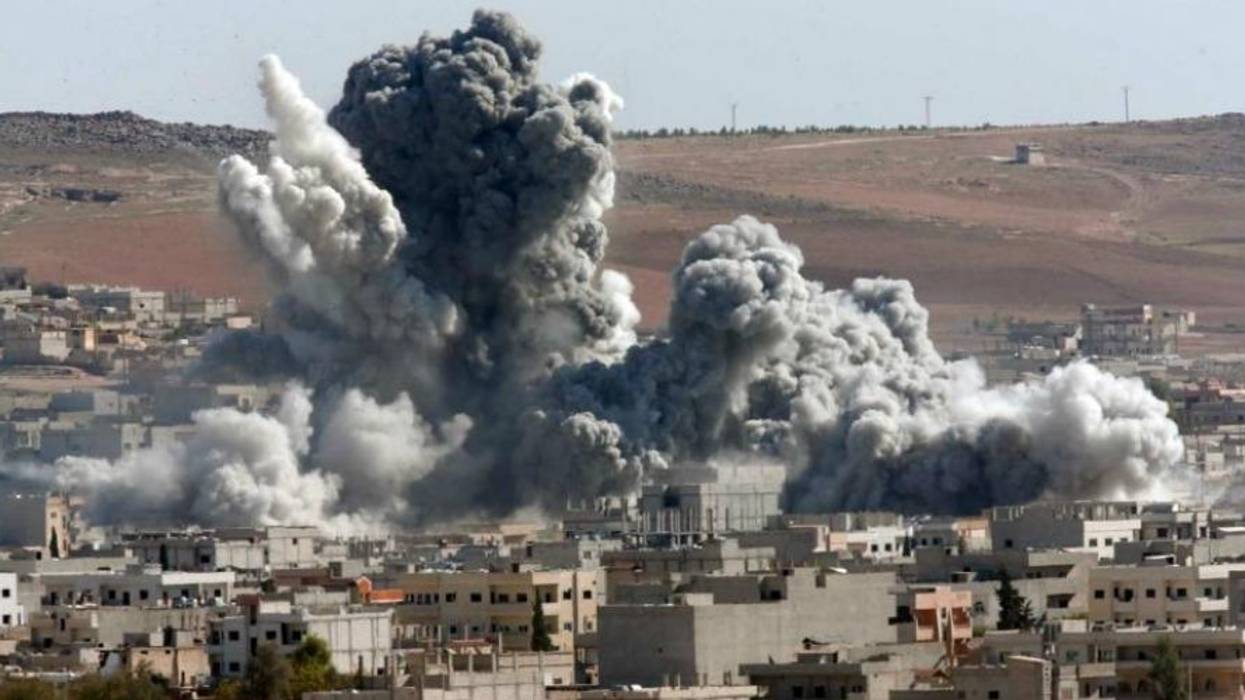
MEMORANDUM FOR: The President
FROM: Veteran Intelligence Professionals for Sanity
SUBJECT: Evidence Required for Military Decision on Syria
Mr. President,
We the undersigned Veteran Intelligence Professionals for Sanity join a number of other credible experts including former UK Ambassador to Syria, Peter Ford (this recent interview on BBC Radio Scotland), former UN weapons inspectors and former military officers who are strongly recommending that you obtain and review actual evidence from the site of the alleged chemical attack in Douma, Syria, before ordering any military action. VIPS has previously reported credible evidence indicating that anti-government forces in Syria have themselves produced and used toxic chemical agents.
Contradictory indications exist given that the video and images of victims in the locations purportedly affected by chemical weapons came from rebel-affiliated entities known as the "Douma Revolution" and the "White Helmets" while Russian military units which later got physical access to the supposed sites and Syrian Red Crescent personnel working in the area reportedly found no indication of a chemical weapon attack.
A major question for us, as former intelligence officers with some knowledge of the operational use of misinformation and false flag actions, is what motive would the Syrian government have for making a chemical weapons attack on its own civilian population, especially at a time when it has growing popular support and is having increased military success. Why would it risk Western ire?
Rebel fighters and their families were already being evacuated to Turkish occupied Jarabulus by air-conditioned bus. As described in more detail by Scott Ritter (here), only Salafist fighters from the "Army of Islam" (Jaish al-Islam) had refused to surrender at the time of the supposed attacks.
One must therefore consider the possibility that the supposed chlorine gas attack at Douma may have been a carefully constructed propaganda fraud. Such a fraud would have as its purpose the elicitation of precisely the kind of political pressure that now has you contemplating military action. In other words, Mr. President, this may be a bid to mousetrap you into a war that neither you nor your fellow Americans want nor need.
More expert opinion and investigation needs to be applied like that voiced by former U.N. weapons inspector in Syria, Ake Sellstrom, (translated from original Swedish):
The attack may have come from Assad's regime, but you may as well have other explanations. Toxic substances can be dispersed in many ways, for example through explosions or smoke.
- There are many poisonous substances in circulation during the battle.
If the UN were to investigate the attack, it is not enough to see recordings or hear testimony, says Sellstrom.
It is essential that the United States have complete and compelling evidence before taking any decisive action. We therefore strongly recommend that you await the findings of the OPCW team which is now on its way to Douma to investigate at the actual site of the alleged attack. A competent, objective group of experts needs to conduct a thorough on-the-ground investigation and collect evidence that will either implicate the Government of Syria or exonerate it.
We have, as you have noted, been down this road before with the Iraq WMD debacle in 2003. Let us not repeat this mistake. By launching a war in Syria, we will be entering a military and political morass involving Iran and Russia that could have fatal consequences for the entire planet, especially if any of the parties feel compelled to resort to nuclear weapons.
The American people neither want nor need another military intervention in the Middle East. History tells us that any initiative centered on the use of armed force to compel acceptable behavior will not be containable and will only propagate more violence. Please do not drain the US Treasury for a war that could lead to catastrophic and unprecedented loss of life and endanger the security of Americans everywhere.
For the Steering Group, Veteran Intelligence Professionals for Sanity (VIPS)
William Binney, former NSA Technical Director for World Geopolitical & Military Analysis; Co-founder of NSA's Signals Intelligence Automation Research Center (ret.)
Marshall Carter-Tripp, Foreign Service Officer (ret.) and Division Director, State Department Bureau of Intelligence and Research
Kathleen Christison, Senior Analyst on Middle East, CIA (ret.)
Bogdan Dzakovic, former Team Leader of Federal Air Marshals and Red Team, FAA Security (ret.) (associate VIPS)
Philip Giraldi, CIA, Operations Officer (ret.)
Matthew Hoh, former Capt., USMC, Iraq & Foreign Service Officer, Afghanistan (associate VIPS)
Larry C. Johnson, former CIA and State Department Counter Terrorism officer
Michael S. Kearns, Captain,Wing Commander, RAAF (ret.); Intelligence Officer & ex-Master SERE Instructor
John Kiriakou, former CIA Counterterrorism Officer and former senior investigator, Senate Foreign Relations Committee
Karen Kwiatkowski, former Lt. Col., US Air Force (ret.), at Office of Secretary of Defense watching the manufacture of lies on Iraq, 2001-2003
Clement J. Laniewski, LTC, USA (ret) (associate VIPS)
Linda Lewis, WMD preparedness policy analyst, USDA (ret.) (associate VIPS)
Edward Loomis, NSA Cryptologic Computer Scientist (ret.)
David MacMichael, Ph.D., former senior estimates officer, National Intelligence Council (ret.)
Ray McGovern, former US Army infantry/intelligence officer & CIA analyst; CIA Presidential briefer (ret.)
Elizabeth Murray, former Deputy National Intelligence Officer for the Near East, National Intelligence Council & CIA political analyst (ret.)
Todd E. Pierce, MAJ, US Army Judge Advocate (ret.)
Scott Ritter, former MAJ., USMC, former UN Weapon Inspector, Iraq
Coleen Rowley, FBI Special Agent and former Minneapolis Division Legal Counsel (ret.)
Peter Van Buren, US Department of State, Foreign Service Officer (ret.) (associate VIPS)
Lawrence Wilkerson, Colonel, US Army (ret.), former Chief of Staff for Secretary of State; Distinguished Visiting Professor, College of William and Mary (associate VIPS)
Sarah G. Wilton, CDR, USNR, (ret.); Defense Intelligence Agency (ret.)
Robert Wing, former Foreign Service Officer (associate VIPS)
Ann Wright, Colonel, US Army (ret.); also Foreign Service Officer who resigned in opposition to the US war on Iraq
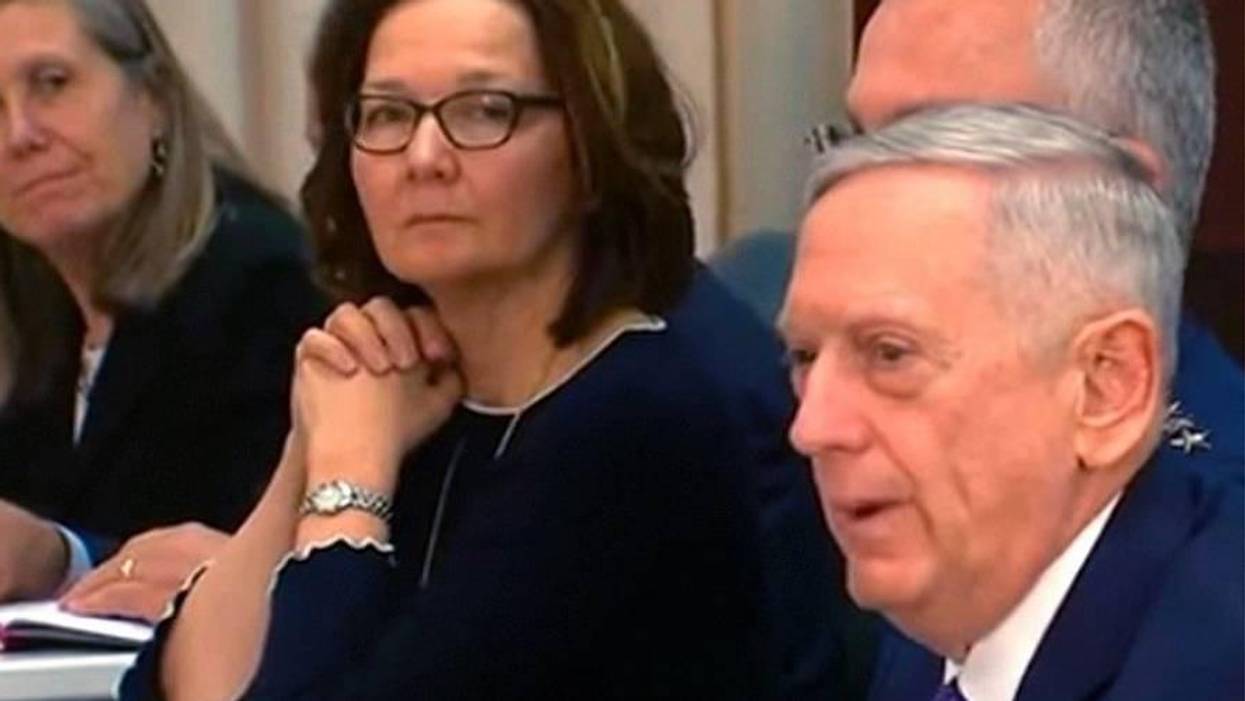
Two dozen former U.S. intelligence officers urge President Trump to rescind Gina Haspel's nomination to lead the CIA, citing torture that she oversaw while supervising a black site prison, as well as her role in destroying evidence.
MEMORANDUM FOR: The President
FROM: Veteran Intelligence Professionals for Sanity
SUBJECT: Request to Withdraw Nomination of Gina Haspel
EXECUTIVE SUMMARY
With respect, we veteran intelligence officers from CIA and other agencies urge you to withdraw the nomination of Gina Haspel for CIA director. From what is already known of her leading role in CIA torture 16 years ago, she has disqualified herself.
In 2002 Haspel supervised the first CIA "black site" for interrogation, where cruel and bizarre forms of torture were applied to suspected terrorists. And when the existence of 92 videotapes of those torture sessions was revealed, Haspel signed a cable ordering their destruction, against the advice of legal counsel at CIA and the White House.
Does Torture 'Work?'
We are confident that if you set aside some time to read the unredacted portions of the Senate Intelligence Committee report of 2014 on the torture ordered and supervised by Haspel and other CIA managers, you will change your mind about her nomination. The five-year Senate investigation was based primarily on original CIA cables and other sensitive documents.
In addition to revealing clear violations of the UN Convention Against Torture, the Senate investigation shows that claims by senior CIA officials that torture is effective are far from true. The US Army -- in which many of us have served -- has been aware of the ineffectiveness of torture for decades.
General John Kimmons, head of Army Intelligence, drove home that point on September 6, 2006 -- approximately an hour before President George W. Bush publicly extolled the virtues of torture methods that became known as "enhanced interrogation techniques." Gen. Kimmons stated: "No good intelligence is going to come from abusive practices. I think history tells us that. I think the empirical evidence of the last five years -- hard years -- tell us that."
We believe that Defense Secretary James Mattis' lack of enthusiasm for torture reflects lessons drawn from the historical experience of the Marine Corps, as well. Not to mention the twin reality that torture brutalizes the brutalizer, and that US use of torture puts our own troops in serious jeopardy when captured. Moreover, there is no more effective recruitment tool than torture to attract more terrorists.
International and Domestic Law
Please also be aware that many signatories to the UN Convention Against Torture take seriously their obligations under the principle of "universal jurisdiction," which applies when those who authorize or practice torture are not brought to justice by authorities in their home countries.
George W. Bush experienced a precarious brush with this reality in 2011, when he had to abruptly cancel a visit to Geneva, Switzerland, after discovering that plans were in place to arrest him as soon as he stepped onto Swiss soil. [See "America's Stay-at-Home Ex-President"] The widely respected European Center for Constitutional and Human Rights already has made no secret of its intention to proceed quickly against Haspel, should she set foot in Europe.
We believe that CIA's activities and general focus have become severely unbalanced, with the lion's share of funding and energy going to the paramilitary-prone operational side -- where the potential for human rights abuses is not given sufficient consideration.
That trend has gone on steroids in more recent decades, and it is a safe bet that Gina Haspel would accelerate it. We would also observe that if most of the talent and funding goes to CIA paramilitary operations, then the by-products will necessarily include a tendency to engage in politically motivated -- and therefore shabby -- analysis. That means that senior policymakers like you will be poorly informed, particularly with respect to complex world issues -- including biased perspectives on Russia and its newly re-elected president, Vladimir Putin.
* * *
We Veteran Intelligence Professionals for Sanity (VIPS) are extremely concerned at the possibility that Gina Haspel might become the next Director of the CIA. Haspel actually supervised a CIA "black site" codenamed "Cat's Eye" in Thailand where a number of suspected terrorists were tortured. She subsequently collaborated in destroying all 92 videotapes of the torture sessions, effectively covering up what were likely serious war crimes.
There should be no question about the illegality of torture. It has been universally condemned and banned by both the Geneva Conventions and United Nations Convention Against Torture and Other Cruel, Inhuman or Degrading Treatment or Punishment, which was signed by President Ronald Reagan in 1988 and ratified by the Senate in 1994.
The UN Convention defines torture "as any act by which severe pain or suffering, whether physical or mental, is intentionally inflicted on a person for such purposes as obtaining from him, or a third person, information or a confession..." and makes clear that "no exceptional circumstances whatsoever, whether a state of war or threat of war, internal political instability or any other public emergency, may be invoked as a justification of torture."
The Convention's Article 2 requires signatories to take effective measures to prevent torture in any territory under their jurisdiction. The complete prohibition of torture is absolute. Under international law, officials cannot receive immunity in cases involving torture and governments that have signed the Convention are obligated to bring torturers to justice. US domestic law was brought in line with the Convention once the US became a signatory and ratified it.
In the wake of the Abu Ghraib revelations, torture, to include its variations that have been euphemistically described as "enhanced interrogation techniques" (EIT), is now explicitly banned by the US military in its training manuals. A number of soldiers were tried and imprisoned in the wake of Abu Ghraib, although the "upper ranks" -- in civilian as well as military spheres -- who approved torture managed to escape serious consequences.
Some in the Pentagon clearly took seriously allegations of torture and were willing to file criminal charges against those involved, though Department of Defense leadership never saw fit to assume responsibility for having set up a policy environment that quite clearly condoned EIT.
There is also another significant historical and legal precedent that demonstrates that the United States government has by its own actions agreed that what is today being called "enhanced interrogation" is a war crime. In 1946-1948, Japanese officers who tortured Allied soldiers -- including what is now referred to as waterboarding -- were tried at the Tokyo post-war tribunals for that crime, found guilty, and executed.
Heinous
More recently, the meticulously documented unclassified 528 page Executive Summary of the Senate Select Committee on Intelligence (SSCI) report on the CIA's secret Rendition, Detention and Interrogation (RDI) program is remarkable for its candor. That five-year investigation was based on original CIA cables and other documents.
In blunt language, the Senate report describes the horrors of the black site secret prisons and the efforts that were made to get terrorist suspects to talk. It demonstrates that the interrogations were brutal -- worse than anyone had been led to believe -- and also that they did not produce any information that might not have been developed otherwise or, in many cases, any actionable intelligence whatsoever. The full classified text of the report -- which names names of the actual torture perpetrators redacted in the summary -- runs to almost 7,000 pages.
Moreover, coercive interrogation frequently produced misleading or fabricated intelligence that wasted resources by having to be meticulously checked before being used. This conclusion was also arrived at by former FBI interrogator Ali Soufan -- who deplored CIA methods -- as well as by a review conducted by CIA's then-Inspector General (IG), John Helgerson, in 2004. The "Helgerson Report" condemned both CIA leadership and Langley's on-the-ground management of questionable programs driven by "analytical assessments that were unsupported by credible intelligence" -- programs which quickly became abusive.
It is our collective judgment that the loathsome physical abuses that included beatings, repeated waterboardings and anal violations referred to as "rectal feeding" -- as well as physical threats to family members -- cannot be whitewashed with the convenient euphemism of "enhanced interrogation." All of those are acts of torture -- plain and simple.
And while there are undoubtedly many good moral arguments against torture, there are practical considerations as well. Despite what the media would have Americans believe, torture does not work.
We recall the unambiguous remarks of then-commander of Army intelligence, Gen. John Kimmons, who held a Pentagon press conference on Sept. 6, 2006 -- the same day President George W. Bush announced what he called "an alternative set of procedures" for interrogation (which later morphed into the term "enhanced interrogation techniques"). Anticipating that Bush would claim the EITS to be necessary and effective, Gen. Kimmons told the media: "No good intelligence is going to come from abusive practices. I think history tells us that. I think the empirical evidence of the last five years -- hard years --tells us that."
Colin Powell Mousetrapped by 'Intelligence' From Torture
Worse still, intelligence officials have used information, which they knew was gained from torture, to mislead the most senior US officials on issues of war and peace. One of the signatories below was eyewitness to how CIA Director George Tenet persuaded Secretary of State Colin Powell to tell the UN of a "sinister nexus" between Saddam Hussein and al-Qaeda.
Tenet did not tell Powell that this "intelligence" came from a source, Abu Yahya al-Libi, who had been "rendered" to, and waterboarded by, Egyptian intelligence. The Defense Intelligence Agency had deemed this intelligence unreliable, but Tenet chose to ignore DIA and never informed Powell. Al-Libi recanted less than a year later, admitting that he fabricated the story about Saddam and al-Qaeda in order to stop his torture.
Moreover, when you wink at torture, you motivate enemies of the United States to do the same to captured US soldiers, diplomats and travelers while also providing a propaganda bonanza for terrorist groups like al-Qaeda and ISIS.
Indeed, the only reason why CIA torturers have not been tried and sentenced to prison for the damage they have done to the nation is that an intimidated President Barack Obama -- who once proclaimed that "nobody is above the law" -- balked at allowing the judicial process to run its course, thereby whitewashing the Bush Administration's many crimes related to the so-called "global war on terror." Obama attempted to justify his inaction as looking forward rather than backward, but it is more likely that he feared opening up a Pandora's Box of shameful government secrets that no doubt would have emerged.
Promoting Haspel in spite of her tainted record would send a message to both intelligence and military personnel that embracing practices like torture -- indisputably a war crime -- can be a path to promotion.
Haspel's involvement with torture began when she accepted the assignment to go to Thailand -- which she could have turned down -- to run the "black site" where the interrogations were being conducted. She was, at the time, the deputy in CIA's Counter Terrorism Center (CTC), working for Jose Rodriguez.
She was in charge of the secret Thailand base in late 2002 while Abd al-Rahim al-Nashiri and possibly more suspects were being tortured in a process that included slamming victims' heads against walls, subjecting them to painful stress positions, regularly depriving them of sleep, confining them to small, coffin-like boxes, and waterboarding.
The "confinement boxes" were of two types; one was coffin-sized, and the other was smaller and less than waist-high. Both had strong claustrophobic effects. A prisoner would be forced into the smaller box as an extreme form of stress positioning, creating excruciating pain. To maximize psychological distress and exploit phobias, insects were sometimes placed in the pitch-black "coffin" alongside the victim.
Destroying the Evidence
In 2005, after returning to CIA headquarters at Langley, she acted on instructions from Rodriguez and drafted the order to destroy the 92 videotapes that had been made of the interrogations. It has been reported that she was a "strong advocate" for the destruction. This was contrary to instructions provided by CIA Counsel John Rizzo and the White House. Thus, her act may have constituted destruction of evidence -- a felony.
Jose Rodriguez was investigated for destruction of evidence by a Special Prosecutor who eventually ruled against charging him. An aide to CIA Executive Director Kyle "Dusty" Foggo later revealed Rodriguez's rationale for shredding the tapes, writing in an email that "the heat from destroying [them] is nothing compared with what it would be if the tapes ever got into public domain - he [Rodriguez] said that they would make us look terrible; it would be devastating to us." Gina Haspel ensured that these tapes -- important, damning evidence of US government torture -- would never see the light of day.
Haspel's defenders claim that she was not the creator of the torture program and only served as a willing executor of a government initiative that she believed to be legal. That may be true as no one has access to the CTC documents that might prove otherwise. Nevertheless, it does not provide her a free pass under international law, where it is generally referred to as the "Nuremberg Defense" -- a thoroughly discredited "defense" that harkens back to the era of Nazi atrocities and those who attempted to justify them by claiming perpetrators were "just following orders."
'Nuremberg Defense' Didn't Work at Nuremberg
Several former CIA leaders have supported her, saying that she was "implementing the legal orders of the president," but many of them may be concerned about their own reputations or questionable decisions they may have made in the name of the "war on terror." And the UN's International Law Commission says something quite different in its codification of the legal options surrounding torture, writing that "the fact that a person acted pursuant to an order of his government or of a superior does not relieve him from responsibility under international law, provided a moral choice was in fact possible to him."
It is also claimed that Gina Haspel was working for the CIA Chief of Station (COS) in Bangkok and acting under the COS's orders, but those of us who have worked in and led CIA bases would dispute that that type of tight control was common, particularly since in this case, she was reporting directly to the Counterterrorism Center at Langley. Haspel would have been the boss and would have had independence in the field in executing directives from CIA Headquarters and the Counterterrorism Center -- some of which she herself had a hand in drafting.
If Haspel is confirmed and wishes to travel abroad, she may have to restrict herself to countries not party to the UN Convention Against Torture because of her widely known involvement in the "black site" in Thailand. The 42 countries that have signed and ratified the Convention include the US and most of its allies. All take on a legal obligation to enforce the prohibition against torture, based on the principle of "universal jurisdiction," when necessary. In other words, they are empowered to act when the accused's home country refuses to do so.
Not Too Late to Do the Right Thing
If you do not withdraw the nomination of Gina Haspel and she is confirmed, this will cast a moral stain on the vast numbers of patriotic and ethically upright Americans who serve their country in the field of national security. It will also be a continuation of the steady erosion of human rights standards and rule of law post-9/11.
Apparent widespread support for torture among the US public -- enabled largely by the false message of Hollywood, the media and the Cheney family that it "works" -- is deplorable. It might have been headed off by the prosecutions of Haspel, Rodriguez and others by former President Obama, together with graphic exposure of the evidence. You have an opportunity to reverse this wrong.
Withdrawing Haspel's nomination now would be a step in the right direction. Confirming her as Director of CIA would signal that Washington embraces what then-Vice President Dick Cheney referred to as the "dark side." Regrettably, torture was once part of US policy. Indeed, one of this Memorandum's signatories spent nearly two years in federal prison because he revealed that. But torture cannot be relied upon to yield accurate intelligence. It remains an internationally condemned malignancy that must be excised, never to return.
* * *
For the Steering Group, Veteran Intelligence Professionals for Sanity (VIPS)
Jean Maria Arrigo, PhD, member of 2005 American Psychological Association task force evaluating the role of psychologists in U.S. intelligence and military interrogations of detainees (associate VIPS)
William Binney, former NSA Technical Director for World Geopolitical & Military Analysis; Co-founder of NSA's Signals Intelligence Automation Research Center (ret.)
Richard H. Black, Senator of Virginia, 13th District; Colonel US Army (ret.); Former Chief, Criminal Law Division, Office of the Judge Advocate General, the Pentagon (associate VIPS)
Bogdan Dzakovic, former Team Leader of Federal Air Marshals and Red Team, FAA Security (ret.) (associate VIPS)
Philip Giraldi, CIA, Operations Officer (ret.)
George Hunsinger, Professor, Princeton Theological Seminary; Founder, National Religious Campaign Against Torture (associate VIPS)
Michael S. Kearns, Captain, USAF (ret.), Intelligence Officer & ex-Master SERE Instructor
John Kiriakou, Former CIA Counterterrorism Officer and former senior investigator, Senate Foreign Relations Committee
Karen Kwiatkowski, Lt. Col., USAF (ret.)
Linda Lewis, WMD preparedness policy analyst, USDA (ret.) (associate VIPS)
Edward Loomis, NSA Cryptologic Computer Scientist, ret.
Ray McGovern, former US Army infantry/intelligence officer & CIA analyst; CIA Presidential briefer (ret.)
Elizabeth Murray, former Deputy National Intelligence Officer for the Near East, National Intelligence Council & CIA political analyst (ret.)
Todd E. Pierce, MAJ, US Army Judge Advocate (ret.)
Valerie Plame, former operations officer, CIA (associate VIPS)
Diane Roark, Republican Professional Staff, House Permanent Select Committee on Intelligence, 1985-2002 (ret.) (associate VIPS)
Coleen Rowley, FBI Special Agent and former Minneapolis Division Legal Counsel (ret.)
Greg Thielmann, former Director, Office of Strategic, Political, and Military Affairs, Bureau of Intelligence and Research, State Department; Former staff member, Senate Intelligence Committee
Peter Van Buren, US Department of State, Foreign Service Officer (ret.) (associate VIPS)
Kirk Wiebe, former Senior Analyst, SIGINT Automation Research Center, NSA
Lawrence Wilkerson, Colonel, US Army (ret.), former Chief of Staff for Secretary of State; Distinguished Visiting Professor, College of William and Mary (associate VIPS)
Sarah G. Wilton, CDR, USNR, (ret.); Defense Intelligence Agency (ret.)
Robert Wing, former Foreign Service Officer (associate VIPS)
Ann Wright, Colonel, US Army (ret.); also Foreign Service Officer who resigned in opposition to the US war on Iraq
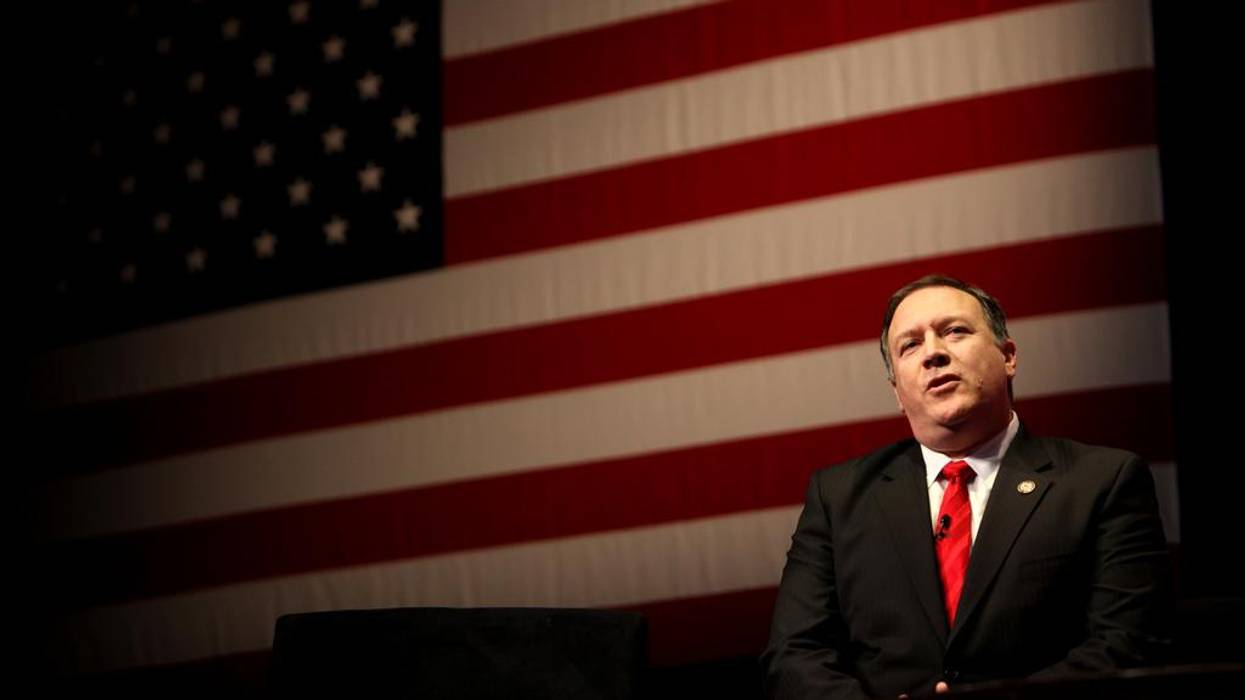
CIA Director Mike Pompeo met late last month with a former U.S. intelligence official who has become an advocate for a disputed theory that the theft of the Democratic National Committee's emails during the 2016 presidential campaign was an inside job, rather than a hack by Russian intelligence.
Pompeo met on October 24 with William Binney, a former National Security Agency official-turned-whistleblower who co-authored an analysis published by a group of former intelligence officials that challenges the U.S. intelligence community's official assessment that Russian intelligence was behind last year's theft of data from DNC computers. Binney and the other former officials argue that the DNC data was "leaked," not hacked, "by a person with physical access" to the DNC's computer system.
In an interview with The Intercept, Binney said Pompeo told him that President Donald Trump had urged the CIA director to meet with Binney to discuss his assessment that the DNC data theft was an inside job. During their hour-long meeting at CIA headquarters, Pompeo said Trump told him that if Pompeo "want[ed] to know the facts, he should talk to me," Binney said.
A senior intelligence source confirmed that Pompeo met with Binney to discuss his analysis, and that the CIA director held the meeting at Trump's urging. The Intercept's account of the meeting is based on interviews with Binney, the senior intelligence source, a colleague who accompanied Binney to CIA headquarters, and others who Binney told about the meeting. A CIA spokesperson declined to comment. "As a general matter, we do not comment on the Director's schedule," said Dean Boyd, director of the CIA's Office of Public Affairs.
Read the full article, with possible updates, at The Intercept.
In depicting National Security Agency whistleblower Edward Snowden as a Russian spy, author Edward Jay Epstein acknowledges his debt to the CIA's famously paranoid counterintelligence chief James Jesus Angleton, who specialized in counterintuitive thinking that surely smeared more honest CIA officers than it snared actual spies.
At a recent book signing at the Hoover Institute in Washington, D.C., for How America Lost Its Secrets: Edward Snowden, the Man and the Theft, Epstein proudly announced that he learned the tricks of the counterintelligence trade from the now-deceased Angleton.
But Angleton, like other counterintelligence sleuths, assumed the carte-blanche right to smother a slender fact with weighty assumptions and then weave upon them a hefty garment of allegations, speculation and imagination fitting with the occupational predisposition to detect a spy.
Over the decades, it's conceivable that this "methodology" may have caught a spy or two (although Angleton is perhaps best known for missing the notorious Soviet spy Kim Philby). But creating a counterfactual, evidence-free scenario seems an irresponsible way to write about Edward Snowden, a whistleblower responsible for the most consequential intelligence leak in U.S. history.
In his new book, Epstein spins his intricate web to prove Snowden's supposed treachery around the fact that after leaking secrets to Western journalists in Hong Kong, Snowden wound up in Russia. The well-known reality is that Snowden never intended to get stuck in Russia but was stranded there when the U.S. government blocked his path to South America. Yet, however clear the record regarding how and why Snowden found asylum there, Epstein sees a more sinister logic.
As a veteran of the Central Intelligence Agency and a private citizen who has befriended many government whistleblowers, I happen to have known Angleton and currently know Snowden (whom I count among my friends).
I recall in 1974, when CIA Director William Colby finally fired Angleton, audible sighs of relief rippled through spydom. Angleton had ruined the careers - and sometimes the lives - of many conscientious CIA officers. When, finally, Angleton was not in position to do any more damage, many of my contemporaries recounted personal examples of how misguided and harmful Angleton's periodic witch hunts had been.
Like Angleton, Epstein also has a tendency to see spies where they aren't, including asserting that Lee Harvey Oswald was a Soviet spy, a claim that finds zero support in the KGB records now available. That proclivity is also evident in Epstein's new book.
Before the book signing at the Hoover Institute, a New York Times review and Pulitzer Prize winner Barton Gellman had thoroughly panned Epstein's book, and more recently New York Times journalist Charlie Savage picked it apart. Their indictments suffice; I feel no need to again recite Epstein's errors of fact and analysis.
Squeezing in a Question
But I did squeeze a question in at the Hoover book event. Epstein's interviewer, Ben Witte of Brookings, had served up a few innings-worth of softball pitches but allowed no questions from the audience. However, when Epstein claimed that his best source on Snowden's perfidy was Russian President Vladimir Putin, whom Epstein proceeded to quote - incorrectly - to the effect that Snowden had met with Russian officials in Hong Kong. I spoke out, saying, "Putin did not say that."
Shock hit the audience at my impertinence, and Witte's eyes scoured the back of the room apparently looking for Security. But the ever-genteel Epstein saved the day by admitting that I was right and that he had misspoken.
After the Witte-Epstein dialogue, the audience was allowed to approach Epstein for conversation. I introduced myself and noted that I had joined other former intelligence officers in visiting Snowden in Moscow.
"Oh, yes, I remember your name," Epstein said, prompting me to ask why he did not seek to interview me for the book. "Yes, I should have contacted you," he said with a smile.
At the time I was unaware of the curious limits Epstein had put on his outreach. Besides those of us who had met with Snowden in Moscow, Epstein "should have contacted" Sarah Harrison, who stayed by Snowden's side during his five weeks at Moscow's Sheremetevo Airport and then for a few additional months; Julian Assange, who pulled out all the stops to facilitate Snowden's sudden and safe departure from Hong Kong; NSA whistleblowers William Binney, Kirk Wiebe and Ed Loomis; and Diane Roark, House Intelligence Committee senior aide who had the NSA account for several years.
Epstein's book shows that - while ignoring people who know Snowden or have had painful experiences trying to expose NSA wrongdoing by going through the "proper channels" - he conducted many interviews with people who consider Snowden, as well as Putin, the devil incarnate.
There is also the issue of how much actual "damage" Snowden's disclosures caused. According to former NSA Technical Director William Binney, it is fair to say that the extent of the NSA's vacuuming up of bulk data on Americans and people around the world was a surprise, first and foremost, to Americans whose eyes were opened (as Snowden intended); that U.S. adversaries were generally aware of NSA's capabilities; and that damage to sources and methods typically has been exaggerated by those interested in overstating it.
Alarmist Complaints
Here there are shades of the alarmist complaints about the supposed damage caused by the disclosures about the wars in Afghanistan and Iraq from Pvt. Chelsea (formerly Bradley) Manning.
After Defense Secretary Robert Gates had joined other senior officials in lamenting the "grave damage" from Manning's revelations, Gates was asked by Senate Armed Services Committee Chair Carl Levin to put it in writing. Gates came back with an honest report: Early claims of damage had been, in Gates's words, "significantly overwrought."
Bill Binney and his colleagues tell me the same is probably true of the hyperbole used to portray the damage from the Snowden disclosures.
Yet, balancing whatever that "damage" was is the significance of Snowden's argument that the warrantless bulk surveillance of Americans was illegal under the Constitution and created the risk of a future leader imposing a "turnkey tyranny" on the United States because of all the embarrassing and incriminating information that would be collected on American citizens.
There is now no doubt that Snowden's constitutional concerns were well-founded and it is not hard to imagine how an unscrupulous politician might make effective use of people's personal secrets or their unguarded comments.
But it is easier to discredit Snowden by simply portraying him as a Russian spy. After all, we are now deep in a New McCarthyism that accompanies the New Cold War. Any contact with Russians - no matter how unintentional in Snowden's case - is regarded as somehow disqualifying.
So, that is the tack that Epstein took. However, the evidence isn't there.
Chris Inglis, who was NSA's Deputy Director when Snowden made the disclosures and who headed the initial NSA investigation, said about Snowden a year ago: "I don't think he was in the employ of the Chinese or the Russians. I don't see any evidence that would indicate that."
Epstein - like so many others - also shows a basic lack of understanding of the important, graduated scale of values that Ed Snowden and other whistleblowers take with utmost seriousness. At one point, Epstein glibly says of Snowden, "In signing this [nondisclosure] document, he swore an oath not to divulge any of this information."
But that's not correct. The only oath that we, as military or other government officials swear is: "To support and defend the Constitution of the United States against all enemies foreign and domestic."
Ethicists describe such an oath as a "supervening value," far more serious than a promise like that embedded in the contract one signs in agreeing not to disclose classified information that could be harmful to U.S. national security. In other words, what do you do when your oath conflicts with the contract language, which one has the priority?
Snowden's Choice
Are promises important? Of course they are. But in the moral sphere, oaths supersede promises. NSA was playing fast and loose with the Constitution's Fourth Amendment (and arguably with the First and the Fifth as well) with warrantless surveillance. Snowden chose not to break his oath to the Constitution. Nor would he remain silent when others broke theirs.
Watching what happened to fellow whistleblowers - like Thomas Drake - who tried to "go through channels," Snowden knew that he had to "get out of Dodge" to have any hope of remaining at liberty long enough to complete his mission. He decided to run the huge risk involved in defending the Constitution against incipient "turnkey tyranny."
That may be difficult for Epstein and many cynical observers to believe, but without any evidence to the contrary, Snowden hardly deserves to be treated like the CIA officers who faced character assassination from Epstein's paranoid mentor, Angleton.
I first met Snowden in early October 2013 when I was a member of the first delegation of Americans to visit him as a political exile in Russia. Four of us, all members of Sam Adams Associates for Integrity in Intelligence, officially presented him with our annual award for integrity.
My three colleagues, each of them an earlier awardee, were whistleblowers Coleen Rowley, Thomas Drake, and Jesselyn Raddack (ex-FBI, -NSA, -Department of Justice, respectively). After the award ceremony we spent seven hours relaxing and comparing notes with Snowden. And a year later, I had a long lunch with him in Moscow.
For my colleagues and me, this unassuming, courageous young man, known to us only by what he had said and done over the previous three months, proved to be the precisely the patriotic whistleblower we thought he was. His courage and motivation were altogether believable to Rowley, Drake and Raddack, for each of them had taken similar risks in blowing the whistle on U.S. government misconduct.
This is simply to say that all four of us seasoned professionals had a unique opportunity to take the measure of Snowden up close and personal. It is a truly a pity that author Epstein did not do the same.
MEMORANDUM FOR: President Barack Obama
FROM: Veteran Intelligence Professionals for Sanity (VIPS)
SUBJECT: A Key Issue That Still Needs to be Resolved
As President-elect Donald Trump prepares to take the oath of office Friday, a pall hangs over his upcoming presidency amid an unprecedentedly concerted campaign to delegitimize it. Unconfirmed accusations continue to swirl alleging that Russian President Vladimir Putin authorized "Russian hacking" that helped put Mr. Trump in the White House.
As President for a few more days, you have the power to demand concrete evidence of a link between the Russians and WikiLeaks, which published the bulk of the information in question. Lacking that evidence, the American people should be told that there is no fire under the smoke and mirrors of recent weeks.
We urge you to authorize public release of any tangible evidence that takes us beyond the unsubstantiated, "we-assess" judgments by the intelligence agencies. Otherwise, we - as well as other skeptical Americans - will be left with the corrosive suspicion that the intense campaign of accusations is part of a wider attempt to discredit the Russians and those - like Mr. Trump - who wish to deal constructively with them.
Remember the Maine?
Alleged Russian interference has been labeled "an act of war" and Mr. Trump a "traitor." But the "intelligence" served up to support those charges does not pass the smell test. Your press conference on Wednesday will give you a chance to respond more persuasively to NBC's Peter Alexander's challenge at the last one (on Dec. 16) "to show the proof [and], as they say, put your money where your mouth is and declassify some of the intelligence. ..."
You told Alexander you were reluctant to "compromise sources and methods." We can understand that concern better than most Americans. We would remind you, though, that at critical junctures in the past, your predecessors made judicious decisions to give higher priority to buttressing the credibility of U.S. intelligence-based policy than to protecting sources and methods. With the Kremlin widely accused by politicians and pundits of "an act of war," this is the kind of textbook case in which you might seriously consider taking special pains to substantiate serious allegations with hard intelligence - if there is any.
During the Cuban missile crisis, for instance, President Kennedy ordered us to show highly classified photos of Soviet nuclear missiles in Cuba and on ships en route, even though this blew sensitive detail regarding the imagery intelligence capabilities of the cameras on our U-2 aircraft.
President Ronald Reagan's reaction to the Libyan terrorist bombing of La Belle Disco in Berlin on April 5, 1986, that killed two and injured 79 other U.S. servicemen is another case in point. We had intercepted a Libyan message that morning: "At 1:30 in the morning one of the acts was carried out with success, without leaving a trace behind." (We should add here that NSA's dragnet SIGINT capability 30 years later renders it virtually impossible to avoid "leaving a trace behind" once a message is put on the network.)
President Reagan ordered the U.S. Air Force to bomb Col. Muammar Qaddafi's palace compound to smithereens, killing several civilians. Amid widespread international consternation and demands for proof that Libya was responsible for the Berlin attack, President Reagan ordered us to make public the encrypted Libyan message, thereby sacrificing a collection/decryption capability unknown to the Libyans - until then.
As senior CIA veteran Milton Bearden has put it, there are occasions when more damage is done by "protecting" sources and methods than by revealing them.
Where's the Beef?
We find the New York Times- and Washington Post-led media Blitz against Trump and Putin truly extraordinary, despite our long experience with intelligence/media related issues. On Jan. 6, the day after your top intelligence officials published what we found to be an embarrassingly shoddy report purporting to prove Russian hacking in support of Trump's candidacy, the Times banner headline across all six columns on page 1 read: "PUTIN LED SCHEME TO AID TRUMP, REPORT SAYS."
The lead article began: "President Vladimir V. Putin of Russia directed a vast cyberattack aimed at denying Hillary Clinton the presidency and installing Donald J. Trump in the Oval Office, the nation's top intelligence agencies said in an extraordinary report they delivered on Friday to Mr. Trump." Eschewing all subtlety, the Times added that the revelations in "this damning report ... undermined the legitimacy" of the President-elect, and "made the case that Mr. Trump was the favored candidate of Mr. Putin."
On page A10, however, Times investigative reporter Scott Shane pointed out: "What is missing from the public report is what many Americans most eagerly anticipated: hard evidence to back up the agencies' claims that the Russian government engineered the election attack. That is a significant omission."
Shane continued, "Instead, the message from the agencies essentially amounts to 'trust us.' There is no discussion of the forensics used to recognize the handiwork of known hacking groups, no mention of intercepted communications between the Kremlin and the hackers, no hint of spies reporting from inside Moscow's propaganda machinery."
Shane added that the intelligence report "offers an obvious reason for leaving out the details, declaring that including 'the precise bases for its assessments' would 'reveal sensitive sources and methods and imperil the ability to collect critical foreign intelligence in the future.'"
Shane added a quote from former National Security Agency lawyer Susan Hennessey: "The unclassified report is underwhelming at best. There is essentially no new information for those who have been paying attention." Ms. Hennessey served as an attorney in NSA's Office of General Counsel and is now a Brookings Fellow in National Security Law.
Everyone Hacks
There is a lot of ambiguity - whether calculated or not - about "Russian hacking." "Everyone knows that everyone hacks," says everyone: Russia hacks; China hacks; every nation that can hacks. So do individuals of various nationalities. This is not the question.
You said at your press conference on Dec. 16 "the intelligence that I have seen gives me great confidence in their [U.S. intelligence agencies'] assessment that the Russians carried out this hack." "Which hack?" you were asked. "The hack of the DNC and the hack of John Podesta," you answered.
Earlier during the press conference you alluded to the fact that "the information was in the hands of WikiLeaks." The key question is how the material from "Russian hacking" got to WikiLeaks, because it was WikiLeaks that published the DNC and Podesta emails.
Our VIPS colleague William Binney, who was Technical Director of NSA and created many of the collection systems still in use, assures us that NSA's "cast-iron" coverage - particularly surrounding Julian Assange and other people associated with WikiLeaks - would almost certainly have yielded a record of any electronic transfer from Russia to WikiLeaks. Binney has used some of the highly classified slides released by Edward Snowden to demonstrate precisely how NSA accomplishes this using trace mechanisms embedded throughout the network.
NSA Must Come Clean
We strongly suggest that you ask NSA for any evidence it may have indicating that the results of Russian hacking were given to WikiLeaks. If NSA can produce such evidence, you may wish to order whatever declassification may be needed and then release the evidence. This would go a long way toward allaying suspicions that no evidence exists. If NSA cannot give you that information - and quickly - this would probably mean it does not have any.
In all candor, the checkered record of Director of National Intelligence James Clapper for trustworthiness makes us much less confident that anyone should take it on faith that he is more "trustworthy than the Russians," as you suggested on Dec. 16. You will probably recall that Clapper lied under oath to the Senate Intelligence Committee on March 12, 2013, about NSA dragnet activities; later apologizing for testimony he admitted had been "clearly erroneous." In our Memorandum for you on Dec. 11, 2013, we cited chapter and verse as to why Clapper should have been fired for saying things he knew to be "clearly erroneous."
In that Memorandum, we endorsed the demand by Rep. Jim Sensenbrenner that Clapper be removed. "Lying to Congress is a federal offense, and Clapper ought to be fired and prosecuted for it," said Sensenbrenner in an interview with The Hill. "The only way laws are effective is if they're enforced."
Actually, we have had trouble understanding why, almost four years after he deliberately misled the Senate, Clapper remains Director of National Intelligence - overseeing the entire intelligence community.
Hacks or Leaks?
Not mentioned until now is our conclusion that leaks are the source of the WikiLeaks disclosures in question - not hacking. Leaks normally leave no electronic trace. William Binney has been emphasizing this for several months and suggesting strongly that the disclosures were from a leaker with physical access to the information - not a hacker with only remote access.
This, of course, makes it even harder to pin the blame on President Putin, or anyone else. And we suspect that this explains why NSA demurred when asked to join the CIA and FBI in expressing "high confidence" in this key judgment of the report put out under Clapper's auspices on Jan. 6, yielding this curious formulation:
"We also assess Putin and the Russian Government aspired to help President-elect Trump's election chances when possible by discrediting Secretary Clinton and publicly contrasting her unfavorably to him. All three agencies agree with this judgment. CIA and FBI have high confidence in this judgment; NSA has moderate confidence." (Emphasis, and lack of emphasis, in original)
In addition, former U.K. Ambassador Craig Murray has said publicly he has first-hand information on the provenance of the leaks, and has expressed surprise that no one from the New York Times or the Washington Post has tried to get in touch with him. We would be interested in knowing whether anyone from your administration, including the intelligence community, has made any effort to contact Ambassador Murray.
What to Do
President-elect Trump said a few days ago that his team will have a "full report on hacking within 90 days." Whatever the findings of the Trump team turn out to be, they will no doubt be greeted with due skepticism, since Mr. Trump is in no way a disinterested party.
You, on the other hand, enjoy far more credibility - AND power - for the next few days. And we assume you would not wish to hobble your successor with charges that cannot withstand close scrutiny. We suggest you order the chiefs of the NSA, FBI and CIA to the White House and ask them to lay all their cards on the table. They need to show you why you should continue to place credence in what, a month ago, you described as "uniform intelligence assessments" about Russian hacking.
At that point, if the intelligence heads have credible evidence, you have the option of ordering it released - even at the risk of damage to sources and methods. For what it may be worth, we will not be shocked if it turns out that they can do no better than the evidence-deprived assessments they have served up in recent weeks. In that case, we would urge you, in all fairness, to let the American people in on the dearth of convincing evidence before you leave office.
As you will have gathered by now, we strongly suspect that the evidence your intelligence chiefs have of a joint Russian-hacking-WikiLeaks-publishing operation is no better than the "intelligence" evidence in 2002-2003 - expressed then with comparable flat-fact "certitude" - of the existence of weapons of mass destruction in Iraq.
Obama's Legacy
Mr. President, there is much talk in your final days in office about your legacy. Will part of that legacy be that you stood by while flames of illegitimacy rose willy-nilly around your successor? Or will you use your power to reveal the information - or the fact that there are merely unsupported allegations - that would enable us to deal with them responsibly?
In the immediate wake of the holiday on which we mark the birthday of Dr. Martin Luther King, Jr., it seems appropriate to make reference to his legacy, calling to mind the graphic words in his "Letter From the Birmingham City Jail," with which he reminds us of our common duty to expose lies and injustice:
"Like a boil that can never be cured as long as it is covered up, but must be opened with all its pus-flowing ugliness to the natural medicines of air and light, injustice must likewise be exposed, with all of the tension its exposing creates, to the light of human conscience and the air of national opinion before it can be cured."
For the Steering Group, Veteran Intelligence Professionals for Sanity (VIPS)
William Binney, former Technical Director, World Geopolitical & Military Analysis, NSA; co-founder, SIGINT Automation Research Center (ret.)
Marshall Carter-Tripp, Foreign Service Officer (ret) and former Office Director in the State Department Bureau of Intelligence and Research
Thomas Drake, former Senior Executive, NSA
Bogdan Dzakovic, Former Team Leader of Federal Air Marshals and Red Team, FAA Security, (ret.) (associate VIPS)
Philip Giraldi, CIA, Operations Officer (ret.)
Mike Gravel, former Adjutant, top secret control officer, Communications Intelligence Service; special agent of the Counter Intelligence Corps and former United States Senator
Matthew Hoh, former Capt., USMC, Iraq & Foreign Service Officer, Afghanistan (associate VIPS)
Larry Johnson, former CIA Intelligence Officer & former State Department Counter-Terrorism Official, ret.
Michael S. Kearns, Captain, USAF (Ret.); ex-Master SERE Instructor for Strategic Reconnaissance Operations (NSA/DIA) and Special Mission Units (JSOC)
Brady Kiesling, former U.S. Foreign Service Officer, ret. (Associate VIPS),
John Kiriakou, Former CIA Counterterrorism Officer and former Senior Investigator, Senate Foreign Relations Committee
Karen Kwiatkowski, former Lt. Col., US Air Force (ret.), at Office of Secretary of Defense watching the manufacture of lies on Iraq, 2001-2003
Linda Lewis, WMD preparedness policy analyst, USDA (ret.)
David MacMichael, National Intelligence Council (ret.)
Ray McGovern, former US Army infantry/intelligence officer & CIA analyst (ret.)
Todd E. Pierce, MAJ, US Army Judge Advocate (ret.)
Elizabeth Murray, former Deputy National Intelligence Officer for Middle East, CIA (ret.)
Scott Ritter, former MAJ., USMC, former UN Weapon Inspector, Iraq
Coleen Rowley, FBI Special Agent and former Minneapolis Division Legal Counsel (ret.)
Peter Van Buren, U.S. Department of State, Foreign Service Officer (ret.) (associate VIPS)
Kirk Wiebe, former Senior Analyst, SIGINT Automation Research Center, NSA (ret.)
Robert Wing, former Foreign Service Officer (associate VIPS)
Ann Wright, U.S. Army Reserve Colonel (ret) and former U.S. Diplomat
MEMORANDUM
Allegations of Hacking Election Are Baseless
A New York Times report on Monday alluding to "overwhelming circumstantial evidence" leading the CIA to believe that Russian President Vladimir Putin "deployed computer hackers with the goal of tipping the election to Donald J. Trump" is, sadly, evidence-free. This is no surprise, because harder evidence of a technical nature points to an inside leak, not hacking - by Russians or anyone else.
Monday's Washington Post reports that Sen. James Lankford, R-Oklahoma, a member of the Senate Intelligence Committee, has joined other senators in calling for a bipartisan investigation of suspected cyber-intrusion by Russia. Reading our short memo could save the Senate from endemic partisanship, expense and unnecessary delay.
In what follows, we draw on decades of senior-level experience - with emphasis on cyber-intelligence and security - to cut through uninformed, largely partisan fog. Far from hiding behind anonymity, we are proud to speak out with the hope of gaining an audience appropriate to what we merit - given our long labors in government and other areas of technology. And corny though it may sound these days, our ethos as intelligence professionals remains, simply, to tell it like it is - without fear or favor.
We have gone through the various claims about hacking. For us, it is child's play to dismiss them. The email disclosures in question are the result of a leak, not a hack. Here's the difference between leaking and hacking:
Leak: When someone physically takes data out of an organization and gives it to some other person or organization, as Edward Snowden and Chelsea Manning did.
Hack: When someone in a remote location electronically penetrates operating systems, firewalls or any other cyber-protection system and then extracts data.
All signs point to leaking, not hacking. If hacking were involved, the National Security Agency would know it - and know both sender and recipient.
In short, since leaking requires physically removing data - on a thumb drive, for example - the only way such data can be copied and removed, with no electronic trace of what has left the server, is via a physical storage device.
Awesome Technical Capabilities
Again, NSA is able to identify both the sender and recipient when hacking is involved. Thanks largely to the material released by Edward Snowden, we can provide a full picture of NSA's extensive domestic data-collection network including Upstream programs like Fairview, Stormbrew and Blarney. These include at least 30 companies in the U.S. operating the fiber networks that carry the Public Switched Telephone Network as well as the World Wide Web. This gives NSA unparalleled access to data flowing within the U.S. and data going out to the rest of the world, as well as data transiting the U.S.
In other words, any data that is passed from the servers of the Democratic National Committee (DNC) or of Hillary Rodham Clinton (HRC) - or any other server in the U.S. - is collected by the NSA. These data transfers carry destination addresses in what are called packets, which enable the transfer to be traced and followed through the network.
Packets: Emails being passed across the World Wide Web are broken down into smaller segments called packets. These packets are passed into the network to be delivered to a recipient. This means the packets need to be reassembled at the receiving end.
To accomplish this, all the packets that form a message are assigned an identifying number that enables the receiving end to collect them for reassembly. Moreover, each packet carries the originator and ultimate receiver Internet protocol number (either IPV4 or IPV6) that enables the network to route data.
When email packets leave the U.S., the other "Five Eyes" countries (the U.K., Canada, Australia, and New Zealand) and the seven or eight additional countries participating with the U.S. in bulk-collection of everything on the planet would also have a record of where those email packets went after leaving the U.S.
These collection resources are extensive [see attached NSA slides 1, 2, 3, 4, 5]; they include hundreds of trace route programs that trace the path of packets going across the network and tens of thousands of hardware and software implants in switches and servers that manage the network. Any emails being extracted from one server going to another would be, at least in part, recognizable and traceable by all these resources.
The bottom line is that the NSA would know where and how any "hacked" emails from the DNC, HRC or any other servers were routed through the network. This process can sometimes require a closer look into the routing to sort out intermediate clients, but in the end sender and recipient can be traced across the network.
The various ways in which usually anonymous spokespeople for U.S. intelligence agencies are equivocating - saying things like "our best guess" or "our opinion" or "our estimate" etc. - shows that the emails alleged to have been "hacked" cannot be traced across the network. Given NSA's extensive trace capability, we conclude that DNC and HRC servers alleged to have been hacked were, in fact, not hacked.
The evidence that should be there is absent; otherwise, it would surely be brought forward, since this could be done without any danger to sources and methods. Thus, we conclude that the emails were leaked by an insider - as was the case with Edward Snowden and Chelsea Manning. Such an insider could be anyone in a government department or agency with access to NSA databases, or perhaps someone within the DNC.
As for the comments to the media as to what the CIA believes, the reality is that CIA is almost totally dependent on NSA for ground truth in the communications arena. Thus, it remains something of a mystery why the media is being fed strange stories about hacking that have no basis in fact. In sum, given what we know of NSA's existing capabilities, it beggars belief that NSA would be unable to identify anyone - Russian or not - attempting to interfere in a U.S. election by hacking.
For the Steering Group, Veteran Intelligence Professionals for Sanity (VIPS)
William Binney, former Technical Director, World Geopolitical & Military Analysis, NSA; co-founder, SIGINT Automation Research Center (ret.)
Mike Gravel, former Adjutant, top secret control officer, Communications Intelligence Service; special agent of the Counter Intelligence Corps and former United States Senator
Larry Johnson, former CIA Intelligence Officer & former State Department Counter-Terrorism Official
Ray McGovern, former US Army infantry/intelligence officer & CIA analyst (ret.)
Elizabeth Murray, Deputy National Intelligence Officer for Middle East, CIA (ret.)
Kirk Wiebe, former Senior Analyst, SIGINT Automation Research Center, NSA (ret.)