SUBSCRIBE TO OUR FREE NEWSLETTER
Daily news & progressive opinion—funded by the people, not the corporations—delivered straight to your inbox.
5
#000000
#FFFFFF
To donate by check, phone, or other method, see our More Ways to Give page.


Daily news & progressive opinion—funded by the people, not the corporations—delivered straight to your inbox.
One of the psychologists paid tens of millions of dollars by the U.S. Central Intelligence Agency to oversee the interrogation of prisoners in the so-called War on Terror provided new details on Monday about the torture of a Guantanamo Bay detainee at CIA "black site" in Thailand.
"Imagine the hell Mr. Nashiri experienced outside of that box that made him prefer being inside it."
The New York Times reports James E. Mitchell told a military judge during a pretrial hearing at Guantanamo that Abd al-Rahim al-Nashiri--a Saudi national facing possible execution for allegedly masterminding the deadly 2000 bombing of the USS Cole in Yemen--broke quickly under torture and became so obedient that he would crawl into a cramped confinement box before guards ordered him to do so.
Initially, guards had to force al-Nashiri into the box. But according to Mitchell, the prisoner "liked being in the box" and would "get in and close it himself."
Annie W. Morgan, a former Air Force defense attorney who is a member of al-Nashiri's legal team, told the Times that when she heard Mitchell's testimony, "I got the image of crate-training a dog and became nauseous."
"That was the goal of the program, to create a sense of learned helplessness and to become completely dependent upon and submissive to his captors," she added, referencing a tactic taught in U.S. torture programs and documents dating back to the 1950s.
Gail Helt, a former CIA analyst who advocates Guantanamo's closure, tweeted, "Imagine the hell Mr. Nashiri experienced outside of that box that made him prefer being inside it."
Al-Nashiri's attorneys--who argue that evidence in the case is tainted by torture--questioned Mitchell about what happened at the Thailand black site in November 2002, when former CIA Director Gina Haspel oversaw the secret prison.
The psychologist's testimony is meant to shed light on abuse that may have been recorded on scores of videotapes documenting detainee torture that were later destroyed at the behest of then-CIA counterterrorism chief Jose Rodriguez, who claimed in his memoir that Haspel drafted the 2005 cable ordering the move.
Mitchell--who along with fellow psychologist John "Bruce" Jessen was paid $81 million by the CIA to develop and supervise an interrogation regimen for terrorism suspects--described how the diminutive al-Nashiri was so scrawny that guards stopped subjecting him to the interrupted drowning torture commonly called waterboarding for fear the prisoner might be seriously hurt.
In addition to waterboarding and other approved torture techniques, a declassified 2014 U.S. Senate Intelligence Committee report revealed how interrogators threatened to sexually assault al-Nashiri's mother, and how he was terrorized with a power drill and raped with a garden hose in a practice known as rectal hydration that was administered to Guantanamo prisoners who refused to eat or drink.
Mitchell told the court that:
The Times previously reported:
Interrogators continually told Mr. Nashiri they did not believe he was telling everything he knew, threatening him with worse treatment if he did not tell them more. The prisoner, already subjected to the whole array of C.I.A. torture techniques--loud noise, sleep deprivation, forced nudity, wall-slamming, and waterboarding--insisted he was trying to remember and tell them everything.
But the interrogators appear to have ultimately concluded that Mr. Nashiri was not lying. Some of the cables back to headquarters, apparently written by Ms. Haspel, described him as "compliant and cooperative," according to the 2014 report on the interrogation program by the Senate Intelligence Committee.
In addition to the black site in Thailand, al-Nashiri--who was captured in Dubai in October 2002--was imprisoned at CIA black sites in Afghanistan, Poland, Romania, and possibly Morocco before being sent to Guantanamo in September 2006.
In 2010 he was granted victim status by the Polish government, whose cooperation with and complicity in the George W. Bush administration's extraordinary rendition and torture program was later revealed and investigated.
Related Content

In March, human rights advocates condemned the U.S. Supreme Court's decision allowing the Biden administration to block Mitchell and Jessen from cooperating with Polish prosecutors investigating the torture of Saudi terror suspect Abu Zubaydah.
The Bush administration officials who devised, approved, and implemented the post-9/11 torture regimen have enjoyed total impunity. Not only did Bush's successor, former President Barack Obama, break a campaign promise to investigate and prosecute abuses as required by U.S. and international law, his Justice Department actively shielded them from accountability as torture continued at Guantanamo.
The Biden administration should avoid perpetuating the culture of impunity at the apex of U.S. leadership that undoubtedly emboldened President Donald Trump to commit human rights crimes both at home and abroad, argues one Guantanamo Bay defense attorney in an op-ed published Thursday by Business Insider.
"Take it from someone who knows the corrosive effect of impunity. I represent tortured detainees at Guantanamo Bay, where the US government has perpetrated human rights violations shrouded from public view for nearly 19 years."
--Alka Pradhan, Guantanamo defense lawyer
Alka Pradhan, human rights counsel at the Military Commissions Defense Organization at Guantanamo Bay, writes that failure to hold government officials accountable for their criminal policies and actions seriously harms U.S. national security and foreign relations.
For example, writes Pradhan, "during the Bush administration, our use of torture wrecked our national security by weakening international alliances, degrading military operations, and even contributing to troop deaths (pdf)."
"When he took office in 2009, [Former President Barack] Obama almost immediately declared he was ending the United States' torture program," she notes. "Yet the Obama administration refused to hold anyone from the Bush administration accountable, insisting that 'we're going to look forward, not backward.'"
Not only did Obama break a campaign promise by failing to prosecute any of the Bush administration officials who planned, authorized, and implemented the global CIA and military torture regime, his administration actively shielded them from ever having to face justice for their crimes. Obama's refusal to prosecute officials he knew committed torture-related crimes is itself a war crime under the Convention Against Torture.
While none of the Bush torturers ever faced the "reckoning" Obama promised, his administration did prosecute and imprison whistleblowers John Kiriakou and Chelsea Manning for revealing U.S. torture. As Pradhan notes:
Gina Haspel, who destroyed torture evidence at one of the CIA's black sites, is now director of the CIA. Steven Bybee, who authored Justice Department memoranda permitting the use of torture on detainees, is now a 9th Circuit judge who ruled in favor of government immunity for torture. John Yoo, who infamously championed the president's absolute power to crush the genitals of a child and now teaches at Berkeley Law, recently reappeared to apply his theory of absolute power to President Trump.
All of this, asserts Pradhan, has exacerbated a climate of impunity in which "the Trump administration has flouted the law on a nearly daily basis." She writes:
The administration has created detention camps on the border, initiated illegal family separations that may never be rectified, and allowed police officers to kill Black Americans without consequence or censure. Most recently, the president created a false narrative regarding the election that led to threats of violence against elected officials.
"While these most recent events are shocking, they are also the direct consequences of the lack of government accountability committed under the guise of 'national security' that has been running rampant for decades," writes Pradhan.
While Pradhan does not mention specific examples here, President Gerald Ford's 1974 pardoning of his immediate predecessor, the Watergate criminal and former President Richard Nixon, as well as former President George H.W. Bush's pardons of several convicted Iran-Contra felons, illustrate her point.
"When a 'nation of laws' refuses to apply those laws to people in power, the law dissolves into a matter of opinion... Nearly 20 years after 9/11, half the country still approves of torture--one of the most serious international crimes."
--Pradhan
Pradhan says the incoming Biden administration "will have a chance to account for past and present crimes and they need to take it. That means a long and detailed look backwards at how America has evaded responsibility in the name of 'national security.'"
However, Biden has given no indication that he intends to hold Trump or any members of his administration accountable for their crimes and other misdeeds. To the contrary--and in strikingly similar language to Obama and Ford--Biden transition team insiders recently claimed that the president-elect has said that he "just wants to move on." And as Pradhan notes, "Biden is even considering the nomination of Mike Morell, a torture apologist, to the CIA."
"It seems that the country has learned no lessons," she laments.
"Take it from someone who knows the corrosive effect of impunity," writes Pradhan. "I represent tortured detainees at Guantanamo Bay, where the U.S. government has perpetrated human rights violations shrouded from public view for nearly 19 years."
Pradhan warns:
When a "nation of laws" refuses to apply those laws to people in power, the law dissolves into a matter of opinion. Our leaders try to avoid assigning accountability so assiduously that they twist themselves into knots trying to create suitable euphemisms for heinous acts. That's how we got "enhanced interrogation" instead of torture; "racially tinged" instead of "racist"; and "border security" out of illegally separating families and traumatizing their children...
Nearly 20 years after 9/11, half the country still approves of torture--one of the most serious international crimes. The illegal indefinite detention of brown-skinned men at Guantanamo Bay barely elicits a shrug from most members of Congress, despite the continued condemnation of our allies. This culture of impunity has never been so dangerous.
"The only way to demonstrate that America believes in the rule of law, and to achieve eventual unity, is to hold people accountable," concludes Pradhan, "whether by investigations, truth commissions, or prosecutions. Otherwise, a 'more perfect union' will forever be out of reach."
Peace activists on Monday sounded the alarm over President-elect Joe Biden's pick for director of national intelligence, Avril Haines, citing her role in drone strike policy during Barack Obama's presidency and covering up torture perpetrated by members of the George W. Bush administration.
Haines, as former deputy national security adviser and former deputy CIA director, worked closely with Obama and former CIA Director John Brennan as the administration dramatically increased drone strikes.
"Appointing a woman to be the director of national intelligence DOES NOT justify, atone or excuse the US intelligence community's murderous drone strikes and violent counterterrorism strategies."
--CodePink
CIA Director Gina Haspel, as the New York Times noted, will report to Haines. Haspel had a role supervising the CIA's torture program, and Haines supported President Donald Trump's nomination of the agency chief in 2018.
As the Daily Beast reported in July, Haines approved an "accountability board" that spared CIA personnel reprisal for spying on the Senate's torture investigators, and was part of the team that redacted their landmark report. After the administration ended, Haines supported Gina Haspel for CIA director, someone directly implicated in CIA torture, a decision that remains raw amongst progressive activists. Until late June, she consulted for the Trump-favorite data firm Palantir, which emerged from the CIA.
Haines' nomination drew praise from Sen. Bob Menendez (D-N.J.), the ranking member of the Senate Foreign Relations Committee, who said he was "incredibly pleased" by the pick, adding it sends "a clear message of hope and support for American values to the world in choosing candidates who possess the qualifications, the demeanor, and the temperament to serve in leadership positions."
Other centist Democrats expressed similar sentiments:
Politicians, press, and pundits took to Twitter to say that Haines is a really nice person:
Peace and digital rights advocates--Haines also worked as a consultant for the surveillance state- and deportation-enabling tech firm Palantir Technologies--had a decidedly different take on her selection. Under the hashtag #FeminismNotMilitarism, the women-led peace group CodePink tweeted that "appointing a woman to be the director of national intelligence DOES NOT justify, atone, or excuse the U.S. intelligence community's murderous drone strikes and violent counterterrorism strategies."
In a Common Dreams op-ed earlier this month, CodePink co-founder Medea Benjamin and co-author Nicolas C. Davies noted that "Haines provided legal cover and worked closely with Obama and CIA Director John Brennan on Obama's tenfold expansion of drone killings."
Benjamin and Davies wrote that Haines taking a prominent position in the Biden administration would be just one more troubling failure to reorient U.S. foreign policy away from past mistakes.
Haines joins a growing list of controversial names either already chosen or under consideration for jobs in the Biden administration, including his highest-ranking Cabinet pick to date, secretary of state nominee and Iraq and Libya invasion supporter Anthony Blinken. Both Haines and Blinken worked for WestExec Advisors, a key player in the revolving door world between government and the corporate sector whose founders include Blinken and former Clinton and Obama hawk Michele Flournoy--who is widely considered the front-runner to become the first woman defense secretary.
Writing at the Guardian Saturday, Arwa Mahdawi cautioned against "acting like Flournoy's likely appointment as head of the Pentagon is some kind of win for feminism."
"There is nothing remotely feminist about women in rich countries dropping bombs on women in poor countries," wrote Mahdawi.
President-elect Joe Biden will soon take office having pledged to "heal" and "unify" the country, possibly signaling a more centrist approach to governing. He also campaigned on a policy platform that former President Barack Obama dubbed the "most progressive ... of any major party nominee in history," and will face either a divided Congress or one with a slim Democratic margin.
We believe that only by holding individuals accountable can the United States signal to the world and its own citizens that executive branch malfeasance and undemocratic behavior will not be tolerated.
There are strong differences of opinion, among both policymakers and the public, about how these factors and associated dynamics should, and ultimately will, shape Biden and Vice President-elect Kamala Harris's personnel decisions, particularly for the Cabinet and other senior leadership positions. A parallel and also contentious conversation is happening about whether President Donald Trump and those in his administration guilty of wrongdoing should face meaningful consequences.
We believe that only by holding individuals accountable can the United States signal to the world and its own citizens that executive branch malfeasance and undemocratic behavior will not be tolerated.
If the United States is truly to "Build Back Better," as Biden has promised, the new administration must not nominate, appoint, or otherwise hire for its staff anyone responsible for serious abuses of power - whether during Trump's presidency or preceding it - especially anyone complicit in torture or who frustrated oversight and accountability for torture.
Most obviously, current CIA Director Gina Haspel should not be part of the new administration. Haspel played a key role in the CIA's post-9/11 torture program and was one of two senior CIA leaders responsible for destroying videotapes depicting torture.
During her confirmation process, Haspel refused to provide information relevant to her involvement in the CIA torture program. In her capacity as senator, Harris asked Haspel four times whether she believed torture was immoral, and each time Haspel avoided a clear answer, a choice that factored heavily in Harris' decision to vote against confirming her.
In addition to excluding Haspel, Biden should promptly replace Transportation Department General Counsel Steven Bradbury (whose confirmation Harris also opposed) and Special Envoy for Arms Control Marshall Billingslea.
As acting head of the Office of Legal Counsel in the Justice Department from 2005 to 2009, Bradbury authored several of the now infamous torture memos, including signing off on the CIA's use of "enhanced interrogation" even after the Senate passed the Detainee Treatment Act (DTA) by a vote of 90-9, legislation that was designed to reinforce the longstanding prohibition on exactly those types of abuses. Billingslea pushed for using torture at Guantanamo and facilitated the interrogation of Mohamedou Ould Slahi, who was tortured until he hallucinated and continued to be tortured notwithstanding that he was cooperating.
We had hoped that the candidate pool for prospective senior national security positions in the Biden administration would exclude those who have defended the torture program, thwarted efforts to hold individuals accountable for their participation in it, or sought to undermine the Senate's investigation of the CIA torture program. Unfortunately, this may not be the case.
Reporting indicating that Biden may be considering former Acting CIA Director Michael Morell to replace Haspel is deeply troubling. During his time as deputy CIA director, Morell was assigned, as he describes in his book, "to chair an accountability board of senior officers" to review Jose Rodriguez and Haspel for their roles in the above-mentioned videotape destruction, when Rodriguez led the agency's National Clandestine Service and Haspel was his chief of staff.
According to Morell's own account, instead of establishing such a board he "elected to handle the assignment solo" and "to break the news to [Rodriguez] over a drink at a nearby hotel," in part because of "the ordeal [Rodriguez had] gone through while being investigated" criminally by the George W. Bush Administration for his actions during the CIA's torture program.
Regardless of the fact that Rodriguez and Haspel ordered the torture tapes destroyed against the direction of almost every relevant senior White House official and agency head, and that they did so just as Congress was debating a commission to investigate detainee abuse, Morell - acting alone - cleared Haspel and simply issued a letter of reprimand, without sanctions, to Rodriguez.
Morell was also responsible for the CIA's response to the Senate Select Committee on Intelligence's 2014 report on CIA torture (for which one of us, Daniel Jones, was the committee's chief investigator). Despite having overseen the agency's defiant response process, Morell later admitted to NBC News that he had not even read the declassified 500-page publicly released executive summary, telling Andrea Mitchell: "I read the summary conclusions and case studies. That was 300 pages. I skimmed the rest of the report."
In an interview the following month, Morell said he rejected the description of the CIA program as torture "because to call it torture says my guys were torturers" and "I'm going to defend my guys to my last breath." He would go on to vocally support Haspel and her candidacy for CIA director.
Biden was right in his Nov. 7 election victory speech, when he said, "America has always been shaped by inflection points - by moments in time where we've made hard decisions about who we are and what we want to be," and that "[w]e stand again at an inflection point." If the United States is going to be the nation that he and Harris envision - a strong, healthy democracy that eschews its "darkest impulses" and "lead[s] not only by the example of our power, but by the power of our example" - their administration needs to embrace accountability.
Biden knows this. He made a powerful case for accountability around U.S. torture in a 2013 exchange with the late Senator John McCain. "[D]oesn't it seem to you," McCain asked Biden, "that we should expose those abuses of human rights committed by the United States and hold people responsible and make sure this kind of thing never happens again?"
"It's a profound statement," Biden replied. He continued, "I think the only way you excise the demons is you acknowledge...exactly what happened straightforwardly." Biden then described the Nuremberg trials as "the single best thing that ever happened to Germany," and the reason "why they became the great democracy they've become. The same thing we're insisting on in Serbia. The same thing we're insisting on with what happened in the Balkans."
Biden and Harris need to insist on the same governing philosophy for their own administration, and resist the temptation of Obama's approach to CIA torture that he once described as a need to "look forward, as opposed to looking backwards." Accountability is hard, and at times unpopular, but impunity is far more dangerous and damaging -- it erodes U.S. credibility, emboldens perpetrators, and increases the likelihood that wrongdoing will happen again.
Of course, accountability shouldn't stop at post-9/11 torture. There is plenty of Trump administration malfeasance that needs to be addressed, for example - from violations of anti-corruption and public integrity laws, to dishonesty before federal investigators and Congress, to grave immigration-related abuses, like forcibly separating families. Nor should accountability be limited to personnel decisions; criminality and similarly serious misconduct warrants transparent investigation and, when justified, prosecution.
But making sure that the Biden-Harris administration is free of torture perpetrators and those who sought to undermine accountability for torture is a necessary place to start.
Taking cues from former Presidents Gerald Ford and Barack Obama--who pardoned or ignored their predecessors' crimes in the name of national unity and healing--President-elect Joe Biden has privately signaled to advisers that he is unlikely to pursue federal investigations of the Trump administration's policies and actions, NBC News reported Tuesday.
"One way to definitely get another Trump--or just Trump again--is to pretend like he didn't spend four years doing crimes."
--Jamelle Bouie, journalist
According to the report, the president-elect has expressed concerns that investigating President Donald Trump or holding members of his administration accountable for wrongdoing would further divide a nation already deeply riven by political tensions, and that focusing on Trump would distract Biden from his forward-looking agenda.
Biden is said to be especially wary of probing Trump's taxes or trying to undo any immunity the president may grant to his associates during his final weeks in office.
Put simply, one adviser said Biden "just wants to move on."
"He's going to be more oriented toward fixing the problems and moving forward than prosecuting them," another Biden confidant told NBC News.
Progressive critics, however, took the news report as a warning signal, not a sign of political wisdom on Biden's part.
"His overarching view is that we need to move the country forward," an aide said. "But the most important thing on this is that he will not interfere with his Justice Department and not politicize his Justice Department."
One adviser stressed that while Biden and his Justice Department will likely not go after Trump, their decision does not affect state-level investigations such as Manhattan District Attorney Cyrus Vance Jr.'s probe of Trump's tax returns.
Biden's position, which was widely anticipated, drew comparisons with his former boss Obama, who while campaigning for president in 2007 and 2008 pledged to investigate the Bush administration officials responsible for CIA and U.S. military torture and to hold accountable the Wall Street bankers and other capitalists whose criminal actions helped cause and exacerbate the 2008 global economic crisis.
However, once in office Obama not only declined to prosecute any of the Bush war criminals, his administration actively protected and promoted them--one of whom, Gina Haspel, now directs the CIA. And while not one Wall Street criminal was sent to jail by the Obama administration for the kind of fraud that led to the economic collapse, many top financial executives ended up in the Obama White House to shape and guide economic policy.
"We need to look forward as opposed to looking backwards," Obama said in regard to investigating and prosecuting CIA torturers shortly before taking office in January 2009. "At the CIA, you've got extraordinarily talented people who are working very hard to keep Americans safe. I don't want them to suddenly feel like they've got to spend all their time looking over their shoulders and lawyering."
Biden's apparent rejection of federal accountability for Trump's actions also evoked memories of Ford's 1974 pardon of his former boss and close friend Richard Nixon in the name of ensuring "domestic tranquility" and avoiding "ugly passions [that] would again be aroused" in the wake of the "long national nightmare" of Watergate.
According to the Biden advisers interviewed by NBC News, the president-elect believes that investigating Trump would arouse plenty of ugly passions in a nation whose people are arguably more divided than they've been in half a century--or, according to some observers, since the Civil War.
Americans wanting to see Trump--only the third U.S. president to have ever been impeached--face justice must now pin their hopes on state prosecutors as Biden prioritizes being "a president who seeks not to divide, but unify" over holding his predecessor accountable.
The International Criminal Court (ICC) opened a three-day hearing in the The Hague, Netherlands on Wednesday at which prosecutors and Afghan torture victims are attempting to convince the court to overturn a previous decision to refuse to investigate war crimes committed by Taliban, Afghan government and US forces.
(Un)Folding Under Pressure
In April, the ICC Pre-Trial Chamber II announced it would not grant a request by ICC Prosecutor Fatou Bensouda to open an investigation of alleged war crimes and crimes against humanity, including deliberate attacks on civilians and child soldier conscription by Taliban militants, torture and sexual violence by members of Afghan National Security Forces (ANSF) and torture of prisoners held in US military and secret Central Intelligence Agency (CIA) prisons in Afghanistan, Poland, Romania and Lithuania. The decision was condemned by human rights advocates, many of whom accused the ICC of bowing to intense pressure from the Donald Trump administration after it barred Bensouda, a Gambian national, from entering the United States. The administration threatened further retaliation, including travel bans and economic sanctions, against the ICC.
President Donald Trump hailed the ICC's April decision as "a major international victory," while asserting that "the United States holds American citizens to the highest legal and ethical standards." Critics countered by noting the president's repeated pardoning of US war criminals, as well as America's overall general impunity from war crimes accountability, as proof of the need for more robust international war crimes investigations and prosecution.
However, the United States is not a member of the ICC, despite having signed the Rome Statute establishing the court. Jay Sekulow, a member of Trump's personal legal team, argued Wednesday at the ICC that this means court prosecutors had no legal basis upon which to build a case against US personnel. Sekulow also argued that under the "complementarity principle," the ICC's jurisdiction is limited to scenarios in which nations are unwilling or unable to prosecute war crimes.
"We have a very comprehensive system of military justice," Sekulow insisted, even in the face of Trump's recent war crimes pardons.
Tortured to Death
The current hearing will examine allegations that US troops and intelligence operatives tortured, raped and abused Afghan prisoners between 2003 and 2004. In December 2014 the US Senate released a 480-page summary of a previously classified 6,000-page report detailing how dozens of innocent individuals were wrongfully detained by the military and CIA due to mistaken identity and faulty intelligence, how these and other detainees were subjected to horrific and even deadly torture and abuse, and how the brutality and scope of the program were hidden from the Justice Department and even high-ranking members of the Bush administration, including President George W. Bush.
By 2006, at least 100 prisoners had died in US custody in Afghanistan and Iraq, most of them violently, according to government data. The most well-publicized detainee death happened at the notorious "Salt Pit," a CIA black site, or secret prison, in Afghanistan, where Gul Rahman died of hypothermia after being severely beaten, stripped naked and chained to a wall in near-freezing temperatures. Abuse of prisoners, who were often kidnapped from third countries in a practice known as extraordinary rendition, was rampant at black sites around the world, including Detention Center Green in Thailand, which current CIA Director Gina Haspel ran in late 2002. Black site prisoners were hung by chains from ceilings for days on end, stuffed into boxes, deprived of sleep, shackled naked in near-freezing temperatures and subjected to mock executions. Prior to Haspel's arrival, CIA torturers at Detention Center Green subjected cooperative prisoner Abu Zubaydah to the interrupted drowning torture known as waterboarding 83 times in a month. Haspel also played a key role in the destruction of videotaped CIA torture sessions.
Scores of friendly nations as well as some of the world's most notorious dictators, including Bashar al-Assad in Syria, the late Muammar Gaddafi in Libya and the mullahs of Iran, cooperated with the CIA's rendition program. The US also outsourced torture by sending abductees to these and other countries for interrogation knowing they would be abused, as well as by allowing agents from some of the world's worst human rights violators, including China, Uzbekistan, Saudi Arabia and Libya, to interrogate and even abuse detainees inside Guantanamo.
No Accountability
Despite numerous campaign promises to investigate Bush-era abuses and early executive orders banning torture and (unsuccessfully) closing GITMO, former president Barack Obama attempted to undermine publication of the Senate torture report. More importantly, not only did he fail to prosecute any of the Bush torturers, his administration actively shielded them from any accountability for their crimes. Furthermore, the administration prosecuted and jailed former CIA agent John Kiriakou for blowing the whistle on torture.
In December 2017 United Nations special rapporteur on torture Nils Melzer warned that the US continued to torture detainees--some of them imprisoned for the better part of two decades without any charge or trial -- in its military prison at Guantanamo Bay, Cuba. However, the Trump administration, led by a president who campaigned on a promise to "bring back a hell of a lot worse than waterboarding," has been a staunch apologist for torture and the war criminals who practice it. Trump has also followed through on promises to commit other war crimes, including one to "bomb this shit" out of Islamic State militants and "take out their families." Civilian casualties from US bombing, drone strikes and ground raids subsequently soared in Afghanistan, Iraq, Syria and Somalia.
There are two forms of government in the United States. There is the visible government--the White House, Congress, the courts, state legislatures and governorships--and the invisible government, or deep state, where anonymous technocrats, intelligence operatives, generals, bankers, corporations and lobbyists manage foreign and domestic policy regardless of which political party holds a majority.
The most powerful and important organs in the invisible government are the nation's bloated and unaccountable intelligence agencies. They are the vanguard of the invisible government. They oversee a vast "black world," tasked with maintaining the invisible government's lock on power. They spy on and smear domestic and foreign critics, fix elections, bribe, extort, torture, assassinate and flood the airwaves with "black propaganda." They are impervious to the chaos and human destruction they leave in their wake. Disasters, social upheavals, economic collapses, massive suffering, death and rabid anti-American blowback have grown out of the invisible government's overthrow of democratically elected governments in Iran, Guatemala and Chile and the wars it fostered in Vietnam, Afghanistan, Iraq, Libya and Syria. The United States and the rest of the globe would be far safer if our self-styled shadow warriors--who failed to foresee the Iranian revolution, the collapse of the Soviet Union, the 9/11 attacks or the absence of Iraqi weapons of mass destruction and whose widespread use of torture makes them the most potent recruiters for radical jihadism--were made accountable to the public and the rule of law.
They spy on and smear domestic and foreign critics, fix elections, bribe, extort, torture, assassinate and flood the airwaves with "black propaganda." They are impervious to the chaos and human destruction they leave in their wake.
There are periodic glimpses of the moral squalor and ineptitude that define this shadow world, such as those provided by the 1970s hearings led by Sen. Frank Church and the leaking of photographs of prisoners being tortured at Abu Ghraib in Iraq. But those who attempt to defy or expose the pernicious inner workings, including Edward Snowden and Julian Assange, are usually discredited, persecuted, silenced and sometimes "disappeared." The invisible government justifies its secrecy and criminality as necessary in the face of existential threats, posed first by communism and later by Islamic terrorism. The ends always justify the means. Anything, no matter how immoral or criminal, is permissible.
The best window we have into this shadow world comes with historical accounts of its crimes, including those in Stephen Kinzer's new book, "Prisoner in Chief: Sidney Gottlieb and the CIA Search for Mind Control." The black sites and torture techniques pioneered by the Central Intelligence Agency in the decades after World War II--developments that saw people kidnapped, tortured and often executed--were "an indispensable link in this grim chain," he writes.
The medical experiments carried out by the Nazis in concentration camps and the Japanese in the occupied Chinese region of Manchuria elicited two responses after World War II. There were some in the visible government who sought to hold the war criminals accountable. But there were many in the invisible government who wanted to obtain and exploit the results of these experiments and recruit the war criminals who had overseen them to work for U.S. intelligence services and the military.
The backgrounds of the Nazi scientists who had directed chemical and biological warfare projects, murdering thousands of helpless victims, including children, with agents such as the gas sarin, were sanitized by the invisible government in what became known as Operation Paperclip. No criminal, including Kurt Blome, who had overseen the Nazis' research into biological warfare, was too heinous or sadistic for the United States to welcome and use.
"Whenever a scientist they coveted turned out to have a blemish on his record, they rewrote his biography," Kinzer writes. "They systematically expunged references to membership in the SS, collaboration with the Gestapo, abuse of slave laborers, and experiments on human subjects. Applicants who had been rated by interrogators as 'ardent Nazi' were re-categorized as 'not an ardent Nazi.' References to their exemplary family lives were added. Once they had been thus 'bleached,' they became suitable candidates for Paperclip contracts."
Shiro Ishii, who between 1936 and 1942 killed as many as 12,000 captured Chinese soldiers, anti-Japanese partisans, Koreans, Mongolians, prisoners, mental patients and, by some accounts, American prisoners of war in medical experiments on behalf of the Japanese government, was a highly valued asset to the invisible government.
Ishii oversaw a four-square-mile complex, called Unit 731, that housed 3,000 scientists and other employees. Kinzer writes that victims "were exposed to poison gas so that their lungs could later be removed and studied; slowly roasted by electricity to determine voltages needed to produce death; hung upside down to study the progress of natural choking; locked into high-pressure chambers until their eyes popped out; spun in centrifuges; infected with anthrax, syphilis, plague, cholera, and other diseases; forcibly impregnated to provide infants for vivisection; bound to stakes to be incinerated by soldiers testing flamethrowers; and slowly frozen to observe the progress of hypothermia. Air was injected into victims' veins to provoke embolisms; animal blood was injected to see what effect it would have. Some were dissected alive, or had limbs amputated so attendants could monitor their slow deaths by bleeding and gangrene. According to a U.S. Army report that was later declassified, groups of men, women, and children were tied to stakes so that 'their legs and buttocks were bared and exposed to shrapnel from anthrax bombs exploded yards away,' then monitored to see how long they lived--which was never more than a week. Ishii required a constant flow of human organs, meaning a steady need for 'logs' [the euphemism for victims]."
After each experiment, "Ishii's microbiologists would meticulously remove tissue samples and mount them on slides for study," Kinzer writes. "Technicians used their research to prepare poisoned chocolate and chewing gum, as well as hairpins and fountain pens rigged with toxin-coated needles for use in close-quarters killing. In industrial-scale laboratories they bred plague-infested fleas and manufactured tons of anthrax that were placed in bomb casings and used to kill thousands of Chinese civilians."
America's invisible government went to great lengths to recruit Ishii and obtain the extensive records and slides from his gruesome experiments. These types of experiments would soon be replicated by the CIA in a top-secret program, MK-ULTRA, with the assistance of Ishii and an assortment of ex-Nazis.
Kinzer builds his book around Sidney Gottlieb, an elusive, quirky and powerful operative in the CIA who in his quest for mind control--something he and others in the CIA had convinced themselves the Soviets had mastered--oversaw medical experiments that had been originated by his German and Japanese collaborators. These experiments were coded-named Bluebird and later Artichoke, which Kinzer calls "one of the most violently abusive projects ever sponsored by an agency of the United States government." The torture sessions often permanently shattered the minds of his subjects. Victims were kidnapped (later this would be called "extraordinary rendition") and sent to clandestine centers around the globe--now known as "black sites"--or were picked from the prison population abroad and at home. Those forced into taking part in these experiments included impoverished African Americans at the Addiction Research Center in Lexington, Ky. Many of the victims were labeled "expendables," meaning they could be murdered after the experiments and disappeared. The corpses were usually burned. Anyone who was powerless, or could be made powerless, was a potential target. Mentally handicapped children at the Walter E. Fernald State School in Massachusetts, for example, were fed cereal laced with uranium and radioactive calcium and their induced sicknesses were monitored. Gottlieb oversaw the administering of LSD and other drugs to induce psychotic states at the federal prison in Atlanta and a youth correctional facility in Bordentown, N.J. None of his subjects consented to being a human guinea pig, and many ended up psychologically impaired for life. The Boston gangster James "Whitey" Bolger, being held in the Atlanta penitentiary, was told he would be part of an experiment on curing schizophrenia but then was surreptitiously given LSD nearly every day for 15 months. CIA scientists also conducted experiments on terminally ill patients at an annex of Georgetown University Hospital in Washington, D.C.
Gottlieb searched for years for a cocktail of drugs that, in Kinzer's words, would draw "prisoners away from their identities, induce them to reveal secrets, and perhaps even program them to commit acts against their will." It was a vain quest. But with each failure he and the CIA became ever more zealous, working closely with former German Gen. Walter Schreiber, the onetime surgeon general of the Nazi army who had "approved experiments at the Auschwitz, Ravensbruck, and Dachau concentration camps in which inmates were frozen, injected with mescaline and other drugs, and cut open so the progress of gangrene on their bones could be monitored." Kinzer adds that according to one American researcher, the experiments "usually resulted in a slow and agonizing death."
Gottlieb had a habit of secretly lacing the drinks of colleagues with LSD to see their reaction. Some never recovered. One of his victims was Frank Olson, a CIA scientist who was appalled by the brutal interrogations he witnessed and planned to resign from the CIA. Gottlieb and his secretive group of torturers and assassins were terrified Olson would go public. Olson was found dead in 1953 on a sidewalk in Manhattan after allegedly diving through a hotel window. His son Eric had his father's body exhumed in 1994 and turned over to James Starrs, a forensic pathologist at George Washington University in the District of Columbia. "Starrs had found no glass shards on the victim's head or neck, as might be expected if he had dived through a window," Kinzer writes. "Most intriguingly, although Olson had reportedly landed on his back, the skull above his left eye was disfigured."
"I would venture to say that this hematoma is singular evidence of the possibility that Dr. Olson was struck a stunning blow to the head by some person or instrument prior to his exiting through the window of room 1018A," Starrs concluded.
Starrs was later more emphatic: "I think Frank Olson was intentionally, deliberately, with malice aforethought, thrown out of that window."
Gottlieb also oversaw the production of an array of poisons intended to be used on leaders and others deemed hostile to the United States, including Patrice Lumumba and Fidel Castro. He and the CIA pursued bizarre schemes, including finding a chemical that would make Castro's beard fall out, leaving the Cuban leader, in the minds of CIA operatives, open to ridicule that would result in his overthrow.
The CIA also experimented with implanting electrodes in brains to control behavior. " 'An Agency team flew to Saigon in July 1968; among them were a neurosurgeon and a neurologist ... ,' " Kinzer says in quoting a study of American intelligence. " 'In a closed-off compound at Bien Hoa Hospital, the Agency team set to work. Three Vietcong prisoners had been selected by the local station. How or why they were chosen would remain uncertain. In turn each man was anaesthetized and, after he had hinged back a flap in their skulls, the neurosurgeon implanted tiny electrodes in each brain. When the prisoners regained consciousness, the behaviorists set to work. ... The prisoners were placed in a room and given knives. Pressing the control buttons on their handsets, the behaviorists tried to arouse their subjects to violence. Nothing happened. For a whole week the doctors tried to make the men attack each other. Baffled at their lack of success, the team flew back to Washington. As previously arranged in case of failure, while the physicians were still in the air the prisoners were shot by Green Beret troopers and their bodies burned.' "
The depth of moral squalor and criminality that can be reached by those given unlimited resources, no oversight or public accountability and total secrecy is breathtaking.
The depth of moral squalor and criminality that can be reached by those given unlimited resources, no oversight or public accountability and total secrecy is breathtaking. Gottlieb and the CIA lured clueless victims in New York City to a "safe house" on Bedford Street and gave them drinks laced with LSD. CIA operatives directed by the thuggish George Hunter White monitored the effects.
"[White] regularly used illegal drugs, keeping for himself a share of whatever he confiscated," Kinzer writes. "His consumption of alcohol--often a full bottle of gin with dinner--was legendary. His other appetite was sexual fetish, especially sadomasochism and high heels. He bought his second wife a closet full of boots, and patronized prostitutes who bound and whipped him. One of his few emotional bonds was with his pet canary. He loved to hold and stroke it. When the bird died, he was deeply pained. 'Poor little bastard just couldn't make it,' he wrote in his diary. 'I don't know if I'll ever get another bird or pet. It's tough on everyone when they die.' "
White, who as a narcotics officer had hounded and often framed jazz musicians including Billie Holiday, was later moved to a safe house in San Francisco that functioned as a CIA brothel. Gottlieb, Kinzer writes, "wanted to systematize the study of how sex, especially in combination with drugs, could loosen men's tongues." The prostituted women were hired by the CIA to lure clients to bedrooms, decorated with photos of manacled women in black stockings and studded leather collars, and lace their drinks with LSD and other drugs.
"While his prostitutes and their clients had sex, White would watch through a one-way mirror, sitting on his portable toilet," Kinzer writes. Gottlieb, on visits to the safe house, demanded the women have sex with him as if they were part of his personal harem.
White was given a second safe house in Marin County outside San Francisco where he used his prostituted women not only to drug men but test an array of Little-Shop-of-Horrors gadgets on his victims including stink bombs, itching powder, sneezing powder, diarrhea inducers, drug-laced swizzle sticks and aerosol cans filled with LSD.
After the long quest for a mind-control drug was abandoned, the CIA destroyed most of the records of its experiments. White, in a letter to Gottlieb thanking him for hiring him, wrote: "Where else could a red-blooded American boy lie, kill, cheat, steal, rape and pillage with the sanction and blessing of the All-Highest? Pretty good stuff, Brudder!" That would make a far more honest motto for the CIA than the biblical passage from John 8:32 carved on the walls of its original headquarters at Langley, Va.: "And ye shall know the truth and the truth shall make you free."
Prisoners, the CIA eventually concluded, were best broken through extreme isolation and sensory deprivation. These techniques, pioneered by CIA-funded research at McGill University in Canada, were laid out in a 1964 manual titled "KUBARK Counter-Intelligence Interrogation." KUBARK is the CIA's cryptonym for itself. The 128-page manual was not fully declassified until 2014. It was the primary resource used by CIA interrogators in the 1960s, including in Vietnam, where at least 20,000 captured Vietnamese were killed, often after being tortured. An updated version of the manual called "Human Resources Exploitation Training Manual" came out in 1983. These forms of torture, which include shackling, sleep deprivation, electroshock, sexual and physical humiliation, prolonged cramped confinement, and hooding for disorientation and sensory deprivation, became routine after 9/11 in American intelligence black sites at home and abroad. CIA psychologists, like Gottlieb's earlier stable of mad scientists and torturers, monitor and perfect these techniques to ensure complete psychological collapse and a childlike dependence on the interrogator.
It would be naive to relegate the behavior of Gottlieb and the CIA to the past, especially since the invisible government has once again shrouded the activities of intelligence agencies from congressional oversight or public scrutiny and installed a proponent of torture, Gina Haspel, as the head of the agency.
When an intelligence service resorts to torture, it has failed. When it relies on sadists and thugs, it has failed. When it treats human beings, including its own citizens, as unwitting pawns to be experimented upon and murdered, it has failed. When it uses dirty tricks, provides billions of dollars in weapons to renegade militias and Islamic radicals, overthrows governments and assassinates leaders, leaving in its wake mayhem and disasters it did not foresee, it has failed.
Intelligence gathering, like investigative reporting, is a process that requires immense patience, trusted sources cultivated over long periods and a cultural, historical and linguistic literacy that is the result of years of study. It is not a summer camp for creeps who revel in human degradation, dirty tricks and murder. All countries need good intelligence officials and agents, not the buffoons, gangsters, sadists and killers who, in the name of national security, do us so much damage.
Just hours after he brought the United States to the brink of war Thursday night by approving a military strike against Iran, President Donald Trump abruptly called off the attack before any missiles were fired.
"The place we have arrived at tonight on Iran is Donald Trump's choice. He chose escalation over diplomacy, without any idea how to get out of the downward spiral he set in motion."
--Sen. Chris Murphy
That's according to the New York Times, which reported that as late as 7 pm Thursday, "military and diplomatic officials were expecting a strike, after intense discussions and debate at the White House among the president's top national security officials and congressional leaders."
"The operation was underway in its early stages when it was called off," the Times reported. "Planes were in the air and ships were in position."
Iranian officials told Reuters Friday that Tehran received a message from Trump "through Oman overnight warning that a U.S. attack on Iran was imminent."
Citing anonymous senior administration officials involved in or briefed on the plan to attack Iran, the Times reported that it is "not clear whether Mr. Trump simply changed his mind on the strikes or whether the administration altered course because of logistics or strategy. It was also not clear whether the attacks might still go forward."
Trump confirmed in a series of tweets Friday morning that he ordered the strikes and then called them off:
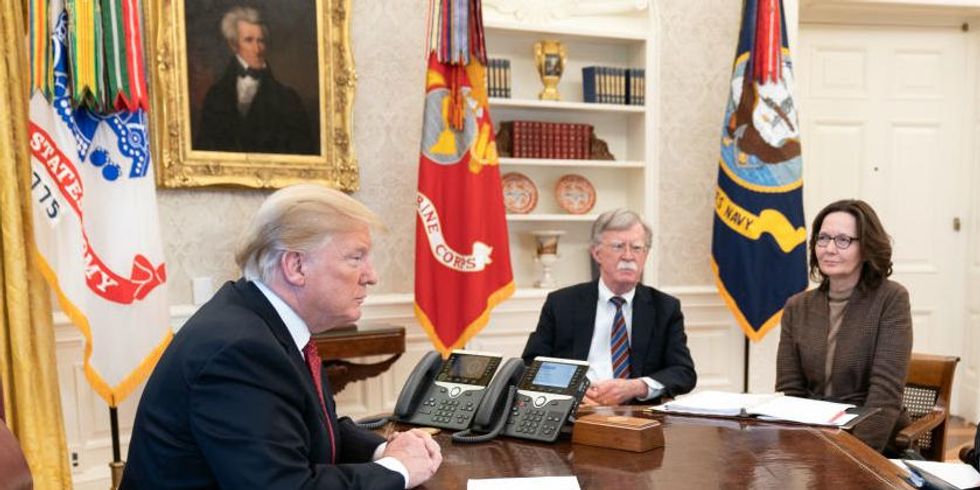
The military strike--which was approved after Iran shot down an American surveillance drone that it said violated its airspace--was reportedly backed by national security adviser John Bolton, Secretary of State Mike Pompeo, and CIA director Gina Haspel, a team critics have described as the president's "war cabinet."
According to the Times, Trump "initially approved attacks on a handful of Iranian targets, like radar and missile batteries."
The Times' reporting, later confirmed by ABC News and other outlets, was met with alarm by lawmakers and anti-war critics who have been warning for months that the Trump administration's belligerence towards Iran could lead to an all-out military conflict.
"Since day one of the Trump administration it has been clear that this is where we were heading," tweeted Stephen Miles, executive director of Win Without War. "A completely reckless foreign policy in which decisions are based on personal vengeance and zero regard for consequences. A team of advisors obsessed with going to war [with] Iran."
Sen. Chris Murphy (D-Conn.) said in response to the Times report that the "place we have arrived at tonight on Iran is Donald Trump's choice."
"He chose escalation over diplomacy," Murphy tweeted, "without any idea how to get out of the downward spiral he set in motion."
Trump's reported approval of military strikes against Iran came after hours of growing tensions, with the president telling reporters they would "soon find out" whether his administration plans to attack Iran following the downing of a U.S. surveillance aircraft.
Iran said the drone violated its airspace and accused U.S. officials of ignoring "repeated radio warnings."
After American military officials claimed the drone was in international airspace when Iran shot it down, Iranian Foreign Minister Javad Zarif tweeted that the "U.S. is lying."
With the U.S. once more on the precipice of an unauthorized war, The Nation's John Nichols asked, "Where is the Congress?"
"Decisions about war and peace should not be left to the whims of a president who is ill-prepared, ill-informed, and ill-advised," Nichols wrote.
In a series of tweets late Thursday, Rep. Ilhan Omar (D-Minn.)--who has been an outspoken opponent of military action against Iran--urged Americans to pressure their representatives to stop a potentially catastrophic war.
Omar went on to address Trump directly, writing, "As a survivor of war, I want to tell you: going to war does not make you strong. It makes you weak."
"Sending teenagers to die, or return with lifelong wounds seen and unseen, does not make you a bigger person. It makes you smaller," Omar wrote. "I have seen firsthand the effects of war. Even in the best of cases, it never has the outcome you expect. War is death, displacement, and terror. War is hell."
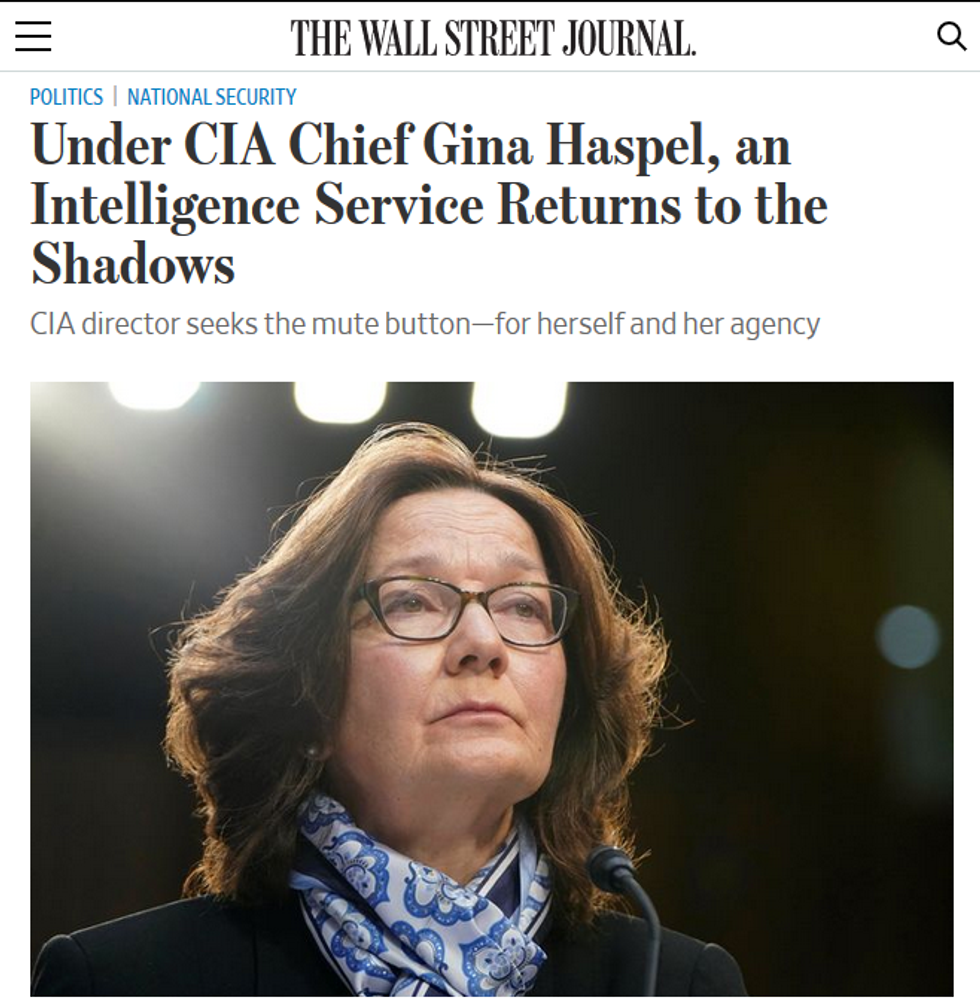
A Wall Street Journal report (5/25/19) by Warren Strobel whitewashed CIA Director Gina Haspel's career and put a positive spin on the CIA's insulation from public accountability with its turn towards its greatest opacity "in decades."
While one might expect CIA officials to support greater secrecy around the organization, it's odd that ostensibly independent journalists--with a mission to hold official organizations accountable by informing the public--would treat less information coming from the agency as a positive development.
Yet that's exactly what the Journal report did, depicting Haspel's strategy of avoiding backlash from the Trump administration by not publicly contradicting its dubious claims as "protecting the agency" from "the domestic threat of a toxic US political culture."
"She and her agency have adopted their lowest public profile in decades," Strobel writes--just before summing her up as a "CIA director who has been warmly received by the workforce she has spent her life among."
In other words, for the Journal, a public intelligence agency sharing its intelligence with the public is a bad thing, unless it supports US foreign policy by agreeing with whatever the Trump administration is saying. This position is echoed in the piece by official sources, like former CIA official and staff director of the House Intelligence Committee Mark Lowenthal, who assures us, "It's not going to be any good for her [Haspel] to be out there attracting lightning bolts."
However, the most egregious part of Strobel's report is its whitewashing of Haspel's disturbing record in the CIA by uncritically transmitting glowing endorsements by other CIA officials:
Former CIA Deputy Director Michael Morell said he is absolutely confident that Ms. Haspel will push back if policy makers ask the agency to do something it shouldn't.
"I was told that somebody asked that the agency do something that was inappropriate. Her response was, 'No. And don't ask again,' " said Mr. Morell, who hosts the Intelligence Matters podcast. He said he did not have details of the incident.
Strange: That's precisely the opposite of what Haspel did when she was asked to violate domestic and international law by torturing post-9/11 prisoners (euphemized by Strobel as "controversies" over "treatment of detainees"), and peddling lies about torture's effectiveness (National Security Archives, 4/26/18).
Nor did Haspel say "No. And don't ask again," when told to destroy videotape recordings of the CIA inflicting torture on its captives, which was condemned as "obstruction" by 9/11 Commission chairs Lee Hamilton and Thomas Kean (Intercept, 3/13/18; New York Times, 1/2/08).
Haspel actually supervised Detention Site Green in Thailand, one of the US's notorious "black sites" where suspects were sent to be tortured after being kidnapped and held in another country to evade legal accountability in the US (Washington Post, 11/2/05). Sondra Crossby, a US Navy Reserve doctor with extensive experience treating torture victims around the world, described one of Haspel's prisoners as "one of the most traumatized individuals I have ever seen."
John Kiriakou, a former CIA official not cited in this laudatory profile, said that Haspel was known to other colleagues as "Bloody Gina" because people like her "tortured for the sake of torture, not for the sake of gathering information" (Democracy Now, 3/14/18).

Many of Haspel's champions have offered the irrelevant and unacceptable "Nuremberg Defense" of "just following orders" to shield her from criticism. Morell himself is one of those people, as he praised her nomination as deputy director specifically because she obediently follows immoral orders (Cipher Brief, 2/2/17):
Haspel does not shy away from the toughest jobs; in fact, she gravitates toward them. Some of the assignments that she took on have later come under political fire, but in each case she was following the lawful orders of the president.
Morell, as FAIR (10/29/13) has noted, is a propagandist who denies that the CIA engaged in what is indisputably torture, and echoes CIA lies about drone strikes being a "very precise weapon," with "very low" collateral damage. Such dishonesty is par for the course for CIA higher-ups (Guardian, 1/7/13).
Strobel presumably knows this, as FAIR (Extra!, 4/06) has also noted that Strobel provided some of the most critical reporting on the Bush Jr. administration's WMD hoax in real time, as Morell was doing his best to advance it. That Morell would defend Haspel is predictable, given that he conducted an internal investigation "clearing" her of any wrongdoing (Intercept, 5/14/18).
Since Strobel's report depends on current and former intelligence officials as sources, it's unsurprising that Haspel is considered to be "a good steward" of the CIA precisely because she won't be a "transformational leader" who would dare to do radical things like respecting the US Constitution's rejection of "cruel and unusual punishment" and international humanitarian law. The piece downplays the CIA's illegal activities as mere "controversies," and presents Haspel and the CIA's attempts to avoid scrutiny and accountability as "no small accomplishment."
Perhaps if outlets like the Wall Street Journal provided less adulatory coverage of the CIA's leaders and the organization's illicit activities, it would be harder for its members like "Bloody Gina" Haspel to get away with lying. Perhaps instead of getting promotions, they'd face accountability for their actions (FAIR.org, 5/20/09; NBC, 2/9/11).
Donald Trump is the real anchor baby in America - childish yet so outsized and unwieldy that he doesn't hold the ship of state upright and in position like a good anchor should but causes it to sink like a stone.
Watching him over the last week or so, listening to the anti-immigration rant he delivered in the Rose Garden when he caved and ended his crippling government shutdown, reading his relentless, hallucinatory blitzkrieg of a Twitter feed... each is continuing evidence of what we already, sadly, know too well: that this is a blustering fool so out of touch with reality, so ignorant of facts and lashing out when that ignorance is challenged, that his continued presence as president feels intolerable.
"This is a blustering fool so out of touch with reality, so ignorant of facts and lashing out when that ignorance is challenged, that his continued presence as president feels intolerable."
Like the kowtowing minions with whom he surrounds himself, he does not know what he does not know. Before this administration, it would have seemed obvious that there always needs to be someone intelligent in the White House. God knows, history shows us that it doesn't necessarily have to be the president himself, but any even halfway effective chief executive knows the importance of being in the presence of at least some people not blinded from truth by ideology and obeisance. You may not agree with the opinions or advice proffered--nor may they agree with you--but at least their beliefs are grounded in some semblance of fact and deserve a hearing.
Yet because he systematically has rid himself of virtually anyone with an ounce of common sense--or because they have used that common sense to run as far away from him as possible--Trump listens to no one but White House sycophants, his own freakish inner demons and the friendly folks at Fox News and other right wing outlets who tell him he's wonderful and to stay his erratic, uncharted course.
Just beyond the innermost circle, though, there are some in government who say things he does not want to hear. When Director of National Intelligence Dan Coats, CIA Director Gina Haspel and FBI Director Christopher Wray--all Trump appointees--spoke to the Senate Intelligence Committee on Tuesday, they sent up a volley of flares warning that the administration's foreign policy, such as it is, ignores danger signals that run contrary to the president's egotistical belief that he can do no wrong.
Coats and his colleagues were presenting the Worldwide Threat Assessment, an annual report that indicates dangers to the United States and the rest of the planet; everything from other nations to terrorist groups, pandemic disease and yes, Mr. President, global warming.
In fact, in many instances, we have met the enemy and he is us. As per David E. Sanger and James E. Barnes in The New York Times, "The 42-page threat report found that American trade policies and 'unilateralism'--central themes of Mr. Trump's 'America First' approach--have strained traditional alliances and prompted foreign partners to seek new relationships."
Further, contrary to Trump's insistence that as the result of his jolly relations with Kim Jong-un, North Korea is moving along the road to complete denuclearization, the report states that nation "is unlikely to give up its nuclear weapons and production capability." CIA Director Haspel told the committee that the North "is committed to developing a long-range nuclear-armed missile that would pose a direct threat to the United States," and DNI Coats noted that Pyongyang's leaders "ultimately view nuclear weapons as critical to regime survival."
And there's more. Despite Trump's insistence that Iran is not complying with the arms agreement from which he withdrew the United States last May, the intelligence report says that despite other hostile activities, Iran continues to live up to the deal's terms and is not building nuclear weapons. And although the president sent a video victory tweet in December declaring, "We have won against ISIS; we've beaten them, and we've beaten them badly," thousands of fighters remain in Syria and Iraq and ISIS terror networks are alive and well.
As for the national emergency Trump conjures over southern border security? No mention of the issue until deep into the global threat report. Higher priorities prevail.
Trump's response to being so blatantly contradicted was, as usual, mature and even-tempered: he sent Twitter screams that his intelligence chiefs were "extremely passive and naive," and perhaps "should go back to school!" He canceled his daily intelligence briefing on Wednesday, told the press on Thursday, "I will be proven right, probably," but by the end of the day, after a meeting with Coats and Haspel and other higher up spies, he said they told him that their testimony had been "totally misquoted" by the media (although it was public and televised) and was--of course!--"fake news."
The history of America's intelligence services is not one of perpetual glory and truth; horrors have been committed in their name. What's more, their assessments are fallible and in the past have been notoriously wrong (WMD's in Iraq, anyone?). But on a day-to-day basis they are more often right and a president ignores at his peril what experts with decades of knowledge and experience tell him.
In fact, there were points in the assessment report that aligned with Trump's opinions. But what's as disturbing as the president's refusal to hear advice from experts that doesn't gibe with his monocular worldview is the resulting lack of policy coherence and constancy manifest in everything from Friday's suspension of the successful Intermediate-Range Nuclear Forces Treaty with Russia to a southern border policy that refuses asylum to Central American refugees while denying aid to their countries that could help protect and keep them at home.
"The president can choose to be an unconventional statesman," James Carafano, a national security expert at the conservative Heritage Foundation told The Washington Post, "but the direction of U.S. policy must be clear to friend and enemy alike. It's his responsibility to make sure that happens."
Clear? When it comes to statesmanship, there is no consistent Trump Doctrine but one: speak loudly, carry a big stick and keep tripping over your own two feet.