

SUBSCRIBE TO OUR FREE NEWSLETTER
Daily news & progressive opinion—funded by the people, not the corporations—delivered straight to your inbox.
5
#000000
#FFFFFF
To donate by check, phone, or other method, see our More Ways to Give page.
Daily news & progressive opinion—funded by the people, not the corporations—delivered straight to your inbox.
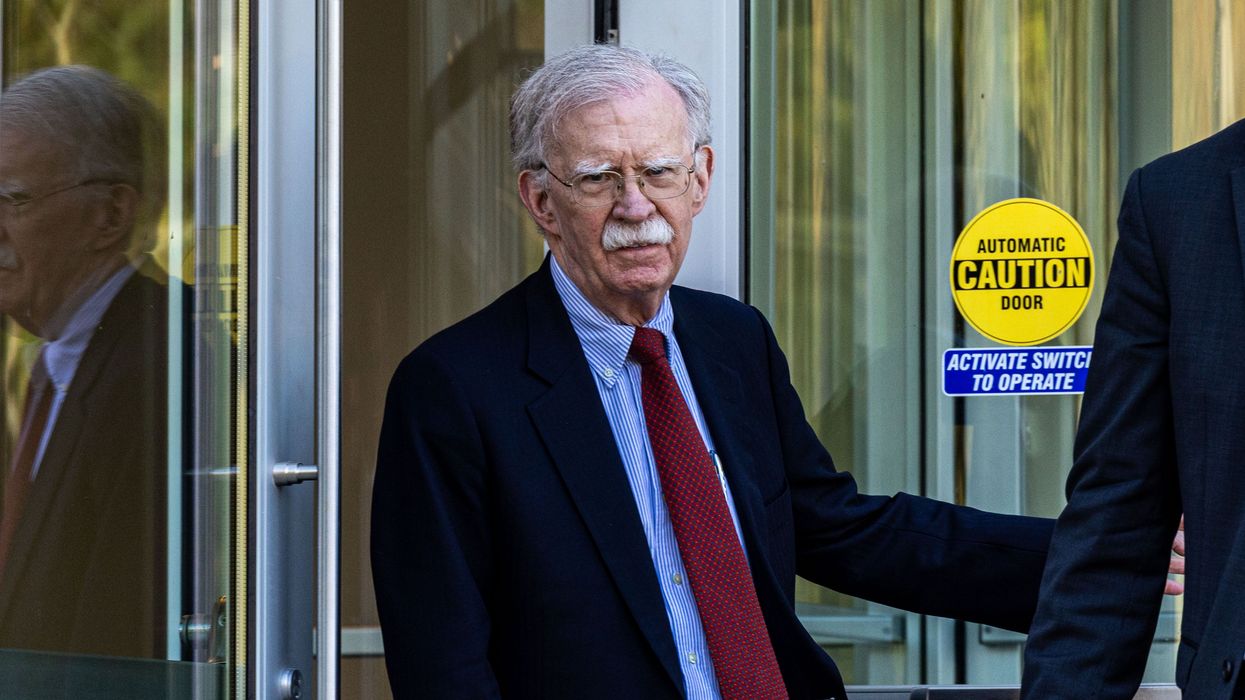
The indictment has been condemned as part of the president's crackdown on his "enemies list," but some legal experts are also highlighting how the case differs from those of Letitia James and James Comey.
While critics of John Bolton have long called for him to be tried at the International Criminal Court, the federal indictment of President Donald Trump's ex-national security adviser on Thursday is generating widespread alarm.
Bolton surrendered at a courthouse in Greenbelt, Maryland Friday morning after a federal grand jury returned an indictment charging him with violating the Espionage Act—specifically 18 counts of unlawfully retaining and transmitting national defense information. If convicted, he could spend the rest of his life in prison. He has pleaded not guilty.
When former Federal Bureau of Investigation Director James Comey was indicted last month, Trump pledged that "there'll be others." Then Democratic New York Attorney General Letitia James—who successfully prosecuted the president for financial crimes—was indicted last week. Critics accuse Trump of weaponizing the US Department of Justice (DOJ) against his enemies.
Some of the reactions to Bolton's indictment were similar, including from the 76-year-old himself, who served in not only Trump's first term but also the Reagan and both Bush administrations. He said in a lengthy statement that "Donald Trump's retribution" against him began when he resigned from the president's first administration and began publicly criticizing him.
"Now, I have become the latest target in weaponizing the Justice Department to charge those he deems enemies with charges that were declined before or distort the facts," Bolton said. "These charges are not just about his focus on me or my diaries, but his intensive efforts to intimidate his opponents, to ensure that he alone determines what is said about his conduct."
"Dissent and disagreement are foundational to America's constitutional system, and vitally important to our freedom," added Bolton, a longtime advocate of regime change in other countries. "I look forward to the fight to defend my lawful conduct and to expose his abuse of power."
Bolton's lawyer is Abbe Lowell, who is also representing James and Lisa Cook, whom Trump is trying to oust from the Federal Reserve's Board of Governors. His former clients include the president's daughter, Ivanka Trump, and her husband, Jared Kushner. Lowell said that "like many public officials throughout history, Ambassador Bolton kept diaries—that is not a crime."
Co-chairs of the Not Above the Law coalition—Praveen Fernandes of the Constitutional Accountability Center, Kelsey Herbert of MoveOn, Lisa Gilbert of Public Citizen, and Brett Edkins of Stand Up America—connected Bolton to James and Comey in a Friday statement:
Three indictments in three weeks. Three Trump critics. Three prosecutions designed to intimidate anyone who dares challenge this president. Three people who were on Trump's "enemies list." The pattern is undeniable: Speak out against Trump, become a target of the DOJ.
The message from this administration couldn't be clearer: Loyalty gets rewarded, dissent gets investigated. While Trump's handpicked prosecutors work overtime delivering indictments against his critics, actual threats to American safety go unaddressed.
A Department of Justice that acts in service of presidential revenge rather than public safety threatens democracy itself. This isn't just about Bolton—it's a warning shot to every American that dissent now comes with the threat of prosecution.
Congress has a constitutional duty to intervene, restore DOJ independence, and end this dangerous abuse of law enforcement before more lives are destroyed for political purposes.
However, University of Alabama law professor and former US attorney Joyce Vance argued on Substack Friday that the Bolton indictment "is entirely different" from those against Comey and James in the Eastern District of Virginia, pointing out that "the US attorney in Maryland is a career prosecutor. But she didn't go into the grand jury to obtain the indictment. It's signed off on by two senior prosecutors in her office as well as lawyers from DOJ's National Security Division."
"Instead of the factually deficient indictments we've seen in the other cases, this is the sort of detailed indictment we are used to seeing in a serious matter," she highlighted. "There is undoubtedly truth to the allegation that Donald Trump wanted Bolton prosecuted. But the intervening layer of professional prosecutors here, people who assessed the case and the evidence and decided there was enough to move forward, may make it difficult to win a selective prosecution argument."
"In the Comey and James cases, experienced prosecutors declined to bring the cases, and the US attorney sacrificed his job for principle. The cases were only brought because Trump dropped in a loyalist to replace him," Vance added. "Here, unless Bolton has some evidence that these prosecutors did not proceed professionally, he may not have a winnable legal argument."
CNN's Aaron Blake published a similar analysis early Friday. Blake also noted that in 2020, US District Judge Royce Lamberth, a Reagan appointee, "ruled in Bolton's favor in a civil case stemming from a dispute with the Trump administration over the publication of Bolton's book. But Lamberth otherwise excoriated Bolton for his handling of classified information."
Meanwhile, Chip Gibbons, policy director of Defending Rights & Dissent, used Bolton's indictment to call for broader reforms on Friday. He began by noting that "John Bolton is an unrepentant war criminal and one of most odious national security hawks in Washington. As part of his antipathy for press freedom, whistleblowers, and anyone who challenges the national security state, he called for both Chelsea Manning and Edward Snowden to be executed for exposing abuses of power by our government."
"Similarly, he called for journalist Julian Assange to get 'at least 176 years in jail' for publishing truthful information about US war crimes," Gibbons explained. "Now, Bolton, like Manning, Snowden, and Assange has been indicted under the Espionage Act."
"We at Defending Rights & Dissent were one of the leading voices in Washington in support of Manning, Snowden, and Assange. And we remain the leading voice on reforming the Espionage Act so it can no longer be used to prosecute courageous whistleblowers and journalists," he said. "As part of our reform proposal, we advocated the Espionage Act be amended to require the government to prove a defendant intended to harm the national security of the US."
"Nothing in the indictment of Bolton indicates the government believes Bolton had that level of intent," Gibbons stressed. "As a result, we do not believe Bolton should be indicted under the Espionage Act. This is the same position we took regarding Donald Trump, who himself has been responsible for abusing the Espionage Act to silence journalists and whistleblowers."
"The Espionage Act is an overly broad, archaic law. As a result, it is ripe for selective, politically motivated enforcement. It is for these reasons that Bolton championed it as a tool for political persecutions against whistleblowers and journalists. And it is for this reason the Trump administration has chosen it as a tool for their petty retaliation against a national security hawk who shares much of their views on the use of the Espionage Act," he concluded. "Enough is enough. It is well past time to reform the Espionage Act once and for all."
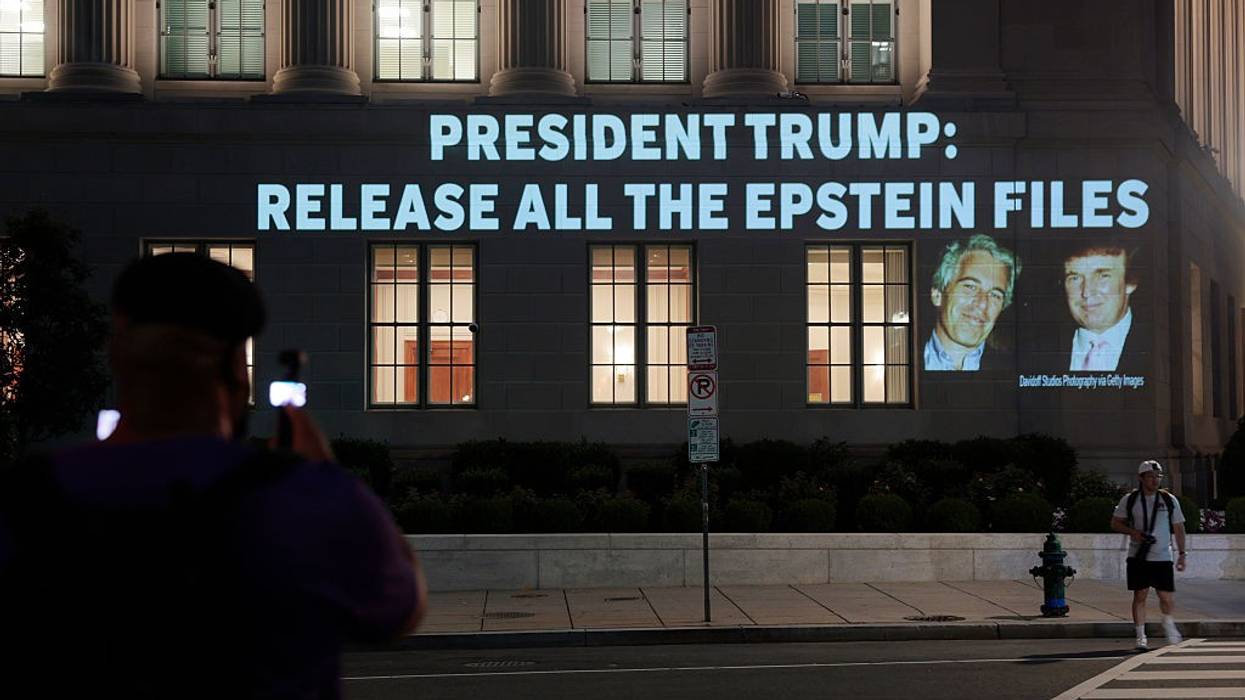
For months, US President Trump has tried to divert public attention from the Jeffrey Epstein-Ghislaine Maxwell files. But he can’t shake the story, and it keeps getting worse.
Drip, drip, drip…
For months, US President Trump has tried to divert public attention from the Jeffrey Epstein-Ghislaine Maxwell files. But he can’t shake the story, and it keeps getting worse.
Trump campaigned for the presidency on the promise to release all of the files relating to Epstein’s sex trafficking in minors. To supercharge his MAGA base, he fueled conspiracy theories that the files contained something sinister involving prominent Democrats.
February 2025: Trump’s Attorney General, Pam Bondi, told a Fox News interviewer that Epstein’s client list was sitting on her desk, awaiting her review before its release.
May: Bondi and Deputy Attorney General Todd Blanche informed Trump that his name appeared in the Epstein files, the New York Times later reported.
July 7: Federal Bureau of Investigation (FBI) Director Kash Patel—who had also pushed conspiracy theories about the files during Trump’s campaign—issued a two-page memo stating that there was no Epstein client list and that the Justice Department (DOJ) would not release any additional materials relating to the matter.
July 16: Assistant US Attorney for the Southern District of New York Maurene Comey was fired. Comey was a lead prosecutor in the investigation and prosecution of Epstein and his coconspirator, Ghislaine Maxwell. She was also the daughter of former FBI Director James Comey and chief of the Violent and Organized Crime Unit. The memo gave no reason for Comey’s abrupt termination.
July 17: The Wall Street Journal published Trump’s alleged birthday note to Epstein that included his sketch of a naked woman.
Trump’s MAGA base erupted in anger over his refusal to release the DOJ’s Epstein files. Trying to appease his followers, Trump directed Bondi to ask that the courts release the Epstein and Maxwell grand jury transcripts. It was disingenuous because: 1) the courts were not likely to release the material; and 2) even if they did, the transcripts would constitute a small fraction of the Justice Department’s Epstein-Maxwell files.
July 23: A Florida judge denied Bondi’s motion to release the files relating to the Justice Department’s Epstein investigations in 2005 and 2007 that had resulted in a non-prosecution agreement. Trump’s then-Secretary of Labor Alex Acosta had negotiated the agreement with Epstein’s high-powered lawyers while serving as US attorney for the Southern District of Florida during George W. Bush’s presidency.
July 24: Deputy Attorney General (and Trump’s former personal attorney) Todd Blanche flew to Tallahassee and met with Maxwell for two days—an unprecedented visit for a No. 2 official in the Justice Department. Maxwell is serving a 20-year sentence for sex trafficking.
July 31: Contrary to prison assignment policies for sex offenders, the Justice Department’s Bureau of Prisons transferred Maxwell from a Tallahassee prison to a “Club Fed” camp in Texas.
August 11: A federal judge in New York denied Bondi’s motion to unseal Maxwell’s grand jury files. The court observed that anyone “who reviewed these materials expecting, based on the Government’s representations, to learn new information about Epstein’s and Maxwell’s crimes and the investigation into them, would come away feeling disappointed and misled. There is no ‘there’ there.”
The entire exercise was a farce—another Trump con job:
The one colorable argument under that doctrine for unsealing in this case, in fact, is that doing so would expose as disingenuous the Government’s public explanations for moving to unseal. A member of the public, appreciating that the Maxwell grand jury materials do not contribute anything to public knowledge, might conclude that the Government’s motion for their unsealing was aimed not at “transparency” but at diversion—aimed not at full disclosure but at the illusion of such.
August 20: A different federal judge in New York blasted Bondi’s motion to unseal the Epstein grand jury transcripts. Describing the “trove” of materials that the Justice Department had assembled but withheld from the public, the court observed:
The Government’s 100,000 pages of Epstein files and materials dwarf the 70 odd pages of Epstein grand jury materials.
Trump’s directive that Bondi seek the release of the grand jury materials was always a ruse. As the court continued:
The Government is the logical party to make comprehensive disclosure to the public of the Epstein files. By comparison, the instant grand jury motion appears to be a “diversion” from the breadth and scope of the Epstein files in the Government’s possession.
The court specifically called out Trump’s about-face on releasing the files:
In February 2025, the Government, as noted, was prepared to release the “Epstein Files” to the public. See DOJ Press Release. But then, on July 6, 2025, the Government announced that it would not make the files available to the public.
And the judge concluded: “The information contained in the Epstein grand jury transcripts pales in comparison to the Epstein investigation and materials in the hands of the Department of Justice.”
Meanwhile, on August 5, several Republicans voted with Democrats on the House Oversight Committee to force chairman James Comer (R-Ky.) to subpoena the Justice Department for the Epstein-Maxwell materials. Comer also issued deposition subpoenas to former Attorneys General William Barr, Merrick Garland, Jeff Sessions, Loretta Lynch, Eric Holder, and Alberto Gonzales; former FBI Director James Comey; former special counsel and FBI Director Robert Mueller III; former Secretary of State Hillary Clinton; and former President Bill Clinton.
That’s superficially impressive, but purely performative. Notably missing from the committee’s witness list are the frontline prosecutors and investigators who actually know something meaningful about the Epstein-Maxwell cases.
One is Maurene Comey.
August 22: The FBI’s surprise search of former National Security Advisor John Bolton’s home and office dominated the media. Coincidentally, the Justice Department also released a transcript of Blanche’s July interview with Maxwell during which she asserted that no one connected with Epstein’s alleged crimes had done anything wrong—including her and, of course, Trump, upon whom she lavished praise.
Sharing the news cycle was the Justice Department’s production of documents to the House Oversight Committee. It provided a fraction of the DOJ’s Epstein file, and only 3% was new.
August 25: The House Oversight Committee subpoenaed materials from Epstein’s estate and announced that it will depose Alex Acosta on September 19.
Drip, drip, drip…
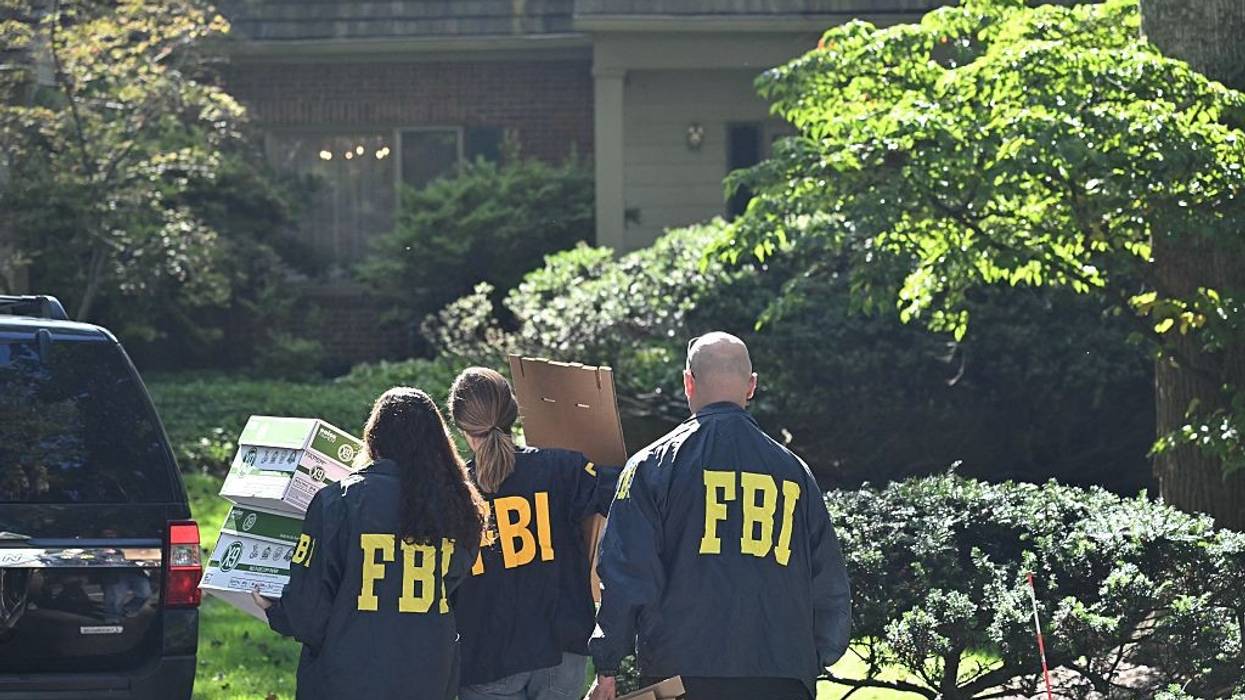
"The government's being weaponized to silence opposition," said one commentator, "and it's only going to get worse."
The FBI's raid on former national security adviser John Bolton's home in suburban Maryland on Friday morning followed his mounting criticism of President Donald Trump's handling of negotiations on Russia's war with Ukraine, leading several observers to warn that the raid displayed the president's desire for "retribution" against his perceived political enemies.
CNN White House correspondent Alayna Treene reported the FBI's "court-authorized" search of Bolton's home in Bethesda stemmed from the U.S. Department of Justice's "now-resumed investigation into whether he disclosed classified information in his 2020 book," which recounted his time serving as Trump's national security adviser during his first term.
A senior federal law enforcement official also told The New York Times that authorities are investigating allegations that Bolton—a right-wing hawk reviled by human rights defenders for his history of war-mongering both inside and outside of government positions under Republicans administrations, including Trump's—leaked national security information to the media to damage Trump over the past few years, as well as accusations regarding Bolton's book.
Trump and Bolton clashed over foreign policy during the president's first term, with Trump denouncing the former George W. Bush administration official—a key propagandist in the lead-up to the Iraq War and an advocate for violent regime change in numerous countries—as "a hawk" who pushed incessantly for military action against Iran.
In June, Trump bombed three nuclear sites in Iran.
Bolton's push for military action against countries including Venezuela and Iraq, his support for Israel's violent apartheid policies, and his boasting of having "helped plan coups d'etat" in other countries have led anti-war groups and progressive critics to accuse the former national security official of war crimes. Many observers on Friday noted that their alarm over the FBI raid was unrelated to their views on Bolton himself.
"The rule of law is under attack," said constitutional law professor Anthony Michael Kreis of Georgia State University. "We have to zealously defend anyone—even ideologically despised folks—from arbitrary government [attacks]."
Sen. Bernie Sanders (I-Vt.) added that while he has "nothing in common politically" with Bolton, the raid appeared to be "just another step in Trump's march toward authoritarianism."
"Last time I heard, in America, people are allowed to criticize the President of the United States without the FBI showing up on their doorstep," said the senator.
The raid was reportedly ordered by FBI Director Kash Patel, who accused Bolton of being a member of "the Executive Branch Deep State" in a book he wrote in 2023.
Pate posted a public message on X Friday morning saying his agency was "on [a] mission," just as news broke about the FBI raid.
"NO ONE is above the law," he added.
The post exemplified how Patel has "shattered norms intended to minimize public comment suggesting animus toward subjects under investigation," reported the Times.
In recent days, Bolton has accused Trump of failing to impose the "severe consequences" he threatened Russian President Vladimir Putin with if he continued attacking Ukraine, and said Putin "clearly won" the negotiations he had with Trump last week—coming away from them without facing sanctions or requirements for a ceasefire.
Democratic political strategist Mike Nellis said that while he has "no love for John Bolton... the FBI is raiding him for criticizing Trump’s foreign policy."
"The government's being weaponized to silence opposition," said Nellis, "and it's only going to get worse."
In an appearence on CNN, U.S. Rep. Raja Krishnamoorthi (D-Ill.) suggested the raid was strategically timed to turn the public's attention away from files regarding the late financier and convicted sex offender Jeffrey Epstein, which were sent to the House Oversight Committee on Friday under a subpoena. Trump was a known associate of Epstein. As Bloomberg News reported earlier this month, FBI officials redacted Trump's name and the names of other prominent public figures in files regarding Epstein.
Krishnamoorthi on the FBI raiding Bolton's house: "It looks like it's also an attempt to distract from the other big news of the day, which is the first production of the Epstein files that is required by subpoena from the Oversight Committee and they want to change the conversation."
[image or embed]
— Aaron Rupar (@atrupar.com) August 22, 2025 at 9:15 AM
"There's a tremendous clamor for these documents and transparency as to these files," said Krishnamoorthi, "and as you know both Donald Trump and Mike Johnson, the speaker of the House, are trying to prevent that from happening, and they want to change the conversation."
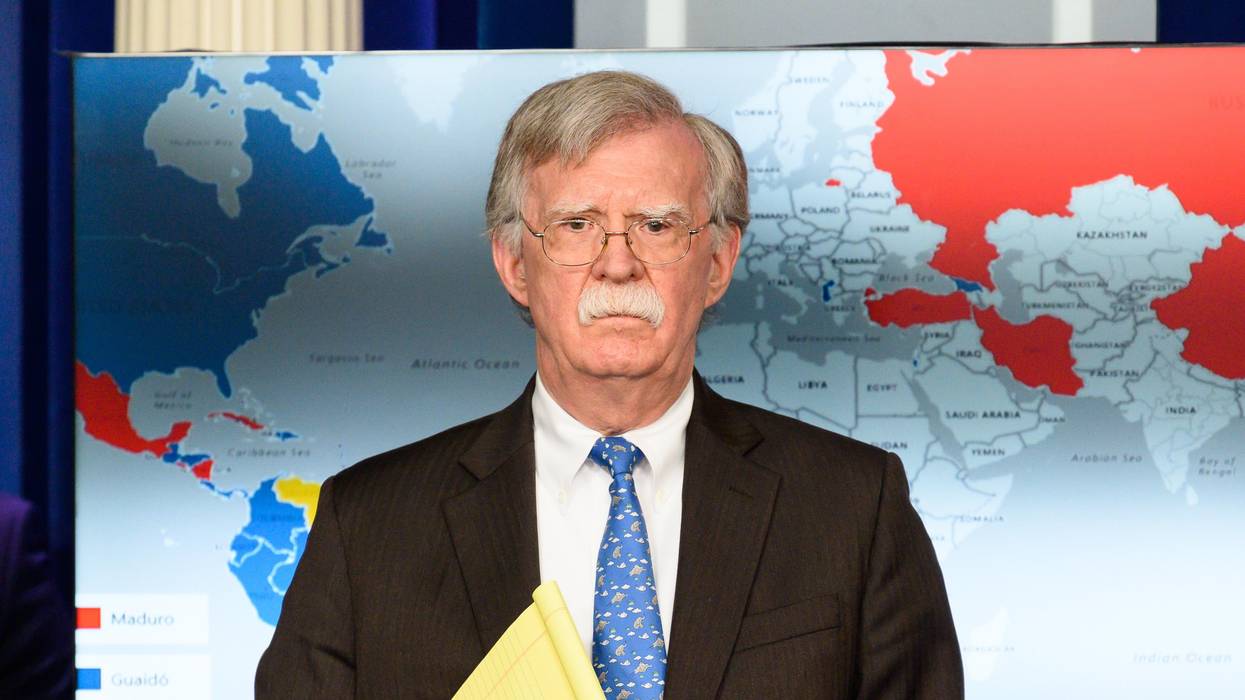
The United States Department of Justice has charged an Iranian citizen who it says is a member of the Islamic Revolutionary Guard Corps with attempting to hire an assassin to murder John Bolton, an ex-national security adviser in the Trump administration, multiple outlets reported Wednesday.
According to the Justice Department, Shahram Poursafi, also known as Mehdi Rezayi, offered to pay unnamed individuals $300,000 in November 2021 to "eliminate" Bolton in Washington, D.C. or Maryland.
Federal officials said the assassination of Bolton would have been in retaliation for the U.S. military's January 2020 drone strike killing of Qasem Soleimani--a top commander in the IRGC, which is a branch of Iran's military--in Iraq.
"Poursafi is alleged to have said that after Bolton was killed, there would be another job, for which the hitman would be paid $1 million," The Guardian reported. "The person offered the money became an FBI confidential informant, and continued to exchange texts on an encrypted communications app with Poursafi."
The 45-year-old suspect, who the DOJ believes tried to orchestrate the plot from Tehran, remains at large abroad.
"If found and convicted, he would face up to 10 years' imprisonment and a fine of up to $250,000 for the use of interstate commerce facilities in the commission of murder-for-hire, and up to 15 years' imprisonment and a fine of up to $250,000 for providing and attempting to provide material support to a transnational murder plot," the Washington Post reported.
As The Guardian noted:
Bolton was no longer national security adviser when the drone strike against Soleimani was carried out as the Iranian general was visiting Baghdad on January 3, 2020, but he is a longtime advocate of military action against Iran and a staunch opponent of the 2015 multilateral nuclear deal with Tehran. Secret Service cars have been reported to have been parked across the road from Bolton's house in the Washington area at least since early 2022.
In the immediate wake of Soleimani's assassination, Bolton tweeted, "Hope this is the first step to regime change in Tehran."
Bolton, who admitted on CNN last month that he has "helped plan coups d'etat" in foreign countries, served as a national security adviser to former President Donald Trump for 17 months, resigning in 2019 over reported disagreements about whether to lift some sanctions against Iran as a negotiating tactic.
"Bolton, who did not want the sanctions lifted, was a main architect of the Trump administration's 'maximum pressure' campaign of escalating economic sanctions and threats of retaliation for Iran's alleged support of terrorism," the Post noted. "The idea was to cripple Iran's economy to the point that its leaders felt they must bargain away any nuclear ambitions and missile technology."
News of the FBI's search for Poursafi comes just two days after negotiators in Vienna said they're close to reviving the Iran nuclear accord that the Trump administration, with no small part played by Bolton, unilaterally tanked.
Before his stint in the Trump White House, Bolton, whom critics have called a "bloodthirsty warmonger," was a major cheerleader for the 2003 invasion of Iraq. He served in senior arms control roles and eventually became ambassador to the United Nations under President George W. Bush.
Between the Bush and Trump presidencies, Bolton spent time working at right-wing think tanks, a private equity firm, and as a Fox News contributor.
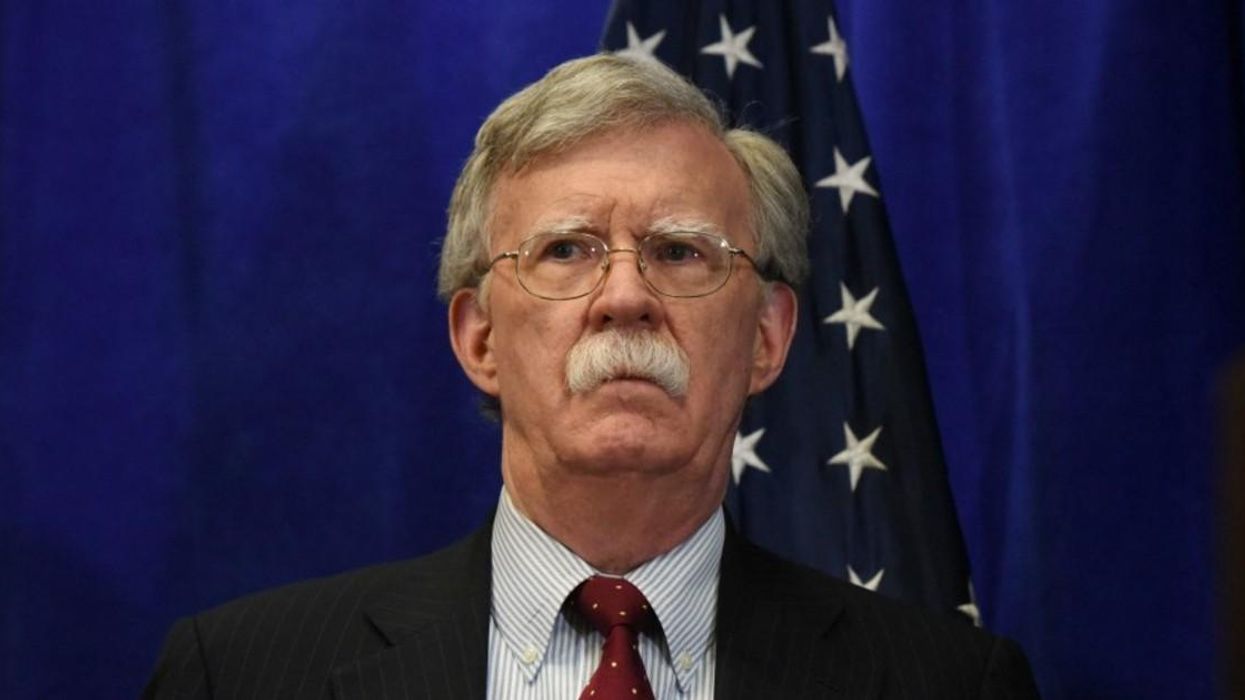
Good old John Bolton. The US diplomatic hawk, a veteran of US interventions from the Iran-Contra fiasco to his global troublemaking as national security adviser to Donald Trump, let the cat out of the bag this week.
CNN reporter Jake Tapper used Bolton's vanity about his iniquitous record to coax him into talking about the regime change activities he had been part of during his 17 tumultuous months working for Trump.
January 6 has become a defining event that may prove, at least to those who care, the unutterable evil of Trump and his followers
Tapper riled Bolton by saying, "One doesn't have to be brilliant to attempt a coup."Bolton took the bait, responding: "As somebody who has helped plan coups d'etat, not here, but, you know, other places. It takes a lot of work."Tapper pressed him to say more about "what you need to do to be able to plan a coup, and you--you cited your expertise having planned coups".
Bolton said he wouldn't get into the specifics, before adding, "Well, I wrote about Venezuela in the book, and it turned out not to be successful."This was the US-backed coup attempt against Venezuela's Nicolas Maduro following his disputed election win in 2018. As Bolton admits, that failed (although US sanctions, for which Bolton was an ardent advocate, are still crippling Venezuela's economy).
Bolton was being interviewed about the chaotic and violent assault on the US Capitol on 6 January last year, which is currently the focus of hearings in Congress. Like Russiagate (the hearings that were supposed to prove how Trump was a puppet of Vladimir Putin, but ended in failure), the 6 January hearings are scrutinising the former president's role in seeking to overturn Biden's victory in 2020. However, Trump is not quite revealed as a would-be Mussolini; instead of disciplined stormtroopers ready to carry out his master plan, he was surrounded by clueless clowns and chancers.
As for serious coup plotters, Bolton is closer to the real deal, although those who actually carry out coups don't give tell-all interviews to CNN. (One of them--CIA clandestine services vet John Sipher - even called out Bolton on Twitter, insisting the US doesn't do coups anymore.)
With Biden's administration in disarray ahead of the mid-term elections, 6 January has become a defining event that may prove, at least to those who care, the unutterable evil of Trump and his followers--and boost the Democrats amid the huge disappointment of Biden's presidency.
Of course, when it comes to coups outside of the United States, of which there are too many to mention, the Democrats are not shy at all in helping to organise the storming of government buildings around the world, even against elected democratic leaders.
Washington insiders were predictably furious with Bolton for breaking the omerta of US officialdom, which spends each working day maintaining the narrative of American values of democracy while working just as hard to undermine governments seen to be a threat to US imperial interests.
Evo Morales, the former president of Bolivia, who was overthrown in 2019 by the military, said the remarks showed that the United States was "the worst enemy of democracy and life", The Washington Post reported.
"This is no surprise,"Chinese foreign ministry spokesperson Wang Wenbin said. "The admission simply shows that interfering in other countries' internal affairs and overthrowing their governments have become the standard practice of the US government... This is very much part of the US rule book."
Larry Diamond, of the Stanford University-Hoover Institution, berated Bolton's admission: "It's damaging to our efforts to advance and support democracy,"he said. "We have enough trouble already countering Russian and Chinese propaganda."Diamond, as it happens, was a significant player in the overthrow of former Ukrainian president Viktor Yanukovych in 2014, and previously advised the US occupation authority in Iraq following George W Bush's invasion.
One of Diamond's more successful productions was the "I am a Ukrainian" video that went viral during the 2013-14 crisis. It appeared to represent the spirit of young Ukrainians fighting a corrupt regime, but was created by a production company funded by the US National Endowment for Democracy (also known as the National Endowment for Regime Change) and led by none other than US State Department adviser Larry Diamond.
US involvement in coups and regime change strategies in Latin America, Africa, the Middle East and Europe are not just a Cold War curiosity.
The key US player in the February 2014 uprising in Ukraine was President Barack Obama's Assistant Secretary of State Victoria "Fuck the EU" Nuland. Thanks to leaked tapes (and the billions of dollars the US funnelled into Ukraine) it is clear that events widely portrayed in western media as a popular uprising were manipulated by the US to bring down Yanukovych and install a nationalist pro-US regime.
In another leaked conversation between EU foreign policy chief Catherine Ashton and Estonian Foreign Minister Urmas Paet in March 2014, the latter pointed to ballistic evidence that the snipers in Kyiv who shot and killed more than 80 people from both sides in the critical days of the Maidan clashes were not working for the Yanukovych government, but were part of the far right opposition. The US nevertheless blamed the deposed government, creating a narrative around the events that holds to this day.
Ever since the Iran coup of 1953, the US has finessed a model to overthrow governments which uses local client forces, willing agents on the ground, media management and propaganda, and of course dirty tricks and specialist troops.
Of course, this geopolitical chess game--which was treated as rather amusing by Bolton and his interviewer--had an endgame, and that is the war in Ukraine. Once the new regime in Kyiv, now led by Vlodomyr Zelensky, was installed in 2014, the Donbas region broke away and Russia annexed Crimea. A war broke out in the east, widely blamed on Russian President Vladimir Putin.
But the US had unerringly backed those forces in Ukraine who saw a war with Russia as the only way to break free from Moscow and reverse the defeat of Ukrainian pro-Nazi forces in the Second World War. This alliance with far right forces was largely airbrushed once Russia invaded Ukraine in February this year.
US involvement in coups and regime change strategies in Latin America, Africa, the Middle East and Europe are not just a Cold War curiosity. Moments of candour such as Bolton's remind us they haven't gone away.
The notion that America stands for democracy and freedom across the world still holds within the bubble of US official discourse, but in the week Joe Biden offers total support to the Israeli occupation regime in Tel Aviv and the Saudi dictatorship in Riyadh, it fools no one.

Longtime Republican official John Bolton admitted during a televised interview Tuesday that he has helped plan coups outside of the United States.
Bolton, who served as former President Donald Trump's national security adviser, appeared on CNN to discuss the congressional committee investigating the January 6, 2021 attack on the U.S. Capitol.
After Bolton claimed that Trump's lies about the 2020 presidential election that provoked last year's Capitol attack were not part of "a carefully planned coup d'etat aimed at the Constitution," host Jake Tapper said that "I don't know that I agree with you, to be fair, with all due respect. One doesn't have to be brilliant to attempt a coup."
Bolton responded that "I disagree with that. As somebody who has helped plan coups d'etat, not here, but, you know, other places, it takes a lot of work. And that's not what he did."
Tapper followed up on coup comments, and Bolton--who also held roles in the administrations of former Presidents Ronald Reagan, George H.W. Bush, and George W. Bush--initially said that "I'm not gonna get into the specifics."
Bolton then pointed out that in his recently released book, he wrote about the failed effort to overthrow Venezuelan President Nicolas Maduro in 2019. The Trump administration notably backed opposition leader Juan Guaido.
However, as reporters and others--such as Rep. Ilhan Omar (D-Minn.)--were quick to highlight, Bolton has a long history of supporting such efforts.
As HuffPost detailed Tuesday:
In 2004, while Bolton was serving in the State Department, the U.S. faced allegations of backing the overthrow of Haiti's president. A former French ambassador told The New York Times this year that the U.S. and France had "effectively orchestrated" the coup.
Bolton has a long history of advocating for coups and supporting regime change plots. He advocated for regime change in Iraq ahead of a war he helped orchestrate and said in 2018 that the United States should overthrow the government of Iran.
Critics of Bolton shared a range of reactions on social media.
Philadelphia Inquirer columnist Will Bunch tweeted that "I've been investigating U.S. imperialism for decades, and...he...just...blurted...it...out."
"America in one clip," More Perfect Union's Jordan Zakarin said of the interview, describing Bolton as "a bloodthirsty right-wing war hawk" who was given a platform to "brazenly admit to secret war crimes without worrying about any consequences whatsoever."
"It's just a little oopsies, a meme for a few days," Zakarin added, declaring that "this is even more embarrassing for CNN."
Anti-war advocates on Tuesday denounced the corporate media for giving former National Security Adviser John Bolton--a longtime proponent of regime change and U.S. military action around the world--a platform to discuss his views on the current tension in Ukraine.
MSNBC host Andrea Mitchell invited the former official for the Trump and George W. Bush administrations to discuss how President Joe Biden should confront Russian President Vladimir Putin's recent escalation of tensions.
"We really, really don't need John Bolton's opinions on a new war."
Bolton said that amid news that the Russian Parliament has authorized the use of military force and Putin issued new demands that Ukraine recognize Russia's claim to Crimea and that the West end weapons shipments there, the Biden administration must swiftly take aggressive action against Putin.
The White House's "gradual escalation" of sanctions against Russia is an "admission of a disastrous failure of policy," Bolton told Mitchell.
"Reminder," tweeted Sarah Reese Jones of Politicus USA. "John Bolton is a neo-con whose foreign policy has been consistently proven wrong. He was wrong about Iraq. He has been wrong about the Middle East. He was wrong about Afghanistan."
Bolton's comments came shortly before Biden announced the White House is joining the European Union in imposing a first round of sanctions against Russian individuals and groups in response to Putin's official recognition of the self-proclaimed people's republics of Donetsk and Luhansk in eastern Ukraine.
Biden announced sanctions against two financial institutions, sovereign debt, and elite individuals in Russia Tuesday afternoon, calling them the "first tranche" of U.S. sanctions and saying the country could take more action if Russian forces advance further into Ukraine.
Bolton advised the White House to "bring the guillotine down on all the sanctions they've been contemplating and take additional steps" in order to avoid further military action by Russia, adding that the U.S. should have placed more troops in Ukraine several months ago.
"I think we should have had more American forces in Ukraine, not to fight the Russians but to train with the Ukrainians, and to show those Russian generals looking across the border and seeing American flags," Bolton told Mitchell. "Biden took that off the table, saying there would be no American forces involved, and he got nothing for it."
Considering Bolton's record as a war hawk who aggressively pushed the false claim that Iraq harbored weapons of mass destruction to justify the 2003 invasion of the country, urged former President Donald Trump to withdraw from the Iran nuclear deal against the advice of international experts, and urged regime change in Venezuela, critics including Win Without War called on media outlets to "STOP giving John Bolton airtime."
"Why is this person on my TV?" asked Andrew Lawrence of Media Matters for America, while podcast host Kyle Kulinski called Bolton "literally the last person on earth who should be giving foreign policy advice right now."
Mehdi Hasan, who also hosts a political news show on MSNBC, warned last week that media outlets that interview Bolton amid flaring tensions in Ukraine must at least "ask him some tough questions."
"We really, really don't need John Bolton's opinions on a new war," Hasan tweeted.

On the morning of February 13, 2021, just before the Senate impeachment trial abruptly ended with Trump's acquittal, Constitutional law specialist Bruce Fein and I sent the following plea to House Speaker Nancy Pelosi.
"A trial without key witnesses possessed of crucial incriminating testimony diminishes the seriousness of the proceedings and the huge stakes for the future of the American republic."
More than 240 years of heroic sacrifices by our forebearers to plant the seeds of a government of the people, by the people, for the people are not being furthered by your shortsighted eagerness for an abbreviated gravely historic second impeachment trial of former President Donald Trump. The trial has thus been shorn of "smoking gun" witnesses and full exposure of his daily wrecking ball against the Constitution rooted in Mr. Trump's unprecedented, brazenly monarchical pronouncement on July 23, 2019, "Then I have Article 2, where I have the right to do anything I want as president." Mr. Trump was as determined as his words.
He usurped the congressional power to tax and spend.
He defied hundreds of congressional subpoenas and demands for testimony or information to disable oversight and to substitute government secrecy for transparency.
He turned the White House into a crime scene with serial violations of the Hatch Act.
According to former national security advisor John Bolton, fortified by the Mueller Report, he made obstruction of justice "a way of life" at the White House.
He appointed principal officers of the United States without Senate confirmation in violation of the Appointments Clause.
He transgressed both the letter and spirit of the Foreign and Domestic Emoluments Clauses.
He flouted his obligation to take care that the laws be faithfully executed by dismantling enforcement of environmental, safety, consumer protection, and labor laws.
January 6, 2021 was but the predictable culmination of Mr. Trump's unalloyed contempt for the Constitution and rule of law. If Article 2 crowns the president with limitless power, then to incite the use of force and violence against the legislative branch of government to prevent the vice president from counting state-certified electoral votes, falls squarely within his vast dictatorial domain.
We submit you will be committing a dereliction of constitutional duty if you do not immediately make the demand to subpoena witnesses in the pending second impeachment trial.
The subpoenas should be issued to at least the following: Donald Trump, Mike Pence, William Barr, John Bolton, Christopher Krebs, Brad Raffensperger, Jeffrey Rosen, Rudy Giuliani, Jeffrey Clark, and Pak Byung-Jin (B.J. Pak).
"The haunting question that history will raise will be this: Why didn't Speaker Pelosi call the witnesses?"
Your immediate call for witnesses critical to fortifying the impeachment evidence will be the definitive test of your resolve to convict Donald J. Trump and your understanding of the serious and gravity of the impeachment charges. A trial without key witnesses possessed of crucial incriminating testimony diminishes the seriousness of the proceedings and the huge stakes for the future of the American republic.
The haunting question that history will raise will be this: Why didn't Speaker Pelosi call the witnesses?
The Senate resumed its trial on Saturday, February 13th at 10:00 am. Soon, came the revelation of an exchange between Representative Jaime Herrera Beutler's (R-Wash.) on January 6th with House Republican Minority Leader Kevin McCarthy (Calif.), regarding his telephone conversation with Donald Trump during the storming of Congress. What followed was a call for witnesses by a Senate vote of 55-45. Eureka! The window for Republican witnesses previously rejected by Democratic House Managers was reopened. There was another chance to overcome Speaker Pelosi's desire for a quick trial without witnesses.
Then came another reversal pressed by President Joe Biden and Senate Majority Leader Chuck Schumer (D-N.Y.). Democratic leaders told the House managers to huddle privately with Trump's defense lawyers to strike a deal. They did. They would place a mere statement from Rep. Beutler into the trial record and call no witnesses. The Republicans couldn't have been more delighted, knowing that the Democratic leadership wanted the trial over that day before Congress went on a weeklong vacation.
Before the deal, Sen. Ben Cardin (D-Md.) predicted on NPR that there would be a call for witnesses, requiring a deferral of the trial for two weeks. How mistaken he was about his party's defeatism and rejection of going forward with a full hand.
"Trump can now run again, vitiating the rule of law and debasing our democratic institutions."
They could have added to their single impeachment Article of inciting an insurrection, two more articles--intimidating Mike Pence and others plus Trump's refusal to call back the attackers during their riot. Those three articles would have made for a more powerful case against Trump's defense attorneys, in the opinion of former federal judge Michael McConnell.
An even stronger impeachment and one deterring future wannabe Trumps was to pair the president's physical attack on the Capitol with his four-year institutional attack on the Congress with his constant usurpation of the legislative branch's constitutional authority (some noted above).
For reasons yet to be divulged, the Democrats, as they did with the first impeachment of Trump, were unwilling to use the full evidence subpoena powers they possess. Trump can now run again, vitiating the rule of law and debasing our democratic institutions. As Republican strategist Kevin Philips noted years ago, the Republicans go for the jugular while the Democrats go for the capillaries.

Peace advocates rejoiced on Thursday in the wake of President Joe Biden's announcement that his administration will be ending U.S. support for "offensive operations" in the Saudi-led war on Yemen and appointing a diplomatic envoy to help resolve the devastating conflict that has caused an estimated 233,000 deaths.
"This war has to end," Biden said during an address at the State Department. "And to underscore our commitment, we are ending all American support for offensive operations in the war in Yemen, including relevant arm sales."
Biden also named Timothy Lenderking as his special envoy to Yemen, saying the career foreign service officer will collaborate with the United Nations and "all parties to the conflict to push for a diplomatic resolution."
"It's about time that the U.S. end all complicity in the Saudi/UAE-led war on Yemen, with at least 100,000 dead and tens of millions on the brink of starvation," Paul Kawika Martin, senior director of policy and political affairs at Peace Action, said Thursday.
Danaka Katovich, Yemen campaign coordinator at the anti-war group CodePink, described Thursday as "a day peace activists around the world have been waiting for. On the campaign trail, President Biden said he would end support for the war in Yemen, and I hope he keeps that promise to the fullest extent."
As Medea Benjamin, CodePink's co-founder, pointed out on social media, White House National Security Adviser Jake Sullivan said the Biden administration's cessation of U.S. support for offensive operations in Yemen will include "an end to precision-guided munition sales," which have contributed to the massive civilian death toll.
While the Biden administration's "decision to stop U.S. support for 'offensive operations' by Saudi Arabia is critically important," said David Segal, co-founder and executive director of Demand Progress, "we must learn more about how 'offensive operations' are defined--and ensure that Biden's plans entail ending targeting support, spare parts transfers, and other logistical support, both known and unknown to the general public."
As for the White House's appointment of Lenderking, Martin said the new special envoy to Yemen "can push Saudi Arabia and the UAE to change its conduct and negotiate in good faith to end their war on Yemen and allow humanitarian aid to flow."
"We must learn more about how 'offensive operations' are defined--and ensure that Biden's plans entail ending targeting support, spare parts transfers, and other logistical support."
--David Segal, Demand Progress
Martin added that Peace Action wants "to make sure the details include stopping all support and blocking all arms sales to Saudi Arabia and the UAE."
Concerns about the fine-print were shared by Segal, who said the Biden administration should show Thursday's announcement "carries serious weight by immediately canceling the pending arms sales to Saudi Arabia and the UAE, both of which have proven they cannot be entrusted with billions of dollars of advanced U.S. weaponry," as well as by Philippe Nassif, Amnesty International's advocacy director for the Middle East and North Africa.
"As the conflict in Yemen enters its seventh year, it is vital for the United States to commit to prioritizing the safety of civilians in the country," said Nassif. "Central to these efforts will be stopping the flow of arms from the United States into situations where they will be used to commit war crimes and grave human rights violations."
While "halting the sale of precision-guided munitions is the first big step," Nassif added, "the human tragedy of United States arms sales is immense pain and suffering inflicted on civilians in Yemen that must not be continued to be swept aside, and crimes committed with arms sold by the United States must be investigated."
Calling Biden's announcement a "historic win," peace activists at Just Foreign Policy (JFP) echoed those at Peace Action and Amnesty, emphasizing that "advocates will need to ensure that [halting U.S. participation in offensive operations in Yemen] includes all unconstitutional support for the war."
In a Twitter thread, Just Foreign Policy shared a timeline depicting nearly six years of advocacy that began in early May 2015, just weeks after the U.S. joined the war in Yemen.
As JFP explained, Reps. Ro Khanna (D-Calif.), Mark Pocan (D-Wis.), and Thomas Massie (R-Ky.) as well as former Rep. Walter Jones (R-N.C.) in October 2017 introduced the first War Powers Resolution that would require the U.S. to end its participation in the war on constitutional grounds.
"The human tragedy of U.S. arms sales is immense pain and suffering inflicted on civilians in Yemen that must not be continued to be swept aside, and crimes committed with arms sold by the U.S. must be investigated."
--Philippe Nassif, Amnesty International
That measure was blocked by congressional leaders, but it led to a compromise resolution that acknowledged for the first time that U.S. support for the war on Yemen had never been authorized by Congress.
In December 2018, the Senate passed for the first time in its history a War Powers Resolution. The effort, led by Sens. Bernie Sanders (I-Vt.), Mike Lee (R-Utah), and Chris Murphy (D-Conn.), directed former President Donald Trump to end the country's participation in the war.
Khanna and Massie introduced another War Powers Resolution in the lower chamber as well, but then-House Speaker Paul Ryan (R-Wisc.) refused to allow a vote on the measure.
Nevertheless, Sanders and Khanna persisted, passing another War Powers Resolution through both chambers in April 2019. This time, however, Trump vetoed the measure, "with opposition inside the administration led by murderous extremists," including then-National Security Adviser John Bolton and then-Secretary of State Mike Pompeo, JFP noted.
In November 2020, "as the Trump administration announced their intent to knowingly exacerbate the famine by labeling Houtis as terrorists, Reps. Peter DeFazio (D-Ore.), Matt Gaetz (R-Fla.), Debbie Dingell (D-Mich.), Andy Biggs (R-Ariz.), Joaquin Castro (D-Texas), Francis Rooney (R-Fla.), and Pocan and Khanna announced another new War Powers Resolution," JFP continued.
In a statement released Thursday, Sanders called Biden's cessation of U.S. support for offensive operations in the Saudi-led war on Yemen and his naming of a diplomatic envoy "to help resolve this conflict and bring aid and reconstruction... important steps, and a tribute to the work of so many activists over the years."
"The U.S. must cease involvement in the Saudi-led de-facto blockade of Yemen that has helped push millions of Yemenis to the brink of starvation [and] should also swiftly and fully reverse the Trump administration's reckless designation of the Houthis as a foreign terrorist organization."
--Rep. Ro Khanna
The senator added that "by honoring the bipartisan War Powers Resolution that the previous president vetoed, President Biden has shown a commitment to restoring authority over war where the framers of the U.S. Constitution placed it: with the Congress."
Pocan, one of the lawmakers who contributed to the effort to halt U.S. participation in the war, on Thursday tweeted: "This is a huge win--led by the work of the Congressional Progressive Caucus--demanding for years that America ends its complicity in the Saudi war in Yemen and the human rights disaster that has resulted."
Hassan El-Tayyab, legislative manager for Middle East policy at the Friends Committee on National Legislation (FCNL), called the Biden administration's decision "the result of years of activism from Yemeni Americans and grassroots activists all over the world. Congrats to lovers of peace everywhere who know #YemenCantWait."
CodePink's Benjamin hopes "Biden's announcement marks the beginning of the end of this horrific war."
"We will be closely following the activities of the new envoy Timothy Lenderking in negotiating a peace process," she said, "and will push the Biden administration to increase U.S. aid to help repair the damages caused by our devastating participation in this war."
To that end, Khanna, another leader in the anti-war fight, said in a statement that "in addition to ending U.S. military, logistics, and intelligence support for the Saudi coalition, the U.S. must cease involvement in the Saudi-led de-facto blockade of Yemen that has helped push millions of Yemenis to the brink of starvation."
"We should also swiftly and fully reverse the Trump administration's reckless designation of the Houthis as a foreign terrorist organization," the lawmaker added. "It's critical we ensure Yemeni civilians have access to the food, medicine, fuel, and other necessities on which they rely."

"You may not be interested in ideology, but ideology is interested in you." I have taken a bit of liberty with a quote widely attributed to Lev Trotsky--he actually is supposed to have said that about the "dialectic," but it's a two-dollar word that's almost meaningless in everyday English, so I've substituted "ideology," a term that in a modern context probably better conveys his meaning.
I learned a few things about ideology while toiling away in the boiler rooms of Republican operations on Capitol Hill. That was during the intellectually lazy and irresponsible time when silly/clever pundits like Maureen Dowd or Ron Fournier were concocting sophisticated cocktail-circuit theories of how Barack Obama was an aloof dictator who played too much golf and wouldn't lead the nation.
It was the same period when it hit me with full force that the Republican Party was rapidly becoming a death cult--a development that had completely escaped the attention of the establishment media. But it was a death cult with a difference.
For all the manifestly toxic idiocy of their ideas, Republicans took ideology seriously in a way Democrats did not and do not, because the latter generally lack any belief system other than that of posturing as enlightened and on the right side of history. But how have Republicans taken ideology seriously when today they're for free trade, and tomorrow against it; or they're yesterday's cold warriors and today, Vladimir Putin's or Xi Jinping's lapdog?
"Not knowing what to do with power, or, more properly, lacking confidence in themselves in their handling of power, makes Democrats fearful. I saw this several times during my career. And Republicans, like a predatory animal, can smell that fear."
Because they understood, and understand, that ideas--and the simpler the better--are advertising slogans that mobilize people based on patriotism, or fear, or the basest motives of which humans are capable. And the GOP's ideological flexibility--although they probably make themselves believe what they say in the moment they're saying it--results from the fact that ideology, however important, is an instrumentality in service of power, and not the other way around. Like it or not, that's politics.
A few Democrats like Franklin Roosevelt understood the relation between power and ideology. Lyndon Johnson understood it, then forgot it when he became determined not to be the first president to lose a war. He then lost an expanded war and destroyed his party. Ever since, Democrats have only obtained power when incumbent Republicans have engineered a colossal disaster--which has been often enough, but which remains an insufficient basis to establish a secure grip on the levers of power.
It is this 50 year history that has made the Democrats fundamentally reactive to whatever the GOP is doing. And not just reactive: not knowing what to do with power, or, more properly, lacking confidence in themselves in their handling of power, makes Democrats fearful. I saw this several times during my career. And Republicans, like a predatory animal, can smell that fear.
To be fair, the de-ideologization, weakening, and demoralization of the center-left is an international phenomenon. In Europe, the homeland of social democracy, bullies like Viktor Orban go from strength to strength, while the extreme Right edges ever closer to power even in major states like Germany. The center-left intellectual class, once the engine of social democratic innovation, has become, like its American cousins, etiolated and irrelevant.
Even their critiques of Trump's America lack punch. For all its geopolitical heaving and sighing and quoting of heavyweight European politicos, this piece, penned by a Briton, manages in nearly 5,000 words to avoid any mention whatever of the political or the ideological. Thus the conditions the writer excoriates, like racism, police abuse, the hollowing out of American governmental institutions and national infrastructure, simply seem to have fallen from the skies on an unfortunate America, and Trump merely showed up one day in the Oval Office.
But the Southern strategy, law and order as a code phrase, privatization and governmental "streamlining," anti-science bias--all of these concepts have a specific ideological content, and all have been overwhelmingly the property on a specific political party, a party that has been smoothing the ideological path for Trump for years if not decades. Yet the author, Tom McTague, instead focuses on aesthetics, as if a humane European liberal's most trenchant complaint is that those beastly Americans use a fork in their right hands, tines up.
Even the most perceptive foreign observer would have difficulty understanding the sheer organic depth of Republican ideological infrastructure that the party has patiently engineered over decades. It is a mutually reinforcing network of right-wing media, fundamentalist churches, wealthy donors, think tanks, sectarian colleges, 501(c)3 and 501(c)4 pressure groups, corporate lobbies, and bogus "grassroots" campaigns. It is a structure as well integrated, and as ideologically guided, as the state-run political organizations of an authoritarian regime. But its extent is seemingly unknown even to our domestic media.
This organic infrastructure explains what otherwise would be baffling: at no other time in American history would you see large numbers of people "spontaneously" demonstrating for their right to get infected by denouncing cloth masks, a familiar, effective, and uncontroversial means of slowing contagion in use since the 19th century. It explains how Southern and rural culture, with their firearms fetishism, love of NASCAR and country music, and peculiar attachment to the "heritage" of Confederate insurrection, have become a kind of Williamsburg-type tableau for the Republican Party as ideological lifestyle.
"[The contemporary] conservative ideology has achieved a meta-state: a complete and hermetically sealed surrogate reality, proof against factual counterargument as an Abrams tank is to a BB gun."
If you doubt the immersive, 24/7 nature of this ideology, try to convince an uncle or an elderly neighbor that Black Lives Matter is no imminent threat to overthrow the government and murder us all in our beds, or that the current president's handling of the coronavirus pandemic might leave something to be desired, and you'll find that conservative ideology has achieved a meta-state: a complete and hermetically sealed surrogate reality, proof against factual counterargument as an Abrams tank is to a BB gun.
The problem for the Democrats, or for anyone else who dwells in the reality that nature provided us, is that if you can't play the game at the Republicans' level, or don't want to, you are tempted to downplay the ideological content and lower the stakes so that none of it really matters. It reminds me of a friend's remarking on a conversation he once had with a woman of his acquaintance. "Maybe it would be better," the woman said, "if Democrats didn't win in 2020, because they'll get the blame for all the problems Trump caused."
This is the fear of taking responsibility, which comes from an aversion to exercising power. One could no more conceive of a Republican asking the question than a Bengal tiger passing up a steak.
This sort of neurosis extends higher up: hence a front-page, above-the-fold thumb sucker in the The Washington Post saying that Democrats are tempering their optimism because they "fear" a repeat of 2016. By all means, bear down harder on registering people to vote if that is what's required to keep one's negative emotions in check, but what made party operatives think that was a good story to leak?
Sometimes, though, good luck falls in one's lap; that is, if one knows what to do with it. John Bolton's book outlining Donald Trump's obsequious behavior towards foreign dictators came just as the president was reeling from the pathetic bust of his Tulsa rally. For once, institutional Democrats generally have handled it about right: ballyhooing it as yet more evidence of Trump's unfitness for office, while at the same time condemning Bolton as a self-serving weasel too cowardly to say it under oath.
This time, it was the Left of the party that didn't waste an opportunity to waste an opportunity. Why play crass, sullying politics if moral purity is at stake? On this very site, one such critic stated that "[O]nly someone with an irrational hatred of Donald Trump--or a desire to bolster the bipartisan military consensus--could turn to the likes of John Bolton."
But one searches in vain for an elected Democrat who valorized Bolton for writing the book, let alone one saying the party ought to adopt his foreign policy. As to whether a media personality like Andrea Mitchell (who, granted, should have retired several administrations ago) represents the views of congressional Democrats, is unknowable and irrelevant. The author castigates her for saying Bolton's assertions are "credible," but doesn't explain why they aren't. Bolton's comments about Trump strike any person who hasn't spent the last four years in a sensory deprivation tank as eminently believable. A court can use the testimony of a consigliere to convict a mob boss; that doesn't mean it gives an attestation of sterling character to the consigliere.
All the signs are favorable: a judge ruled that the book could be published, thus overruling Trump's desire to suppress it, but the strong legal consensus is that Bolton will wind up forfeiting the proceeds. Doesn't that sound like a win-win? The author seems to think it is impossible to enjoy the spectacle of watching Trump and Bolton trash each other without losing our moral bearings and, impressionable young things that we are, gaining a strange new respect for Bolton's atrocious foreign policy views.
"It is not just power that corrupts, but habitual lack of power."
If politically profiting from the Trump-Bolton feud is too dreadfully Machiavellian for the Democratic Party, how is it going to unseat a president who is attempting to deny funding of coronavirus testing and thereby condemn unknown numbers of people to death because the testing numbers make him look bad? This is a president, by the way, who happens to lead a party that is deeply invested in its control of state governments to make voting as onerous, and voting districts as unfair, for Democrats as possible.
The views I've criticized represent the paradoxical nature of how it is not just power that corrupts, but habitual lack of power. A good many on the Left believe that voting doesn't matter; but as we can see, Republicans know in their bones that it matters, which its why they make every effort to keep you from voting if you're not part of their cult.
Likewise the common view that there is no difference between the parties worth bothering about. A former Republican operative, David Frum, has been at some pains to tell us that Trump and his coterie some time ago made a calculated bet that COVID-19 would disproportionately kill Democratic constituencies and non-voting groups, and that they were therefore content to let the virus run its lethal course. Isn't that a difference that's worth evaluating on its own terms?
Of course, only an idiot would say that the Democratic Party, or Joe Biden, or any number of other Democrats represent a remotely ideal, or even satisfactory, state of affairs. As long as money rules politics, it will rule politicians. One might as well ask why man was born to suffer and die.
Soon enough, that latter philosophical conundrum may no longer be the province of 2:00 a.m. dorm room bloviation, and suffering and dying could become uncomfortably up close and personal. Donald Trump has already notched 130,000 COVID-19 deaths on his watch, probably over half of them unnecessary but for his delay, obstruction, and sabotage. We can lever him out of power knowing that, no, it will not usher in the Millennium. Or we can indulge in rhetorical figure-skating about our moral purity, keep our hands clean, and grant him a second term.