

SUBSCRIBE TO OUR FREE NEWSLETTER
Daily news & progressive opinion—funded by the people, not the corporations—delivered straight to your inbox.
5
#000000
#FFFFFF
To donate by check, phone, or other method, see our More Ways to Give page.
Daily news & progressive opinion—funded by the people, not the corporations—delivered straight to your inbox.

The UN’s International Organization for Migration warned that it “does not consider Libya to be a safe port for migrants.”
A United Nations agency said on Monday that 53 migrants are dead or missing after their boat capsized off the coast of Libya.
According to the UN's International Organization for Migration (IOM), the boat carrying the migrants capsized in "perishingly cold waters of the central Mediterranean Sea, north of the coastal town of Zuwara" on Friday.
At least two women, originally from Nigeria, survived the shipwreck and were rescued by Libyan authorities.
However, the rescued women offered little hope for finding other survivors, as one said her husband drowned, while the other said she lost both of her children who were aboard the vessel.
IOM noted that at least 375 migrants were reported dead or missing while journeying in the central Mediterranean Sea last month alone, and the agency said there are likely "many more tragedies" that have gone unrecorded.
In 2025, IOM reported 1,342 migrants dead or missing while traveling through the central Mediterranean.
IOM also warned migrants about trying to reach their destinations by traveling through Libya.
"IOM does not consider Libya to be a safe port for migrants," the agency said. "Investigations indicate that the victims had been held in captivity and subjected to torture to coerce ransom payments from their families."
The agency pointed to a recent raid of an underground facility in the region of Kufra, where authorities freed more than 200 migrants who had been detained by traffickers.
"Initial information suggests that the migrants had been held for a prolonged period in grossly inhumane conditions," IOM said of the facility.

"American-led ethnic cleansing should be flatly unacceptable," said one professor.
A plan reportedly under consideration by the Trump administration to send up to one million Gazans to the divided country of Libya was met with criticism on Friday and Saturday, with several observers calling it part of a plan to carry out ethnic cleansing.
On Friday, NBC News reported that the Trump administration has broached the plan with Libya's leadership, though no final agreement has been reached. NBC News' reporting relied on several unnamed sources "with knowledge of the effort."
"This is absolutely categorically an ethnic cleansing and sending people to Libya of all places is unconscionable," wrote investigative journalist James Stout on Bluesky on Friday, in response to the reporting.
An unnamed spokesperson for the Trump administration told NBC News after publication that "these reports are untrue."
As part of the plan, the Trump administration may unfreeze billions of dollars of funds originally meant for Libya that the U.S. froze over ten years ago, the outlet reported.
"A decade and change after U.S. military intervention in Libya under Obama, a direct appeal from the Trump administration to make it a destination for a 21st century Trail of Tears," remarked Olúfẹ́mi O. Táíwò, the Georgetown University assistant professor and philosopher, referencing the forced displacement of indigenous people in the United States in the 19th Century.
Gregg Carlstrom, a Middle East correspondent for the The Economist, called the NBC News' reporting "insanity."
"Skeptical that there's a serious 'plan' here (rather than just spitballing). But the underlying premise is correct: the Trump administration has spent months approaching various countries to see if it could bribe them into helping out with the ethnic cleansing of Gaza," Carlstrom wrote in a post on X on Saturday.
NBC News also reported that the Trump administration has discussed multiple locations for resettling Palestinians in Gaza, and that the administration is considering Syria as a potential location.
In February, Trump floated a plan to "take over" Gaza and mused about permanently displacing Palestinians in Gaza. International law prohibits the forced deportation and transfer of civilians.
Israel has carried out a brutal military campaign on the Gaza Strip following a Hamas attack on Israel on October 7, 2023.
Observers pointed out that Libya is itself experiencing instability.
"This would be an expensive nightmare to practically implement, Libya is an active war zone with a current [population] of only 7 million and in no shape to absorb refugees, and American-led ethnic cleansing should be flatly unacceptable," wrote David Burbach, an associate professor at the U.S. Naval War College on Bluesky on Friday
In 2011, a U.S.-backed intervention toppled Libya's then leader, Muammar Gaddafi, which was followed by a six-year civil war between rival political factions. Currently, eastern Libya is controlled by Khalifa Hifter and a United Nations-recognized government lead by Abdul Hamid Dbeibah is in control in the west. While the humanitarian situation in the country has eased in recent years, largely due to a cease-fire implemented in 2020, the country still experiences outbreaks of violence.
The spokesperson for the Trump administration also highlighted instability in Libya in their response to NBC News. "The situation on the ground is untenable for such a plan. Such a plan was not discussed and makes no sense."
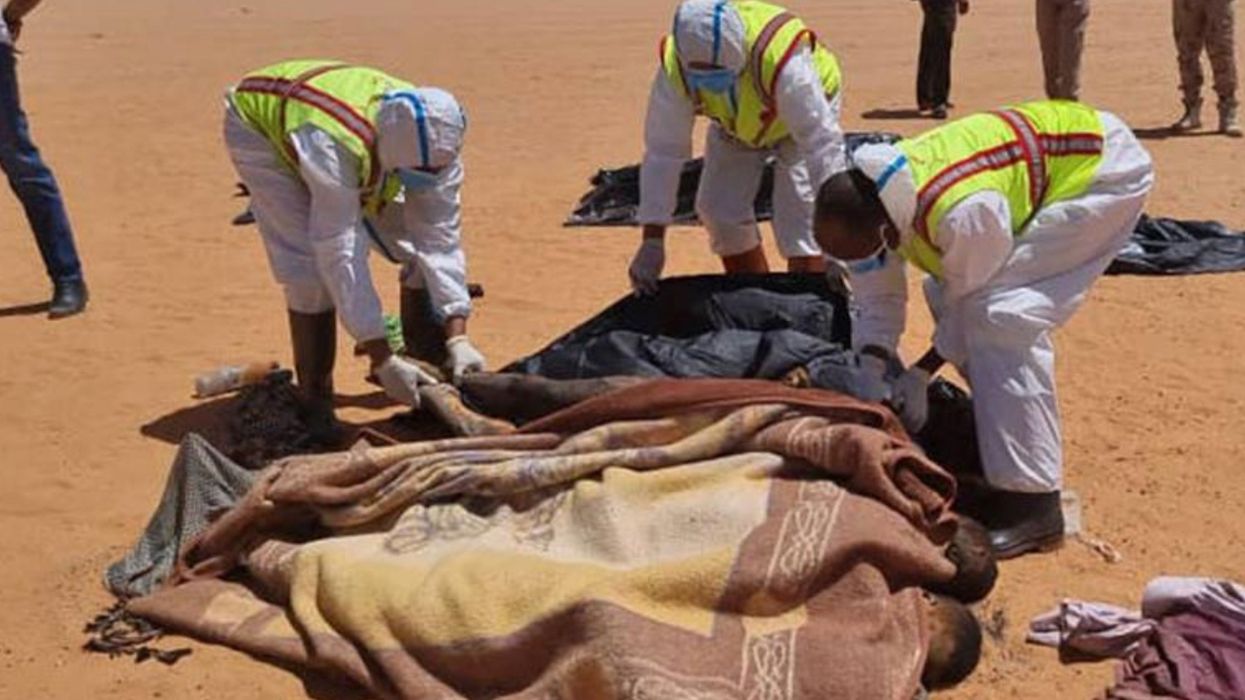
No one can keep track of these disappearances, since no one even knows that they have happened.
Sabah, Libya, is an oasis town at the northern edge of the Sahara Desert. To stand at the edge of the town and look southward into the desert toward Niger is forbidding. The sand stretches past infinity, and if there is a wind, it lifts the sand to cover the sky. Cars come down the road past the al-Baraka Mosque into the town. Some of these cars come from Algeria (although the border is often closed) or from Djebel al-Akakus, the mountains that run along the western edge of Libya. Occasionally, a white Toyota truck filled with men from the Sahel region of Africa and from western Africa makes its way into Sabah. Miraculously, these men have made it across the desert, which is why many of them clamber out of their truck and fall to the ground in desperate prayer. Sabah means “morning” or “promise” in Arabic, which is a fitting word for this town that grips the edge of the massive, growing, and dangerous Sahara.
For the past decade, the United Nations International Organization of Migration (IOM) has collected data on the deaths of migrants. This Missing Migrants Project publishes its numbers each year, and so this April, it has released its latest figures. For the past ten years, the IOM says that 64,371 women, men, and children have died while on the move (half of them have died in the Mediterranean Sea). On average, each year since 2014, 4,000 people have died. However, in 2023, the number rose to 8,000. One in three migrants who flee a conflict zone die on the way to safety. These numbers, however, are grossly deflated, since the IOM simply cannot keep track of what they call “irregular migration.” For instance, the IOM admits, “[S]ome experts believe that more migrants die while crossing the Sahara Desert than in the Mediterranean Sea.”
Abdel Salam, who runs a small business in the town, pointed out into the distance and said, “In that direction is Toummo,” the Libyan border town with Niger. He sweeps his hands across the landscape and says that in the region between Niger and Algeria is the Salvador Pass, and it is through that gap that drugs, migrants, and weapons move back and forth, a trade that enriches many of the small towns in the area, such as Ubari. With the erosion of the Libyan state since the NATO war in 2011, the border is largely porous and dangerous. It was from here that the al-Qaeda leader Mokhtar Belmokhtar moved his troops from northern Mali into the Fezzan region of Libya in 2013 (he was said to have been killed in Libya in 2015). It is also the area dominated by the al-Qaeda cigarette smugglers, who cart millions of Albanian-made Cleopatra cigarettes across the Sahara into the Sahel (Belmokhtar, for instance, was known as the “Marlboro Man” for his role in this trade). An occasional Toyota truck makes its way toward the city. But many of them vanish into the desert, a victim of the terrifying sandstorms or of kidnappers and thieves. No one can keep track of these disappearances, since no one even knows that they have happened.
Matteo Garrone’s Oscar-nominated Io Capitano (2023) tells the story of two Senegalese boys—Seydou and Moussa—who go from Senegal to Italy through Mali, Niger, and then Libya, where they are incarcerated before they flee across the Mediterranean to Italy in an old boat. Garrone built the story around the accounts of several migrants, including Kouassi Pli Adama Mamadou (from Côte d’Ivoire, now an activist who lives in Caserta, Italy). The film does not shy away from the harsh beauty of the Sahara, which claims the lives of migrants who are not yet seen as migrants by Europe. The focus of the film is on the journey to Europe, although most Africans migrate within the continent (21 million Africans live in countries in which they were not born). Io Capitano ends with a helicopter flying above the ship as it nears the Italian coastline; it has already been pointed out that the film does not acknowledge racist policies that will greet Seydou and Moussa. What is not shown in the film is how European countries have tried to build a fortress in the Sahel region to prevent migration northwards.
More and more migrants have sought the Niger-Libya route after the fall of the Libyan state in 2011 and the crackdown on the Moroccan-Spanish border at Melilla and Ceuta. A decade ago, the European states turned their attention to this route, trying to build a European “wall” in the Sahara against the migrants. The point was to stop the migrants before they get to the Mediterranean Sea, where they become an embarrassment to Europe. France, leading the way, brought together five of the Sahel states (Burkina Faso, Chad, Mali, Mauritania, and Niger) in 2014 to create the G5 Sahel. In 2015, under French pressure, the government of Niger passed Law 2015-36 that criminalized migration through the country. G5 Sahel and the law in Niger came alongside European Union funding to provide surveillance technologies—illegal in Europe—to be used in this band of countries against migrants. In 2016, the United States built the world’s largest drone base in Agadez, Niger, as part of this anti-migrant program. In May 2023, Border Forensics studied the paths of the migrants and found that due to the law in Niger and these other mechanisms the Sahara had become an “open-air tomb.”
Over the past few years, however, all of this has begun to unravel. The coup d’états in Guinea (2021), Mali (2021), Burkina Faso (2022), and Niger (2023) have resulted in the dismantling of G5 Sahel as well as the demand for the removal of French and US troops. In November 2023, the government of Niger revoked Law 2015-36 and freed those who had been accused of being smugglers.
Abdourahamane, a local grandee, stood beside the Grand Mosque in Agadez and talked about the migrants. “The people who come here are our brothers and sisters,” he said. “They come. They rest. They leave. They do not bring us problems.” The mosque, built of clay, bears within it the marks of the desert, but it is not transient. Abdourahamane told me that it goes back to the 16th century, long before modern Europe was born. Many of the migrants come here to get their blessings before they buy sunglasses and head across the desert, hoping that they make it through the sands and find their destiny somewhere across the horizon.
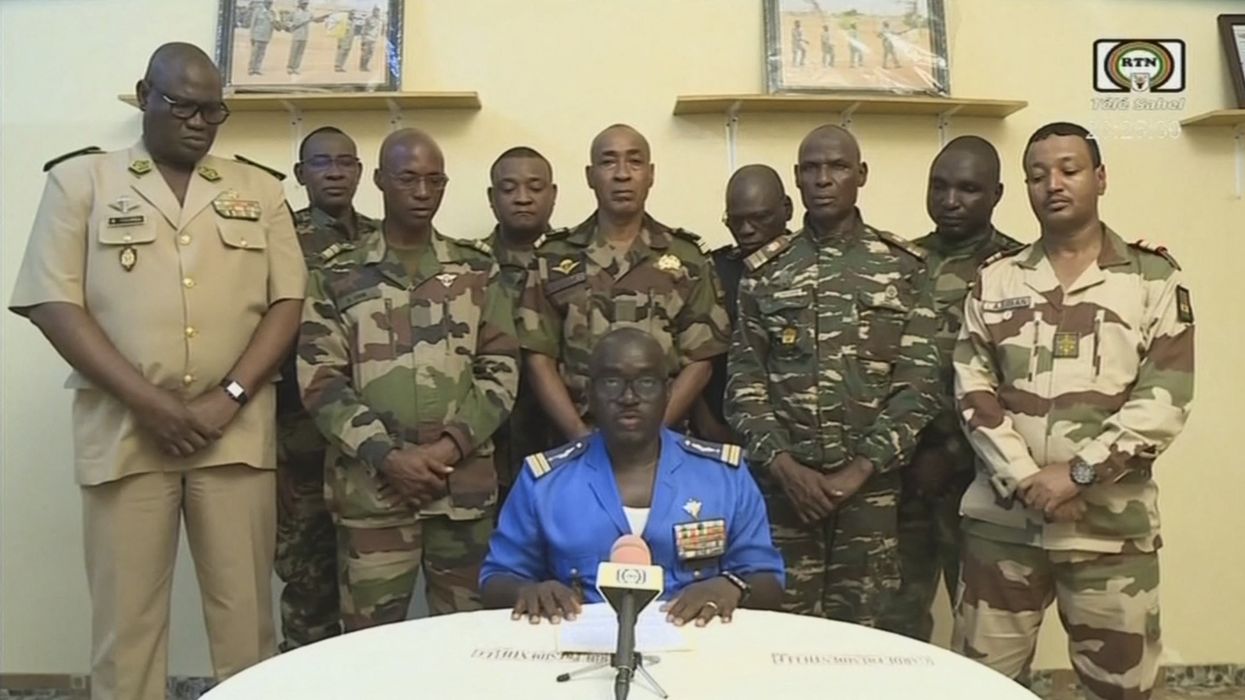
Will the Biden administration reverse a course that the U.S. has been on since the early 2000s?
Dressed in green military fatigues and a blue garrison cap, Colonel Major Amadou Abdramane, a spokesperson for Niger’s ruling junta, took to local television last month to criticize the United States and sever the long-standing military partnership between the two countries. “The government of Niger, taking into account the aspirations and interests of its people, revokes, with immediate effect, the agreement concerning the status of United States military personnel and civilian Defense Department employees,” he said, insisting that their 12-year-old security pact violated Niger’s constitution.
Another sometime Nigerien spokesperson, Insa Garba Saidou, put it in blunter terms: “The American bases and civilian personnel cannot stay on Nigerien soil any longer.”
The announcements came as terrorism in the West African Sahel has spiked and in the wake of a visit to Niger by a high-level American delegation, including Assistant Secretary of State for African Affairs Molly Phee and General Michael Langley, chief of U.S. Africa Command, or AFRICOM. Niger’s repudiation of its ally is just the latest blow to Washington’s sputtering counterterrorism efforts in the region. In recent years, longstanding U.S. military partnerships with Burkina Faso and Mali have also been curtailed following coups by U.S.-trained officers. Niger was, in fact, the last major bastion of American military influence in the West African Sahel.
Niger’s junta is pursuing another such path, attempting to end an American forever war in one small corner of the world—doing what President Biden pledged but failed to do.
Such setbacks there are just the latest in a series of stalemates, fiascos, or outright defeats that have come to typify America’s Global War on Terror. During 20-plus years of armed interventions, U.S. military missions have been repeatedly upended across Africa, the Middle East, and South Asia, including a sputtering stalemate in Somalia, an intervention-turned-blowback-engine in Libya, and outright implosions in Afghanistan and Iraq.
This maelstrom of U.S. defeat and retreat has left at least 4.5 million people dead, including an estimated 940,000 from direct violence, more than 432,000 of them civilians, according to Brown University’s Costs of War Project. As many as 60 million people have also been displaced due to the violence stoked by America’s “forever wars.”
President Joe Biden has both claimed that he’s ended those wars and that the United States will continue to fight them for the foreseeable future—possibly forever—“to protect the people and interests of the United States.” The toll has been devastating, particularly in the Sahel, but Washington has largely ignored the costs borne by the people most affected by its failing counterterrorism efforts.
Roughly 1,000 U.S. military personnel and civilian contractors are deployed to Niger, most of them near the town of Agadez at Air Base 201 on the southern edge of the Sahara desert. Known to locals as “Base Americaine,” that outpost has been the cornerstone of an archipelago of U.S. military bases in the region and is the key to America’s military power projection and surveillance efforts in North and West Africa. Since the 2010s, the U.S. has sunk roughly a quarter-billion dollars into that outpost alone.
Washington has been focused on Niger and its neighbors since the opening days of the Global War on Terror, pouring military aid into the nations of West Africa through dozens of “security cooperation” efforts, among them the Trans-Sahara Counterterrorism Partnership, a program designed to “counter and prevent violent extremism” in the region. Training and assistance to local militaries offered through that partnership has alone cost America more than $1 billion.
Just prior to his recent visit to Niger, AFRICOM’s General Langley went before the Senate Armed Services Committee to rebuke America’s longtime West African partners. “During the past three years, national defense forces turned their guns against their own elected governments in Burkina Faso, Guinea, Mali, and Niger,” he said. “These juntas avoid accountability to the peoples they claim to serve.”
After 20 years, it’s clear that America’s Sahelian partnerships aren’t “reducing terrorist violence” at all.
Langley did not mention, however, that at least 15 officers who benefited from American security cooperation have been involved in 12 coups in West Africa and the greater Sahel during the Global War on Terror. They include the very nations he named: Burkina Faso (2014, 2015, and twice in 2022); Guinea (2021); Mali (2012, 2020, and 2021); and Niger (2023). In fact, at least five leaders of a July coup in Niger received U.S. assistance, according to an American official. When they overthrew that country’s democratically elected president, they, in turn, appointed five U.S.-trained members of the Nigerien security forces to serve as governors.
Langley went on to lament that, while coup leaders invariably promise to defeat terrorist threats, they fail to do so and then “turn to partners who lack restrictions in dealing with coup governments… particularly Russia.” But he also failed to lay out America’s direct responsibility for the security freefall in the Sahel, despite more than a decade of expensive efforts to remedy the situation.
“We came, we saw, he died,” then-Secretary of State Hillary Clintonjoked after a U.S.-led NATO air campaign helped overthrow Colonel Muammar el-Qaddafi, the longtime Libyan dictator, in 2011. Former President Barack Obama hailed the intervention as a success, even as Libya began to slip into near-failed-state status. Obama would later admit that “failing to plan for the day after” Qaddafi’s defeat was the “worst mistake” of his presidency.
As the Libyan leader fell, Tuareg fighters in his service looted his regime’s weapons caches, returned to their native Mali, and began to take over the northern part of that nation. Anger in Mali’s armed forces over the government’s ineffective response resulted in a 2012 military coup led by Amadou Sanogo, an officer who learned English in Texas, and underwent infantry-officer basic training in Georgia, military-intelligence instruction in Arizona, and mentorship by Marines in Virginia.
Having overthrown Mali’s democratic government, Sanogo proved hapless in battling local militants who had also benefited from the arms flowing out of Libya. With Mali in chaos, those Tuareg fighters declared their own independent state, only to be pushed aside by heavily armed Islamist militants who instituted a harsh brand of Shariah law, causing a humanitarian crisis. A joint French, American, and African mission prevented Mali’s complete collapse but pushed the Islamists to the borders of both Burkina Faso and Niger, spreading terror and chaos to those countries.
Since then, the nations of the West African Sahel have been plagued by terrorist groups that have evolved, splintered, and reconstituted themselves. Under the black banners of jihadist militancy, men on motorcycles armed with Kalashnikov rifles regularly roar into villages to impose zakat (an Islamic tax) and terrorize and kill civilians. Relentless attacks by such armed groups have not only destabilized Burkina Faso, Mali, and Niger, prompting coups and political instability, but have spread south to countries along the Gulf of Guinea. Violence has, for example, spiked in Togo (633%) and Benin (718%), according to Pentagon statistics.
American officials have often turned a blind eye to the carnage. Asked about the devolving situation in Niger, for instance, State Department spokesperson Vedant Patel recently insisted that security partnerships in West Africa “are mutually beneficial and are intended to achieve what we believe to be shared goals of detecting, deterring, and reducing terrorist violence.” His pronouncement is either an outright lie or a total fantasy.
After 20 years, it’s clear that America’s Sahelian partnerships aren’t “reducing terrorist violence” at all. Even the Pentagon tacitly admits this. Despite U.S. troop strength in Niger growing by more than 900% in the last decade and American commandos training local counterparts, while fighting and even dying there; despite hundreds of millions of dollars flowing into Burkina Faso in the form of training as well as equipment like armored personnel carriers, body armor, communications gear, machine guns, night-vision equipment, and rifles; and despite U.S. security assistance pouring into Mali and its military officers receiving training from the United States, terrorist violence in the Sahel has in no way been reduced. In 2002 and 2003, according to State Department statistics, terrorists caused 23 casualties in all of Africa. Last year, according to the Africa Center for Strategic Studies, a Pentagon research institution, attacks by Islamist militants in the Sahel alone resulted in 11,643 deaths—an increase of more than 50,000%.
In January 2021, President Biden entered the White House promising to end his country’s forever wars. He quickly claimed to have kept his pledge. “I stand here today for the first time in 20 years with the United States not at war,” Biden announced months later. “We’ve turned the page.”
Late last year, however, in one of his periodic “war powers” missives to Congress, detailing publicly acknowledged U.S. military operations around the world, Biden said just the opposite. In fact, he left open the possibility that America’s forever wars might, indeed, go on forever. “It is not possible,” he wrote, “to know at this time the precise scope or the duration of the deployments of United States Armed Forces that are or will be necessary to counter terrorist threats to the United States.”
Niger’s U.S.-trained junta has made it clear that it wants America’s forever war there to end. That would assumedly mean the closing of Air Base 201 and the withdrawal of about 1,000 American military personnel and contractors. So far, however, Washington shows no signs of acceding to their wishes. “We are aware of the March 16th statement… announcing an end to the status of forces agreement between Niger and the United States,” said Deputy Pentagon Press Secretary Sabrina Singh. “We are working through diplomatic channels to seek clarification… I don’t have a timeframe of any withdrawal of forces.”
Carnage, stalemate, and failure seem to have had remarkably little effect on Washington’s desire to continue funding and fighting such wars, but facts on the ground like the Taliban’s triumph in Afghanistan have sometimes forced Washington’s hand.
“The U.S. military is in Niger at the request of the Government of Niger,” said AFRICOM spokesperson Kelly Cahalan last year. Now that the junta has told AFRICOM to leave, the command has little to say. Email return receipts show that TomDispatch’s questions about developments in Niger sent to AFRICOM’s press office were read by a raft of personnel including Cahalan, Zack Frank, Joshua Frey, Yvonne Levardi, Rebekah Clark Mattes, Christopher Meade, Takisha Miller, Alvin Phillips, Robert Dixon, Lennea Montandon, and Courtney Dock, AFRICOM’s deputy director of public affairs, but none of them answered any of the questions posed. Cahalan instead referred TomDispatch to the State Department. The State Department, in turn, directed TomDispatch to the transcript of a press conference dealing primarily with U.S. diplomatic efforts in the Philippines.
“USAFRICOM needs to stay in West Africa… to limit the spread of terrorism across the region and beyond,” General Langley told the Senate Armed Services Committee in March. But Niger’s junta insists that AFRICOM needs to go and U.S. failures to “limit the spread of terrorism” in Niger and beyond are a key reason why. “This security cooperation did not live up to the expectations of Nigeriens—all the massacres committed by the jihadists were carried out while the Americans were here,” said a Nigerien security analyst who has worked with U.S. officials, speaking on the condition of anonymity.
America’s forever wars, including the battle for the Sahel, have ground on through the presidencies of George W. Bush, Barack Obama, Donald Trump, and Joe Biden with failure the defining storyline and catastrophic results the norm. From the Islamic State routing the U.S.-trained Iraqi army in 2014 to the Taliban’s victory in Afghanistan in 2021, from the forever stalemate in Somalia to the 2011 destabilization of Libya that plunged the Sahel into chaos and now threatens the littoral states along the Gulf of Guinea, the Global War on Terror has been responsible for the deaths, wounding, or displacement of tens of millions of people.
Carnage, stalemate, and failure seem to have had remarkably little effect on Washington’s desire to continue funding and fighting such wars, but facts on the ground like the Taliban’s triumph in Afghanistan have sometimes forced Washington’s hand. Niger’s junta is pursuing another such path, attempting to end an American forever war in one small corner of the world—doing what President Biden pledged but failed to do. Still, the question remains: Will the Biden administration reverse a course that the U.S. has been on since the early 2000s? Will it agree to set a date for withdrawal? Will Washington finally pack up its disastrous war and go home?
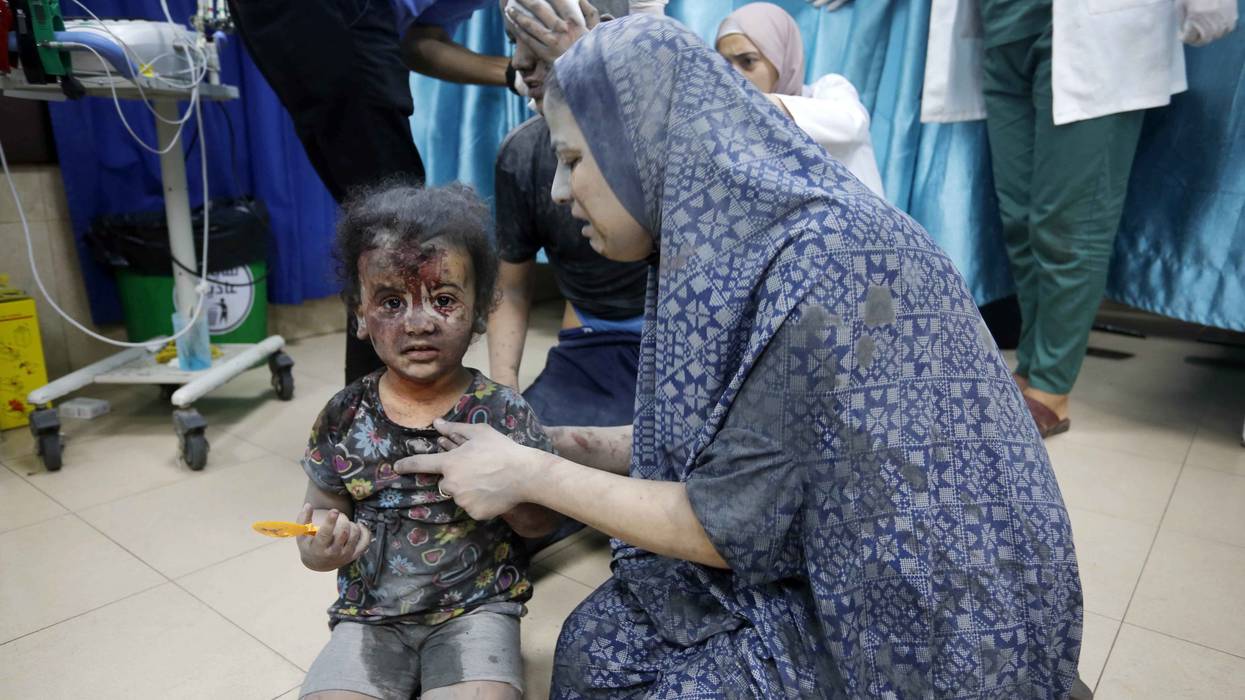
Not being able to live up to its own principles when a humanitarian crisis is unleashed by an allied country such as Israel is the last nail in the coffin for a thoroughly failed idea.
At the height of the “unipolar moment” of the 1990s and 2000s, a popular school of thought argued that the U.S. could use its unchecked power to do good on the world stage. When peace proved elusive after the fall of the Soviet Union, the world saw exceptionally deadly warfare and attempted ethnic cleansing erupt in Karabakh, the Congo, Rwanda, and Yugoslavia. If there was one power that could do anything about this, it was the United States.
The primary ideologue of this push for humanitarian interventionism would become Samantha Power. A journalist and author of the influential book A Problem from Hell: America in the Age of Genocide, Power argued that the U.S. and other liberal nation states should use military force to halt crimes against humanity in other countries. Nation-states have a responsibility to protect their citizens, and if they are found not be doing this, other states may then step in to do so should the situation continue to deteriorate. This principle was called “Responsibility to Protect,” or “R2P,” and it became so influential that it was adopted into the United Nations Charter in 2005.
Both the Romans and Spanish, more than 1,000 years apart, argued that their bloody conquests in Carthage and Central America would help the world by ending the practice of human sacrifice.
Two decades later, the concept has been shown to be both hypocritical and dangerous. As Israel bombs Gaza to dust, world elites have shown no interest in living up to their apparent responsibility to protect civilians. Contrast this with the response to Russia’s war in Ukraine, in which commentators called for direct intervention to save innocent Ukrainians. And actual examples of R2P have led to disaster, as civilians in Libya can attest. Fortunately, there’s a simple answer to this hellish problem: abandoning R2P once and for all.
Power’s line of argument masked the darker history of so-called humanitarian interventions. Both the Romans and Spanish, more than 1,000 years apart, argued that their bloody conquests in Carthage and Central America would help the world by ending the practice of human sacrifice. In the 19th century, the colonial states of western Europe began to see their maritime expansion abroad not simply in terms of wealth and power acquisition but as an inevitable stage of human moral development. France and Britain in particular dove into Africa with the justification of putting an end to tribal wars and extirpating the slave trade. With economic and technological shifts, the same empires who had once expanded with shackles in hand now came, so they said, as liberators. Yet the result of this “liberation” was little more than violence and famine.
Unfortunately, the lessons of this sordid history didn’t stick. Barack Obama would end up recruiting Power for multiple roles in his administration. While Obama ran explicitly against the disastrous foreign policy of George W Bush in 2008, subsequent events related to the “Arab Spring” would see him continue if not expand these same policies, launching an overt regime change war in Libya (and a covert one in Syria) while intensifying U.S. operations in Yemen.
It was in the Libya war that Power would see her dream fulfilled, when R2P was explicitly invoked to protect Libyan civilians in rebel-held areas from retaliation by the government of Muamar Gaddafi. This operation resulted in widespread state failure, a collapse of central authority, a massive refugee crisis, a resurgence of extremism in that country, and, most gallingly of all, the return of slave markets along the North African coast. It turned out that there are worse things out there than oppressive governments.
The current Gaza War is, by all the standards usually cited by humanitarian interventionists, a perfect case for invoking R2P.
R2P’s reputation took a hit and receded from the discourse, at least until Russia’s invasion of Ukraine gave it life once more. Some members of the press called for no-fly zones over the country, and politicians in NATO states debated if such ideas were feasible. Ultimately, they decided that it was not, given Russia’s conventional capabilities, particularly in the field of anti-aircraft weaponry. There was also the inconvenient fact of Moscow having nuclear deterrence. Any attempts to create a safe area for Ukrainians using NATO military forces risked a level of escalation deemed unpalatable by most in the alliance. This clearly showed that R2P was only ever really meant to be used by great powers against smaller countries that could not defend themselves. It never had any utility against more robust foes. Interestingly, Moscow had picked up on the trick and justified its invasion of Ukraine using explicitly R2P-flavored rhetoric about protecting lives in the Donbass.
The current Gaza War is, by all the standards usually cited by humanitarian interventionists, a perfect case for invoking R2P. Rhetoric from some actors inside the Israeli state suggests that some form of population displacement is at least being considered. The incredible population density of the Gaza Strip means civilians bear the brunt of the violence. Lack of access to medicine and food exacerbates all of these problems.
Samantha Power is the current head of USAID in the Biden administration. One cannot help but wonder what she thinks of the war currently unfolding in Gaza while she coordinates food shipments through Egypt’s Sinai that are often held up at border checkpoints. For one so adamant that the U.S. must intervene whenever war disproportionately hits a civilian populace, she has been strangely silent.
Meanwhile, Yemen’s Houthis explicitly cite their own version of R2P to justify their attacks on shipping in the Red Sea. This shows the true future of R2P, if it is to have any—one of selective applications by great powers that muddy the waters around their wars in an attempt to gain media approval from within their alliance networks. As the world’s balance of power inevitably moves into its more normal state of multipolarity, governments further undermine claims of ethical conduct in foreign policy, as states now have constant incentive to claim that their foes have a monopoly on human rights abuses. Inevitably, this will lead to all such claims being met with greater and greater skepticism by the global public, regardless of their factuality.
Far from the centers of great power rivalries, the utility of R2P seems to be declining, as crises such as Myanmar and Sudan are assiduously ignored by the countries expected to be intervening, likely out of fear of being sucked into another Syria or Iraq and giving one’s foes more opportunities to indirectly strike at stretched-thin tripwire forces.
It is a trite observation to point out that great powers have different moral standards for their allies and their enemies, but R2P is a foreign policy doctrine entirely based on moralist claims. Not being able to live up to its own principles when a humanitarian crisis is unleashed by an allied country such as Israel is the last nail in the coffin for a thoroughly failed idea. We can only hope that a silver lining of this difficult moment in history is that we never have to hear about the Responsibility to Protect again.
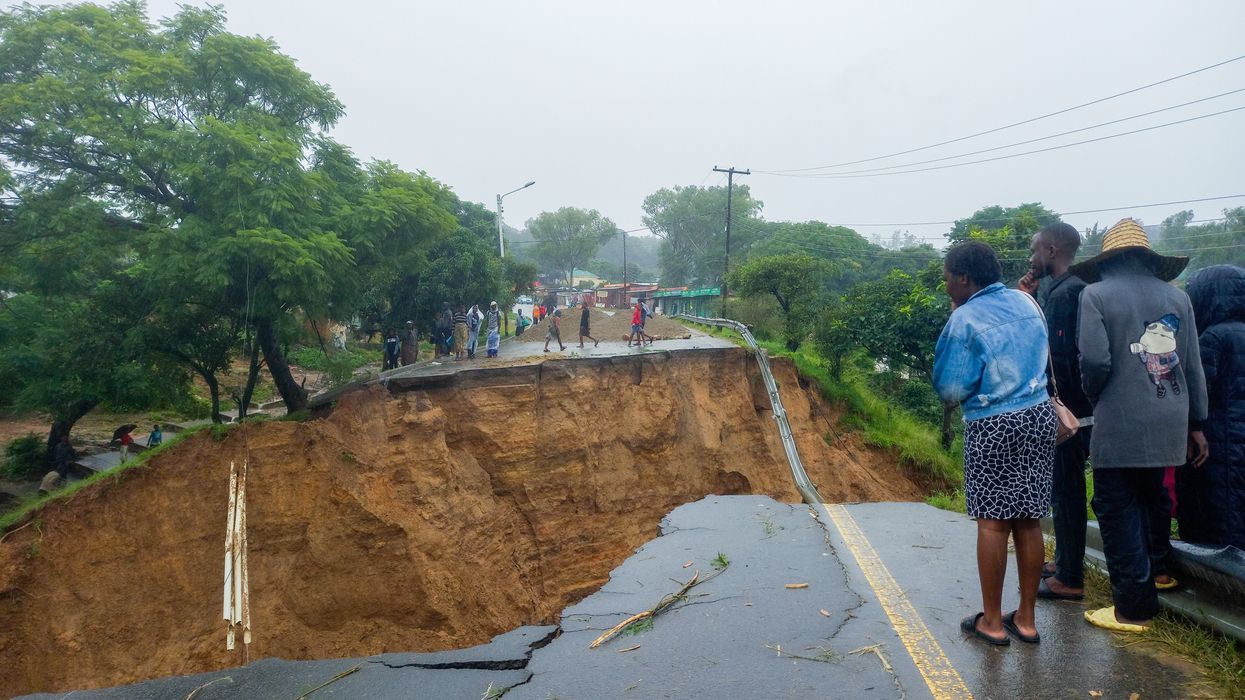
"There is a global postcode lottery that is stacked against the poor," Christian Aid's chief executive said on the publication of the charity's annual list of the year's costliest climate-driven disasters.
Christian Aid's annual list of the 20 costliest climate crisis-driven disasters of 2023, published Wednesday, reveals a "double injustice," as populations that have emitted relatively little greenhouse gas disproportionately suffer the impacts of extreme weather events ranging from floods to storms to wildfires.
While the disasters on the list impacted low-, medium-, and high-income countries, the U.K.-based charity observed that people in low-income nations have fewer resources to recover.
"When it comes to the climate crisis, there is a global postcode lottery that is stacked against the poor," Christian Aid chief executive Patrick Watt said in a statement. "In poorer countries, people are often less prepared for climate-related disasters and have fewer resources with which to bounce back. The upshot is that more people die, and recovery is slower and more unequal."
The disasters on the list reflect an accelerating climate emergency, as 2023 is set to be the hottest year both on the official record and in 125,000 years of human history.
"The effects of climate change are increasingly obvious, not least in the increasing frequency and severity of climate related disasters," Watt wrote in the report foreword. "Floods, storms, heatwaves, and droughts are all becoming more intense, and climate attribution science is becoming clearer that climate change is causing these more intense disasters."
The report focuses on disasters whose increased frequency or intensity have been linked to the burning of fossil fuels, excluding events like earthquakes. It draws primarily on the EM-DAT database of international disasters, supplementing with data from individual countries, insurers, and the United Nations. It then determines their per capita cost by dividing total damages by the impacted population.
"The worst negative impact of Cyclone Freddy that I shall never forget in my entire life is the destruction of the only house that we struggled to construct."
"This method offers a more individualized perspective of the disaster's impact, highlighting the financial strain on the average citizen rather than just the aggregate economic toll," the report authors explained.
The costliest climate disaster of 2023 was the wildfire that devastated Maui from August 8 to 11. The report found that the fires had a per capita cost of $4,161 for the people of Hawaii. While Hawaii is part of the U.S., a wealthy country, other commenters have noted that the fire reflected the legacy of the colonialism inflicted on Indigenous Hawaiians and land-use changes that favored first agricultural plantations and then tourism over maintaining a healthy ecosystem. Locals and climate justice advocates voiced concerns that the affected area would be rebuilt in the interests of wealthy developers rather than surviving residents.
Other headline-making disasters on the list included the flooding that inundated Libya in September and Cyclone Freddy in Malawi, which was the second deadliest cyclone in Africa since 2000.
Christian Aid's full list of the 20 costliest disasters of 2023 and their per capital price tag is as follows:
The report authors pointed out that per capita costs tend to be higher in wealthier countries that have higher costs of living and more insurance data to inform figures. This does not always reflect the relative impact of a disaster on a population. For example, a full recovery from Storm Freddy in Malawi is estimated to cost $680 million.
"Given the scale of the disaster, and the huge number of people affected, this may seem like a relatively low amount," the report authors noted, "but since the total of economy of Malawi is $13 billion, it represents 5%, a much higher proportion than in most other disasters on our list."
The per-person cost of that full recovery comes out to $33, which seems small by U.S. standards but amounts to more than 5% of the average annual income of $500 in Malawi.
"The worst negative impact of Cyclone Freddy that I shall never forget in my entire life is the destruction of the only house that we struggled to construct," 69-year-old widow and storm survivor Mofolo Chikaonda told Christian Aid.
Watt wrote in the foreword that "the fact that poorer countries and communities contribute little to global heating makes climate-related disasters a double inequality. This is an injustice that a growing number of poorer countries and civil society campaigners have rightly challenged."
The charity made several recommendations for the international community to prepare for and address climate disasters in a just manner.
"Governments urgently need to take further action at home and internationally to cut emissions and adapt to the effects of climate change," Watt said. "And where the impacts go beyond what people can adapt to, the loss and damage fund must be resourced to compensate the poorest countries for the effects of a crisis that isn't of their making."
A loss and damage fund to help poorer nations pay for the inevitable impacts of the climate crisis was agreed to at the 27th annual U.N. Climate Change Conference (COP27) in 2022 and had its details finalized at this year's COP28 in Dubai.
"Loss and damage costs are in the hundreds of billions of dollars annually in developing countries alone," Nushrat Chowdhury, Christian Aid's climate justice policy adviser in Bangladesh, said in a statement. "Wealthy nations must commit the new and additional money required to ensure the loss and damage fund agreed at COP28 can be quickly get help to those that need it most."
Christian Aid said that countries should agree on a New Collective Quantified Goal to fully fund climate mitigation, adaptation, and loss and damage; make sure poorer nations can quickly access the new loss and damage fund as it becomes operational in 2024; make vulnerable communities more resilient by investing in solutions like agroecology; increase funding for early warning and response systems; measure the impacts of disasters and share their findings; and establish social services at home to assist disaster victims while providing poorer nations with the debt relief, funding, and tax-rule reform they need so they can afford to help their own populations.

The $1.5 trillion in military outlays each year is the scam that keeps on giving—to the military-industrial complex and the Washington insiders—even as it impoverishes and endangers America and the world.
On the surface, US foreign policy seems to be utterly irrational. The US gets into one disastrous war after another -- Afghanistan, Iraq, Syria, Libya, Ukraine, and Gaza. In recent days, the US stands globally isolated in its support of Israel’s genocidal actions against the Palestinians, voting against a UN General Assembly resolution for a Gaza ceasefire backed by 153 countries with 89% of the world population, and opposed by just the US and 9 small countries with less than 1% of the world population.
In the past 20 years, every major US foreign policy objective has failed. The Taliban returned to power after 20 years of US occupation of Afghanistan. Post-Saddam Iraq became dependent on Iran. Syria’s President Bashar al-Assad stayed in power despite a CIA effort to overthrow him. Libya fell into a protracted civil war after a US-led NATO mission overthrew Muammar Gaddafi. Ukraine was bludgeoned on the battlefield by Russia in 2023 after the US secretly scuttled a peace agreement between Russia and Ukraine in 2022.
To understand the foreign-policy scam, think of today’s federal government as a multi-division racket controlled by the highest bidders.
Despite these remarkable and costly debacles, one following the other, the same cast of characters has remained at the helm of US foreign policy for decades, including Joe Biden, Victoria Nuland, Jake Sullivan, Chuck Schumer, Mitch McConnell, and Hillary Clinton.
What gives?
The puzzle is solved by recognizing that American foreign policy is not at all about the interests of the American people. It is about the interests of the Washington insiders, as they chase campaign contributions and lucrative jobs for themselves, staff, and family members. In short, US foreign policy has been hacked by big money.
As a result, the American people are losing big. The failed wars since 2000 have cost them around $5 trillion in direct outlays, or around $40,000 per household. Another $2 trillion or so will be spent in the coming decades on veterans’ care. Beyond the costs directly incurred by Americans, we should also recognize the horrendously high costs suffered abroad, in millions of lives lost and trillions of dollars of destruction to property and nature in the war zones.
The costs continue to mount. US Military-linked outlays in 2024 will come to around $1.5 trillion, or roughly $12,000 per household, if we add the direct Pentagon spending, the budgets of the CIA and other intelligence agencies, the budget of the Veteran’s Administration, the Department of Energy nuclear weapons program, the State Department’s military-linked “foreign aid” (such as to Israel), and other security-related budget lines. Hundreds of billions of dollars are money down the drain, squandered in useless wars, overseas military bases, and a wholly unnecessary arms build-up that brings the world closer to WWIII.
Yet to describe these gargantuan costs is also to explain the twisted “rationality” of US foreign policy. The $1.5 trillion in military outlays is the scam that keeps on giving—to the military-industrial complex and the Washington insiders—even as it impoverishes and endangers America and the world.
To understand the foreign-policy scam, think of today’s federal government as a multi-division racket controlled by the highest bidders. The Wall Street division is run out of the Treasury. The Health Industry division is run out of the Department of Health and Human Services. The Big Oil and Coal division is run out of the Departments of Energy and Interior. And the Foreign Policy division is run out of the White House, Pentagon and CIA.
Each division uses public power for private gain through insider dealing, greased by corporate campaign contributions and lobbying outlays. Interestingly, the Health Industry division rivals the Foreign Policy division as a remarkable financial scam. America’s health outlays totaled an astounding $4.5 trillion in 2022, or roughly $36,000 per household, by far the highest health costs in the world, while America ranked roughly 40th in the world among nations in life expectancy. A failed health policy translates into very big bucks for the health industry, just as a failed foreign policy translates into mega-revenues of the military-industrial complex.
The more wars, of course, the more business.
The Foreign Policy division is run by a small, secretive and tight-knit coterie, including the top brass of the White House, the CIA, the State Department, the Pentagon, the Armed Services Committees of the House and Senate, and the major military firms including Boeing, Lockheed Martin, General Dynamics, Northrop Grumman, and Raytheon. There are perhaps a thousand key individuals involved in setting policy. The public interest plays little role.
The key foreign policy makers run the operations of 800 US overseas military bases, hundreds of billions of dollars of military contracts, and the war operations where the equipment is deployed. The more wars, of course, the more business. The privatization of foreign policy has been greatly amplified by the privatization of the war business itself, as more and more “core” military functions are handed out to the arms manufacturers and to contractors such as Haliburton, Booz Allen Hamilton, and CACI.
In addition to the hundreds of billions of dollars of military contracts, there are important business spillovers from the military and CIA operations. With military bases in 80 countries around the world, and CIA operations in many more, the US plays a large, though mostly covert role, in determining who rules in those countries, and thereby on policies that shape lucrative deals involving minerals, hydrocarbons, pipelines, and farm and forest land. The US has aimed to overthrow at least 80 governments since 1947, typically led by the CIA through the instigation of coups, assassinations, insurrections, civil unrest, election tampering, economic sanctions, and overt wars. (For a superb study of US regime-change operations from 1947 to 1989, see Lindsey O’Rourke’s Covert Regime Change, 2018).
In addition to business interests, there are of course ideologues who truly believe in America’s right to rule the world. The ever-warmongering Kagan family is the most famous case, though their financial interests are also deeply intertwined with the war industry. The point about ideology is this. The ideologists have been wrong on nearly every occasion and long ago would have lost their bully pulpits in Washington but for their usefulness as warmongers. Wittingly or not, they serve as paid performers for the military-industrial complex.
There is one persistent inconvenience for this ongoing business scam. In theory, foreign policy is carried out in the interest of the American people, though the opposite is the truth. (A similar contradiction of course applies to overpriced healthcare, government bailouts of Wall Street, oil-industry perks, and other scams). The American people rarely support the machinations of US foreign policy when they occasionally hear the truth. America’s wars are not waged by popular demand but by decisions from on high. Special measures are needed to keep the people away from decision making.
In theory, foreign policy is carried out in the interest of the American people, though the opposite is the truth.
The first such measure is unrelenting propaganda. George Orwell nailed it in 1984 when “the Party” suddenly switched the foreign enemy from Eurasia to Eastasia without a word of explanation. The US essentially does the same. Who is the US gravest enemy? Take your pick, according to the season. Saddam Hussein, the Taliban, Hugo Chavez, Bashar al-Assad, ISIS, al-Qaeda, Gaddafi, Vladimir Putin, Hamas, have all played the role of “Hitler” in US propaganda. White House spokesman John Kirby delivers the propaganda with a smirk on his face, signaling that he too knows that what he is saying is ludicrous, albeit mildly entertaining.
The propaganda is amplified by the Washington think tanks that live off of donations by military contractors and occasionally foreign governments that are part of the US scam operations. Think of the Atlantic Council, CSIS, and of course the ever-popular Institute for the Study of War, brought to you by the major military contractors.
The second is to hide the costs of the foreign policy operations. In the 1960s, the US Government made the mistake of forcing the American people to bear the costs of the military-industrial complex by drafting young people to fight in Vietnam and by raising taxes to pay for the war. The public erupted in opposition.
From the 1970s onward the government has been far more clever. The government ended the draft, and made military service a job for hire rather than a public service, backed by Pentagon outlays to recruit soldiers from lower economic strata. It also abandoned the quaint idea that government outlays should be funded by taxes, and instead shifted the military budget to deficit spending which protects it from popular opposition that would be triggered if it were tax-funded.
It has also suckered client states such as Ukraine to fight America’s wars on the ground, so that no American body bags would spoil the US propaganda machine. Needless to say, US masters of war such as Sullivan, Blinken, Nuland, Schumer, and McConnell remain thousands of miles away from the frontlines. The dying is reserved for Ukrainians. Sen. Richard Blumenthal (D-Conn.) defended American military aid to Ukraine as money well spent because it is “without a single American service woman or man injured or lost,” somehow not dawning on the good Senator to spare the lives of Ukrainians, who have died by the hundreds of thousands in a US-provoked war over NATO enlargement.
This system is underpinned by the complete subordination of the U.S. Congress to the war business, to avoid any questioning of the over-the-top Pentagon budgets and the wars instigated by the Executive Branch. The subordination of Congress works as follows. First, the Congressional oversight of war and peace is largely assigned to the House and Senate Armed Services Committees, which largely frame the overall Congressional policy (and the Pentagon budget). Second, the military industry (Boeing, Raytheon, and the rest) funds the campaigns of the Armed Services Committee members of both parties. The military industries also spend vast sums on lobbying in order to provide lucrative salaries to retiring members of Congress, their staffs, and families, either directly in military businesses or in Washington lobbying firms.
It is the urgent task of the American people to overhaul a foreign policy that is so broken, corrupted, and deceitful that it is burying the government in debt while pushing the world closer to nuclear Armageddon.
The hacking of Congressional foreign policy is not only by the US military-industrial complex. The Israel lobby long ago mastered the art of buying the Congress. America’s complicity in Israel’s apartheid state and war crimes in Gaza makes no sense for US national security and diplomacy, not to speak of human decency. They are the fruits of Israel lobby investments that reached $30 million in campaign contributions in 2022, and that will vastly top that in 2024.
When Congress reassembles in January, Biden, Kirby, Sullivan, Blinken, Nuland, Schumer, McConnell, Blumenthal and their ilk will tell us that we absolutely must fund the losing, cruel, and deceitful war in Ukraine and the ongoing massacre and ethnic cleansing in Gaza, lest we and Europe and the free world, and perhaps the solar system itself, succumb to the Russian bear, the Iranian mullahs, and the Chinese Communist Party. The purveyors of foreign policy disasters are not being irrational in this fear-mongering. They are being deceitful and extraordinarily greedy, pursuing narrow interests over those of the American people.
It is the urgent task of the American people to overhaul a foreign policy that is so broken, corrupted, and deceitful that it is burying the government in debt while pushing the world closer to nuclear Armageddon. This overhaul should start in 2024 by rejecting any more funding for the disastrous Ukraine War and Israel’s war crimes in Gaza. Peacemaking, and diplomacy, not military spending, is the path to a US foreign policy in the public interest.

"How many more deaths in the Central Mediterranean will the European states wait for before they halt their hostile and inhumane approach?" asked a search-and-rescue representative.
Doctors Without Borders on Wednesday called out European countries for "dangerous" policies and practices that have already made 2023 the deadliest year for migration in the Central Mediterranean since 2017.
The group, known globally as Médecins Sans Frontières (MSF), put out "No One Came to Our Rescue": The human costs of European migration policies in the Central Mediterranean, a report featuring medical and operational data as well as testimonies of people saved at sea.
"MSF has been running search-and-rescue (SAR) activities since 2015 as a direct response to European Union (E.U.) policies of disengagement and nonassistance along this stretch of the sea," the report states. The organization launched operations with the ship Geo Barents in May 2021 and has since saved at least 9,411 lives as of September.
"For more than two years, MSF teams on board Geo Barents have treated the physical and mental health impacts of European migration policies," said SAR representative Juan Matias Gil. "Patients' wounds and stories reflect the scale of violence to which they were subjected in their country of origin and along their journey, including in Libya and Tunisia."
"We documented numerous cases in which Italy and Malta failed to lawfully coordinate rescues and ensure assistance to those at risk of drowning, leading to delayed rescues or no rescue at all."
Of 3,660 medical consultations conducted on the ship this year, most patients had "conditions directly related to long journeys at sea," but MSF also saw 273 people affected by serious violence, with "scars from gunshot wounds, broken and severed limbs, and scars and bruises caused by recurrent violent beatings with metal bars, electric cables, baseball bats, machetes, and knives," according to the report.
"In addition to physical injuries," the publication continues, "these conditions include mental health conditions and the direct consequences of sexual and gender-based violence such as sexually transmitted infections (STIs), unwanted pregnancies, and female genital mutilation (FGM), among others."
The report says that "our teams have seen firsthand the manifold ways in which E.U. states have gradually withdrawn from their SAR obligations and have simultaneously enabled third countries to forcibly return people to unsafe places such as Libya, where many are either trapped in inhumane conditions or have no choice but to take to the sea due to a lack of safe and legal options."
A 19-year-old from Cameroon, rescued by MSF in June 2022, told the group that the previous November, the Libyan Coast Guard "caught me at sea and sold me to the jail of Roshofana." There, guards beat prisoners, "and they were filming and taking pictures while doing so," said the man, who worked for his freedom. "Sometimes, when people were wounded, they piled them up in one place and filmed them."
Europe has given the Libyan government millions of euros, and "since 2017, more than 120,000 people have been intercepted at sea by the E.U.-trained Libyan Coast Guard with E.U.-donated vessels, and illegally pushed back to Libya," MSF pointed out.
"Tunisia has overtaken Libya as the main departure point for people on the move, with nearly five times more arrivals than last year," the group noted. In response, the E.U. has "expanded its Libya strategy," providing millions of euros to "curb undocumented migration—including through incentives, trainings, and material support to increase interceptions at sea."
MSF highlighted that along with enabling interceptions, E.U. governments have directly neglected and hampered SAR efforts.
"In 2022 and 2023, we documented numerous cases in which Italy and Malta failed to lawfully coordinate rescues and ensure assistance to those at risk of drowning, leading to delayed rescues or no rescue at all," the group said. "They have left a deadly void in which people at risk of drowning are either left to drown or forcefully returned to unsafe countries."
While MSF and other groups "have faced frequent harassment by the authorities, including criminal charges, inspections, and prolonged detainment," the publication explains, "November 2022 marked the beginning of a new phase of escalation in the obstruction of NGO-led search-and-rescue activities" led by a new Italian government.
"Italian authorities prohibited Geo Barents and two other SAR ships from stopping in their territorial waters, and eventually facilitated only those considered most vulnerable to disembark," the document details. "The 'selective' disembarkation lasted for three days and eventually, following intense media coverage, political pressure, and the intervention of medical specialists on board the rescue ships, all survivors could eventually disembark in Italy."
Then, in January, "the Italian government introduced a new set of rules applying exclusively to civilian rescue vessels," which "has had a very tangible effect on the presence of NGO ships at sea and their ability to rescue," the report adds. Gil stressed that "while the new Italian rules target NGOs, the real price is paid by those fleeing across the Central Mediterranean, who are left without assistance."
"How many more deaths in the Central Mediterranean will the European states wait for before they halt their hostile and inhumane approach?" he asked. "We urge the European Union and its member states, especially Italy and Malta, to immediately change course in order to prioritize the safety of those seeking sanctuary at European shores."
Since the United States ramped up its counterterrorism operations in Africa, terrorism has spiked 75,000%.
America’s Global War on Terror has seen its share of stalemates, disasters, and outright defeats. During 20-plus years of armed interventions, the United States has watched its efforts implode in spectacular fashion, from Iraq in 2014 to Afghanistan in 2021. The greatest failure of its “Forever Wars,” however, may not be in the Middle East, but in Africa.
“Our war on terror begins with al-Qaeda, but it does not end there. It will not end until every terrorist group of global reach has been found, stopped, and defeated,” President George W. Bush told the American people in the immediate wake of the 9/11 attacks, noting specifically that such militants had designs on “vast regions” of Africa.
To shore up that front, the U.S. began a decades-long effort to provide copious amounts of security assistance, train many thousands of African military officers, set up dozens of outposts, dispatch its own commandos on all manner of missions, create proxy forces, launch drone strikes, and even engage in direct ground combat with militants in Africa. Most Americans, including members of Congress, are unaware of the extent of these operations. As a result, few realize how dramatically America’s shadow war there has failed.
In country after country on that continent, the U.S. has, indeed, faltered and its failures have been paid for by ordinary Africans killed, wounded, and displaced by the terror groups that Bush pledged to “defeat.”
The raw numbers alone speak to the depths of the disaster. As the United States was beginning its Forever Wars in 2002 and 2003, the State Department counted a total of just nine terrorist attacks in Africa. This year, militant Islamist groups on that continent have, according to the Pentagon, already conducted 6,756 attacks. In other words, since the United States ramped up its counterterrorism operations in Africa, terrorism has spiked 75,000%.
Let that sink in for a moment.
75,000%.
The U.S. wars in Afghanistan and Iraq opened to military successes in 2001 and 2003 that quickly devolved into sputtering occupations. In both countries, Washington’s plans hinged on its ability to create national armies that could assist and eventually take over the fight against enemy forces. Both U.S.-created militaries would, in the end, crumble. In Afghanistan, a two-decade-long war ended in 2021 with the rout of an American-built, -funded, -trained, and -armed military as the Taliban recaptured the country. In Iraq, the Islamic State nearly triumphed over a U.S.-created Iraqi army in 2014, forcing Washington to reenter the conflict. U.S. troops remain embattled in Iraq and neighboring Syria to this very day.
In Africa, the U.S. launched a parallel campaign in the early 2000s, supporting and training African troops from Mali in the west to Somalia in the east and creating proxy forces that would fight alongside American commandos. To carry out its missions, the U.S. military set up a network of outposts across the northern tier of the continent, including significant drone bases—from Camp Lemonnier and its satellite outpost Chabelley Airfield in the sun-bleached nation of Djibouti to Air Base 201 in Agadez, Niger—and tiny facilities with small contingents of American special operations troops in nations ranging from Libya and Niger to the Central African Republic and South Sudan.
For almost a decade, Washington’s war in Africa stayed largely under wraps. Then came a decision that sent Libya and the vast Sahel region into a tailspin from which they have never recovered.
American-mentored military personnel in that region have had only one type of demonstrable “success”: overthrowing governments the United States trained them to protect.
“We came, we saw, he died,” Secretary of State Hillary Clinton joked after a U.S.-led NATO air campaign helped overthrow Colonel Muammar el-Qaddafi, the longtime Libyan dictator, in 2011. President Barack Obama hailed the intervention as a success, but Libya slipped into near-failed-state status. Obama would later admit that “failing to plan for the day after” Qaddafi’s defeat was the “worst mistake” of his presidency.
As the Libyan leader fell, Tuareg fighters in his service looted his regime’s weapons caches, returned to their native Mali, and began to take over the northern part of that nation. Anger in Mali’s armed forces over the government’s ineffective response resulted in a 2012 military coup. It was led by Amadou Sanogo, an officer who learned English in Texas and underwent infantry-officer basic training in Georgia, military-intelligence instruction in Arizona, and was mentored by U.S. Marines in Virginia.
Having overthrown Mali’s democratic government, Sanogo and his junta proved hapless in battling terrorists. With the country in turmoil, those Tuareg fighters declared an independent state, only to be muscled aside by heavily armed Islamists who instituted a harsh brand of Shariah law, causing a humanitarian crisis. A joint Franco-American-African mission prevented Mali’s complete collapse but pushed the militants into areas near the borders of both Burkina Faso and Niger.
Since then, those nations of the West African Sahel have been plagued by terrorist groups that have evolved, splintered, and reconstituted themselves. Under the black banners of jihadist militancy, men on motorcycles—two to a bike, wearing sunglasses and turbans, and armed with Kalashnikovs—regularly roar into villages to impose zakat (an Islamic tax); steal animals; and terrorize, assault, and kill civilians. Such relentless attacks have destabilized Burkina Faso, Mali, and Niger and are now affecting their southern neighbors along the Gulf of Guinea. Violence in Togo and Benin has, for example, jumped 633% and 718% over the last year, according to the Pentagon.
U.S.-trained militaries in the region have been unable to stop the onslaught, and civilians have suffered horrifically. During 2002 and 2003, terrorists caused just 23 casualties in Africa. This year, according to the Pentagon, terrorist attacks in the Sahel region alone have resulted in 9,818 deaths—a 42,500% increase.
At the same time, during their counterterrorism campaigns, America’s military partners in the region have committed gross atrocities of their own, including extrajudicial killings. In 2020, for example, a top political leader in Burkina Faso admitted that his country’s security forces were carrying out targeted executions. “We’re doing this, but we’re not shouting it from the rooftops,” he told me, noting that such murders were good for military morale.
American-mentored military personnel in that region have had only one type of demonstrable “success”: overthrowing governments the United States trained them to protect. At least 15 officers who benefited from such assistance have been involved in 12 coups in West Africa and the greater Sahel during the war on terror. The list includes officers from Burkina Faso (2014, 2015, and twice in 2022); Chad (2021); Gambia (2014); Guinea (2021); Mali (2012, 2020, and 2021); Mauritania (2008); and Niger (2023). At least five leaders of a July coup in Niger, for example, received American assistance, according to a U.S. official. They, in turn, appointed five U.S.-trained members of the Nigerien security forces to serve as that country’s governors.
Military coups of that sort have even super-charged atrocities while undermining American aims, yet the United States continues to provide such regimes with counterterrorism support. Take Colonel Assimi Goïta, who worked with U.S. Special Operations forces, participated in U.S. training exercises, and attended the Joint Special Operations University in Florida before overthrowing Mali’s government in 2020. Goïta then took the job of vice president in a transitional government officially charged with returning the country to civilian rule, only to seize power again in 2021.
That same year, his junta reportedly authorized the deployment of the Russia-linked Wagner mercenary forces to fight Islamist militants after close to two decades of failed Western-backed counterterrorism efforts. Since then, Wagner—a paramilitary group founded by the late Yevgeny Prigozhin, a former hot-dog vendor turned warlord—has been implicated in hundreds of human rights abuses alongside the longtime U.S.-backed Malian military, including a 2022 massacre that killed 500 civilians.
Despite all of this, American military aid for Mali has never ended. While Goïta’s 2020 and 2021 coups triggered prohibitions on some forms of U.S. security assistance, American tax dollars have continued to fund his forces. According to the State Department, the U.S. provided more than $16 million in security aid to Mali in 2020 and almost $5 million in 2021. As of July, the department’s Bureau of Counterterrorism was waiting on congressional approval to transfer an additional $2 million to Mali. (The State Department did not reply to TomDispatch’s request for an update on the status of that funding.)
On the opposite side of the continent, in Somalia, stagnation and stalemate have been the watchwords for U.S. military efforts.
“Terrorists associated with Al Qaeda and indigenous terrorist groups have been and continue to be a presence in this region,” a senior Pentagon official claimed in 2002. “These terrorists will, of course, threaten U.S. personnel and facilities.” But when pressed about an actual spreading threat, the official admitted that even the most extreme Islamists “really have not engaged in acts of terrorism outside Somalia.” Despite that, U.S. Special Operations forces were dispatched there in 2002, followed by military aid, advisers, trainers, and private contractors.
More than 20 years later, U.S. troops are still conducting counterterrorism operations in Somalia, primarily against the Islamist militant group al-Shabaab. To this end, Washington has provided billions of dollars in counterterrorism assistance, according to a recent report by the Costs of War Project. Americans have also conducted more than 280 air strikes and commando raids there, while the CIA and special operators built up local proxy forces to conduct low-profile military operations.
Since President Joe Biden took office in January 2021, the U.S. has launched 31 declared airstrikes in Somalia, six times the number carried out during President Obama’s first term, though far fewer than the record high set by President Trump, whose administration launched 208 attacks from 2017 to 2021.
America’s long-running, undeclared war in Somalia has become a key driver of violence in that country, according to the Costs of War Project. “The U.S. is not simply contributing to conflict in Somalia, but has, rather, become integral to the inevitable continuation of conflict in Somalia,” reported Ẹniọlá Ànúolúwapọ Ṣóyẹmí, a lecturer in political philosophy and public policy at the Blavatnik School of Government at Oxford University. “U.S. counterterrorism policies are,” she wrote, “ensuring that the conflict continues in perpetuity.”
“Supporting the development of professional and capable militaries contributes to increasing security and stability in Africa,” said General William Ward, the first chief of U.S. Africa Command (AFRICOM)—the umbrella organization overseeing U.S. military efforts on the continent—in 2010, before he was demoted for profligate travel and spending. His predictions of “increasing security and stability” have, of course, never come to pass.
While the 75,000% increase in terror attacks and 42,500% increase in fatalities over the last two decades are nothing less than astounding, the most recent increases are no less devastating. “A 50% spike in fatalities tied to militant Islamist groups in the Sahel and Somalia over the past year has eclipsed the previous high in 2015,” according to a July report by the Africa Center for Strategic Studies, a Defense Department research institution. “Africa has experienced a nearly four-fold increase in reported violent events linked to militant Islamist groups over the past decade… Almost half of that growth happened in the last three years.”
Twenty-two years ago, George W. Bush announced the beginning of a Global War on Terror. “The Taliban must act, and act immediately,” he insisted. “They will hand over the terrorists, or they will share in their fate.” Today, of course, the Taliban reigns supreme in Afghanistan, al-Qaeda was never “stopped and defeated,” and other terror groups have spread across Africa (and elsewhere). The only way “to defeat terrorism,” Bush asserted, was to “eliminate it and destroy it where it grows.” Yet it has grown, and spread, and a plethora of new militant groups have emerged.
Bush warned that terrorists had designs on “vast regions” of Africa but was “confident of the victories to come,” assuring Americans that “we will not tire, we will not falter, and we will not fail.” In country after country on that continent, the U.S. has, indeed, faltered and its failures have been paid for by ordinary Africans killed, wounded, and displaced by the terror groups that Bush pledged to “defeat.” Earlier this year, General Michael Langley, the current AFRICOM commander, offered what may be the ultimate verdict on America’s Forever Wars on that continent. “Africa,” he declared, “is now the epicenter of international terrorism.”

In this time, not one beneficial U.S. effort at peace in the Middle East or Asia has succeeded; few were even seriously attempted.
In his recent address concerning the wars in Gaza and Ukraine and U.S. involvement in both, President Biden quoted the famous line by former Secretary of State Madeleine Albright, that America is “the indispensable nation.” This is indeed the belief by which the U.S. foreign and security establishment lives and works.
As Biden’s speech reflected, it is one way in which the establishment justifies to American citizens the sacrifices that they are called on to make for the sake of U.S. primacy. It is also how members of the Blob pardon themselves for participation in U.S. crimes and errors. For however ghastly their activities and mistakes may be, they can be excused if they take place as part of America’s “indispensable” mission to lead the world towards “freedom” and “democracy.”
It is therefore necessary to ask: Indispensable for what? Empty claims about the “Rules-Based Order” cannot answer this question. In the Greater Middle East, the answer should be obvious. I suppose that a different hegemon might have made an even bigger mess of the region at even greater cost to itself than the United States has succeeded in doing over the past 30 years, but it would have had to put some really serious effort into the task. Nor is it clear that the absence of a superpower hegemon could have made things any worse.
In this time, not one beneficial U.S. effort at peace in the region has succeeded; few were even seriously attempted. And more than this, the U.S. has not even fulfilled the core positive role of any hegemon, that of providing stability.
Instead, it has all too often acted a force of disorder: by invading Iraq and thereby enabling an explosion of Sunni Islamist extremism that went on to play a dreadful role in Syria as well; by pursuing through 20 years a megalomaniac strategy of externally-driven state-building in Afghanistan, in defiance of every lesson of Afghan history; by destroying the Libyan state, and thereby plunging the country into unending civil war, destabilizing much of northern Africa, and enabling a flood of migrants to Europe; by repeatedly wrecking or abandoning possibilities of a reasonable deal with Iran; and most gravely of all, by refusing to take an even remotely equitable approach to the Israel-Palestine conflict, and failing through the greater part of the past thirty years to make any serious effort to promote a settlement.
Over the past generation, successive U.S. administrations turned a blind eye, not merely while the Likud governments slowly killed the “two-state solution” and stoked Palestinian and Arab rage through its settlement policy, but while Prime Minister Netanyahu deliberately helped build up Hamas as a force against the Palestine Liberation Organization, so as not to have to negotiate seriously with the latter.
This strategy has now proved catastrophic for Israel itself. It was also carried out with no regard whatsoever to the interests of the United States or its European allies in the face of Islamist terrorism.
And what have the American people themselves gained from this? Nothing at all, is the answer; while the losses can be precisely calculated: More than 15,000 soldiers and contractors killed in Afghanistan and Iraq; more than 50,000 wounded, and often disabled for life; more than 30,000 veteran suicides; 2,996 civilian dead on 9/11, an attack claimed by al-Qaida as a reprisal for U.S. Middle East policy; some $8 trillion subsequently expended in the “Global War on Terror.”
Elsewhere in the world, the U.S. record has not been so disastrous, but nor has it remotely justified claims to the necessity of U.S. primacy. The only area where this has been broadly true is in Europe. In World War II and the Cold War, the United States liberated western Europe and defended democracy there; while in the rest of the world, all too often it stepped into the shoes of European colonialism.
After the Cold War, populations in eastern Europe genuinely welcomed U.S. protection — though Biden’s claim that if not stopped in Ukraine, Putin will invade Poland is baseless. Russia has neither the will nor the capacity to do so; and in any case, if NATO membership is not a sufficient deterrent, what was the point of offering NATO membership to Ukraine?
Outside Europe, the only region where the United States can truly be said to have played a largely positive role to date is East Asia (the Vietnam War obviously excepted), and for the same reason: that Japan and South Korea welcome alliance with the United States. And while other states, like the Philippines, wish to balance between America and China, they do not wish America to leave. This role however requires U.S. presence, not U.S. primacy. Since China cannot invade Japan and South Korea — let alone Australia — the United States can perfectly well stand on the defensive behind its existing alliance systems, while sharing influence elsewhere with Beijing.
As to Africa, countries there do not have conflicts with each other that America has to control or mediate. Africa’s problems are internal, and the U.S. has done very little since 9/11 and the Global War on Terror to help. The recent increase of U.S. interest in Africa is mainly a reaction to Russia’s and China’s growing commercial stake there.
Strangest and most striking of all is the U.S. role in its own backyard, in Mexico, Central America and the Caribbean, whose problems really do affect the population of the United States. As in Africa, the United States does not need to suppress local conflicts between states, for these have long since ceased. Once again, the threats are internal, but are also driven to a very great extent by the demand for illegal drugs in the United States. One result of the internal decay of these countries is the huge flow of migrants to the United States, which is causing blowback and political discord in America itself.
Faced with this threat, and concerned with the interests of U.S. citizens, it might be assumed that the regional hegemon would prioritize this region and devote serious resources to its development. This would also be in tune with the “foreign policy for the middle class” that Biden promised in his election campaign.
In fact, the comparative figures for U.S. aid are positively grotesque. Total U.S. development aid to Mexico and all of Central America since 2001 comes to $12.21 billion. This compares to $64.8 billion to Israel and $32.8 billion to Egypt. Even Georgia has received almost twice as much aid as Mexico ($3.9 billion to $2.1 billion) — and Georgia is 6,000 miles from the shores of the United States with a population less than one thirtieth that of Mexico.
Faced with problems from Mexico spilling over into the United States, some leading Republican politicians are now calling not for more assistance, but for the U.S. military to be deployed in Mexico to fight drug traffickers — an insane idea that reveals the moral and practical bankruptcy of U.S. primacy on its own continent.
The neglect of America’s neighbors to the south reveals something else about U.S. primacy: that whatever a region’s problems, the U.S. only becomes engaged if it sees a real or alleged danger that a rival power is taking an interest. This could be called the approach of the dog in a manger elevated to a basic strategic principle. It is well summed up in an article by Suzanne Maloney of the Brookings Institution about the previous — and disastrous — attempt of the Biden administration partially to pull back from the Middle East without solving the basic problems there:
“The White House devised a creative exit strategy, attempting to broker a new balance of power in the Middle East that would allow Washington to downsize its presence and attention while also ensuring that Beijing did not fill the void.”
If the U.S. really wants to pull back from the Middle East, it should welcome other states trying to play a positive role — as China has done by promoting détente between Iran and Saudi Arabia.
The pursuit of global primacy is also intellectually and morally corrupting for Americans themselves. To justify its costs and sacrifices to ordinary Americans requires on the one hand vastly overblown claims to the promotion of democracy, on the other a colossal exaggeration of both the threat and the evil of other states. The result is a public discourse that all too often resembles baby food spiked with cyanide — the pap being the language of America spreading freedom, and the poison being that of mistrust for other countries and their peoples.
Even if successful, if not "indispensable" U.S. global primacy were in principle possible, it could not be based on a foundation as corruptive as this.