

SUBSCRIBE TO OUR FREE NEWSLETTER
Daily news & progressive opinion—funded by the people, not the corporations—delivered straight to your inbox.
5
#000000
#FFFFFF
To donate by check, phone, or other method, see our More Ways to Give page.
Daily news & progressive opinion—funded by the people, not the corporations—delivered straight to your inbox.
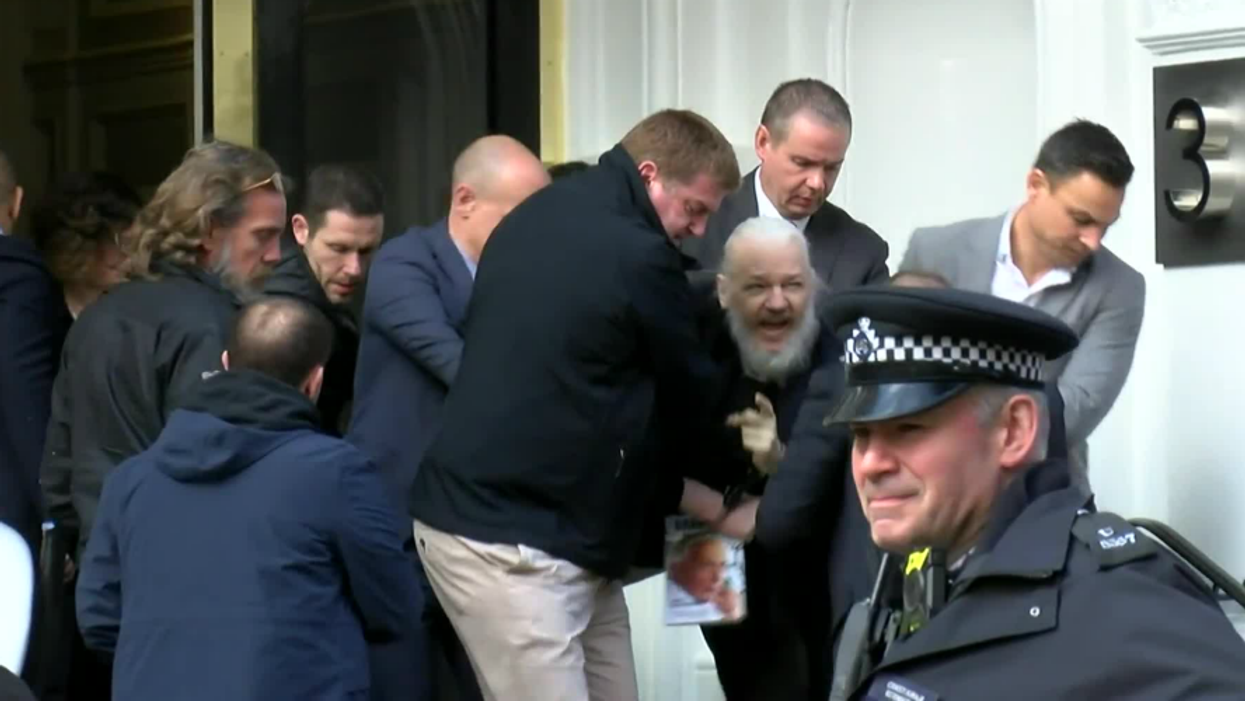
It has been over three weeks since Ecuador illegally terminated political asylum of WikiLeaks founder Julian Assange and the UK police violently arrested him. Assange is now held in solitary confinement in what many have called the UK's Guantanamo Bay.
On Thursday, Assange's fight against US extradition began at a UK court. The US charged him with conspiracy to commit computer intrusion with former US military intelligence analyst Chelsea Manning related to the 2010 release of classified material. His extradition was framed as a case about "hacking".
But, let's make this clear. Assange was charged for doing journalism, publishing information critical for democracy in the public interest, at a scale and speed that was unprecedented. Although the Department of Justice press release on the indictment accuses him of hacking a government computer, the actual indictment accuses him for protecting the anonymity of his source.
This indictment against Assange signals the criminalization of journalism, specifically punishing critical aspects of journalistic practice, related to a story gathering for a newsworthy story published in the public interest. The criminal investigation into WikiLeaks began in 2010. It was part of Obama's aggressive war on whistleblowers. Now, the Trump administration carries on this legacy, by expanding a combat zone to include journalists as their target. But this is more than an attack on press freedom.
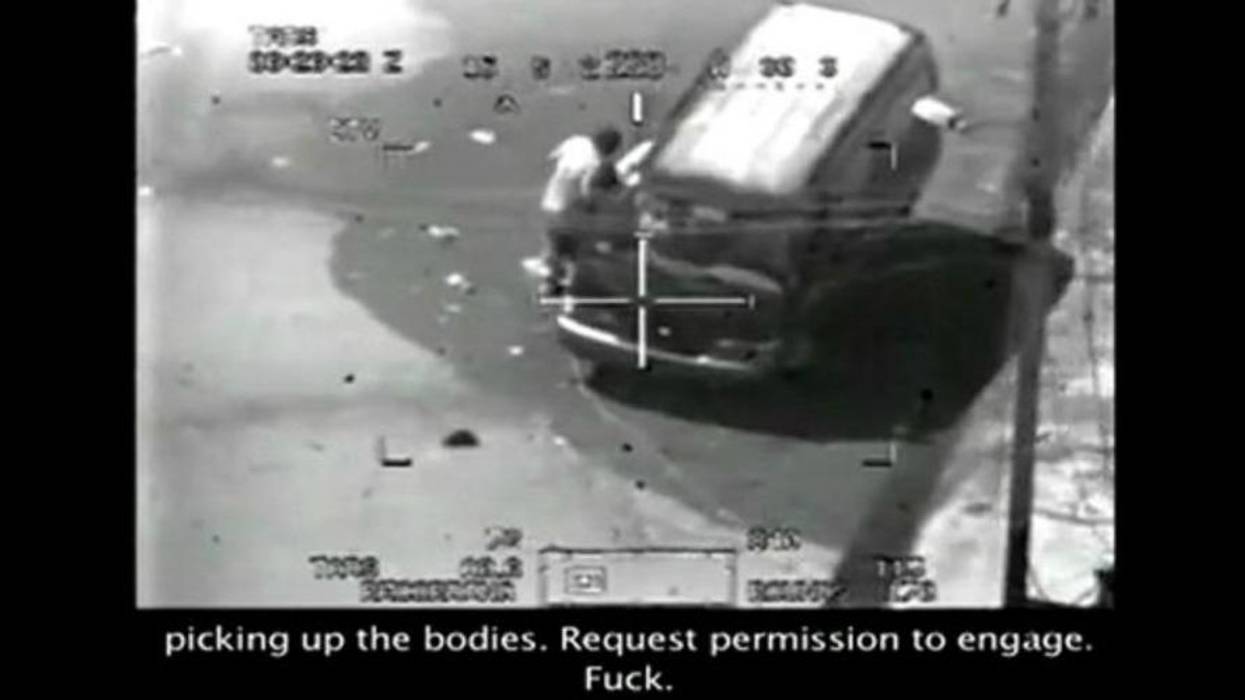
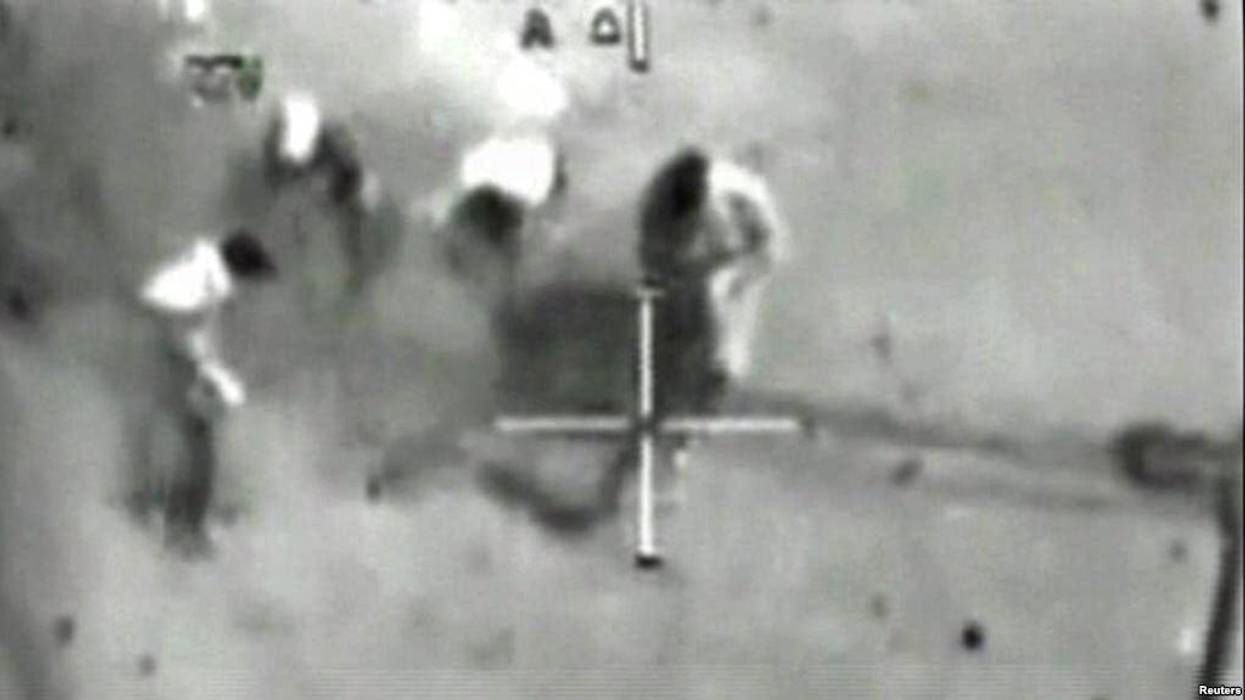
WikiLeaks exposed the US government's illegal wars, dirty trade deals, spying, and its secret offshore prison and torture. These documents that they published with a pristine record of accuracy, were not just information. It was her conscience that called Chelsea Manning to engage in a search for moral clarity, as she watched the scenery of a US military airstrike killing Iraqi civilians including journalists in New Baghdad. It was a tiny voice in a heart that remembered our inherent obligation to one another and awakened this young whistleblower to the truth described in her words, "we are human ... and we're killing ourselves ...".
This conscience that was brought forward by Manning and then amplified by WikiLeaks through their method of transparency shone the light into our history. The release of the collateral murder video didn't just expose Bush's war crimes. It revealed darkness inside this nation that goes all the way back to its very inception.
In the original 38-minute video footage that captured the everyday life of the brutal military occupation in the oil-rich Middle East, the colonization of the past was carried over. In the shadow of Iraqi civilians who are paralyzed under the US military gun sight, those who remain frozen in lost pages of history began to reveal themselves.
The cynical naming of the Apache helicopter evokes a memory of the killing of natives that took place long ago in the US. Through access to this forbidden view, made possible by WikiLeaks, we were given an opportunity to witness the historic crimes committed against the indigenous people of America.
In the uncensored images of modern war, what did we see? We saw our government violating the highest laws of the land. These were ideals that inspired America's independence from the British monarchy, expressed in the words of Thomas Jefferson, "all men are created equal".
America represented a new land for freedom-loving people around the world to come together in, to form a new union governed not by the King, but by a rule of law. Yet, despite these ideals, America was never a democracy. From the onset, it contained internal contradiction manifested in the genocide of natives, the slavery of blacks and the suppression of women. But the words in the Declaration of Independence were a promise and the Constitution was meant to be its fulfillment.
The conscience of ordinary people was a vital link that could fill the gap and create a democracy. Out of conscience springs the power of We the People that could truly perform checks and balances of our government. When the laws themselves become unjust, conscience reminds us of our duty to break these laws in order to uphold our ideals.
In our history, we have seen individuals who fought to keep those words of promise through their acts of civil disobedience. Dr. Martin Luther King, Jr, who demonstrated extraordinary courage for the struggle of Black people to fight against racist laws once said:
"Cowardice asks the question, 'Is it safe?' Expediency asks the question, 'Is it politic?' Vanity asks the question, 'Is it popular?' But, conscience asks the question, 'It it right?' And there comes a time when one must take a position that is neither safe, nor politic, nor popular, but one must take it because one's conscience tells one that it is right."
Decades after the civil rights movement, a young US soldier in her act of delivering information to WikiLeaks, risked her life to carry on this American tradition of civil disobedience. As a consequence, she was sentenced to 35 years in prison and served seven years until her sentence was commuted in 2017. Now, by refusing to testify against a publisher at a secret grand jury targeting WikiLeaks, she is once again sent back to jail.
After having witnessed Manning confessing her role as the WikiLeaks whistleblower at her court-martial, the late attorney Michael Ratner acknowledged how locking her up "for even a day is to lock up the conscience of our nation".
Julian Assange is a journalist, but foremost, he is a defender of this America's conscience. Now, the Department of Justice tries to punish him for his courageous act of providing protection to his source, by framing it as though he had conspired with his source to assist in espionage in order to hack into a Pentagon computer.
So, we are now clear what this US extradition case against Assange is all about. This prosecution of Assange and the detainment of Manning are assaults on our conscience. Vicious attacks came from both Republicans and Democrats. Rep. Peter King, a New York Republican, designated WikiLeaks as a terrorist organization. Former Vice President Joe Biden compared Assange to a "high-tech terrorist", while California senator Dianne Feinstein urged that Assange be prosecuted for espionage.
Corporate media engages non-stop in smearing, depicting this Nobel Peace Prize nominee as a rapist and Putin's intelligence asset. The former CIA chief and Trump's Secretary of State, Mike Pompeo called WikiLeaks a hostile intelligence service. Now, using the rhetorical descriptions of "traitor" and "threat to national security", the DOJ tries to extradite Assange and sentence him to life in prison or worse, to execute him.
But, who are the traitors? Who are those who engaged in conspiracy, working in secret to betray ideals promised in America's proclamation of independence to the world?
WikiLeaks' publication of documents concerning wars in Afghanistan and Iraq revealed the US government's conspiracy to perpetuate racism in a War on Terror, with Muslim as the new Black. WikiLeaks' release of the DNC and John Podesta emails pierced the veil of the illusion of an American democracy. It let us see that the Democratic establishment conspired against people, by secretly colluding to undermine Bernie Sanders during the primary and that the Hillary Clinton campaign strategy was to get friendly media to elevate "Pied Piper" GOP candidates like Donald Trump.
Their publication of Vault 7, the largest leak of confidential documents in CIA history revealed that the agency has developed cyber weapons that enable them to spy on us through smartphones and smart TVs. It exposed the intelligence community as a true ruling elite of our society, growing its power with surveillance, military occupation, and financial terrorism.
The US government, with the UK, Sweden and Spain as its allies, bullied a small South American nation to hand over Assange, who exposed the national security state and their conspiracy against people.
There is the other America we have forgotten, the America that has been here from the very beginning, before Columbus discovered this land. It is the heart of the earth that stretches its veins across four corners, sustaining the life of all living beings. This is the true America before it was assaulted by guns and canons and before it was occupied by the few.
By forgetting our own collateral murder, massacre, theft, treaty violations, and cultural genocide that happened on this soil, we have forgotten who we are. As our memory fragmented, We the People became a narrow tribe of Democrats and Republicans. By plunging into national and ideological battle, we wave flags to justify the killing of our brothers and sisters in the name of national security and together we engage in our self righteous destruction of this planet that we all inherit.
Chelsea Manning and Julian Assange reminded us of the highest law of the land inscribed in our hearts. They are real patriots who fought to secure Life, Liberty and the Pursuit of Happiness. With their love for humanity, they sacrificed their personal liberty so that these unalienable rights can be enjoyed by everyone around the world.
Now the beast of secret law tries to devour them. The conscience has no chance for a fair trial in the empire's justice system. It is defenseless before the Espionage Act. For this vulnerable love of humanity, the public is the only line of defense.
Assange's fight against extradition has just begun. He is fighting for his life, but also he is fighting for all of us. We now must join this battle to defend and free the conscience of America that has become imprisoned in this war on truth. We must become a shield for whistleblowers and publishers. Only through us forming a court of public opinion, can we end this empire and its conspiracy and redeem the torch of liberty that this nation once held as a beacon of light for the world.
The United States Justice Department dramatically escalated its political prosecution of WikiLeaks editor-in-chief Julian Assange. Their efforts are aimed at criminalizing a journalist--and more broadly, a media organization--for allegedly aiding and abetting the disclosure of classified information and publishing that information on the internet.
Assange was expelled from the Ecuador embassy in the United Kingdom and arrested by British police on April 11. The expulsion and arrest was linked to an indictment and extradition request that was filed many months ago by the United States government.
He was granted political asylum by Ecuador in 2012. His asylum was terminated, and the Ecuador government allowed the British police to enter the embassy to apprehend Assange and load him into a police van.
When Assange was hauled out of the embassy, video captured him urging the UK to resist and fight President Donald Trump's administration.
The Justice Department's grand jury investigation into WikiLeaks charged Assange with "conspiracy to commit computer intrusion." It falls under the Computer Fraud and Abuse Act (CFAA) and a general part of the criminal code that can be used against individuals who conspire to defraud the United States.
While on the surface it appears the Justice Department attempted to circumvent many of the First Amendment issues, which discouraged President Barack Obama's administration from moving forward with an indictment of Assange, the language in the indictment--dated March 6, 2018--is very similar to what prosecutors typically include in indictments against individuals charged with violating the Espionage Act.
The indictment criminalizes Assange as an "aider" and "abettor" of "espionage" for publishing unauthorized disclosures of classified information on the WikiLeaks website.
"The WikiLeaks website publicly solicited submissions of classified, censored, and other restricted information," the indictment states. "Assange, who did not possess a security clearance or need to know, was not authorized to receive classified information of the United States."
Reporters or editors for media organizations publish stories based upon on leaks of classified information all the time and typically do not have security clearances.
If a precedent were set where journalists had to possess a security clearance, it would create a threat for any reporter relying upon such information to expose abuses of power or corruption committed by the U.S. government, including but not limited to security agencies.
If a precedent were set where journalists had to possess a security clearance, it would create a threat for any reporter relying upon such information to expose abuses of power or corruption committed by the U.S. government, including but not limited to security agencies.
More significantly, Assange holds citizenship in Australia and was also granted citizenship by Ecuador a little over one year ago. Invoking secrecy regulations in the U.S. as part of an indictment against someone who is not an American citizen carries implications for world press freedom.
When referring to an alleged "password-cracking agreement" between Assange and Manning, the indictment contends, "Assange knew that Manning was providing WikiLeaks with classified records containing national defense information of the United States. Assange was knowingly receiving such classified records from Manning for the purpose of disclosing them on the WikiLeaks website."
Here is the part of the Espionage Act that Manning was charged with violating:
(e) Whoever having unauthorized possession of, access to, or control over any document, writing, code book, signal book, sketch, photograph, photographic negative, blueprint, plan, map, model, instrument, appliance, or note relating to the national defense, or information relating to the national defense which information the possessor has reason to believe could be used to the injury of the United States or to the advantage of any foreign nation, willfully communicates, delivers, transmits or causes to be communicated, delivered, or transmitted, or attempts to communicate, deliver, transmit or cause to be communicated, delivered, or transmitted the same to any person not entitled to receive it, or willfully retains the same and fails to deliver it to the officer or employee of the United States entitled to receive it; or [emphasis added]
Part of the alleged computer crime contains language alleging Assange violated the CFAA. Yet, the Justice Department mostly shoehorns language from the Espionage Act into the alleged computer violation:
(a) to knowingly access a computer, without authorization and exceeding authorized access, to obtain information that has been determined by the United States government pursuant to an executive order and statute to require protection against unauthorized disclosure for reasons of national defense and foreign relations, namely, documents relating to the national defense classified up to the "secret" level, with reason to believe that such information so obtained could be used to the injury of the United States and the advantage of any foreign nation, and to willfully communicate, deliver, transmit, and cause to be communicated, delivered, or transmitted, to any person not entitled to receive it, and willfully retain the same and fail to deliver it to the officer or employee entitled to receive it. [emphasis added]
To the Justice Department, part of the conspiracy involves publishing information that could "damage" the United States. They believe when Assange received the information he should have destroyed the documents or tried to "return" them to the U.S. government. It is but another alarming aspect of this indictment
"It was part of the conspiracy that Assange encouraged Manning to provide information and records from departments and agencies of the United States," according to the indictment. "It was part of the conspiracy that Assange and Manning used a special folder on a cloud drop box of WikiLeaks to transmit classified records containing information related to the national defense of the United States."
In this section, prosecutors further allege Assange "aided" and "abetted" "espionage" as a co-conspirator by specifically criminalizing the act of using a drop box.
Several journalists and media organizations use drop boxes to accept documents from sources. One well-known setup is called SecureDrop. It would appear the Justice Department would like to establish a precedent that discourages media organizations from using this practice when engaging in journalism.
The second part of the alleged computer crime explicitly notes the indictment is pulling from two sections of the Espionage Act--793(c) and 793(e)--even though Assange was not charged with violating the Espionage Act.
Additionally, there is the timeline of events that appears in the indictment. On March 8, 2010, prosecutors allege Assange "agreed" to assist in cracking a password so she could anonymously access Defense Department computer connected to the Secret Internet Protocol Network that held the documents.
Manning had a security clearance because she was an all-source military intelligence analyst in Baghdad. She did not need Assange to help her obtain access. What the prosecutors are claiming is her interest in shielding her identity, and the fact that Assange allegedly was willing to help her protect her identity, opened him up to a charge of conspiracy.
The indictment highlights chats that allegedly occurred between Assange and Manning over the Jabber online chat service. What the indictment does not state is that the account Manning corresponded with was "Nathaniel Frank." The U.S. government believes Assange used this account, but they will have to prove it in order to mount a successful prosecution.
During Manning's Article 32 hearing in December 2011, before her case proceeded to a court-martial, military prosecutors presented evidence they said would show Assange "attempted to devise a way to browse SIPRnet anonymously."
Journalist Alexa O'Brien transcribed much of the proceedings. From her "unofficial" transcript, this is when a military prosecutor described the alleged "password-cracking agreement":
On the screen your Honor is an excerpt of a chat log--again these are the chat logs recovered from PFC Manning's personal computer--and the evidence will show Pfc. Manning asked, 'Any good at LM hash cracking?' LM, the evidence will show, stands for Land Management.
Pressassociation responds, 'We have rainbow tables for LM.' Your Honor the evidence will show that an LM hash is essentially the way that a Windows computer stores passwords on that computer.
***
All of this supposed evidence was available to President Barack Obama's Justice Department. It begs the question: why didn't the Obama Justice Department indict Assange?
The answer may involve the fact that the government still did not have enough evidence beyond a chat log to substantiate the existence of an "agreement" to crack a password. After all, Manning is in jail because she refused to testify before the grand jury and was held in civil contempt. Prosecutors may feel they need her testimony on the "password-cracking agreement."
Or it may be that the Obama Justice Department thought even this charge would raise issues of press freedom that were intertwined with protections, which individuals are supposed to enjoy under the First Amendment. It still targets aspects of the news gathering process itself despite the fact that the Justice Department can claim they are specifically going after a supposed agreement to crack a password.
Regardless, what unfolded is exactly what Center for Constitutional Rights director Michael Ratner, attorneys for WikiLeaks, press freedom advocates, and a small group of mostly dissident journalists and activists warned would happen to Assange. It is why he was granted political asylum. Yet, they were universally treated as delusional for promoting the conspiracy that the U.S. and U.K governments would work together to use a sexual assault allegation in Sweden as a pretext to extradite Assange to the U.S. to prosecute him for publishing documents.
It was evident for well over a month that Assange's arrest could happen very soon, especially when Manning chose to publicly fight her subpoena. The editorial boards of major news organizations, such as the New York Times and Washington Post, sat in silence. They were apparently too concerned anything they said might affect their access to the halls of power. They have never really considered Assange to be a journalist, and believe Manning is a national security leaker, who deserved to be punished.
Now, there are many more details that are known. The "Which side are you on?" moment has come. The world will see who stands up for freedom of the press and who stands with President Donald Trump's administration in their dangerous assertion of U.S. power.
The former US Army intelligence analyst Chelsea Manning was sent to jail Friday for refusing to answer questions relating to WikiLeaks 2010 disclosures at a grand jury in the Eastern District of Virginia. She has been remanded into federal custody and is made to remain confined until she testifies or until the end of the life of the grand jury.
Manning, 31 was convicted in 2013 of releasing the largest trove of state secrets in US history, revealing Bush era's war crimes. She served seven years of a 35-year sentence until President Barack Obama commuted her sentence just before leaving his office in 2017.
On March 5, Manning, a network security expert, appeared in Alexandria federal court to fight the subpoena requiring her to testify before a federal grand jury. Outside the courthouse after an hour-long closed-door hearing where the judge rejected her motion to quash the subpoena, she spoke to activists and reporters stating her principle opposition to the grand jury system was that it is shrouded in secrecy.
Manning's subpoena came about three months after prosecutors, from a copy and paste error, revealed the US government's sealed indictment against WikiLeaks founder Julian Assange. The secret criminal charges, whose existence was made known inadvertently in November last year, have been originally filled in the US District Court in Alexandria, Virginia. In January this year, a U.S. federal judge ruled against the petition filed by the Reporters' Committee for Freedom of the Press that demands the government to unseal that criminal complaint.
Assange attained political asylum in the Ecuadorian Embassy in London in 2012 to mitigate the risk of extradition to the US, relating to his publishing activities with WikiLeaks. He remains being arbitrarily detained by the UK government in violation of two UN rulings, denied access to medical treatment, fresh air, sunlight and adequate space to exercise.
Manning's fight against this grand jury subpoena further brings out the US government's assault on the free press. Now, whistleblowers are forced to testify against journalists at a secret trial, and those who refuse to cooperate will be sent to jail.
Given the secrecy of federal grand jury procedures, parameters of questions that prosecutors intend to ask the WikiLeaks source is not entirely clear. Manning, after her appearance in the court Tuesday, noted the presence of many government attorneys in the room. The case appears to be part of the Trump administration's efforts to prosecute Assange.
A Grand Jury investigation of WikiLeaks has been active since late 2010, when US Attorney General, Eric Holder at a news conference publicly confirmed it. Since then, this criminal investigation into WikiLeaks and Assange has been ongoing. The late Michael Ratner, attorney and president emeritus of the Center for Constitutional Rights who attended Manning's pretrial hearing in 2013 spoke about the significance of her testimony in putting "WikiLeaks and Julian Assange in the same place that The New York Times would be or The Guardian." He noted there were two of the prosecuting attorneys for the grand jury during Manning's court-martial.
The Washington Post recently confirmed through information obtained by U.S. officials, speaking on condition of anonymity that the case of this grand jury is based on the Manning disclosures era, that is to say not based on material relating to the 2016 Presidential election, and it has nothing to with U.S. Special Counsel Robert Mueller's Trump-Russia investigation.
The New York Times that first broke the story of Manning vowing to refuse to give testimony at the grand jury reported that the former US soldier wondered if prosecutors now wanted to try to get her to back away from the account she made during her court-martial.
In a statement she released a day before her contempt hearing for refusing to testify in front of a grand jury, Manning expressed her determination for a continuous fight against this government repression:
"Yesterday, I appeared before a secret grand jury after being given immunity for my testimony. All of the substantive questions pertained to my disclosures of information to the public in 2010--answers I provided in extensive testimony during my court-martial in 2013. I responded to each question with the following statement: I object to the question and refuse to answer on the grounds that the question is in violation of my First, Fourth, and Six Amendment, and other statutory rights."
She then noted she would stand by her principles and is prepared to face imprisonment as consequences of her refusing to testify before the secret grand jury.
During her court-martial, Manning stated her decisions to send classified government documents to the whistleblowing website was motivated by her conscience. She made it clear that it was her sense of moral duty to inform the American public, that made her release documents about US wars in Iraq, Afghanistan, and torture in Guantanamo, along with US diplomatic cables that sparked a global crisis of legitimacy. In her testimony, she said no one pressured her to do what she has done and that she takes full responsibility for her actions.
Manning's testimony highlighted WikiLeaks' extraordinary source protection that is unprecedented in a history of modern journalism. With its innovative technical infrastructure, WikiLeaks built a system that enables the anonymity of sources, where Assange or any other staff would never be able to know their identities in the first place. Along with its pristine record for accuracy, the organization has never failed to protect the identity of its sources.
The identity of Manning as a source behind WikiLeaks' published documents only became public, due to her failure to follow the whistleblowing site's security instructions. Manning spoke to a computer hacker she met online, who turned her into law enforcement and the Wired Magazine published the chat logs.
For this young American whistleblower who was deeply disturbed by "blood lust" displayed by the US military in the video footage from a US Apache helicopter in 2007, WikiLeaks was the publisher of her last resort. Manning first approached The Washington Post and The New York Times with documents that would reveal the true cost of the wars in Iraq and Afghanistan. After she was not taken seriously by these news organizations, she went to WikiLeaks.
When other media outlets turned away from critical material that provided evidence of the US government's war crimes, killing by the US of Iraq civilians including two Reuters journalists, and their subsequent cover-ups, WikiLeaks, through their publication, courageously defended the public's right to know.
As a consequence of exposing unaccounted power, the organization has met political retaliation under the Obama administration. Assange has become a political prisoner, been gagged and isolated by the President of Ecuador, Lenin Moreno who bowed down to demands of Washington in exchange for an International Monetary Fund bailout. Now he is hunted down by Trump's cabinet that is eager to extradite him to the US.
Prosecuting a non-American journalist who published information in the public interest outside of the US, working with other media organizations, possibly under the Espionage Act would set a perilous precedent for press freedom around the world. Now, the Department of Justice forcing an alleged source to testify against the journalist for publishing government's wrongdoing is hugely alarming.
Recognizing its threat on democracy, leading human rights organizations and civil liberty groups have denounced the US government's unprecedented prosecution of WikiLeaks founder. The United Nations, Human Rights Watch, Amnesty International and the ACLU, all opposed Assange's extradition. Recently, the city of Geneva passed a resolution that proposes to grant this award-winning journalist and the 2019 Nobel Peace Prize nominee an asylum. In the UK and other European states, this year alone 36 MEPs and MPs demanded UN Secretary-General Antonio Guterres and UK Prime Minister Theresa May to end his arbitrary detention.
After she was sentenced to 35 years in prison by a military court, Manning said in her statement, "Sometimes you have to pay a heavy price to live in a free society." Manning risked her life to bring back information that belongs to the public. By refusing to give testimony at a secret grand jury, she now once again sacrificed her liberty and defended the public's right to know. She launched a campaign to raise funds for her legal defense. After being taken into custody, she stated that she would continue to fight against a secret court that is used to "entrap and prosecute activists for protected political speech."
This courage that is now brought back to the court reminds us of a battle that we are all engaged in. The fight for free speech began with this person of incredible conscience. It all started with a tiny voice inside individuals that call them to act in search of moral clarity. Inspired by the source who takes enormous risk to bring social change, WikiLeaks entered into the frontline of this battle, providing a shield for this conscience and letting its voice speak loud and clear.
Now, the force that destroys our fundamental democratic rights is no longer secret. The government's assault on press freedom is an attempt to squash the conscience of ordinary people that want to be free. We must stand with Chelsea Manning to resist this secret grand jury. Only through informed citizens around the world standing up for justice in a court of public opinion, can we end this government's relentless prosecution of free speech. We must fight and continue to shine the light on government secrecy, for democracy dies in darkness.
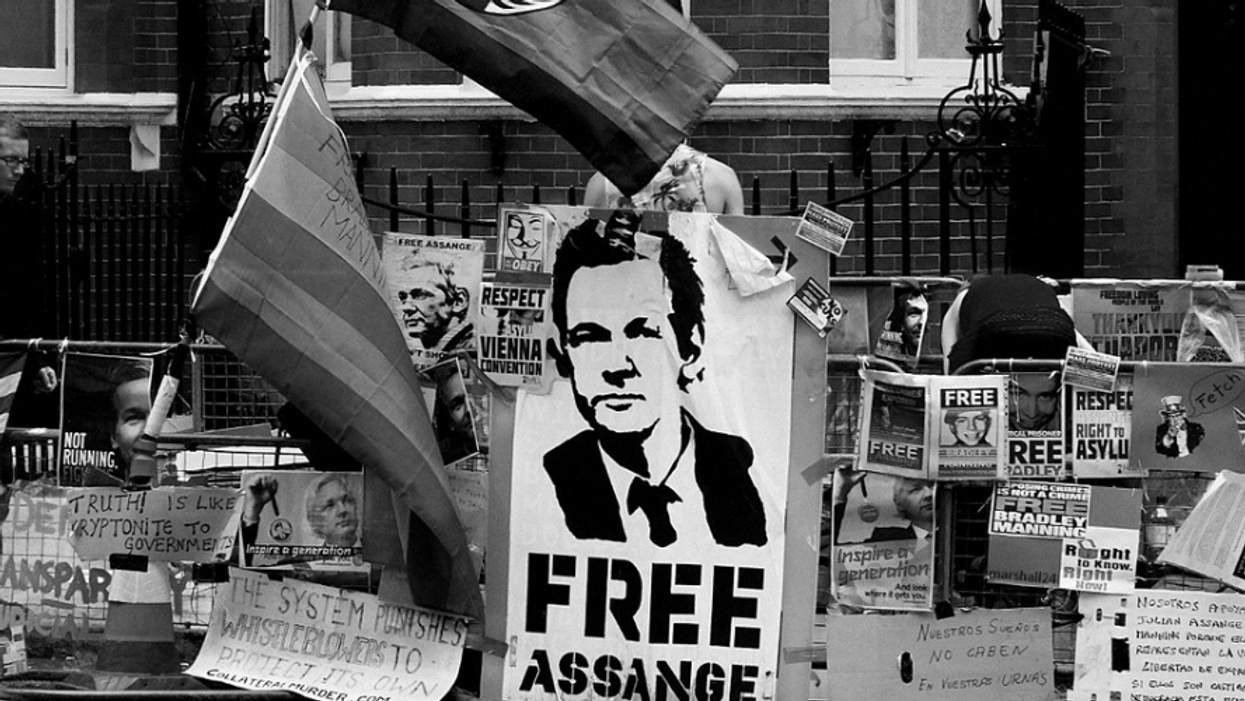
WikiLeaks founder Julian Assange remains arbitrarily detained in the Ecuadorian embassy in London. As he is in a critical situation under a special protocol imposing prison-like surveillance, news emerged that shed light on the grave danger he has been facing. Last week, the Washington Post reported that the US Justice Department, in what appeared to be an error of cut and paste in their court filing, inadvertently disclosed criminal charges against Assange exist under seal.
Assange's lawyer Jennifer Robinson responded to the revelation of a secret US government's prosecution against the publisher, by noting that it confirms what Assange and his legal team have been suspecting. She pointed out how a criminal investigation into WikiLeaks started in 2010 in relation to disclosures made by WikiLeaks in partnership with other major newspapers revealing the evidence of US war crimes. She made it clear that this risk of his extradition to the US has been the reason why Assange sought and was granted asylum by Ecuador in 2012.
This public confirmation of a US indictment sent a huge alarm to civil liberty groups in the US. The ACLU issued a statement, noting how this sealed indictment violates the Constitution and prosecuting journalists for publishing classified documents would set a dangerous precedent for press freedom. Now that this sealed indictment is out in the open, validating Assange's fear of leaving the embassy, the public is given an opportunity to see the true nature of his plight for freedom. What is now being revealed is the war on the First Amendment waged by the US government, targeting the Western journalist who has published materials in the public interest at a scale that has never been seen before.
The war on the First Amendment
The spark for this war was quietly lit in 2008 with US intelligence's plan to destroy WikiLeaks, viewing the website as an information security threat to the US army. It got inflamed in 2010 shortly after the whistleblowing site published the trove of US classified military records of the Afghan war, revealing around 20,000 deaths by assassination, massacre and night raids, and the Iraq War Logs, that informed people in Iraq and the international community about 15,000 civilian casualties previously unreported.
As the White House downplayed the significance of these disclosures, US Joint Chiefs of Staff Mike Mullen called WikiLeaks publications "reckless" and "irresponsible". While there is not a single shred of evidence that any of these disclosures caused anyone harm, the Pentagon deflected its own crimes and aggressively tried to attack the messenger with a bombastic line of "they have blood on their hands".
Assange as a spokesperson of this new multi-national media organization came under attack with an intense campaign of character assassination. The preliminary investigation of his alleged sexual misconduct involving two women in Sweden who explicitly denied the accusation of rape was turned into a full blown legal battle trapping him in London where the local press criminalized him as a rapist.
Right after WikiLeaks' publication of the US diplomatic cables, the vilification of Assange intensified by high profile US political figures. The former Vice President Joe Biden branded Assange as a high-tech terrorist, while a former Republican Speaker of the House, Newt Gingrich calling him an "enemy combatant", who deserves to be executed.
WikiLeaks also has faced massive coordinated political retaliation. On November 29, 2010, the US Attorney General publicly confirmed the existence of a secret grand jury investigation into disclosures of classified information made by WikiLeaks. In December 2010, Amazon removed WikiLeaks from their server after being pressured by US officials. Then, signaled by the US State Department, private paying processing companies such as VISA, MasterCard, PayPal, Bank of America and Western Union engaged in extrajudicial financial blockade against WikiLeaks, reportedly destroying over 95 % of their revenue. Meanwhile, WikiLeaks associates were repeatedly harassed at borders.
Whistleblowers as casualty of war
This attack on WikiLeaks is an escalation of Obama's war on whistleblowers. Before Snowden's revelations, former National Security Agency analysts, Thomas Drake, William Binney, J. Kirk Wiebe and Edward Loomis were alarmed by widespread government surveillance and decided to speak out.
Thomas Drake, former NSA senior executive who blew the whistle on secret mass surveillance programs, spoke about how he came to witness his own government actively violating the privacy and freedom of its citizens in the name of national security and decided not to remain silent. He said, "I took an oath to defend the constitution. Here I am finding myself defending the constitution against my own government, a government that I did not recognise, an alien form of government. I had to stand up to it."
Drake, who faced 35 years in prison before the government charges against him were unexpectedly dropped, also alerted the public about the government's war on whistleblowers:
"We are seeing an unprecedented campaign against whistleblowers and truthtellers: it's now criminal to expose the crimes of the state. Under this relentless assault by the Obama administration, I am the only person who has held them off and preserved his freedom. All the other whistleblowers I know have served time in jail, are facing jail or are already incarcerated or in prison."
John Kiriakou became the first CIA officer to confirm the use of torture and to face jail time for challenging the legality of the US torture program. Before going to jail, he spoke of his decision:
"I took my oath seriously. My oath was to the Constitution. On my first day in the CIA, I put my right hand up, and I swore to uphold the Constitution. And to me, torture is unconstitutional, and it's something that we should not be in the business of doing ... If you see waste, fraud, abuse or illegality, shout it from the rooftops, whether it's internally or to Congress."
While Obama was relentlessly prosecuted whistleblowers more than all other previous administrations combined, corporate media effectively kept the battlefield out of public sight. These whistleblowers who fought to hold the ground for truth became an invisible casualty of this war on the First Amendment, who were made to quietly endure suffering.
Frontline of the battle
As the unchecked power of the national security state grew, expanding its territory in cyberspace with increasing surveillance and censorship, a new stream of dissidents emerged on the Internet. WikiLeaks courageously entered into a frontline of the battle in defense of the First Amendment. With unprecedented technical infrastructure that enables anonymous submission of documents, it provided an avenue for a new generation of whistleblowers to exercise free speech that has been stifled in traditional channels.
The former US Army intelligence analyst Chelsea Manning, the source behind WikiLeaks major publications including the raw footage of a US airstrike killing innocent civilians in Iraq, first reached out to the established media outlets such as the New York Times and the Washington Post, but was not taken seriously by editors. When the mainstream press turned away, she chose to put her trust in the non-profit media organization that was little known at that time.
Manning's act of courage became contagious, creating a wave of whistleblowers. By following the step of his forerunner, political activist Jeremy Hammond exposed the inner workings of the pervasive surveillance state. At the sentencing hearing, he explained how he perfectly understood the consequences of his action and that it was against the law, yet he felt a duty to confront injustice. Then came Edward Snowden who revealed the NSA mass surveillance. In one of the addresses he made, Snowden also described his act as a public service and connected it with non-violent civil disobedience that Dr. King, a leader of civil rights movement employed to challenge the racist laws
As disclosures of government corruption began to challenge the legitimacy of authorities, the war on whistleblowers has escalated to a new level. Recent public confirmation of the US government's secret charges on Assange has shown the empire's expansion of a combat zone, to include journalists and publishers as its target. Although there is no clarity as to what charges are filed against Assange, the data that Google handed over to the US government in order to assist the prosecution of WikiLeaks' staff indicated that alleged offenses include espionage.
The Espionage Act of 1917 is a US federal law, created after World War I for wartime prosecutions. This outdated law does not allow a public interest defense and prevents whistleblowers from having their motivations considered in court, making it impossible for them to defend their acts and receive a fair trial. Manning was convicted and Snowden charged under the Espionage Act by President Obama.
Now this law that was used to imprison whistleblowers is weaponized to punish those who report on government crimes. Commenting on imminent withdrawal of asylum for Assange by the Moreno government and his risk of prosecution in the US, Glenn Greenwald, journalist at The Intercept noted how Obama's Justice Department was eager to prosecute Assange and WikiLeaks for the crime of publishing classified documents, but chose not to do so, due to concerns that it would set a precedent which could strip away the First Amendment protection for the press. Yet he contended that the Trump administration made it clear that they have no such reservation.
Tradition of civil disobedience
The possibility of the US government charging Assange who is not American, and didn't publish in the US under its laws, probably for 'espionage' is extremely alarming. What is this crime of 'aiding the enemy' that the US government is eager to convict this transnational journalistic organization for? WikiLeaks, the organization that claimed to derive its source of inspiration from American founding ideas, with cryptography as a non-violent democratic weapon, helped American people to engage in the tradition of civil disobedience. By doing so, Assange, an Australian citizen, enabled the vital function of American democracy.
The idea of civil disobedience was presented by American philosopher Henry David Thoreau, as a critical component of checks and balances of governmental power. Thoreau, who believed that "government is best which governs least" (1957, p. 235), put forward the idea of civil disobedience, reminding the moral responsibility of ordinary people to defy the illegitimate authority of the state and restrict its power.
Thoreau engaged in the act of civil disobedience, to oppose slavery and went to a prison for refusing to pay a poll tax that supported the US war against Mexico. For him, the method of civil disobedience offered a way for people to create laws that reflect the true values of society and improve democracy that was inherited from the forebears.
He posed the questions:
"Is a democracy, such is we know it, the last improvement possible in government? Is it not possible to take a step further towards recognizing and organizing the rights of man? There will never be a really free and enlightened State until the State comes to recognize the individual as a higher and independent power, from which all its own power and authority are derived, and treats him accordingly." (1957, p. 256)
This father of civil disobedience asked, "... Must the citizen ever for a moment, or in the least degree, resign his conscience to the legislator? Why has every man a conscience, then?" (p. 236). He aimed to institute a new form of government that places conscience as the highest law, allowing each individual to freely explore what is right in their hearts with obligation to act out of their own knowing. He noted, "Unjust laws exist: Shall we be content to obey them, or shall we endeavor to amend them, and obey them until we have succeeded, or shall we transgress them at once?" (p. 242). Through his own act of civil disobedience, he has shown how only by each person's adamant refusal to obey the dictates of unjust laws can we bring real accountability of the government and enshrine ideals into laws.
Conscience of America
Contrary to the ideals of equality and liberty at its foundation, from the onset of the US constitutional republic, unaccounted power has always existed, manifested in the founders' internal contradiction over slavery, genocide of natives and oppression of minority rights. The Declaration of Independence was said to be the promise and the Constitution was its fulfillment. What bridges between the ideals in the original document and laws were ordinary people who are capable of developing their own moral conscience and bearing true faith and allegiance to it.
As WikiLeaks pushed the boundaries of free speech, the world has seen the rise of the power of ordinary people. The late attorney and President Emeritus of the Center for Constitutional Rights, Michael Ratner, who witnessed Manning read her prepared statement at the military court facility in Fort Meade, Maryland, recognized her as the conscience of America.
Through its scientific journalism, publishing primary source material in its full archives, WikiLeaks gave this conscience of America the maximum political impact for it to inform the public, in order to redeem the nation that has lost its own course. In this war of a tyrannical state on the First Amendment, Assange became a lightning rod to take all the heat, so ordinary people can uphold these ideals that are inscribed in their hearts, defending them against all enemies, foreign and domestic.
As the invisible beast inside the US government devours the hearts of these brave young patriots, WikiLeaks acted as a shield. This was demonstrated in their extraordinary source protection. After Snowden identified himself as the source behind the NSA files, aggressive prosecution quickly rolled out from Washington. As Snowden was stranded in Hong Kong, it was then the investigations editor at WikiLeaks and journalist Sarah Harrison who risked her life to secure his asylum.
Call for duty
Just as the Founding Fathers of the United States, by revolting against the autocratic rule of King George were regarded as traitors, by aiding ordinary people expose and defy unjust secret law, WikiLeaks too has been branded as an enemy of the state. Trump's Secretary of State and the former CIA director, Mike Pompeo calls WikiLeaks a non-state hostile intelligence agency, claiming that the organization threatens American values and needs to be shut down. Members of the US Congress urged the Ecuadorian President to persecute Assange, calling him a "dangerous criminal" and a "threat to global security". While all these vicious verbal attacks are thrown at him, Assange remains in confinement, over the past months, being completely shut out from the outside, being continually deprived of fresh air, access to medical care and sunlight by the UK government in violation of UN rulings.
All wars start and are fueled by lies and propaganda. Once it was the Vietnam War, where under the command of the US President Lyndon B. Johnson, the Gulf of Tonkin lies unleashed military forces into Southeast Asia. Then came the invasion of Iraq with the former Secretary of State Colin Powell's speech at the UN, falsely claiming Iraq had 'Weapons of Mass Destruction'. This battle against free speech is another secret war of this empire. It now has become a fog of war, where with the hype of Russia Gate that was created out of thin air, the public was prevented from seeing who the real enemies are.
As Trump's administration now carries on Obama's legacy, vowing to destroy WikiLeaks for engaging in publishing activities that are protected under the First Amendment, American people are slowly coming to see their own government's dirty war that has been waged in their name.
By trying to prosecute Julian Assange, America is betraying its own ideals. As this government that proclaims to be the greatest nation on the earth now heads toward its own destruction, each of us are called to respond to the duty of civil disobedience. Can we the people break silence to end this war and defend those who fought for the ideals that founded this nation? Solidarity across political lines can create the greatest anti-war movement that this country has ever seen. Outcome of this battle matters not only for the freedom of Assange, but for the liberation of America and realization of its own ideals that this country once stood for the world.
The United States is in a major upheaval. Trump's cabinet shake up moves the country into an alarming direction. From the nomination of torturer Gina Haspel as a head of the Central Intelligence Agency to Mike Pompeo, the former CIA Director and a vocal opponent of nuclear deal with Iran as a new secretary of state, his selection exposes the White House's dangerous kill instincts.
An ultimatum came with the president's appointment of John Bolton, the former American ambassador to the United Nations as his 3rd national security advisor. Bolton who served in the George W. Bush administration is notorious for his hawkishness, with a great zeal for military action against Iran and North Korea. This rearranging of the deck chairs on the sinking empire signals the great calamity of foreign policy ahead with potential threats of nuclear war.
In this seeming free-fall toward despotism, what can ordinary people do about it? Tackling corruption of our political system and averting a doomed future requires us to truly understand the problems we are facing. The crisis of representation is now amplified with increasing trends toward authoritarianism, violence and white supremacy. This trouble didn't just arise with Trump, the new commander in chief. A glimpse of it was shown during the 2008 financial meltdown, which was covered up swiftly by bank bailouts and politics of 'hope and change'. The truth is that the seed for dystopia has been inside this country all along. The roots of the issues that are now emerging in Trump's America go back to the very beginning of this nation.
In its modern formation, the United States inspired the world with its torch of liberty and equality. At the same time, this beacon of light had its own darkness within. From the onset, America contained internal contradictions manifested as the founder's hypocrisy and the violation of its own ideals with genocide of natives, slavery of blacks and suppression of women. The Founding Fathers of the United States brought a victory of rejecting the power of the King's monarchy and pioneered a path for one's own self-determination. The concept of a nation governed by laws, not by a man was groundbreaking at that time. Yet, without reconciling its own shadow, this nation of law failed to fully shield the republic from the tyranny of the Old World.
Supremacy of reason
The unredeemed darkness found in America's troubled past was a force inside Western civilization that tries to define history, subjugating other perspectives to its single vision. Author and essayist John Ralston Saul (1992) in Voltaire's Bastards: The Dictatorship of Reason in the West described how:
"reason began, abruptly, to separate itself from and to outdistance the other more or less recognized human characteristics-- spirit, appetite, faith and emotion, but also intuition, will and, most important, experience." (p. 15)
Europe, with its ethos of separation and objectivity set out to conquer the world, spreading its influence across many continents. This domineering power of reason found its new front of exploration in the New World. America, driven by the monotheistic goal of Manifest Destiny expanded its territory with brutality. It swallowed what is edible, assimilating immigrants one by one to its conception of what is civil, while spitting out those that it considered impalatable, relegating them into three-fifths of a person or exterminating them from the earth altogether as savages.
This maddened head centricity was manifested in the structure of a new government. Sheldon Wolin, author of Democracy Inc noted how the framers of the Constitution created a so-called managed democracy, a system that favored elite rule and that "the American political system was not born a democracy, but born with a bias against democracy" (2008, p. 228). The intellectual elites regarded the democratic majority rule as an irrational force and they feared the tyranny of popular majorities. While the faculty of reason positioned itself as a supreme force, enslaving all other human characteristics, a potential to account its autocratic power was found inside America.
Civil disobedience of We the People
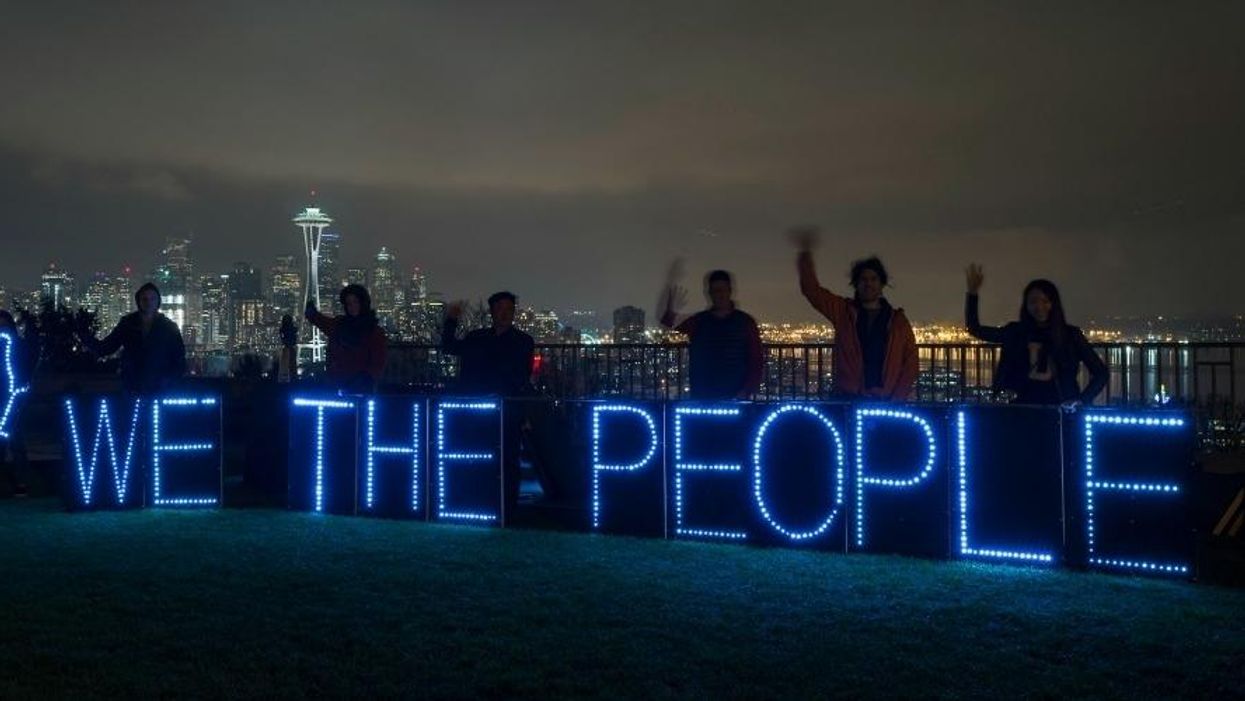
Expressed in the preamble of the Constitution "We the People" was faith in the wisdom of ordinary people to govern themselves. This was an intention to shift from the model of government that acts as authority of their lives to one that places power in the hands of ordinary people. In this government established under the rule of the people, the source of legitimacy was not derived from a God or King, but was meant to come from people themselves.
This arrangement of governance was not granted from above. It was first demanded by those who opposed the ratification of the 1787 Constitution that lacked the guarantee of individual liberties. A loose coalition of several states who saw inadequate separation of power in the proposed structure of checks and balances contended to restrict governmental power, in order to safeguard the rights of individuals. The proponents of the Bill of Rights articulated essential parts of the sovereign power of We the People as a freedom of expression; freedom of speech, religion, assembly and the right to petition the government for a redress of grievances.
By building upon First Amendment rights, further efforts emerged from below. From abolitionists' defiance to the women's suffrage movement, people's determination for individual autonomy persisted. On December 1, 1955, history saw another strong will for self-determination. During the usual evening rush hour in Montgomery, Alabama, 42 year old Rosa Parks took courageous action that changed the entire landscape of this nation.
Her lifelong rebelliousness came to momentum on that day when she refused to give up her seat. Young Rosa once said to her grandmother, "I would rather be lynched than live to be mistreated than not be allowed to say 'I don't like it.'" This refusal to obey unjust laws of segregation was her act of free speech and with this, she was claiming the power to speak back. This instigated non-violent direct action. Instead of appealing to authority, those who have been denied their liberty boycotted buses and by walking one step at a time they paved a way toward freedom.
Solidarity of civil disobedience that united the destiny of black and white people appeared in the Bay Area in 1964. Mario Savio, a young student of the University of California at Berkeley, upon returning from his volunteer in Mississippi Freedom Summer saw the similar struggle on the campus in the administration's ban on students' political activities and their effort to regulate the content of speech. Inspired by the courage of black people fighting for first class citizenship, students who had been treated as raw materials that are to be made into products, began pushing the boundaries of free speech.
With sit-ins, picket lines and weeks of demonstrations, white middle class youth exercised speech that had consequences to rebel against bureaucracy and the university's crackdown on students who were participating in the civil rights movement. In his impassioned speech, Savio liberated human emotions that have been oppressed by the dictatorship of reason. The iconic image of this freedom's orator atop the police car ignited radical politics, giving birth to the free speech movement (FSM) that put the city of Berkeley at the center of world's attention.
Taming corporate power
In the U.S. political system of managed democracy, giant corporations began to assert their influence, gaining control over media to manipulate public perception and manufacture consent through illusions of choice. In the structure of corporations that legally authorize a single entity to act on behalf of a company or a group of people, an unchecked colonial mentality was incorporated. Under the legal fiction of corporate personhood, these artificial entities that are separate and distinct from owners gained equal rights as humans.
Manifest Destiny has now become Nike's slogan of "just do it". With limited liability and having no human beings in charge, the abstraction of the head inside transnational corporations took flight from the communal ground. Under the banner of a free market, Wall Street cowboys in suits with their unbridled greed plundered their way into the globe, without ever having to take responsibility for the consequences of their actions.
When commercial interests got out of hand and the ruthless mentality of profits at any cost penetrated into every aspect of our lives, political activist Ralph Nader began taking on corporate abuse, fraud and crime. This launched the beginning of civic arousal in a form of a modern consumer movement. Law students and graduates across the country came together to form what is known as Nader's Raiders, dedicating themselves to causes of environmental protection, workers rights and government oversight.
A few decades later, Nader who became an icon revived in the American people an appetite for democracy. In his presidential runs as an independent and third party candidate, the man who took on General Motors' Chevrolet Corvair for the issues of automobile safety began to challenge the defective engine of a concocted political system of the lesser of the two evils that itself was unsafe at any speed with either party. By providing a choice that is not available in this charade democracy, he called for direct action of voting with conscience. This people's lawyer empowered all to awaken a fire in the belly to defy the rules of corporate masters and reclaim their own significance.
The rise of cryptographic direct action
In the political winter of the post-911 war on terror, as fear and apathy spread around the globe, a new insurgency surfaced online. The waves of whistleblowers began shedding light on the collaborative secrecy of elites that deceive and manipulate the public behind the facade of democracy. WikiLeaks, with its motto of "privacy for the weak and transparency for the powerful", opened an avenue for the conscience of a young generation who grew up on the Internet.
Here the conscience that led black people's struggle for racial equality burst into the digital space. Martin Luther King, Jr., the leader of the civil rights movement described conscience as a subtle intuitive voice within that tells one legalized racism is unjust and calls him or her to disobey such laws. With the idea that cryptography is the "ultimate form of non-violent direct action" (2012, p. 5), WikiLeaks founder and editor in chief Julian Assange built the system of scientific journalism that would give everyday people around the world tools to combat military might and confront the madness of fallen reason that censors and suppresses intuition that knows what is right.
The invention of the anonymous drop box was truly revolutionary. It enabled anyone to send information securely without the trace of his or her identity. Through the robust decentralized infrastructure built around this game changing technology, WikiLeaks was able to provide unprecedented source protection in the history of journalism. Here, the organization that derived its source of inspiration in American founding ideas, freed the First Amendment that had been captured through corporate monopoly and co-optation of the media, making it available all around the world.
It is through WikiLeaks' adamant commitment to the principle of free press that former U.S. Army intelligence analyst and whistleblower Chelsea Manning was able to exercise uncompromising free speech and engage in an American tradition of civil disobedience. Manning, whom the late attorney and President Emeritus of the Center for Constitutional Rights, Michael Ratner described as the "conscience of our nation", let the American public see their own culture's barbarianism, atrocities of everyday collateral murder that had been carried out against natives and racial minorities at home, continuing on in a distant land.
In her request for a presidential pardon, Manning stated her commitment to the ideal of America:
"I will serve my time knowing that sometimes you have to pay a heavy price to live in a free society. I will gladly pay that price if it means we could have a country that is truly conceived in liberty and dedicated to the proposition that all women and men are created equal."
Through her non-violent cryptographic direct action, she helped America find its conscience. One individual's act of courage brought another. By following the step of his forerunner, political activist Jeremy Hammond exposed the inner workings of the pervasive surveillance state. At the sentence hearing, he explained how he perfectly understood the consequences of his action and that it was against the law, yet he felt a duty to confront injustice.
Then came Edward Snowden. Inspired by Manning, he too courageously released information that belongs to the public and informed people about the NSA's mass surveillance. In one of the addresses he made, Snowden also described his act as a public service and connected it with Dr. King's non-violent civil disobedience. Through his whistleblowing, the former NSA contractor defended individual privacy as fundamental civil rights for all people and tried to preserve the world where people can share creativity, love and friendship freely without every conversation and interaction being monitored and recorded.
Whistleblowers and their faith in ordinary people
From WikiLeaks disruptions to Snowden revelations, courageous act of truth-tellers renewed the faith in the wisdom of ordinary people to govern themselves. Both Manning and Snowden believed in the public's right to know and held a view that when people are informed, they can make changes and determine their own destiny.
Faith is different than mere belief. It is not about one blindly trusting or passively accepting something. Faith is an active will that requires one to choose out of themselves to believe in something. When established media and trusted institutions failed, Manning chose to put her trust in the journalistic organization that was little known at that time. When the government's internal mechanisms of accountability were broken, combined with the betrayal of Obama's campaign promises and his war on whistleblowers, Snowden turned to American journalists whom he could trust by his own judgment of the integrity of their work. They placed faith not in political leaders or authority but in fellow men and women.
It is to this faith in the ability for the wise and knowledgeable public to govern themselves that fearless journalism responded. WikiLeaks, the publisher of last resort kept its promise to the source by publishing full archives with maximum political impact and bringing information back to the historical record. Through honoring Snowden's wishes, journalists Glenn Greenwald, Laura Poitras and Barton Gellman broke the story of NSA surveillance and led the Guardian's independent journalism, making the established media fulfill its duty. In the aftermath of Snowden's disclosures, when this young whistleblower was stranded in Hong Kong, WikiLeaks demonstrated its extraordinary source protection with journalist Sarah Harrison risking her own liberty to help Snowden attain asylum.
With this faith given by peers, citizens around the world who have been distrusted by their own governments and made powerless began to claim their own power. By recognizing that someone believed in them and sacrificed their lives so that they can be free, these ordinary people were able to believe in their own ability to protect those they love and preserve rights that they cherish. The will to respond to this faith in one another awakened love for one's neighbor. This made it possible for ordinary people to carry out extraordinary acts, to choose paths that do not lead to financial success, fame and security, but one of scourging, persecution and punishment.
Manning was sentenced to prison for 35 years, initially being held in a cage in Kuwait and then being put in a tiny cell in solitary confinement. Hammond was sentenced for 10 years and is still confined. Snowden remains in exile, being called for execution by the president and his new nominee for the secretary of state, Mike Pompeo. WikiLeaks has been declared an enemy of the state by the most powerful government in the world, being subjected to legal and extra-legal pressure. Unconstitutional secret U.S. Grand Jury investigation against WikiLeaks and its staff continues, keeping its founder in long years of arbitrary detention in the Ecuadorian embassy in London in violation of the UN ruling. Now, threats of a free press increase with Trump's Department of Justice stating the arrest of the Assange is a "priority" and the former CIA chief calling the whistleblowing site a "hostile intelligence service".
Our native heart as the seat of reason
Contagious courage lit by people's faith created a fellowship that no amount of state violence can break. It began to shift the balance of power, replacing the source of legitimacy from trusted institutions to the network of trust in one another. This faith as a seat of reason is a function of the heart that philosopher Jacob Needleman (2002) pointed to as an intelligence of very high order that Native Americans lived with. This knowledge of the heart was crushed by Anglo's mission of territorial expansion, with the killing of natives and the destruction of their culture and land.
What was this knowing of the heart which early European settlers largely failed to understand? Needleman (2002) described how indigenous people of America regarded man as "the bridge between heaven and earth, between levels of being in the universe". They lived their lives in a manner that aligns with cosmic law, "according to conscience, which is the voice of the universe within each man or woman" (p. 196). For them, conscience was linked to peace. Needleman described how:
"to be at peace within the community or to live in peace with other nations is to submit to a rule of law that is the communal expression of conscience and that provides conditions within which an individual is free to listen for that voice within himself." (p. 196)
This peace as a way of living was at the foundation of this nation. It was the breath that inspired the document of the Declaration of Independence. The formation of the United States was influenced by the Iroquois and their great law of peace that set a model of governance based on decision-making processes on consensus rather than majority rule. The legendary peacemaker that brought order and peace in a time of chaos and formed the Iroquois Confederacy spoke of the constitution of Great Peace:
"We bind ourselves together by taking hold of each other's hands so firmly and forming a circle so strong that if a tree should fall upon it, it could not shake nor break it, so that our people and grandchildren shall remain in the circle in security, peace and happiness." (1994, p. 71)
At a root of enlightenment ideas, individual liberty and equality, there lies a native heart that remembers our kinship that extends into the Seven Generations to come. This First Nation's idea of peace as an essential principle of government secures every individual's ability to freely explore his or her own unique and diverse ways to develop their relationship to their own conscience.
This intelligence of the heart became silent as the reason that was cut off from its roots took charge to lead modern civilization. The heart buried deep inside the American soil yearns to breathe free, waiting for sparks that awaken its wisdom.
Revolutionary way of peace
Our forebears, no matter how imperfect they were, brought us ideas conceived in a revolutionary spirit. The genius of the Constitution is that it makes fundamental laws and principles of government amendable. The highest law of the land preserved space for people to not accept authority imposed on them and even to revolt against it when it is necessary, by giving ordinary people means to change rules. America indeed was founded on rebelliousness, demonstrated in the Declaration that reads "whenever any Form of Government becomes destructive... it is the Right of the People to alter or to abolish it, and institute a new Government..."
The government that was brought by our founding fathers not only allowed dissent, but depended on our rebellion. The realization of the Constitution as the fulfillment of ideals in the Declaration required individuals with a strong and independent mind. It demanded people to develop moral courage to defend these ideals against special interests of single groups or nations and any adversarial forces that try to deny them.
Through revolutionary spirit kindled inside ordinary men and women, the heart becomes uplifted and its ideals come alive. From the civil rights movement to Nader's Raiders, through people's courageous civic action striving to keep the promise of equality, the quiet pulse of peace began to speak. Whistleblowers at the frontier of digital liberation through their act of civil disobedience upheld the great law of peace, to resuscitate the ideals of this country.
The national security state armed with intelligence agencies increases its power, trying to control the entire world. In this coming dystopia, will American people claim their own sovereign power and can We the People develop solidarity to form a more perfect Union?
Solutions to the crisis of representation are within us. Through freely associating with one another, united in love, we can walk the revolutionary way of peace, carrying the steps of our ancestors. The mind uprooted from the heart has long escaped accountability. Western civilization in its crusade to free the world from superstition and irrationality lost connection to the source of its own light. Now two worlds of the mind and heart that have long separated can come together. Logic of domination and separation yields to its higher mind of intuition and imagination, unleashing a creative power of the human spirit.
The light drawn out of our own darkness enlightens our civilization, illuminating the way for the intelligence that lost its course to come home. Ordinary people linked with their own wisdom can give birth to the rule of real democracy here on earth that embodies the divine law of the universe, allowing all to experience life, liberty and the pursuit of happiness.
Legendary human rights lawyer Michael Ratner died last Wednesday. His pathbreaking legal and political work on behalf of the poor and oppressed around the world is unmatched. His death is an incalculable loss for the cause of freedom, peace and justice.
The last time I saw Michael was shortly before he was diagnosed with cancer. We were in New York for the annual dinner of the National Lawyers Guild (NLG). Both of us had served as NLG presidents, he during the Reagan years, I during the George W. Bush administration. When we met in New York, Michael had just returned from Cuba, where he had a wonderful visit with Gerardo Hernandez, one of the Cuban Five. I was about to leave for Cuba, where I would meet with Rene Gonzalez and Antonio Guerrero, two other members of the Cuban Five.
The Five had traveled to Miami to gather intelligence about terrorist plots against Cuba. When they turned over their data to the FBI, they were rewarded with arrests, convictions and incarceration. In Cuba, the Five ("Los Cinco") are considered national heroes. One of the conditions for the historic detentebetween Barack Obama and Raul Castro in December 2014 was the United States' release of the members of the Cuban Five who still remained in custody.
Michael raved about his Cuba trip. A longtime friend and ally of the Cuban Revolution, Michael had first traveled to Cuba in the 1970s. He later co-authored the book, "Who Killed Che?", in which he and Michael Smith concluded, based on U.S. government documents, that the CIA was behind the assassination. When Cuba opened its embassy in Washington, D.C., last July, Michael was there. He told "Democracy Now!" host Amy Goodman that "other than the birth of my children, this is perhaps one of the most exciting days of my life. ... This is a major, major victory for the Cuban people, and that should be understood. We are standing at a moment that I never expected to see in our history."
Indeed, Michael will probably be best remembered for his victory in gaining the right to habeas corpus for U.S. detainees held in Cuba at Guantanamo. Michael was lead counsel in the 2004 case of Rasul v. Bush, in which the Supreme Court upheld the right of those detained as "enemy combatants" at Guantanamo to have their petitions for habeas corpus heard by U.S. courts. The Bush administration had argued that since the detainees were being held on Cuban soil, they had no right of access to U.S. federal courts to challenge their confinement. But the court held that the United States exercises complete jurisdiction and control over the Guantanamo Bay base. As Justice John Paul Stevens wrote for the majority, "Aliens held at the base, no less than American citizens, are entitled to invoke the federal courts' authority" under the federal habeas corpus statute.
"We went into court with a very straightforward proposition--that habeas corpus meant every single person detained has a right to go into court and say to the government: 'Tell me why you are detaining me and give me the legal justification,' " Michael wrote in his chapter published in my book, "The United States and Torture: Interrogation, Incarceration, and Abuse."
Michael also wrote that "[p]reventive detention is a line that should never be crossed. A central aspect of human liberty that has taken centuries to win is that no person shall be imprisoned unless he or she is charged and tried." Michael added, "If you can take away those rights and simply grab someone by the scruff of the neck and throw them into some offshore penal colony because they are non-citizen Muslims, those deprivations of rights will be employed against all. ... This is the power of a police state and not a democracy."
In his chapter, Michael advocated "accountability by means of criminal prosecutions" of Bush, Dick Cheney, George Tenet and Donald Rumsfeld for their torture program. "Until this occurs," Michael wrote, "a future president can, with the stroke of a pen, put the United States back in the torture business."
Michael sued Ronald Reagan, George H.W. Bush, Bill Clinton, Rumsfeld, the FBI and the Pentagon for their violations of law. He challenged U.S. policy in Cuba, Iraq, Haiti, Nicaragua, Guatemala, Puerto Rico and Israel/Palestine. He was lead counsel for whistleblower Julian Assange. As David Cole wrote in The Nation, Michael "knew that when you sue the powerful, you will often lose. But he also understood that such suits could prompt political action, and that advocacy inspired by a lawsuit was often more important in achieving justice than the litigation itself."
Jules Lobel, who followed Michael as president of the Center for Constitutional Rights(CCR), said on "Democracy Now!" that Michael "never backed down from a fight against oppression, against injustice, no matter how difficult the odds, no matter how hopeless the case seemed to be." Lobel added, "Michael was brilliant in combining legal advocacy and political advocacy. ... He loved people all around the globe. He represented them, met with them, shared their misery, shared their suffering."
As NLG president in the early 1980s, Michael initiated the guild's challenges to Reaganism, including U.S. interventions in Central America and the Caribbean. When he was president of CCR, he choreographed litigation that essentially ended New York City's draconian stop-and-frisk policing policy.
Fellow past NLG president Barbara Dudley noted, "Michael leavened his brilliant mind and his creative legal skills with love and humor and an abundant energy. His work, his laugh, his irony and his enduring belief in the revolutionary spirit will live on."
Vince Warren, CCR's executive director, called Michael "one of the great justice warriors of our time," noting that family members said Michael was born with the "empathy gene."
In 2002, Michael presciently told The New York Times, "A permanent war abroad means permanent anger against the United States by those countries and people that will be devastated by U.S. military actions. Hate will increase, not lessen; and the terrible consequences of that hate will be used, in turn, as justification for more restrictions on civil liberties in the United States."
We will not see the likes of him again.
Michael Ratner, a friend of EFF who dedicated his life as a human rights attorney to fighting for justice, passed away on Wednesday.
Michael was a staunch defender of civil liberties, forging new pathways for using the court systems and advocacy to fight for justice. As the president emeritus of the Center for Constitutional Rights and a formidable social justice attorney, Michael crossed paths with EFF around Wikileaks and related whistleblower cases, among others. CCR was our co-counsel in the early NSA spying cases. But more importantly, Michael was one of our legal heroes, unafraid to use law and lawsuits to try to address human rights problems in the U.S. and around the world. We have modeled our EFF litigation approach, in part, on the strong work he did. Michael's many-decades career was colored by his commitment to human dignity, and he fought to ensure that we had a government accountable to the people--and that those who opposed government overreach would be protected and defended.
As an author, attorney, thought-leader, activist, speaker, and friend, Michael helped further the civil liberties movement and inspired hundreds of others both in the law and outside of it. We at EFF will miss him dearly, and mourn his loss.
Michael lived the life many of us dream of living. He used his 72 years on earth as a tool for good, and he used his intellect and his courage to fight for justice, even in the most vexing of cases. He died having accomplished more to create positive change in the world than most people ever dream to create. His legacy is a democratic society that is stronger because of the dissent, transparency, free speech, and tolerance that he helped nourish.
Michael's death is a reminder that our lives are too brief to waste on the sidelines. The threats to liberty have not abated. Our society still suffers from privacy invasions, speech restrictions, and government surveillance, while those who work to shine a light on these problems often face disproportionately harsh penalties. Such battles will not be won by those who excuse themselves from the fight, who eschew politics, fear controversy, or grow cynical and exhausted in the face of mounting pressure. Now more than ever, we need those who can live with Michael's courage. In honor of Michael's lifetime of advocacy, we reaffirm out commitment to bringing lawsuits and otherwise taking a stand to defend civil liberties. Michael may have left us, but the work will continue.
Several years ago, I asked the civil-rights lawyer Michael Ratner, who died Wednesday at age 72, whether he thought he had any chance of prevailing when, with the Center for Constitutional Rights, he sued George W. Bush in early 2002 on behalf of some of the first Guantanamo detainees. "None whatsoever," he replied. "We filed 100 percent on principle." The law was against him; the Supreme Court had ruled in World War II that prisoners of war could not challenge their detention in US courts. And the politics were even worse; the World Trade Center cleanup was still ongoing, the detainees had been declared "the worst of the worst," and, as alleged foreign terrorists, the detainees elicited little sympathy from Americans. But to Ratner, challenging the president was the right thing to do, and that was enough.
"In an era of globalization, Ratner adapted the tactics of the classic civil-rights lawyer to concerns about global justice."
Ratner made a career of suing the powerful. He sued Ronald Reagan for funding the contras in Nicaragua and invading Grenada, George H.W. Bush for invading Iraq without congressional authorization, Bill Clinton for warehousing Haitian refugees with HIV at Guantanamo Bay, and Defense Secretary Donald Rumsfeld for torture. He sued an Indonesian general, a Guatemalan defense minister, and a Haitian dictator, among others, for human-rights abuses. He sued the FBI for spying on Central American activists and the Pentagon for restricting press coverage of the Gulf War. The pattern was set early: His very first federal lawsuit was styled Attica Brothers v. Rockefeller, and sought to compel New York to prosecute state police responsible for killing prisoners at Attica State Prison after riots broke out there in 1971.
Ratner knew that when you sue the powerful, you will often lose. But he also understood that such suits could prompt political action, and that advocacy inspired by a lawsuit was often more important in achieving justice than the litigation itself. He understood the inextricable links between advocacy in court and out. Consider, for example, his greatest victory--the Supreme Court's 2004 decision in Rasul v. Bush, declaring that Guantanamo detainees had a right to seek judicial review of the legality of their detention as "enemy combatants." As soon as Ratner filed the first habeas corpus petition on behalf of Guantanamo detainees, in 2002, he began working with Gareth Peirce, Clive Stafford Smith, and other British lawyers to build public support in the UK for his clients, several of whom were British. He understood that the British public would be more sympathetic to the plight of British detainees than would Americans, and that British public opinion could be a useful prod to American action. The public outcry in the UK forced Prime Minister Tony Blair, initially a full-throated supporter of Bush's Guantanamo policy, to reverse himself and demand that the British detainees be released.
Once Blair reversed his position, Bush released several of the British detainees, including some of Ratner's clients. And upon their return to the UK, the detainees immediately went public with accounts of the torture they had suffered there. Those stories traveled across the Atlantic, and when the first "enemy combatant" cases were argued in the Supreme Court, Justice Ruth Bader Ginsburg asked the government's lawyer about torture, even though the issue was not presented by the case. Bush's lawyer, Paul Clement, assured the Court that the government would never torture. That evening, CBS's 60 Minutes 2 broadcast the first photos of prisoner abuse at Abu Ghraib. The Supreme Court went on, in Rasul v. Bush, to reject Bush's argument that he had unreviewable authority to detain in the "war on terror," marking the first time in history that the Court ruled against a president during wartime on the treatment of enemy fighters. In significant part because of pressure sparked by that victory, by the time Bush left office, he had released more than 500 of the 779 people he had imprisoned at Guantanamo.
He was the catalyst for countless lawsuits, but he rarely took the role of lead counsel, letting others take credit.
Lawyers tend to be cautious, by temperament and training. Not Ratner. He pursued justice fearlessly in the face of daunting odds. Lawyers also often have large egos. Again, not Ratner. He was the catalyst for and brains behind countless lawsuits, but he rarely took the role of lead counsel, comfortable standing back and letting others take credit. In this respect, he was the consummate mentor, giving countless younger lawyers, myself among them, the guidance and responsibility that inspired us to follow in his footsteps. And he never overestimated the importance of lawyers in movements for social justice. He saw law not as the sole or even primary means of achieving change, but as just one tool among many. For someone so willing to file bold challenges against the most powerful officials, he was remarkably humble about the part he played, and the part that law itself played, in the wider struggle.
In an era of globalization, Ratner adapted the tactics of the classic civil-rights lawyer to concerns about global justice. Many of his lawsuits challenged US interventions abroad, especially in Central America. He pioneered the use of the Alien Tort Statute, a law enacted in 1789, to bring human-rights claims in US courts for torture and other grave human-rights abuses. He invoked the principle of "universal jurisdiction," which permits countries to prosecute torturers wherever they are found, to pursue accountability for US torture in German, Spanish, and French courts in Germany, when US avenues were blocked. In the latter cases, he did not prevail. But as he would have put it, "We filed 100 percent on principle."
Dear CCR Community,
It is with a very heavy heart that we write to tell you of a great loss to our family. On Wednesday, we lost one of the great social justice warriors of our time, Michael Ratner. In July 2015, Michael fell ill. But he fought his illness in the same manner as he did all of the injustices he encountered for the last half century; with clarity, tenacity, good cheer, the support of his loving family and friends, and hope for the best possible outcome against the odds. Sadly, this was one fight that he wasn't able to win. We send our deepest condolences to his family and to all of those who knew and loved him.
"There is not the same sense of strength in struggle that you can change things, not as there was in the '60s and '70s. You get to the point where you have a very conservative government and you feel like you are only a flickering light. But we have to keep the light lit."
--Michael Ratner
Family members say Michael was born with the "empathy gene," which made him a wonderful and loyal friend. While a law student at Columbia University in 1968 this empathy and compassion helped him find his political focus during student protests against the Vietnam War. While participating in a building occupation on campus Michael was pushed to the ground and beaten by the police. Seeing his bloodied classmates who were, like him, standing up for what's right, he decided he would always stand on the side of the oppressed and against the oppressor. A law student was pushed down; a radical rose up. In his words, "[E]vents like this created the activists of the generation and I never looked back; I declared that I was going to spend my life on the side of justice and non-violence." And this is exactly what Michael did until his last breath.
After law school Michael was drawn to the Center for Constitutional Rights; it would be his political home for over 40 years. He started as a staff attorney on the same day as another lost CCR hero, Rhonda Copelon, who along with other CCR colleagues, built gender work into the Center's portfolio in the early 1970s. Through the years, Michael came to embrace international law as a key tool for the Center through the counsel of Rhonda and former CCR Vice President, Peter Weiss. This work, along with Michael's tenacity and spirit remain the defining features of CCR 50 years after it was founded.
Michael was the organizational bridge between the work of CCR's founders, from whom he learned how to litigate boldly and work with social movements, and our current generation of lawyers and advocates. He was a mentor and inspiration to generations of law students and lawyers who have come through CCR. Twenty-four years ago, the Center's current Executive Director, Vince Warren, was one of these students. He shared his thoughts upon first meeting Michael as a CCR Ella Baker Intern:
"He lived the vision for how a radical people's lawyer could almost literally shift the world for the most precarious in our society, by shifting the ground under the most powerful. But what really shifted, was me. Hearing his stories of representing clients and political movements from every corner of the globe, I came to see how I could use my law degree for something extraordinary and eternal. It was my honor to have later served with him on CCR's Board and to work in partnership as the Executive Director of the organization we both cherished."
In accepting the Center's Relentless Radical Award in 2012, Michael explained why he chose to spend his career in partnership with CCR: "I believed then and I still believe today, that it is the place that will change the world. I am as excited to walk into the Center today as I was that first day. And I still believe it is the place that will change the world."
Jules Lobel, CCR's Board President and frequent CCR co-counsel with Michael, shared "Michael was the moral and political compass for me and CCR. He was the spirit of the Center: his approach to litigation and working with communities, his fortitude in waging long running campaigns, and the values he held dear. These will outlive him and continue to impact CCR's work for generations."
Michael had the vision to see things on the horizon--things that others barely glimpsed, often dismissed, or were convinced simply didn't exist. From his work at CCR challenging US imperialism and oppression through policies of brutal militarism from Central America, Iraq and at home, Michael stood for peaceful conflict resolution and accountability for the inevitable abuse that accompanies the use of force. He never shied away from a fight, no matter the odds; indeed, it is likely he specifically selected the cases with the longest odds. After all, those involved in these cases were most in need of solidarity, support and a legal ally. This was obvious in the years he spent dedicated to exposing conditions facing Palestinians in Gaza and the West Bank and advocating for adherence to international law and recognition of their human rights.
Katherine Franke, CCR's Board Chair, reflects on the legacy that Michael has left us with:
"He was among the most visionary lawyers of our generation, holding the U.S. government accountable when it went to war illegally, tortured its citizens, withheld state secrets, limited the rights of a free press, persecuted political dissidents and in countless other contexts. There has hardly been a progressive social movement in the last 45 years that Michael hasn't been part of, contributing his phenomenally creative and cutting edge legal mind. All of us who treasure freedom and oppose oppressive state violence owe a debt of gratitude to Michael Ratner."
Michael's special gift was his ability to turn an urgent problem into a meaningful, hard-hitting lawsuit. He sometimes won in court, but he always won in the court of public opinion; even if it took the rest of the world a decade to get there. Among his many iconic wins was gaining freedom for HIV+ Haitians held at Guantanamo Bay in 1993. This experience prepared him to recognize what was at stake when the first men were transferred to Guantanamo in 2001--he knew that this was an attempt to place them beyond the reach of the law, the courts, reporters or lawyers. Within months of the 9/11 attacks Michael had made a compelling case for why CCR, alone among U.S. organizations, and at the great risk of losing support, should take up the challenge to these detentions.
No target was too daunting; Michael went after dictators, torturers, corporations, and the military, and he challenged the impunity of government officials everywhere. Famously antiwar, he represented members of Congress three times over two decades in challenges to executive war making, and he represented solidarity activists who fought for peace. He fought in domestic and international legal forums for the victims of U.S. oppression in Central America, to end the illegal U.S. blockade of Cuba, and for independence for Puerto Rico. Most recently, he represented journalist Julian Assange and WikiLeaks in support of whistleblowers who expose abuses and provide access to information; two things a democracy needs to be both morally accountable and functional.
Michael dedicated his life to the most important justice causes of the last half century. He was the second wave of people's lawyers at CCR, its first Legal Director, and longtime Board Member and Board President; and as such helped shape the course of the work for four decades. He is survived by the legacy he created at CCR. We were undeservedly fortunate to have had so much of Michael's vision, time and leadership over these many years. We send his wife Karen Ranucci, and children Jake and Ana, and the rest of his close-knit family a heartfelt embrace from the entire CCR family.
We close with Michael's words: "There is not the same sense of strength in struggle that you can change things, not as there was in the '60s and '70s. You get to the point where you have a very conservative government and you feel like you are only a flickering light. But we have to keep the light lit."
We will keep the light lit for you Michael.
Michael Ratner--the renowned civil rights lawyer who sued Donald Rumsfeld over the United States' use of torture, defended whistleblower Julian Assange and WikiLeaks, and oversaw a lawsuit that successfully eradicated the NYPD's controversial "stop and frisk" practice--died from complications of cancer in Manhattan on Wednesday.
Ratner was remembered by activists, journalists, and lawyers worldwide as an indefatigable and dogged pursuer of justice, filing lawsuits on principle even when the odds were such that it seemed absolutely impossible his cases would succeed.
Author and activist Naomi Klein described Ratner's death as a "body blow" in a tweet: "He was a moral giant, a fearless fighter, a lifelong learner. So many grieving this loss today."
"To understand Michael Ratner's courage and bone-deep belief in human rights, all you need to know is that he was the first lawyer to challenge the Bush administration's policy of indefinite detention at Guantanamo Bay," wrote the ACLU in a statement.
"But Michael's principled stance against government overreach and abuse at home and abroad span the decades," the civil rights group continued, "from fighting stop and frisk in New York City to helping to prosecute war criminals in Haiti."
Ratner "used his law degree, integrity and skills for the greatest possible good," tweeted Glenn Greenwald.
Despite extremely long odds, Ratner's principled suits would occasionally be met with watershed moments of success.
One such groundbreaking moment was the Supreme Court's 2004 decision in Ratner's lawsuit Rasul v. Bush (pdf), wherein the court found that theGeorge W. Bush Administration's detention of prisoners in Guantanamo indeed violated the U.S. Constitution.
The decision marked the first time that the Supreme Court had ruled against a sitting president during wartime for his treatment of prisoners of war, and led to the release of hundreds of prisoners who went on to provoke further global outcry when they revealed the U.S. government's illegal use of torture during their detentions.
Ratner devoted his life to such cases. After being radicalized by the Vietnam War and his direct experience of the Columbia University riots in 1968 as a law student, Ratner spent 40 years defending the powerless through the Center for Constitutional Rights (CCR), ultimately rising to lead the rights advocacy organization.
Ratner's colleague and Georgetown Law professor David Cole credited Ratner with transforming CCR "from a small but scrappy civil rights organization into one of the leading human rights organizations in the world" in an interview with the New York Times.
As CCR's head, Ratner was in charge of litigation that "in effect, voided New York City's wholesale stop-and-frisk policing tactic," the Times reports. "The center also accused the federal government of complicity in the kidnapping and torture of terrorism suspects and argued against the constitutionality of warrantless surveillance by the National Security Agency, the waging of war in Iraq without the consent of Congress, the encouragement of right-wing rebels in Nicaragua and the torture at the Abu Ghraib prison during the Iraq war."
"No target was too daunting; Michael went after dictators, torturers, corporations, and the military, and he challenged the impunity of government officials everywhere," wrote CCR in a statement.
Indeed, "Ratner made a career of suing the powerful," as Cole wrote:
He sued Ronald Reagan for funding the contras in Nicaragua and invading Grenada, George H.W. Bush for invading Iraq without congressional authorization, Bill Clinton for warehousing Haitian refugees with HIV at Guantanamo Bay, and Defense Secretary Donald Rumsfeld for torture. He sued an Indonesian general, a Guatemalan defense minister, and a Haitian dictator, among others, for human-rights abuses. He sued the FBI for spying on Central American activists and the Pentagon for restricting press coverage of the Gulf War. The pattern was set early: His very first federal lawsuit was styled Attica Brothers v. Rockefeller, and sought to compel New York to prosecute state police responsible for killing prisoners at Attica State Prison after riots broke out there in 1971.
"Michael had the vision to see things on the horizon--things that others barely glimpsed, often dismissed, or were convinced simply didn't exist," CCR wrote:
From his work at CCR challenging US imperialism and oppression through policies of brutal militarism from Central America, Iraq and at home, Michael stood for peaceful conflict resolution and accountability for the inevitable abuse that accompanies the use of force. He never shied away from a fight, no matter the odds; indeed, it is likely he specifically selected the cases with the longest odds. After all, those involved in these cases were most in need of solidarity, support and a legal ally. This was obvious in the years he spent dedicated to exposing conditions facing Palestinians in Gaza and the West Bank and advocating for adherence to international law and recognition of their human rights.
"There has hardly been a progressive social movement in the last 45 years that Michael hasn't been part of, contributing his phenomenally creative and cutting edge legal mind," observed Katherine Franke, CCR's board chair.
"All of us who treasure freedom and oppose oppressive state violence owe a debt of gratitude to Michael Ratner," said Franke.
Ratner was also a longtime supporter of independent media, and he was frequently a guest on Democracy Now! and The Real News, where he was a member of the board.
Watch Ratner discuss the course of his early life and how it led him to become a civil rights defender in this 2014 interview with The Real News: