SUBSCRIBE TO OUR FREE NEWSLETTER
Daily news & progressive opinion—funded by the people, not the corporations—delivered straight to your inbox.
5
#000000
#FFFFFF
To donate by check, phone, or other method, see our More Ways to Give page.


Daily news & progressive opinion—funded by the people, not the corporations—delivered straight to your inbox.
"The only responsible, effective, and decent response to this judgement should be to get down to the serious task of fairly and efficiently determining people's claims," said one rights advocate.
Rights advocates in the United Kingdom on Wednesday called on the Conservative government to finally abandon its efforts to detain and deport asylum-seekers after the British Supreme Court ruled that a proposal to send refugees to the East African country of Rwanda violated domestic and international law and could not move forward.
Speaking for five justices on the court, Justice Robert Reed said the Supreme Court agreed with an earlier ruling by the British Court of Appeal, which had found that refugees sent to Rwanda faced a significant risk of refoulement, or being sent back to the countries where they originally fled persecution or violence.
"We agree with their conclusion," said Reed.
The judge pointed out that Britain follows the legal principle of non-refoulement under the United Nations Refugee Convention and several other international agreements.
"It is a core principle of international law, to which the United Kingdom government has repeatedly committed itself on the international stage," Reed said.
Despite this fact, former Conservative Prime Minister Boris Johnson announced the plan to send asylum-seekers to Rwanda in 2022, and his successor, Prime Minister Rishi Sunak, pledged to follow through on the effort.
The government has already paid Rwanda 140 million pounds (nearly $175 million) with the intention of deporting anyone who used "illegal, dangerous, or unnecessary methods" to reach the U.K., including on small boats. More than 45,000 people crossed the English Channel on small vessels in 2022.
A deportation flight was scheduled for June 14, 2022, but a ruling by the European Court of Human Rights forced the government to ground the plane, which was carrying a man who had sought refuge in England after leaving Iraq. Subsequent legal challenges kept other refugees from being sent to Rwanda.
Former Home Secretary Suella Braverman, who was fired this week after saying unhoused people had made a "lifestyle choice" and claiming London police were biased toward pro-Palestinian rights protesters, had said it was her "dream" to send refugees to Rwanda and had pushed for the U.K. to exit the European Convention on Human Rights in order to move forward with the policy.
"That 'dream' has just been ruled to be unlawful by the Supreme Court," said Member of Parliament Zarah Sultana. "Let's make sure that's the end of these cruel and callous anti-migrant policies."
Agnes Callamard, secretary-general of Amnesty International, called the ruling one piece of good news in an "ocean of horrific sufferings."
Amnesty International U.K.'s chief executive, Sacha Deshmukh, called on new Home Secretary James Cleverly to "not only abandon the idea of doing a deal with Rwanda, but to scrap the underlying policy of refusing to process people's asylum claims and the Illegal Migration Act that has entrenched that dismal policy."
The law, which passed in July, states that anyone who arrives in the U.K. via small boats or other "unsafe" methods will have their asylum claim deemed "inadmissable."
"This policy has made complete chaos of the U.K.'s asylum system and this shameful deal has simply exacerbated the mess," said Deshmukh. "The only responsible, effective, and decent response to this judgement should be to get down to the serious task of fairly and efficiently determining people's claims."
"The idea that the U.K. should withdraw from the European Convention to pursue this failed policy is nonsensical and should be immediately binned," he added. "The government should make policies which fit with the law, not fit the law around their policies."
Nearly 130 U.K. rights organizations signed a joint statement on Wednesday welcoming the Supreme Court's ruling and and urging the government to "protect the rights of people who have come to our country in search of sanctuary."
"While we welcome the decision today, we remain concerned by this government's overall treatment of people who move to their country," said the groups, including the Joint Council for the Welfare of Immigrants (JCWI), the Scottish Refugee Council, and the Muslim Council of Britain. "We know that as a community we are compassionate and welcoming, and we need immigration policies that are rooted in that same care, compassion, and respect for human rights."
The JCWI noted that Sunak's government could still try to move forward with the Rwanda deal "in a different form, such as a treaty which would need to go through Parliament."
"Our fight continues!" said the group. "Although immediate removal risks are reduced, challenges persist. Let's resist hostile policies and safeguard the universal right to seek asylum in the U.K."
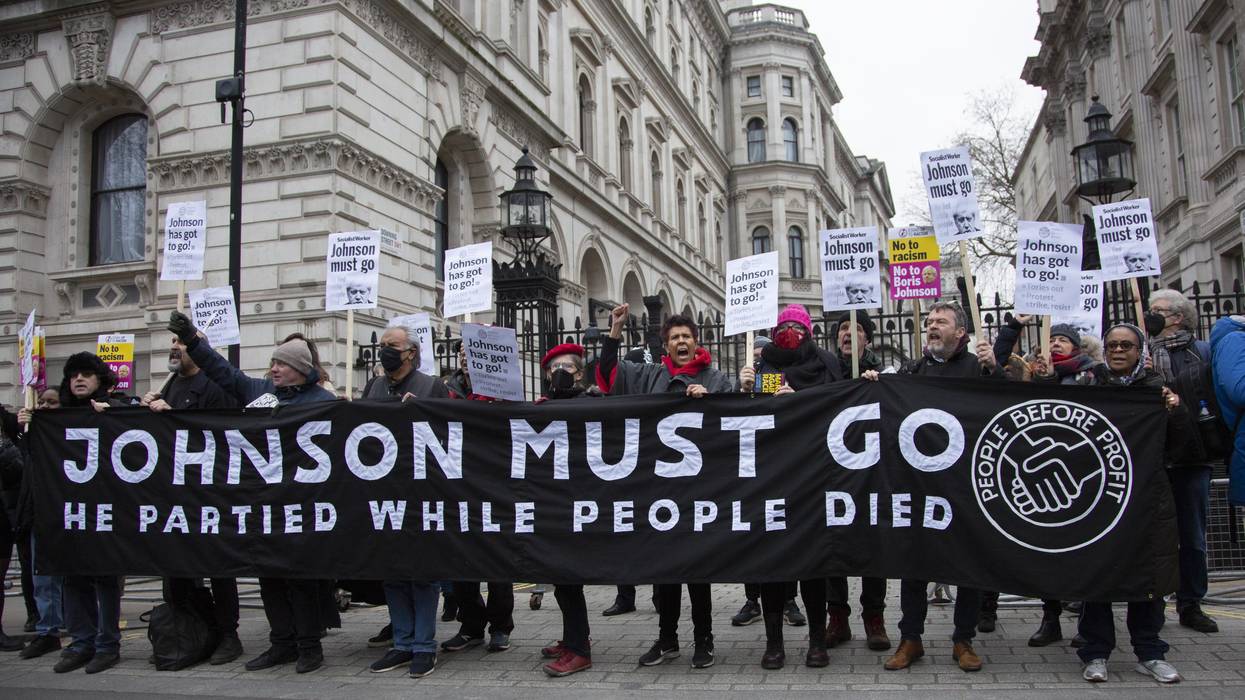
Conservative British Prime Minister Boris Johnson announced his resignation Thursday after dozens of his government ministers stepped down earlier this week, jumping ship as the U.K. leader was engulfed by scandal, backlash over skyrocketing costs of living, and other crises.
As the Associated Press summarized, "Johnson, 58, managed to remain in power for almost three years, despite allegations that he was too close to party donors, that he protected supporters from bullying and corruption allegations, and that he misled Parliament and was dishonest to the public about government office parties that broke pandemic lockdown rules."
"But recent disclosures that Johnson knew about sexual misconduct allegations against Chris Pincher, a Conservative lawmaker, before he promoted Pincher to a senior position turned out to be the last straw," the AP added.
Johnson, who has also come under fire for badly mismanaging the U.K.'s coronavirus response and working against diplomatic efforts in Ukraine, said Thursday that he intends to stay on as a caretaker prime minister until a successor is chosen.
"I want to tell you how sorry I am to be giving up the best job in the world," Johnson told a crowd outside 10 Downing Street. "But them's the breaks."
With the resignation highly anticipated, progressive critics over recent days have said Johnson's ignoble ouster would be a fitting end for the right-wing politician reviled by so many.
Nicola Sturgeon, first minister of Scotland, questioned whether it is "sustainable" for Johnson to remain prime minister until the fall.
"Boris Johnson was always manifestly unfit to be PM and the Tories should never have elected him leader or sustained him in office for as long as they have," Sturgeon said. "But the problems run much deeper than one individual. The Westminster system is broken."
In a statement, Labour Leader Keir Starmer declared that "it is good news for the country that Boris Johnson has resigned as prime minister."
"But it should have happened long ago," said Starmer. "He was always unfit for office. He has been responsible for lies, scandal, and fraud on an industrial scale. And all those who have been complicit should be utterly ashamed. The Tory Party have inflicted chaos upon the country during the worst cost of living crisis in decades. And they cannot now pretend they are the ones to sort it out."
"We don't need to change the Tory at the top--we need a proper change of government," he added. "We need a fresh start for Britain."
Former Labour Leader Jeremy Corbyn sent a similar message earlier this week, writing on Twitter that "12 years of cruel Tory rule" has been "inflicting pain for the many to feather the beds of the few."
"Johnson should resign now," Corbyn added, "but real change can only come when the Tories are swept away and replaced with a people's government to redistribute wealth and power."
The climate movement Extinction Rebellion on Wednesday revealed plans to bring millions of people into the United Kingdom's streets on September 10 in response to the government's latest efforts to enact new limits on protest.
"Our organizations were set up to break the law to drive positive change. Your actions show that we are winning."
In the Queen's Speech--which outlines the government's priorities at the ceremony to open a new session of Parliament--Prince Charles on Tuesday announced the Public Order Bill containing anti-protest measures that the House of Lords last year rejected as "draconian and anti-democratic."
Charlie Waterhouse of Extinction Rebellion (XR) said in a statement that "it is foolish to think that announcing new curbs in the Queen's Speech will stop people taking to the streets to demand their government act to ensure a safe future for people in the U.K. and around the world."
"As we in Extinction Rebellion know full well: what we do works," he continued. "It's worked countless times before. It has worked to give us weekends and the vote, human rights, and freedom. And it will work again. Faced with a government incapable of anything other than a desperate attempt to shore up its own power and cover up its criminality it is the only thing we can do. To be a bystander is not enough."
Waterhouse noted that "w hen juries are asked to sit in judgment of their peers, they are acquitting. The government's increasing reliance on private injunctions shows that they know they cannot rely on the courts, because the courts agree with us."
"So Boris Johnson and Priti Patel, we thank you," he added, taking aim at the U.K.'s Tory prime minister and home secretary. "Our organizations were set up to break the law to drive positive change. Your actions show that we are winning."
Plans to take to the streets in opposition to the looming anti-protest measures--which clearly target not only Extinction Rebellion but also Insulate Britain and Just Stop Oil (JSO)--follow a wave of climate actions in the U.K. and around the world last month.
The actions in April included XR members blocking multiple London bridges, scientists gluing climate research and their own hands to the windows of a U.K. government building, and Just Stop Oil campaigners shutting down terminals across the United Kingdom.
XR's Wednesday statement highlighted YouGov polling from April which showed that 58% of U.K. adults support the demands of Just Stop Oil, with just 23% opposed and 19% neutral, and in a three-week period, the number of respondents who said they are likely to engage in some form of climate action over the next year jumped from 8.7% to 11.3%--an increase of approximately 1.7 million people.
The Guardian reported Tuesday that the anti-protest measures include:
"The bill is expected to extend stop and search powers so the police can seize articles related to these new offenses," the newspaper noted. "New preventive 'serious disruption prevention orders' will also be available for repeat offenders."
XR wasn't alone in responding with alarm to the anti-protest measures and other priorities addressed in the speech, including repealing the Human Rights Act and replacing it with a narrower Bill of Rights.
"This highly regressive legislative agenda represents a systematic gutting of key legal protections for ordinary people," Amnesty International U.K. CEO Sacha Deshmukh said broadly before blasting the Public Order Bill. "It's frightening to see the home secretary demonizing people who are simply exercising their right to peaceful protest."
"These authoritarian provisions, recently removed by the Lords from the policing bill, are similar to repressive policies in countries the U.K. regularly criticizes--including Russia, Hong Kong, and Belarus," Deshmukh added. "It follows a pattern of a government voicing support for protest around the world but cracking down on the right to speak up here at home."
Sam Grant, head of policy and campaigns at the human rights group Liberty, said Tuesday that "these rehashed measures to crack down on protest in today's Queen's speech are yet another power grab from a government determined to shut down accountability."
"Protest is a right, not a gift from the state--and measures like these are designed to stop ordinary people making their voices heard," the campaigner continued. "Parliamentarians and the general public rejected these dangerous measures when they were first rushed through in the policing bill, but the government has refused to listen.
"From restrictions on protest to scrapping the Human Rights Act," Grant warned, "this is all part of the government's continued attempts to rewrite the rules so only they can win, and prevent ordinary people from having their say."
We are waiting for the long-promised invasion.
So are the fishes.
-- Winston Churchill, Radio broadcast to the French people October 21, 1940
If these were normal times there would be no need for those of us who live across the ocean from the country that is now governed by Boris Johnson to be apprehensive. His problems are uniquely his own and in ordinary times would not give us even a moment's pause. These are not, all would agree, ordinary times.
As far as Boris is concerned his problems are of his own making and may, if not properly addressed, threaten his ability to retain his premiership. And some in the United States are concerned that his attempts may place the United States in peril. It has all come about because of Boris' fondness for a good time and his willingness to attend a Downing Street Garden party during the pandemic when such gatherings were forbidden. Pictures of the gathering were distributed on the internet at a time when Boris' subjects were themselves subject to a prohibition against such gatherings.
The result of the episode is that now, many months later, Boris finds himself in a position where he may lose the position that enables him to live at 10 Downing Street and, indeed, members of the opposition hope that the party will lead to Mr. Johnson's downfall. It is not, however, a given. There are ways he may be able to retain his position.
One possibility is that he will seek a confidence vote before the summer and, if that is successful, will call for a general election in the fall. If he wins that election he will have overcome the result of having succumbed to a love of parties during the pandemic. That, of course, is not the only possible way Boris can take steps to secure his position. The obvious alternative to a confidence vote or a general election that may be available to Mr. Johnson was presented to us (and Mr. Johnson if he hadn't already thought of it) by one of Kentucky's two United States senators, Rand Paul.
Before his election to the United States Senate, Rand was an ophthalmologist. His expertise in matters of vision has given him unique insights into many aspects of government including foreign policy. During congressional hearings in 2017, when the Senate was considering a vote on a treaty admitting Montenegro to membership in NATO, Senator Paul blocked an attempt for the Senate to vote on the treaty causing former Senator John McCain to observe that: "The senator from Kentucky is now working for Vladimir Putin." (Notwithstanding Senator Paul's efforts, Montenegro was formally admitted to NATO on June 5, 2017.)
Senator Paul's employment by Putin was once again shown during hearings on Putin's war in Ukraine. During a Congressional hearing at the end of April Paul explained that one of the reasons Putin had invaded Ukraine was that Ukraine was once part of the Soviet Union. Paul said that although there was no justification for the invasion of Ukraine by Putin "You could also argue that the countries that it has attacked were. . . part of the Soviet Union" and Putin has long wanted a "sphere of influence" over former Soviet states.
Although Putin's position in Russia is not as imminently threatened as is Boris Johnson's in England, it is undeniable that in the back of Putin's mind is an awareness that by successfully invading former members of the Soviet Union he enhances his stature and his ability to retain control of Russia. And that is, of course, why Rand Paul's observations are cause for alarm for some of us living on this side of the Atlantic.
As most of us know, the United States was once a part of the British Empire. That all came to an end in the period between 1765 and 1791 when those of us who lived in the 13 colonies formed independent states and defeated the British in the Revolutionary War thus gaining independence from the British Crown. Although that defeat of the British is not much discussed today, the concern expressed by some is that, like Putin, Boris Johnson may, in the back of his mind, intend to reclaim the 13 Colonies that Britain lost during the American Revolution. He may hope that in undertaking that task he will prove his ability to govern and retain his position as Prime Minister.
To reclaim what the 13 Colonies comprised in 1776 is of course, a daunting task, but people who are at risk of losing positions of power that they consider valuable are not beyond attempting what most of us would consider a foolish undertaking. This column is not intended to serve as a roadmap should Boris happen to see it. The complexity of fairly dividing up what were the original 13 colonies is itself such a daunting task that it is unlikely Boris would undertake it. Nonetheless, it has given some readers cause for alarm and the purpose of this piece is to give them some assurance that such an invasion is highly unlikely. Rand Paul notwithstanding.
The Ukrainian news outlet Ukrayinska Pravda reported Thursday that British Prime Minister Boris Johnson used his surprise visit to Kyiv last month to pressure President Volodymyr Zelenskyy to cut off peace negotiations with Russia, even after the two sides appeared to have made tenuous progress toward a settlement to end the war.
Citing unnamed sources from Zelenskyy's "inner circle" and advisory team, Pravda reported that "Johnson brought two simple messages to Kyiv":
"The first is that Putin is a war criminal; he should be pressured, not negotiated with. And the second is that even if Ukraine is ready to sign some agreements on guarantees with Putin, they are not. We can sign [an agreement] with you [Ukraine], but not with him. Anyway, he will screw everyone over," is how one of Zelenskyy's close associates summed up the essence of Johnson's visit...
Johnson's position was that the collective West, which back in February had suggested Zelenskyy should surrender and flee, now felt that Putin was not really as powerful as they had previously imagined.
Moreover, there is a chance to "press" him. And the West wants to use it.
In public remarks during his trip, Johnson vowed that the U.K.--in line with the U.S., Germany, and other western powers--would continue ramping up its "military and economic support and convening a global alliance to bring this tragedy to an end, and ensure Ukraine survives and thrives as a free and sovereign nation."
"I made clear today that the United Kingdom stands unwaveringly with them in this ongoing fight," the right-wing British leader said, "and we are in it for the long run."
In the weeks ahead of Johnson's April 9 visit, high-level diplomatic talks held in Belarus and Turkey had failed to yield a diplomatic breakthrough, though reports in mid-March indicated that Russian and Ukrainian delegations "made significant progress" toward a 15-point peace deal that would involve Ukraine renouncing its NATO ambitions in exchange for the withdrawal of Moscow's troops.
But the talks have since been at a standstill as Russia continues its devastating and illegal assault.
On April 12, Russian President Vladimir Putin declared that the peace negotiations had reached a "dead end." And while Zelenskyy demanded a face-to-face meeting with Putin in late March, one of the Ukrainian president's advisers said in a radio interview last month that "this is still not the time for negotiations between the two presidents."
"A little later, probably, it will [happen]," said Mykhailo Podoliak. "But we want Ukraine's position in these negotiations to be very, very strong."
Johnson, too, has publicly dismissed the prospect of an imminent diplomatic resolution to the conflict. Speaking to reporters on April 20, the British prime minister said that negotiating with Putin was like dealing with "a crocodile when it's got your leg in its jaws."
"It is very hard to see how the Ukrainians can negotiate with Putin now given his manifest lack of good faith," Johnson said. "His strategy, which is evident, is to try to engulf and capture as much of Ukraine as he can and perhaps to have some sort of negotiation from a position of strength."
It's not clear how Zelenskyy himself responded to Johnson's reported push to halt peace talks. On the same day of the British prime minister's arrival in Kyiv, Zelenskyy told the Associated Press in an interview that "no one wants to negotiate with a person or people who tortured this nation."
"It's all understandable," he continued. "And as a man, as a father, I understand this very well."
But, Zelenskyy added, "we don't want to lose opportunities, if we have them, for a diplomatic solution."
On Friday, Zelenskyy said in a virtual address to the British think tank Chatham House that "not all the bridges" to a peaceful settlement with Russia "are destroyed."
Related Content

Pravda's reporting, along with the public statements of Johnson and other western leaders, heightened longstanding concerns that global powers are actively dashing the chances of a diplomatic resolution to Russia's war, which has killed thousands of civilians and sparked a humanitarian crisis with global implications.
"The British government has become an obstacle to peace in Ukraine by encouraging the continuation of the war through huge arms shipments and incendiary rhetoric," Lindsey German, convenor of the U.K.-based Stop the War Coalition, said in a statement Friday. "The conflict there is developing into a proxy war between Russia and NATO and it is the Ukrainian people who will suffer the consequences."
"We're campaigning for an immediate ceasefire and a negotiated settlement--anything less risks an escalating conflict with unfathomable consequences," German added.
Russia's invasion is now in its third month as Moscow focuses its assault on eastern Ukraine and Ukrainian forces heavily armed with western weapons look to drive Russian troops out of key cities.
"Ukrainian soldiers went on the offensive against Russian forces in northeast Ukraine on Friday... as the grueling battle for control over territory in the east increasingly turns into a brutal war of attrition, with neither side able to score a major breakthrough in the fighting," the New York Times reported. "Ukraine's assertion that it was shifting to offensive actions in part of the country came as more sophisticated weapons and long-range artillery provided by Western allies were flowing to the front, allowing Ukraine to take more aggressive action."
Last week, as Common Dreams reported, U.S. Pentagon Secretary Lloyd Austin said that the Biden administration's objective in arming Ukrainian forces is to "see Russia weakened to the degree that it can't do the kinds of things that it has done in invading Ukraine."
Foreign policy analysts and peace advocates perceived Austin's remarks as another troubling indication that the U.S. is committed to a long-term proxy war with Russia, one that could risk direct confrontation between the two nuclear-armed powers.
"If the claim from inside President Zelenskyy's team as reported by Ukrainian media is true... it would not be inconsistent with recent U.S. actions," Phyllis Bennis, director of the New Internationalism Project at the Institute for Policy Studies, told Common Dreams in an email on Friday. "U.S. actions have made clear that Washington's priority is to weaken Russia, not protect Ukrainians."
Citing unnamed U.S. officials, the Times reported Wednesday that in addition to billions of dollars worth of advanced weaponry, the Biden administration has provided Ukraine with "intelligence about Russian units that has allowed Ukrainians to target and kill many of the Russian generals who have died in action in the Ukraine war."
The Pentagon denied the report, though agency spokesperson John Kirby acknowledged the U.S. military has provided some level of intelligence to the Ukrainians and would continue to do so.
Anatol Lieven, a senior research fellow on Russia and Europe at the Quincy Institute for Responsible Statecraft, warned in a column on Thursday that "giving Ukraine intel on Russian generals is a risky gamble."
"The Biden administration and the U.S. establishment need to ask themselves just one question: If the position were reversed, how would the United States react to a third country deliberately helping to kill U.S. commanders?" Lieven wrote. "The Biden administration must move immediately to assure Russia that U.S. strategy is to help defend Ukraine, but not to impose a complete defeat on Russia and use this to weaken or destroy the Russian state."
"The first step," Lieven argued, "should be for Washington to declare publicly that it supports a diplomatic solution to the issues of the status of Crimea and the Donbas, and that if Russia will cease its offensive in Ukraine and agree to a ceasefire, the United States will respect that ceasefire."
This story has been updated to include comment from Phyllis Bennis of the Institute for Policy Studies.
The United Kingdom's Thursday announcement that some asylum-seekers will be given one-way plane tickets to Rwanda was swiftly and forcefully denounced by human rights groups, with one expert calling right-wing Prime Minister Boris Johnson's ploy to offshore migrants "unethical, immoral, ineffective, costly, and very likely unlawful."
"This shockingly ill-conceived idea will go far further in inflicting suffering while wasting huge amounts of public money."
"Anyone entering the U.K. illegally... may now be relocated to Rwanda," Johnson said in a speech. He asserted that the policy is intended to stop "vile people-smugglers [who] are abusing the vulnerable and turning the [English] Channel into a watery graveyard."
Enver Solomon, chief executive of the Refugee Council, said in a statement that the conservative Tory Party's "cruel and nasty" plan to deport asylum-seekers to another country thousands of miles away "will do little to deter desperate people from seeking protection or stop the smugglers but only lead to more human suffering, chaos, and at huge expense to the U.K."
"Treating people like human cargo by using the force of military to repel vulnerable people who have already endured extreme human suffering, and expelling them to centers in Rwanda, a country with a questionable record on human rights, is dangerous, cruel, and inhumane," said Solomon.
According to the Associated Press:
Home Secretary Priti Patel visited the Rwandan capital, Kigali, on Thursday to sign what the two countries called an "economic development partnership." The plan will see some people who arrive in Britain as stowaways on trucks or in small boats across the English Channel picked up by the U.K. government and flown 4,000 miles (6,400 kilometers) to Rwanda, apparently for good.
Migrants have long used northern France as a launching point to reach Britain, either by hiding on trucks or ferries, or--increasingly since the coronavirus pandemic shut down other routes in 2020--in dinghies and other small boats organized by smugglers. More than 28,000 people entered the U.K. on small boats last year, up from 8,500 in 2020. Dozens have died, including 27 people in November when a single boat capsized.
The news outlet reported that "the Rwandan government said Britain had paid 120 million pounds ($158 million) up front to pay for housing and integrating the migrants. It said they would be given 'a range of opportunities for building a better life in a country which has been consistently ranked as one of the world's safest.'"
Rwandan opposition figure Victoire Ingabire Umuhoza questioned her government's deal with the U.K. She noted that the East African country--where more than 800,000 people were killed in a genocide less than 30 years ago and whose current government has been criticized, including by the U.K. Home Office last year, for being repressive--is also a source of refugees.
"Rwanda has consistently ranked [as] one of the world's safest nations but at the same time consistently a country where its inhabitants are unhappy," Ingabire Umuhoza said in a statement.
Amnesty International U.K.'s Refugee and Migrant Rights director Steve Valdez-Symonds said in a statement that "this shockingly ill-conceived idea will go far further in inflicting suffering while wasting huge amounts of public money."
"Sending people to another country--let alone one with such a dismal human rights record--for asylum 'processing' is the very height of irresponsibility and shows how far removed from humanity and reality the government now is on asylum issues," said Valdez-Symonds.
According to AP, "Britain says relocation decisions will not be based on migrants' country of origin but on whether they used 'illegal or dangerous routes' to reach the U.K. from a safe country such as France. Not all such arrivals will be considered suitable to be sent to Rwanda; it was unclear what the criteria for making the decisions would be."
Claiming that Rwanda will have the "capacity to resettle tens of thousands of people in the years ahead," Johnson said that an "unlimited" number of asylum-seekers, including thousands who have arrived since the start of 2022, will be subject to relocation. Patel, for her part, said that the "vast majority" of migrants arriving in the U.K "illegally" would be considered for expulsion.
BBC News, however, saw the Rwandan accommodations set up to house asylum-seekers and estimated that they provide "enough space for about 100 people at a time and to process up to 500 a year." A pilot program is expected to focus on single men, though the prime minister acknowledged that the scheme, precise details of which have yet to be confirmed, would not take effect immediately due to legal challenges.
Yasmine Ahmed, U.K. director at Human Rights Watch (HRW), pointed out on social media that Patel unveiled the government's plan to banish asylum-seekers to Rwanda "at a time when the British public have opened their hearts and homes to Ukrainian refugees."
"Every day the U.K. is witnessing the brutality of war that desperate Ukrainian families are fleeing," said Solomon of the Refugee Council. "This is the reality faced by refugees escaping conflicts all over the world."
"Every day the U.K. is witnessing the brutality of war that desperate Ukrainian families are fleeing. This is the reality faced by refugees escaping conflicts all over the world."
"There is a deliberate attempt to paint people seeking asylum as jumping the queue," Solomon continued. "Yet, this ignores the fact that the government's own data shows that two-thirds of men, women, and children arriving in small boats across the Channel come from countries where war and persecution have forced them from their homes. With so few safe and legal routes available, these people are left with no other option than to risk their lives in small boats at the hands of smugglers in desperation to find safety."
"This government's proposal to treat refugees differently purely on the basis of how they arrived in the U.K. undermines a key principle of refugee protection," he added. "People desperately fleeing war and persecution should always have a fair hearing on British soil."
Patel contended that the Johnson administration's "world-first migration partnership with Rwanda will deter dangerous and illegal journeys to the U.K., give migrants the chance of a new life, [and] set a new standard on asylum and resettlement," but other governments have deported asylum-seekers to third countries before.
According to AP:
In 2013, Australia began sending asylum-seekers attempting to reach the country by boat to Papua New Guinea and the tiny atoll of Nauru, vowing that none would be allowed to settle in Australia. The policy all but ended the people-smuggling route from Southeast Asia, but was widely criticized as a cruel abrogation of Australia's international obligations.
Israel sent several thousand people to Rwanda and Uganda under a contentious and secretive "voluntary" scheme between 2014 and 2017. Few are believed to have remained there, with many trying to reach Europe.
HRW, which has documented the "disastrous" effects of Australia's offshore asylum processing scheme, characterized the U.K.'s new plan as "copycat cruelty."
Calling Johnson's decision "abhorrent," Emilie McDonnell, U.K. advocacy and communications coordinator at HRW, tweeted that "the government is shirking its legal and moral duties, and learning nothing from Australia's cruel and illegal offshore detention regime."
Kartik Raj, Europe researcher at HRW, added that "even by the standards of the U.K. government's cruel and callous treatment of people seeking asylum and general hostility to migration, and what we have come to expect, the reported offshoring deal plumbs new depths."
As AP reported:
Britain's Conservative government has floated other proposals including building a wave machine in the Channel to drive boats back. Johnson said the Royal Navy would take charge of responding to small-boat crossings, but that the idea of pushing vessels back towards France had been rejected as too dangerous.
Several earlier proposed locations for the U.K. to send migrants to--including the remote Ascension Island, Albania, and Gibraltar--were rejected, at times angrily, by the nations themselves.
"The Rwanda plan faces hurdles both in Britain's Parliament and in the courts," the news outlet noted. "Johnson's Conservative government has introduced a tough new immigration bill that would make it more difficult for people who enter the country by unauthorized routes to claim asylum and would allow asylum-seekers to be screened abroad. It has not yet been approved by Parliament, with the House of Lords seeking to dilute some of its most draconian provisions."
"People desperately fleeing war and persecution should always have a fair hearing on British soil."
Opposition lawmakers accused Johnson and other Tories of attempting to divert attention from the so-called "partygate scandal." Johnson, who was recently fined by police for holding parties in government buildings in violation of Covid-19 pandemic lockdown regulations, became the first British prime minister found guilty of lawbreaking while in office, and he is currently resisting calls, including from some members of his own party, to resign.
Touting a plan to fly asylum-seekers to Rwanda "is less about dealing with small boats and more about dealing with the prime minister's own sinking boat," Labour Party lawmaker Lucy Powell told BBC.
Solomon, meanwhile, said that "if the U.K. government is serious about reducing the need for onward movement of refugees, it must act as a truly global Britain and invest humanitarian and development aid into the countries people are fleeing. "
"We must work multilaterally," he said, "to get an effective bilateral agreement with France and our E.U. neighbors for fair, effective, and coordinated asylum processing, creating safe routes via humanitarian visas from assessment centers set up at British embassies elsewhere in Europe to enable people in need to travel without resorting to smuggling networks."
Thousands of scientists and doctors in the United Kingdom on Monday rejected Prime Minister Boris Johnon's assertion that it is time to begin "living with Covid" and demanded to know how his government is justifying its decision to end nearly all pandemic-related public health restrictions in the coming weeks, warning the policy change could worsen the spread of future variants.
Writing to Patrick Vallance, Johnson's chief scientific officer, and Professor Chris Whitty, the chief medical officer, more than 2,900 physicians, epidemiologists, and other experts in science and public health called on the officials to share the "scientific advice underpinning" the new policy.
"We believe humanity is in a race against the virus. We believe the science strongly supports using vaccines combined with public health interventions to slow transmission and regain the upper hand on viral evolution."
Under the plan announced by Johnson on Monday, people in England will no longer be legally required as of this Thursday to self-isolate after testing positive for Covid-19 or if they suspect they have the disease.
The same day, the government will also terminate a program under which some people with lower incomes have been able to receive nearly $700 in "test and trace support" funds if they have to self-isolate.
In most cases, the government will stop providing free coronavirus tests to the public on April 1, and as of March 24, sick pay for Covid-related reasons will only be paid after four or seven days of absence from work instead of immediately.
The "weakening of sick pay" is "proof once again the Tories simply aren't on the side of workers," said Jonathan Ashworth, a Member of Parliament for the Labour Party.
The scientists and doctors said they "do not believe there is a solid scientific basis for the policy" and warned the government's call for the public and employers to treat the pandemic as though is it is over "is almost certain to increase the circulation of the virus and remove the visibility of emerging variants of concern."
The letter cited a document released less than two weeks ago by the Scientific Advisory Group for Emergencies (SAGE), a government panel.
"The emergence of new variants and a resultant wave of infections can occur very quickly, potentially within just several weeks," wrote SAGE on February 10. "The ability to rapidly detect and characterize new variants and to scale up necessary responses (such as [test-trace-isolate] and vaccinations) quickly will be very important."
"Considerations for future response preparedness and surveillance infrastructure should take this into account," added the panel.
Despite that warning released earlier this month, Johnson on Monday also asserted that the country's rate of vaccination would allow officials to "tackle" new variants when they arise.
"We have no reason to assume that all future new variants will be mild," said the signatories of Monday's letter.
The health experts cited data released by SAGE on February 2 which showed that if self-isolation guidelines and testing availability were eliminated, transmission could increase "by between around 25% to 80% if the population were to return to pre-pandemic behaviors and no mitigations."
"We believe humanity is in a race against the virus. We believe the science strongly supports using vaccines combined with public health interventions to slow transmission and regain the upper hand on viral evolution," wrote the doctors and scientists. "For the one in four people in the U.K. who are clinically vulnerable, the current approach appears a perilous and politicized pandemic response."
The concerns expressed in the letter were echoed by Scottish First Minister Nicola Sturgeon, who said Johnson's plan amounted to "inexcusable negligence."
Steve Chalke, founder of the Oasis Charitable Trust, which includes more than 50 schools across England, said the government's decision to lift public health measures was "a huge gamble" for immunocompromised students, teachers, and family members around the country.
"I think it will become a forced form of exclusion of those who are vulnerable, those immunosuppressed children and staff who are put at increased risk," Chalke said of Johnson's new plan. "They will not be able to afford to take the gamble. I think we will see a group of children turning away from education."
"Removing the requirement for positive cases to self isolate puts them all at increased risk," he added.
With U.S. President Joe Biden "convinced" that Russian President Vladimir Putin is planning not only confirmed nuclear drills but also an invasion of Ukraine that Moscow has repeatedly denied, the global peace movement on Friday reiterated calls for de-escalation.
"Stop the War opposes any war over Ukraine, and believes the crisis should be settled on a basis which recognizes the right of the Ukrainian people to self-determination and addresses Russia's security concerns," declares a statement from the U.K.-based coalition signed by thousands of people.
The Russian Ministry of Foreign Affairs on Thursday accused the Biden administration of ignoring Moscow's security demands--including Ukraine's exclusion from the North Atlantic Treaty Organization (NATO)--but also insisted that "there is no 'Russian invasion' of Ukraine."
Despite the assurance from Moscow, when asked Friday if there is any indication whether Putin has decided to invade Ukraine, Biden told reporters--without providing any further details or evidence--that "as of this moment, I'm convinced he's made the decision. We have reason to believe that."
Members of the Biden administration--and other Western officials--have also recently claimed, without offering proof, that Russia will engage in a false flag operation as a pretext for invasion.
Eight years into fighting in Ukraine's Donbas region, pro-Russian separatists and Ukrainian forces on Thursday accused each other of violating a cease-fire. After the Ukrainian military said shells fired by separatists hit a kindergarten, U.K. Prime Minister Boris Johnson claimed it "was a false-flag operation designed to discredit the Ukrainians, designed to create a pretext, a spurious provocation for Russian action."
Stop the War took aim at recent actions and comments from U.K. leaders.
"Our focus is on the policies of the British government which have poured oil on the fire throughout this episode," the coalition explained. "In taking this position we do not endorse the nature or conduct of either the Russian or Ukrainian regimes."
"The British government has talked up the threat of war continually," the statement continued. "Unlike the French and German governments, it has advanced no proposals for a diplomatic solution to the crisis, and has contributed only saber-rattling."
Instead of pursuing diplomacy, the British government has not only "sent arms to Ukraine and deployed further troops to eastern Europe," but also "declared that Ukraine has a 'sovereign right' to join NATO," the coalition added.
"Britain needs to change its policy, and start working for peace, not confrontation," the group asserted, encouraging a halt to the eastward expansion of NATO.
The statement also said:
We refute the idea that NATO is a defensive alliance, and believe its record in Afghanistan, Yugoslavia, and Libya over the last generation, not to mention the U.S.-British attack on Iraq, clearly proves otherwise.
We support all efforts to reach new arms control agreements in Europe and to move towards nuclear disarmament across the continent.
We urge the entire anti-war movement to unite on the basis of challenging the British government's aggressive posturing and direct its campaigning to that end above all.
High-profile signatories to the statement include former Labor Party Leader Jeremy Corbyn, along with another dozen members of Parliament, the heads of several U.K. unions, and various academics, activists, and artists such as musician Brian Eno and rapper Lowkey.
Other signatories include Joe Glenton of Veterans for Peace; Pawel Wargan, coordinator of Progressive International's international secretariat; and Kate Hudson, general secretary of the Campaign for Nuclear Disarmament.
The statement came as anti-nuclear and peace campaigners urged against Russia's planned drills, which are scheduled for Saturday, set to be overseen by Putin, and will involve launching cruise missiles and intercontinental ballistic missiles (ICBM).
"Test-firing ICBMs at this time of heightened tensions is particularly irresponsible but any practice to use WMDs at any time is unacceptable," the International Campaign to Abolish Nuclear Weapons (ICAN) tweeted Friday, referring to weapons of mass destruction.
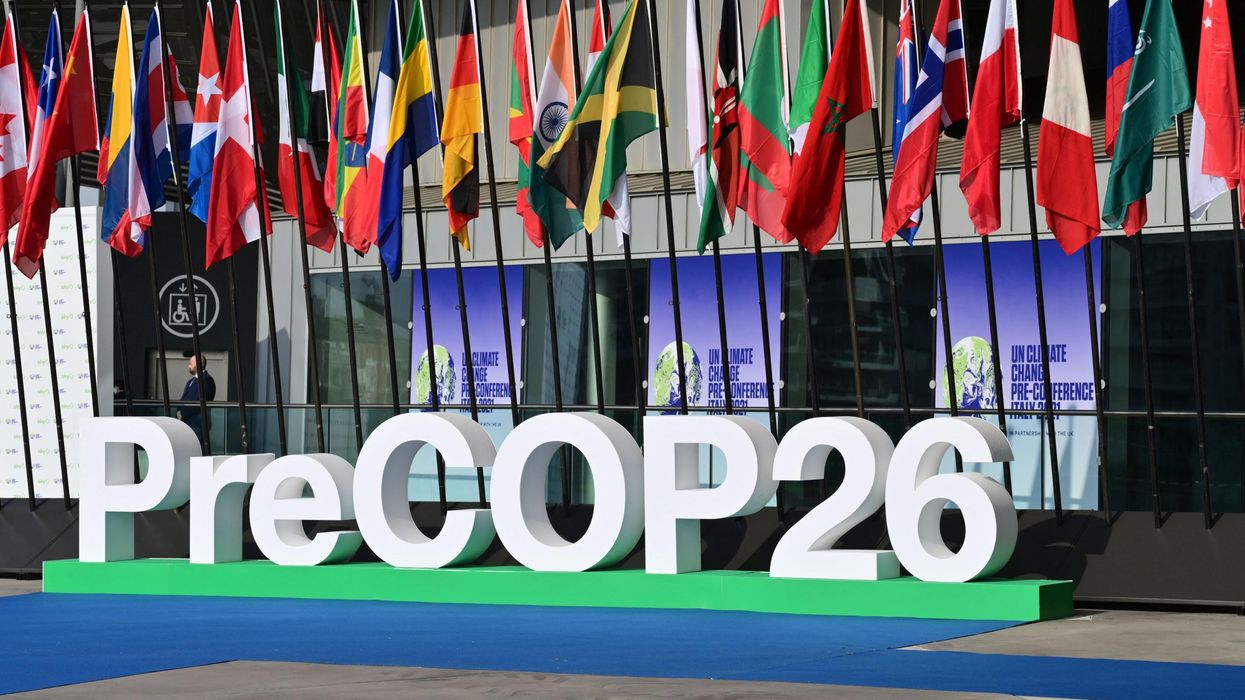
Chanting "shame on you," activists rallied amid a heavy police presence Monday evening outside a swanky reception for world leaders and others attending the United Nations Climate Change Conference in Glasgow, Scotland to protest their inadequate response to the planetary emergency.
Members of Britain's royal family and corporate executives joined heads of state and other leaders at the exclusive dinner event, which was hosted by British Prime Minister Boris Johnson at the Kelvingrove Art Gallery and Museum.
"How dare these world leaders have a fancy dinner on the first night of COP26, as if they have something to be proud of," said Cat Scothorne of the group Glasgow Calls Out Polluters, according to STV News.
"The continued support of the fossil fuel industry by the heads of state, particularly in the Global North, is killing millions of people," Scothorne added. "The consequences of climate change are faced by people not in power, but those mainly in the Global South and people on sites where extraction occurs, yet the perpetrators sit in luxury, insulated from it all."
One protester told Capital Scotland News he was there "to raise awareness of the need for urgent action on the climate and ecological emergency, mostly because with our political processes, we're left with almost no other routes to make a difference."
"We're going down an utterly absurd route of deciding as a species to kill ourselves," he added. "We have to step up and say, 'No, that's completely absurd; let's choose a route that saves ourselves.'"
Another demonstrator told the outlet she was protesting to hold decision-makers accountable.
"We're working towards global justice, climate justice," she said, "not just making decisions that only benefit a few people, but rather to make decisions that benefit everyone."
The demonstration came at the end of the second day of the global summit and amid demands from Indigenous leaders, youth climate campaigners, and others for a little less conversation and a lot more action to address the growing climate crisis.
Occasionally, when I'm walking the dog on the beach, I find a lump of coal, black against the yellow sand. The Firth of Forth, the fjord that washes the north of Edinburgh, cuts deep into the seam that Scotland's central belt is built on. Sometimes, the waves dislodge a chunk of the bed, and wash up a 350-million-year-old piece of driftwood from the mighty forests of the Carboniferous Period.
In many ways, the story of man-made climate change was first written with these stones. Across the water from Portobello beach where I walk the dog is Fife, where a young Adam Smith observed the birth of industrial capitalism, powered by that same bed of rock. On the Firth of Clyde to the west is Greenock, the home town of James Watt, whose improvements to the steam engine drove the Industrial Revolution and powered the expansion of the British Empire.
The UK's responsibility is also about history. Britain developed the form of coal-powered industrial capitalism at the heart of this crisis and, through its empire, exported it around the world.
With the engineers and philosophers produced by the Enlightenment, it's often claimed--somewhat arrogantly--that Scotland invented the modern world.
In a few weeks' time, at COP26, international delegates will gather on the south bank of the River Clyde, just a few miles inshore from Watt's childhood home, to discuss what to do about the fact that the modern world is burning. Their task is clear. They must reinvent it.
But the most important thing the climatologists have said isn't a prediction. On the front page of one such report, which warns of the risks of exceeding 1.5degC of warming, the IPCC quote the French writer Antoine de Saint Exupery: "Pour ce qui est de l'avenir, il ne s'agit pas de le prevoir, mais de le rendre possible."
"As for the future, it is not a question of foreseeing it, but of making it possible."
COP26--or the 26th Conference of Parties to the United Nations Framework Convention on Climate Change, to give it its full name--will be a fight over different possible futures, a battle between social movements and entrenched power; between those desperate to defend the world, and those who prefer to preserve the world order; between reality and spin.
While these events are annual, this one, like Paris in 2015 or Copenhagen in 2009, is set to be a big one. Alongside haggling over money and discussing how to adapt to the now inevitably changing climate, governments are being asked for "ambitious 2030 emissions reductions targets that align with reaching net zero by the middle of the century."
Getting countries to agree to reduce their emissions dramatically over the next decade, as the science requires, won't be easy. Last month, the IPCC added together the global total of each country's own agreed targets. Combined, these wouldn't lead to a reduction in carbon emissions by 2030, but "a sizeable increase... of about 16%."
Even theoretical agreements to slash emissions won't be enough. Many countries--the UK included--have failed to put in place anything like the policies needed to meet their commitments. Without these, the discussion is indeed, as Greta Thunberg put it recently, "all blah blah blah."
One of those 'blahs', at the very least, must refer to the way that technology will be promoted at COP. Those who profit from the current world order will try to use the gathering as a trade show for their latest gizmos, in a desperate attempt to prove that nothing more fundamental needs to change.
Introducing this theme at the Conservative Party conference this week, Boris Johnson declared that the solution to the climate crisis lay in "science, innovation, capitalism."
We do need different machines. But alone they will never solve the problem. In 2020, the number of battery-powered cars driving the world's roads hit record numbers. This led to a reduction in oil consumption from conventional-sized vehicles of around 40,000 barrels per day on top of the pandemic-related fall, according to the International Energy Agency.
But while some drivers were shifting away from climate-changing commutes, others were going in the opposite direction. A record 42% of new cars sold last year were SUVs. Since 2010, the total number of gas guzzlers has gone from 50 million to 280 million. According to the same IEA report, this trend has wiped out any gains made by eco-aware consumers with their battery-powered engines.
These two trends probably aren't entirely unrelated. If one group of people buys less petrol, then the price of fuel will fall. And so other people will buy more.
Similarly, the aviation industry will talk up the possibility of more fuel-efficient planes. But we've already tried that. Between 1960 and 2018, passenger aircraft became eight times more fuel-efficient. The result was that the cost of a plane ticket fell, and a new class of people was invented: frequent flyers. From 1970 to 2019, the number of air passenger journeys a year has grown from 310 million to 4.4 billion--a 14-fold increase. More efficient machines meant more fuel was used in total.
This isn't surprising. James Watt's inventions radically increased the efficiency of steam engines. But, as the economist William Stanley Jevons observed in the 1860s, coal consumption in the UK didn't fall. It increased: buyers got more pump for their pound, and delivered the Industrial Revolution.
The Jevons' paradox, and the more recent and related Khazzoom-Brookes postulate, show that this is normal. In a free-market capitalist economy, the more effectively a machine uses its fuel, the more fuel will tend to be poured into it.
These rules of free-market economies also undermine another element of the spin our rulers will attempt in Glasgow. You can expect a whole strand of coverage over the next month to focus on what you, personally, can do to reduce your 'carbon footprint'. But in reality, the most likely impact of you cutting your energy consumption is, as all those people who bought electric cars show, that someone else will buy more in your place.
The problem isn't a lack of efficient technology, nor of a desire to do the right thing. It's that our society is governed by the perverse rules of the free market.
A mirage of 'negative-emissions technologies' has been conjured up by highly paid illusionists.
We should be equally sceptical of other kinds of technology that will be paraded as the solution to the climate crisis. During the Paris 2015 conference, I gatecrashed a party of lobbyists at a club that Marcel Proust once described as "the most exclusive in the world" and "the inner sanctum of the elite". Sipping astonishingly good red wine, I met Al Gore and one of the Florida lawyers who, in 2000, had ensured he lost the presidency--now working as an aviation lobbyist. I listened to speeches by the hosts, the great and good of the US fossil fuel industry. And I secretly recorded what they had to say.
When I said I was "a writer", the swarm of lobbyists were all very keen that I promote the same idea: carbon capture and storage. They wouldn't need to change their filthy ways, they believed. Pollution could simply be pumped into the ground.
For years, this mirage of 'negative-emissions technologies' has been conjured up by highly paid illusionists to create a sense that we don't need to change the economic system driving the climate crisis--or even to stop extracting fossil fuels. There is a problem with all of this, though: no project has successfully captured and stored carbon at anything like sufficient scale.
As an editorial in the scientific journal Nature put it in 2018, "Negative-emissions strategies remain magical thinking."
It's easy to be distracted by the humming of new toys. And of course, the shift to a zero-carbon world will require a green energy revolution. Cheaper solar panels are a good thing. But the new will be meaningless if it's built alongside the old. We must focus on the material reality of what's being negotiated over: some of our planet's vital systems.
Over hundreds of millions of years, plants and plankton have photosynthesised, taking carbon out of the atmosphere. Sometimes, when they died, they rotted, returning it to the air. But sometimes, they became entombed in places without oxygen, and were preserved. Those carboniferous forests, for example, laid down wood that was cooked into coal under pressure from above and heat from below. Plankton that sank into low-oxygen parts of the ocean became oil.
As these plants and plankton drank carbon from the air and took it to their graves, they reduced the amount of the sun's energy that was trapped in the atmosphere, calming the planet's weather systems, and gradually creating the conditions for human civilisation to emerge.
There are hundreds of millions of years' worth of this carbon stored in the rocks beneath us--the lithosphere. In just two and a half centuries since James Watt invented the separate condenser, improving the efficiency of steam engines, we have taken millions of years of deposits, and returned them to the atmosphere.
Over the same period, we have burnt through huge portions of the life around us--the biosphere--slashing plants, poisoning plankton and hunting megafauna. This, in turn, has reduced Earth's capacity to suck carbon from the atmosphere.
This distribution of carbon between the lithosphere, the biosphere and the atmosphere is the basic material reality upon which all climate change negotiations take place.
The percentage of reserves of oil, gas and coal that must remain unextracted from each region of the world, if the world is to have a 50% chance of remaining with a 1.5C temperature rise by 2050 and 2100 | Welsby, Price, Pye, Eckins, NatureLast month, the journal Nature published a paper calculating what this means. "To allow for a 50% probability of limiting warming to 1.5degC... by 2050, we find that nearly 60% of oil and fossil methane gas, and 90% of coal must remain unextracted," the authors conclude. If we want better than a 50% chance, we must burn less.
Berlin's Mercator Research Institute puts it another way. If we are to remain within the 1.5degC target, it says, "The atmosphere can absorb... no more than 400 gigatonnes of CO2 ... Annual emissions of CO2 are estimated to be 42.2 gigatonnes per year. With emissions at a constant level, the budget would be expected to be used up in less than eight years from now."
At the 2009 climate conference in Copenhagen, countries in the Global South rallied under the banner "1.5 to survive". The conditions created by any more warming than this, they pointed out, would likely leave much of their territory uninhabitable.
At the 2015 conference in Paris it was finally agreed that the world should be allowed to warm by no more than 1.5degC above pre-industrial levels. As world leaders meet in Glasgow, they have to figure out how to meet that target in less time than it took them to set it.
Rather than engaging seriously with this task, Boris Johnson, the conference's bombastic host, is likely to use it as a global ego-booster. The combination of Brexit cock-ups and one of the worst COVID responses in the world has left him looking like a bit of an eejit, and while he enjoys the role of jester, he doesn't like being seen as stupid. Here is a chance to do what he does best: pompously blaming other people to get his mates off the hook.
Just as Johnson's enthusiasm for technological solutions to climate change matches his excitement about technological solutions to the Irish border, he will be as quick to blame other countries for the climate crisis as he was to blame them for his Brexit mess. In particular, it seems likely he will try to imply that this is all China's fault, and to cast Britain as an eco-Utopia.
It's important, therefore, to understand the extraordinary extent to which Britain has caused this crisis.
The UK can seem like a progressive voice on climate change, having committed itself to a 68% reduction in greenhouse gas emissions by 2030 against 1990 levels.
The first problem is that the government has no serious plans to meet those targets. The second is that they count Britain's responsibility in the narrowest possible way.
Indeed, the UK is arguably more to blame for the climate crisis than any other country.
For his 2011 book 'The No Nonsense Guide to Climate Change', the researcher Danny Chivers dug back through historic emissions data and compared them to current population levels. Between 1850 and 2007, he found, the UK was responsible for more CO2 from fossil fuels per person than any other major country. The only country with a higher historic per-person carbon footprint was Luxembourg.
A decade on, Chivers re-ran the numbers for me. "Every UK resident is sitting on around 1,200 tonnes of historical CO2, making us one of the most historically polluting countries per person in the world," he said. Out of countries responsible for more than 1% of emissions, "We're jostling for the top spot on the historic responsibility table with a similar per capita figure as the US, compared with 150 historic tonnes per person for China, and 40 tonnes per person for India."
The infrastructure and relative wealth we enjoy in the UK has been built on huge amounts of past pollution--much of which is still in the atmosphere today.
These figures only account for emissions rising up from the UK's land mass. If a British company designs a product in the UK, sells it in the UK and counts its profits in the UK, but offshores its manufacture to Vietnam, then its emissions are counted in Vietnam. And because the UK is one of the world's most de-industrialised countries, this offshoring of emissions means that Britain undercounts its carbon footprint more than most other countries.
A report for WWF last year, for example, argued that around half--46%--of the UK's emissions come from products made overseas to satisfy demand in the UK.
The UK's responsibility is also about history. Britain developed the form of coal-powered industrial capitalism at the heart of this crisis and, through its empire, exported it around the world. When European colonists arrived in Africa, Australasia, the Americas and Asia, they drove deforestation, plunder and pollution, often replacing civilisations which had long survived relatively sustainably, and establishing machinery that continues to extract wealth to this day.
This week, the brilliant website Carbon Brief published its own league table of historic responsibility, which included the impact of changes in land use as well as of fossil fuels--that is, carbon from the biosphere as well as from the lithosphere, as a result of deforestation and agriculture. This addition catapulted Canada to the top of the historic responsibility charts, and Australia into fourth place, while the UK slipped down to eighth. What their analysis didn't count, though, was that most of the deforestation of both Canada and Australia happened while they were British colonies and was done to enrich British subjects, while Britain itself is one of the most deforested countries on earth, but this land-use change happened before 1850, when the league table starts counting.
On top of this, Britain is still a major oil economy. Two of the world's five major oil companies, BP and Shell, are British and Anglo-Dutch. The Royal Navy spends a fortune policing the major routes of oil tankers around the world, and significant Foreign Office policy heft is thrown behind British oil companies, from the UK's oversized representation in countries like Azerbaijan to its willingness to throw resources into propping up the House of Saud.
From Portobello beach, it's often possible to see rigs loitering in the Firth of Forth, waiting for higher oil prices to make their deployment profitable. Far from working to wind up the North Sea oil industry, the British state is pumping hard to keep it afloat, giving it tax breaks of PS250bn in recent years and continuing to permit new exploration and extraction projects.
In Scotland, a political battle is raging over the proposed new Cambo field, west of Shetland. Britain has already used up far more than its fair share of fossil fuels. But in August, Boris Johnson allowed drilling to go ahead.
Johnson has also failed to block the first new deep coal mine in 30 years, which is being fought over in West Cumbria.
Britain's main contribution to climate breakdown, though, probably comes from its financial institutions.
When fossil fuel companies want to borrow in order to invest, like anyone else, they do it against their assets. And the main things they own are rights to untapped reserves.
As assets, though, these should be worthless: at least 60% of oil and 90% of coal reserves must remain untapped. If you believe that dangerous climate change is going to be avoided, then most major oil companies are already insolvent--they've borrowed vast amounts of money against the value of oil fields which must never be drilled.
The only reason the companies are still operational is that the world's major banks are betting that the oil--and the planet--will be burned. Chatting after a small oil industry fringe meeting during the Paris 2015 climate conference, a senior Shell executive admitted to me that their business model was based on the assumption that keeping warming to 2degC is "not a given."
Along with China and the US, the UK is one of the biggest banking countries in the world. So the scale of emissions resulting from the investments of British financial institutions is vastly out of proportion to the country's population--and nearly twice the domestic emissions of the UK in 2019, according to a study by WWF and Greenpeace.
Looking only at coal, Banktrack found in 2019 that the UK's big four banks were financing over $26bn to international companies which were planning to build a coal plant fleet 16 times greater than UK operational capacity.
Britain's banks are funding an armada of coal power plants big enough to sink any chance of avoiding dangerous climate change.
Another part of the story is the way Britain protects the wealth of fossil fuel barons.
A study by the Transnational Institute think tank recently found that, "Corporate value chains are habitually structured along... the (former) territories of the British Empire, [and] the Low Countries--Belgium, Luxembourg and the Netherlands."
They concluded: "Overall, this group ... together with the wealth of the world's billionaire class, effectively constitutes the backbone of global capitalism."
The recent revelations of the Pandora Papers only emphasise this.
The cash that Russian oligarchs, Saudi princes and Emirati rulers stash in bank accounts in the Cayman Islands or British Virgin Islands or Gibraltar--or clean up via London's housing market--very often originates in oil and gas extraction. Understood properly, Britain isn't just a declining fringe power with limited impact on the world. Its territories are vertebrae holding up and protecting a global system of extraction, impoverishment and pollution--the same system that's killing the planet.
The UK keeps the world's hidden oil money safe, ensuring that we are no longer allowed to know the names and addresses of the people killing the planet.
The UK also has a positive story to tell about climate change. According to analysis by Carbon Brief, domestic emissions have genuinely been falling since 2007, even when you account for offshoring. This reduction has largely been driven by the switch away from coal won by climate protesters in the late Noughties, when a series of Climate Camp protests brought the issue into focus.
Indigenous movements--run by the descendants of those same people slaughtered by the British Empire all those generations ago--have managed to stave off the equivalent of a quarter of the US and Canada's emissions over the past decade, according to one recent analysis.
It's not technology or public opinion holding back the action needed to avert the climate crisis.
The technology needed for the world to transition to a zero-carbon economy exists. In a recent survey of half a million people across the planet, 64% said they believed that climate change is a global emergency, with overwhelming support for a wide range of policy changes. According to another poll, 80% of people across the developed world say they would be willing to change their lifestyles to reduce the impacts of climate change.
The bloc holding back the radical action needed to avert the climate crisis isn't technology or public opinion. It's the system of power that puts our leaders in place. It's the networks of lobbyists, public relations executives and advertisers who work every day to defend that system. And it's the deep wells of wealth that pay them to do so.
Facing off against them is perhaps the biggest and best-coordinated global movement humanity has ever seen: networks of young people going on strike across the globe, allied with people of colour insisting that their lives matter, and supported, according to poll after poll, by the vast majority of people across the planet.
On the other side of the Firth of Forth, and a few miles inshore, is the land where Scotland's last coal power station, Longannet, used to be. It was shut down in 2016. In its place, the hills around Edinburgh dance with the white blades of wind turbines: a reminder on my dog walks that change is possible and, when it comes, it isn't gradual. It sweeps in like an ocean storm.
Over the next couple of months, I'll be sending out regular emails from COP26 and its build-up. If you want to get them, sign up here.