

SUBSCRIBE TO OUR FREE NEWSLETTER
Daily news & progressive opinion—funded by the people, not the corporations—delivered straight to your inbox.
5
#000000
#FFFFFF
To donate by check, phone, or other method, see our More Ways to Give page.
Daily news & progressive opinion—funded by the people, not the corporations—delivered straight to your inbox.

Prominent anti-war voices including Medea Benjamin, Noam Chomsky, Abby Martin, and Roger Waters on Monday joined over 220 groups around the world in calling for the cancellation of Lockheed Martin's $1.7 trillion F-35 fighter plane program.
"The only people this project benefits are the executives at Lockheed Martin."
The women-led peace group CodePink is spearheading an international effort to urge President Joe Biden and members of the U.S. Congress to cancel the manufacturing and training of the F-35 fighter jet, which has been dogged by serious technical and operational problems since it first flew in 2006.
"I joined over 200 organizations from around the world in calling on the U.S. government to end the disastrous F-35 fighter jet program because as a global community we need to drastically change our priorities." Waters, co-founder of the iconic rock band Pink Floyd, said in a statement.
"To the people in the countries the F-35 is sold to and produced in, it's time we demand a reinvestment into life, not war," he added.
In a letter to Biden and U.S. lawmakers signed by nearly 230 groups, CodePink says that its cancellation demand is "based on the harm caused abroad, cost of the program to the taxpayer, inefficiencies and failures, the environmental impact of F-35s, and the effects training has on local communities."
Some of those communities are in Vermont, where--despite railing against the military-industrial complex during his two presidential runs--Sen. Bernie Sanders (I-Vt.) supports the F-35 program.
"Currently, F-35 training in Vermont disrupts the lives of working-class people," the letter states. "The training is irregular and Vermonters go without warning of when these trainings will take place. The noise caused by the F-35 hits 115 decibels which especially hurts and injures infants and children, the elderly, and the disabled. The F-35 has 300 to 600 takeoffs and landings a month."
Ben Cohen, co-founder of Ben & Jerry's ice cream and a Vermont resident, said that "the global community is fed up with overpriced, underperforming weapon systems like the F-35. It's a complete waste of taxpayer dollars that causes harm abroad and here at home in Vermont."
"The only people this project benefits are the executives at Lockheed Martin," Cohen added. "Real security is knowing you can see a doctor when you're sick, not a boondoggle fighter jet that can't fly near thunderstorms."
That's just one of the many problems plaguing the F-35. The warplane's exorbitant cost has also raised critics eyebrows and ire. According to the Center for Arms Control and Non-Proliferation:
The F-35's price per unit, including ancillary costs like depot maintenance, ground support equipment, and spare parts is $110.3 million per F-35A, $135.8 million per F-35B, and $117.3 million per F-35C. Those totals do not include the nearly $1.3 trillion in life cycle costs to operate and sustain the aircraft over its 66-year life cycle, making it the most expensive weapons system in U.S. history.
Ashik Siddique, a research analyst for the National Priorities Project at the Institute for Policy Studies, recently noted that canceling all U.S. student loan debt would cost about $1.75 trillion, or about the same amount as the total cost of the F-35 program. Department of Education data shows that amount is also enough to eliminate all tuition at U.S. public colleges for more than 20 years.
According to the Children's Defense Fund, the projected cost of the program would also be enough to reduce child poverty in the United States by more than 60% for the next two decades.
Related Content

"The F-35 program is a microcosm of the military-industrial complex. Each year the U.S. government funnels massive amounts of money into the program while letting places in the U.S. go without clean water for months or years," said CodePink national co-director Danaka Katovich. "Sustaining this program for any longer will have detrimental effects on human life and the Earth."
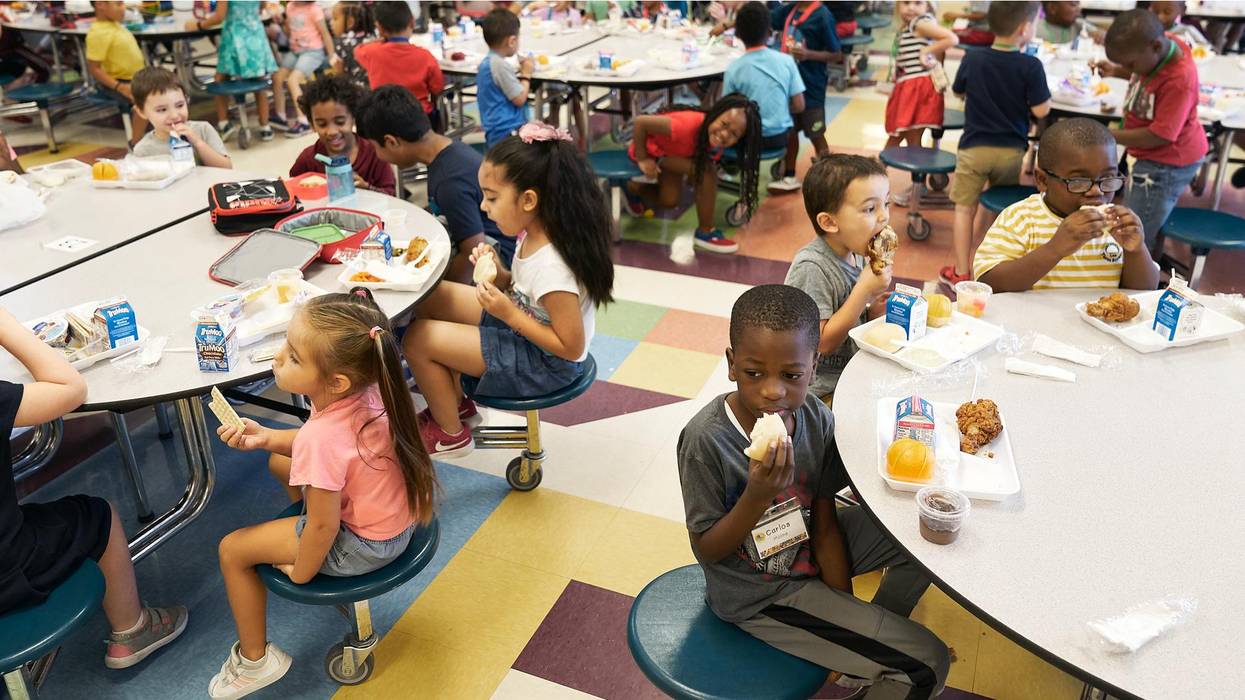
In a bid to better the Biden administration's plan to expand school lunch programs for U.S. children, three Democratic lawmakers and Sen. Bernie Sanders on Friday introduced a bill that would make all school meals free for every student, regardless of their household income.
"Every student should have the opportunity to learn, grow, and focus in school, without worrying about where their next meal will come from."
--Rep. Gwen Moore
Sens. Sanders (I-Vt.) and Kirsten Gillibrand (D-N.Y.) along with Reps. Ilhan Omar (D-Minn.) and Gwen Moore (D-Wis.) introduced the Universal School Meals Program Act of 2021 (pdf), a reprise of a similar 2019 bill from Sanders and Omar.
If passed, the new version would eliminate reduced-price meals and "permanently provide free breakfast, lunch, dinner, and a snack to all school children regardless of income, eliminate school meal debt, and strengthen local economies by incentivizing local food procurement," according to a statement issued by Omar's office.
Unlike the 2019 version, which had no Senate co-sponsors, the new iteration of the bill is backed by nine other Democrats, including Sens. Elizabeth Warren (Mass.) and Ron Wyden (Ore.).
In the House, it is co-sponsored by 34 Democratic lawmakers, including Reps. Jamaal Bowman (N.Y.), Cori Bush (Mo.), Raul Grijalva (Az.), Ro Khanna (Calif.), Barbara Lee (Calif.), Alexandria Ocasio-Cortez (N.Y.), Ayanna Pressley (Mass.) and Rashida Tlaib (Mich.).
The bill is also endorsed by more than 370 organizations including the School Nutrition Association, American Federation of Teachers, National Education Association, Service Employees International Union, Food Research and Action Center, Hunger Free America, UnidosUS, Children's Defense Fund, and National Action Network.
No Republican lawmakers support the measure, which follows an announcement last month by the U.S. Department of Agriculture (USDA) that schools nationwide can keep offering students free lunches until the end of June 2022 as part of what it called the Biden administration's "commitment to provide safe, healthy meals free of charge to children as the pandemic continues to threaten the food and nutrition security of our most vulnerable."
The USDA also announced last month that the Biden administration will launch a national summer food program to feed more than 30 million children from low-income households.
In a statement introducing the bill, Omar said that "no child in the richest country in the world should face hunger."
"One in six children in my state of Minnesota don't know where their next meal will come from," Omar continued. "Families across Minnesota and nationwide are still struggling from the fallout of the pandemic, and children are often bearing the brunt of this crisis."
"I am proud to partner with my colleagues to implement a universal school meals program to ensure all of our children have the nutrition they need to succeed," she added.
"One in six children in my state of Minnesota don't know where their next meal will come from."
--Rep. Ilhan Omar
Moore said in the same statement that "every student should have the opportunity to learn, grow, and focus in school, without worrying about where their next meal will come from."
Sanders concurred, adding that "every child deserves a quality education free of hunger."
"What we've seen during this pandemic is that a universal approach to school meals works," he said. "We cannot go backwards."
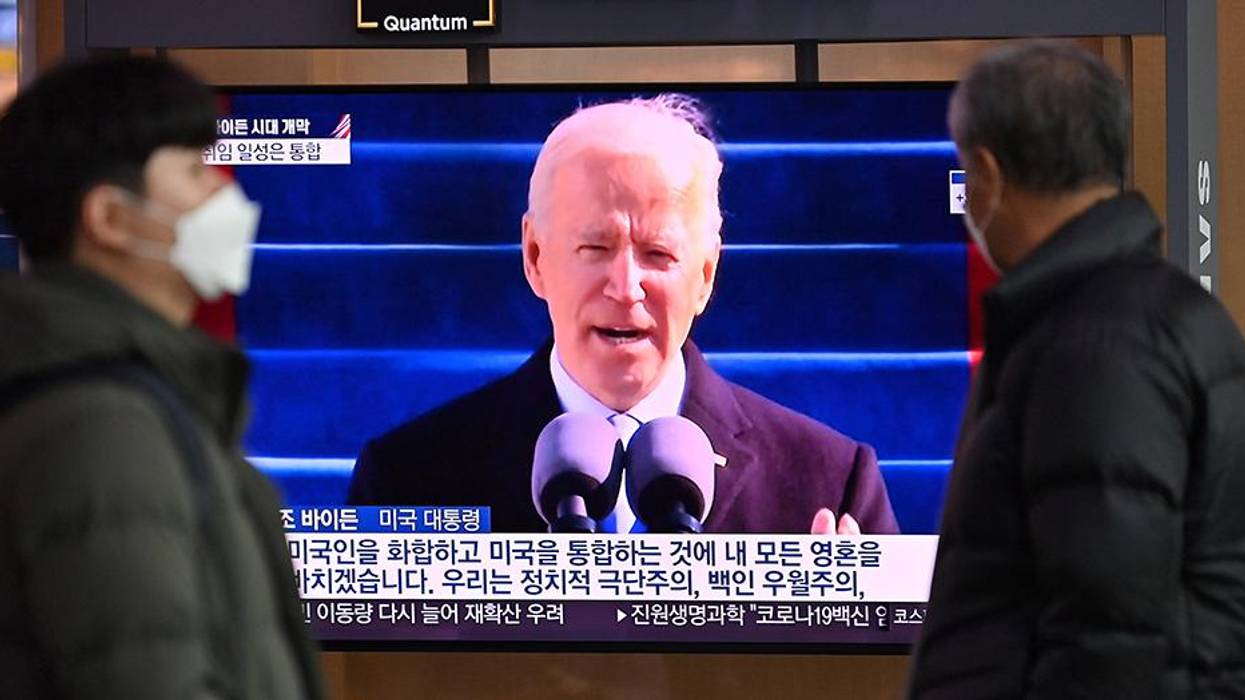
Often I hear the media or my friends refer to "when things go back to normal."
Having Joe Biden inaugurated as President of the United States on Jan. 20th makes it seem more possible--a return to "normalcy." Every day the deaths from the pandemic continue to tick upwards on the news -- as the numbers inch inexorably beyond 400,000 in the US, I suspect I am not the only one numbed and depressed - unable to take in the enormity of the numbers flashing on the screen - number dead, number sickened, number hospitalized...and behind every number, a human being, a worker, teacher or artist, someone who died alone because their families and friends could not sit by their bedside in that loneliest of vigils.
We must chart a post-pandemic future that is not a return to normalcy, but an opportunity to create anewCan we be blamed if we daydream about a post-COVID future, a return to normalcy?
But what does normalcy mean? My guess is that for many people - normalcy includes visits with family and friends, hugs and kisses for those we love, going out for a meal with friends, seeing a movie in a theatre.
But even pre-COVID, normalcy meant different things to different people. For the more than half a million people without a home (as of January 2019: "State of Homelessness: 2020 Edition", National Alliance to End Homelessness), normalcy pre-COVID meant living on the streets without a roof over their heads and without enough to eat. For the more than 400,000 young people in the foster care system (as of 2018, "The State of America's Children 2020" pg. 60, The Children's Defense Fund), normalcy meant living with people they did not call Mom and Dad. For people of color, normalcy includes walking in fear--of being in the wrong place at the wrong time, saying or doing the wrong thing at the wrong time to the wrong person.
The yearning for physical human contact and connection is a universal longing. Still, the talk about returning to normalcy amongst people with resources often implies, in addition: being able to eat out, attend movies and concerts, and return to carefree travel and vacation. These are not universal norms but rather the luxuries of the middle class and the wealthy.
One thing this pandemic has gifted us is how it has opened our eyes to how precarious life is and always has been. Life is precarious, and also precarious are the conditions the poor, the sick, and those unvalued by society have grappled with. We now appreciate and acknowledge essential workers. But before the pandemic, how many of us thought about farmworkers' conditions or meatpacking plant employees? Not to mention the myriad of other workers who don't receive livable wages...
This pandemic did not make essential workers essential - they were essential before. Still, we chose to ignore their importance, in most instances paying them poorly and treating them with little respect (supermarket employees, farmworkers, health care people, trash removal workers-this is far from a comprehensive list) and/or taking them for granted (doctors, teachers, the post office, all those who take care of those we have lost). The exploitative treatment of low-wage workers, disproportionately represented by people of color, has contributed to the disproportionate impact of COVID-19 on black and brown people. 34% of all deaths related to Covid19 are Black Americans (Centers for Disease Control and Prevention).
Returning to "normal" is not looking so feasible anymore, nor does it look desirable. Do we want to return to a world where some of us enjoyed the fruits of all of our labors and so many others struggled just to put meals on the table for their families? A world where some turn to the police for safety while others fear for their lives? A world where some of us jump on flights or into our cars to take carefree trips without considering what we are doing to the planet and hence to our own present and future?
If we had enough money, a family, and the kind of job where we could work at home, we have spent most of the past year spending more time with our families than ever before, more time in nature, more time taking care of ourselves and our loved ones and we got to shelter in place at home. If we didn't, we worked harder than we had ever worked before in unsustainable, terrifying, heartbreaking, and dangerous conditions.
We must chart a post-pandemic future that is not a return to normalcy, but an opportunity to create anew, a world where all people are treated with love and respect, respect reflected in fair wages for honorable work, and all work is understood to be honorable. Where we value all workers all the time, not just during bleak pandemic times when we have to face how much we have taken for granted the people who kept our worlds and our lives running.
Can those of us who had the luxury to stay at home take what we learned about staying home, working from home, and learn to lead sustainable lives where travel is much more judiciously and rarely planned and all that running, walking, and biking can be applied towards commuting, not just exercise? Can we "dare to create something new," as Pope Francis stated in his editorial "A Crisis Reveals What is in Our Hearts" (November 26, 2020). The Pope issues a clarion call: "This is a moment to dream big, to rethink our priorities -- what we value, what we want, what we seek -- and to commit to act in our daily life on what we have dreamed of."
Let us rise to his call and dare to dream big, to imagine and create a world where each person is valued and respected, where work is adequately and fairly compensated, and each person has their basic human needs (food, shelter, safety, health care, fulfilling work, love, and respect) met generously, yet in a responsibly sustainable manner that will meet and solve the urgent challenges of the climate crisis.
We have united across the world before to face existential and terrifying crises victoriously - the human race is at a pivotal moment to prove that we can do it yet again. Will we be able to rise and be victorious? I think we can. We must.
The first car my parents carted me and my siblings around in, in the 1950s, didn't even have seatbelts. Not one of us was ever strapped into a car seat. No kid I knew donned a helmet before hopping on her bike.
When I was a kid, there were no government-regulated safety standards for cribs or playpens or strollers. There were no "choking hazard" warnings on the packages containing the toys we played with, regardless of how many small, potentially detachable parts came with those toys.
After decades marred by child deaths in car accidents, and what were determined to be preventable deaths if only baby equipment manufacturers had thought to make this crib safer, or that stroller less dangerous, the federal government stepped in.
Taxpayer-funded government agencies, like the Consumer Product Safety Commission, founded in 1972, told corporations they had to make products safer. They had to take responsibility for the products they profited from, and for keeping kids safe.
Despite being "regulated" by the EPA, and despite being linked to a host of human health issues, agricultural chemicals like glyphosate and chlorpyrifos that pollute our air and water, and whose residues contaminate our food, continue to be widely used.
Meanwhile, over this same time period, chemical companies brought more and more chemicals to market, including pesticides and herbicides. The U.S. Food & Drug Administration (FDA), in place since 1906, was already supposed to be keeping our food safe. The U.S. Environmental Protection Agency (EPA), which didn't come along until 1970, was supposed to keep our air and water safe.
Yet of the more than 80,000 chemicals used in the U.S. today, most haven't been adequately tested for their impact on human health, much less on the health of children.
That's bad enough. But this is worse: Despite being "regulated" by the EPA, and despite being linked to a host of human health issues, agricultural chemicals like glyphosate and chlorpyrifos that pollute our air and water, and whose residues contaminate our food, continue to be widely used. Even though cancer kills more children in the U.S. than accidents do.
It begs the question: Why have we come so far on protecting our kids from some harms, only to allow chemical companies to poison them?
A toxic, deadly soup
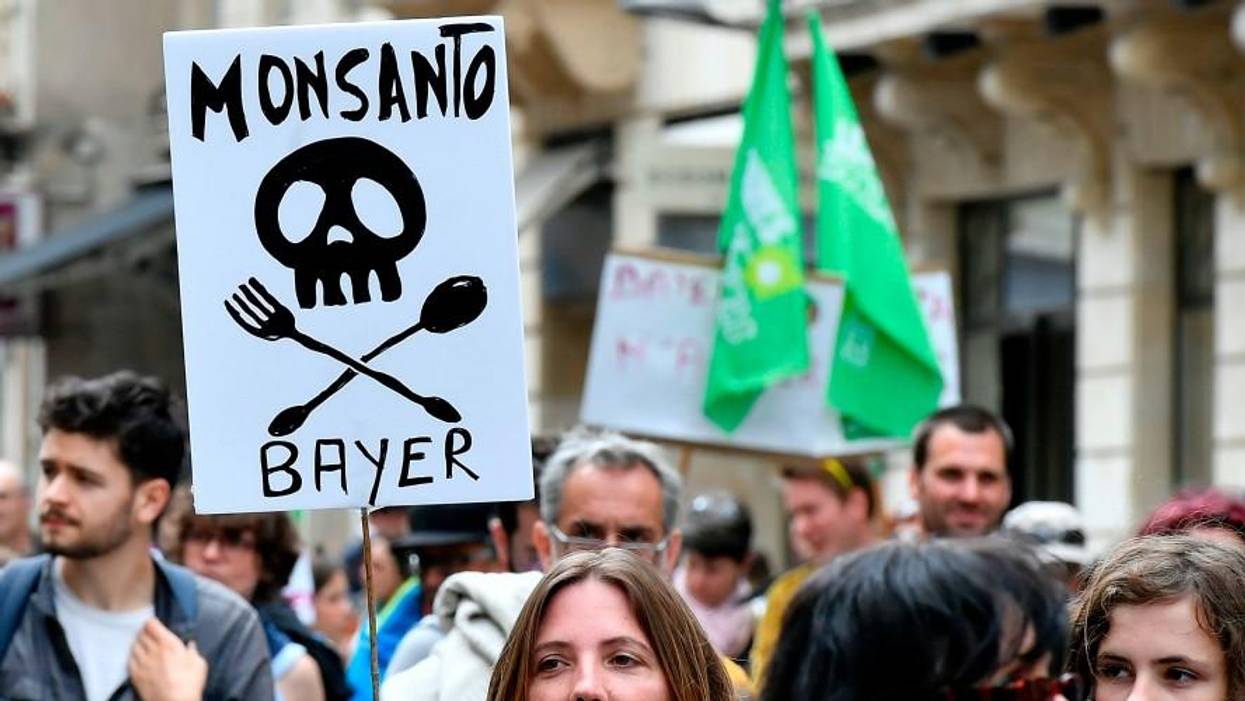
Sometime in the near future, a 12-year-old boy will take on Bayer-Monsanto in a U.S. courtroom. Jake Bellah has non-Hodgkin lymphoma, a type of cancer linked to exposure to Monsanto's Roundup weedkiller. He and his parents allege that exposure to Roundup caused his cancer.
An article in the Guardian this week featured the story of Oliver Strong, who died from acute myeloid leukemia in June 2015 at the age of 12. Concerned that their otherwise healthy, athletic son's cancer was caused by exposure to toxic chemicals, Oliver's parents set up a foundation that is working with Texas Children's Hospital and the Baylor College of Medicine to study the correlation between exposure to chemical toxicants and childhood cancer.
Citing statistics from the National Cancer Institute, the Guardian reported that cases of pediatric cancer in the U.S. surged by almost 50 percent from 1975 to 2015. The institute predicted that in 2018, up to 16,000 children, from birth to age 19, would receive a new cancer diagnosis.
Are all these cancers caused by exposure to chemicals? Probably not. But most are, says Dr. Zach Bush, a former cancer researcher. Bush, who said he was taught that cancer was a genetic disease, says his research now supports the theory that most cancers can be tied to exposure to chemicals.
Bush specifically blames Monsanto's Roundup:
"This one tiny molecule is now gumming up the gears of life, it's stopping, on so many levels, all normal functions of resilience, and we're becoming a very unresilient species and damaged species, and we're dying very quickly."
For decades, glyphosate-based herbicides like Roundup have been under fire for harming human health and the environment. The 2015 decision by the World Health Organization that glyphosate is a "probable human carcinogen" led to heightened scrutiny. It also led many countries --though not the corporate lobbyist-loving U.S.--to ban the chemical.
Today, there are more than 18,400 lawsuits pending against Bayer, by people who believe exposure to Roundup caused their cancer.
It isn't just glyphosate making us sick. And it isn't just cancer that's harming our kids. The EPA recently overturned a ban on chlorpyrifos, an agricultural chemical known to cause birth defects and neurological damage in children.
Writing about the EPA's chlorpyrifos decision for the Washington Post, Joseph G. Allen, assistant professor at Harvard T.H. Chan School of Public Health, posed this question:
Do you think that a chemical cousin of nerve agents used in World War II that alters the brain function of children should be used as a pesticide? I'd hazard a guess that most people think this is a bad idea. The Trump administration, on the other hand, thinks this is just fine.
Caution to the wind
How is it that chemical companies are able to unleash more than 80,000 unregulated chemicals into our environment and food supply? And how do we protect our children from the toxins we know--like glyphosate and chlorpyrifos--and those we don't even know exist, much less where they lurk?
How is it that chemical companies are able to unleash more than 80,000 unregulated chemicals into our environment and food supply?
An article pubished this week by CBS Marketwatch, covering Organic Consumers Assocation's lawsuit against Twinings Tea, and a similar lawsuit by Children's Defense Fund against Beech-Nut baby food, included this quote by Dr. Aparna Bole, chair of the American Academy of Pediatrics Council on Environmental Health:
"Ultimately it should not be the job of consumers to try to purchase their way out of the fact that we in this country don't take a precautionary approach to chemical safety."
Bole was no doubt referring to the Precautionary Principle, a principle that government agencies routinely and recklessly ignore.
In a 2001 paper published in Environmental Health Perspectives, a team of scientists wrote:
The precautionary principle, proposed as a new guideline in environmental decision making, has four central components: taking preventive action in the face of uncertainty; shifting the burden of proof to the proponents of an activity; exploring a wide range of alternatives to possibly harmful actions; and increasing public participation in decision making.
That was in 2001. Yet here we are, in 2019, with an EPA that clearly has no intention of following these guidelines--no matter what the scientists say or the public demands. And no matter how many children suffer through surgeries and painful, debilitating treatments--only, in many cases, to die anyway.
The International Federation of Gynecology and Obstetrics issued a statement this week calling for the "removal of glyphosate from global usage."
Meanwhile, we're stuck with an EPA that won't ban glyphosate or chlorpyrifos, and that earlier this year proposed tripling the amount of perchlorate, a chemical used in rocket fuel, allowed in our drinking water supplies.
My three siblings and I were lucky. We survived, minus the seatbelts and carseats and helmets that provide protection for today's kids. But I worry for my 2-year-old grandson and 6-year-old granddaughter. Though they travel surrounded by high-tech protective gear and play with safety-tested toys, when it comes to cancer-causing chemicals, they're at the mercy of our government "protection" agencies that place a far higher value on corporate profits than they do on small lives.

For all the rhetoric and all the charities regarding America's children, the U.S. stands at the very bottom of western nations and some other countries as well, in terms of youth well-being. The U.S.'s exceptionalism is clearest in its cruelty to children. The U.S. has the highest infant mortality rate of comparable OECD countries. Not only that, but 2.5 million American children are homeless and 16.2 million children "lack the means to get enough nutritious food on a regular basis."
The shamelessness continues as the youngsters increase in age. The Trump regime is cutting the SNAP food program for poor kids. In 2018, fewer children were enrolled in Medicaid and CHIP than in 2017. To see just how bad Trump's war on poor American children is getting, go to the web sites of the Children's Defense Fund and the Children's Advocacy Center.
Trump brags about a robust economy--still, however, rooted in exploitation of the poor and reckless Wall Street speculation with people's savings.
"Until the contented classes wake up and organize for change, history has shown, our country will continue to slide in the wrong direction."
Trump's pompous promises during his presidential campaign have proved to be a cowardly distraction. He claimed he would take on the drug companies and their price gouging. The hyper-profiteering pharmaceutical goliaths are quietly laughing at him. Worse, Trump continues their tax credits and allows them to use new drugs developed with taxpayer money through the National Institute of Health free of charge--no royalties. Even though he talks tough, Trump lets these companies sell imported medicines manufactured in China and India with inadequate FDA inspections of foreign plants.
Torrents of Trump tweets somehow overlooked H.P. Acthar Gel, a drug produced by Mallinckrodt to treat a rare infant seizure disorder, which increased in price from $40 per vial to $39,000 per vial! Other drug prices are booming cruelly upward, while Trump blusters, but fails to deliver on his campaign promises.
For years our country's political and corporate rulers have saddled college students with breathtaking debt and interest rates. Student debt is now at $1.5 trillion. Both corporations and the federal government are profiting off of America's young. In no other western country is this allowed, with most nations offering tuition-free higher education.
On May 2, 2019, The New York Times featured an article titled, "Tuition or Dinner? Nearly Half of College Students Surveyed in a New Report Are Going Hungry."
When you read the stories of impoverished students, squeezed in all directions, you'd think they came out of third-world favelas. At the City University of New York (CUNY), forty eight percent of students had been food insecure in the past 30 days.
Kassandra Montes, a senior at Lehman College, lives in a Harlem homeless shelter. Montes "works two part-time jobs and budgets only $15 per week for food... [She] usually skips breakfast in order to make sure that her 4-year-old son is eating regularly." Montes said: "I feel like I'm slowly sinking as I'm trying to grow."
When you don't have a living wage, have to pay high tuition, are mired in debt, and live in rent-gouging cities, where do you go? Increasingly, you go to the community college or college food pantry. In a nation whose president and Congress in one year give tens of billions of dollars to the Pentagon more than the generals asked for, it is unconscionable that students must rely on leftover food from dining halls and catered events, SNAP benefits, and whatever food pantries can assemble.
The CUNY pantries are such a fixture in these desperate times that they are now a stop on freshman orientation tours.
As long as we're speaking of shame, what about those millions of middle and upper middle class informed, concerned bystanders. They're all over America trading "tsk tsks" over coffee or other social encounters. They express dismay, disgust, and denunciations at each outrage from giant corporations' abuses, to the White House and the Congress' failings. They are particularly numerous in University towns. They know but they do not do. They are unorganized, know it, keep grumbling, and still fail to start the mobilization in Congressional Districts of likeminded citizens to hold their Senators and Representatives accountable.
For Congress, the smallest yet most powerful branch of government, whose members names we know, can turn poverty and other injustices around and help provide a better life for so many Americans. These informed, concerned people easily number over 1 percent of the population. They can galvanize a supporting majority of voters on key, long-overdue redirections for justice. Redirections that were mostly established in Western Europe decades ago (For more details, see my paperback, Breaking Through Power: It's Easier than We Think).
These informed, concerned people--who don't have to worry about a living wage, not having health insurance, being gouged by payday loans, and having no savings--were called "the contented classes" in The Culture of Contentment, a book by the late progressive Harvard economist John Kenneth Gailbraith. His main point--until the contented classes wake up and organize for change, history has shown, our country will continue to slide in the wrong direction. He said all this before climate disruption, massive money-corrupting politics, and the corporate crime wave had reached anywhere near their present destructive levels.
The question to be asked: Who among the contented classes will unfurl the flag of rebellion against the plutocrats and the autocrats? It can be launched almost anywhere they please. A revolution can start the moment they decide to prioritize the most marginalized people in this country over their comfort.

Children's rights and immigrant rights advocates are incensed over the forced separation of a Congolese woman and her seven-year-old daughter who arrived in the United States last November, seeking asylum.
The woman is being held in a detention facility in San Diego while her daughter is being held 2,000 miles away in Chicago by the Office of Refugee Resettlement. Immigration and Customs Enforcement (ICE) has given no reason for separating the two.
"Tearing apart asylum seekers and their families is abhorrent and counter to child welfare practices, federal law, and international laws and treaties," Sandy Santana, executive director of Children's Rights, said in a statement Monday. "It also stands in stark contrast to this administration's purported commitment to family values."
Along with the Children's Defense Fund, the Juvenile Law Center, and a dozen other advocacy groups, Children's Rights filed an amicus brief on Monday in support of the mother and child in a lawsuit filed against the Trump administration by the American Civil Liberties Union (ACLU).
According to the brief, the separation of the mother and her child is "an unconscionable overreach of government power violating fundamental principles of fairness, including substantive due process rights under U.S. constitutional law, and threatens one of our most fundamental social constructs, the family.
After fleeing political unrest in the Democratic Republic of Congo, the mother and daughter passed a "credible fear" interview upon arriving at San Ysidro Port of Entry in California, convincing immigration officials that they should be granted an asylum hearing.
But days later, ICE inexplicably moved the woman into Otay Messa Detention Center in San Diego and sent her child to Chicago, "without justification or even a hearing." The two have spoken over the phone just six times since their separation.
The Trump administration has considered proposals to separate families who attempt to cross the U.S.-Mexico border, sparking outcry from critics.
The separation of refugee or immigrant parents from their children without a hearing is a violation of due process rights, say immigrant rights groups, while children's health experts warn of the long-lasting effects a separation like the one the mother and her daughter could have on the child.

After a short summer hiatus, the battle over health care policy reemerged with a passion last week when Senator Sanders introduced a version of "single payer" universal health care coverage and Senators Cassidy and Graham introduced yet another bill attempting to repeal Obamacare. These are just the latest eruptions of a longstanding war both for and against government supported comprehensive healthcare coverage and quality health care. It is an on-going war--a war that began with Teddy Roosevelt's 1912 presidential campaign and the Progressive Party, extended through the Roosevelt and Truman administrations, erupted with Medicare and Medicaid during the Johnson administration, faltered with HillaryCare during the Clinton administration, and exploded into the 21st century with the struggle over Obamacare.
This article will examine the Republican side of this war. Republicans hate government supported health care in general and Obamacare in particular for a number of reasons: ideological opposition to any major government program expenditures not directly benefitting big business and support for supposed "free" market policies that maintain private sector control and corporate domination; opposition to taxes on the wealthy and large corporations especially when those taxes are used to fund government programs that support moderate and low-income families including the Obamacare taxes that subsidize the cost of insurance to make it more affordable; a focus on limiting and eliminating the availability of contraception and abortion; or a mix of all of these.
Given such opposition, Republicans have been engaged in a four-pronged attack against governmental programs that seek to improve the health of all Americans: introducing legislation to repeal and replace Obamacare; sabotaging and killing Obamacare through administrative fiat and court cases; significantly slashing funds for government health care programs; and eliminating environmental and workplace regulations and programs that protect people's health. There is a sense of urgency to complete this offensive because Republicans apparently want to register some kind of "win" in order to fulfill long-standing promises to gut Obamacare, roll back government supported health care programs and grant billions of dollars in tax cuts to large corporations and the wealthy--no matter the cost in human suffering.
THE LEGISLATIVE ATTACK ON GOVERNMENT SUPPORTED HEALTH CARE
Not one of the Republican-sponsored bills to repeal/replace Obamacare included any plan to improve the health and welfare of most Americans. Not one of their bills sought to increase comprehensive coverage for the 28 million Americans who are still uninsured or to reduce premiums and out of pocket expenses for comprehensive coverage. Instead, every one of their proposed legislative bills would have led to the deaths of thousands of people and adverse impacts on the health of everyone--especially women, infants, and children. The only real beneficiaries of their health care schemes would be large corporations and wealthy individuals whose taxes would have been reduced.
Yet, these bills passed the House with the support of more than 90% of the Republican caucus and lost by just 1 vote in the Senate. Senators Cassidy and Graham introduced a new repeal bill last week proving that any of these bills can be resurrected at almost anytime subject to the legislative rules in each of the chambers. Here are just two examples to remind us of the disastrous consequences of these bills.
THE ADMINISTRATIVE AND JUDICIAL CAMPAIGN TO SABOTAGE OBAMACARE
Even if their legislative strategy of repeal/replace fails, Republicans are continuing their seven-year campaign to sabotage and kill Obamacare. This effort was begun in Congress, supported by19 Republican Governors, reinforced by court rulings and joined by Trump after he was elected. Here are some examples of the sabotage that have already taken place.
All of these tactics have deliberately caused greater increases in premiums and reductions in the number of people able to obtain coverage as well as destabilizing the health care exchanges. As a result, these tactics have caused widespread pain and suffering for millions of people.
THE BUDGETARY WAR AGAINST PROGRAMS THAT IMPROVE HEALTH CARE - ESPECIALLY FOR WOMEN, INFANTS AND CHILDREN
While the media and public have focused attention on the attack against Obamacare, President Trump and House Republicans have also proposed budget plans that will cut trillions of dollars from health programs and basic assistance while promising massive tax cuts that will largely go to large corporations and the most wealthy members of our society. Children and women are among the groups that will be most harmed by these budget cuts. Here are some examples.
THE ATTACK ON ENVIRONMENTAL AND WORKPLACE PROGRAMS AND REGULATIONS THAT PROTECT EVERYONE'S HEALTH
The administration and Congressional attack on any government program to support health quality is also taking place through the elimination or slashing of environmental and workplace programs and regulations. The attack on environmental programs is not only an attempt to assist corporate polluters and pad the profits of large corporations but also a means to make room for the coming massive tax breaks that will be proposed for large corporations and the wealthy. But guess who suffers from this dismantling of environmental programs and protections? Christine Todd Whitman, the EPA administrator under President W. Bush even wrote an article for The Atlantic entitled "I ran George W. Bush's EPA and Trump's Cuts to the Agency Will Cost Lives." Here is a small sample of what is taking place and who will suffer.
SO FAR, THE REPUBLICAN OFFENSIVE HAS BACKFIRED
The Republicans have implemented a strategy to undermine Obamacare and destroy all vestiges of government support for comprehensive health coverage and health care quality. So far, this strategy has backfired. The Republican repeal/replace bills energized a significant, broad and active opposition by citizen groups and health care institutions and experts around the country. This opposition forced Democrats to hold the line and made it possible for at least three Republican Senators to vote against the Republican repeal/replace bills this past spring and summer. This was a narrow margin but a significant victory. Such mass activity will again be required to enable at least three Republican and all Democratic Senators to oppose the Cassidy-Graham repeal bill. This broad based opposition will continue whether or not the Cassidy-Graham bill passes and could be an important factor in the 2018 and 2020 elections.
The Republican offensive also sought to forestall any efforts to "improve" Obamacare. However, it actually stimulated a number of Republicans and Democratic Senators to discuss reforms that might strengthen Obamacare. The Republicans leading this effort have pulled back during the fight over the Cassidy-Graham bill. Yet, such discussions may be revived if the latest repeal effort is defeated.
Finally, the Republican offensive was an attempt to deliver a generational deathblow to any proposals that would create a government-sponsored health care system requiring universal and comprehensive coverage. Yet, the Republican strategy apparently awakened a sleeping giant - a progressive movement to establish a truly universal health care system. It is now up to progressives to implement a strategy to achieve this goal.
Late in the afternoon of February 1, 1960, four young black men -- Ezell Blair Jr., David Richmond, Franklin McCain, and Joseph McNeil, all students at North Carolina Agricultural and Technical College in Greensboro -- visited the local Woolworth's five-and-dime store. They purchased school supplies and toothpaste, and then they sat down at the store's lunch counter and ordered coffee.
"I'm sorry," said the waitress. "We don't serve Negroes here."
Late in the afternoon of February 1, 1960, four young black men -- Ezell Blair Jr., David Richmond, Franklin McCain, and Joseph McNeil, all students at North Carolina Agricultural and Technical College in Greensboro -- visited the local Woolworth's five-and-dime store. They purchased school supplies and toothpaste, and then they sat down at the store's lunch counter and ordered coffee.
"I'm sorry," said the waitress. "We don't serve Negroes here."
The four students refused to give up their seats until the store closed. The local media soon arrived and reported the sit-in on television and in the newspapers.
The four students returned the next day with more students, and by February 5 about 300 students had joined the protest, generating more media attention. Their action inspired students at other colleges across the South to follow their example. By the end of March sit-ins had spread to 55 cities in 13 states. Many students, mostly black but also white, were arrested for trespassing, disorderly conduct, or disturbing the peace.
In hundreds of cities across the country, Americans of conscience -- led by churches and synagogues, unions, and college students -- demonstrated their support for the sit-ins by picketing in front of Woolworths stores, urging people to boycott the national chain until it desegregated its Southern lunch counters.
The Greensboro Woolworths ended its policy of segregation a few weeks after the North Carolina A&T students began their protest. Within months, hundreds of other lunch counters, department stores, and other retail businesses throughout the South announced plans to serve all customers equally. The sit-ins, the picketing by allies, the consumer boycott, and the negative publicity had worked.
Most conservatives and even some liberals -- black and white -- thought that the student activists were too radical. But their actions galvanized a new wave of civil rights protest.
At the invitation of organizer Ella Baker, over Easter weekend -- April 16-18 -- several hundred sit-in activists and their allies came to Shaw University, a black college in Raleigh, North Carolina, to discuss how to capitalize on the sit-ins' growing momentum and publicity.
This gathering became the founding meeting of the Student Nonviolent Coordinating Committee (SNCC). Its growing base of supporters played key roles in the freedom rides, marches, and voter registration drives that eventually led Congress to enact the Civil Rights Act of 1964 and the Voting Rights Act of 1965.
Many SNCC activists became key leaders in subsequent battles for social justice. One was Marion Wright Edelman, founder of the Children's Defense Fund. Another was Congressman John Lewis, who courageously risked his life many times for social justice, but whom Donald Trump, in one of his recent twitter tantrums, criticized as "all talk, no action."
Two weeks ago, over four million Americans took to the streets to resist Donald Trump's assault on women's rights, immigrants, Muslims, civil liberties, workers' rights, environmental justice, and the basic tenets of our democracy. Last weekend, Americans again took to the streets (and airports) to oppose Trump's ban on admitting refugees and immigrants to this nation of immigrants. Every day since Trump took office, Americans have taken to the streets, and will continue to take to the streets, to challenge Trump's threat to our democracy.
The struggle continues. This is how people make history.
After her loss to Barack Obama in the 2008 Democratic primary, few predicted that Hillary Clinton would leave the world of presidential politics. On the contrary, it was widely believed that she would make another run for the White House.
Anticipating such a run, the renowned political scientist and activist Frances Fox Piven, along with sociologist Fred Block, penned an open letter calling on Clinton, who had just left the State Department, to "step forward" and "launch a national debate about poverty and welfare."
"Specifically," Piven and Block wrote, "we are asking for you to open a conversation about the shortcomings of the 1996 welfare legislation that was passed when you and Bill Clinton were in the White House."
The letter was not unprovoked: In the years immediately following welfare reform's implementation, Hillary Clinton was an ardent defender of its underlying logic, arguing that it was a "critical first step" in the broader move toward a more effective system.
And Clinton's defenses of the law didn't cease even as evidence of its harmful effects became increasingly prominent. Indeed, in 2008, the New York Times reported that, in an interview, "Clinton expressed no misgivings about the 1996 legislation."
In 2016, circumstances changed. Faced with a primary opponent running far to her left, Clinton shifted: "Now we have to take a hard look at" welfare reform, Clinton said in April, citing the entirely predictable failure of the now almost non-existent safety net to catch those harmed by the financial crisis.
Fast-forward several months, however, and the issue has all but vanished from the scene; no such "hard look" appears to be forthcoming.
Welfare reform's absence was especially conspicuous in Clinton's recent Times op-ed, in which she outlined her "plan for helping America's poor."
Clinton highlighted her tenure as a lawyer for the Children's Defense Fund, where she was mentored by Marian Wright Edelman, the organization's founder. But the issue that prompted a rather bitter split between the two was left unmentioned.
Prior to its passage, welfare reform garnered striking bipartisan support. But dissent was there, and it was forceful. Edelman's voice was among the most powerful, the most insistent, and, to those reading her words today, the most prescient.
"It would be wrong to leave millions of voteless, voiceless children to the vagaries of 50 state bureaucracies and politics, as both the Senate and House bills will do," she wrote in the Washington Post. "It would be wrong to strip children of or weaken current ensured help for their daily survival and during economic recessions and natural disasters, as both the Senate and House bills will do. It would be wrong to exacerbate rather than alleviate the current shameful and epidemic child poverty that no decent, rich nation should tolerate for even one child."
Her pleas fell upon deaf ears; welfare reform passed and was implemented, and its successes in booting millions off of "the dole" and diverting money away from poor families and into the coffers of state governments--which were given tremendous latitude in how they could spend the money -- were cheered by Democrats and Republicans alike.
But for the most vulnerable, there was little to celebrate.
Some found work, largely in low-wage jobs; those who didn't, or couldn't, slipped into deep poverty. The research of Kathryn Edin and Luke Shaefer, noted the Washington Post's Max Ehrenfreund in February, "shows that the number of people living on $2 a day or less in cash has increased more than twofold, to 1.6 million households" since welfare reform's passage.
The impact on children has been profound. "Under TANF," a report by the Center on Budget and Policy Priorities notes, "the number of children living in deep poverty--with incomes below half the poverty line, using a comprehensive poverty measure--has risen significantly, placing large numbers of children at risk for long-term negative academic, employment, and health outcomes."
It is significant that Hillary Clinton has consistently downplayed this reality. In her Times piece, she acknowledges in passing that "extreme poverty has increased," but she does little to explain how such destitution arose in the world's wealthiest nation.
And, as Ryan Cooper explains, while many of the proposals Clinton puts forward are welcome and necessary--from her emphasis on affordable housing to her support for paid family and medical leave -- her plan taken as a whole is "woefully inadequate."
"The problem, at root, is the same one Paul Ryan has with his various anti-poverty ideas--a wildly disproportionate focus on work, and a corresponding lack of attention to the welfare policies that could seriously cut poverty," Cooper argues.
Citing the research of Matt Bruenig, Cooper writes that Clinton's work-centric approach would do little to alleviate poverty because a "huge majority of poor people are not employable."
Bruenig calls this large group "the CEDS bloc": It consists of children, the elderly, those with disabilities, and students. And, Bruenig notes, "no matter which common poverty measure you use," 60 to 65 percent of the poor fall in one of these four categories. Add to that the 20 percent represented by "carers and those who faced a spell of involuntarily unemployment during the year," and you have a picture of poverty that is entirely different than that painted by the nation's two major political parties.
"So, all together," Bruenig concludes, "the CEDS bloc plus carers and those who faced a spell of involuntarily unemployment make up around 80-85% of the poor in any given year."
Given this context, Clinton's assertion that "The best way to help families lift themselves out of poverty is to make it easier to find good-paying jobs" is, at best, disconnected, both from the lived experience of impoverished families and from statistical realities. Cooper notes that, of course, "more and better-paying jobs are a great policy objective, but it will have little purchase on the problem of poverty."
That work is nonetheless at the center of Clinton's anti-poverty strategy--as opposed to, say, the most effective approach to reducing poverty--is indicative of the ideological limitations not just of Hillary Clinton's agenda, but of the Democratic Party more broadly. It is not merely, to use Adolph Reed's phrase, an "atrophy of political imagination" that imposes such strictures; it is also the party's active commitments, both to its donor base and to dominant economic and political ideas.
Perhaps the most apt description of the party's ethos comes from former Nixon strategist Kevin Phillips, who once remarked that the Democratic Party is "history's second most enthusiastic capitalist party."
"They do not interfere with capitalist momentum," he added, "but wait for excesses and the inevitable popular reaction."
Far from defying this tradition--one that consolidated power during the administration of Bill Clinton--Hillary Clinton is advancing it, embracing a political status quo in which big money dominates and celebrating the relationship between America's dominant institutions and the nation's economic direction.
"Hillary Clinton is a capitalist," Emmett Rensin summarizes, "and even within a capitalist party, she is in both perception and in practice unusually comfortable with capitalism's worst practices."
Often characterized as clear-headed pragmatism, Clinton's approach to poverty lays bare the deep conservatism of the party that claims for itself, despite contradictory evidence, the label "progressive." But such conservatism is not surprising if one considers the significant changes that have taken place within the party over the last several decades.
Thomas Frank has documented the extent to which the Democratic Party has come to consist of professionals and technocrats, and this is reflected in voting patterns: As Lee Drutman has noted, as Democrats have moved rightward, theirs has increasingly become "the preferred party of the very wealthy."
Hillary Clinton's embrace of the anti-Trump members of the billionaire class provides only a superficial marker of this shift; the most consequential shifts have taken place just below this surface.
Clinton's party, Thomas Edsall has observed, is largely made up of an "unruly coalition": "upscale well-educated whites and, importantly, ethnic and racial minorities, many of them low income."
If we have learned anything in recent years, it is that the interests of the wealthy almost always win out.
As such, Edsall concludes, "Instead of serving as the political arm of working and middle class voters seeking to move up the ladder, the Democratic Party faces the prospect of becoming the party of the winners, in collaboration with many of those in the top 20 percent who are determined to protect and secure their economic and social status."
A party committed to securing the privileges of elite sectors of society cannot also push the aggressive (but remarkably simple) measures necessary to eradicate poverty; the party of Goldman Sachs, the party of ultra-rich professionals, and the party of oil lobbyists cannot also be the party of the poor.
In 2009, Peter Edelman--the husband of Marian Wright Edelman--and Barbara Ehrenreich wrote a scathing critique of the new anti-poverty discourse, whose adherents "consider poverty a voluntary condition, one curable with a quick kick in the pants and the opportunity to work for minimum wage."
This view persists in the present, on both sides of the political aisle; it is, in effect, a way of omitting the systemic causes of destitution, invoking in their place a critique not of capitalism, but of those victimized by it.
If we are to wage a successful war on poverty, we cannot, in the words of Mathew Snow, "accept capital's terms for addressing its own problems or purported moral imperatives that presuppose them. We can [we must] overturn those terms completely."
Speaking at Georgetown University in October of 1991, shortly after he announced that he would be pursuing the presidency, Bill Clinton put forward what he called "A New Covenant," an agenda that proposed an alternative to both "small government" conservatism and "big government" liberalism.
Speaking at Georgetown University in October of 1991, shortly after he announced that he would be pursuing the presidency, Bill Clinton put forward what he called "A New Covenant," an agenda that proposed an alternative to both "small government" conservatism and "big government" liberalism.
He spoke of a "third way to approach the American family," one that would do away, once and for all, with "the old big-government notion that there is a program for every social problem." Most famously, Clinton promised to "end welfare as we know it."
While these proposals were nominally centrist, in practice they relied on insidious right-wing rhetoric that decried "dependency" and lauded "personal responsibility."
Indeed, years into his presidency, when Clinton finally achieved his professed goal, the legislation he signed was a major plank of the reactionary Contract with America, a platform written in part by Newt Gingrich, who became Speaker of the House in 1995.
"Today, we are ending welfare as we know it," President Clinton -- ceremoniously "flanked by three former welfare recipients" -- told the press gathered on the White House lawn in August of 1996. "But I hope this day will be remembered not for what it ended, but for what it began."
As he spoke these words, the Washington Post reported, "women's groups and advocates for the poor protested along Pennsylvania Avenue."
They weren't alone. Writing in the Post the previous year, Marian Wright Edelman, founder of the Children's Defense Fund, called the legislation "fatally flawed, callous," and "anti-child." The law, she wrote, would "eviscerate the moral compact between the nation and its children and its poor."
Shortly after welfare reform was signed into law, Marian's husband, Peter, resigned from the Clinton administration in protest, calling the bill in a 1997 piece for The Atlantic "the worst thing Bill Clinton has done."
Stepping up to defend the Personal Responsibility and Work Opportunity Reconciliation Act from these compelling attacks was a former lawyer for the Children's Defense Fund and long-time friend of the Edelman family, First Lady Hillary Clinton.
This defense was far from tepid, and it continued even during her 2008 presidential run.
"I agreed that he should sign it and worked hard to round up votes for its passage," she wrote in her memoir, published in 2003. In 1999, she again invoked the rhetoric of the right, lamenting that "many of those on welfare had known nothing but dependency all their lives."
Welfare reform, she would go on to insist in an interview in 2002, had succeeded; the only question remaining was how to sustain this success.
"Now that we've said these people are no longer deadbeats -- they're actually out there being productive -- how do we keep them there?" Clinton said.
For many leftists, the debate over welfare reform serves as a useful starting point in drawing distinctions between the democratic left and the Democratic Party -- distinctions that began to emerge as early as the late 1960's and that became increasingly sharp in the years following Bill Clinton's presidency.
Throughout the 2016 primary process, Clinton touted her tenure as a lawyer for the Children's Defense Fund, but she did not focus on the welfare reform law she so eagerly championed in years past; her opponent, Bernie Sanders, was not so hesitant.
"I spoke out against so-called welfare reform because I thought it was scapegoating people who were helpless, people who were very, very vulnerable," Sanders said while campaigning in South Carolina. "Secretary Clinton at that time had a very different position on welfare reform -- strongly supported it and worked hard to round up votes for its passage."
Sanders also made a striking assertion: Welfare reform, he said, "more than doubled" the "number of families living in extreme poverty." The assertion prompted digging, and analysts largely agree that it is accurate.
"The prevalence of extreme poverty rose sharply between 1996 and 2011," note Kathryn Edin and H. Luke Shaefer. "This growth has been concentrated among those groups that were most affected by the 1996 welfare reform."
These facts, Sanders insisted, should not be overlooked, even as Hillary Clinton and her campaign attempt, from time to time, to adopt a more progressive posture.
"It's important," Sanders noted, referring to the record of presidential candidates. "If people are going to elect a president, they want to know, 'What is the history?'"
Throughout the primaries, much ink was spilled -- and is still being spilled -- in attempts to diagnose the left's wariness, and often deep dislike, of Hillary Clinton.
Some have, falsely and in bad faith, painted the socialist left as sexist and racist, arguing that the foundation of left opposition to Clintonism is burgeoning white male status anxiety.
Others have taken a different track, pointing to the perception -- quite widespread -- that Hillary Clinton is a liar as the reason she is viewed so unfavorably. This has been a topic of particular interest to New York Times columnist Nicholas Kristof. Back in April, Kristof called the notion that Clinton is "fundamentally dishonest" a "bogus narrative." On Sunday, he was back at it, this time to compare Clinton's "fibs" with the "huge lies" of Donald Trump.
While this kind of discussion may be entertaining for the commentariat -- it seems to have sparked a debate of sorts, with the Washington Post's Daniel Drezner countering that Clinton is the "the bigger and badder liar" because, unlike Trump, she is aware of the truth -- it contributes almost nothing of use.
And, of course, it distracts from the more central reasons leftists oppose Clinton, the main one being her actual record, as Politico's Bill Scher correctly observed back in May. Given her time in the public eye and in public office, this record is extensive -- one that cannot be erased with a few months of campaigning.
(This is not to say that the honesty question is irrelevant or unimportant. But the theme underlying much of the focus on values and public perception is that Clinton's lack of appeal, particularly among youngprogressives, is somehow due to her reputation as a liar, and not due to her record and views.)
"Clinton and the political movement she represents are simply despised by a great many leftists, with much justification," summarizes The Week's Ryan Cooper. "Democrats have been promoting milquetoast domestic policy, and capitulating to or participating in belligerent militarism, for an entire generation."
Cooper actually understates the case: With their championing of welfare reform, NAFTA, and the omnibus crime bill in the 1990's, along with their continued support for interventionist wars abroad and pro-business "trade" agreements, Democrats have moved rightward along with the Republicans, who, as Noam Chomsky often observes, have gone completely off the political spectrum.
But one need not look back in time to find reasons to reject Clintonism: In 2016, Hillary is actively courting the favor of conservative billionaires and, according to recent reports, the contemptible Henry Kissinger, who she touts as a personal friend. Despite purporting to be in favor of campaign finance reform, she has accepted millions in donations from Wall Street and hedge funds. And, having also received a significant sum of campaign cash from the insurance industry, she has turned her back on what was previously a key plank of the Democratic agenda, single-payer health care.
Her decision to choose a running mate who has in the past been hostile to labor and whose most notable claim to fame is his ability to woo corporate donors is just icing.
Clinton's record, in short, betrays a series of rightward sprints on matters of extreme consequence, sprints that were often accompanied by the crass, reactionary, and hostile rhetoric that has come to characterize the anti-poor, fanatically pro-business Republican Party. And though in 2016 Clinton has put forward a new image, the substance of her politics remains fundamentally unaltered.
In many ways, though, it is unfair, and unproductive, to focus solely on Hillary Clinton; many of these critiques, after all, can apply to the Democratic Party as a whole, which has flippantly abandoned any explicit working class agenda in favor of stale, top-down incrementalism that is compatible with the views of its donor base.
"Look at prominent Democrats like New York Gov. Andrew Cuomo, Connecticut Gov. Dan Malloy, New Jersey Sen. Corey Booker, or Chicago Mayor Rahm Emanuel," writes Fredrik deBoer. "Each has, to one degree or another, criticized unions, pushed for lower corporate taxes and undermined public schools. Like Clinton, each enjoys cozy relationships with economic elites. And these aren't random minor-league politicians, but the kind of prominent leaders who help define the party."
One figure not mentioned in the piece quoted above is Chuck Schumer, who essentially summarized the prevailing outlook of the Democratic Party when he remarked to the Washington Post, "For every blue-collar Democrat we will lose in western Pennsylvania, we will pick up two or three moderate Republicans in the suburbs of Philadelphia."
Having long ago done away with efforts to broaden their appeal among the working class by putting forward an ambitious agenda and rejecting the status quo, Democrats' principle concern these days is how best to publicly square a progressive exterior with an interior dominated by the wealthy.
In Trump, Democrats have, deBoer notes, found a much-needed excuse to avoid confronting the crises within their own party. But they are there, and they are very real.
Nonetheless, many leftists will hold their noses and vote for Hillary Clinton in November, largely for strategic reasons. Eddie Glaude and Noam Chomsky have been two of the most prominent voices advocating this approach; many have pushed back against it.
But in advocating lesser evilism as a voting strategy, Chomsky often makes another crucial point: That electoral politics should make up only a tiny part of efforts to change society for the better.
"The electoral season in the United States, the quadrennial extravaganza, typically tends to draw energy away from activism because people are caught up in the hoopla and the excitement and so on," Chomsky has said, expressing a view similar to that of Adolph Reed, who has frequently noted the problems with "electoralitis."
Democrats, for their part, have long been infected by electoralitis; they have come to view the election of more Democrats as an end in itself, not as a means to push for a more equitable society. But, long-term, we must be focused on more than merely defeating Trump; we must also defeat the appeal of Trumpism.
For that to happen, we need a strong left with a working class core.
Corporate centrism may be enough to pull off an electoral victory this time around, but it is not nearly enough to address unprecedented income and wealth inequality, environmental degradation, or -- for obvious reasons -- the corporate capture of the political process.
And it most certainly won't be enough to win over the diverse coalition of young progressives that overwhelmingly repudiated Clinton in the primaries.
If recent history is any guide, it is unlikely that Democrats will change course in any meaningful way, having been restrained by their own ideological and financial commitments. For that reason, it will be necessary to revisit, and to take very seriously, the words of Michelle Alexander: "I hold little hope that a political revolution will occur within the Democratic Party without a sustained outside movement forcing truly transformational change. I am inclined to believe that it would be easier to build a new party than to save the Democratic Party from itself."