
SUBSCRIBE TO OUR FREE NEWSLETTER
Daily news & progressive opinion—funded by the people, not the corporations—delivered straight to your inbox.
5
#000000
#FFFFFF
To donate by check, phone, or other method, see our More Ways to Give page.


Daily news & progressive opinion—funded by the people, not the corporations—delivered straight to your inbox.
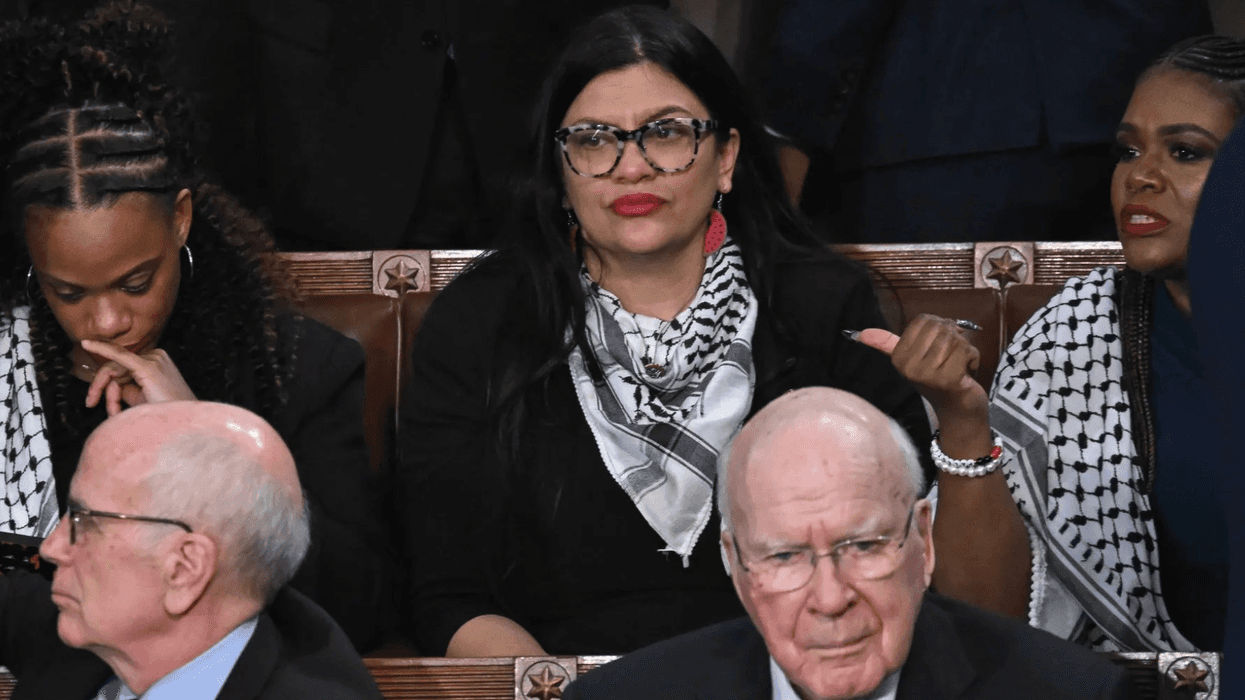
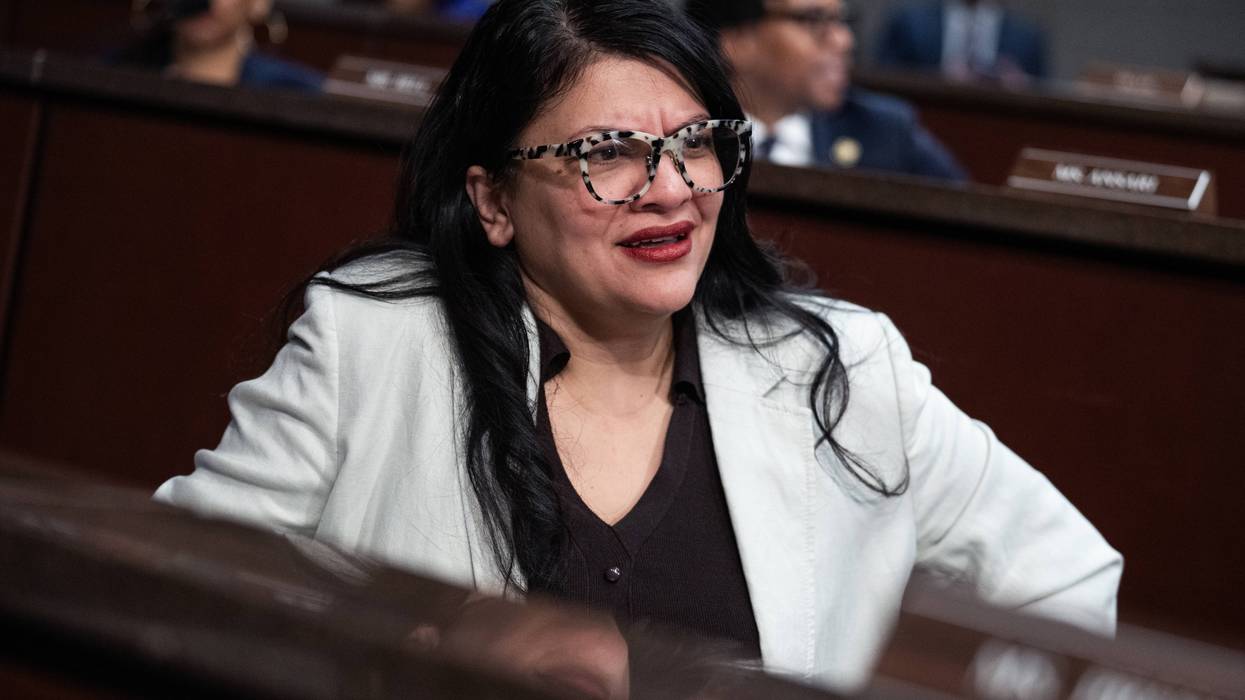
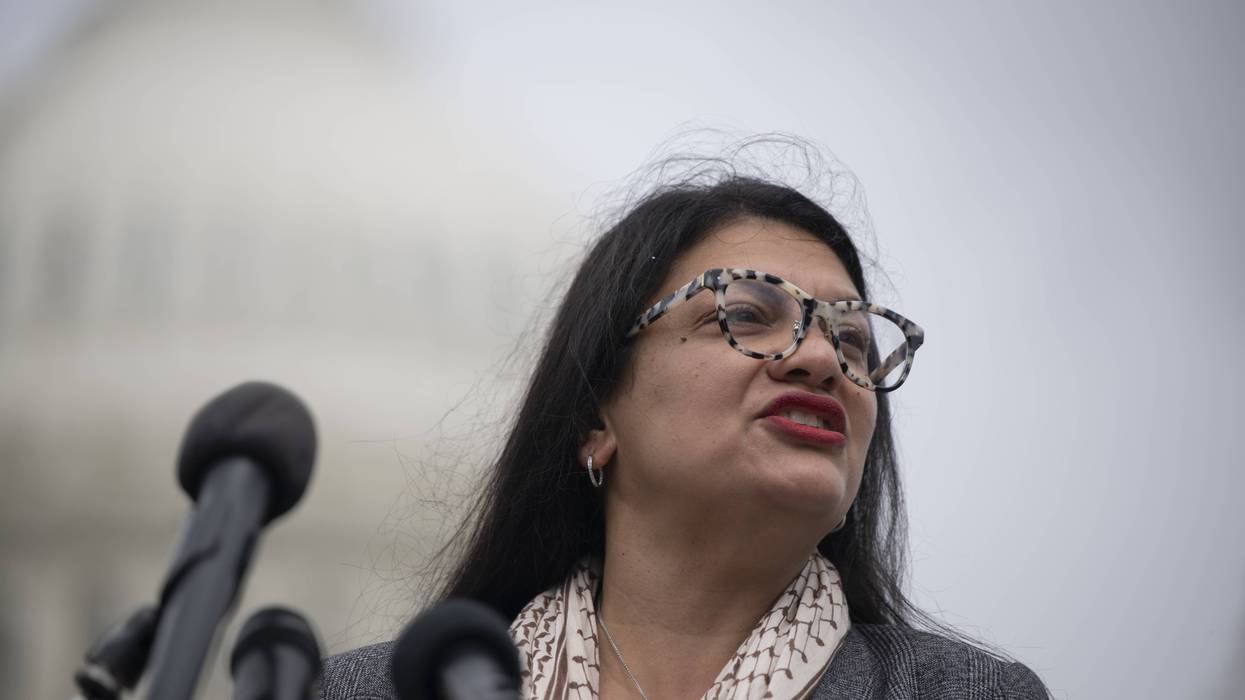
"The United States is not a bystander to these war crimes. It's an active participant," said the resolutions sponsor Rep. Rashida Tlaib.
Nearly two dozen Democrats joined almost every Republican on Tuesday to vote down a war powers resolution that would have halted US military participation in Israel's assault on Lebanon, which is threatening to derail President Donald Trump's peace negotiations with Iran.
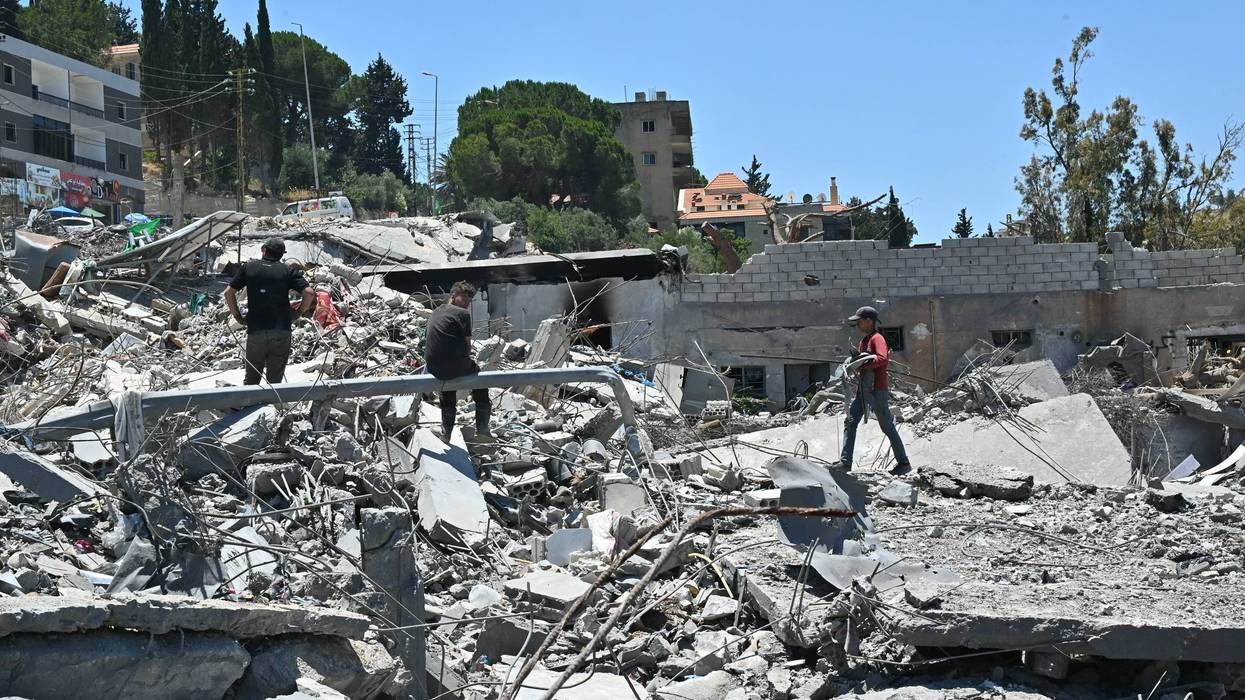
"More than 1.3 million people have already been forced to leave their homes or be killed, with the Israeli military telling them they will not be allowed to return," said the resolution's sponsor, Rep. Rashida Tlaib (D-Mich.), on the House floor Tuesday. "Eighty-one Lebanese neighborhoods have been violently depopulated and demolished—erased from the map entirely."
Along with Republican Reps. Thomas Massie (Ky.) and Lauren Boebert (Colo.), the resolution received support from 187 Democrats on Tuesday, more than double the number who supported a similar resolution introduced by Tlaib earlier this month.
Despite top House Democrats, including Minority Leader Hakeem Jeffries (NY) and Foreign Affairs Committee Ranking Member Gregory Meeks (NY), giving rhetorical backing to the resolution this time around, The Intercept reported that they did not formally whip the vote.
Twenty-two Democratic hawks joined the GOP to vote against ending cooperation with Israel's war, which has killed more than 4,000 people since March.
Among them were a clique of Democrats who have signed on to the centrist "Promise to America" aimed at countering the momentum of progressive and democratic socialist candidates within the party—including Reps. Donald Davis (NC), Laura Gillen (NY), Vicente Gonzalez (Texas), Josh Gottheimer (NJ), Adam Gray (Calif.), Susie Lee (Nev.), and Tom Suozzi (NY).
Others include favorites of the America Israel Public Affairs Committee (AIPAC), including Reps. George Latimer (NY), Henry Cuellar (Texas), Jared Golden (Maine), and Brad Schneider (Ill.), who have each received over a million dollars from it and other pro-Israel lobbying groups over their careers, according to FEC reports reviewed by Track AIPAC.
Other Democratic opponents include Reps. Steny Hoyer (Md.), Greg Landsman (Ohio), Jared Moskowitz (Fla.), Donald Norcross (NJ), Jimmy Panetta (Calif.), Marie Gluesenkamp Perez (Wash.), Brad Sherman (Calif.), Darren Soto (Fla.), Norma Torres (Calif.), Juan Vargas (Calif.), and Marc Veasey (Texas), many of whom have also received extensive support from the lobby.
As voting began on Tuesday afternoon, Lebanese-American journalist Rania Khalek said that "how people vote on this is a big indicator of who is bought and paid for by the war machine and Israel lobby."
In a comment to Axios, the staunch pro-Israel centrist Golden justified his vote against the measure by claiming that "to the best of my knowledge, we're not engaged in a conflict with Lebanon."
Latimer made a similar statement on social media, claiming that the resolution was only good for "messaging" since the US did not have any active troops in Lebanon.
But Tlaib argued on the House floor that "the United States is not a bystander to these war crimes. It's an active participant."
"The United States is currently engaged in illegal and unauthorized hostilities supporting the Israeli invasion of Lebanon in violation of the War Powers Act," she said. "The Trump administration is providing intelligence, coordinating strikes, demonstrating overt command over the Israeli military decisions, including greenlighting specific Israeli attacks and operations."
Other supporters of the resolution emphasized that ending Israel's occupation of Lebanon is a precondition for ending Trump's war with Iran.
"Ending Israeli military action in Lebanon is a key part of ensuring that the negotiation process with Iran continues and peace prevails in the Middle East," said Rep. Betty McCullom (D-Minn.).
The memorandum of understanding signed by the US and Iran earlier this month states that, for peace to be achieved, it must be implemented on "all fronts," including in Lebanon.
Iranian negotiators have repeatedly emphasized that they will not allow Trump to pull back from the war he's desperate to end unless Israel fully withdraws troops from Lebanon, which Israeli Prime Minister Benjamin Netanyahu has emphatically refused to do.
Janet Abou-Elias, a researcher at the Democratizing Foreign Policy Project at the Quincy Institute for Responsible Statecraft, told Common Dreams earlier this month that without US military participation, Israel could likely continue its occupation “only for a limited period of time."
Just Foreign Policy, an anti-war group that has agitated for the passage of Tlaib's war powers resolution, lambasted the 22 Democrats who voted against it.
"These 22 fringe House Democratic hawks revealed today that they don't actually want the Iran War to end," the group wrote in a post to social media. "By failing to end US participation in the Israeli war in Lebanon, they are undermining a peace deal."
Noting that the closure of the Strait of Hormuz has caused oil prices to spike and inflation to ripple across the economy, the group said these Democrats were "keeping prices high for Americans."
Just Foreign Policy's executive director Erik Sperling told The Intercept that although the resolution did not pass, the vote signaled that things were moving in the right direction.
“Democrats have been pretty unified about speaking out against the killing of innocents and all of the harm by the Iran War, but there has been less vocal outrage about the mass killing and occupation in Lebanon,” Sperling said. “This is just an important signal that Democrats are aware of the way the Lebanon war is a humanitarian crisis and is the key roadblock to ending this war and delivering the peace that Americans are demanding.”
"This vote is effectively a proxy vote on the Iran deal," an anti-war activist told Common Dreams. "Members who vote no are functionally prioritizing continued Israeli operations in Lebanon over the prospects of a deal."
As Israel's continued assault on Lebanon threatens to derail peace negotiations between the Trump administration and Iran, the US House of Representatives is expected to hold another vote on Tuesday on a war powers resolution that could halt American support for Israel's attacks.
H.Con.Res. 108, introduced in early June by Rep. Rashida Tlaib (D-Mich.), would direct President Donald Trump to halt US military involvement in "hostilities" connected to Israel's attacks on Lebanon, which have killed more than 4,000 people and led to the forced displacement of more than 1.2 million residents.
It is the second such resolution to be put to a vote in the House this month. H.Con.Res. 84, also introduced by Tlaib, was shot down after Democratic leadership declined to endorse it—since it did not include a carve-out allowing the US to continue coordinating actions against Hezbollah with the Lebanese military—but still received support from 91 Democrats, plus Rep. Thomas Massie (R-Ky.).
The new resolution, which has the support of House Minority Leader Hakeem Jeffries (D-NY), Whip Katherine Clark (D-Mass.), and Caucus Chair Pete Aguilar (D-Calif.), is expected to fare even better. The anti-war group Just Foreign Policy told Common Dreams that between 160 and 210 Democrats could now vote in favor of the measure.
Even in the best-case scenario, this would still require at least seven GOP defectors in addition to Massie. But Erik Sperling, Just Foreign Policy's executive director, said the fact that the vote was happening at all was still tremendously significant.
"This is only the second vote [to halt US military action in] Lebanon on the floor of Congress in history," he said. "It was already one of the most significant things imaginable that we'd even have a vote on it, much less have two in a month."
Adding to the significance is the fact that Israel's actions in Lebanon have become the primary obstacle to Trump's efforts to end the war in Iran.
The memorandum of understanding signed earlier this month calls for a halt to military operations "on all fronts," including Lebanon, and the Iranian delegation has repeatedly insisted that there is no deal without an Israeli withdrawal.
Last week, Israeli Prime Minister Benjamin Netanyahu doubled down on his defiance of the agreement, stating that Israel would not withdraw "as long as I am prime minister." Defense Minister Israel Katz added there had been "no American demand for Israel to withdraw."
This is despite Trump's public and private fuming at Israel for derailing his desperate efforts to back out of the conflict, which is deathly unpopular among the American public and which he has warned will cause "global economic catastrophe" if allowed to drag on much longer.
Israel and Lebanon agreed to another US-brokered framework on Friday that is supposed to set up a path for the Lebanese army to take over so-called "pilot zones" in southern Lebanon that are currently controlled by Israel. But in order for Israel to fully withdraw, it has demanded that Hezbollah fully disarm, which the group has said it will not do.
On the ground, there is little sign the deal is being implemented. Since Friday, Israel has conducted several strikes both inside the occupation zone and outside of it against what it said were Hezbollah militants.
While members of House Democratic leadership have said that the US is "not currently engaged in hostilities in Lebanon," supporters of Tlaib's measure have noted that even without boots on the ground, the US is intimately involved in Israel's attacks. Trump has reportedly given a "green light" to multiple operations, and Israel has extensively relied on US intelligence.
Janet Abou-Elias, a researcher at the Democratizing Foreign Policy Project at the Quincy Institute for Responsible Statecraft, told Common Dreams earlier this month that ending US coordination with Israel would significantly hamper its ability to continue its occupation of Lebanon.
With Iranian Foreign Ministry spokesperson Esmaeil Baqaei reiterating on Monday that an end to Israel's occupation of Lebanon was an “essential prerequisite” for an end to the war with the US, the anti-war coalition on Capitol Hill has said the urgency of passing Tlaib's resolution is only continuing to grow.
"This vote is effectively a proxy vote on the Iran deal," Sperling said. "Any member who genuinely wants a negotiated end to the Iran conflict should be voting yes. Members who vote no are functionally prioritizing continued Israeli operations in Lebanon over the prospects of a deal."
"The silence from Democrats when Muslim colleagues and candidates are attacked is a cancerous rot."
Congresswoman Summer Lee spoke at length Thursday evening about recent anti-Muslim attacks that have been launched by Republicans as well as the corporate media against two progressive political leaders—reserving much of her condemnation for Democratic lawmakers who have remained silent as Rep. Rashida Tlaib and US House candidate Adam Hamawy have been both directly and indirectly accused of "terrorism" in recent days.
"Democrats, we are way too quiet right now," said Lee (D-Pa.) in a three-minute video she posted on her official social media accounts. "This is a moral rot that we are dealing with, and I hope that we will not stand by and let this particular hatred grow and grow until it's out of our control."
Lee spoke up a day after Rep. Max Miller (R-Ohio) openly accused Tlaib, the only Palestinian-American member of Congress, of advocating "for terrorists on a daily basis" during a debate on a proposal she introduced to block US forces from taking part in Israel's invasion of Lebanon—a war powers resolution that ultimately failed to pass Thursday after House Minority Leader Hakeem Jeffries (D-NY) and more than 100 other Democrats joined the GOP in opposing it.
More than 3,500 Lebanese people have been killed and 1.2 million have been forcibly displaced since Israel began attacking Lebanon in March, in what it says is an effort to defeat Hezbollah. Israeli officials have said they are using the Israel Defense Forces' (IDF) decimation of Gaza as a "model" in Lebanon.
While Tlaib advocated on the House floor for Lebanese civilians, Miller characterized Hezbollah as “butchers that you like to hang out with to a certain extent,” addressing the progressive congresswoman—prompting her to demand that Miller's comments be stricken from the record and accusing him of a "direct attack on my character."
Rep. Brian Mast (R-Fla.), who volunteered to serve in the IDF in 2015, also said supporters of Tlaib's resolution were acting as "proxies for Hezbollah."
In her statement Thursday, Lee said, "Yesterday on the House floor, two different Republicans basically called my sister Rashida a terrorist for nothing more than being there, being Palestinian, being Muslim, being a woman."
She emphasized that the attacks on Tlaib followed similar remarks about congressional candidate Dr. Adam Hamawy, a retired US Army surgeon who volunteered to treat victims of Israel's assault on Gaza and saved the life of Sen. Tammy Duckworth (D-Ill.) after her helicopter was shot down in Iraq in 2004.
Before voters in New Jersey's 12th Congressional District went to the polls this week to vote in the primary the progressive Democrat won, opponents attacked him for his former association with Omar Abdel-Rahman, a cleric who was convicted of terrorism in 1995 and whom Hamawy said he met through the Egyptian-American community in New Jersey.
Rep. Jared Moskowitz (D-Fla.) said Hamawy was "not in line with our values," and The New York Times focused its subheadline on Abdel-Rahman in its report on Hamawy's primary victory, before editing the subhead.
"The anti-Muslim rhetoric is picking up," said Lee on Thursday. "And we don't often talk about how dangerous that is, and we also don't talk about how dangerous it is to our coalition. As the Democratic Party, we are supposed to be the ones that are the standard-setters, the ones who are fighting for justice and equal opportunity and liberation, and if we aren't able to speak up against this right now, then how can we continue to hold that particular mantle?"
"It's not just Republicans who are dealing in this," she added. "I've heard Democrats use and deal in some of the worst tropes and stereotypes of my Muslim colleagues."
Lee was applauded for speaking out about attacks that Democratic leaders had not directly addressed—and that Jeffries was accused of amplifying recently when he said he planned to speak to Hamawy about "his past affiliations."
"Incredibly brave stuff for Summer to explicitly name and condemn Democratic Islamophobia and do so on broad terms," said organizer and writer Cole Sandick. "I hope more elected progressives follow her lead."
Lee emphasized that "no marginalized person should have to deal with the abuse that they are dealing with daily from the White House on down, by themselves."
"So I just really hope that we can be as clear about anti-Muslim hate as we are about all the other forms of hatred that we're fighting back right now," she added, "and recognize that our liberation is tied together."
"Every day that we do nothing, 11 more Lebanese children are killed or injured by the Israeli military in this US-supported invasion."
House Democratic leader Hakeem Jeffries helped Republicans tank Rep. Rashida Tlaib’s war powers resolution to limit US military involvement in Lebanon on Thursday, holding up the effort to curb the conflict for at least another several weeks.
Despite Israel’s invasion of Lebanon pushing deeper, with more than 3,500 people killed and 1.2 million displaced since early March, the Michigan Democrat's resolution was defeated in a 324-92 vote, with a large number in her own party joining Jeffries (D-NY) and the Republican majority against it.
In a joint statement shortly ahead of the vote on Tlaib's resolution, House Minority Leader Jeffries of New York, along with Whip Katherine Clark (D-Mass.), and Caucus Chair Pete Aguilar (D-Calif.), said: “We stand with the Lebanese people, the government of Lebanon, and the Lebanese Armed Forces in their efforts to live peacefully and defeat Hezbollah." The statement included no mention of Israel.
The lawmakers said they’d support a different resolution introduced by Tlaib on Wednesday, which was crafted in tandem with Rep. Gregory Meeks (D-NY), the ranking Democrat on the House Foreign Affairs Committee.
That resolution likewise required President Donald Trump to remove US forces “from any hostilities in Lebanon” within seven days of passage. But it also added the caveat that it could not be construed to "prevent or limit security cooperation with the Lebanese Armed Forces."
Jeffries, Clark, and Aguilar said, "There are no US servicemembers involved in combat operations or hostilities in Lebanon."
However, supporters of Tlaib's original measure have noted that the US military is heavily involved in Israel's actions in the country without having boots on the ground.
"The US is actively cooperating with Israel on coordinating strikes, intelligence sharing, and planning, including Trump green-lighting major attacks on Lebanon multiple times," Janet Abou-Elias, a researcher at the Democratizing Foreign Policy Project at the Quincy Institute for Responsible Statecraft, told Common Dreams.
While the resolution's passage wouldn't "end US involvement overnight," she said, "it fundamentally changes the landscape of accountability" by giving opponents of US collaboration a legal mechanism to conduct oversight.
And while the resolution would not cut off US military aid to Israel, Abou-Elias said Israel could continue its occupation "only for a limited period of time" without US assistance.
"Israel would be absorbing losses while also draining its broader manpower and firepower reserves," she said. "At some point, the cost-benefit of continuing their occupation without US support would shift."
Because war powers resolutions are privileged, they can be forced to a vote even without approval from the Republican majority.
However, committees are given 15 days to act before a resolution is forced onto the floor, followed by three days for a House vote. This means it could take until June 21 for the new version to pass. The Senate would also have to pass it, and it would then take another week to go into effect.
"The people of Lebanon can't wait another month for Congress to act," Tlaib said on social media following news that the proposal would be voted down. "Every day that we do nothing, 11 more Lebanese children are killed or injured by the Israeli military in this US-supported invasion. Congress must pass today's Lebanon war powers resolution."
Abou-Elias said that despite the setback, Tlaib's introduction of the measure was not a wasted effort.
"Even if the resolution doesn't pass today, the vote forces every representative on record on the US participation in the attacks on Lebanon," she said. "That alone has value."
Though resolution failed, proponents of the measure championed the 92 lawmakers who did vote in favor.
“Congress’s failure to act has thus far enabled multiple Israeli invasions of Lebanon and war crimes against Lebanese civilians,” said Beth Miller, political director of Jewish Voice for Peace Action, in a statement. “Tonight’s vote demonstrated that a growing block of members of Congress are beginning to listen to their constituents. Americans don’t want the US involved in atrocities against Lebanese, Palestinians, Iranians, or anyone. This vote is just the beginning, and we will continue to organize until all of Congress acts to end these atrocities.”
A coalition of anti-war groups said Rep. Rashida Tlaib's resolution "is the only legislative tool that can force a vote and thus every member of Congress to take a position about this war on the record."
As Israel's deepening invasion of Lebanon threatens to derail peace talks between the US and Iran, American lawmakers are facing pressure to pass a war powers resolution to limit US involvement this week.
In recent days, despite a ceasefire agreement in April, Israel has ordered the forced evacuation of hundreds of thousands more Lebanese civilians from their homes in the country's south, and declared all areas south of the Zahrani River a combat zone.
In what Defense Minister Israel Katz has described as a continuation of its "Gaza model," the Israel Defense Forces have systematically razed dozens of villages across southern Lebanon.
US Rep. Rashida Tlaib (D-Mich.), who introduced the war powers resolution in April, said, "This must stop."
"Our country should not be assisting or supporting indiscriminate bombings and forced displacement anywhere, including Lebanon," Tlaib said on social media Monday, responding to a report that the death toll had climbed above 3,400 since Israel launched its assault on Lebanon in March. "We must pass the Lebanon war powers resolution this week."
The brief resolution would require the US to end unauthorized military cooperation with Israel within seven days of being passed, which proponents said may also limit the ability of the US military to share intelligence and coordinate targets with Israel.
Tlaib and other progressives like Rep. Ro Khanna (D-Calif.) initially pushed for the resolution to be brought to a House vote during the week of May 18, but it was kicked until after lawmakers returned from recess.
In the meantime, several cosponsors have signed onto the resolution, bringing the total up to 17. They include Congressional Progressive Caucus Chair Greg Casar (D-Texas) and Rep. André Carson (D-Ind.), who serves on the House Permanent Select Committee on Intelligence.
War powers votes can be introduced by any member of Congress and do not need the support of the Republican Speaker of the House, Mike Johnson (La.).
A coalition of anti-war groups led by Just Foreign Policy organized a letter-writing campaign to tell members of Congress to support the resolution. The groups say supporters have sent nearly 24,000 letters to Congress so far.
"Israel's invasion of Lebanon has killed more than 3,000 people since March 2nd, displaced over 1.2 million—a fifth of the country's entire population—and caused over $14 billion in destruction. Hospitals bombed. Entire villages erased," they said. "Rashida Tlaib’s resolution... is the only legislative tool that can force a vote and thus every member of Congress to take a position about this war on the record."
Spokespeople for the Democrats on the House Foreign Relations Committee did not respond when asked by Common Dreams whether members planned on supporting Tlaib's resolution.
Israel has been accused of ramping up its attacks on Lebanon as a means of sabotaging peace talks between the US and Iran. Abbas Araghchi, Iran's foreign minister, wrote on social media Monday that “the ceasefire between Iran and the US is unequivocally a ceasefire on all fronts, including in Lebanon."
It was reported by Iran's Tasnim News Agency on Monday that Tehran was backing away from talks with President Donald Trump in response to Israel's escalation in Lebanon. The country's foreign ministry said the US “bears direct responsibility both for the violations of the ceasefire against Iran and for the violations committed by the Zionist regime against Lebanon.”
However, after phone calls with a Hezbollah intermediary and Israeli Prime Minister Benjamin Netanyahu, Trump said on Truth Social that “talks were continuing at a rapid pace,” and “there will be no Troops going to Beirut, and any Troops that are on their way have already been turned back.”
Netanyahu responded to the reports by saying that he planned to launch more attacks against Lebanon's densely populated capital if Hezbollah did not stop attacking Israel, and that Israel would "continue operating in southern Lebanon as planned."
Israeli forces intercepted and detained at least 175 people off the coast of Greece, including 14 Americans, some of whom reportedly suffered broken bones and other injuries.
Congresswoman Rashida Tlaib of Michigan and 18 other House Democrats on Tuesday condemned the US State Department's failure to protect 14 Americans aboard the latest humanitarian aid convoy seized by Israeli forces en route to Gaza, as well as the agency's threat to punish US participants in the flotilla.
"On Wednesday April 29, 2026, Israeli military forces illegally intercepted and attacked nearly two dozen civilian vessels in international waters and abducted at least 175 unarmed humanitarians, journalists, and solidarity activists taking part in the Global Sumud Flotilla, a brave effort to end the Israeli government's ongoing starvation blockade of Gaza and deliver essential food and medical aid, establish a humanitarian corridor, and save lives," the lawmakers wrote in a letter to Secretary of State Marco Rubio.
"This attack on a civilian humanitarian mission involving participants from over 55 countries, including the United States, conducted an unprecedented 600 miles into international waters, is a grave violation of international law," the letter states. "It demands action and accountability from the United States to protect abducted US citizens, to allow the free flow of humanitarian aid to Palestinians in Gaza enduring forced starvation, and an end to the decades of impunity that enable these crimes."
The lawmakers continued:
We are outraged that instead of speaking out and taking action to ensure the safety and immediate release of the at least 14 US citizens illegally abducted by the Israeli military, the Department of State went out of its way to issue a formal condemnation of their humanitarian efforts, smearing them with libelous falsehoods that expose them to greater danger and violence and threatening allied countries who allow port access to this humanitarian mission. This is an abdication of your duty to protect the safety of all Americans and is an Orwellian distortion where providing food to the hungry is terror and forced starvation is peace.
While we are relieved by reporting that most abducted flotilla passengers have now been released and will not be forced to suffer the abuse and inhumane conditions endured for days by participants of the previous flotilla illegally detained in Israeli prison, we are disturbed by reports that abductees were violently abused while held on Israeli vessels and that multiple US citizens have been hospitalized following their release. After all this, it is extremely alarming that US participants in the flotilla may face additional unjust persecution upon their return home.
Numerous people aboard the flotilla reported being brutally beaten by their captors, with some allegedly suffering broken ribs, noses, and other injuries, some of which reportedly required hospitalization.
Instead of assisting US victims, State Department spokesperson Thomas Piggott said his agency "will explore using available tools to impose consequences on those who provide support to this pro-Hamas flotilla."
The lawmakers' letter calls on Rubio and the Trump administration "to rescind these threats against flotilla participants, their supporters, and states that open their ports to this humanitarian mission and urge you to use your immense leverage to secure the freedom of all passengers who continue to be illegally detained."
"Above all else, we urge you to address the issue at the root of this voyage: the brutal Israeli blockade and genocide of the Palestinian people in Gaza," the Democrats said.
"The ongoing forced starvation of the Palestinian population in Gaza is a direct result of the Israeli government’s siege and blockade of the territory, which continues to impede the entry of food and humanitarian aid in flagrant violation of legally binding orders from the International Court of Justice," they continued.
"Likewise, the United Nations Independent International Commission of Inquiry has determined that the Israeli government is committing the crime of genocide in Gaza and that this blockade is deliberately inflicting conditions of life calculated to bring about the physical destruction of the Palestinian people in whole or in part," the letter notes.
"While the Trump administration fails to use its immense leverage to end this blockade and fulfill the United States’ binding legal obligations under the Genocide Convention, the activists on board the flotilla are an example of profound solidarity and humanitarianism," the lawmakers added. "Undeterred by this latest attack, additional flotilla ships continue their mission to deliver aid to Gaza. We call on you to deter any further hostile actions against the flotilla and ensure the successful completion of its humanitarian mission.”
Earlier Tuesday, Brazilian President Luiz Inácio Lula da Silva condemned Israel’s twice-extended detention of two Global Sumud Flotilla members—Thiago Ávila of Brazil and Spanish-Swedish national Saif Abu Keshek—who Israeli authorities claim without providing evidence are linked to the Palestinian militant resistance group Hamas. Spanish Prime Minister Pedro Sánchez has also condemned the activists' abduction and demanded their release, as have numerous humanitarian groups and advocates around the world.
In addition to Tlaib—the only Palestinian American member of Congress—the letter was signed by Reps. Mark Pocan (Wis.), Delia Ramirez (Ill.), Ro Khanna (Calif.), Jesús "Chuy" García (Ill.), André Carson (Ind.), Jim McGovern (Mass.), Pramila Jayapal (Wash.), Greg Casar (Texas), Henry "Hank" Johnson (Ga.), Nydia Velásquez (NY), Ayanna Pressley (Mass.), Maxine Dexter (Ore.), Summer Lee (Pa.), Ilhan Omar (Minn.), Bonnie Watson Coleman (NJ), Al Green (Texas), Lateefah Simon (Calif.), and Alexandria Ocasio-Cortez (NY).
"Netanyahu helped walk us into war, but he cannot keep us there," said US Rep. Debbie Dingell.
A group of Democrats in the US House of Representatives on Thursday demanded that any ceasefire deal to pause the war in Iran must force Israel to halt its operations in Lebanon, and called for the passage of a war powers resolution to help end the attacks.
Although the US, Iran, and Israel agreed to a two-week ceasefire on Tuesday, Israel has continued its bombing campaign in Lebanon, killing more than 250 people on Wednesday alone.
Iran has said it will not abide by a deal to reopen the Strait of Hormuz until the attacks on Lebanon stop, while Pakistan, which helped broker the ceasefire, has insisted that halting strikes on Lebanon has always been part of the agreement.
In a Thursday social media post, Rep. Rashida Tlaib (D-Mich.) promoted a resolution she introduced in late March that called on the US to force Israel to stop its campaign in Lebanon, which has killed and wounded thousands of people while displacing more than 1 million more.
"I didn't wait for the genocidal regime of Israel to kill over 250 people in Lebanon yesterday to file resolutions to stop the US funding of these war crimes," wrote Tlaib. "So for colleagues speaking up now, welcome, but also don't just tweet, support the war powers resolution to save lives."
The call to include Lebanon in any ceasefire didn't just come from progressives like Tlaib, but from centrist members such as Rep. Valerie Foushee (D-NC), who recently defeated a progressive primary challenger who heavily criticized her past support from the American Israeli Public Affairs Committee (AIPAC).
"I am signing Rep. Tlaib's war powers resolution to stop all US military involvement in Israel’s hostilities in Lebanon," Foushee said. "The war in Lebanon has displaced nearly 1 million people and has claimed the lives of thousands. Our federal government must hold itself to higher humanitarian standards than participating in a war that is putting innocent people at risk."
Rep. Debbie Dingell (D-Mich.) didn't explicitly endorse Tlaib's resolution, but affirmed that any ceasefire deal needed to curtail Israel's Lebanon campaign.
"This ceasefire must become a permanent peace. That means including Lebanon," wrote Dingell. "Netanyahu helped walk us into war, but he cannot keep us there."
Tlaib's resolution, which was introduced on March 27, calls for the US to force Israel to end its incursion and to withdraw its forces from Lebanese territory, while providing humanitarian aid and guaranteeing a right of return for all displaced Lebanese people.
Anti-war advocacy organization Just Foreign Policy encouraged Democratic leaders to get on board with Tlaib's resolution.
"Let's hope that leadership of House Democrats can support Rep. Tlaib's war powers resolution—without any delay!" the group wrote.
The group called on voters to demand that House Minority Leader Hakeem Jeffries (D-NY), House Foreign Affairs Committee Ranking member Gregory Meeks (D-NY), and other leaders to "do so—and say they'll support the House floor vote—NOW!"
On Thursday, House Republicans blocked Democrats' efforts to force a vote on a war powers resolution that would halt Trump's Iran war, although the party is expected to try again next week when Congress is scheduled to return to Washington, DC.
"We are witnessing the same genocidal playbook used against Palestinians in Gaza, now in Lebanon," Rep. Rashida Tlaib said.
As Israel ramps up its devastating invasion of Lebanon, Rep. Rashida Tlaib has introduced legislation in the US House of Representatives aimed at blocking US support.
Israel's latest onslaught against Lebanon, launched after the militant group Hezbollah retaliated against the joint US-Israeli attack against Iran at the end of February, has already killed more than 1,100 people, including at least 121 children, according to the Lebanese Health Ministry.
Many pieces of civilian infrastructure—including hospitals, schools, and residential buildings—have been attacked, and Israel has issued forced evacuation orders that have led more than 1 million people to be displaced from their homes.
“Thousands of families in our district with strong ties to Lebanon are living through immense pain,” said Tlaib, who represents a district that includes parts of Detroit and surrounding suburbs. “Many have lost loved ones, watched their grandparents' towns and villages be completely destroyed, and seen relatives uprooted from their homes, not knowing if they will ever be able to return.”
Tlaib (D-Mich.), the only Palestinian-American member of Congress, introduced two resolutions on Friday. The first calls on the US to use its leverage to end Israel's land and air assaults against Lebanese territory, denounce efforts at territorial expansion, and investigate alleged crimes against humanity.
The second, cosponsored by Reps. Delia Ramirez (D-Ill.) and Nydia Velázquez (D-NY), is a war powers resolution that would require President Donald Trump to remove US forces from participation in all military actions in Lebanon that have not been authorized by Congress.
In recent days, Israel has expanded its ground operation, aiming to control the entire territory south of the Litani River indefinitely. Leaders of the military campaign, such as Defense Minister Israel Katz, have suggested using the genocidal war in Gaza as a "model" for Lebanon, including the full destruction of residential areas.
"We are witnessing the same genocidal playbook used against Palestinians in Gaza, now in Lebanon," Tlaib said. "Israeli leaders are openly celebrating it. This ethnic cleansing campaign is only possible because of US support, funded by our tax dollars. We must act now to stop these crimes against humanity and illegal invasion of Lebanon.”
Nathan Thompson, a senior analyst at Just Foreign Policy, which advised Tlaib on the legislation, told Common Dreams that although the US military and Israel Defense Forces (IDF) are "deeply operationally integrated, and have only become more so since October 7, 2023," the extent of direct US involvement in Lebanon has been kept secret from the public.
"Military officials wouldn’t say whether or not they provided targeting assistance for Israel’s airstrikes on Hezbollah in 2024, and that’s exactly the type of action Congress has considered to be unauthorized ‘hostilities’ under the War Powers Act in the past," Thompson said.
However, he said, "We know that the IDF and the US military are linked at the hip—on weapons sales, missile defense, targeting assistance, everything."
Tlaib's resolutions come as another war powers resolution to limit Trump's ability to launch more attacks against Iran appears to have gained enough support to pass the House, although Democratic leadership has chosen to delay the vote until mid-April despite warnings that Trump may soon dramatically escalate the war, including with US ground troops.
That bill remains viable due to limited Republican support, including from Reps. Thomas Massie (Ky.), Warren Davidson (Ohio), and Nancy Mace (SC). While Massie has been a consistent anti-war vote, it's unclear whether other Republicans, as well as some pro-Israel Democrats, would similarly sign onto a resolution concerning Lebanon.
Thompson said the Lebanon-related legislation is an “urgently necessary tool to end US complicity” as Israeli officials are “talking about functionally annexing southern Lebanon and recreating Gaza-level destruction there.”
He said, "A war powers vote forces all of Congress to go on the record: Do you want the US to enable this genocide, or not?"
"With whistleblowers, journalists, and civil liberties under significant attack and government decision-making shrouded in increasing secrecy, reining in the abuses of the Espionage Act could not be more urgent.”
Warning that the Espionage Act has been used to "persecute and criminalize" dissenters, journalists, and whistleblowers numerous times since it was passed into law, US Rep. Rashida Tlaib on Thursday introduced the Daniel Ellsberg Press Freedom and Whistleblower Protection Act to "rein in" the 109-year-old law.
The proposal is named for the military analyst-turned-activist who disclosed decades of deception by the US government regarding Vietnam when he leaked the Pentagon Papers to the press in 1971—an act that led the government to charge Ellsberg with espionage, conspiracy, and other crimes before the case was thrown out over the Nixon administration's misconduct.
In the cases of Ellsberg, former National Security Agency contractor Edward Snowden, WikiLeaks founder Julian Assange, and other journalists and whistleblowers, "Espionage Act prosecutions have been used to silence dissent and undermine government transparency and are a clear violation of the First Amendment and the fundamental right to due process," said Tlaib (D-Mich.).
“Alerting the public to government wrongdoing is not a crime,” said the congresswoman. “The Espionage Act has been abused by administrations of both parties to target whistleblowers and journalists for sharing critically important information with the public. With whistleblowers, journalists, and civil liberties under significant attack and government decision-making shrouded in increasing secrecy, reining in the abuses of the Espionage Act could not be more urgent.”
Tlaib noted that in addition to past administrations using the Espionage Act to prosecute media sources and whistleblowers who alerted the public about mass surveillance, torture, drone assassinations, and war crimes in Iraq and Afghanistan, the FBI raided the home of a Washington Post reporter in January in connection to the prosecution of a government whistleblower.
The proposed legislation would limit the scope of the Espionage Act to foreign agents and government employees who have a legal duty to protect classified information—prohibiting the use of the law to prosecute publishers, journalists, or members of the public.
It would also increase due process standards and safeguards for whistleblowers who disclose government wrongdoing, war crimes, or abuses of power to the public. The legislation would create and affirmative public interest defense and require the government to prove that a whistleblower acted with the specific intent of harming the US or aiding a foreign power.
Under the Daniel Ellsberg Press Freedom and Whistleblower Protection Act, said Jenna Leventoff, senior policy counsel for the ACLU, "the government could no longer abuse [the Espionage Act] to silence those sharing information that is beneficial to the public."
“For too long the Espionage Act has been used to persecute and silence whistleblowers, journalists and publishers,” said Leventoff. “But journalism is not a crime—it is a First Amendment protected activity that protects our democracy by allowing the public to hold our nation’s leaders to account."
The Espionage Act was originally passed to crack down on those who spread information that could interfere with the war effort during World War I, and "from its inception," said Chip Gibbons, policy director at Defending Rights and Dissent, "the law has been used to stifle public debate and has become the go to weapon against whistleblowers and now journalists."
"Public servants who witness egregious crimes like torture, mass surveillance of Americans, or the killing of civilians, and seek to alert the American people about them are whistleblowers," said Gibbons. "Yet, using the Espionage Act the government prosecutes them as though they were spies. And with the government going further and prosecuting a journalist under the Espionage Act, the threat not just to press freedom, but to our very democracy, posed by this antiquated law is growing. Rep. Tlaib’s bill is desperately needed as it is well past time to bring the Espionage Act in line with the First Amendment.”
Tlaib noted that before his death in 2023, Ellsberg expressed public support for the reforms the congresswoman had proposed, when she introduced them as an amendment to the National Defense Authorization Act.
“For half a century, starting with my own prosecution, no whistleblower charged with violating the Espionage Act of 1917 has had, or could have, a fair trial," said Ellsberg in 2022. "These long-overdue amendments would remedy that injustice, protect the First Amendment freedom of the press, and encourage vitally needed truth-telling.”
"These acts of war threaten to ignite a catastrophic regional war that will make no one safer while unleashing unconscionable suffering," said US Rep. Rashida Tlaib.
More than 50 young children were reportedly killed Saturday by an Israeli airstrike on southern Iran as the US and Israel carried out joint attacks across the country. A local official told Iranian state media that "an Israeli missile attack" hit a girls' elementary school in Minab.
Saturday is a school day in Iran. A school staff member told Middle East Eye that "you could hear the sound of children crying and screaming" following the strike.
“We still don’t know how many are under the rubble," said the unnamed staffer. "Some are even saying more than 100. Some of these small children are severely injured. Their parents have come to the school, and this place has turned into a house of mourning.”
Iranian media now report 40 killed and 48 students injured following the strike on a girls’ elementary school in Minab, as rescue and recovery efforts continue. https://t.co/kCR6Gagvip pic.twitter.com/faBFkgFn3D
— Ali Hashem علي هاشم (@Alihashem) February 28, 2026
Iranian Foreign Minister Abbas Araghchi wrote on social media that the school "was bombed in broad daylight, when packed with young pupils."
"Dozens of innocent children have been murdered at this site alone," he added. "These crimes against the Iranian people will not go unanswered."
Al Jazeera noted that "separately, Iran’s Mehr news agency reported that at least two students were killed by another Israeli attack that hit a school east of the capital, Tehran."
“Every war is a war on children," said Inger Ashing, CEO of the global humanitarian group Save the Children. "All children have the right to access a safe education, and schools should always be a haven for children—not a battlefield."
In a statement, US Rep. Rashida Tlaib (D-Mich.) alluded to the Minab school bombing as she condemned President Donald Trump for "acting on the violent fantasies of the American political elite and the Israeli apartheid government, ignoring the vast majority of Americans who say loud and clear: No More Wars."
"The Trump administration and Israeli regime’s illegal war of aggression on Iran has already killed dozens of children, and more horrific death and destruction will come," Tlaib warned. "These acts of war threaten to ignite a catastrophic regional war that will make no one safer while unleashing unconscionable suffering."
“President Trump will pretend this is about democracy and the rights of the Iranian people," she continued. "Don’t be fooled, Trump does not care about the Iranian people. The Iranian people are not pawns for the interests of foreign powers. Our government has imposed brutal sanctions that have destroyed the Iranian economy and the lives and livelihoods of millions of people. You cannot ‘free’ people by killing them and destroying their country."
Tlaib issued her statement shortly after Trump declared in a Washington Post interview that he decided to wage war on Iran to secure "freedom for the people." As of this writing, the White House has not responded to the Minab school massacre. (Update: A spokesperson for the US Central Command said in a statement that "we are aware of reports concerning civilian harm resulting from ongoing military operations. We take these reports seriously and are looking into them. The protection of civilians is of utmost importance, and we will continue to take all precautions available to minimize the risk of unintended harm.")
"I want a safe nation, and that’s what we’re going to have," Trump said as the US-Israeli onslaught hurled the Middle East into chaos.
Tlaib said in her statement that the US Congress "must stop the bloodshed by immediately reconvening to exert its war powers and stop this deranged president."
"But let’s be clear: Warmongering politicians from both parties support this illegal war, and it will take a mass anti-war movement to stop it," she added.