SUBSCRIBE TO OUR FREE NEWSLETTER
Daily news & progressive opinion—funded by the people, not the corporations—delivered straight to your inbox.
5
#000000
#FFFFFF
To donate by check, phone, or other method, see our More Ways to Give page.


Daily news & progressive opinion—funded by the people, not the corporations—delivered straight to your inbox.
Hooray! We have free will and free choice: you get to live happily ever after in the stupor of our surrealistic dystopia, or you can (if you wish) bang your head against the padded walls of the insane asylum that is America.
It is as if we all synchronized our nightmares—or, rather, in a world of neoliberal austerity, we have run out of night-time horror tales and need to all share the same moth-eaten, unraveling, tedious bad dream. We have a tsunami of infected shit pouring mightily through our paper mache sea wall—a fierce, eternal heat wave, wars and genocides, fires, storms, poisons, plastics, and perverts oh my, and to make matters worse, our so called Democratic party has just discovered that the refrigerator went down in a blackout and the carton of milk turned as dank, sour, and foul as raw sewage. I am talking about Joe "I-supply-weapons-for-genocide" Biden, who just yesterday was as vibrant and clever as, uh... a normal person... and now, in a snap of the fingers, stares blankly into eternity like the two knotholes in your attic wall.
This sour milk emergency has provoked the Democratic Party big wigs—the people who could not possibly have known that Joe Biden's wits had taken the uptown A-Train to oblivion without so much as leaving a note—to run in every direction at once in a frantic search for a warm, corporate friendly body to stuff into the empty ballot. I swear that if Curly of Three Stooges fame had gotten Ilse Koch pregnant, she might have given birth to the Democratic Party. The admixture of evil and slapstick ineptitude defies imagination. How do you not fucking know that your standard bearer, your champion of freedom and apple pie, has been stumbling into walls and wandering naked in the woods at night?
We have stopped wars and kicked scoundrels out of office. But those were simpler times.
It appears as though the Democrats will finally put the gong show hook around grandpa's waist, and call Kamala, or Pete Buttigieg, or Ronald MacDonald out of the storage bin to save our democracy. Fortunately, we live in the greatest country ever created and have so much freedom that we can't figure out what to do with it all. We are free to vote for the Democratic clown car ticket, or the alternative, Night-of-the-Living-Dead party that just nominated Darth Vader and Heinrich Himmler as their candidates. Forgive me for my metaphoric extravagance—not the Vader/Himmler ticket, but Donald Trump and whatever evil fuckwit he bites in the throat to be his VP.
And the beautiful thing about a Donald Trump/Joseph Goebbels ticket is that your vote automatically brings forth Clarence Thomas, Sam Alito, Stephen Miller, and Ted Bundy... oops, I mean Ted Cruz.
That is the lovely thing about democratic freedom and your choice to be yourself and vote for whomever the fuck you want, so long as it is a Democrat or Republican. We get to vote Clown Car or Nazi wannabe in a free and fair election. You get to "drill baby drill" or bomb Gaza into the sea of Armageddon.
We have free will and free choice: you get to live happily ever after in the stupor of our surrealistic dystopia, or you can (if you wish) bang your head against the padded walls of the insane asylum that is America. If this was some other country, some other planet, some other dimension of being, we might be out in the streets shutting it all down, but there are Amazon orders to wait for, and Tik-Tok videos to watch. We live in our perfectly ordered reality where nothing can shake us up. If a giant lobster from Andromeda landed in Wyoming wielding inter-galactic death rays in either pincer—so what?
The U.S. has an honorable history of mass protest. We all recall that Abbie Hoffman nominated a pig for president in 1968 Chicago, and that the mighty U.S. army turned tail in Vietnam and left Henry Kissinger with a mouthful of blood and guts looking for new outlets for his cannibalism. We have stopped wars and kicked scoundrels out of office. But those were simpler times. A mere four years ago we had millions in the streets over the police murder of George Floyd. How did that fizzle out and leave us all washed up—a nation of beached whales? The big question is this: how passively can we watch the planet burn to a crisp and remain as fatalistic about our political perpetrators as we all appear to be?
Prabowo Subianto "is the most notorious massacre general in Indonesia, and he's also the general who was closest to the U.S. as he was carrying out his mass killings," said journalist Allan Nairn.
Indonesian Defense Minister Prabowo Subianto—a former U.S.-trained general in an army unit implicated in genocidal violence—declared victory Wednesday after polls closed in the archipelago nation's presidential election, although no winner has officially been announced.
Unofficial results showed Prabowo, of the right-wing populist Gerindra party, with nearly 60% of the vote. His two rivals—former Jakarta Gov. Anies Baswedan of the Coalition of Change for Unity and Ganjar Pranowo of the Indonesian Democratic Party of Struggle (PDI-P)—have not yet conceded defeat. In order to avert a runoff, Prabowo needs more than 50% of all votes and at least 20% in each of the nation's 38 provinces.
"We should not be arrogant. We should not be proud. We should not be euphoric. We still have to be humble," Prabowo told jubilant supporters in a packed Jakarta stadium Wednesday. "This victory must be a victory for all Indonesian people."
U.S. journalist Allan Nairn explained in a Tuesday interview with Democracy Now! how Prabowo ran a "two-pronged" campaign that involved "pressuring and coercing the poor with threats to their well-being" as well as a "PR campaign that portrays the general as a cuddly cartoon character."
Nairn added that "none of it would be possible" without the support of popular incumbent PDI-P President Joko Widodo, whose son Gibran Rakabuming Raka is Prabowo's running mate.
In addition to concerns about potential democratic backsliding, critics noted Prabowo's bloody past.
"Gen. Prabowo is the most notorious massacre general in Indonesia, and he's also the general who was closest to the U.S. as he was carrying out his mass killings, abductions of activists, and systematic tortures," said Nairn. "He was also the son-in-law of the former dictator of Indonesia, Gen. Suharto."
Prabowo, who trained at Fort Benning in Georgia, joined the elite Kopassus commando unit in 1976, shortly after then-U.S. President Gerald Ford and Secretary of State Henry Kissinger greenlighted the genocidal Indonesian invasion of East Timor after the former Portuguese colony declared independence.
Over the following two decades, around 200,000 people—approximately a quarter of East Timor's population—were killed or died from starvation or disease.
"He is the general, most importantly, who led many of the massacres in East Timor after the Indonesian army invaded," Nairn said of Prabowo. "In one case, in the village of Kraras, Prabowo and his forces killed hundreds of fleeing civilians. He later was involved in other massacres and directing assassinations of political activists in Aceh and West Papua."
Nairn and Democracy Now! host Amy Goodman witnessed and survived a 1991 massacre of hundreds of East Timorese pro-independence demonstrators in Dili. Nairn was also briefly jailed by Indonesia's military in 1999 and subsequently deported.
Prabowo also allegedly orchestrated the worst atrocity of the period immediately preceding Suharto's 1998 fall from power. Kopassus troops under Prabowo's command led the mass rape and murder of at least 160 Chinese-Indonesian women and girls—many of whom were reportedly burned to death after being sexually assaulted—and the slaughter of hundreds of other Indonesians of Chinese origin.
The Clinton administration cut ties with Kopassus in 1999 and banned Prabowo from entering the United States the following year. However, in 2010 the Obama administration, citing the unit's improved human rights record under a democratic Indonesian government, resumed cooperation. This, despite reports that Kopassus was still committing atrocities against Christians in independence-minded West Papua.
In 2020, then-U.S. Defense Secretary Mike Esper invited Prabowo to the Pentagon as the Trump administration sought to bolster ties with Indonesia to counter the rise of China.
Beyond the war crimes that impacted untold millions, perhaps Kissinger’s most abiding legacy was this: the failure of accountability.
As conservative pundits cry crocodile tears over the alleged decline of excellence and integrity at Harvard, symbolized by former University President Claudine Gay, there’s a more significant scandal worth addressing. Recently announced by the University is the Henry A. Kissinger Professorship of Statecraft and World Order.
As specified in the job description, a successful candidate “will be a distinguished analyst of diplomacy, strategy and statecraft,” and have an “excellent record of academic achievement and of contributing to public policy debate on how to build a stable international order.” The presumption is that the late Henry Kissinger exemplified these virtues.
Over the past five decades, the evidence has steadily accumulated that Kissinger was a secretive, fiercely competitive, habitually dishonest, ruthless promoter of American dominance in the world, irrespective of the cost to tens of millions of people. His policy recommendations regarding Chile, Argentina, East Timor, Pakistan, Vietnam, Laos, and Cambodia were as destabilizing, as they were cruel. Some of these human rights calamities must surely be known by the authorities at Harvard’s Kennedy School.
Yet at Harvard—as for numerous U.S. institutions and mainstream media—Kissinger’s crimes and failed policies were of no consequence. Certainly not a reason to preclude a named chair, an honored spot-on TV news, a special column for the Washington Post, or invitations to the White House and State Department.
No matter how much harm you cause, or how unwise your recommended policies, if you inhabit a certain stratum in the American hierarchy—and have made yourself a celebrity—you can get away with it.
Henry Kissinger played an instrumental role in a surprisingly long list of international tragedies. However, it is worth remembering that in none of these cases, did he act alone. Most of his recommendations were offered in tandem with Presidents Nixon and Ford, and were for the most part in line, with the preferences of people in the “national security” bureaucracies, notably the CIA and military.
Most unusual was Kissinger’s public face during the time he held public office and afterward. In the early Nixon presidency, he lost no opportunity to be in front of a camera, and after the Nixon White House became shadowed by Watergate, Kissinger’s media omnipresence was an administration asset.
In the decades that followed, Kissinger remained prominent, writing thousands of pages of self-justification, offering theories of international relations, and often dispensing unwise advice—notably his vocal support for the Bush administration’s invasion of Iraq in 2003.
The Vietnam War was of course the “original sin.” Although Kissinger readily accepted the Nobel Peace Prize for helping to negotiate the 1973 Paris Peace agreement, he knew it to be fraudulent: once all U.S. military forces departed Vietnam, the fighting would resume, with Hanoi the likely victor.
So long as government records remained classified, it was possible to imagine that Kissinger was the author of “Vietnamization”—Nixon’s policy of removing large increments of U.S. troops, while handing over greater responsibility for the fighting to the South Vietnamese. Yet ironically, this was the one Nixon policy, which Kissinger opposed. His disdain for the South Vietnamese government and its army (ARVN) was ongoing. And by contrast to Nixon, and some other administration colleagues he was undeterred by the sacrifice of American soldiers. His advice was habitually in the service of escalation when it came to Cambodia, Laos, the bombing of North Vietnamese cities, and the more aggressive use of U.S. air power in the South.
This blood-stained history returns us to Harvard’s morally obtuse decision to create a Chair in his honor. Indeed, this perhaps is Kissinger’s most abiding legacy: the failure of accountability. No matter how much harm you cause, or how unwise your recommended policies, if you inhabit a certain stratum in the American hierarchy—and have made yourself a celebrity—you can get away with it.
This personal story exemplifies the more far-reaching phenomenon: the failure of the United States to ever take responsibility for the human suffering it has caused in other nations, or to affect the institutional changes which might prevent this. Here we are once again: giving billions of dollars in weapons to Israel, as its military massacres thousands of defenseless Palestinian women and children. Many young Americans find this incomprehensible.
A post-Kissinger realpolitik would acknowledge power politics and the ruthless reality of military force but would nevertheless find ways to assert the importance of norms and strengthen the hand of the weak.
Henry Kissinger wrote his doctoral dissertation about Europe’s “long peace” after the defeat of Napoleon, focusing on how conservative statesmen negotiated the Concert of Europe through a mixture of diplomacy and military power. Kissinger was enamored of this approach to achieving an “equilibrium of forces.” The lesson he absorbed, and later applied as a presidential advisor, was the imperative of suppressing rebellious elements, be they reactionary or revolutionary, in order to preserve a stable status quo.
It was this seemingly old-fashioned approach to geopolitics that Kissinger smuggled into the second half of the 20th century. He saw no role in global affairs for morality, particularly in its modern version of human rights. He spent long hours analyzing the global balance of power in order to reinforce a world order favorable to the United States. He wanted to sustain the “long peace” of the Cold War even if it meant the deaths of millions of people who lived far from Washington, Moscow, or the Berlin Wall.
Many obituaries of the recently deceased centenarian have highlighted his high crimes and misdemeanors: his recommendations to expand the Vietnam War to Cambodia, his role in overthrowing Salvador Allende in Chile, his support for Pakistan’s generals as they slaughtered up to 3 million people in East Pakistan, his effective greenlighting of Indonesia’s invasion of East Timor and Turkey’s invasion of Cyprus.
He became a Metternich with nukes. And that was a very dangerous thing indeed.
Kissinger certainly shares responsibility for this catalogue of war crimes. In this respect, he is no different from many of the despots whose rings he kissed: Mao in China, Brezhnev in the Soviet Union, Pinochet in Chile, the Shah of Iran. Because he spoke their idiom—a transnational language of power salted with frequent brutality—Kissinger could serve as the ideal interlocutor between a putatively democratic country and a series of dictatorships.
Kissinger was thus a throwback to previous centuries of statecraft when force of arms took precedence over force of argument. What made him different—larger than life and attractive to autocrats and celebrities alike—was the country that he served. If Kissinger had been a foreign minister in post-war Austria or Germany, he would not have had such global impact. Instead, having relocated as a young man to America before World War II, he became a Metternich with nukes. And that was a very dangerous thing indeed.
But aside from the fingerprints he left on any particular atrocity, Kissinger’s insertion of his version of realpolitik into U.S. foreign policy will represent perhaps his most toxic legacy.
The concept of realpolitik, formulated in 1853 by German theorist Ludwig August von Rochau, was a challenge to liberals of the time to “get real”—to acknowledge that apex predators rule the jungle. That didn’t mean, in Rochau’s book, to go all “red in tooth and claw” in response. Rochau simply reminded his fellow liberals that ideals and moral suasion would not necessarily win the day. As Rochau put it rather elegantly, if you want “to bring down the walls of Jericho, the Realpolitik thinks that lacking better tools, the most simple pickaxe is more effective than the sound of the most powerful trumpets.”
The conflict between a policy based on the world as it should be (idealism) and one grounded in the world as it is (realism) engaged many a thinker and government official in the decades since Rochau. Kissinger’s innovation, such that it was, involved the application of realpolitik, a term encrusted with many associations over the years, to the realm of the Cold War.
During that 40-year span, in an atmosphere of compulsive and often compulsory anti-Communism, conservatives maintained an unrelenting hostility toward the Soviet Union, China, and their sympathizers. Liberals did too, for the most part, though they were notably pinker in their approach to domestic policy. Progressives on the other hand favored détente with Communist regimes, either out of sympathy for some putatively shared socialist goals or out of a fear of nuclear war.
He was not rigorously anti-ideological. He was pursuing an ideology of his own making, a liberal internationalism presided over by the United States.
Kissinger didn’t care about those forms of ideology. He looked at geopolitics as if it were a game in which the players must outmaneuver one another for maximum gain (no game, no gain). Ideology was just so much heavy baggage that could prevent the odd alliances necessary for such game-playing. Thus, Kissinger urged the Nixon administration to negotiate an opening with China to drive a wedge between Beijing and Moscow. And he favored nuclear arms control negotiations with the Soviet Union not because he was a fan of disarmament but because he believed the United States could profitably redirect its resources in order to retain (or regain) a strategic advantage.
This single-minded focus on geopolitical advantage rendered all other considerations irrelevant. Kissinger once asserted that “nothing important can come from the South. History has never been produced in the South. The axis of history starts in Moscow, goes to Bonn, crosses over to Washington, and then goes to Tokyo.” It was no accident that the axis of history overlapped the axis of his personal fortune. Kissinger made much money from helping companies invest in the same China that he’d helped to open years before. No surprise that some of his most flattering obituaries have come from the Chinese.
The categories of idealism and realism inevitably became entwined in Kissinger’s mind. He wasn’t bowing to any reality by driving a wedge between China and the Soviet Union. He was creating a reality, a version of the world as he wanted it to be. He was not rigorously anti-ideological. He was pursuing an ideology of his own making, a liberal internationalism presided over by the United States. He simply embraced Deng Xiaping’s preference for an effective mice-catcher regardless of the color of its fur.
Let’s get realpolitik here for a moment.
The Biden administration, looking at the geopolitical map, could decide that the current alliance between China and Russia does not serve U.S. interests or those of its European allies. It could decide that even though Chinese policies have become considerably more nationalistic and assertive over the last decade, the leadership in Beijing today is certainly more level-headed than were Mao and his advisors in the late 1960s. Borrowing a page from Kissinger’s book, Biden might decide to dial down the current anti-China enmity in the United States and semi-secretly negotiate a rapprochement that effectively drives a wedge (once again) between Beijing and Moscow. This deal would be considerably more equitable than what Kissinger managed, given the current size of the Chinese economy, but the effect would be comparable: a reduction of Russia’s influence.
When Kissinger’s brand of Chinapolitik prevailed in the 1970s, critics accused him of selling out the Tibetans and the Taiwanese, among others. If the Biden administration were to revive this strategy, critics would similarly accuse the president of abandoning the Uighurs and the Taiwanese.
Countries of the Global South—Brazil, South Africa, India—have taken their revenge on Kissinger by becoming important geopolitical players.
But this time, Washington would have another, rather un-Kissinger-like priority: decarbonizing the global economy. Cooperation with China could speed innovation, direct more investments on an international level toward sustainable energy, and help to rewrite the rules of the global economy to make the transition away from fossil fuels possible. The argument for China to downgrade its relationship with Russia would rest not on the latter’s human rights record but on its stubborn dependence on a petro-economy.
The question, then, is whether this kind of chess-playing diplomacy can be stripped of its national arrogance—increasing the power and status of the United States—and applied to collective goals like saving the planet. In this case, as in the 1970s, ideals like human rights would not be jettisoned but rather delinked from singular priorities. In the 1970s, nuclear arms control agreements were largely protected from conditionalities like adherence to this or that human rights convention; today the same would apply to climate agreements.
To be clear, Kissinger-style realpolitik lives on in its most noxious forms. The Biden administration is making deals with the Saudi government regardless of its human rights record, much as Kissinger disregarded the Shah’s ruthlessness in Iran. What Kissinger did with Pakistan, a succession of U.S. administrations is now doing with India, this time in the name of containing China rather than opening it up. Trump’s greenlighting of Turkey’s invasion of Syria echoed Kissinger’s backing of Turkey’s incursion into Cyprus.
But the world has also moved on from the Kissinger era. Human rights agreements, institutions, and civil society organizations exert a powerful influence on global policy. The United States no longer has quite the free hand that it did in the 1970s; both China and the European Union represent alternative centers of power. Countries of the Global South—Brazil, South Africa, India—have taken their revenge on Kissinger by becoming important geopolitical players.
At 100, Henry Kissinger had become an anachronism, much as his version of realpolitik was an anachronism when he reintroduced it into U.S. policy in the 1960s and 1970s. Pragmatism, of course, has long been an engine of politics. But a systematic indifference to moral concerns became untenable after the adoption of the Universal Declaration of Human Rights in 1948, two years before Kissinger submitted his undergraduate thesis at Harvard.
Now that Kissinger is gone, it’s time to reassess realpolitik for this era.
Over the last decade, Kissinger viewed Ukraine as part of Russia’s “sphere of influence,” though near the end of his life he shifted to supporting Ukraine’s membership in NATO. Either way, he was calculating the likelihood of different scenarios based on his assessment of the balance of power on the ground. Although it would be ludicrous to ignore such assessments, it’s critically important to incorporate international law and human rights in any policy recommendation, namely that Russia violated international law by invading Ukraine and has committed extensive atrocities during the war. Negotiations that contribute to undermining these norms, along with Ukrainian sovereignty, would represent the worst kind of realpolitik, as does the notion that Ukraine should “give up” simply because Russia has a larger and stronger military.
Support for Ukraine on these grounds is no mere idealism. The U.N., after all, exists, as does international law. A realpolitik rescued from Kissinger would acknowledge power politics and the ruthless reality of military force but would nevertheless find ways to assert the importance of norms and strengthen the hand of the weak, the poor, and the victimized.
Addressing climate change will require a hard look at the powerful forces maintaining the fossil-fuel status quo and a forging of alliances across disparate ideologies.
Even more critically, the planet needs a new realpolitik for the waning of the Anthropocene era. Addressing climate change is not idealistic or ideological. It is also not in the interests of a single country or some subset of U.N. member states. Rather, the rising water, the burning wildfires, and the super-storms are as real as it gets—for all countries. But to address these problems fairly requires adherence to norms of equity, for instance in the climate debt the Global North owes the Global South so that it too can transition away from fossil fuels.
That’s what Rochau was driving at when he coined the term realpolitik. Addressing climate change will require a hard look at the powerful forces maintaining the fossil-fuel status quo and a forging of alliances across disparate ideologies. But it will also need that ingredient that Kissinger scorned: a respect for rights and international law.
Kissinger is gone. By purging geopolitics of his antiquated notions of amorality, let’s put to rest his toxic legacy as well.
For all his crimes and carnage, I have at least one reason to thank him for the way he changed my life for the better.
On the occasion of his death at 100, praises and denunciations of Henry Kissinger are being sung and spewed out in record numbers. Let me add to the “praises.” More than anyone else, Henry, along with his boss, Richard Nixon, was responsible for my transformation into an activist.
This transition from being a free-floating intellectual into an activist took place unexpectedly. It happened sometime in April 1970, when Kissinger and Nixon said they were going to end the war in Vietnam by expanding it to Cambodia. I was rushing along Prospect Road—where Princeton’s “eating clubs” or fraternities were located—to attend class when I was attracted to a commotion at a building housing the Institute of Defense Analysis (IDA). A crowd of about 100 surrounded some 15 people who had sat down and linked arms to block the entrance to the Institute, which was known to be doing contract work for the Pentagon. I crossed the street to see things, more out of curiosity than anything else. Then a phalanx of policemen arrived and shoved people aside in order to clear a path to arrest those who were seated on the ground with arms linked.
When the police started to brutally cut the human chain and pull people into the paddy wagon, something in me snapped and I leaped into the empty space opened up by an arrest and found myself linking up with two people that I later learned were Arno Mayer, a distinguished professor of diplomatic history, and Stanley Stein, an equally prominent professor of Latin American history. All I was conscious of as I joined them was: there goes my PhD. At that time, foreign students who were arrested in political events could expect deportation according to Immigration and Naturalization Service rules. In a split second, I had given up my future as a sociologist.
As we were processed after arrest at the Princeton police headquarters, I called Madge, my wife, and told her what had happened but left unmentioned the likelihood that we would be deported. I had made the leap, and, surprisingly, I had no regrets since I felt I had found my place in life: being an activist, an organizer for social change. Like the other participants in the IDA rally, I was judged guilty of trespassing and resisting arrest and given a punishment of community service, that is, cleaning the streets of Princeton on weekends for a whole month.
I waited for the deportation order. And waited. After a month of waiting, I began to realize what was happening. The local government in Princeton was not coordinating its work with the Immigration and Naturalization Service, as I had been led to expect. That would not happen until after 9/11, under the aegis of the newly established Department of Homeland Security, over 30 years later.
My profession as a sociologist, for which I was being trained at Princeton, was given a new lease on life. But I was no longer the same. The arrest had transformed me.
At that point, my priority during my stay at Princeton became stopping the war in Vietnam, and when I was not deep into reading Marx and Marxists and post-Marxists, much of my work was leading or participating in discussion groups on how to organize more and more students into a critical mass on campus against the war.
By the time that Kissinger and Nixon invaded Laos early in 1971 to destroy the traffic on the Ho Chi Minh Trail, I had become part of the informal leadership of the anti-war movement on campus. We called for a boycott of classes, but the coup de main was the takeover and shutting down of what was then called the Woodrow Wilson School, Princeton’s school of public administration that served as a recruiting ground for the Central Intelligence Agency and the trained bureaucrats of foreign governments allied with the United States. I led the successful occupation of the School by hundreds of students, but at the price of my incurring the perpetual enmity of one of its professors. The prominent sociologist of modernization Marion Levy tried his best in the next few years to worm his way onto my dissertation panel with the sole aim of torpedoing the person he regarded as sullying his beloved Woodrow Wilson School.
I went on to do my dissertation, a study of the counterrevolution in Salvador Allende’s Chile from a Marxist perspective, and this was approved in 1975, thanks partly to the successful effort of the department chairman, Marvin Bressler, to keep the vengeful Marion Levy from getting onto my committee.
I went on to do full-time underground work as a cadre of the Communist Party of the Philippines for the next 15 years, incurring more arrests and jailing for civil disobedience in protests in the United States against the dictator Ferdinand Marcos. Later, as an international activist during the George W. Bush era, I again gave full play to my anti-war addiction, participating in mobilizations across the globe, from Baghdad to London to Beirut.
So, here’s to you, you old devil, Henry, for saving me from what would surely have been an unexciting academic life specializing in some godawful field such as Marion Levy’s “modernization theory.”
The death of Henry Kissinger allows us to remember that his 3 to 4 million victims are not just amorphous entities but individuals who had names, families, lives, hopes, and dreams.
Historian Greg Grandin, in his 2015 biography of Henry Kissinger, estimated that Kissinger’s policies were responsible for 3 to 4 million deaths around the world—from Vietnam to Pakistan, to Indonesia, to Chile, to southern Africa, to the Middle East. Grandin’s damning indictment against the former U.S. national security adviser and secretary of state is powerful and overwhelming.
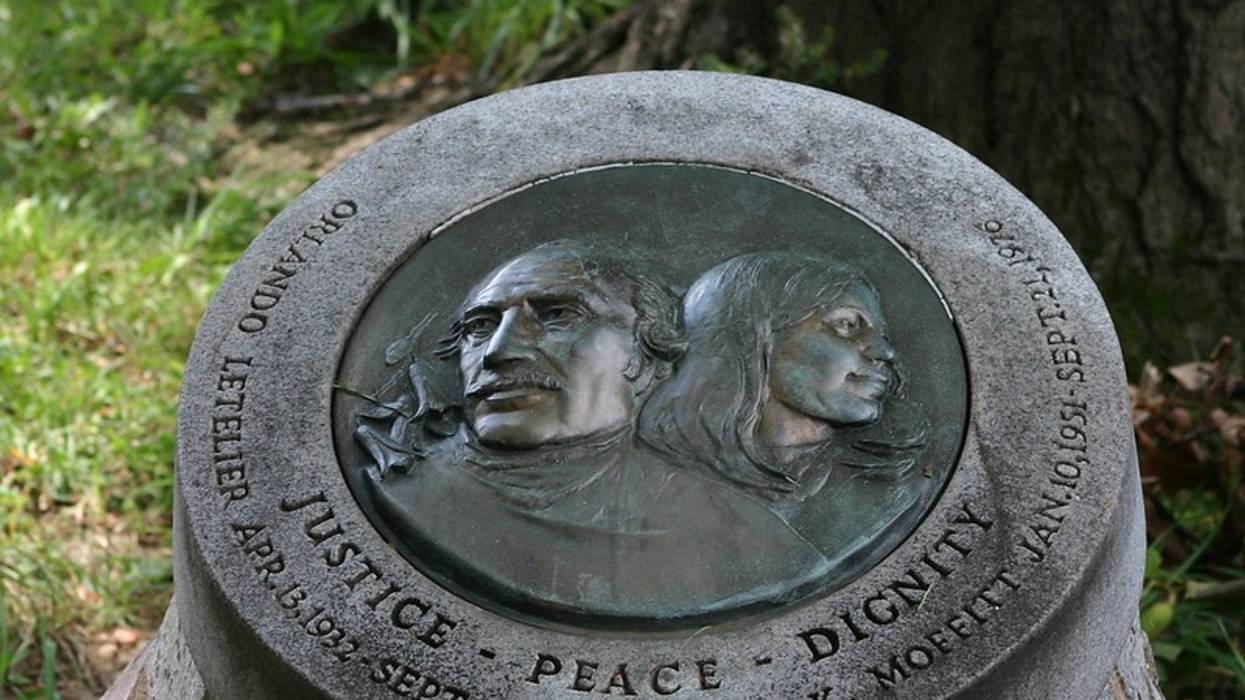
But large numbers like 3 to 4 million mask the very real pain, terror, and tragedy suffered by those individuals and their families. Look at the cases of Charles Horman, Frank Teruggi, and Ronni Moffit. All three were Americans killed by the Kissinger-Nixon backed Chilean military junta that overthrew the democratically elected socialist government of Salvador Allende.
Horman and Teruggi were journalists in Chile in 1973 when the coup happened. They were taken to the infamous National Stadium in Santiago where they were executed along with thousands of Chileans. Their story was painfully yet meaningfully represented in the 1982 film Missing with Jack Lemon and Sissy Spacek.
My wish would be that anyone who praises Kissinger or cites his “accomplishments” must also acknowledge his victims and know some of their names.
"Ronni Moffit was a researcher at the Institute for Policy Studies in Washington, D.C, who was riding in a car with her husband Michael Moffit and the former Chilean diplomat Orlando Letelier in Sheridan Circle when their car exploded. It was determined that a bomb was planted by agents of the Chilean secret police most likely under orders from junta leader General Augusto Pinochet.
The record indicates that Kissinger told Pinochet in a phone conversation in June of 1976 that his regime was a victim of leftist propaganda on human rights:
In the United States as you know we are sympathetic with what you are trying to do here. We want to help, not undermine you. You did a great service to the West in overthrowing Allende.
A few months later, Moffit and Letelier were murdered. Letelier’s lower torso was blown away and his legs had been severed. Moffit’s larynx and carotid artery were slashed by a piece of shrapnel and she drowned in her own blood.
Most Americans today don’t know about these murders or the names of the three victims mentioned above. After all, it was almost 50 years ago and people have become inured to the many atrocities committed at home and abroad since then. The death of Henry Kissinger allows us to remember that his 3 to 4 million victims are not just amorphous entities but individuals who had names, families, lives, hopes, and dreams. They did not deserve to die miserable deaths.
My wish would be that anyone who praises Kissinger or cites his “accomplishments” must also acknowledge his victims and know some of their names. In particular, American media figures, politicians, and prognosticators should know who Charles Horman, Frank Teruggi, and Ronni Moffit were, how they died, and who was responsible for their deaths. Their families, friends, and descendants certainly know and deserve to have their pain and loss acknowledged.
Henry Kissinger never had to answer for his crimes or face his victims’ families. There is nothing we can do about this now that he is dead. But we can at least insure that his crimes and misdeeds are never forgotten.
If anything, Kissinger was but a faithful representative of the criminal U.S. elites whom he served all his life—and who guaranteed him a long life of fame, wealth, and luxury.
Nothing notable distinguished the birth of Heinz Alfred Kissinger on 27 May 1923 to a German Jewish family in Furth, a city in Bavaria, who died on Wednesday at the age of 100.
In 1938, when he was 15, he and his family fled Nazi Germany to New York before Kristallnacht. When the adolescent Heinz became Henry in the US, while retaining his heavy German accent, no one could have predicted that he would order the murder of hundreds of thousands of people as an adult, and become a millionaire as a result.
In 1943, at the age of 20, Kissinger was drafted by the US Army. He became naturalised as a US citizen the same year. He served in the army intelligence division on account of his German fluency and was put in charge of a team in US-occupied Germany in charge of de-Nazification.
After the war, Kissinger attended Harvard, graduating with a BA in political science in 1950 and a PhD in 1954. While still at school in 1952, he worked for the US government’s Psychological Strategy Board, formed by the White House in 1951 to propagandise against communism in support of the US and “democracy”. This was during the US invasion of Korea when US forces killed millions of people.
As US Air Force commander Major-General Emmett O’Donnell put it at a Senate hearing at the time: “Everything is destroyed. There is nothing standing worthy of the name… there were no more targets in Korea [to bomb].” US psychological warfare still refers to US genocidal crimes in the Korean peninsula as the “Korean War”.
Kissinger insisted that the legitimacy of the international order only required the agreement of the great powers. As for morality, he argued that it was irrelevant
At the Harvard International Seminar, which he helped found as a summer programme that convened young future leaders from around the world, Kissinger volunteered to spy on attendees for the FBI and on his Harvard colleagues.
In his academic work, Kissinger insisted that the legitimacy of the international order only required the agreement of the great powers. As for morality, he argued that it was irrelevant. As Thomas Meaney explains in the New Yorker, for Kissinger, “moral indeterminacy was a condition of human freedom”.
In 1952, Kissinger ran an article in the journal Confluence, which he edited, by Ernst von Salomon, a convicted murderer for his participation in the assassination of the foreign minister of the Weimar Republic. German Jewish emigre contributors to the journal, including Hannah Arendt and Reinhold Niebuhr, were not pleased. Kissinger joked with a friend that the article was considered “a symptom of my totalitarian and even Nazi sympathies”.
He was also study director in nuclear weapons and foreign policy at the Council on Foreign Relations in 1955-56, and published his book Nuclear Weapons and Foreign Policy in 1957, arguing that the US should use tactical nuclear weapons on a regular basis in war to ensure victory. Critics would later parody him as “Dr Henry Killinger”, as the cartoon show Venture Bros did in the 2000s.
His right-wing authorised biographer, Niall Ferguson, states that the argument of Kissinger’s book “might very easily be presented as evidence” that he was “the inspiration for Stanley Kubrick’s Dr. Strangelove”. Kissinger finally received tenure at Harvard with the support of the dean, McGeorge Bundy, despite faculty objections that his book on nuclear weapons was not scholarly.
He did not limit himself to academe, but became a consultant to politicians and presidential candidates, such as Nelson Rockefeller. When Bundy became President John F Kennedy’s national security adviser in 1961, Kissinger joined him as an adviser, a position he would retain under Lyndon Johnson.
In light of Kissinger’s sympathy for the use of tactical nuclear weapons, he was invited to visit Israel in 1962, and again in 1965, most likely by Israel’s architect of the country’s nuclear program, Shimon Peres.
Recent documents reveal that in his report to the US embassy in Tel Aviv in 1965 based on meetings with Israeli officials and scientists, he already believed that Israel was developing nuclear weapons, a program he looked upon with “great understanding, if not sympathy”. This would lead him in 1969, as Nixon’s national security advisor, to broker the understanding of the Nixon administration for Israel’s already developed nuclear weapons program.
Even though Kissinger believed in the futility of the US war in Vietnam, he conspired with Richard Nixon’s electoral campaign in 1968 by leaking information to it from the Paris Peace Talks to prolong the war, lest the Democrats win the elections. Once Nixon was elected, Kissinger came on board as national security adviser in January 1969, a position he occupied until 1975.
Nixon referred to him as “Jew boy”, but it seems right-wing antisemitism never bothered him, as he had been a lifelong conservative Republican. He also served as secretary of state from September 1973 until January 1977.
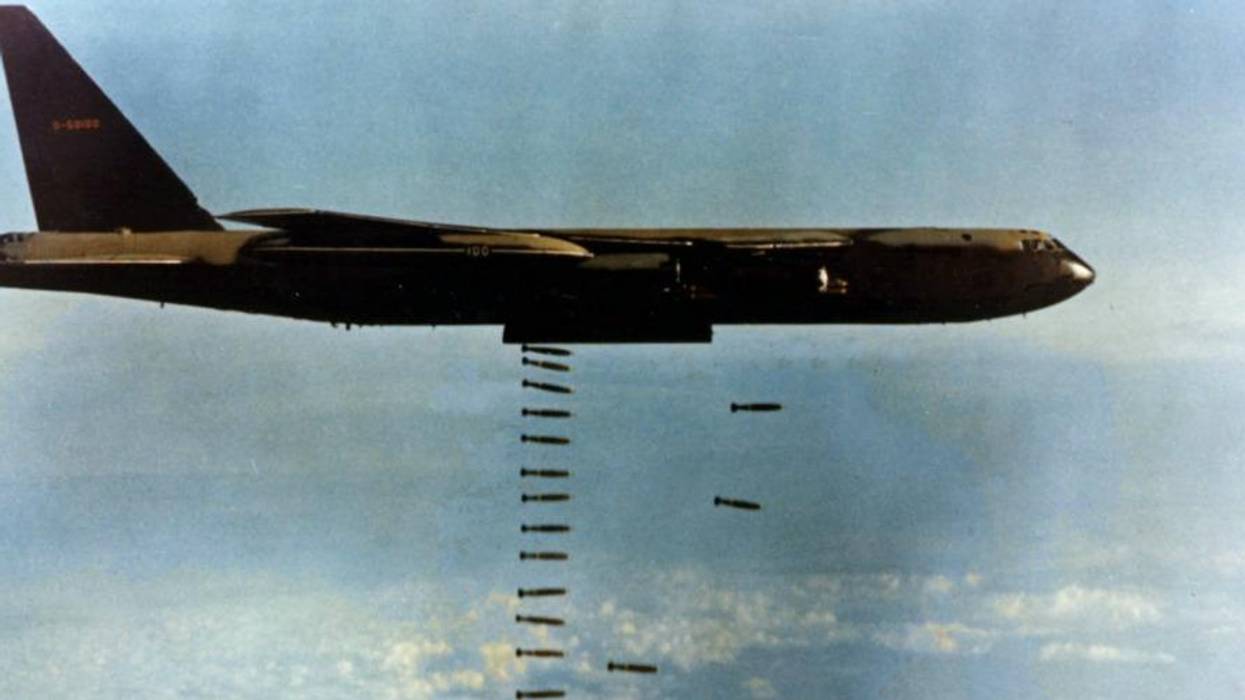
Determined to defeat the South Vietnamese National Liberation Front and North Vietnam, Kissinger decided to intensify the secret tactical bombing of Cambodia, which had started under Johnson in 1965, into a ruthless campaign of carpet bombing that continued until 1973.
In early March 1969, Kissinger told Nixon: “Hit them!” By 1973, between 150,000 and half a million Cambodians were killed. Kissinger callously described the excessive bombing by saying: “We would rather err on the side of doing too much.”
Kissinger personally supervised the schedules of the bombing runs and the allocation of planes from one area to the other. He reportedly loved playing “bombardier”. When he and Nixon started to bomb North Vietnam again, Kissinger was most excited at the “size of the bomb craters”. In keeping with his support for the use of nuclear weapons, he devised a plan to nuke North Vietnam in 1969 as part of an operation called Duck Hook.
While some in his social circles referred to him as “cuddly Kissinger” and he was described in women’s magazines as “always friendly, particularly with women”, his sweet-tongued persona seemed nowhere in sight when he spoke of those women he hated, such as former Indian Prime Minister Indira Gandhi, whom he called a “bitch” and a "witch", while “the Indians” were “bastards”.
Indeed, Christopher Hitchens asserted, regarding Kissinger’s popularity among the elite, that “Kissinger is not invited and feted because of his exquisite manners or his mordant wit (his manners are in any case rather gross, and his wit consists of a quiver of borrowed and secondhand darts)”, but rather because he exuded raw power. Kissinger was less like Dr Strangelove and more like the fictional character Dr Evil in the Austin Powers films, though with much less charm.
In 1971, Kissinger backed former Pakistani President Yahya Khan’s genocidal campaign against East Pakistan (Bangladesh), and in 1975, he endorsed the Indonesian dictator Suharto’s genocidal war on the people of East Timor, in which a third of the population was killed. Suharto had come to power through a US-supported coup in 1965 that unleashed massacres against up to one million Indonesians as suspected communists. As for the 200,000 dead in East Timor, Kissinger was unmoved: “I think we’ve heard enough about Timor.”
When, in 1970, the socialist Salvador Allende was popularly elected as president of Chile, Kissinger commented: “I don’t see why we need to stand by and watch a country go Communist due to the irresponsibility of its own people.” He pushed Nixon to organise a violent coup against Allende, subjecting the country to fascist rule for the next decade and a half, with thousands killed by the US-supported military junta.
All the imperial murderous policies that Kissinger pursued did not deviate from US foreign policy before or after him
It was also Kissinger who advocated the “tar baby” option of strengthening US ties with the white supremacist settler-colonies in South Africa, Rhodesia, and the Portuguese colonies of Mozambique and Angola.
As for the Middle East, aside from strengthening ties with the Zionist settler-colony of Israel, which became a major US ally during the Nixon and Ford years, Kissinger armed Israel to the teeth during the 1973 war in order “to prevent an Arab victory”. His emergency military help to Israel during the war reversed the early victories of the Egyptian and Syrian armies and ensured that Israel won the war. He also ensured that no US relations could be established with the Palestine Liberation Organisation.
In September 1975, Kissinger signed a “memorandum of understanding” with the Israelis committing the US not to recognise or negotiate with the PLO unless it recognised Israel’s “right to exist” as a racist, Jewish-supremacist state. Former PLO chairman Yasser Arafat would finally do so in 1988 in Geneva, and again in 1993 with the signing of Oslo.
In effect, Kissinger ensured the perpetuation of Israeli colonisation of Palestinian lands for decades to come. He was the architect of former Egyptian President Anwar Sadat’s surrender to Israel and selling out of Palestinian rights at Camp David, and designed the so-called American-sponsored “peace process”, which has defined US policy towards Palestinians and Israel and has since brought about the ongoing calamities in much of the Arab world.
Amid all of Kissinger’s war-mongering around the world, helping fascist dictators come to power and supporting white supremacy in settler-colonies in southern Africa and Palestine, he is also credited with pursuing detente with the Soviet Union and opening diplomatic relations with China. He even received the Nobel Peace Prize for negotiating “peace” with North Vietnam amid his savage bombing of Cambodia.
Kissinger would go on to advise subsequent US presidents and support their wars, including Ronald Reagan and George W Bush. In 1982, he established his own consultancy firm, Kissinger Associates, with a highly secretive client list, to advise US and European imperial corporations and banks, Third World western-supported dictators, and white supremacist settler-colonies. His last reported net worth was around $50m.
Kissinger’s horrifying record, however, has endeared him to many US liberal politicians. The Clintons loved him dearly and attended his birthday parties. Hillary Clinton could not stop praising him for the advice he had given her when she served as secretary of state, insisting that “Kissinger is a friend”.
Former President Barack Obama cited Kissinger as supporting his own views on Iran during the 2008 presidential campaign, but Kissinger rebuffed him. In 2010, Obama’s administration used Kissinger’s murderous policies in Cambodia to justify Obama’s own murderous drone killings of American citizens and non-Americans around the world.
In 2016, Obama’s defence secretary gave the accused war criminal an award “honouring Dr Henry A Kissinger for his years of distinguished public service.” In the last few years, he has been invited by several liberal US universities, including the Massachusetts Institute of Technology, Yale and New York University, which marked the 45th anniversary of his receiving the Nobel prize. It was mostly socialists who protested him.
In April 2018, Kissinger was a guest at Trump’s first state dinner at the White House, alongside Trump’s billionaire friends. He would even weigh in on the war in Ukraine, about which he changed his mind several times.
In his book about Kissinger, Hitchens charged him with war crimes, crimes against humanity, and offences “against common or customary or international law, including conspiracy to commit murder, kidnap, and torture”. Hitchens, however, did not seem to realise that Kissinger was no maverick, and each of those crimes should be levelled against the US government more generally.
Indeed, all the imperial murderous policies that Kissinger pursued did not deviate from US foreign policy before or after him. It is that which accounted for his popularity among the American business and intellectual elite, liberals and conservatives alike.
As Meaney put it, blaming one man for the country’s sins serves everyone: “Kissinger’s status as a world-historic figure is assured, and his critics can regard his foreign policy as the exception rather than the rule.”Kissinger’s amoral, genocidal crimes are no more monstrous than the crimes of the US since its establishment. If anything, Kissinger was but a faithful representative of the criminal US elites whom he served all his life—and who guaranteed him a long life of fame, wealth and luxury.
Kissinger died at his home in Connecticut on 29 November 2023, the International Day of Solidarity with the Palestinian People.
The professional love affairs between Kissinger and many U.S. journalists endured from the time he got a grip on power in 1969—and continue even in his death.
For U.S. mass media, Henry Kissinger’s quip that “power is the ultimate aphrodisiac” rang true. Influential reporters and pundits often expressed their love for him. The media establishment kept swooning over one of the worst war criminals in modern history.
After news of his death broke on Wednesday night, prominent coverage echoed the kind that had followed him ever since his years with President Richard Nixon, while they teamed up to oversee vast carnage in Southeast Asia.
The headline over a Washington Post news bulletin summed up: “Henry Kissinger Dies at 100. The Noted Statesman and Scholar Had Unparalleled Power Over Foreign Policy.”
But can a war criminal really be a “noted statesman”?
The New York Times top story began by describing Kissinger as a “scholar-turned-diplomat who engineered the United States’ opening to China, negotiated its exit from Vietnam, and used cunning, ambition and intellect to remake American power relationships with the Soviet Union at the time of the Cold War, sometimes trampling on democratic values to do so.”
And so, the Times spotlighted Kissinger’s role in the U.S. “exit from Vietnam” in 1973 -- but not his role during the previous four years, overseeing merciless slaughter in a war that took several million lives.
"Once you’ve been to Cambodia, you’ll never stop wanting to beat Henry Kissinger to death with your bare hands." —Anthony Bourdain
“Leaving aside those who perished from disease, hunger, or lack of medical care, at least 3.8 million Vietnamese died violent war deaths according to researchers from Harvard Medical School and the University of Washington,” historian and journalist Nick Turse has noted. He added: “The best estimate we have is that 2 million of them were civilians. Using a very conservative extrapolation, this suggests that 5.3 million civilians were wounded during the war, for a total of 7.3 million Vietnamese civilian casualties overall. To such figures might be added an estimated 11.7 million Vietnamese forced from their homes and turned into refugees, up to 4.8 million sprayed with toxic herbicides like Agent Orange, an estimated 800,000 to 1.3 million war orphans, and 1 million war widows.”
All told, during his stint in government, Kissinger supervised policies that took the lives of at least 3 million people.
Henry Kissinger was the crucial U.S. official who supported the September 11, 1973 coup that brought down the democratically elected government of Salvador Allende in Chile—initiating 17 years of dictatorship, with systematic murder and torture (“trampling on democratic values” in Times-speak).
Kissinger remained as secretary of state during the presidency of Gerald Ford. Lethal machinations continued in many places, including East Timor in the Indonesian archipelago. “Under Kissinger’s direction, the U.S. gave a green light to the 1975 Indonesian invasion of East Timor (now Timor-Leste), which ushered in a 24-year brutal occupation by the Suharto dictatorship,” the human rights organization ETAN reported. “The Indonesian occupation of East Timor and West Papua was enabled by U.S. weapons and training. This illegal flow of weapons contravened congressional intent, yet Kissinger bragged about his ability to continue arms shipments to Suharto.
“These weapons were essential to the Indonesian dictator’s consolidation of military control in both East Timor and West Papua, and these occupations cost the lives of hundreds of thousands of Timorese and Papuan civilians. Kissinger’s policy toward West Papua allowed for the U.S.-based multinational corporation Freeport McMoRan to pursue its mining interests in the region, which has resulted in terrible human rights and environmental abuses; Kissinger was rewarded with a seat on the Board of Directors from 1995-2001.”
Now that’s the work of a noted statesman.
The professional love affairs between Kissinger and many American journalists endured from the time he got a grip on the steering wheel of U.S. foreign policy when Nixon became president in early 1969. In Southeast Asia, the agenda went far beyond Vietnam.
Nixon and Kissinger routinely massacred civilians in Laos, as Fred Branfman documented in the 1972 book “Voices From the Plain of Jars.” He told me decades later: “I was shocked to the core of my being as I found myself interviewing Laotian peasants, among the most decent, human and kind people on Earth, who described living underground for years on end, while they saw countless fellow villagers and family members burned alive by napalm, suffocated by 500-pound bombs, and shredded by antipersonnel bombs dropped by my country, the United States.”
Branfman’s discoveries caused him to scrutinize U.S. policy: “I soon learned that a tiny handful of American leaders, a U.S. executive branch led by Lyndon Johnson, Richard Nixon, and Henry Kissinger, had taken it upon themselves—without even informing let alone consulting the U.S. Congress or public—to massively bomb Laos and murder tens of thousands of subsistence-level, innocent Laotian civilians who did not even know where America was, let alone commit an offense against it. The targets of U.S. bombing were almost entirely civilian villages inhabited by peasants, mainly old people and children who could not survive in the forest. The other side’s soldiers moved through the heavily forested regions in Laos and were mostly untouched by the bombing.”
In the corridors of U.S. media power, Henry Kissinger never lost the sheen of brilliance.
The U.S. warfare in Southeast Asia was also devastating to Cambodia. Consider some words from the late Anthony Bourdain, who illuminated much about the world’s foods and cultures. As this century got underway, Bourdain wrote: “Once you’ve been to Cambodia, you’ll never stop wanting to beat Henry Kissinger to death with your bare hands. You will never again be able to open a newspaper and read about that treacherous, prevaricating, murderous scumbag sitting down for a nice chat with Charlie Rose or attending some black-tie affair for a new glossy magazine without choking. Witness what Henry did in Cambodia—the fruits of his genius for statesmanship—and you will never understand why he’s not sitting in the dock at The Hague next to [Slobodan] Milošević.”
Bourdain added that while Kissinger continued to hobnob at A-list parties, “Cambodia, the neutral nation he secretly and illegally bombed, invaded, undermined, and then threw to the dogs, is still trying to raise itself up on its one remaining leg.”
But back in the corridors of U.S. media power, Henry Kissinger never lost the sheen of brilliance.
Among the swooning journalists was ABC’s Ted Koppel, who informed viewers of the Nightline program in 1992: “If you want a clear foreign-policy vision, someone who will take you beyond the conventional wisdom of the moment, it’s hard to do any better than Henry Kissinger.” As one of the most influential broadcast journalists of the era, Koppel was not content to only declare himself “proud to be a friend of Henry Kissinger.” The renowned newsman lauded his pal as “certainly one of the two or three great secretaries of state of our century.”"A true tally will probably never be known of everyone who died so Kissinger could be national security adviser," wrote journalist Spencer Ackerman.
Henry Kissinger, the former diplomat whose efforts to prolong and expand the U.S. war on Southeast Asia and undermine democracy in Latin America and elsewhere took millions of lives, died Wednesday at 100 years old.
Treated like royalty in elite U.S. political circles until his death at his home in Connecticut, Kissinger—who served as secretary of state and national security adviser under Nixon and Ford—never faced justice for the secretive carpet bombing of Cambodia that he helped orchestrate, the overthrow of Chile's democratically elected president, or the murderous "dirty war" in Argentina that killed tens of thousands.
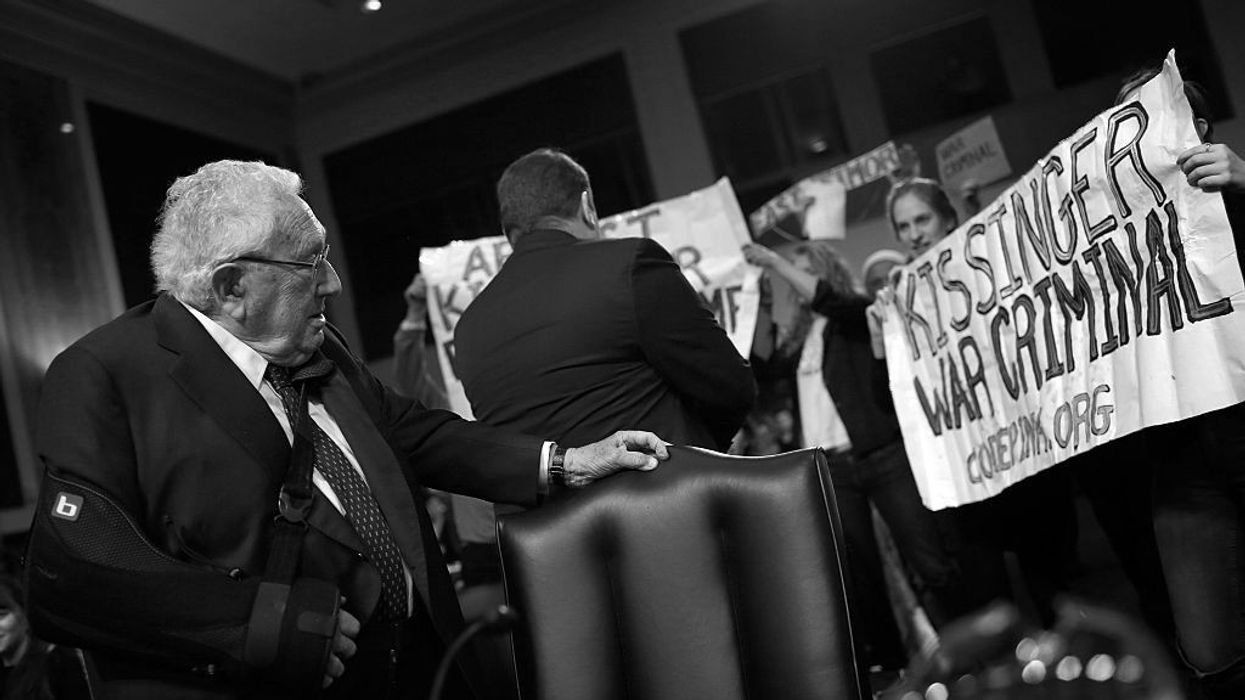
The scope of his crimes was so vast that he had to watch where he traveled, lest he be detained to face questioning for his role in assassinations, massacres, and violent military coups whose reverberations are still felt in the present.
"The covert justifications for illegally bombing Cambodia became the framework for the justifications of drone strikes and forever war. It's a perfect expression of American militarism's unbroken circle," historian Greg Grandin, author of "Kissinger's Shadow," told The Intercept earlier this year. Grandin has estimated that Kissinger was responsible for at least 3 million deaths.
Observers of Kissinger's impact have said it's difficult to convey the true extent of the destruction he inflicted across the globe.
In his obituary of Kissinger for Rolling Stone, journalist Spencer Ackerman wrote that "measuring purely by confirmed kills, the worst mass murderer ever executed by the United States was the white-supremacist terrorist Timothy McVeigh."
"McVeigh, who in his own psychotic way thought he was saving America, never remotely killed on the scale of Kissinger, the most revered American grand strategist of the second half of the 20th century," Ackerman continued. "Every single person who died in Vietnam between autumn 1968 and the Fall of Saigon—and all who died in Laos and Cambodia, where Nixon and Kissinger secretly expanded the war within months of taking office, as well as all who died in the aftermath, like the Cambodian genocide their destabilization set into motion—died because of Henry Kissinger."
"We will never know what might have been, the question Kissinger's apologists, and those in the U.S. foreign policy elite who imagine themselves standing in Kissinger's shoes, insist upon when explaining away his crimes," he added. "We can only know what actually happened. What actually happened was that Kissinger materially sabotaged the only chance for an end to the war in 1968 as a hedged bet to ensure he would achieve power in Nixon's administration or Humphrey's. A true tally will probably never be known of everyone who died so Kissinger could be national security adviser."
There was no intention to attack friendly soldiers and their families; however, this erroneous air strike was occurring in a context in which U.S. bombers had been striking Cambodia secretly and illegally for five years.
As Americans flock to Oppenheimer, one salutary result is a reawakened public awareness of the perils of nuclear weapons, and revived attention to the U.S. decision to bomb Hiroshima (August 6, 1945) and Nagasaki (August 9, 1945). Less apparent is the extraordinary suffering of Japanese civilians and the appalling failure of the Truman administration to consider policy alternatives.
This inattention mirrors the public’s perception at the time, a pattern which has persisted over decades, as the U.S. government strikes countries from the air.
Long forgotten, and largely unnoticed in America, was the accidental bombing on August 6, 1973, by American B-52s of the center of Neak Luong, a ferry and garrison town inside Cambodia. It had fallen most heavily near barracks, where pro-government soldiers resided with their wives and children, damaging the local hospital and demolishing large sections of the town.
“Let the Americans see me,” mourned the anguished Cambodian soldier.
New York Times correspondent Sydney Schanberg encountered the victims as they were carried to the Preah Ket Mealea hospital in Phnom Penh. As he described it, “there were scenes of blood and weeping. Infants shattered by shrapnel, lay unconscious on stretchers.” Whole families had been affected. Walking along the riverbank, he observed a Cambodian soldier sobbing uncontrollably: “All my family is dead. .All my family is dead…Take my picture! Let the Americans see me.”
At the American Embassy, Colonel David Opfer was assuring the press that “the destruction was minimal,” although more than 200 people had died. As was routinely the case, whether in South Vietnam, Laos, or Cambodia, government officials chose to deny or downplay the destruction.
Viewed in isolation, Neak Luong was a genuine accident. There was no intention to attack friendly soldiers and their families. However, this erroneous air strike was occurring in a context in which U.S. bombers had been striking Cambodia secretly and illegally for the past five years. Until that summer, the Nixon Administration had successfully concealed from Congress and the public their 3,600 bombing raids between March of 1969 and May of 1970.
Importantly, the attack on Neak Luong had occurred seven months after the January 1973 Paris Peace Accord had been signed, ostensibly ending U.S. participation in the Vietnam War. Although a specific Cambodian cease-fire was not included, National Security Advisor Henry Kissinger had assured colleagues that based on understandings with Hanoi, fighting there would cease. Instead, the country was consumed by its own civil war between the Lon Nol government and the rapidly growing Khmer Rouge. As fighting continued, the United States kept bombing in support of the regime. The result was a six-month period more hellish than its predecessor, as much of the countryside became a virtual “free-fire zone,” for all participants.
This U.S. activity was of questionable legality, since under the Cooper-Church Amendment, the U.S. military was prohibited from bombing in support of the Cambodian government, except in response to North Vietnamese aggressor. In April 1973, the Senate Foreign Relations Committee sent two veteran observers, James Lowenstein and Richard Moose, on a fact-finding trip to Southeast Asia. Although assured by the Embassy and Air Force personnel that U.S. air strikes were to halt “the movement of North Vietnamese personnel, tanks, artillery, and supplies into South Vietnam,” they soon discovered the U.S. Embassy was coordinating the bombings, with an estimated 80% in support of Lon Nol’s regime.
Remarkably some American airmen responsible for the bombing were expressing their distress in letters to elected officials. These messages were so anguished, they were placed in the Congressional Record by Senator William Fulbright and given to The New York Times by Senator Edward Kennedy. According to one, “I am an AC-130 gunship navigator fighting the war in Cambodia on a day-to-day basis… What I see is an absurd effort by my Commander in Chief to preserve an unpopular, corrupt, dictatorial government at any expense. We have once again become involved in a civil conflict and because of our involvement have escalated the death and destruction on a massive scale.”
The careless killing of civilians did not end with the wars in Southeast Asia. One unfortunate lesson from that era was that a reliance on air power was politically safer than a large, extended deployment of American soldiers. Hence the “war on terrorism” waged in Afghanistan, Iraq, and elsewhere has involved tens of thousands of airstrikes whether by U.S. bombers or drones. Sadly, the tragic coda to the U.S. presence in Afghanistan was a hasty drone attack on August 29, 2021, that killed an innocent aid worker and seven children.
“Let the Americans see me,” mourned the anguished Cambodian soldier. While the case of Neak Luong was carefully reported, as was the misdirected drone attack in Kabul, these were the exceptions. Largely unaware of the existence or consequences of these air wars, the public has had little appetite or interest in policy alternatives. This remains a daunting challenge for the peace movement: how to make visible the ongoing practice of striking alleged enemies, with no accountability.