

SUBSCRIBE TO OUR FREE NEWSLETTER
Daily news & progressive opinion—funded by the people, not the corporations—delivered straight to your inbox.
5
#000000
#FFFFFF
To donate by check, phone, or other method, see our More Ways to Give page.
Daily news & progressive opinion—funded by the people, not the corporations—delivered straight to your inbox.
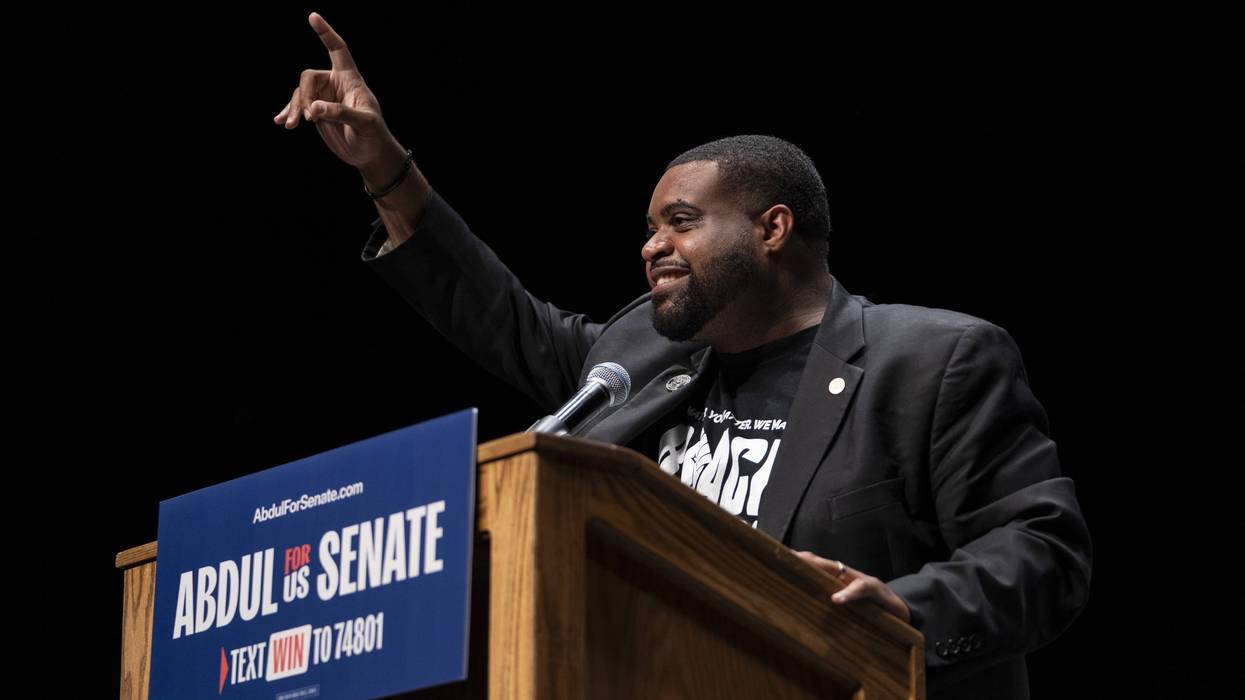
"The Democratic establishment threw everything it had at Abdul El-Sayed," said one podcaster. "If he wins, the reverberations will be felt far outside of Michigan."
Voters in five states are going to the polls Tuesday to cast ballots for US House and Senate candidates, including several who aim to continue a recent streak of progressive victories that—as Colorado democratic socialist Melat Kiros said after she won her own primary race last month—will send a message to "both parties, to Donald Trump, and to the entire country.”
Major races in which progressives are hoping to beat corporate-backed, centrist Democrats are set to be decided in Missouri and Michigan, and observers have pointed to unprecedented outside spending on the primaries—including more than $100 million that's been poured into races by the American Israel Public Affairs Committee (AIPAC) as public support for Israel plummets—as clear evidence that the political establishment views left-wing challengers as formidable opponents.
With AIPAC taking an outsized role in funding a number of centrist primary campaigns this election cycle, the results Tuesday night are expected to reveal whether the lobby group can continue to influence elections and US policy regarding Israel, while a growing number of Americans view Israel negatively following nearly three years of its US-backed assault on Gaza.
Dan Pfeiffer, a former Obama administration staffer who co-hosts the podcast "Pod Save America," said that with the Democratic establishment particularly throwing its weight behind pro-Israel US Rep. Haley Stevens (D-Mich.) in the race between her and progressive former public health official Abdul El-Sayed in Michigan's US Senate race, Tuesday will be "the culmination of one of the most heated and expensive Democratic Senate primaries in history."
"The Democratic establishment threw everything it had at Abdul El-Sayed," said Pfeiffer. "If he wins, the reverberations will be felt far outside of Michigan."
The Michigan Senate race is arguably the most high-profile race taking place Tuesday, but in a number of House districts in the state and elsewhere, progressives are vying for seats in Congress in hopes of increasing the number of Democrats who would use their power to advocate for programs like Medicare for All and universal childcare and against massive Pentagon budgets and US aid to Israel.
Key races include:
McKinney, a former labor organizer, is running to unseat Thanedar in the state's 13th District, and recently notched endorsements from the Democratic Socialists of America and Rep. Summer Lee (D-Pa.). Sen. Bernie Sanders (I-Vt.) and Rep. Rashida Tlaib (D-Mich.) have also thrown their support behind McKinney.
The state lawmaker's website states that he is running "because I’ve lived through the same bull**** as you my whole life, right here at home in Detroit." He calls his city "the poster child for communities in need of the Green New Deal," pointing to lead-polluted water and "some of the most polluted air in the country."
He has also pushed to ban utility monopolies and government contractors, calling Thanedar "our multimillionaire congressman who bought this seat with his own money," and had pledged to defeat "the corporate and right-wing super PACs that will spend millions to support" Thanedar.
According to Punchbowl News, Thanedar is "heavily self-funding" his campaign and, along with the pro-cryptocurrency group Protect Progress, has spent $4.6 million on TV ads.
McKinney has also pointed to Thanedar's campaign funding from Detroit's unpopular energy utility company, DTE, and from AIPAC. According to The Intercept, "two-thirds of the money Thanedar raised in the last quarter came from AIPAC, which collects money from multiple donors and funnels it to the pro-Israel group’s preferred candidates... Less than a quarter of those donors listed Michigan as their state of residence."
Thanedar "was in the minority of House Democrats who voted against cutting $3.3 billion in military aid to Israel from a State Department spending bill" last month, The Intercept added.
In his "closing message" on Tuesday, McKinney told radio show host Dean Obeidallah that he doesn't "have any special interests pulling the strings."
"My special interest is the people of the mighty 13th District, and instead of continuing to send our taxpayer money to fund genocide and send it for bombs and weapons to kill families and children, or to start wars in Iran and spend over $1 billion a day on average, my focus is going to be taking those resources, our taxpayer money, and bringing it back home for people who need it the most," said McKinney.
As Michigan heads to the polls, @DonavanMI13 gave @DeanObeidallah his closing message, that he'll be a fighter for his district. pic.twitter.com/7VofIpa6tz
— SiriusXMProg.bsky.social (@SiriusXMProg) August 4, 2026
Lawrence has also been endorsed by Sanders, Tlaib, and a number of progressive groups in his race in the state's 7th District, where he and the two moderate candidates seek to oust US Rep. Tom Barrett.
Some polls have shown the progressive co-founder of Sunrise Movement in the lead by as many as six percentage points, but other recent surveys have shown Brink in the lead.
Lawrence has touted his energetic grassroots campaign, announcing on Monday that 864 volunteers had knocked on 100,000 doors in the district, which includes Lansing and the surrounding area.
Yesterday we knocked our 100,000th door. We've built a grassroots operation unlike anything Mid-Michigan has seen before.
864 volunteers got us here, and we're just getting started. We will hit even more by November to beat Barrett. pic.twitter.com/WDZJ7gYPDl
— William Lawrence (@WeWill2026) August 4, 2026
Lawrence has focused heavily on the push to build nearly 80 artificial intelligence data centers in communities in Michigan. President Donald Trump has demanded a deregulated approach, and people in towns and cities across the country have rallied against the facilities, arguing the massive water and energy consumption of data centers makes them undesirable additions to their communities.
Lawrence has joined Sanders and US Rep. Alexandria Ocasio-Cortez (D-NY) in calling for a nationwide moratorium on the construction of new data centers. In one campaign ad he was seen at a farm, saying, “Tech billionaires want to turn this field into a massive data center that’ll jack up our energy bills and ruin our home values... I’m running for U.S. Congress because I’ve never been afraid to stand up to corporate power."
Some in the Democratic establishment attacked Lawrence recently over comments he made in 2024 in which he said older Black leaders in the party have worked to defang "the white left." He apologized for the remark.
At a rally ahead of the primary, Lawrence told supporters that the campaign has "continued climbing" despite the attacks.
"And that's because there are real human beings in this campaign who are having real conversations, and that is cutting through the lies and the bullshit," he said.
Our campaign has continued to surge despite the millions of dollars in attacks misrepresenting my record.
We've built real relationships with our neighbors that the dark money outsiders can't buy with lies.
Our movement is ready to weather these smears from the GOP and beat… pic.twitter.com/sNgaoXYMBz
— William Lawrence (@WeWill2026) August 3, 2026
In the state's most closely-watched race, El-Sayed has taken direct aim at Stevens for benefiting from tens of millions of dollars in AIPAC money as he has run on the slogan, "Money out of politics, money in your pocket, and Medicare for all."
Stevens has been endorsed by Senate Minority Leader Chuck Schumer (D-NY), who has come under fire this election cycle for other endorsements including that of Maine Gov. Janet Mills in the New England state's Senate race, with progressives arguing Schumer has backed establishment candidates and ignored the energy around Medicare for All, taxing billionaires, and ending aid for Israel among the party's base.
Ben Rhodes, another former Obama staffer, said Monday that the party leadership "decided to back Haley Stevens in part out of fear of Abdul and the future he represents."
El-Sayed is an outspoken advocate for Medicare for All, but Stevens has appeared eager to center his identity as a Muslim American in the race, joining the centrist think tank Third Way in attacking him for campaigning with commentator Hasan Piker, an outspoken critic of Israel, and claiming last week that El-Sayed wants "to blame all of [his] problems on Jewish Americans."
The latter comment was widely condemned as "race-baiting."
El-Sayed closed his primary campaign out Tuesday with an ad featuring several of his high-profile endorsers as well as grassroots supporters.
"We need to talk about who we are and affirm what we're willing to fight for, and that's exactly why this movement is resonating with so many," said Rep. Ayanna Pressley (D-Mass.).
Time to vote, Michigan! For the many. For money out of politics. For money in your pocket. For Medicare for All. pic.twitter.com/e64Y9A4wuH
— Dr. Abdul El-Sayed (@AbdulElSayed) August 4, 2026
Numerous polls in recent weeks have shown El-Sayed far ahead of Stevens, particularly among younger voters.
Drop Site News highlighted a number of other Michigan races in which progressives are running, including organizer Abbas Alawieh in the 2nd state Senate district and Sanders-endorsed Eboni Taylor in the 3rd state Senate district.
In Missouri's 1st District in St. Louis, former US Rep. Cori Bush is running for a second time against Rep. Wesley Bell, who defeated her in the 2024 primary after nearly two-thirds of his campaign funding came from the United Democracy Project (UDP), a super political action committee affiliated with AIPAC. The group allocated more than $100 million toward defeating candidates that supported Palestinian rights and opposed US military funding for Israel that year.
Bush told Politico recently that this year's election is no different.
“One of us is of the people, by the people, and for the people,” Bush said in a recent interview. “The other one is paid for by AIPAC."
According to AdImpact, UDP has again spent more than $3 million on advertising in the primary.
While Bell has a clear financial advantage, he lacks the "grassroots army" Bush has, The Intercept recently reported, as well as voter engagement. The former county prosecutor has not shown up to several candidate forums.
Polling in the race has been scarce; a survey released in February that was sponsored by Bush's campaign showed Bell ahead by four points, with 17% of respondents undecided.
Jessica Montgomery, co-chair of the St. Louis DSA chapter, told The Intercept that voters in St. Louis are likely to show "buyer's remorse" regarding Bell in Tuesday's election.
He voted along with 74 other Democrats to "thank" US Immigration and Customs Enforcement in June 2025, when Trump was beginning his violent mass deportation campaign
“There’s a lot of very progressive voters in St. Louis who don’t like the fact that he voted to thank ICE,” Montgomery told the outlet. “I think they want someone who will be more adversarial and will fight back against the Trump administration.”
Bush said Monday that her opponent "is backed by billionaires, MAGA money, and AIPAC. But our movement is backed by the people."
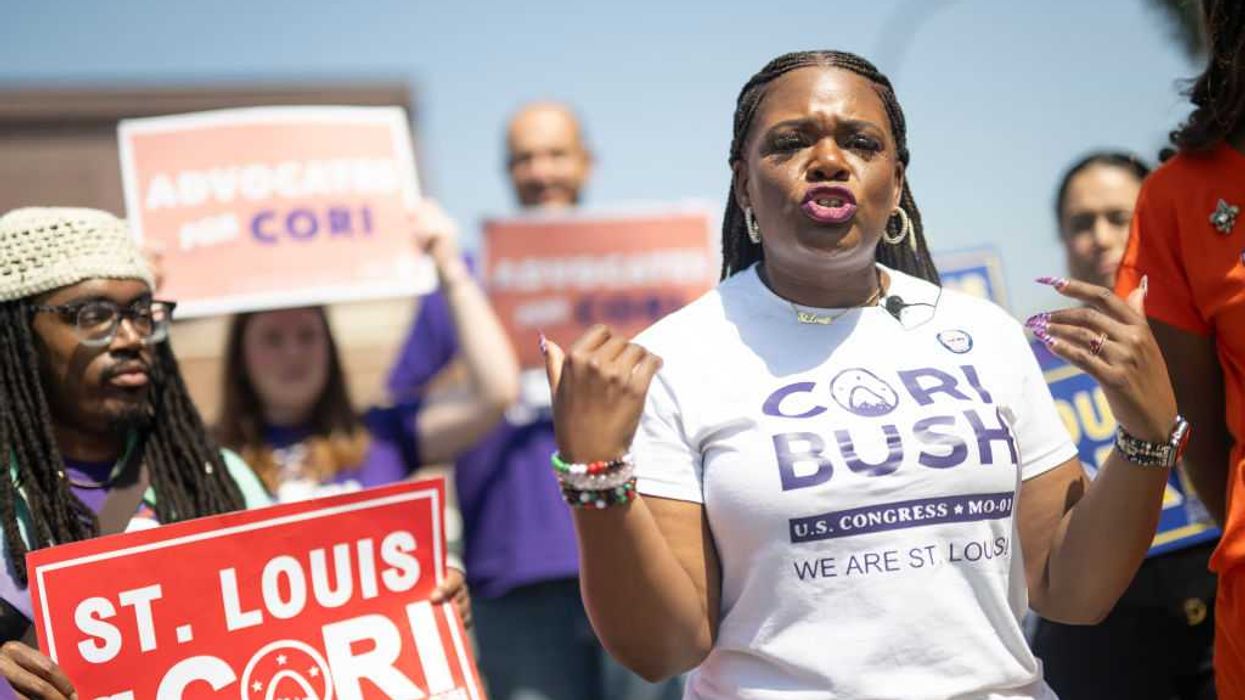
"I’m running again because St. Louis deserves leadership that doesn’t wait for permission, doesn’t answer to wealthy donors, and doesn’t hide when things get tough."
Former Democratic Congresswoman Cori Bush is running again in Missouri to reclaim the US House seat from which she was ousted last year amid a tsunami of campaign spending against her and other progressives by the Israel lobby.
"St. Louis deserves a leader who is built different. That’s why I’m running to represent Missouri’s 1st District in Congress," Bush announced Friday on social media. "We need a fighter who will lower costs, protect our communities, and make life fairer. I’ll be that fighter."
“I ran for Congress to change things for regular people,” Bush says in her first 2026 campaign ad. “I’m running again because St. Louis deserves leadership that doesn’t wait for permission, doesn’t answer to wealthy donors, and doesn’t hide when things get tough.”
Bush—a two-term member of the so-called "Squad" of progressive House lawmakers—was defeated in her district's August 2024 Democratic primary by current Rep. Wesley Bell (D-Mo.), a former county prosecutor.
Nearly two-thirds of Bell's campaign funding came from one source: The American Israel Public Affairs Committee's independent expenditures arm and conduit for dark money, the United Democracy Project, which allocated more than $100 million toward defeating candidates AIPAC deemed insufficiently supportive of Israel.
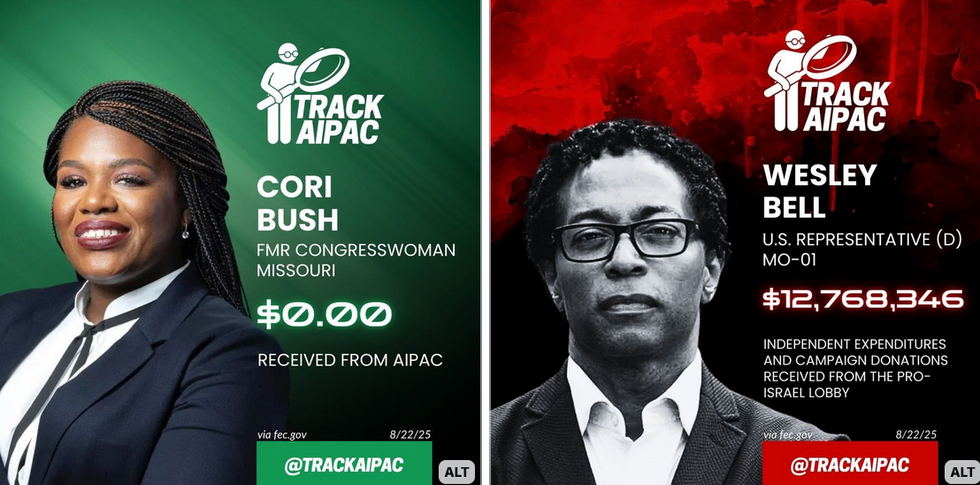 (Image by @TrackAIPAC/X)
UDP also spent heavily last year to defeat then-Congressman Jamaal Bowman (D-NY) and to help thwart the Democratic congressional candidacy of Susheela Jayapal in Oregon and former Republican Congressman John Hostettler's comeback bid in Indiana.
AIPAC's largesse was stoked by Bush's steadfast advocacy for Palestine and staunch opposition to Israel's genocidal war on Gaza. It was Bush who, just over a week into Israel's genocidal retaliation for the Hamas-led October 7 attack, introduced the first House ceasefire resolution.
Bush was also one of the first lawmakers to call Israel's annihilation and starvation of Gaza a genocide—as countless observers have since done, including numerous members of Congress, national governments and leaders, jurists, Holocaust scholars, and United Nations experts.
However, it was championing the needs and values of her overwhelmingly working-class community that propelled Bush—who rose to prominence during the Ferguson, Missouri protests against the police killing of unarmed Black man Michael Brown—to her 2020 Democratic primary victory over an opponent whose family had held the 1st Congressional District seat for half a century.
For example, during the Covid-19 pandemic, Bush led a five-day sit-in outside Congress, where she slept rough with other Squad members and persuaded the Biden administration to extend a temporary eviction moratorium. She also secured hundreds of millions of dollars in economic recovery funds via the American Rescue Plan signed by former President Joe Biden in 2021.
While Bell dismissed Bush's comeback bid by contending that "the headlines and controversies of the past aren’t what we need," progressives cheered her reentry into the political arena.
The political action group Our Revolution quickly endorsed Bush, as it had previously done.
BIG NEWS: Cori Bush could officially announced her run for Congress 👀🔥The nurse. The activist. The Congresswoman who camped on the Capitol steps to stop evictions. The one who never backed down. 👇 🧵
[image or embed]
— Our Revolution (@our-revolution.bsky.social) October 3, 2025 at 7:51 AM
"Cori Bush embodies the values of our movement—she is a nurse, a pastor, and an activist who rose up from Ferguson to fight for working families in Congress,” Our Revolution executive director Joseph Geevarghese said in a statement. “She has been a fearless advocate for Medicare for All, student debt cancellation, housing rights, climate justice, and an end to US military support of Israel."
"That’s why oligarchs and dark money super PACs spent millions to buy this seat and silence her voice," he added. "But they cannot silence the people she represents, and Our Revolution is proud to stand with her as she takes back the people’s seat in Missouri’s 1st.”
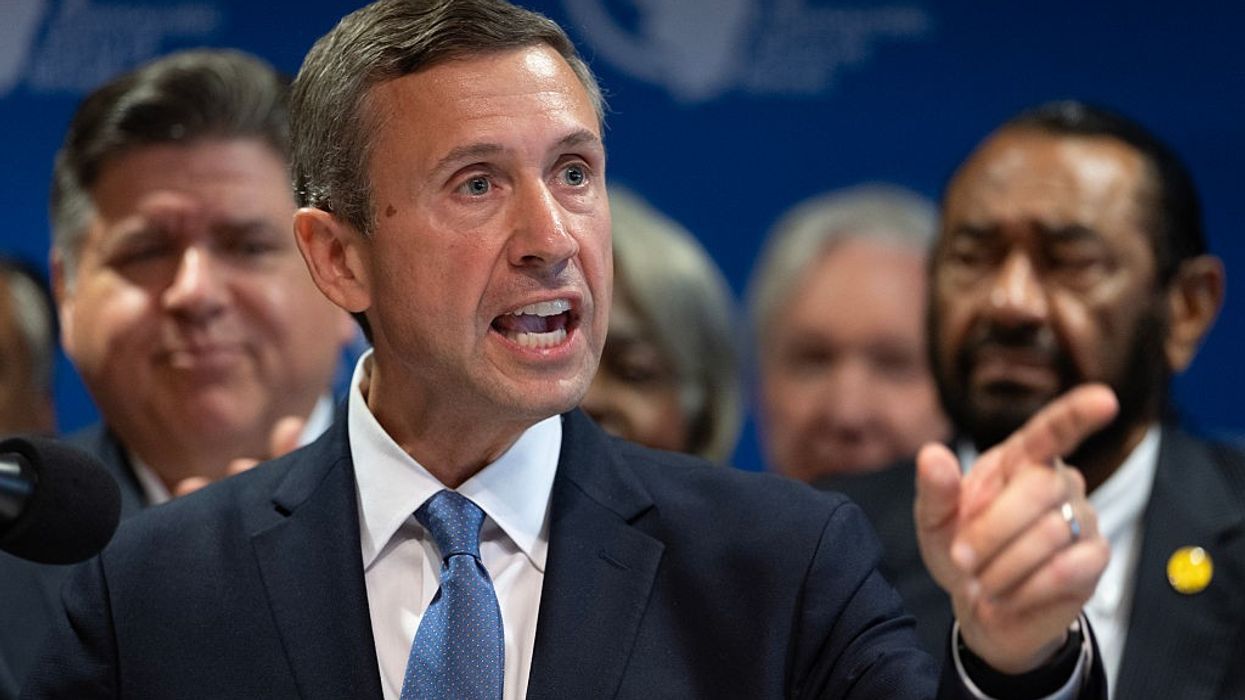
"For those of us focused on progressive social change," says the board chair of Our Revolution, secretive spending by corporations and the ultra-rich "has blocked candidates committed to our entire agenda including workers' rights, Gaza ceasefire, financial reform, rent control, Medicare for All, and renewable energy."
Ahead of the Democratic National Committee's upcoming summer meeting in Minneapolis, organizers with the grassroots advocacy group Our Revolution on Thursday delivered a petition with 13,000 signatures calling on committee members to adopt DNC Chair Ken Martin's proposal to take a major step toward banning dark money in presidential primaries.
As Common Dreams reported earlier this month, Martin's proposal directed the DNC Committee on Reforms to identify "real, enforceable steps the DNC can take to eliminate unlimited corporate and dark money in its 2028 presidential primary process."
The panel is set to vote on the issue on August 27 as the DNC wraps up the summer meeting.
The DNC has in the past declined to allow votes on resolutions that sought to ban dark money—undisclosed and corporate funds that can go towards election efforts through issue-advocacy groups—with the committee's resolutions panel refusing to bring the issue up for a vote twice in five months in 2022-23, after super PACs had spent $1.35 billion on the 2022 midterms.
While super PACs are legally required to disclose their donors, many effectively act as dark money groups because the sources of their funding are difficult to trace.
"For too long, billionaires and corporate super PACs have drowned out the voices of working people," said Joseph Geevarghese, executive director of Our Revolution, on Thursday. "Democrats can't claim to be the party of working people while letting dark money groups and corporate elites choose their presidential nominees. This resolution is about putting power back where it belongs—in the hands of voters, not billionaire donors."
Paco Fabian, campaign director for Our Revolution, told Common Dreams that Democratic leaders have long been driven by the "fear of scaring away funders that provide a lot of money to the party."
"This resolution is about putting power back where it belongs—in the hands of voters, not billionaire donors."
Our Revolution backed Martin's run to lead the DNC earlier this year in part because of his call for the party to rein in corporate and dark money spending in elections, said Fabian.
"I think he understands that in the past, especially in Democratic primaries, they haven't necessarily been shared contests," Fabian said. "The DNC can really make it a fairer process where it's not about who spends the most money. It's really about who convinces the most people to support them based on their policy positions."
Martin's proposal does not seek to ban super PACs from Democratic primaries, as Sen. Bernie Sanders (I-Vt.) has demanded, but the progressive senator—whose 2016 presidential campaign led to the founding of Our Revolution—applauded the step urged by the DNC chair earlier this month.
"Congrats to the DNC for starting the process to ban Big Money from presidential primaries," said Sanders.
Martin's proposal notes that the Democratic Party must "demonstrate its willingness to reject certain types of donations if it hopes to win the trust of voters," according to The New York Times.
"The DNC encourages Democratic officeholders and candidates at all levels of government to support efforts to reduce the influence of corporate and dark money in their campaign policy platforms, and to lead by example in rejecting such donations," reads the resolution, which does not specify how candidates would be held to account for accepting dark money from outside groups.
Larry Cohen, board chair of Our Revolution, wrote in The Nation on Friday that "candidates could be required to sign some version of the 'People's Pledge' agreed to by Elizabeth Warren and Scott Brown in the 2012 general election for the U.S. Senate," which required a candidate benefiting from "big money independent expenditures [IE] to donate a similar amount, from their campaign funds to a designated charity."
"Campaign funds are far more valuable than IE money, providing a powerful deterrent," wrote Cohen.
Cohen emphasized that in Democratic primaries, "big money has often weighed in on behalf of centrist Democrats and against progressives," with independent expenditures including dark money hitting record highs in 2024 "as millions of dollars poured into several districts in the weeks before primary elections, demonizing leading Democratic candidates" such as former Reps. Cori Bush (D-Mo.) and Jamaal Bowman (D-N.Y.).
Cohen added:
For those of us focused on progressive social change, this spending has blocked candidates committed to our entire agenda including workers' rights, Gaza ceasefire, financial reform, rent control, Medicare for All, and renewable energy. The Congressional Progressive Caucus which had been advancing towards a majority of the Democratic Party Caucus, has now seen incumbents defeated and new progressive candidates blocked by the onslaught of money from crypto, fossil fuel, and an endless parade of corporate spending, AIPAC (American Israeli Political Action Committee) and other right-wing groups, as well as Republican billionaires.
Our Revolution delivered the 13,000 petition signatures a day after the Times reported on the Democratic Party's plummeting voter registration numbers, with all 30 states that track voter registration by political party finding that Democrats ceded ground to the Republicans between 2020-24.
While Democrats lost about 2.1 million registered voters between those years' presidential elections, the GOP gained 2.4 million.
Fabian expressed hope that Martin's resolution could be the first step towards "a real boon" for the party.
"It can really bring in folks to the party where they're like, 'Okay, it's not about money now. It's about people. And that means I feel like my voice will be heard, as opposed to the current system where my voice will only be heard if I bring a bag of money with me.'"
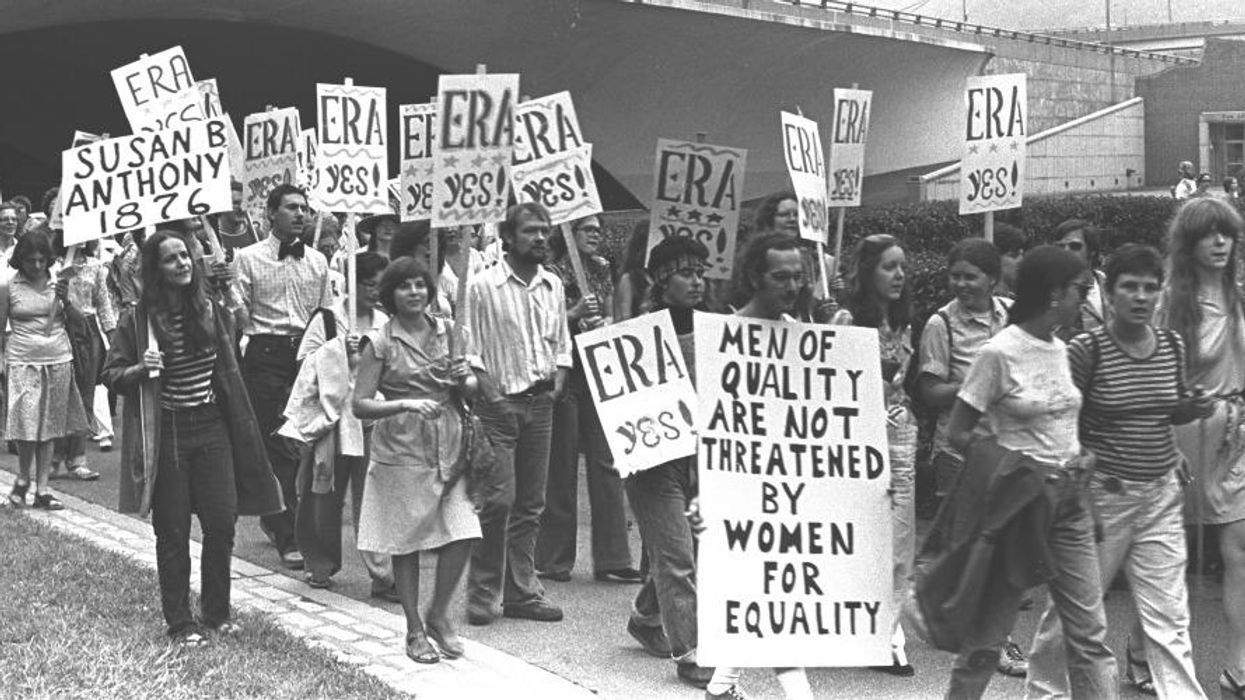
"It is long past time to recognize the will of the American people," said the president.
More than half a century after the U.S. Congress passed the Equal Rights Amendment, President Joe Biden on Friday announced his administration's official opinion that the amendment is ratified and its protections against sex-based discrimination are enshrined in the U.S. Constitution.
The announcement has been long demanded by rights advocates including Democratic lawmakers who have recently called on Biden to affirm the ERA's ratification in order to protect reproductive rights that have been gutted by the Republican Party.
"It is long past time to recognize the will of the American people," said Biden. "In keeping with my oath and duty to Constitution and country, I affirm what I believe and what three-fourths of the states have ratified: The 28th Amendment is the law of the land, guaranteeing all Americans equal rights and protections under the law regardless of their sex."
The statement came five years after Virginia became the 38th state to ratify the ERA. With that move, state lawmakers completed the requirement that three-fourths of U.S. states ratify the amendment.
According to the Brennan Center for Justice, ratification deadlines that were set by Congress after the ERA had passed by the time Virginia ratified the amendment, and five states have rescinded their approval.
But a senior White House official told CNN Friday that the president's decision was informed by the American Bar Association's opinion that "no time limit was included in the text of the Equal Rights Amendment."
"The Constitution's framers wisely avoided the chaos that would have resulted if states were able to take back the ratifying votes at any time," according to the legal association.
Former U.S. Rep. Cori Bush (D-Mo.), who in November called on Biden to take every action available to him in order to protect reproductive rights, including ensuring the ERA was recognized as part of the Constitution, called the president's announcement "an historic and consequential step."
"For over a century, we have fought for the principle that 'equality of rights under the law shall not be denied or abridged by the United States or any state on account of sex,'" said Bush. "These 24 words must now be published and enshrined in our Constitution to provide a crucial safeguard against discrimination for women, LGBTQ+ folks, and all marginalized communities."
With Biden issuing his opinion, advocates have held that the archivist of the United States, Colleen Shogan, must now certify and publish the amendment.
In December, Shogan released a statement saying that in 2020 and 2022, "the U.S. Department of Justice affirmed that the ratification deadline established by Congress for the ERA is valid and enforceable" arguing that the ERA could not be certified.
The senior administration official told CNN that Shogan "is required to publish an amendment once it has been effectively ratified."
"It will be up to the courts to interpret this and their view of the Equal Rights Amendment," they added.
Kate Kelly, a human rights lawyer who wrote the book Ordinary Equality about the ERA, asserted the amendment has been part of the Constitution since it was ratified by Virginia in 2020.
"The Archivist has no constitutional or legal role in the amending process," said Kelly. "She does NOT get to decide what is or is not in the U.S. Constitution. Her boss (the president of the United States) has spoken for his administration. That's it. The ERA is in! This is a victory."
Rep. Pramila Jayapal (D-Wash.) said Biden's action on Friday honored "the work of generations of activists and organizers for equal rights."
"While we still have much work to do to ensure that the next generation of women has more, not less, rights than previous generations, this is an important declaration," said Jayapal. "Now we must do the work to truly make this the practice of the land."
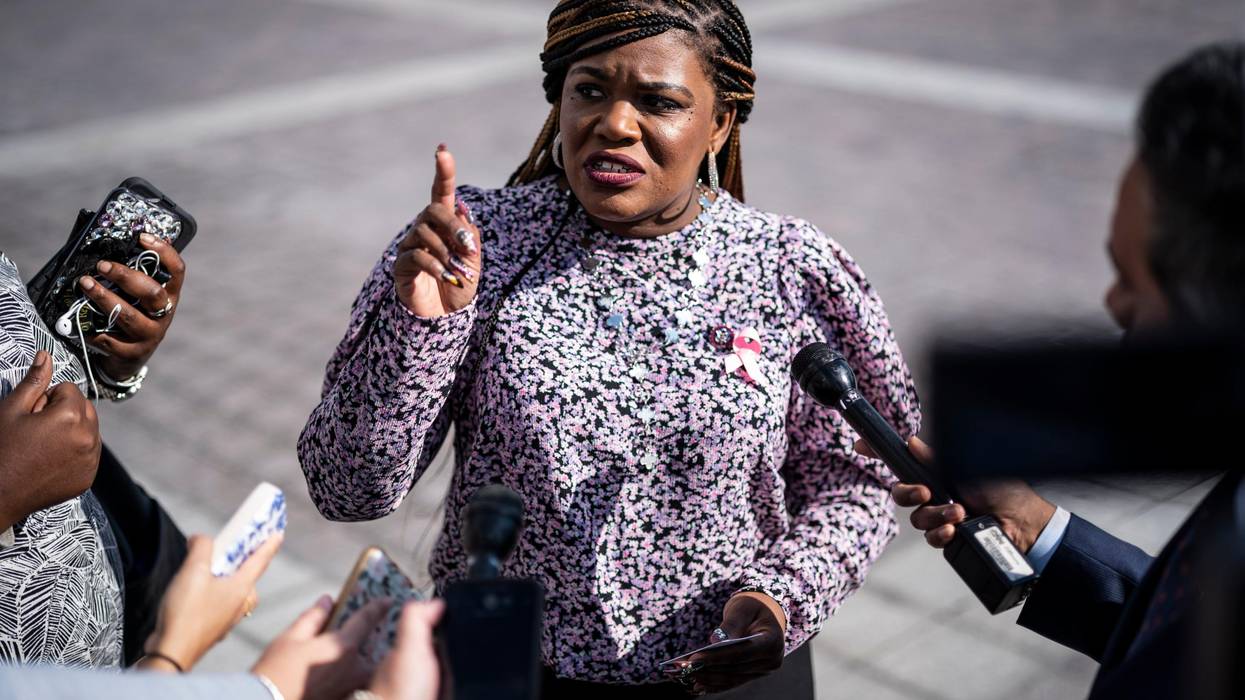
"President Biden has two months," said the congresswoman.
With just over two months to go until U.S. President-elect Donald Trump takes office, U.S. Rep. Cori Bush on Wednesday urged President Joe Biden to take all the action he can to protect reproductive rights from Republican leader who has bragged about his role in ensuring Roe v. Wade was overturned.
Biden "must immediately direct the archivist of the United States to certify and publish the Equal Rights Amendment which can protect access to abortion care and contraception," said the Missouri Democrat, who co-chairs the Congressional Caucus for the Equal Rights Amendment.
Bush's call comes more than a year after the congresswoman and Sen. Kirsten Gillibrand (D-N.Y.) introduced the ERA Now Resolution, urging Colleen Shogan, the archivist of the United States, to certify state ratifications of the amendment and publish it in the Federal Register, which would formally cement it as part of the U.S. Constitution.
First introduced 101 years ago, the ERA would guarantee legal equality for women and men in the U.S. It could push judges to overturn anti-abortion rights laws on the basis that they violate a constitutional right to gender equality. In Utah, a state-level ERA has successfully blocked an abortion ban.
Since first being proposed, the ERA was passed by Congress in 1972 and sent to the states for ratification. Virginia became the 38th state to ratify it in 2020, meeting the threshold for it to become law.
"Today the ERA has met all the constitutional requirements to become the 28th Amendment—all that's standing in the way is some paperwork," said Bush in July on the anniversary of the ERA's introduction. "As Republicans and the Supreme Court's extremist majority continue to attack access to abortion care, contraception, and LGBTQ+ rights, the ERA is needed now more than ever to protect our communities. I'm urging the archivist to fulfill her ministerial duty by certifying and publishing the Equal Rights Amendment and affirming it as the 28th Amendment."
The overturning of Roe in 2022 paved the way for at least 21 states to ban or restrict abortion care. Republicans in Congress have proposed a nationwide 15-week abortion ban. Trump has claimed he would not sign a national ban but Vice President-elect JD Vance has expressed support for one.
"There is always the possibility of a national ban," Brittany Fonteno, president of the National Abortion Federation, told The Cut on Wednesday.
In her July statement, Bush said that "one hundred and one years of advocacy have brought us to this moment, and we refuse to wait a minute longer to cement constitutional gender equality as the law of the land in St. Louis, Missouri, and across the nation."
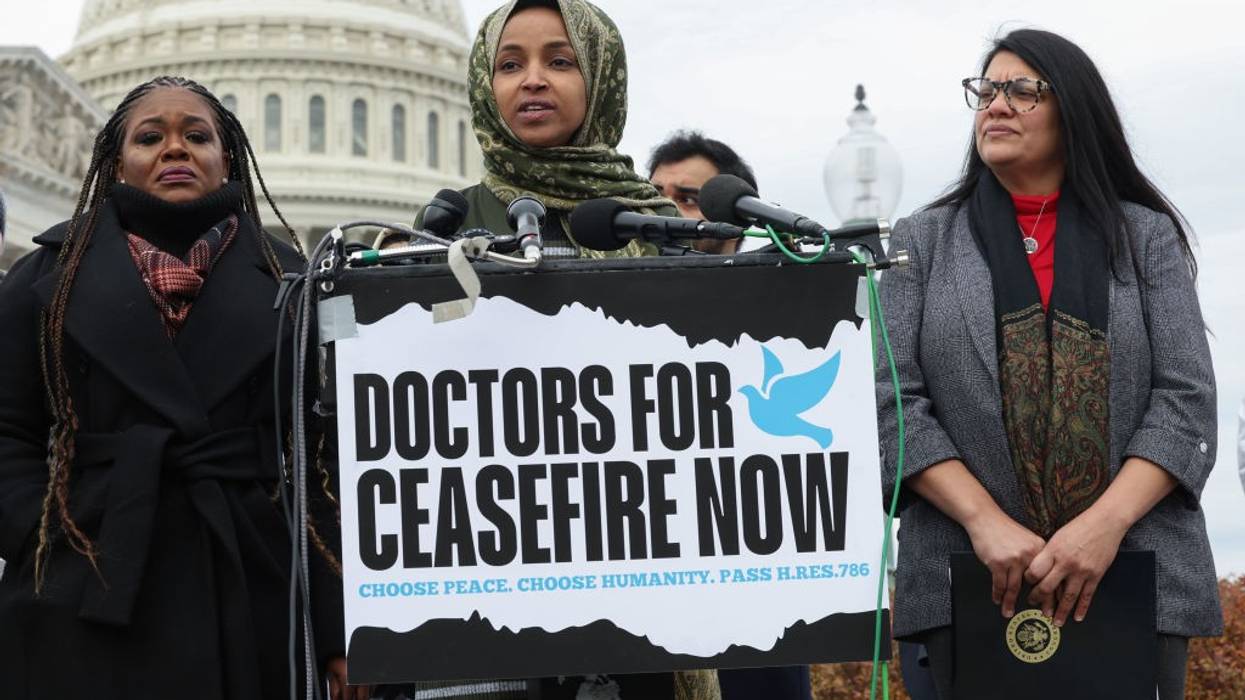
"Absent an imminent or actual sudden attack on the United States, its territories or possessions, or its armed forces, the executive branch may not introduce U.S. armed forces into hostilities without Congress' prior approval."
A handful of progressive Democrats in the House of Representatives on Friday accused President Joe Biden of violating the Constitution and the War Powers Act by deploying U.S. troops to help Israel's war effort and urged his administration to pursue "de-escalatory action" in the Middle East.
"We are deeply concerned about the increasing role and involvement of the U.S. armed forces in expanding wars across the Middle East," Reps. Rashida Tlaib (D-Mich.), Cori Bush (D-Mo.), Ilhan Omar (D-Minn.), Summer Lee (D-Pa.), and André Carson (D-Ind.)—who all sponsored last year's " Cease-fire Now" resolution—wrote in a letter to Biden.
"Congress has the sole power to declare war."
This includes the deployment of U.S. commandos and intelligence officers to Israel just days after last year's Hamas-led attack that left more than 1,100 Israelis and foreign nationals dead—some of them killed fratricidally—and over 240 others taken prisoner, as well as a crew to operate an anti-ballistic missile battery following Iran's barrage against Israel last month.
"Congress has the sole power to declare war under Article I, Section 8, Clause 11 of the Constitution," the lawmakers wrote. "As Section 5(c) of the War Powers Resolution of 1973 makes abundantly clear, Congress holds the power to direct the removal of any armed forces engaged in hostilities outside the territory of the United States without a declaration of war or specific statutory authorization."
"Absent an imminent or actual sudden attack on the United States, its territories or possessions, or its armed forces, the executive branch may not introduce U.S. armed forces into hostilities without Congress' prior approval," they stressed.
The letter—which came shortly before Election Day and is backed by over a dozen peace, progressive, and faith-based groups—continues:
Despite the administration's stated goal of avoiding a regional war, increasingly dangerous escalations have been made possible by transfers to the Israeli government of billions of dollars worth of weapons and military aid, comprehensive intelligence sharing and operational coordination, and diplomatic cover from the United States in the face of widespread condemnation from the international community...
Meanwhile, recent reporting indicates American military officials have discussed unauthorized U.S. military strikes against Iran. We have already seen an increase in U.S. service members deployed to the region in areas where there is a clear and present danger of hostilities.
"This current involvement, and any additional involvement or deployment, of the armed forces in the Israeli government's expanding regional war fall under the definition of 'hostilities' in the War Powers Resolution and are not in response to an imminent or actual attack against the United States," the lawmakers wrote. "As such, these actions are unauthorized and are subject to Congress' authorities pursuant to the Constitution and the War Powers Resolution."
The legislators ask Biden to explain his administration's "legal or constitutional justification" for "proposed hostilities" against Iran, whether the U.S. is "providing military services of any nature" for Israel, and for clarification of claims that U.S. attacks on Houthi rebels in Yemen were conducted in accordance with the Constitution's self-defense authority.
The lawmakers stressed:
De-escalatory action is urgent and essential. Since October of last year, the Israeli government has killed over 43,000 Palestinians in Gaza, with this number likely a significant undercount. This includes over 16,700 children. Over 90% of the population has been displaced, and Palestinians throughout Gaza continue to face famine and starvation. In this same period, the Israeli government has killed over 2,700 people in Lebanon, the vast majority of whom have been killed since the start of the Israeli military's ground invasion and bombing campaign last month. Over 1.2 million people in Lebanon have already been displaced. These campaigns of collective punishment have continued to spread, with sieges on Palestinian cities and refugee camps in the West Bank, the bombing of critical civilian infrastructure in Yemen, and escalations of belligerence with Iran and Syria.
"These destructive wars must end, as must any unauthorized U.S. involvement in them," the letter concludes. "The American public deserves a say on the issue of war. Thus, Congress' involvement and debate are necessary. Every day that passes without a cease-fire produces catastrophic loss of life and threatens further death and destruction. We have an obligation to both the living and the dead to put an immediate end to this devastation."

"When will our country stop funding this madness?" asked U.S. Congresswoman Rashida Tlaib. "When?"
Dozens of Palestinians were killed and many more wounded Sunday and Monday by Israeli attacks on a Gaza hospital and multiple refugee camps, where victims included people queueing for food and a group of children at play.
The United Nations Relief and Works Agency for Palestine Refugees in the Near East (UNRWA) said at least 10 Palestinians were killed and at least 70 others wounded Monday by Israel Defense Forces shelling of hungry people waiting for flour at a food distribution center in the Jabalia refugee camp, where dozens of homes were reportedly destroyed since Saturday.
Medics said the victims from Monday's strike included many women and children. An Israel Defense Forces spokesperson said the IDF operates "only against terrorists" and that the attack is being investigated.
Earlier on Monday, at least four people were killed and dozens more wounded in an IDF airstrike on the al-Aqsa Martyrs Hospital compound in Deir al-Balah, where Palestinians forcibly displaced by Israel's yearlong assault on Gaza were sheltering. The strike caused an inferno that raged through the densely packed tent encampment. Video footage of the attack recorded by journalist Saleh al Jafarawi showed at least one person burning alive as horrified bystanders looked on unable to help.
"We woke up to smoke, flames, fire, and burning pieces falling on the tents from every direction," survivor Om Ahmad Radi told Al Jazeera. "The explosions terrified us in our tents and outside where we live behind al-Aqsa Hospital."
"The fire trucks couldn't get here," Radi added. "There were so many burned and charred bodies all over the place. The amount of fire and explosions was enormous. We witnessed one of the most horrible and brutal nights."
The Gaza Ministry of Health said most victims were women and children. An IDF spokesperson claimed without evidence that the airstrike targeted a "command and control center" used by Hamas, the Palestinian group that led the October 7, 2023 attack on Israel.
Responding to the attack on social media, U.S. Congresswoman Cori Bush (D-Mo.)
said that "Israeli forces launched missiles at al-Aqsa Hospital, where displaced Palestinians were sheltering in tents and receiving the very limited healthcare services available."
"ISRAELI FORCES BURNED THEM ALIVE! Can you see the hand?" she said, referring to a graphic image of one of the victims. "This is the extermination of a whole people!"
U.S. Rep. Rashida Tlaib (D-Mich.)—the only Palestinian American member of Congress— called Israeli Prime Minister Benjamin Netanyahu a "genocidal maniac" who "is burning Palestinians alive, bombing hospitals, starving people, and killing aid workers."
Last week, an independent panel of United Nations experts said that Israel "has perpetrated a concerted policy to destroy Gaza's healthcare system as part of a broader assault on Gaza, committing war crimes and the crime against humanity of extermination with relentless and deliberate attacks on medical personnel and facilities."
On Sunday, an IDF artillery attack targeting a school in the Nuseirat refugee camp housing forcibly displaced Palestinians killed at least 22 people including 15 children and injured at least scores more.
"There seems to be no end to the horrors that Palestinians in Gaza are forced to endure," U.N. Acting Undersecretary-General for Humanitarian Affairs and Emergency Relief Coordinator Joyce Msuya
said in a statement Monday. "There really is no safe place in Gaza for people to go."
Earlier Sunday, at least five Palestinian children were killed and at least a dozen others, including women and children, were injured as Israeli forces bombed a group of children playing in the al-Shati refugee camp, according to The Palestine Chronicle. Some observers said the massacre evoked memories of a 2014 Israeli attack that killed four boys playing soccer on a beach in Gaza City.
Hamas condemned the al-Shati attack as "a horrific crime and a moral degradation that exceeds all limits and norms." The armed group—whose political wing has ruled Gaza for nearly two decades—called for "filing lawsuits before all competent courts, most notably the International Criminal Court," whose chief prosecutor is seeking arrest warrants for Netanyahu, Israeli Defense Minister Yoav Gallant, and three Hamas leaders—at least one of whom, political chief Ismail Haniyeh, has been assassinated by Israel—for alleged war crimes and crimes against humanity including extermination.
Israel is also
on trial for genocide at the International Court of Justice.
Gaza Government Media Office Director-General Ismail Al-Thawabta said over the weekend that Israeli forces have killed more than 300 Palestinians in northern Gaza since the start of the latest IDF offensive there earlier this month. Al-Thawabta accused Israel of waging a "criminal war of extermination" and said it is blocking fuel and other critical supplies from reaching hospitals in northern Gaza.
Since the October 2023 attack, Israeli forces have killed or maimed more than 150,000 Palestinians in Gaza, including over 10,000 people who are missing and feared dead and buried beneath the rubble of hundreds of thousands of bombed-out buildings, according to Gazan and international officials. Nearly all of Gaza's 2.3 million people have been forcibly displaced, and at least hundreds of thousands of others have been starved or sickened.
Thousands more people have been killed by Israeli forces in the West Bank of Palestine and in Lebanon, where Hezbollah fighters have launched thousands of rockets and other projectiles at Israel, killing and wounding hundreds.
On Sunday, the United States—which has provided Israel with tens of billions of dollars worth of
military aid and diplomatic cover including vetoes of multiple U.N. Security Council cease-fire resolutions—said it would deploy around 100 troops to the key Mideast ally to operate an advanced anti-missile system, sparking further fears of a wider regional war that would likely include an attack on Iran.
"When will our country stop funding this madness?" Tlaib asked Monday. "When?"
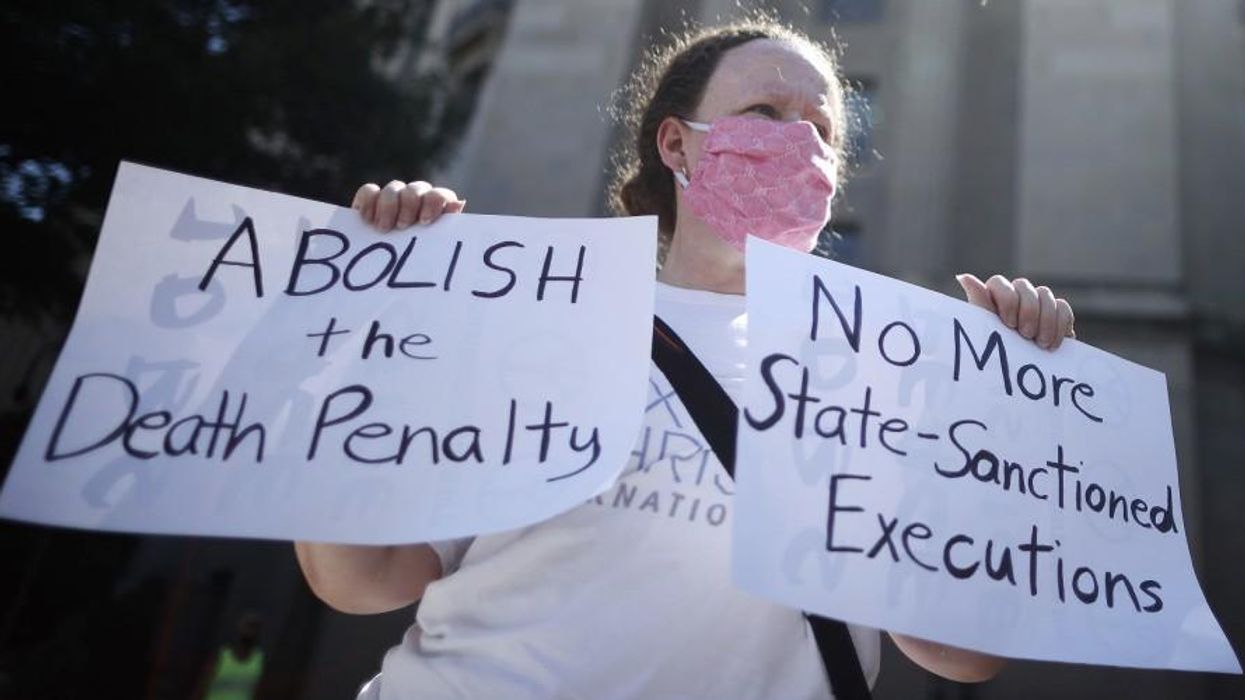
"The use of the death penalty in the United States is one of the ugliest stains on our broken criminal justice system," said Congresswoman Barbara Lee.
Amid a wave of executions in Republican-led states—including Tuesday's lethal injection of Marcellus Williams in Missouri—progressive U.S. lawmakers and groups renewed calls to "abolish the death penalty."
Congressional Progressive Caucus Chair Pramila Jayapal (D-Wash.) and Congresswomen Alexandria Ocasio-Cortez (D-N.Y.), Rashida Tlaib (D-Mich.), Ilhan Omar (D-Minn.), and Cori Bush (D-Mo.) were among those who took to social media to demand an end to capital punishment following Williams' execution.
"The use of the death penalty in the United States is one of the ugliest stains on our broken criminal justice system," said Rep. Barbara Lee (D-Calif.). "It is disproportionately imposed against poor people and people of color. We must abolish it once and for all."
Williams, 55, was killed by the state of Missouri via lethal injection—a method known for botched executions—despite serious doubts about his guilt. The office that prosecuted him sought to have his murder conviction overturned and members of the victim's family pleaded for clemency.
"Sometimes injustice is so glaring that it leaves us struggling to comprehend how such events could happen in the first place," Bush said in a statement released after Williams' execution.
The congresswoman continued:
The deadly decision to execute Williams came despite urgent pleas from Missourians and people all across the country... who called for clemency. Gov. Mike Parson didn't just ignore these pleas and end Williams' life, he demonstrated how the death penalty is wielded without regard for innocence, compassion, equity, or humanity. He showed us how the standard of "beyond a reasonable doubt" can be applied selectively, depending on who stands accused and who stands in power.
"The state of Missouri and our nation's legal system failed Marcellus Williams, and as long as we uphold the death penalty, we continue to perpetuate this depravity—where an innocent person can be killed in the name of justice," Bush stressed. "We have a moral imperative to abolish this racist and inhumane practice, and to work towards building a just legal system that values humanity and compassion over criminalization and violence."
"Rest in power, Marcellus Williams," she added.
Williams wasn't the only one executed on Tuesday. Travis Mullis—a 38-year-old autistic man who murdered his infant son—was killed by lethal injection in Texas after waiving his right to appeal.
Last week, South Carolina executed Freddie Owens by lethal injection after Republican state Attorney General Alan Wilson brushed off a key prosecution witness' bombshell claim that the convicted man did not commit the murder for which his life was taken.
Although the number of U.S. executions has been steadily decreasing from 85 in 2000 to 24 last year, there is currently a surge in state killings, with five more people set to be put to death in three states by October 17.
On Thursday, Alabama is scheduled to kill Alan Eugene Miller using nitrogen gas, despite the inmate suffering severe mental illness. Miller was meant to be put to death in 2022; however, prison staff could not find a vein in which to inject the lethal cocktail and his execution was postponed.
That same day, Emmanuel Antonio Littlejohn is set to be executed by lethal injection in Oklahoma, even after the state's Pardon and Parole Board voted to recommend clemency.
According to a 2014 study, over 4% of people on U.S. death rows did not commit the crime for which they were condemned. The Death Penalty Information Center found that since 1973, at least 200 people who were wrongly convicted and sentenced to death in the U.S. have been exonerated.
"The only way to eliminate the possibility of executing an innocent person is to do away with the death penalty altogether," the advocacy group Human Rights First said Wednesday.
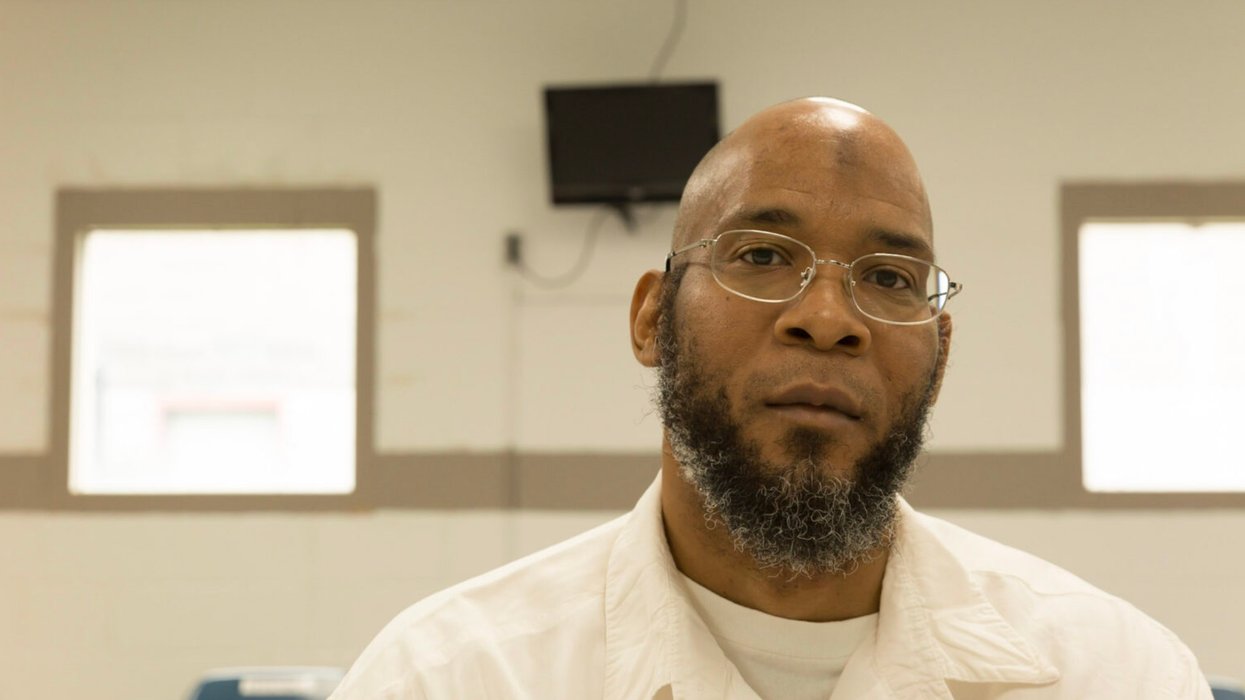
"We must abolish this flawed, racist, inhumane practice once and for all," Congresswoman Cori Bush said of the death penalty.
Update: The state of Missouri executed Marcellus Williams by lethal injection Monday evening over the objections of his prosecutor and the murder victim's relatives, The Associated Press reported.
Earlier:
Advocates for a man set to be executed by the state of Missouri on Tuesday lodged desperate pleas for Republican Gov. Mike Parson to change course and grant an eleventh-hour reprieve in a case with such serious red flags that even the office that prosecuted the defendant wants his conviction overturned.
On Tuesday, the U.S. Supreme Court denied a stay for Williams, one day after both Parson and the Missouri Supreme Court said they would not halt Williams' killing by lethal injection—a method associated with botched executions—barring a last-minute change of heart by the governor.
"We wish we had better news. But as of now, Marcellus Williams is still scheduled to be executed by Missouri tonight at 6:00 pm Central for a crime he is totally innocent of," the Innocence Project—which works to exonerate wrongfully convicted people—said in a social media post.
Williams, who is Black, was convicted in 2001 of murdering Felicia Gayle, a white woman, during a 1998 robbery. DNA found on the knife used to kill Gayle matched another man. However, Williams was convicted by a nearly all-white jury after St. Louis County prosecutors were permitted to preemptively strike half a dozen Black prospective jurors from service.
Earlier this year, St. Louis County Prosecutor Wesley Bell, a Democrat running for Congress, asked to vacate Williams' conviction, citing "clear and convincing evidence" of his innocence including evidence contamination and the revelation that at least one potential juror was excluded because he was Black.
However, the Missouri Supreme Court unanimously ruled against stopping the execution, asserting that Williams' lawyers "failed to demonstrate by clear and convincing evidence Williams' actual innocence or constitutional error at the original criminal trial that undermines the confidence in the judgment of the original criminal trial."
Following the ruling, Parson said that Williams "has exhausted due process and every judicial avenue, including over 15 hearings attempting to argue his innocence and overturn his conviction."
Congresswoman Cori Bush (D-Mo.)—a death penalty opponent who was recently defeated by Bell in their district's Democratic House primary—joined civil and human rights defenders in appealing to Parson to reconsider.
"A system that rules that an innocent man can be executed by the hands of the state is anything but just," Bush said on social media. "Gov. Parson must reverse his disgraceful decision not to stop this inhumane execution and act now to save Marcellus Williams' life."
As NAACP Legal Defense and Educational Fund president and director-counsel Janai Nelson noted:
There is a groundswell of voices calling for either commutation or a temporary reprieve. As you know, these voices include the family of Felicia Gayle... Gayle's family had communicated their "desire that the death penalty not be carried out in this case." Mr. Williams has presented compelling evidence that he is innocent of Ms. Gayle's murder. The perpetrator of this horrific crime left behind significant forensic evidence, including fingerprints, footprints, hair, and trace DNA on the murder weapon. None of this evidence matches Mr. Williams. The St. Louis County prosecuting attorney has recognized that Mr. Williams' capital trial was marred by constitutional errors and the prosecution's presentation of unreliable evidence, which undermine confidence in the judgment against him.
"I implore you to use your gubernatorial authority to grant Mr. Williams clemency, or, at a minimum, grant a reprieve until the underlying conviction can be investigated further and applicable law can be determined," Nelson said.
As Amherst College law professor Austin Sarat noted in Slate Monday, the United States is currently "witnessing the worst execution spree in three decades."
Republican-led states are set to carry out four state-sanctioned killings in addition to last week's lethal injection of Freddie Owens in South Carolina, despite the key prosecution witness' bombshell claim that the convicted man did not commit the murder for which he was put to death.
"This week's execution spree should unsettle all Americans, whether or not they support the death penalty," Sarat wrote. "It will offer further reasons for why capital punishment should be abolished everywhere in this country."
As the Death Penalty Information Center (DPIC) notes on its website, capital punishment "carries the inherent risk of executing an innocent person."
"Since 1973, at least 200 people who had been wrongly convicted and sentenced to death in the U.S. have been exonerated," the group says, adding that it is "clear that innocent defendants will be convicted and sentenced to death with some regularity as long as the death penalty exists."
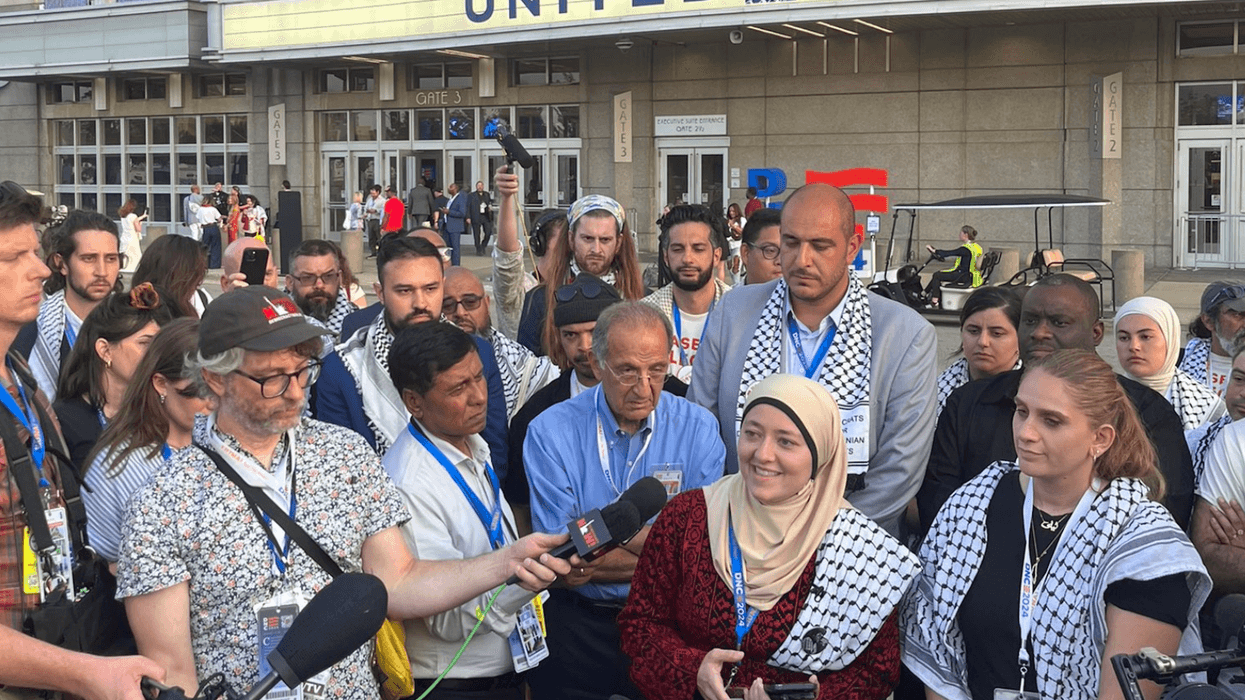
"We are waiting for a phone call from Vice President Harris and the DNC to allow a single Palestinian American speaker from the convention stage."
What would a Palestinian speaker tell U.S. Vice President Kamala Harris, the thousands of delegates gathered at the Democratic National Convention in Chicago, and millions more people watching across the country and around the world as Israel—which is on trial for genocide at the World Court—continues its obliteration of Gaza?
On Thursday, the Uncommitted National Movement—which garnered hundreds of thousands of Democratic primary votes against the Biden-Harris administration's support for Israel's war—circulated a copy of the speech it still hopes to deliver on the DNC main stage.
However, DNC organizers are refusing to allow any Palestinian to speak on that stage, where the Israeli-American parents of a young man kidnapped by Hamas on October 7 spoke Wednesday night with Uncommitted's blessing. Uncommitted used a space away from the main stage to hold a first-ever DNC panel on Palestinian rights on Monday and a Tuesday press conference featuring testimonies from American doctors who recently volunteered in Gaza hospitals.
"We don't know why the campaign said no. We literally have no feedback. We are in the dark."
The DNC rebuff prompted a sit-in protest by some of the approximately 30 Uncommitted delegates and their supporters, as well as calls from progressive lawmakers, human rights defenders, and allies including the United Auto Workers for the Democratic Party to change course.
Uncommitted and allied groups including Let Palestine Speak and Not Another Bomb held a Thursday evening press conference outside the United Center, the Chicago arena hosting the DNC and the site of large protests before and during the convention.
"We are waiting for a phone call from Vice President Harris and the DNC to allow a single Palestinian American speaker from the convention stage," Uncommitted said earlier Thursday. "Our party's platform states that every life is valuable: whether American, Palestinian, or Israeli."
The proposed DNC speech would be delivered by Uncommitted delegate and Georgia state Rep. Ruwa Romman (D-97), who is Palestinian American.
Here's what she wants to say:
My name is Ruwa Romman, and I'm honored to be the first Palestinian elected to public office in the great state of Georgia and the first Palestinian to ever speak at the Democratic National Convention. My story begins in a small village near Jerusalem, called Suba, where my dad's family is from. My mom's roots trace back to Al Khalil, or Hebron. My parents, born in Jordan, brought us to Georgia when I was eight, where I now live with my wonderful husband and our sweet pets.
Growing up, my grandfather and I shared a special bond. He was my partner in mischief—whether it was sneaking me sweets from the bodega or slipping a $20 into my pocket with that familiar wink and smile. He was my rock, but he passed away a few years ago, never seeing Suba or any part of Palestine again. Not a day goes by that I don't miss him.
This past year has been especially hard. As we've been moral witnesses to the massacres in Gaza, I've thought of him, wondering if this was the pain he knew too well. When we watched Palestinians displaced from one end of the Gaza Strip to the other I wanted to ask him how he found the strength to walk all those miles decades ago and leave everything behind.
But in this pain, I've also witnessed something profound—a beautiful, multifaith, multiracial, and multigenerational coalition rising from despair within our Democratic Party. For 320 days, we've stood together, demanding to enforce our laws on friend and foe alike to reach a ceasefire, end the killing of Palestinians, free all the Israeli and Palestinian hostages, and to begin the difficult work of building a path to collective peace and safety. That's why we are here—members of this Democratic Party committed to equal rights and dignity for all. What we do here echoes around the world.
They'll say this is how it's always been, that nothing can change. But remember Fannie Lou Hamer—shunned for her courage, yet she paved the way for an integrated Democratic Party. Her legacy lives on, and it's her example we follow.
But we can't do it alone. This historic moment is full of promise, but only if we stand together. Our party's greatest strength has always been our ability to unite. Some see that as a weakness, but it's time we flex that strength.
Let's commit to each other, to electing Vice President Harris, and defeating Donald Trump, who uses my identity as a Palestinian as a slur. Let's fight for the policies long overdue—from restoring access to abortions to ensuring a living wage, to demanding an end to reckless war and a cease-fire in Gaza. To those who doubt us, to the cynics and the naysayers, I say, yes we can—yes we can be a Democratic Party that prioritizes funding our schools and hospitals, not for endless wars. That fights for an America that belongs to all of us—Black, brown, and white, Jews and Palestinians, all of us, like my grandfather taught me, together.
Uncommitted told Mother Jones that it is open to having the speech vetted and even edited, but that the DNC has not asked to see it.
"We don't know why the campaign said no. We literally have no feedback. We are in the dark," said Romman. "I want to be clear. We've been in negotiations for days. This did not just come up... We've been talking about this for at least a week."
Some observers speculated that the DNC is denying stage time to a Palestinian because party officials worry the speaker will go off-script and criticize the Biden administration's staunch support for Israel in the form of tens of billions of dollars in military assistance, diplomatic cover including United Nations Security Council vetoes, and outright genocide denial.
"We need the stages of the DNC to reflect the fullness of our party, inclusive of Palestinian Americans, who are grieving and mourning and demanding better of their leaders," said Rep. Cori Bush (D-Mo.)—whose sponsorship of a Gaza cease-fire resolution led to a torrent of cash from the American Israel Public Affairs Committee into her pro-Israel Democratic primary opponent's campaign coffers. Bush lost the race.
"The Democratic Party prides itself on being the party of human rights," Bush added. "So when it comes to defending Palestinian lives and ending the ongoing genocide in Gaza, the Democratic Party needs to uphold those same values."