

SUBSCRIBE TO OUR FREE NEWSLETTER
Daily news & progressive opinion—funded by the people, not the corporations—delivered straight to your inbox.
5
#000000
#FFFFFF
To donate by check, phone, or other method, see our More Ways to Give page.
Daily news & progressive opinion—funded by the people, not the corporations—delivered straight to your inbox.
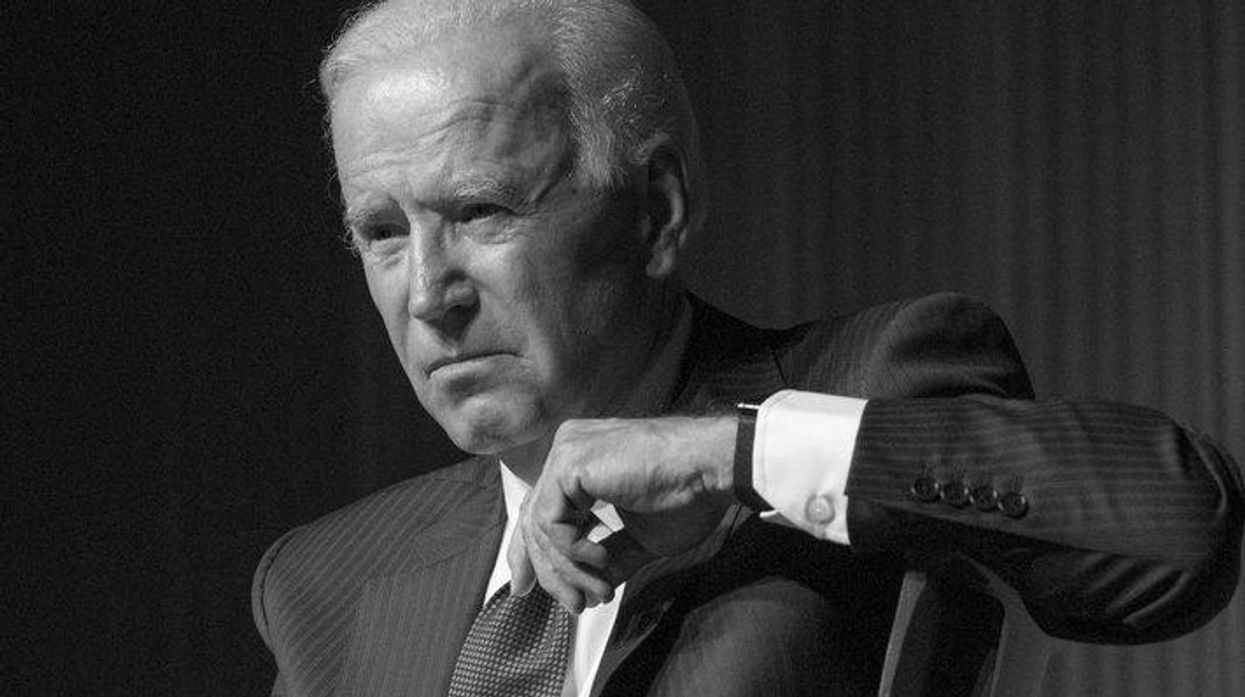
Joe Biden's almost-certain decision to jump into the 2020 presidential race means that the top three candidates for the White House in 2020 are all white men over the age of 75--Biden, Bernie Sanders, and Donald Trump.
There's something wrong with this picture in a political era defined by #MeToo, Black Lives Matter, and a massive backlash against the White Man's Last Stand presidency of Donald Trump.
And the problem is bigger than the optics of race and gender.
Biden's coziness with the financial industry--especially his support for a 2005 bankruptcy bill that made it harder for ordinary people to get out of crushing debt and easier for big banks to profit from predatory lending--puts him on the opposite end of the spectrum from the Elizabeth Warren wing of the Democratic Party.
Biden's not-very-progressive record is actually a huge mismatch for the current political moment.
Biden told a group of supporters in Delaware that "I have the most progressive record of anybody running." But Biden's not-very-progressive record is actually a huge mismatch for the current political moment.
A lot of the ghosts in Biden's past are the consequence of a long, long career in politics: his eulogy for Southern segregationist Strom Thurmond; his warning, as Senate Judiciary Committee chairman, about "predators on our streets" who were "beyond the pale," taking credit for a crime law that exacerbated mass incarceration; his dismissive treatment of Anita Hill; his support for the Iraq War.
But age is not the only factor. In the 1960s, Bernie Sanders joined the Student Nonviolent Coordinating Committee and helped lead in a sit-in to desegregate student housing at the University of Chicago.
In 1973, Hillary Clinton went undercover in Alabama, working with Marian Wright Edelman to expose tax-exempt "segregation academies" set up so that white children could avoid going to school with black children.
Here's an excerpt from a 1975 interview with Biden The Week dug out of the Congressional record:
"The new integration plans being offered are really just quota-systems to assure a certain number of blacks, Chicanos, or whatever in each school. That, to me, is the most racist concept you can come up with; what it says is, 'in order for your child with curly black hair, brown eyes, and dark skin to be able to learn anything, he needs to sit next to my blond-haired, blue-eyed son. That's racist!'"
Biden's biggest problem in the primary is likely to be Elizabeth Warren, who is bound to shine a bright light on Biden's cozy relationship with--and considerable campaign donations from--the financial industry.
Warren has a lot of credibility. Like Biden, she makes a pitch to blue-collar voters that they deserve a champion.
But Warren is the real thing. In a CNN town hall in Jackson, Mississippi, she made news by declaring that the Electoral College should be eliminated, along with laws designed to make it harder for poor people, people of color, and young people to vote. She gave a powerful account of her own life story, connecting it to the struggles of working-class Americans as a group. And she talked about her plans for expanding access to health care and combating corporate crime and income inequality that clearly stakes out the progressive wing of the Democratic Party--what her supporters call the Warren Wing.
Who can forget the Senate hearing when Warren skewered Wells Fargo CEO Timothy Sloan who, Warren pointed out, got rich urging Wells Fargo employees to open fake accounts for customers and then covered it up? "At best you were incompetent; at worst you were complicit. Either way, you should be fired," she told Sloan.
In the 2020 primary, Biden will have to deal with Warren face-to-face.
I predict another moment like the Bernie Sanders/Hillary Clinton debate, when Sanders called out Hillary for taking money from Goldman Sachs, and pointed out that big donors don't hand out big money without expecting something in return. Only it will be Elizabeth Warren putting the screws to Biden this time.
Biden brushed back "the New Left" and extolled bipartisanship to an enthusiastic crowd at a fundraiser in Delaware--you know, the state that mails you your credit card statements? Biden, as a long-time, powerful Senator from the state that helps banks skirt consumer protections, counts among his friends many executives in the financial industry. MBNA America Bank, his largest contributor, lobbied him, successfully, to support the 2005 bankruptcy bill that made it harder for recession-battered consumers to seek bankruptcy and allowed banks to collect high interest rates on their debts.
Elizabeth Warren criticized Biden for that vote at the time, as The New York Times has pointed out.
The Times quoted Warren's 2014 book, A Fighting Chance: "The Senate was evenly split between the two parties, but one of the bill's lead sponsors was Democratic powerhouse Joe Biden, and right behind him were plenty of other Democrats offering to help. Never mind that the country was sunk in an ugly recession and millions of families were struggling--the banking industry pressed forward and Congress obliged."
Biden, who defends his friendliness with Republicans including Strom Thurmond, John McCain, and Mike Pence, as a healthy sign of civility and bipartisanship--comes from an era when the good old boys got together and made policy.
And that's exactly what the next election is likely to be about. Not, as Biden says, about voters longing for a return to the days when we all got along, but a new generation's demand for a powerful brushback of the good-old-boys' network and everything that comes with it: sexism, racism, self-dealing, a rigged system, and an increasingly out-of-it elite that doesn't worry much about inequality and sees coziness with an in-group of powerful men as a good thing.
Either another candidate will overcome Biden's early lead and win the primary, or he will advance to the general election having been damaged by the process.
Either way, Biden will have to deal with the "Warren Wing" of the party--progressive voters who want a candidate who will fight the power. They are demanding that the person who runs against Trump address our climate emergency, regulate predatory banks, make college and health care available to everyone, and end special favors for the elites. They do not want an affable, get-along centrist.
They want big, bold progressive change.
Sorry, Joe.
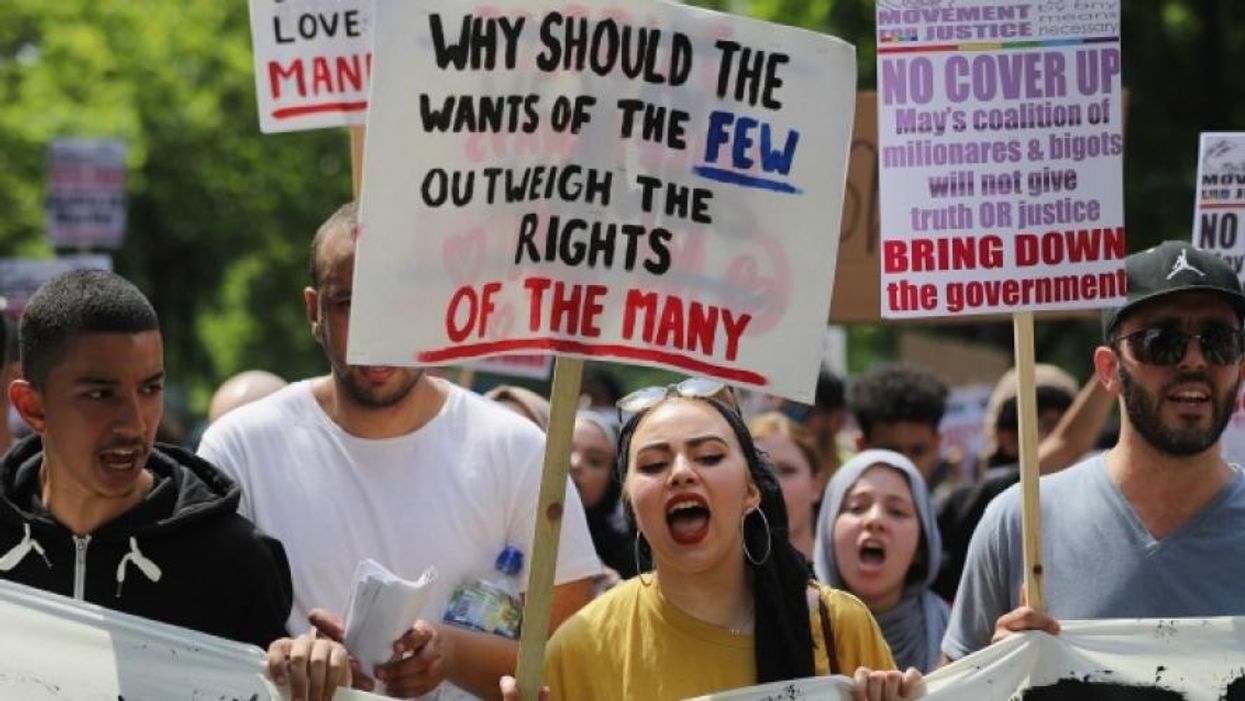
At least 80 people are missing and presumed dead after a devastating fire in Grenfell Tower, a high-rise apartment building in London. It's the deadliest fire in Britain in more than a century.
At least 80 people are missing and presumed dead after a devastating fire in Grenfell Tower, a high-rise apartment building in London. It's the deadliest fire in Britain in more than a century.
This fire is, unequivocally, a tragedy--particularly because it was so preventable. Investigators say the root causes were lax regulation and an unwillingness to invest in basic safety features. Residents had repeatedly warned that their living conditions were dangerous, pointing out that the building didn't have fire alarms, sprinklers, or a fire escape, and there was only one stairway for people to get out and one road for firefighters to get in.
The fire has been a wake-up call for British politicians about a dangerous lack of investment in safe housing. Unfortunately, Britain is not the only country that has underinvested in safe homes.
A report by the Federal Healthy Homes Work Group found that more than 30 million homes in the United States are putting their occupants at risk. Six million homes have moderate to severe infrastructure problems, such as substandard heating, plumbing, and electrical wiring. Another 23 million homes have lead-based paint hazards, and 6.8 million homes have dangerously high levels of radon exposure. This means that millions of families face increased risk of lung cancer from radon exposure, fire-related injuries, and lead poisoning.
So far, the Trump administration has stymied efforts to address these problems. The administration's proposed $6 billion in budget cuts to the Department of Housing and Urban Development (HUD) would severely curtail efforts to provide safe and affordable housing.
At least $300 million in cuts would come from rental assistance programs such as the housing choice vouchers program, which means that 250,000 people could lose access to housing vouchers. Landlords participating in the housing choice voucher program commit to extensive property maintenance and safety standards that other private landlords serving very low-income families are often not required to meet. When families who cannot pay their rent are evicted, they often move into homes with more health and safety hazards, which is why children who are evicted are twice as likely to be in poor health.
More than 30 million homes in the United States are putting their occupants at risk
The Trump administration's budget also calls for direct cuts to the HUD public housing Capital Fund, the program that funds repairs to public housing. The budget would slash the fund by more than half, so that 212,000 fewer units would receive the repairs they need next year. It also means that local public housing authorities--which rely on this funding to address fire hazards before they become disasters and address health risks like mold, lead, and rodent infestations--could be short on their budgets.
Even indirect cuts, such as the proposed elimination of the Legal Services Corporation (LSC), will put more people at risk. LSC funds civil legal aid organizations that help low-income households bring lawsuits against landlords who refuse to deal with potentially deadly living conditions. After similar cuts to legal aid in Britain, residents of Grenfell Tower were unable to afford legal advice when they had concerns about their building's safety.
We're not doomed yet. Fire deaths have been dropping across the United States due to stronger building safety codes. Most states ban the usage of flammable aluminum cladding in tall buildings, which contributed to the Grenfell Tower fire.
Still, the Trump administration has promised to dramatically cut back on important safety regulations. Trump's recent executive order that requires eliminating two regulations every time a new one is created forces agencies to choose which life-saving regulations they should prioritize to comply with the rule. Congress is now considering the Regulatory Accountability Act, which would add so many hurdles to the regulatory process that companies that produce dangerous products could delay regulations indefinitely. The Environmental Protection Agency faced similar roadblocks when it tried to ban asbestos--a known carcinogen--more than 25 years ago. Asbestos manufacturers used hurdles in the regulatory process to their advantage and blocked the agency from removing this toxic substance from commerce. Since 1999, at least 12,000 Americans have died every year because of asbestos exposure. Under the Trump administration, long-awaited asbestos regulations and many other critical protections may never be implemented.
In a chilling letter written just months before the building caught fire, residents of Grenfell Tower warned that "only a catastrophic event will expose the ineptitude and incompetence of our landlord, the KCTMO, and bring an end to the dangerous living conditions and neglect of health and safety legislation that they inflict upon their tenants and leaseholders." Americans shouldn't wait for a tragedy of this magnitude. Investing in the health and safety of low-income Americans begins with the funding decisions Congress will make this year.
Our nation's budget should reflect our nation's professed values, but President Trump's 2018 Federal Budget, "A New Foundation for America's Greatness," radically does the opposite. This immoral budget declares war on America's children, our most vulnerable group, and the foundation of our nation's current and future economic, military and leadership security. It cruelly dismantles and shreds America's safety net laboriously woven over the past half century to help and give hope to the 14.5 million children struggling today in a sea of poverty, hunger, sickness, miseducation, homelessness and disabilities. It slashes trillions of dollars from health care, nutrition and other critical programs that give poor babies and children a decent foundation in life to assure trillions of dollars in tax cuts for millionaires and billionaires and powerful corporations who do not deserve massive doses of government support.
The cruel Trump budget invests more in our military -- already the most costly in the world -- but denies vulnerable children and youths the income, health care, food, housing and education supports they need to become strong future soldiers to defend our country. Seventy-one percent of our 17- to 24-year-olds are now ineligible for military service because of health and education deficits. It seeks to build a wall to keep immigrants out by slashing supports for those inside who can be counted on to help staff our businesses and factories and other services. This budget creates more inequality and less opportunity for those struggling to make ends meet and is a grave injustice.
President Trump invests in fighting those he sees as outside enemies through weapons and walls and turns his back on the internal enemies that threaten the basic domestic needs of our people -- health care, housing, education and jobs that pay living wages. The Congress and the people of the United States must reject President Trump's 2018 budget and the mean spirited values it reflects. It declares war on children and working people struggling to support their families by ignoring even their most basic needs and gives trillions to those who do not need massive government support -- especially at a time of record wealth and income inequality.
The president's 2018 budget:
At the same time, President Trump's 2018 Budget includes an estimated $5 trillion tax package for the wealthiest individuals and corporations who neither need nor deserve massive government support and dramatically increases spending on defense and border security. The Trump budget:
This draconian budget slashes over $3 trillion dollars in the next decade and tramples America's values and is anti-child, anti-poor, and anti-low-income working people. It erodes the security of our nation's future.
President Dwight Eisenhower, a five star general and World War II hero, understood that throwing money at the military could not be an excuse for assaulting the poor and stealing from our children, saying, "Every gun that is made, every warship launched, every rocket fired, signifies ... a theft from those who hunger and are not fed, those who are cold and are not clothed. This world in arms is not spending money alone. It is spending the sweat of its laborers, the genius of its scientists, and the hope of its children."
The Trump budget would not pass the test of any great faith or standard of fairness. It must be rejected resoundingly by the Congress and the American people.
Earlier this month, when rumors of erstwhile presidential candidate Ben Carson's role in a future Trump administration started flying, Carson made it clear that he wasn't interested in an agency appointment. In the words of his business manager, "Dr. Carson feels he has no government experience, he's never run a federal agency. The last thing he would want to do was take a position that could cripple the presidency."
Earlier this month, when rumors of erstwhile presidential candidate Ben Carson's role in a future Trump administration started flying, Carson made it clear that he wasn't interested in an agency appointment. In the words of his business manager, "Dr. Carson feels he has no government experience, he's never run a federal agency. The last thing he would want to do was take a position that could cripple the presidency."
A lot can change in a month.
Despite Carson's earlier objections, last week it seemed like President-elect Trump was on the verge of nominating the former neurosurgeon as Secretary of the Department of Housing and Urban Development (HUD). And Carson, citing the fact that he once lived in a city, now believes he's up to the task.
Here's the problem: HUD is a critically important federal agency with a budget of almost $50 billion, 9,000 employees across the country, and programs that affect the lives of millions of people. The Secretary of HUD isn't a vanity appointment to be bestowed upon any half-willing volunteer.
Here are six reasons why the agency deserves a qualified leader who is up to the task.
One of HUD's core missions is to help families buy a home, which is critical for building wealth. That's why it manages the Federal Housing Administration (FHA), which insures private mortgage loans against the risk of default by the borrower. That makes financial institutions more willing to provide credit--particularly to groups who have been historically excluded from homeownership, like families of color.
FHA has insured more than 40 million homes since it was established in 1934, and it's becoming even more important in the current tight credit environment. FHA's market share of single-family purchase loan originations more than doubled between 2004 and 2015, and many of those loans are going to underserved communities of color where conventional credit continues to be limited.
For many years, the private market has failed to provide enough affordable rental housing for low-income families. HUD helps fill this gap through a variety of rental assistance programs--from public housing to housing vouchers--in order to ensure that more low-income families have a decent, safe, and affordable place to live. More than 5 million low-income households use federal rental assistance, and without it, many of these families would likely experience homelessness.
HUD is working to break up the concentrated poverty and de facto segregation that put some communities at a major disadvantage. Last year, the department finalized a rule that requires local governments that use HUD funding to examine patterns of poverty and residential segregation--and to put forward a credible plan for addressing these challenges. That's essential in a country that is becoming increasingly diverse--and where discrimination in housing is still alive and well.
Through programs such as the Housing Choice Voucher Program, HUD also helps many families move out of distressed neighborhoods to higher opportunity areas, where there is better access to jobs and good schools.
HUD is able to process significantly more housing discrimination complaints than any other government agency--an average of 9,201 per year from 2010 to 2013. The complaints are typically rooted in someone's race or disability, and nearly a third result in some form of penalty against an offending lender or landlord.
There are a few other agencies that share some of the responsibility for enforcing fair housing law--specifically the Justice Department's Housing and Civil Enforcement Section--but they are not set up for efficient, large scale enforcement. As a result, the Justice Department's annual case load is a tiny fraction of what HUD processes each year.
HUD provides more funding for homeless assistance than any other federal department. The department has also been responsible for the development of tens of thousands of housing units to house people who are homeless, or at risk of homelessness. HUD also helps to ensure that residents living in these units receive the social support services they need to get back on their feet, and to avoid homelessness in the future. Since hundreds of thousands of Americans still experience homelessness every day, these services are critical.
Too often, the root cause behind homelessness is domestic violence. Through its Office of Special Needs Assistance Program, HUD plays a key role in rapid re-housing and in providing homeless families and survivors of domestic violence with options that let them transition into safe, stable, and affordable housing.
HUD serves as an important partner to communities rebuilding after disasters have struck. For example, the department played a major role in the recovery of the Gulf Coast after Hurricane Katrina displaced more than 1 million people, through the Community Development Block Grant Disaster Recovery (CDBG-DR) Program. The department invested $20 billion in affected states, which supported the long-term recovery of the region's housing stock, economy, and infrastructure.
HUD can deploy CDBG-DR funds in the case of any presidentially-declared natural disasters, as long as funds are available. Just this fall, HUD deployed $500 million to help communities in Louisiana, West Virginia, and Texas recover from historic flooding. As extreme weather events increase in frequency, HUD's role in rebuilding communities will be even more vital.
Housing is one of the biggest determinants of where and how we live, and it is intimately linked with broader issues of wealth and poverty. HUD's vital role necessitates engaged, qualified, and experienced leadership. Ben Carson--by his own admission--is simply not up to the task.
After her loss to Barack Obama in the 2008 Democratic primary, few predicted that Hillary Clinton would leave the world of presidential politics. On the contrary, it was widely believed that she would make another run for the White House.
Anticipating such a run, the renowned political scientist and activist Frances Fox Piven, along with sociologist Fred Block, penned an open letter calling on Clinton, who had just left the State Department, to "step forward" and "launch a national debate about poverty and welfare."
"Specifically," Piven and Block wrote, "we are asking for you to open a conversation about the shortcomings of the 1996 welfare legislation that was passed when you and Bill Clinton were in the White House."
The letter was not unprovoked: In the years immediately following welfare reform's implementation, Hillary Clinton was an ardent defender of its underlying logic, arguing that it was a "critical first step" in the broader move toward a more effective system.
And Clinton's defenses of the law didn't cease even as evidence of its harmful effects became increasingly prominent. Indeed, in 2008, the New York Times reported that, in an interview, "Clinton expressed no misgivings about the 1996 legislation."
In 2016, circumstances changed. Faced with a primary opponent running far to her left, Clinton shifted: "Now we have to take a hard look at" welfare reform, Clinton said in April, citing the entirely predictable failure of the now almost non-existent safety net to catch those harmed by the financial crisis.
Fast-forward several months, however, and the issue has all but vanished from the scene; no such "hard look" appears to be forthcoming.
Welfare reform's absence was especially conspicuous in Clinton's recent Times op-ed, in which she outlined her "plan for helping America's poor."
Clinton highlighted her tenure as a lawyer for the Children's Defense Fund, where she was mentored by Marian Wright Edelman, the organization's founder. But the issue that prompted a rather bitter split between the two was left unmentioned.
Prior to its passage, welfare reform garnered striking bipartisan support. But dissent was there, and it was forceful. Edelman's voice was among the most powerful, the most insistent, and, to those reading her words today, the most prescient.
"It would be wrong to leave millions of voteless, voiceless children to the vagaries of 50 state bureaucracies and politics, as both the Senate and House bills will do," she wrote in the Washington Post. "It would be wrong to strip children of or weaken current ensured help for their daily survival and during economic recessions and natural disasters, as both the Senate and House bills will do. It would be wrong to exacerbate rather than alleviate the current shameful and epidemic child poverty that no decent, rich nation should tolerate for even one child."
Her pleas fell upon deaf ears; welfare reform passed and was implemented, and its successes in booting millions off of "the dole" and diverting money away from poor families and into the coffers of state governments--which were given tremendous latitude in how they could spend the money -- were cheered by Democrats and Republicans alike.
But for the most vulnerable, there was little to celebrate.
Some found work, largely in low-wage jobs; those who didn't, or couldn't, slipped into deep poverty. The research of Kathryn Edin and Luke Shaefer, noted the Washington Post's Max Ehrenfreund in February, "shows that the number of people living on $2 a day or less in cash has increased more than twofold, to 1.6 million households" since welfare reform's passage.
The impact on children has been profound. "Under TANF," a report by the Center on Budget and Policy Priorities notes, "the number of children living in deep poverty--with incomes below half the poverty line, using a comprehensive poverty measure--has risen significantly, placing large numbers of children at risk for long-term negative academic, employment, and health outcomes."
It is significant that Hillary Clinton has consistently downplayed this reality. In her Times piece, she acknowledges in passing that "extreme poverty has increased," but she does little to explain how such destitution arose in the world's wealthiest nation.
And, as Ryan Cooper explains, while many of the proposals Clinton puts forward are welcome and necessary--from her emphasis on affordable housing to her support for paid family and medical leave -- her plan taken as a whole is "woefully inadequate."
"The problem, at root, is the same one Paul Ryan has with his various anti-poverty ideas--a wildly disproportionate focus on work, and a corresponding lack of attention to the welfare policies that could seriously cut poverty," Cooper argues.
Citing the research of Matt Bruenig, Cooper writes that Clinton's work-centric approach would do little to alleviate poverty because a "huge majority of poor people are not employable."
Bruenig calls this large group "the CEDS bloc": It consists of children, the elderly, those with disabilities, and students. And, Bruenig notes, "no matter which common poverty measure you use," 60 to 65 percent of the poor fall in one of these four categories. Add to that the 20 percent represented by "carers and those who faced a spell of involuntarily unemployment during the year," and you have a picture of poverty that is entirely different than that painted by the nation's two major political parties.
"So, all together," Bruenig concludes, "the CEDS bloc plus carers and those who faced a spell of involuntarily unemployment make up around 80-85% of the poor in any given year."
Given this context, Clinton's assertion that "The best way to help families lift themselves out of poverty is to make it easier to find good-paying jobs" is, at best, disconnected, both from the lived experience of impoverished families and from statistical realities. Cooper notes that, of course, "more and better-paying jobs are a great policy objective, but it will have little purchase on the problem of poverty."
That work is nonetheless at the center of Clinton's anti-poverty strategy--as opposed to, say, the most effective approach to reducing poverty--is indicative of the ideological limitations not just of Hillary Clinton's agenda, but of the Democratic Party more broadly. It is not merely, to use Adolph Reed's phrase, an "atrophy of political imagination" that imposes such strictures; it is also the party's active commitments, both to its donor base and to dominant economic and political ideas.
Perhaps the most apt description of the party's ethos comes from former Nixon strategist Kevin Phillips, who once remarked that the Democratic Party is "history's second most enthusiastic capitalist party."
"They do not interfere with capitalist momentum," he added, "but wait for excesses and the inevitable popular reaction."
Far from defying this tradition--one that consolidated power during the administration of Bill Clinton--Hillary Clinton is advancing it, embracing a political status quo in which big money dominates and celebrating the relationship between America's dominant institutions and the nation's economic direction.
"Hillary Clinton is a capitalist," Emmett Rensin summarizes, "and even within a capitalist party, she is in both perception and in practice unusually comfortable with capitalism's worst practices."
Often characterized as clear-headed pragmatism, Clinton's approach to poverty lays bare the deep conservatism of the party that claims for itself, despite contradictory evidence, the label "progressive." But such conservatism is not surprising if one considers the significant changes that have taken place within the party over the last several decades.
Thomas Frank has documented the extent to which the Democratic Party has come to consist of professionals and technocrats, and this is reflected in voting patterns: As Lee Drutman has noted, as Democrats have moved rightward, theirs has increasingly become "the preferred party of the very wealthy."
Hillary Clinton's embrace of the anti-Trump members of the billionaire class provides only a superficial marker of this shift; the most consequential shifts have taken place just below this surface.
Clinton's party, Thomas Edsall has observed, is largely made up of an "unruly coalition": "upscale well-educated whites and, importantly, ethnic and racial minorities, many of them low income."
If we have learned anything in recent years, it is that the interests of the wealthy almost always win out.
As such, Edsall concludes, "Instead of serving as the political arm of working and middle class voters seeking to move up the ladder, the Democratic Party faces the prospect of becoming the party of the winners, in collaboration with many of those in the top 20 percent who are determined to protect and secure their economic and social status."
A party committed to securing the privileges of elite sectors of society cannot also push the aggressive (but remarkably simple) measures necessary to eradicate poverty; the party of Goldman Sachs, the party of ultra-rich professionals, and the party of oil lobbyists cannot also be the party of the poor.
In 2009, Peter Edelman--the husband of Marian Wright Edelman--and Barbara Ehrenreich wrote a scathing critique of the new anti-poverty discourse, whose adherents "consider poverty a voluntary condition, one curable with a quick kick in the pants and the opportunity to work for minimum wage."
This view persists in the present, on both sides of the political aisle; it is, in effect, a way of omitting the systemic causes of destitution, invoking in their place a critique not of capitalism, but of those victimized by it.
If we are to wage a successful war on poverty, we cannot, in the words of Mathew Snow, "accept capital's terms for addressing its own problems or purported moral imperatives that presuppose them. We can [we must] overturn those terms completely."
Speaking at Georgetown University in October of 1991, shortly after he announced that he would be pursuing the presidency, Bill Clinton put forward what he called "A New Covenant," an agenda that proposed an alternative to both "small government" conservatism and "big government" liberalism.
Speaking at Georgetown University in October of 1991, shortly after he announced that he would be pursuing the presidency, Bill Clinton put forward what he called "A New Covenant," an agenda that proposed an alternative to both "small government" conservatism and "big government" liberalism.
He spoke of a "third way to approach the American family," one that would do away, once and for all, with "the old big-government notion that there is a program for every social problem." Most famously, Clinton promised to "end welfare as we know it."
While these proposals were nominally centrist, in practice they relied on insidious right-wing rhetoric that decried "dependency" and lauded "personal responsibility."
Indeed, years into his presidency, when Clinton finally achieved his professed goal, the legislation he signed was a major plank of the reactionary Contract with America, a platform written in part by Newt Gingrich, who became Speaker of the House in 1995.
"Today, we are ending welfare as we know it," President Clinton -- ceremoniously "flanked by three former welfare recipients" -- told the press gathered on the White House lawn in August of 1996. "But I hope this day will be remembered not for what it ended, but for what it began."
As he spoke these words, the Washington Post reported, "women's groups and advocates for the poor protested along Pennsylvania Avenue."
They weren't alone. Writing in the Post the previous year, Marian Wright Edelman, founder of the Children's Defense Fund, called the legislation "fatally flawed, callous," and "anti-child." The law, she wrote, would "eviscerate the moral compact between the nation and its children and its poor."
Shortly after welfare reform was signed into law, Marian's husband, Peter, resigned from the Clinton administration in protest, calling the bill in a 1997 piece for The Atlantic "the worst thing Bill Clinton has done."
Stepping up to defend the Personal Responsibility and Work Opportunity Reconciliation Act from these compelling attacks was a former lawyer for the Children's Defense Fund and long-time friend of the Edelman family, First Lady Hillary Clinton.
This defense was far from tepid, and it continued even during her 2008 presidential run.
"I agreed that he should sign it and worked hard to round up votes for its passage," she wrote in her memoir, published in 2003. In 1999, she again invoked the rhetoric of the right, lamenting that "many of those on welfare had known nothing but dependency all their lives."
Welfare reform, she would go on to insist in an interview in 2002, had succeeded; the only question remaining was how to sustain this success.
"Now that we've said these people are no longer deadbeats -- they're actually out there being productive -- how do we keep them there?" Clinton said.
For many leftists, the debate over welfare reform serves as a useful starting point in drawing distinctions between the democratic left and the Democratic Party -- distinctions that began to emerge as early as the late 1960's and that became increasingly sharp in the years following Bill Clinton's presidency.
Throughout the 2016 primary process, Clinton touted her tenure as a lawyer for the Children's Defense Fund, but she did not focus on the welfare reform law she so eagerly championed in years past; her opponent, Bernie Sanders, was not so hesitant.
"I spoke out against so-called welfare reform because I thought it was scapegoating people who were helpless, people who were very, very vulnerable," Sanders said while campaigning in South Carolina. "Secretary Clinton at that time had a very different position on welfare reform -- strongly supported it and worked hard to round up votes for its passage."
Sanders also made a striking assertion: Welfare reform, he said, "more than doubled" the "number of families living in extreme poverty." The assertion prompted digging, and analysts largely agree that it is accurate.
"The prevalence of extreme poverty rose sharply between 1996 and 2011," note Kathryn Edin and H. Luke Shaefer. "This growth has been concentrated among those groups that were most affected by the 1996 welfare reform."
These facts, Sanders insisted, should not be overlooked, even as Hillary Clinton and her campaign attempt, from time to time, to adopt a more progressive posture.
"It's important," Sanders noted, referring to the record of presidential candidates. "If people are going to elect a president, they want to know, 'What is the history?'"
Throughout the primaries, much ink was spilled -- and is still being spilled -- in attempts to diagnose the left's wariness, and often deep dislike, of Hillary Clinton.
Some have, falsely and in bad faith, painted the socialist left as sexist and racist, arguing that the foundation of left opposition to Clintonism is burgeoning white male status anxiety.
Others have taken a different track, pointing to the perception -- quite widespread -- that Hillary Clinton is a liar as the reason she is viewed so unfavorably. This has been a topic of particular interest to New York Times columnist Nicholas Kristof. Back in April, Kristof called the notion that Clinton is "fundamentally dishonest" a "bogus narrative." On Sunday, he was back at it, this time to compare Clinton's "fibs" with the "huge lies" of Donald Trump.
While this kind of discussion may be entertaining for the commentariat -- it seems to have sparked a debate of sorts, with the Washington Post's Daniel Drezner countering that Clinton is the "the bigger and badder liar" because, unlike Trump, she is aware of the truth -- it contributes almost nothing of use.
And, of course, it distracts from the more central reasons leftists oppose Clinton, the main one being her actual record, as Politico's Bill Scher correctly observed back in May. Given her time in the public eye and in public office, this record is extensive -- one that cannot be erased with a few months of campaigning.
(This is not to say that the honesty question is irrelevant or unimportant. But the theme underlying much of the focus on values and public perception is that Clinton's lack of appeal, particularly among youngprogressives, is somehow due to her reputation as a liar, and not due to her record and views.)
"Clinton and the political movement she represents are simply despised by a great many leftists, with much justification," summarizes The Week's Ryan Cooper. "Democrats have been promoting milquetoast domestic policy, and capitulating to or participating in belligerent militarism, for an entire generation."
Cooper actually understates the case: With their championing of welfare reform, NAFTA, and the omnibus crime bill in the 1990's, along with their continued support for interventionist wars abroad and pro-business "trade" agreements, Democrats have moved rightward along with the Republicans, who, as Noam Chomsky often observes, have gone completely off the political spectrum.
But one need not look back in time to find reasons to reject Clintonism: In 2016, Hillary is actively courting the favor of conservative billionaires and, according to recent reports, the contemptible Henry Kissinger, who she touts as a personal friend. Despite purporting to be in favor of campaign finance reform, she has accepted millions in donations from Wall Street and hedge funds. And, having also received a significant sum of campaign cash from the insurance industry, she has turned her back on what was previously a key plank of the Democratic agenda, single-payer health care.
Her decision to choose a running mate who has in the past been hostile to labor and whose most notable claim to fame is his ability to woo corporate donors is just icing.
Clinton's record, in short, betrays a series of rightward sprints on matters of extreme consequence, sprints that were often accompanied by the crass, reactionary, and hostile rhetoric that has come to characterize the anti-poor, fanatically pro-business Republican Party. And though in 2016 Clinton has put forward a new image, the substance of her politics remains fundamentally unaltered.
In many ways, though, it is unfair, and unproductive, to focus solely on Hillary Clinton; many of these critiques, after all, can apply to the Democratic Party as a whole, which has flippantly abandoned any explicit working class agenda in favor of stale, top-down incrementalism that is compatible with the views of its donor base.
"Look at prominent Democrats like New York Gov. Andrew Cuomo, Connecticut Gov. Dan Malloy, New Jersey Sen. Corey Booker, or Chicago Mayor Rahm Emanuel," writes Fredrik deBoer. "Each has, to one degree or another, criticized unions, pushed for lower corporate taxes and undermined public schools. Like Clinton, each enjoys cozy relationships with economic elites. And these aren't random minor-league politicians, but the kind of prominent leaders who help define the party."
One figure not mentioned in the piece quoted above is Chuck Schumer, who essentially summarized the prevailing outlook of the Democratic Party when he remarked to the Washington Post, "For every blue-collar Democrat we will lose in western Pennsylvania, we will pick up two or three moderate Republicans in the suburbs of Philadelphia."
Having long ago done away with efforts to broaden their appeal among the working class by putting forward an ambitious agenda and rejecting the status quo, Democrats' principle concern these days is how best to publicly square a progressive exterior with an interior dominated by the wealthy.
In Trump, Democrats have, deBoer notes, found a much-needed excuse to avoid confronting the crises within their own party. But they are there, and they are very real.
Nonetheless, many leftists will hold their noses and vote for Hillary Clinton in November, largely for strategic reasons. Eddie Glaude and Noam Chomsky have been two of the most prominent voices advocating this approach; many have pushed back against it.
But in advocating lesser evilism as a voting strategy, Chomsky often makes another crucial point: That electoral politics should make up only a tiny part of efforts to change society for the better.
"The electoral season in the United States, the quadrennial extravaganza, typically tends to draw energy away from activism because people are caught up in the hoopla and the excitement and so on," Chomsky has said, expressing a view similar to that of Adolph Reed, who has frequently noted the problems with "electoralitis."
Democrats, for their part, have long been infected by electoralitis; they have come to view the election of more Democrats as an end in itself, not as a means to push for a more equitable society. But, long-term, we must be focused on more than merely defeating Trump; we must also defeat the appeal of Trumpism.
For that to happen, we need a strong left with a working class core.
Corporate centrism may be enough to pull off an electoral victory this time around, but it is not nearly enough to address unprecedented income and wealth inequality, environmental degradation, or -- for obvious reasons -- the corporate capture of the political process.
And it most certainly won't be enough to win over the diverse coalition of young progressives that overwhelmingly repudiated Clinton in the primaries.
If recent history is any guide, it is unlikely that Democrats will change course in any meaningful way, having been restrained by their own ideological and financial commitments. For that reason, it will be necessary to revisit, and to take very seriously, the words of Michelle Alexander: "I hold little hope that a political revolution will occur within the Democratic Party without a sustained outside movement forcing truly transformational change. I am inclined to believe that it would be easier to build a new party than to save the Democratic Party from itself."
The title of the film about Hillary Clinton that actor Morgan Freeman narrated at the Democratic National Convention should have been "Escape From Accountability." Of course, the same could be said--far more so (a pathetic comfort)--of the GOP convention propaganda depicting Donald Trump's ascension to power. What we have in this election is a race to the bottom in what once was regarded as adult behavior, meaning that one should take responsibility for one's actions.
The title of the film about Hillary Clinton that actor Morgan Freeman narrated at the Democratic National Convention should have been "Escape From Accountability." Of course, the same could be said--far more so (a pathetic comfort)--of the GOP convention propaganda depicting Donald Trump's ascension to power. What we have in this election is a race to the bottom in what once was regarded as adult behavior, meaning that one should take responsibility for one's actions.
But while the deep venality of Trump's record should be obvious to anyone old enough to read, that is not the case with his opponent, safely ensconced as the very much lesser evil. Now that America's version of Margaret Thatcher is poised to become president, the obvious value of breaking that glass ceiling has to be tempered by the prospect of increased belligerence in foreign policy and a Wall Street-manipulated, heartless economy at home.
For all of the Democrats' denunciation of Citizens United and the role of big money, that is what saved Clinton in this campaign, and the fat cats toasting over at the Ritz-Carlton were delighted with the outcome. It is the Democrats, first Barack Obama and now Clinton, who turned their backs on public financing because, thanks to their sellout to Wall Street, they can look to big money to smash populist sentiment, as expressed so dramatically this time by the incredible outpouring of small contributions that financed the Bernie Sanders campaign.
Follow the money and it is obvious that the Democratic Party as much as the GOP is now the plaything of the super-rich. GOP nominee Trump is one of the few egomaniacal outliers who think they can game the system on their own. But in this election, for the multinational corporate hustlers who view governance as a means of establishing a convenient world order supportive of their plunder, Clinton triangulation best fits the bill.
Sitting in those sessions at the theater of the absurd that the Democratic Party establishment produced at the appropriately named Wells Fargo Center in Philadelphia last week, I was as startled as I have ever been by the reality disconnect. That's after a lifetime of covering such events, beginning with participating as a student volunteer at the 1956 Chicago convention that nominated Democrat Adlai Stevenson to oppose incumbent Republican President Dwight David Eisenhower.
As they often have in the past, the Democrats offer us a hawk in dove's feathers. But super-frightening this time, the GOP candidate is not a representative of sane restraint and basic decency as was the Ike I liked. Rather, Trump is a truly dangerous boob who makes the Democrat appealing when she ought not to be viewed as such.
Clinton is responsible for much death around the globe, including that of many of the women and children about whom she claims to care so much. The disastrous wreckage that is the Middle East has largely been on her watch, and the question to be asked about all of the patriotic victims, dead and alive, paraded before the convention or cited therein, is: Who sent them off to those unnecessary wars?
True, the ill-conceived and calamitous decision to invade Iraq does fall primarily on Republican President George W. Bush, but how can Clinton's unqualified support for that madness, and the disasters of Libya and Syria that she initiated, be consistently ignored by the delegates who proved to be so willing to provide Clinton's bellicose nature free rein?
How else to interpret the shrill "USA! USA!" chants ordered by the Hillary hacks on the convention floor to drown out the cries for peace that came from the Sanders supporters? This was a convention the military-industrial complex that Eisenhower warned us about would have been proud to host.
The merchants of death who have delighted in the massive arms sales conducted under the Obama administration are now salivating at the prospect of even more profit, as the neoconservatives consolidate their grip on the foreign policy of both parties. Do I exaggerate, as some readers no doubt are thinking at this moment? Really? Did you listen to the rhetorically fearsome former commander of our failed efforts in Afghanistan as he barked his orders to get behind Clinton because she will give the military everything it wants?
On domestic policy, there was great hypocrisy in conventioneers ignoring Wall Street's hold on the Democrats as the faux party of the middle class, the Democrats having more effectively presided over the bankruptcy of hardworking folks to the benefit of Wall Street than the GOP had been able to accomplish since Herbert Hoover was running the show.
There is no doubt that this Clinton will continue the course of her husband, who accomplished for Wall Street what Ronald Reagan could not by gleefully signing the reversal of the Glass-Steagall Act, giving Wall Street unfettered power to amass greater and greater profits at a devastating cost to the middle class, costing jobs, homes, life savings--most severely among blacks and Latinos--and any sense of security. The greedy fat cats who most benefited are among Clinton's biggest contributors, and those who suffered most greatly are those for whom the messages of both Trump and Sanders soundly resonate.
The dominant message of the convention, aside from a truly obscene co-option of every bit of victimhood in the nation, including the "undocumented," of whom Obama has deported by the millions, was Clinton's lifelong concern for "the children." Ah, yes, the children! Thank you, Morgan Freeman, for reminding us in the "Hillary" film of the Children's Defense Fund being the claimed essence of Clinton's early career.
The film avoided the ugly fact that Clinton betrayed the beneficiaries of that fund and all children in poverty, beginning when she was first lady of Arkansas, proclaiming the virtues of a sham called "Project Success" as the best way to help poor women and their children. Project Success was a success only for those who wanted to devastate welfare.
That plan, as I documented as a reporter for the Los Angeles Times, forced women on welfare to abandon mothering their children and take low-paying jobs at places like Wal-Mart and Tyson poultry, both of which Clinton represented as a lawyer with Little Rock's Rose Law Firm, and the program was an atrocious failure.
But facts be damned. Project Success became the national model for President Clinton's much-ballyhooed 1996 "welfare reform" that turned over the nation's main anti-poverty program, Aid to Families with Dependent Children, to the tender mercies of the states.
That action was condemned by Marian Wright Edelman, founder of the same Children's Defense Fund championed in Clinton's bio, who said it "makes a mockery of his pledge not to hurt children." Her husband, Peter Edelman, resigned in protest from the Clinton administration.
Undoubtedly, readers troubled by this column will quickly produce quotes establishing that Trump wants to hurt poor children far more barbarically. But if that's enough to float your boat as you hold your nose for Clinton, know that that is a truly depressing choice for the country.
USA? USA?
The horrors we witnessed in Baton Rouge, Minneapolis, and Dallas are rooted in racism that has haunted our families for generations, and is perhaps at its deadliest when embodied in law enforcement and embedded in our communities.
As I took my oldest son to summer camp on Thursday morning, we rode in uneasy silence, listening to the news of Philando Castile's death by cop in Falcon Heights, Minn., outside of the Twin Cities. I was emotionally wrung out. The night before I'd begun writing a piece about Alton Sterling's death at the hands of police in Baton Rouge, La., and planned to finish it in the morning. Before I could begin, my news feed overflowed with reports of Castile's death.
After the Orlando massacre, I plunged into writing about the event, because doing so allowed me to keep it at arm's length, as a writer examining the facts of the story, instead of feeling it as a gay man absorbing an attack on my community. Likewise, as an African-American father of two boys, the act of writing about these incidents affords me some emotional distance from the horror. But, at points where the personal and political intersect, pain is unavoidable, and it inevitably breaks through.
Days after Orlando, alone in the safety of my home, I broke down and wept for those lost, and for the families whose love one's had been so violently ripped away. Sitting in the car with my son on Thursday morning, however, I maintained my composure, even as we sat and listened to reports of Castile's death. Neither of us spoke of it, but I couldn't help thinking about it.
I thought about the times I have been in similar circumstances. More than 20 years ago, I was stopped by police late one night on Capitol Hill. It was around 4 a.m., and I was giving my fraternity brother a ride home, when I saw blue lights flashing behind me.
The officer said she stopped me for the same reason Castile was told he was stopped: my taillight was out. It may have been. I'd been in an accident with my car the day before, but was still driving it. Uber and Lyft were still 20 years away, and the odds were solidly against a black man getting a cab anywhere in Washington, D.C., at 4 a.m.
It's just as likely that we were also stopped because we "fit the profile." According to recently released audio clips of police radio traffic, the officer stopped Castile because "The two occupants just look like people that were involved in a robbery," and "the driver looks more like one of our suspects, just 'cause of the wide set nose." We were two young black men, driving a banged-up car, in a neighborhood where the offer said there'd been several car thefts.
Two more police units joined the traffic stop. Then a police van pulled up on the passenger side of the car. I thought of how easily and quickly things could go downhill from there. If it had, there would have been no smartphones to stream it, no body cams or dashcams to record it, and no way for millions of people to see the video online. It would have amounted to little more than a police news release, if that.
The officer returned, and told me that my license and registration checked out. Then she asked if I had the title to the car. Most people don't keep their title in the car. But, having just moved to D.C., I had it in my briefcase, in the trunk of my car.
Like Castile explained to the officer that he had a licensed firearm in the car, but was reaching for his license and registration, I had to explain to the police officer what I had to do to comply with her requests. I told her that in order to show her the title, I'd have to open my door, get out of the car, walk around to the back of the car, open the trunk, open my briefcase, and retrieve the title.
I was lucky that night. I drove away, with just a warning. Philando Castile wasn't. I thought about my long-ago traffic stop on Thursday morning. I thought about how Castile's mother, Valerie, always told her son to comply with the police. I thought about how my parents had taught me the same thing -- respectful compliance as a survival tactic. It may have saved me that night on Capitol Hill, but it didn't save Philando Castile.
Former New York City Mayor Rudy Giuliani chose this moment of collective trauma -- when African-American parents question what we can teach our children to keep them alive -- to lecture us that we should teach our children to be "very respectful of the police."
We have always lived with the knowledge that our children may come face to face with institutional and structural racism when they go out into the world, and it may show up armed and in uniform. The first rule we teach our children as a matter of survival is, "Be polite and respectful when stopped by the police." We know that it may not save them, anymore than it saved Philando Castile, but we teach them anyway.
Racism deeply embedded in law enforcement is the reason Philando Castile was stopped for having a "wide set nose" and being "black and in the wrong place," not because of anything he did to make himself suspect. Earlier this year, a parade in Baton Rouge featured racist-themed floats that mocked black men killed by police, passed off as "satire."
Where black deaths are a joke, black lives don't matter. Is it any wonder then, that just months after Baton Rouge had a good laugh over Eric Garner's death, Alton Sterling would be shot dead by police on its streets, under all-too-familiar circumstances?
Sterling and Castile now join a long list of names that include Michael Brown, John Crawford, Tamir Rice, Sandra Bland, Walter Scott, Delwran Small, Sam DuBose, Tanisha Andereson, Rekia Boyd, Aiyana Stanley-Jones, and Tamir Rice. We wouldn't know their names were it not for the Black Lives Matter movement that made their deaths national news. That movement forced the issues of police violence and the militarization of police departments in communities of color into the national debate, insisting that the lives of black people gunned down by police mattered and that the circumstances of their deaths deserved attention and action.
Deaths that would have barely made local news now launch nationwide demonstrations. Those demonstrations and direct actions are one of the most powerful tools we have to call attention to institutional and structural racism, and make our communities safe from deadly policing.
It's no wonder that conservatives want to blame these protests and the Black Lives Matter movement for the deadly attack on police officers in Dallas this week. As we learn more about the shooter, however, it looks more like mental illness, and easy access to weapons and explosives, had more to do with the Dallas attack than anything else.
I took one last look at my son as we arrived at his summer camp, and all the statistics I've absorbed in the last few years scrolled through my head.
* He is 21 times more likely than his white peers to be shot dead by police.
* He is less likely to be seen as innocent than his white peers.
* less likely to be seen as a child.
He is also the child I first held in my arms 13 years ago, who took his first steps toward me, and whose tears I've wiped away countless times. He's the child who worked hard to make honor roll, earned his black belt in taekwondo this year, and started learning computer programming this summer, because he wants to create video games someday.
And nothing I can teach him will guarantee he won't become another statistic until we address the institutional and structural racism inherent in policing today.
"They didn't want me to have Walter because of my age. But I finally convinced them that age has nothing to do with love...What I had to give was love. And that's what Walter needed... I never doubted that I could help Walter. Never, if they gave me the chance. If you have the courage and the faith and the strength God will do the rest."
"They didn't want me to have Walter because of my age. But I finally convinced them that age has nothing to do with love...What I had to give was love. And that's what Walter needed... I never doubted that I could help Walter. Never, if they gave me the chance. If you have the courage and the faith and the strength God will do the rest."
Mrs. Viola Dees epitomized mother love, and her story has stayed with me since 2000 when 89-year-old Mrs. Dees and her 9-year-old grandson Walter were the subjects of the Academy Award-winning documentary Big Mama. It followed Mrs. Dees' struggles to keep a promise to her late son and raise Walter in an effort to keep him out of the child welfare system. Mrs. Dees gained custody of Walter when he was 4. His mother was addicted to crack cocaine before he was born and Walter spent time in foster care before he went to live with his grandmother. The documentary shows her determined efforts to fight constant bureaucratic concerns about her age and do everything a growing boy needed, including keeping up with him at the playground and catching his rebounds as he played basketball. In the turmoil and uncertainty after Mrs. Dees suffered a heart attack Walter set fire to their home and was admitted to a psychiatric hospital - yet even then his grandmother stood by him and was heartbroken as he was committed to a residential facility and taken out of her care. I've carried that picture of Mrs. Dees with me for these past 16 years, watching him shoot hoops and sticking by him until her end.
Mrs. Dees faced dramatic challenges, but in her love, tenacity, and absolute unconditional dedication to Walter she was far from alone. On Mother's Day and every day we must remember and celebrate not just birth mothers but grandmothers, adoptive mothers, foster mothers, aunts, sisters, cousins, and all those with a mothering spirit who have reached out to raise and care for children who need them and made those children their own.
More than 5.8 million children are living in households headed by grandparents. Even when parents also live in the home many grandparents assume the parental role. Nearly half of these children are living with grandparents who say they are responsible for their grandchildren, and close to a million have no parent present in the home. More than a third of the 1.6 million grandmothers who say they are responsible for grandchildren are like Mrs. Dees - over 60 years old. So many children have been diverted from the child welfare system to live with a grandparent and sometimes their grandparents are their foster parents or legal guardians.
Grandparents and other relatives often step in because the children's needs are great and they want to keep their family together. Of the more than 415,000 children in foster care, three quarters are in foster family homes - 29 percent with relatives. Some of these foster mothers and fathers care for children short term - others much longer. Over half of the children adopted in 2014 were adopted by their foster parents. Like all mothers, those stepping into that role need help to offer children unconditional love, permanence, and special services to help children recover from the trauma in their lives.
Congress has taken some important steps to increase support for children being raised by kin and hopefully will do more this year. In 2008, Congress provided funds for Guardianship Assistance Payments for relatives who had cared for children as foster parents for at least six months and were committed to caring for them permanently. The Family First Act being proposed by Senators Orrin Hatch (R-UT) and Ron Wyden (D-OR), Chair and Ranking Member of the Senate Finance Committee, would reach a broader group of children at risk of placement in foster care who could be well cared for by relatives. It would help with time-limited mental health, substance abuse prevention and treatment, and in-home parent support services, and for some, kinship navigator services and short-term financial assistance. And, as an alternative to foster care, funds also would be available to help children remain safely with their birth parents.
My own mother fostered children and finding another child in my room or a pair of my shoes gone was far from unusual. After Daddy died nearly a dozen foster children followed my sister, three brothers and me as we left home for college. Mama always wanted to find ways for the children to return safely home or to find loving adoptive families to care for them permanently. I remember her trying to convince some of my family members to adopt the young beautiful twins she is shown with here. While her family members did not adopt them, a loving stable couple did and they are thriving young adults today.
So as we celebrate mothers and grandmothers, foster mothers, and all those who step in to parent children in need, let's pledge to take responsibility not only for our own children and grandchildren but for all children or at least for one child who may not be our own. Imagine if every faith congregation in the United States took responsibility to assure a permanent family for just one child, we would be able to assure no children are left in limbo without a permanent family to call their own.
Former President Bill Clinton accused protesters of defending gang leaders and crack dealers, who killed the black lives protesters say matter, while stumping for his wife, Hillary, at a presidential campaign event in Philadelphia.
Former President Bill Clinton accused protesters of defending gang leaders and crack dealers, who killed the black lives protesters say matter, while stumping for his wife, Hillary, at a presidential campaign event in Philadelphia.
The protesters from the movement for black lives were present to call attention to Clinton's crime policy, which increased sentencing minimums for federal offenses, and how young black Americans were criminalized as "super-predators." They also called attention to the devastating impact of welfare reform and policies in the War on Drugs, which Bill Clinton strengthened.
Bill Clinton responded, "I don't know how you would characterize the gang leaders, who got 13-year-olds hopped up on crack and sent them out in the street to murder other African American children. Maybe you thought they were good citizens. She didn't. She didn't. You are defending the people who killed the lives you say matter. Tell the truth."
In February, after a Black Lives Matter activist confronted her at a fundraiser in South Carolina, Hillary Clinton apologized for calling black youth "super-predators" when she was First Lady. She said, "I shouldn't have used those words, and I wouldn't use them today." However, she did not repudiate the crime policies, which she supported in the 1990s.
Remarkably, Bill Clinton, one of her campaign's most valuable surrogates, undermined her February apology by justifying her "super-predator" comments and support for the crime legislation he signed into law.
"I had an assault weapons bill in it. I had money for inner city kids for out of school activities," Bill Clinton argued. "We had 110,000 police officers so we could put people on the street, not in these military vehicles, and the police would look like the people they're policing," he said, although it must be noted that it was the Clinton administration which first authorized the Pentagon to sell military vehicles to police departments.
He maintained African American groups, who "thought black lives matter," told him to take the crime legislation and get it passed because their kids were being shot in the streets by gangs.
"We had 13 year-old kids planning their own funerals. She don't want to hear any of that," Clinton said, referring to one of the protesters. "You know what else she doesn't want to hear? Because of that bill, we had a twenty-five year low in crime, a thirty-three year low in the murder rate. And listen to this--because of that and a background check law, we had a forty-six year low in the deaths of people by gun violence, and who do you think those lives were that mattered? Whose lives were saved that mattered?"
Except, Bill Clinton's main talking point about the crime bill is a lie. It did not create the "twenty-five year low."
In September 2014, Glenn Kessler of The Washington Post did a fact check and gave the claim three Pinocchios. The Community Oriented Police Services (COPS), which funded tens of thousands of additional police, was only responsible for a "1.3 percent decline in the overall crime rate," according to the Government Accountability Office.
The COPS program was "not the primary or even secondary factor in the dramatic reduction in crime during the 1990s," and the "precise reasons for which remain a mystery," Kessler wrote. Funding community police was not the "primary reason" for why the crime rate "went way down."
Michelle Alexander provided a robust critique against the policies of the Clintons in her post, "Why Hillary Clinton Doesn't Deserve Black People's Votes," which was published in early February. It highlighted the federal "three strikes" law," the creation of "dozens of new federal capital crimes," "100-to-1 sentencing disparity for crack versus powder cocaine, which produced staggering racial injustice," and the elimination of "Pell grants for prisoners seeking higher education," along with the signing of legislation, which imposed "a lifetime ban on welfare and food stamps for anyone convicted of a felony drug offense--an exceptionally harsh provision given the racially biased drug war that was raging in inner cities." The Clinton administration made it easier to deny public housing to anyone with a criminal record.
Rather than fully rehash Bill Clinton's record, let's focus on the right-wing nature of his statement about protesters supporting gang leaders and crack dealers, who were responsible for the deaths of black Americans. One thing the Clintons have not confronted is the pseudo-science, which fueled the perception of "super-predators" who were responsible for high rates of crime in inner cities.
As Eddie Glaude, a professor and chair of the African American Studies Department at Princeton University, emphasized back in February, John DiIulio coined the term "super-predator" to create a "moral panic around a so-called 'new breed of criminal.'" However, his findings were proven incorrect. The data he relied upon was wrong. There were "no super-predators on the horizon."
"Bad social science drove public policy and ruined the lives of countless people," Glaude declared. Quite a number of black politicians supported this "bad social science," and DiIulio recanted his theory of "super-predators" in 2001. "If I knew then what I know now, I would have shouted for prevention of crimes," he said, when he was an aide for President George W. Bush.
To be clear, DiIulio's theory was the following, "America is now home to thickening ranks of juvenile 'super-predators'--radically impulsive, brutally remorseless youngsters, including ever more preteenage boys, who murder, assault, rape, rob, burglarize, deal deadly drugs, join gun-toting gangs, and create serious communal disorders."
None of this was addressed as wrong. Bill Clinton defended what everyone who supported the bill at the time thought, in the same way one might defend their vote for the Iraq War by pointing out that the majority of the political class supported the invasion.
Also, Bill Clinton defended his welfare reform bill, suggesting it contributed to the largest drop in poverty. This statement misrepresents what positive effects the legislation had for Americans.
In 2006, Joel Berg, executive director for the New York City Coalition Against Hunger who was part of Clinton's administration, argued, "Poverty reduction occurred despite the bill. The act was signed into law in the summer of 1996 and took full effect in 1997. According to the U.S. Census Bureau, between 1993 and 1997, there was a 25% (7.7 million person) drop in poverty. Between 1997 and 2000, poverty declined by 15%, a four million person decrease. In other words, poverty dropped more rapidly before welfare reform than after welfare reform."
Both Hillary and Bill Clinton are fond of noting Hillary's work with Marian Wright Edelman for the Children's Defense Fund. Bill Clinton mentioned her as he challenged the protesters. However, Edelman thought the welfare reform legislation was a "moment of shame," and her husband, Peter Edelman, resigned from the Clinton administration in protest against the bill.
As Peter Edelman described in an essay for The Atlantic in 1997, there was an effort to make cuts to balance the budget, but "the only deep, multi-year budget cuts" enacted were cuts affecting low-income Americans. A Department of Health and Human Services study found 2.6 million people, including 1.1 million children, would move into poverty. Eleven million families would lose income.
Finally, in one of the most cringe-inducing parts of Bill Clinton's remarks, he said, "All I know is this election's about the future. They're trying to blame her for something she didn't do. So, I'll tell you another story about a place where black lives matter: Africa."
He proceeded to tell a story about a picture from Dar es Salaam, Tanzania, which showed a crafts store called "The Hillary Clinton Store." Clinton suggested there was a store named after her in Tanzania because Hillary has "tripled" the number of Africans whose lives were saved from AIDS by lowering the costs of drugs.
The Clinton Health Access Initiative, which was responsible for the effort to lower the costs for drugs for AIDS, has been the subject of controversy. It "failed to disclose its donors from 2010 to 2013, violating an agreement Hillary Clinton forged with President Obama as a condition of becoming secretary of state," according to the Boston Globe.
As secretary of state, foreign contributions sharply increased. The Boston Globe conducted a review of donors that found "prominent examples of overlapping interests," involving corporations like Hewlett-Packard and German drug manufacturer Bayer AG. In other words, the Clinton Health Access Initiative has been utilized to keep up the flow of corporate cash into the bank accounts of the Clintons and maintain mutually beneficial ties to corporations.
Plus, as the Boston Globe pointed out, South African president Nelson Mandela signed a law in 1997, which "angered pharmaceutical companies because it allowed South Africa to import HIV/AIDS medicines from countries where the same drug sold for a lower price." Bill Clinton's administration "sided with U.S. drug companies and put South Africa on a trade watch list in 1998 and 1999."
This was apparently a moment in history when black lives in Africa didn't matter.