

SUBSCRIBE TO OUR FREE NEWSLETTER
Daily news & progressive opinion—funded by the people, not the corporations—delivered straight to your inbox.
5
#000000
#FFFFFF
To donate by check, phone, or other method, see our More Ways to Give page.
Daily news & progressive opinion—funded by the people, not the corporations—delivered straight to your inbox.

The federal minimum wage stands at a shockingly low $7.25 an hour and hasn’t been raised for nearly two decades. Raising it should be step one for lawmakers elected on a wave of concerns about affordability.
With a new crop of Democratic senators and representatives heading to Congress in January, many are calling for their first order of business to be raising the federal minimum wage. Even Rep. Hakeem Jeffries, who is vying for the position of House Speaker and is known for being cautious, says raising the minimum wage is imperative.
An Associated Press survey of voters in November 2026 showed that “about 9 in 10 voters said the cost of living was a ‘crucial’ or ‘major’ factor in their vote for Congress.”
Saru Jayaraman, the co-founder and president of One Fair Wage who represents 14 million restaurant workers, says Democrats have a “mandate” to improve affordability—but argues that politicians should focus more on raising wages than lowering prices.
In an exit poll of 10,000 midterm voters from around the nation, nearly 90% of people felt that raising the minimum wage to $25 an hour was somewhat, very, or one of the most important issues for them.
“While the cost of living can be brought under control, it can’t really fall,” she explains. “It’s not going to happen, nor would economists really suggest that it’s a good thing to happen. It’s called deflation.”
Instead, she concludes, “We have to bring the pay up to the cost of living.”
The federal minimum wage stands at a shockingly low $7.25 an hour and hasn’t been raised for nearly two decades. Many states have raised their own wage floors since then, but minimum wage workers in at least 20 states are stuck at this poverty level.
Raising it should be step one for lawmakers elected on a wave of concerns about affordability.
The MIT Living Wage calculator offers concrete guidelines for the wages people need in order to survive. Jayaraman points out that “the least you need to live anywhere in the United States right now, including the cheapest county in the US, which is McLennan County, Texas, is $25 an hour if you have even one dependent.”
This past April, Reps. Delia C. Ramirez (D-Ill.), Jesús “Chuy” García (D-Ill.), Lateefah Simon (D-Calif.), and Analilia Mejia (D-NJ) introduced the Living Wage for all Act, raising the wage floor to $25 an hour nationwide. The act currently has 35 co-sponsors, while the Senate version of the bill has four co-sponsors.
While $25 may sound like a large jump from $7.25, the increase is phased in over six years, and Jayaraman sees it as “a very slow and reasonable pathway to get closer to the cost of living.”
The standard opposition to raising wages is that it leads to job losses. But there is plenty of evidence to the contrary. In states like California and New York, economists found that low-wage workers saw higher wages and more jobs after the states raised their minimum wages to $15 an hour, more than double the federal minimum.
“When working people earn more, they spend it,” says Jayaraman, which in turn creates more jobs. “It doesn’t go to the Cayman Islands or a Swiss bank account like it would when we cut taxes for the wealthy. Instead, when you put more money in people’s pockets… they are spending it in the economy to survive, and therefore the economy does better.”
In an exit poll of 10,000 midterm voters from around the nation, nearly 90% of people felt that raising the minimum wage to $25 an hour was somewhat, very, or one of the most important issues for them.
The idea is so popular, in fact, that last year some MAGA supporters were circulating a viral social post falsely claiming that President Donald Trump had signed an executive order to raise the wage floor to $25. (Unfortunately, he didn’t.)
Still, there is an expectation that Trump will veto all congressional legislation in 2027 to ensure Democrats can’t claim any wins. But Jayaraman urges Congress to pass it anyway. If the president does veto the wage hike, the opposition party can use it to their benefit in the next campaign.
And if he signs it, everyone wins.

The Bipartisan American Affordability and Jobs Act (BAAJA) sounds like a warm slice of Thanksgiving apple pie. It claims to address affordability and create jobs, with a dollop of bipartisanship. But cut into this half-baked bill and you'll find poison fruit.
There is something particularly sinister about rolling back our rights during the holidays. This year, while families gather to celebrate traditions, Congress advances a bill that would dramatically weaken protections for historic places across America — places where we have gathered in celebration for generations. It will eliminate our seat at the table. If we don't call, write, and raise hell NOW, we could start the New Year with our voices severely diminished.
The Bipartisan American Affordability and Jobs Act (BAAJA) sounds like a warm slice of Thanksgiving apple pie. It claims to address affordability and create jobs, with a dollop of bipartisanship. But cut into this half-baked bill and you'll find poison fruit. The disingenuous name is really an assault on states' rights, separation of powers, and democracy. Its worst provision, Title III, guts Section 106 of the National Historic Preservation Act (NHPA), making deceptive promises about faster project approvals and Green Energy permitting certainty. Those promises mask the true goal to expand federal overreach. Unless you’re a fan of stadium-sized data centers or ICE detainment facilities in your neighborhood, BAAJA is not for you.
Let's be clear: Section 106 is not bureaucratic red tape, it’s a tried and true process that empowers us to safeguard our heritage. It does not stifle progress; it requires that interested parties be consulted when the federal government takes actions affecting them. It facilitates good faith collaboration to “avoid, minimize or mitigate” harm. For six decades, it has held the government accountable, saved places, and improved projects. BAAJA eviscerates it.
The Stakes Have Never Been Higher
For more than a year, we've witnessed bad actors flout the rule of law by bypassing preservation laws and meaningful review of projects that radically change national landmarks. Washington has seen a barrage of problematic proposals following purges of nonpartisan review committees. Presently, unqualified “yes-men” sit at formerly bi-partisan decision-making tables and rubber-stamp the president’s increasingly bizarre pet projects. They routinely disregard public comment, litigation, and judicial rulings. In less than two years we’ve witnessed the demolition of the White House East Wing, approval of a hulking ballroom to replace it, and fast tracking a monstrous Triumphal Arch that will dominate DC’s skyline if constructed.
The Eisenhower Executive Office Building, Kennedy Center, Arlington National Cemetery, Wilbur J. Cohen Federal Building, East Potomac Park, and the Smithsonian Institution, among others, have all been similarly targeted. Public outcry, in the media as well as oral testimony and written comments, has fallen on deaf ears at the White House. Thus far, federal courts, where plaintiffs are successfully invoking the NHPA, are intervening to protect our heritage.
But, incomprehensibly, after an election that overwhelmingly demanded change, Congress is poised to silence Americans by handing over more power to the executive branch and industry elites. If BAAJA’s power grab becomes law, then the playbook for destroying history, already beta-tested in DC, will be hyperscaled and unleashed nationwide.
A government that makes it easier to sell and demolish history, rather than protect it, fails its people.
A Familiar Nightmare
Americans have lived this nightmare before, fought back, and expanded protection for our history. During urban renewal we lost countless historic sites, culminating in New York City razing Penn Station. In the words of Ada Louise Huxtable, it was a "monumental act of vandalism against one of the largest and finest landmarks of its age." Heartbroken Americans demanded a course correction.
In response, President Johnson commissioned a report that demonstrated nationwide carnage. Coast-to-coast, more than half of the sites Americans acknowledged as historically significant were gone. Regret motivated Congress to pass the NHPA. Section 106 enacted a simple principle: the government makes better decisions if it takes time to inform communities, to assess effects before acting, and to collaborate on a more acceptable outcome for all.
BAAJA rolls THAT back to solve problems that don’t even exist!
BAAJA’s champions claim that our informed consent leads to burdensome lawsuits and prolonged reviews. In truth, Section 106 consultations average 16 days and the odds of litigation are 0.0067% – about the same as being struck by lightning.
Proponents also claim preservation hinders economic development. But data shows preservation helps businesses flourish. Take it from President Ronald Reagan, who publicly stated:
“In an earlier time, many thought that preservation work was expensive, time-consuming, and limited in its outcome. We have evidence…to prove that notion false….The presence of historic properties as working and productive assets in our communities gives us an important link between the past and the present and reminds us of what we were, who we are, and where we hope to be.”
He was spot on! Historic tax credits incentivize rehabilitation, attract tourism, and support small businesses. Those credits depend on identifying eligible historic properties, which happens most often during a Section 106 review!
So, BAAJA will undermine our ability to recognize heritage assets. Possibilities to save and invest in our cultural heritage will be foreclosed upon and rehabilitation opportunities shrink.
There is a better way forward
America needs infrastructure, housing, energy, and economic investment, but we don’t have to horse trade our heritage to get them. We can walk and chew gum at the same time. Congress must do better than dishonoring NHPA’s proud, sixty-year bipartisan success story – what the National Parks Service calls, “a conversation with our past about our future” – by force-feeding us BAAJA.
There are better ways to achieve permitting reform than destroying the laws that work. The people that implement NHPA regulations tell us that increased agency staffing, improved coordination, sufficient funding, and better technology are what’s actually needed. The incoming Congress should work with experts, not corporate lobbyists, moving forward.
The House must reject BAAJA this holiday season. Our cultural sites belong to the people, not to elites rushing to grab even more power and control. With a historic number of lawmakers headed for the exits after the midterms, newly elected congressmembers should have the opportunity to convene, rethink, and assess before voting on this “Affordability and Jobs” smokescreen.
As the holidays approach, we remember that traditions survive because generations have endeavored to preserve them. This time last year, we rallied thousands of people to save the Wilbur J. Cohen Federal Building in Washington DC - the "Sistine Chapel of the New Deal," preventing bulldozers from arriving and forever destroying its incredible architecture and art. If BAAJA passes, the guardrails disappear. We must defend them.
If you agree — join us on November 30 to make Cyber Monday a day for advocacy. We encourage every American to call, email, and post about BAAJA. If you want your voice and our historic sites protected, tell lawmakers to VOTE NO.
Switchboard for Congress: (202) 224-3121
Simple script: "Please oppose passage of the Bipartisan American Affordability and Jobs Act (BAAJA) in any form in this Congress."
Additional advocacy resources: https://www.106strong.com/
The opinions expressed by the authors are their own and do not represent the views of any employer or organization with which they are affiliated.
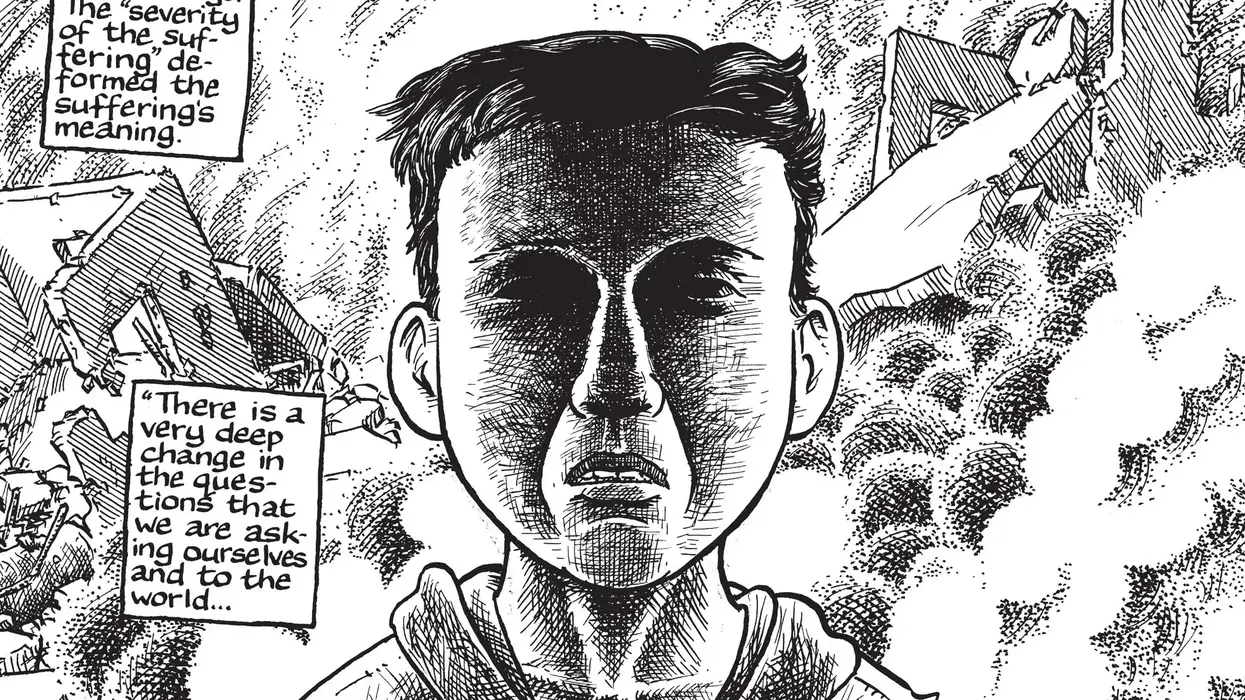
Sandwiched between text written by Chris Hedges and the illustration of Joe Sacco—an award winning artist—their new book details the hardship and survival in gritty black and white captioned storyboards that capture close-ups of Gaza’s victims amid the terror of bombardment and the weariness of constant forced displacement.
In the gut-wrenching book Requiem for Gaza, a collaboration between journalist Chris Hedges and cartoonist Joe Sacco, the reader bears witness to US-backed Israeli genocide through the eyes of 29 survivors living as refugees in Egypt. In the spring of 2025, Hedges, a former New York Times war correspondent, and Sacco, a comics journalist, spent three weeks in Cairo interviewing men and women–doctors, journalists, teachers, mental health workers—who one way or another—through medical approval, foreign citizenship, Go Fund Me accounts—managed to leave Gaza via the Rafah Crossing before Israel shut the gates, once again, to declare no exit.
With chapters that cover First Day, Exodus, Assassinations, Ceasefire, Exile and Resistance, Requiem for Gaza (160 pages) introduces us to Osama, a trauma psychologist. The former resident of Gaza City recalls how in the days that followed October 7th, he and his family huddled at home in a safe room while Israel pummeled his neighborhood with warplanes, artillery, naval guns and tanks. Osama, his wife, three children and Persian cat, loaded up the car to get the hell out but were stricken with fear—unable to think clearly before landing in a place long enough to set up a Go Fund Me page to raise $30,000 for exit visas to Egypt.
Hedges points out the cost of visas doubled, tripled, quadrupled and more after Israel launched its AI-assisted genocide that, in the crime of scholasticide destroyed every university in Gaza, where the literacy rate–among the highest in the world–had reached 98 percent.
Life is not easy for Osama in Egypt, where 150-thousand exiles from Gaza—100,000 since Oct. 7th—cannot obtain work permits, forcing them to survive in an underground economy or on donations sent from abroad. Hedges quotes Osama, “We have no status in Egypt … We are nothing … It is another level of war and struggle.”
Sandwiched between Hedge’s text, Sacco—an award winning artist—draws Osama’s story of hardship and survival in gritty black and white captioned storyboards that capture close-ups of Gaza’s victims amid the terror of bombardment and the weariness of constant forced displacement. In bold strokes—more realistic than cartoonish—Sacco illustrates the frightful and panicked expressions of Osama and his wife as they sit frozen in their car, unsure of how to escape Israel’s assault; the smoke, rubble and tanks they pass enroute to a humanitarian organization, where Osama worked in mental health. “There was bombing everywhere,” ‘but Osama assumed the Israelis knew the location of international aid groups and wouldn’t target their facilities,’ reads the panelled caption. Sacco illustrates the violence and chaos that results when a bomb falls in front of the building, killing two people. Head-bandaged children, anguished men carrying victims into the ground floor of the office, adults covering as many windows as they can with filing cabinets …” Sacco breaks up the brutal images with drawings of Osama’s daughters joyfully petting and tickling the belly of their cat, Semsen–which means sesame seed in Arabic.
Pleasure juxtaposed with pain reminds us that even in the bleakest of times life can hold humor in small moments. In this way Requiem for Gaza recalls the diverse stories told in the 2025 Gaza film “From Ground Zero”--an anthology of 22 mini-docs and animated videos, in which the short film “Everything is Fine’ chronicles a stand-up comedian’s preparation and performance for the children—some wounded and orphaned—of Gaza. Whereas other films–American Doctor, NAZA–present the point of view of caring outsiders treating the wounded in Gaza or IDF soldiers in Tel Aviv coldly recounting their obliteration of Gaza neighborhoods, Requiem for Gaza presents the intimate stories of Palestinian survivors in exile who remind us of the broad spectrum of human emotion that traverses love, guilt, fear, empathy, longing, pride–and even hope.
We meet Anna, a Palestinian from Gaza who waited four months to cross into Egypt so her paralyzed daughter Layan could receive medical treatment. “We have to continue physical therapy so she can walk again. I keep reminding her that she is very strong and one day she will walk.” Back in Gaza, Anna’s husband and two other children shelter in the ruins of a school. When she speaks to them on her cell phone–every day or every two days, depending on internet service—she tells a harmless lie—one we all might tell, that she, like them, eats only canned food. “I can’t tell them what I actually ate.” Anna picks up her phone to show Hedges and Sacco her “painfully thin” son who “is constantly complaining of headaches because of his malnutrition. I tell my sisters to get him some peanut butter.”
What makes Requiem for Gaza such a compelling read is not just the voices of the exiled but Hedge’s expose of a fraudulent Holocaust industry. “Holocaust scholars, with a handful of exceptions, have exposed their true purpose, which is not to examine the dark side of human nature and the frightening propensity we all have to commit evil," writes Hedges, "but to sanctify Jews as eternal victims and absolve the ethnonationalist state of Israel of its crimes of settler colonialism, apartheid and genocide.”
In the chapters Assassinations and Resistance, Hedges rebukes Israel’s deliberate assassination of medical workers and journalists in Gaza; the sanctions the US has imposed on Francesca Albanese, the UN special rapporteur for Palestine, after she exposed 1,000 companies’ corporate complicity in genocide; Israel’s arrests, torture and solitary confinement of flotilla activists who since 2010 have tried to break Israel’s siege on Gaza. “They are reminding the world of its moral and legal duty to intervene. They are shaming not only Israel, but the Western governments whose complicity sustains the genocide,” writes Hedges.
Requiem for Gaza is the journalists’ second collaboration. Their first–Days of Destruction, Days of Revolt–was a journey to America’s heartland, where the health and land of Native Americans were sacrificed at the altar of capitalist exploitation. When Simon and Schuster wouldn’t even entertain a “Requiem” proposal—and other publishers also passed, Hedges and Sacco published their book in 2026 through Fantagraphics, publisher of Sacco’s many graphic novels, including Palestine, winner of the 1996 American Book Award.
Requiem for Gaza has been reviewed by the Financial Times and the Columbia Journalism Review, but legacy news outlets, such as the New York Times—Hedges former employer of 15 years, Washington Post, Chicago Tribune and even the Guardian—have failed to review a book that should be classroom reading at every high school and college campus to teach students the imperative of resistance to genocide lest ascendant global fascism swallow us in fire and fury.

Decades of evidence shows us that Chuck Schumer cannot do—will not do—what must be done.
Chris Van Hollen will. Chuck Schumer won’t.
Big shoutout for the Blue Tsunami. Sooner than we dared dream MAGA is dangling from the ropes. When the Democratic-controlled Congress convenes next January we can reasonably expect reversals of Trump’s most heinous policies: the Iran war, the chaotic tariffs, and the drastic cuts in healthcare and nutrition benefits.
Jeffries in the House, and both Schumer and Van Hollen in the Senate seem willing and able to advance this agenda; all three have verbalized most of it. Reclaiming a pre-Trump status quo seems a Congressional shoo-in, and if Trump vetoes the reform measures he’ll be orchestrating a total collapse of the Republican Party in 2028.
MAGA will be a memory, but MAGA is not our most urgent political problem.
Long before Trump’s caustic presidencies corporate oligarchy took command of federal governance, tilting public policy routinely to favor corporate interests over the wellbeing of the nation.
Senator Van Hollen knows this. The Maryland Democrat rages against “...rigging the government in favor of billionaires and corporations while leaving the rest of us to pay the price.” Senator Schumer, on the other hand, is part of the problem. Over the years he has taken more than $19 million in campaign contributions from corporate sources, notably from the Wall Street banks. He is supported handsomely by AIPAC and other pro-Israel groups.
As an agent of corporate oligarchy, Schumer is not the person to challenge it.
We need Van Hollen. Tackling corporate oligarchy, regaining a functioning democracy, calls for his independent, bold, and determined effort.
Democracy in America was sabotaged—corporate oligarchy germinated—about 30 years ago. A random convergence occurred, of several absurd Supreme Court decisions, Ronald Reagan’s misbegotten presidency, and two world-class hypocrites, Bill and Hillary Clinton.
In the late 1800’s, the US Supreme Court declared American corporations to be legal persons, with rights guaranteed by the Constitution, including the freedom of speech and the right “to petition government for a redress of grievances.” A century later the Court said spending money in political campaigns is a form of free speech and therefor could not be abridged. And lobbying could not be abridged, either: the right of petition guarantees that. Corporations were empowered to donate as much and lobby as much as they pleased, potentially to dominate the crafting of public policy.
Only one brute fact prevented them from overcoming democracy altogether. Until late in the 20thcentury, corporations were numerous, typically small, and in fierce competition with others. They simply could not afford to lavish money on office seekers, or to hire expensive lobbyists.
Enter Ronald Reagan in 1981, whose presidency was guided not by the problems and opportunities facing the nation, but by his obsession with neoliberal ideology. Government is the problem, he said, stifling free enterprise with burdensome regulations.
For most of the 20th century, for example, American corporations had been stifled by antitrust laws, preventing them from growing into the savage behemoths of the Gilded Age. That’s why they were small, competitive, and cash-strapped.
Reagan suspended enforcement of those laws. As a result, unstifled American corporations, through mergers and acquisitions, plummeted in number and exploded in size. Some 3,908 corporations are traded on the stock exchanges these days, almost exactly half the high-water mark of 8,090 in the last century. Most of them in fact pose no threat to democracy, but the largest of them do: the top 500 American corporations account for 91.2% of the total of US market capitalization. Here we’ll find the corporate oligarchs.
Reagan’s dogmatism drove virtually every industry in the country into textbook oligopoly—a few giant corporations in control, largely escaping the constraints of competitive pricing. Today, ten gigantic supermarket chains sell more than 90% of all the groceries bought nationwide. This condition holds for nearly every other item of consumer goods, from books to power tools. Diminished competition inevitably raises prices; in the US today, according to economist Thomas Phillipon, living costs for American families have escalated by about $5,000 per year.
Reagan should be seen as the person most responsible for the affordability crisis raging today, not President Donald Trump. What Trump has done is merely exacerbate a crisis already in full motion.
After Reagan, came the Clintons. Over the course of their dominance over the Democratic Party, Bill and Hillary Clinton claimed to be the champions of working class Americans. But during those years they accepted from Wall Street banks a total of $93 million. In exchange they destroyed the Democratic Party’s historic affiliation with organized labor.
It began in 1992. Bill Clinton, taking a cue from Republican candidates, enlisted corporate sources for much of his campaign funding. Once in office, he rewarded his benefactors by moving the Democratic Party sharply rightward: “The era of big government is over,” he announced, and then took action to “...end welfare as we know it.” In Clinton’s preferred term the New Democratic Party joined the Republicans in accommodating, even welcoming corporate oligarchy.
Van Hollen at the time was serving in the Maryland legislature. He sponsored the Maryland Fair Campaign Finance Act, previewing his concern with the issue today.
The next president, Republican George W. Bush, embraced corporate oligarchy, taking us into a fraudulent "war on terrorism." In fact a war for oil and empire, the American people paid in blood and taxes while the nation’s corporations prospered.
The grip of corporate oligarchy was tightening, and then in 2010 the Supreme Court decided Citizens United. The guard rails vanished. The millions in corporate campaign finance surged into the billions. Van Hollen watched as the peril grew, and in 2019 he introduced a Constitutional amendment to overturn Citizens. “It’s time we finally end the outside influence of special interest spending that is corrupting our democracy,” he said at the time.
Corporate oligarchy prevailed. In the 2024 presidential campaign, small individual contributions ($200 or less) amounted to 16% of the total. That could be called the American people’s effort. “Business” donations, according to the Open Secrets organization, totaled 60.4%. And corporate lobbying? Corporations outspend citizen groups by a factor of 86:1.
The American people are stratospherically outgunned. Democracy was defeated long before Trump’s autocracy: his Administration is merely corporate oligarchy on steroids. Defeating MAGA will strip away its steroids, but not corporate oligarchy’s hammerlock.
Chris Van Hollen as Majority Leader will be a potent adversary. Chuck Schumer, who has stood aside as Wall Street and corporate interests have ravaged our politics and our economy, has shown he is not up to the task.
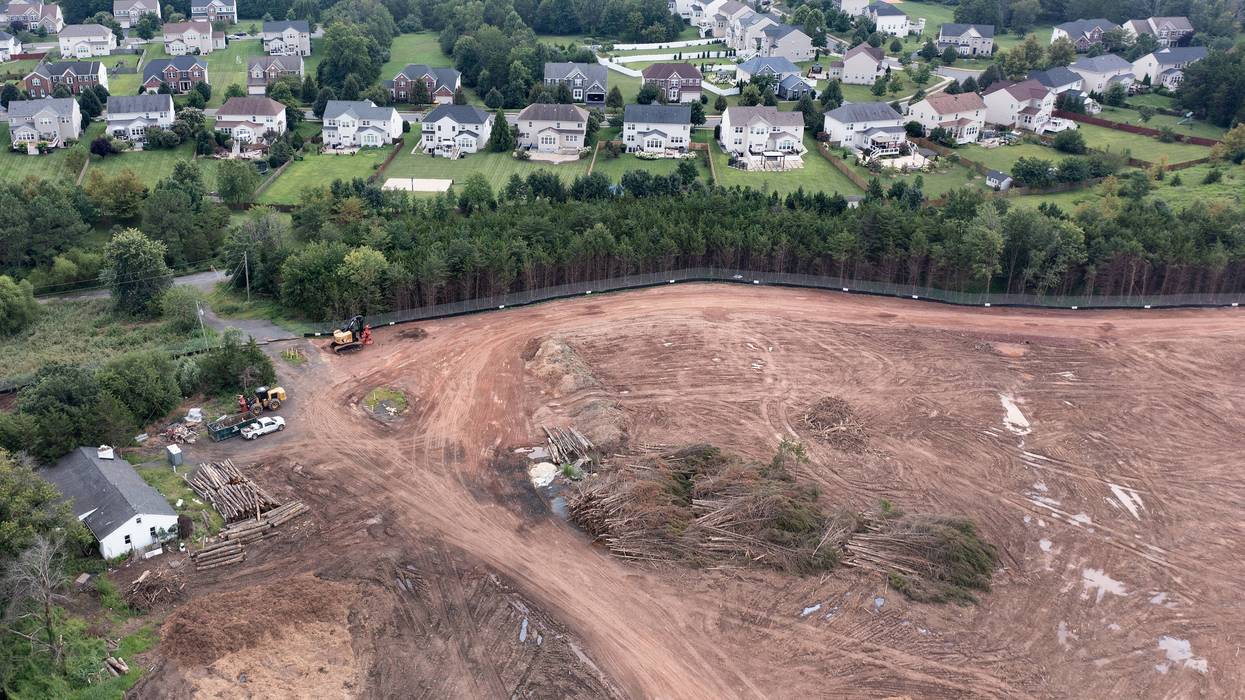
If foreign oligarchs and private equity funds own the servers, algorithms, and patents that run a country’s banks, courts, hospitals, and farms, future generations across the Global South—and working families in Virginia and Texas—will become permanent digital tenants paying rent on their own minerals, water, and data.
The rush into artificial intelligence—and the uproar over Nvidia’s Jensen Huang and an alleged Chinese intelligence operative—makes one pause for a minute and ask what is really going on. Nvidia co-founder Jensen Huang was abruptly reinstated as chief executive on Monday after President Donald Trump personally intervened with Nvidia’s board—sending the company’s stock surging nearly 30% and adding roughly a trillion dollars back to its market value.
Why did the president of the United States step in to rescue a single chip executive, and why are Wall Street private equity titans—BlackRock, Blackstone, Apollo, KKR, and sovereign wealth funds—pumping nearly $2 trillion into artificial intelligence data centers? Because what is at stake is not a software product. It is the permanent ownership of the 21st century’s means of production. As the old maxim goes, "Whoever controls the instruments of production will control the society." And whoever controls the physical compute centers, microchips, and algorithms controls global banking, defense, logistics, agriculture, and governance—extracting monopoly rent from every nation on Earth.
Isn’t this reminiscent of the First Industrial Revolution, which paved the way for colonization? Roughly 40-50% of all new data center capacity under construction worldwide sits inside the United States, and more than 60% is concentrated in the United States and China combined—leaving over 150 developing nations with no large-scale AI computing hubs at all.
Compare today’s map with 19th-century England. There were three important centers in England’s Industrial Revolution: Lancashire, Manchester, and London. Northern Virginia ("Data Center Alley") is the new Lancashire: Nearly 70% of the world’s internet traffic passes through Ashburn and Loudoun County, where windowless server warehouses and power substations spin raw global data into proprietary intelligence. Texas is the new Manchester: Fueled by cheap natural gas, vast land, and light regulation, Texas has become the boomtown of multi-gigawatt AI campuses—repeating Manchester’s lightly regulated industrial expansion. Silicon Valley, Wall Street, and Beijing are the new London: Just as London held the Bank of England and the commodity exchanges that financed the mills and wrote global trade rules, Silicon Valley, Wall Street, and Beijing hold the capital, intellectual property, and regulatory power that govern the digital order.
Yet there is one stark difference from 19th-century England. Manchester’s textile mills employed tens of thousands of factory workers. Once built, a $5-billion AI data center employs barely 30-50 permanent technicians. Local residents in Northern Virginia and Texas get almost none of the jobs—yet they sacrifice their water tables, breathe turbine exhaust, endure relentless industrial noise, and watch their household electric bills climb to subsidize billionaire server farms. Just days after the United Nation’s COP31 climate talks collapsed without an agreement, private equity funds are treating water depletion and carbon emissions as free externalities dumped onto working families—sparking grassroots blockades across Virginia and Texas that have already stalled nearly $200 billion in projects.
Colonialism as we know ended after 1945. As Ghana’s founding President Kwame Nkrumah warned in 1965, external powers no longer need viceroys or gunboats when monopoly ownership of capital and technology allows them to extract wealth from formally independent states. What we face today is Oligarchical AI Neocolonialism, operating through a three-tier global extraction chain:
Article 2 of the UN Charter guarantees sovereign equality among nations of the world and protects their territorial integrity and political independence. Yet if foreign oligarchs and private equity funds own the servers, algorithms, and patents that run a country’s banks, courts, hospitals, and farms, future generations across the Global South—and working families in Virginia and Texas—will become permanent digital tenants paying rent on their own minerals, water, and data. Breaking Oligarchical AI Neocolonialism before it hardens requires enforcing three clear rules: local mineral refining and technology transfer, strict data localization laws treating national data as a public commons, and public investment in Digital Public Infrastructure (DPI) and open-source computing owned by citizens rather than private oligarchs. True sovereignty in the 21st century begins where the server racks stand.

Although the origins of nativist thought in America continue to be instructive in the modern era, what is new is the degree to which those fears and anxieties have been stoked, amalgamated, exploited, and broadened to push what can only be called a neofascist agenda.
In 1955, the historian John Higham published his classic analysis of American nativism, Strangers in the Land. During the 19th and 20th centuries, nativist movements tapped into particular fears and ideas specific to the historical context, and Higham convincingly argued that there were three central roots—distinct from one another but, at times, overlapping—that fed “foreigner-hating” in the US.
Higham’s analysis still feels relevant, particularly as the United States continues to witness waves of nativism and, especially, as the central force behind the Trump administration’s immigration policy, Stephen Miller, has been promoted to the president’s chief of staff. (Miller’s foreigner hating has been carefully documented over the years, most notably in Jean Guerrero’s Hatemonger.) While Higham’s work is informative, the modern xenophobic milieu requires some updated, but complementary, explication. Historians explore both continuity and change, and these newer manifestations of foreigner hating capture both: recent anti-immigrant expressions harken back to Higham’s earlier patterns of American nativism and, simultaneously, have generated something relatively new, a least in the US.
Higham’s religiously based branch of nativism, often associated with the Know-Nothing Party—its slogan was “America for the Americans”—was initially directed at the Irish and German Catholics in the mid-1800s. Even after the demise of Know-Nothingism, however, religion and xenophobia again mixed and swept through the nation as large numbers of Catholics and Jews emigrated from Southern and Eastern Europe later in the 19th century.
Previous nativist movements and politicians’ exploitation of foreigner hating did not facilitate the development of a fascist movement that, ultimately, was able to control (and expand the power of) the executive branch of the government—as well as parts of the Congress—until now.
Anti-Catholic sentiment has not disappeared in the modern era—the lobbyist group US English’s WITAN memo that was leaked in the 1980s was rife with it—and polling suggests that antisemitism is again on the rise. Unsurprisingly, the nativism directed at Muslim immigrants and Muslim Americans since the terrorist attacks on September 11, 2001 has increased exponentially. Twenty-five years after 9/11, over 40% of Americans continue to hold negative opinions of Muslims in the US. At a recent campaign rally, for example, President Donald Trump stated that Abdul El-Sayed, the then-Democratic candidate for US Senate in Michigan, was a “jihadist lunatic that wants to destroy you.” (The previous month, Trump had used an antisemitic slur—the same one he used in 2025—at a rally in Kansas.)
Higham argued that economically based fears formed another root cause of nativism in the United States during the late-19th and early-20th centuries, notably fears related to depressions and the then-growing interest in “foreign” economic ideologies, such as socialism. The fiscal downturns in the 1870s and 1890s, for instance, provided a new justification for restricting programs for immigrants in some parts of the country, such as bilingual education in the public schools, while the fear of economic “radicalism” prompted an increased scrutiny of newcomers as they arrived on America’s shores, culminating with the first Red Scare in the aftermath of World War I.
Economically driven nativism, of course, is still with us today. Although not solely tied to immigrants, socialism is a boogeyman in US political discourse, with over half of Americans opposing the framework (the percent of those holding a favorable view has increased in recent years though). Financial crises continue to be a driver of nativism, so much so that the late sociologist Zygmunt Bauman argued that, as modern globalization disrupted fiscal stability, the anger many felt toward multinational corporations’ machinations—relocating factories to countries with minimal labor and environmental protections, etc.—was directed at immigrants because they were often the closest thing to a tangible “global force” on which people could focus their fury.
Perhaps most unsettling, Higham’s third source of nativism was rooted in the racial pseudoscience of the Progressive Era. This “science” spawned a hierarchy of ethnicities that unsurprisingly placed people of color on the bottom rungs and that also undergirded the Johnson-Reed Act of 1924, which greatly restricted immigration from Southern and Eastern Europe (from where, ironically, Stephen Miller’s ancestors emigrated). In the racialist thinking of the day, Italians, Russian Jews, and others were not only considered inferior to Northern and Western Europeans, but often were characterized as non-white.
Although eugenics and other forms of racist pseudoscience have been thoroughly debunked, many of the core beliefs and attitudes of that pattern of nativism have witnessed a resurgence in recent decades. White nationalists and “great replacement” conspiracy theorists’ numbers are growing, not only in the darkest corners of the internet, but also throughout mainstream culture and American politics. President Trump and Chief of Staff Miller both have promoted the replacement conspiracy—essentially an updated version of Madison Grant’s 1916 The Passing of the Great Race—and right-wing terrorists have used such ideologies and conspiracies as justifications for mass murder.
Although Higham’s origins of nativist thought in America continue to be instructive in the modern era, what is new, at least in the United States, is the degree to which those fears and anxieties have been stoked, amalgamated, exploited, and broadened by political actors to push what can only be called a neofascist agenda. After rejecting the label for years, Robert Paxton, one of the leading historians of fascism, concluded after the January 6, 2021, insurrection that Trumpism is, in fact, an American version of fascism. Trump’s inability to accept the 2020 election results and his encouragement of political violence to stop the certification makes one think of President Ronald Reagan’s opening remarks at his inauguration in 1981: “The orderly transfer of authority as called for in the Constitution routinely takes place... and few of us stop to think how unique we really are. In the eyes of many in the world, this... ceremony... is nothing less than a miracle.” As it turns out, Americans are not so unique.
Certainly, politicians have long tapped into a subset of Americans’ fears of immigrants, socialism, and the decline of the “white race” to advance their policies and careers, Joseph McCarthy, George Wallace, and Pat Buchanan being some of the most prominent. Yet, the previous nativist movements and politicians’ exploitation of foreigner hating did not facilitate the development of a fascist movement that, ultimately, was able to control (and expand the power of) the executive branch of the government—as well as parts of the Congress—until now.
The fundamental fascist aim of “internal cleansing” has been in full swing during the second Trump administration, with nativism and other forms of prejudice playing a central role in that purge. The administration’s fueling of xenophobia ensured that those who have recent roots in other parts of the world feel unwelcome, as well as those who have the “wrong” skin tone, gender, political views, sexual orientation, religion, or mother tongue. The result has been a dramatic narrowing of those who count as “real” Americans. These “disappearing citizens”—as scholars Christopher Robbins and Eric Ferris have called those who have been pushed aside by the current regime—had their say on November 3, 2026, and resoundingly repudiated the administration’s fascist agenda, along with the nativism, corruption, and cruelty upon which it was built.

Amazon made $20.7 billion in profit between July and September 2026, on an operating margin of 13.9 percent, the highest in its history. That is about $225 million a day. Or $156,000 a minute, if you like your outrage in smaller change.
The promotions started weeks ago. Fridges, sports shoes, air fryers — every one a deal of the day, every one ending at midnight, every one ending again tomorrow. Adobe expects Americans to spend $12.9 billion online on Black Friday alone. Shoppers are expected to have to use short-term credit plans to purchase more than $800 million in goods that day.
When wages can stretch no more, the corporations sell you the stretch.
The biggest deal is the one Amazon and Jeff Bezos get every day of the year through exploiting their workers. On Friday, the people who pack and drive those parcels will try to take some of it back.
Make Amazon Pay is a coalition founded in 2020 of more than 80 unions and campaign groups, led by UNI Global Union, the global union for service workers, and Progressive International.
The campaign’s demands: decent wages, safe work, union rights, fair taxation, and climate justice. This year, unions and campaigners in more than 20 countries are expected to take part in strikes and protests from November 27 to November 30.
In response to last year’s actions, an Amazon spokesperson called the campaign “intentionally misleading” and said Amazon offers “great pay, great benefits, and great opportunities.” Then the company published its numbers.
Amazon made $20.7 billion in profit between July and September 2026, on an operating margin of 13.9 percent, the highest in its history. That is about $225 million a day. Or $156,000 a minute, if you like your outrage in smaller change.
Amazon’s own press release puts U.S. warehouse starting pay at $20 an hour, or $41,600 for a full-time employee before tax. They do not reveal pay levels for their many part-time employees.
If that makes you angry, add your name to our petition to tax extreme wealth.
The company plans to spend about $220 billion this year, much of it on AI data centers. The company’s internal plan is to use robots to avoid hiring more than 600,000 U.S. workers by 2033. So the “great opportunities” come with an expiry date for many employees.
Forbes says Jeff Bezos, Amazon’s founder and executive chair, had a net worth of $361 billion on November 1, 2026. That makes him the second-richest person alive. The richest, Elon Musk, had a bad week earlier this month and didn’t notice.
A worker on Amazon’s $20 starting rate would need about 8.7 million years of full-time shifts to earn as much as Bezos’s personal wealth. Clock on 8.7 million years ago and you’d be finishing about now, if the scanner gun lets you take your break.
Bezos would like you to think he built his fortune himself. In reality, he built it with warehouse workers, delivery drivers, public roads, and every customer who ever paid extra for next-day delivery. Profits soared. The people holding the scanners got a $1 an hour rise in September.
Black Friday has gone global. So have the bills. In Nigeria, delivery-app Black Friday deals trended on X on November 20. The same week, the national statistics office put food inflation at 19.13 percent, and 31.43 percent in Lagos.
In Pakistan, the government’s weekly price index shows cooking gas up 111 percent in a year and tomatoes up 79 percent. In Brazil, the basic food basket in Fortaleza has risen 21.52 percent since December.
Nobody is running a Black Friday sale on rice.
The same rules produce both numbers. Big companies set the prices, pay trails behind, and the winners keep what they bank. That is a choice made by people with names, and governments can change it.
Six years in, Make Amazon Pay can point to concrete victories. In Italy, workers won a nationwide Amazon agreement curbing surveillance. In India, they won social-security protections for delivery workers. In Canada, warehouse workers have won union recognition. And across Germany, they’ve formed Amazon works councils, legally protected bodies through which employees elected by their peers represent worker interests before management.
On November 19, Brazil’s President Lula signed a decree ending the six-day workweek. Starting December 16, 14.8 million workers on six-day rotations get two days off a week with no pay cut. The maximum week drops from 44 hours to 42, then 40 in December 2027.
“There’s no point giving people two days off if, for lack of money, they’re stuck at home,” Lula stated. Time and money, back to the people who make the profit. That is the fight.
Amazon can afford decent pay and its full share of tax. So can the 3,428 billionaires on Forbes’s list, whose annual circus we watch every spring. You don’t need an economics degree to see that a company making $156,000 a minute can pay the person packing the box better.
The fix is to tax extreme wealth, so governments have money for the schools, clinics and buses the rest of us use.
The big retailers will spend Friday telling you the deal ends at midnight. Amazon’s workers will spend it telling Jeff Bezos his deal needs to end.

What this dismal COP31 tells us is that we must return to our countries and build the political and governance changes necessary to ensure that those who come to multilateral conferences carry the mandates of their people, not corporate polluters.
Sometimes when I close my eyes at night, I still see that massive wall of water and mud swallowing people in Nepal a few months ago—with people running for their very lives.
Too often, those who contributed least to this crisis are paying the highest price. Tragically, this is not an accident. It is the consequence of an economic system that treats nature as a commodity, the atmosphere as a dumping ground, and human suffering as an acceptable cost of profit. Climate injustice is not a side effect of the system. It is one of the ways the system works.
COP31 was meant to be an implementation COP, a moment for governments to move beyond promises and deliver the urgent climate action that science and communities demand. Instead, we witnessed a betrayal of commitments already made. At a time when we must confront the reality of 1.5°C overshoot, accelerate a just transition away from fossil fuels, and deliver the climate finance urgently needed by frontline communities, governments are failing to translate existing commitments under the Paris Agreement, COP28, and COP30 into meaningful action. The failure to include explicit language on transitioning away from fossil fuels in the final cover text is an outrage, but it is also the main reason no agreement was made on the text, as some governments are finally taking a stand against petrostates.
The future of climate negotiations must be shaped by the people most affected by the climate crisis, not by those who profit from its continuation.
Fossil fuels are the principal driver of the climate crisis. The extraction, production, and burning of coal, oil, and gas continue to push global temperatures higher, intensify extreme weather, and devastate ecosystems and livelihoods. The failure to secure even a reference to transitioning away from fossil fuels at COP31 exposes the deep political and economic interests standing in the way of climate action. We cannot solve the climate crisis while continuing to expand the very industry driving it. We need a rapid, equitable, and legally binding transition away from fossil fuels, grounded in historical responsibility, climate justice, and the right of every community to a safe and sustainable future.
Implementing climate justice means transforming how we produce, distribute, and use energy. Renewable energy and electrification are essential, but they must accelerate the phaseout of fossil fuels, not provide cover for their continued expansion. Consequently, we must critically challenge the way electrification has been advanced on the COP31 agenda. While electrification is essential to the energy transition, it cannot become a vehicle for false solutions or a backdoor for expanding Carbon Capture, Utilization, and Storage (CCUS) and prolonging fossil fuel dependence. We do not want renewable energy systems driven by fossil fuel interests; greenwashed through corporate agendas; or imposed at the expense of communities, Indigenous peoples, and ecosystems. Electrification must be powered by genuinely renewable energy, with public accountability, community ownership, and democratic control at their center. Nor can the renewable energy transition justify mineral extraction without a rights-based framework that protects communities, Indigenous peoples, their territories and ecosystems.
Equally unacceptable is the continued failure of wealthy countries and major polluters to deliver adequate and accessible climate finance. The argument that there are insufficient resources simply does not hold. Governments provided approximately $725 billion in direct fossil fuel subsidies in 2024 alone, and global military expenditure reached approximately $2.9 trillion in 2025. This demonstrates the enormous financial resources governments can mobilize when they choose to prioritize them. The question is not simply whether the money exists, but whose priorities governments choose to fund. These priorities must shift toward climate action, adaptation, loss and damage, and the communities bearing the greatest consequences of a crisis they did the least to create.
In Antalya, governments also fell short on meaningful implementation of the Belém Gender Action Plan and Just Transition Mechanism, both adopted at COP30, with concrete commitments, adequate resources, and accountability to advance justice in climate action. The operationalization of the Just Transition Mechanism was pushed to next year, while discussions on the Gender Action Plan continued to see attempts to roll back already agreed gender language. In both negotiating tracks, hard-fought language on human and Indigenous peoples' rights continued to be contested by governments. The recognition, protection, and fulfillment of human rights, including Indigenous peoples' rights, land and territorial rights, self-determination, and the right of Indigenous peoples to free, prior, and informed consent, cannot be sacrificed. Climate action cannot be considered just if it reproduces the same inequalities, dispossession, and violations of rights that have contributed to the crisis in the first place.
What this dismal COP31 tells us is that we must return to our countries and build the political and governance changes necessary to ensure that those who come to multilateral conferences carry the mandates of their people, not those of fossil fuel lobbyists or corporate polluters. We need a different vision for these multilateral spaces, rooted in climate justice and genuine accountability. Civil society, Indigenous peoples, frontline communities, women, and social movements must lead the way in demanding that governments move from rhetoric to real action. The future of climate negotiations must be shaped by the people most affected by the climate crisis, not by those who profit from its continuation.
But we, the climate movement, are undeterred. We know community-led solutions are already working, and we are advancing bold strategies that center justice, equity, and community resilience. From accelerating a fossil fuel phaseout and democratizing renewable energy to advancing a Just Transition that includes care workers, Indigenous peoples, frontline communities, and ecosystems, we will continue building the future many governments have failed to deliver. This also means recognizing the Rights of Nature and protecting ecosystems not as commodities to be exploited, but as the foundation of all life. We are ready, we are rising, and we are moving forward with this work despite government inaction.
The outcome of COP31 makes it clear that we cannot rely on a single multilateral process to deliver the transformation this moment requires. While the COP remains one of the few international arenas where Small Island Developing States, Least Developed Countries, Indigenous peoples, frontline communities, and civil society can bring their experiences and demands directly into global decision-making, we need complementary spaces to further a much needed robust agenda. This is why the call for a Fossil Fuel Treaty is more urgent than ever. We need an international framework that closes the gap left by existing climate agreements, one that stops new fossil fuel expansion, ensures a fair and equitable phaseout of existing production, and provides the international cooperation and finance needed for a Just Transition.
The Paris Agreement sets climate goals, but it does not establish a comprehensive, legally binding framework to end fossil fuel production. Importantly, COP31 saw growing momentum for this treaty, with the coalition of countries developing the proposed international legal instrument reaching 30 nations, including new countries from Africa, Latin America, and the Caribbean. Kenya also advanced a new partnership to strengthen cooperation on the treaty and an equitable phaseout. This growing leadership demonstrates that, even when consensus fails inside the United Nations negotiations, countries are willing to move forward together. The treaty is about confronting the root cause of the crisis rather than simply attempting to manage its consequences.
Looking ahead, the failures of COP31 make the next Conference on the Transition Away From Fossil Fuels (TAFF), co-hosted by Tuvalu and Ireland in 2027, even more important. The first Santa Marta Conference, held in Colombia in April 2026, brought together 57 countries to advance international cooperation on moving away from fossil fuel production and dependence. It created an important space beyond the consensus-based UN Framework Convention on Climate Change negotiations for countries willing to move from rhetoric to action. The next conference in Tuvalu must build on this momentum, turning dialogue into concrete cooperation on finance, economic diversification, and a Just Transition, while advancing the political foundations for a Fossil Fuel Treaty. We cannot allow the inability of some governments to agree to become an excuse for inaction by those ready to lead.
The tide of climate justice is rising, powered by the courage of communities, the determination of movements, and the leadership of those on the frontlines—no government, no fossil fuel lobby, and no failed negotiation can hold back a movement whose time has come.

After noisy debates all through the 2026 election cycle over whether the Party needs a sharp change in direction, Senate Democrats are split over the path forward. Let's do the numbers.
Senate Democrats are currently slated to choose their leader for the next Congress on December 1st in a secret ballot. Usually such exercises are routine, but not this year.
The sense of drama is palpable: Because the Democrats will have a heavy majority in the upper chamber, their leader is guaranteed vast leverage over both process and policy. But for the first time in many years, the strenuously maintained façade of unity that customarily cloaks intra-party differences has cracked wide open.
After noisy debates all through the 2026 election cycle over whether the Party needs a sharp change in direction, Senate Democrats are split over the path forward. New York Senator Charles Schumer, their long-time leader, faces an open challenge from Chris Van Hollen, the senior Senator from Maryland. Progressives such as Bernie Sanders, and incoming Senators Peggy Flanagan and Abdul El-Sayed, have lined up behind Van Hollen. They and others want sweeping changes in health care, policies toward AI data centers, and worker rights. They also seek a major redirection in foreign policy with respect to Israel and the undeclared US war with Iran.[1] Party stalwarts in favor of less drastic policy swings are rallying around Schumer, often very quietly.
Caught in between are many incoming Democratic Senators who were elected promising to be aggressive challengers of the status quo. The need to make a choice is plainly putting candidates like incoming Texas Senator James Talarico, Maine’s Troy Jackson and others in an awkward spot. Some Senators widely considered to be possible presidential candidates, such as Georgia Senator Jon Ossoff, are also in the spotlight.
Until all the data becomes public, a full accounting of Democratic fundraising in the 2026 election is impossible to present. We are skeptical of current media tales of a great blue wave of voters battering down cyclopean walls of red money, but it is impossible to know for sure until final campaign reports become available in December (or even later).
What is clear already, though, is that many victorious Democrats benefited heavily from funds Schumer raised and their own homegrown networks of billionaires whose policy preferences differ little from the New York Senator’s but are light years away from, say, Sanders’. (The example is not picked at random. In the next Congress, the Vermont Senator is slated to chair a key Senate committee responsible for health policy. His recent announcement that he would introduce legislation to implement Medicare for All in stages cratered stocks of insurers and other firms in the industry, including United Health Care.)
Some Senators are ducking a choice, alluding to unspecified “questions” they want answers for or even punting entirely by resonantly announcing they will not support Schumer but may not vote for Van Hollen.
Their dilemma is easy to understand. Schumer is not merely a representative of the status quo in the Democratic Party – he is its living incarnation. The start of his political career coincided with the dollar’s phoenix-like revival from the collapse of the Bretton Woods international monetary system. Then a young member of the House of Representatives, Schumer quite deliberately sought out membership on the House Banking Committee, making no bones about his desire to cultivate close relations with Wall Street.
In the following decades both Wall Street and Schumer prospered mightily. As New York emerged as the world’s financial center on a scale beyond anything it had ever attained before, Schumer’s links with financial markets ripened. In 1998, he moved to the Senate. Though sharply criticized for uncritically supporting Wall Street in the run up to the 2008 financial crisis, Schumer’s fundraising prowess propelled him steadily forward. Eventually he took over from Nevada Senator Harry Reid as Senate Democratic Leader. Today, he presides over a far-flung network of campaign fundraising vehicles, including giant Super Pacs that make heavy use of dark money, and steadily revolving door interchanges which family and friends cycle lucratively through.
Which leads to an interesting question. In the spirit of our earlier works (Ferguson, Jorgensen, and Chen, 2022) that analyzed Congressional leaders and presidential candidates in 2016 and Congressional leaders this year (Lalisse, 2026), we think it is timely to compare the shape of Schumer’s donor distributions with those of Van Hollen.
The data we present here are put together along the same lines as in our earlier studies. The crucial point is that we aggregate contributions from the same people and firms to reveal the true size distribution of donors nourishing each campaign.
We have already observed that these tabulations are necessarily incomplete. A full list of the campaign spending vehicles for each Senator that we surveyed appears in our Appendix. Coverage is reasonably complete through reports covering (not filed by) mid-October, though long experience teaches that these interim reports normally contain sizeable holes.
But we also know from previous work that in most campaigns shapes of basic donor distributions change only marginally in the later weeks of campaigns, in contrast to totals, which soar. No matter when you surveyed Bernie Sanders’ campaign filings, for example, you can be sure that his campaign finances will tilt as lopsidedly toward small donors as Figure 1’s final 2016 summary shows.
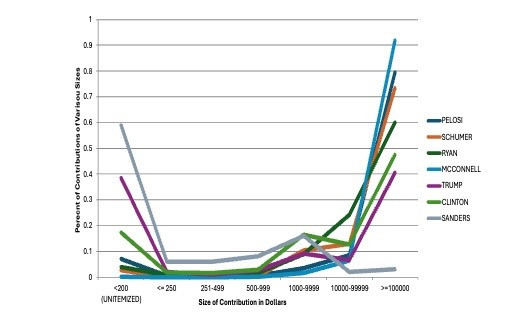
Figure 1: Size distribution of contributions for congressional leaders (Pelosi, Ryan, McConnell, and Schumer) and presidential candidates (Clinton, Trump, and Sanders) in the 2016 election cycle.
Adapted from Ferguson, Jorgensen, and Chen, Structural Change and Economic Dynamics 2022.[2]
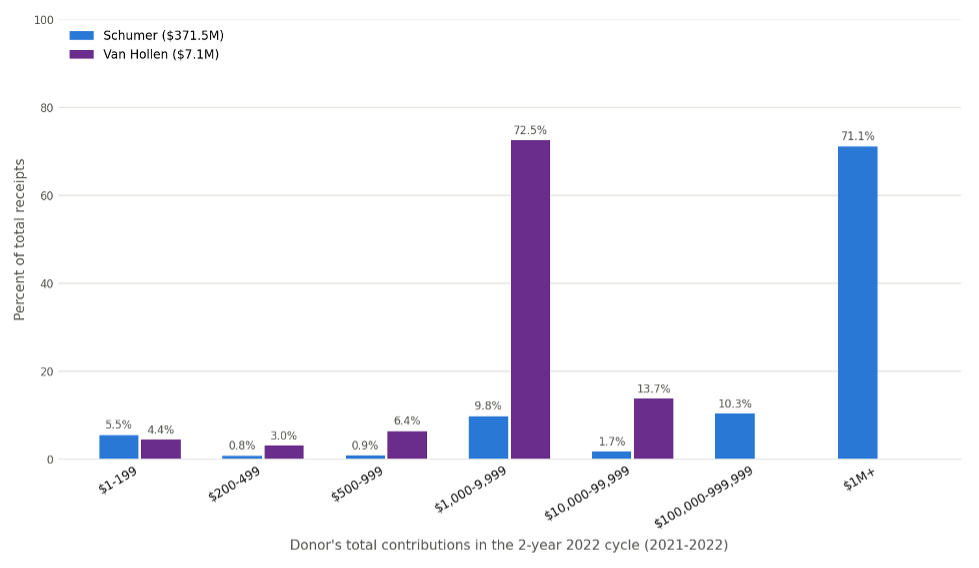
Here, then, is our comparison of donor patterns for Schumer and Van Hollen, run across the last three election cycles, since Senators are elected for six year terms and that affects money flows in between. Figures 2, 3, and 4 show why pictures are worth a thousand words. As Lalisse showed earlier this year, the new normal of Schumer’s donor distribution is now massively weighted toward donors proffering not total contributions of $100,000 or more as in the figure for 2016 above, but a million dollars or more.
Figure 2: Schumer and Van Hollen Donor Distributions 2022
Source: Authors’ calculations from FEC data
Figure 3: Schumer and Van Hollen Distributions 2024
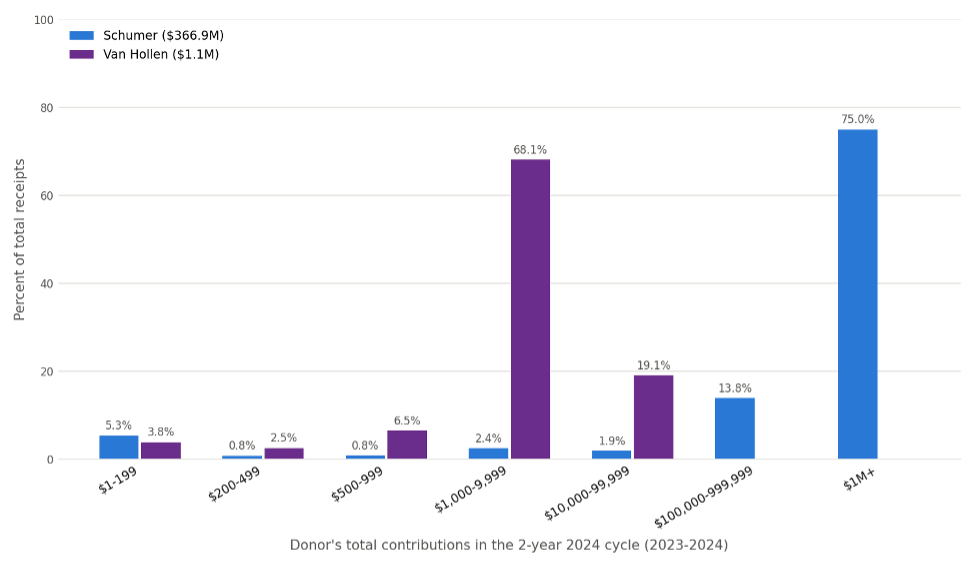
Source: Authors’ calculations from FEC data
Figure 4: Schumer and Van Hollen Donor Distributions 2026
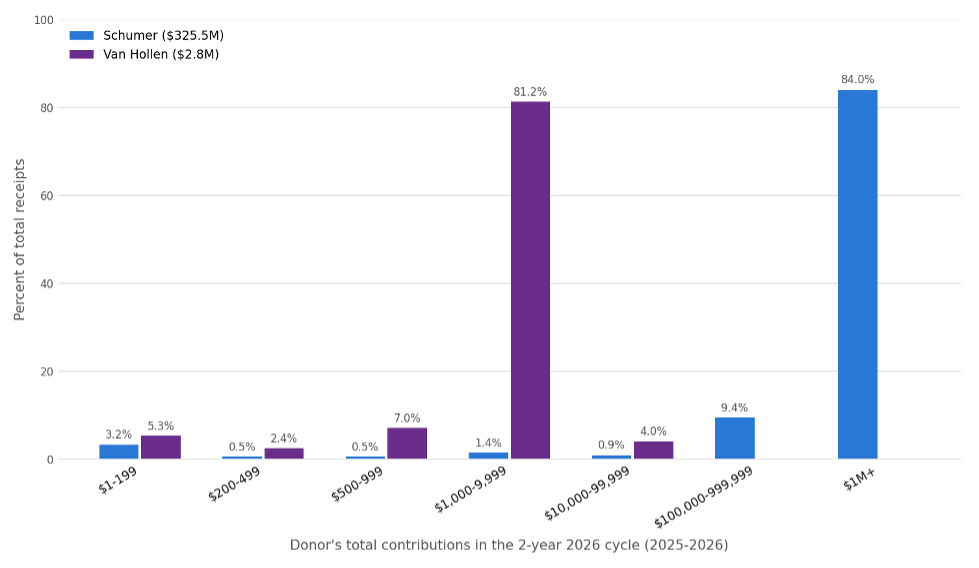
Source: Authors’ calculations from FEC data
Van Hollen’s distributions are far more modest. The response that of course the campaign treasury of the Majority Leader will be bigger slides past the crucial point: where the money comes from from. Only one of the two contestants depends on fundraising from the super-rich. That is not Van Hollen.
Appendix
Schumer’s financing is Baroque even by Congressional standards as we detailed in several earlier discussions (Ferguson, Jorgensen, Lalisse, and Chen, 2026); (Ferguson, Jorgensen, and Chen, 2026); Lalisse, 2026). Van Hollen’s is much simpler – he has no Super Pac and no cognate dark money vehicle.
We began by rounding up the political action committees associated with each candidate. These are of several types, subject to differing regulations and filing deadlines. They include formal campaign committees, leadership Pacs, joint fundraising committees, and super Pacs. The first three account for much smaller flows than the last category. For Schumer the committees include the Friends of Schumer; Impact, his Leadership Pac; the Senate Majority Pac, which is a Super Pac; and WinSenate, another Super Pac. Van Hollen’s are his campaign committee, Van Hollen for Senate; Victory Now Pac, his Leadership Committee, and a joint fundraising committee, the Van Hollen Victory Fund.
We make strenuous efforts to avoid double counting. We treat transfers between a candidate’s Pacs as duplicate transactions (WinSenate’s total income was from the Senate Majority Pac). Joint committees transfer their income to other Pacs in itemized form, and we treat the receipts of the endpoint committee as the original money, not the contributions to the joint committee. This process can be trickier than we have space to recount, but it is essential to avoid double counting.
The enormous amounts of dark money flowing through Schumer’s Super Pac vehicles, the Senate Majority Pac (“SMP”) and the affiliate organization called WinSenate, require a special word. As discussed at greater length in Lalisse (2026), a large share of their receipts originate from untraceable contributions routed through a group known as Majority Forward. Depending on the election cycle, that renders anonymous the donors of anywhere from a fifth to a third of the Super Pacs’ receipts. Though in principle it is possible to disaggregate the gargantuan sums sent on by Majority Forward, the organization declines to declare any of its contributors on its annual tax forms and the accounting practices enabled by the Supreme Court’s Citizens United ruling and other court decisions make it impossible to trace these giant lumps of cash to their origin. As a result, Majority Forward is treated as a single hundred million-dollar donor, an elision rendered essentially inescapable by the nature of the data. Experience and prior analyses of the dark money landscape suggest that the types of donors who contribute to dark money groups cluster in the $100,000 to million-dollar tier, so not much is lost for our tally of contribution sizes.

Why would the Trump administration decide that South Sudan was the right place to send men brutally rounded up by Immigration and Customs Enforcement?
The New York Times reported Tuesday:
Kilmar Armando Abrego Garcia, who was wrongfully deported from the United States last year, arrived in Madrid on Wednesday, ending a 20-month legal fight.
He left America voluntarily because it became obvious that as part of their childlike pique of revenge (a federal judge has already determined that our government was engaged in “a vindictive abuse of prosecutorial power”), President Donald Trump and Chief of Staff Stephen Miller were about to deport him to Africa.
America—in our names and with our tax dollars—has now officially embraced forms of cruelty and torture that we used to exclusively associate with brutal dictatorships like Russia and China.
Certainly we have a brutal past—I lived through parts of its final years, and am old enough to remember the "Whites Only" signs at restaurants, hotels, and other places of public accommodation. I remember the beatings at Selma, the murders in Mississippi, and the violence brought against civil rights and anti-war people; I myself both saw and experienced it in my own body in the 1960s.
And that was nothing, of course, to the hundreds of years of chattel slavery; open slaughter of Native Americans; and official oppression of women, gays, and religious minorities that preceded it.
But what we’re experiencing now is something that most of us—and certainly most of the civilized world—thought America had long ago left behind.
Back in the first Trump term, Adam Serwer wrote an article for The Atlantic titled "The Cruelty is the Point" (later made into a book of the same title), subtitled “President Trump and his supporters find community by rejoicing in the suffering of those they hate and fear.”
He chronicles the stories from the Museum of African-American History and Culture through the modern day and the open—and proudly bragged about—brutality of the first Trump administration, including the child separation, mocking the disabled, the hatred for queer people, and how the MAGA crowd went after Christine Blasey Ford when she dared expose Brett Kavanaugh’s alleged sexual assault of her. He clarified the grim reality:
This isn’t incoherent. It reflects a clear principle: Only the president and his allies, his supporters, and their anointed are entitled to the rights and protections of the law, and if necessary, immunity from it. The rest of us are entitled only to cruelty, by their whim. This is how the powerful have ever kept the powerless divided and in their place, and enriched themselves in the process.
Two weeks ago my fellow Oregonian and writer—one of our nation’s most brilliant chroniclers of modern America and our cultural deterioration under the MAGA movement—Nicholas Kristoff wrote what’s arguably the follow-up, tracking down a handful of the hundreds of human beings who’ve been brutally rounded up by Immigration and Customs Enforcement and then deported to African nations to which they have no relation and where they both look different and don’t speak the language.
He found these men in Juba, the capital city of South Sudan, noting:
They were nearly starving, can’t regularly communicate with their families or anyone else, and don’t have any path to get to their home countries or, in the case of some of them, to ever see their American citizen children again.
Kristoff documented the horror these men are confronting, alone and now imprisoned in a distant land at a cost to our government that’s absurdly higher than simply keeping them here or sending them to a nearby country were at least they could speak their native languages. He wrote:
The biggest problem, they said, is a lack of food and water, leading one man to lose 30 pounds and another 50 pounds.
One of the men, José Manuel Rodríguez-Quiñones, from Cuba, said that he had once asked for clean water and as punishment was locked in his room.
“‘I was locked down for three days,’ he said. ‘I didn’t eat for three days." The others confirmed that.Most of the time, each man is given three liters of water—less than a gallon—every two days, for drinking, bathing, and toilet flushing, they said.
I’m familiar with Juba; I was there in March of 2008 as an international relief worker during the Sudanese civil war when South Sudan had declared its independence; I spent a day with the man leading the rebellion, who’d soon become the new nation’s first (and still current) president, Salva Kiir.
He was a massive man who when we met wore a bandolier with a rifle and bullets and a huge black hat the looked like something out of a spaghetti western. He and I were born the same year (1951), and we had a fascinating conversation about the histories of our two nations, and his hopes for independence. He was also a fierce fighter who was unafraid to kill for his nation’s independence. I was both impressed by his intellect and intimidated by his penchant for violence.
This capital city of South Sudan, Juba, had one paved street that ran a mile or so long. Everything else was dirt. From there, I flew about 500 miles to the north to the border with Darfur and Sudan, where a massive refugee crisis was unfolding (which had brought us to the region).
I wrote of the experience in my diary, later published in my book Threshold, the Crisis of Western Culture. It will give you a sense of the experience these unfortunate men Trump had kidnapped from American streets and sent to that distant land are facing:
It’s late morning, and I’m sitting on the dirt ground typing into an old AA battery-operated pocket word processor (a Zaurus ZR5000), in part because the nearest electricity is over five hundred miles away. So is the nearest paved road, and the nearest building made from anything other than mud or grass. This is Gok Machar, South Sudan, just a few miles from the border with Darfur, a village that’s swelled from eight thousand people to more than forty-five thousand as refugees flee the bombings and murders taking place, as I type these words, just a few miles to the northwest. About three hundred people arrived just this morning, most with nothing more than the clothes they were wearing, many with stories of relatives who died along the way as they fled or before the UN could transport them here.
When we first arrived on the African continent we looked out on to the nighttime savannah beyond our Nairobi hotel, and it was truly a startling sight. The landscape was huge, horizon to horizon, like the movies you see of these parts of Africa. The land here in Southern Sudan is just as vast and flat. The forty-five thousand people around me share one single hand-pumped well (drilled a decade ago by the United Nations), and no other infrastructure beyond that. No buildings, no roads, no septic tank or sewage system, no schools, no clinics or hospitals, no stores or even storehouses—nothing. Most live on a patch of reddish dirt about ten feet square with a few of their possessions marking the perimeter of their “home,” sleeping on the dirt or on a ragged piece of cloth or, for the lucky few, a piece of salvaged tarp from some previous relief mission. Stick-thin women and children with bellies swollen by malnutrition outnumber the men, whose peers were murdered by the Janjaweed or taken to the north as slaves.
The air is so hot and dry that even body odor vanishes. My nose is encrusted with dust.
The land is barren of any vegetation, other than the occasional large tree with roots deep enough to reach into the water table thirty or so feet below us. Dust devils blow up and around, tiny cyclones that seem to erupt from nowhere amid air so hot and dry it feels as if we’ve been wrapped in glass-wool insulation and tossed into a furnace’s heating duct.
One relief worker we met on the way here, who was leaving the Darfur area via Juba in Southern Sudan, said, “If there is a hell, it is much like Darfur.”
This being a refugee community, it is thick with disease, as refugees not only bring illness with them but are among the most vulnerable of all populations to disease. Ebola was first discovered here and in nearby Zaire. And there’s Buruli ulcer, an incurable (other than by surgery) flesh-eating disease caused by a bacteria related to leprosy; I saw a case of it yesterday in a girl who had just arrived from Darfur. She had a hole in the side of her shin that was about four inches long, two inches wide, and three quarters of an inch deep, nearly down to the bone.
Eighty percent of the world’s cases of Guinea worm disease are here in Southern Sudan. The worm’s microscopic eggs make their way into the guts of tiny, almost invisible sand fleas, who themselves infest food and water. About three months after an infected flea is ingested, the eggs hatch. Over the course of the next year the Guinea worms grow throughout the human body, often boring through the skin, taking months to fully emerge and causing an ulcer that produces dreadful and incapacitating pain. There is no cure.
In parts of Southern Sudan, sleeping sickness—caused by a parasite named trypanosoma that’s transmitted by the bite of local flies—kills more people than AIDS. This is also the world epicenter of onchocerciasis, a worm that grows to more than one and a half feet long inside the body and spreads thousands of eggs to all the organs—soon to become more worms—over the decade or so it takes to kill a person. Sometimes the smaller worms work their way into the cornea, causing the blindness that gives this illness its common name: river blindness.
There’s also visceral leishmaniasis, tuberculosis, leprosy, yellow fever, dengue fever, various bacteria and mycoplasma that cause severe and deadly forms of pneumonia, and many, many of the people in this village are infected with malaria. (A particularly nasty, drug-resistant, and usually fatal form, P. falciparum, is the most common in Southern Sudan.)
All of the refugees have horror stories to tell. Most were burned out of their villages, some were shot, beaten, stabbed, and/or raped (including the young boys). Many had been taken as slaves and were allowed to escape only when they became too sick, lame, or old to be of value to their captors. The women and girls have particularly horrific stories to tell about gang rape by the northern Arab Muslims, whose specific goal was impregnation so the girls would have “Arab” children, and the racial/cultural/religious/tribal lineage of their families, and by extension their culture, would thus be destroyed. (We saw many “Arab-looking” young children among these very dark skinned Sudanese women.)
The sun is relentless, the air still and thick. At night it gets down into the nineties, and the sky is so big and wide, and we are so far from any electric lights, that it looks like you can reach out and touch the thick horizon-to-horizon strip of the Milky Way.
My son and I returned three years later when the war was over and the election was underway that made Kiir president; the country was still in crisis and one of the poorest and least developed in the world.
I’m guessing things have improved somewhat since then, as the land also had some oil (the main reason the north, Sudan, was so determined to hang onto the south), but this is not what these mostly Hispanic and Asian men imagined in their worst dreams as, years ago, they slipped into the United States.
Why would Miller, Trump, Vice President JD Vance, and Secretary of State Marco Rubio decide that South Sudan was the right place to send these unfortunate men? Particularly when it cost so much more than it would to have sent them to a more nearby nation? Kristoff tells the entire story in detail, so I’ll refer you to his brilliant piece in the Times.
But, in summary, I agree with his analysis that “foisting them on impoverished African countries where they are not treated humanely seems to me a moral and practical failure.”
And that’s where we are in America today, as we prepare to feast on turkey or tofurkey and celebrate the first arrival of violent, illegal, undocumented aliens to this land.
For these men in the Trump administration, the cruelty is, indeed, as Serwer wrote, the point.
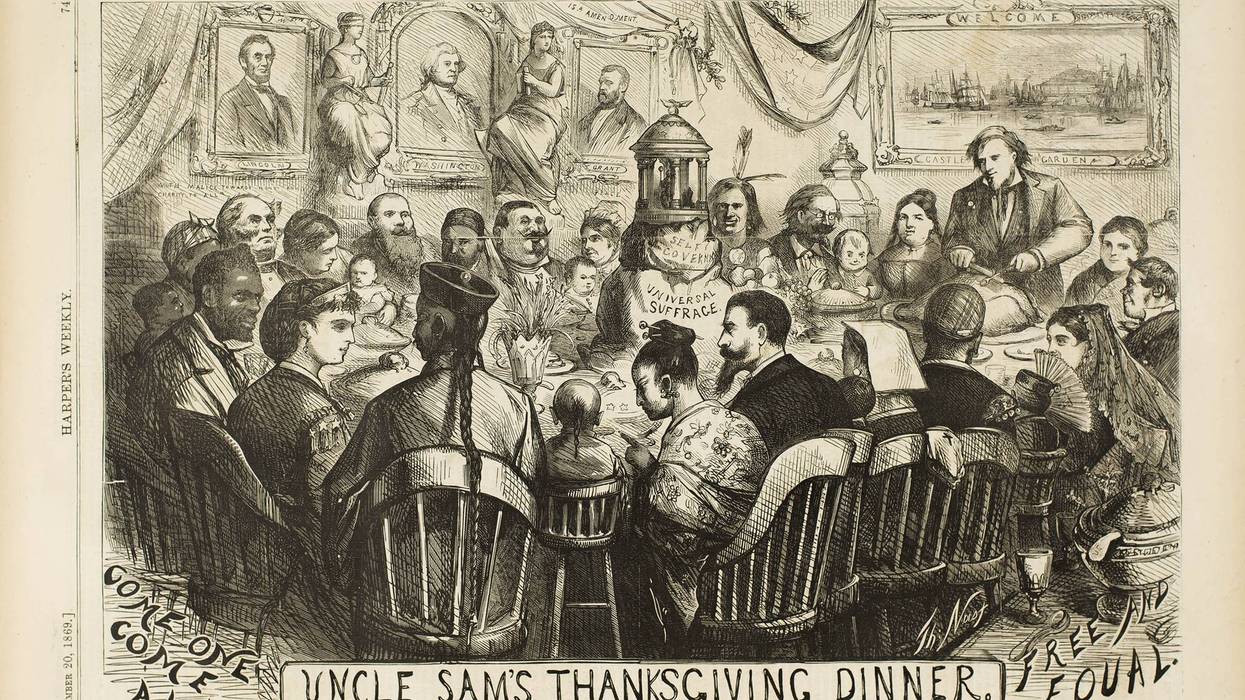
The first annual National Day of Thanksgiving was declared by Abraham Lincoln and held in 1863 in the midst of the Civil War. It's time to reclaim the emancipatory meaning of the holiday.
For more than a century, Americans have been taught that the annual Thanksgiving Day dinner on the fourth Thursday of every November commemorates a so-called “First Thanksgiving” of 1621 when 50 religious refugees from Great Britain and at least 90 of their Wampanoag hosts celebrated the group’s first harvest. That story is an historical fable invented to hide its anti-slavery and egalitarian origins long after the tradition had begun.
The first annual National Day of Thanksgiving was held in 1863 “in the midst of a civil war of unequaled magnitude and severity.” On October 3 of that year, President Abraham Lincoln declared the fourth Thursday of November a “day of thanksgiving and praise.” It was the second of three national Thanksgiving Day proclamations he would issue. On July 15, 1863, he had already become the first president since 1815, and only the third in the history of the office, to declare a day of “national thanksgiving, praise, and prayer,” asking Americans to set aside Thursday, August 6, to mark the recent victories of the Union army at Gettysburg in eastern Pennsylvania and Vicksburg on the Mississippi.
The reasons Lincoln felt compelled to proclaim two such days in quick succession are obscure, but the context of his decision is illuminating and underscores the holiday’s anti-slavery origins. There had been many state and local proclamations for a day of thanksgiving between 1815 and 1863, but none for a national and fixed day. However, Sarah Josepha Hale, the editor of the most widely read women’s magazine in the country, Godey’s Lady’s Book, had been campaigning since 1847 and the end of the US-Mexico War for a fixed Thanksgiving Day in every state and territory in the nation.
With the end of Reconstruction in 1877, however, and the resurgence of racist terror across the former Confederacy, as well as the rise of an explicitly elitist and white supremacist politics in the rest of the country, the egalitarian, anti-slavery and emancipationist origins of Thanksgiving became more and more untenable and a new origin story was required.
She did so in the hope that such a national celebration might foster a sense of national unity and counter the intense intersectional strife caused by the continued existence of slavery and its threatened expansion across the newly conquered Southwest. Addressing her plea to every governor in the union, she worked state by state and by 1859, had convinced 32 of them to declare the last Thursday of November as Thanksgiving Day.
Then came the election of Abraham Lincoln in 1860, which prompted seven pro-slavery states to secede and, a few days after his inauguration, the Confederate attack on the Union Fort Sumter in Charleston harbor, which started the civil war that Hale had so fervently hoped to avoid.
For their part, the Confederate states made no secret of the fact that they seceded from and then went to war against the Union to preserve and protect slavery. Explicit declarations to that effect were a feature of every secession declaration. For the first months of the war, the aims of the remaining United States were more diffuse until Lincoln finally issued his Emancipation Proclamation in September 1862. It declared that as of January 1, 1863, the Union would consider all the enslaved persons in the seceding states emancipated and would treat as free anyone that the Union army’s advance into the South liberated, as well as anyone who managed to find refuge behind its lines.
While the issue was thus joined, the fortunes of war at first favored the enslavers. Finally, the 1863 defeats of the Southern pro-slavery forces at Gettysburg and Vicksburg decisively checked the northern and western advance of the Confederacy—something to be thankful for, indeed—and from that point forward, the initiative lay with the Union and anti-slavery.
Looking back, the defeat of the enslavers now appears as only matter of time. But the future was far less clear to those actually involved the war. Among other things, Lincoln was up for reelection in 1864 and if an anti-war candidate were to win the presidency, they were likely to seek a peace with the secessionists that preserved slavery.
In that context, it makes perfect sense that Lincoln would see the advantage of supporting the call of the nation’s most widely read women’s magazine for a “great Union Festival of America” even though he had proclaimed such a day in honor of Gettysburg and Vicksburg two months before. How better to show the country that the Union was the party of peace and freedom and the Confederacy the party of war and slavery?
The third of Lincoln’s Thanksgiving Day proclamations, issued the next year in the midst of his reelection campaign for what he intended to be an annual event, spelled out his war aims explicitly. In it, he gave thanks for “many and signal victories over the enemy,” for a growing free population “augmented… by emancipation and immigration,” and for “minds and hearts” animated with “fortitude, courage, and resolution sufficient for the great trial of civil war into which we have been brought by our adherence as a nation to the cause of freedom and humanity.”
And thus began what has ever since been a National Day of Thanksgiving on the fourth (usually but not always the last) Thursday of November. Every year thereafter, president after president proclaimed the day, and through at least the 1890s each of them surely knew of its anti-slavery origins—for they had lived as adults through the civil war crisis and its aftermath.
With the end of Reconstruction in 1877, however, and the resurgence of racist terror across the former Confederacy, as well as the rise of an explicitly elitist and white supremacist politics in the rest of the country, the egalitarian, anti-slavery and emancipationist origins of Thanksgiving became more and more untenable and a new origin story was required. In response, genealogical societies, best-selling novelists, mass circulation magazines, and US history textbook authors ginned up the story of the Pilgrim “First Thanksgiving" to replace the true story of the holiday’s egalitarian and anti-slavery origins.
Beginning in the late 1880s and gathering steam as they went along, these groups launched several systematic campaigns to tout the racial superiority of white Anglo-Saxons and erase the emancipatory legacies of the Civil War. The new mythology provided a national origin story with which to “Americanize” the large numbers of new immigrants from Southern and Eastern Europe who were flooding the country from nations whose democratic traditions were more radical than White, Anglo-Saxon, Protestant gentility could stomach.
At the same time, erasing the anti-slavery and emancipatory aims of the Civil War aided the efforts of the rising faction of “Lily White” Republicans to win over Southern whites, especially after new restrictions on the rights of Black voters who were the party’s core base of support in the South. It also conveniently served the ideological requirements of Northern racists concerned to restrict the suffrage to those few believed to be racially suited for democratic government. Indeed, federal voter participation rates fell from around 80% in the aftermath of the Civil War to almost 50% after the rise of Jim Crow and anti-immigrant nativism.
A story for another time! For now, let us simply remember, as we gather together, the original egalitarian and anti-slavery meaning of the holiday.
Happy Thanksgiving!