SUBSCRIBE TO OUR FREE NEWSLETTER
Daily news & progressive opinion—funded by the people, not the corporations—delivered straight to your inbox.
5
#000000
#FFFFFF
To donate by check, phone, or other method, see our More Ways to Give page.
Daily news & progressive opinion—funded by the people, not the corporations—delivered straight to your inbox.
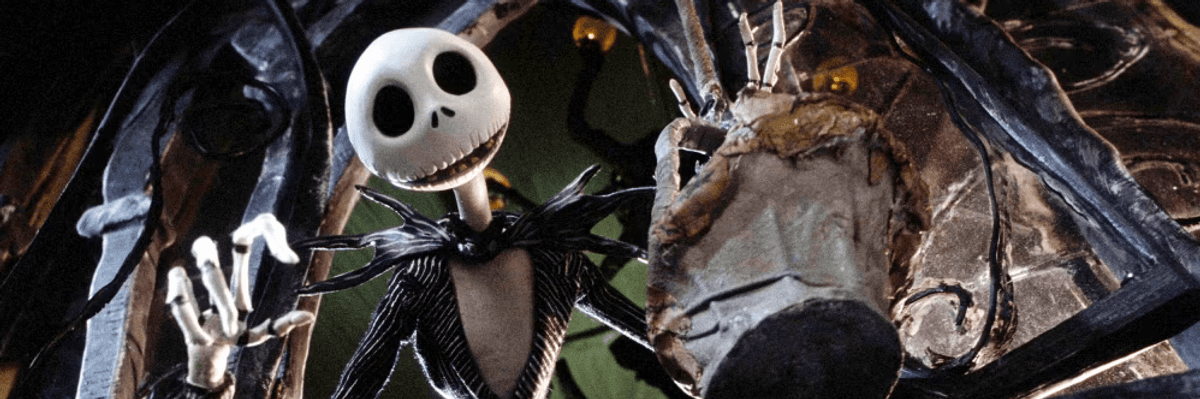
The fictional character Jack Skellington as depicted in Tim Burton's "The Nightmare Before Christmas."
The Bipartisan American Affordability and Jobs Act (BAAJA) sounds like a warm slice of Thanksgiving apple pie. It claims to address affordability and create jobs, with a dollop of bipartisanship. But cut into this half-baked bill and you'll find poison fruit.
There is something particularly sinister about rolling back our rights during the holidays. This year, while families gather to celebrate traditions, Congress advances a bill that would dramatically weaken protections for historic places across America — places where we have gathered in celebration for generations. It will eliminate our seat at the table. If we don't call, write, and raise hell NOW, we could start the New Year with our voices severely diminished.
The Bipartisan American Affordability and Jobs Act (BAAJA) sounds like a warm slice of Thanksgiving apple pie. It claims to address affordability and create jobs, with a dollop of bipartisanship. But cut into this half-baked bill and you'll find poison fruit. The disingenuous name is really an assault on states' rights, separation of powers, and democracy. Its worst provision, Title III, guts Section 106 of the National Historic Preservation Act (NHPA), making deceptive promises about faster project approvals and Green Energy permitting certainty. Those promises mask the true goal to expand federal overreach. Unless you’re a fan of stadium-sized data centers or ICE detainment facilities in your neighborhood, BAAJA is not for you.
Let's be clear: Section 106 is not bureaucratic red tape, it’s a tried and true process that empowers us to safeguard our heritage. It does not stifle progress; it requires that interested parties be consulted when the federal government takes actions affecting them. It facilitates good faith collaboration to “avoid, minimize or mitigate” harm. For six decades, it has held the government accountable, saved places, and improved projects. BAAJA eviscerates it.
The Stakes Have Never Been Higher
For more than a year, we've witnessed bad actors flout the rule of law by bypassing preservation laws and meaningful review of projects that radically change national landmarks. Washington has seen a barrage of problematic proposals following purges of nonpartisan review committees. Presently, unqualified “yes-men” sit at formerly bi-partisan decision-making tables and rubber-stamp the president’s increasingly bizarre pet projects. They routinely disregard public comment, litigation, and judicial rulings. In less than two years we’ve witnessed the demolition of the White House East Wing, approval of a hulking ballroom to replace it, and fast tracking a monstrous Triumphal Arch that will dominate DC’s skyline if constructed.
The Eisenhower Executive Office Building, Kennedy Center, Arlington National Cemetery, Wilbur J. Cohen Federal Building, East Potomac Park, and the Smithsonian Institution, among others, have all been similarly targeted. Public outcry, in the media as well as oral testimony and written comments, has fallen on deaf ears at the White House. Thus far, federal courts, where plaintiffs are successfully invoking the NHPA, are intervening to protect our heritage.
But, incomprehensibly, after an election that overwhelmingly demanded change, Congress is poised to silence Americans by handing over more power to the executive branch and industry elites. If BAAJA’s power grab becomes law, then the playbook for destroying history, already beta-tested in DC, will be hyperscaled and unleashed nationwide.
A government that makes it easier to sell and demolish history, rather than protect it, fails its people.
A Familiar Nightmare
Americans have lived this nightmare before, fought back, and expanded protection for our history. During urban renewal we lost countless historic sites, culminating in New York City razing Penn Station. In the words of Ada Louise Huxtable, it was a "monumental act of vandalism against one of the largest and finest landmarks of its age." Heartbroken Americans demanded a course correction.
In response, President Johnson commissioned a report that demonstrated nationwide carnage. Coast-to-coast, more than half of the sites Americans acknowledged as historically significant were gone. Regret motivated Congress to pass the NHPA. Section 106 enacted a simple principle: the government makes better decisions if it takes time to inform communities, to assess effects before acting, and to collaborate on a more acceptable outcome for all.
BAAJA rolls THAT back to solve problems that don’t even exist!
BAAJA’s champions claim that our informed consent leads to burdensome lawsuits and prolonged reviews. In truth, Section 106 consultations average 16 days and the odds of litigation are 0.0067% – about the same as being struck by lightning.
Proponents also claim preservation hinders economic development. But data shows preservation helps businesses flourish. Take it from President Ronald Reagan, who publicly stated:
“In an earlier time, many thought that preservation work was expensive, time-consuming, and limited in its outcome. We have evidence…to prove that notion false….The presence of historic properties as working and productive assets in our communities gives us an important link between the past and the present and reminds us of what we were, who we are, and where we hope to be.”
He was spot on! Historic tax credits incentivize rehabilitation, attract tourism, and support small businesses. Those credits depend on identifying eligible historic properties, which happens most often during a Section 106 review!
So, BAAJA will undermine our ability to recognize heritage assets. Possibilities to save and invest in our cultural heritage will be foreclosed upon and rehabilitation opportunities shrink.
There is a better way forward
America needs infrastructure, housing, energy, and economic investment, but we don’t have to horse trade our heritage to get them. We can walk and chew gum at the same time. Congress must do better than dishonoring NHPA’s proud, sixty-year bipartisan success story – what the National Parks Service calls, “a conversation with our past about our future” – by force-feeding us BAAJA.
There are better ways to achieve permitting reform than destroying the laws that work. The people that implement NHPA regulations tell us that increased agency staffing, improved coordination, sufficient funding, and better technology are what’s actually needed. The incoming Congress should work with experts, not corporate lobbyists, moving forward.
The House must reject BAAJA this holiday season. Our cultural sites belong to the people, not to elites rushing to grab even more power and control. With a historic number of lawmakers headed for the exits after the midterms, newly elected congressmembers should have the opportunity to convene, rethink, and assess before voting on this “Affordability and Jobs” smokescreen.
As the holidays approach, we remember that traditions survive because generations have endeavored to preserve them. This time last year, we rallied thousands of people to save the Wilbur J. Cohen Federal Building in Washington DC - the "Sistine Chapel of the New Deal," preventing bulldozers from arriving and forever destroying its incredible architecture and art. If BAAJA passes, the guardrails disappear. We must defend them.
If you agree — join us on November 30 to make Cyber Monday a day for advocacy. We encourage every American to call, email, and post about BAAJA. If you want your voice and our historic sites protected, tell lawmakers to VOTE NO.
Switchboard for Congress: (202) 224-3121
Simple script: "Please oppose passage of the Bipartisan American Affordability and Jobs Act (BAAJA) in any form in this Congress."
Additional advocacy resources: https://www.106strong.com/
The opinions expressed by the authors are their own and do not represent the views of any employer or organization with which they are affiliated.
This country and this world are at a monumental crossroads. US voters have an opportunity to beat back the forces of fascism and confront the billionaires who are rigging the economy, our media system, and our democracy, making it increasingly impossible for ordinary people to get by. We’re not just talking about the election. We’re talking about what must be done once these fascist elements are vanquished from power. We need a bolder set of solutions than what either major party has so far been willing to offer and a working-class movement ready to fight like hell for it. Trump didn't emerge from nowhere. The conditions that fueled MAGA authoritarianism were created by decades of radical neoliberal economic policies and a corrupt political system dominated by corporate interests. They slashed taxes on the super-rich, promising that the benefits would trickle down. They said giveaways to the corporate titans would make life more affordable for the rest of us. It was all bullshit. And when a bitter, betrayed populace searches for someone to blame, right-wing demagogues have little trouble finding scapegoats. People know when they're being lied to, but you won't hear any of this from the corporate media. Only independent journalism—powered and funded by people who believe in building a better world—can deliver truly trustworthy daily news. If you share our vision, please contribute whatever you can to sustain our work. |
There is something particularly sinister about rolling back our rights during the holidays. This year, while families gather to celebrate traditions, Congress advances a bill that would dramatically weaken protections for historic places across America — places where we have gathered in celebration for generations. It will eliminate our seat at the table. If we don't call, write, and raise hell NOW, we could start the New Year with our voices severely diminished.
The Bipartisan American Affordability and Jobs Act (BAAJA) sounds like a warm slice of Thanksgiving apple pie. It claims to address affordability and create jobs, with a dollop of bipartisanship. But cut into this half-baked bill and you'll find poison fruit. The disingenuous name is really an assault on states' rights, separation of powers, and democracy. Its worst provision, Title III, guts Section 106 of the National Historic Preservation Act (NHPA), making deceptive promises about faster project approvals and Green Energy permitting certainty. Those promises mask the true goal to expand federal overreach. Unless you’re a fan of stadium-sized data centers or ICE detainment facilities in your neighborhood, BAAJA is not for you.
Let's be clear: Section 106 is not bureaucratic red tape, it’s a tried and true process that empowers us to safeguard our heritage. It does not stifle progress; it requires that interested parties be consulted when the federal government takes actions affecting them. It facilitates good faith collaboration to “avoid, minimize or mitigate” harm. For six decades, it has held the government accountable, saved places, and improved projects. BAAJA eviscerates it.
The Stakes Have Never Been Higher
For more than a year, we've witnessed bad actors flout the rule of law by bypassing preservation laws and meaningful review of projects that radically change national landmarks. Washington has seen a barrage of problematic proposals following purges of nonpartisan review committees. Presently, unqualified “yes-men” sit at formerly bi-partisan decision-making tables and rubber-stamp the president’s increasingly bizarre pet projects. They routinely disregard public comment, litigation, and judicial rulings. In less than two years we’ve witnessed the demolition of the White House East Wing, approval of a hulking ballroom to replace it, and fast tracking a monstrous Triumphal Arch that will dominate DC’s skyline if constructed.
The Eisenhower Executive Office Building, Kennedy Center, Arlington National Cemetery, Wilbur J. Cohen Federal Building, East Potomac Park, and the Smithsonian Institution, among others, have all been similarly targeted. Public outcry, in the media as well as oral testimony and written comments, has fallen on deaf ears at the White House. Thus far, federal courts, where plaintiffs are successfully invoking the NHPA, are intervening to protect our heritage.
But, incomprehensibly, after an election that overwhelmingly demanded change, Congress is poised to silence Americans by handing over more power to the executive branch and industry elites. If BAAJA’s power grab becomes law, then the playbook for destroying history, already beta-tested in DC, will be hyperscaled and unleashed nationwide.
A government that makes it easier to sell and demolish history, rather than protect it, fails its people.
A Familiar Nightmare
Americans have lived this nightmare before, fought back, and expanded protection for our history. During urban renewal we lost countless historic sites, culminating in New York City razing Penn Station. In the words of Ada Louise Huxtable, it was a "monumental act of vandalism against one of the largest and finest landmarks of its age." Heartbroken Americans demanded a course correction.
In response, President Johnson commissioned a report that demonstrated nationwide carnage. Coast-to-coast, more than half of the sites Americans acknowledged as historically significant were gone. Regret motivated Congress to pass the NHPA. Section 106 enacted a simple principle: the government makes better decisions if it takes time to inform communities, to assess effects before acting, and to collaborate on a more acceptable outcome for all.
BAAJA rolls THAT back to solve problems that don’t even exist!
BAAJA’s champions claim that our informed consent leads to burdensome lawsuits and prolonged reviews. In truth, Section 106 consultations average 16 days and the odds of litigation are 0.0067% – about the same as being struck by lightning.
Proponents also claim preservation hinders economic development. But data shows preservation helps businesses flourish. Take it from President Ronald Reagan, who publicly stated:
“In an earlier time, many thought that preservation work was expensive, time-consuming, and limited in its outcome. We have evidence…to prove that notion false….The presence of historic properties as working and productive assets in our communities gives us an important link between the past and the present and reminds us of what we were, who we are, and where we hope to be.”
He was spot on! Historic tax credits incentivize rehabilitation, attract tourism, and support small businesses. Those credits depend on identifying eligible historic properties, which happens most often during a Section 106 review!
So, BAAJA will undermine our ability to recognize heritage assets. Possibilities to save and invest in our cultural heritage will be foreclosed upon and rehabilitation opportunities shrink.
There is a better way forward
America needs infrastructure, housing, energy, and economic investment, but we don’t have to horse trade our heritage to get them. We can walk and chew gum at the same time. Congress must do better than dishonoring NHPA’s proud, sixty-year bipartisan success story – what the National Parks Service calls, “a conversation with our past about our future” – by force-feeding us BAAJA.
There are better ways to achieve permitting reform than destroying the laws that work. The people that implement NHPA regulations tell us that increased agency staffing, improved coordination, sufficient funding, and better technology are what’s actually needed. The incoming Congress should work with experts, not corporate lobbyists, moving forward.
The House must reject BAAJA this holiday season. Our cultural sites belong to the people, not to elites rushing to grab even more power and control. With a historic number of lawmakers headed for the exits after the midterms, newly elected congressmembers should have the opportunity to convene, rethink, and assess before voting on this “Affordability and Jobs” smokescreen.
As the holidays approach, we remember that traditions survive because generations have endeavored to preserve them. This time last year, we rallied thousands of people to save the Wilbur J. Cohen Federal Building in Washington DC - the "Sistine Chapel of the New Deal," preventing bulldozers from arriving and forever destroying its incredible architecture and art. If BAAJA passes, the guardrails disappear. We must defend them.
If you agree — join us on November 30 to make Cyber Monday a day for advocacy. We encourage every American to call, email, and post about BAAJA. If you want your voice and our historic sites protected, tell lawmakers to VOTE NO.
Switchboard for Congress: (202) 224-3121
Simple script: "Please oppose passage of the Bipartisan American Affordability and Jobs Act (BAAJA) in any form in this Congress."
Additional advocacy resources: https://www.106strong.com/
The opinions expressed by the authors are their own and do not represent the views of any employer or organization with which they are affiliated.