SUBSCRIBE TO OUR FREE NEWSLETTER
Daily news & progressive opinion—funded by the people, not the corporations—delivered straight to your inbox.
5
#000000
#FFFFFF
To donate by check, phone, or other method, see our More Ways to Give page.


Daily news & progressive opinion—funded by the people, not the corporations—delivered straight to your inbox.
As the Republican Party has gone fascist, with unhinged Trump at its head, the potential consequences of your not voting or voting for a third-party candidate are horrific.
Some people tell me they hate Trump but don’t particularly like Biden. They say Biden is too old, or he’s not doing enough to stop Israel’s bombing of Gaza, or he’s caved to Big Oil, or he isn’t tough enough.
So they tell me they’re not going to vote next November. Or they’ll vote for a third-party candidate.
Maybe you know someone like this. Or you yourself fall into this camp.
Here’s what I tell them: By not voting or voting for a third party, they’re actually casting a vote for Trump.
Some respond by saying that Trump may be a curse, but they’re sick and tired of voting for the lesser of two evils.
Wrong. Biden is not evil. Trump is truly evil.
The fact is, America has a two-party system. You may not like it, but that’s our reality. The founders did not opt for a parliamentary system, where citizens have more options of whom to vote for. So one of the nominees from one of the two major parties is going to win. And if you don’t vote, or you vote for a third-party candidate, you’re inevitably hurting the candidate from one of the major parties who’s closest to you in values — and helping the one farthest from you.
Which perhaps wasn’t of huge consequence 50 years ago. But as the Republican Party has gone fascist, with unhinged Trump at its head, the potential consequences of your not voting or voting for a third-party candidate are horrific.
In 2016, many people knew Trump was out of his gourd. But they disliked Hillary Clinton so much they decided to sit on their hands, or vote for the Green Party candidate, Jill Stein, rather than vote for what they described as “the lesser of two evils.”
And look what we got.
If Trump gets back into the Oval Office, it’s likely to be even worse this time.
***
On Amy Goodman’s “Democracy Now” broadcast of August 4, 2016, I debated journalist and author Chris Hedges, who was supporting Green Party candidate Jill Stein. [The following transcript has been edited for length. You can find the unedited transcript here, or if you have the time you may want to watch the entire 35-minute debate, which I’ve posted here.]
Me: Hillary Clinton is going to be the nominee. I support her. And I support her not only because she will be a good president, if not a great president, but also, frankly, because I am tremendously worried about the alternative. And the alternative is somebody who is a megalomaniac and a bigot who will set back the progressive movement decades, if not more.
Hedges: Clinton has abandoned children. She and her husband destroyed welfare as we know it, and 70 percent of the original recipients were children. I don’t like Trump, but Trump is responding to a phenomenon created by neoliberalism. And we may get rid of Trump, but we will get something even more vile, maybe Ted Cruz.
Me: If Donald Trump becomes president, irrevocable negative changes will happen in the United States, including appointments to the Supreme Court that will worsen the structure of this country. Voting for Donald Trump or equating Hillary Clinton with Donald Trump is insane.
Hedges: I admire Robert and have read much of his stuff and like his stuff, but if you listen to what he’s been saying, the message is the same message of the Trump campaign, and that is fear. And fear is all the Democrats have to offer now and all the Republicans have to offer now.
Me: Given our two-party, winner-take-all system, it’s just too much of a risk to say, “I’m not going to vote for the lesser of two evils.” If you do not support Hillary Clinton, you are increasing the odds of a true, clear and present danger to the United States, a menace to the United States. And you’re increasing the possibility that the United States will be changed for the worse. I must urge everyone who is listening or who is watching to do whatever they can to make sure that Hillary Clinton is the next president, and not Donald Trump.
Hedges: I find Trump a vile and disturbing and disgusting figure, but I don’t believe that voting for the Democratic establishment [will help]. The TPP [Trans Pacific Partnership] is going to go through, whether it’s Donald Trump or Hillary Clinton. Endless war is going to be continued, whether it’s Trump or Clinton. We’re not going to get our privacy back, whether it’s under Clinton or Trump. The idea that, at this point, the figure in the executive branch exercises that much power, given the power of the war industry and Wall Street, is a myth.
***
Starting five months after this discussion, we had four years of Trump. We saw what his bigotry and hatefulness did to America. We witnessed how he divided America into two angry camps that are still furious with each other. We endured his giant tax cut to the rich and big corporations. We watched his attempted coup. We suffered through his refusal to concede the 2020 election and his big lie that it was “stolen” from him. He is now running again, in an even more paranoid and bigoted campaign than in 2016 or 2020.
I rest my case.
The misery and carnage, which rippled out from a dismembered Libya, was unleashed in the name of democratization, nation-building, promoting the rule of law and human rights.
“We came, we saw, he died,” Hillary Clinton famously quipped when Muammar Gaddafi, after seven months of U.S. and NATO bombing, was overthrown in 2011 and killed by a mob who sodomized him with a bayonet. But Gaddafi would not be the only one to die. Libya, once the most prosperous and one of the most stable countries in Africa, a country with free healthcare and education, the right for all citizens to a home, subsidized electricity, water and gasoline, along with the lowest infant mortality rate and highest life expectancy on the continent, along with one of the highest literacy rates, swiftly fragmented into warring factions. There are currently two rival regimes battling for control in Libya, along with an array of rogue militias.
The chaos that followed Western intervention saw weapons from the country’s arsenals flood the black market, with many snatched up by groups such as the Islamic State. Civil society ceased to function. Journalists captured images of migrants from Nigeria, Senegal and Eritrea being beaten and sold as slaves to work in fields or on construction sites. Libya’s infrastructure, including its electrical grids, aquifers, oil fields and dams, fell into disrepair. And when the torrential rains from Storm Daniel — the climate crisis being another gift to Africa from the industrialized world — overwhelmed two decrepit dams, walls of water 20 feet high raced down to flood the port of Derna and Benghazi, leaving up to 20,000 dead according to Abdulmenam Al-Gaiti, Mayor of Derna, and some 10,000 missing.
Utopian social engineering is always catastrophic. It creates power vacuums that augment the suffering of those the utopianists claim to protect.
“The fragmentation of the country’s disaster management and disaster response mechanisms, as well as deteriorating infrastructure, exacerbated the enormity of the challenges. The political situation is a driver of risk,” said Professor Petteri Taalas, Secretary General of the World Meteorological Organization.
Taalas told reporters last Thursday that “most of the human casualties” would have been avoided if there had been a “normally operating meteorological service” which “would have issued the [necessary] warnings and also the emergency management of this would have been able to carry out evacuations of the people.”
Western regime-change, carried out in the name of human rights under the doctrine of R2P (Responsibility to Protect), destroyed Libya – as it did Iraq – as a unified and stable nation. The flood victims are part of the tens of thousands of Libyan dead resulting from our “humanitarian intervention,” which rendered disaster relief non-existent. We bear responsibility for Libya’s prolonged suffering. But once we wreak havoc on a country in the name of saving its persecuted — regardless of whether they are being persecuted or not — we forget they exist.
Karl Popper in “The Open Society and Its Enemies” warned against utopian engineering, massive social transformations, almost always implanted by force, and led by those who believe they are endowed with a revealed truth. These utopian engineers carry out the wholesale destruction of systems, institutions and social and cultural structures in a vain effort to achieve their vision. In the process, they dismantle the self-correcting mechanisms of incremental and piecemeal reform that are impediments to that grand vision. History is replete with murderous utopian social engineering — the Jacobins, the communists, the fascists and now, in our own age, the globalists, or neoliberal imperialists.
Libya, like Iraq and Afghanistan, fell victim to the self-delusions peddled by humanitarian interventionists — Barack Obama, Hillary Clinton, Ben Rhodes, Samantha Power, and Susan Rice. The Obama administration armed and backed an insurgent force that they believed would do the bidding of the U.S. Obama in a recent post urged people to support aid agencies to alleviate the suffering of the people of Libya, a plea that ignited an understandable backlash on social media.
There is no official tally of the casualties in Libya that have resulted directly and indirectly from the violence in Libya over the last 12 years. This is exacerbated by the fact that NATO failed to investigate casualties resulting from its seven month bombardment of the country in 2011. But the total figure of those killed and injured is likely in the tens of thousands. Action on Armed Violence recorded “8,518 deaths and injuries from explosive violence in Libya” from 2011 to 2020, 6,027 of which were civilian casualties.
In 2020, a statement published by seven U.N. agencies reported that “Close to 400,000 Libyans have been displaced since the start of the conflict nine years ago — around half of them within the past year, since the attack on the capital, Tripoli, [by Field Marshal Khalifa Belqasim Haftar’s forces] started.”
“The Libyan economy has been battered by the [civil war], the COVID-19 pandemic, and Russia’s invasion of Ukraine,” the World Bank reported in April of this year. “The country’s fragility is having far-reaching economic and social impact. GDP per capita declined by 50 percent between 2011 and 2020 while it could have increased by 68 percent if the economy had followed its pre-conflict trend,” the report says. “This suggests that Libya’s income per capita could have been 118 percent higher without the conflict. Economic growth in 2022 remained low and volatile due to conflict-related disruptions in oil production.”
Amnesty International’s 2022 Libya report also makes for grim reading. “Militias, armed groups and security forces continued to arbitrarily detain thousands of people,” it says. “Scores of protesters, lawyers, journalists, critics and activists were rounded up and subjected to torture and other ill-treatment, enforced disappearances and forced ‘confessions’ on camera.” Amnesty describes a country where militias operate with impunity, human rights abuses, including kidnappings and sexual violence, are widespread. It adds that “EU-backed Libyan coastguards and the Stability Support Authority militia intercepted thousands of refugees and migrants at sea and forcibly returned them to detention in Libya. Detained migrants and refugees were subjected to torture, unlawful killings, sexual violence and forced labour.”
Reports by the U.N. Support Mission to Libya (UNSMIL) are no less dire.
Stockpiles of weapons and ammunition — estimated to be between 150,000 and 200,000 tons — were looted from Libya with many being trafficked to neighboring states. In Mali, weapons from Libya fuelled a dormant insurgency by the Tuareg, destabilizing the country. It ultimately led to a military coup and a jihadist insurgency which supplanted the Tuareg, as well as a protracted war between the Malian government and jihadists. This triggered another French military intervention and led to 400,000 people being displaced. Weapons and ammunition from Libya also made their way into other parts of the Sahel including Chad, Niger, Nigeria and Burkina Faso.
The misery and carnage, which rippled out from a dismembered Libya, was unleashed in the name of democratization, nation-building, promoting the rule of law and human rights.
The pretext for the assault was that Gaddafi was about to launch a military operation to massacre civilians in Benghazi where rebellious forces had seized power. It had as much substance as the charge that Saddam Hussein had weapons of mass destruction, another example of utopian social engineering that left over a million Iraqi dead and millions more driven from their homes.
Gaddafi — who I interviewed for two hours in April 1995 near the gutted remains of his home that was bombed by U.S. warplanes in 1986 — and Hussein were targeted not because of what they did to their own people, although both could be brutal. They were targeted because their nations had large oil reserves and were independent of Western control. They renegotiated more favorable contracts for their nations with Western oil producers and awarded oil contracts to China and Russia. Gaddafi also gave the Russian fleet access to the port of Benghazi.
Hillary Clinton’s emails, obtained via a freedom of information request and published by WikiLeaks, also expose France’s concerns about Gaddafi’s efforts to “provide Francophone African Countries with an alternative to the French Fran (CFA).” Sidney Blumenthal, a longtime adviser to Clinton, reported on his conversations with French intelligence officers about the motivations of French President Nicholas Sarkozy, the chief architect of the attack on Libya. Blumenthal writes that the French president seeks “a greater share of Libyan oil”, increased French influence in the region, an improvement in his domestic political standing, a reassertion of French military power and an end to Gaddafi’s attempts to supplant French influence in “Francophone Africa.”
Sarkozy, who has been convicted on two separate cases of corruption and breach of campaign finance laws, faces a historic trial in 2025 for allegedly receiving millions of euros in secret illegal campaign contributions from Gadaffi, to assist with his successful 2007 presidential bid.
These were the real “crimes” in Libya. But the real crimes always remain hidden, papered over by florid rhetoric about democracy and human rights.
The American experiment, built on slavery, began with a genocidal campaign against Native Americans that was exported to the Philippines and, later, nations such as Vietnam. The narratives we tell ourselves about World War II, largely to justify our right to intervene around the globe, are a lie. It was the Soviet Union that destroyed the German army long before we landed at Normandy. We firebombed cities in Germany and Japan killing hundreds of thousands of civilians. The war in the South Pacific, where one of my uncles fought, was bestial, characterized by rabid racism, mutilation, torture and the routine execution of prisoners. The atomic bombings of Hiroshima and Nagasaki were egregious war crimes. The U.S. routinely destroys democracies that nationalize U.S. and European corporations as in Chile, Iran and Guatemala, replacing them with repressive military regimes. Washington supported the genocides in Guatemala and East Timor. It embraces the crime of preemptive war. There is little in our history to justify the claim of unique American virtues.
The nightmares we orchestrated in Iraq, Afghanistan and Libya are minimized or ignored by the press while the benefits are exaggerated or fabricated. And since the U.S. does not recognize the International Criminal Court, there is no chance of any American leader being held accountable for their crimes.
Human rights advocates have become a vital cog in the imperial project. The extension of U.S. power, they argue, is a force for good. This is the thesis of Samantha Power’s book “A Problem from Hell: America and the Age of Genocide.” They champion the R2P doctrine, unanimously adopted in 2005 at the U.N. World Summit. Under this doctrine, states are required to respect the human rights of their citizens. When these rights are violated, then sovereignty is nullified. Outside forces are permitted to intervene. Miguel d’Escoto Brockmann, the former president of the U.N. General Assembly, warned in 2009 that R2P could be misused “to justify arbitrary and selective interventions against the weakest states.”
“Since the end of the Cold War, the idea of human rights has been made into a justification for intervention by the world’s leading economic and military powers, above all, the United States, in countries that are vulnerable to their attacks,” writes Jean Bricmont in “Humanitarian Imperialism: Using Human Rights to Sell War.” “Until the U.S. invasion of Iraq, [a] large part of the left was often complicit in this ideology of intervention, discovering new ‘Hitlers’ as the need arose, and denouncing antiwar arguments as appeasement on the model of Munich in 1938.”
The creed of humanitarian intervention is selective. Compassion is extended to “worthy” victims while “unworthy” victims are ignored. Military intervention is good for Iraqis, Afghans or Libyans, but not for Palestinians or Yeminis. Human rights are supposedly sacrosanct when discussing Cuba, Venezuela and Iran, but irrelevant in our offshore penal colonies, the world’s largest open air prison in Gaza or our drone-infested war zones. The persecution of dissidents and journalists is a crime in China or Russia, but not when the targets are Julian Assange and Edward Snowden.
Utopian social engineering is always catastrophic. It creates power vacuums that augment the suffering of those the utopianists claim to protect. The moral bankruptcy of the liberal class, which I chronicle in “Death of the Liberal Class,” is complete. Liberals have prostituted their supposed values to the Empire. Incapable of taking responsibility for the carnage they inflict, they clamor for more destruction and death to save the world.
The failure of too many in the mainstream press is not only inexcusable, but ominous.
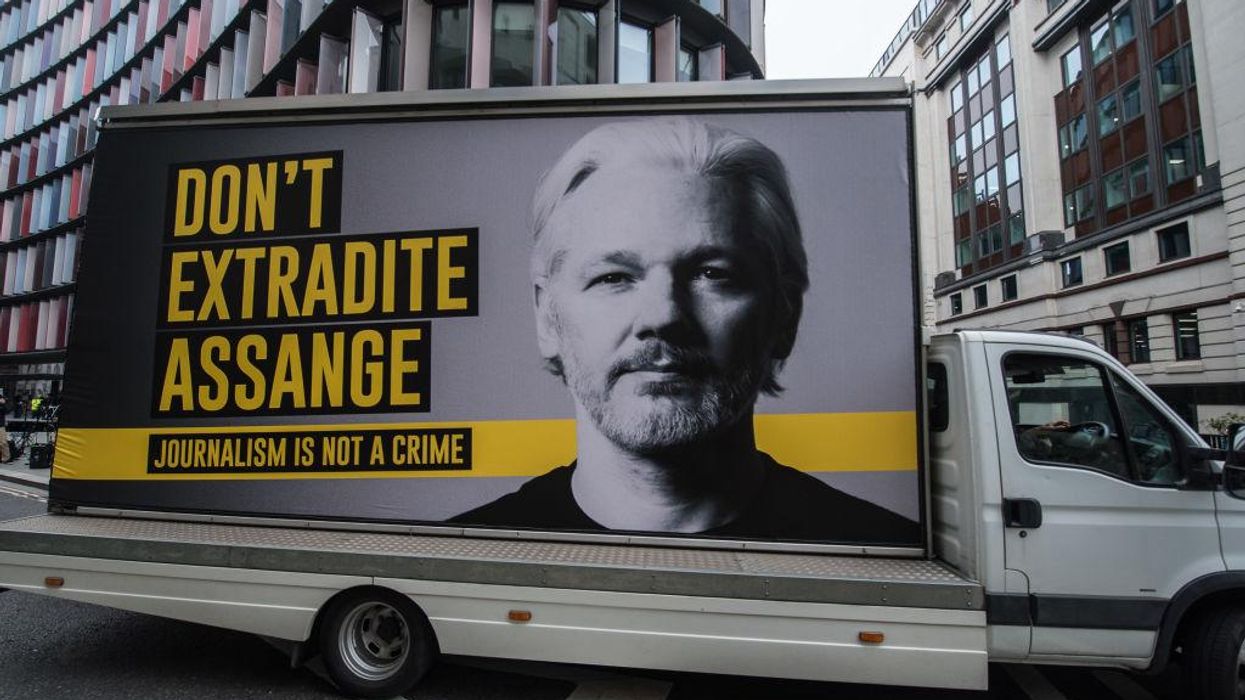
The persecution of Julian Assange, along with the climate of fear, wholesale government surveillance and use of the Espionage Act to prosecute whistleblowers, has emasculated investigative journalism. The press has not only failed to mount a sustained campaign to support Julian, whose extradition appears imminent, but no longer attempts to shine a light into the inner workings of power. This failure is not only inexcusable, but ominous.
The U.S. government, especially the military and agencies such as the CIA, the FBI, the NSA and Homeland Security, have no intention of stopping with Julian, who faces 170 years in prison if found guilty of violating 17 counts of the Espionage Act. They are cementing into place mechanisms of draconian state censorship, some features of which were exposed by Matt Taibbi in the Twitter Files, to construct a dystopian corporate totalitarianism.
The U.S. and the U.K. brazenly violated a series of judicial norms and diplomatic protocols to keep Julian trapped for seven years in the Ecuadorian Embassy after he had been granted political asylum by Ecuador. The CIA, through the Spanish security firm UC Global, made recordings of Julian’s meetings with his attorneys, which alone should invalidate the extradition case. Julian has been held for more than four years in the notorious Belmarsh high-security prison since the British Metropolitan Police dragged him out of the embassy on April 11, 2019. The embassy is supposed to be the sovereign territory of Ecuador. Julian has not been sentenced in this case for a crime. He is charged under the Espionage Act, although he is not a U.S. citizen and WikiLeaks is not a U.S.-based publication. The U.K. courts, which have engaged in what can only be described as a show trial, appear ready to turn him over to the U.S. once his final appeal, as we expect, is rejected. This could happen in a matter of days or weeks.
On Wednesday night at the School of Oriental and African Studies, University of London, Stella Assange, an attorney who is married to Julian; Matt Kennard, co-founder and chief investigator of Declassified UK, and I examined the collapse of the press, especially with regard to Julian’s case. You can watch our discussion here.
“I feel like I’m living in 1984,” Matt said. “This is a journalist who revealed more crimes of the world’s superpower than anyone in history. He’s sitting in a maximum-security prison in London. The state that wants to bring him over to that country to put him in prison for the rest of his life is on record as spying on his privileged conversations with his lawyers. They’re on record plotting to assassinate him. Any of those things, if you told someone from a different time ‘Yeah this is what happened and he was sent anyway and not only that, but the media didn’t cover it at all.’ It’s really scary. If they can do that to Assange, if civil society can drop the ball and the media can drop the ball, they can do that to any of us.”
When Julian and WikiLeaks released the secret diplomatic cables and Iraq War logs, which exposed numerous U.S. war crimes, including torture and the murder of civilians, corruption, diplomatic scandals, lies and spying by the U.S. government, the commercial media had no choice but to report the information. Julian and WikiLeaks shamed them into doing their job. But, even as they worked with Julian, organizations such as The New York Times and The Guardian were determined to destroy him. He threatened their journalistic model and exposed their accommodation with the centers of power.
“They hated him,” Matt said of the mainstream media reporters and editors. “They went to war with him immediately after those releases. I was working for The Financial Times in Washington in late 2010 when those releases happened. The reaction of the office at The Financial Times was one of the major reasons I got disillusioned with the mainstream media.”
Julian went from being a journalistic colleague to a pariah as soon as the information he provided to these news organizations was published. He endured, in the words of Nils Melzer, at the time the U.N. Special Rapporteur on Torture, “a relentless and unrestrained campaign of public mobbing, intimidation and defamation.” These attacks included “collective ridicule, insults and humiliation, to open instigation of violence and even repeated calls for his assassination.”
Julian was branded a hacker, although all the information he published was leaked to him by others. He was smeared as a sexual predator and a Russian spy, called a narcissist and accused of being unhygienic and slovenly. The ceaseless character assassination, amplified by a hostile media, saw him abandoned by many who had regarded him a hero.
“Once he had been dehumanized through isolation, ridicule and shame, just like the witches we used to burn at the stake, it was easy to deprive him of his most fundamental rights without provoking public outrage worldwide,” Melzer concluded.
The New York Times, The Guardian, Le Monde, El Pais and Der Spiegel, all of which published WikiLeaks documents provided by Julian, published a joint open letter on Nov. 28, 2022 calling on the U.S. government “to end its prosecution of Julian Assange for publishing secrets.”
But the demonization of Julian, which these publications helped to foster, had already been accomplished.
“It was pretty much an immediate shift,” Stella recalled. “While the media partners knew that Julian still had explosive material that still had to be released, they were partners. As soon as they had what they thought they wanted from him, they turned around and attacked him. You have to put yourself in the moment where the press was in 2010 when these stories broke. They were struggling for a financial model to survive. They hadn’t really adapted to the age of the internet. You had Julian coming in with a completely new model of journalism.”
There followed a WikiLeaks-isation of U.S. media outlets such as The New York Times, which adopted the innovations pioneered by WikiLeaks, including providing secure channels for whistleblowers to leak documents.
“Julian was a superstar,” Stella said. “He came from outside the ‘old boys’ network. He talked about how these revelations should lead to reform and how the Collateral Murder video reveals that this is a war crime.”
Julian was outraged when he saw the heavy redactions of the information he exposed in newspapers such as The Guardian. He criticized these publications for self-censoring to placate their advertisers and the powerful.
He exposed these news organizations, as Stella said, “for their own hypocrisy, for their own poor journalism.”
“I find it very ironic that you have all this talk of misinformation, that’s just cover for censorship,” Stella said. “There are all these new organizations that are subsidized to find misinformation. It’s just a means to control the narrative. If this whole disinformation age really took truth seriously, then all of these disinformation organizations would hold WikiLeaks up as the example, right? Julian’s model of journalism was what he called scientific journalism. It should be verifiable. You can write up an analysis of a news item, but you have to show what you’re basing it on. The cables are the perfect example of this. You write up an analysis of something that happened and you reference the cables and whatever else you’re basing your news story on.”
“This was a completely new model of journalism,” she continued. “It is one [that] journalists who understood themselves as gatekeepers hated. They didn’t like the WikiLeaks model. WikiLeaks was completely reader-funded. Its readers were global and responding enthusiastically. That’s why PayPal, MasterCard, Visa and Bank of America started the banking blockade in December 2010. This has become a standardized model of censorship to demonetize, to cut channels off from their readership and their supporters. The very first time this was done was in 2010 against WikiLeaks within two or three days of the U.S. State Department cables being published.”
While Visa cut off WikiLeaks, Stella noted, it continued to process donations to the Ku Klux Klan.
Julian’s “message was journalism can lead to reform, it can lead to justice, it can help victims, it can be used in court and it has been used in court in the European Court of Human Rights, even at the U.K. Supreme Court in the Chagos case here,” she said. “It has been used as evidence. This is a completely new approach to journalism. WikiLeaks is bigger than journalism because it’s authentic, official documents. It’s putting internal history into the public record at the disposal of the public and victims of state-sponsored crime. For the first time we were able to use these documents to seek justice, for example, in the case of the German citizen, Khalid El-Masri, who was abducted and tortured by the CIA. He was able to use WikiLeaks cables at the European Court of Human Rights when he sued Macedonia for the rendition. It was a completely new approach. It brought journalism to its maximum potential.”
The claims of objectivity and neutrality propagated by the mainstream media are a mechanism to prevent journalism from being used to challenge injustices or reform corrupt institutions.
“It’s completely alien, the idea that you might use journalism as a tool to better the world and inform people of what’s happening,” Matt said. “For them it’s a career. It’s a status symbol. I never had a crisis of conscience because I never wanted to be a journalist if I couldn’t do that.”
“For people who come out of university or journalism school, where do you go?” he asked. “People get mortgages. They have kids. They want to have a normal life…You enter the system. You slowly get all your rough edges shorn off. You become part of the uniformity of thought. I saw it explicitly at The Financial Times.”
“It’s a very insidious system,” Matt went on. “Journalists can say to themselves ‘I can write what I like,’ but obviously they can’t. I think it’s quite interesting starting Declassified with Mark Curtis in the sense that journalists don’t know how to react to us. We have a complete blackout in the mainstream media.”
“There has been something really sinister that has happened in the last twenty years, particularly at The Guardian,” he said. “The Guardian is just state-affiliated media. The early WikiLeaks releases in 2010 were done with The Guardian. I remember 2010 when those releases were happening with The Guardian and The New York Times. I’d read the same cables being covered in The Guardian and The New York Times and I’d always thought ‘Wow, we’re lucky to have The Guardian because The New York Times were taking a much more pro-U.S. pro-government position.’ That’s now flipped. I’d much prefer to read The New York Times covering this stuff. And I’m not saying it’s perfect. Neither of them were perfect, but there was a difference. I think what’s happened is clever state repression.”
The D-notice committee, he explained, is composed of journalists and state security officials in the U.K. who meet every six months. They discuss what journalists can and can’t publish. The committee sends out regular advisories.
The Guardian ignored advisories not to publish the revelations of illegal mass surveillance released by Edward Snowden. Finally, under intense pressure, including threats by the government to shut the paper down, The Guardian agreed to permit two Government Communication Headquarters (GCHQ) officials to oversee the destruction of the hard drives and memory devices that contained material provided by Snowden. The GCHQ officials on July 20, 2013 filmed three Guardian editors as they destroyed laptops with angle grinders and drills. The deputy editor of The Guardian, Paul Johnson — who was in the basement during the destruction of the laptops — was appointed to the D-notice committee. He served at the D-notice committee for four years. In his last committee meeting Johnson was thanked for “re-establishing links” between the committee and The Guardian. The paper’s adversarial reporting, by then, had been neutralized.
“The state realized after the war in Iraq that they needed to clamp down on the freedom in the British media,” Matt said. “The Daily Mirror under Piers Morgan…I don’t know if anyone remembers back in 2003, and I know he is a controversial character and he’s hated by a lot of people, including me, but he was editor at The Daily Mirror. It was a rare opening of what a mainstream tabloid newspaper can do if it’s doing proper journalism against the war, an illegal war. He had headlines made out of oil company logos. He did Bush and Blair with blood all over their hands, amazing stuff, every day for months. He had John Pilger on the front page, stuff you would never see now. There was a major street movement against the war. The state thought ‘Shit, this is not good, we’ve gotta clamp down.’”
This triggered the government campaign to neuter the press.
“I wouldn’t say we have a functioning media in terms of the newspapers,” he said.
“This is not just about Assange,” Matt continued. “This is about all of our futures, the future for our kids and our grandkids. The things we hold dear, democracy, freedom of speech, free press, they’re very, very fragile, much more fragile than we realize. That’s been exposed by Assange. If they get Assange, the levies will break. It’s not like they’re going to stop. That’s not how power works. They don’t pick off one person and say we’re going to hold off now. They’ll use those tools to go after anyone who wants to expose them.”
“If you’re working in an environment in London where there’s a journalist imprisoned for exposing war crimes, maybe not consciously but somewhere you [know you] shouldn’t do that,” Matt said. “You shouldn’t question power. You shouldn’t question people who are committing crimes secretly because you don’t know what’s going to happen…The U.K. government is trying to introduce laws which make it explicit that you can’t publish [their crimes]. They want to formalize what they’ve done to Assange and make it a crime to reveal war crimes and other things. When you have laws and a societal-wide psyche that you cannot question power, when they tell you what is in your interest, that’s fascism.”
Diversity is important. But diversity, when devoid of a political agenda that fights the oppressor on behalf of the oppressed, is window dressing.
The brutal murder of Tyre Nichols by five Black Memphis police officers should be enough to implode the fantasy that identity politics and diversity will solve the social, economic and political decay that besets the United States. Not only are the former officers Black, but the city’s police department is headed by Cerelyn Davis, a Black woman. None of this helped Nichols, another victim of a modern-day police lynching.
The militarists, corporatists, oligarchs, politicians, academics and media conglomerates champion identity politics and diversity because it does nothing to address the systemic injustices or the scourge of permanent war that plague the U.S. It is an advertising gimmick, a brand, used to mask mounting social inequality and imperial folly. It busies liberals and the educated with a boutique activism, which is not only ineffectual but exacerbates the divide between the privileged and a working class in deep economic distress. The haves scold the have-nots for their bad manners, racism, linguistic insensitivity and garishness, while ignoring the root causes of their economic distress. The oligarchs could not be happier.
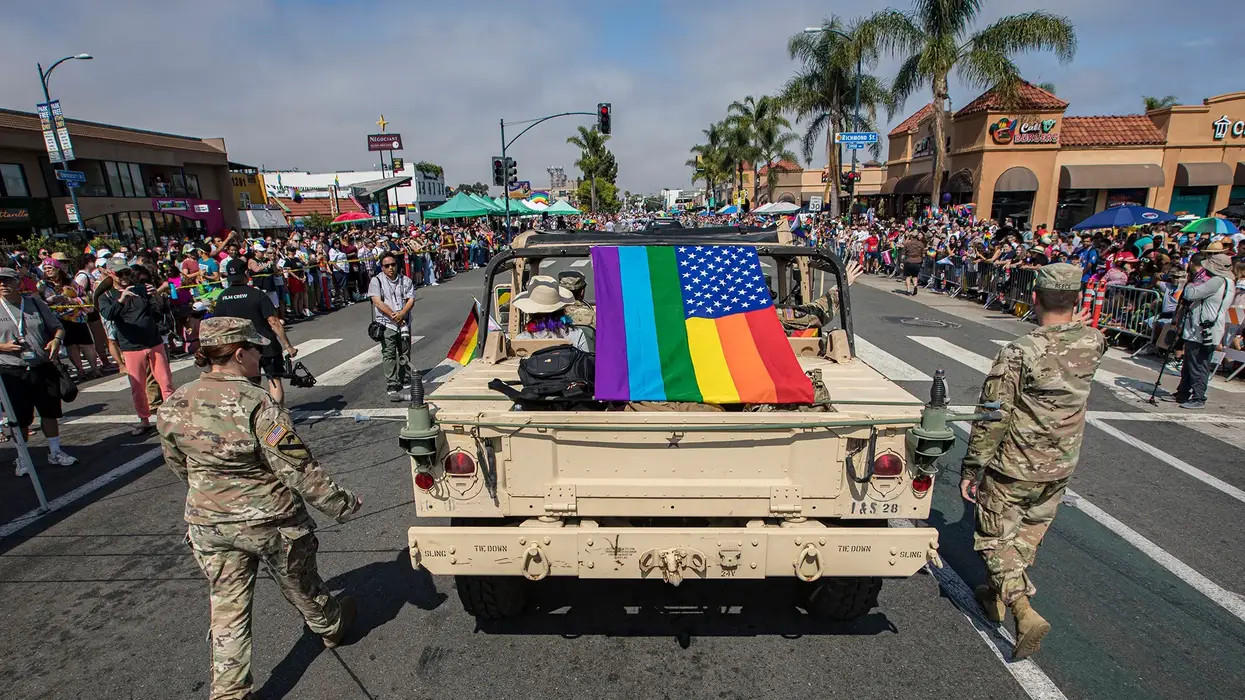
Did the lives of Native Americans improve as a result of the legislation mandating assimilation and the revoking of tribal land titles pushed through by Charles Curtis, the first Native American Vice President? Are we better off with Clarence Thomas, who opposes affirmative action, on the Supreme Court, or Victoria Nuland, a war hawk in the State Department? Is our perpetuation of permanent war more palatable because Lloyd Austin, an African American, is the Secretary of Defense? Is the military more humane because it accepts transgender soldiers? Is social inequality, and the surveillance state that controls it, ameliorated because Sundar Pichai — who was born in India — is the CEO of Google and Alphabet? Has the weapons industry improved because Kathy J. Warden, a woman, is the CEO of Northop Grumman, and another woman, Phebe Novakovic, is the CEO of General Dynamics? Are working families better off with Janet Yellen, who promotes increasing unemployment and “job insecurity” to lower inflation, as Secretary of the Treasury? Is the movie industry enhanced when a female director, Kathryn Bigelow, makes “Zero Dark Thirty,” which is agitprop for the CIA? Take a look at this recruitment ad put out by the CIA. It sums up the absurdity of where we have ended up.
Colonial regimes find compliant indigenous leaders — “Papa Doc” François Duvalier in Haiti, Anastasio Somoza in Nicaragua, Mobutu Sese Seko in the Congo, Mohammad Reza Pahlavi in Iran — willing to do their dirty work while they exploit and loot the countries they control. To thwart popular aspirations for justice, colonial police forces routinely carried out atrocities on behalf of the oppressors. The indigenous freedom fighters who fight in support of the poor and the marginalized are usually forced out of power or assassinated, as was the case with Congolese independence leader Patrice Lumumba and Chilean president Salvador Allende. Lakota chief Sitting Bull was gunned down by members of his own tribe, who served in the reservation’s police force at Standing Rock. If you stand with the oppressed, you will almost always end up being treated like the oppressed. This is why the FBI, along with Chicago police, murdered Fred Hampton and was almost certainly involved in the murder of Malcolm X, who referred to impoverished urban neighborhoods as “internal colonies.” Militarized police forces in the U.S. function as armies of occupation. The police officers who killed Tyre Nichols are no different from those in reservation and colonial police forces.
We live under a species of corporate colonialism. The engines of white supremacy, which constructed the forms of institutional and economic racism that keep the poor poor, are obscured behind attractive political personalities such as Barack Obama, whom Cornel West called “a Black mascot for Wall Street.” These faces of diversity are vetted and selected by the ruling class. Obama was groomed and promoted by the Chicago political machine, one of the dirtiest and most corrupt in the country.
“It’s an insult to the organized movements of people these institutions claim to want to include,” Glen Ford, the late editor of The Black Agenda Report told me in 2018. “These institutions write the script. It’s their drama. They choose the actors, whatever black, brown, yellow, red faces they want.”
Ford called those who promote identity politics “representationalists” who “want to see some Black people represented in all sectors of leadership, in all sectors of society. They want Black scientists. They want Black movie stars. They want Black scholars at Harvard. They want Blacks on Wall Street. But it’s just representation. That’s it.”
The toll taken by corporate capitalism on the people these “representationalists” claim to represent exposes the con. African-Americans have lost 40 percent of their wealth since the financial collapse of 2008 from the disproportionate impact of the drop in home equity, predatory loans, foreclosures and job loss. They have the second highest rate of poverty at 21.7 percent, after Native Americans at 25.9 percent, followed by Hispanics at 17.6 percent and whites at 9.5 percent, according to the U.S. Census Bureau and the Department for Health and Human Services. As of 2021, Black and Native American children lived in poverty at 28 and 25 percent respectively, followed by Hispanic children at 25 percent and white children at 10 percent. Nearly 40 percent of the nation’s homeless are African-Americans although Black people make up about 14 percent of our population. This figure does not include people living in dilapidated, overcrowded dwellings or with family or friends due to financial difficulties. African-Americans are incarcerated at nearly five times the rate of white people.
Identity politics and diversity allow liberals to wallow in a cloying moral superiority as they castigate, censor and deplatform those who do not linguistically conform to politically correct speech. They are the new Jacobins. This game disguises their passivity in the face of corporate abuse, neoliberalism, permanent war and the curtailment of civil liberties. They do not confront the institutions that orchestrate social and economic injustice. They seek to make the ruling class more palatable. With the support of the Democratic Party, the liberal media, academia and social media platforms in Silicon Valley, demonize the victims of the corporate coup d’etat and deindustrialization. They make their primary political alliances with those who embrace identity politics, whether they are on Wall Street or in the Pentagon. They are the useful idiots of the billionaire class, moral crusaders who widen the divisions within society that the ruling oligarchs foster to maintain control.
Diversity is important. But diversity, when devoid of a political agenda that fights the oppressor on behalf of the oppressed, is window dressing. It is about incorporating a tiny segment of those marginalized by society into unjust structures to perpetuate them.
A class I taught in a maximum security prison in New Jersey wrote “Caged,” a play about their lives. The play ran for nearly a month at The Passage Theatre in Trenton, New Jersey, where it was sold out nearly every night. It was subsequently published by Haymarket Books. The 28 students in the class insisted that the corrections officer in the story not be white. That was too easy, they said. That was a feign that allows people to simplify and mask the oppressive apparatus of banks, corporations, police, courts and the prison system, all of which make diversity hires. These systems of internal exploitation and oppression must be targeted and dismantled, no matter whom they employ.
My book, “Our Class: Trauma and Transformation in an American Prison,” uses the experience of writing the play to tell the stories of my students and impart their profound understanding of the repressive forces and institutions arrayed against them, their families and their communities. You can see my two-part interview with Hugh Hamilton about “Our Class” here and here.
August Wilson’s last play, “Radio Golf,” foretold where diversity and identity politics devoid of class consciousness were headed. In the play, Harmond Wilks, an Ivy League-educated real estate developer, is about to launch his campaign to become Pittsburgh’s first Black mayor. His wife, Meme, is angling to become the governor’s press secretary. Wilks, navigating the white man’s universe of privilege, business deals, status seeking and the country club game of golf, must sanitize and deny his identity. Roosevelt Hicks, who had been Wilk’s college roommate at Cornell and is a vice president at Mellon Bank, is his business partner. Sterling Johnson, whose neighborhood Wilks and Hicks are lobbying to get the city to declare blighted so they can raze it for their multimillion dollar development project, tells Hicks:
You know what you are? It took me a while to figure it out. You a Negro. White people will get confused and call you a nigger but they don’t know like I know. I know the truth of it. I’m a nigger. Negroes are the worst thing in God’s creation. Niggers got style. Negroes got . A dog knows it’s a dog. A cat knows it’s a cat. But a Negro don’t know he’s a Negro. He thinks he’s a white man.
Terrible predatory forces are eating away at the country. The corporatists, militarists and political mandarins that serve them are the enemy. It is not our job to make them more appealing, but to destroy them. There are amongst us genuine freedom fighters of all ethnicities and backgrounds whose integrity does not permit them to serve the system of inverted totalitarianism that has destroyed our democracy, impoverished the nation and perpetuated endless wars. Diversity when it serves the oppressed is an asset, but a con when it serves the oppressors.
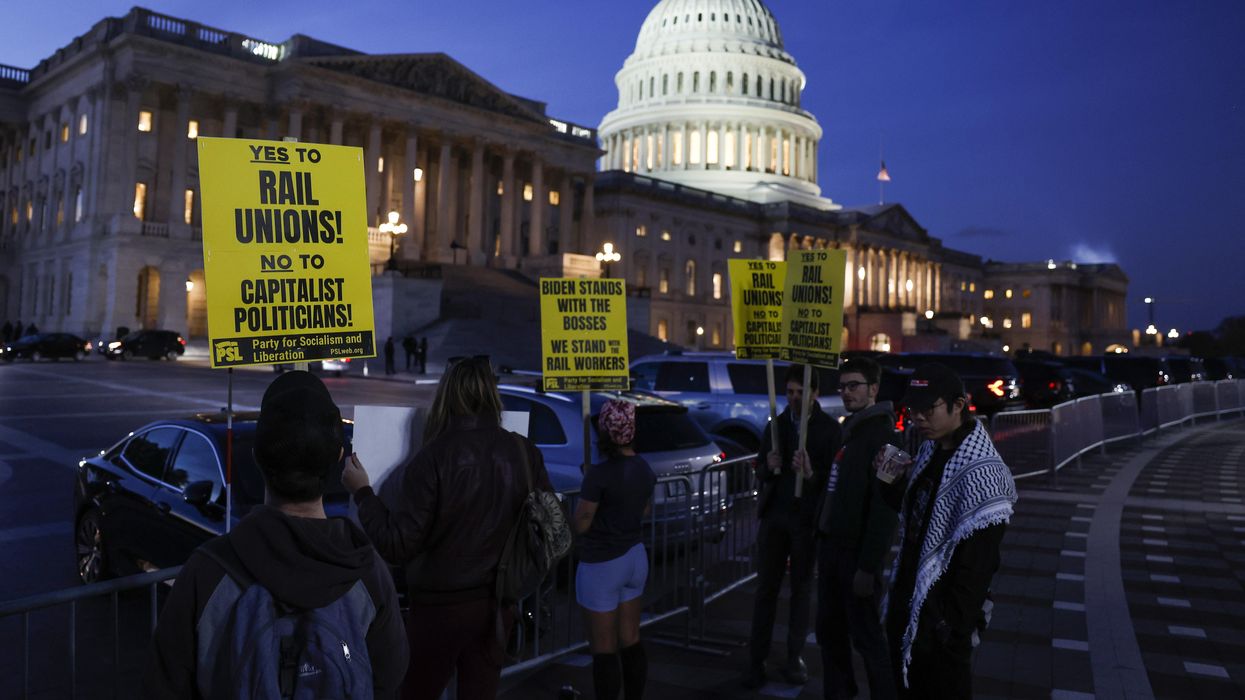
The Congressional decision to prohibit railroad workers from going on strike and force them to accept a contract that meets few of their demands is part of the class war that has defined American politics for decades. The two ruling political parties differ only in rhetoric. They are bonded in their determination to reduce wages; dismantle social programs, which the Bill Clinton administration did with welfare; and thwart unions and prohibit strikes, the only tool workers have to pressure employers. This latest move against the railroad unions, where working conditions have descended into a special kind of hell with massive layoffs, the denial of even a single day of paid sick leave, and punishing work schedules that include being forced to "always be on call," is one more blow to the working class and our anemic democracy.
The rich, throughout history, have subjugated and re-subjugated the populations they control.
The rage by workers towards the Democratic Party, which once defended their interests, is legitimate, even if, at times, it is expressed by embracing proto-fascists and Donald Trump-like demagogues. Dating back to the Clinton administration with NAFTA, the greatest betrayal of the working class since the 1947 Taft-Hartley Act, the Democratic Party has become a full partner in the corporate assault on workers. The cloying feel-your-pain rhetoric, a staple of the Joe Biden White House, is offset by a hypocritical subservience to the billionaire class.
In 1926, the havoc wreaked by rail strikes led to the federal government passing the Railway Labor Act to give itself the power to impose labor settlements on the rail industry. The Biden administration used this authority to broker a tentative labor agreement that would ensure a 24 percent pay increase by 2024, annual $1,000 bonuses and a freeze on rising health care costs. But workers would be permitted only one paid personal day and no paid sick leave. Of 12 unions voting on the deal, four of them--representing 56 percent of union membership in the industry--refused to ratify it. Biden signed the legislation into law on Friday.
The railroad barons refuse to permit sick days because they have stripped the railroads down to skeleton crews in a process known as precision scheduled railroading, or PSR. In essence, no spare labor is available, which is why the reduced labor force is subjected to such punishingly short periods of time off and onerous working conditions.
Class struggle defines human history. We are dominated by a seemingly omnipotent corporate elite. Hostile to our most basic rights, this elite is disemboweling the nation; destroying basic institutions that foster the common good, including public schools, the postal service and health care; and is incapable of reforming itself. The only weapon left to thwart this ongoing pillage is the strike. Workers have the collective power to slash profits and cripple industry, which is why the ruling class has gone to such lengths to defang unions and outlaw strikes. A rail freight strike, it is estimated, would cost the U.S. economy $2 billion a day, with daily losses increasing the longer a strike continued.
The few unions that remain--only 10.7 percent of the workforce is unionized--have been largely domesticated, demoted into obsequious junior partners in the capitalist system. As of January 2022, private-sector unionization stood at its lowest point since the passage of the National Labor Relations Act of 1935. And yet, 48 percent of U.S. workers say they would like to belong to a union.
Railroad workers have been especially hard hit. The workforce has shrunk from nearly 540,000 in 1980 to some 130,000 today. The consolidation of the rail industry means there are only seven Class I freight companies, with four of those companies controlling 83 percent of rail traffic. Service on the nation's rail lines, along with working conditions and wages, has deteriorated as Wall Street squeezes the big railroad conglomerates for greater and greater profits. Indeed, the fragility of the rail system led to huge backlogs and delays during the pandemic.
The Democrats insist they are the party of the working class. Joe Biden calls himself "a proud pro-labor president." But they pile up one empty promise after another. In 2020, they promised, for example, that with control of the White House and both branches of Congress, they would pass a law to strengthen collective bargaining. Instead, they revoked the collective bargaining power of one of the few unionized industries that retains it.
They promised to raise the minimum wage. They failed. They promised a national paid family and medical leave program allowing all employees to take up to 12 weeks of paid time off. It never happened. They promised to impose a federal tax rate on corporations ranging from 21 percent to 28 percent, so that "wealthy Americans and big corporations pay their fair share." The proposed tax increase was scuttled. They promised to pass legislation to ensure that super PACs "are wholly independent of campaigns and political parties." It went nowhere. They then mounted a midterm election campaign, which cost both parties a staggering $16.7 billion and was funded by massive infusions of PAC money.
The Democrats routinely say the right thing and do the wrong thing, and this is true for its tiny progressive minority, which dutifully votes to funnel billions to the war industry, including the war in Ukraine. Alexandria Ocasio-Cortez and most other progressive House members voted for the anti-union legislation while also voting for a separate resolution that would have given rail workers seven days of paid sick leave. The unions were demanding 14. The second resolution died in the Senate, as they knew it would, leaving workers with a woefully inadequate, pro-management deal that over half of them had already rejected. To his credit, Bernie Sanders voted against the bill when the sick leave amendment from the House, which he backed, was rejected in the Senate.
Why does any legislator believe railroad workers should be forced to use what few vacation days they may have if they fall sick and request permission to be absent days in advance, as if illnesses are scheduled events? Congress members and their staff do not work under these conditions.
"In a statement that perfectly captured the yawning gap between Democratic Party rhetoric and behavior," Binyamin Appelbaum, the lead writer on economics and business for the New York Times editorial board, wrote in the newspaper, "House Speaker Nancy Pelosi denounced railroad companies as rapacious profiteers who 'have been selling out to Wall Street to boost their bottom lines, making obscene profits while demanding more and more from railroad workers.' Then, just one sentence later, she announced that House Democrats would stand with the profiteers."
What are we to make of a Congress that refuses to support a single day of paid sick leave for 115,000 freight railroad workers, while the combined net income of the railroad industry is $27 billion -- double what it was in 2013?
What are we to make of a Congress that in its latest military policy legislation sets the appropriation at $45 billion above the Pentagon's request?
What are we to make of a Congress that refuses to pass gun control legislation despite 600 mass shootings this year, more than one per day?
What are we to make of a Congress that defunds the Internal Revenue Service, making it only practical to investigate those earning middle and lower incomes and near impossible to investigate tens of billions of dollars in tax evasion by corporations and the rich?
What are we to make of a Congress that rewrites the tax code on behalf of lobbyists so 55 of the largest corporations that collectively made over $40 billion in pre-tax income in 2020 - paid no federal income tax and received $3.5 billion in tax rebates.
What are we to make of a Congress, more than half of whose members are millionaires, who flagrantly use their committee assignments, inside knowledge of proposed legislation and classified intelligence reports to carry out insider trading to increase their wealth? House Speaker Nancy Pelosi's husband invested millions of dollars in computer-chip stocks as the Democratic leadership was formulating a plan to subsidize the chip-manufacturing industry.
Most political theorists, including Aristotle, Niccolo Machiavelli, Alexis de Tocqueville, Adam Smith, Karl Marx, Karl Polanyi and Max Weber, started from the premise that there is a natural antagonism between owners and workers. They understood that if the oligarchs shook off all restraints to the accumulation of wealth, it would destroy the political order. The ruling class masks its greed behind ideologies--in our nation's case, free market capitalism and neoliberal globalization. Neoliberalism never made any economic sense. But it was disseminated by compliant academics, the media and political theorists because, to quote Marx, it allowed "the dominant material relationships" to be "grasped as ideas."
"We Americans are not usually thought to be a submissive people, but of course we are," Wendell Berry wrote. "Why else would we allow our country to be destroyed? Why else would we be rewarding its destroyers? Why else would we all--by proxies we have given to greedy corporations and corrupt politicians--be participating in its destruction? Most of us are still too sane to piss in our own cistern, but we allow others to do so, and we reward them for it. We reward them so well, in fact, that those who piss in our cistern are wealthier than the rest of us. How do we submit? By not being radical enough. Or by not being thorough enough, which is the same thing."
All the advances we made in the early 20th century through union strikes, government regulation, the New Deal, a fair tax code, the courts, an alternative press and mass movements have been reversed. The oligarchs are turning American workers--as they did in the 19th century steel and textile factories--into serfs, kept in check by onerous anti-union laws, militarized police, the world's largest prison system, an electoral system dominated by corporate money and the most pervasive security and surveillance apparatus in human history.
The rich, throughout history, have subjugated and re-subjugated the populations they control. And the public, throughout history, has awakened to the class war waged by the oligarchs and plutocrats and revolted. Let us hope that defying Congress, freight railroad workers carry out a strike. A strike will at least expose the fangs of the ruling class, the courts, law enforcement and the National Guard, much as they did during labor unrest in the 20th century, and broadcast a very public message about whose interests they serve. Besides, a strike might work. Nothing else will.
As this century began, I was writing War Is a Force That Gives Us Meaning, my reflections on two decades as a war correspondent, 15 of them with the New York Times, in Central America, the Middle East, Africa, Bosnia, and Kosovo. I worked in a small, sparsely furnished studio apartment on First Avenue in New York City. The room had a desk, chair, futon, and a couple of bookshelves -- not enough to accommodate my extensive library, leaving piles of books stacked against the wall. The single window overlooked a back alley.
The super, who lived in the first-floor apartment, smoked prodigious amounts of weed, leaving the grimy lobby stinking of pot. When he found out I was writing a book, he suggested I chronicle his moment of glory during the six days of clashes known as the Stonewall Riots, triggered by a 1969 police raid on the Stonewall Inn, a gay club in Greenwich Village. He claimed he had thrown a trash can through the front window of a police cruiser.
It was a solitary life, broken by periodic visits to a small antique bookstore in the neighborhood that had a copy of the 1910-1911 Encyclopedia Britannica, the last edition published for scholars. I couldn't afford it, but the owner generously let me read entries from those 29 volumes written by the likes of Algernon Charles Swinburne, John Muir, T.H. Huxley, and Bertrand Russell. The entry for Catullus, several of whose poems I could recite from memory in Latin, read: "The greatest lyric poet of Rome." I loved the certainty of that judgment -- one that scholars today would not, I suspect, make, much less print.

To the publisher's surprise, the book exploded. Hundreds of thousands of copies were eventually sold. Big publishers, dollar signs in their eyes, dangled significant offers for another book on war. But I refused. I didn't want to dilute what I had written or go through that experience again. I did not want to be ghettoized into writing about war for the rest of my life. I was done. To this day, I'm still unable to reread it.
The Open Wound of War
Yet it's not true that I fled war. I fled my wars but would continue to write about other people's wars. I know the wounds and scars. I know what's often hidden. I know the anguish and guilt. It's strangely comforting to be with others maimed by war. We don't need words to communicate. Silence is enough.
I wanted to reach teenagers, the fodder of wars and the target of recruiters. I doubted many would read War Is a Force That Gives Us Meaning. I embarked on a text that would pose, and then answer, the most basic questions about war -- all from military, medical, tactical, and psychological studies of combat. I operated on the assumption that the simplest and most obvious questions rarely get answered like: What happens to my body if I'm killed?
I hired a team of researchers, mostly graduate students at Columbia University's School of Journalism, and, in 2003, we produced an inexpensive paperback -- I fought the price down to $11 by giving away any future royalties -- called What Every Person Should Know About War.
I worked closely on the book with Jack Wheeler, who had graduated from West Point in 1966 and then served in Vietnam, where 30 members of his class were killed. (Rick Atkinson's The Long Gray Line: The American Journey of West Point's Class of 1966 is the story of Jack's class.) Jack went on to Yale Law School after he left the military and became a presidential aide to Ronald Reagan, George H.W. Bush, and George W. Bush, while chairing the drive to build the Vietnam Veterans Memorial in Washington.
He struggled with what he called "the open wound of Vietnam" and severe depression. He was last seen on December 30, 2010, disoriented and wandering the streets of Wilmington, Delaware. The next day, his body was discovered as it was dumped from a garbage truck into the Cherry Island Landfill. The Delaware state medical examiner's office said the cause of death was assault and "blunt force trauma." Police ruled his death a homicide, a murder that would never be solved. He was buried in Arlington National Cemetery with full military honors.
The idea for the book came from the work of Harold Roland Shapiro, a New York lawyer who, while representing a veteran disabled in World War I, investigated that conflict, discovering a huge disparity between its reality and the public perception of it. His book was, however, difficult to find. I had to get a copy from the Library of Congress. The medical descriptions of wounds, Shapiro wrote, rendered "all that I had read and heard previously as being either fiction, isolated reminiscence, vague generalization or deliberate propaganda." He published his book, What Every Young Man Should Know About War, in 1937. Fearing it might inhibit recruitment, he agreed to remove it from circulation at the start of World War II. It never went back into print.
The military is remarkably good at studying itself (although such studies aren't easy to obtain). It knows how to use operant conditioning -- the same techniques used to train a dog -- to turn young men and women into efficient killers. It skillfully employs the tools of science, technology, and psychology to increase the lethal force of combat units. It also knows how to sell war as adventure, as well as the true route to manhood, comradeship, and maturity.
The callous indifference to life, including the lives of our soldiers, sailors, airmen and marines, leapt off the pages of the official documents. For example, the response to the question "What will happen if I am exposed to nuclear radiation but do not die immediately?" was answered in a passage from the Office of the Surgeon General's Textbook of Military Medicine that read, in part:
Fatally irradiated soldiers should receive every possible palliative treatment, including narcotics, to prolong their utility and alleviate their physical and psychological distress. Depending on the amount of fatal radiation, such soldiers may have several weeks to live and to devote to the cause. Commanders and medical personnel should be familiar with estimating survival time based on onset of vomiting. Physicians should be prepared to give medications to alleviate diarrhea, and to prevent infection and other sequelae of radiation sickness in order to allow the soldier to serve as long as possible. The soldier must be allowed to make the full contribution to the war effort. He will already have made the ultimate sacrifice. He deserves a chance to strike back, and to do so while experiencing as little discomfort as possible.
Our book, as I hoped, turned up on Quaker anti-recruitment tables in high schools.
"I Am Sullied"
I was disgusted by the simplistic, often mendacious coverage of our post-9/11 war in Iraq, a country I had covered as the Middle East bureau chief for the New York Times. In 2007, I went to work with reporter Laila Al-Arian on a long investigative article in the Nation, "The Other War: Iraq Veterans Bear Witness," that ended up in an expanded version as another book on war, Collateral Damage: America's War Against Iraqi Civilians.
We spent hundreds of hours interviewing 50 American combat veterans of Iraq about atrocities they had witnessed or participated in. It was a damning indictment of the U.S. occupation with accounts of terrorizing and abusive house raids, withering suppressing fire routinely laid down in civilian areas to protect American convoys, indiscriminate shooting from patrols, the large kill radius of detonations and air strikes in populated areas, and the slaughter of whole families who approached military checkpoints too closely or too quickly. The reporting made headlines in newspapers across Europe but was largely ignored in the U.S., where the press was generally unwilling to confront the feel-good narrative about "liberating" the people of Iraq.
For the book's epigraph, we used a June 4, 2005, suicide note left by Colonel Theodore "Ted" Westhusing for his commanders in Iraq. Westhusing (whom I was later told had read and recommended War is a Force That Gives Us Meaning) was the honor captain of his 1983 West Point class. He shot himself in the head with his 9mm Beretta service revolver. His suicide note -- think of it as an epitaph for the global war on terror - read in part:
Thanks for telling me it was a good day until I briefed you. [Redacted name] -- You are only interested in your career and provide no support to your staff -- no msn [mission] support and you don't care. I cannot support a msn that leads to corruption, human right abuses and liars. I am sullied -- no more. I didn't volunteer to support corrupt, money-grubbing contractors, nor work for commanders only interested in themselves. I came to serve honorably and feel dishonored.
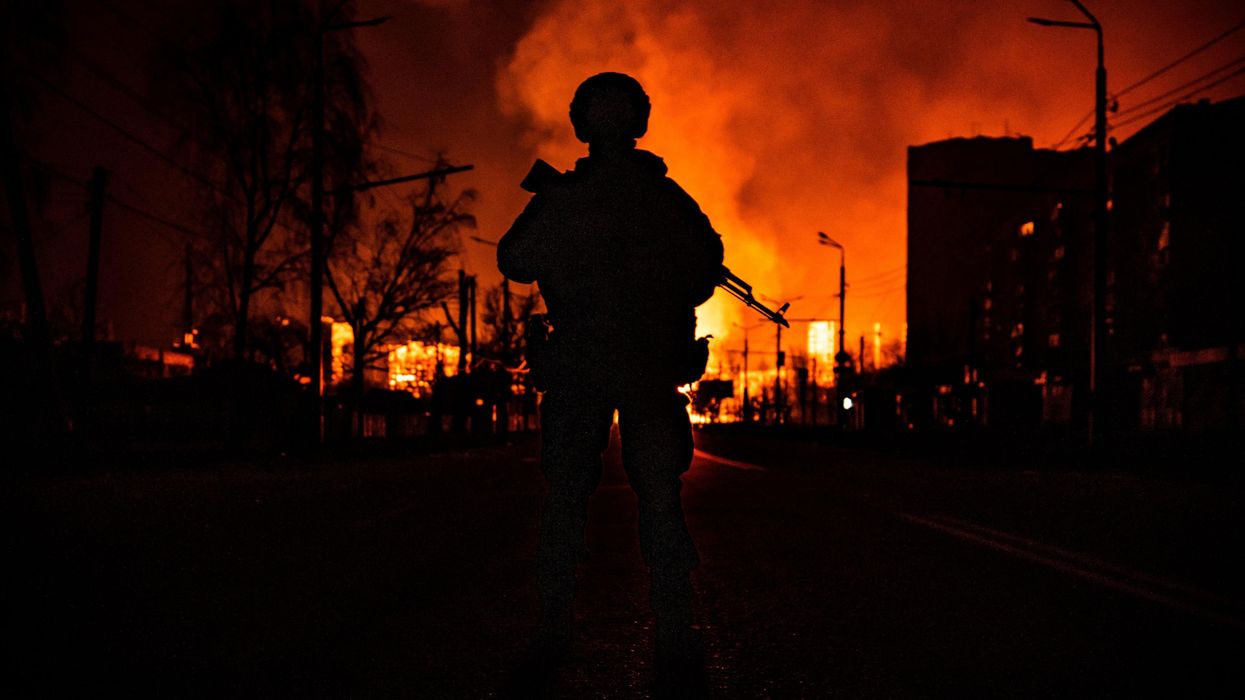
The war in Ukraine raised the familiar bile, the revulsion at those who don't go to war and yet revel in the mad destructive power of violence. Once again, by embracing a childish binary universe of good and evil from a distance, war was turned into a morality play, gripping the popular imagination. Following our humiliating defeat in Afghanistan and the debacles of Iraq, Libya, Somalia, Syria, and Yemen, here was a conflict that could be sold to the public as restoring American virtue. Russian President Vladimir Putin, like Iraqi autocrat Saddam Hussein, instantly became the new Hitler. Ukraine, which most Americans undoubtedly couldn't have found on a map, was suddenly the front line in the eternal fight for democracy and liberty.
The orgiastic celebration of violence took off.
The Ghosts of War
It's impossible, under international law, to defend Russia's war in Ukraine, as it is impossible to defend our invasion of Iraq. Preemptive war is a war crime, a criminal war of aggression. Still, putting the invasion of Ukraine in context was out of the question. Explaining -- as Soviet specialists (including famed Cold War diplomat George F. Kennan) had -- that expanding NATO into Central and Eastern Europe was a provocation to Russia was forbidden. Kennan had called it "the most fateful error of American policy in the entire post-Cold War era" that would "send Russian foreign policy in directions decidedly not to our liking."
In 1989, I had covered the revolutions in East Germany, Czechoslovakia, and Romania that signaled the coming collapse of the Soviet Union. I was acutely aware of the "cascade of assurances" given to Moscow that NATO, founded in 1949 to prevent Soviet expansion in Eastern and Central Europe, would not spread beyond the borders of a unified Germany. In fact, with the end of the Cold War, NATO should have been rendered obsolete.
I naively thought we would see the promised "peace dividend," especially with the last Soviet leader Mikhail Gorbachev reaching out to form security and economic alliances with the West. In the early years of Vladimir Putin's rule, even he lent the U.S. military a hand in its war on terror, seeing in it Russia's own struggle to contain Islamic extremists spawned by its wars in Chechnya. He provided logistical support and resupply routes for American forces fighting in Afghanistan. But the pimps of war were having none of it. Washington would turn Russia into the enemy, with or without Moscow's cooperation.
The newest holy crusade between angels and demons was launched.
War unleashes the poison of nationalism, with its twin evils of self-exaltation and bigotry. It creates an illusory sense of unity and purpose. The shameless cheerleaders who sold us the war in Iraq are once again on the airwaves beating the drums of war for Ukraine. As Edward Said once wrote about these courtiers to power:
Every single empire in its official discourse has said that it is not like all the others, that its circumstances are special, that it has a mission to enlighten, civilize, bring order and democracy, and that it uses force only as a last resort. And, sadder still, there always is a chorus of willing intellectuals to say calming words about benign or altruistic empires, as if one shouldn't trust the evidence of one's own eyes watching the destruction and the misery and death brought by the latest mission civilizatrice.
I was pulled back into the morass. I found myself writing for Scheerpost and my Substack site, columns condemning the bloodlusts Ukraine unleashed. The provision of more than $50 billion in weapons and aid to Ukraine not only means the Ukrainian government has no incentive to negotiate, but that it condemns hundreds of thousands of innocents to suffering and death. For perhaps the first time in my life, I found myself agreeing with Henry Kissinger, who at least understands realpolitik, including the danger of pushing Russia and China into an alliance against the U.S., while provoking a major nuclear power.
Greg Ruggiero, who runs City Lights Publishers, urged me to write a book on this new conflict. At first, I refused, not wanting to resurrect the ghosts of war. But looking back at my columns, articles, and talks since the publication of War is a Force That Gives Us Meaning in 2002, I was surprised at how often I had circled back to war.
I rarely wrote about myself or my experiences. I sought out those discarded as the human detritus of war, the physically and psychologically maimed like Tomas Young, a quadriplegic wounded in Iraq, whom I visited recently in Kansas City after he declared that he was ready to disconnect his feeding tube and die.
It made sense to put those pieces together to denounce the newest intoxication with industrial slaughter. I stripped the chapters down to war's essence with titles like "The Act of Killing," "Corpses" or "When the Bodies Come Home."
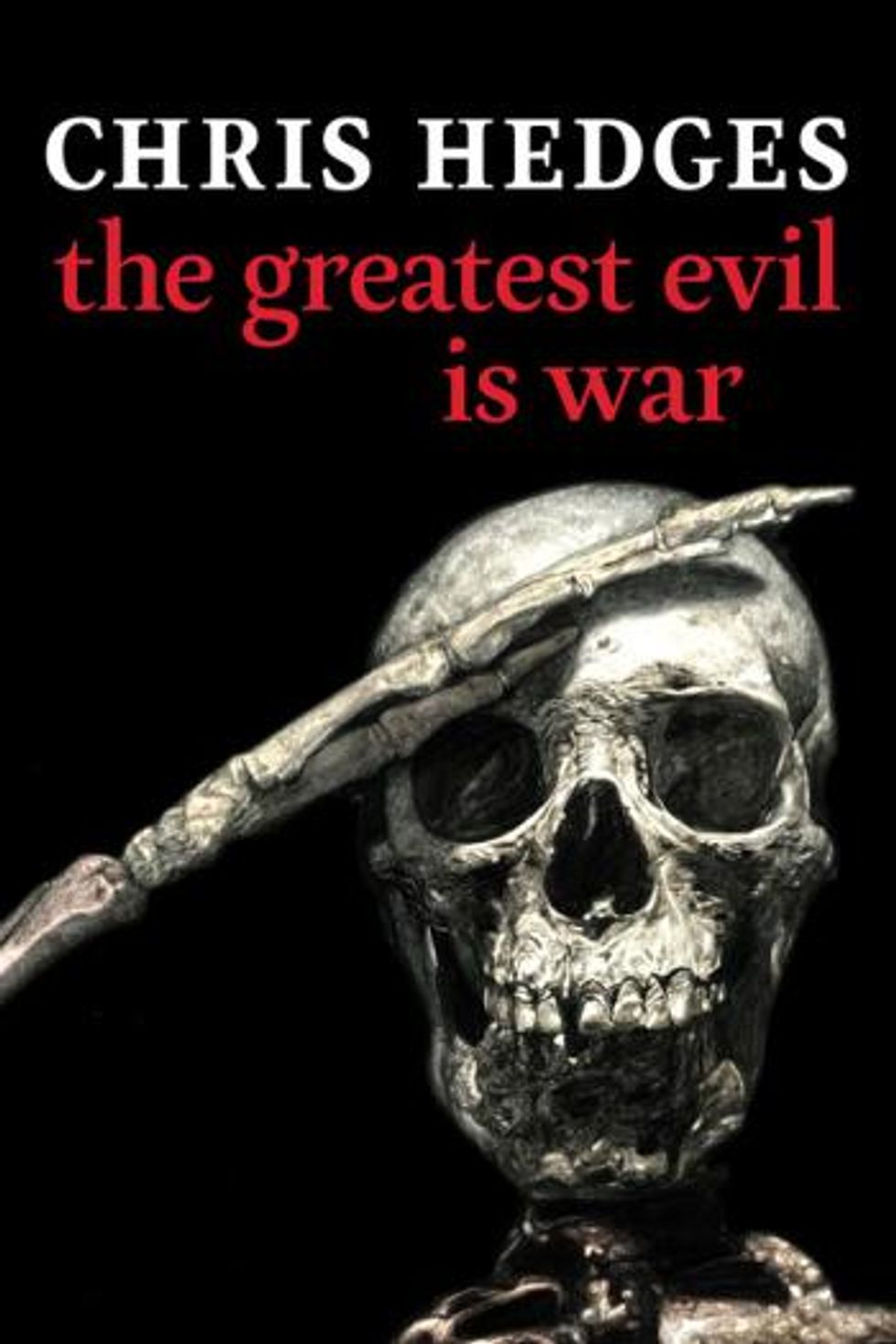
The Greatest Evil Is War has just been published by Seven Stories Press.
This, I pray, will be my final foray into the subject.
I am standing atop a 100-foot-high temple mound, the largest known earthwork in the Americas built by prehistoric peoples. The temperatures, in the high 80s, along with the oppressive humidity, have emptied the park of all but a handful of visitors. My shirt is matted with sweat.
The historian Arnold Toynbee, who singled out unchecked militarism as the fatal blow to past empires, argued that civilizations are not murdered, but commit suicide.
I look out from the structure--known as Monks Mound--at the flatlands below, with smaller mounds dotting the distance. These earthen mounds, built at a confluence of the Illinois, Mississippi and Missouri rivers, are all that remain of one of the largest pre-Columbian settlements north of Mexico, occupied from around 800 to 1,400 AD by perhaps as many as 20,000 people.
This great city, perhaps the greatest in North America, rose, flourished, fell into decline and was ultimately abandoned. Civilizations die in familiar patterns. They exhaust natural resources. They spawn parasitic elites who plunder and loot the institutions and systems that make a complex society possible. They engage in futile and self-defeating wars. And then the rot sets in. The great urban centers die first, falling into irreversible decay. Central authority unravels. Artistic expression and intellectual inquiry are replaced by a new dark age, the triumph of tawdry spectacle and the celebration of crowd-pleasing imbecility.
"Collapse occurs, and can only occur, in a power vacuum," anthropologist Joseph Tainter writes in The Collapse of Complex Societies. "Collapse is possible only where there is no competitor strong enough to fill the political vacuum of disintegration."
Several centuries ago, the rulers of this vast city complex, which covered some 4,000 acres, including a 40-acre central plaza, stood where I stood. They no doubt saw below in the teeming settlements an unassailable power, with at least 120 temple mounds used as residences, sacred ceremonial sites, tombs, meeting centers and ball courts. Cahokia warriors dominated a vast territory from which they exacted tribute to enrich the ruling class of this highly stratified society. Reading the heavens, these mound builders constructed several circular astronomical observatories--wooden versions of Stonehenge.
The city's hereditary rulers were venerated in life and death. A half mile from Monks Mound is the seven-foot-high Mound 72, in which archeologists found the remains of a man on a platform covered with 20,000 conch-shell disc beads from the Gulf of Mexico. The beads were arranged in the shape of a falcon, with the falcon's head beneath and beside the man's head. Its wings and tail were placed underneath the man's arms and legs. Below this layer of shells was the body of another man, buried face downward. Around these two men were six more human remains, possibly retainers, who may have been put to death to accompany the entombed man in the afterlife. Nearby were buried the remains of 53 girls and women ranging in age from 15 to 30, laid out in rows in two layers separated by matting. They appeared to have been strangled to death.
The poet Paul Valery noted, "a civilization has the same fragility as a life."
Across the Mississippi River from Monks Mound, the city skyline of St. Louis is visible. It is hard not to see our own collapse in that of Cahokia. In 1950, St. Louis was the eighth-largest city in the United States, with a population of 856,796. Today, that number has fallen to below 300,000, a drop of some 65 percent. Major employers--Anheuser-Busch, McDonnell-Douglas, TWA, Southwestern Bell and Ralston Purina --have dramatically reduced their presence or left altogether. St. Louis is consistently ranked one of the most dangerous cities in the country. One in five people live in poverty. The St. Louis Metropolitan Police Department has the highest rate of police killings per capita, of the 100 largest police departments in the nation, according to a 2021 report. Prisoners in the city's squalid jails, where 47 people died in custody between 2009 and 2019, complain of water being shut off from their cells for hours and guards routinely pepper spraying inmates, including those on suicide watch. The city's crumbling infrastructure, hundreds of gutted and abandoned buildings, empty factories, vacant warehouses and impoverished neighborhoods replicate the ruins of other post-industrial American cities, the classic signposts of a civilization in terminal decline.
"Just as in the past, countries that are environmentally stressed, overpopulated, or both, become at risk of getting politically stressed, and of their governments collapsing," Jared Diamond argues in Collapse: How Societies Choose to Fail or Succeed. "When people are desperate, undernourished and without hope, they blame their governments, which they see as responsible for or unable to solve their problems. They try to emigrate at any cost. They fight each other over land. They kill each other. They start civil wars. They figure that they have nothing to lose, so they become terrorists, or they support or tolerate terrorism."
Pre-industrial civilizations were dependent on the limits of solar energy and constrained by roads and waterways, impediments that were obliterated when fossil fuel became an energy source. As industrial empires became global, their increase in size meant an increase in complexity. Ironically, this complexity makes us more vulnerable to catastrophic collapse, not less. Soaring temperatures (Iraq is enduring 120 degree heat that has fried the country's electrical grid), the depletion of natural resources, flooding, droughts, (the worst drought in 500 years is devastating Western, Central and Southern Europe and is expected to see a decline in crop yields of 8 or 9 percent), power outages, wars, pandemics, a rise in zoonotic diseases and breakdowns in supply chains combine to shake the foundations of industrial society. The Arctic has been heating up four times faster than the global average, resulting in an accelerated melting of the Greenland ice sheet and freakish weather patterns. The Barents Sea north of Norway and Russia are warming up to seven times faster. Climate scientists did not expect this extreme weather until 2050.
"Each time history repeats itself, the price goes up," the anthropologist Ronald Wright warns, calling industrial society "a suicide machine."
In A Short History of Progress, he writes:
Civilization is an experiment, a very recent way of life in the human career, and it has a habit of walking into what I am calling progress traps. A small village on good land beside a river is a good idea; but when the village grows into a city and paves over the good land, it becomes a bad idea. While prevention might have been easy, a cure may be impossible: a city isn't easily moved. This human inability to foresee--or to watch out for--long-range consequences may be inherent to our kind, shaped by the millions of years when we lived from hand to mouth by hunting and gathering. It may also be little more than a mix of inertia, greed, and foolishness encouraged by the shape of the social pyramid. The concentration of power at the top of large-scale societies gives the elite a vested interest in the status quo; they continue to prosper in darkening times long after the environment and general populace begin to suffer.
Wright also reflects upon what will be left behind:
The archaeologists who dig us up will need to wear hazmat suits. Humankind will leave a telltale layer in the fossil record composed of everything we produce, from mounds of chicken bones, wet-wipes, tires, mattresses and other household waste to metals, concrete, plastics, industrial chemicals, and the nuclear residue of power plants and weaponry. We are cheating our children, handing them tawdry luxuries and addictive gadgets while we take away what's left of the wealth, wonder and possibility of the pristine Earth.
Calculations of humanity's footprint suggest we have been in 'ecological deficit,' taking more than Earth's biological systems can withstand, for at least 30 years. Topsoil is being lost far faster than nature can replenish it; 30 percent of arable land has been exhausted since the mid-20th century.
We have financed this monstrous debt by colonizing both past and future, drawing energy, chemical fertilizer and pesticides from the planet's fossil carbon, and throwing the consequences onto coming generations of our species and all others. Some of those species have already been bankrupted: they are extinct. Others will follow.
As Cahokia declined, violence dramatically increased. Surrounding towns were burned to the ground. Groups, numbering in the hundreds, were slaughtered and buried in mass graves. At the end, "the enemy killed all people indiscriminately. The intent was not merely prestige, but an early form of ethnic cleansing" writes anthropologist Timothy R. Pauketat, in Ancient Cahokia and the Mississippians. He notes that, in one fifteenth-century cemetery in central Illinois, one-third of all adults had been killed by blows to the head, arrow wounds or scalping. Many showed evidence of fractures on their arms from vain attempts to fight off their attackers.
Such descent into internecine violence is compounded by a weakened and discredited central authority. In the later stages of Cahokia, the ruling class surrounded themselves with fortified wooden stockades, including a two-mile long wall that enclosed Monks Mound. Similar fortifications dotted the vast territory the Cahokia controlled, segregating gated communities where the wealthy and powerful, protected by armed guards, sought safety from the increasing lawlessness and hoarded dwindling food supplies and resources.
Overcrowding inside these stockades saw the spread of tuberculosis and blastomycosis, caused by a soil-borne fungus, along with iron deficiency anemia. Infant mortality rates rose, and life spans declined, a result of social disintegration, poor diet and disease.
By the 1400s Cahokia had been abandoned. In 1541, when Hernando de Soto's invading army descended on what is today Missouri, looking for gold, nothing but the great mounds remained, relics of a forgotten past.
This time the collapse will be global. It will not be possible, as in ancient societies, to migrate to new ecosystems rich in natural resources. The steady rise in heat will devastate crop yields and make much of the planet uninhabitable. Climate scientists warn that once temperatures rise by 4, the earth, at best, will be able to sustain a billion people.
The more insurmountable the crisis becomes, the more we, like our prehistoric ancestors, will retreat into self-defeating responses, violence, magical thinking and denial.
The historian Arnold Toynbee, who singled out unchecked militarism as the fatal blow to past empires, argued that civilizations are not murdered, but commit suicide. They fail to adapt to a crisis, ensuring their own obliteration. Our civilization's collapse will be unique in size, magnified by the destructive force of our fossil fuel-driven industrial society. But it will replicate the familiar patterns of collapse that toppled civilizations of the past. The difference will be in scale, and this time there will be no exit.
The United States, Israel and Saudi Arabia are plotting a war with Iran. The 2015 Iranian nuclear arms accord, or Joint Comprehensive Plan of Action (JCPOA), which Donald Trump sabotaged, does not look like it will be revived. U.S. Central Command (CENTCOM) is reviewing options to attack if Teheran looks poised to obtain a nuclear weapon and Israel, which opposes U.S.-Iran nuclear negotiations, carries out military strikes.
During his visit to Israel, Biden assured Prime Minister Yair Lapid that the U.S. is "prepared to use all elements of its national power," including military force, to stop Iran from building a nuclear weapon.
Saudi Arabia, Israel and the U.S. function as a troika in the Middle East. The Israeli government has built a close alliance with Saudi Arabia, which produced 15 of the 19 hijackers in the September 11 attacks and has been a prolific sponsor of international terrorism, supporting Salafi jihadism, the basis of al-Qaeda, and such groups as the Afghanistan Taliban, Lashkar-e-Taiba (LeT) and the Al-Nusra Front.
The three countries worked in tandem to back the 2013 military coup in Egypt, led by General Abdel Fattah al-Sisi, who overthrew its first democratically elected government. He has imprisoned tens of thousands of government critics, including journalists and human rights defenders, on politically motivated charges. The Sisi regime collaborates with Israel by keeping its common border with Gaza closed to Palestinians, trapping them in the Gaza strip, one of the most densely populated and impoverished places on earth.
Israel, the only nuclear power in the Middle East, has conducted an ongoing campaign of covert attacks on Iranian nuclear sites and nuclear scientists. Four Iranian nuclear scientists were assassinated, presumably by Israel, between 2010 and 2012. In July 2020, a fire, attributed to an Israeli bomb, damaged Iran's Natanz nuclear site. In November 2020, Israel used remote control machine guns to assassinate Iran's top nuclear scientist. In January 2020, the United States assassinated Gen. Qassem Soleimani, the head of Iran's elite Quds Force, along with nine other people including a key figure in the anti-ISIS coalition, Abu Mahdi al-Muhandis. It used an MQ-9 Reaper to fire missiles into his convoy, near Baghdad's airport.
If similar attacks had been carried out by Iranian operatives inside Israel, it would have triggered a war. Only Iran's decision not to retaliate, beyond lobbing about a dozen ballistic missiles at two military bases in Iraq, prevented a conflagration.
On July 7, Iran informed The International Atomic Energy Agency (IAEA) that it is using IR-6 centrifuges with "modified subheaders." The declared purpose of the enrichment process at its underground facility at Fordow is to create uranium isotope enriched up to 20 percent--far below the 90 percent enrichment levels necessary to create weapons-grade uranium. Under the JCPOA agreement, enrichment levels were capped at 3.67 percent.
Israel has allocated $1.5 billion for a potential strike against Iran and, during the first week of June, held large-scale military exercises, including one over the Mediterranean and in the Red Sea, in preparation to attack Iranian nuclear sites using dozens of fighter aircraft, including Lockheed Martin F-35 fighter jets.
The 2016 Memorandum of Understanding signed by President Barack Obama provides a 10-year, $38 billion military package for Israel.
Israel and its lobby in the U.S. are working to scuttle negotiations with Iran to monitor its nuclear program. The preparation for war mirrors the Israeli pressure on the U.S. to invade Iraq, one of the worst strategic decisions in U.S. history.
Former British Prime Minister Tony Blair, in testimony before the British Iraq war commission, offered this account of his discussions with George W. Bush in Crawford, Texas in April 2002:
As I recall that discussion, it was less to do with specifics about what we were going to do on Iraq or, indeed, the Middle East, because the Israel issue was a big, big issue at the time. I think, in fact, I remember, actually, there may have been conversations that we had even with Israelis, the two of us, whilst we were there. So that was a major part of all this.
Saudi Arabia, which seeks to dominate the Arab world, severed ties with Iran in 2016 after its embassy in Tehran was stormed by protesters following Riyadh's execution of Shia cleric Sheikh Nimr al-Nimr. Saudi Arabia, with Chinese help, has built a plant to process uranium ore and acquired ballistic missiles. Saudi Arabia signed a series of letters in 2017 with the U.S. to purchase weapons totaling $110 billion immediately, and $ 350 billion over the next decade.
A war with Iran would be a catastrophe of unimaginable proportions. It would spread swiftly throughout the region. The Shiites across the Middle East would see an attack on Iran as a religious war against Shiism. The two million Shiites in Saudi Arabia, concentrated in the oil-rich Eastern province; the Shiite majority in Iraq; and the Shiite communities in Bahrain, Pakistan and Turkey would join the fight against the U.S. and Israel.
Iran would use its Chinese-supplied anti-ship missiles, rocket and bomb-equipped speedboats and submarines, mines, drones and coastal artillery to shut down the Strait of Hormuz, the corridor for 20 percent of the world's oil and liquified gas supply. Oil production facilities in the Persian Gulf would be sabotaged. Iranian oil, which makes up 13 percent of the world's energy supply, would be taken off the market. Oil would jump to over $500 a barrel and perhaps, as the conflict drags on, to over $750 a barrel. Our petroleum-based economy, already reeling under rising prices because of the sanctions on Russia, would grind to a halt.
Israel would be hit by Iranian Shahab-3 ballistic missiles. Hezbollah's store of Iranian-supplied rockets that allegedly can reach any part of Israel, including Israel's nuclear plant at Dimona, would also be deployed. Strikes by Iran and its allies on Israel, as well as on American military installations in the region, would leave hundreds, maybe thousands, dead.
In 2002, the U.S. military conducted its "most elaborate war game" ever, costing over $ 250 million. Known as the Millennium Challenge, the exercise was between a Blue Force (the U.S.) and the Red Force (widely considered as a stand-in for Iran). It was meant to validate America's "modern, joint-service war-fighting concepts." It did the opposite. The Red Force, led by retired Marine lieutenant general Paul Van Riper, conducted a swarm of kamikaze suicide boat attacks and destroyed 16 U.S. warships in under 20 minutes.
When the war game was reset, it was rigged in favor of the Blue Force. The Blue Force was given access to experimental technology - including that which doesn't exist such as airborne laser weapons. Meanwhile, the Red Force was told they weren't allowed to shoot down the Blue Team's aircraft, had to keep their offensive weapons in the open and could not use chemical weapons. Even then, the Blue Force could not achieve all of its objectives as Riper unleashed a guerrilla insurgency on the occupying forces.
Why shouldn't Joe Biden be feted by the murderous regime of Saudi Arabia and the apartheid state of Israel? He and the U.S. have as much blood on their hands as they do. Yes, in 2018 the de facto ruler of Saudi Arabia, Mohammed bin Salman, ordered the assassination and dismemberment of my friend and colleague Jamal Khashoggi. Yes, Israel assassinated Palestinian journalist Shireen Abu Akleh. But Washington has more than matched the crimes carried out by Israel and the Saudis, including against journalists.
The imprisonment of Julian Assange - who released the collateral murder videoshowing U.S. helicopter pilots laughing as they shot to death two Reuters journalists and a group of civilians in Iraq in 2007 - is designed to destroy Assange psychologically and physically. The corpses of civilians, including children, piled up by Israel and Saudi Arabia, who do much of their killing in Gaza and Yemen with U.S. weapons, don't come close to the hundreds of thousands of dead we have left behind in the two decades of warfare we have perpetrated in the Middle East.
In 1991, a U.S.-led coalition destroyed much of Iraq's civilian infrastructure, including water treatment facilities resulting in sewage contaminating the country's drinking water. Then followed years of U.S., U.K. and French airstrikes enforcing a "No Fly Zone" along with crushing sanctions they imposed via the U.N. From 1991 to 1998, these sanctions alone were estimated to have killed 100,000 to 227,000 Iraqi children under the age of five, although the exact figures have been the subject of much dispute. The U.S. "Shock and Awe" bombing campaign of Iraqi urban centers during its subsequent invasion of Iraq in 2003 dropped 3,000 bombs on civilian areas, killing over 7,000 noncombatants in the first two months of the war.
By one estimate, the U.S. has been responsible for directly or indirectly killing nearly 20 million people since the end of the Second World War.
Israel and Saudi Arabia are gangster states. But so is the United States.
"There are few of them," Biden, reacting to Democratic lawmakers who have criticized Israel's treatment of the Palestinians, told Israel's Channel 12 news. "I think they're wrong. I think they're making a mistake. Israel is a democracy. Israel is our ally. Israel is a friend and I make no apologies."
The angst about Biden's not holding the Saudis and the Israelis to account on this visit is risible, as if we have any credibility left that allows us to arbitrate between right and wrong. The idea that Biden and the U.S. are brokers for peace was eviscerated long ago. The U.S. offers shameless support for Israel's right-wing government, including vetoing U.N. resolutions that censor Israel. It refuses to condition aid on a respect for human rights even as Israel launches repeated murderous assaults against the civilian population in Gaza, labels Palestinian NGOs as terror groups, expands illegal Jewish-only settlements, carries out aggressive housing evictions of Palestinian families and mistreats Palestinian and Arab-American citizens at points of entry and within the Occupied Palestinian Territories.
The idea that we represent and promote virtue illustrates the self-delusion that accompanies our moral and physical degeneration. The rest of the world, which recoils in repugnance at whom we have become, does not take us seriously. They fear our bombs. But fear is not respect. They no longer envy our hedonistic mass culture, tarnished by mass shootings, social inequality, the decay of our infrastructure, dysfunction and a Grand Guignol-style of politics that has turned civil and political discourse into a tawdry burlesque. America is a grim joke, one about to be made worse when the Christian fascists, bigots and conspiracy theorists take control of the Congress in the fall, and I expect, the presidency two years later.
The U.S., along with Israel, makes war on Muslims who, with an estimated 1.9 billion adherents, comprise nearly 25 percent of the world population. We have turned many in the Muslim world into our enemies. The Muslim world does not hate us for our values. It hates our hypocrisy. It hates our racism, our refusal to honor their political aspirations, our lethal attacks and military occupations and our crippling sanctions. Muslims express the rage felt by Guatemalans, Cubans, Congolese, Brazilians, Argentines, Indonesians, Panamanians, Vietnamese, Cambodians, Filipinos, North and South Koreans, Chileans, Nicaraguans and Salvadorans - those Frantz Fanon called "the wretched of the earth." They too were slaughtered by our high-tech military machine and subjugated, humiliated, forced to accept U.S. hegemony and killed in our clandestine torture centers or by CIA-backed assassins.
No one is held accountable. The CIA blocked all investigations into its torture program, including destroying videotape evidence of interrogations involving torture and classifying nearly all of the 6,900-page report by the Senate Select Committee on Intelligence that examined the CIA's post-9/11 program of detention, torture and other abuse of detainees.
Biden goes to Saudi Arabia and Israel as a supplicant. As a presidential candidate, he called Saudi Arabia a "pariah" and vowed to make it "pay the price" for Khashoggi's murder. But with the rising price of oil, Biden is whitewashing the murder, along with the humanitarian disaster the Saudis have caused in Yemen, imploring the Saudis to increase output, a plea Prince Salman has rejected. Similarly, Biden is weak in Israel, powerless against the expansion of Jewish settlements and assaults on Palestinians, and unwilling to move the U.S. Embassy back to Tel Aviv from Jerusalem, a move by the Trump administration that violates international law. Biden's staff was reduced to pleading with the Israelis not to embarrass him as they did during his 2010 visit as vice president. During his 2010 visit, Israel announced it was building 1,600 new Jewish-only houses in illegal settlements in occupied East Jerusalem. The Obama White House angrily condemned "the substance and timing of the announcement."
How can the U.S. bar Cuba, Nicaragua and Venezuela from a summit of the Americas in Los Angeles and embrace the Saudi regime and the Israeli aparatheid state? How can it decry the war crimes of Russia and unleash industrial violence on the Mulism world? How can it plead for the 12 million Uyghurs, mostly Muslim, living in Xinjiang, and ignore the Palestinians? How can it justify another "preemptive war," this time against Iran? The duplicity is not lost on most of the world. They know who we are. They know that in our eyes they are unworthy. Our inevitable demise on the world stage is cheered by the majority of the planet. The tragedy is that, as we go down, we are determined to take so many others down with us.
The United States, as the near unanimous vote to provide nearly $40 billion in aid to Ukraine illustrates, is trapped in the death spiral of unchecked militarism. No high speed trains. No universal health care. No viable Covid relief program. No respite from 8.3 percent inflation. No infrastructure programs to repair decaying roads and bridges, which require $41.8 billion to fix the 43,586 structurally deficient bridges, on average 68 years old. No forgiveness of $1.7 trillion in student debt. No addressing income inequality. No program to feed the 17 million children who go to bed each night hungry. No rational gun control or curbing of the epidemic of nihilistic violence and mass shootings. No help for the 100,000 Americans who die each year of drug overdoses. No minimum wage of $15 an hour to counter 44 years of wage stagnation. No respite from gas prices that are projected to hit $6 a gallon.
The opposition to permanent war should have come from the tiny progressive wing of the Democratic Party, which unfortunately sold out to the craven Democratic Party leadership to save their political careers.
The permanent war economy, implanted since the end of World War II, has destroyed the private economy, bankrupted the nation, and squandered trillions of dollars of taxpayer money. The monopolization of capital by the military has driven the US debt to $30 trillion, $ 6 trillion more than the US GDP of $ 24 trillion. Servicing this debt costs $300 billion a year. We spent more on the military, $ 813 billion for fiscal year 2023, than the next nine countries, including China and Russia, combined.
We are paying a heavy social, political, and economic cost for our militarism. Washington watches passively as the U.S. rots, morally, politically, economically, and physically, while China, Russia, Saudi Arabia, India, and other countries extract themselves from the tyranny of the U.S. dollar and the international Society for Worldwide Interbank Financial Telecommunication (SWIFT), a messaging network banks and other financial institutions use to send and receive information, such as money transfer instructions. Once the U.S. dollar is no longer the world's reserve currency, once there is an alternative to SWIFT, it will precipitate an internal economic collapse. It will force the immediate contraction of the U.S. empire shuttering most of its nearly 800 overseas military installations. It will signal the death of Pax Americana.
Democrat or Republican. It does not matter. War is the raison d'etat of the state. Extravagant military expenditures are justified in the name of "national security." The nearly $40 billion allocated for Ukraine, most of it going into the hands of weapons manufacturers such as Raytheon Technologies, General Dynamics, Northrop Grumman, BAE Systems, Lockheed Martin, and Boeing, is only the beginning. Military strategists, who say the war will be long and protracted, are talking about infusions of $4 or $5 billion in military aid a month to Ukraine. We face existential threats. But these do not count. The proposed budget for the Centers for Disease Control and Prevention (CDC) in fiscal year 2023 is $10.675 billion. The proposed budget for the Environmental Protection Agency (EPA) is $11.881 billion. Ukraine alone gets more than double that amount. Pandemics and the climate emergency are afterthoughts. War is all that matters. This is a recipe for collective suicide.
There were three restraints to the avarice and bloodlust of the permanent war economy that no longer exist. The first was the old liberal wing of the Democratic Party, led by politicians such as Senator George McGovern, Senator Eugene McCarthy, and Senator J. William Fulbright, who wrote The Pentagon Propaganda Machine. The self-identified progressives, a pitiful minority, in Congress today, from Barbara Lee, who was the single vote in the House and the Senate opposing a broad, open-ended authorization allowing the president to wage war in Afghanistan or anywhere else, to Ilhan Omar now dutifully line up to fund the latest proxy war. The second restraint was an independent media and academia, including journalists such as I.F Stone and Neil Sheehan along with scholars such as Seymour Melman, author of The Permanent War Economy and Pentagon Capitalism: The Political Economy of War. Third, and perhaps most important, was an organized anti-war movement, led by religious leaders such as Dorothy Day, Martin Luther King Jr. and Phil and Dan Berrigan as well as groups such as Students for a Democratic Society (SDS). They understood that unchecked militarism was a fatal disease.
None of these opposition forces, which did not reverse the permanent war economy but curbed its excesses, now exist. The two ruling parties have been bought by corporations, especially military contractors. The press is anemic and obsequious to the war industry. Propagandists for permanent war, largely from right-wing think tanks lavishly funded by the war industry, along with former military and intelligence officials, are exclusively quoted or interviewed as military experts. NBC's "Meet the Press" aired a segment May 13 where officials from Center for a New American Security (CNAS) simulated what a war with China over Taiwan might look like. The co-founder of CNAS, Michele Flournoy, who appeared in the "Meet the Press" war games segment and was considered by Biden to run the Pentagon, wrote in 2020 in Foreign Affairs that the U.S. needs to develop "the capability to credibly threaten to sink all of China's military vessels, submarines and merchant ships in the South China Sea within 72 hours."
The handful of anti-militarists and critics of empire from the left, such as Noam Chomsky, and the right, such as Ron Paul, have been declared persona non grata by a compliant media. The liberal class has retreated into boutique activism where issues of class, capitalism and militarism are jettisoned for "cancel culture," multiculturalism and identity politics. Liberals are cheerleading the war in Ukraine. At least the inception of the war with Iraq saw them join significant street protests. Ukraine is embraced as the latest crusade for freedom and democracy against the new Hitler. There is little hope, I fear, of rolling back or restraining the disasters being orchestrated on a national and global level. The neoconservatives and liberal interventionists chant in unison for war. Biden has appointed these war mongers, whose attitude to nuclear war is terrifyingly cavalier, to run the Pentagon, the National Security Council, and the State Department.
Since all we do is war, all proposed solutions are military. This military adventurism accelerates the decline, as the defeat in Vietnam and the squandering of $8 trillion in the futile wars in the Middle East illustrate. War and sanctions, it is believed, will cripple Russia, rich in gas and natural resources. War, or the threat of war, will curb the growing economic and military clout of China.
These are demented and dangerous fantasies, perpetrated by a ruling class that has severed itself from reality. No longer able to salvage their own society and economy, they seek to destroy those of their global competitors, especially Russia and China. Once the militarists cripple Russia, the plan goes, they will focus military aggression on the Indo-Pacific, dominating what Hillary Clinton as secretary of state, referring to the Pacific, called "the American Sea."
You cannot talk about war without talking about markets. The U.S., whose growth rate has fallen to below 2 percent, while China's growth rate is 8.1 percent, has turned to military aggression to bolster its sagging economy. If the U.S. can sever Russian gas supplies to Europe, it will force Europeans to buy from the United States. U.S. firms, at the same time, would be happy to replace the Chinese Communist Party, even if they must do it through the threat of war, to open unfettered access to Chinese markets. War, if it did break out with China, would devastate the Chinese, American, and global economies, destroying free trade between countries as in World War I. But that doesn't mean it won't happen.
Washington is desperately trying to build military and economic alliances to ward off a rising China, whose economy is expected by 2028 to overtake that of the United States, according to the UK's Centre for Economics and Business Research (CEBR). The White House has said Biden's current visit to Asia is about sending a "powerful message" to Beijing and others about what the world could look like if democracies "stand together to shape the rules of the road." The Biden administration has invited South Korea and Japan to attend the NATO summit in Madrid.
But fewer and fewer nations, even among European allies, are willing to be dominated by the United States. Washington's veneer of democracy and supposed respect for human rights and civil liberties is so badly tarnished as to be irrecoverable. Its economic decline, with China's manufacturing 70 percent higher than that of the U.S., is irreversible. War is a desperate Hail Mary, one employed by dying empires throughout history with catastrophic consequences. "It was the rise of Athens and the fear that this instilled in Sparta that made war inevitable," Thucydides noted in the History of the Peloponnesian War.
A key component to the sustenance of the permanent war state was the creation of the All-Volunteer Force. Without conscripts, the burden of fighting wars falls to the poor, the working class, and military families. This All-Volunteer Force allows the children of the middle class, who led the Vietnam anti-war movement, to avoid service. It protects the military from internal revolts, carried out by troops during the Vietnam War, which jeopardized the cohesion of the armed forces.
The All-Volunteer Force, by limiting the pool of available troops, also makes the global ambitions of the militarists impossible. Desperate to maintain or increase troop levels in Iraq and Afghanistan, the military instituted the stop-loss policy that arbitrarily extended active-duty contracts. Its slang term was the backdoor draft. The effort to bolster the number of troops by hiring private military contractors, as well, had a negligible effect. Increased troop levels would not have won the wars in Iraq and Afghanistan but the tiny percentage of those willing to serve in the military (only 7 percent of the U.S. population are veterans) is an unacknowledged Achilles heel for the militarists.
"As a consequence, the problem of too much war and too few soldiers eludes serious scrutiny," writes historian and retired Army Colonel Andrew Bacevich in After the Apocalypse: America's Role in a World Transformed. "Expectations of technology bridging that gap provide an excuse to avoid asking the most fundamental questions: Does the United States possess the military wherewithal to oblige adversaries to endorse its claim of being history's indispensable nation? And if the answer is no, as the post-9/11 wars in Afghanistan and Iraq suggest, wouldn't it make sense for Washington to temper its ambitions accordingly?"
This question, as Bacevich points out, is "anathema." The military strategists work from the supposition that the coming wars won't look anything like past wars. They invest in imaginary theories of future wars that ignore the lessons of the past, ensuring more fiascos.
The political class is as self-deluded as the generals. It refuses to accept the emergence of a multi-polar world and the palpable decline of American power. It speaks in the outdated language of American exceptionalism and triumphalism, believing it has the right to impose its will as the leader of the "free world." In his 1992 Defense Planning Guidance memorandum, U.S. Under Secretary of Defense Paul Wolfowitz argued that the U.S. must ensure no rival superpower again arises. The U.S. should project its military strength to dominate a unipolar world in perpetuity. On February 19, 1998, on NBC's "Today Show", Secretary of State Madeleine Albright gave the Democratic version of this doctrine of unipolarity. "If we have to use force it is because we are Americans; we are the indispensable nation," she said. "We stand tall, and we see further than other countries into the future."
This demented vision of unrivaled U.S. global supremacy, not to mention unrivaled goodness and virtue, blinds the establishment Republicans and Democrats. The military strikes they casually used to assert the doctrine of unipolarity, especially in the Middle East, swiftly spawned jihadist terror and prolonged warfare. None of them saw it coming until the hijacked jets slammed into the World Trade Center twin towers. That they cling to this absurd hallucination is the triumph of hope over experience.
There is a deep loathing among the public for these elitist Ivy League architects of American imperialism. Imperialism was tolerated when it was able to project power abroad and produce rising living standards at home. It was tolerated when it restrained itself to covert interventions in countries such as Iran, Guatemala, and Indonesia. It went off the rails in Vietnam. The military defeats that followed accompanied a steady decline in living standards, wage stagnation, a crumbling infrastructure and eventually a series of economic policies and trade deals, orchestrated by the same ruling class, which deindustrialized and impoverished the country.
The establishment oligarchs, now united in the Democratic Party, distrust Donald Trump. He commits the heresy of questioning the sanctity of the American empire. Trump derided the invasion of Iraq as a "big, fat mistake." He promised "to keep us out of endless war." Trump was repeatedly questioned about his relationship with Vladimir Putin. Putin was "a killer," one interviewer told him. "There are a lot of killers," Trump retorted. "You think our country's so innocent?" Trump dared to speak a truth that was to be forever unspoken, the militarists had sold out the American people.
Noam Chomsky took some heat for pointing out, correctly, that Trump is the "one statesman" who has laid out a "sensible" proposition to resolve the Russia-Ukraine crisis. The proposed solution included "facilitating negotiations instead of undermining them and moving toward establishing some kind of accommodation in Europe...in which there are no military alliances but just mutual accommodation."
Trump is too unfocused and mercurial to offer serious policy solutions. He did set a timetable to withdraw from Afghanistan, but he also ratcheted up the economic war against Venezuela and reinstituted crushing sanctions against Cuba and Iran, which the Obama administration had ended. He increased the military budget. He apparently flirted with carrying out a missile strike on Mexico to "destroy the drug labs." But he acknowledges a distaste for imperial mismanagement that resonates with the public, one that has every right to loath the smug mandarins that plunge us into one war after another. Trump lies like he breathes. But so do they.
The 57 Republicans who refused to support the $40 billion aid package to Ukraine, along with many of the 19 bills that included an earlier $13.6 billion in aid for Ukraine, come out of the kooky conspiratorial world of Trump. They, like Trump, repeat this heresy. They too are attacked and censored. But the longer Biden and the ruling class continue to pour resources into war at our expense, the more these proto fascists, already set to wipe out Democratic gains in the House and the Senate this fall, will be ascendant. Marjorie Taylor Greene, during the debate on the aid package to Ukraine, which most members were not given time to closely examine, said: "$40 billion dollars but there's no baby formula for American mothers and babies."
"An unknown amount of money to the CIA and Ukraine supplemental bill but there's no formula for American babies," she added. "Stop funding regime change and money laundering scams. A US politician covers up their crimes in countries like Ukraine."
Democrat Jamie Raskin immediately attacked Greene for parroting the propaganda of Russian president Vladimir Putin.
Greene, like Trump, spoke a truth that resonates with a beleaguered public. The opposition to permanent war should have come from the tiny progressive wing of the Democratic Party, which unfortunately sold out to the craven Democratic Party leadership to save their political careers. Greene is demented, but Raskin and the Democrats peddle their own brand of lunacy. We are going to pay a very steep price for this burlesque.
The entire archive of On Contact, the Emmy-nominated show I hosted for six years for RT America and RT International, has been disappeared from YouTube. Gone is the interview with Nathaniel Philbrick on his book about George Washington. Gone is the discussion with Kai Bird on his biography of J. Robert Oppenheimer. Gone is my exploration with Professor Sam Slote from Trinity College Dublin of James Joyce's "Ulysses." Gone is the show with Benjamin Moser on his biography of Susan Sontag. Gone is the show with Stephen Kinzer on his book on John Foster Dulles and Allen Dulles. Gone are the interviews with the social critics Cornel West, Tariq Ali, Noam Chomsky, Gerald Horne, Wendy Brown, Paul Street, Gabriel Rockwell, Naomi Wolff and Slavoj Zizek. Gone are the interviews with the novelists Russell Banks and Salar Abdoh. Gone is the interview with Kevin Sharp, a former federal judge, on the case of Leonard Peltier. Gone are the interviews with economists David Harvey and Richard Wolff. Gone are the interviews with the combat veterans and West Point graduates Danny Sjursen and Eric Edstrom about our wars in the Middle East. Gone are the discussions with the journalists Glenn Greenwald and Matt Taibbi. Gone are the voices of those who are being persecuted and marginalized, including the human rights attorney Steven Donziger and the political prisoner Mumia Abu Jamal. None of the shows I did on mass incarceration, where I interviewed those released from our prisons, are any longer on YouTube. Gone are the shows with the cartoonists Joe Sacco and Dwayne Booth. Melted into thin air, leaving not a rack behind.
I received no inquiry or notice from YouTube. I vanished.
I received no inquiry or notice from YouTube. I vanished. In totalitarian systems you exist, then you don't. I suppose this was done in the name of censoring Russian propaganda, although I have a hard time seeing how a detailed discussion of "Ulysses" or the biographies of Susan Sontag and J. Robert Oppenheimer had any connection in the eyes of the most obtuse censors in Silicon Valley with Vladimir Putin. Indeed, there is not one show that dealt with Russia. I was on RT because, as a vocal critic of US imperialism and militarism and, of the corporate control of the two ruling parties, and especially because I support the Boycott, Divestment and Sanctions movement against Israel, I was blacklisted. I was on RT for the same reason the dissident Vaclav Havel, who I knew, was on Voice of America during the communist regime in Czechoslovakia. It was that or not be heard. Havel had no more love for the policies of Washington than I have for those of Moscow.
Are we a more informed and better society because of this wholesale censorship? Is this a world we want to inhabit where those who know everything about us and about whom we know nothing can instantly erase us? If this happens to me, it can happen to you, to any critic anywhere who challenges the dominant narrative. And that is where we are headed as the ruling elites refuse to respond to the disenfranchisement and suffering of the working class, opting not for social and political change or the curbing of the rapacious power and obscene wealth of our oligarchic rulers, but instead imposing iron control over information, as if that will solve the mounting social unrest and vast political and social divides.
The most vocal cheerleaders for this censorship are the liberal class. Terrified of the enraged crowds of QAnon conspiracy theorists, Christian fascists, gun-toting militias, and cult-like Trump supporters that grew out of the distortions of neoliberalism, austerity, deindustrialization, and the collapse of social programs, they plead with the digital monopolies to make it all go away. They blame anyone but themselves. Democrats in Congress have held hearings with the CEOs of social media companies pressuring them to do more to censor content. Banish the troglodytes. Then we will have social cohesion. Then life will go back to normal. Fake news. Harm reduction model. Information pollution. Information disorder. They have all sorts of Orwellian phrases to justify censorship. Meanwhile, they peddle their own fantasy that Russia was responsible for the election of Donald Trump. It is a stunning inability to be remotely self-reflective or self-critical, and it is ominous as we move deeper and deeper into a state of political and social dysfunction.
What were my sins? I did not, like my former employer, The New York Times, sell you the lie of weapons of mass destruction in Iraq, peddle conspiracy theories about Donald Trump being a Russian asset, put out a 10-part podcast called the Caliphate that was a hoax, or tell you that the information on Hunter Biden's laptop was "disinformation." I did not prophesize that Joe Biden was the next FDR or that Hillary Clinton was going to win the election.
This censorship is about supporting what, as I.F Stone reminded us, governments always do - lie. Challenge the official lie, as I often did, and you will soon become a nonperson on digital media. Julian Assange and Edward Snowden exposed the truth about the criminal inner workings of power. Look where they are now. This censorship is one step removed from Joseph Stalin's whitewashing of nonpersons such as Leon Trotsky out of official photographs. It is a destruction of our collective memory. It removes those moments in the media and the press when we attempted to examine our reality in ways the ruling class did not appreciate. The goal is to foster historical amnesia. If we don't know what happened in the past, we cannot make sense of the present.
"The moment we no longer have a free press, anything can happen," Hannah Arendt warned. "What makes it possible for a totalitarian or any other dictatorship to rule is that people are not informed; how can you have an opinion if you are not informed? If everybody always lies to you, the consequence is not that you believe the lies, but rather that nobody believes anything any longer. This is because lies, by their very nature, have to be changed, and a lying government has constantly to rewrite its own history. On the receiving end you get not only one lie--a lie which you could go on for the rest of your days--but you get a great number of lies, depending on how the political wind blows. And a people that no longer can believe anything cannot make up its mind. It is deprived not only of its capacity to act but also of its capacity to think and to judge. And with such a people you can then do what you please."
I am not alone. YouTube regularly removes or demonetizes channels, which happened to Progressive Soapbox, without warning, usually by arguing that the content contained videos that violated YouTube's community guidelines. Status Coup, which filmed the January 6 storming of the Capitol, was suspended from YouTube for "advancing the false claims of election fraud." My video content, by the way, primarily consisted of book covers, quotes from passages of books and author photos, but it got disappeared anyway.
The deplatforming of voices like mine, already blocked by commercial media and marginalized with algorithms, is coupled with the pernicious campaign to funnel people back into the arms of the "establishment" media such as CNN, The New York Times, and The Washington Post. In the US, as Dorthey Parker once said about Kathrine Hepburn's emotional range as an actress, any policy discussion ranges from A to B. Step outside those lines and you are an outcast.
The deplatforming of voices like mine, already blocked by commercial media and marginalized with algorithms, is coupled with the pernicious campaign to funnel people back into the arms of the "establishment" media such as CNN, The New York Times, and The Washington Post.
The Ukraine war, which I denounced as a "criminal war of aggression" when it began, is a sterling example. Any effort to put it into historical context, to suggest that the betrayal of agreements by the West with Moscow, which I covered as a reporter in Eastern Europe during the collapse of the Soviet Union, along with the expansion of NATO might have baited Russia into the conflict, is dismissed. Nuance. Complexity. Ambiguity. Historical context. Self-criticism. All are banished.
My show, dedicated primarily to authors and their books, should have been, if we had a functioning system of public broadcasting, on PBS or NPR. But public broadcasting is as captive to corporations and the wealthy as the commercial media, indeed PBS and NPR run commercials in the guise of sponsorship acknowledgements. The last show on public broadcasting that examined power was Moyers & Company. Once Bill Moyers went off the air in 2015, no one took his place.
A few decades ago, you could hear independent voices on public broadcasting, including Martin Luther King, Malcolm X, Howard Zinn, Ralph Nader, Angela Davis, James Baldwin, and Noam Chomsky. No more. A few decades ago, there were a variety of alternative weeklies and magazines. A few decades ago, we still had a press that, however flawed, had not rendered whole segments of the population, especially the poor and social critics, invisible. It is perhaps telling that our greatest investigative journalist, Sy Hersh, who exposed the massacre of 500 unarmed Vietnamese civilians by US soldiers at My Lai and the torture at Abu Ghraib, has trouble publishing in the United States. I would direct you to the interview I did with Sy about the decayed state of the American media press, but it no more longer exists on YouTube.