SUBSCRIBE TO OUR FREE NEWSLETTER
Daily news & progressive opinion—funded by the people, not the corporations—delivered straight to your inbox.
5
#000000
#FFFFFF
To donate by check, phone, or other method, see our More Ways to Give page.
Daily news & progressive opinion—funded by the people, not the corporations—delivered straight to your inbox.
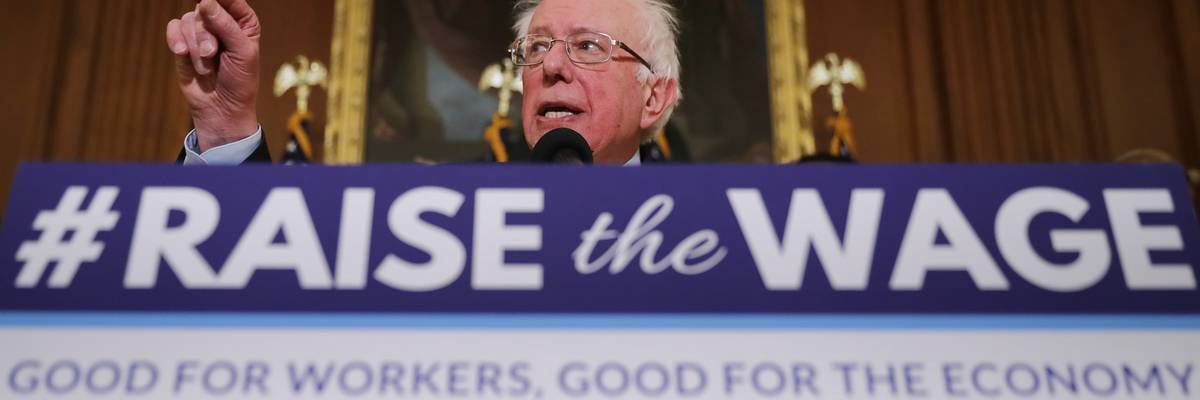
Sen. Bernie Sanders (I-Vt.) speaks during an event to introduce the Raise The Wage Act in the Rayburn Room at the US Capitol January 16, 2019 in Washington, DC.
The federal minimum wage stands at a shockingly low $7.25 an hour and hasn’t been raised for nearly two decades. Raising it should be step one for lawmakers elected on a wave of concerns about affordability.
With a new crop of Democratic senators and representatives heading to Congress in January, many are calling for their first order of business to be raising the federal minimum wage. Even Rep. Hakeem Jeffries, who is vying for the position of House Speaker and is known for being cautious, says raising the minimum wage is imperative.
An Associated Press survey of voters in November 2026 showed that “about 9 in 10 voters said the cost of living was a ‘crucial’ or ‘major’ factor in their vote for Congress.”
Saru Jayaraman, the co-founder and president of One Fair Wage who represents 14 million restaurant workers, says Democrats have a “mandate” to improve affordability—but argues that politicians should focus more on raising wages than lowering prices.
In an exit poll of 10,000 midterm voters from around the nation, nearly 90% of people felt that raising the minimum wage to $25 an hour was somewhat, very, or one of the most important issues for them.
“While the cost of living can be brought under control, it can’t really fall,” she explains. “It’s not going to happen, nor would economists really suggest that it’s a good thing to happen. It’s called deflation.”
Instead, she concludes, “We have to bring the pay up to the cost of living.”
The federal minimum wage stands at a shockingly low $7.25 an hour and hasn’t been raised for nearly two decades. Many states have raised their own wage floors since then, but minimum wage workers in at least 20 states are stuck at this poverty level.
Raising it should be step one for lawmakers elected on a wave of concerns about affordability.
The MIT Living Wage calculator offers concrete guidelines for the wages people need in order to survive. Jayaraman points out that “the least you need to live anywhere in the United States right now, including the cheapest county in the US, which is McLennan County, Texas, is $25 an hour if you have even one dependent.”
This past April, Reps. Delia C. Ramirez (D-Ill.), Jesús “Chuy” García (D-Ill.), Lateefah Simon (D-Calif.), and Analilia Mejia (D-NJ) introduced the Living Wage for all Act, raising the wage floor to $25 an hour nationwide. The act currently has 35 co-sponsors, while the Senate version of the bill has four co-sponsors.
While $25 may sound like a large jump from $7.25, the increase is phased in over six years, and Jayaraman sees it as “a very slow and reasonable pathway to get closer to the cost of living.”
The standard opposition to raising wages is that it leads to job losses. But there is plenty of evidence to the contrary. In states like California and New York, economists found that low-wage workers saw higher wages and more jobs after the states raised their minimum wages to $15 an hour, more than double the federal minimum.
“When working people earn more, they spend it,” says Jayaraman, which in turn creates more jobs. “It doesn’t go to the Cayman Islands or a Swiss bank account like it would when we cut taxes for the wealthy. Instead, when you put more money in people’s pockets… they are spending it in the economy to survive, and therefore the economy does better.”
In an exit poll of 10,000 midterm voters from around the nation, nearly 90% of people felt that raising the minimum wage to $25 an hour was somewhat, very, or one of the most important issues for them.
The idea is so popular, in fact, that last year some MAGA supporters were circulating a viral social post falsely claiming that President Donald Trump had signed an executive order to raise the wage floor to $25. (Unfortunately, he didn’t.)
Still, there is an expectation that Trump will veto all congressional legislation in 2027 to ensure Democrats can’t claim any wins. But Jayaraman urges Congress to pass it anyway. If the president does veto the wage hike, the opposition party can use it to their benefit in the next campaign.
And if he signs it, everyone wins.
This country and this world are at a monumental crossroads. US voters have an opportunity to beat back the forces of fascism and confront the billionaires who are rigging the economy, our media system, and our democracy, making it increasingly impossible for ordinary people to get by. We’re not just talking about the election. We’re talking about what must be done once these fascist elements are vanquished from power. We need a bolder set of solutions than what either major party has so far been willing to offer and a working-class movement ready to fight like hell for it. Trump didn't emerge from nowhere. The conditions that fueled MAGA authoritarianism were created by decades of radical neoliberal economic policies and a corrupt political system dominated by corporate interests. They slashed taxes on the super-rich, promising that the benefits would trickle down. They said giveaways to the corporate titans would make life more affordable for the rest of us. It was all bullshit. And when a bitter, betrayed populace searches for someone to blame, right-wing demagogues have little trouble finding scapegoats. People know when they're being lied to, but you won't hear any of this from the corporate media. Only independent journalism—powered and funded by people who believe in building a better world—can deliver truly trustworthy daily news. If you share our vision, please contribute whatever you can to sustain our work. |
With a new crop of Democratic senators and representatives heading to Congress in January, many are calling for their first order of business to be raising the federal minimum wage. Even Rep. Hakeem Jeffries, who is vying for the position of House Speaker and is known for being cautious, says raising the minimum wage is imperative.
An Associated Press survey of voters in November 2026 showed that “about 9 in 10 voters said the cost of living was a ‘crucial’ or ‘major’ factor in their vote for Congress.”
Saru Jayaraman, the co-founder and president of One Fair Wage who represents 14 million restaurant workers, says Democrats have a “mandate” to improve affordability—but argues that politicians should focus more on raising wages than lowering prices.
In an exit poll of 10,000 midterm voters from around the nation, nearly 90% of people felt that raising the minimum wage to $25 an hour was somewhat, very, or one of the most important issues for them.
“While the cost of living can be brought under control, it can’t really fall,” she explains. “It’s not going to happen, nor would economists really suggest that it’s a good thing to happen. It’s called deflation.”
Instead, she concludes, “We have to bring the pay up to the cost of living.”
The federal minimum wage stands at a shockingly low $7.25 an hour and hasn’t been raised for nearly two decades. Many states have raised their own wage floors since then, but minimum wage workers in at least 20 states are stuck at this poverty level.
Raising it should be step one for lawmakers elected on a wave of concerns about affordability.
The MIT Living Wage calculator offers concrete guidelines for the wages people need in order to survive. Jayaraman points out that “the least you need to live anywhere in the United States right now, including the cheapest county in the US, which is McLennan County, Texas, is $25 an hour if you have even one dependent.”
This past April, Reps. Delia C. Ramirez (D-Ill.), Jesús “Chuy” García (D-Ill.), Lateefah Simon (D-Calif.), and Analilia Mejia (D-NJ) introduced the Living Wage for all Act, raising the wage floor to $25 an hour nationwide. The act currently has 35 co-sponsors, while the Senate version of the bill has four co-sponsors.
While $25 may sound like a large jump from $7.25, the increase is phased in over six years, and Jayaraman sees it as “a very slow and reasonable pathway to get closer to the cost of living.”
The standard opposition to raising wages is that it leads to job losses. But there is plenty of evidence to the contrary. In states like California and New York, economists found that low-wage workers saw higher wages and more jobs after the states raised their minimum wages to $15 an hour, more than double the federal minimum.
“When working people earn more, they spend it,” says Jayaraman, which in turn creates more jobs. “It doesn’t go to the Cayman Islands or a Swiss bank account like it would when we cut taxes for the wealthy. Instead, when you put more money in people’s pockets… they are spending it in the economy to survive, and therefore the economy does better.”
In an exit poll of 10,000 midterm voters from around the nation, nearly 90% of people felt that raising the minimum wage to $25 an hour was somewhat, very, or one of the most important issues for them.
The idea is so popular, in fact, that last year some MAGA supporters were circulating a viral social post falsely claiming that President Donald Trump had signed an executive order to raise the wage floor to $25. (Unfortunately, he didn’t.)
Still, there is an expectation that Trump will veto all congressional legislation in 2027 to ensure Democrats can’t claim any wins. But Jayaraman urges Congress to pass it anyway. If the president does veto the wage hike, the opposition party can use it to their benefit in the next campaign.
And if he signs it, everyone wins.