

SUBSCRIBE TO OUR FREE NEWSLETTER
Daily news & progressive opinion—funded by the people, not the corporations—delivered straight to your inbox.
5
#000000
#FFFFFF
To donate by check, phone, or other method, see our More Ways to Give page.
Daily news & progressive opinion—funded by the people, not the corporations—delivered straight to your inbox.
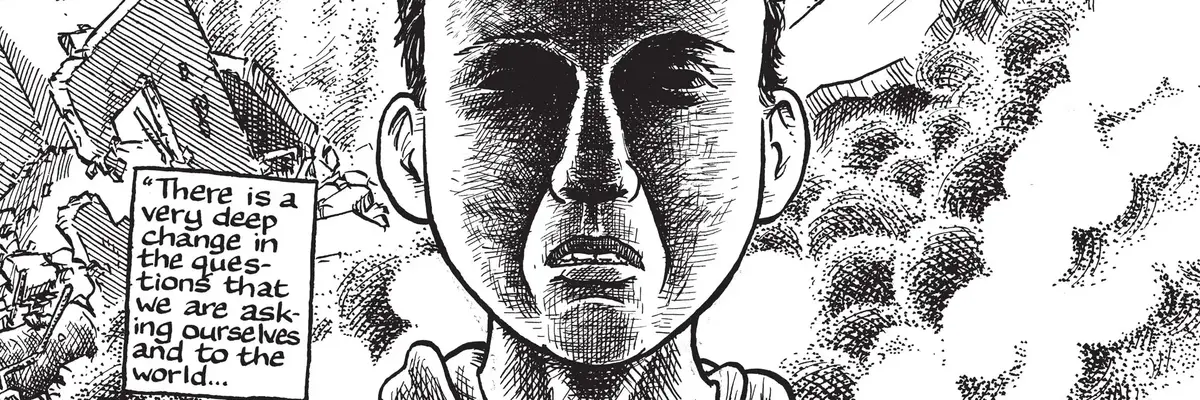
A detail from Hedges and Sacco's latest work together, "Requiem for Gaza."
Sandwiched between text written by Chris Hedges and the illustration of Joe Sacco—an award winning artist—their new book details the hardship and survival in gritty black and white captioned storyboards that capture close-ups of Gaza’s victims amid the terror of bombardment and the weariness of constant forced displacement.
In the gut-wrenching book Requiem for Gaza, a collaboration between journalist Chris Hedges and cartoonist Joe Sacco, the reader bears witness to US-backed Israeli genocide through the eyes of 29 survivors living as refugees in Egypt. In the spring of 2025, Hedges, a former New York Times war correspondent, and Sacco, a comics journalist, spent three weeks in Cairo interviewing men and women–doctors, journalists, teachers, mental health workers—who one way or another—through medical approval, foreign citizenship, Go Fund Me accounts—managed to leave Gaza via the Rafah Crossing before Israel shut the gates, once again, to declare no exit.
With chapters that cover First Day, Exodus, Assassinations, Ceasefire, Exile and Resistance, Requiem for Gaza (160 pages) introduces us to Osama, a trauma psychologist. The former resident of Gaza City recalls how in the days that followed October 7th, he and his family huddled at home in a safe room while Israel pummeled his neighborhood with warplanes, artillery, naval guns and tanks. Osama, his wife, three children and Persian cat, loaded up the car to get the hell out but were stricken with fear—unable to think clearly before landing in a place long enough to set up a Go Fund Me page to raise $30,000 for exit visas to Egypt.
Hedges points out the cost of visas doubled, tripled, quadrupled and more after Israel launched its AI-assisted genocide that, in the crime of scholasticide destroyed every university in Gaza, where the literacy rate–among the highest in the world–had reached 98 percent.
Life is not easy for Osama in Egypt, where 150-thousand exiles from Gaza—100,000 since Oct. 7th—cannot obtain work permits, forcing them to survive in an underground economy or on donations sent from abroad. Hedges quotes Osama, “We have no status in Egypt … We are nothing … It is another level of war and struggle.”
Sandwiched between Hedge’s text, Sacco—an award winning artist—draws Osama’s story of hardship and survival in gritty black and white captioned storyboards that capture close-ups of Gaza’s victims amid the terror of bombardment and the weariness of constant forced displacement. In bold strokes—more realistic than cartoonish—Sacco illustrates the frightful and panicked expressions of Osama and his wife as they sit frozen in their car, unsure of how to escape Israel’s assault; the smoke, rubble and tanks they pass enroute to a humanitarian organization, where Osama worked in mental health. “There was bombing everywhere,” ‘but Osama assumed the Israelis knew the location of international aid groups and wouldn’t target their facilities,’ reads the panelled caption. Sacco illustrates the violence and chaos that results when a bomb falls in front of the building, killing two people. Head-bandaged children, anguished men carrying victims into the ground floor of the office, adults covering as many windows as they can with filing cabinets …” Sacco breaks up the brutal images with drawings of Osama’s daughters joyfully petting and tickling the belly of their cat, Semsen–which means sesame seed in Arabic.
Pleasure juxtaposed with pain reminds us that even in the bleakest of times life can hold humor in small moments. In this way Requiem for Gaza recalls the diverse stories told in the 2025 Gaza film “From Ground Zero”--an anthology of 22 mini-docs and animated videos, in which the short film “Everything is Fine’ chronicles a stand-up comedian’s preparation and performance for the children—some wounded and orphaned—of Gaza. Whereas other films–American Doctor, NAZA–present the point of view of caring outsiders treating the wounded in Gaza or IDF soldiers in Tel Aviv coldly recounting their obliteration of Gaza neighborhoods, Requiem for Gaza presents the intimate stories of Palestinian survivors in exile who remind us of the broad spectrum of human emotion that traverses love, guilt, fear, empathy, longing, pride–and even hope.
We meet Anna, a Palestinian from Gaza who waited four months to cross into Egypt so her paralyzed daughter Layan could receive medical treatment. “We have to continue physical therapy so she can walk again. I keep reminding her that she is very strong and one day she will walk.” Back in Gaza, Anna’s husband and two other children shelter in the ruins of a school. When she speaks to them on her cell phone–every day or every two days, depending on internet service—she tells a harmless lie—one we all might tell, that she, like them, eats only canned food. “I can’t tell them what I actually ate.” Anna picks up her phone to show Hedges and Sacco her “painfully thin” son who “is constantly complaining of headaches because of his malnutrition. I tell my sisters to get him some peanut butter.”
What makes Requiem for Gaza such a compelling read is not just the voices of the exiled but Hedge’s expose of a fraudulent Holocaust industry. “Holocaust scholars, with a handful of exceptions, have exposed their true purpose, which is not to examine the dark side of human nature and the frightening propensity we all have to commit evil," writes Hedges, "but to sanctify Jews as eternal victims and absolve the ethnonationalist state of Israel of its crimes of settler colonialism, apartheid and genocide.”
In the chapters Assassinations and Resistance, Hedges rebukes Israel’s deliberate assassination of medical workers and journalists in Gaza; the sanctions the US has imposed on Francesca Albanese, the UN special rapporteur for Palestine, after she exposed 1,000 companies’ corporate complicity in genocide; Israel’s arrests, torture and solitary confinement of flotilla activists who since 2010 have tried to break Israel’s siege on Gaza. “They are reminding the world of its moral and legal duty to intervene. They are shaming not only Israel, but the Western governments whose complicity sustains the genocide,” writes Hedges.
Requiem for Gaza is the journalists’ second collaboration. Their first–Days of Destruction, Days of Revolt–was a journey to America’s heartland, where the health and land of Native Americans were sacrificed at the altar of capitalist exploitation. When Simon and Schuster wouldn’t even entertain a “Requiem” proposal—and other publishers also passed, Hedges and Sacco published their book in 2026 through Fantagraphics, publisher of Sacco’s many graphic novels, including Palestine, winner of the 1996 American Book Award.
Requiem for Gaza has been reviewed by the Financial Times and the Columbia Journalism Review, but legacy news outlets, such as the New York Times—Hedges former employer of 15 years, Washington Post, Chicago Tribune and even the Guardian—have failed to review a book that should be classroom reading at every high school and college campus to teach students the imperative of resistance to genocide lest ascendant global fascism swallow us in fire and fury.
This country and this world are at a monumental crossroads. US voters have an opportunity to beat back the forces of fascism and confront the billionaires who are rigging the economy, our media system, and our democracy, making it increasingly impossible for ordinary people to get by. We’re not just talking about the election. We’re talking about what must be done once these fascist elements are vanquished from power. We need a bolder set of solutions than what either major party has so far been willing to offer and a working-class movement ready to fight like hell for it. Trump didn't emerge from nowhere. The conditions that fueled MAGA authoritarianism were created by decades of radical neoliberal economic policies and a corrupt political system dominated by corporate interests. They slashed taxes on the super-rich, promising that the benefits would trickle down. They said giveaways to the corporate titans would make life more affordable for the rest of us. It was all bullshit. And when a bitter, betrayed populace searches for someone to blame, right-wing demagogues have little trouble finding scapegoats. People know when they're being lied to, but you won't hear any of this from the corporate media. Only independent journalism—powered and funded by people who believe in building a better world—can deliver truly trustworthy daily news. If you share our vision, please contribute whatever you can to sustain our work. |
In the gut-wrenching book Requiem for Gaza, a collaboration between journalist Chris Hedges and cartoonist Joe Sacco, the reader bears witness to US-backed Israeli genocide through the eyes of 29 survivors living as refugees in Egypt. In the spring of 2025, Hedges, a former New York Times war correspondent, and Sacco, a comics journalist, spent three weeks in Cairo interviewing men and women–doctors, journalists, teachers, mental health workers—who one way or another—through medical approval, foreign citizenship, Go Fund Me accounts—managed to leave Gaza via the Rafah Crossing before Israel shut the gates, once again, to declare no exit.
With chapters that cover First Day, Exodus, Assassinations, Ceasefire, Exile and Resistance, Requiem for Gaza (160 pages) introduces us to Osama, a trauma psychologist. The former resident of Gaza City recalls how in the days that followed October 7th, he and his family huddled at home in a safe room while Israel pummeled his neighborhood with warplanes, artillery, naval guns and tanks. Osama, his wife, three children and Persian cat, loaded up the car to get the hell out but were stricken with fear—unable to think clearly before landing in a place long enough to set up a Go Fund Me page to raise $30,000 for exit visas to Egypt.
Hedges points out the cost of visas doubled, tripled, quadrupled and more after Israel launched its AI-assisted genocide that, in the crime of scholasticide destroyed every university in Gaza, where the literacy rate–among the highest in the world–had reached 98 percent.
Life is not easy for Osama in Egypt, where 150-thousand exiles from Gaza—100,000 since Oct. 7th—cannot obtain work permits, forcing them to survive in an underground economy or on donations sent from abroad. Hedges quotes Osama, “We have no status in Egypt … We are nothing … It is another level of war and struggle.”
Sandwiched between Hedge’s text, Sacco—an award winning artist—draws Osama’s story of hardship and survival in gritty black and white captioned storyboards that capture close-ups of Gaza’s victims amid the terror of bombardment and the weariness of constant forced displacement. In bold strokes—more realistic than cartoonish—Sacco illustrates the frightful and panicked expressions of Osama and his wife as they sit frozen in their car, unsure of how to escape Israel’s assault; the smoke, rubble and tanks they pass enroute to a humanitarian organization, where Osama worked in mental health. “There was bombing everywhere,” ‘but Osama assumed the Israelis knew the location of international aid groups and wouldn’t target their facilities,’ reads the panelled caption. Sacco illustrates the violence and chaos that results when a bomb falls in front of the building, killing two people. Head-bandaged children, anguished men carrying victims into the ground floor of the office, adults covering as many windows as they can with filing cabinets …” Sacco breaks up the brutal images with drawings of Osama’s daughters joyfully petting and tickling the belly of their cat, Semsen–which means sesame seed in Arabic.
Pleasure juxtaposed with pain reminds us that even in the bleakest of times life can hold humor in small moments. In this way Requiem for Gaza recalls the diverse stories told in the 2025 Gaza film “From Ground Zero”--an anthology of 22 mini-docs and animated videos, in which the short film “Everything is Fine’ chronicles a stand-up comedian’s preparation and performance for the children—some wounded and orphaned—of Gaza. Whereas other films–American Doctor, NAZA–present the point of view of caring outsiders treating the wounded in Gaza or IDF soldiers in Tel Aviv coldly recounting their obliteration of Gaza neighborhoods, Requiem for Gaza presents the intimate stories of Palestinian survivors in exile who remind us of the broad spectrum of human emotion that traverses love, guilt, fear, empathy, longing, pride–and even hope.
We meet Anna, a Palestinian from Gaza who waited four months to cross into Egypt so her paralyzed daughter Layan could receive medical treatment. “We have to continue physical therapy so she can walk again. I keep reminding her that she is very strong and one day she will walk.” Back in Gaza, Anna’s husband and two other children shelter in the ruins of a school. When she speaks to them on her cell phone–every day or every two days, depending on internet service—she tells a harmless lie—one we all might tell, that she, like them, eats only canned food. “I can’t tell them what I actually ate.” Anna picks up her phone to show Hedges and Sacco her “painfully thin” son who “is constantly complaining of headaches because of his malnutrition. I tell my sisters to get him some peanut butter.”
What makes Requiem for Gaza such a compelling read is not just the voices of the exiled but Hedge’s expose of a fraudulent Holocaust industry. “Holocaust scholars, with a handful of exceptions, have exposed their true purpose, which is not to examine the dark side of human nature and the frightening propensity we all have to commit evil," writes Hedges, "but to sanctify Jews as eternal victims and absolve the ethnonationalist state of Israel of its crimes of settler colonialism, apartheid and genocide.”
In the chapters Assassinations and Resistance, Hedges rebukes Israel’s deliberate assassination of medical workers and journalists in Gaza; the sanctions the US has imposed on Francesca Albanese, the UN special rapporteur for Palestine, after she exposed 1,000 companies’ corporate complicity in genocide; Israel’s arrests, torture and solitary confinement of flotilla activists who since 2010 have tried to break Israel’s siege on Gaza. “They are reminding the world of its moral and legal duty to intervene. They are shaming not only Israel, but the Western governments whose complicity sustains the genocide,” writes Hedges.
Requiem for Gaza is the journalists’ second collaboration. Their first–Days of Destruction, Days of Revolt–was a journey to America’s heartland, where the health and land of Native Americans were sacrificed at the altar of capitalist exploitation. When Simon and Schuster wouldn’t even entertain a “Requiem” proposal—and other publishers also passed, Hedges and Sacco published their book in 2026 through Fantagraphics, publisher of Sacco’s many graphic novels, including Palestine, winner of the 1996 American Book Award.
Requiem for Gaza has been reviewed by the Financial Times and the Columbia Journalism Review, but legacy news outlets, such as the New York Times—Hedges former employer of 15 years, Washington Post, Chicago Tribune and even the Guardian—have failed to review a book that should be classroom reading at every high school and college campus to teach students the imperative of resistance to genocide lest ascendant global fascism swallow us in fire and fury.

