SUBSCRIBE TO OUR FREE NEWSLETTER
Daily news & progressive opinion—funded by the people, not the corporations—delivered straight to your inbox.
5
#000000
#FFFFFF
To donate by check, phone, or other method, see our More Ways to Give page.
Daily news & progressive opinion—funded by the people, not the corporations—delivered straight to your inbox.
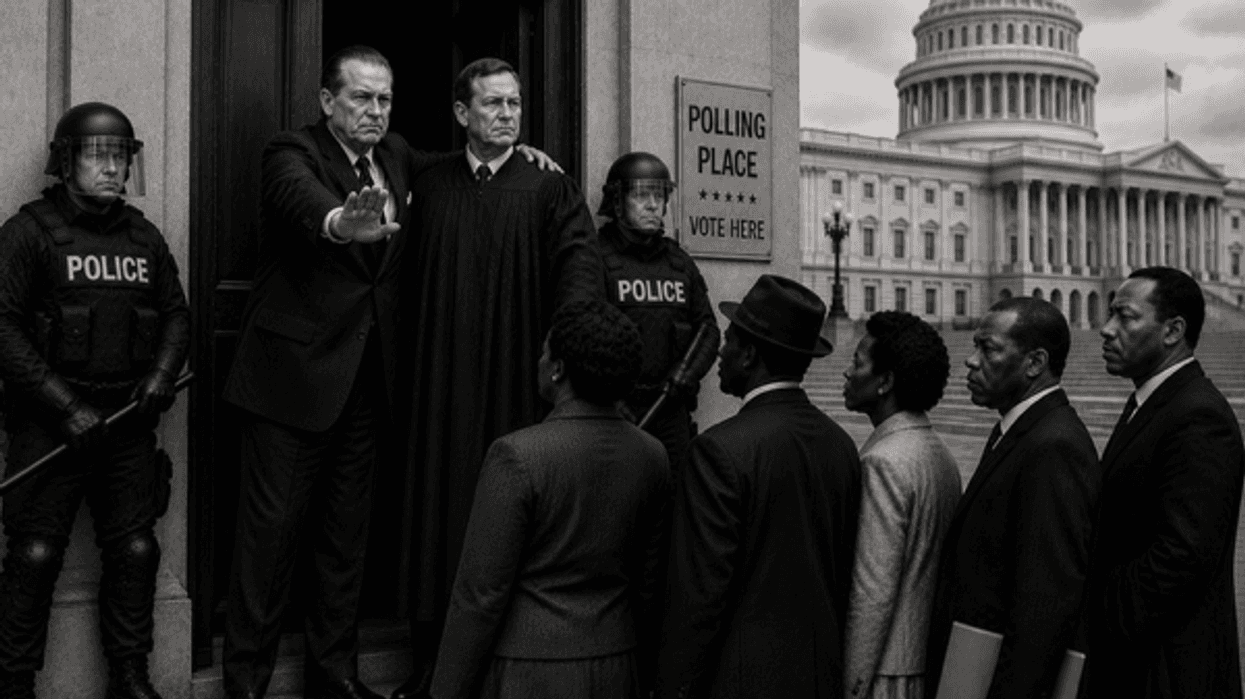
What the infamous segregationist from Alabama could not accomplish with violence, the US Supreme Court Justice has accomplished with a pen.
George Wallace was sworn in as Governor of Alabama in 1963 and famously declared in his inauguration speech (written by a Ku Klux Klan leader) "segregation now, segregation tomorrow, segregation forever." Two years later, Alabama state troopers violently broke up a nighttime voting rights march during which a police officer shot and killed young African American protester and Baptist deacon Jimmie Lee Jackson who was unarmed and protecting his mother.
In response, civil rights leaders, including Martin Luther King and John Lewis, organized a mass march from Selma to Montgomery over the Edmund Pettus Bridge in an attempt to deliver a civil rights and voting rights message to Gov. Wallace. It became known as "Bloody Sunday" as state troopers gassed and beat the protestors, including fracturing Lewis' skull and sending 57 others to the hospital. Televised images of the brutal attack shocked the nation, directly leading to President Johnson's push for the Voting Rights Act of 1965.
Numerous Americans, black and white, were injured and even died fighting for the Civil Rights Act. John Roberts and his five Republican Supreme Court colleagues effectively overturned the Civil Rights Act and essentially disenfranchised black voters.
George Wallace tried to disenfranchise black voters with violent state troopers. Roberts disenfranchised black voters with the stroke of a pen. It's not hyperbole to say that while Roberts wears the black robes of a judge, he may as well wear the white robes of the Klan.
It's not hyperbole to say that while Roberts wears the black robes of a judge, he may as well wear the white robes of the Klan.
In her dissent to Louisiana v. Callais in which the 6-member Republican majority of the Court effectively overturned Section 2 of the Civil Rights Act, Justice Elena Kagan wrote: “The Voting Rights Act is—or, now more accurately, was—one of the most consequential, efficacious, and amply justified exercises of federal legislative power in our Nation’s history. It was born of the literal blood of Union soldiers and civil rights marchers. It ushered in awe-inspiring change, bringing this Nation closer to fulfilling the ideals of democracy and racial equality." Kagan concluded, " I dissent because the Court betrays its duty to faithfully implement the great statute Congress wrote. I dissent because the Court’s decision will set back the foundational right Congress granted of racial equality in electoral opportunity. I dissent.”
But the Court didn't destroy the Civil Rights Act in a day. It was part of a lifelong mission by John Roberts to do so.
Starting as early as 1981, as a 26-year-old lawyer just three years out of Harvard Law School, Roberts began his campaign to undermine the Civil Rights Act. He got himself a job as Special Assistant to Ronald Reagan's Attorney General William French Smith. Congress was about to amend the Civil Rights Act to provide that state laws would be illegal if they had a racially discriminatory effect, without having to prove that they had a racially discriminatory intent—something almost impossible to prove.
Roberts zealously took on the assignment coming up with arguments against the Amendment. Roberts wrote over 25 memos opposing the Amendment. In one, he argued that the Civil Rights Act was "the most intrusive interference imaginable by federal courts into state and local processes."
Despite the efforts of Roberts and others in the Reagan administration, Congress passed the Amendment with overwhelming bipartisan support. Little did anyone imagine at the time that Roberts would become Chief Justice and the leader of right-wing Justices' ultimately successful efforts to undermine the Civil Rights Act as he had initially set out to do as a young Justice Department official.
At his confirmation hearing, Roberts told the Senate "The existing Voting Rights Act, the constitutionality has been upheld and I don't have any issue with that." He was lying.
In 2013, Roberts got his first shot at dismantling the Civil Rights Act. In his 5-4 ruling in Shelby v. Holder, he overturned Section 5 of the Act , which required that states with a history of racist voter suppression pre-clear changes in election laws with the Justice Department to be sure they were not reinstituting racial suppression. He argued that it was no longer necessary since racism in America had diminished since the Act had been passed. In response, many states previously subject to preclearance rushed to enact new voter suppression laws.
In coming years, the Roberts Court further chipped away at the Voting Rights Act. But Roberts finally got his opportunity to make the rest of the Voting Rights Act a nullity when Louisiana v. Calais came before the Court this year. In a 6-3 opinion, which Roberts assigned to his anti-voting rights ally Justice Samuel Alito, the Court overruled the other crown jewel of the Voting Rights Act which had previously held that racially gerrymandered districts were illegal if they had racially discriminatory effect. Instead, racially gerrymandered districts would only be illegal if it can be proven that they have a racially discriminatory intent, a bar that is almost impossible to clear.
This was the argument that Roberts first made as a young Justice Department attorney back in 1982. As Chief Justice, he finally succeeded in his long campaign to revoke the Civil Rights Act.
Meanwhile, if a state can claim that it's gerrymandering is motivated by ensuring that its political party wins, it's totally cool with the Roberts Court. With the Court overturning both Section 2 and Section 5 of the Voting Rights Act, it effectively repealed the entire Voting Rights Act that so many had fought and died for.
The very next day, Florida passed a redistricting law that would allow for new levels of gerrymandering designed to erase districts with large populations of black voters.
Roberts accomplished with a pen what George Wallace had tried to accomplish with violent state troopers.
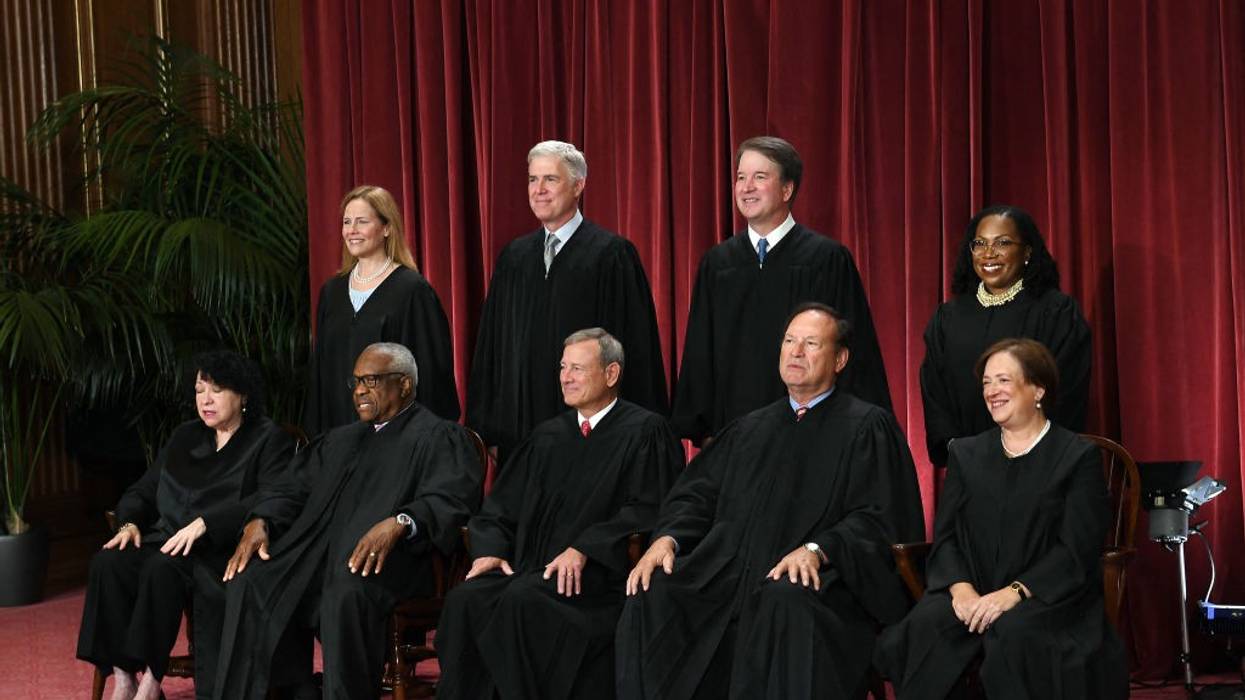
If Andrew Johnson and Bull Connor were alive today, they’d be mighty happy with this Supreme Court. It might be their ghosts, along with their ideological chums from Roger Taney, architect of the infamous Dred Scott case, to Strom Thurmond, George Wallace and the other Southern Dixiecrats, wearing those Court robes today.
Those defenders of slavery and segregation would be thrilled with the efforts of Roberts and his cabal to rewrite the history of the 14th Amendment’s “equal protection of the laws” clause of the Reconstruction era that is the core of American democracy. And their frontal assault on the goal of a multi-racial society premised on diversity, equity, and inclusion that is so feared by the ghosts of the plantation class ideologues and their descendants longing for a return to those days past.
Chief Justice John Roberts’ labored efforts to pretend his court is not merely a far-right partisan cabal crashed aground in a parade of extremist court rulings in the waning days of the 2022-2023 court term.
In the cynical hands of Roberts and his cronies on the court, the original intent of the 14th has been perverted to instead buttress and protect white supremacy and white privilege. And to strike down reforms designed to expand rights and protections for the marginalized and disadvantaged.
The debauched majority opinion striking down affirmative action, defines the “core purpose” of the Equal Protection Clause of the 14th as “do[ing] away with all governmentally imposed discrimination based on race,” by which Roberts argues means historically disadvantaged Black and Brown students should not “be admitted (to colleges and universities) in greater numbers than they otherwise would have been.”
That would surely be news to the authors of the 14th and its precursor, the 1866 Civil Rights Act, who specifically crafted the bill and amendment to reverse the horrors of slavery and the pseudo-scientific racism which buttressed it in the face of virulent racism and increasingly violent repression by the former Confederate soldiers abetted by the white politicians aligned with them.
As Eric Foner, one of the most prominent historians of Reconstruction, wrote in his seminal book “The Second Founding,” President Johnson vetoed the 1866 Act (overridden by Congress) as made to operate in favor of the colored and against the white race” and opponents of the 14th directly attacked it as a violation of white supremacy.
“[E]qual protection of the laws is not achieved through indiscriminate imposition of inequalities,” Roberts pontificated, seeking to obscure and re-write the 14th’s “equal protection of the laws” clause as meant to advocate a colorblind society that as Justice Sonia Sotomayor wrote in her forceful dissent “is not, and has never been, colorblind.”
As with his mugging on the Voting Rights Act, the subtext of his evisceration of affirmative action is infused with his presumption that the racist sins of the past are now past.
Roberts’ interpretation of the 14th, noted Sonia Sotomayor, is not only “contrary to precedent and the entire teachings of our history, but is also grounded in the illusion that racial inequality was a problem of a different generation. Entrenched racial inequality remains a reality today.”
Or as Justice Ketanji Brown-Jackson in her dissent, noted in beautiful simplicity, “history speaks. In some form, it can be heard forever. The race-based gaps that first developed centuries ago are echoes from the past that still exist today. By all accounts, they are still stark.”
The Court majority, wrote Sotomayor in her far reaching dissent, “subverts the constitutional guarantee of equal protection by further entrenching racial inequality in education, the very foundation of our democratic government and pluralistic society… Reduced to its simplest terms, the Court’s conclusion is that an increase in the representation of racial minorities at institutions of higher learning that were historically reserved for white Americans is an unfair and repugnant outcome that offends the Equal Protection Clause”.
Or as Leah Litman, one of three constitutional law professors who provide colorful takedowns on the Court in their entertaining podcast Strict Scrutiny put it, “there’s almost nothing more that the Republican appointed justices love to do than to deny doing what it is in fact they are doing.”
The veil of Roberts’ deception is easily ripped off by glaring exemptions in the majority opinion, another telling case described by Sotomayor, and a companion Court ruling the next day.
First, there is the court’s transparent acceptance of preferential admission policy for legacy applicants and the offspring of wealthy donors, which ensures special status rather than the “merit” of a supposed colorblind society. Of white Harvard students, 43 percent are either legacies, children of faculty, kin of donors or a recruited athlete who would not have gotten in if not for special treatment that the Court does not challenge.
Second, not well hidden in a footnote, Roberts exempts military academies, allowing them to continue to use race-based admissions “in light of the potentially distinct interests that military academies may present.” In other words, the highly diverse military and the need for a diverse officer corps.
“During the Vietnam War,” Sotomayor noted, lack of racial diversity “threatened the integrity and performance of the Nation’s military” because it fueled “perceptions of racial/ethnic minorities serving as ‘cannon fodder’ for white military leaders.” Or as Jackson put it, “the Court has come to rest on the bottom-line conclusion that racial diversity in higher education is only worth potentially preserving insofar as it might be needed to prepare Black Americans and other underrepresented minorities for success in the bunker, not the boardroom.”
To Sotomayor, “the majority recognizes the compelling need for diversity in the military and
the national security implications at stake but it ends race-conscious college admissions at civilian universities implicating those interests anyway.” Diversity is equally essential everywhere in a society that is growing more multi-national, more multi-cultural by the day no matter how hard the Tucker Carlson’s and his ilk, try to stop it.
“Race-conscious college admissions,” Sotomayor added, are, for example, “critical for providing equitable and effective public services. State and local governments require public servants educated in diverse environments who can “identify, understand, and respond to perspectives” in “our increasingly diverse communities.”
Third, Sotomayor cited another case where the Court majority was perfectly comfortable with a race-based exception where “Mexican appearance” could be “a relevant factor” to justify a stop “at the border.” The Court, she wrote, thus facilitated racial profiling of Latinos as a law enforcement tool and did not adopt a race-blind rule. The Court later extended this reasoning to border patrol agents selectively referring motorists for secondary inspection at a checkpoint, concluding that “even if it be assumed that such referrals are made largely on the basis of apparent Mexican ancestry, [there is] no constitutional violation.”
And then came the subsequent ruling the next day ruling 6-3 on partisan lines if a Colorado web designer could hypothetically, as Strict Scrutiny noted, refuse to design hypothetical wedding websites for hypothetical same-sex couples despite a state law that forbids discrimination against gay people.
“For the first time in history”, Sotomayor wrote in another powerful dissent, “granted a business open to the public a Constitutional right to refuse to serve members of a protected class.”
“The owner who hangs a shingle and offers her services to the public cannot retreat from the promise of open service. It is to convey the promise of a free and open society and then take the prize away from the despised few.”
Sotomayor aptly recounts the long struggle to achieve a “public accommodations law” that guarantees to every person the full and equal enjoyment of places of public accommodation without unjust discrimination. The civil rights freedom movement won enactment of the Civil Rights Act of 1964 and the Americans with Disabilities Act of 1990 which prohibit discrimination by places of public accommodation on the basis of race, color, religion, national origin, or disability – laws premised, one might add, on the equal protection clause of the 14th Amendment that the Roberts Court majority is so determined to subvert.
Sotomayor and Jackson both emphasized the need for continued popular struggle to win the reforms needed to counter the rightwing assaults.
In a master class history that recounts the pervasive legacy of slavery, segregation and continuing structural racism, Jackson reminded all of us that “the justification for admissions programs that account for race is inseparable from the race-linked gaps in health, wealth, and well-being that still exist in our society (the closure of which today’s decision will forestall).”
From economic opportunity, savings and income to housing to education to the criminal justice system, the examples continue to rip through every fabric of our society. Those are reasons that historically disadvantaged Black and Latino students are disproportionately harmed by the Court’s overturning of President Biden’s plan to cancel federal student debt as well.
One of the most insidious consequences Jackson highlights, is the most basic – health, life and death. Citing the success of the University of North Carolina (UNC) policy outlawed by the court, Jackson wrote: “Beyond campus, the diversity that UNC pursues for the betterment of its students and society is not a trendy slogan. It saves lives.
“For marginalized communities in North Carolina,” she continued, “it is critically important that UNC and other area institutions produce highly educated professionals of color. Research shows that Black physicians are more likely to accurately assess Black patients’ pain tolerance and treat them accordingly (including, for example, prescribing them appropriate amounts of pain medication).
“For high-risk Black newborns, having a Black physician more than doubles the likelihood that the baby will live, and not die. Studies also confirm what common sense counsels: Closing wealth disparities through programs like UNC’s – which, beyond diversifying the medical profession, open doors to every sort of opportunity – helps address the aforementioned health disparities (in the long run) as well,” Jackson wrote.
Sotomayor cited briefs submitted by the Southern Governors that increasing the number of students from underrepresented backgrounds who join “the ranks of medical professionals” improves “healthcare access and health outcomes in medically underserved communities.” And another from the Association of American Medical Colleges that all physicians become better practitioners when they learn in a racially diverse environment.
Other medical professionals have issued similar warnings. Lee Jones, dean of medical education at the Georgetown University School of Medicine, observed that the ruling will harm efforts to mitigate the country’s massive racial and health disparities, adding that white residents in Washington, D.C., live more than 15 years more than Black residents.
After California banned affirmative action in the notorious Prop. 209 initiative in 1996, the number of Black and Latino students in colleges and medical schools plummeted. At the University of California San Diego, the entering medical school class in 1997 did not include a single Black student.
Health and Human Services Secretary Xavier Becerra noted that people of color had been excluded from attending medical school and joining medical organizations for generations. “This ruling will make it even more difficult for the nation’s colleges and universities to help create future health experts and workers that reflect” the nation’s diversity. “We need more health workers, especially those who look like and share the experiences of the people they serve,” he said.
“It is important to have a representative, culturally and linguistically competent nursing workforce to provide the best care for our communities, and yet only 6.3 percent of RNs are Black and just 6.9 percent are Latinx, despite Black and Latinx people respectively accounting for 13.6 percent and 19.1 percent of the total U.S. population,” said National Nurses United. “We need to diversify the nursing workforce and thus increase, not cut back, educational opportunities for people of color who want to be nurses.”
Fig leaf efforts by Roberts to shroud his racist intent that universities can, as Sotomayor put it, “in some situations, consider race in application essays is nothing but an attempt to put lipstick on a pig. The Court’s opinion circumscribes universities’ ability to consider race in any form by meticulously gutting respondents’ asserted diversity interests. Yet, because the Court cannot escape the inevitable truth that race matters in students’ lives, it announces a false promise to save face and appear attuned to reality. No one is fooled.”
For everyone appalled by the ghosts of Andrew Johnson, Bull Connors et al who sit on the court bench today, it is long past time to revisit proposals for essential court reform, from term limits of the lifetime appointments to expansion of the court to reflect the political reality of the nation.
“Despite the Court’s unjustified exercise of power the opinion today will serve only to highlight the Court’s own impotence in the face of an America whose cries for equality resound, Sotomayor concluded. “As has been the case before in the history of American democracy, concluded, quoting Dr. Martin Luther King, “the arc of the moral universe” will bend toward racial justice despite the Court’s efforts today to impede its progress.”
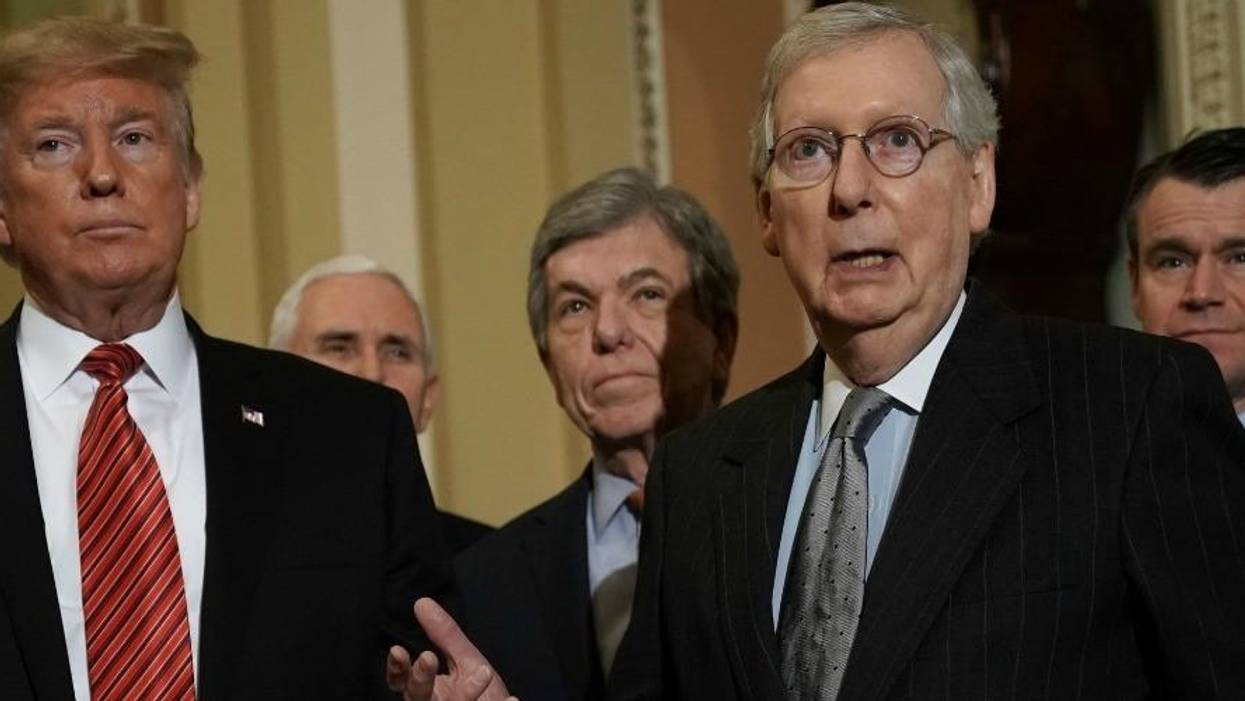
Senate GOP leader Mitch McConnell is from Kentucky, but he epitomizes what is wrong with the nation's capital.
McConnell is a 77-year-old white man who has been running the Senate -- deciding its agenda and what will or will not be voted on by all 100 senators -- longer than any previous Republican in history. He was first elected to the Senate in 1984 and was last re-elected with just over 56% of the vote.
McConnell's second wife is Elaine Chao, another Washington fixture who has served in a number of Cabinet posts and is currently heading the Department of Transportation. McConnell is worth an estimated $22.5 million, most of it inherited from Chao's mother. Chao's Chinese family runs a prosperous shipping company; she now oversees America's shipping industry.
"It's about clinging to power at any cost. It's about getting right-wing judges appointed to lifetime judicial posts who will be counted on for decades to keep the anti-abortion, pro-gun, tax-cuts-for-the-rich, social-safety-net-slashing, unlimited-campaign-donations-for-special-interests and anti-business-regulation agenda in full throttle."
We bring up McConnell, the Senate majority leader, because unequivocally he will never be awarded any sort of profile in courage award.
McConnell is steadfastly refusing to bring up two House-passed bills that would mandate stiffer background checks on sales of guns. After a week of devastating shooting massacres in California, Texas and Ohio, McConnell would not bring the Senate back from its August recess to vote on any form of common-sense gun control. That includes taking away guns from dangerously mentally ill people (red-flag laws), reducing the size of high-capacity magazines, making military-style assault weapons illegal, buying back unwanted guns or requiring tougher background checks.
This is despite the shooting deaths of so many Americans in schools, movie theaters, churches, mosques, temples, festivals, offices -- no place is safe. Two hundred fifty-five Americans have died in mass shootings in seven months this year.
Ohio Democratic Sen. Sherrod Brown said in disgust that McConnell "has an addiction to gun company money."
Rep. Tim Ryan, D-Ohio, said, "Come on, Mitch McConnell, where are your guts? Get off your ... and get something done.... You could walk out of the Senate with your head held high that you actually did something other than pad your pension."
Just days ago McConnell was dubbed "Moscow Mitch" for refusing to bring up bipartisan legislation that had passed the House to strengthen America's elections from manipulation from foreign governments such as Russia. Russia is now proven to have intervened in the 2016 elections in favor of Donald Trump. Intelligence agencies say there is no doubt that Russia will try to interfere in the 2020 elections and is already preparing. Nothing is being done to forestall that.
McConnell first came to the attention of many Americans when he refused to permit confirmation hearings on former President Barack Obama's nomination of Merrick Garland, widely respected by both Republicans and Democrats, to be a Supreme Court justice even though Obama had another year in office.
Trump has now put two justices on the court, turning it solidly to the right, and hopes to win a second term and name one or two more. For that alone, McConnell will support Trump, right or wrong, through racism and white supremacist rants, through trade wars, through alienation of allies, through disregard for the environment, through praising evil dictators, through one moral outrage after another.
Time after time after time, McConnell has defended Trump's indefensible behavior and policy positions that at one time were anathema to the Republican Party.
It's about clinging to power at any cost. It's about getting right-wing judges appointed to lifetime judicial posts who will be counted on for decades to keep the anti-abortion, pro-gun, tax-cuts-for-the-rich, social-safety-net-slashing, unlimited-campaign-donations-for-special-interests and anti-business-regulation agenda in full throttle.
McConnell listens and smiles enigmatically as Trump defends white supremacists, talks about "invasions" of immigrants, separates children from parents and imprisons them, taunts minority members of Congress and abuses his power while being compared more to George Wallace than George Washington, in the words of former Vice President Joe Biden.
McConnell smiles and does nothing but wait to hear from Trump, applaud and implement Trump's agenda.
McConnell is what is wrong with the Republican Party. He is what is wrong with Washington and politicians who put themselves above the people.
Perhaps even more than the morally bankrupt Trump, McConnell is the worst among us. He sees evil and does nothing but permit it to flourish. He closes his heart to what is right and good about America. He is one of the most powerful people in the world but doesn't understand that power has responsibilities as well as privileges. And he is very likely to hold on to that perch of power for the foreseeable future.
Donald Trump's campaign is selling drinking straws. Plastic drinking straws, naturally. The campaign has raised nearly half a million from sales of packs of fifteen red straws with "TRUMP" branded on them, as an alternative to "liberal paper straws."
The premise, of course, is that liberals with their silly ideas about saving the planet and banning plastic straws deserve to be mocked. Paper straws don't work and neither does liberalism. (Who knows what socialist straws might look like?)
The straw campaign is so utterly childish, so petty--with a dash of nihilism--that it's the perfect encapsulation of the real heart of Trumpism. Americans, after all, have long had politicians who used white supremacy as a selling point, from the founders to John C. Calhoun to George Wallace, Nixon's "Southern strategy" to Ronald Reagan, as the news this week reminded us. We're used to grandstanding about America being the greatest country in the world--that's bipartisan foreign policy since before the Monroe Doctrine.
But the politics of petulance is somehow perfect for our current moment. Four decades of relentless there-is-no-alternative propaganda has so many people believing that change is impossible, so they might as well stick their middle finger up at the world instead.
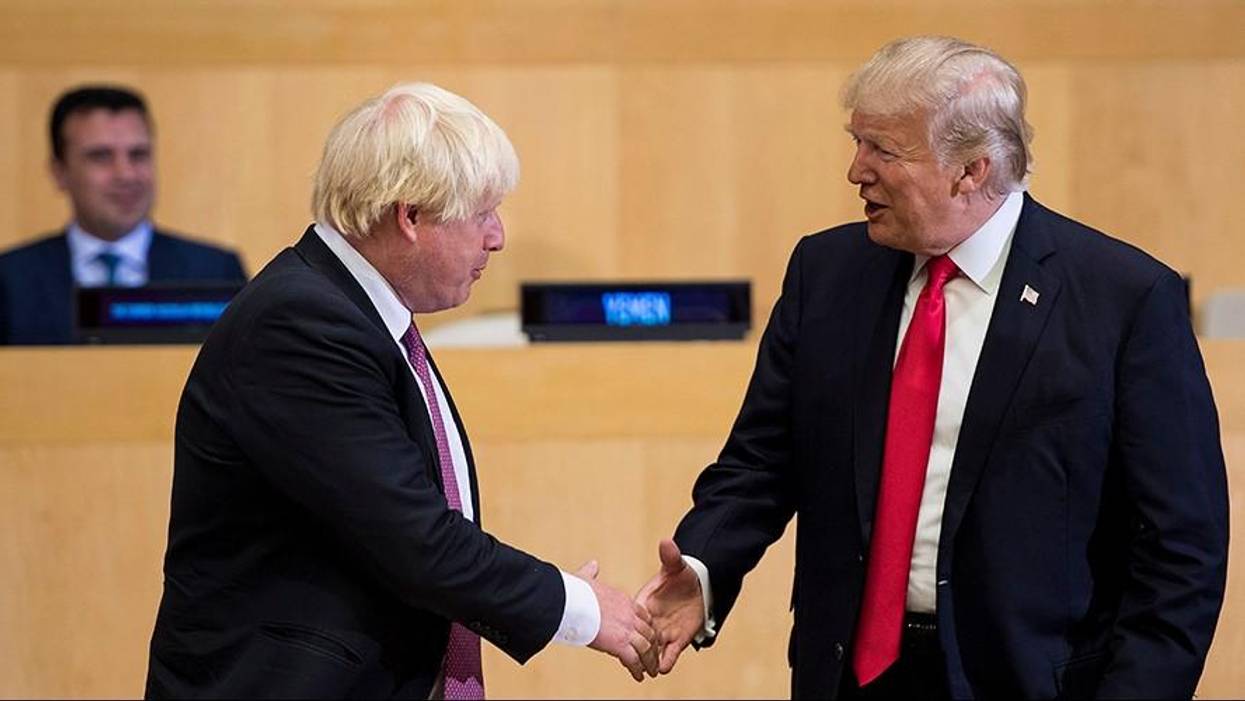
In the United Kingdom, Boris Johnson has ridden a Trump-esque wave of Brexit demagoguery into the prime minister's office--not through an election but by being chosen by the Conservative party after Theresa May stepped down. He, too, puts this pettiness on display.
The Guardian writer John Harris, citing Fintan O'Toole, thinks Johnson's appeal is "the spirit of punk, or something like it." Punk surely had its nihilists, its priests of the rude gesture, those who revelled in wearing swastikas just to shock. And Harris is right that part of the impetus for Brexit is "a collective set of desires akin to the punk-era urge to break things, along with a connected inability to channel resentment into anything more than gestures of self-harm."
But punk isn't the right term.
In fact, punk was the last gasp of the age of social democracy. Funded by the dole and educated on free art school in the United Kingdom and cheap Manhattan rents in the United States, it nevertheless screamed its frustration at what it saw as the curdled promise of the peace-and-love generation.
When punk itself curdled, it could be nothing but bratty, the demands of a spoiled child. Yet Boris Johnson and Donald Trump are anything but punks. They are the opposite of the downwardly mobile children of the working class who took aim at the institutions of power that Trump and Johnson revel in pretending to control.
The politics of petulance is for those who feel a loss looming but can't quite put their finger on what it is because they haven't really lost much of anything yet.
Their petulance is that of the underachieving rich kid who nevertheless manages to snatch power for himself and has only contempt for those who let him get there. They are, as Duncan Thomas noted, in over their heads, unlikely to produce any real solutions. They just hope that if they shout loudly enough, it will mask the obvious fact that they have no idea what they're doing.
And it's the middle class driving the politics of petulance. It's a politics for those who feel a loss looming but can't quite put their finger on what it is because they haven't really lost much of anything yet. They cannot envision what that change will look like, so instead they overstate the smallest of slights. A blue passport instead of a burgundy one, a plastic straw instead of a paper one.
But if the planet burns or chokes on plastic, it won't just be liberals who die. If the United Kingdom crashes out of the European Union without a deal, everyone will feel the consequences. Everyone, that is, except the people who caused the crisis in the first place. The rich will also feel the sting, but they feel it through the insulation of wealth, the princess feeling the pea through her stack of mattresses.
After three years of Trump, the petulance is the only thing his supporters--the ones who don't thirst for out-and-out blood--have left. The wall has not been built, the factories keep closing, and the coal mines are declaring bankruptcy without paying their workers.
Trump and Johnson will likely be fine, unless the crisis turns bad enough that the followers they placate with rallies of chest-beating bigotry turn on them. Right now, though, there are fifteen-packs of plastic straws. Buy something to express your rage, and all it will do is help destroy your own world a little bit faster.
As Johnny Rotten once asked, "Ever get the feeling you've been cheated?"
The standout moment in either of the first two Democratic primary debates was unquestionably the showdown between Kamala Harris and Joe Biden over school desegregation. Harris came prepared with her own story being bused to an integrated school as a young girl and attacked Biden over his fond recollections of being friendly with the vicious racist James Eastland.
Naturally, this has the Biden camp on the defensive. "We can be proud of her nonetheless, but her ambition got it wrong about Joe," former Sen. Carol Moseley Braun (D-Il.) told Politico. But this is an absolute crock -- on the contrary, Harris barely scratched the surface of Biden's awful civil rights record.
Let's start with "busing." As I have written before, the focus on busing per se as being the essence of school desegregation is wildly misleading. Buses are merely a way of moving children around; they were common under Jim Crow and they are common now after desegregation efforts have been largely abandoned. The real controversy was over jumbling up school district populations -- through boundary adjustments, transportation, or other means -- to mix black and white children and thus provide the former the same educational resources as the latter. (It's important to remember that educational equality was the main goal of desegregation, not simple rubbing shoulders between the races.) For a few years after the civil rights victories in the 1960s, there was enough consensus around the horror of Jim Crow that the political class widely agreed on desegregration.
But a huge fraction of white people both in and out of the South didn't want black kids anywhere near their own children, nor did they want to share school resources with black families, and so they ginned up excuses to obscure their real motivations. School integration was smeared as "forced busing," and stopping it a mere defense of "community schools" -- thus following the classic American tradition of portraying a change in government policy as the imposition of a new policy and racist whites the helpless victims of Dread Government Coercion.
After being elected in 1972, Biden quickly moved right on desegregation, capitalizing on and heightening this white backlash. In one speech, he called busing a "bankrupt concept," and suggested in an interview that "I think the Democratic Party could stand a liberal George Wallace." He sought support from outright white supremacists like James Eastland, Jesse Helms, Strom Thurmond, and James Allen to pass amendments banning federal funding for transport-based school integration. As late as 2007 he called busing a "liberal train wreck" in an autobiography.
Read full article here.

Over the past two decades, education reform has been a major topic of debate and policymaking, from President Bush's No Child Left Behind bill to President Obama's Race to the Top initiative. Reforms have generally followed the pattern of adapting mechanisms from the for-profit business world to "fix" supposedly broken aspects of the public education system: weakening teacher unions, replacing public schools with privately-run charters, tying teacher pay to test score results, and so on.
Yet there is one idea that was once a major focus of reform efforts, but has been set aside for years: racial desegregation.
That is, until now. Last week, Bernie Sanders released a plan to revitalize school integration efforts. It's both an excellent plan and brings attention to a vitally important racial justice issue.
Historical context is important here. For a couple decades after the civil rights legislation of the 1960s, the federal government put real effort into forcing school districts to integrate their populations. The main objective was to equalize educational opportunity, particularly in the South. Stuffing black populations into crummy, under-resourced institutions was one of the major mechanisms of the Jim Crow apartheid system -- but if white and black children went to the same schools, then they should receive education of a similar quality (or at least a lot closer than before).
Because cities across the nation were (and remain) extremely segregated, and whites violently resisted any attempt to integrate actual neighborhoods, the only realistic option was using transportation to achieve a decent demographic mix. But this led to an enormous white backlash across the country.
It turned out northern schools were just as segregated as southern ones, if not worse, and northern whites were not any keener on integration than southern ones -- indeed, an integration plan in Boston sparked violent riots. Centrist triangulators like then-Senator Joe Biden (D-Del.), seized on the issue, teaming up with southern segregationists to beat back integration efforts. (In 1977 Biden wrote to Dixiecrat Senator James Eastland of Missippi: "I want you to know that I very much appreciate your help during this week's committee meeting in attempting to bring my anti-busing legislation to a vote.")
It's key to understand that the rhetoric of the anti-integration backlash was total nonsense. Biden (along with infamous racists like George Wallace and Louise Day Hicks) called integration "forced busing," portraying it as a simple defense of the traditional neighborhood school.
In reality, as historian Matt Delmont writes in Why Busing Failed, busing has always been common in schools, and had been used as a key tool of segregation itself prior to the Civil Rights Movement. Indeed, the very plaintiff in Brown vs. Board of Education was a girl who was bused 20 miles to a black school when she lived just four blocks from a white one. Integration sometimes meant children being transported to a far-off school, but not always. Conversely, long-distance busing is still common today -- nobody complains when their kid gets a slot in a high-status, distant magnet school. What whites really objected to (then and now) was their children attending school with blacks. It's a simple as that.
The educational benefits of integration are large. One study found that "for blacks, school desegregation significantly increased both educational and occupational attainments, college quality and adult earnings, reduced the probability of incarceration, and improved adult health status; desegregation had no effects on whites across each of these outcomes."
Conversely, as this Tampa Bay Times investigation shows, when one Florida county got out from under a federal desegration order in 2007, they immediately re-segregated their schools -- warehousing most of their poor black population in five schools, and starving them of resources. They quickly plunged from average or above-average in quality to some of the worst in the entire state, with 95 percent of students failing reading or math.
So what would Sanders do? He would end the prohibition on funding desegregation transport (a relic from that 1970's backlash), provide several pots of money to encourage schools to desegregate, triple funding support for the poorest schools, expand funding for minority teacher education, ramp up desegregation orders, and provide more money for school construction and maintenance, (as well as several other policies not directly related to desegregation). It's an excellent start, to say the least.
A Biden spokesman, by contrast, told CNN that Biden stands by his segregationist record.
Other 2020 Democrats have so far largely avoided the topic. Only Julian Castro has offered a plan to combat school segregation, but only through integrating neighborhoods, which while a worthy goal (ideally, both should be done) would be both more difficult and take much longer.
Now, integration is not a panacea; a disproportionate number of African-American children still come from impoverished families or face other problems rooted in systemic racism. And the biggest overall problem with American education is certainly America's hideous income inequality, as household income is very closely correlated with educational achievement. But integration does prevent them from being stuffed into essentially fake schools where rich white elites can simply let them drown -- and it doesn't harm white children either.
It's also true that the federal government's power over the school system is not that great, as most power is still exercised locally. But a committed president could still achieve a lot, and more still with the support of Congress. School integration has been outside the main political discussion for a long time, and it's long since time we started talking about it again.
Bernie Sanders deserves enormous credit for bringing it back on the national radar and offering a meaningful plan to address it.
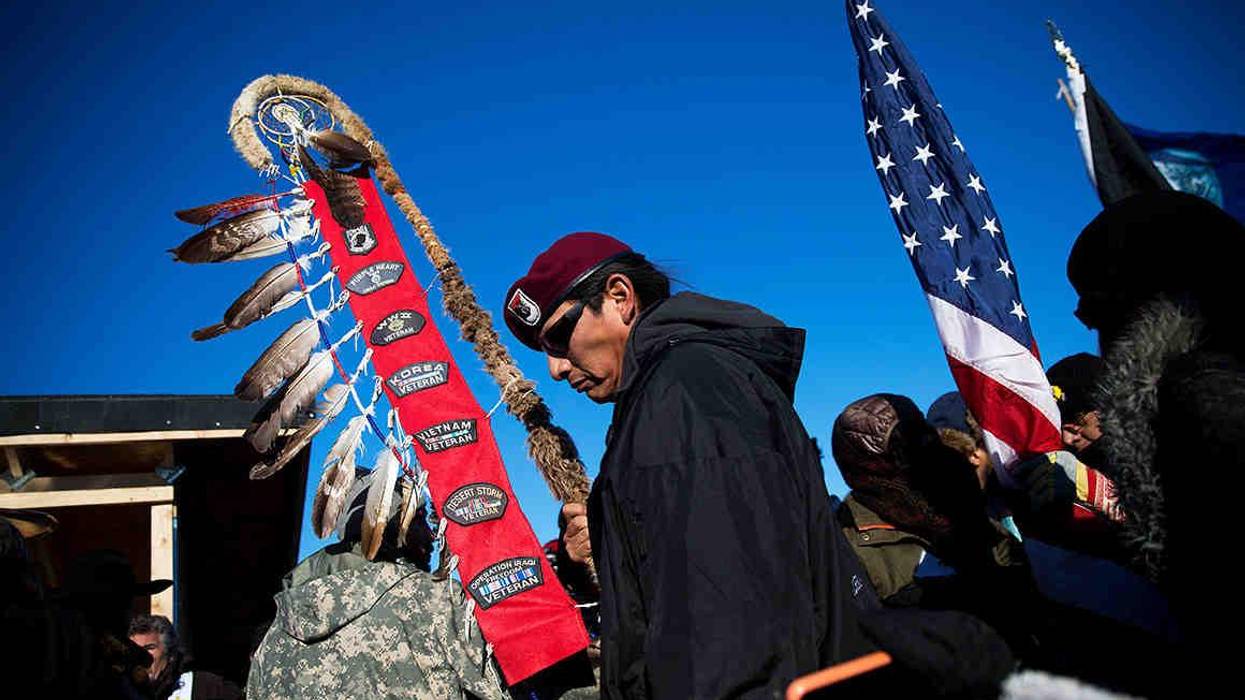
In this atmosphere, South Dakota enacted a new law last week, the Riot Boosting Act. The law seeks to suppress protests before they even start and prohibits people from engaging in full-throated advocacy. It does so by creating a new, ambiguous term: "riot boosting."
If you're wondering what that means, so is everyone else, including those who want to speak out. And that's a big problem.
The law joins two existing state criminal laws that also target such speech, meaning that advocacy could now result in up to 25 years of prison time, fines, or civil penalties -- or a combination of all three.
The new law gives the state the authority to sue individuals and organizations for "riot boosting," but it does not clearly describe what speech or conduct it considers to be "riot boosting." The law is written so broadly that even a tweet encouraging activists to "Join a protest to stop the pipeline and give it all you've got!" could be interpreted as "riot-boosting" should a fight break out at the protest. The law joins two existing state criminal laws that also target such speech, meaning that advocacy could now result in up to 25 years of prison time, fines, or civil penalties -- or a combination of all three.
Let's be very clear: States are within their rights to prohibit incitement of violence -- a narrow category of unprotected speech that refers to words intended and likely to cause imminent violence. But these laws go far beyond that by criminalizing impassioned advocacy that lies at the core of our political discourse. They instill a fear among peaceful organizers that their actions or words could be misconstrued by the government as "riot boosting." As a result, activists are now forced to think twice before even encouraging others to join a protest, let alone train, educate, or advise those who plan to protest. And, because of these laws, they may forgo such speech and association altogether.
That is a clear First Amendment violation--and why we are in court to challenge the laws on behalf of the Sierra Club, NDN Collective, Dakota Rural Action, and the Indigenous Environmental Network.
According to the state's website, the Riot Boosting Act is a result of Governor Kristi Noem's discussions with TransCanada--the company that is set to build and operate the Keystone XL pipeline--and other stakeholders. Notably, the state did not meet with Native American tribes or environmental groups.
This comes across loud and clear in the final law, which not only gives the state the authority to sue anti-pipeline groups and activists but also gives third-parties--including TransCanada--the ability to join in. Further, the money seized from protesters through these lawsuits can be used to fund the very thing they are protesting, thereby giving the company an added financial incentive to go after pipeline protesters.
If this attack on protest sounds eerily familiar, that's because it is.
In just the last two years, we've seen a rise in government efforts to stifle protests, particularly those led by Indigenous and environmental activists, often in opposition to pipelines. There have been attempts to equate protesters with domestic terrorists and saboteurs. Law enforcement authorities have partnered with private security companies to surveil activists and control protests. Known FBI informants have infiltrated activist spaces and camps. The federal government has implemented "no-fly zones" to black out media coverage during heightened police crackdowns.
And if Governor Noem's rhetoric on "shut[ting] down" "out-of-state people" who come into South Dakota to "slow and stop construction" of the pipeline sounds familiar, it should. It echoes government attempts throughout our history to justify anti-protest actions by delegitimizing protesters as "outside agitators."
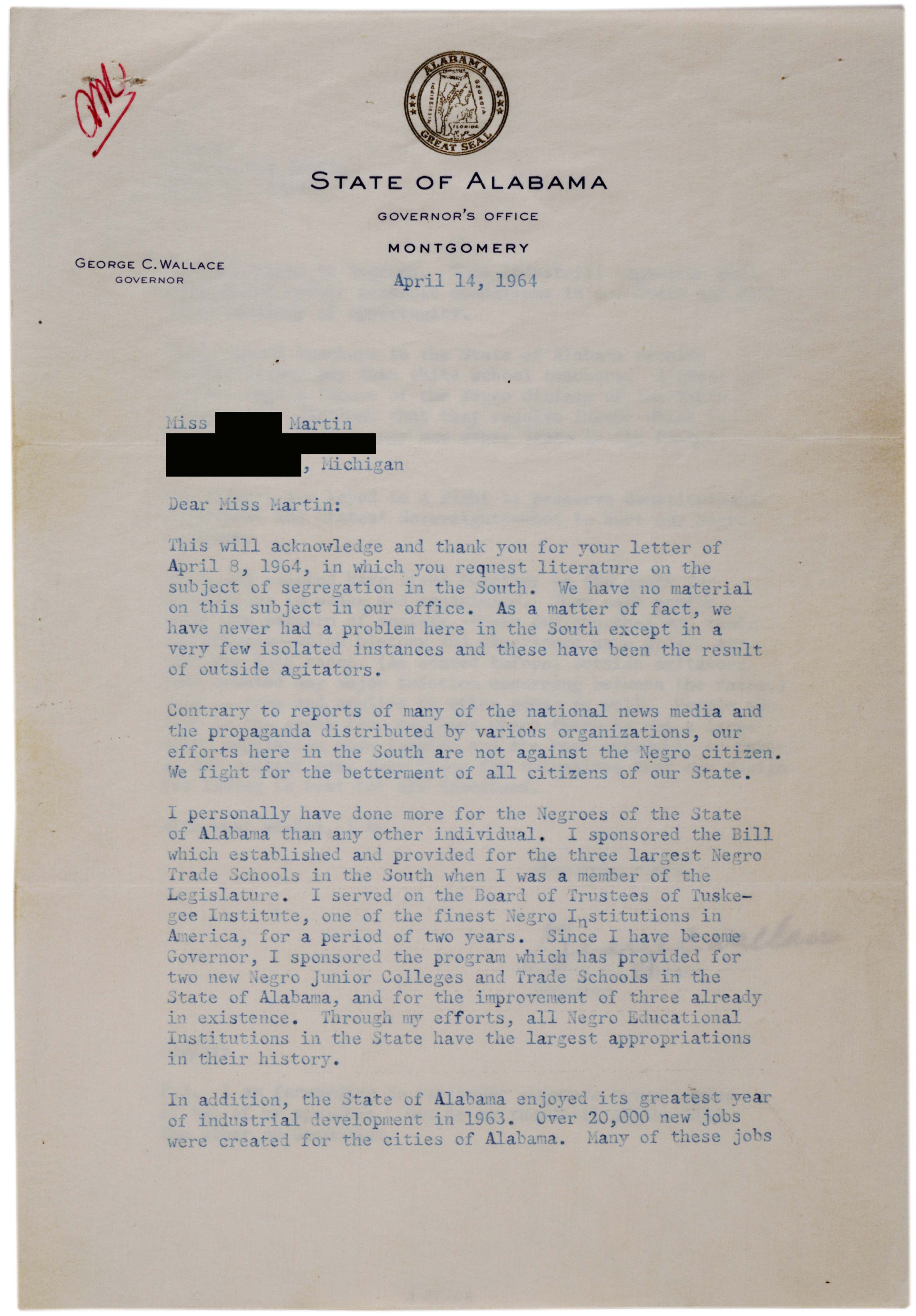
In 1964, infamous segregationist George Wallace said racial tensions did not exist in the South "except in a very few isolated instances" caused exclusively by "outside agitators." He was not alone in attempting to frame the civil rights movement in the South as the work of "outside agitators." Southern authorities frequently attempted to discount legitimate grievances and protests by Black people as nothing more than an attempt by radical outsiders to sow dissent. They even called Reverend Martin Luther King Jr. an "outside agitator."
More recently, in 2014, after the unrest in Ferguson, Missouri, the police blamed "outside agitators" for the majority of the unlawful activities. Not only were these claims later debunked in a scathing report by the Department of Justice, they also allowed the police to minimize the harmful impact of their own improper practices that caused the citizens of the city to protest in the first place.
What's happening in South Dakota is no different. The government has dismissed Native Americans, state farmers and ranchers, and residents of nearby states who opposed the pipeline as outside agitators. But the pipeline, if constructed, would have a substantial impact on all of their lives--including our clients, many of whom are South Dakotans. Moreover, the construction of the Keystone XL pipeline is a national issue, and it deserves a national debate.
Opposition to the construction of the pipeline may agitate Gov. Noem, but the First Amendment guarantees the right to voice that opposition. Those affected by the pipeline's construction deserve to be heard even if Gov. Noem and TransCanada want them all to shut up.
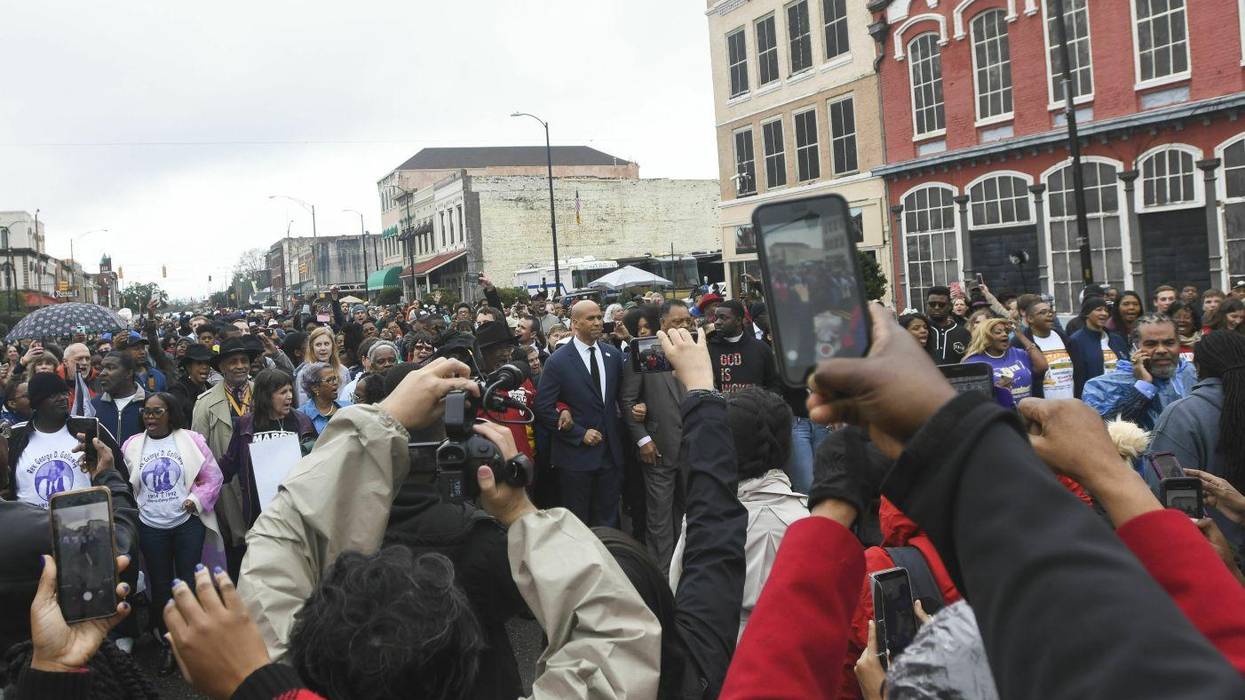
This past weekend, political leaders from across the country gathered in Selma, Alabama, to commemorate "Bloody Sunday," the 1965 march across the Edmund Pettus Bridge where peaceful demonstrators, attempting to cross the bridge, were violently driven back by Alabama State Troopers, Dallas County Sheriff's deputies and a horse-mounted posse wielding billy clubs and water hoses to savage the crowd.
The horrors played on TV sets across the country generated a national outrage that provided the final impetus for passage of the 1965 Voting Rights Act.
In many ways, Selma is the birthplace of modern democracy in America, helping to secure the right to vote for African Americans and the young, and for providing the foundation for future battles for equality, including the equal rights of women.
When former Alabama Gov. George Wallace was ill late in his life, I joined him for prayer. I asked him why he unleashed the troopers on the demonstrators in 1965. He said, "I did them a favor."
Wallace argued that the mob would have been much worse on the peaceful marchers. He never even considered that he might have used the troopers to protect them from the mob. That was a mentality that, as Dr. Martin Luther King taught, could only be challenged by nonviolent protest that demonstrated our humanity while demanding our rights.
Democrats should see Selma and rural America as both an obligation and an opportunity.
In the commemorative ceremonies this year, presidential candidates Sen. Bernie Sanders and Cory Booker, as well as Sen. Sherrod Brown and former Secretary of State Hillary Clinton were joined by many legislators and political leaders. They sensibly called on participants to rise up again to challenge the revival of systematic efforts to suppress the vote and to push back against the outrageous Supreme Court decision in Shelby v. Holder. This decision gutted enforcement provisions of the Voting Rights Act, and opened the floodgates to a wave of discriminatory state laws meant to keep people of color from exercising their right to vote.
There are laws that now require new forms of ID, voting districts have been gerrymandered and voter rolls purged. Laws now limit early voting and polling places have been closed or move without notice, and much, much more. The brave marchers in 1965 did their part for democracy, now it is up to us to defend it and extend it.
At the same time, while Selma is the birthplace of modern democracy, it is in danger of becoming a prop. Selma is the ninth poorest small town in America and 40 percent of its residents live in poverty. It exemplifies the rural and small-town America that has been left out of the recovery.
Democrats tend to see rural America as Trump country. Trump appealed to rural voters by stoking their fears and turning them against each other, but he has come up with no plan to help them. Trump offers only hate, not hope.
The new Democratic majority in the House is in many ways the fruit of the sacrifices made at Selma and elsewhere. Democrats should see Selma and rural America as both an obligation and an opportunity. What's needed is a comprehensive rural reconstruction plan, a modern version of what Franklin D. Roosevelt did when he built the Tennessee Valley Authority and modernized the Department of Agriculture, which literally electrified rural America.
Today, the Department of Agriculture has the authority and the capacity to invest in water and sewage systems, modernize utilities, provide broadband to underserved communities, offer zero interest loans to community centers and subsidize affordable housing. What we need is a plan and a budget to get this done. House Democrats should make this a priority.
Let's honor those who sacrificed so much by repealing voter suppression laws. But let us also make Selma the birthplace of a new economic justice in rural America. Selma should be more than a symbol of past struggles; it must also become a beacon for a new hope.

A young friend is seriously considering joining her state's National Guard. She's a world-class athlete, but also a working-class woman from a rural background competing in a rich person's sport. Between seasons, she works for a local farm and auctioneer to put together the money for equipment and travel.
Each season, raising the necessary money to compete is a touch-and-go proposition, so she's now talking to the National Guard. If, after basic training, she joins the Army's World Class Athletes Program as a reservist, her service will essentially consist of competing in her sport. She'll get an annual salary, health care, college tuition -- all to do what she loves and wants to do anyway. What could possibly go wrong?
Well, she could end up fighting in one of this country's forever wars.
That's what happened to thousands of National Guard troops and reservists when Washington discovered its all-volunteer forces were woefully inadequate for the project of occupying Iraq after the 2003 invasion. As then-Secretary of Defense Donald Rumsfeld famously explained, Washington went to war with the Army it had, "not the Army you might wish you have." So the National Guard filled in the gaps, supplying up to 41% of the troops deployed there by 2005. By 2011, more than 300,000 Guards had deployed to Iraq and Afghanistan as well.
Real Soldiers Fighting Real Wars
Members of the National Guard sign on to train one weekend a month and two weeks a year in return for some substantial rewards, including (at the moment) a possible $20,000 signing bonus. But what many of them don't realize is how likely it is that, somewhere along the line, they'll be deployed for a lot more than two weeks.
The National Guard isn't the only force whose members sign up for 12 weekends and two weeks a year. The regular armed forces also maintain reserves, soldiers who want to combine military service with civilian life. Unlike the National Guard, however, they answer only to federal, not to dual (state and federal), authority. Like the Guard, reservists can be deployed for much longer than a weekend. A photograph sent home from Iraq by a reservist classically summed up the situation encountered by both types of part-time soldiers, then and now. It shows a military vehicle with this sign displayed across the windshield: "One Weekend a Month, My Ass!"
In fact, as the Guard explains, its "343,000 Soldiers, 8 division headquarters, 27 brigade combat teams, 55 functional support brigades, 42 multifunctional brigades, 8 combat aviation brigades and 2 Special Forces groups" make it an integral part of the U.S. armed forces. Today, it operates 42% of all military aircraft and supplies 39% of the Army's operational forces -- essentially the same proportion it provided during the early years of the Iraq War.
For example, although President Obama officially ended Operation Enduring Freedom (the U.S.'s post-9/11 war in Afghanistan) in 2014, the Guard continues to deploy to that very war zone, with 400 Illinois reservists, another 400 from Wisconsin, 100 from Georgia, 50 from Colorado, and 46 from New York sent there as recently as this December and January. And not only are they being deployed to Afghanistan, but they're still dying there. Among the 60 sent from Utah in November 2018, for instance, was Brent Taylor, the mayor of the town of North Ogden, who was killed during an "insider attack" at a base in Kabul. Given the provisional peace agreement reportedly now being negotiated between the U.S. and the Taliban, there is at least a modest hope that the deployments of such part-time soldiers to America's longest war may end in some imaginable future.
As TomDispatch regular Nick Turse has observed, it's difficult to get specifics from the U.S. military about much of anything, whether it's foreign bases or deployment numbers. But it's clear that the Guard now goes everywhere the regular Army and Air Force go. Its members have served in U.S. conflicts in Syria, Yemen, and Libya, among other places. They are now deployed in at least 56 countries around the world, from Macedonia and Kosovo to Egypt, not to mention the Mexican border inside the U.S.
The Guard appreciates the special skills its members develop in civilian life, which is how the 50-year-old uncle of one of my students found himself deployed as a doctor in Iraq in 2005. Indeed, the soldiers who so infamously abused detainees at Iraq's Abu Ghraib prison back in 2004 also had special skills honed in their civilian jobs -- as prison guards. In fact, Specialist Charles Graner, the torturers' ringleader, wrote home at the time, "The Christian in me says it's wrong, but the corrections officer in me says, 'I love to make a grown man piss himself.'"
Protecting the Homeland
But wait! Aren't the National Guard the troops who rescue us from fires and floods, the ones who are called out when there's a natural disaster?
Indeed, they are mobilized for just that in times of peril, but responding to national disasters has never been the Guard's main purpose, although recruitment efforts often emphasize that role. Today's National Guard represents the evolution of the original state militias, created for military purposes -- fighting enemies from Indian nations on this continent to rebels in the Philippines. The National Guard Bureau's 2019 "posture statement" identifies "three core missions." None of these involve supporting elite athletes, but neither is there any mention of the Guard's well-known role in confronting fires or floods. Its stated core missions are "fighting America's wars, securing the homeland, and building enduring partnerships." Those "enduring partnerships" turn out to be arrangements with military forces in the 79 countries (just under a third of the world's nations) where the National Guard has "strategic state partnerships," or SSPs.
My friend tells me that the regular Army and Air Force look down on the Guard; they're not real soldiers in the eyes of the full-time military. Maybe that's why General Joseph Lengyel, the chief of the National Guard Bureau, whose photo and signature introduce that posture statement, is at pains to represent those forces not as the friendly folks in uniform who pull flooded-out Americans off their roofs, but as a full-on fighting force. In case there's any doubt, illustrated with drawings and photos of a multicultural array of rifle-toting men and women, it says clearly: "Fighting America's wars will always be the primary mission of the National Guard."
But what about that second core mission, "securing the homeland"? Could that be where its natural disaster work comes in? Not according to the posture statement, which puts it this way:
"The homeland is part of the global battle space. In the past, America benefited from its favorable geography with friendly neighbors to the north and south and large oceans to our east and west as natural barriers. Today, we no longer enjoy this safe haven as a result of new technologies and weapons that can reach the heart of America with little or no warning."
Touting its "dual-use nature and robust presence in 2,600 [U.S.] communities," the document assures its readers that the Guard is here -- in fact, just about everywhere -- to protect us from the "[p]roliferation of nuclear, biological, and chemical weapons, and high-yield explosive devices" that "has increased the threat of a weapons of mass destruction... attack on the United States."
In the spirit of being everywhere, it even dispatched 2,200 troops to the U.S.-Mexico border late last year, in response to President Trump's many election-time warnings about the approach of a caravan of desperate refugees and asylum-seekers from Central America. As far back as April 2018, Defense Secretary Jim Mattis authorized the deployment of up to 4,000 members of the National Guard, to stay there at least through August 2019 -- in addition to the regular Army troops whose initial 45-day deployment has already been extended twice. In fact, at the end of January, President Trump defended the expected deployment this month of yet another 3,500 regular troops "to stop the attempted Invasion of Illegals, through large Caravans, into our Country."
Working jointly with the U.S. Border Patrol, Guard members are not deployed to police the border directly, but engaged in a variety of activities including stringing concertina wire, reviewing intelligence, and flying helicopter surveillance missions.
Dual Use, Dual Authority?
Who commands the National Guard? That's a complicated question. Article 1, Section 8 of the Constitution recognized then-existing state militias and gave Congress the power to call them out "to execute the laws of the Union, suppress insurrections and repel invasions." From the beginning, those militias (which, with the passage of federal legislation in 1903, became the National Guard) were under the dual control of the federal and state governments. Congress was also given the power
"to provide for organizing, arming, and disciplining, the militia, and for governing such part of them as may be employed in the service of the United States, reserving to the states respectively, the appointment of the officers, and the authority of training the militia according to the discipline prescribed by Congress..."
Except when a state Guard has been "federalized" (called up by Congress or the president), each governor serves as the commander-in-chief of his or her state's units. When they are federalized, however, the president is their commander-in-chief.
The 1878 Posse Comitatus Act forbids the use of Army troops for law enforcement purposes inside the United States (except for suppressing insurrections). Federal legislation in 1956 expanded the Act to cover the Air Force, while Department of Defense regulations also forbid the use of the Navy and Marines (but not the Coast Guard) for domestic policing.
The National Guard, on the other hand, is under no such prohibition and so its troops have often been deployed in response to events inside this country. An illustration of the Guard's dual (and, in this case, dueling) command structure occurred in 1957, when nine black students attempted to integrate Central High School in Little Rock, Arkansas. Governor Orval Faubus called out the Arkansas Guard to "preserve the peace" by preventing the students from entering the school. In response, President Dwight Eisenhower federalized the same forces and ordered them (along with soldiers from the Army's 101st Airborne Division) to assist in the integration of Central High. (As the only "insurrection" in Little Rock then was the governor's rejection of the Supreme Court's 1954 Brown v. Board of Education decision declaring public school segregation unconstitutional, it's quite possible that the use of regular Army troops violated the Posse Comitatus Act.)
Eisenhower's successor, John F. Kennedy, sent the Guard to Birmingham to oversee the integration of the University of Alabama and that state's public schools (over the objections of then-Governor George Wallace). In 1967, both the National Guard and federal troops were sent to Detroit at the request of Mayor Jerome Cavanagh to put down an urban insurrection there.
After the murder of Martin Luther King, Jr., President Johnson again ordered units in to quell riots in Chicago, Baltimore, and my hometown, Washington, D.C. I remember coming down my front steps one evening in April 1968 to be met by a pale, uniformed boy of about 18, who sternly warned me not to walk around in my calm, leafy neighborhood, because of the danger posed by "those people" from downtown. I'm afraid I laughed at him. My mother was dating one of those people and that evening she was helping distribute food in those very downtown neighborhoods, where grocery stores were closed and a pall of smoke hung in the air.
From Protecting the Union to Busting Unions
President Richard Nixon sent the National Guard into New York City in 1970 to try to break a postal workers' strike. The Guardsmen may have been good soldiers, but they turned out to be less than efficient letter carriers, so the postal union got the raise it was demanding.
That strike was hardly the first time that the National Guard had been sent in to put down labor actions. Sadly, there's a long history in which it's acted on behalf of wealthy companies against striking workers. During an 1892 steelworkers' strike in Homestead, Pennsylvania, for instance, the governor brought in the state militia to dislodge strikers occupying a steel plant that belonged to the Carnegie Corporation and help break the strike.
In 1894, the Illinois National Guard had a hand in putting down a national strike by railroad workers organized by the American Railroad Union. In 1914, the National Guard fired machine guns into a tent city of striking miners and their families in Ludlow, Colorado, killing more than 20 people. The mining company belonged to John D. Rockefeller, Jr.
In more recent years, Guard members have been used less as violent strikebreakers than as scabs, replacing striking workers, especially in public-sector jobs. A 1982 study, for example, found that, over the previous decade, various units were called in 45 times to replace city or state employees, prison guards, mental health workers, community transit workers, and -- infamously -- under President Ronald Reagan, air traffic controllers.
In 2011, Wisconsin Governor Scott Walker threatened to bring in the National Guard if public service workers went on strike. The Green Bay Packers football team responded with this statement:
"As a publicly owned team we wouldn't have been able to win the Super Bowl without the support of our fans. It is the same dedication of our public workers every day that makes Wisconsin run. They are the teachers, nurses and child care workers who take care of us and our families. But now in an unprecedented political attack Governor Walker is trying to take away their right to have a voice and bargain at work.
"The right to negotiate wages and benefits is a fundamental underpinning of our middle class. When workers join together it serves as a check on corporate power and helps ALL workers by raising community standards."
Now that's solidarity. And lest you think states have given up using the Guard as strikebreakers, as recently as last September, Michigan Governor Rick Snyder threatened to bring them in when a heavy equipment engineers' strike delayed highway construction.
The National Guard in the Age of Trump
God help us all if Donald Trump figures out that he's actually the commander-in-chief of a force that, unlike the U.S. military, can legally be deployed for law enforcement purposes inside the United States itself. He remains a flailing, failing president, with the sensibility of an autocrat who, from the beginning of his time in office, has conflated the protection of the country with the protection of Donald J. Trump and his obsessions. While I don't expect him to call out the National Guard to put down anti-Trump demonstrations any time soon, I didn't expect him to be elected president either.
He's already sent the National Guard to the border to protect the country from a manufactured invasion threat. Once he gets the idea that the president can mobilize the Guard and send them anywhere, who knows how an increasingly embattled president might decide to use them?
My young friend was initially afraid to tell me that she was considering joining the National Guard. She knows what her "auntie" thinks about U.S. military interventions across the Greater Middle East and parts of Africa, not to mention the accompanying militarization of our world and culture here in the United States.
She doesn't, in fact, disagree with me about such matters, but she hopes that she can use the military without being completely used by it. I've told her I support whatever her decision may be. She needs the money for herself and her family -- and she's done her research. She's talked to more than 20 people who have joined the National Guard's World Class Athlete Program. She knows that her state Guard is not among those that have established strategic state partnerships with repressive governments in places like Honduras, Azerbaijan, or the Philippines. But she also knows, as she said to me, that "it's the military. They can do what they want with you."
I just hope that I never have to face her, or someone like her, across a barricade.

President Trump and the Republican Party have run the most racist national political campaign since the 1968 presidential bid of segregationist George Wallace. We shall soon see how much the country has changed in 50 years -- and in what direction.
I grew up in the South under Jim Crow, so I've seen and heard this garbage before. Trump claims that Democrat Stacey Abrams, who happens to be African American, is "not qualified" to be governor of Georgia because of her "past." What past? Her degrees from Spelman College, the University of Texas and Yale Law School? Her work as a tax attorney? Her service as minority leader of the Georgia state legislature?
In Florida, referring to another African American candidate, Trump has said that "Andrew Gillum is not equipped to be your governor. It's not for him." He has also, apropos of nothing, called Gillum "a stone-cold thief." Gillum has a degree from Florida A&M University and has been mayor of Tallahassee since 2014.
Trump chooses his attack words carefully. "Not qualified" and "not equipped" are of a piece with the "low-I.Q." jibe he uses when he tweets about Rep. Maxine Waters (D-Calif.) -- smarmy and unsubtle suggestions that these accomplished black Americans are intrinsically inferior to whites. Implying that Abrams has a shady past and that Gillum is a thief echoes the old segregationists' claim that black people simply cannot be trusted. Trump might as well have called the two candidates lazy and shiftless.
I understand that Trump is in a panic -- Gillum is slightly favored to defeat Republican Ron DeSantis, and Abrams has been running neck-and-neck with Republican Brian Kemp. For Democrats to win governorships in these two big, important Southern states would be an ominous sign for the future of the GOP, not to mention for Trump's reelection bid.
But I also understand that the president is blatantly encouraging his white supporters to buy into ugly, long-discredited racist stereotypes about African Americans. Even Wallace -- who stood in the schoolhouse door to try to prevent integration of the University of Alabama -- was less openly bigoted during his run for the White House.
Trump's racism toward Latinos is worse. And the Republican Party shamefully goes along without even a word of protest.
Last week, Trump tweeted a campaign spot that made the infamous Willie Horton ad look mild by comparison. It features an undocumented Mexican immigrant named Luis Bracamontes, who brazenly boasts of having slain two California police officers in 2014 and says he wishes he had killed more. "Democrats let him into our country," the ad states. "Democrats let him stay . . . Who else would Democrats let in?"
As The Post's "Fact Checker" column noted, the ad is a lie. Bracamontes came into the country illegally under both Republican and Democratic administrations -- and was deported under both Bill Clinton and George W. Bush. Nobody "let him into our country." Nobody "let him stay" -- not even the Republican prosecutor in Arizona who, at one point, decided to dismiss drug and weapons charges against him. Bracamontes is an evil individual who resides on death row.
But facts are never the point with Trump. The theme of the ad isn't law and order; it's immigration. Bracamontes is presented as the kind of person who will terrorize your neighborhood if you vote for Democrats -- one of the "bad hombres" who, in Trump's dystopian fantasy, have created an acute crisis along the border.
Trump began his presidential campaign by portraying Mexican immigrants as drug smugglers and rapists. He has ended the GOP's midterm campaign by pretending that a ragtag "caravan" of Central American asylum seekers -- still in southern Mexico, far from the Rio Grande -- poses such a threat that 15,000 combat-ready troops are needed to guard the border.
Except for Trump's short-lived policy of separating asylum-seeking parents from their children, the GOP has been content to go along with Trump's general program of demonizing Latino immigrants. Republicans know that illegal border crossings are far down from their peak; that undocumented immigrants are not responsible for any kind of crime wave; and that most asylum seekers who are provisionally admitted to the country dutifully report for their court hearings. But when Trump lies about all of this, Republicans just smile.
Trump encourages his base to hold and express racist views about African Americans. He encourages the crowds at his raucous rallies to see Latinos as predatory criminals. He stokes fear, anger and resentment toward minorities. Republicans who do not reject and condemn Trump's demagoguery are complicit in it and will share in history's judgment.