SUBSCRIBE TO OUR FREE NEWSLETTER
Daily news & progressive opinion—funded by the people, not the corporations—delivered straight to your inbox.
5
#000000
#FFFFFF
To donate by check, phone, or other method, see our More Ways to Give page.
Daily news & progressive opinion—funded by the people, not the corporations—delivered straight to your inbox.
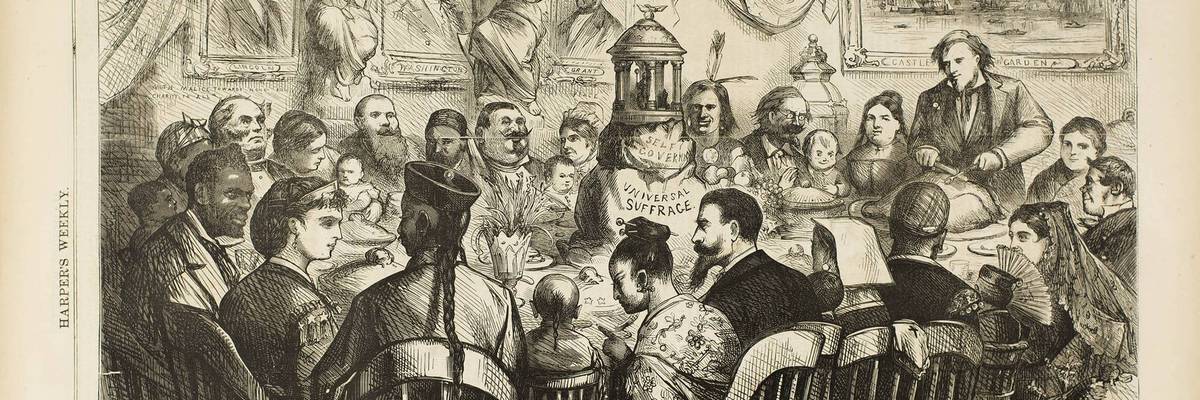
A Thanksgiving-themed cartoon, "Uncle Sam's Thanksgiving Dinner: Come One Come All Free and Equal," celebrates the passage of the 15th Amendment.
The first annual National Day of Thanksgiving was declared by Abraham Lincoln and held in 1863 in the midst of the Civil War. It's time to reclaim the emancipatory meaning of the holiday.
For more than a century, Americans have been taught that the annual Thanksgiving Day dinner on the fourth Thursday of every November commemorates a so-called “First Thanksgiving” of 1621 when 50 religious refugees from Great Britain and at least 90 of their Wampanoag hosts celebrated the group’s first harvest. That story is an historical fable invented to hide its anti-slavery and egalitarian origins long after the tradition had begun.
The first annual National Day of Thanksgiving was held in 1863 “in the midst of a civil war of unequaled magnitude and severity.” On October 3 of that year, President Abraham Lincoln declared the fourth Thursday of November a “day of thanksgiving and praise.” It was the second of three national Thanksgiving Day proclamations he would issue. On July 15, 1863, he had already become the first president since 1815, and only the third in the history of the office, to declare a day of “national thanksgiving, praise, and prayer,” asking Americans to set aside Thursday, August 6, to mark the recent victories of the Union army at Gettysburg in eastern Pennsylvania and Vicksburg on the Mississippi.
The reasons Lincoln felt compelled to proclaim two such days in quick succession are obscure, but the context of his decision is illuminating and underscores the holiday’s anti-slavery origins. There had been many state and local proclamations for a day of thanksgiving between 1815 and 1863, but none for a national and fixed day. However, Sarah Josepha Hale, the editor of the most widely read women’s magazine in the country, Godey’s Lady’s Book, had been campaigning since 1847 and the end of the US-Mexico War for a fixed Thanksgiving Day in every state and territory in the nation.
With the end of Reconstruction in 1877, however, and the resurgence of racist terror across the former Confederacy, as well as the rise of an explicitly elitist and white supremacist politics in the rest of the country, the egalitarian, anti-slavery and emancipationist origins of Thanksgiving became more and more untenable and a new origin story was required.
She did so in the hope that such a national celebration might foster a sense of national unity and counter the intense intersectional strife caused by the continued existence of slavery and its threatened expansion across the newly conquered Southwest. Addressing her plea to every governor in the union, she worked state by state and by 1859, had convinced 32 of them to declare the last Thursday of November as Thanksgiving Day.
Then came the election of Abraham Lincoln in 1860, which prompted seven pro-slavery states to secede and, a few days after his inauguration, the Confederate attack on the Union Fort Sumter in Charleston harbor, which started the civil war that Hale had so fervently hoped to avoid.
For their part, the Confederate states made no secret of the fact that they seceded from and then went to war against the Union to preserve and protect slavery. Explicit declarations to that effect were a feature of every secession declaration. For the first months of the war, the aims of the remaining United States were more diffuse until Lincoln finally issued his Emancipation Proclamation in September 1862. It declared that as of January 1, 1863, the Union would consider all the enslaved persons in the seceding states emancipated and would treat as free anyone that the Union army’s advance into the South liberated, as well as anyone who managed to find refuge behind its lines.
While the issue was thus joined, the fortunes of war at first favored the enslavers. Finally, the 1863 defeats of the Southern pro-slavery forces at Gettysburg and Vicksburg decisively checked the northern and western advance of the Confederacy—something to be thankful for, indeed—and from that point forward, the initiative lay with the Union and anti-slavery.
Looking back, the defeat of the enslavers now appears as only matter of time. But the future was far less clear to those actually involved the war. Among other things, Lincoln was up for reelection in 1864 and if an anti-war candidate were to win the presidency, they were likely to seek a peace with the secessionists that preserved slavery.
In that context, it makes perfect sense that Lincoln would see the advantage of supporting the call of the nation’s most widely read women’s magazine for a “great Union Festival of America” even though he had proclaimed such a day in honor of Gettysburg and Vicksburg two months before. How better to show the country that the Union was the party of peace and freedom and the Confederacy the party of war and slavery?
The third of Lincoln’s Thanksgiving Day proclamations, issued the next year in the midst of his reelection campaign for what he intended to be an annual event, spelled out his war aims explicitly. In it, he gave thanks for “many and signal victories over the enemy,” for a growing free population “augmented… by emancipation and immigration,” and for “minds and hearts” animated with “fortitude, courage, and resolution sufficient for the great trial of civil war into which we have been brought by our adherence as a nation to the cause of freedom and humanity.”
And thus began what has ever since been a National Day of Thanksgiving on the fourth (usually but not always the last) Thursday of November. Every year thereafter, president after president proclaimed the day, and through at least the 1890s each of them surely knew of its anti-slavery origins—for they had lived as adults through the civil war crisis and its aftermath.
With the end of Reconstruction in 1877, however, and the resurgence of racist terror across the former Confederacy, as well as the rise of an explicitly elitist and white supremacist politics in the rest of the country, the egalitarian, anti-slavery and emancipationist origins of Thanksgiving became more and more untenable and a new origin story was required. In response, genealogical societies, best-selling novelists, mass circulation magazines, and US history textbook authors ginned up the story of the Pilgrim “First Thanksgiving" to replace the true story of the holiday’s egalitarian and anti-slavery origins.
Beginning in the late 1880s and gathering steam as they went along, these groups launched several systematic campaigns to tout the racial superiority of white Anglo-Saxons and erase the emancipatory legacies of the Civil War. The new mythology provided a national origin story with which to “Americanize” the large numbers of new immigrants from Southern and Eastern Europe who were flooding the country from nations whose democratic traditions were more radical than White, Anglo-Saxon, Protestant gentility could stomach.
At the same time, erasing the anti-slavery and emancipatory aims of the Civil War aided the efforts of the rising faction of “Lily White” Republicans to win over Southern whites, especially after new restrictions on the rights of Black voters who were the party’s core base of support in the South. It also conveniently served the ideological requirements of Northern racists concerned to restrict the suffrage to those few believed to be racially suited for democratic government. Indeed, federal voter participation rates fell from around 80% in the aftermath of the Civil War to almost 50% after the rise of Jim Crow and anti-immigrant nativism.
A story for another time! For now, let us simply remember, as we gather together, the original egalitarian and anti-slavery meaning of the holiday.
Happy Thanksgiving!
This country and this world are at a monumental crossroads. US voters have an opportunity to beat back the forces of fascism and confront the billionaires who are rigging the economy, our media system, and our democracy, making it increasingly impossible for ordinary people to get by. We’re not just talking about the election. We’re talking about what must be done once these fascist elements are vanquished from power. We need a bolder set of solutions than what either major party has so far been willing to offer and a working-class movement ready to fight like hell for it. Trump didn't emerge from nowhere. The conditions that fueled MAGA authoritarianism were created by decades of radical neoliberal economic policies and a corrupt political system dominated by corporate interests. They slashed taxes on the super-rich, promising that the benefits would trickle down. They said giveaways to the corporate titans would make life more affordable for the rest of us. It was all bullshit. And when a bitter, betrayed populace searches for someone to blame, right-wing demagogues have little trouble finding scapegoats. People know when they're being lied to, but you won't hear any of this from the corporate media. Only independent journalism—powered and funded by people who believe in building a better world—can deliver truly trustworthy daily news. If you share our vision, please contribute whatever you can to sustain our work. |
Michael Merrill is an historian and research fellow with Rutgers LEARN. He was the dean of The Harry Van Arsdale Jr Center for Labor Studies at SUNY Empire from 2002-2016. He currently co-hosts a radio show, "Liberty and Justice for All," on KPFT Houston with Egberto Willies, which is archived on Substack and available on Spotify and other platforms.
For more than a century, Americans have been taught that the annual Thanksgiving Day dinner on the fourth Thursday of every November commemorates a so-called “First Thanksgiving” of 1621 when 50 religious refugees from Great Britain and at least 90 of their Wampanoag hosts celebrated the group’s first harvest. That story is an historical fable invented to hide its anti-slavery and egalitarian origins long after the tradition had begun.
The first annual National Day of Thanksgiving was held in 1863 “in the midst of a civil war of unequaled magnitude and severity.” On October 3 of that year, President Abraham Lincoln declared the fourth Thursday of November a “day of thanksgiving and praise.” It was the second of three national Thanksgiving Day proclamations he would issue. On July 15, 1863, he had already become the first president since 1815, and only the third in the history of the office, to declare a day of “national thanksgiving, praise, and prayer,” asking Americans to set aside Thursday, August 6, to mark the recent victories of the Union army at Gettysburg in eastern Pennsylvania and Vicksburg on the Mississippi.
The reasons Lincoln felt compelled to proclaim two such days in quick succession are obscure, but the context of his decision is illuminating and underscores the holiday’s anti-slavery origins. There had been many state and local proclamations for a day of thanksgiving between 1815 and 1863, but none for a national and fixed day. However, Sarah Josepha Hale, the editor of the most widely read women’s magazine in the country, Godey’s Lady’s Book, had been campaigning since 1847 and the end of the US-Mexico War for a fixed Thanksgiving Day in every state and territory in the nation.
With the end of Reconstruction in 1877, however, and the resurgence of racist terror across the former Confederacy, as well as the rise of an explicitly elitist and white supremacist politics in the rest of the country, the egalitarian, anti-slavery and emancipationist origins of Thanksgiving became more and more untenable and a new origin story was required.
She did so in the hope that such a national celebration might foster a sense of national unity and counter the intense intersectional strife caused by the continued existence of slavery and its threatened expansion across the newly conquered Southwest. Addressing her plea to every governor in the union, she worked state by state and by 1859, had convinced 32 of them to declare the last Thursday of November as Thanksgiving Day.
Then came the election of Abraham Lincoln in 1860, which prompted seven pro-slavery states to secede and, a few days after his inauguration, the Confederate attack on the Union Fort Sumter in Charleston harbor, which started the civil war that Hale had so fervently hoped to avoid.
For their part, the Confederate states made no secret of the fact that they seceded from and then went to war against the Union to preserve and protect slavery. Explicit declarations to that effect were a feature of every secession declaration. For the first months of the war, the aims of the remaining United States were more diffuse until Lincoln finally issued his Emancipation Proclamation in September 1862. It declared that as of January 1, 1863, the Union would consider all the enslaved persons in the seceding states emancipated and would treat as free anyone that the Union army’s advance into the South liberated, as well as anyone who managed to find refuge behind its lines.
While the issue was thus joined, the fortunes of war at first favored the enslavers. Finally, the 1863 defeats of the Southern pro-slavery forces at Gettysburg and Vicksburg decisively checked the northern and western advance of the Confederacy—something to be thankful for, indeed—and from that point forward, the initiative lay with the Union and anti-slavery.
Looking back, the defeat of the enslavers now appears as only matter of time. But the future was far less clear to those actually involved the war. Among other things, Lincoln was up for reelection in 1864 and if an anti-war candidate were to win the presidency, they were likely to seek a peace with the secessionists that preserved slavery.
In that context, it makes perfect sense that Lincoln would see the advantage of supporting the call of the nation’s most widely read women’s magazine for a “great Union Festival of America” even though he had proclaimed such a day in honor of Gettysburg and Vicksburg two months before. How better to show the country that the Union was the party of peace and freedom and the Confederacy the party of war and slavery?
The third of Lincoln’s Thanksgiving Day proclamations, issued the next year in the midst of his reelection campaign for what he intended to be an annual event, spelled out his war aims explicitly. In it, he gave thanks for “many and signal victories over the enemy,” for a growing free population “augmented… by emancipation and immigration,” and for “minds and hearts” animated with “fortitude, courage, and resolution sufficient for the great trial of civil war into which we have been brought by our adherence as a nation to the cause of freedom and humanity.”
And thus began what has ever since been a National Day of Thanksgiving on the fourth (usually but not always the last) Thursday of November. Every year thereafter, president after president proclaimed the day, and through at least the 1890s each of them surely knew of its anti-slavery origins—for they had lived as adults through the civil war crisis and its aftermath.
With the end of Reconstruction in 1877, however, and the resurgence of racist terror across the former Confederacy, as well as the rise of an explicitly elitist and white supremacist politics in the rest of the country, the egalitarian, anti-slavery and emancipationist origins of Thanksgiving became more and more untenable and a new origin story was required. In response, genealogical societies, best-selling novelists, mass circulation magazines, and US history textbook authors ginned up the story of the Pilgrim “First Thanksgiving" to replace the true story of the holiday’s egalitarian and anti-slavery origins.
Beginning in the late 1880s and gathering steam as they went along, these groups launched several systematic campaigns to tout the racial superiority of white Anglo-Saxons and erase the emancipatory legacies of the Civil War. The new mythology provided a national origin story with which to “Americanize” the large numbers of new immigrants from Southern and Eastern Europe who were flooding the country from nations whose democratic traditions were more radical than White, Anglo-Saxon, Protestant gentility could stomach.
At the same time, erasing the anti-slavery and emancipatory aims of the Civil War aided the efforts of the rising faction of “Lily White” Republicans to win over Southern whites, especially after new restrictions on the rights of Black voters who were the party’s core base of support in the South. It also conveniently served the ideological requirements of Northern racists concerned to restrict the suffrage to those few believed to be racially suited for democratic government. Indeed, federal voter participation rates fell from around 80% in the aftermath of the Civil War to almost 50% after the rise of Jim Crow and anti-immigrant nativism.
A story for another time! For now, let us simply remember, as we gather together, the original egalitarian and anti-slavery meaning of the holiday.
Happy Thanksgiving!